
Buccal Fat Removal and Your Smile: Avoiding an Overdone Look
AI Summary
- Buccal fat removal smile balance depends on conservative planning, not aggressive cheek hollowing.
- Safety starts with candidate selection based on cheek volume, facial structure, age, and smile movement.
- Recovery affects early judgement; swelling can hide final contour for weeks to months.
- Cost should stay secondary; choose personalised assessment over dramatic, overdone results.
Summary generated by AI, fact-checked by our medical experts
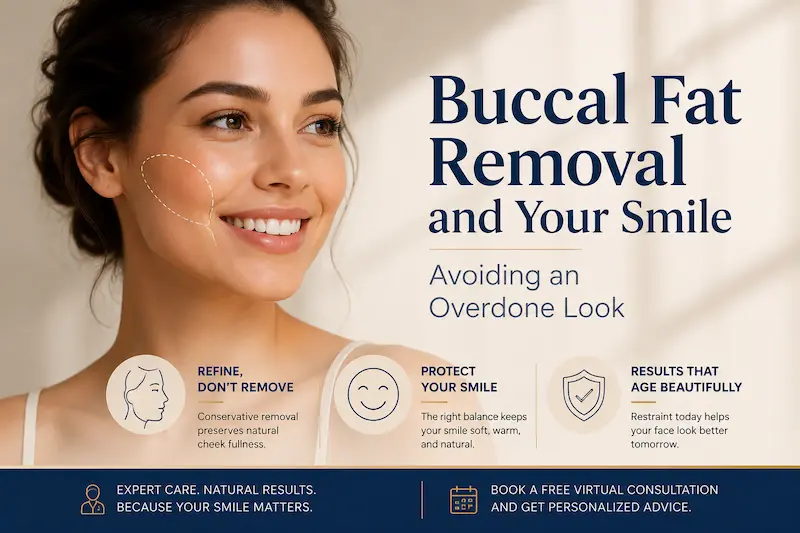
Buccal fat removal smile concerns are real because the buccal fat pad affects more than cheek fullness. It also changes how the mid-cheek moves and reads when you smile. A conservative approach can refine the lower face; aggressive removal can make the cheeks look hollow, tight, or overdone.
That is why the safest question is not “How much can be removed?” It is “How much should be left behind for my face to keep its natural movement, softness, and long-term balance?”
At AKM Clinic, how AKM approaches buccal fat removal is guided by a Natural-First philosophy: refinement without creating a pulled, carved-out, or operated-on appearance. For Canadian patients considering surgery abroad, this matters. You are not only choosing a procedure; you are choosing a judgement call.
This guide explains how buccal fat affects your smile, what an overdone result can look like, who carries a higher risk of overcorrection, and what to ask before deciding.
Table of Contents
How Buccal Fat Shapes Your Smile
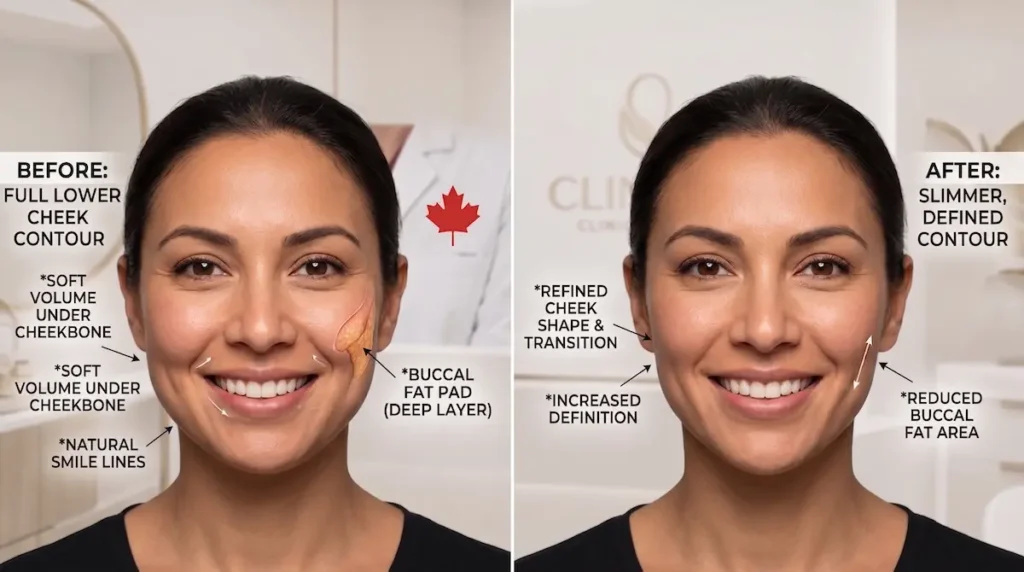
Buccal fat sits deep in the lower cheek, between facial muscles. It contributes to the soft roundness below the cheekbone and beside the mouth. When you smile, that area does not stay still. It shifts, compresses, and helps create the transition between the cheek, nasolabial fold, and corner of the mouth.
Removing part of the buccal fat pad can make the lower cheek appear slimmer. In the right face, that may create a cleaner cheek contour. In the wrong face, or when too much is removed, the same change can make a smile look sharper than intended.
Where the buccal fat pad sits
The buccal fat pad is not surface fat that can be pinched easily from the outside. It is a deeper facial fat compartment, positioned under the cheek and near muscles involved in chewing and expression. This is why it should be treated with restraint.
A surgeon is not simply “taking cheek fat out.” They are adjusting a structure that helps define the lower cheek from the inside. Small differences matter.
Johns Hopkins describes buccal fat removal as a procedure that removes fat from the lower cheek area to create a slimmer facial contour. That description is useful, but it leaves out the practical question patients care about most: how that slimmer contour looks when the face moves.
Its role in a full versus hollow cheek
A naturally full cheek has a gentle curve from the cheekbone down toward the mouth. A naturally hollow cheek has a more visible dip below the cheekbone. Neither is automatically better. The right look depends on your bone structure, skin thickness, age, facial width, and baseline volume.
Buccal fat removal works best when the lower cheek is genuinely full and the rest of the face has enough structure to support a slimmer contour. If the face is already narrow, a small reduction can look dramatic. If the cheekbone is flat or the jaw is not strongly defined, removing buccal fat may not create the “sculpted” result a patient imagines.
This is where overcorrection often starts: the goal is cheek definition, but the anatomy does not support aggressive hollowing.
What changes when you smile
A smile lifts and compresses the cheeks. If enough soft tissue remains, the smile still looks natural: the cheek rises, the skin folds normally, and the face keeps warmth. If too much volume is removed, the cheek can look hollow beside the mouth or overly sharp under the cheekbone.
Some patients notice this more in photos than in the mirror. A resting face may look defined, but a smiling face may look drawn. That difference is one reason surgeons assess both neutral and animated expressions before recommending buccal fat removal.
For a Canadian patient weighing medical travel, this is also a follow-up issue. Your surgeon should explain how your smile may look in the early swelling phase, after settling, and later as natural facial volume changes.
What “Overdone” Looks Like
An overdone buccal fat removal result is usually not about one single feature. It is the overall impression: cheeks that look too hollow for the rest of the face, smile lines that appear harsher, or a lower face that seems older rather than more defined.
The risk is not that buccal fat removal always damages the smile. It does not. The risk is that aggressive removal can remove the softness that made the smile look balanced in the first place.
The gaunt or sunken look
A gaunt result often appears as a visible dip under the cheekbone, especially beside the mouth. Instead of a natural contour, the cheek can look scooped out. In some faces, this creates a tired or undernourished appearance rather than a refined one.
This matters because facial attractiveness is not just about sharpness. It is about proportion. A cheek that looks elegant in one person may look severe in another.
The American Society of Plastic Surgeons has warned that facial fat is valuable and that surgeons should avoid being too aggressive with buccal fat removal. That warning fits this topic directly: once deep cheek volume is removed, restoring the exact same softness is not simple.
Why it shows more when smiling
When you smile, the cheek tissue bunches and lifts. If there is too little fullness left, the area beside the mouth can look tight or hollow. The smile may still function normally, but it may look less soft.
This is an aesthetic problem rather than a simple “movement problem.” Many people asking whether buccal fat removal can ruin the smile are not asking whether they will physically be able to smile. They are asking whether their smile will still look like them.
That is the right question. The best result should not erase your natural facial character.
Why it can worsen over time
Faces naturally lose volume with age. Cheeks that look sharply defined in the first year can appear more hollow later if too much buccal fat was removed or if the patient already had a lean facial structure.
This is why overcorrection and long-term ageing are connected, but not identical. This article focuses on the smile and overdone look; for the decade-long volume question, see how aggressive removal ages the face.
The core principle is simple: a result should look good in motion, not only in a still photo taken at one angle.
How Much Removal Is Safe?
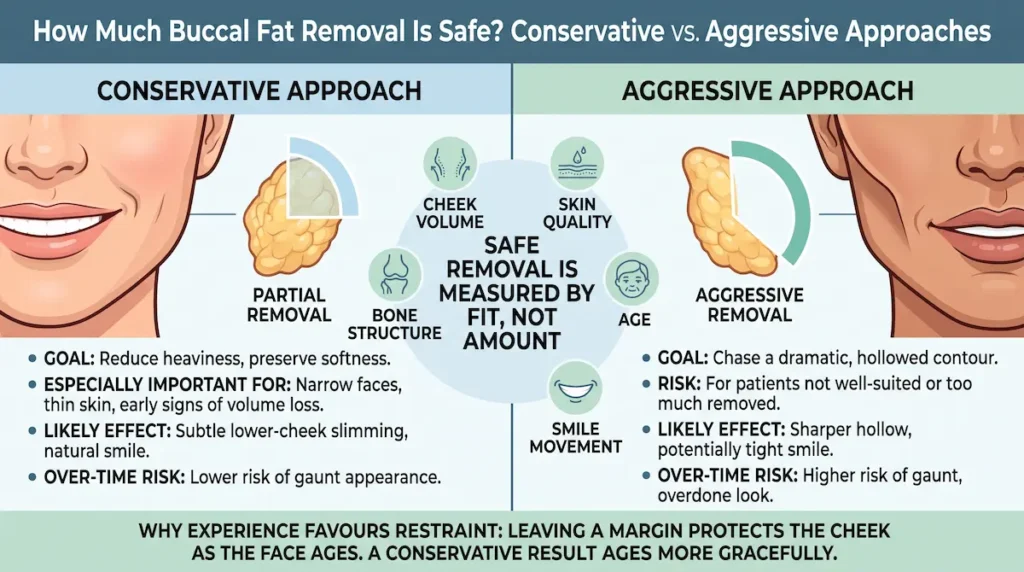
Safe buccal fat removal is not measured by a universal amount. It is measured by fit: your cheek volume, skin quality, bone structure, age, and how your smile moves. Two patients can have the same amount removed and look completely different afterward.
For that reason, a conservative plan is usually safer than an aggressive one. The goal is to reduce heaviness in the lower cheek while preserving enough softness for a natural smile.
Conservative versus aggressive resection
Conservative resection means removing only the amount needed to soften lower-cheek fullness. It does not chase a hollow cheek at all costs. This approach is especially important for patients with narrow faces, thin skin, or early signs of facial volume loss.
Aggressive resection removes too much of the buccal fat pad or removes it in a patient who was not a strong candidate to begin with. The short-term result may look dramatic. The long-term result may not be as forgiving.
This is why many experienced facial surgeons now speak more carefully about buccal fat removal than social media trends do. The most natural result often comes from doing less.
| Resection approach | Likely effect on smile and cheek | Over-time risk |
|---|---|---|
| Conservative partial removal | Subtle lower-cheek slimming while keeping softness when smiling | Lower risk when the patient is well selected |
| Moderate removal in a full face | More visible contour change, usually still balanced if cheek volume is adequate | Moderate risk; depends on age, skin quality, and bone support |
| Aggressive removal | Sharper hollow below the cheekbone; smile may look tighter or more drawn | Higher risk of gaunt cheeks and an overdone appearance |
| Removal in a naturally slim face | Can exaggerate hollowness even if only a modest amount is removed | High risk; often better to avoid or choose another strategy |
Why surgeons leave a margin
The buccal fat pad is part of the face’s natural volume reserve. Leaving a margin protects the cheek as the face changes over time. It also helps prevent a smile that looks too hollow beside the mouth.
This is not about being timid. It is about planning for a living face. Your cheeks move, swell, settle, and age. A result that looks slightly conservative at first can age more gracefully than one that looks sharply carved right away.
With buccal fat, restraint is not a compromise. It is often the reason the smile still looks natural years later.
Partial removal philosophy
Partial removal is based on the idea that buccal fat should be reduced, not erased. The surgeon evaluates how much fullness is truly caused by the buccal pad and how much comes from other factors such as facial width, masseter prominence, skin thickness, or overall body weight.
This matters because buccal fat removal cannot replace jawline surgery, weight change, skin tightening, or cheekbone augmentation. If the concern is not actually caused by buccal fat, removing more fat will not solve the problem. It may simply create a new one.
For Canadian patients travelling for treatment, this is a key consultation point. Ask whether your surgeon plans full removal or partial reduction, and ask how they judge the stopping point.
Note for Canadian patients: A careful plan should be based on surgeon training, facial assessment, and follow-up documentation. AKM uses European Board certification as its credential standard; it is comparable to RCPSC standards, but it is not RCPSC certification.
Who’s at Higher Risk of Overcorrection?
Not every patient has the same risk of an overdone result. Some faces tolerate buccal fat reduction well. Others rely on that same fat pad for softness, balance, and a natural smile.
The highest-risk patients are often the ones who ask for the most dramatic change. That does not make their goals wrong. It means the consultation needs to be honest.
Already slim or narrow faces
If your face is already narrow, removing buccal fat can make the lower cheek look too empty. This is especially true if your cheekbones are not naturally prominent or if your jawline is not strong enough to balance the new hollow.
A slim face may look more sculpted in a filtered photo, but real life is less controlled. Different lighting, smiling, talking, and natural facial movement can make hollowness more visible.
Patients with naturally slim cheeks should be cautious about using buccal fat removal to create definition. Definition may need to come from another area of the face, not from subtracting cheek volume.
Older patients or early facial volume loss
Facial volume decreases with age. This can show as flatter cheeks, deeper folds, or more visible hollows under the cheekbone. Removing buccal fat in someone who is already beginning that process can accelerate the appearance of facial thinning.
This does not mean buccal fat removal is only for very young patients. Age alone is not the deciding factor. Facial structure is.
A patient in their 30s or 40s with a full lower cheek and strong facial support may still be a candidate. A younger patient with a naturally lean face may not be. The mirror matters more than the birthday.
Unrealistic “chiseled” goals
The word “chiseled” can be misleading. In a photo, it may mean shadow under the cheekbone. In surgery, chasing that shadow too aggressively can remove the volume that keeps the smile approachable.
A good consultation should separate inspiration from anatomy. Bringing reference photos is useful, but the surgeon should explain which parts of the look are realistic for your face and which parts depend on lighting, makeup, weight, filters, or bone structure.
This is also where male and female goals can differ. Men often ask for sharper lower-face definition, but the same overcorrection risk still applies. For a deeper look at that segment, read about conservative resection in men.
The safest plan is the one that protects facial identity. You should still look like yourself when you smile.

Protecting Your Result
Protecting your result starts before surgery. The consultation should test the goal, not simply agree with it. A careful surgeon should look at your resting face, your smile, your cheekbone support, your facial width, and your age-related volume pattern before recommending buccal fat removal.
The safest outcome is not the most dramatic one. It is the one that still looks balanced when you smile, speak, laugh, and age.
Choosing a conservative surgeon
A conservative surgeon will not treat every full cheek the same way. They will ask whether the fullness is truly from the buccal fat pad, whether removing it will improve facial proportion, and whether your future face can tolerate the loss of that volume.
This is especially important in medical travel. Canadian patients should leave the consultation with a clear written plan: what is being removed, what is being preserved, how early swelling may affect the look, and how follow-up will be handled once they return home.
For a useful outside benchmark, the ASPS article on why surgeons warn against aggressive buccal removal reinforces the same principle: facial fat should not be treated as disposable. Johns Hopkins also provides an overview of how buccal fat removal works, including the basic candidacy framework.
What to ask in consultation
Good questions make overcorrection less likely. Do not ask only whether you are a candidate. Ask what makes you a candidate, what makes you borderline, and what would make the surgeon advise against the procedure.
- Do I have true buccal fullness, or is my concern caused by another part of my face?
- Would you recommend partial removal rather than aggressive removal?
- How will my smile look once swelling settles?
- Do I have a higher risk of gaunt cheeks later?
- What should I expect during healing and follow-up after returning to Canada?
- What documentation will I receive for my records at home?
These questions are not overly cautious. They are appropriate. Buccal fat removal is a small procedure in terms of incision size, but it has a visible effect on facial balance.
Cost can be part of planning, but it should not drive the surgical decision. This article does not cover pricing; Canadian patients can review the cost of buccal fat removal separately without mixing price with the safety question.
Recovery and settling
Early swelling can temporarily hide the final contour. In the first weeks, the cheeks may look puffy, uneven, or less defined than expected. That does not mean the final result has failed.
As swelling settles, the cheek contour becomes clearer. This is also when over-resection, if it has occurred, may become more noticeable. That is why follow-up photos and scheduled check-ins matter.
For the healing timeline itself, see the recovery section of our buccal fat removal page rather than trying to judge the final smile too early. If you are considering multiple facial procedures, it can also help to read about lip lift surgery, another procedure that reshapes the smile area, because the mouth, cheek, and upper lip are visually connected.
Canadian follow-up note: Before travelling, ask how your surgical plan, operative note, medication instructions, and follow-up schedule will be shared with you. A good medical tourism plan should not end when you board the flight home.
If you are worried about an overdone look, that is not a reason to avoid asking about buccal fat removal. It is a reason to choose a surgeon who is comfortable saying “less,” “not yet,” or “not for your face.”
Book a free virtual consultation with AKM Clinic to discuss whether conservative buccal fat removal can refine your lower cheek while protecting your natural smile.
Frequently Asked Questions: Buccal Fat Removal Smile
These questions focus on the smile and overcorrection risk. They do not replace a personal assessment, because the safest answer depends on your facial anatomy, age, and baseline cheek volume.
Can buccal fat removal ruin your smile?
How much buccal fat is too much?
Can overcorrection be reversed?
Will I look gaunt later?
Am I a high-risk candidate?
How do I avoid an overdone look?
Does buccal fat removal affect men and women differently?
When should I judge my final smile?
Medical disclaimer: This article is for educational purposes only and is not a substitute for medical advice, diagnosis, or treatment. Results vary by anatomy, age, skin quality, healing response, and surgical plan. Always consult a qualified surgeon before deciding on any cosmetic procedure.
Related Procedures


Ready to Begin Your Journey?
Join the more than 2,000 patients who have trusted Dr. Akif Mehmetoğlu and the AKM Clinic team. Your journey begins with an informative, no-obligation conversation. Contact us today from across Canada to schedule your complimentary virtual consultation.
#1: Receive Your Personalized Quote
Start with a complimentary, no-obligation virtual consultation. Share your photos, and our surgical team will provide a fully personalized treatment plan and a transparent, all-inclusive pricing package quoted in Canadian dollars (CAD). There are no hidden fees.
#2: Secure Your Procedure Date
Once you are ready to proceed, our dedicated English-speaking patient coordinators will help you secure your procedure date. We will manage your logistical bookings in Istanbul, including your five-star hotel and private airport transfers.
#3: Arrive in Istanbul & Meet Your Surgeon
Arrive at Istanbul Airport (IST), where you will be greeted by your private driver. Settle into your hotel before your comprehensive in-person consultation. You will meet your specialist surgeon to finalize the details of your procedure and ensure your goals are aligned for a natural, subtle result.