
Buccal Fat Removal for Men: What's Different and Who It Suits
AI Summary
- Buccal fat removal for men suits fuller lower cheeks, stable weight and balanced facial structure.
- Conservative planning defines masculine cheeks without creating a gaunt or prematurely aged look.
- Safety-focused assessment helps lean, hollow or changing faces avoid over-resection.
- Recovery and CAD costs should be reviewed through personalised consultation and dedicated AKM guidance.
Summary generated by AI, fact-checked by our medical experts
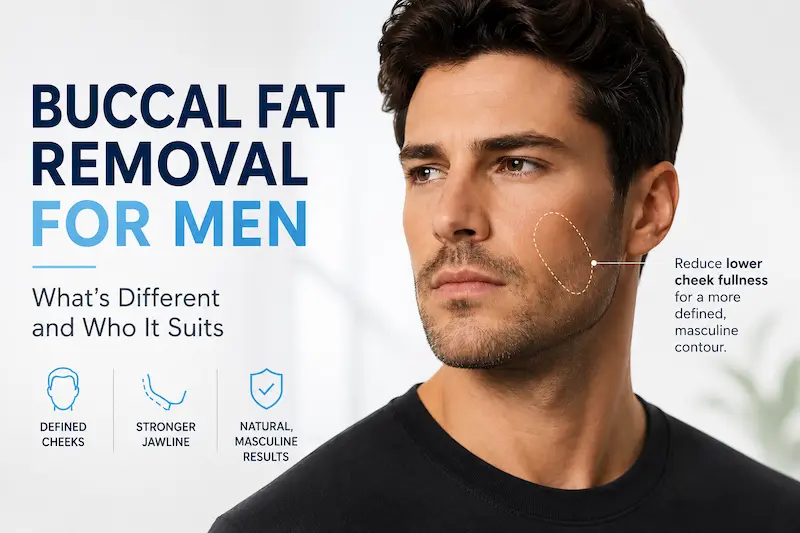
Buccal fat removal for men can create a more defined lower-cheek contour, but the best male results are usually conservative. The goal is not to hollow the face. It is to reduce excess cheek fullness while preserving enough facial volume for a masculine, natural-looking result as the face ages.
For many men, the appeal is simple: less roundness in the lower cheeks, more visible cheekbone structure, and a sharper transition into the jawline. But male facial contouring is not just about removing fat. Bone structure, skin thickness, beard pattern, weight stability, and the natural ageing pattern of the face all matter.
That is why how buccal fat removal works at AKM is planned around facial structure rather than a one-size-fits-all “chiseled” look. A good result should make the face look more balanced, not surgically thinned.
This guide explains what is different about male buccal fat removal, who tends to suit it, who should be cautious, and what Canadian patients should ask before deciding.
Table of Contents
How Male Facial Fat Differs
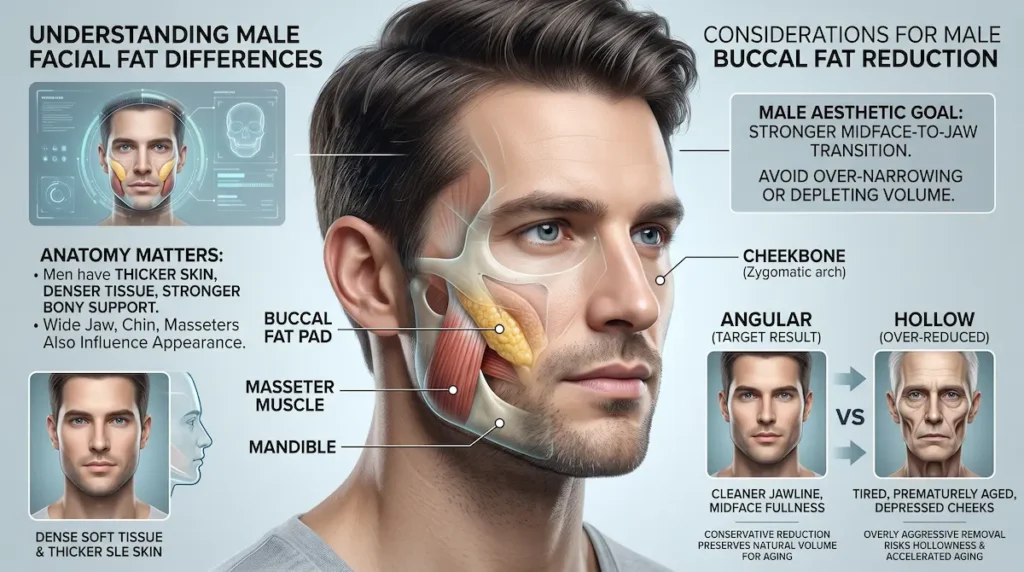
Men and women can both have prominent buccal fat pads, but the aesthetic target is usually different. In male patients, the aim is often a stronger-looking midface-to-jaw transition, not a delicate or overly narrowed cheek. This is where anatomy matters. The buccal fat pad sits deep in the lower cheek, and reducing it can change how much fullness appears beneath the cheekbone.
Johns Hopkins describes buccal fat removal as a procedure that removes lower-cheek fat pads to create a slimmer facial appearance, but candidacy depends on the individual face, not the trend. A naturally narrow face can look too hollow if too much volume is removed. That warning is especially relevant for men who already have a lean face or strong cheekbone shadowing.
Male fat distribution and bone structure
Many men have thicker skin, denser soft tissue, and stronger bony support around the jaw and brow. Some also carry more fullness in the lower face even when their body weight is stable. In those cases, the buccal fat pad can soften the cheek-to-jaw transition and make the face look rounder than the rest of the body suggests.
But buccal fat is only one part of male facial shape. A wide mandible, chin projection, masseter size, neck fullness, and submental fat can all affect the way the jawline reads. Removing buccal fat will not build a jaw. It can only reduce one pocket of cheek volume.
That distinction prevents a common mistake: blaming every “soft jawline” on buccal fat. Some men need chin or jaw assessment, weight stability, or neck contour evaluation before buccal fat removal is even considered.
What defines a masculine lower face
A masculine lower face usually has structure without looking depleted. The cheekbone-to-jawline transition may be sharper, but the midface still needs enough volume to look healthy. Too much hollowness can make the face look tired, older, or drawn.
For male patients, the best result is often subtle in still photos but noticeable in proportions. The lower cheek looks less padded. The cheekbone casts a cleaner shadow. The jawline appears more defined because the cheek no longer blends into it as heavily.
It should not look like a scoop has been taken from the face. That is the line between angular and hollow.
Angular versus hollow
Angular means the face has clearer planes: cheekbone, lower cheek, jaw. Hollow means the soft tissue looks underfilled, especially when smiling, talking, or losing weight. One can look athletic. The other can look prematurely aged.
This difference matters because male faces often age by losing midface and cheek volume over time. A conservative reduction may age well; an aggressive one may not. ASPS has specifically warned that facial fat is valuable and that overly aggressive buccal fat removal can backfire as natural facial fat decreases with age.
Clinical perspective: In male buccal fat removal, restraint is not a compromise. It is often the thing that keeps the result masculine, natural, and wearable over the next decade.
What “Masculine Definition” Realistically Means
Masculine definition is not the same as maximum fat removal. This section is important because many men arrive with a goal image that shows lighting, low body fat, facial hair, jaw projection, and sometimes editing. Buccal fat removal can support definition, but it cannot recreate every feature in that image.
The most realistic expectation is a leaner lower cheek, not a new bone structure. If the face is already slim, the procedure may create more risk than benefit. If the lower cheek is genuinely full and the rest of the face is balanced, a conservative reduction may help the cheekbone and jawline appear better separated.
The look men usually want
Most male patients are not asking for a dramatic cheek hollow. They want the face to look less rounded in photos, less “baby-faced,” or less heavy in the lower cheek. They may notice that even at a healthy weight, the lower cheeks stay full.
That is the scenario where buccal fat removal may be worth discussing. The goal is a cleaner contour, not a severe shadow. A good male result should still look like the same person—just with less lower-cheek softness.
Facial hair can also change the way results appear. A beard may visually strengthen the jawline, while clean-shaven skin may reveal cheek hollowing more clearly. Planning should account for both.
What buccal fat removal can and cannot do
Buccal fat removal can reduce fullness in the lower cheek area. It can make the cheekbone-to-jaw transition look more visible. It may help a round face look less padded when the fullness is specifically coming from the buccal fat pad.
It cannot tighten loose skin, move the jaw forward, reduce neck fat, correct bite structure, or guarantee a model-like jawline. It also cannot be treated as a shortcut for weight loss. If weight is changing, the result becomes harder to predict.
For men comparing facial contour options, this is where a full-face assessment matters. Sometimes the right answer is buccal fat removal. Sometimes it is not.
Jaw versus cheek contribution
A stronger jawline can come from several different visual cues. The chin may project well. The mandibular angle may be naturally wide. The neck may be lean. The cheek may have enough contrast to make the lower face look structured.
Buccal fat removal works only on the cheek side of that equation. If the jaw itself is small or the neck is full, removing buccal fat may not create the effect the patient expects. It may simply make the midface look thinner while the jawline remains unchanged.
That is why the consultation should separate “I want a stronger jaw” from “I have excess lower-cheek fullness.” They are related, but they are not the same.
Men who are specifically worried about expression, cheek movement, or an overdone look should also review how it affects your smile before deciding.
Who Is a Good Male Candidate?
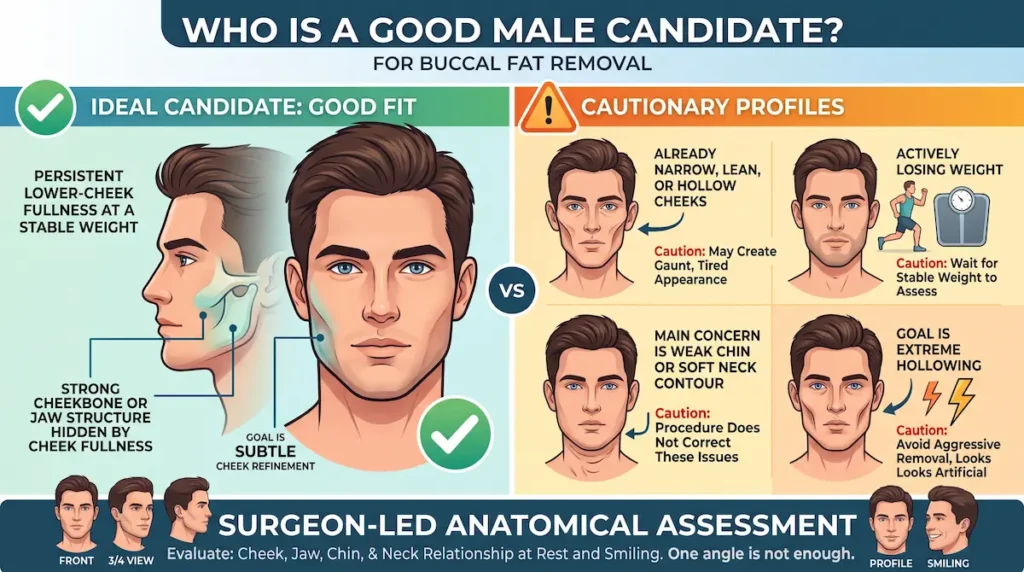
A good male candidate is not simply someone who wants sharper cheeks. The best fit is a man whose lower-cheek fullness is out of proportion with the rest of his face, whose weight is stable, and whose goal is realistic refinement rather than dramatic hollowing.
This is also where a conservative surgeon-led assessment matters. The face should be evaluated at rest, while smiling, from the front, from three-quarter view, and in relation to the jaw, chin, and neck. One angle is not enough.
Fuller lower cheeks on a balanced face
The strongest candidate usually has persistent fullness in the lower cheeks despite being at a stable, healthy weight. His face may look rounded in photos even when his body is lean. The fullness sits below the cheekbone and above the jawline, creating a padded transition.
In this profile, partial buccal fat removal may help reveal existing structure. The key word is existing. The procedure works best when there is bone structure underneath that can be revealed, not when the face needs volume, projection, or skin tightening.
A balanced face also matters. If the temples, under-eyes, and midface are already hollow, reducing the lower cheek may make the face look less healthy. A face can be full in one zone and depleted in another. That is why the assessment should be anatomical, not trend-driven.
Stable weight
Weight stability is important because buccal fat removal is a contouring procedure, not a weight-loss treatment. If a man is actively losing weight, the lower cheeks may naturally slim further over the next few months. Removing buccal fat too early can overcorrect the result.
The reverse can also happen. If weight gain occurs after surgery, other areas of the face may become fuller while the buccal zone remains reduced. That can make the contour less predictable.
For most men, it is better to reach a stable, maintainable weight first. Then the surgeon can judge whether the cheek fullness is truly buccal fat, general facial fat, muscle bulk, or simply normal male facial volume.
Realistic goals
Realistic goals are just as important as anatomy. A good candidate understands that buccal fat removal may make the lower cheek look less full, but it will not create a new jawbone, a stronger chin, or a different facial identity.
The best goals sound specific and modest: “I want my lower cheeks to look less round,” or “I want better separation between my cheek and jaw.” Riskier goals sound extreme: “I want my face as hollow as possible,” or “I want a completely different jawline.”
That difference changes the surgical plan. Conservative removal can refine. Aggressive removal can age the face.
| Male candidate signal | Good fit or caution? | Why it matters |
|---|---|---|
| Persistent lower-cheek fullness at a stable weight | Good fit | The fullness may be coming from the buccal fat pad rather than temporary weight fluctuation. |
| Strong cheekbone or jaw structure hidden by cheek fullness | Good fit | Reducing lower-cheek volume may reveal structure that already exists. |
| Already narrow, lean, or hollow cheeks | Caution | Removing more volume can create a gaunt or tired appearance, especially over time. |
| Actively losing weight | Caution | The face may continue slimming naturally, making early surgery harder to judge. |
| Main concern is weak chin or soft neck contour | Caution | Buccal fat removal does not correct chin projection, neck fullness, or jaw structure. |
| Goal is subtle cheek refinement | Good fit | Conservative goals match the safest and most natural male result pattern. |
| Goal is extreme hollowing | Caution | Over-resection can look artificial and may become more noticeable with age. |
Who Should Skip It — Over-Resection Risk
Some men are not good candidates, even if they like the idea of a sharper cheek contour. This section matters because the main risk in male buccal fat removal is not “no change.” It is taking a face that already has enough definition and removing volume that it may need later.
The buccal fat pad is not a mistake in the face. It is normal anatomy. In the wrong patient, removing it can make the face look older, flatter, or less athletic rather than more defined.
Already lean or narrow faces
Men with naturally narrow faces should be careful. If the cheekbones are already visible and the lower cheek is not truly full, buccal fat removal may create a hollow that looks sharper at first but harsher later.
This is especially true for men with low body fat, strong cheekbone shadows, thin skin, or naturally long faces. A small amount of removed volume can be more visible on these faces than on rounder, fuller ones.
In consultation, the surgeon should check whether the face needs reduction or preservation. Sometimes the more masculine choice is not to remove fat at all.
Why men age into hollowing
Faces naturally lose volume with age. This does not happen evenly. The temples, midface, under-eye area, and cheeks can all change, and the skin may become less elastic. Men may notice this later than women because thicker skin and facial hair can mask early change, but the process still happens.
If too much buccal fat is removed in a man who is already lean, normal ageing can make the hollow more obvious. What looked “defined” at 30 may look drawn at 45.
That is why men who are unsure should read more about how the face changes ten years later. The best decision is not only about this year’s photos. It is about how the face may carry the result over time.
The gaunt-look warning
The gaunt look usually happens when cheek reduction goes beyond the face’s natural support. Instead of a clean shadow under the cheekbone, the cheek appears scooped, tired, or overly flat. This can be more noticeable in motion than in a single still image.
Men should be cautious if they are choosing surgery mainly because of edited images, celebrity comparisons, or short-term social media trends. Those references often exaggerate contrast and facial shadows. Real faces move. They smile, talk, lose weight, gain weight, and age.
A safe plan leaves enough volume for that movement. It should look good in normal light, not only in dramatic lighting.
Canadian patients should also be wary of any consultation that promises a guaranteed jawline result from buccal fat removal alone. A more credible assessment will explain what the procedure can improve, what it cannot, and when doing nothing is the better option.
Planning a Conservative Result
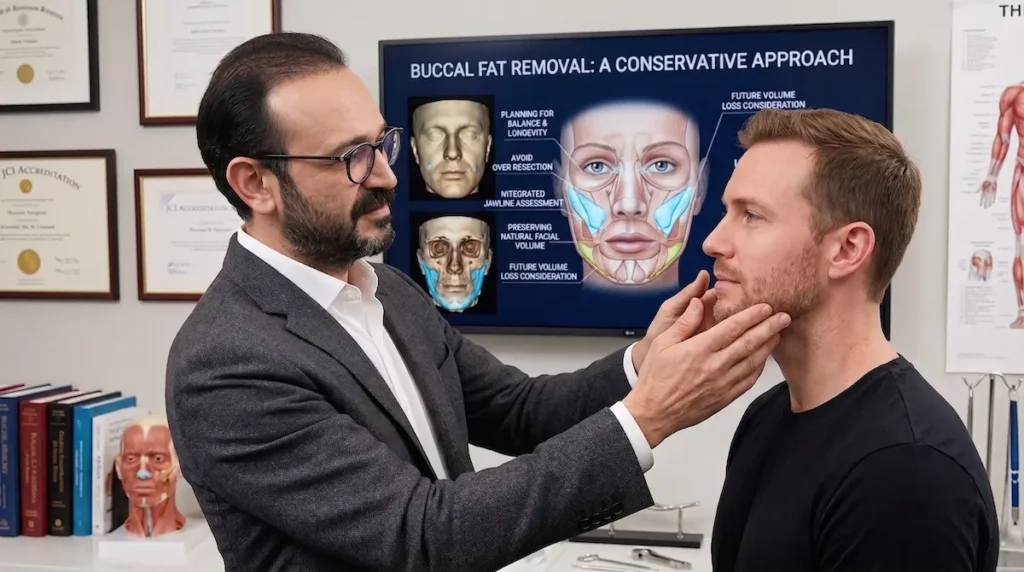
A conservative result does not mean a weak result. In male buccal fat removal, it usually means removing only the amount that improves cheek balance while keeping enough soft tissue to support a natural face over time. This is the section to slow down on before deciding.
The safest-looking male outcomes come from planning the whole face, not chasing one shadow under the cheekbone. A surgeon should assess whether the lower cheek is truly the problem, whether the jawline needs a different type of evaluation, and whether future facial volume loss could make removal unwise.
Why less is more
Buccal fat removal is difficult to “undo” in a simple way. Once fat is removed, it does not reliably come back in the same form. Volume restoration may be possible later with fillers or fat transfer, but that is a correction strategy, not a true reset button.
That is why conservative planning is protective. Leaving some buccal volume helps the face look natural when smiling, talking, and aging. It also reduces the chance of a scooped or tired appearance.
ASPS has warned that facial fat is valuable and that aggressive buccal fat removal can create problems as the face naturally loses volume with age. A measured approach is not less masculine. It is often more durable.
Combining buccal assessment with jawline assessment
Many men ask about buccal fat removal because they want a stronger jawline. That is understandable, but it can lead to the wrong plan if the jawline concern is actually caused by chin projection, neck fullness, skin laxity, or general facial weight distribution.
A proper consultation should separate cheek fullness from jaw structure. If the lower cheek is full but the chin and neck are balanced, buccal fat removal may help. If the main issue is under the chin or along the neck, cheek fat removal may do very little for the concern.
For men in their late 30s, 40s, or beyond, the surgeon may also discuss broader facial aging patterns. That does not mean buccal fat removal is impossible. It means the plan should account for where volume is already decreasing and where support is still needed. Men considering facial aging procedures can also review facial aging options after 40.
What to ask in consultation
Before committing, ask direct questions. A good consultation should not only explain why you qualify; it should also explain why you might not.
- Is my lower-cheek fullness actually caused by the buccal fat pad?
- Would partial removal be safer than full removal in my face?
- Do I already have hollowing in the midface, temples, or under-eye area?
- How could my result look ten years from now?
- Will this improve my jawline, or is my jawline concern coming from another area?
- What happens if I lose more facial volume with age?
- What aftercare and follow-up will I have once I return to Canada?
At AKM Clinic, facial procedures are planned by European Board-Certified surgeons. Surgery is performed in Istanbul, with long-term virtual follow-up built into the patient journey. The consultation should feel like an anatomy review, not a sales pitch.
Recovery also deserves a realistic conversation. Buccal fat removal is usually a shorter procedure than many facial surgeries, but swelling, diet changes, oral hygiene, and settling time still matter. For the practical timeline, review what recovery involves.
Cost should be handled with the same transparency, but this article is not a pricing guide. Canadian patients who want procedure-specific pricing can review buccal fat removal cost in CAD without mixing currencies or relying on exchange estimates.
For medical background, Johns Hopkins provides a useful overview of buccal fat removal candidacy, and ASPS has published clear guidance on why surgeons should avoid being too aggressive with facial fat removal. These are useful benchmarks when comparing advice across clinics.
Johns Hopkins on buccal fat removal candidacy
ASPS on why aggressive buccal removal can backfire
Frequently Asked Questions: Buccal Fat Removal for Men
These questions are common among men researching buccal fat removal from Canada. The answers are intentionally direct, because the right decision depends on anatomy, not trends.
Is buccal fat removal good for men?
Does buccal fat removal make the jaw look stronger?
Will buccal fat removal age me?
Am I too lean for buccal fat removal?
How is buccal fat removal different for men versus women?
Can buccal fat removal be reversed?
Final Thoughts: The Right Male Result Is Measured, Not Extreme
Buccal fat removal for men is most successful when it is treated as facial refinement, not facial reinvention. The right candidate has true lower-cheek fullness, stable weight, and enough structure to benefit from subtle reduction. The wrong candidate is often already lean and chasing a hollow look that may not age well.
For Canadian patients, the safest next step is a careful virtual consultation with clear photos, honest anatomy review, and a conservative plan. Ask what should be removed. Also ask what should be preserved.
Book a free virtual consultation with AKM Clinic to find out whether buccal fat removal suits your facial structure and long-term goals.
Medical disclaimer: This article is for informational purposes only and is not medical advice. Surgical suitability, risks, recovery, and results vary by patient. Always consult a qualified medical professional before making decisions about cosmetic surgery.
Related Procedures



Ready to Begin Your Journey?
Join the more than 2,000 patients who have trusted Dr. Akif Mehmetoğlu and the AKM Clinic team. Your journey begins with an informative, no-obligation conversation. Contact us today from across Canada to schedule your complimentary virtual consultation.
#1: Receive Your Personalized Quote
Start with a complimentary, no-obligation virtual consultation. Share your photos, and our surgical team will provide a fully personalized treatment plan and a transparent, all-inclusive pricing package quoted in Canadian dollars (CAD). There are no hidden fees.
#2: Secure Your Procedure Date
Once you are ready to proceed, our dedicated English-speaking patient coordinators will help you secure your procedure date. We will manage your logistical bookings in Istanbul, including your five-star hotel and private airport transfers.
#3: Arrive in Istanbul & Meet Your Surgeon
Arrive at Istanbul Airport (IST), where you will be greeted by your private driver. Settle into your hotel before your comprehensive in-person consultation. You will meet your specialist surgeon to finalize the details of your procedure and ensure your goals are aligned for a natural, subtle result.