
Lip Lift Regrets: Who Should Think Twice Before Surgery
AI Summary
- Lip lift regrets often come from poor candidacy, over-lifting, scar concerns, or wrong expectations.
- Right candidates want structural lift, not volume, and understand permanence before surgery.
- Safer planning includes philtrum measurement, smile assessment, conservative millimetres, and scar review.
- Think twice if filler, rhinoplasty timing, gummy smile, or scar anxiety affects your decision.
Summary generated by AI, fact-checked by our medical experts
Lip lift regrets usually start before surgery, not after it: the wrong candidate, the wrong expectation, or a result planned too aggressively by just a few millimetres. A lip lift can look refined and natural when the upper lip, philtrum length, smile pattern, skin quality, and scar risk all line up. It can also feel permanent in the wrong way if someone wanted volume, not lift.
This guide is not written to scare you away from surgery. It is written to help you pause for the right reasons. If you are comparing a surgical lip lift with filler, thinking about rhinoplasty, worried about a visible scar, or unsure whether your upper lip is already short, read this before you book.
Quick answer: Most lip lift regrets trace back to three issues: the wrong candidate, an over-lifted result that shows too much tooth or looks tight, and a scar that becomes more visible than expected. Because a lip lift is difficult to reverse, the safest protection is honest candidacy, conservative millimetre planning, and clear expectations before surgery.
A lip lift planned at AKM Clinic starts with facial proportion, not trend-chasing. The goal is not a copied upper lip. It is a better relationship between the nose, philtrum, upper lip, tooth show, and smile.
Table of Contents
Lip Lift Regrets: Why People Regret a Lip Lift
Many of the regret patterns patients report after lip lift surgery can be predicted before the procedure. It helps to separate realistic recovery anxiety from deeper dissatisfaction caused by the wrong plan.
People rarely regret a lip lift because the operation is unclear. They regret it because the trade-offs were not fully understood. The lift is small in measurement but large in visual effect. A few millimetres can change the resting mouth, the smile, the amount of tooth show, and how the nose base is perceived.
A thematic analysis of patient-reported dissatisfaction after lip lift surgery found recurring concerns such as scarring, nasal or alar distortion, lip asymmetry, and expectation mismatch among dissatisfied reviewers. That type of evidence should be read carefully because it reflects dissatisfied patient narratives, not every lip lift outcome. Still, it is useful. It tells us where regret tends to begin.
In consultation, “Will I like the result?” is too broad. Better questions are more specific: Will my philtrum still look natural? How many millimetres are being removed? Will my smile look tighter? Could this expose too much tooth? What is my scar risk? Would filler solve my goal with less permanence?

The most common lip lift regret reasons
The first regret pattern is expectation mismatch. A lip lift shortens the distance between the nose and upper lip. It can roll more of the pink lip outward, but it does not add true volume in the same way filler does. If your goal is a plumper upper lip, surgery may not answer the right question.
The second pattern is over-lifting. Too much lift can create a tense upper lip, excessive tooth show, or a shape that feels theatrical rather than fresh. This can be especially upsetting because a lip lift is not like dissolving filler. Tissue was removed.
The third pattern is scar surprise. A bullhorn lip lift places the incision under the nose, where it can hide well in the natural crease for the right patient. It can still heal more visibly in some people. Skin type, tension, surgical closure, aftercare, sun exposure, and individual healing all matter.
True regret versus normal recovery anxiety
Early anxiety is not always true regret. The first weeks can include swelling, tightness, redness, stiffness, and a smile that feels unfamiliar. The upper lip may look too high before swelling settles. That temporary phase can be emotionally difficult.
True regret is different. It usually persists after healing has matured and is tied to a real mismatch: the lip is too short, the scar remains distracting, the nostril base looks wider, or the patient realizes they wanted volume rather than surgical elevation.
This distinction matters because early panic can push patients toward rushed decisions. A careful surgeon will separate normal healing from a result that genuinely needs review.
Why permanence changes the decision
Cleveland Clinic describes a lip lift as a permanent cosmetic surgery. That permanence is exactly what appeals to many patients who are tired of repeat filler. It is also why candidacy matters so much.
If you like changing your lip shape often, if you are still experimenting with filler, or if your idea of the “perfect” lip changes with every photo you save, a permanent procedure may feel too final. A surgical lift should fit a stable facial plan.
“In a lip lift, millimetres are permanent. A conservative lift that respects the smile is safer than trying to undo an aggressive one later.”
Canadian patient note: The Canadian Society of Plastic Surgeons advises patients to verify specialist credentials and provincial licensing when choosing a plastic surgeon. For international surgery, use the same mindset: check training, ask how complications are managed, and make sure your surgeon can explain why you are—or are not—a good candidate. You can review the CSPS patient guidance on choosing a plastic surgeon before comparing clinics abroad.
The Wrong Candidate: Who Should Think Twice?
Some patients are healthy and suitable for other aesthetic treatments, but not ideal candidates for a lip lift right now. Many regret stories begin when a lip lift is used to solve the wrong problem.
A lip lift is not a universal upgrade. The best candidates usually have a longer upper-lip-to-nose distance, want more upper tooth show, understand the scar trade-off, and prefer structural lift over added volume. The wrong candidate may still be healthy and attractive. They simply need a different plan.
This is where many lip lift regrets can be prevented. A good consultation should sometimes end with “not yet,” “not this procedure,” or “dissolve filler first.” That answer can feel disappointing in the moment, but it protects your face.
You already have a short philtrum
The philtrum is the vertical space between the base of the nose and the upper lip. If it is already short, removing more skin can make the upper lip look compressed. The result may show too much upper tooth at rest or make the mouth look tight when speaking.
This is the “lip lift too short” problem. It is not always obvious in selfies because phone angles distort facial proportions. A proper assessment needs relaxed-face photos, smiling photos, side views, and millimetre measurements.
For some people, a tiny lift may still be possible. For others, it is better to avoid surgery and consider non-surgical shaping instead.
You want volume, not lift
A lip lift and filler solve different problems. Lip lift vs filler is not a competition; it is a question of anatomy and goal.
Filler adds volume and can adjust contour. It is temporary and can often be modified. A lip lift shortens the skin distance above the lip and changes how much upper lip is visible. It can make the upper lip look more present, but it is not a volume-building procedure.
If your main complaint is “my lip is too thin,” filler may be the better first test. If your complaint is “my upper lip is hidden because the space under my nose is long,” a lip lift may be more logical.
You have a gummy smile or high tooth show already
A lip lift can increase upper tooth show. That can be beautiful in the right amount. It can also become too much if you already show a lot of gum or teeth when smiling.
This is where a gummy smile needs careful evaluation. Sometimes the issue is lip length. Sometimes it is dental position, jaw relationship, muscle activity, or previous filler. A lip lift that ignores these factors can worsen the exact feature you hoped to soften.
If you already feel self-conscious about gum show, do not assume a lip lift will balance it. Ask your surgeon to show, in millimetres, how the lift may change resting tooth show and smiling tooth show.
You are scar-prone or anxious about the incision
Scar risk does not automatically rule out surgery, but it should slow the decision down. A lip lift scar sits in a highly visible part of the face. Even a small scar can feel large to someone who studies their reflection closely.
If you have a history of raised scars, widened scars, pigment change, or prolonged redness, the scar conversation should be detailed. Skin tone, incision design, closure tension, aftercare, sun exposure, and healing biology all play a role.
Do not let anyone dismiss the scar as “nothing.” The better framing is more honest: many scars heal discreetly, but not every scar disappears. For a deeper look at scar placement and maturation, read how lip lift scars heal.
You are still unsure what you want your face to look like
A lip lift is a small operation with a strong identity. It changes the centre of the face. That can be positive when the patient has a stable goal. It can feel wrong when the decision is based on a passing trend, a filtered image, or a single feature that keeps changing in the patient’s mind.
If your saved photos show very different lips from week to week, wait. If you are trying to look like someone else, wait. If you want a result that no one can detect, but also want a dramatic upper-lip change, pause and clarify which priority matters more.
A regret-proof decision starts with a realistic target, not a perfect fantasy.
The Over-Lifted Look — and Why It Is Hard to Undo
An over-lifted lip can be difficult to live with emotionally and difficult to correct technically. The concern is not only how the lip looks at rest, but how the mouth moves when speaking, smiling, and showing teeth.
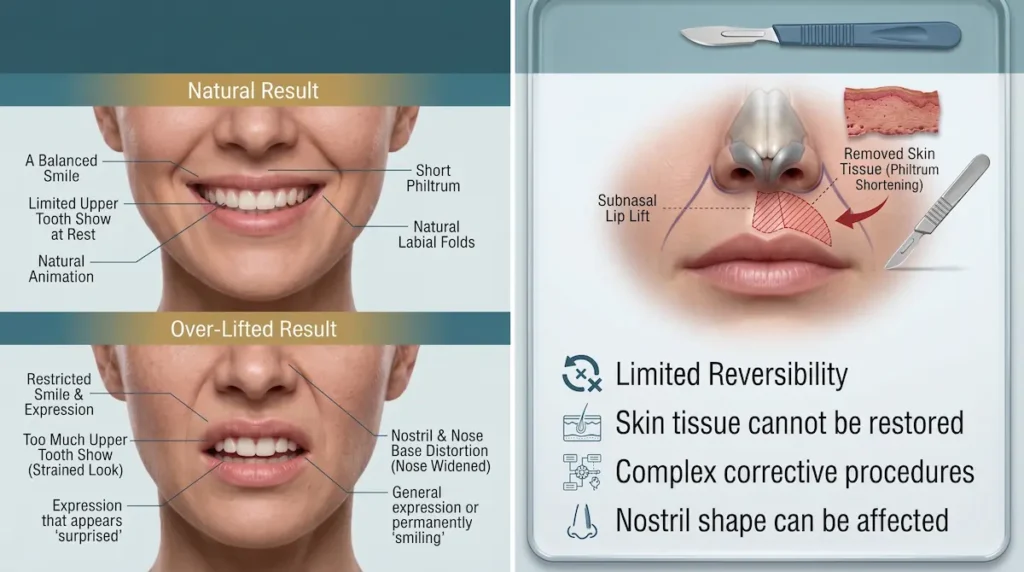
An over-lifted lip lift is one of the regret patterns patients worry about most. It can make the upper lip look tight, expose more upper teeth than intended, or create a nose-to-lip relationship that feels too “done.” The problem is not always dramatic. Sometimes it is subtle enough that other people cannot name it, but the patient feels it every time they speak, smile, or see a side-view photo.
This is why conservative planning matters. Lip lift surgery works in millimetres. A small change can be elegant. A slightly larger change can cross into a result that feels difficult to live with.
Too much tooth show
A balanced lip lift can reveal a little more upper tooth at rest. For many patients, that is part of the appeal. It can make the mouth look more youthful and animated. But too much tooth show can look strained, especially if the upper lip no longer relaxes naturally over the teeth.
This is not just a cosmetic detail. It affects expression. The face may look like it is always slightly smiling, slightly tense, or slightly surprised. In photos, that can read as overdone. In real life, it may feel less like “rejuvenation” and more like alteration.
Before surgery, the question should not be “Can we lift more?” It should be “How much can be lifted while the mouth still looks natural at rest and in motion?”
A tight upper lip when speaking or smiling
Some lip lift regret reasons only become clear when the face moves. A result can look acceptable in a still photo but feel tight while talking. The upper lip may resist normal movement, the smile may feel shortened, or the central lip may appear pulled upward while the corners stay lower.
Movement is the test. A good consultation should include relaxed photos, smiling photos, and a discussion of speech, tooth show, and animation. The goal is not just a shorter philtrum. It is a mouth that still belongs to your face.
Widened nostrils or nose-base distortion
The incision for a subnasal lip lift sits close to the base of the nose. If the design, tension, or closure is not carefully controlled, some patients worry about changes around the nostrils or alar base. This may include a wider-looking nose base, nostril distortion, or a scar that draws attention upward.
Not every patient is at equal risk. Nose shape, skin thickness, previous rhinoplasty, scar behaviour, and the amount of lift all matter. If you are also considering nose surgery, sequencing becomes important. Planning the lip and nose separately can create proportion problems later.
If you are already sensitive about nostril width or nose base shape, bring that up early. It should not be treated as a small side note.
Limited reversibility
Filler can often be dissolved or adjusted. A lip lift cannot be reversed in the same way because skin has been removed. Scar revision, filler balancing, or secondary procedures may soften a result, but they do not simply put the philtrum back exactly as it was.
This is the strongest argument for restraint. If your surgeon suggests a more conservative lift than the dramatic result you imagined, that may be a good sign. Conservative does not mean underwhelming. It means the plan respects the permanence of the operation.
| Regret trigger | Higher-risk profile | How to reduce the risk |
|---|---|---|
| Over-lifted upper lip | Already short philtrum, high tooth show, trend-based goal | Use conservative millimetre planning and assess the smile, not just the resting face |
| Visible scar | Scar-prone skin, high tension, poor sun protection, unrealistic scar expectations | Discuss incision design, closure, scar care, and healing history before surgery |
| Wrong procedure | Patient wants volume rather than lift | Compare lip lift vs filler and decide whether the goal is structural shortening or fullness |
| Nose-base distortion concern | Previous rhinoplasty, narrow nose base, strong concern about nostril shape | Plan the lip lift in relation to nasal anatomy and any future rhinoplasty |
| Long-term mismatch | Unstable aesthetic goal, very young patient, rapidly changing preferences | Delay surgery until the desired facial proportion feels consistent over time |
When to Postpone or Skip a Lip Lift
Timing matters. Some patients are not wrong for a lip lift forever; they simply need to wait until filler has settled, a rhinoplasty plan is clear, or their aesthetic goals have become stable.
Thinking twice is not the same as saying no forever. Sometimes the best decision is to postpone. That gives swelling from previous treatments time to settle, lets filler dissolve, or allows a larger facial plan to become clearer. A delayed lip lift often leads to a better-planned lip lift.
Patients who avoid regret are usually not the ones who rush. They are the ones who understand timing.
Wait if your filler is distorting the assessment
Previous filler can change the apparent length and shape of the upper lip. It can make the lip look heavier, rolled forward, or uneven. If a surgeon measures your philtrum and smile while filler is still influencing the tissues, the plan may be based on a moving target.
Some patients need filler dissolved before a true lip lift assessment. Others may only need time for recent filler to settle. Either way, the consultation should separate filler-related shape from natural anatomy.
If you are unsure whether you want lift or volume, do not rush into permanent surgery. The first step is clarifying the problem.
Wait if you are planning rhinoplasty
The nose and upper lip share the same visual neighbourhood. Rhinoplasty can change nasal projection, columella show, nostril shape, and how the philtrum is perceived. A lip lift can change the same central facial zone from below.
If both procedures are on your mind, ask which should come first. In some cases, surgeons prefer to plan them together. In others, it may be safer to complete one, heal, and reassess. The wrong sequence can make a result look less balanced than either procedure would have looked alone.
This does not mean rhinoplasty and lip lift cannot both be part of a plan. It means they should not be planned in isolation.
Wait if your goal is based on one photo
A single photo can be persuasive. Lighting, expression, camera angle, makeup, filler, dental show, and editing can all influence what you think you want. The lip that looks perfect on someone else may not fit your tooth show, chin position, nose shape, or facial length.
A lip lift should be planned from your anatomy. Inspiration images can help describe preference, but they should not override measurement and proportion.
If the goal is “I want that exact lip,” pause. If the goal is “I want my upper lip to fit my face better,” the conversation is already healthier.
Wait if you are not comfortable with a scar trade-off
Every surgical lip lift has a scar. Many heal discreetly. Some remain more noticeable. If the idea of any visible mark under the nose feels unacceptable, surgery may not be the right choice right now.
This is especially true for patients who know they inspect small facial details closely. A scar that other people barely notice can still bother you if it becomes the first thing you look for in the mirror.
A mature decision accepts both sides: the possible improvement in lip proportion and the real incision required to create it.
Wait if your facial proportions are still changing
Facial proportions change with age, weight shifts, dental work, filler history, skin elasticity, and bone structure. That does not mean younger patients can never choose a lip lift. It does mean they should be especially clear about permanence.
Some patients are better served by temporary or reversible steps first. Others may benefit from doing nothing until their goals become more stable. A lip lift should not be used to chase every small change in preference.
This is where broader facial proportion matters. Lessons from other facial procedures also apply here: removing or lifting too much can age differently than expected. For example, overcorrection lessons from smile changes show why subtle facial shifts can become more noticeable when the face moves.
Skip surgery if the consultation feels dismissive
A good consultation should make space for doubt. If your concerns about scars, tooth show, nostril change, or reversibility are brushed aside, that is a warning sign. You are not being difficult by asking about regret. You are being realistic.
For Canadian patients considering surgery abroad, this point matters even more. You should understand who performs the procedure, what the aftercare pathway looks like, what happens if healing is not straightforward, and how remote follow-up is handled after you return home.
Trust builds when a clinic explains both what surgery can do and what it should not do.
A Regret-Proof Decision Checklist: Is a Lip Lift Worth It for You?
The warning signs above can be turned into a practical checklist. Use it before consultation to decide whether your goal is structural lift, lip volume, scar trade-off acceptance, or a broader facial-proportion plan.
A lip lift is worth it for the right patient when the goal is structural lift, not lip size alone. It may be the wrong move when the patient wants volume, is unsure about the scar, already has a short philtrum, or expects the result to be as adjustable as filler.
Use this checklist before making the decision. It is not a replacement for consultation, but it can help you ask better questions and avoid the most common lip lift regret reasons.

1. What is my actual goal: lift, volume, or both?
Write down what bothers you in one sentence. “My upper lip disappears when I smile” is different from “I want fuller lips.” The first may be a lip lift conversation. The second may be filler, fat transfer, or another approach.
If you cannot name the goal without using someone else’s photo, keep refining. A lip lift should be chosen because it fits your face, not because it matches a saved image.
2. How many millimetres would be removed?
Ask for the proposed lift in millimetres. A vague answer like “just a little” is not enough. In lip lift planning, small differences matter. You should understand what is being removed, how it changes philtrum length, and how it may affect tooth show.
The safest plan is usually conservative. If you later want a stronger effect, your surgeon can discuss whether more treatment is possible. But once too much skin has been removed, the options become more limited.
3. What happens to my smile?
A lip lift should be assessed in motion. Ask how the lift may affect relaxed tooth show, smiling tooth show, and gum visibility. If you already show a lot of gum, the plan should be especially careful.
Do not make the decision from a resting front-view photo only. The mouth is dynamic. Regret often appears when the result looks fine still, but wrong in conversation or smiling.
4. Am I prepared for the scar?
A good scar conversation is direct. Where will the incision sit? How is it closed? What aftercare is expected? How long can redness last? What happens if the scar becomes raised, widened, or darker than expected?
Some people are comfortable with that trade-off. Others are not. Both responses are valid. The mistake is pretending the scar does not exist.
5. Have I compared lip lift vs filler honestly?
Filler is not “less serious” just because it is non-surgical, and surgery is not “better” just because it is permanent. They are different tools. If you want to test a shape, filler may be more flexible. If you are tired of repeat filler and your main issue is a long philtrum, a lip lift may be more logical. The key is choosing the tool for the anatomy.
6. Have I checked surgeon credentials and aftercare?
Canadian patients are used to verifying qualifications through a specialist framework. For surgery abroad, use the same level of caution. Ask who performs the operation, what their facial surgery experience is, how the clinic handles complications, and how follow-up works once you are back in Canada. If the plan sounds vague, wait.
Canadian planning note: If pricing is part of your decision, keep it separate from candidacy. Cost should never be the reason to accept an aggressive lift. For budget planning only, review lip lift cost planning in CAD once candidacy is clear.
7. How might my facial proportions change over time?
A lip lift sits in the middle of the face, so long-term proportion matters. Ageing, dental changes, skin laxity, filler history, and weight shifts can all change how the mouth looks later. This does not mean you should avoid surgery. It means the result should be designed with restraint.
For a wider facial-proportion perspective, it can help to think beyond the lip itself. The same principle appears in other facial contouring decisions: a result that looks sharp today may age differently over time. Read more about how facial proportions can change over time.
Regret-proof checklist table
| Question to ask | Green flag answer | Pause if... |
|---|---|---|
| Do I want lift or volume? | You can explain the difference between shortening the philtrum and adding fullness. | You mainly want a plumper lip and have not tried or considered non-surgical options. |
| Is my philtrum actually long? | Your surgeon measures it and explains how your face compares proportionally. | You already have a short upper-lip-to-nose distance. |
| How will my smile change? | The plan considers relaxed face, speech, tooth show, and smile animation. | The assessment is based only on still photos. |
| Can I accept the scar? | You understand placement, healing, scar care, and revision limits. | You expect the incision to be completely invisible. |
| Is the surgeon conservative with millimetres? | The surgeon explains why less lift may protect natural movement. | You are encouraged toward a dramatic change without discussing reversibility. |
Frequently Asked Questions About Lip Lift Regrets
These are the questions patients usually raise after they start comparing before-and-after photos, filler options, scar stories, and surgical permanence. The answers are direct because uncertainty is where many regret patterns begin.
Is a lip lift worth it?
The best answer comes from anatomy. If the procedure solves the right problem, it can look refined. If it solves the wrong problem, regret is more likely.
Why do people regret lip lifts?
That does not mean these problems happen to every patient. It means they deserve to be discussed before surgery.
Can a lip lift be reversed?
This is why conservative planning is so important. The safest time to prevent overcorrection is before the first surgery.
Who is not a good candidate for a lip lift?
“Not now” is not a failure. It may be the most protective answer.
Will a lip lift show too many teeth?
Ask your surgeon to explain the expected change in millimetres, not just in general terms.
Should I get filler instead of a lip lift?
Some patients use filler first to understand proportion. Others come to surgery after years of filler migration or maintenance fatigue. The right sequence depends on your anatomy and tolerance for permanence.
Can a lip lift scar be fixed?
If scar visibility is your biggest fear, spend time reviewing incision placement, skin history, and aftercare before deciding.
How do I avoid lip lift regrets?
The best lip lift is not the biggest lift. It is the one that still looks like you.
Final Thoughts: A Good Lip Lift Starts With Saying “Maybe Not Yet”
In the end, the decision comes back to patient safety and realistic expectations. A lip lift can be an elegant procedure, but only when the anatomy, timing, and goals support it.
The patients least likely to regret a lip lift are often the ones who are allowed to slow down. They ask about scars. They compare lift with filler. They think about the smile, not just the still photo. They understand that a few millimetres can change the centre of the face.
A lip lift can be elegant, lasting, and natural-looking when the indication is right. It can also feel like too much when the plan ignores volume goals, tooth show, scar risk, or long-term proportion. The difference is not luck. It is candidacy, restraint, and surgeon-led planning.
If you are unsure, that is useful information. Bring that uncertainty into consultation rather than hiding it. A responsible plan should help you decide whether to proceed, postpone, or choose a different option.
Medical disclaimer: This article is for educational purposes only and does not replace a personal consultation with a qualified medical professional. Individual anatomy, healing, scarring, and surgical results vary. If you have symptoms, complications, or concerns after surgery, contact your surgeon or a local medical professional promptly.
Related Procedures




Ready to Begin Your Journey?
Join the more than 2,000 patients who have trusted Dr. Akif Mehmetoğlu and the AKM Clinic team. Your journey begins with an informative, no-obligation conversation. Contact us today from across Canada to schedule your complimentary virtual consultation.
#1: Receive Your Personalized Quote
Start with a complimentary, no-obligation virtual consultation. Share your photos, and our surgical team will provide a fully personalized treatment plan and a transparent, all-inclusive pricing package quoted in Canadian dollars (CAD). There are no hidden fees.
#2: Secure Your Procedure Date
Once you are ready to proceed, our dedicated English-speaking patient coordinators will help you secure your procedure date. We will manage your logistical bookings in Istanbul, including your five-star hotel and private airport transfers.
#3: Arrive in Istanbul & Meet Your Surgeon
Arrive at Istanbul Airport (IST), where you will be greeted by your private driver. Settle into your hotel before your comprehensive in-person consultation. You will meet your specialist surgeon to finalize the details of your procedure and ensure your goals are aligned for a natural, subtle result.