





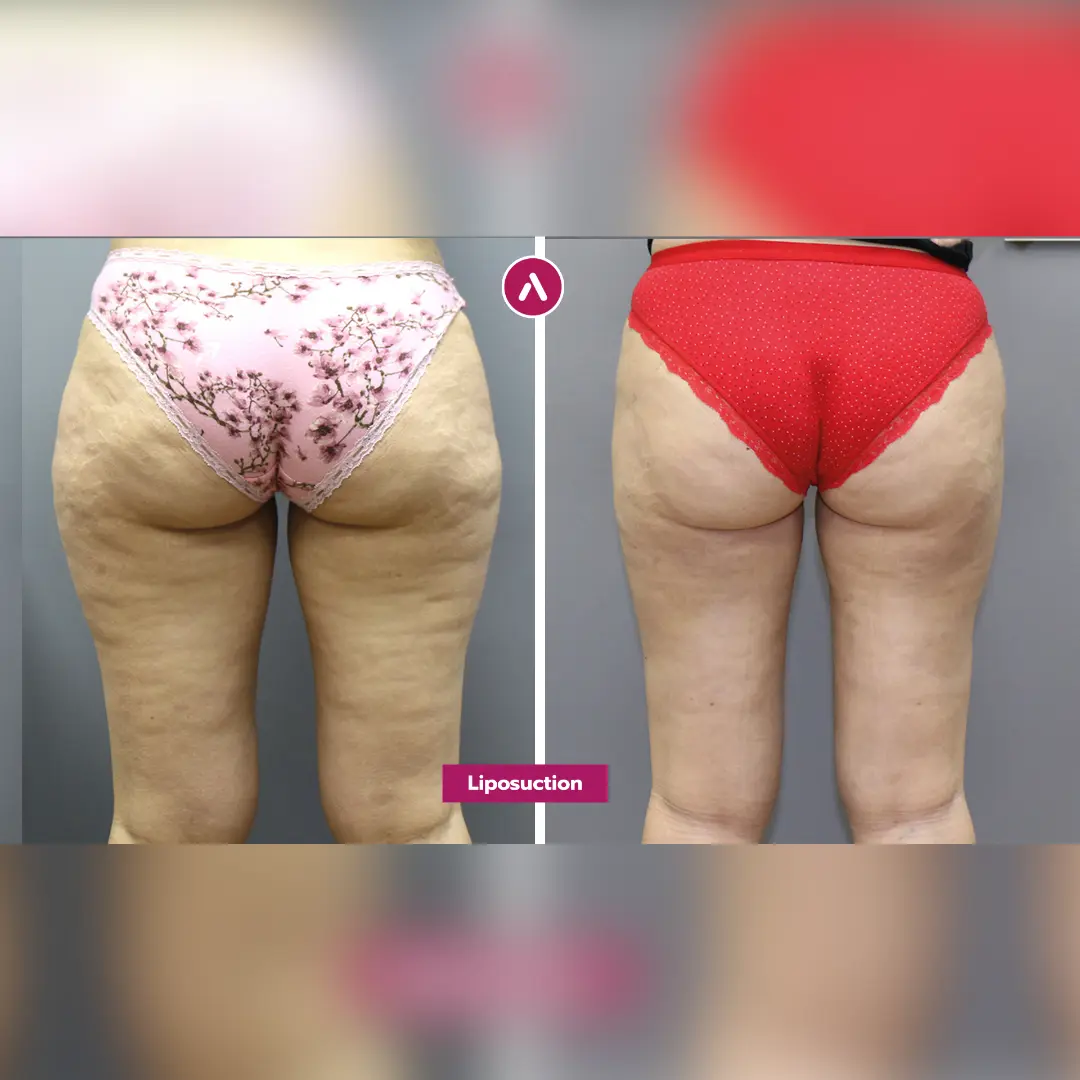
If you have worked hard to lose weight but still feel held back by loose skin on your thighs, you are not imagining the problem. Exercise can strengthen the muscles underneath, but it cannot remove stretched skin that has lost its ability to retract. A thigh lift, also called thighplasty, removes excess thigh skin and reshapes the leg contour. At AKM Clinic in Istanbul, we plan thigh lift surgery for Canadian patients who want a cleaner, more proportionate lower-body shape without ignoring the real trade-off: scars.
Table of Contents
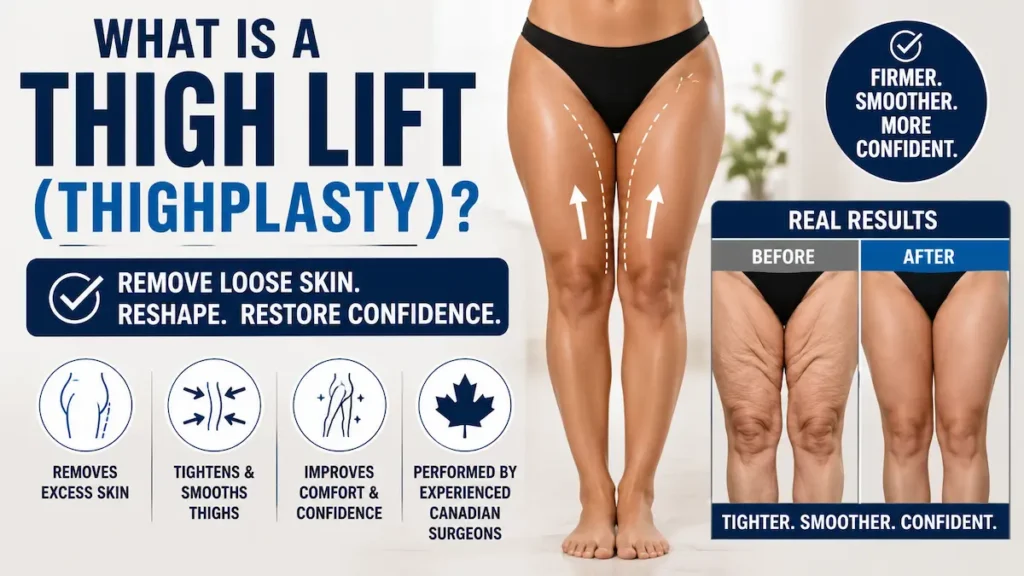
What Is a Thigh Lift (Thighplasty)?
A thigh lift, or thighplasty, is a body contouring surgery that removes excess skin and reshapes the inner or outer thighs after weight loss, aging, or skin laxity. It is different from liposuction because it treats loose skin, not only stubborn fat.
How a Thigh Lift Works
A thigh lift works by surgically removing loose, hanging skin from the thigh area. The remaining tissue is then tightened and closed in a planned incision pattern. This creates a firmer, smoother thigh contour.
The exact technique depends on where the laxity sits. Some patients need an inner thigh lift for loose skin near the groin and medial thigh. Others need a more extended approach to correct laxity that wraps around the front, outer, or back of the thigh.
We do not treat every thigh lift patient with one template. Our surgeons assess skin quality, fat distribution, scar placement, weight stability, and how the thighs relate to the abdomen, hips, and buttocks.
Thigh Lift vs Thighplasty: Same Procedure, Different Names
“Thigh lift” is the patient-friendly term. “Thighplasty” is the medical term. They refer to the same surgical category: removing and tightening excess thigh skin.
Canadian patients often see both terms while researching. Toronto and Vancouver clinics may use “thigh lift,” while surgical literature often uses “thighplasty.” On this page, we use both terms so the meaning stays clear.
What It Addresses: Sagging Inner and Outer Thigh Skin
A thigh lift is most useful when the thigh skin hangs, folds, rubs, or moves independently from the muscle underneath. This is common after major weight loss, pregnancy-related body change, aging, or long-term fluctuations in weight.
Patients often describe the problem in practical terms:
- Inner thighs rub together while walking.
- Loose skin bunches in leggings or jeans.
- Shorts fit poorly despite stable weight.
- The legs look heavier than the rest of the body.
- Thigh skin feels deflated after weight loss.
These concerns are not only aesthetic. Chafing, skin irritation, hygiene difficulty, and discomfort during exercise are common reasons Canadians consider thigh lift surgery.
Thigh Lift vs Thigh Liposuction: When Skin Removal Is Needed
Liposuction removes fat. It does not remove loose skin. This distinction matters because many patients assume thigh liposuction will “tighten” the leg. In patients with good skin elasticity, liposuction can refine the thigh contour. In patients with stretched skin, liposuction alone can make looseness more visible.
A helpful rule is simple: if the thigh looks bulky because of fat, liposuction may help. If the thigh looks loose because of hanging skin, a thigh lift is usually the more appropriate procedure.
Some patients need both. In those cases, we may combine conservative liposuction with skin excision to improve contour while avoiding unnecessary tension on the incision.
Benefits of a Thigh Lift
A thigh lift can improve both contour and comfort by removing loose, hanging thigh skin that exercise cannot tighten. For many Canadian patients after weight loss, thighplasty helps reduce inner-thigh chafing, improves how clothing fits, and creates a smoother leg shape. The goal is not an artificial look, but a firmer, more proportionate contour that matches your current body.
Firmer, More Contoured Thighs
The main benefit of a thigh lift is structural reshaping. By removing excess skin, we can create a firmer thigh contour that better matches the patient’s current weight and body proportions.
This is especially meaningful after weight loss. Many patients reach their goal weight but still feel their thighs reflect a previous body. A thigh lift can help align the outside appearance with the work already done.
Reduced Inner-Thigh Chafing
Inner-thigh chafing is one of the most practical reasons to consider surgery. Loose medial thigh skin can rub during walking, hiking, cycling, or daily commuting. In Canadian winters, layers of clothing can make the friction worse.
By reducing redundant skin, an inner thigh lift can decrease rubbing and improve comfort during movement. This is not a promise of “perfect” friction-free legs, but many patients report a meaningful improvement in day-to-day comfort.
Improved Fit in Clothing
Loose thigh skin can make clothing difficult. Jeans may pull at the upper thigh. Leggings may highlight folds. Swimwear may feel uncomfortable or exposing.
A thigh lift can make clothing fit more predictably because the skin envelope is tighter and smoother. This benefit is often subtle but emotionally important.
Completing a Weight-Loss Transformation
After bariatric surgery or major lifestyle-driven weight loss, the thighs can be one of the last areas to change. Loose skin may remain even when the patient has built muscle and maintained a stable weight.
For many patients, thighplasty is not the start of a transformation. It is the final stage. It can be combined with related post-weight-loss procedures such as an arm lift, tummy tuck, or 360 body lift when a broader body contouring plan is appropriate.
Long-Lasting Skin Removal With Stable Weight
Removed skin does not grow back. That makes thigh lift results long-lasting when weight remains stable and the patient follows recovery instructions.
Aging continues, and skin quality can change over time. Large weight fluctuations can also stretch the result. This is why we emphasize candidacy, weight stability, and realistic expectations before surgery.
“A successful thigh lift is not about making the legs look artificially tight. It is about matching the skin envelope to the patient’s real body after weight loss, while placing scars as thoughtfully as possible.”
Am I a Good Candidate for a Thigh Lift?
You may be a good candidate for a thigh lift if your weight is stable and your main concern is loose thigh skin rather than fat alone. Ideal candidates often have skin folds, rubbing, or laxity after weight loss, pregnancy, aging, or bariatric surgery. During consultation, we assess skin quality, scar tolerance, medical history, and whether liposuction alone would be enough.
Post-Weight-Loss Sagging Thigh Skin
You may be a good candidate for a thigh lift if your main concern is loose skin rather than simple fat fullness. This is common after major weight loss, especially when the skin has been stretched for many years.
Good candidates often notice that the thigh skin hangs or folds even when their weight is stable. The skin may ripple when standing, gather near the groin, or rub during walking. This is the kind of concern that exercise cannot reliably correct.
At AKM Clinic, we assess the thighs in relation to the full lower body. Thigh laxity often connects to the hips, abdomen, buttocks, or arms after weight loss. Your surgical plan should match the full pattern, not only one isolated area.
After Bariatric or Massive Weight Loss
Patients who have lost a significant amount of weight through bariatric surgery, medication-assisted weight loss, or lifestyle change often develop loose thigh skin. This does not mean the weight loss was incomplete. It means the skin envelope could not shrink back to the new body size.
For post-bariatric patients, timing matters. We usually want weight to be stable before surgery. If your weight is still changing quickly, the result may stretch or shift later.
Many Canadian patients also coordinate with their family physician, bariatric team, or primary care provider before travelling. This helps confirm that nutrition, iron levels, protein intake, and general health are ready for surgery.
Skin Elasticity Assessment: Why Skin Will Not Always Re-Tighten
Skin elasticity depends on collagen quality, age, genetics, sun exposure, smoking history, pregnancy, and how long the skin was stretched. Once skin loses enough recoil, it may not tighten with workouts, massage, creams, or energy devices.
A simple way to think about it: muscle can be strengthened, and fat can be reduced. Loose skin needs a different solution. A thigh lift directly removes the redundant skin and repositions the remaining tissue.
During consultation, our surgeons look at:
- How much skin hangs while standing.
- Whether the laxity is inner, outer, front, back, or circumferential.
- Whether fat removal is also needed.
- Where the scar can be placed most safely.
- Whether the patient accepts the scar trade-off.
Weight Stability Requirement Before Surgery
Stable weight is one of the strongest predictors of a lasting thigh lift result. If you continue losing weight after surgery, new laxity can appear. If you gain significant weight, the tightened skin can stretch again.
We usually prefer patients to be close to their goal weight and stable for several months. The exact timing depends on your medical history, weight-loss method, nutrition, and overall health.
This is not about judging a number on a scale. It is about protecting your result and reducing avoidable surgical risk.
When Liposuction Alone Suffices vs When Skin Removal Is Needed
Liposuction may be enough if the thigh is full because of fat and the skin still has good elasticity. In that case, removing fat can refine the leg shape without a long thigh lift incision.
A thigh lift is usually more appropriate when the skin hangs, folds, or creases. Liposuction alone can sometimes make this worse because it removes volume from underneath already loose skin.
For patients with both fat and laxity, we may use liposuction as part of the thigh lift. This can improve contour while the skin excision treats the loose tissue. For a broader explanation of fat-removal techniques, see our liposuction in Turkey guide.
Realistic Expectation Framework: Scar Trade-Off Acceptance
A thigh lift can create a smoother and more proportional thigh shape, but it does not happen without scars. This is the central trade-off of the procedure.
The right candidate understands that the goal is not a scar-free leg. The goal is to exchange hanging skin, friction, and poor contour for a planned scar that fades over time and is placed as thoughtfully as possible.
This is why we discuss scars before we discuss dates. A patient who is not ready for a visible scar may be better suited to non-surgical care, liposuction, or delaying surgery.
Disqualifying Conditions
A thigh lift may need to be delayed or avoided if the risk is too high. Safety comes first.
- Unstable weight or active major weight loss.
- Smoking or nicotine use that cannot be stopped safely before surgery.
- Poorly controlled diabetes or circulation problems.
- Untreated anemia or nutritional deficiency after bariatric surgery.
- History of blood clots without proper specialist clearance.
- Unrealistic expectations about scars or recovery.
If surgery is not appropriate yet, we will tell you. A safer delay is better than a rushed operation.
Inner, Outer, Spiral & Mini Thigh Lift: The Technique Decision
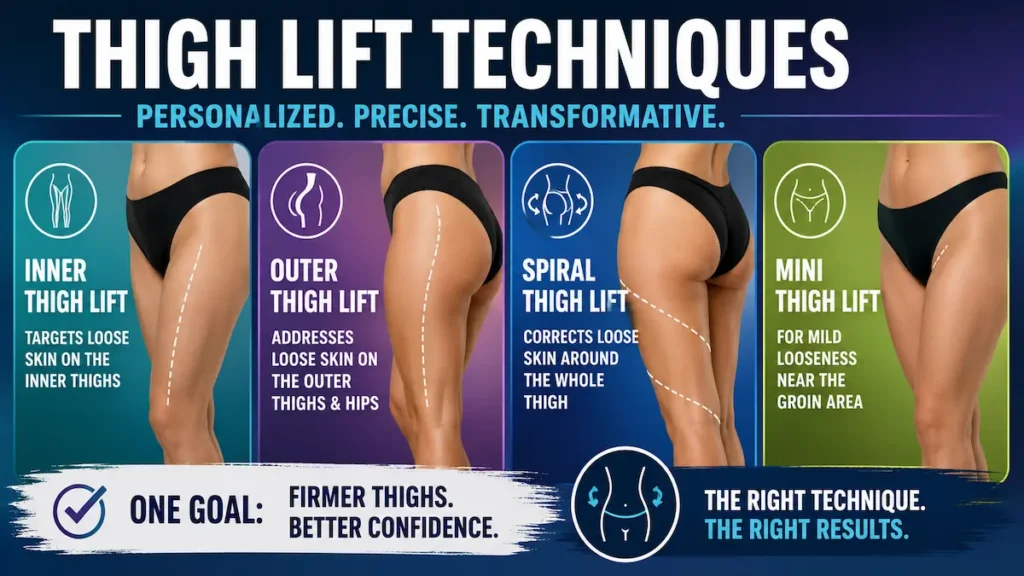
Thigh lift technique depends on where your loose skin sits and how much correction you need. An inner thigh lift treats medial thigh laxity, an outer thigh lift addresses hip and outer-thigh looseness, a spiral thigh lift corrects more extensive laxity, and a mini thigh lift suits mild upper-inner-thigh skin. The right technique balances correction, scar placement, and recovery.
The Technique-Matching Framework
Thigh lift surgery is not one procedure with one incision. The correct technique depends on where the loose skin sits and how much correction is required.
A patient with mild looseness near the groin may need a mini thigh lift. A patient after massive weight loss may need a longer medial or spiral approach. Choosing the smallest incision is not always the safest choice if it cannot correct the real laxity.
Our planning begins with the laxity pattern:
- Inner thigh only.
- Outer thigh and hip laxity.
- Circumferential looseness around the thigh.
- Mild groin-area laxity.
- Fat fullness with limited skin looseness.
Inner / Medial Thigh Lift
The inner or medial thigh lift is the most common thighplasty technique. It targets loose skin on the inner thigh, where chafing and skin folds often occur.
For limited laxity, the incision may sit mainly in the groin crease. For greater laxity, the incision may extend down the inner thigh toward the knee. This longer scar allows more skin removal and better vertical tightening.
The inner thigh is a high-movement area. Walking, sitting, and leg motion create tension on the incision. That is why careful closure, compression, and scar management matter so much.
Outer / Lateral Thigh Lift
An outer or lateral thigh lift addresses loose skin along the outer thigh and hip area. It is less common as an isolated procedure than an inner thigh lift.
Outer thigh laxity often connects to the buttock, hip, or lower-body contour. In these cases, a lateral thigh lift may be planned as part of a broader lower body or 360 body lift strategy.
The goal is not to over-tighten the outer thigh. The goal is to improve proportion between the thigh, hip, and buttock while keeping scar placement realistic.
Spiral Thigh Lift
A spiral thigh lift is designed for more advanced laxity that wraps around the thigh. It can address inner, front, outer, and sometimes posterior thigh looseness in a more circumferential way.
This technique is often considered for post-massive-weight-loss patients. It offers more correction than a limited inner thigh lift, but it also involves more planning, longer incisions, and a more demanding recovery.
Spiral thigh lift candidacy is highly individual. We assess whether the added correction justifies the larger scar pattern and recovery commitment.
Mini Thigh Lift
A mini thigh lift uses a more limited incision, usually hidden near the groin crease. It can be helpful for mild upper-inner-thigh laxity.
The benefit is a shorter and more concealed scar. The limitation is correction power. A mini thigh lift cannot remove large amounts of hanging skin from the mid or lower inner thigh.
This is where honest planning matters. Choosing a mini lift for severe laxity may leave the patient disappointed. Choosing a longer lift when only mild correction is needed may create more scar than necessary.
The Scar-vs-Correction Trade-Off
Every thigh lift technique sits on a scar-versus-correction spectrum. Smaller scars mean less correction. More correction usually requires a longer incision.
| Technique | Typical Incision / Scar | Best For | Correction Level | AKM Offers |
|---|---|---|---|---|
| Mini Thigh Lift | Groin crease | Mild upper-inner-thigh laxity | Limited | Yes |
| Inner / Medial Thigh Lift | Groin crease, sometimes extending down inner thigh | Inner-thigh sagging and chafing | Moderate to significant | Yes |
| Outer / Lateral Thigh Lift | Outer hip/thigh region, often linked to body lift planning | Outer thigh and hip laxity | Moderate | Yes |
| Spiral Thigh Lift | More extended, circumferential-style pattern | Post-massive-weight-loss circumferential laxity | Significant | Yes |
“The best thigh lift technique is not the one with the smallest scar. It is the one that corrects the patient’s actual laxity while keeping scar placement, tension, and healing risk under control.”
“Scarless” and Non-Surgical Thigh Lift Claims: Honest Reality
A true scarless thigh lift does not exist. Any procedure that removes excess skin requires an incision. A mini thigh lift can limit the scar to the groin crease in selected patients, but that is not the same as scar-free surgery.
Non-surgical treatments may improve mild skin quality or temporary firmness. They cannot remove hanging skin after major weight loss. Marketing that suggests otherwise can create unrealistic expectations.
We prefer a direct conversation: if your problem is loose skin, surgery is the only method that removes that skin. The question is whether the benefit is worth the scar for you.
Liposuction-Assisted Thigh Lift
Some thigh lift patients also have residual fat. In that case, conservative liposuction can be used to refine contour before or during skin removal.
This must be done carefully. Over-aggressive liposuction near a thigh lift incision can affect blood supply and healing. The surgical plan should balance contour improvement with tissue safety.
| Procedure | Addresses | Removes Skin? | Best Candidate |
|---|---|---|---|
| Thigh Liposuction | Localized fat fullness | No | Good skin elasticity, minimal laxity |
| Thigh Lift | Loose skin, folds, chafing, laxity | Yes | Post-weight-loss or aging-related skin excess |
Areas Addressed by a Thigh Lift
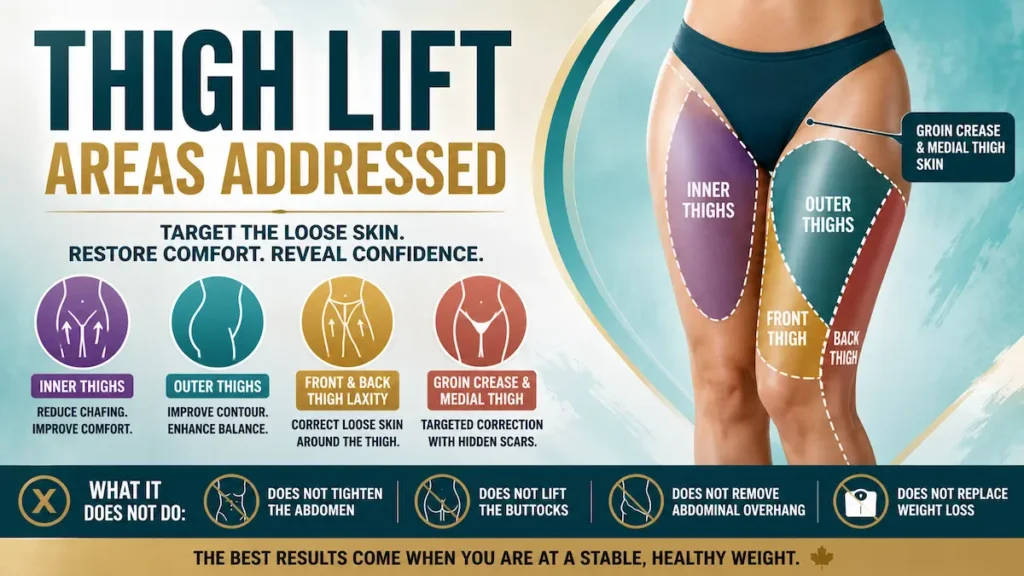
A thigh lift can address loose skin on the inner thighs, outer thighs, front thigh, back thigh, and groin-crease area. It is especially helpful when excess skin causes rubbing, folds, or an uneven contour after weight loss. A thigh lift does not tighten the abdomen, lift the buttocks, or replace weight loss, so full-body planning matters.
Inner Thighs
The inner thighs are the most common area treated with thigh lift surgery. This is where loose skin often hangs after weight loss and creates friction during walking.
Inner-thigh laxity can be mild, moderate, or significant. Mild laxity may sit close to the groin crease. More advanced laxity may extend down the medial thigh toward the knee.
For many patients, the inner thigh is both an aesthetic and functional concern. Reducing redundant skin can improve leg contour, but it can also reduce chafing, moisture trapping, and clothing discomfort.
Outer Thighs
Outer thigh laxity is different. It often connects to the hip, flank, and buttock region. This is why an outer thigh lift is sometimes considered within a broader lower-body contouring plan.
If the outer thigh has loose skin but the abdomen, hips, and buttocks also sag, a localized outer thigh lift may not be enough. A 360 body lift may offer a more complete correction in selected post-massive-weight-loss patients.
We assess outer-thigh laxity by looking at the full silhouette. The goal is balance, not simply pulling the thigh tighter.
Front and Back Thigh Laxity
Some patients have skin looseness that wraps around the thigh. This can affect the front, side, and back of the leg rather than only the inner thigh.
In these cases, a spiral thigh lift may be considered. It offers more circumferential correction, but it also involves more extensive planning and a larger scar pattern.
This is not the right choice for every patient. We recommend it only when the laxity pattern justifies the added recovery and incision length.
Groin-Crease and Medial Thigh Skin
The groin crease is an important scar-hiding zone for selected patients. A mini or limited inner thigh lift may place the incision mainly in this crease.
This approach can work well for mild upper-inner-thigh looseness. It cannot correct major hanging skin down the full thigh. That limitation must be understood before surgery.
When more skin must be removed, the scar may need to extend down the inner thigh. This gives more correction but makes scar planning more important.
What a Thigh Lift Does Not Address
A thigh lift does not tighten the abdomen, lift the buttocks, remove abdominal overhang, or correct upper-arm skin. Those concerns require different procedures.
For post-weight-loss patients, we often discuss whether a staged plan is better than treating one area in isolation. A thigh lift can pair well with an arm lift, tummy tuck, or mommy makeover when the patient’s health and recovery capacity support it.
It also does not replace weight loss. The best results occur when the patient is already close to a stable, healthy weight.
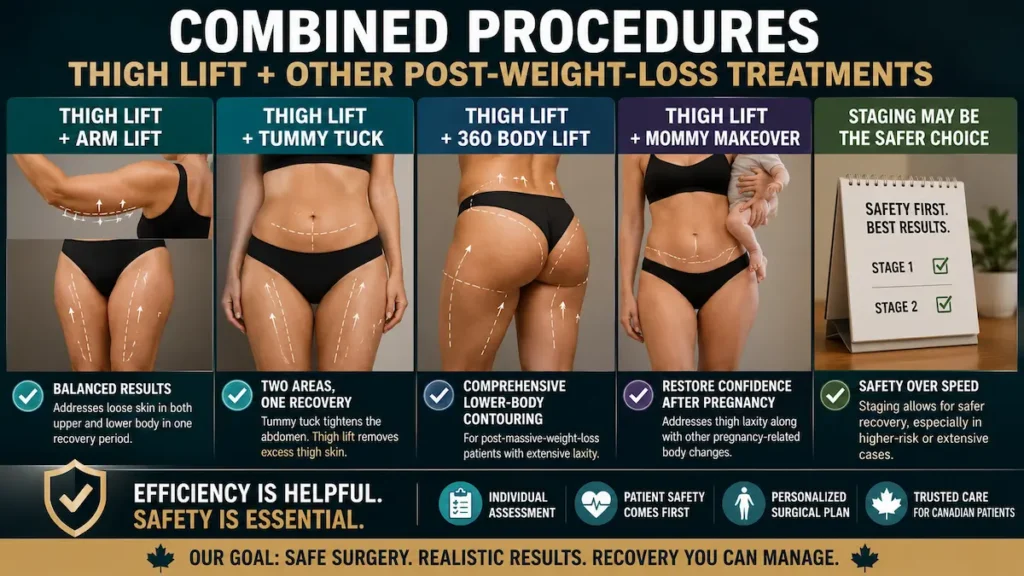
Combined Procedures: Thigh Lift + Other Post-Weight-Loss Treatments
Many post-weight-loss patients consider combining a thigh lift with an arm lift, tummy tuck, 360 body lift, or mommy makeover. Combining procedures can reduce the number of anaesthetic events and recovery periods, but it is not right for everyone. We prioritize safety, surgical time, mobility, wound healing, and whether your recovery plan is realistic after returning to Canada.
Thigh Lift + Arm Lift
A thigh lift is often paired with an arm lift for patients who have loose skin in both the upper and lower body after weight loss. This combination can create a more balanced result because the arms and thighs often change together after major weight reduction.
The benefit is efficiency. One anaesthetic plan and one recovery period may address two areas that bother the patient daily.
The trade-off is recovery demand. Both arms and thighs are high-movement zones. We only recommend this pairing when the patient’s health, mobility, support system, and scar expectations make sense.
For patients who are strong candidates, our Arm Lift + Thigh Lift package can reduce planning complexity by placing both procedures inside one coordinated clinical pathway.
Thigh Lift + Tummy Tuck
A tummy tuck and thigh lift can work well together when abdominal skin excess and inner-thigh laxity are both present. This pattern is common after pregnancy, bariatric surgery, or long-term weight fluctuation.
The procedures address different problems. A tummy tuck removes loose abdominal skin and can repair muscle separation when needed. A thigh lift removes excess thigh skin and improves leg contour.
Combining them requires careful safety planning. Surgery length, anesthesia time, blood-clot risk, mobility, and garment management must all be considered.
For broader post-weight-loss cases, we may also discuss the Tummy Tuck + Arm Lift + Thigh Lift package when one staged operation is clinically appropriate.
Thigh Lift + 360 Body Lift
A thigh lift may be part of a broader 360 body lift plan for post-massive-weight-loss patients. This is usually considered when laxity involves the abdomen, hips, buttocks, and outer thighs.
A 360 body lift can improve lower-body contour more globally. It may indirectly lift parts of the outer thigh and buttock region, while a separate thigh lift more directly addresses inner-thigh laxity.
These procedures should not be combined casually. The plan must consider surgical time, wound burden, patient nutrition, mobility, and fit-to-fly timing.
Thigh Lift as Part of a Mommy Makeover
A thigh lift can be included in a mommy makeover plan when pregnancy-related body changes include thigh laxity. This is less common than breast and abdominal combinations, but it can be appropriate for selected patients.
The key question is recovery practicality. A mommy makeover already places demands on mobility, sleep, garment use, and household support. Adding a thigh lift increases that demand.
We help patients choose between combining and staging. Sometimes one trip makes sense. Sometimes two safer, smaller recoveries are the better decision.
When Staging Is Better Than Combining
Staging means separating procedures into different operations. This can feel less efficient at first, but it may be safer for some patients.
We may recommend staging if the patient has a higher medical risk, extensive laxity, nutritional concerns, long expected surgery time, or limited support during recovery.
A good surgical plan is not always the fastest plan. It is the plan that gives the best balance of correction, safety, and recovery capacity.
“Combining procedures can be efficient, but efficiency is not the main goal. The main goal is a safe operation with a recovery plan the patient can actually follow.”
Anesthesia for Thigh Lift Surgery
Most full thigh lift procedures are performed under general anesthesia because the surgery involves skin excision, careful positioning, and controlled tissue closure. Limited cases may use sedation, depending on the technique and patient profile. Before surgery, we review your medical history, medications, weight-loss background, clotting risk, and fitness for long-haul travel back to Canada.
Thigh Lift Anesthesia Options
Most full thigh lift procedures are performed under general anesthesia. This allows the surgical team to manage comfort, positioning, airway safety, and operative time during a larger skin-excision procedure.
Limited procedures may sometimes involve sedation, depending on the exact scope and patient profile. However, a true medial, lateral, or spiral thigh lift usually requires deeper anaesthetic planning than a minor office procedure.
We do not position anesthesia as a marketing feature. The right anaesthetic plan is the one that supports safe surgery and controlled recovery.
Why Larger Skin-Excision Procedures Need Careful Monitoring
A thigh lift is more demanding than a small cosmetic procedure. It involves skin excision, tissue handling, wound-tension control, and compression garment planning.
During surgery, the anesthesia team monitors vital signs, fluid balance, body temperature, and patient positioning. This matters because thigh lift patients may have post-weight-loss nutritional concerns or a history of bariatric surgery.
For Canadian patients travelling internationally, we also consider the return-flight timeline. Surgery and travel must be planned together.
Pre-Anesthesia Assessment for Canadian Patients
Before confirming surgery, we review your medical history, current medications, allergies, prior surgeries, smoking or nicotine use, and any history of blood clots.
Post-bariatric patients may need extra attention to protein levels, iron, B12, vitamin D, and general healing capacity. If we need updated lab work, we will ask for it before your travel plan is finalized.
We may also recommend speaking with your Canadian family physician before booking flights. This is especially important if you have diabetes, cardiovascular disease, anemia, clotting history, or complex medication needs.
AKM Anesthesia Team Credentials
Our thigh lift procedures are planned in a hospital-based surgical environment with anesthesia support. This is important for body contouring procedures that may take several hours and require careful positioning.
We follow structured pre-operative screening, intra-operative monitoring, and post-operative observation. Patients are not rushed from consultation to surgery without medical review.
For international patients, this step protects both the surgery and the return journey. A safer operation begins before the operating room.
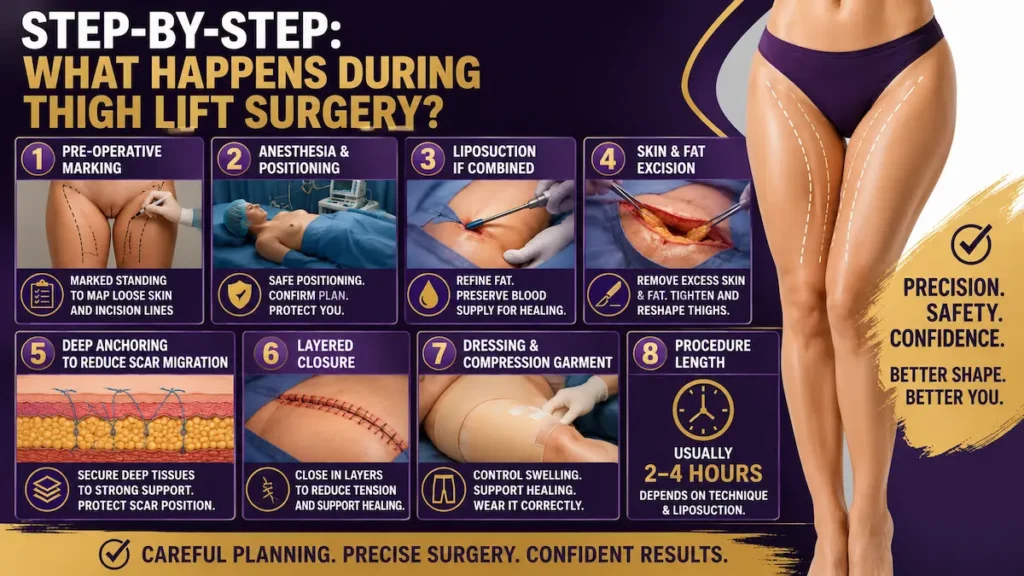
Step-by-Step: What Happens During Thigh Lift Surgery?
Thigh lift surgery begins with standing markings that show the true laxity pattern. After anesthesia and positioning, the surgeon follows the planned incision, removes excess skin and selected fatty tissue, and may add conservative liposuction if needed. Deep anchoring and layered closure help reduce wound tension, while compression garments support swelling control and early healing.
Pre-Operative Marking
Thigh lift planning begins before anesthesia. While you are standing, our surgeon marks the areas of loose skin, expected incision lines, and zones of tension.
Standing marks matter because thigh skin behaves differently when lying down. Gravity reveals the real laxity pattern. This helps us choose the correct technique and avoid under-correction.
Photos are taken for medical documentation and surgical planning. The final plan is reviewed with you before the operation.
Anesthesia and Positioning
After anesthesia begins, the surgical team positions you according to the planned technique. A medial thigh lift, lateral thigh lift, and spiral thigh lift may require different access and support.
Positioning is not only about surgeon access. It also protects pressure points, circulation, and airway safety during the procedure.
The team confirms the surgical plan before incision. Every step is matched to the markings discussed with you.
Liposuction If Combined
If liposuction is part of the plan, it is usually performed conservatively. The goal is to refine fat fullness while preserving tissue blood supply for healing.
Over-aggressive liposuction near the incision can increase risk. We use restraint when combining fat removal with skin excision.
This is why thigh lift planning must distinguish between contour and laxity. Fat removal and skin removal solve different problems.
Skin and Fat Excision
The surgeon removes the planned amount of skin and, when appropriate, underlying fatty tissue. The incision pattern depends on the technique chosen during consultation.
A mini lift may remove a smaller crescent of skin near the groin crease. A vertical medial lift may remove a longer panel of skin along the inner thigh. A spiral lift may address more circumferential laxity.
The goal is controlled tightening. Removing too much skin can create wound tension, scar widening, or contour distortion.
Deep Anchoring to Reduce Scar Migration
Deep anchoring is a key part of thigh lift surgery. The deeper tissues may be secured to stronger support structures to reduce downward pull on the scar.
This helps protect scar position and lowers the risk of widening or migration. It is especially important in the medial thigh, where movement and gravity create ongoing tension.
Good thigh lift surgery is not only about cutting away skin. It is about managing forces on the closure.
Layered Closure
The incision is closed in layers to distribute tension. Deep sutures support the tissue, while the skin layer is closed more precisely.
This layered approach helps reduce strain on the outer scar. It does not remove the scar, but it improves the conditions for better healing.
Dressings are applied once closure is complete. The surgical team then places your compression garment.
Dressing and Compression Garment
Compression helps control swelling and supports the healing tissue. It also reminds patients to move carefully during the early phase.
The garment must fit properly. Too loose, and it does not support the tissue. Too tight, and it can cause discomfort or circulation issues.
We explain how to wear it, how to remove it safely, and what signs should prompt a message to your coordinator.
Procedure Length
A thigh lift usually takes about two to four hours, depending on the technique and whether liposuction is included. More extensive post-weight-loss cases may take longer.
Procedure time is not a competition. A careful, properly planned operation is safer than rushing to keep the surgery short.
After surgery, you are monitored during the immediate recovery phase before returning to your hospital room or hotel pathway, depending on the plan.
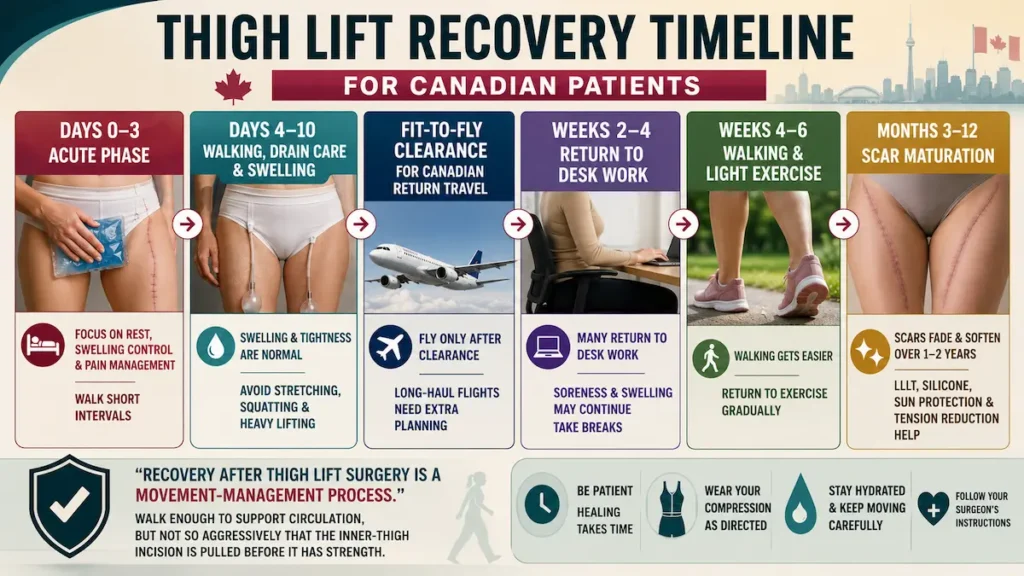
Thigh Lift Recovery: Timeline for Canadian Patients
Thigh lift recovery usually begins with rest, swelling control, short walks, and compression garment use during the first few days. By days 4–10, walking becomes easier, though tightness and swelling remain normal. Canadian patients should fly home only after fit-to-fly clearance. Desk work, light exercise, and scar maturation happen gradually over weeks to months.
Days 0–3: Acute Phase
The first few days focus on rest, swelling control, pain management, and safe movement. You will wear your compression garment and follow specific positioning instructions.
Walking is usually encouraged in short, careful intervals. This helps circulation and reduces stiffness. You should not push through pain or attempt long walks too early.
Some patients have drains, depending on the technique and surgical plan. If drains are used, we teach you how they work and when they may be removed.
Days 4–10: Walking, Drain Care, and Swelling
By days 4 to 10, most patients move more comfortably, but swelling and tightness remain expected. The inner thighs may feel firm or tender.
You should still avoid wide leg movements, squatting, heavy lifting, or stretching the incision. The scar is still building strength.
We monitor photos, symptoms, and progress during this stage. If you are travelling from Canada, this period is also when your return-flight readiness begins to be assessed.
Our HBOT/LLLT Recovery Protocol
We use recovery technologies to support healing in selected surgical patients. Hyperbaric Oxygen Therapy, or HBOT, increases oxygen delivery to healing tissues. Low-Level Laser Therapy, or LLLT, supports cellular activity and scar maturation.
These technologies do not replace surgical technique. They support the healing environment after surgery.
For thigh lift patients, this matters because the medial thigh is a high-movement, high-tension area. Better swelling control and scar support can make recovery more predictable.
For a deeper explanation of our recovery technologies, see our technology and standards page and our guide to hyperbaric oxygen therapy benefits.
Fit-to-Fly Clearance for Canadian Return Travel
Canadian patients should not fly home until they have been cleared by the surgical team. Thigh lift recovery must be planned around walking ability, swelling, garment comfort, and blood-clot risk reduction.
Long-haul flights from Istanbul to Toronto, Montreal, Vancouver, or Calgary require extra planning. You may need aisle access, hydration, gentle in-flight movement, and compression discipline.
We discuss flight timing individually. For broader guidance, our flight safety after surgery guide explains the travel considerations Canadian patients should understand before booking.
Weeks 2–4: Return to Desk Work
Many patients can return to desk-based work during this window, especially if they can work remotely. Long commutes, standing jobs, and physically demanding roles require more time.
You may still feel pulling, tightness, or swelling when sitting. Adjusting your chair position and taking short walking breaks can help.
Returning to work does not mean returning to exercise. The incision is still healing internally.
Weeks 4–6: Walking and Light Exercise
By weeks 4 to 6, walking becomes easier for most patients. Light activity may resume if swelling is controlled and the surgeon approves it.
Lower-body training, cycling, running, and deep stretching usually need more caution. The inner thigh scar can widen if stressed too early.
Your return to exercise should be gradual. A slow return protects the result.
Months 3–12: Scar Maturation
Thigh lift scars change slowly. They may look pink, firm, raised, or darker in the first months. That does not mean the final scar has declared itself.
Scar maturation often continues for one to two years. LLLT, silicone care, sun protection, and tension reduction can support a better final appearance.
A scar cannot disappear completely. The goal is a flatter, softer, lighter scar that becomes easier to conceal and accept over time.
“Recovery after thigh lift surgery is a movement-management process. The patient must walk enough to support circulation, but not so aggressively that the inner-thigh incision is pulled before it has strength.”
Safety, Risks & Thigh Lift Scars: An Honest Look
A thigh lift creates visible scars because excess skin cannot be removed without an incision. Common risks include swelling, bruising, numbness, delayed wound healing, asymmetry, scar widening, infection, and blood clots. We reduce risk through careful patient selection, hospital-based surgery, layered closure, compression, movement guidance, and long-term scar care. A “scarless thigh lift” is not realistic.
Common Side Effects After a Thigh Lift
Thigh lift surgery creates predictable short-term effects. Swelling, bruising, tightness, tenderness, and temporary numbness are common in the first weeks.
The inner thighs may feel especially sensitive because the area moves during walking, sitting, standing, and turning in bed. This does not mean something is wrong. It means the surgical area is active during normal daily movement.
Most patients also notice firmness along the incision. This softens gradually as swelling decreases and scar tissue matures.
Medial Thigh Scar Reality
A thigh lift leaves scars. That statement should be clear before any patient commits to surgery.
With an inner or medial thigh lift, the scar may sit in the groin crease, extend down the inner thigh, or combine both patterns. The exact placement depends on how much skin must be removed.
Shorter scars can be easier to conceal, but they also correct less laxity. Longer scars allow stronger correction, especially after major weight loss. The right choice depends on your anatomy and your scar tolerance.
Early scars may look red, raised, dark, or firm. Over time, most scars flatten and fade. They do not vanish completely.
Is a Scarless Thigh Lift Real?
No. A true scarless thigh lift is not real because skin cannot be removed without an incision.
Some clinics use “scarless” to describe non-surgical tightening, limited liposuction, or a short groin-crease incision. Those options may suit mild cases, but they do not correct hanging thigh skin after significant weight loss.
This is one of the most important decisions in thighplasty. A patient who needs skin removal must decide whether the improvement is worth a planned scar. We help you make that decision before you travel.
High-Tension Wound Healing Areas
The inner thigh is a challenging healing area. It moves often, holds moisture, and experiences friction from walking and sitting.
That is why wound-tension control matters. If the incision is closed under too much strain, the scar may widen or healing may slow. We reduce this risk through careful planning, deep support, layered closure, compression, and movement restrictions.
Healing also depends on patient factors. Smoking, nicotine, diabetes, anemia, poor nutrition, and unstable weight can raise the risk of wound problems.
Numbness, Swelling, and Asymmetry
Temporary numbness is common after skin-excision surgery. Small sensory nerves are stretched or divided during tissue removal. Sensation often improves with time, but some numbness can persist.
Swelling can also make the thighs look uneven early in recovery. This usually improves as fluid reduces and tissues settle.
True asymmetry is possible because no two thighs are perfectly identical before surgery. Our goal is proportionate improvement, not mathematically identical legs.
LLLT for Scar Maturation
Low-Level Laser Therapy, or LLLT, can support scar maturation by stimulating cellular activity and tissue repair. At AKM Clinic, our LLLT system uses 424 medical-grade semiconductor laser diodes at 650nm.
LLLT does not erase scars. It supports the healing environment so the scar has a better chance of becoming flatter, softer, and less noticeable over time.
Scar care is a long process. We combine technology with patient habits: silicone support when appropriate, sun protection, hydration, garment use, and controlled movement.
For more detail on scar support, see our guide on minimizing scars with LLLT laser therapy.
How We Reduce Risk at AKM Clinic
Risk reduction starts with patient selection. We do not approve surgery just because a patient wants it. We check medical history, weight stability, scar expectations, medications, and travel readiness.
During surgery, our European Board-Certified Surgeons use technique-specific incision planning, controlled tissue removal, layered closure, and compression support. After surgery, our coordinators monitor your recovery and keep communication open.
We also provide structured long-term virtual follow-up at 1, 3, 6, and 12 months. Canadian patients should not feel abandoned once they fly home.
For an external patient-education overview of thigh lift risks, the American Society of Plastic Surgeons thigh lift safety page lists general risks such as anesthesia risks, asymmetry, wound healing problems, infection, and the possibility of revision surgery. We use this kind of public reference as a discussion starting point, not as a substitute for an individualized consultation.
“The scar is part of the thigh lift decision. Our job is to place it thoughtfully, reduce tension, support maturation, and make sure the patient understands the trade-off before surgery.”
| Scar Stage | Typical Appearance | What Helps | Patient Reminder |
|---|---|---|---|
| First 2–6 weeks | Pink, firm, swollen, sometimes raised | Compression, careful walking, wound care | This is early healing, not the final scar. |
| 3–6 months | Less swollen, still visible, may darken or lighten | Silicone care, LLLT when appropriate, sun protection | Scar maturation is still active. |
| 12 months | Flatter and softer for most patients | Consistent scar care and stable weight | Colour can continue changing. |
| 18–24 months | More settled, lighter, easier to conceal | Long-term protection from sun and friction | The scar fades, but it does not disappear. |
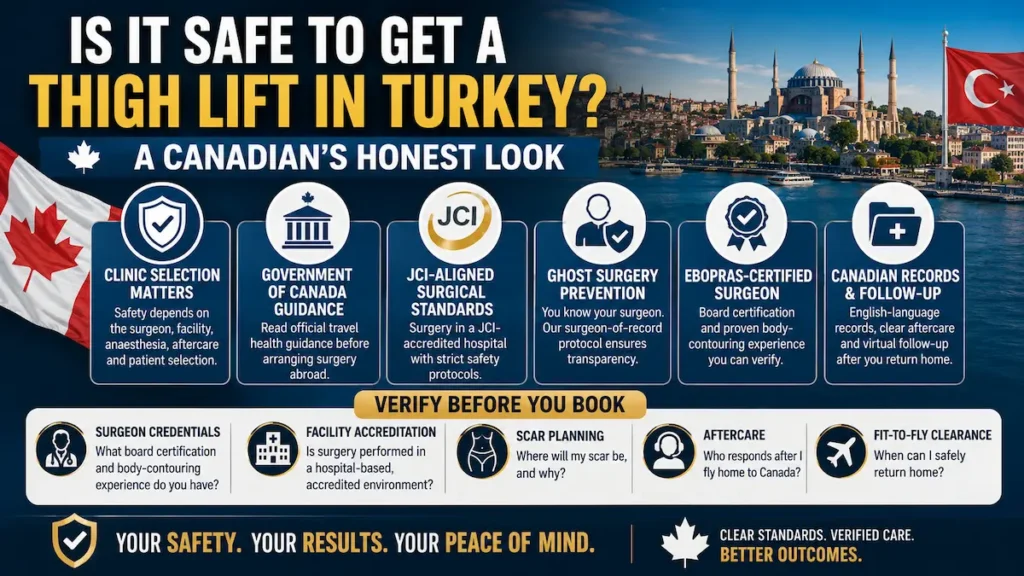
Is It Safe to Get a Thigh Lift in Turkey? A Canadian’s Honest Look
Getting a thigh lift in Turkey can be safe when the clinic, surgeon, facility, anesthesia support, and follow-up systems are properly verified. Canadian patients should confirm surgeon credentials, hospital standards, English-language medical records, fit-to-fly planning, and aftercare before booking. At AKM Clinic, we use a surgeon-led pathway, JCI-accredited hospital care, and structured follow-up after you return home.
The Turkey Safety Reality: Clinic Selection Matters
Turkey is a major destination for international surgical care, but not every clinic offers the same standard. This distinction matters.
A safe thigh lift depends on the surgeon, facility, anesthesia support, sterilization, aftercare, and patient selection. Geography alone does not protect you. Verification does.
We encourage Canadian patients to compare clinics with the same seriousness they would use when assessing a private clinic in Toronto, Vancouver, Calgary, or Montreal. Ask who performs the surgery, where it is performed, how complications are handled, and what follow-up is included.
Our broader safety guide, Is It Safe to Get Plastic Surgery in Turkey?, explains the verification steps Canadian patients should use before booking any international surgical programme.
What Government of Canada Guidance Says
Canadian patients should read official travel health guidance before arranging elective surgery abroad. The Government of Canada guidance on receiving medical care outside Canada discusses concerns such as complications, resistant infections, language barriers, and the importance of proper medical records.
We do not dismiss those concerns. We address them through surgeon-of-record clarity, English-language documentation, hospital-based surgery, structured follow-up, and clear fit-to-fly planning.
JCI-Aligned Surgical Standards
We perform surgery in a JCI-accredited hospital environment with structured safety protocols. This includes pre-operative testing, sterile operating-room workflow, anesthesia monitoring, and post-operative observation.
For thigh lift surgery, facility standards matter because the procedure can involve longer incisions, larger tissue surfaces, and a higher demand on wound healing. A properly equipped surgical environment is not optional.
We also use English-language documentation so patients can share records with their Canadian family physician if needed.
Ghost Surgery Prevention
Ghost surgery means the patient believes one surgeon will operate, but another person performs key parts of the procedure. This is a serious concern in international care.
Our surgeon-of-record protocol is clear. You know who is responsible for your operation, and your plan is reviewed before surgery. We do not treat surgical identity as a vague administrative detail.
Canadian patients should ask every clinic direct questions:
- Who will perform the surgery?
- Will the named surgeon be present for the critical steps?
- Where is the operation performed?
- What credentials can I verify?
- How is follow-up managed after I return home?
For a focused checklist, read our article on ghost surgery in Turkey.
EBOPRAS-Certified Surgeon Verification
Canadian patients often understand the Royal College of Physicians and Surgeons of Canada framework. In Europe, EBOPRAS certification provides a structured board-certification pathway for plastic surgeons.
The exact systems are not identical, but the principle is familiar: verify training, specialty focus, facility standards, and ongoing surgical experience. Credentials should be understandable, not hidden behind vague marketing language.
Our surgeon checklist later in this guide explains what to ask and what documentation to request. You can also review our plastic surgeon board certification guide.
Canadian Medical Records and Follow-Up
Follow-up matters more when you travel for surgery. You need clear records, discharge instructions, medication guidance, and a team that responds after you leave Istanbul.
We provide English-language discharge summaries and recovery instructions. We also maintain communication through your patient coordinator and virtual follow-up schedule.
If you have a Canadian family physician, we encourage you to involve them before travel when appropriate. They do not need to manage the cosmetic result, but they can help with general medical readiness and continuity.
Travel Insurance Limitations
Most standard Canadian travel insurance policies do not cover elective cosmetic surgery complications. Patients should read their policy carefully before booking.
This does not mean international surgery is automatically unsafe. It means financial planning should be honest. You should understand what is covered, what is excluded, and what support the clinic provides if concerns arise.
We discuss recovery expectations, return-flight timing, and emergency communication before you travel. Clear planning reduces uncertainty.
What Canadian Patients Should Verify Before Booking
Before choosing any clinic for thigh lift surgery abroad, use a verification checklist. Do not rely only on social media photos.
| Verification Point | What to Ask | Why It Matters |
|---|---|---|
| Surgeon credentials | What board certification and body-contouring experience do you have? | Thigh lift requires skin-excision planning, not only aesthetic judgment. |
| Facility accreditation | Is surgery performed in a hospital-based, accredited environment? | Longer body procedures need proper monitoring and sterile workflow. |
| Scar planning | Where will my scar be, and why? | Scar placement is central to the result. |
| Aftercare | Who responds after I fly home to Canada? | International patients need structured continuity. |
| Fit-to-fly clearance | When can I safely return home? | Long-haul travel must be planned around swelling and mobility. |
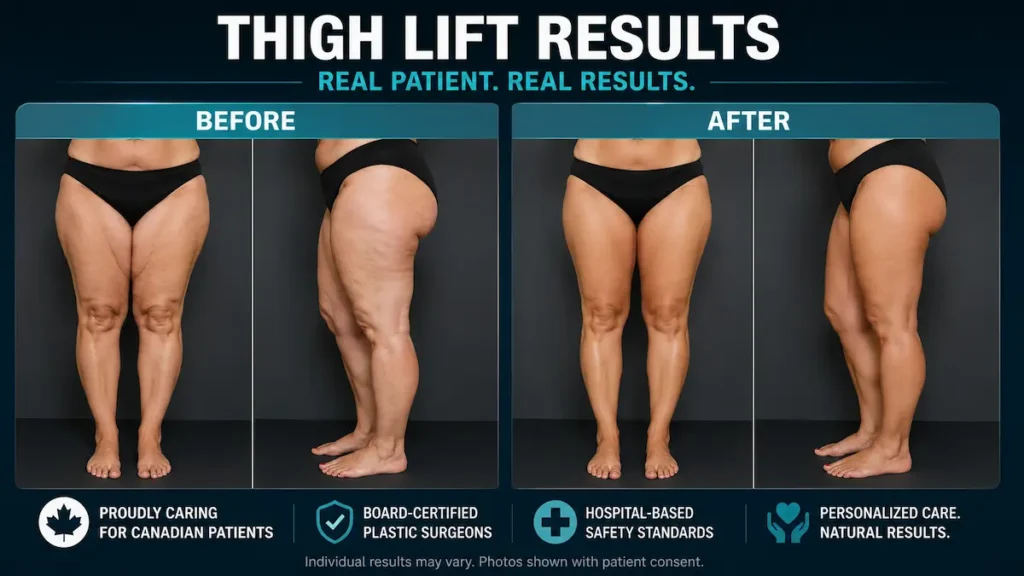
Thigh Lift Before and After: Realistic Expectations & Results
Thigh lift before and after results should show smoother contour, reduced loose skin, and better proportion, not an over-tight or artificial leg shape. Early swelling can hide the final result, and scars may look firm or pink for several months. Final contour and scar maturation can continue for 12 to 24 months, depending on skin quality and healing.
Thigh Lift Before and After: What Actually Changes
Thigh lift before and after results should be judged by skin removal, contour improvement, and proportion. The goal is not to create unusually thin legs. It is to remove loose skin that no longer matches the patient’s current body.
After surgery, the thighs usually look smoother and firmer. Hanging folds are reduced. Clothing may fit better. Inner-thigh rubbing may also improve when excess medial skin is removed.
The result continues changing for months. Early swelling can make the thighs look tight, uneven, or fuller than expected. This usually softens as tissues settle.
Mini Thigh Lift Before and After: Limited Correction
A mini thigh lift can create a meaningful improvement for the right patient. It works best when looseness is mild and sits near the upper inner thigh.
The main advantage is scar placement. The incision is usually limited to the groin crease, making it easier to conceal than a longer vertical scar.
The limitation is correction power. If loose skin extends down the inner thigh, a mini lift may not remove enough tissue. In that case, a longer inner thigh lift may be more honest.
Inner / Medial Thigh Lift Before and After
An inner or medial thigh lift can create a stronger change in patients with post-weight-loss sagging. It removes skin from the inner thigh, where laxity often causes chafing and visible folds.
Before surgery, the inner thighs may look deflated or wrinkled. After surgery, the thigh contour can appear smoother and more supported. The trade-off is the medial scar.
This scar may run in the groin crease, down the inner thigh, or both. We show scar expectations clearly during consultation because the scar is part of the result, not an afterthought.
Before and After Including the Scar
Thigh lift results should not be presented with the scar hidden from the conversation. A patient deserves to know what the improvement looks like and what incision pattern made that improvement possible.
In the early months, scars can look obvious. They may be red, pink, darker than nearby skin, or firm. This can be emotionally difficult even when the contour improvement is strong.
Over one to two years, scars usually fade and soften. They do not fully disappear. This is why thigh lift surgery is best for patients who value skin removal enough to accept a planned scar.
Is It Permanent? Yes, With Stable Weight
Thigh lift results are long-lasting because removed skin does not return. Stable weight helps preserve the contour.
Large weight gain can stretch the tissues again. Further major weight loss can create new looseness. Pregnancy, aging, and collagen changes can also affect the result over time.
For post-weight-loss patients, timing matters. The best result usually comes when the body has already reached a stable point.
Before & After Gallery
Before and after photos help patients understand scar placement, contour change, and realistic improvement. They should be reviewed with a clinical explanation, not as isolated images.
You can explore our case examples through the before and after gallery. During consultation, we can discuss which examples are most similar to your anatomy and laxity pattern.
We encourage patients to look for two things: whether the skin excess was actually corrected, and whether the scar trade-off feels acceptable to them.
“A thigh lift result is successful when the contour improvement and the scar trade-off make sense together. We do not separate those two conversations.”
Thigh Lift Cost 2026: Turkey vs Canada
Canadian patients researching thigh lift cost often compare private quotes in Toronto, Ottawa, Vancouver, and Montreal with all-inclusive surgical care in Istanbul. The gap is usually significant, especially when Canadian clinic estimates separate surgeon fees, facility fees, anesthesia, garments, and follow-up.
At AKM Clinic, technique-level thigh lift pricing starts at CAD $4,100 for Inner Thigh Lift, Mini Thigh Lift, or Outer Thigh Lift. A Vertical Thigh Lift is CAD $5,450, while a Spiral Thigh Lift is CAD $6,150. Liposuction-only thigh reduction is CAD $4,800 for patients with fat fullness and highly elastic skin.
Our Thigh Lift All-Inclusive Package is CAD $5,450, including 3 nights of hotel stay, VIP transfers, pre-operative testing, surgery, post-operative medication, support garment, and 24/7 patient advocacy.
By comparison, Toronto private thigh lift quotes commonly fall around CAD $13,000–$16,000, while Vancouver may reach CAD $14,000–$17,000. Ottawa and Montreal vary by facility and surgeon experience. For a full breakdown, see our thigh lift cost guide for Canadian patients.
Canadian-dollar pricing shown for planning clarity; your coordinator will confirm the final payment details before booking.
| Location / Option | Typical CAD Range | What Is Usually Included | Important Note |
|---|---|---|---|
| Toronto private thigh lift | CAD $13,000–$16,000 | Often surgical fee first; facility and anesthesia may be separate | Ask for a full written quote. |
| Ottawa private thigh lift | Variable by clinic | Usually private-pay cosmetic pathway | Availability may be limited. |
| Vancouver private thigh lift | CAD $14,000–$17,000 | Often separate line items | Higher private-clinic overhead can affect pricing. |
| Montreal private thigh lift | Variable by surgeon and facility | Private-pay unless rare functional criteria apply | Confirm whether follow-up is included. |
| AKM Clinic Istanbul | CAD $5,450 all-inclusive package | Surgery, 3-night hotel stay, VIP transfers, tests, garment, medication, advocacy | Canadian-dollar pricing shown for planning clarity; your coordinator will confirm the final payment details before booking. |
How to Find the Best Thigh Lift Surgeon in Turkey: A Canadian Patient’s Checklist
The best thigh lift surgeon for your case should understand post-weight-loss body contouring, scar placement, wound tension, and the full range of thigh lift techniques. Canadian patients should verify board certification, hospital setting, before-and-after examples, scar discussion, aftercare access, and whether the surgeon recommends the right technique rather than the smallest or easiest incision.
EBOPRAS Certification and RCPSC Equivalency
Canadian patients are used to checking whether a specialist is properly trained and regulated. In Canada, the Royal College of Physicians and Surgeons of Canada’s specialist certification framework is a familiar reference point.
In Europe, EBOPRAS certification is one of the key plastic surgery board pathways patients should understand. The systems are not identical, but the purpose is similar: to confirm structured specialty training and professional standards.
When comparing clinics in Turkey, do not stop at the word “surgeon.” Ask what board certification the surgeon holds, what body contouring experience they have, and whether they routinely perform post-weight-loss skin-excision procedures.
For more detail on how Canadian patients can evaluate training pathways, see our plastic surgeon board certification guide.
Body Contouring Sub-Specialization
A thigh lift is not simply a “leg tightening” procedure. It is a post-weight-loss body contouring operation that requires judgement about skin laxity, scar placement, wound tension, and long-term proportion.
The surgeon should understand how the thighs relate to the abdomen, buttocks, hips, and arms. Many patients who need thighplasty also need broader body-contouring planning.
Canadian patients can use the Canadian Society of Plastic Surgeons’ guidance on choosing a surgeon as a familiar professional reference point when thinking about specialty standards, terminology, and the difference between properly trained specialists and vague cosmetic titles.
Ask whether the surgeon regularly performs:
- Inner / medial thigh lifts.
- Vertical thigh lifts.
- Outer / lateral thigh lifts.
- Spiral thigh lifts.
- Combined post-weight-loss procedures.
A surgeon who offers only one technique may try to fit every patient into that technique. That is not how thigh lift planning should work.
Technique Range: Inner, Outer, Spiral, and Mini Capability
The best thigh lift plan starts with the correct technique. A mini thigh lift is not enough for significant vertical skin excess. A spiral thigh lift may be unnecessary for mild upper-inner-thigh laxity.
During consultation, your surgeon should explain why a specific incision pattern is recommended. The explanation should connect directly to your anatomy.
Good questions include:
- Where is my laxity strongest?
- Can a groin-crease incision correct it?
- Do I need a vertical scar?
- Would liposuction help or harm my result?
- Could this be staged with another body procedure?
If the answer is vague, keep asking. The technique choice determines both the result and the scar.
Honest Scar Discussion
A trustworthy thigh lift surgeon should talk about scars before the patient asks. Scar placement, scar length, and scar maturation are central to the procedure.
Be cautious if a clinic promises a “scarless thigh lift” for significant loose skin. A true skin-excision procedure leaves a scar. The honest conversation is about where that scar sits, how it may heal, and whether the correction is worth it.
Ask to review before and after examples that show the scar, not only flattering front-view contour photos. A good result should be discussed from multiple angles.
International Membership and Professional Screening
International memberships are not a substitute for direct surgeon verification, but they can help patients ask better questions. The International Society of Aesthetic Plastic Surgery’s Find a Surgeon directory is one global professional resource Canadian patients may use during surgeon research.
Use these references as part of a wider checklist. Confirm the actual operating surgeon, facility, anesthesia plan, scar strategy, aftercare pathway, and complication response protocol before you book.
Real Patient Reviews and Before/After Documentation
Before and after photos should be relevant to your body type, laxity pattern, and technique. A mini thigh lift case does not predict a spiral thigh lift result.
Reviews should also mention aftercare, communication, scar support, and follow-up. For international patients, the experience after surgery matters as much as the operation itself.
You can review our broader patient feedback through professional plastic surgery reviews. During consultation, we can help you compare examples that match your clinical pattern more closely.
Aftercare Continuity From Istanbul to Canada
Aftercare is not finished when you leave Istanbul. Thigh lift recovery continues for months, and scar maturation can continue for one to two years.
Our care pathway includes communication with your patient coordinator, recovery instructions, photo review when appropriate, and long-term virtual follow-ups at 1, 3, 6, and 12 months.
For Canadian patients, this continuity matters. You may be thousands of kilometres away, but you should still know who to contact and what to send if you have a concern.
| Credential / Standard | What It Means | Why It Matters for Canadians |
|---|---|---|
| EBOPRAS | European board pathway for plastic surgery certification | Helps patients verify structured specialty training outside Canada. |
| RCPSC | Canadian specialist certification reference point | Useful comparison framework for Canadian patients assessing credentials abroad. |
| Body-contouring experience | Practical surgical volume in skin-excision procedures | Thigh lift requires scar and tension management, not only aesthetic design. |
| Hospital-based surgery | Procedure performed in an equipped surgical environment | Important for anesthesia, monitoring, and post-operative safety. |
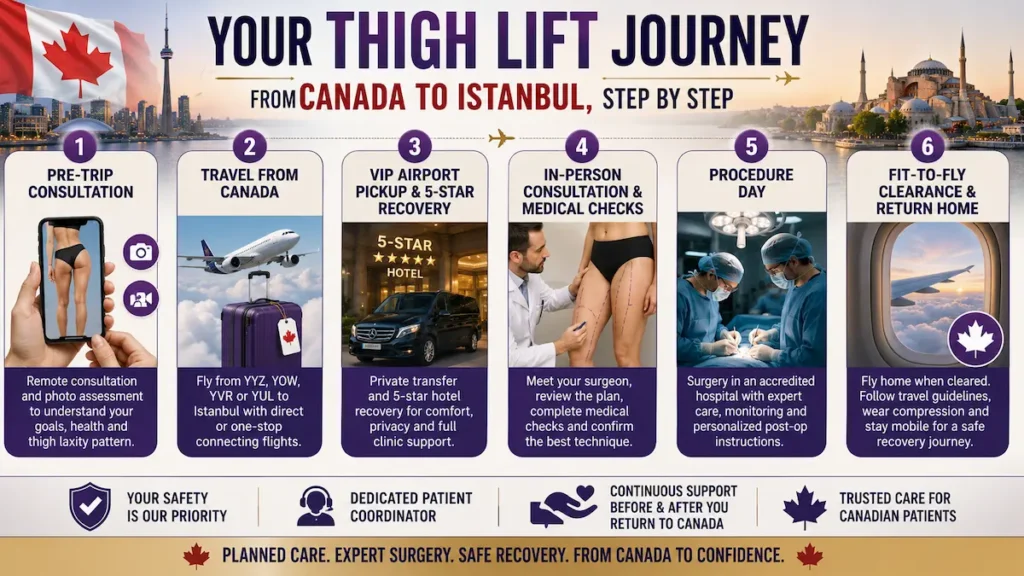
Your Thigh Lift Journey from Canada: From YYZ to Istanbul, Step by Step
Your thigh lift journey begins with remote consultation, photo assessment, and technique planning before you travel. After arriving in Istanbul, we coordinate VIP transfer, hotel recovery, in-person consultation, medical checks, surgery, early aftercare, and fit-to-fly clearance. The process is designed for Canadian patients who need clear logistics, privacy, medical support, and continuity after returning home.
Pre-Trip Consultation
Your thigh lift journey begins before you book a flight. We start with a remote consultation and photo assessment so our team can understand your laxity pattern, scar tolerance, health background, and goals.
Photos usually need to show the thighs from the front, side, back, and standing positions. Clothing should allow the surgeon to assess the upper thigh, groin crease, hip line, and lower-thigh laxity.
During this stage, we discuss whether you are a better candidate for inner thigh lift, mini thigh lift, vertical thigh lift, spiral thigh lift, liposuction, or a combined plan. We also review whether your weight is stable enough for surgery.
For a full overview of the travel pathway, see our Canadian patient journey guide.
Travel Logistics From Toronto, Ottawa, Vancouver, and Montreal
Most Canadian patients fly into Istanbul Airport from major Canadian cities such as Toronto, Ottawa, Vancouver, or Montreal, often with direct or one-stop routing depending on the season and airline schedule.
Flight availability changes. We recommend checking current routes before finalizing your dates. Your return flight should be planned only after the expected fit-to-fly window has been discussed with our team.
Canadian citizens can typically enter Turkey for short medical and tourism stays without a visa, but passport validity and airline requirements should be checked before travel.
VIP Airport Pickup and 5-Star Hotel Recovery
After arrival in Istanbul, your private transfer brings you to the hotel or clinic pathway according to your itinerary. We use a coordinated system so you are not trying to navigate a new city immediately before surgery.
Our 5-star hotel recovery structure is designed for rest, privacy, and access to clinic support. You can learn more about the facility experience through our Istanbul clinic page.
For thigh lift patients, hotel comfort matters because sitting, standing, and walking need to be managed carefully. Loose clothing, easy bathroom access, and enough rest time are practical recovery details, not luxuries.
In-Person Consultation and Medical Checks
Before surgery, you meet the surgical team in person. The surgeon reviews the plan, confirms the technique, and marks the thigh laxity pattern.
You also complete required medical checks. These may include blood work, anesthesia review, medication review, and any additional steps needed for your health profile.
This in-person step protects patient safety. If something changes after travel, the plan can be modified. Surgery should never feel automatic.
Procedure Day
On surgery day, you arrive at the hospital-based surgical setting. The team confirms identity, procedure, technique, markings, and anesthesia plan.
After surgery, you are monitored during the early recovery phase. You will wake with dressings, compression, and movement instructions. If drains are used, the team explains how they are managed.
Your patient coordinator remains involved. The goal is to make the first stage of recovery clear, supported, and calm.
Fit-to-Fly Clearance and Return Travel
You should not fly home until the surgical team clears you. Thigh lift return travel depends on wound stability, mobility, swelling, pain control, drain status, and blood-clot risk considerations.
For the flight, you may need:
- Compression garment discipline.
- Loose clothing.
- Aisle-seat access when possible.
- Short, careful walks during the flight.
- Hydration and medication timing.
- A plan for sitting comfortably.
Long-haul travel after thigh surgery requires planning. We give instructions before departure and continue to monitor your recovery after you return to Canada.
“The flight home is part of the surgical plan. We do not treat it as an afterthought, especially for thigh lift patients who need mobility, compression, and wound protection during long-haul travel.”
Tgigh Lift Surgery Frequently Asked Questions (FAQ):
Will a thigh lift leave a visible scar?
Yes. A thigh lift removes skin, and skin removal requires an incision. The scar may sit in the groin crease, down the inner thigh, or in a more extended pattern depending on the technique.
Scars usually fade over one to two years, but they do not disappear completely. We discuss scar placement before surgery so you can decide whether the trade-off feels worthwhile.
Is a “scarless thigh lift” real?
No. A true scarless thigh lift is not real if excess skin is being removed. Non-surgical treatments may improve mild skin quality, and liposuction can remove fat, but neither can remove hanging skin without an incision.
What is the difference between an inner, spiral, and mini thigh lift?
A mini thigh lift treats mild upper-inner-thigh laxity with a shorter incision near the groin crease. An inner or medial thigh lift treats more significant inner-thigh skin excess and may require a vertical scar.
A spiral thigh lift addresses more extensive laxity that wraps around the thigh. It is usually reserved for post-massive-weight-loss patients who need stronger correction.
Do I need a thigh lift or just liposuction?
You may need liposuction if your main issue is fat fullness and your skin still has good elasticity. You may need a thigh lift if your main issue is hanging or folded skin.
Some patients need both. Liposuction can refine contour, while the thigh lift removes loose skin.
Does OHIP, MSP, AHCIP, or RAMQ cover a thigh lift after weight loss?
Provincial health plans rarely cover thigh lift surgery when it is considered cosmetic. In unusual cases, documentation of severe functional problems may be reviewed locally, but coverage is not guaranteed.
Most Canadian patients should plan for thigh lift surgery as a private-pay procedure. Ask your provincial plan and family physician about your specific situation before assuming coverage.
How much does a thigh lift cost in Toronto vs Istanbul?
Toronto private thigh lift quotes often fall around CAD $13,000–$16,000, while Vancouver can be CAD $14,000–$17,000. At AKM Clinic, the Thigh Lift All-Inclusive Package is CAD $5,450.
For a more detailed city-by-city comparison, visit our thigh lift cost guide.
Does Canadian travel insurance cover complications from elective thigh lift surgery in Turkey?
Many Canadian travel insurance policies exclude elective cosmetic surgery and complications related to it. You should review your policy carefully before booking and ask the insurer direct written questions.
To reduce this concern, AKM Clinic provides complimentary complication insurance for all patients. This is separate from standard Canadian travel insurance and is designed to add an extra layer of protection around your surgical care. Your coordinator will explain the coverage terms, limits, and required documentation before you confirm your booking.
How long until my thigh lift scar fades?
Most thigh lift scars change significantly over 12 to 24 months. They may look pink, raised, firm, or darker in the early months.
With time, careful movement, compression, scar care, and sun protection, scars often become flatter and lighter. They still remain visible to some degree.
When can I walk normally after a thigh lift?
You will usually begin gentle walking early, but “normal” walking takes longer. Many patients move more comfortably after two to four weeks, although tightness and swelling can persist.
Long walks, stairs, cycling, running, and gym training should wait until your surgeon clears you. Pushing too early can strain the incision.
Is the result permanent?
The removed skin is permanently gone. Your result can last many years if your weight remains stable and you follow recovery instructions.
Aging, major weight gain, further weight loss, pregnancy, and collagen changes can affect the result over time.
Can I have a thigh lift if I am still losing weight?
It is usually better to wait until your weight is stable. If you continue losing weight after surgery, new skin laxity may develop.
We assess this individually. A safer delay can protect your final result.
Can I combine a thigh lift with an arm lift or tummy tuck in one trip?
Yes, selected patients can combine a thigh lift with an arm lift, tummy tuck, or broader post-weight-loss body contouring plan. The decision depends on your health, procedure length, recovery support, and travel timeline.
We will recommend staging if combining procedures would make recovery too demanding or increase risk.
Medical Disclaimer: This page is for educational purposes only and does not replace medical advice from a qualified physician. Thigh lift candidacy, technique selection, anesthesia, recovery timing, and travel clearance must be assessed individually. All surgery carries risks, including bleeding, infection, scarring, delayed wound healing, asymmetry, numbness, blood clots, and the need for revision. Results vary based on anatomy, skin quality, weight stability, medical history, and adherence to post-operative instructions.