



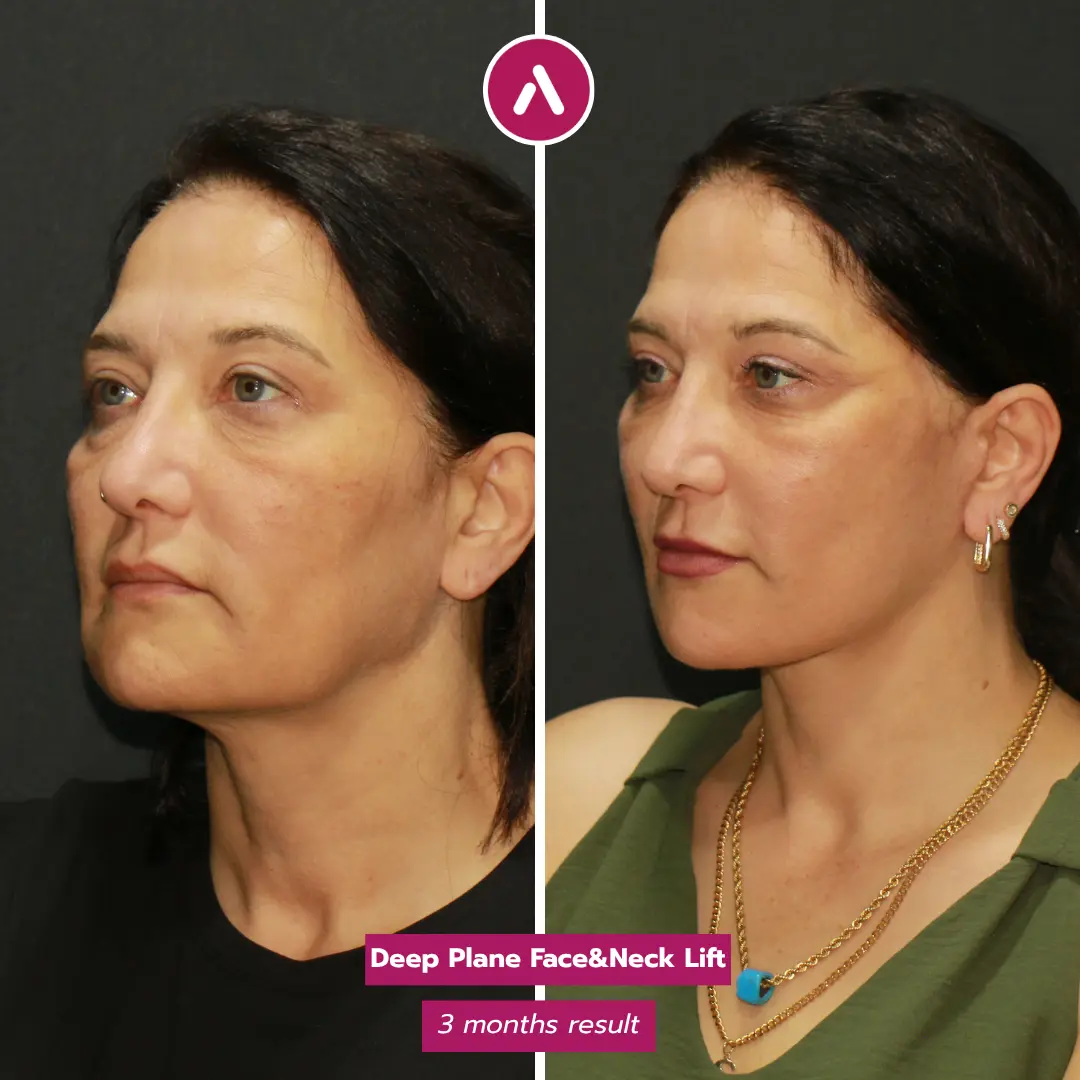
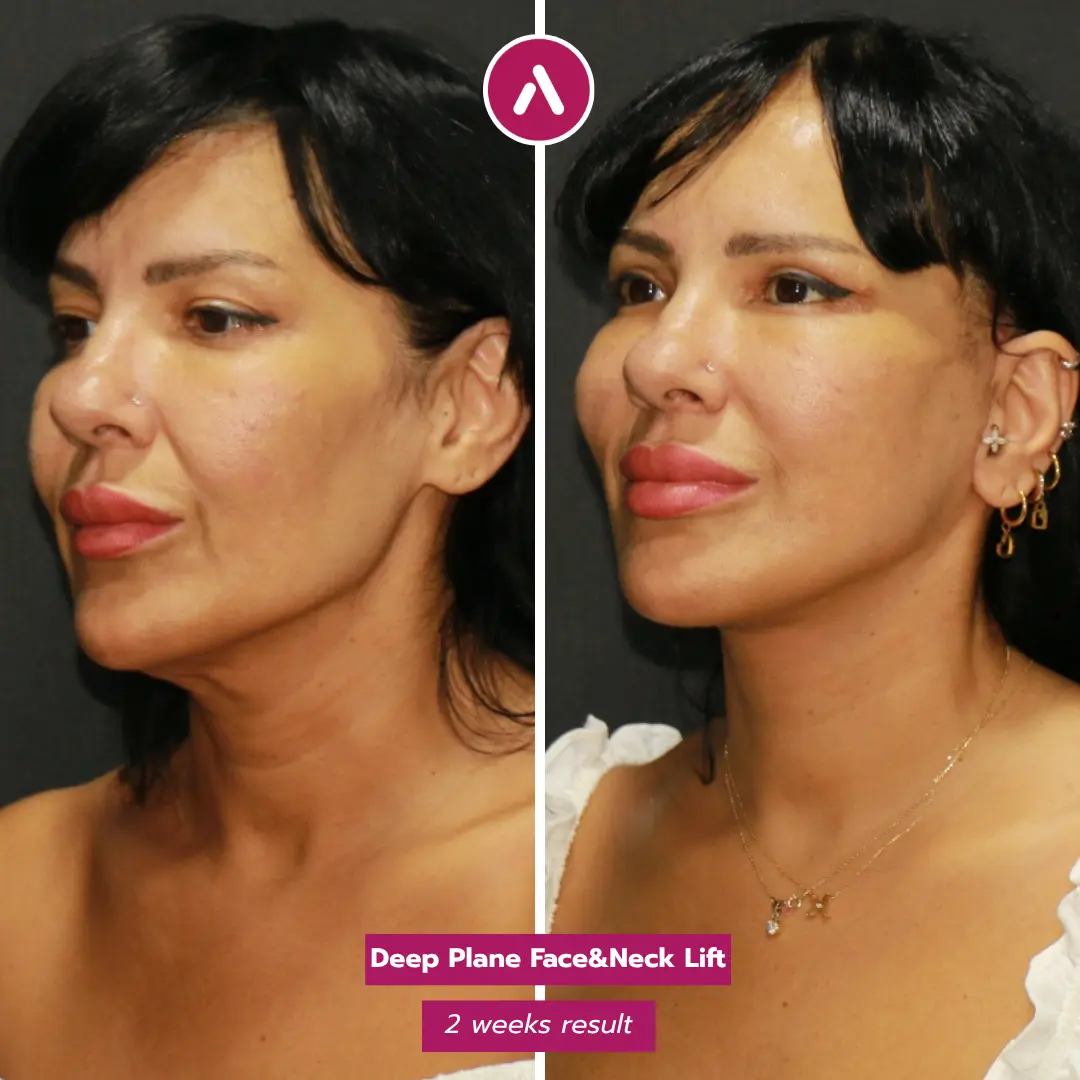
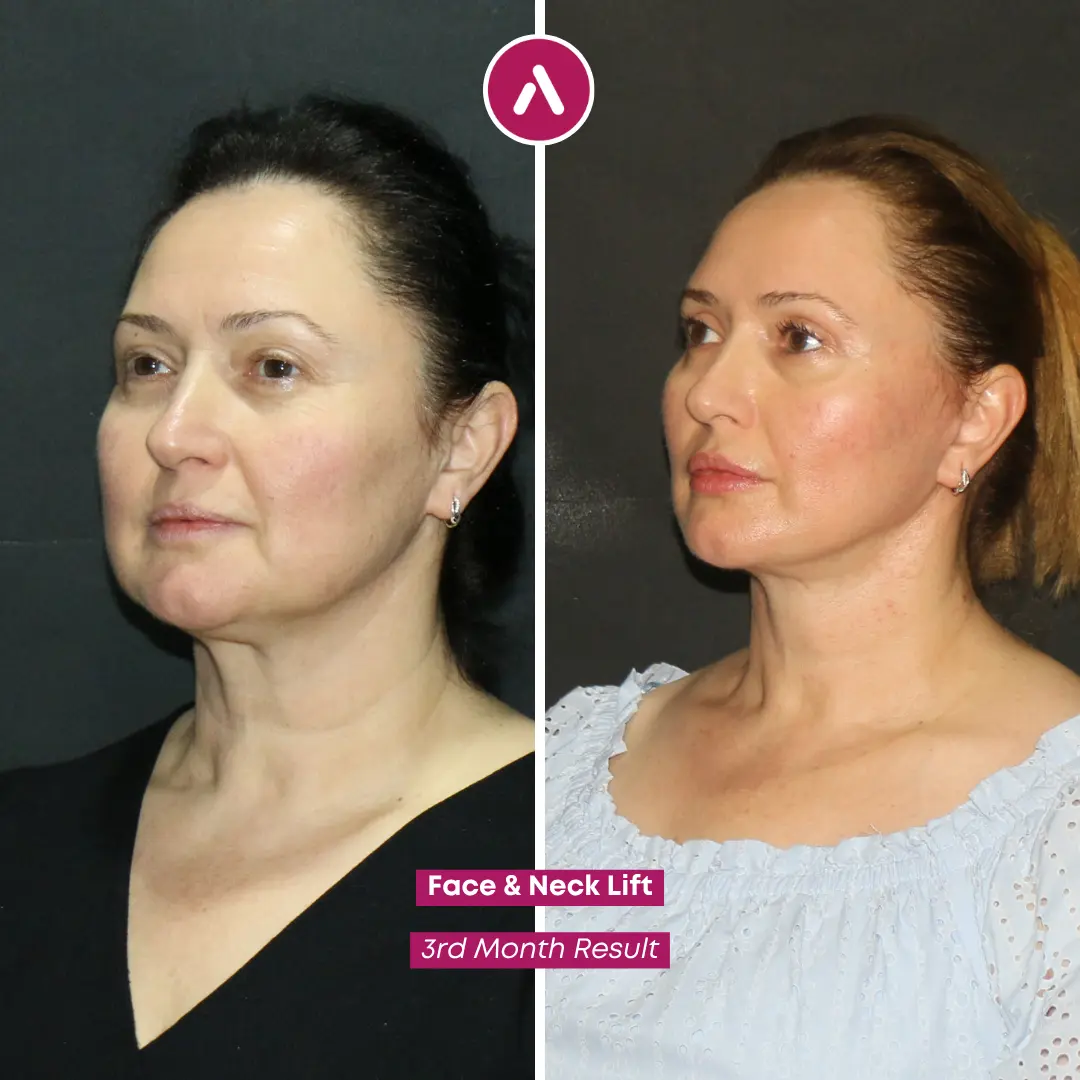
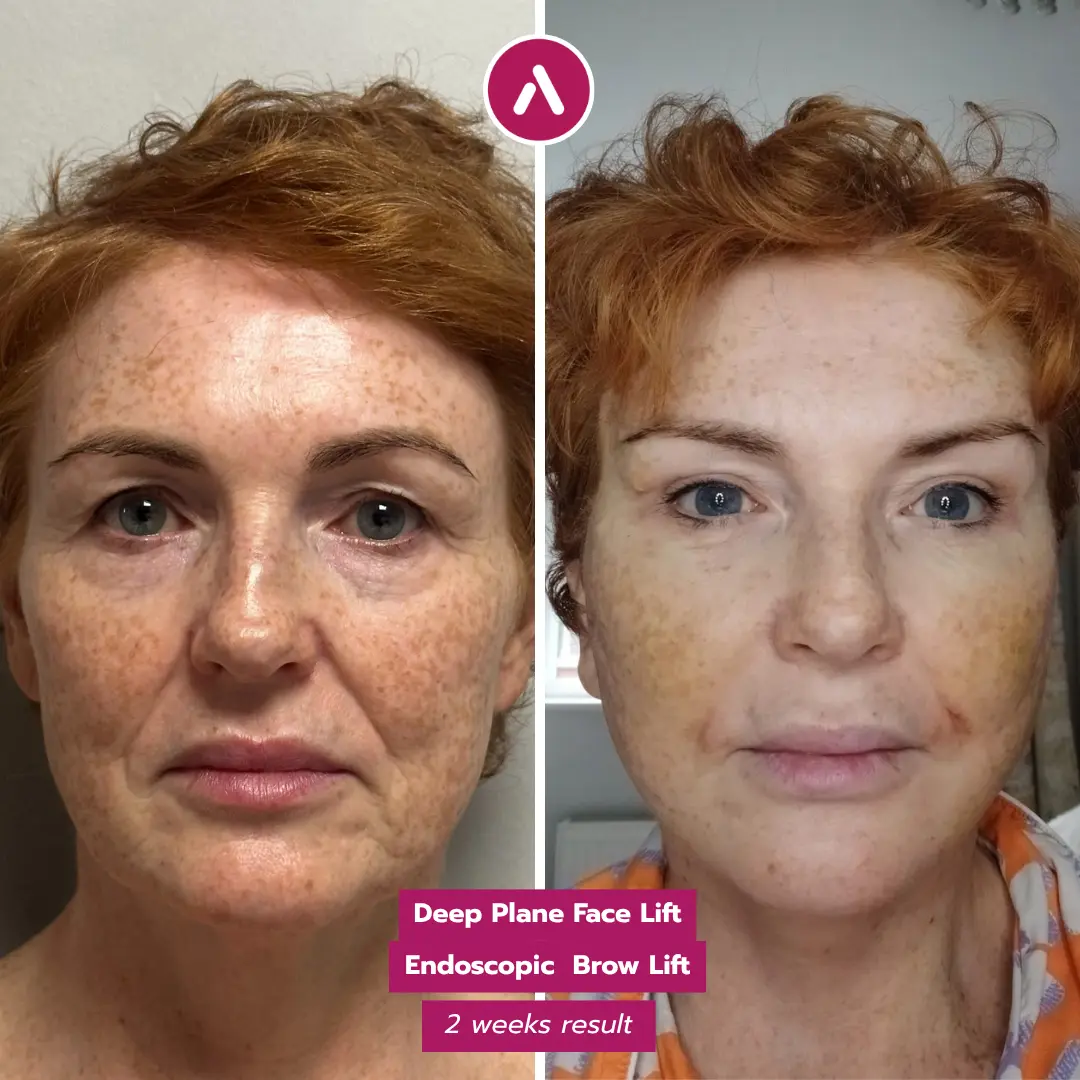
First, a quick clarification: the “SMAS” in a SMAS facelift is the Superficial Musculoaponeurotic System, a deep layer of tissue and muscle in your face. It is not the unrelated SMA syndrome you may have seen online. A SMAS facelift is the workhorse facelift technique: instead of tightening only the skin, it lifts and secures this deeper support layer to improve jowls, jawline softness, and lower-face sagging. For many Canadian patients comparing Toronto or Vancouver private clinic quotes with Istanbul, the appeal is not simply price. It is transparent planning, surgeon-led care, and a Natural-First result that looks refreshed rather than pulled.
Table of Contents
What Is a SMAS Facelift? (And What “SMAS” Actually Means)
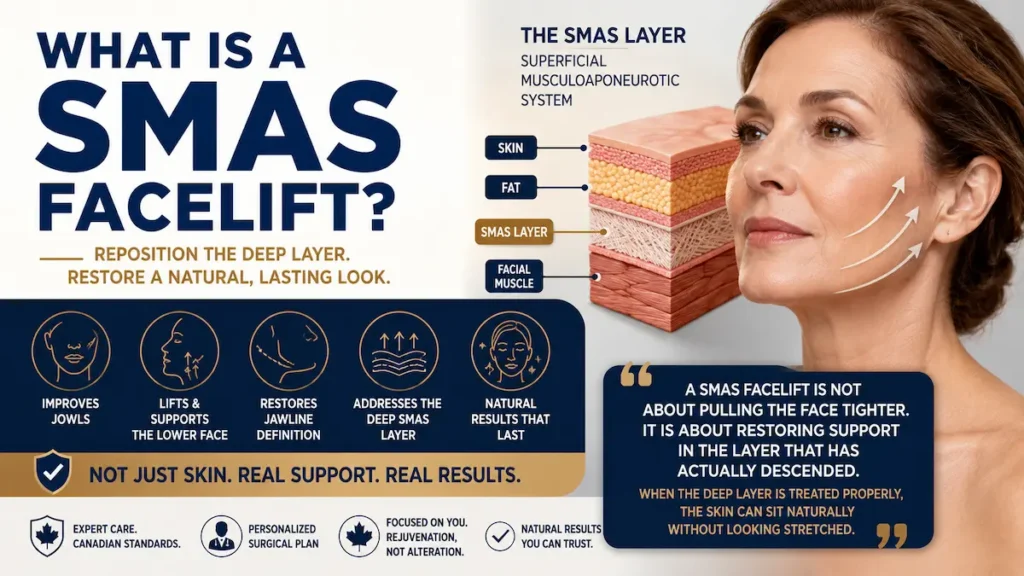
A SMAS facelift repositions the SMAS, or Superficial Musculoaponeurotic System, which is the deep tissue-and-muscle layer of the face. By lifting this structural layer rather than only pulling skin, the procedure can improve jowls, soften lower-face descent, and restore a more defined jawline. Techniques include SMAS plication, imbrication, SMASectomy, and High-SMAS approaches.
The SMAS Layer Explained: Superficial Musculoaponeurotic System
The SMAS is a fibromuscular layer that sits below the skin and superficial fat of the face. It connects with facial muscles and helps transmit movement across the cheeks, lower face, and jawline. When facial aging occurs, the skin is not the only structure that changes. The deeper support layer also loosens, allowing the lower face to descend.
That is why older skin-only facelifts often created a tight appearance without durable support. A modern SMAS facelift addresses the deeper layer first. The skin is then redraped more gently, which helps reduce visible tension around the ears and hairline.
The Canadian Society of Plastic Surgeons describes facelift surgery as a procedure that addresses sagging cheeks, aging around the mouth, loss of jawline definition, jowls, and neck aging. That overlaps closely with the lower-face concerns SMAS facelift patients usually describe.
SMAS Facelift vs SMA Syndrome: Clearing Up the Confusion
The word “SMAS” can be confusing online. In facial surgery, SMAS means Superficial Musculoaponeurotic System. It is a facial anatomy term.
It is not the same as SMA syndrome, which refers to Superior Mesenteric Artery syndrome. That is a separate medical condition involving the digestive system and blood vessels. This page discusses only SMAS facelift surgery for facial rejuvenation.
For Canadian patients doing detailed research, this distinction matters. It prevents mixed search results from creating unnecessary concern and keeps your decision focused on the correct surgical topic.
How a SMAS Facelift Works: Repositioning the Deep Layer, Not Just Skin
During a SMAS facelift, our surgeon carefully elevates the facial skin to access the SMAS layer underneath. Depending on your anatomy, the SMAS may be folded, overlapped, tightened, or partially reduced. The goal is to restore support where the lower face has descended.
This deeper-layer support is what separates a true SMAS facelift from surface tightening. The procedure can improve:
- Jowls along the jawline
- Lower-face heaviness
- Softening around the mandibular border
- Moderate cheek and lower-midface descent
- Loose facial skin caused by deeper structural laxity
At AKM Clinic, we plan each SMAS facelift around your existing anatomy. Our philosophy is rejuvenation, not alteration. The goal is a rested, natural appearance that still looks like you.
Why SMAS Lift Is the “Workhorse” Facelift Technique
The SMAS facelift remains one of the most established facelift techniques because it balances structure, versatility, and predictability. It can be adapted for patients with moderate lower-face aging, visible jowls, and early-to-moderate jawline loss.
It is also highly useful for patients who do not require the deeper ligament release of a deep plane facelift. For that reason, many patients start their research by comparing SMAS facelift with deep plane facelift. The best choice depends on tissue mobility, cheek descent, neck involvement, prior procedures, and your tolerance for recovery.
“A SMAS facelift is not about pulling the face tighter. It is about restoring support in the layer that has actually descended. When the deep layer is treated properly, the skin can sit naturally without looking stretched.”
Benefits of a SMAS Facelift
A SMAS facelift is designed for patients who want visible lower-face rejuvenation without an over-operated appearance. It is especially relevant for Canadian patients in their mid-40s to early 60s who notice jowls, jawline softening, and a tired look that non-surgical treatments no longer improve.
Lifted Jowls and a More Defined Lower Face
Jowls are one of the main reasons patients ask about SMAS facelift surgery. They form when facial support weakens and soft tissue drops toward the jawline. A SMAS facelift repositions the deeper support layer, which can sharpen the transition between the cheek, jawline, and neck.
The result should not look tight. The goal is cleaner structure. Many patients describe the change as looking less tired, not dramatically different.
Natural, Lasting Results by Treating the Deep Layer
Skin naturally stretches over time. If a facelift relies only on skin tension, results may look tight early and soften quickly. SMAS lifting provides deeper structural support, which helps the result age more naturally.
At AKM Clinic, our Natural-First approach guides every facial surgery plan. We do not pursue a wind-swept or operated-on look. We aim to restore support while preserving facial identity.
Reduced “Windswept” Risk Compared With Skin-Only Lifts
A pulled or windswept result usually happens when the skin carries too much tension. SMAS techniques reduce that risk by shifting support to the deep layer. The skin is redraped after the foundation has been lifted.
This matters for Canadian professionals who want discretion. Most patients do not want colleagues to know they had surgery. They want to look rested on a Zoom call, at the office, or at a family event.
Versatility for Moderate Facial Aging
A SMAS facelift is not one single move. It includes several technique options, such as plication, imbrication, SMASectomy, and High-SMAS. That allows us to adjust the surgery to the patient rather than forcing every face into the same plan.
Patients with moderate jowls may need SMAS plication. Patients with stronger lower-face laxity may benefit from SMASectomy or a more advanced SMAS tightening pattern. Patients with mid-face involvement may be assessed for High-SMAS or a deep plane approach.
A Well-Established Surgical Track Record
SMAS facelift surgery has a long surgical history and remains widely used because it addresses a real anatomical layer. It is not a trend treatment. It is a structural facial surgery technique.
At AKM Clinic, our facial rejuvenation programme is built around surgeon-led planning, careful patient selection, and natural-looking outcomes. We have performed over 2,000 facial surgeries since 2013, and our approach is designed for patients who value subtle, age-appropriate improvement.
Am I a Good Candidate for a SMAS Facelift?
You may be a good candidate for a SMAS facelift if your lower face has changed in a way that fillers, skin treatments, or HIFU can no longer correct. The key question is not your age alone. It is whether your deeper facial support layer has descended enough to justify surgery.
Facial Aging Assessment: Jowls, Lower-Face Sagging, and Jawline Softening
SMAS facelift candidates often notice jowls first. The jawline becomes less crisp, the lower face feels heavier, and the face may look tired even when the patient feels well. These changes usually reflect deeper support laxity, not just loose skin.
During your consultation, we assess:
- Jowl severity
- Skin elasticity
- Lower-face heaviness
- Cheek descent
- Neck involvement
- Previous filler or facial surgery history
The 45–60 Demographic: Moderate Aging Sweet Spot
Many SMAS facelift patients are in their mid-40s to early 60s. This is often the stage where early non-surgical options have stopped producing meaningful improvement, but tissue quality is still strong enough to heal well.
Age is not a strict rule. A healthy 62-year-old with good skin quality may be a better candidate than a younger smoker with poor healing risk. We look at anatomy, health, and expectations together.
Skin Quality, Elasticity, and Tissue Thickness
Good skin elasticity helps the skin redrape smoothly after the SMAS layer is secured. Very thin or sun-damaged skin may need more careful incision planning and scar management. Thicker skin may hold swelling longer, which can affect the visible recovery timeline.
This is one reason photo assessment is useful before travelling from Canada. It helps us identify whether SMAS, High-SMAS, deep plane, neck lift, or a combined approach is more appropriate.
When SMAS Is Enough vs When You Need Deep Plane
A SMAS facelift may be enough when the main concern is lower-face laxity, moderate jowls, and jawline softening. A deep plane facelift may be a better option when cheek descent, deeper ligament tethering, or more advanced mid-face aging is present.
We keep this comparison brief here because it deserves its own technical discussion. For a detailed breakdown, see our SMAS vs Deep Plane Facelift comparison guide.
Realistic Expectations Before You Travel
A SMAS facelift can restore structure, but it cannot stop aging. Your face will continue to age naturally after surgery. A good result should age with you, not freeze your expression.
It also will not replace every facial procedure. If you have heavy eyelids, deep neck bands, or significant volume loss, we may recommend combining your SMAS facelift with eyelid surgery, neck lift, or fat transfer to face.
When We May Recommend Waiting or Choosing Another Technique
We may advise against SMAS facelift surgery if your laxity is too mild, your expectations are unrealistic, or your medical risk is too high. Smoking, uncontrolled diabetes, blood-thinning medication, and significant cardiovascular concerns require careful review before any elective procedure.
We may also recommend another approach if your anatomy points elsewhere. Mini facelift, mid facelift, deep plane facelift, or neck lift may be a better match depending on your facial structure.
SMAS Technique Variants + How It Compares
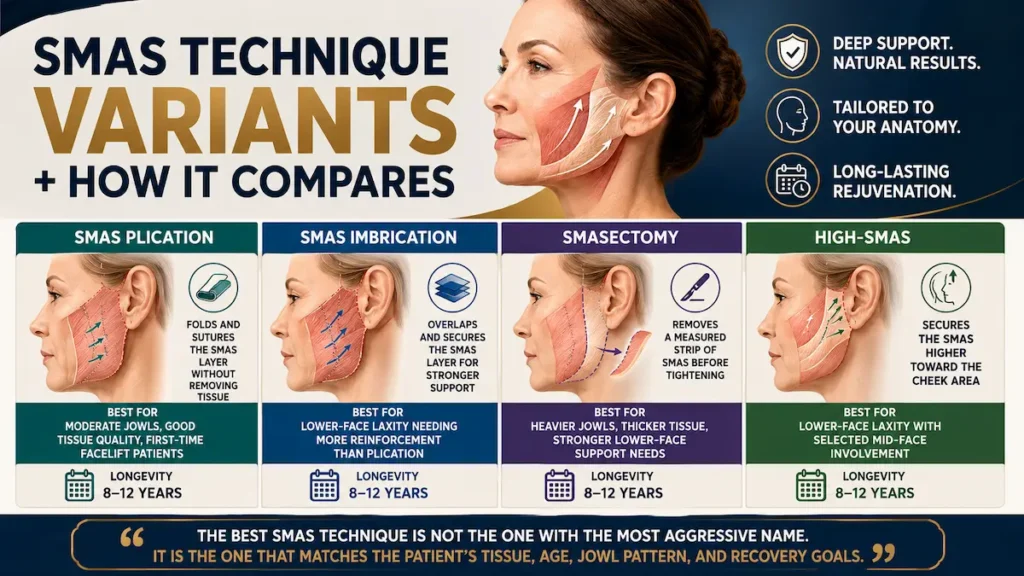
A SMAS facelift is not one fixed manoeuvre. The surgeon can tighten, fold, overlap, elevate, or partially reduce the SMAS layer depending on your anatomy. That flexibility is one reason the technique remains useful for Canadian patients with moderate jowls, lower-face descent, and early jawline loss.
The right SMAS method depends on tissue thickness, laxity, previous procedures, neck involvement, and how much lift the lower face needs. We choose the technique during surgical planning, not from a generic menu. Your face determines the method.
SMAS Plication: Folding and Suturing the SMAS
SMAS plication folds the SMAS layer onto itself and secures it with sutures. No strip of SMAS is removed. This approach can work well for patients with moderate jowling, good skin quality, and lower-face laxity that does not require aggressive tissue reduction.
Plication is often chosen when the goal is support rather than maximal tightening. It allows the surgeon to create a firm internal foundation while keeping tissue disruption controlled. The skin can then be redraped with less surface tension.
For many first-time facelift patients, SMAS plication offers a balanced option. It is structural, but not excessive. That matches our Natural-First philosophy.
SMAS Imbrication: Overlapping the Deep Tissue Layer
SMAS imbrication overlaps the SMAS layer to create stronger support. Think of it as reinforcing the deeper layer by advancing one section over another. It can be useful when the lower face needs more lift than simple folding can provide.
The key benefit is deeper support without relying on skin pull. This matters around the jawline, where tension-based surgery can create visible distortion near the ear or a stretched appearance across the cheek.
Imbrication requires careful judgement. Too little support may not last. Too much tension may look unnatural. Our surgeons plan the vector and tension based on your natural facial movement.
SMASectomy: Removing a Strip of SMAS for Tighter Support
SMASectomy removes a measured strip of the SMAS layer before the remaining tissue is tightened and secured. This can provide stronger contouring for patients with heavier lower-face laxity or thicker tissue.
The technique is not about removing as much tissue as possible. It is about controlled reduction. The surgeon must preserve natural expression, protect facial nerve anatomy, and avoid an overly tight result.
SMASectomy can be helpful when jowls are more visible or when the lower face needs a firmer reset. It is not automatically better than plication or imbrication. It is better only when your anatomy calls for it.
High-SMAS Technique: Higher Release for Mid-Face Involvement
High-SMAS extends the lifting effect higher toward the cheek and mid-face region. It may be considered when a patient has lower-face sagging plus early cheek descent. This can help avoid treating the jawline while leaving the upper cheek unsupported.
High-SMAS is still different from a deep plane facelift. It works at the SMAS layer and may improve selected mid-face concerns, but it does not involve the same deep ligament release as deep plane surgery.
For patients comparing High-SMAS, mid facelift, and deep plane facelift, we assess where the aging pattern begins. If the problem is mostly lower-face laxity, SMAS may be enough. If cheek descent and deeper tethering dominate, deep plane may be more appropriate.
| Technique | Method | Best For | Longevity | AKM Offers |
|---|---|---|---|---|
| SMAS Plication | Folds and sutures the SMAS layer without removing tissue | Moderate jowls, good tissue quality, first-time facelift patients | Often 8–12 years, depending on anatomy and aging | Yes |
| SMAS Imbrication | Overlaps and secures the SMAS layer for stronger support | Lower-face laxity needing more reinforcement than plication | Often 8–12 years | Yes, when clinically appropriate |
| SMASectomy | Removes a measured strip of SMAS before tightening | Heavier jowls, thicker tissue, stronger lower-face support needs | Often 8–12 years | Yes |
| High-SMAS | Secures the SMAS higher toward the cheek area | Lower-face laxity with selected mid-face involvement | Often 8–12 years | Yes |
“The best SMAS technique is not the one with the most aggressive name. It is the one that matches the patient’s tissue, age, jowl pattern, and recovery goals. A natural result starts with restraint.”
SMAS vs Deep Plane: The Short Version
SMAS and deep plane facelifts both treat deeper facial structures, but they do it differently. A SMAS facelift tightens or repositions the SMAS layer itself. A deep plane facelift works beneath the SMAS and releases retaining ligaments so the cheek and lower face can move as a connected unit.
That difference matters most when mid-face descent is advanced. SMAS can be excellent for lower-face laxity and moderate jowls. Deep plane may be stronger for patients who need vertical mid-face repositioning, ligament release, and cheek restoration.
We do not treat one technique as universally superior. We match the method to your anatomy. For the full technical breakdown, read our SMAS vs Deep Plane Facelift comparison guide. You can also review the broader surgical definition of facelift surgery through the American Society of Plastic Surgeons facelift resource.
Surgical SMAS Lift vs HIFU “SMAS Lifting” Devices
Many Canadian patients see the term “SMAS lifting” used in HIFU or ultrasound treatment marketing. This can create confusion. HIFU devices may heat tissue at selected depths and create mild tightening, but they do not surgically reposition the SMAS layer.
A true SMAS facelift is different. It involves incisions, direct access to the SMAS layer, structural repositioning, and surgical fixation. HIFU may be reasonable for early laxity or maintenance, but it cannot replace surgery when the jowls and lower face have physically descended.
This distinction protects patients from disappointment. A non-surgical device may offer subtle tightening. A surgical SMAS facelift offers structural lift.
| Method | Mechanism | Result | Duration | Our Position |
|---|---|---|---|---|
| Surgical SMAS Facelift | Directly repositions the deep facial support layer | Structural improvement in jowls, jawline, and lower-face descent | Long-term surgical result | Appropriate for true tissue descent |
| HIFU / Energy-Based “SMAS Lifting” | Uses ultrasound or heat-based energy to tighten tissue | Mild tightening in selected early cases | Temporary and variable | Not a replacement for facelift surgery |
“HIFU can tighten selected tissue, but it cannot move descended facial structure back into place. If the SMAS layer has dropped, a device cannot do the work of surgery.”
We will tell you if you are too early for surgery. We will also tell you if a device-based treatment is unlikely to meet your goals. Honest candidacy is part of surgical safety.
That is especially relevant for Canadian patients who may already have spent thousands of dollars on repeated non-surgical treatments. If HIFU, threads, or fillers no longer change the jawline, it may be time to discuss a structural solution.
Areas Addressed by a SMAS Facelift
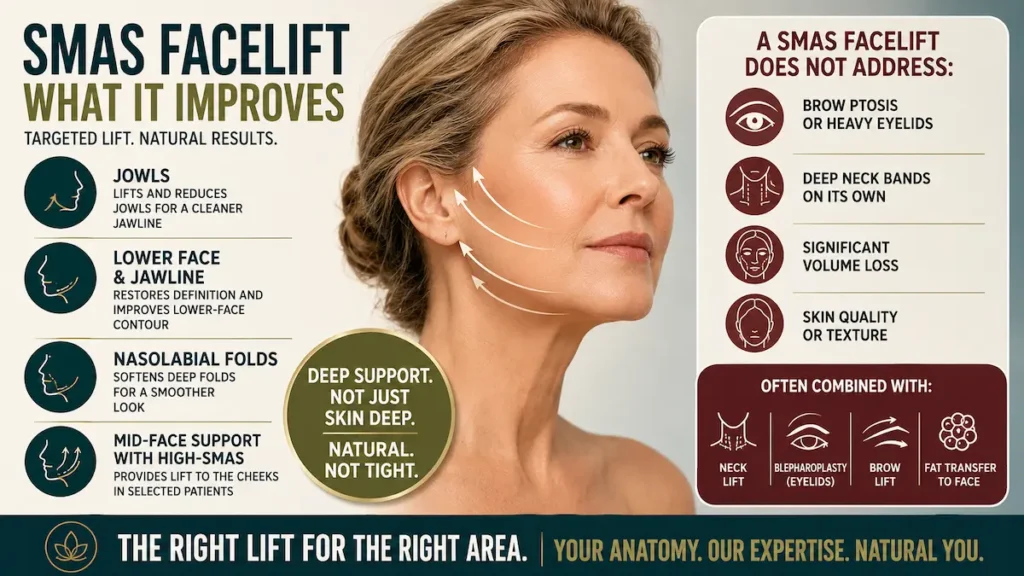
A SMAS facelift focuses mainly on the lower face and jawline. It can also support selected mid-face concerns when a High-SMAS approach is appropriate. The key is matching the lift to the area that has actually descended.
Not every facial aging concern belongs to the SMAS layer. Heavy eyelids, brow descent, deep neck bands, and significant volume loss may require different or combined procedures. We explain those limits clearly during consultation.
Jowls: The Primary Target
Jowls are the most common reason Canadian patients ask about a SMAS facelift. They appear when soft tissue descends below the jawline, softening the border between the lower face and neck.
A SMAS facelift improves jowls by lifting and securing the deeper support layer. This creates a cleaner lower-face contour without relying only on skin tension. The result should look structured, not stretched.
Lower Face and Jawline
The lower face includes the area from the cheeks down to the jawline. With aging, this region can become heavier, especially around the mandibular border. Patients may notice that their face looks less oval and more square or tired.
By repositioning the SMAS layer, we can improve lower-face definition. This is especially useful for patients who still have good skin quality but have lost deeper facial support.
Nasolabial Folds: Partial Improvement Only
A SMAS facelift can soften nasolabial folds, but it is not designed to erase them completely. These folds are influenced by cheek descent, skin quality, facial volume, and natural anatomy.
This is where honest planning matters. If your primary concern is deep folds or facial hollowing, we may discuss fat transfer to face or another volume-restoring option. A lift improves descent. It does not replace lost volume in every case.
Mid-Face Support With High-SMAS
High-SMAS may help selected patients with early mid-face descent. It extends the SMAS support higher than a standard lower-face SMAS lift, which can improve cheek support in carefully chosen cases.
That said, High-SMAS is not the same as a deep plane facelift or a dedicated mid facelift. If your main concern is cheek drooping, under-eye hollowing, or deep mid-face descent, we may compare SMAS with mid facelift or deep plane facelift.
Areas a SMAS Lift Does Not Address
A SMAS facelift is powerful, but it is not a full-face solution for every concern. It does not directly lift the brows, remove eyelid skin, or correct deep vertical neck bands on its own.
Patients with multiple aging patterns may benefit from a combined plan. Common additions include:
- Neck lift for neck laxity or platysmal bands
- Blepharoplasty for upper or lower eyelid concerns
- Temporal brow lift for outer brow descent
- Fat transfer to face for facial hollowing or volume loss
Our goal is not to add procedures unnecessarily. It is to avoid under-treating the concern that brought you to surgery in the first place.
Combined Procedures: SMAS Facelift + Other Treatments
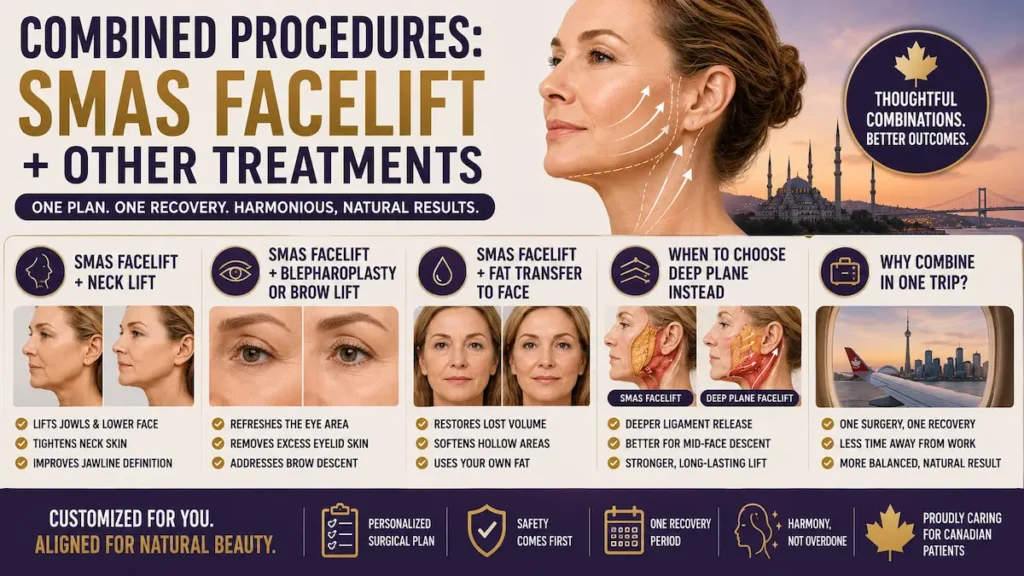
A SMAS facelift can be performed alone, but many patients benefit from combining it with other facial procedures. The right combination depends on where aging appears. Lower-face lifting will not automatically correct eyelids, brow descent, deep neck bands, or facial volume loss.
We do not recommend combination surgery just to add procedures. We recommend it when one recovery period can address connected concerns safely and coherently.
SMAS Facelift + Neck Lift
SMAS facelift and neck lift are commonly paired because the lower face and neck age together. If the jawline improves but the neck remains loose, the result may look incomplete. This is especially true for patients with platysmal bands, loose neck skin, or submental heaviness.
A neck lift can address the area below the jawline while the SMAS facelift improves jowls and lower-face descent. Together, they can create a more continuous face-and-neck contour.
This combination may require a longer surgery and a more cautious recovery plan. We assess whether the benefit justifies the added surgical scope.
SMAS Facelift + Blepharoplasty or Brow Lift
A SMAS facelift improves the lower face, but it does not remove excess eyelid skin or lift a heavy brow. Patients who feel their whole face looks tired may need upper eyelid surgery, lower eyelid surgery, or brow support.
Blepharoplasty can refresh the eye area by addressing drooping upper lids, lower eyelid bags, or skin excess. A brow or temporal lift may help patients with outer brow descent or hooding that comes from brow position rather than eyelid skin alone.
This combined approach must be planned carefully. Over-treating the eyes and lower face at the same time can look artificial if the plan is too aggressive. We aim for harmony, not a changed identity.
SMAS Facelift + Fat Transfer to Face
A facelift lifts tissue. It does not fully replace lost volume. If facial aging includes hollow cheeks, temples, or deep volume loss, lifting alone may not create the softer support you expect.
Fat transfer to face can restore selected volume using your own fat. It may be considered when patients need both lift and subtle replenishment. The goal is not to overfill the face. It is to restore support where aging has created hollowing.
Volume decisions require restraint. Too much fat can look heavy or unnatural. Too little may not support the result. We plan fat transfer conservatively and anatomically.
When to Choose Deep Plane Instead
Some patients come in asking for SMAS but are better candidates for deep plane facelift. This is common when cheek descent, deeper ligament tethering, and mid-face aging are more significant than lower-face laxity alone.
Deep plane facelift releases deeper retaining ligaments and repositions tissue as a connected unit. It may be stronger for patients who need vertical mid-face restoration and longer-lasting structural support.
SMAS and deep plane are not enemies. They are tools. The best choice is the one that fits your anatomy, recovery goals, and desired level of correction.
Why One Trip Can Make Sense for Canadian Patients
Many Canadian patients prefer to combine procedures because it can reduce duplicate travel, duplicate time away from work, and separate recovery periods. This can be practical, especially for patients flying from Toronto, Vancouver, Calgary, or Montreal.
Combination surgery is not always appropriate. Longer operations require stricter health screening, careful anesthesia planning, and realistic recovery expectations. We will not combine procedures if doing so increases risk beyond an acceptable level.
When combination surgery is appropriate, it can create a more balanced result. The face, eyes, neck, and volume pattern can be planned together rather than corrected in disconnected stages.
Anesthesia for SMAS Facelift: General Anesthesia Standard
A SMAS facelift is usually performed under general anesthesia because it involves careful work around the deeper facial support layer. The procedure requires stillness, precise tissue handling, and reliable comfort during a 2.5–4 hour operation.
Canadian patients often ask whether a SMAS facelift can be done awake or under lighter sedation. In selected limited cases, a less intensive approach may be possible. For a full SMAS facelift, general anesthesia remains the standard pathway.
Why SMAS Facelift Typically Uses General Anesthesia
SMAS surgery requires controlled access to the deep layer of the face. The surgeon must elevate skin, expose the SMAS, reposition tissue, and close incisions with precision. Any unexpected movement can affect safety and symmetry.
General anesthesia helps maintain a stable surgical environment. It also allows the anesthesia team to monitor your airway, blood pressure, oxygen levels, and comfort throughout the procedure.
Sedation Option for Limited SMAS or Awake-Mini Candidates
Some limited lower-face procedures may be performed with local anesthesia and sedation. This is more common in mini facelift or awake-mini candidates, where the dissection is smaller and the surgical field is more limited.
If you are interested in a lighter anesthesia model, we can discuss whether awake mini facelift or twilight facelift is a better match. We will not recommend a lighter pathway if it compromises surgical control.
Pre-Anesthesia Assessment for Canadian Patients
Before surgery, we review your medical history in detail. This includes medications, allergies, previous anesthesia reactions, smoking status, blood pressure, diabetes, heart history, and any blood-thinning supplements.
Canadian patients should also speak with their family physician before international surgery, especially if they have chronic health conditions. A stable medical baseline makes travel and recovery safer.
Our Anesthesiology Team and Monitoring Protocols
Your anesthesia is managed by qualified medical professionals in a controlled surgical setting. During the procedure, your vital signs are monitored continuously. This includes oxygen saturation, heart rhythm, blood pressure, breathing, and temperature.
We also plan post-operative observation before you return to your hotel. You are not discharged casually after a facial procedure. You leave only when your surgical and anesthesia teams are satisfied with your early recovery.
“The safest anesthesia plan is the one that matches the procedure, the patient’s health, and the level of surgical precision required. For a full SMAS facelift, stability matters.”
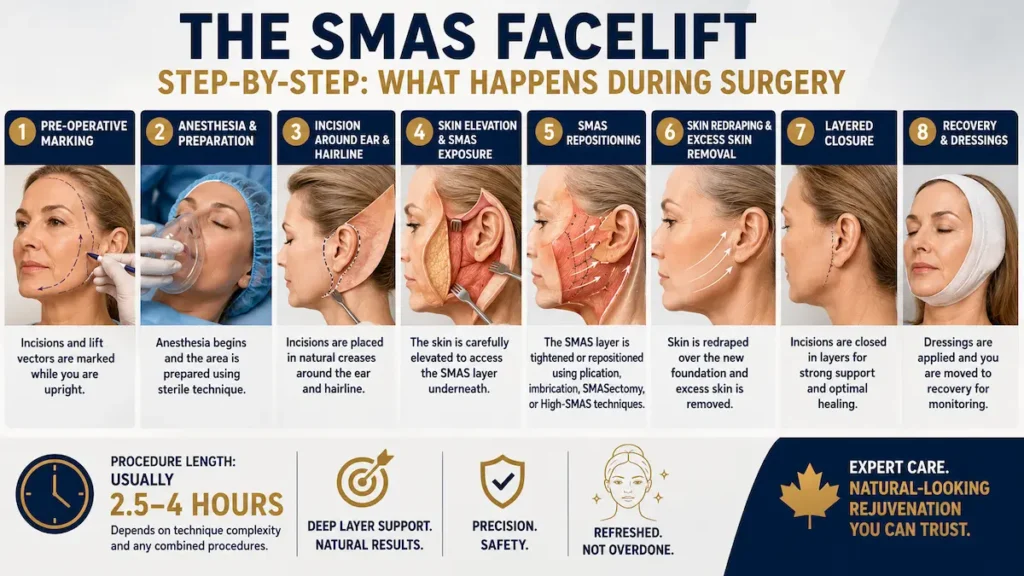
Step-by-Step: What Happens During a SMAS Facelift?
A SMAS facelift follows a structured surgical sequence. The exact details vary by anatomy, but the core steps are consistent: marking, anesthesia, incision, SMAS exposure, deep-layer repositioning, skin redraping, and layered closure.
We explain the process before surgery so you know what each stage is designed to achieve. Understanding the sequence helps reduce anxiety and keeps expectations realistic.
Pre-Operative Marking
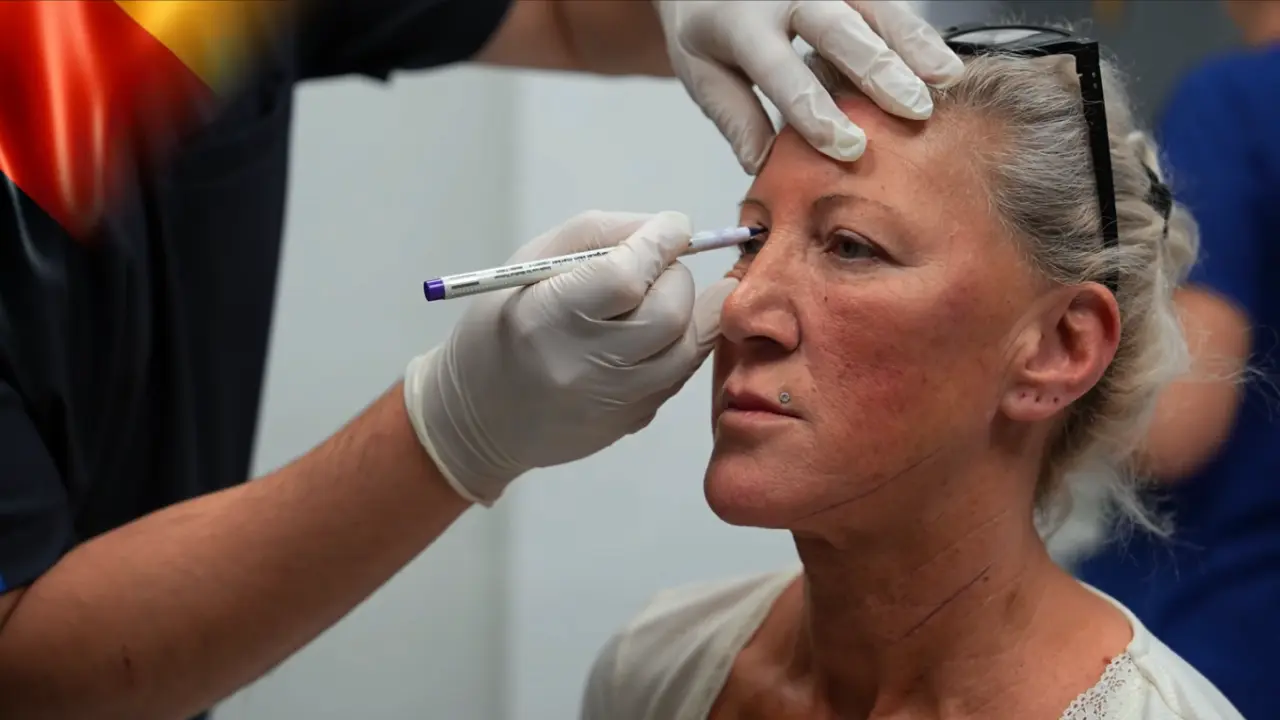
Before surgery, your surgeon marks the planned incision lines and lift vectors while you are upright. This matters because facial tissue shifts when you lie down. Upright marking helps us plan for the way gravity affects your actual face.
We also review your surgical goals one more time. This is the moment to confirm priorities: jowls, jawline definition, lower-face heaviness, neck involvement, or subtle mid-face support.
Anesthesia and Surgical Preparation
Once the plan is confirmed, anesthesia begins. The surgical area is then prepared using sterile technique. Hair is protected, skin is cleansed, and the operative field is draped carefully.
We use this stage to create a controlled, quiet environment. Facial surgery rewards precision. The preparation is part of that precision.
Incision Around the Ear and Hairline
SMAS facelift incisions are usually placed around the ear and into natural creases or hairline zones. The exact incision depends on your hairline, sideburn position, skin laxity, and whether the neck is included.
The goal is concealment. A good incision plan respects how you wear your hair and how scars mature over time. We avoid unnecessary tension around the earlobe to reduce the risk of distortion.
The American Academy of Facial Plastic and Reconstructive Surgery describes common facelift incisions as beginning near the temple hair, continuing around the ear, and blending into the hairline. Your exact incision plan still depends on anatomy and surgical goals.
Skin Elevation and SMAS Exposure
After the incision, the surgeon carefully elevates the skin to access the SMAS layer. This is done with attention to tissue thickness, blood supply, and facial nerve anatomy.
The amount of elevation depends on the planned technique. Limited laxity may need a smaller flap. More advanced lower-face descent may require wider access to allow proper SMAS repositioning.
SMAS Repositioning: Plication, Imbrication, or SMASectomy
This is the structural part of the operation. The surgeon tightens or repositions the SMAS layer using the method chosen for your anatomy. That may be plication, imbrication, SMASectomy, or a High-SMAS variation.
The vector matters. We do not simply pull sideways. We aim for a lift direction that supports the jawline and lower face while preserving natural expression.
Skin Redraping and Excess Skin Removal
Once the SMAS layer is secure, the skin is redraped over the new foundation. Excess skin is removed conservatively. The skin should lie smoothly without carrying the full lifting force.
This is how we reduce the risk of a pulled appearance. The deeper layer does the support work. The skin follows.
Layered Closure
The incisions are closed in layers to support healing and reduce tension on the skin edge. Fine suturing around the ear is especially important because this is where scars are most likely to be inspected closely.
Dressings are placed after closure. You are then moved to recovery for monitoring.
Procedure Length: Usually 2.5–4 Hours
A SMAS facelift usually takes about 2.5–4 hours, depending on technique complexity and whether combined procedures are included. A SMAS facelift with neck lift or eyelid surgery takes longer than a lower-face-only procedure.
We do not rush facial surgery. Efficiency is useful, but precision is more important. Your surgical plan should be complete, controlled, and appropriate for your anatomy.
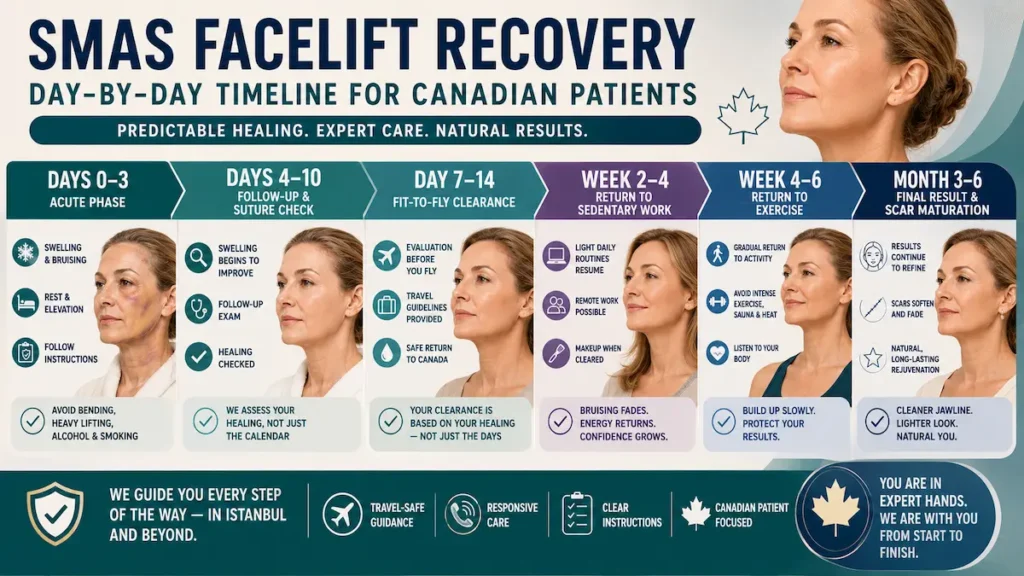
SMAS Facelift Recovery: Day-by-Day Timeline for Canadian Patients
SMAS facelift recovery is predictable when the procedure is planned carefully, but it is not instant. Swelling, bruising, tightness, and temporary numbness are normal in the early phase. Most Canadian patients plan to stay in Istanbul long enough for initial monitoring, follow-up, and fit-to-fly clearance before returning home.
Your timeline depends on your anatomy, technique, combined procedures, age, smoking status, skin quality, and general health. A SMAS facelift with neck lift will usually take longer to settle than a lower-face-only procedure.
Days 0–3: Acute Phase
The first three days are the most intense. Swelling and bruising begin to develop, and the face may feel tight or heavy. This does not mean something is wrong. It is part of normal tissue response after deep-layer facial surgery.
You will rest with your head elevated and follow a medication schedule. We give clear instructions on wound care, sleeping position, hydration, walking, and what symptoms should be reported immediately.
During this period, you should avoid:
- Bending forward
- Heavy lifting
- Alcohol
- Smoking or nicotine
- Sleeping flat
- Touching or pulling near the incisions
Short, gentle walks are encouraged. Movement helps circulation and lowers the risk of stiffness, especially for patients preparing for long-haul travel back to Canada.
Days 4–10: Suture Check and First Follow-Up
By days 4–10, swelling often remains visible but begins to feel more manageable. Bruising may move downward because of gravity. This can look dramatic, but it usually reflects normal healing.
Your follow-up appointment allows us to check incisions, swelling pattern, skin colour, and overall recovery. We also review your medication use and confirm whether you are healing as expected.
This stage is important for Canadian travellers. We do not want you flying before your early healing is stable. Your fit-to-fly timing depends on your examination, not only the calendar.
Our HBOT/LLLT Recovery Protocol
We use advanced recovery support to help reduce inflammation and support tissue healing. Hyperbaric Oxygen Therapy, or HBOT, increases oxygen delivery to healing tissues. Low-Level Laser Therapy, or LLLT, supports cellular repair and incision maturation.
For SMAS facelift patients, these tools are valuable because facial swelling can affect comfort, sleep, and social readiness. They also matter for Canadians returning on long-haul flights from Istanbul to Toronto, Vancouver, Calgary, or Montreal.
HBOT is designed to support oxygenation in healing tissue. LLLT uses 650nm low-level laser energy to stimulate cellular activity without heat damage. Together, they support a calmer recovery environment.
Our recovery philosophy is not only about looking better sooner. It is about lowering avoidable stress during the early healing window. That is especially important when your recovery includes international travel.
You can learn more about our recovery technology on our technology and standards page, and the full science is discussed in our Hyperbaric Oxygen Therapy benefits guide.
Day 7–14: Fit-to-Fly Clearance for Canadian Return Travel
Most Canadian patients plan their return flight after their surgeon has reviewed early healing. Fit-to-fly clearance is based on swelling, incision status, comfort, blood pressure, mobility, and whether any combined procedure was performed.
Long-haul flights add extra considerations. Cabin pressure, dehydration, prolonged sitting, and sleep disruption can all affect comfort. We give practical instructions before you leave Istanbul.
For the return flight, we usually recommend:
- Walking in the cabin when safe
- Drinking water regularly
- Avoiding alcohol
- Keeping medications in your carry-on
- Using a supportive neck pillow
- Keeping your head elevated as much as possible
- Following all surgeon-specific instructions
For a broader travel-readiness discussion, see our flight safety after surgery guide. Your individual clearance always comes from your surgical team.
Week 2–4: Return to Sedentary Work
By weeks 2–4, many patients feel comfortable with light daily routines. Bruising is usually easier to conceal, swelling is improving, and energy levels begin to normalize. Remote work may be possible earlier than public-facing work.
Canadian patients often plan recovery around professional commitments. If you work in finance, health care administration, education, law, or tech, you may want extra buffer time before video meetings or in-person presentations.
Makeup may be allowed once incisions are safe and your surgeon approves it. Do not apply products over healing incision lines unless cleared.
Week 4–6: Return to Exercise
Exercise returns gradually. Light walking is allowed early, but heavy lifting, intense cardio, hot yoga, sauna, and high-impact activity must wait. Increased blood pressure can worsen swelling or raise bleeding risk during the early healing phase.
By weeks 4–6, many patients can begin more normal activity with guidance. You should still avoid anything that strains the neck, pulls the face, or raises pressure suddenly.
If you had a neck lift, blepharoplasty, or fat transfer at the same time, your timeline may be adjusted. Combined surgery means combined healing.
Month 3–6: Final Result and Scar Maturation
By month 3, the face usually looks more settled. Swelling continues to refine over time, especially around the cheeks, jawline, and incision areas. Some numbness or tightness may still be present, but it should keep improving.
Scar maturation takes longer than swelling resolution. Incisions around the ear and hairline may stay pink or firm before softening. This is normal.
By month 6, most patients can judge their result more accurately. The jawline looks cleaner, the lower face feels lighter, and the overall expression should still look natural.
Safety, Risks & Scars of a SMAS Facelift
Every surgery has risk. A trustworthy clinic should say that clearly. A SMAS facelift is a well-established procedure, but it still requires careful patient selection, sterile protocols, surgeon experience, and realistic expectations.
Our role is to reduce avoidable risk, not pretend risk does not exist. We do that through medical screening, surgeon-led planning, JCI-accredited surgical environments, meticulous technique, and structured follow-up after you return to Canada.
Common Side Effects: Swelling, Bruising, Temporary Numbness
Swelling and bruising are expected after a SMAS facelift. The face may look uneven during early healing because swelling does not resolve at the same pace on both sides. This is common and usually temporary.
Temporary numbness can occur near the cheeks, ears, and incision areas. Sensation often returns gradually as tissues recover. Tingling, tightness, or a “wooden” feeling may appear before sensation normalizes.
You should contact us promptly if you notice sudden one-sided swelling, severe pain, fever, spreading redness, drainage, shortness of breath, or symptoms that feel unusual. Early communication is part of safe recovery.
SMAS Facelift Scars: Around-Ear Hidden Reality
SMAS facelift scars are usually placed around the ear, sideburn, and sometimes into the hairline. The goal is concealment in natural creases and hair-bearing areas. Scar quality depends on incision design, closure technique, tension, genetics, smoking status, and aftercare.
No facelift is scarless. Any clinic promising an invisible or scar-free facelift is not being medically precise. The honest goal is a well-placed, well-healed scar that becomes difficult to notice over time.
We reduce visible scar risk by:
- Planning incisions around natural folds
- Avoiding excess tension on the skin edge
- Using layered closure
- Monitoring early wound healing
- Supporting scar maturation with appropriate aftercare
Facial Nerve Considerations at the SMAS Level
Facial nerve safety is one of the most important issues in facelift surgery. The SMAS layer lies in a region where careful anatomical knowledge matters. Injury is uncommon in experienced hands, but it is a serious risk that deserves direct discussion.
Most nerve-related symptoms after facelift surgery are temporary sensory changes, such as numbness or altered feeling. Motor nerve injury, which affects movement, is much rarer but more significant.
We reduce risk through controlled dissection, respect for facial anatomy, and technique selection based on tissue planes. Surgeon experience matters here. This is not the place for casual or technician-led care.
Avoiding the “Pulled” or “Windswept” Look
The pulled look usually comes from excessive skin tension or the wrong vector. The face may appear stretched sideways, the mouth can look distorted, and the ears may show tension. This is exactly what many Canadian patients fear.
Our Natural-First approach avoids that aesthetic. In a SMAS facelift, the deeper layer should carry the lift. The skin should be redraped, not used as the main lifting structure.
We also avoid over-correction. A good SMAS facelift should restore definition while preserving familiar expression. Friends may say you look rested. They should not feel that your face has changed identity.
“A natural facelift is built on the right vector. If the lift direction is wrong, even technically neat surgery can look artificial. We plan the vector before we plan the incision.”
Why Deep-Layer Support Reduces Skin-Only Relapse
Skin-only facelifts can relapse more quickly because skin stretches. The SMAS layer provides deeper support. When it is repositioned correctly, the result is more structurally stable.
This does not make aging stop. It means the lift is supported by a stronger anatomical foundation. Over time, your face continues to age from a more refreshed starting point.
Longevity depends on many factors, including skin quality, weight stability, sun exposure, smoking, genetics, and post-operative care. We discuss these factors before surgery so expectations stay realistic.
How Our Sterile Protocols and Surgeon-Led Planning Reduce Risk
Safety starts before the operating room. We review your medical history, medications, smoking status, previous surgery, and travel plans. If something increases risk, we address it before confirming surgery.
During surgery, we work in a JCI-accredited hospital environment with sterile protocols and continuous monitoring. After surgery, our patient hosts and medical team remain available for structured follow-up.
For Canadian patients, continuity matters after the flight home. We provide English-language post-operative instructions and long-term virtual follow-up at 1, 3, 6, and 12 months. You are not left to interpret healing alone.
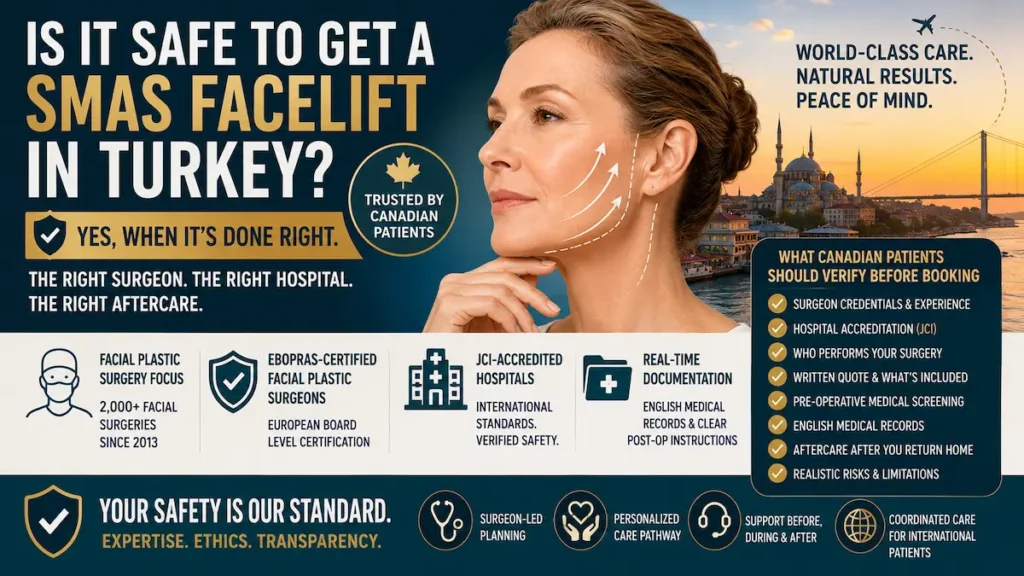
Is It Safe to Get a SMAS Facelift in Turkey? A Canadian’s Honest Look
Yes, a SMAS facelift in Turkey can be safe when it is performed by qualified surgeons in an accredited surgical environment with proper screening, documentation, and aftercare. The real question is not “Turkey or Canada?” The real question is: who is operating, where is the procedure performed, and what happens after surgery?
Canadian patients are right to be cautious. You may have read news stories about complications after cosmetic surgery abroad. We do not dismiss those concerns. We address them directly because safety depends on verifiable systems, not advertising language.
The Turkey Cosmetic Surgery Reality: How AKM Differs
Turkey is a major destination for aesthetic surgery, but not every clinic works to the same standard. Some centres operate at high surgical volume with limited surgeon involvement. Others may rely too heavily on sales teams before a patient has received proper medical assessment.
That is not our model. At AKM Clinic, your SMAS facelift begins with clinical evaluation, not pressure. We assess your anatomy, health history, medications, previous treatments, smoking status, and recovery logistics before recommending surgery.
Our philosophy is simple: the right procedure should be medically appropriate, technically realistic, and aligned with your goals. If SMAS is not the right technique, we will say so.
Canadian patients often compare our process with private clinics in Toronto, Vancouver, Calgary, or Montreal. The main difference is not only cost. It is the structure of the care pathway. We organize your surgical planning, hospital experience, hotel recovery, transfers, medications, and long-term virtual follow-up within one coordinated clinical programme.
For a broader due-diligence framework, see our guide on plastic surgery safety in Turkey. Canadian travellers should also review the Government of Canada travel advice for Türkiye before booking international medical travel.
Facial Plastic Surgery Sub-Specialization and SMAS Technique Volume
A SMAS facelift is not a basic skin-tightening procedure. It requires knowledge of facial anatomy, SMAS layer behaviour, incision planning, nerve safety, scar management, and natural lift vectors. Surgeon experience matters.
You should ask whether the clinic routinely performs facial rejuvenation procedures, not only body surgery or hair restoration. SMAS facelift surgery requires different judgement than liposuction, rhinoplasty, or breast surgery.
At AKM Clinic, facial rejuvenation is a core focus. Our team has performed over 2,000 facial surgeries since 2013. That experience supports a more refined approach to lower-face lifting, jowl correction, and natural-looking facial balance.
Ghost Surgery in Turkey Facial Procedures: How to Avoid It
“Ghost surgery” means the patient believes one surgeon will operate, but another person performs part or all of the procedure without clear consent. This concern is not unique to Turkey, but it is a valid risk in any poorly regulated or sales-driven surgical setting.
Canadian patients should protect themselves by asking direct questions before booking:
- Who is my surgeon of record?
- Will that surgeon perform the key surgical steps?
- Where will the surgery take place?
- Is the hospital accredited?
- Will I receive written medical records in English?
- Who do I contact after I return to Canada?
We support surgeon-led planning and clear documentation. You should never feel uncertain about who is responsible for your face. Our ghost surgery in Turkey guide explains the verification steps in more detail.
EBOPRAS-Certified Facial Plastic Surgeon Verification
Canadian patients often use the RCPSC and FRCSC framework as their mental reference for specialist standards. Turkey and Europe use different credentialing systems, so the comparison can feel confusing at first.
EBOPRAS certification is a European board-level credential in plastic, reconstructive, and aesthetic surgery. It does not mean the surgeon is licensed in Canada. It means the surgeon has completed structured European specialist certification that Canadian patients can use as part of their due diligence.
The Royal College of Physicians and Surgeons of Canada explains Canadian specialist designations such as FRCSC. We use that framework as a familiar comparison point when helping Canadian patients understand international credentials.
When reviewing any clinic, ask for:
- Surgeon credentials
- Board certification details
- Facial surgery experience
- Hospital accreditation
- Before-and-after examples
- Written post-operative care protocol
We also recommend comparing surgeon credentials with the expectations you would apply to a Canadian private clinic. The standard should not drop because the procedure is international.
Our JCI-Aligned Standards and Real-Time Documentation
Your SMAS facelift is performed in a JCI-accredited hospital environment. This matters because international patients need external quality signals they can verify. Accreditation does not remove all surgical risk, but it does show that the facility follows structured safety and quality processes.
We also focus on documentation. Canadian patients may need records for their family physician, insurance provider, or emergency care if a concern appears after returning home. We provide English-language discharge information and post-operative instructions.
This documentation supports continuity. Your Canadian doctor should not have to guess what was done. Clear records make follow-up safer.
What Canadian Patients Should Verify Before Booking
Before booking any SMAS facelift abroad, use the same scrutiny you would use in Canada. A polished website is not enough. You need evidence.
Your checklist should include:
- Surgeon identity and credentials
- Hospital accreditation
- Written quote with what is included
- Clear anesthesia plan
- Pre-operative medical screening
- English-language consent and discharge records
- Aftercare contact after returning to Canada
- Realistic explanation of risks and limits
You should also speak with your Canadian family physician before travelling, especially if you have high blood pressure, diabetes, heart disease, clotting history, or previous anesthesia concerns.
Travel insurance is another important point. Many Canadian travel insurance policies do not cover complications from elective cosmetic surgery abroad. You should review your policy before booking and consider supplementary coverage where available.
“A safe international facelift is built before the surgery begins. The surgeon, hospital, anesthesia plan, medical records, and follow-up system all matter. If one piece is missing, the patient carries unnecessary risk.”
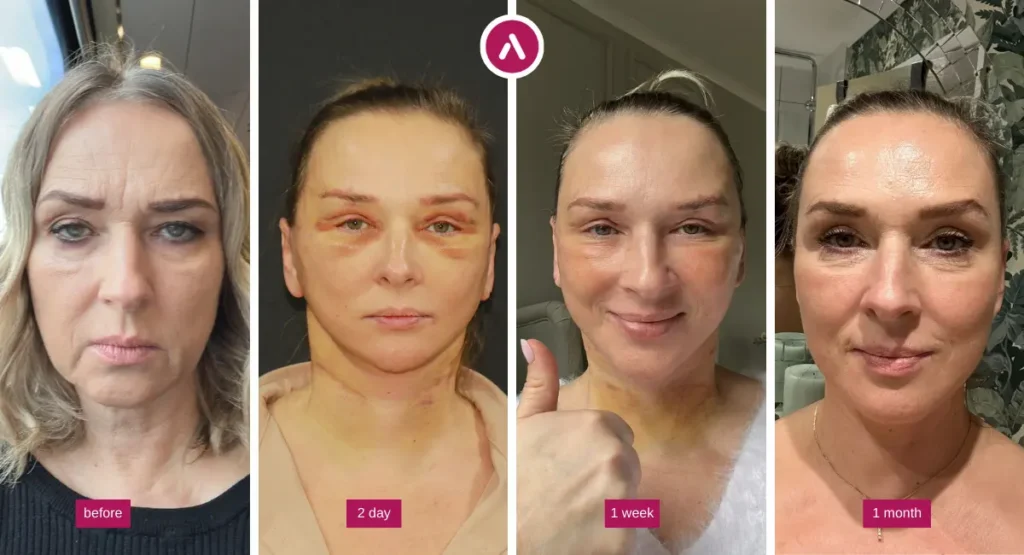
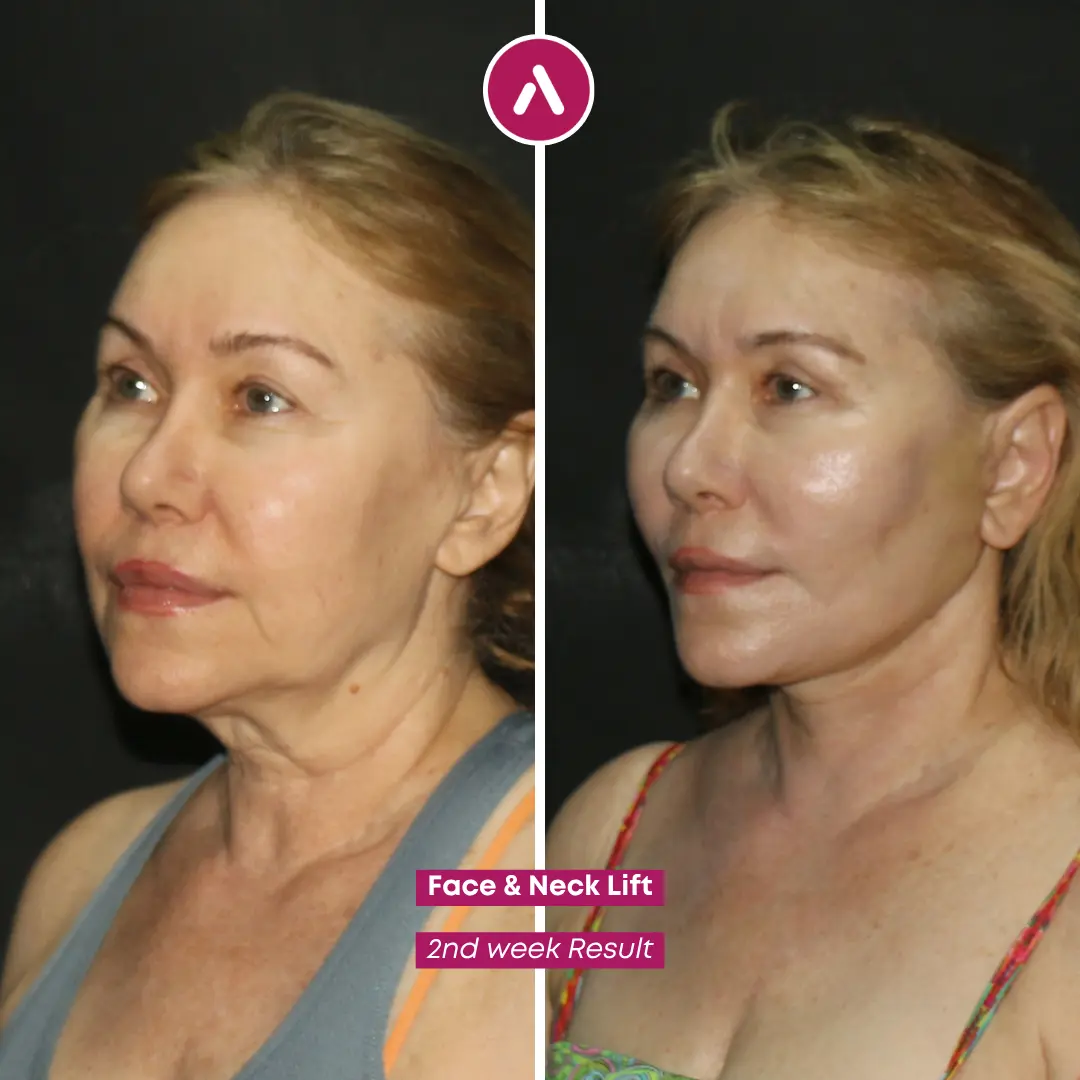
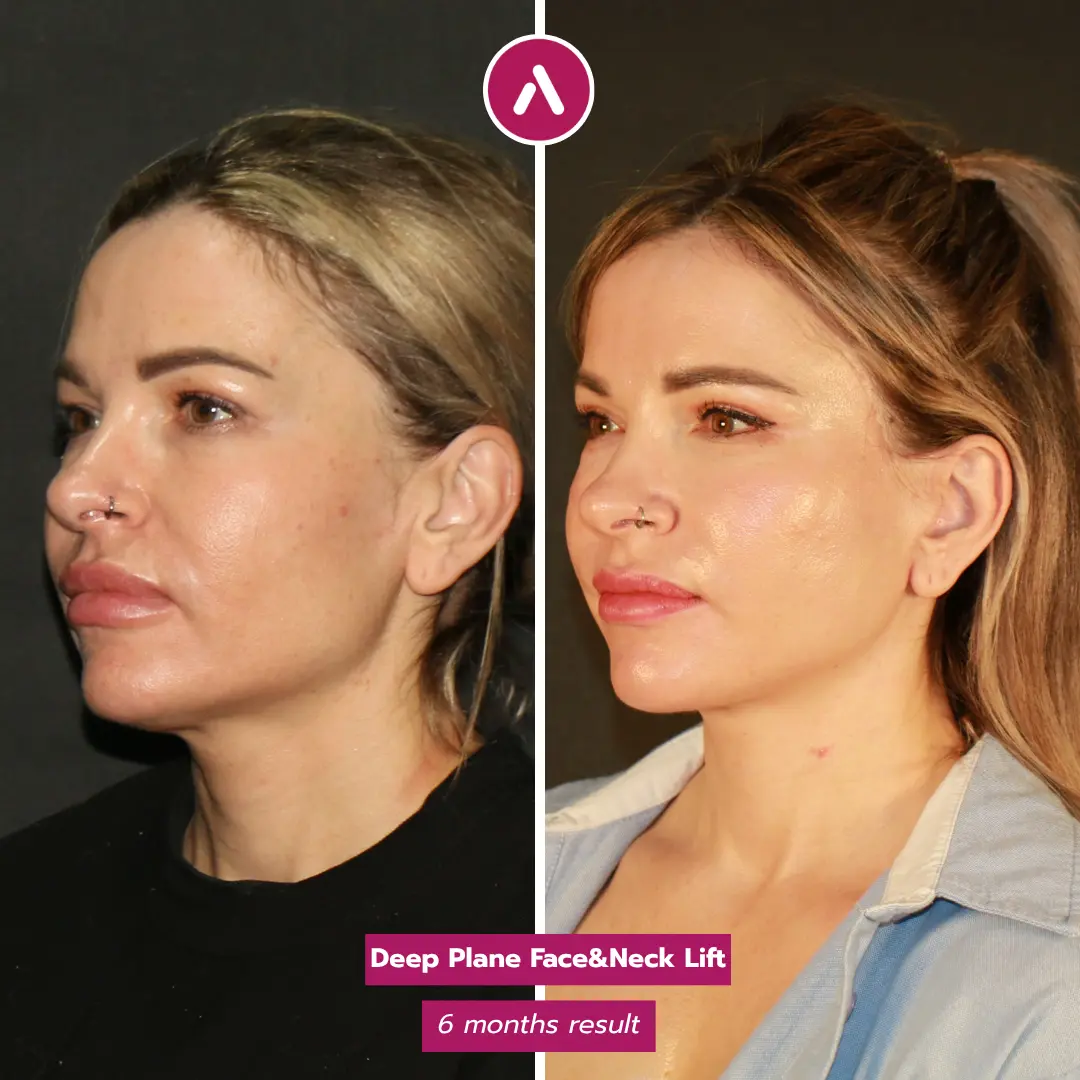
SMAS Facelift Before and After: Realistic Expectations & Results
A SMAS facelift can create meaningful lower-face improvement, but it should not change your identity. The best result looks like a rested, lifted version of your own face. It should not look tight, frozen, or dramatically altered.
We use a Natural-First approach because most Canadian patients do not want an obvious surgical look. They want their jawline back. They want jowls softened. They want the face to look less heavy without looking “done.”
SMAS Facelift Before and After: Realistic Outcomes
Before-and-after results should be evaluated with restraint. Lighting, angles, swelling, makeup, and facial expression can all change how a result appears. A trustworthy gallery should help you understand patterns, not sell fantasy.
A realistic SMAS facelift result may show:
- Cleaner jawline definition
- Reduced jowl heaviness
- Improved lower-face contour
- Softer skin drape around the cheeks
- A more rested appearance
- Natural ear and hairline placement
It should not show a face that looks stretched sideways. It should not distort the mouth, earlobes, or natural expression. You can review our available outcomes through the facelift before-and-after gallery.
How Long Does a SMAS Facelift Last?
SMAS facelift results often last 8–12 years, depending on anatomy, skin quality, age, sun exposure, smoking, weight stability, and lifestyle. Some patients enjoy improvement longer. Others age more quickly because of genetics or environmental factors.
Longevity does not mean your face stops aging. It means you age from a more lifted starting point. The face will continue to change naturally, but the structural reset can remain visible for years.
Patients who protect their skin, avoid nicotine, maintain stable weight, and follow aftercare instructions usually support better long-term results.
SMAS vs Skin-Only Facelift Longevity
A skin-only facelift depends heavily on surface tension. Skin stretches over time, so results may relax faster. A SMAS facelift treats the deeper support layer, which provides a more stable foundation.
This is why SMAS techniques became a major step forward in facelift surgery. They address the anatomy that contributes to descent, not only the skin that reveals it.
That deeper support also helps reduce the risk of early relapse. The result should feel more structural and less dependent on tight skin.
Natural vs Over-Tightened Results
Natural does not mean invisible. A good SMAS facelift should create visible improvement. The difference is that the improvement should respect your facial proportions.
An over-tightened result often shows warning signs:
- Stretched cheeks
- Distorted earlobes
- Flattened expression
- Mouth corner tension
- Hairline distortion
- A lateral, wind-swept direction of pull
We avoid these issues by supporting the SMAS layer, planning the vector carefully, and removing skin conservatively. The face should look lifted, not pulled.
Scar Maturation Timeline
Facelift scars mature slowly. In the early weeks, they may look pink, raised, or firm. This can be frustrating for patients who expected scars to disappear quickly. It is normal for scars to take months to soften.
Most scars improve gradually over 6–12 months. Some patients continue to see refinement beyond one year. Scar quality depends on genetics, closure technique, tension, sun exposure, smoking status, and aftercare.
We will give you scar care instructions before you leave Istanbul. You should protect healing incisions from sun exposure and avoid aggressive skincare near the incision line until cleared.
Before & After Gallery
Before-and-after photos are useful when they are interpreted honestly. They should show what a SMAS facelift can improve and what it cannot. We encourage patients to look for lower-face shape, jowl correction, jawline definition, ear position, and scar placement.
Photos should also reflect your own anatomy. A patient with thin skin, minimal jowls, and strong cheekbones will not heal or look the same as a patient with thicker skin and heavier lower-face descent.
During consultation, we discuss realistic examples and match your goals to your anatomy. We do not promise that you will look like another patient. We plan for your face.
“The best facelift result is not the tightest result. It is the one that restores support, preserves expression, and still belongs to the patient.”
SMAS Facelift Cost 2026: Turkey vs Canada
Canadian patients researching SMAS facelift cost often compare Toronto, Vancouver, Calgary, and Montreal private clinic quotes with Istanbul-based all-inclusive clinical pathways. In Canada, the first quote may cover only the surgeon’s fee. Anesthesia, facility fees, medications, garments, and follow-up can be listed separately.
At AKM Clinic, SMAS Plication and SMASectomy are listed at CAD $6,700. High-SMAS Facelift is listed at CAD $7,150, and Extended SMAS Facelift is listed at CAD $7,500. Canadian-dollar pricing shown for planning clarity; your coordinator will confirm the final payment details before booking.
By comparison, Toronto private clinic SMAS facelift quotes often sit around CAD $15,000–$20,000, while Vancouver quotes may reach CAD $16,000–$22,000. Calgary and Montreal pricing varies by surgeon, facility, anesthesia model, and whether the neck is included.
For the full Canadian dollar breakdown, hidden-fee comparison, and city-by-city pricing context, see our SMAS facelift cost guide for Canadian patients.
If your lower face and neck both require correction, our SMAS Facelift & Neck Lift Package is the most relevant package pathway. It should be reviewed with your coordinator because final planning depends on anatomy, technique, hotel nights, and combined procedures.
| Location | Typical SMAS Facelift Pricing | What to Check Before Comparing |
|---|---|---|
| Toronto | CAD $15,000–$20,000 | Ask whether anesthesia, facility fees, medications, and follow-up are included. |
| Vancouver | CAD $16,000–$22,000 | Ask whether the quote includes lower face only or face and neck. |
| Calgary | Varies by private clinic | Ask whether hospital privileges, anesthesia fees, and revision policy are clear. |
| Montreal | Varies by private clinic | Ask whether follow-up appointments are included or billed separately. |
| AKM Clinic Istanbul | From CAD $6,700 depending on SMAS technique | Canadian-dollar pricing shown for planning clarity; your coordinator will confirm the final payment details before booking. |
Why Cost Comparisons Can Be Misleading
A facelift quote is only useful when you know what it includes. A lower Canadian quote may exclude anesthesia or facility fees. A higher quote may include some aftercare but not medications, compression support, or revision policy.
Our approach is to make the clinical pathway easier to understand before you travel. Your coordinator explains what is included, what is not included, and what may change if your surgeon recommends a different technique after in-person examination.
SMAS vs Deep Plane Cost: Why Technique Changes Pricing
SMAS and deep plane facelifts are different operations. Deep plane surgery often involves deeper ligament release and broader tissue repositioning, while SMAS facelift focuses on the SMAS layer itself. The surgical time, complexity, and combined procedure plan can affect pricing.
You should not choose based on price alone. The better value is the technique that matches your anatomy. A less expensive operation is not cost-effective if it under-treats the concern.
Does Canadian Medicare Cover SMAS Facelift Surgery?
Canadian Medicare and provincial health plans such as OHIP, MSP, AHCIP, and RAMQ generally do not cover elective cosmetic facelift surgery. Coverage is usually reserved for medically necessary reconstructive procedures, not age-related facial rejuvenation.
If you are unsure whether any portion of your case has functional or reconstructive relevance, discuss it with your Canadian physician before booking. For most SMAS facelift patients, the procedure is private-pay.
How to Find the Best SMAS Facelift Surgeon in Turkey: A Canadian Patient’s Checklist
Many Canadian patients begin by searching for a local facelift surgeon in Toronto, Vancouver, Calgary, or Montreal. That is a reasonable starting point. Once they compare technique options, surgeon credentials, total cost, and aftercare, many begin evaluating Istanbul as a serious surgical destination.
The goal is not to find the loudest claim online. The goal is to verify the surgeon, the facility, the technique range, and the follow-up system. SMAS facelift surgery requires anatomical judgement. Your checklist should reflect that.
EBOPRAS Certification and RCPSC Equivalency
Canadian patients are familiar with the Royal College of Physicians and Surgeons of Canada, or RCPSC, and the FRCSC designation. These are Canadian specialist frameworks. Turkey and Europe use different credentialing systems, so you need a way to compare standards.
EBOPRAS certification is a European board-level credential in plastic, reconstructive, and aesthetic surgery. It is not the same as Canadian licensure. It is a specialist-level framework that can help Canadian patients assess training depth when reviewing an international surgeon.
| Credential | Region | Why It Matters for Canadian Patients |
|---|---|---|
| EBOPRAS | Europe | Shows structured European board-level certification in plastic, reconstructive, and aesthetic surgery. |
| RCPSC / FRCSC | Canada | Canadian specialist certification reference point for patients comparing standards. |
| ABFPRS | United States | Facial plastic surgery credential reference for North American comparisons. |
For a deeper credential framework, review our plastic surgeon board certification guide. The American Board of Facial Plastic and Reconstructive Surgery is another useful reference point when Canadian patients compare facial plastic surgery credential systems.
Facial Plastic Surgery Sub-Specialization
Not every plastic surgeon focuses heavily on the face. Some surgeons spend most of their time on body contouring, breast surgery, or hair restoration. SMAS facelift surgery requires a different skill set.
Ask how often the surgeon performs facial rejuvenation procedures. Ask whether they perform SMAS, deep plane, mini, mid facelift, and revision facelift. A surgeon who understands multiple techniques is less likely to force one method onto every patient.
At AKM Clinic, facial rejuvenation is a major part of our surgical programme. Our surgeons assess the lower face, neck, cheek, skin quality, and previous treatment history before recommending a SMAS plan.
Technique Range: Does the Surgeon Offer SMAS and Deep Plane?
A strong facelift surgeon should understand more than one technique. If a clinic offers only one approach, every patient may be pushed toward that approach. That is not ideal.
For SMAS candidates, the surgeon should be comfortable discussing:
- SMAS plication
- SMAS imbrication
- SMASectomy
- High-SMAS facelift
- Deep plane facelift
- Mini facelift
- Neck lift combinations
This range matters because the correct answer may not be SMAS. Some patients need a deep plane facelift. Others may be better served by a mini facelift or neck lift.
Honest Technique Recommendation: SMAS vs Deep Plane Per Patient
The best surgeon is not the one who always recommends the most complex procedure. It is the one who can explain why one technique fits your anatomy better than another.
For example, a patient with moderate jowls and good cheek support may do well with SMAS. A patient with stronger mid-face descent and deeper ligament tethering may need deep plane. A patient with mild lower-face laxity may not need a full facelift at all.
We explain this decision directly during consultation. If SMAS is enough, we will say so. If deep plane is more appropriate, we will explain why. If surgery is premature, we will recommend waiting.
“A good facelift consultation should include the word no when needed. If the patient’s anatomy does not match the operation, the ethical answer is to choose another plan or wait.”
Real Patient Reviews and Before/After Documentation
Reviews help, but they should be read carefully. Look for comments about communication, aftercare, surgeon honesty, recovery support, and natural-looking outcomes. A review that only says “great result” is less useful than one that explains the care pathway.
Before-and-after photos should also be reviewed with context. Look for patients with similar age, skin quality, jowl pattern, and neck involvement. Do not judge your future result from a patient whose anatomy is completely different from yours.
You can also review broader patient experiences through our professional plastic surgery reviews. During consultation, we discuss examples that are relevant to your face rather than showing random transformations.
Aftercare Continuity From Istanbul to Canada
Aftercare is one of the most important differences between a safe international pathway and a risky one. You need to know who to contact after surgery, how follow-up is structured, and what happens after you return to Canada.
Our aftercare pathway includes local monitoring in Istanbul, English-language discharge instructions, 24/7 coordinator support, and long-term virtual follow-up at 1, 3, 6, and 12 months. Patient hosts such as Hande, Emine, and Khadija help coordinate communication so you are not left alone during recovery.
We also encourage you to keep your Canadian family physician informed. International surgery works best when local medical support and surgical documentation are aligned.
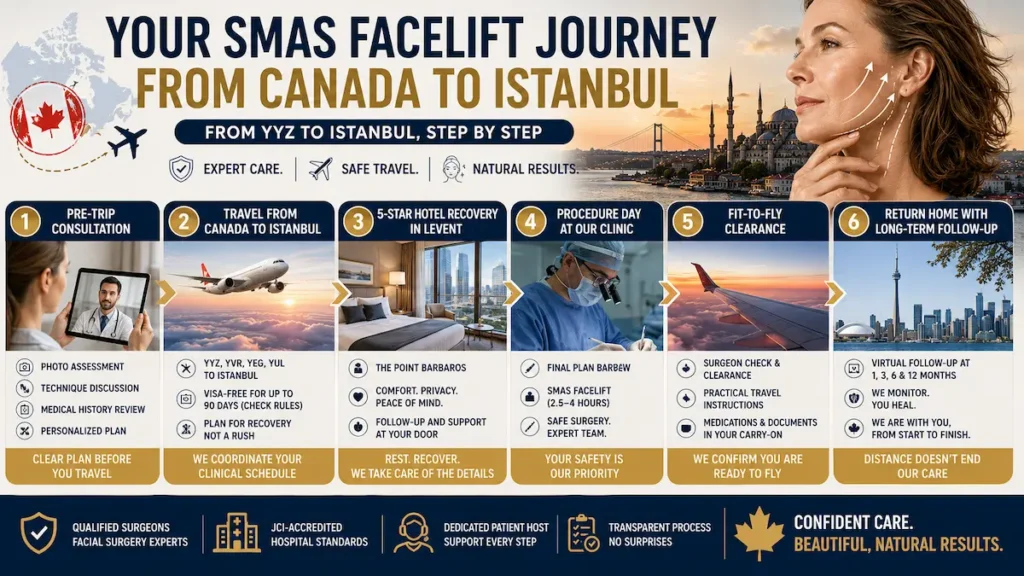
Your SMAS Facelift Journey from Canada: From YYZ to Istanbul, Step by Step
Travelling from Canada for a SMAS facelift requires more planning than booking a local consultation, but the process should still feel organized and clinically clear. We structure your care so that medical decisions, travel timing, hotel recovery, and follow-up all work together.
You remain responsible for booking your international flights. We coordinate the clinical pathway around your confirmed travel dates, surgical plan, hotel stay, airport transfers, and recovery appointments.
Pre-Trip Consultation: Photo Assessment and Technique Discussion
Your process begins with a confidential virtual consultation. You send standardized photos, describe your concerns, and share your medical history. We assess jowls, lower-face descent, cheek support, neck laxity, prior procedures, filler history, and skin quality.
At this stage, we discuss whether SMAS facelift is likely to fit your anatomy. We may also compare SMAS with deep plane facelift, mini facelift, mid facelift, or neck lift. The goal is to narrow the plan before you travel, not to surprise you after arrival.
We may ask for:
- Front, side, and three-quarter facial photos
- Photos with relaxed expression
- Photos showing the neck and jawline clearly
- Medication and supplement list
- Smoking or nicotine history
- Previous facial surgery or filler details
If you have a Canadian family physician, we recommend discussing your plan before travel. This is especially important if you have high blood pressure, diabetes, heart disease, clotting history, or previous anesthesia concerns.
Travel Logistics: Toronto, Vancouver, Calgary, and Montreal to Istanbul
Many Canadian patients travel from Toronto Pearson, Vancouver, Calgary, or Montreal. Flight schedules change often, so you should check current airline availability before booking. Your coordinator can help you choose arrival timing that fits your consultation, surgery, and recovery appointments.
Canadian citizens travelling to Türkiye for tourism generally do not need a visa for stays up to 90 days in a 180-day period, according to the Government of Canada travel advice for Türkiye. You should still confirm entry rules, passport validity, and airline requirements before departure because regulations can change.
Plan your travel with recovery in mind. A SMAS facelift is not a procedure you should schedule around a rushed return. We recommend building in enough time for early swelling, wound checks, surgeon review, and fit-to-fly clearance.
Useful planning points include:
- Arrive early enough for your in-person consultation and pre-operative tests
- Keep medications and medical documents in your carry-on
- Bring glasses instead of relying on contact lenses immediately after surgery
- Pack front-opening tops to avoid pulling clothing over your face
- Avoid tight collars, heavy scarves, or anything that rubs the incision area
For the full travel process, see our Canadian patient journey guide.
5-Star Hotel Recovery Stay in Levent
After surgery, recovery environment matters. You need quiet, comfort, privacy, and quick access to your care team. Our hotel pathway is designed to reduce avoidable stress during the early healing window.
We work with The Point Barbaros in the Levent district, a 5-star hotel selected for international patient comfort and proximity to our clinic. Your package may include hotel accommodation depending on the selected clinical pathway.
During hotel recovery, your priorities are simple:
- Rest with your head elevated
- Take medications as instructed
- Attend scheduled follow-up appointments
- Avoid strenuous activity
- Stay hydrated
- Contact your coordinator if anything feels unusual
Your patient host helps coordinate transfers, appointment timing, communication, and practical recovery needs. This support is especially useful for patients travelling alone from Canada.
Procedure Day at Our Istanbul Clinic
On procedure day, your surgical plan is reviewed again. Your surgeon confirms markings, anesthesia plan, technique choice, and any combined procedures. This is also the final opportunity to confirm priorities before anesthesia begins.
Your SMAS facelift is performed in a controlled surgical setting with appropriate monitoring and sterile protocol. The procedure usually takes 2.5–4 hours, but combined surgery may extend that time.
After surgery, you are monitored before transfer to the next recovery setting. We do not treat discharge as a formality. You leave only when the team has reviewed your early condition and recovery instructions.
You can learn more about our facility standards on our Istanbul clinic page.
Fit-to-Fly Clearance and Return Travel
Fit-to-fly clearance is based on your actual recovery. We assess swelling, blood pressure, incision healing, comfort, mobility, and any signs that require additional monitoring. The date on the calendar is not the only factor.
Before your return flight, we review practical precautions for the airport and cabin. You should keep your medications, documents, and wound-care supplies in your carry-on. Avoid heavy luggage, dehydration, and alcohol.
For long-haul travel back to Canada, we usually recommend:
- Walking gently during the flight when safe
- Drinking water regularly
- Keeping your head and neck supported
- Avoiding pressure on the incision areas
- Using your medication schedule exactly as instructed
- Contacting us if swelling changes suddenly after arrival
Once you return home, your recovery continues through virtual follow-up. We monitor progress at key milestones, including 1, 3, 6, and 12 months. This long-term follow-up helps bridge the distance between Istanbul and Canada.
SMAS Facelift Surgery Frequently Asked Questions (FAQ):
Is a SMAS facelift the same as the SMA syndrome I read about?
No. In facial surgery, SMAS means Superficial Musculoaponeurotic System. It is the deep support layer of the face that surgeons can reposition during facelift surgery.
SMA syndrome is a completely different medical condition involving the superior mesenteric artery and the digestive system. This page is about SMAS facelift surgery only.
What's the difference between a SMAS facelift and a deep plane facelift?
A SMAS facelift tightens, folds, overlaps, or partially reduces the SMAS layer to improve jowls and lower-face descent. A deep plane facelift works beneath the SMAS layer and releases retaining ligaments to reposition the cheek and lower face as a connected unit.
SMAS may be appropriate for moderate lower-face laxity. Deep plane may be better for patients with stronger cheek descent, deeper tissue tethering, or more advanced mid-face aging. For the full technical comparison, read our SMAS vs Deep Plane Facelift guide.
Is HIFU "SMAS lifting" the same as a SMAS facelift?
No. HIFU and other energy-based devices may create mild tissue tightening in selected early cases, but they do not surgically reposition the SMAS layer.
A surgical SMAS facelift uses incisions, direct access to the SMAS, deep-layer fixation, and skin redraping. If your jowls and lower face have physically descended, HIFU is not a true substitute for surgery.
How long does a SMAS facelift last?
SMAS facelift results often last 8–12 years, depending on skin quality, age, genetics, smoking status, sun exposure, weight stability, and aftercare. Some patients maintain improvement longer, while others age faster because of individual biology.
A facelift does not stop aging. It resets facial support so you continue to age from a more lifted starting point.
Does OHIP, MSP, AHCIP, or RAMQ cover a SMAS facelift?
In most cases, no. Provincial health plans such as OHIP in Ontario, MSP in British Columbia, AHCIP in Alberta, and RAMQ in Quebec generally do not cover elective cosmetic facelift surgery.
Coverage is usually reserved for medically necessary reconstructive procedures. Speak with your Canadian physician if you believe your case has functional or reconstructive elements.
How much does a SMAS facelift cost in Toronto vs Istanbul?
Toronto private clinic quotes for SMAS facelift commonly sit around CAD $12,000–$20,000, while Vancouver quotes may reach CAD $13,000–$22,000. Pricing varies depending on surgeon, facility, anesthesia, neck inclusion, and follow-up structure.
At AKM Clinic, SMAS Plication and SMASectomy are listed at CAD $6,700, High-SMAS at CAD $7,150, and Extended SMAS at CAD $7,500. Canadian-dollar pricing shown for planning clarity; your coordinator will confirm the final payment details before booking. For the detailed breakdown, visit our SMAS facelift cost guide.
Will I have visible scars?
A SMAS facelift is not scarless. Incisions are usually placed around the ear, sideburn, and hairline so scars can be hidden in natural folds and hair-bearing areas.
Early scars may look pink, firm, or slightly raised. They usually soften and fade over several months. Scar quality depends on incision design, closure technique, skin type, smoking status, genetics, and aftercare.
Does Canadian travel insurance cover complications from elective SMAS facelift in Turkey?
Many Canadian travel insurance policies exclude elective cosmetic surgery and complications related to it. You should review your policy carefully before booking and ask the insurer direct written questions.
To reduce this concern, AKM Clinic provides complimentary complication insurance for all patients. This is separate from standard Canadian travel insurance and is designed to add an extra layer of protection around your surgical care. Your coordinator will explain the coverage terms, limits, and required documentation before you confirm your booking.
Will I look pulled or windswept?
Our goal is to avoid that look. A pulled or windswept result usually happens when the skin carries too much tension or the lift vector is poorly planned.
In a SMAS facelift, the deeper support layer should carry the main lift. The skin is then redraped more naturally. This supports our Natural-First philosophy: rejuvenation, not alteration.
Am I too young or too old for a SMAS facelift?
Age alone is not the deciding factor. Many SMAS facelift candidates are in their mid-40s to early 60s, but anatomy, skin quality, health, and expectations matter more than the number.
You may be too early if your laxity is mild and non-surgical options still work. You may still be a candidate at an older age if you are medically stable, have realistic goals, and can follow recovery instructions.
Can I combine a SMAS facelift with a neck lift or eyelid surgery in one trip?
Yes, when it is medically appropriate. SMAS facelift is often combined with neck lift, blepharoplasty, temporal brow lift, or fat transfer to face. Combining procedures can create a more balanced result and reduce duplicate travel from Canada.
Combination surgery is not automatic. We assess anesthesia time, medical risk, recovery demands, and whether each procedure genuinely improves your result. Safety comes before convenience.
When can I return to work and exercise?
Many patients return to light desk work or remote work within 2–4 weeks, depending on swelling, bruising, and comfort. Public-facing work may require more time if you want bruising and swelling to be less noticeable.
Light walking begins early. More intense exercise usually waits until around 4–6 weeks, with surgeon approval. If you combine SMAS facelift with neck lift, eyelid surgery, or fat transfer, your recovery timeline may be adjusted.
Medical Disclaimer: This page is for educational purposes only and does not replace medical advice from a qualified physician. A SMAS facelift is an elective surgical procedure with risks, including bleeding, infection, scarring, asymmetry, temporary or permanent sensation changes, facial nerve injury, anesthesia-related complications, and dissatisfaction with cosmetic outcome.