



Prominent ears can affect a child who is being teased at school, an adult who avoids short hairstyles, or anyone who feels their ears draw more attention than their face. Otoplasty, commonly called ear pinning surgery, reshapes the ear cartilage to bring the ears closer to the head. Incisions are usually placed behind the ear, where scars tend to remain discreet.
At AKM Clinic in Istanbul, we approach otoplasty as a precise facial-balancing procedure, not a one-size-fits-all correction. The goal is natural ear position. We avoid the overly pinned look that can make the ears appear flattened against the head.
This guide explains candidacy by age, the difference between surgical and incisionless ear pinning, recovery with the headband protocol, scar placement, cost comparisons for Canadians, and how families should plan travel from Canada to Istanbul.
Table of Contents
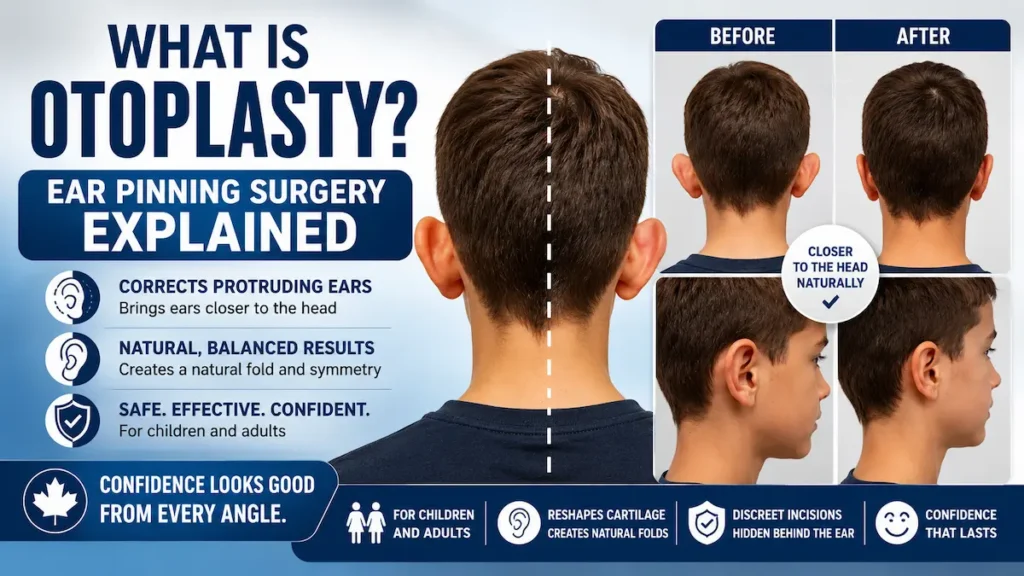
What Is Otoplasty? Ear Pinning Surgery Explained
Otoplasty, also called ear pinning surgery, reshapes prominent or protruding ears by modifying the cartilage and creating a natural antihelical fold. The goal is to bring the ears closer to the head while avoiding an over-pinned look. It can be performed for children and adults.
How Otoplasty Works: Cartilage Reshaping and Fold Creation
Most prominent ears are caused by one or both of two anatomical features: an underdeveloped antihelical fold or an enlarged conchal bowl. The antihelical fold is the inner ridge that gives the ear its natural curved shape. The concha is the deeper cup-shaped area near the ear canal.
During otoplasty surgery, our surgeon reshapes these structures so the ear sits closer to the side of the head. This may involve cartilage-sparing sutures, controlled cartilage scoring, or a combination of both. The technique depends on cartilage thickness, age, symmetry, and the amount of projection.
Otoplasty vs Ear Pinning: Same Procedure, Different Names
Canadian patients often search both “otoplasty” and “ear pinning.” They usually mean the same cosmetic procedure. “Otoplasty” is the medical term, while “ear pinning” is the everyday phrase used by parents and adult patients.
Ear pinning describes the visible goal: reducing how far the ears project from the head. Otoplasty describes the surgical method: reshaping cartilage, adjusting folds, and improving ear symmetry. Both terms are used throughout this guide because Canadian families use both during research.
What Otoplasty Corrects
Otoplasty can address several ear-shape concerns. The most common is prominent ears, where one or both ears extend outward more than the patient prefers. It can also improve uneven projection, mild cup ear, lop ear, or a missing antihelical fold.
- Prominent ears: ears that sit too far from the head.
- Asymmetrical ears: one ear projects more than the other.
- Cup ear: the upper ear appears constricted or folded.
- Lop ear: the upper ear folds downward.
- Large or stretched earlobes: may require earlobe reduction or repair.
Otoplasty does not change hearing. It reshapes the external ear only. If a child has recurrent ear infections, hearing loss, or middle-ear concerns, those issues should be assessed by a Canadian pediatrician or otolaryngologist before any cosmetic plan is considered.
Cosmetic Otoplasty vs Reconstructive Ear Surgery
Cosmetic otoplasty focuses on reshaping ears that are structurally present but prominent, uneven, or visually distracting. Reconstructive ear surgery is different. It may involve congenital ear absence, trauma, burns, or complex cartilage reconstruction.
This page focuses on cosmetic otoplasty and ear pinning for Canadian children and adults. If a patient needs reconstructive ear care, we review the case individually and advise whether our Istanbul-based surgical team is the right fit or whether a reconstructive pathway in Canada should come first. For general patient-facing background on ear surgery, patients can also review the American Society of Plastic Surgeons ear surgery resource.
Ear Anatomy Reference for Otoplasty Planning
| Ear Structure | Why It Matters in Otoplasty | Common Correction |
|---|---|---|
| Antihelical fold | Often underdeveloped in prominent ears. | Created or strengthened with sutures. |
| Conchal bowl | Can push the ear outward when enlarged. | Set back closer to the head. |
| Earlobe | May remain prominent even after upper-ear correction. | Reshaped or reduced when needed. |
| Postauricular crease | The fold behind the ear hides most incisions. | Used for discreet scar placement. |
“A good otoplasty result should not make the ears disappear. It should make them stop distracting from the face. We plan the fold, projection, and symmetry together so the result looks balanced from the front, side, and back.”
Benefits of Otoplasty for Children and Adults
Otoplasty is a small anatomical correction with a meaningful psychological impact. The ears sit at the edge of the face, but they can shape how a person feels in photographs, social settings, school, or work. The benefit is not about creating a “new” appearance. It is about reducing one feature that feels distracting.
Our Natural-First philosophy applies to ear surgery as much as it does to facial rejuvenation. We aim for ears that look balanced, proportionate, and unremarkable in the best way. The goal is confidence without obvious surgery.
Ears Brought Closer to the Head
The main benefit of ear pinning surgery is reduced projection. When the ears sit closer to the head, the face usually appears more balanced from the front. The side profile also looks more proportionate, especially when the hair is tied back or cut short.
For many patients, the change is subtle in measurement but significant in daily life. A few millimetres of cartilage repositioning can change how the ears frame the face. This is why careful planning matters.
Confidence for Children Facing Teasing
For children, prominent ears can become a focus of teasing around school age. Parents often notice the concern only after a child starts hiding their ears, avoiding haircuts, or asking why their ears look different. This should be handled gently.
We never frame otoplasty as something a child “needs” because of appearance alone. The child should understand the procedure in age-appropriate language and want the change for themselves. Parents should also speak with their Canadian pediatrician before planning international surgery.
The ideal child otoplasty candidate is emotionally ready, healthy, and old enough for the ear cartilage to be stable. In most children, this is around age 5 or older. That timing can vary, so readiness matters as much as age.
Hairstyle Freedom for Adults
Adults often describe otoplasty differently. Many have lived for years with small behaviours that avoid attention to the ears. They may keep long hair, avoid ponytails, skip certain hats, or dislike side-profile photographs.
Otoplasty can make those choices feel optional rather than defensive. Adult patients often choose ear pinning because they want a quiet correction that does not change their identity. They still look like themselves, just less preoccupied with one feature.
Permanent, One-Time Correction
Otoplasty is designed as a long-lasting procedure. Once the cartilage heals in its new position, the result is usually stable. Children continue to grow, but the ear is already close to adult size by the usual treatment age.
Relapse can occur if sutures loosen, trauma occurs during healing, or the cartilage is unusually strong. This is one reason the headband protocol is important. It protects the ears while the internal support becomes stable.
Symmetry Correction When Ears Differ
Many patients do not have two equally prominent ears. One ear may project more, sit at a different angle, or have a weaker fold. Otoplasty planning should account for those asymmetries instead of applying the same correction to both sides.
Perfect symmetry is not realistic because natural ears are not identical. The goal is balanced symmetry. That means the ears should look like they belong to the same face, without drawing attention from ordinary social distance.
Candidacy: Otoplasty for Children vs Adults
Otoplasty candidacy depends on age, anatomy, health, motivation, and expectations. A child and an adult may need the same cartilage correction, but the decision-making process is different. For children, emotional readiness and family support matter. For adults, expectations and scar understanding are usually the bigger focus.
Children: From Age 5+, Once Ears Are Nearly Adult-Sized
Children are often considered for otoplasty once the ears have reached near-adult size, commonly around age 5. This timing is practical. It allows correction before years of school teasing while avoiding surgery too early in ear development.
Age alone is not enough. The child should be able to follow simple recovery instructions, tolerate a headband, and understand that the ears need protection after surgery. A child who is fearful or resistant should not be pushed.
Parent’s Role: Child Readiness, Not Parent Preference
Parents play an important role, but the procedure should not be driven only by parental preference. A child who is happy with their ears should not be made to feel something is wrong. The healthiest decision happens when the concern is shared by the child and supported by the parents.
During consultation, we discuss the child’s own feelings, the family’s goals, and whether the timing is appropriate. We also recommend that Canadian families involve their pediatrician before travelling. That creates a safer and more grounded decision.
Adults: No Upper Age Limit
Adults can have otoplasty at almost any age if they are healthy enough for the procedure. Cartilage may be firmer than in children, so the technique may need more structural support. This is not a problem when planned correctly.
Adult candidates should understand that swelling, headband use, and sleeping position matter during recovery. They should also have realistic expectations. Otoplasty improves projection and shape; it does not make the ears invisible.
Addressing Teasing and Bullying Sensitively
Prominent ears can become a visible target for teasing, especially in early school years. Parents may feel protective, but the conversation should stay calm. The child should never feel blamed for having ears that look different.
A healthy discussion sounds practical: “This is something we can improve if it bothers you.” It should not sound urgent or shame-based. When a child feels included in the decision, recovery is usually easier.
General Health and Cartilage Quality Assessment
Good otoplasty candidates should be in stable general health. Adults should disclose smoking, diabetes, bleeding disorders, medication use, and any history of poor wound healing. Children should be free of active infection and medically cleared for travel and anesthesia.
Cartilage quality also affects technique. Younger cartilage is softer and more responsive to suture shaping. Adult cartilage can be firmer, so it may require stronger fixation or cartilage scoring to hold the new contour.
When Otoplasty Is Not Recommended
Otoplasty may be delayed or declined if the patient has an active ear infection, uncontrolled medical condition, unrealistic expectations, or a child who is not emotionally ready. We also avoid operating when the concern is driven entirely by someone else.
For Canadian families, a pre-travel conversation with a family physician or pediatrician is a sensible safeguard. It helps confirm that the patient is healthy enough to travel, undergo anesthesia, and recover away from home. The Canadian Paediatric Society’s procedural sedation guidance also shows why patient selection, preparation, monitoring, and post-sedation care matter in children.
| Candidate Type | Typical Age | Anesthesia Approach | Recovery Focus | Key Consideration |
|---|---|---|---|---|
| Child otoplasty | Usually age 5+ | Often general anesthesia | Headband compliance, school timing, parent support | The child should want the correction, not only the parent. |
| Teen otoplasty | Adolescence | Local anesthesia with sedation or general anesthesia, depending on comfort | Sports restrictions, school return, social confidence | Expectations should be mature and realistic. |
| Adult otoplasty | No strict upper limit | Often local anesthesia with sedation | Work return, sleeping position, headband use | Cartilage may be firmer and need stronger structural support. |
“For children, age is only one part of the decision. We want the ears to be developed enough, but we also want the child to understand the change and feel comfortable with the recovery plan.”
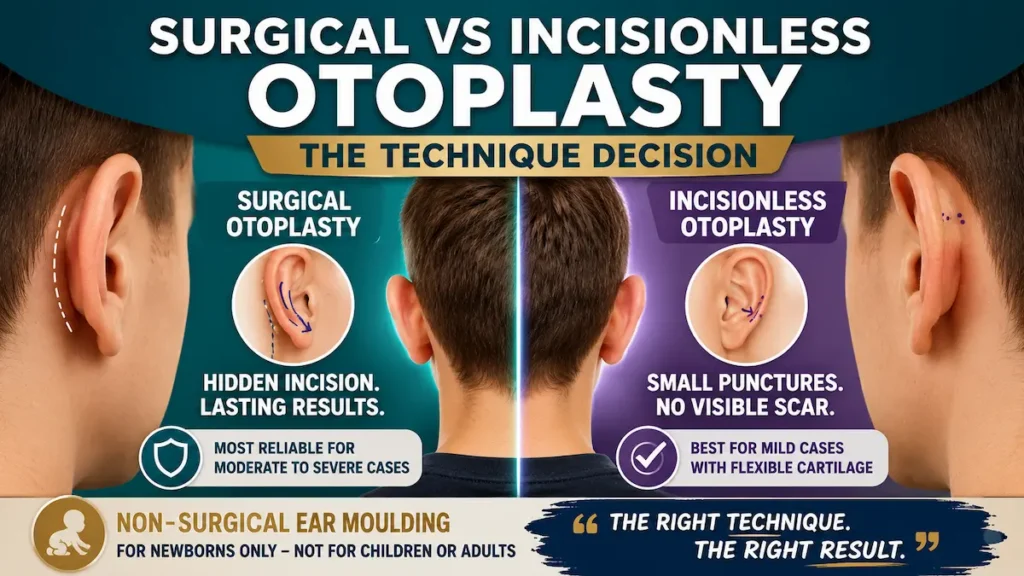
Surgical vs Incisionless Otoplasty: The Technique Decision
Canadian patients often ask whether incisionless otoplasty can avoid scars entirely. The honest answer is that incisionless ear pinning can help selected mild cases, but it is not a universal replacement for surgical cartilage reshaping. The right technique depends on the cause of the prominence.
At AKM Clinic, we choose technique based on cartilage anatomy, not marketing appeal. Some ears need a new antihelical fold. Some need conchal setback. Some need both. A suture-only method cannot solve every structural cause.
Traditional Otoplasty: Cartilage Reshaping as the Gold Standard
Traditional otoplasty uses a hidden incision behind the ear. Through this access point, the surgeon can reshape the cartilage, create or strengthen the antihelical fold, reduce projection, and adjust asymmetry. The scar sits in the natural crease behind the ear.
This approach is most reliable for moderate to significant ear prominence. It allows direct control over cartilage shape and ear position. It is also the usual choice when the concha is enlarged or the cartilage is thick.
Incisionless Otoplasty: Suture-Only Honest Framing
Incisionless otoplasty uses sutures placed through small puncture points to bend the cartilage into a new position. It may be suitable for mild prominence, especially when the cartilage is flexible and the main issue is a weak antihelical fold.
The limitation is strength. If the cartilage is thick, stiff, or pushed forward by a prominent concha, sutures alone may not hold the result. In those cases, incisionless methods can have a higher relapse risk.
Non-Surgical Ear Pinning: Infant Moulding vs Adult Reality
Non-surgical ear moulding can work in newborns because ear cartilage is still soft under the influence of maternal estrogen. This is a narrow early-life window. It is not the same as adult ear pinning.
For older children, teens, and adults, tape, clips, or external moulding devices cannot permanently reshape mature cartilage. They may temporarily hold the ear closer to the head, but they do not create durable structural change.
Which Technique Fits Which Patient?
A mild case with soft cartilage may be considered for incisionless otoplasty. A moderate or severe case usually needs traditional otoplasty. A patient with large earlobes may need earlobe reshaping at the same time.
We explain these tradeoffs before surgery so the patient or family understands why a particular technique is recommended. The priority is stability, symmetry, and a natural ear angle, not simply the smallest possible incision.
| Technique | Method | Best For | Scar Profile | Relapse Risk | AKM Position |
|---|---|---|---|---|---|
| Traditional otoplasty | Hidden incision behind the ear with cartilage reshaping and sutures | Moderate to severe prominence, thick cartilage, conchal excess | Scar hidden in postauricular crease | Lower when healing protocol is followed | Most reliable for structural correction |
| Incisionless otoplasty | Suture-only reshaping through small puncture points | Mild prominence, flexible cartilage, weak antihelical fold | Minimal puncture marks | Higher in strong or thick cartilage | Useful for selected cases only |
| Non-surgical ear moulding | External moulding device | Newborn ear deformity in early weeks of life | No surgical scar | Not applicable to mature cartilage | Not a substitute for child or adult otoplasty |
“Incisionless otoplasty sounds attractive, but the ear has to be anatomically suitable. If strong cartilage is forcing the ear forward, a hidden incision and controlled reshaping usually gives the safer, more stable result.”
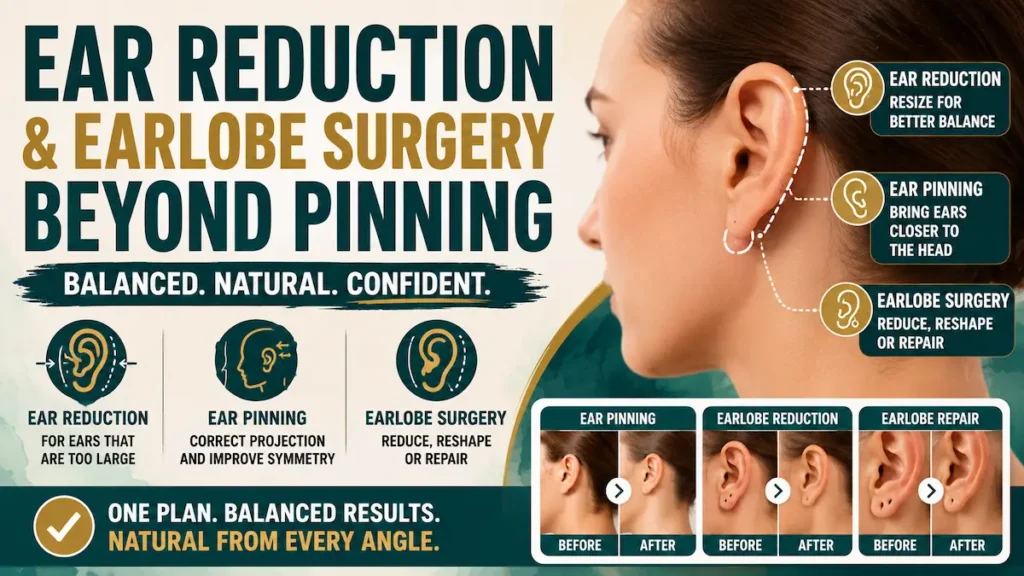
Ear Reduction and Earlobe Surgery Beyond Pinning
Not every ear concern is caused by projection. Some patients have ears that feel too large for the face, stretched earlobes, torn piercing holes, or earlobes that hang lower with age. These concerns may be treated with ear reduction surgery, earlobe reduction, or earlobe repair.
We assess the full ear, not only the upper cartilage. If the upper ear is pinned but the earlobe still projects outward, the result may look incomplete. A balanced otoplasty plan considers the upper ear, middle ear, and lobe together.
Ear Reduction Surgery for Macrotia
Macrotia means the ear is larger than average. In selected patients, ear reduction surgery can reduce the height or width of the ear while preserving a natural contour. This is more complex than standard ear pinning because tissue must be removed without making the ear look shortened or irregular.
Ear reduction is not recommended for every patient who feels their ears are prominent. Many ears look large because they project outward. Once the ears are brought closer to the head, the apparent size often looks more balanced.
Earlobe Surgery: Reduction and Reshaping
Earlobe surgery can reduce large lobes, reshape elongated lobes, or repair stretched piercing holes. It may be performed alone or combined with otoplasty. The incision is planned along natural lobe curves so the scar is as discreet as possible.
Patients often ask about earrings after earlobe repair. Re-piercing is usually delayed until the tissue has healed fully. The new piercing site should avoid the old scar line when possible.
Combining Ear Pinning and Earlobe Reduction
Ear pinning and earlobe reduction can be combined when the upper ear and lobe both contribute to the concern. This is common in adults whose earlobes have stretched over time. It can also help when the lobe projects outward even after upper-ear correction.
The combined plan should stay conservative. Over-reducing the lobe can make the ear look unnatural. We aim for a proportionate lobe that matches the new ear position.
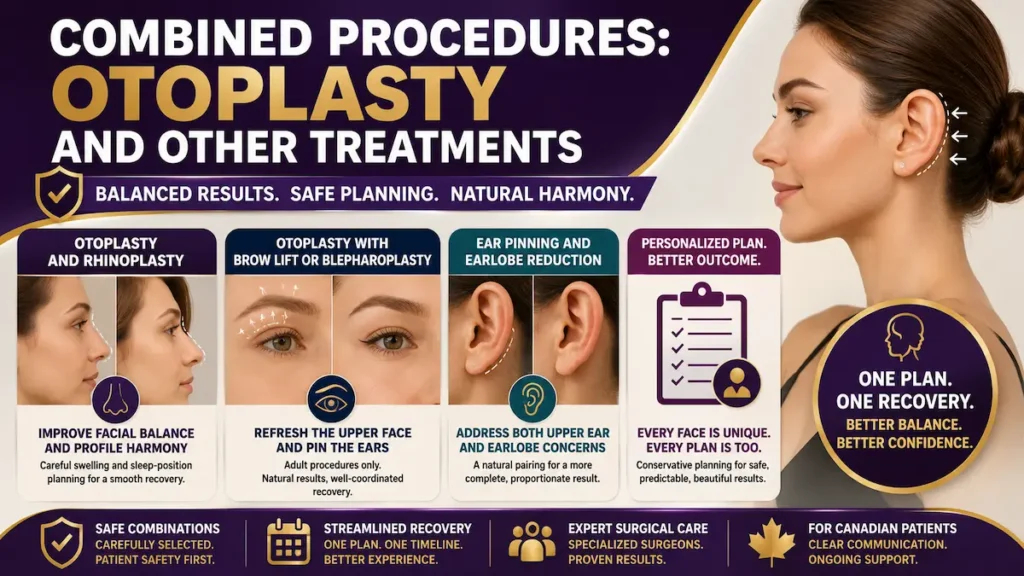
Combined Procedures: Otoplasty and Other Treatments
Otoplasty can be performed alone or combined with selected facial procedures. Combination planning should be conservative. Ear surgery has a specific recovery protocol, and the headband should not interfere with another procedure’s healing.
Otoplasty and Rhinoplasty
Ear projection and nose shape both influence facial balance. Some adult patients consider otoplasty with rhinoplasty in Turkey when they want a more complete profile correction. This combination requires careful swelling and sleep-position planning.
Otoplasty with Brow Lift or Blepharoplasty
Otoplasty can sometimes be combined with upper-face procedures such as endoscopic temporal brow lift or blepharoplasty. These are adult combinations only. They are not relevant for child otoplasty.
Ear Pinning and Earlobe Reduction
Ear pinning and earlobe reduction are a natural pairing when the lobe contributes to the visible prominence. The surgeon can adjust the upper ear position and reshape the lobe in the same session when anatomy allows.
This can produce a more complete result than pinning the upper ear alone. The decision depends on lobe size, skin quality, and whether the earlobe projects independently from the rest of the ear.
Anesthesia for Otoplasty: Adults vs Children
Anesthesia planning depends on age, anxiety level, medical history, and procedure complexity. Otoplasty is usually shorter than many facial surgeries, but patient comfort still matters. A calm, controlled surgical experience helps the surgeon work precisely.
Adults: Local Anesthesia with Sedation When Appropriate
Many adult otoplasty patients can have surgery under local anesthesia with light sedation. The ear is numbed, and the patient remains comfortable while the surgeon reshapes the cartilage. This avoids the longer grogginess often associated with general anesthesia.
Local anesthesia is not the same as “no anesthesia.” The surgical area is fully numbed. Sedation can be added for patients who feel nervous or prefer not to be fully aware of the operating-room experience.
Children: General Anesthesia and Pediatric Safety Considerations
Children often do better under general anesthesia because they may have difficulty staying still during delicate cartilage work. This is a safety choice, not a convenience choice. Stillness protects precision.
Before planning child otoplasty, we ask families to confirm the child is healthy enough for travel and anesthesia. Canadian families should discuss the plan with their pediatrician, especially if the child has asthma, sleep apnea, heart concerns, allergies, or a history of anesthesia issues.
Pre-Anesthesia Assessment for Canadian Families
Before surgery, we review medical history, medications, allergies, previous anesthesia reactions, and current health status. Adults may need standard pre-operative blood work. Children may need extra documentation depending on age and medical history.
We also review travel timing. A child should not fly internationally with an active respiratory infection, fever, or ear infection. If illness develops before travel, surgery timing should be reassessed.
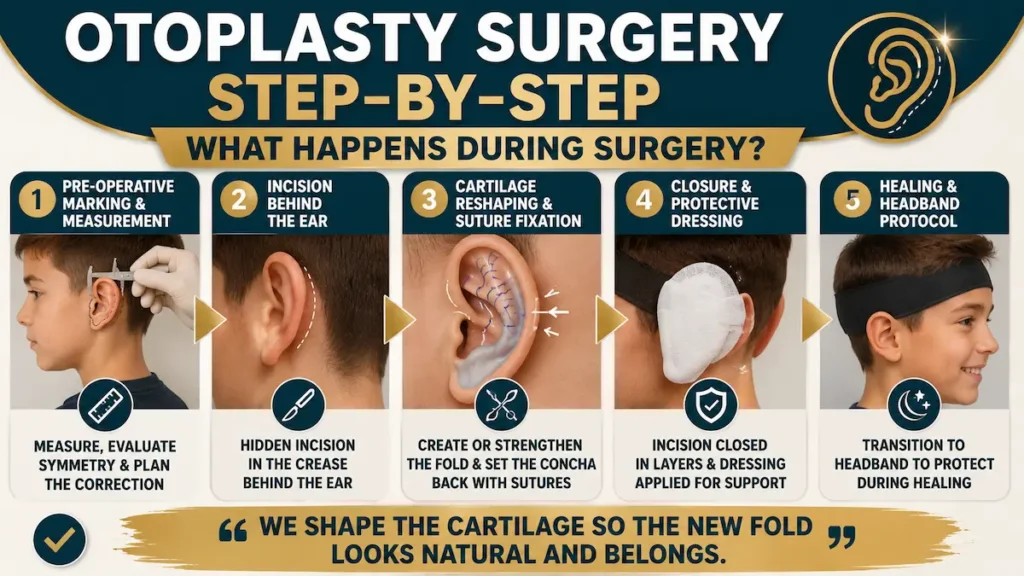
Step-by-Step: What Happens During Otoplasty Surgery?
Otoplasty is highly planned before the first incision. The surgeon marks ear position, evaluates symmetry, and confirms the intended correction from multiple angles. For children, the parent or guardian is involved in the final discussion before surgery.
Pre-Operative Marking and Ear Measurement
The surgeon measures projection from the head, checks fold shape, and compares both ears. The plan may differ from side to side because most ears are naturally asymmetric. The goal is balance, not a mirrored copy.
Incision Behind the Ear
Traditional otoplasty uses an incision in the crease behind the ear. This location gives access to the cartilage while keeping the scar hidden from the front. Hair usually does not need to be shaved.
Cartilage Reshaping and Suture Fixation
The surgeon creates or strengthens the antihelical fold and may set the conchal bowl back toward the head. Permanent or long-lasting sutures hold the cartilage in its new position. In some cases, careful cartilage scoring helps the ear bend naturally.
Closure and Protective Dressing
The incision is closed in layers, then a protective dressing is applied. The dressing supports the ears and reduces early swelling. Patients later transition to a headband protocol, which protects the ears during sleep and daily movement.
“The most important step is not simply pulling the ear back. We shape the cartilage so the new fold looks like it belongs there naturally.”
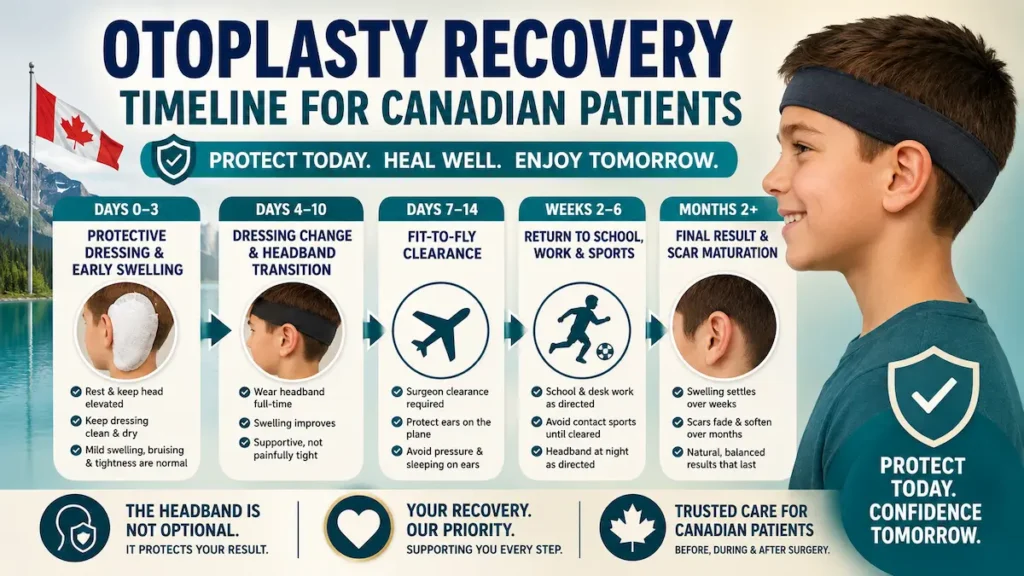
Otoplasty Recovery: Timeline for Canadian Patients
Otoplasty recovery is usually more comfortable than patients expect, but it is very dependent on protection. The ears are newly shaped, and the cartilage needs time to stabilize. The headband is not optional. It protects the result while the sutures and soft tissues heal.
Most Canadian patients can plan a relatively short stay in Istanbul compared with larger facial or body procedures. The exact travel schedule depends on age, anesthesia type, swelling, and surgeon clearance. Children need a more cautious plan because they may bump or rub the ears without thinking.
Days 0–3: Protective Dressing and Early Swelling
Immediately after surgery, the ears are covered with a protective dressing. This dressing helps control swelling and keeps the ears in a safe position. Mild pressure, tightness, bruising, and warmth are expected in the first few days.
Pain is usually manageable with prescribed medication. Adults often describe the sensation as soreness rather than sharp pain. Children may be more bothered by the dressing than the surgical discomfort itself.
- Sleep on your back with the head elevated.
- Avoid touching, bending, or checking the ears repeatedly.
- Keep the dressing clean and dry.
- Contact your coordinator if pain suddenly worsens on one side.
Days 4–10: Dressing Change and Headband Transition
After the first dressing check, many patients transition to a soft protective headband. The headband holds the ears in position and prevents accidental folding during sleep. It should feel supportive, not painfully tight.
Swelling and bruising usually begin to improve during this stage. The ears may still look slightly over-corrected or puffy. That is normal. Early appearance should not be judged as the final result.
The Headband Protocol
The headband is one of the most important parts of otoplasty recovery. For many patients, it is worn full-time at first, then at night for several weeks. Children may need extra reminders and parental supervision.
We give each patient a specific schedule based on technique, age, and tissue response. Patients flying home to Canada should keep the headband available in carry-on luggage. It can protect the ears during sleep on the plane and while moving through busy airports.
| Recovery Stage | Typical Timing | Main Goal | Canadian Planning Note |
|---|---|---|---|
| Protective dressing | Days 0–3 | Reduce swelling and protect the new ear position | Stay close to the clinic for early monitoring. |
| Headband full-time | Early recovery, as directed | Prevent accidental bending or trauma | Useful during hotel recovery and airport travel. |
| Headband at night | Several weeks, as directed | Protect ears during sleep | Plan for school, work, and bedtime routines after return to Canada. |
Our HBOT and LLLT Recovery Protocol
For selected surgical patients, we use recovery technologies that support tissue healing. Hyperbaric Oxygen Therapy helps increase oxygen delivery to healing tissues and may reduce inflammation. Low-Level Laser Therapy supports cellular repair and scar maturation through 650 nm medical-grade laser diodes.
These technologies are especially relevant for international patients because they support a smoother early recovery before long-haul travel. You can read more about our recovery infrastructure on our technology and standards page, and the science is covered in our guides to Hyperbaric Oxygen Therapy benefits and LLLT for scar minimization.
Day 7–14: Fit-to-Fly Clearance
Most otoplasty patients can fly once the surgeon confirms the ears are healing properly, pain is controlled, and there are no signs of infection or bleeding. The return flight should be planned after an in-person check, not based on calendar days alone.
During the flight, avoid pressure on the ears. Use a neck pillow, keep the headband available, and avoid sleeping with the ear folded against the seat. For broader travel safety planning after surgery, see our flight safety guide for Canadian patients.
Weeks 2–6: Return to School, Work, and Sports
Adults can often return to desk work within one to two weeks, depending on swelling and comfort. Children may return to school once they feel well and can protect the ears. The bigger issue is play, not classroom learning.
Contact sports, roughhousing, helmets, and activities that could bend the ears should wait until the surgeon gives clearance. This is usually several weeks. Hockey, soccer, wrestling, gymnastics, and martial arts need special caution.
Final Result and Scar Maturation
The ears look better quickly, but final refinement takes longer. Swelling settles over weeks, and scars behind the ear soften over months. A mature otoplasty scar is usually difficult to see unless the ear is pulled forward.
The result should look natural from the front and side. The ears should sit closer to the head without looking flattened. That balance is the mark of careful otoplasty planning.
Safety, Risks and Scars of Otoplasty
Otoplasty is generally considered a lower-risk cosmetic surgery, but it is still surgery. The ears have blood supply, cartilage, nerves, skin, and healing demands. A safe plan requires careful technique, sterile conditions, and realistic recovery behaviour.
We discuss risks clearly before surgery because informed patients recover better. For children, this conversation also includes parents or guardians. The family should understand what is normal, what is not normal, and when to contact our team.
Common Side Effects: Swelling, Bruising and Temporary Numbness
Swelling, bruising, tightness, and mild tenderness are expected after otoplasty. The ears may feel firm or sensitive for several weeks. Temporary numbness can occur because small sensory nerves are disturbed during the operation.
These effects usually improve gradually. It is normal for one ear to look slightly more swollen than the other early on. Sudden one-sided pain, expanding swelling, fever, discharge, or a foul smell should be reported right away.
Otoplasty Scars: Hidden Behind the Ear
Traditional otoplasty scars are placed in the crease behind the ear. This location is one reason the procedure is popular with adults and children. From the front, the incision is not usually visible.
Scars mature over months. Early scars may look pink or firm, then soften and fade. Patients with a history of keloids or thick scars should tell us before surgery, especially if they have darker skin tones or previous problematic piercing scars.
Suture Extrusion and Relapse Risk
Otoplasty often uses internal sutures to hold cartilage in its new position. Rarely, a suture can become irritated, visible, or work its way toward the skin. This is called suture extrusion.
Relapse means the ear starts to project again. It can happen if strong cartilage pushes back, if the headband protocol is not followed, or if the ear is bent during early healing. Technique choice matters here. A patient with firm cartilage may need more than a suture-only approach.
Asymmetry and Revision
No two natural ears are identical. Otoplasty improves symmetry, but perfect matching is not realistic. A small difference between ears is normal, even after a well-performed procedure.
Revision may be considered if one ear relapses, the correction is too conservative, or the ear appears over-pinned. We plan conservatively to avoid the flattened look. A natural ear should still have shape, depth, and a visible curve.
Pediatric-Specific Safety Considerations
Children need extra protection during recovery. They may scratch, bump, or sleep on the ears without thinking. Parents should plan the recovery week carefully, including school timing, sleeping setup, headband reminders, and sports restrictions.
We also ask parents to watch for behaviour changes after surgery. A child may feel tired, irritable, or frustrated by the headband. That is normal, but the family should be prepared.
How AKM Reduces Risk Through Sterile Protocols
We perform surgery in a controlled clinical environment with strict sterilization protocols and documented surgical planning. Our team reviews anatomy, anesthesia safety, medication use, and travel timing before confirming the procedure.
For international patients, aftercare is part of safety. You are not left to interpret healing alone from Canada. Our patient hosts and medical team remain available through scheduled follow-ups and 24/7 support during the early recovery period.
“A natural otoplasty result depends on restraint. If the ear is pulled too flat, the correction becomes obvious. We shape the cartilage, check the angle, and protect the ear’s natural depth.”
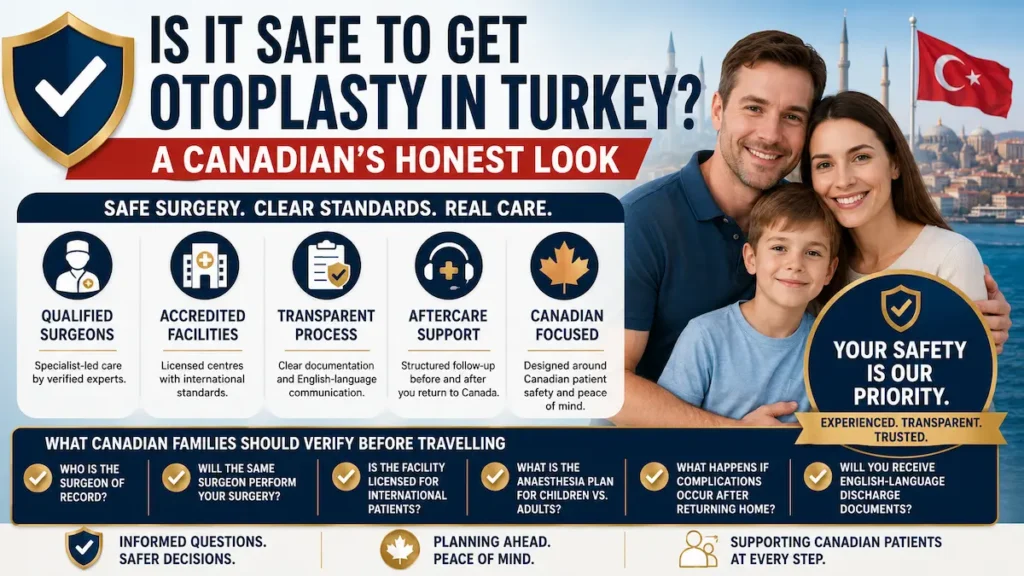
Is It Safe to Get Otoplasty in Turkey? A Canadian’s Honest Look
It can be safe to get otoplasty in Turkey when the clinic, surgeon, facility, and aftercare system are verified carefully. The risk is not the country alone. The risk is choosing an unverified provider, unclear surgeon identity, or a clinic that treats international patients as transactions.
Canadian patients are right to be cautious. The Government of Canada’s guidance on receiving medical care outside Canada discusses health risks, financial risks, planning your procedure, and returning home. We address those concerns directly instead of dismissing them.
The Turkey Cosmetic Surgery Reality and How AKM Differs
Turkey has both excellent surgical centres and high-volume providers that are not appropriate for every patient. Your job is to separate medical infrastructure from marketing. Our job is to make that verification easier.
At AKM Clinic, your surgical plan is led by qualified specialists, not anonymous staff. You receive clear documentation, English-language communication, and a structured follow-up pathway. For a broader safety framework, read our guide on whether it is safe to get plastic surgery in Turkey.
Pediatric Surgery Standards for Child Patients
Child otoplasty requires a different mindset than adult cosmetic surgery. The operation may be technically similar, but the decision involves a child’s emotional readiness, anesthesia safety, parental consent, and recovery supervision. We treat those factors as part of the medical plan.
Parents should speak with their Canadian pediatrician before committing to travel. This is especially important for children with asthma, allergies, sleep apnea, developmental concerns, or previous anesthesia issues. A safer pathway starts before the flight.
Ghost Surgery in Turkey Facial Procedures
“Ghost surgery” refers to a situation where the person presented during consultation is not the person performing the operation. Canadian patients should ask who will perform the procedure, who will be present, and how the surgical plan is documented.
We address this through clear surgeon-of-record protocols and direct documentation. You should never feel uncertain about who is responsible for your care. Our detailed guide to ghost surgery in Turkey explains the warning signs Canadian patients should know before booking.
Credential Verification: EBOPRAS, RCPSC and International Standards
Canadian patients are used to provincial colleges and Royal College pathways. International systems use different names, but the same question applies: has the surgeon completed structured specialist training, and can those credentials be verified?
Our surgical team includes European Board-Certified specialists and facial plastic surgery expertise. In the surgeon-checklist section below, we explain how to compare EBOPRAS-style credentials with Canadian RCPSC expectations. For deeper background, see our guide to plastic surgeon board certification.
Medical Records and Follow-Up After Returning to Canada
International surgery becomes safer when records are clear. You should receive procedure details, medication instructions, and recovery guidance in English. This helps your Canadian family physician understand what was done if you need local care.
We also maintain long-term virtual follow-up at 1, 3, 6, and 12 months when appropriate. This does not replace emergency care in Canada, but it gives patients a structured line back to the surgical team that performed the procedure.
What Canadian Families Should Verify Before Travelling
Before booking otoplasty abroad, ask direct questions. The answers should be specific. Vague reassurance is not enough.
- Who is the surgeon of record?
- Will the same surgeon perform the otoplasty?
- Is the facility licensed for international patients?
- What anesthesia approach is planned for a child versus an adult?
- What happens if swelling, infection, or suture irritation occurs after returning to Canada?
- Will I receive English-language discharge documents?
These questions do not make you difficult. They make you informed. That is the standard Canadian patients should expect.
Ear Pinning Surgery Before and After: Realistic Expectations and Results
Otoplasty can change the way the ears frame the face, but the result should remain believable. The best outcome is often the one other people do not immediately notice. They may simply feel the face looks more balanced.
We focus on proportion, not dramatic change. Ears should sit closer to the head while keeping natural curves, depth, and individuality. Over-correction can look as artificial as under-correction looks distracting.
Otoplasty Before and After: What to Look For
Before-and-after photos should be reviewed from the front, side, and back. The front view shows whether the ears still draw attention. The side view shows projection. The back view shows whether the ears are evenly positioned.
Patients should look for natural spacing, not ears pressed flat against the scalp. The ear should still have visible contour. The antihelical fold should look formed, not sharp or forced.
Ear Pinning Results for Children and Adults
Children usually heal with soft, flexible tissue and may adapt quickly to the new ear position. Adults can also achieve excellent results, although their cartilage may require stronger correction. The visible outcome is similar when technique is matched properly.
For children, the emotional result may be relief from teasing or reduced self-consciousness. For adults, it may be hairstyle freedom, confidence in photographs, or simply no longer thinking about the ears every day.
Ear Reduction and Earlobe Results
Ear reduction and earlobe reshaping should be subtle. The goal is proportion. If the ear or lobe is reduced too aggressively, it can look less natural than before.
For earlobe repair, results depend on tissue quality, scar history, and whether the lobe was torn, stretched, or elongated. Re-piercing should be delayed until healing is complete and cleared by the surgeon.
Is Otoplasty Permanent?
Otoplasty is designed to be permanent. Once cartilage heals in the new position, the correction usually remains stable for years. The ear will continue to age naturally, but it should not return to its original projection if healing is protected.
Relapse is uncommon but possible. It is more likely when cartilage is strong, the technique is too conservative, or the ears are bent during early recovery. Wearing the headband as directed is one of the easiest ways to protect the result.
Natural Position vs Over-Correction
A natural otoplasty does not hide the ears completely. It reduces projection while preserving a normal ear angle. From the front, the ears should frame the face quietly. From the side, they should still have shape.
We avoid excessive pinning because it can create an operated-on appearance. The ears should look like they have always belonged in that position. That is the difference between correction and overcorrection.
Before and After Gallery
Visual examples help patients understand what otoplasty can and cannot do. Before booking, review results that show different ages, ear shapes, projection levels, and scar placement. For visual documentation, visit our before-and-after gallery.
Otoplasty Cost 2026: Turkey vs Canada
Canadian patients comparing otoplasty cost usually find two different pricing models. In Canada, private clinic quotes often separate surgeon fees, anesthesia, facility costs, follow-up visits, and medication. At AKM Clinic, pricing is presented through a more structured international surgical pathway, so patients can understand the clinical and travel-related costs before booking.
Our otoplasty technique pricing starts at CAD $2,750 for ear pinning or incisionless otoplasty in selected candidates. Cartilage-sparing Mustardé otoplasty is CAD $3,850, while cartilage scoring or Furnas-style correction is CAD $4,400. Earlobe reduction or repair is CAD $2,750.
By comparison, Toronto, Vancouver, Calgary, and Montreal private clinics may quote significantly higher total fees, especially when both ears, anesthesia, facility use, and follow-up visits are itemized separately. Pediatric otoplasty may also involve different anesthesia costs than adult otoplasty.
For a full fee breakdown, technique-by-technique comparison, and updated Canadian metro pricing analysis, see our otoplasty cost guide for Canadian patients. Patients who want travel coordination can also review the otoplasty all-inclusive clinical pathway.
| Location / Option | Typical Cost Context | What to Check |
|---|---|---|
| Toronto private clinic | Often higher than international clinic pricing | Does the quote include anesthesia, facility fees, and follow-up? |
| Vancouver private clinic | Often similar to Toronto private pricing | Ask whether pediatric anesthesia is billed separately. |
| Calgary private clinic | Varies by surgeon and facility | Confirm one-ear versus both-ear pricing. |
| Montreal private clinic | May vary between cosmetic and reconstructive pathways | Ask whether RAMQ coverage applies in rare reconstructive cases. |
| AKM Clinic Istanbul | From CAD $2,750 for selected ear pinning cases | Confirm the recommended technique after photo assessment. |
How to Find the Best Otoplasty Surgeon in Turkey: A Canadian Patient’s Checklist
Many Canadian families start by searching for an otoplasty surgeon in Toronto or Vancouver, then compare private domestic quotes with international options. That comparison should not be based on price alone. Ear surgery is visible, and millimetres matter.
The best otoplasty surgeon for your case should understand ear cartilage, pediatric readiness, facial balance, scar placement, and conservative correction. The checklist below helps Canadian patients evaluate international care with the same rigour they would use at home. You can also review our broader clinical philosophy on the About AKM Clinic page.
EBOPRAS Certification and RCPSC Equivalency
Canada uses the Royal College of Physicians and Surgeons of Canada’s eligibility and exams framework as a familiar specialist benchmark.
At AKM Clinic, our surgical team includes European Board-Certified specialists and internationally trained facial plastic surgery expertise. We explain these credentials clearly so Canadian patients can understand the comparison instead of guessing. The Canadian Society of Plastic Surgeons’ guidance on choosing a surgeon is a useful reference for specialist standards and professional expectations.
| Credential Framework | What It Signals | How Canadian Patients Should Use It |
|---|---|---|
| RCPSC | Canadian specialist certification pathway | Use as the familiar benchmark for specialist-level training. |
| EBOPRAS / European Board frameworks | Structured European specialist assessment | Ask how training and scope compare with Canadian standards. |
| Facial plastic surgery fellowship training | Focused experience in face, nose, and ear anatomy | Important for subtle ear-shape correction and symmetry. |
Otoplasty Sub-Specialization
Ask how often the surgeon performs otoplasty. A surgeon who performs mainly body surgery may not have the same ear-specific refinement as a facial plastic surgery specialist. Otoplasty requires three-dimensional judgement.
Good before-and-after documentation should show the ears from several angles. Front-only photos are not enough. You need side and back views to judge projection, symmetry, and whether the ears look over-pinned.
Pediatric Experience
Child otoplasty is not only smaller adult otoplasty. Children need age-appropriate communication, anesthesia planning, parental guidance, and recovery supervision. A clinic should be able to explain how its approach changes for a child.
Parents should ask who monitors the child after surgery, how pain is managed, and what happens if the child develops fever, respiratory symptoms, or ear irritation before the procedure date.
Traditional and Incisionless Technique Range
A clinic that only offers one technique may try to fit every ear into that method. That is a warning sign. Incisionless otoplasty can help selected patients, but many cases need cartilage reshaping through a hidden incision.
The surgeon should be comfortable explaining why one technique is recommended over another. If the answer is only “no scar” or “faster,” ask for more detail. Stability matters more than a marketing phrase.
Reviews and Before-and-After Documentation
Canadian patients should review photographs, patient feedback, and documentation before booking. A reliable clinic should show realistic results, explain limitations, and avoid promising a perfectly symmetrical or risk-free outcome.
For broader patient feedback, review our professional plastic surgery reviews. Reviews should support your research, but they should not replace credential verification and a direct consultation.
Aftercare Continuity from Istanbul to Canada
International surgery should include follow-up after you return home. We provide recovery instructions, coordinator access, and virtual follow-up planning so patients are not left alone after the flight. This is especially important for children.
Before booking, ask how to contact the team from Canada, what photos to send during healing, and what symptoms require local medical assessment. A trustworthy clinic will answer those questions before payment.
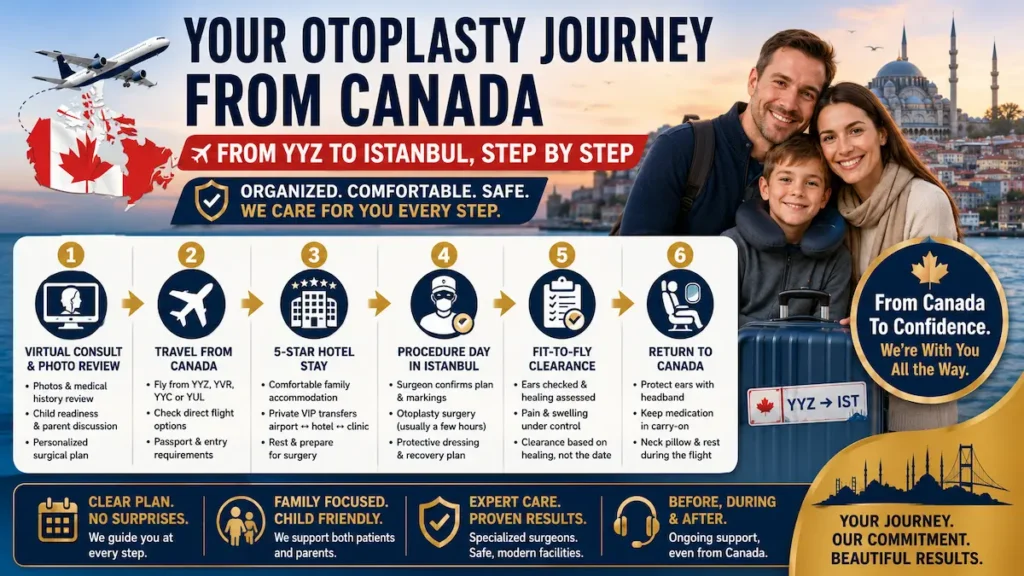
Your Otoplasty Journey from Canada: From YYZ to Istanbul, Step by Step
Travelling for otoplasty should feel organized, not improvised. This is especially true for families travelling with a child. A clear plan helps reduce stress, protect the surgical result, and make recovery easier before returning to Canada.
Our role is to coordinate the clinical and logistical parts of your stay. You arrange your international flight. We organize the clinic schedule, private transfers, hotel coordination, and patient support pathway. The full process is outlined on our patient journey page.
Pre-Trip Photo Assessment and Child Readiness Discussion
The process starts with photos and a virtual consultation. We review ear projection, fold shape, asymmetry, earlobe position, age, medical history, and the patient’s expectations. For children, we also discuss readiness and parent concerns.
Photos should include front, side, three-quarter, and back views. Hair should be pulled away from the ears. These images help our surgeon decide whether traditional otoplasty, incisionless otoplasty, earlobe work, or a combined plan may be appropriate.
Travel Logistics from Toronto, Vancouver, Calgary and Montreal
Many Canadian patients travel through Toronto Pearson, Vancouver, Calgary, or Montreal. Direct flight availability and schedules can change, so patients should check current airline options before booking. We advise choosing flights that allow rest time before the in-person consultation.
Canadian citizens can usually enter Türkiye visa-free for short stays, but passport validity and airline requirements should be checked before travel. Families travelling with a child should also review consent documentation if only one parent is travelling.
5-Star Hotel Recovery Stay and Family Accommodation
Our international patient pathway includes 5-star hotel accommodation through our partner network, including The Point Barbaros in the Levent district. For families, hotel comfort matters. Children need quiet recovery, easy meals, and a predictable routine.
Private VIP transfers are arranged between the airport, hotel, clinic, and surgical facility. This reduces the stress of navigating Istanbul after a long flight or during early recovery. You can review the full logistics pathway on our hotels and VIP transfers page.
Procedure Day at Our Istanbul Clinic
On procedure day, the surgeon confirms the markings, technique, and expected ear position. Adults review anesthesia and recovery instructions. Parents review the plan for their child, including headband use and activity restrictions.
The surgery is usually completed in a few hours or less, depending on whether both ears, earlobes, or ear reduction are included. After surgery, the protective dressing is placed and the early recovery plan begins. You can learn more about the facility experience on our Istanbul clinic page.
Fit-to-Fly Clearance and Headband Protection
Before returning to Canada, our team checks the ears, dressing, pain control, and swelling pattern. Fit-to-fly clearance is based on healing, not only the date. If a child is uncomfortable or has unexpected swelling, travel plans may need adjustment.
During the return flight, protect the ears from pressure. Keep the headband and any medication in carry-on luggage. A neck pillow can help prevent the ear from folding against the seat while sleeping.
Ear Pinning Surgery Frequently Asked Questions (FAQ):
What is the right age for a child to have otoplasty?
Many children can be assessed for otoplasty from around age 5, once the ears are close to adult size. Age is not the only factor. The child should be emotionally ready, healthy, and able to follow simple recovery instructions.
What is the difference between otoplasty and ear pinning?
Otoplasty is the medical term for cosmetic ear reshaping. Ear pinning is the common phrase for bringing prominent ears closer to the head. In most patient searches, the terms refer to the same procedure.
Does incisionless ear pinning really work?
It can work for selected mild cases with flexible cartilage and a weak antihelical fold. It is less reliable for strong cartilage, enlarged concha, or significant prominence. Traditional otoplasty is usually more stable for structural correction.
Will otoplasty scars be visible?
Traditional otoplasty scars are usually placed behind the ear in the natural crease. They may look pink or firm early in healing, then soften over time. Most mature scars are difficult to notice unless the ear is pulled forward.
Does OHIP, MSP, AHCIP or RAMQ cover otoplasty for children?
Most otoplasty is considered cosmetic and is not covered by Canadian provincial health plans. Coverage may vary in rare reconstructive or congenital deformity cases, depending on the province and documentation. Families should confirm directly with their provincial plan and Canadian physician.
How much does otoplasty cost in Toronto vs Istanbul?
Toronto private clinic pricing can be significantly higher once surgeon fees, anesthesia, facility costs, and follow-up are included. At AKM Clinic, ear pinning starts at CAD $2,750, while more complex cartilage techniques may cost more. Final technique is confirmed after assessment.
Does Canadian travel insurance cover elective otoplasty complications in Turkey?
Many Canadian travel insurance policies exclude complications related to elective cosmetic surgery. Patients should read the policy wording before booking. Ask specifically about elective procedure complications, surgical aftercare abroad, emergency care, and return-flight changes.
Is otoplasty safe for children?
Otoplasty can be safe for children when the child is medically suitable, emotionally ready, and treated by a qualified surgical team in an appropriate facility. Pediatric anesthesia planning and parent-led recovery supervision are essential. Families should involve their Canadian pediatrician before travelling.
How long do I or my child need to wear the headband?
The headband schedule depends on technique, age, and healing. Many patients wear it full-time early in recovery, then at night for several weeks. We provide a tailored schedule after surgery, and children usually need parent reminders to protect the ears.
When can my child return to school or when can I return to work?
Adults may return to desk work within one to two weeks if swelling and comfort allow. Children may return to school once they feel well and can protect the ears. Rough play, helmets, and contact sports require a longer restriction period.
Is otoplasty permanent?
Otoplasty is designed to be permanent. Once the cartilage heals in its new position, the ears usually remain stable. Relapse is possible if sutures loosen, cartilage is unusually strong, or the ears are bent during early healing.
Can ear pinning and earlobe reduction be done together?
Yes, they can be combined when the earlobe contributes to the overall prominence or looks elongated. The surgeon may adjust upper-ear projection and reshape the earlobe in one session when the anatomy and healing plan allow it.
Can otoplasty make ears too flat?
Yes, overcorrection can create ears that look flattened or operated-on. We avoid this by preserving natural ear depth and contour. The goal is a balanced ear angle, not ears pressed tightly against the head.
Can adults have otoplasty if they were never treated as children?
Yes. Many adult patients choose otoplasty after years of hiding their ears or avoiding certain hairstyles. Adult cartilage can be firmer than child cartilage, so the surgical plan may require stronger fixation or cartilage scoring.
What should Canadian families pack for otoplasty recovery?
Pack button-up or zip-front clothing, a soft travel pillow, approved medications, entertainment for a child, and a loose hat if desired. Keep the headband and medication in carry-on luggage for the return flight. Avoid tight hoodies that pull over the ears.
Medical Disclaimer
Medical Disclaimer: This page is for educational purposes only and does not replace medical advice from a qualified physician. Otoplasty candidacy, anesthesia planning, travel timing, and recovery instructions must be tailored to the individual patient.