



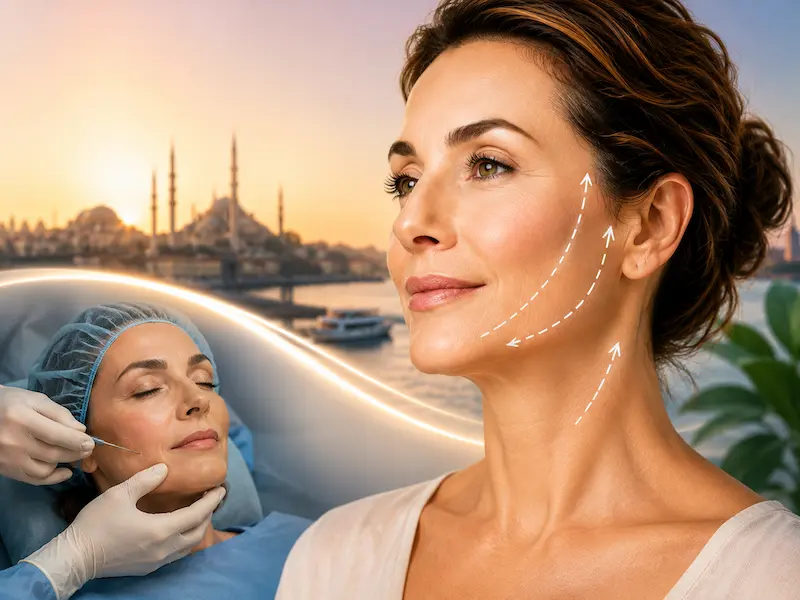
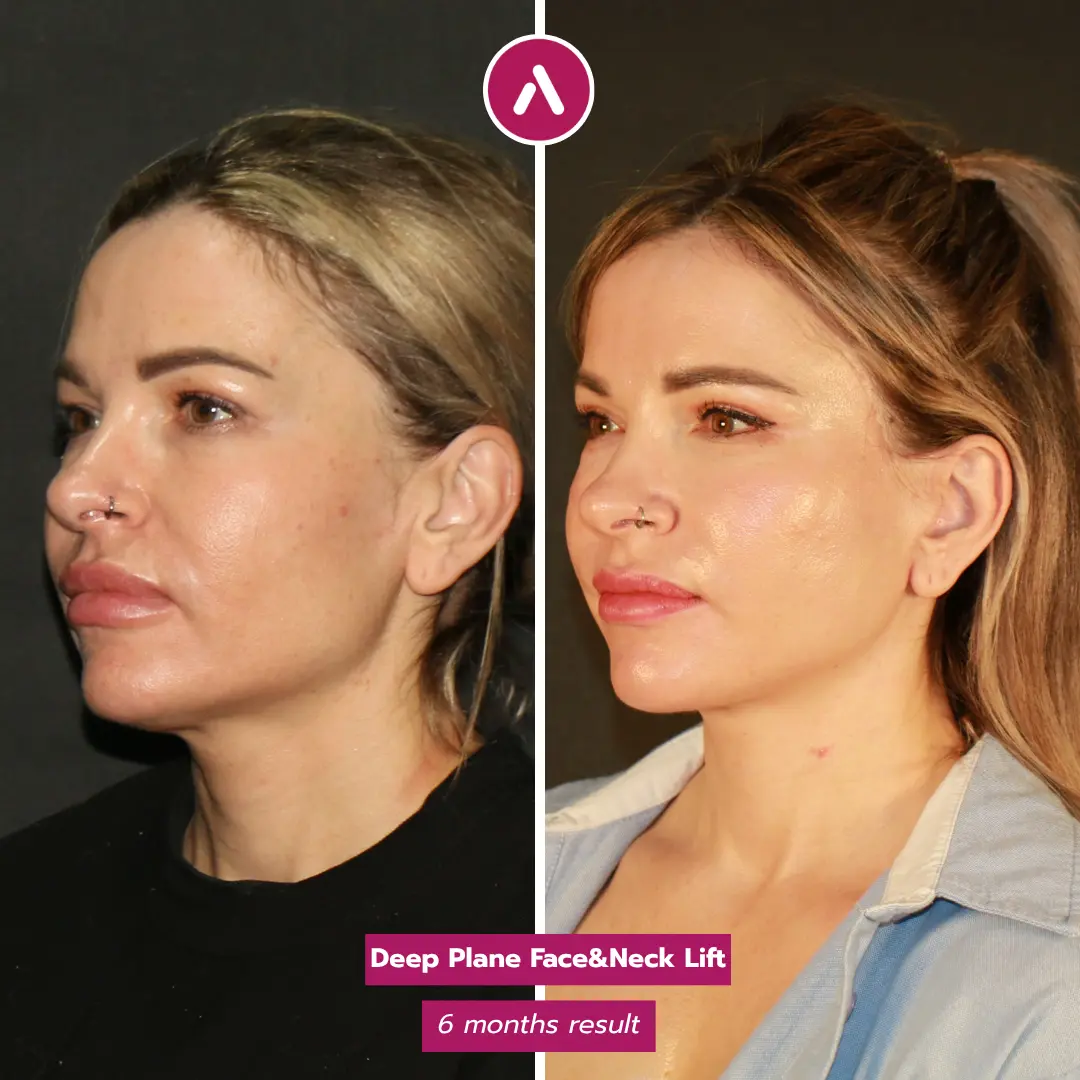
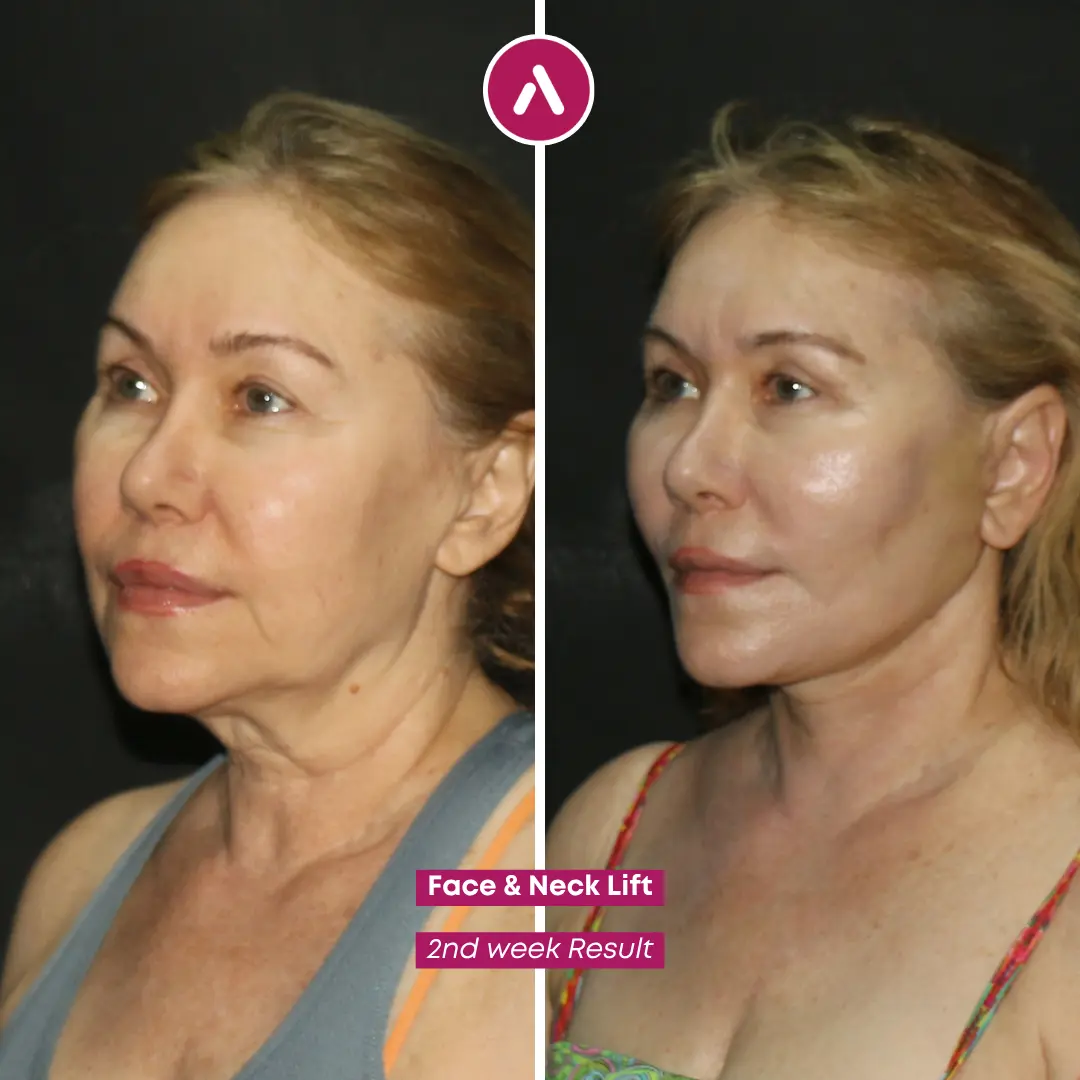
A mini facelift already appeals to patients who want a lower-face refresh without the downtime of a full facelift. Performing it awake, under pure local anesthesia, takes that lighter philosophy further. You remain comfortable and fully conscious, avoid general anesthesia entirely, and usually experience a faster early recovery.
This guide focuses on the awake approach: what it feels like, who suits it, how safety is managed, and how Canadian patients plan the trip to Istanbul. For the mini-facelift technique itself, we keep the surgical explanation brief and direct you to our dedicated Mini Facelift in Turkey guide.
Table of Contents
What Is an Awake Mini Facelift?
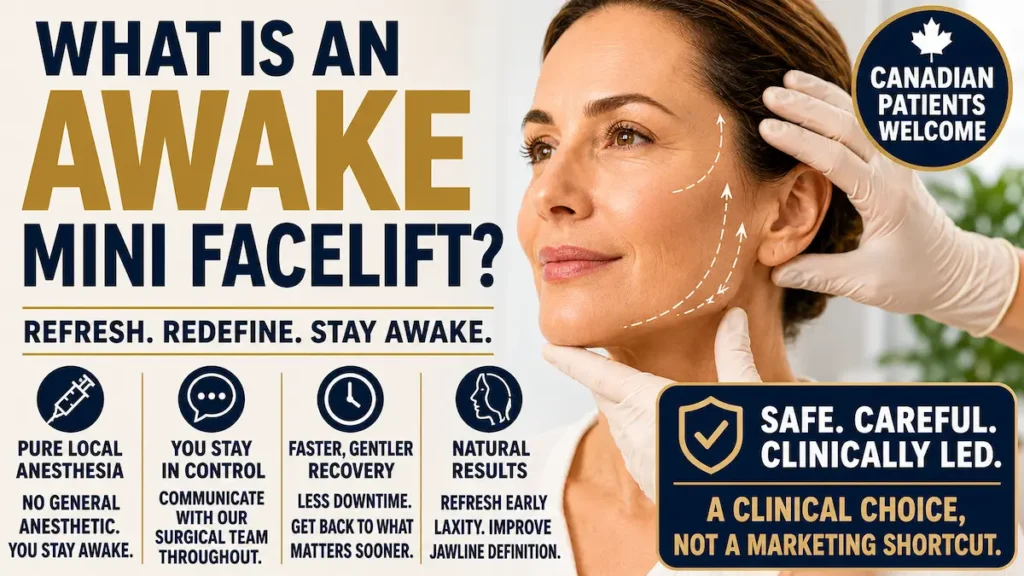
An awake mini facelift is a mini facelift performed under pure local anesthesia while you stay fully conscious — no general anesthetic or sedation. Because a mini facelift is shorter and less extensive than a full facelift, it is especially well suited to the awake approach, with a faster, gentler recovery.
Awake Mini Facelift Defined
An awake mini facelift is not a different facelift technique. It is a different anesthesia approach.
The surgical goal remains the same: to refresh early lower-face laxity, soften mild jowling, and improve jawline definition in a natural-looking way. The difference is that we perform the procedure while the treatment area is fully numbed with local anesthetic.
You are awake. You can communicate with our surgical team. You do not need a breathing tube, and your body does not need to recover from general anesthesia.
This makes awake mini facelift appealing to Canadian patients who want a lighter procedure experience and a shorter early recovery window.
Pure Local Anesthesia Explained
Pure local anesthesia means we numb only the surgical area. You remain conscious, breathing on your own, and aware of your surroundings.
The Canadian Anesthesiologists’ Society explains anesthesia as a loss of sensation, with different methods used depending on the procedure and patient needs. In an awake mini facelift, the goal is local pain control without putting the whole body to sleep.
You may feel pressure, touch, or movement, but you should not feel sharp pain during the procedure.
Local anesthesia is carefully dosed and monitored. We assess your medical history, anxiety level, procedure scope, and comfort expectations before confirming whether the awake approach is appropriate.
This is especially important for international patients. A lighter anesthesia profile can make the first days of recovery feel more manageable after a long trip from Canada.
How It Differs From a Standard Mini Facelift
A standard mini facelift and an awake mini facelift can address similar lower-face concerns. The difference is how the procedure is performed from an anesthesia perspective.
In a standard pathway, the patient may receive twilight sedation or general anesthesia depending on the case. In an awake pathway, the patient remains fully conscious under local anesthesia only.
The surgical plan still depends on your anatomy. A mini facelift may be suitable for early jowling, mild jawline laxity, and limited lower-face sagging. It is not designed for severe neck bands, major skin excess, or advanced facial descent.
For a deeper explanation of the short-scar technique, tissue repositioning, and mini facelift candidacy, we recommend reading our dedicated Mini Facelift in Turkey guide.
Why Canadian Patients Ask About Awake Surgery
Canadian patients often ask about awake surgery for practical reasons. Many are not afraid of the facelift itself. They are worried about general anesthesia.
Common concerns include nausea, grogginess, intubation, longer hospital recovery, and feeling unwell before a return flight. Some patients have had a difficult anesthesia experience in the past and want to avoid repeating it.
Others are motivated by scheduling. They want a focused facial refresh, a controlled recovery window, and a care pathway that does not feel more intense than necessary.
At AKM Clinic, we treat awake surgery as a clinical choice, not a marketing shortcut. We recommend it only when the procedure scope, patient temperament, and safety profile all align.
Benefits of an Awake Mini Facelift
The main benefit of an awake mini facelift is not that it changes the surgical result. The result still comes from the surgeon’s planning, facial anatomy, and tissue handling.
The benefit is the experience around the procedure. For the right patient, awake surgery can reduce anesthesia burden, simplify early recovery, and make the process feel more controlled.
Avoiding General Anesthesia
General anesthesia is safe when performed by qualified teams in the right setting. It is also not always necessary for every facial procedure.
For a limited mini facelift, pure local anesthesia may be enough to keep the patient comfortable. This avoids full unconsciousness, intubation, and the grogginess some patients experience after general anesthesia.
Many Canadian patients find this reassuring. They want facial rejuvenation, but they do not want a procedure that feels larger than their actual concern.
An awake mini facelift can be a good fit when the surgical plan is focused, the patient is calm, and the expected operating time is appropriate for local-only anesthesia.
Faster Early Recovery
Recovery after any facelift still involves swelling, bruising, tightness, and temporary numbness. Awake surgery does not remove those normal healing steps.
It can, however, reduce the recovery burden linked to general anesthesia. Many patients feel clearer and more alert shortly after the procedure because their body is not clearing a full general anesthetic.
This can make the first evening easier. You can walk gently, follow instructions, eat light food, and communicate clearly with your coordinator.
For Canadians recovering in a hotel before a long-haul flight home, that early clarity matters.
A More Controlled, Lighter Procedure Experience
An awake mini facelift is often chosen by patients who want control. They like knowing they can speak, ask for a pause, or report discomfort immediately.
This does not mean the procedure is casual. It is still surgery. It requires sterile technique, careful planning, and experienced facial surgery judgement.
The “lighter” part refers to the anesthesia pathway. The surgical standards remain the same.
Our role is to keep the experience calm, measured, and clinically appropriate. If awake surgery is not the safest choice, we say so.
Lower Logistical Burden for International Patients
International surgery requires more planning than local care in Canada. Flights, hotel recovery, fit-to-fly timing, and follow-up all matter.
An awake mini facelift can reduce logistical strain for selected patients because the immediate post-anesthesia period is simpler. There is usually less grogginess, less nausea risk, and a clearer transition back to hotel recovery.
At AKM Clinic, our all-inclusive clinical pathway includes private VIP transfers, 5-star hotel accommodation, and 24/7 patient advocate support. This allows you to focus on recovery rather than navigating Istanbul alone.
Your coordinator remains involved through the key early healing period, including the days leading up to your return flight.
Honest Limits
Awake surgery is not the right answer for everyone. That honesty protects patients.
If you have severe facial laxity, significant neck aging, high anxiety, or a complex revision history, twilight sedation or general anesthesia may be safer and more comfortable.
Awake surgery also requires cooperation. You must be comfortable hearing movement, feeling pressure, and staying still while our team works.
We do not recommend awake mini facelift simply because it sounds easier. We recommend it when it is clinically suitable.
Am I a Good Candidate for Awake Mini Facelift?
The best awake mini facelift candidate is not just someone with early lower-face aging. They also need the right comfort profile for local-only surgery.
That means we assess both anatomy and temperament. A technically simple case can still be a poor awake candidate if the patient feels highly anxious about being conscious during surgery.
Best Candidates
You may be a good candidate for awake mini facelift if your concerns are focused on early lower-face laxity. This often includes mild jowling, early jawline softness, or a tired look around the lower face.
Good candidates usually have reasonable skin elasticity and do not need extensive neck correction. They want refinement, not a dramatic structural change.
The awake pathway also suits patients who understand what local anesthesia can and cannot do. You should expect comfort, not total sensory absence.
Our Natural-First approach is especially important here. The goal is a rested, subtle result that fits your face, not an over-tightened look.
Anxiety and Comfort Readiness
Awake surgery can feel empowering for some patients and stressful for others. Both reactions are valid.
You may hear surgical sounds. You may feel pressure or movement. You may be aware of time passing.
If that idea makes you uncomfortable, twilight sedation may be a better fit. Twilight allows relaxation and drowsiness while avoiding the depth of general anesthesia.
During consultation, we ask direct questions about anxiety. We would rather guide you to the right anesthesia model than force an awake pathway that does not match your comfort level.
Health Factors That Favour Local Anesthesia
Some patients prefer local anesthesia because of previous experiences with general anesthesia. They may have had nausea, prolonged grogginess, or fear of intubation.
Others want to minimize systemic anesthesia exposure because they are travelling internationally. This does not mean local anesthesia is automatically safer for every patient, but it can be a reasonable choice when the surgical plan is limited.
We still review your medical history carefully. Heart conditions, blood pressure, medications, allergies, smoking status, and healing risk all matter.
For Canadian patients, we may also recommend speaking with your family physician before travel, especially if you have chronic medical conditions.
Who Should Not Choose Awake Mini Facelift
Awake mini facelift is not suitable for everyone. Severe neck laxity, advanced jowling, major skin excess, or a need for deeper facial repositioning may require a different procedure.
Patients with high anxiety may also be poor candidates. If staying awake would make you tense or distressed, it can make the experience harder for both you and the surgical team.
Revision cases often require more careful dissection and longer operating time. These are usually better suited to deeper anesthesia models.
We also avoid awake surgery when the patient’s expectations exceed what a mini facelift can achieve. A lighter anesthesia pathway cannot compensate for the wrong surgical indication.
Canadian Pre-Trip Health Check
We encourage Canadian patients to approach international surgery with the same seriousness they would bring to private surgery in Toronto, Vancouver, Calgary, or Montreal.
Before travelling, review your medication list, medical conditions, smoking status, and travel plans. If you have a family physician or specialist, consider discussing whether you are fit for elective surgery abroad.
This step is not meant to create barriers. It creates safer planning.
It also gives you a local point of contact if you need routine medical support after returning to Canada.
Awake vs Twilight vs General for Mini Facelift
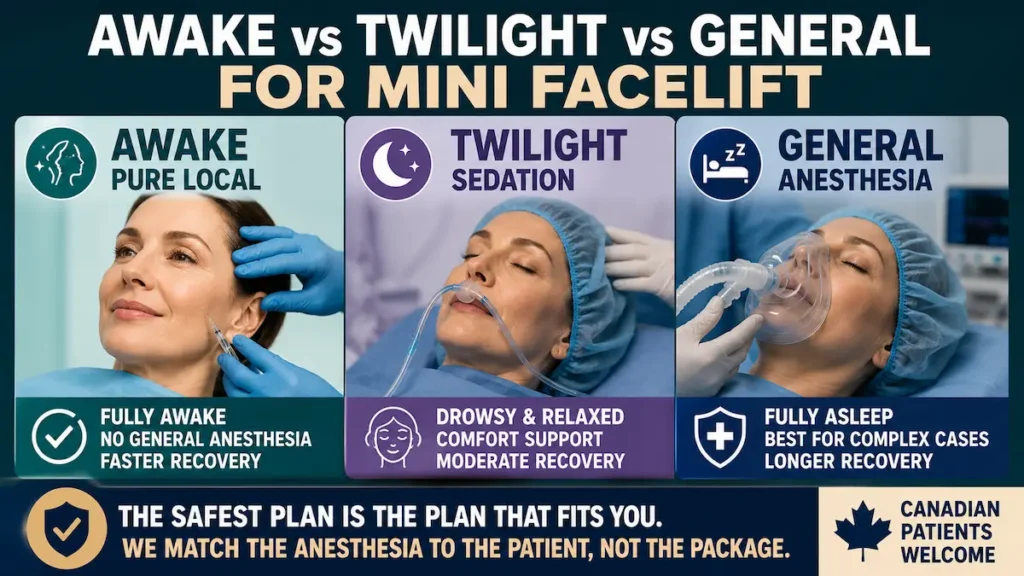
The best anesthesia model is the one that matches your procedure, your anatomy, and your comfort level. Awake is one option. It is not the only good option.
At AKM Clinic, we explain the full spectrum so you can make an informed decision. We also reserve the right to recommend a different model if it is safer for your case.
Awake / Pure Local
Awake surgery uses local anesthesia only. You remain fully conscious and breathe on your own.
This model is best for selected, limited procedures. In mini facelift, it may suit patients with early lower-face aging who need a focused correction rather than extensive facial and neck work.
The advantage is a simpler early recovery. There is no general-anesthesia grogginess and no sedation hangover.
The trade-off is awareness. You must be comfortable staying awake during the procedure.
Twilight Sedation
Twilight sedation sits between awake and general anesthesia. You are not fully unconscious, but you are relaxed and drowsy.
The American Society of Anesthesiologists describes a continuum of sedation, from minimal sedation through general anesthesia. This is useful for patients comparing awake, twilight, and general pathways.
Twilight can suit patients who want to avoid general anesthesia but do not want to be fully aware during surgery. It can also help patients with mild-to-moderate procedural anxiety.
Twilight is not the same as pure local anesthesia. It still involves sedating medications and a different recovery profile.
For a deeper explanation of the sedation pathway, read our Twilight Facelift in Turkey guide.
General Anesthesia
General anesthesia means you are fully asleep. It may be appropriate for longer procedures, complex combinations, revision cases, or patients who cannot tolerate being awake.
Some patients assume general anesthesia is always excessive. That is not true. In the right case, it can be the safest and most humane option.
For example, if your plan includes a more extensive neck lift, deeper tissue work, or multiple procedures in one session, general anesthesia may allow better control and comfort.
Our recommendation depends on the full clinical picture, not a preference for one anesthesia model.
How We Choose the Right Model
We choose anesthesia based on four questions.
- How extensive is the surgical plan?
- How long will the procedure take?
- How comfortable is the patient with being awake?
- What does the patient’s medical history suggest?
If all four align, awake mini facelift can be a strong option. If one factor raises concern, twilight or general anesthesia may be more appropriate.
This is why consultation matters. A safe plan starts with matching the anesthesia to the patient, not forcing the patient into a pre-set package.
Awake vs Twilight vs General: Quick Comparison
| Anesthesia Model | Consciousness | Best For | Recovery Profile | Our Position |
|---|---|---|---|---|
| Awake / Pure Local | Fully awake | Shorter, limited mini facelift cases | No general-anesthesia grogginess | Preferred when the patient is calm and the surgical scope is limited |
| Twilight Sedation | Drowsy and relaxed | Patients who want comfort support without full general anesthesia | Moderate recovery from sedation | Useful for anxious patients or slightly longer cases |
| General Anesthesia | Fully asleep | Longer combined procedures or complex facial surgery | Longer immediate recovery | Chosen when safety, comfort, or surgical scope requires it |
“Awake surgery should never be chosen just because it sounds lighter. We choose it when the anatomy, procedure length, and patient temperament all support local-only anesthesia. The safest plan is the plan that fits the patient.”
Canadian patients comparing anesthesia models may also find our local vs general anesthesia facelift guide helpful before consultation.
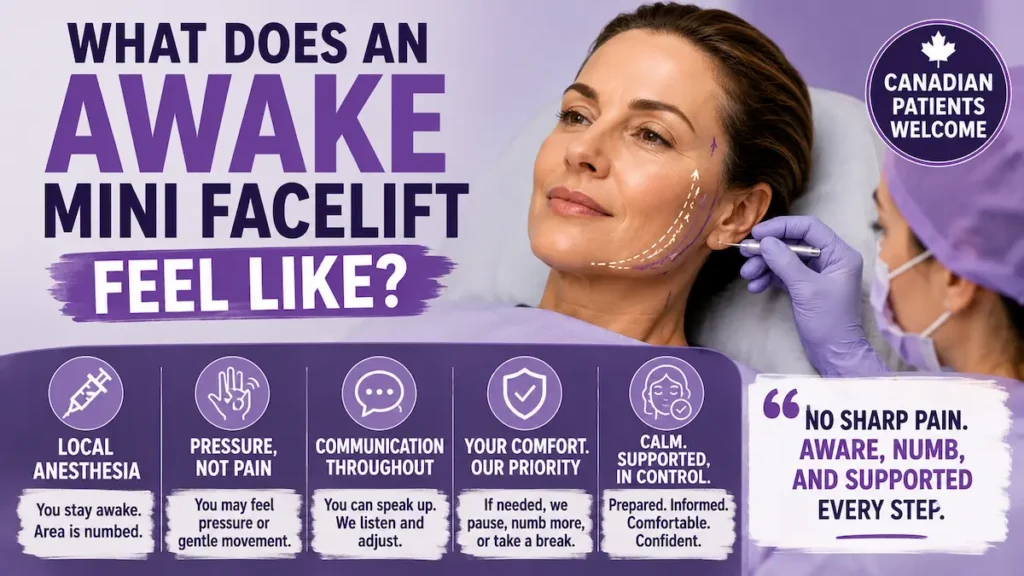
What Does an Awake Mini Facelift Feel Like?
This is usually the first question Canadian patients ask. They do not want a vague reassurance. They want to know what they will actually experience.
During an awake mini facelift, you should not feel sharp pain. You may feel pressure, gentle movement, or a pulling sensation because local anesthesia blocks pain more effectively than it blocks all awareness of touch.
That distinction matters. Awake does not mean uncomfortable. It means conscious, numb, and supported by a surgical team that can respond in real time.
Before the Procedure
Before surgery begins, we confirm your markings, review the plan again, and answer any last questions. This short pause helps reduce anxiety.
The local anesthetic is then placed carefully into the treatment area. The first injections may sting or burn briefly. This is usually the most noticeable part of the awake experience.
After the anesthetic takes effect, the tissue becomes numb. We test comfort before moving forward.
If you are not adequately numb, we do not simply continue. We add more local anesthetic and reassess.
During the Procedure
During surgery, most patients describe awareness rather than pain. You may notice pressure, vibration, or movement near the cheek and jawline.
You may also hear normal surgical sounds. This can feel unusual, especially if you expected surgery to be silent.
Our team explains what is happening in a calm, measured way. You do not need to watch anything, and the operative field is kept out of your view.
Many patients find the experience easier than expected once the numbing is complete. The most important requirement is emotional readiness.
Communication During Surgery
One advantage of awake surgery is communication. You can tell us if you feel discomfort, need a short pause, or feel anxious.
This does not mean we ask you to participate in surgical decisions during the procedure. Your surgical plan is already set before we begin.
Communication is about comfort and safety. If something feels sharper than pressure, we want to know immediately.
Our team monitors your comfort throughout the case. Awake surgery should feel controlled, not improvised.
Does Awake Mini Facelift Hurt?
The honest answer is that numbing injections can sting briefly. The procedure itself should not feel painful once the area is properly anesthetized.
You may feel tugging or pressure. That can be surprising, but it should not be sharp.
We prepare you for this difference before surgery. Patients who understand the sensation usually feel calmer when it happens.
If your main fear is pain, we discuss that directly during consultation. Some patients feel reassured by the explanation; others decide twilight sedation is a better match.
What We Do If You Feel Discomfort
If you feel discomfort, we pause. We do not expect patients to “push through” pain.
We can add more local anesthetic, adjust positioning, or take a short break. Your comfort is part of the safety protocol.
If anxiety becomes the limiting factor rather than pain, we reassess the plan. In rare cases, an awake pathway may no longer be appropriate.
This is why we screen carefully in advance. Awake mini facelift works best when the patient feels informed, prepared, and calm.
“Most awake patients are surprised by how little pain they feel after numbing. What they do notice is pressure and awareness. Preparing them for that difference is the key to a calm experience.”
For a deeper answer to the pain question, our awake facelift pain guide explains what patients typically feel before, during, and after local anesthesia.
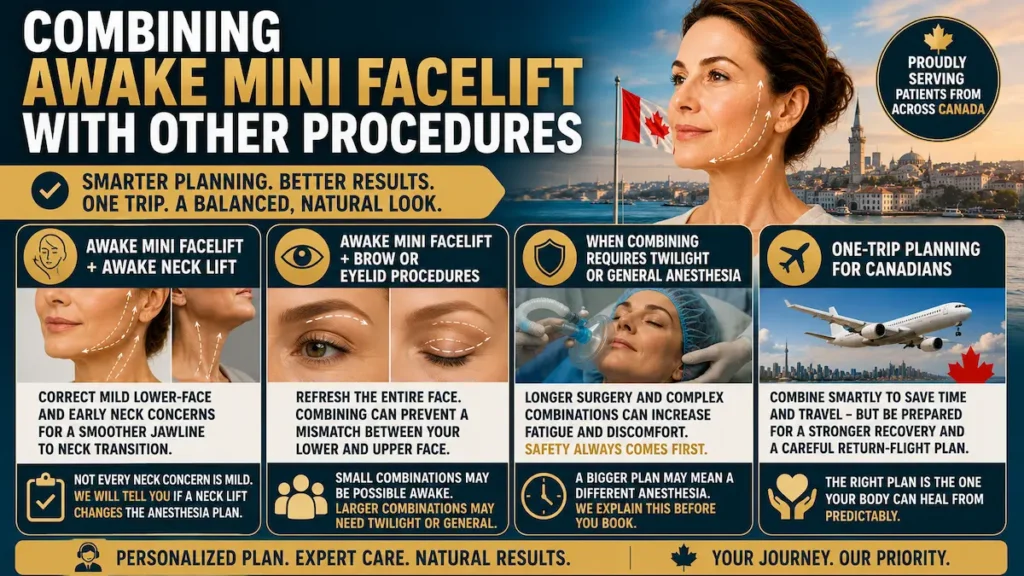
Combining Awake Mini Facelift With Other Procedures
Some Canadian patients want to make one international trip count. Combining procedures can be efficient, but it must be done carefully.
The more procedures you combine, the more likely anesthesia requirements may change. A plan that begins as awake may become better suited to twilight or general anesthesia if the total surgical scope expands.
Awake Mini Facelift + Awake Neck Lift
This combination may suit patients with mild lower-face laxity and early neck transition concerns. It can create a more balanced jawline-to-neck result.
However, not every neck concern is mild. Visible platysmal bands, heavy skin laxity, or deeper neck fullness may require a more extensive neck lift plan.
If your neck is part of the concern, review our Awake Neck Lift in Turkey guide and our standard Neck Lift in Turkey page.
We will tell you if adding the neck makes local-only surgery less appropriate.
Awake Mini Facelift + Brow or Eyelid Procedures
Some patients combine lower-face rejuvenation with upper-face or eyelid procedures. This can help avoid a mismatch between a refreshed jawline and tired-looking eyes.
Small combinations may be possible under local anesthesia in selected patients. Larger combinations may require twilight or general anesthesia.
The key is total procedure time and patient comfort. A patient who can tolerate one awake procedure may not tolerate several in one sitting.
We plan combinations conservatively because safety matters more than convenience.
When Combining Requires Twilight or General Anesthesia
Awake surgery works best when the procedure is focused. As surgical time increases, the patient may become tired, restless, or uncomfortable.
Complex combinations can also require broader tissue work. In those cases, twilight or general anesthesia may create a safer and more controlled environment.
This does not mean awake surgery failed. It means the plan became larger than local-only anesthesia should handle.
We explain this before booking so you are not surprised by an anesthesia recommendation later.
One-Trip Planning for Canadians
For Canadians, combining procedures can reduce repeated flights, repeated recovery windows, and repeated time away from work or family.
It can also increase the intensity of recovery. More treatment areas mean more swelling, more instructions, and a more careful return-flight plan.
Our team helps you weigh efficiency against recovery burden. Sometimes one trip is best. Sometimes staging is safer.
The right plan is the one your body can heal from predictably.
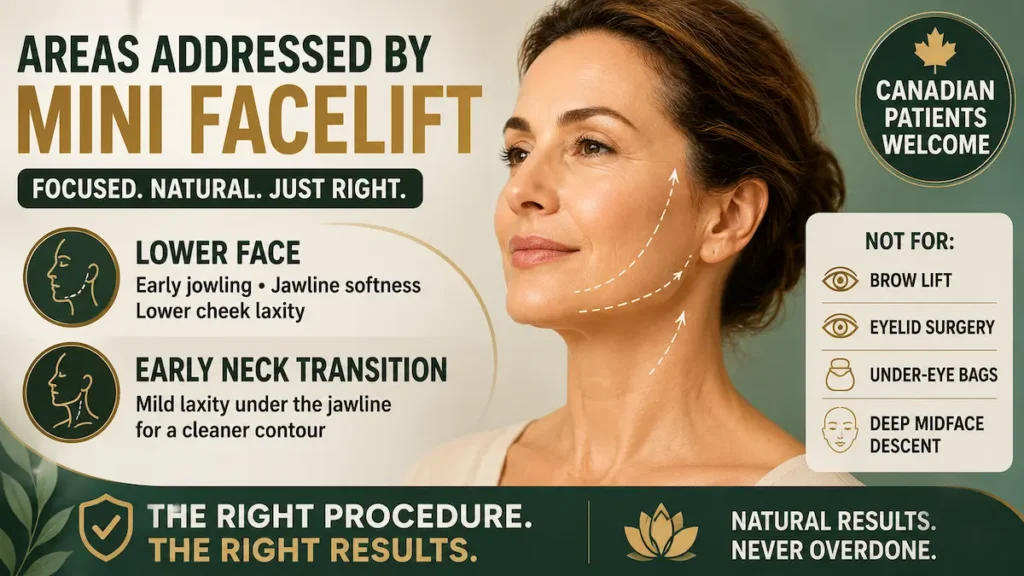
Areas Addressed by Mini Facelift
An awake mini facelift is best understood as a focused lower-face procedure. It is not a full-face solution.
This section is intentionally brief because surgical technique belongs to our main Mini Facelift in Turkey guide. Here, we focus on how procedure scope affects awake suitability.
Lower Face
The main target is the lower face. This includes early jowling, mild jawline softness, and laxity near the lower cheek.
Patients often describe looking tired, heavier around the jaw, or less defined in photos. They do not always need a full facelift.
A mini facelift can help restore a cleaner lower-face contour when the aging pattern is early or moderate. The result should look refreshed, not tight.
For awake surgery, this limited scope is important. Shorter and more focused procedures are better suited to pure local anesthesia.
Early Neck Transition
Some patients have mild laxity where the jawline transitions into the upper neck. A mini facelift may improve this area modestly.
It will not correct heavy neck bands, significant skin excess, or deep platysma separation. Those concerns usually require a neck lift.
If the neck is a major part of your concern, we may recommend an Awake Neck Lift in Turkey assessment instead.
Choosing the right procedure is more important than choosing the lightest one.
What Awake Mini Facelift Does Not Treat
An awake mini facelift does not lift the brow, remove eyelid skin, or correct under-eye bags. Those concerns require separate procedures.
It also does not restore deep midface descent the way a deep plane approach can. Mini facelift is a limited lower-face strategy.
Patients seeking dramatic transformation may feel disappointed if they choose a mini procedure for a full-face problem.
During consultation, we identify whether your concern is truly mini-facelift territory or whether another facial rejuvenation pathway would serve you better.
When Deep Plane or Neck Lift Is Better
Deep plane facelift is better when the issue involves deeper facial descent, stronger jowls, or midface tissues that need more structural repositioning.
The Canadian Society of Plastic Surgeons notes that facelift surgery can reposition deeper facial tissues and muscles, which is why technique selection matters.
Neck lift is better when the main concern is loose neck skin, visible vertical bands, or heaviness under the chin.
Awake options may still exist in selected cases, but the procedure must match the anatomy. We may direct patients to our Awake Deep Plane Facelift or neck lift pathways when a mini facelift is too limited.
This is part of our Natural-First philosophy. We do not use a smaller procedure when it will under-treat the problem.
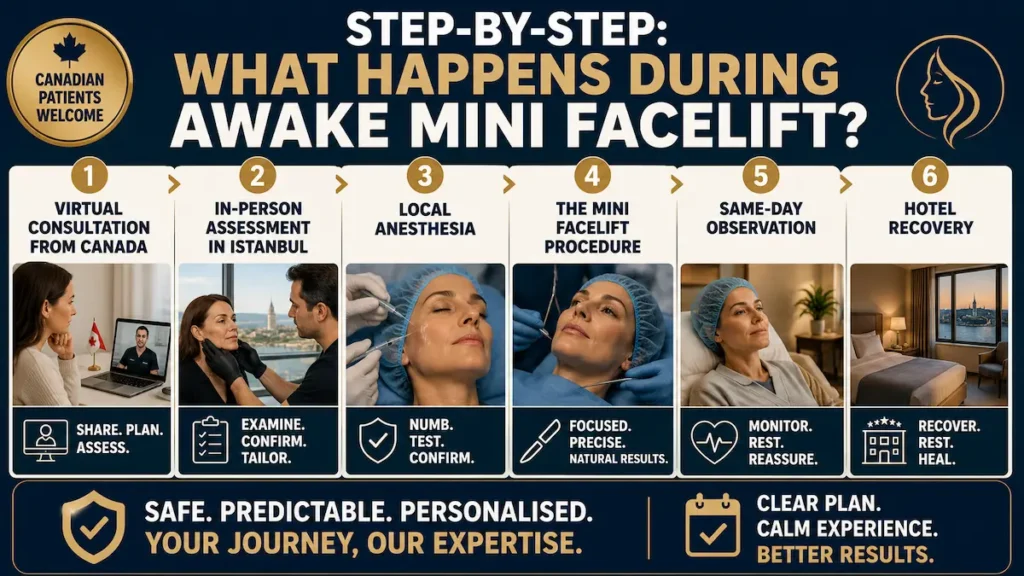
Step-by-Step: What Happens During Awake Mini Facelift?
A predictable process reduces anxiety. Canadian patients often feel more comfortable when they understand each step before travelling.
Your exact plan may vary, but the awake mini facelift pathway usually follows the same clinical sequence: remote assessment, in-person confirmation, local anesthesia, surgery, observation, and hotel recovery.
Virtual Consultation From Canada
Your first step is a remote consultation. You share photos, medical history, goals, and any anesthesia concerns.
We assess whether your lower-face aging pattern appears suitable for mini facelift. We also assess whether the awake approach seems realistic.
This stage is not a final surgical clearance. It is a planning step.
We may ask about previous anesthesia reactions, anxiety level, smoking, blood thinners, chronic conditions, and your intended travel dates from Canada.
In-Person Assessment in Istanbul
Once you arrive in Istanbul, we complete an in-person assessment. This confirms the plan created during your virtual consultation.
We examine skin laxity, jowling, jawline structure, scar placement, and neck involvement. We also confirm whether local-only anesthesia still makes sense.
If your anatomy suggests a mini facelift would under-treat the concern, we explain that before surgery. If your anxiety level changes, we discuss anesthesia alternatives.
A good plan can be adjusted. Safety comes before sticking to the original idea.
Local Anesthesia
On procedure day, we prepare the surgical area using sterile protocol and careful marking. Local anesthetic is then placed into the planned treatment zone.
The injection phase may feel briefly uncomfortable. After that, the area becomes numb.
We allow time for the anesthetic to work. We test sensation before beginning the surgical portion.
Local anesthesia is not rushed. Proper numbing is what makes the awake procedure possible.
The Mini Facelift Procedure
The surgical portion uses the mini facelift plan selected for your anatomy. The details may include limited incisions, controlled tissue repositioning, and careful closure.
We will not over-expand the technique here because this awake page is about anesthesia. The deeper surgical explanation belongs in our standard mini facelift treatment guide.
During surgery, you remain awake and can communicate. The operative field is kept controlled, sterile, and out of your direct view.
The goal is a calm, focused procedure with subtle lower-face rejuvenation.
Same-Day Recovery
After the procedure, we observe you before discharge. Because there is no general anesthesia, many awake patients feel clearer during this stage.
We review medication instructions, sleeping position, swelling care, and warning signs. Your coordinator also confirms your transfer plan back to the hotel.
You should not treat same-day discharge as a return to normal activity. You still had surgery.
The first evening should be quiet, hydrated, and restful.
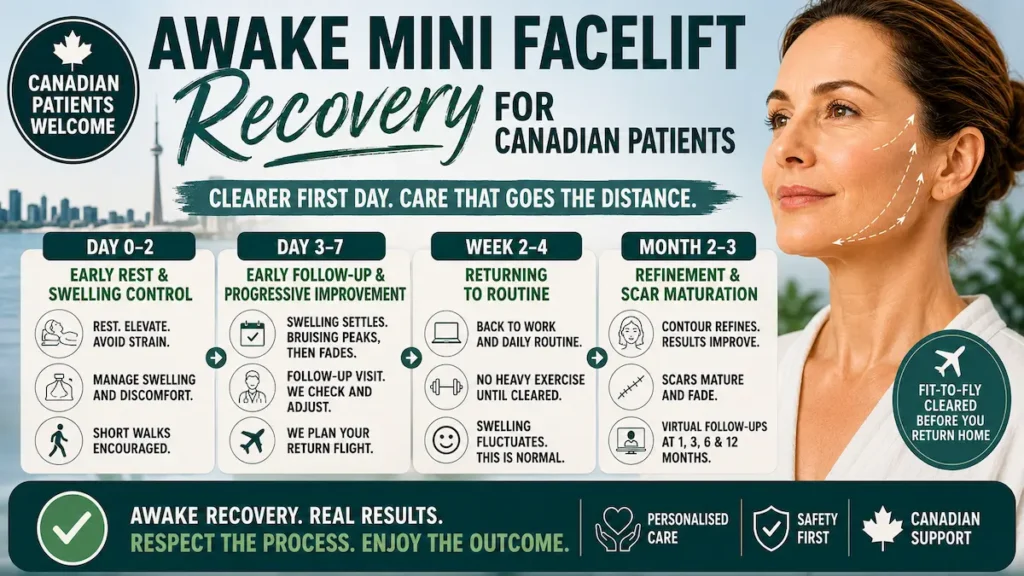
Awake Mini Facelift Recovery for Canadian Patients
Recovery after an awake mini facelift is usually easier in the first hours because there is no general-anesthesia grogginess. The surgical healing process still takes time.
You should expect swelling, bruising, tightness, and temporary numbness. These are normal parts of facial surgery recovery.
Day 0–2: Early Rest and Swelling Control
The first two days are about rest. Keep your head elevated, avoid bending, and follow your medication plan.
You may feel tightness along the lower face and near the ears. Mild discomfort is expected, but pain should be manageable with the prescribed protocol.
Short, gentle walks are encouraged when approved. They support circulation and reduce the feeling of stiffness after travel and surgery.
Your coordinator remains available if you feel unsure about swelling, bruising, or dressing care.
Day 3–7: Early Follow-Up and Progressive Improvement
During days three to seven, swelling often begins to shift and settle. Bruising may become more visible before it fades.
This is when many patients start to feel more confident moving around the hotel. You still need to avoid exertion, heat exposure, alcohol, and smoking.
Your follow-up visit allows our team to check incisions, review healing, and adjust instructions if needed.
For Canadians, this phase is also when we begin discussing return-flight readiness.
Our HBOT / LLLT Recovery Support
We use recovery technologies to support healing when clinically appropriate. Hyperbaric Oxygen Therapy, or HBOT, helps increase oxygen delivery to healing tissues and may reduce inflammation.
Low-Level Laser Therapy, or LLLT, supports cellular repair. Our system uses 424 medical-grade semiconductor laser diodes at 650nm to stimulate cellular ATP production without heat.
For facelift patients, this can support incision healing, reduce visible redness, and help the tissues settle more comfortably. It does not replace good surgical technique.
It supports recovery. Technique still creates the result.
You can learn more about our recovery technologies on our Technology and Standards page.
Fit-to-Fly Timing for Canadians
Canadian patients must plan for a long-haul flight. Returning too early can increase discomfort and make swelling harder to manage.
We assess fit-to-fly status before you leave Istanbul. This includes incision status, swelling, blood pressure, mobility, and overall recovery.
Most patients should plan their return only after medical clearance. Exact timing depends on your case and any combined procedures.
For a broader travel-safety explanation, read our flight safety after surgery guide.
Week 2–4: Returning to Routine
By weeks two to four, many patients can return to desk work, video calls, and low-intensity daily routines. Bruising may still need camouflage.
Swelling can fluctuate. This is normal, especially after long travel or busy workdays.
Avoid heavy exercise until cleared. Facial tissues are still settling, even if you feel well.
Patients returning to office environments in Toronto, Vancouver, Calgary, or Montreal often appreciate the mini facelift’s subtler recovery profile.
Month 2–3: Refinement and Scar Maturation
At two to three months, the lower-face contour usually looks more refined. Incisions continue to mature and fade over time.
Small areas of firmness or numbness may still improve gradually. Facial healing is not instant.
Your virtual follow-up programme helps us monitor progress after you return to Canada. Our care pathway includes long-term virtual check-ins at 1, 3, 6, and 12 months.
This continuity matters. International care should not end at the airport.
“Awake recovery is often clearer in the first day because there is no general anesthetic to clear. The surgical tissues still need the same respect: elevation, rest, incision care, and follow-up.”
Safety & Risks of Awake Mini Facelift
An awake mini facelift is still surgery. The anesthesia pathway may be lighter, but the safety standards must remain strict.
We treat awake surgery with the same clinical rigour we apply to sedated and general-anesthesia procedures. That includes screening, sterile technique, careful local anesthetic dosing, and clear post-operative instructions.
Common Temporary Effects
Most temporary effects are related to the mini facelift itself, not the awake anesthesia model. Swelling, bruising, tightness, and numbness are expected in the early recovery period.
You may feel pulling near the ears or along the lower face. Mild asymmetry from swelling is also common at first.
These changes usually improve gradually. The early appearance is not the final result.
We explain normal healing signs before you leave the clinic so you know what to expect at the hotel.
Awake-Specific Considerations
Awake surgery adds a different type of safety question: comfort while conscious. Some patients do very well with this. Others feel tense once the procedure begins.
That is why candidacy screening matters. A calm patient with realistic expectations is usually a better awake candidate than a highly anxious patient who wants to avoid general anesthesia at all costs.
Awareness is not unsafe by itself. Distress can become unsafe if it causes movement, panic, or inability to cooperate.
If we believe you would be more comfortable with twilight sedation, we will tell you directly.
Surgical Risks
The surgical risks of awake mini facelift include bleeding, hematoma, infection, visible scarring, asymmetry, delayed healing, and temporary nerve irritation.
These risks are uncommon when the procedure is performed in the right candidate by an experienced facial surgery team, but they are never zero.
We reduce risk through careful planning, conservative tissue handling, sterile protocols, and structured follow-up. We also ask patients to stop smoking and avoid medications or supplements that may increase bleeding when medically appropriate.
You should tell us about all prescriptions, over-the-counter medications, vitamins, and herbal supplements before surgery.
Local Anesthesia Safety
Local anesthesia is widely used in surgical care, but it must be dosed correctly. More is not automatically better.
We calculate local anesthetic use according to the treatment area, patient weight, procedure length, and safety limits. We monitor how you feel throughout the procedure.
Signs such as dizziness, ringing in the ears, unusual metallic taste, or sudden anxiety must be reported immediately. These are rare, but patients should know that local anesthesia is still a medical drug, not just “numbing cream.”
Safe local anesthesia depends on judgement, dosing discipline, and monitoring.
How We Reduce Risk
Our safety model begins before you arrive in Istanbul. We review photos, health history, medications, prior surgeries, smoking status, and anesthesia concerns.
In Turkey, your in-person consultation confirms whether the planned procedure and anesthesia model still make sense. If your case is no longer a good awake case, we change the plan.
We operate with strict sterilization discipline and regulated facility standards. Our institutional protocols include WHO- and CDC-aligned hygiene frameworks, advanced autoclave sterilization, and a zero-compromise sterile operative field. We are also authorized by the Turkish Ministry of Health for international health tourism.
For Canadian patients, these details help replace uncertainty with verifiable structure.
“The safest awake surgery is not the shortest one or the lightest one. It is the one where the patient, procedure, anesthesia dose, and surgical environment all match.”
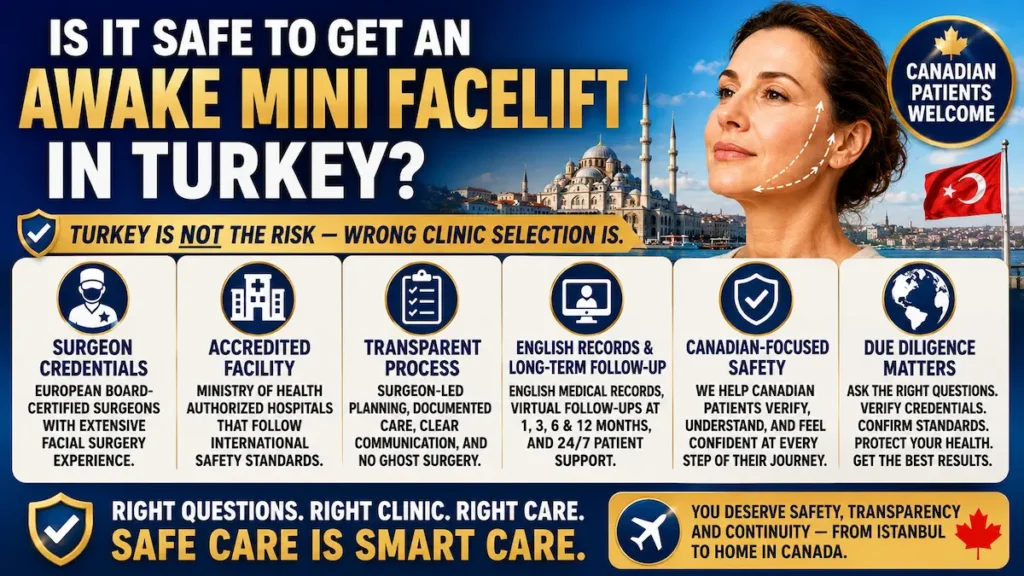
Is It Safe to Get an Awake Mini Facelift in Turkey?
Canadian patients are right to ask this question. Surgery abroad requires more due diligence than booking a local consultation in Toronto or Vancouver.
Our answer is direct: Turkey is not the risk. Poor clinic selection is the risk.
Turkey Is Not the Risk — Wrong Clinic Selection Is
A bad result can happen in any country when the surgeon is not properly qualified, the facility is not appropriate, or the patient is rushed into the wrong procedure.
The Government of Canada advises patients to understand the risks of receiving medical care outside Canada, including complications, aftercare issues, and medical-record gaps. We agree that these concerns should be addressed directly.
We do not ask Canadian patients to ignore official concerns about surgery abroad. We ask them to evaluate the clinic, surgeon, facility, documentation, and aftercare with the same seriousness they would apply in Canada.
The question is not simply, “Is Turkey safe?”
The better question is, “Who will perform my surgery, where will it be performed, what standards govern the facility, and what happens after I return home?”
Ghost Surgery Concerns
“Ghost surgery” means the person advertised or expected to perform the procedure is not the person who actually performs it. This concern is especially important in international cosmetic surgery.
Canadian patients should confirm the surgeon of record before booking. They should also ask who performs each step, who supervises the procedure, and who is responsible for follow-up.
At AKM Clinic, we build the process around surgeon-led planning and documented care. Your treatment plan is not handed off as a generic template.
For a detailed due-diligence checklist, read our ghost surgery in Turkey guide.
Surgeon Credentials
Credentials matter more than marketing language. For Canadian patients, the familiar reference point is often RCPSC certification and provincial college registration.
The Royal College of Physicians and Surgeons of Canada is the Canadian benchmark many patients know for specialist physician standards, and its public directory of certified specialists lets you check how a surgeon’s credentials would be verified at home. Turkey uses a different regulatory structure, so patients need a translation framework.
We recommend looking for European Board certification, facial surgery experience, international society participation, facility accreditation, and transparent documentation.
Our team includes European Board-Certified Surgeons and facial surgery specialists who work within regulated Turkish health care standards. For general body text, we avoid over-personalizing the page around one doctor because the key point is system-level accountability.
You should still ask who will operate, how their credentials can be verified, and how many similar facial procedures they perform.
Canadian-Equivalent Verification
Canadian patients are used to checking provincial colleges such as CPSO, CPSBC, CPSA, or CMQ. International care requires a different checklist.
Instead of a provincial college number, look for evidence of specialist training, board certification, hospital accreditation, Ministry of Health authorization, documented pre-operative assessment, and English-language medical records.
Ask whether the facility follows international safety frameworks. Ask how complications are handled. Ask who you contact after returning to Canada.
These questions are not impolite. They are the right questions.
English Records and Long-Term Follow-Up
One common Canadian concern is follow-up after returning home. This is valid.
Our all-inclusive clinical pathway includes long-term virtual follow-up at 1, 3, 6, and 12 months. It also includes 24/7 dedicated patient advocate support during the active care period.
We provide instructions that help you understand what is normal, what needs monitoring, and when local medical review is appropriate.
International surgery should not feel like you are alone once you board the return flight. Continuity is part of responsible care.
For broader country-specific due diligence, our plastic surgery safety in Turkey guide explains what Canadian patients should verify before booking.
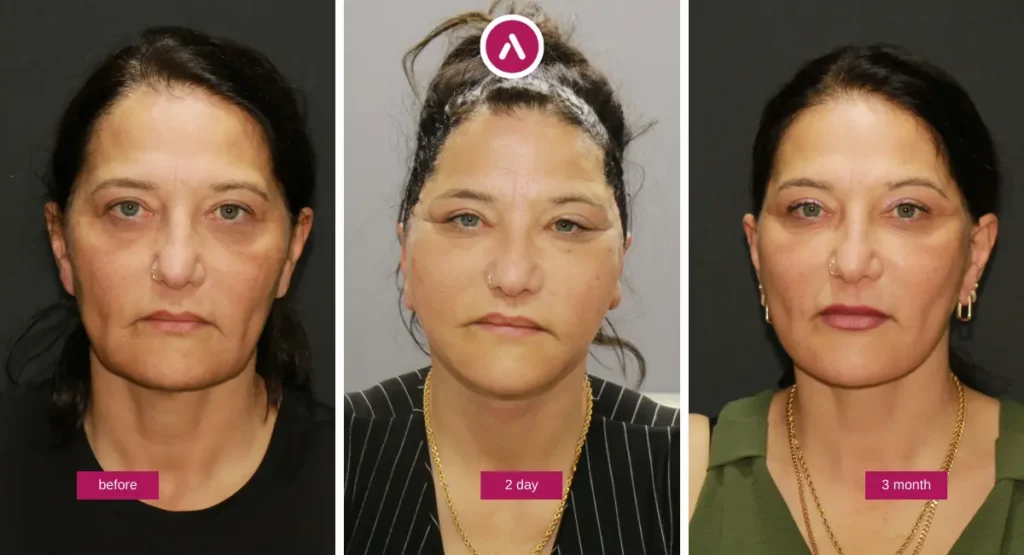
Awake Mini Facelift Before and After: Realistic Expectations & Results
An awake mini facelift can improve the lower face in the right candidate. It should not be sold as a full facelift, deep plane facelift, or neck lift replacement.
Awake surgery changes the procedure experience. It does not make a limited procedure unlimited.
The Result Comes From Technique, Not Anesthesia
This is the most important expectation to understand. The anesthesia model does not create the result.
Your result depends on anatomy, surgical planning, tissue handling, skin quality, scar healing, and whether the procedure matches the concern. Awake anesthesia simply changes how you experience the surgery.
A well-selected awake mini facelift can look natural and refined. A poorly selected mini facelift can under-treat the concern, even if the anesthesia experience was easy.
That is why we do not let the desire to avoid general anesthesia override the correct surgical indication.
Our Natural-First Philosophy
Our philosophy is “Rejuvenation, not alteration.” We aim to help you look rested and refreshed, not obviously operated on.
For mini facelift patients, this means preserving identity and avoiding an over-tight lower face. The goal is usually sharper jawline definition, softer early jowling, and better facial balance.
North American patients often tell us they do not want a dramatic or “pulled” look. Our Natural-First approach is designed for that preference.
Subtle does not mean ineffective. It means the result should fit your face.
What Mini Facelift Can Realistically Improve
A mini facelift can improve mild-to-moderate lower-face laxity. It can soften early jowls and refine the jawline.
It may help the face look less tired in photos, especially around the lower cheek and jaw. It can also create a cleaner transition between face and upper neck in selected patients.
The best results happen when the aging pattern is limited. Patients with good skin quality and realistic goals usually do better.
If the problem is more advanced, we may recommend a deep plane facelift, neck lift, or combined plan instead.
What It Cannot Do
An awake mini facelift cannot correct severe neck bands. It cannot remove heavy skin excess from the neck.
It does not replace upper eyelid surgery, lower eyelid surgery, brow lift, or fat transfer. It also does not reposition the deeper midface the way a deep plane facelift can.
If your concern involves the whole face, choosing a mini procedure may lead to disappointment.
We prefer to be clear before surgery rather than explain under-treatment afterward.
Gallery and Reviews
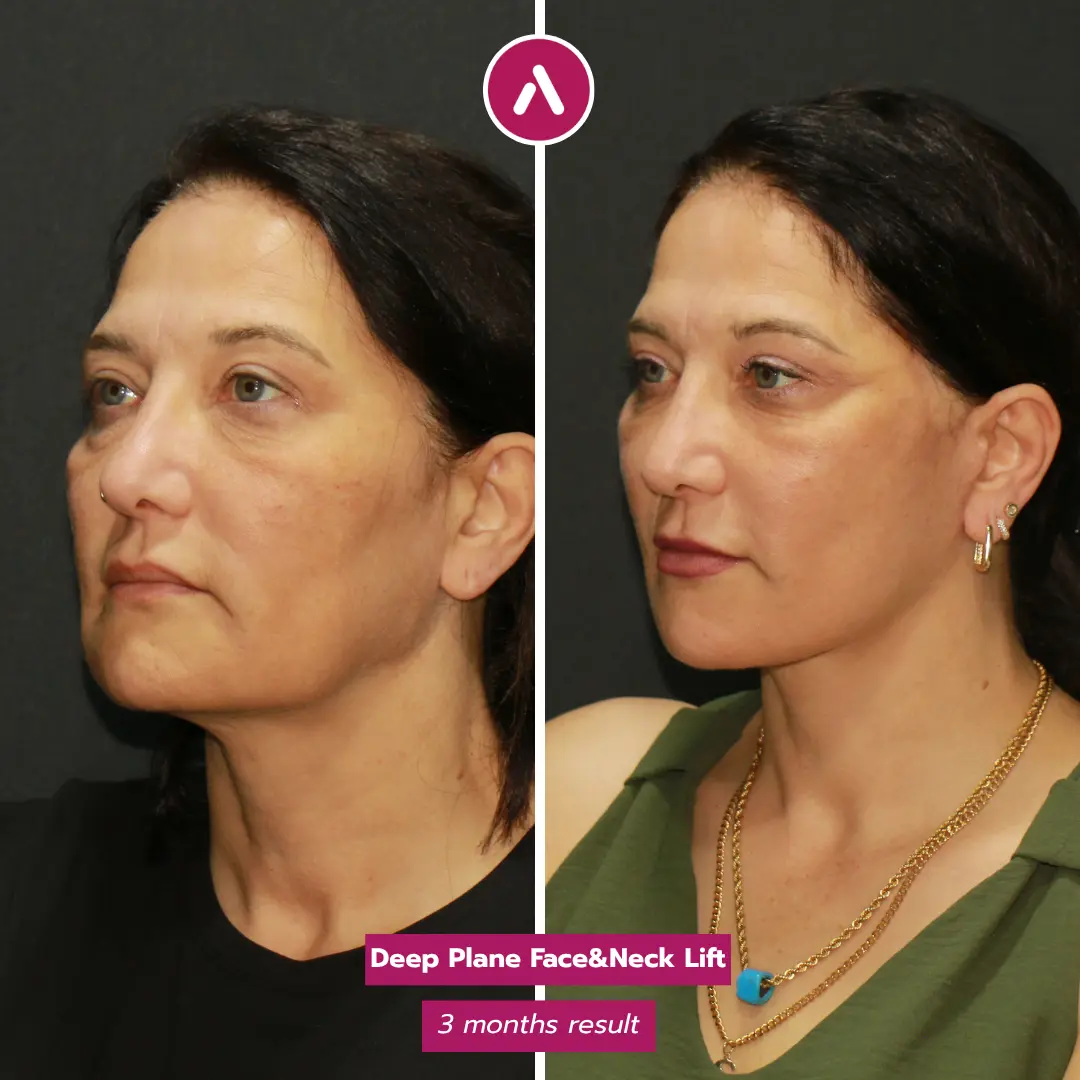
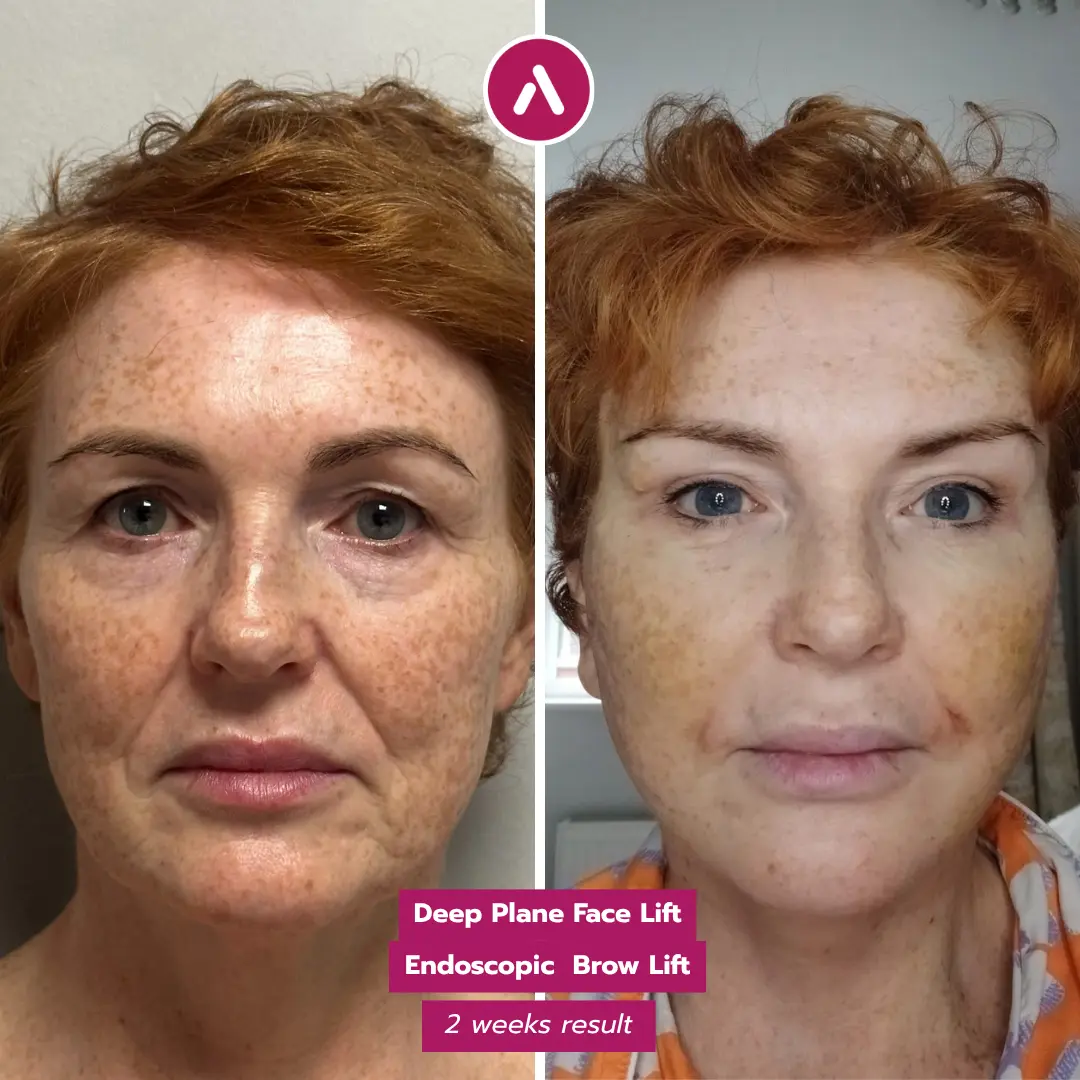
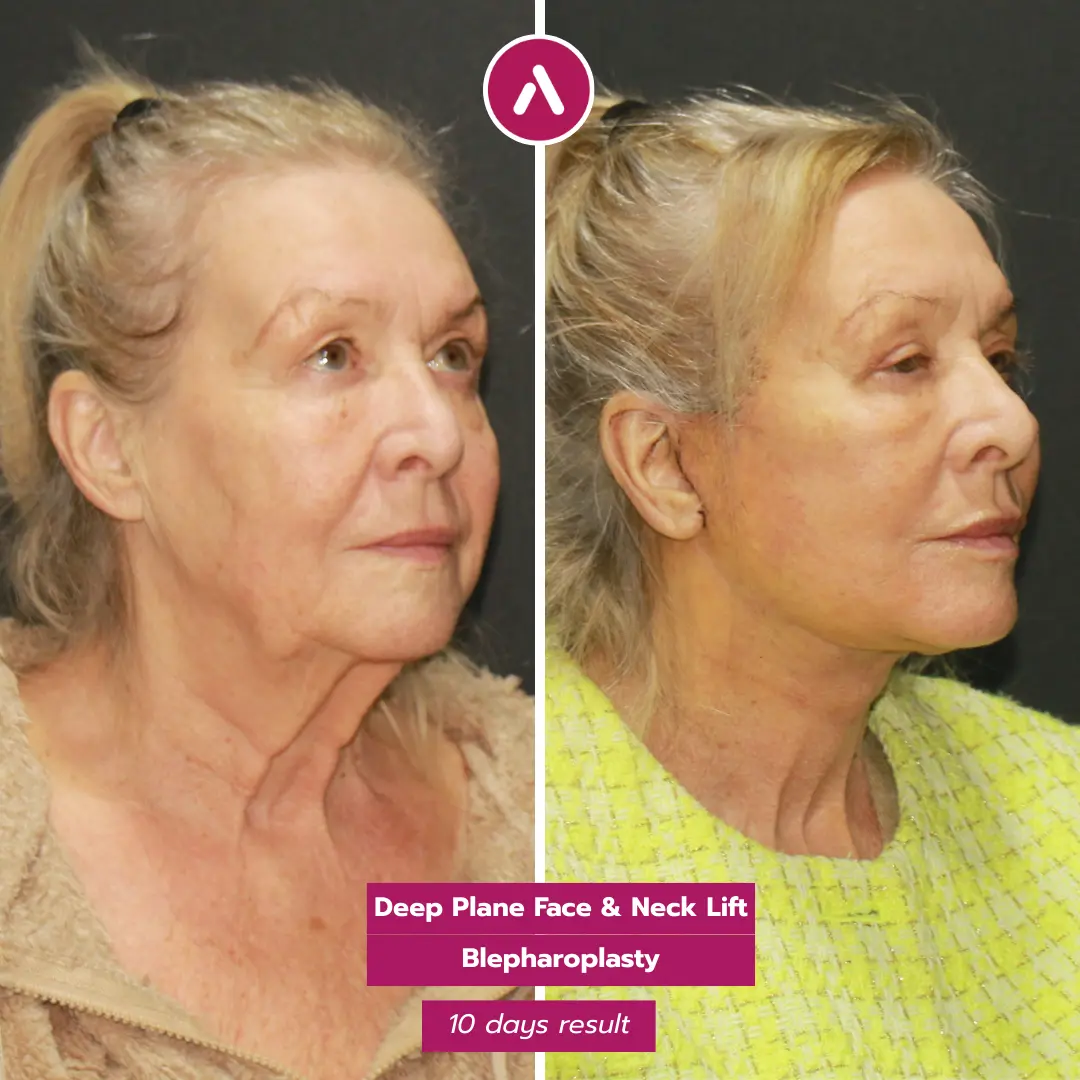
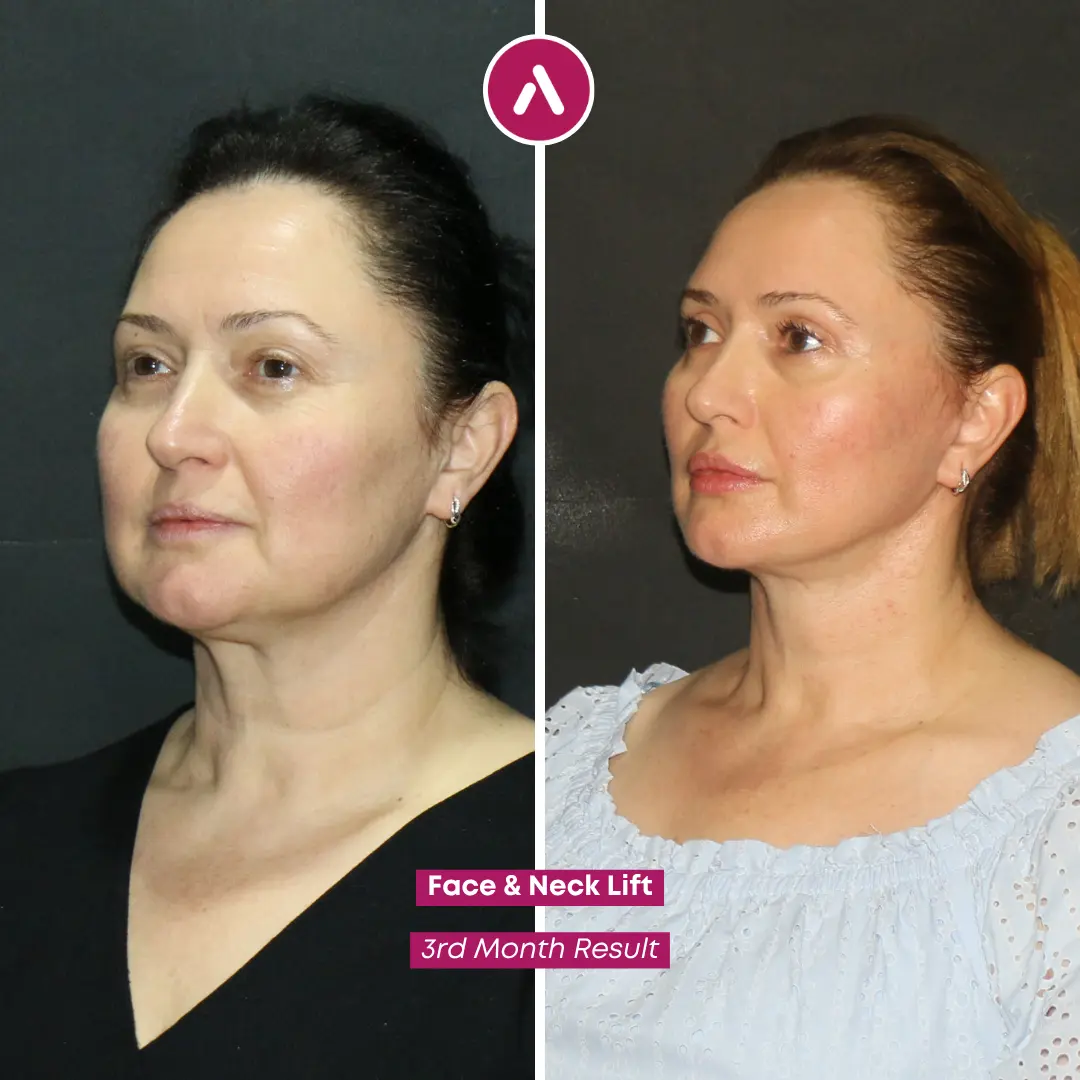
Before-and-after research can help you understand the style of result we aim for. It should be used carefully.
Look for patients with similar anatomy, similar aging severity, and similar procedure scope. A deep plane facelift result should not be used as your expectation for a mini facelift.
You can review facial rejuvenation outcomes through our relevant facelift before-and-after gallery and learn more from verified patient experiences on our professional plastic surgery reviews page.
Canadian patient stories also matter. Lisa, Jammal, Ava, and Tina are among the verified Canadian patients referenced in our testimonial materials.
“Awake surgery does not change the aesthetic target. The same Natural-First principles apply: correct the right layer, avoid tension, and never promise a full facelift result from a mini procedure.”
For awake-specific result questions, our awake facelift before-and-after guide explains how to interpret photos without confusing procedure types.
Awake Mini Facelift Cost 2026: Turkey vs Canada
Canadian patients researching awake mini facelift cost often discover two issues at the same time: private facial surgery in Canada is usually billed through separate line items, and awake surgery may not be clearly offered as a distinct pathway. Surgeon fees, facility fees, anesthesia costs, medications, and follow-up visits can all change the final total.
At AKM Clinic in Istanbul, the Awake Mini Facelift is listed at CAD $6,150. This reference comes from our treatment-technique pricing, where Awake Mini Facelift is identified as a local-anesthesia option for a faster recovery period.
For Canadian patients comparing Toronto, Vancouver, Calgary, or Montreal quotes, the key is not just the surgical fee. Ask what is included. Our all-inclusive clinical pathway may include the surgical procedure, anesthesia and facility fees, pre-operative tests, 5-star hotel accommodation, VIP transfers, post-operative medications, patient advocate support, and long-term virtual follow-up when included in the final tailored quote.
Because each face and surgical plan is different, your final quote is confirmed after consultation. If your anatomy requires a neck lift, deep plane facelift, or twilight/general anesthesia instead of awake mini facelift, the pricing changes accordingly.
Canadian-dollar pricing shown for planning clarity; your coordinator will confirm the final payment details before booking.
| Location | Typical Cost Structure | What Patients Should Check |
|---|---|---|
| Toronto / GTA | Private-pay cosmetic pricing, often billed in separate line items | Surgeon fee, facility fee, anesthesia, follow-up visits |
| Vancouver / Lower Mainland | Private cosmetic clinic pricing | Whether anesthesia and facility costs are included |
| AKM Clinic Istanbul | CAD $6,150 | Awake mini facelift assessment and final tailored quote |
For the dedicated price breakdown, visit our mini facelift cost in Turkey guide. Package availability may also be reviewed through the all-inclusive facelift package page where applicable.
How to Find the Best Awake Mini Facelift Surgeon in Turkey
Choosing an awake mini facelift surgeon requires two layers of verification. The first is facial surgery experience. The second is experience operating under local anesthesia while the patient remains fully awake.
Canadian patients often know how to evaluate a surgeon at home through provincial colleges and RCPSC-related credentials. For surgery in Turkey, the checklist is different, but the mindset should be just as strict.
Verify Facial Surgery Experience
A mini facelift may be less extensive than a full facelift, but it is still facial surgery. Small changes around the lower face can look very visible if the plan is wrong.
Ask whether the surgeon regularly performs facial rejuvenation procedures, not just general cosmetic surgery. Ask to see examples of lower-face work in patients with similar anatomy.
At AKM Clinic, our facial rejuvenation programme is built around a Natural-First philosophy and more than 2,000 successful facial surgeries since 2013. This experience matters because subtle facial work leaves little room for guesswork.
The goal is not to find the most aggressive surgeon. It is to find the surgeon who knows when a mini facelift is enough and when it is not.
Verify Awake / Local-Anesthesia Case Experience
Not every surgeon who performs mini facelifts is comfortable performing them fully awake. Awake surgery changes the rhythm of the procedure.
The surgeon must work precisely while also maintaining patient comfort. The team must know how to communicate calmly, manage local anesthetic timing, and respond if the patient feels pressure or anxiety.
Ask how awake candidacy is determined. A responsible clinic should not say that every patient can have local-only surgery.
If the clinic cannot explain why you are a good awake candidate, that is a warning sign.
Confirm Surgeon-of-Record
Before travelling, confirm who will perform your procedure. Do not rely only on social media content, coordinator messages, or general clinic branding.
Ask whether the named surgeon will personally perform the surgical steps. Ask who will close incisions. Ask who is responsible for post-operative decisions.
This is especially important in international surgery because patients are far from their usual health care system. You deserve clarity before you book flights.
Our recommendation is simple: if a clinic avoids answering surgeon-of-record questions, do not proceed.
Confirm Facility Standards
An awake mini facelift still requires a controlled surgical environment. Local anesthesia does not make sterile standards less important.
Ask where the procedure will take place, what emergency protocols exist, and how instruments are sterilized. Ask whether the clinic is licensed for international patients.
Our clinical model includes regulated infrastructure, sterile operating protocols, Turkish Ministry of Health authorization, and JCI-accredited hospital partnership where appropriate.
These systems are especially important for Canadians who cannot rely on provincial oversight once they leave Canada.
Ask the Right Questions
A good consultation should welcome detailed questions. Careful patients make safer decisions.
- Am I a true awake mini facelift candidate?
- Who will perform the procedure?
- What happens if local anesthesia is not enough?
- Will I need twilight or general anesthesia instead?
- Where will the surgery take place?
- How are complications handled after I return to Canada?
- Will I receive English-language post-operative instructions?
These questions are not confrontational. They are standard due diligence.
For a broader credential checklist, our plastic surgeon board certification guide explains how Canadian patients can compare international qualifications.
Credential Equivalency Table
| Credential Signal | What It Means | Why Canadians Should Care |
|---|---|---|
| European Board Certification | Structured specialist-level training and assessment | Comparable verification mindset to RCPSC research |
| JCI-Accredited Facility | International hospital quality and safety framework | Helps replace the comfort of Canadian provincial oversight with external facility standards |
| Documented Follow-Up | English records and virtual follow-ups | Supports continuity when the patient returns to Canada |
| Awake Surgery Experience | Specific experience with local-only procedures | Important because awake surgery requires patient communication and careful local-anesthetic planning |
“The best awake mini facelift surgeon is not simply the surgeon willing to operate under local anesthesia. It is the surgeon willing to say no when local-only surgery is not the safest or most comfortable plan.”
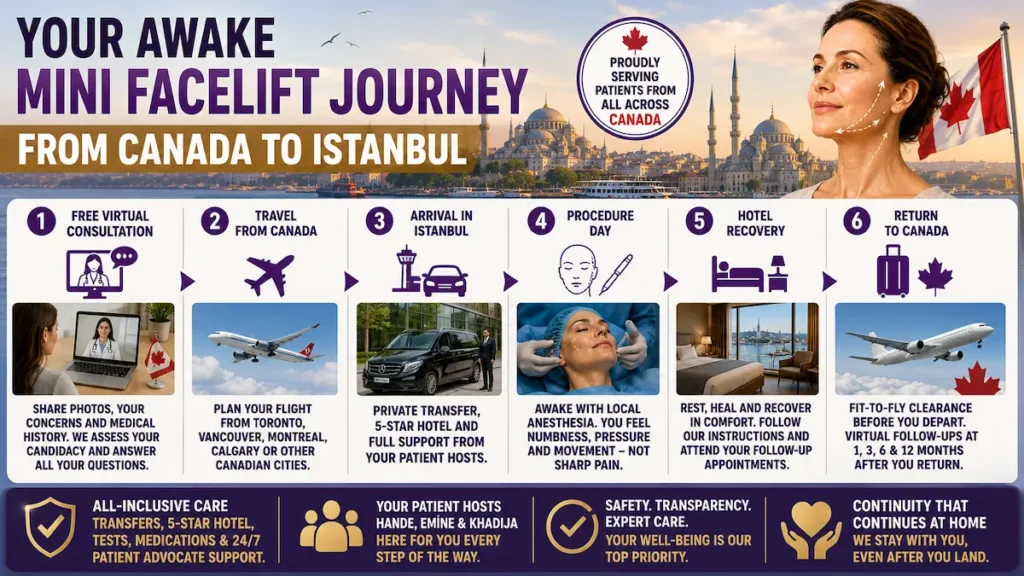
Your Awake Mini Facelift Journey From Canada
A successful awake mini facelift is not only about the procedure. It also depends on planning the travel, recovery setting, and follow-up correctly.
We designed our international care pathway for patients who are arriving from cities such as Toronto, Vancouver, Calgary, Ottawa, Montreal, Edmonton, Winnipeg, and Halifax.
Free Virtual Consultation
Your journey begins with a remote consultation. You send photos, describe your concerns, and share your medical history.
We assess whether your facial aging pattern appears appropriate for a mini facelift. We also assess whether awake surgery seems realistic based on your comfort level and health history.
You can ask about local anesthesia, pain control, travel timing, hotel recovery, and follow-up before committing to a date.
This step helps you avoid unnecessary travel if your goals do not match an awake mini facelift.
Travel From Canada
Canadian patients commonly travel through Toronto, Vancouver, Montreal, or Calgary. Flight schedules change, so you should always check current airline routes and connection times before booking.
Canadian passport holders generally benefit from simplified short-stay travel to Turkey, but entry rules can change. Always confirm current passport and travel requirements before departure.
We help coordinate your clinical schedule around your arrival and recovery window. You remain responsible for booking international flights.
The key is not to compress the timeline. Give your body enough time in Istanbul for consultation, surgery, early recovery, and fit-to-fly review.
Arrival in Istanbul
After arrival, your private transfer brings you to your hotel or clinical appointment according to the agreed schedule. You do not need to navigate transportation while tired from a long-haul flight.
Our all-inclusive clinical pathway can include private VIP transfers, 5-star hotel accommodation, pre-operative tests, post-operative medications, and 24/7 patient advocate support when included in your final plan.
Our patient hosts — Hande, Emine, and Khadija — help bridge the gap between medical care and day-to-day logistics.
This matters after surgery. A calm recovery environment supports better healing.
Procedure Day
On procedure day, we review the plan, confirm markings, and prepare the treatment area. You remain awake during local-anesthetic placement and the procedure itself.
You should feel numbness, pressure, and movement rather than sharp pain. We keep communication open throughout the case.
After surgery, we observe you and review instructions before you return to your hotel. Even without general anesthesia, you should rest for the remainder of the day.
Awake does not mean casual. It means conscious and carefully monitored.
Hotel Recovery
Hotel recovery gives you privacy, comfort, and proximity to the clinical team during the early healing phase. We commonly work with 5-star hotel partners in Istanbul’s Levent district, including The Point Barbaros where appropriate.
The first days are structured around rest, head elevation, medication timing, gentle walking, and follow-up appointments.
You should avoid sightseeing, heavy meals, alcohol, smoking, and unnecessary exertion. Your body needs quiet recovery.
If you have questions, your coordinator can guide you before small concerns become major anxiety.
Return to Canada
Before you fly home, we assess your healing and provide travel guidance. Fit-to-fly clearance depends on your incision status, swelling, comfort, mobility, and overall recovery.
During the flight, you may need to walk periodically, stay hydrated, avoid heavy lifting, and keep your head supported. We provide instructions based on your case.
Once you return to Canada, your virtual follow-up schedule continues at 1, 3, 6, and 12 months. This supports continuity even after you are back in your provincial health care system.
For a broader overview of the full process, see our patient journey from Canada to Istanbul page and our Istanbul clinic guide.
Awake Mini Facelift Frequently Asked Questions (FAQ):
What is an awake mini facelift?
An awake mini facelift is a focused lower-face facelift performed under pure local anesthesia. You remain conscious, breathe on your own, and avoid general anesthesia.
Does awake mini facelift hurt?
The numbing injections may sting briefly. Once local anesthesia is working, you should feel pressure or movement rather than sharp pain.
Am I fully awake during the procedure?
Yes. In a pure-local awake mini facelift, you remain fully conscious. If you want to be drowsy, twilight sedation may be a better fit.
Is awake safer than general anesthesia?
Awake surgery avoids general-anesthesia exposure, which can be beneficial for selected patients. It is not automatically safer for everyone. Safety depends on the procedure, your health, your anxiety level, and the surgical setting.
How long does recovery take?
Most patients need several days of quiet recovery and several weeks for swelling and bruising to settle. Final refinement continues over the following months.
How soon can I fly back to Canada?
You should fly only after fit-to-fly clearance from our team. Timing depends on your healing, swelling, mobility, and whether you combined procedures.
Does OHIP, MSP, RAMQ, or AHCIP cover awake mini facelift?
No. Provincial health plans in Canada generally do not cover elective cosmetic facelift surgery. Rare reconstructive exceptions do not apply to standard aesthetic mini facelift.
Does Canadian travel insurance cover complications?
Many Canadian travel insurance policies exclude elective cosmetic surgery and complications related to it. You should review your policy carefully before booking and ask the insurer direct written questions.
To reduce this concern, AKM Clinic provides complimentary complication insurance for all patients. This is separate from standard Canadian travel insurance and is designed to add an extra layer of protection around your surgical care. Your coordinator will explain the coverage terms, limits, and required documentation before you confirm your booking.
What if I get anxious during the awake mini facelift procedure?
We screen for anxiety before surgery. If you become uncomfortable, we pause, support you, and reassess. If high anxiety is expected, twilight sedation may be recommended instead of awake surgery.
Will my results differ because I was awake?
No. The result comes from the surgical technique and your anatomy. Anesthesia changes the experience, not the aesthetic goal.
How much does awake mini facelift cost in Turkey?
Our Awake Mini Facelift reference price is CAD $6,150. Your final quote is confirmed after consultation and depends on your surgical plan.
Can I combine awake mini facelift with an awake neck lift?
Sometimes. Mild neck concerns may be compatible with an awake plan. More significant neck correction may require a different anesthesia model.
How do I verify the surgeon before travelling?
Ask who will perform the procedure, what their credentials are, where the surgery will take place, and how follow-up works after you return to Canada.
What follow-up do I get after returning to Canada?
Our clinical pathway includes virtual follow-up at 1, 3, 6, and 12 months when included in your care plan. You also receive post-operative instructions and coordinator support.
Medical Disclaimer: This page is for educational purposes only and does not replace consultation with a qualified physician or surgeon. Awake mini facelift suitability depends on your anatomy, medical history, medication use, anxiety level, smoking status, and surgical goals. All surgical procedures involve risks, including swelling, bruising, bleeding, infection, scarring, asymmetry, delayed healing, temporary numbness, and dissatisfaction with results. Local anesthesia also requires proper dosing and monitoring.