




After major weight loss, loose upper-back skin and “bra bulge” rolls are among the most stubborn and least discussed areas, because no amount of exercise removes excess skin. An upper back lift, also called a bra-line back lift, excises those rolls through an incision concealed along the bra line. This guide explains the bra-line, vertical, and liposuction-only techniques, the honest scar trade-off, and how an extended back lift can connect to an arm or breast lift in one trip.
Table of Contents
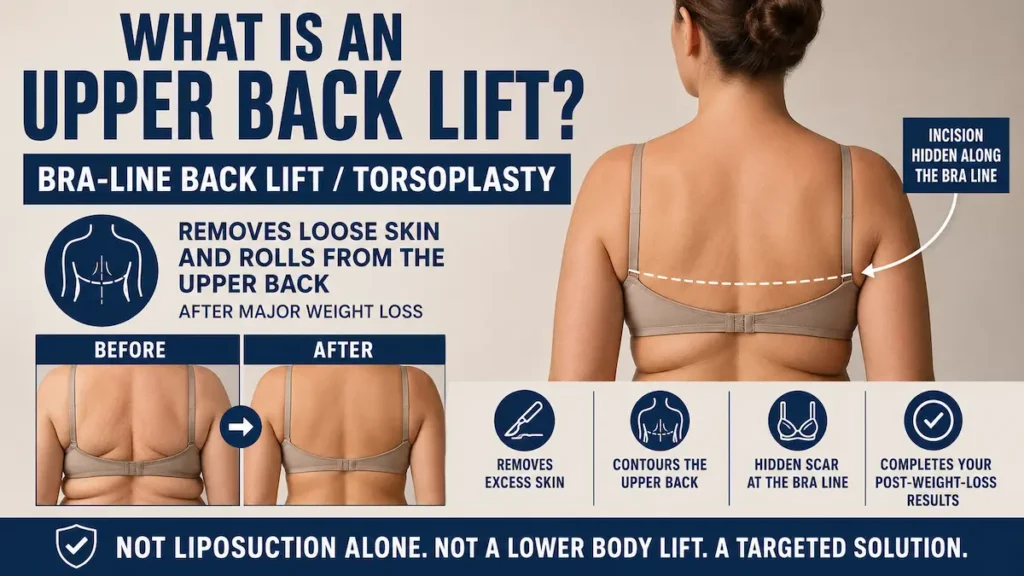
What Is an Upper Back Lift? (Bra-Line Back Lift / Torsoplasty)
An upper back lift, also called a bra-line back lift or torsoplasty, surgically removes loose skin and rolls from the upper back, typically after major weight loss. The incision is usually hidden along the bra line. Variants include vertical and liposuction-only back contouring.
Upper Back Lift Defined: Removing Posterior Trunk Rolls
An upper back lift is a body-contouring procedure designed for loose skin and soft-tissue folds across the upper back. These folds often sit above and below the bra line, along the lateral chest, or across the posterior trunk after significant weight loss.
This procedure is different from weight-loss surgery. It does not reduce body weight. It reshapes the area after weight has already been lost and the skin has not retracted on its own.
At AKM Clinic, we assess the upper back as part of the full post-weight-loss body-contouring picture. Many patients need isolated upper-back correction. Others benefit from combining it with an arm lift, breast lift, or broader 360 body lift plan.
“Bra-Line Back Lift” and “Torsoplasty” Explained
The term “bra-line back lift” describes the most common incision strategy. The surgeon places the incision horizontally across the upper back so that a bra band, swimsuit, or structured garment can often conceal it.
“Torsoplasty” is a broader surgical term for reshaping the torso. In practical patient language, a bra-line back lift is the technique most Canadian patients mean when they ask about removing upper-back rolls.
The key point is simple: the scar is intentional. It allows us to remove excess skin that liposuction, exercise, massage, or energy-based tightening cannot correct when laxity is significant.
Where It Fits in Post-Weight-Loss Body Contouring
Upper-back laxity often appears after bariatric surgery, GLP-1-assisted weight loss, pregnancy-related body change, or long-term weight fluctuation. Patients may be happy with the number on the scale but frustrated that the skin envelope still feels oversized.
The upper back is also easy to overlook during planning. Many patients first research tummy tuck, arm lift, or thigh lift, then realize that the back rolls remain visible through fitted tops and bras.
Body contouring after major weight loss is recognized by the American Society of Plastic Surgeons as a surgical category that removes excess skin and fat while improving underlying tissue tone. We use that same anatomical logic when assessing whether the upper back needs excision, liposuction, or a staged body-contouring plan.
Our role is to map the body as a connected structure. Treating only the front of the torso can leave the back looking unfinished. Treating the upper back can complete the silhouette from every angle.
What It Is NOT: Not Liposuction Alone, Not a Lower Body Lift
An upper back lift is not the same as back liposuction. Liposuction removes fat, but it does not remove hanging skin. If the problem is skin laxity rather than fat volume, liposuction alone can make the area look looser.
It is also not the same as a lower body lift. A lower or 360 body lift focuses on the abdomen, hips, buttocks, and lower back. An upper back lift targets the bra-line region and upper posterior trunk.
This distinction matters for Canadian patients comparing procedures. A precise diagnosis helps avoid paying for a treatment that cannot solve the real concern.
Benefits of an Upper Back Lift
An upper back lift can improve the contour of the upper back by removing loose skin folds that exercise, weight loss, and liposuction alone cannot correct. For Canadian patients after major weight loss, the main benefit is a smoother bra-line area with a scar planned for concealment.
Removing “Bra Bulge” and Upper-Back Rolls
The main benefit of an upper back lift is direct removal of skin folds that gather around the bra line. These folds can create visible bulging through clothing, even when a patient is at a healthy and stable weight.
By excising the redundant tissue, we flatten the upper back and improve the transition between the shoulder blade area, side chest, and waist. The goal is not an over-tight appearance. The goal is a smoother contour that fits the patient’s new body.
What Exercise and Weight Loss Cannot Fix
Exercise can build muscle and reduce fat. It cannot remove stretched skin once the skin has lost enough elasticity. This is why many disciplined patients still feel frustrated after doing “everything right.”
Loose upper-back skin is a mechanical problem. When skin redundancy is the main issue, the solution must physically remove that excess. That is where excisional surgery becomes appropriate.
“The honest trade-off in an upper back lift is simple: we exchange visible rolls for a planned scar that is placed where clothing can usually hide it. The right patient understands that trade-off before surgery, not after.”
Clothing Fit and Confidence
Many patients describe this concern through clothing rather than anatomy. Bras dig in. Fitted shirts reveal rolls. Dresses that fit the waist may still pull across the back.
An upper back lift can improve how clothing sits on the body. It may also reduce the need to size up just to accommodate loose tissue in the back.
For patients who have worked hard through weight loss, this can feel like the final missing piece. The change is often subtle in daily life but meaningful in how the body feels in clothes.
Completing the Post-Weight-Loss Body Transformation
Post-weight-loss contouring is rarely about one isolated area. The abdomen, arms, thighs, breasts, and back often change together. Correcting one zone while ignoring another can create imbalance.
That is why we frequently evaluate upper-back lift candidacy alongside arm lift, breast lift, and 360 body lift planning. Some patients need only the upper back. Others achieve a more complete result through a staged or combined approach.
For Canadian patients travelling to Istanbul, this matters logistically. Combining appropriate procedures can mean one anesthesia event, one recovery window, and one international trip.
Honest Framing: Trading Rolls for a Hidden Scar
We do not describe an upper back lift as scarless. It is not. The procedure works because it removes skin, and skin removal requires an incision.
The question is whether the scar is a worthwhile trade-off for the patient’s concern. For many post-weight-loss patients, a bra-line scar that can be hidden under clothing is preferable to loose rolls that show through clothing every day.
Our “Natural-First” philosophy still applies to body contouring. We plan the incision conservatively, avoid over-tightening, and focus on a result that looks balanced rather than surgically exaggerated.
Am I a Good Candidate for an Upper Back Lift?
The best candidates for an upper back lift have stable weight, visible upper-back skin folds, and realistic expectations about scarring. During consultation, we determine whether your concern is true skin redundancy, excess fat, or a combination that may need a different approach.
Post-Weight-Loss / Massive Weight Loss Candidacy
You may be a good candidate for an upper back lift if you have loose folds across the upper back after significant weight loss. These folds often remain even when your weight is stable, your nutrition is strong, and your exercise routine is consistent.
Many candidates have lost weight through bariatric surgery, GLP-1 medication, lifestyle change, or pregnancy-related body transformation. The common pattern is the same: the fat volume has reduced, but the skin envelope has not tightened enough.
For Canadian patients, we often evaluate this concern as part of a broader post-weight-loss plan. If the back, arms, breasts, abdomen, or thighs all show laxity, we may discuss staged contouring rather than treating everything at once.
Stable Weight and Why It Matters
Stable weight is one of the most important requirements before upper back lift surgery. If your weight is still changing, the skin and soft tissue may continue to shift after surgery.
A stable weight does not mean a perfect number. It means your weight has been reasonably consistent for several months, and your body is no longer in an active weight-loss phase.
We also consider nutrition. Protein intake, iron levels, smoking status, diabetes control, and general healing capacity all matter when planning an excisional body-contouring procedure.
“For post-weight-loss patients, timing matters as much as technique. We prefer to operate when the weight is stable, the nutrition is strong, and the patient understands the scar trade-off clearly.”
Posterior Skin Laxity Assessment
During your consultation, we assess whether the upper-back concern is mostly loose skin, excess fat, or a combination of both. This diagnosis determines the right procedure.
If the tissue is mostly fat and the skin still has good elasticity, liposuction may be enough. If the tissue is mostly loose skin, an upper back lift is usually more appropriate.
We also look at fold direction. Horizontal rolls often respond best to a bra-line back lift. More vertical laxity along the side chest may require a vertical or extended approach.
When Liposuction Alone or J-Plasma Suffices Instead
Not every back contour concern needs excision. Some patients have mild laxity and localized fat rather than heavy skin folds. In those cases, J-Plasma skin tightening or liposuction may be discussed as a less invasive option.
The limitation is important. Energy-based tightening cannot remove redundant skin. It may improve mild looseness, but it cannot replace surgery when the skin folds are substantial.
We explain this clearly because the wrong treatment can waste time and money. A smaller procedure is only a better option when it can actually address the anatomy.
Realistic Expectation and Scar-Acceptance Framework
An upper back lift works well for the right patient, but it requires scar acceptance. The incision is planned carefully, yet it is still a permanent surgical mark.
Most candidates are comfortable with this because the scar is usually placed where a bra band or fitted garment can cover it. Others may prefer to avoid surgery if they are not ready for that exchange.
Our job is not to persuade you into surgery. Our job is to help you decide whether the result is worth the trade-off for your body, lifestyle, and clothing preferences.
Disqualifying Factors
Upper back lift surgery may not be appropriate if your weight is unstable, you smoke, your blood sugar is poorly controlled, or you have an active medical condition that increases wound-healing risk.
We may also recommend waiting if you plan major future weight loss or pregnancy. Changes after surgery can stretch the tissues again and reduce the longevity of the result.
During your virtual consultation, we review your medical history, photos, medications, and travel timeline. If surgery is not the right choice, we will say so.
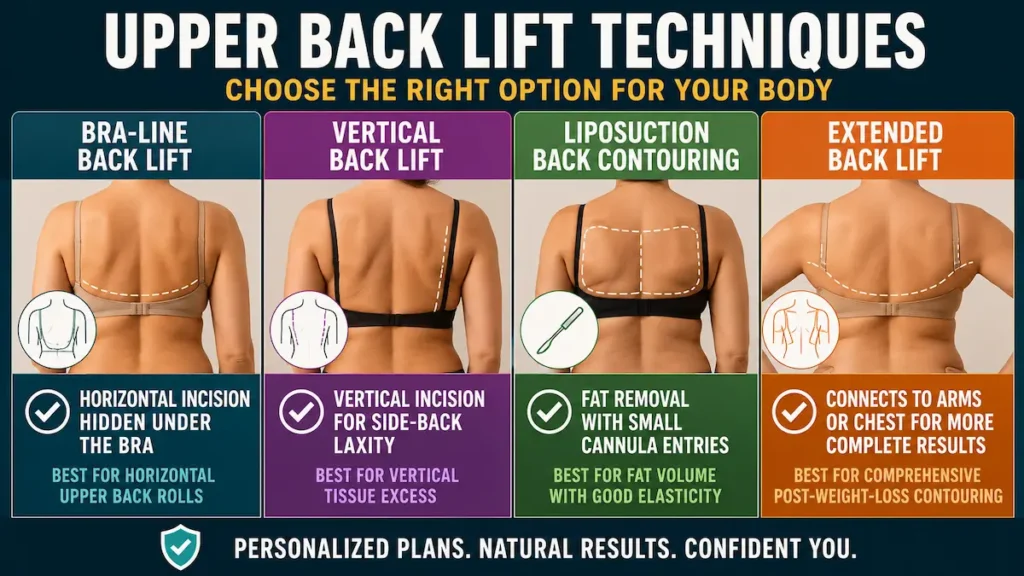
Upper Back Lift Techniques: Bra-Line vs Vertical vs Lipo-Only vs Extended
Upper back lift planning depends on the direction of your skin folds, scar tolerance, clothing preferences, and whether nearby areas such as the arms or chest also need contouring. The goal is to choose the least invasive technique that can still correct the actual anatomy.
Bra-Line Back Lift: Incision Hidden Under the Bra
The bra-line back lift is the most common technique for upper-back rolls. The incision runs horizontally across the upper back, usually positioned to sit under a bra band, bikini top, or fitted garment.
This technique is best for horizontal folds across the upper back. It allows the surgeon to remove a wide segment of loose skin and flatten the area from the shoulder blades toward the side chest.
The main advantage is concealment. The main limitation is that the scar follows the bra-line path, so patients who do not wear bras or structured garments may need a different incision plan.
Vertical Back Lift: Lateral Excision and Vertical Incision
A vertical back lift addresses laxity that runs more along the sides of the back and lateral chest. Instead of a horizontal bra-line incision, the surgeon removes tissue along a more vertical pattern.
This may be useful when the loose skin gathers near the side chest rather than across the central upper back. It can also help when the fold direction is not well suited to a horizontal approach.
The trade-off is scar visibility. A vertical scar may be harder to hide in certain clothing, so we reserve this technique for patients whose anatomy truly benefits from it.
Liposuction Back Contouring: Fat Only, No Skin Excision
Liposuction can refine the upper back when the problem is fat volume rather than skin excess. It uses small cannula incisions and does not create the long scar of an excisional back lift.
The limitation is that liposuction does not remove loose skin. In a patient with poor elasticity, removing fat alone may leave the skin looking more deflated.
This is why diagnosis matters. Liposuction is not a “smaller back lift.” It is a different procedure for a different problem.
Extended Back Lift: Connecting to Arm or Breast Lift
An extended back lift connects the upper-back plan to nearby body-contouring procedures. It may be considered when skin laxity continues into the arms, side chest, or breast area.
For example, some post-weight-loss patients benefit from combining an upper back lift with an arm lift. Others need a breast lift to address the front of the chest at the same time.
Combined planning can create a more continuous contour. It must be balanced against operative time, healing demands, and safe recovery before the return flight to Canada.
Lower Back / Circumferential Considerations
If your laxity extends around the waist, abdomen, hips, and buttocks, an isolated upper back lift may not be enough. In that case, we may discuss a 360 body lift or staged total body-contouring strategy.
The upper back and lower trunk are different zones. Treating the wrong zone can leave the main concern unchanged.
During photo assessment, we ask for front, side, and back views. This helps us understand whether the skin excess is localized to the bra-line area or part of a broader circumferential laxity pattern.
How Surgeons Choose the Right Technique
We choose the technique based on fold direction, skin quality, scar tolerance, clothing preferences, and whether you need additional procedures. There is no single “best” upper back lift for every patient.
The right plan is the one that removes the problem tissue while placing the scar in the most acceptable location. This is a design decision as much as a surgical decision.
| Technique | Best For | Incision Pattern | Main Advantage | Main Trade-Off |
|---|---|---|---|---|
| Bra-Line Back Lift | Horizontal upper-back rolls | Horizontal scar along bra line | Often hidden by bras or fitted garments | Permanent long scar |
| Vertical Back Lift | Side-back and lateral chest laxity | Vertical or oblique scar | Better for vertical tissue excess | May be harder to conceal |
| Liposuction Back Contouring | Fat volume with good skin elasticity | Small cannula entry points | No long excision scar | Does not remove loose skin |
| Extended Back Lift | Upper-back laxity connected to arms or chest | Customized extension pattern | More complete post-weight-loss contour | Longer surgery and recovery planning |
| Concern | Upper Back Lift | Liposuction | J-Plasma |
|---|---|---|---|
| Loose skin folds | Strongest correction | Not suitable alone | Mild improvement only |
| Localized fat | May be combined | Strong option | May support mild tightening |
| Scar profile | Long planned scar | Small entry points | Small entry points |
| Best candidate | Post-weight-loss skin excess | Good elasticity with excess fat | Mild laxity without heavy folds |
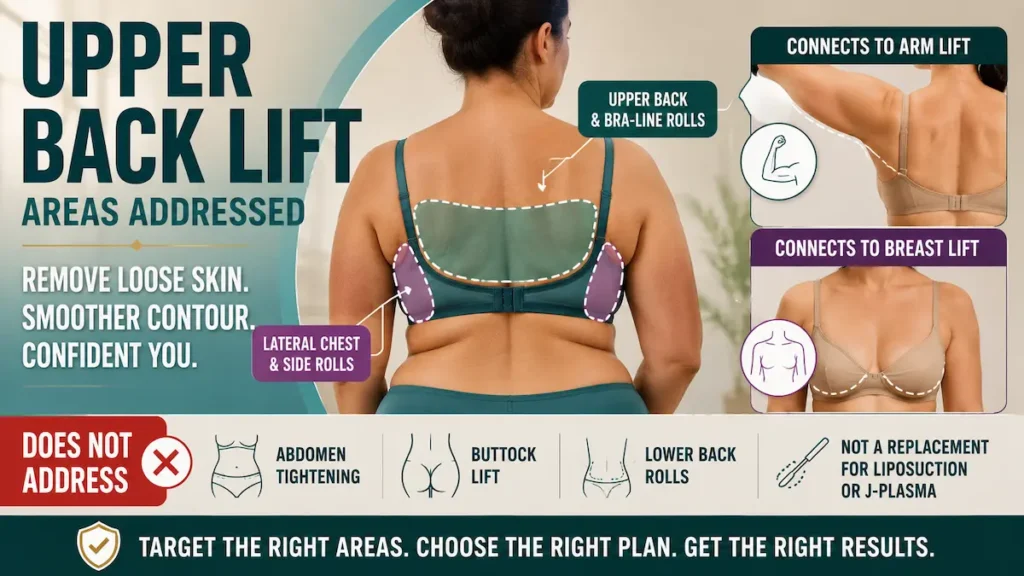
Areas Addressed by an Upper Back Lift
An upper back lift mainly treats the bra-line region, posterior trunk rolls, and loose skin that may extend toward the lateral chest. It can also connect strategically with arm lift or breast lift planning when post-weight-loss laxity affects several nearby zones.
Upper Back and Bra-Line Rolls
The main treatment zone is the upper back, especially the folds that sit above and below the bra line. These rolls often become more visible after major weight loss because the skin no longer matches the smaller body frame.
A bra-line back lift removes this redundant tissue directly. The surgeon designs the incision so the scar follows a natural clothing line whenever possible.
This approach can improve the contour between the shoulder blades, upper rib cage, and side chest. It is most useful when the tissue forms a true skin fold rather than a simple fat deposit.
Lateral Chest and Side Rolls
Many patients describe the concern as “back fat,” but the tissue often wraps toward the side chest. This is why a back-only view does not give the full picture.
During assessment, we look at how the roll behaves from the back, side, and front. If the laxity continues into the lateral chest, the incision plan may need to extend slightly to smooth the transition.
This is also where technique selection matters. A short bra-line excision may not be enough if the tissue excess continues around the side of the torso.
Connection to Arm Lift
Upper-back laxity and upper-arm laxity often occur together after weight loss. The skin can loosen from the posterior arm into the armpit and upper back as one connected zone.
For selected patients, combining an upper back lift with an arm lift can create a more continuous result. This may reduce the risk of leaving a visible fold between the arm and back.
We do not recommend combining procedures automatically. The decision depends on operative time, healing capacity, scar planning, and whether the patient can recover safely before travelling home to Canada.
Connection to Breast Lift
For women after weight loss, upper-back rolls may sit directly behind the bra band while breast ptosis appears in front. Treating only one side of the torso can leave the silhouette incomplete.
A breast lift addresses sagging on the front of the chest. An upper back lift addresses posterior rolls along the bra-line region.
When planned together, the surgeon must consider incision placement carefully. The goal is to create a balanced chest and upper-torso contour without overextending the scars.
What It Does NOT Address
An upper back lift does not tighten the abdomen, lift the buttocks, or remove lower-back rolls. Those concerns usually belong to a 360 body lift or another lower-trunk procedure.
It also does not replace J-Plasma or liposuction when the concern is mild skin laxity or fat alone. The best procedure depends on whether your main issue is skin, fat, or both.
This is why we avoid one-size-fits-all planning. A correct diagnosis protects your result and your recovery.
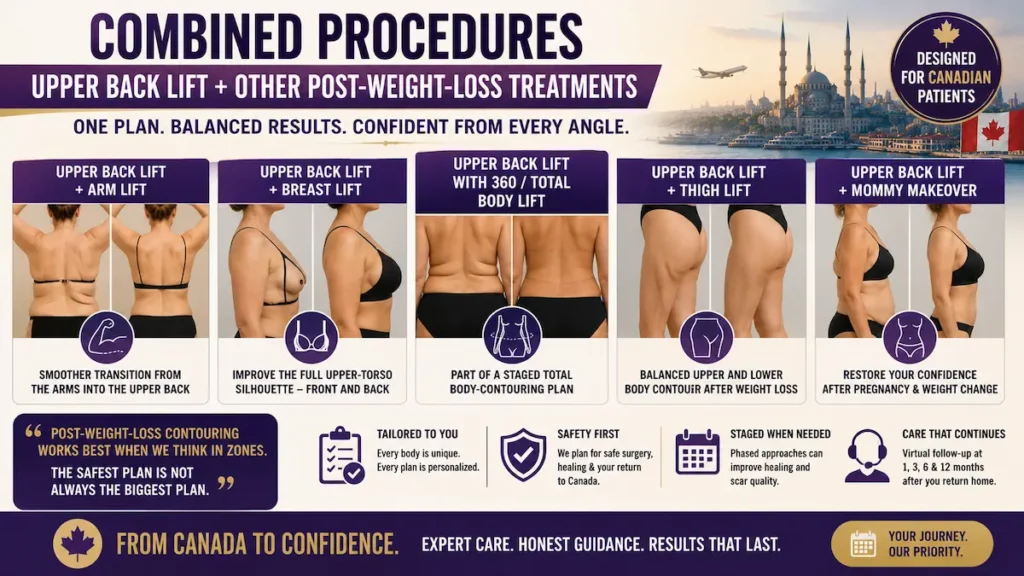
Combined Procedures: Upper Back Lift With Other Post-Weight-Loss Treatments
Upper back lift surgery is often considered alongside other post-weight-loss procedures because loose skin rarely affects only one area. When appropriate, combining or staging arm lift, breast lift, thigh lift, mommy makeover, or 360 body lift planning can create a more balanced result.
Upper Back Lift + Arm Lift
Upper-back rolls and upper-arm laxity often connect through the armpit and side chest. When these areas are treated separately without coordination, a residual fold can remain between them.
Combining an upper back lift with an arm lift may create a smoother transition from the posterior arm into the back. This is most relevant for post-weight-loss patients with loose skin across both zones.
The trade-off is a longer incision plan and a more demanding recovery. We only recommend this combination when the contour benefit justifies the healing burden.
Upper Back Lift + Breast Lift
After weight loss, the front and back of the bra-line region often change together. A patient may have upper-back rolls behind the bra and breast ptosis in front.
In selected cases, an upper back lift can be planned with a breast lift. This can improve the full upper-torso silhouette rather than correcting only one side.
Combination surgery requires careful incision design. The surgeon must consider bra-line scar position, breast-lift scars, garment pressure, and safe healing before your return to Canada.
Upper Back Lift Within a 360 / Total Body Lift
Some patients need more than upper-back correction. If laxity extends around the waist, lower back, abdomen, hips, or buttocks, a 360 body lift may be the better organizing procedure.
An upper back lift can be part of a staged total body-contouring plan. It does not always need to happen in the same operation as lower-body surgery.
The International Society of Aesthetic Plastic Surgery’s Find a Surgeon directory provides a global professional context for aesthetic plastic surgery and patient safety. For Canadian patients comparing domestic and international options, professional-body verification is part of responsible planning.
Staging can be safer when several areas need correction. It allows the body to heal in phases and gives the surgeon better control over scar quality and tissue tension.
Upper Back Lift + Thigh Lift / Mommy Makeover
A thigh lift may be considered when post-weight-loss laxity affects the lower body as well as the upper trunk. This combination is usually planned carefully because both procedures affect mobility and positioning.
For mothers after pregnancy and weight fluctuation, an upper back lift may also be discussed alongside a mommy makeover. This is not a standard package for every patient. It is a tailored clinical decision.
Our priority is safety, not maximizing the number of procedures in one trip. When a combined plan is appropriate, we explain the recovery timeline clearly before you travel.
“Post-weight-loss contouring works best when we think in zones. The upper back, arms, breasts, abdomen, and thighs all influence the final silhouette. The safest plan is not always the biggest plan.”
Anesthesia for an Upper Back Lift: General Anesthesia Standard
Upper back lift surgery is usually performed under general anesthesia because it involves a broad treatment area, careful positioning, and a long layered closure. For Canadian patients, anesthesia planning also considers flight timing, combined procedures, and safe early mobility before returning home.
Why General Anesthesia Is Standard
Upper back lift surgery usually requires general anesthesia because the procedure involves a broad excision area, careful positioning, and layered closure across the back. Patient comfort and stillness are essential.
General anesthesia also allows the surgical team to work with precision. This matters when the incision is long and must sit cleanly along the planned bra-line position.
Before surgery, our team reviews your medical history, medications, allergies, previous anesthesia experience, and travel timeline. Safety starts before you enter the operating theatre.
Combined-Procedure Anesthesia Planning
If your upper back lift is combined with an arm lift, breast lift, thigh lift, or mommy makeover component, anesthesia planning becomes more detailed. The team must balance total operative time with safe recovery.
For Canadian patients, this is especially important because the return flight is long. We plan surgery and recovery so you are mobile, medically stable, and cleared before travelling.
Combining procedures can be efficient, but only when it is clinically appropriate. A shorter staged plan may be safer for some patients than one long operation.
Pre-Anesthesia Assessment for Canadian Patients
Your pre-anesthesia assessment includes blood work, vital signs, and a review of risk factors such as smoking, clotting history, diabetes, and cardiovascular health. We may request additional information from your Canadian family physician when appropriate.
We also discuss practical details. You should tell us about prescription medications, supplements, recent infections, previous clotting events, and any anesthesia-related nausea or complications.
Our goal is simple: no surprises. A well-planned anesthesia protocol supports a safer operation, smoother first night, and more predictable recovery.
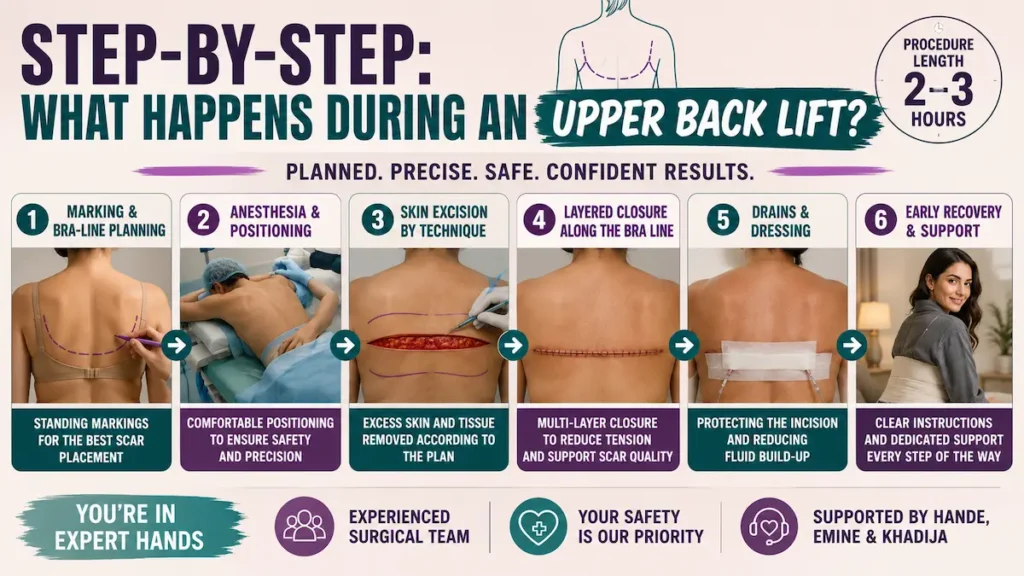
Step-by-Step: What Happens During an Upper Back Lift?
Upper back lift surgery follows a structured sequence: standing markings, anesthesia, careful positioning, skin excision, layered closure, dressing, and early recovery monitoring. Each step is planned to remove the correct tissue while protecting scar quality and shoulder movement.
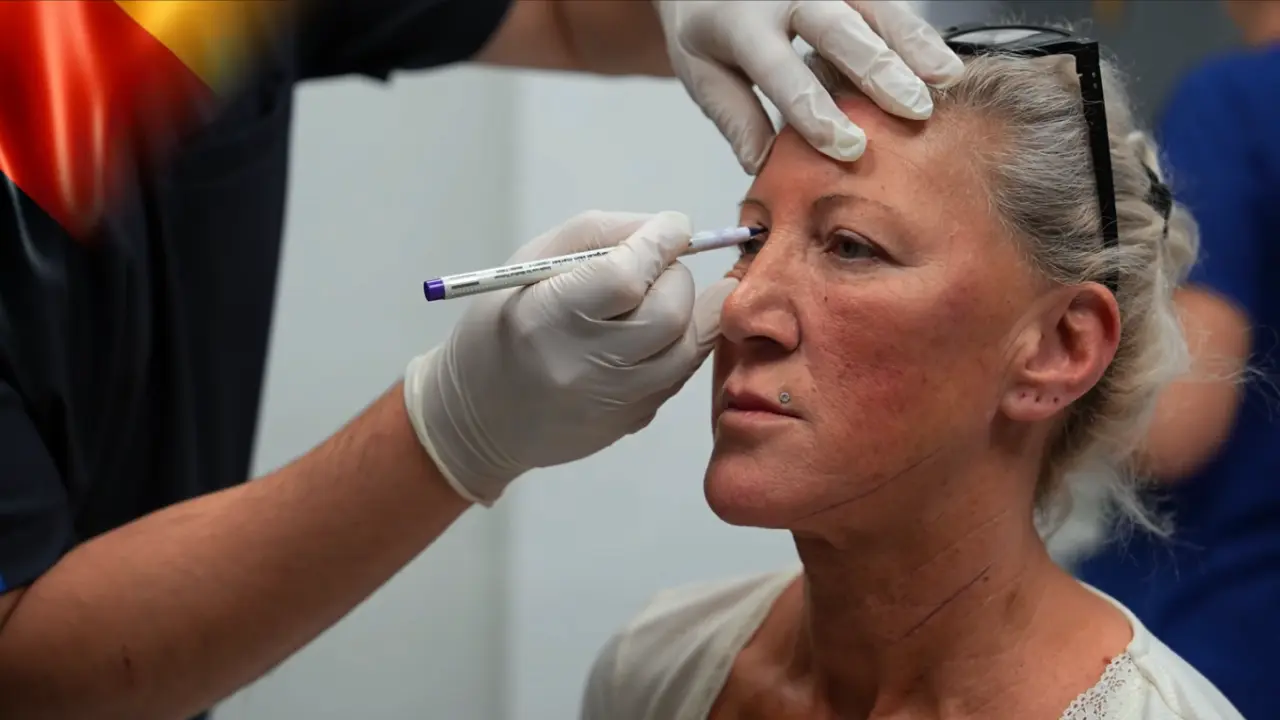
Pre-Operative Marking and Bra-Line Planning
Before surgery, your surgeon marks the upper back while you are standing. This is important because skin folds change when you sit, lie down, or raise your arms.
The bra-line plan is mapped around your natural fold pattern, clothing preferences, and the location where the scar can be most easily concealed. If you regularly wear a specific bra or sports bra style, mention it during planning.
This step is not cosmetic guesswork. It is surgical design. A few centimetres of scar placement can make a meaningful difference in how discreet the result feels later.
“In a bra-line back lift, the incision plan is as important as the tissue removal. We design the scar around how the patient actually dresses, not around a generic textbook line.”
Anesthesia and Positioning
Once anesthesia begins, the team positions you carefully to expose the upper back while protecting pressure points. Positioning also helps the surgeon confirm the planned tissue removal pattern.
This stage must be controlled and deliberate. The upper back is a mobile area, and the final closure needs to account for shoulder movement, posture, and daily activity.
Our operating team monitors your vital signs throughout the procedure. Safety and tissue handling remain the priority from the first incision to the final dressing.
Skin Excision by Technique
In a bra-line back lift, the surgeon removes a horizontal ellipse of skin and soft tissue. In a vertical or extended approach, the excision pattern is adapted to the direction of the skin excess.
If liposuction is part of the plan, it may be performed before or during the excisional portion. This can refine nearby fullness but does not replace the skin removal itself.
The amount of excision is measured carefully. Removing too little may leave folds behind. Removing too much can create tension, widened scars, or movement discomfort.
Layered Closure Along the Bra Line
After the excess tissue is removed, the surgeon closes the incision in layers. Deep sutures reduce tension on the skin surface, while the outer closure is designed to support a flatter scar.
This layered approach is especially important on the back because movement and garment pressure can stress the incision. Good closure technique supports better scar quality.
The goal is not simply to close the skin. The goal is to distribute tension so the scar matures as neatly as possible.
Drains and Dressing
Some upper back lift patients need small drains to prevent fluid collection. Drains are temporary and are removed when output is low enough.
The surgical dressing protects the incision during the earliest healing phase. You will receive instructions on showering, garment use, sleeping position, and when to contact your coordinator.
Our patient hosts, Hande, Emine, and Khadija, help you understand each step. You are not left to interpret post-operative instructions alone in a foreign city.
Procedure Length
An isolated upper back lift often takes about two to three hours, depending on the amount of tissue removed and the technique used. Combined procedures take longer.
We do not rush this operation. Careful marking, tissue handling, closure, and dressing all influence the quality of the final result.
Before confirming your plan, we explain the expected operative time and recovery stay. That helps you plan your Istanbul schedule and return to Canada more safely.
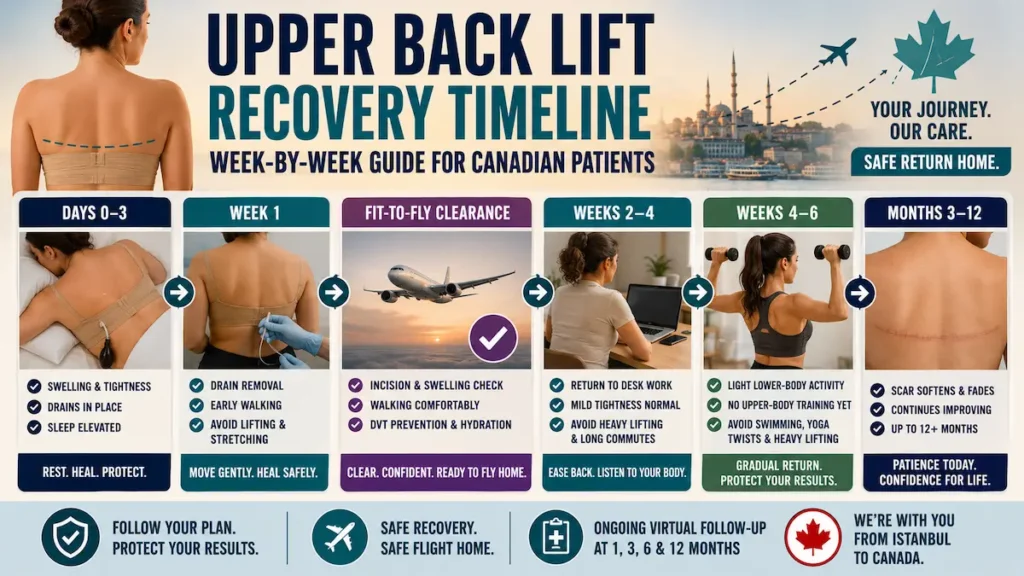
Upper Back Lift Recovery: Week-by-Week Timeline for Canadian Patients
Recovery after an upper back lift focuses on protecting the incision, controlling swelling, maintaining safe mobility, and preparing for the long return flight to Canada. Most patients improve steadily over the first few weeks, while scar maturation continues for months.
Days 0–3: Swelling, Drains, Sleeping and Sitting Challenges
The first three days are the most demanding. You can expect swelling, tightness across the upper back, and some discomfort when changing positions.
If drains are used, our team will show you how they work and when they are likely to be removed. You will not be expected to manage this alone.
Sleeping position matters. Most patients rest slightly elevated and avoid pressure directly across the incision. Soft pillows can reduce pulling when you sit, stand, or turn.
Week 1: Drain Removal and Early Mobility
During the first week, we focus on safe movement, incision checks, and fluid control. Walking is encouraged early because it supports circulation and reduces stiffness.
You should avoid lifting, stretching, twisting, or reaching overhead. These movements can place tension across the back closure and increase swelling.
Drain removal depends on output, not a fixed date. Your surgeon will decide when it is safe.
Our HBOT/LLLT Recovery Protocol
We use recovery technologies to support tissue repair after body-contouring surgery. Hyperbaric Oxygen Therapy, or HBOT, increases oxygen delivery to healing tissues. Low-Level Laser Therapy, or LLLT, supports cellular energy production and incision maturation.
This matters for upper back lift patients because the incision is long and the back is a high-movement area. Better oxygenation and controlled inflammation can make recovery more predictable.
You can read more about the science behind our recovery approach in our HBOT recovery guide and our LLLT scar-minimization guide. Our full clinical technology framework is also explained on our technology and standards page.
Fit-to-Fly Clearance for Canadian Return Travel
Most Canadian patients need careful flight planning because the return journey from Istanbul to Toronto, Vancouver, Montreal, or Calgary is long. We do not clear you to fly based only on the calendar.
We check your incision, swelling, mobility, drain status, pain control, and general medical stability. You should be walking comfortably before your return flight.
Compression, hydration, aisle walking, and DVT prevention instructions are reviewed before departure. For broader travel guidance, see our flight safety after surgery guide.
Week 2–4: Return to Desk Work
Many patients can return to remote or desk-based work within two to four weeks, depending on the extent of surgery and whether procedures were combined.
You may still feel tightness when reaching, driving, or wearing structured garments. That is normal. The back continues to settle for several weeks.
If your work involves lifting, patient care, warehouse tasks, or long commutes, you may need a longer timeline. We tailor this advice to your actual job, not a generic recovery chart.
Week 4–6: Return to Exercise
Light lower-body activity usually returns before upper-body training. Shoulder, back, and chest exercises must wait until the incision can tolerate tension safely.
You should avoid pull-ups, rows, swimming, yoga twists, and heavy lifting until your surgeon clears you. A beautiful scar starts with patient tissue handling after surgery.
When exercise resumes, it should be gradual. Sudden stretching can widen scars or trigger swelling.
Month 3–12: Scar Maturation
The scar changes significantly over time. Early scars may look pink, firm, or raised. Over months, they usually soften and fade.
Scar maturation can take a full year or longer. This is especially true for long body-contouring incisions.
We monitor your healing through our long-term virtual follow-up programme at 1, 3, 6, and 12 months. That continuity matters after you return to Canada.
Scars & Safety of an Upper Back Lift
The central safety discussion in upper back lift surgery is the scar trade-off: the procedure removes loose skin through a planned incision, usually placed along the bra line. Good outcomes depend on conservative planning, sterile technique, layered closure, and careful aftercare.
The Bra-Line Scar: Placement, Concealment and Honest Reality
An upper back lift is not a scarless procedure. The bra-line technique works because it removes loose skin through a planned incision across the upper back.
The goal is to place that incision where clothing can usually hide it. For many patients, the scar sits under a bra band, bikini top, compression garment, or fitted sportswear.
Scar visibility depends on your anatomy, skin tone, healing biology, tension, and aftercare. We discuss this before surgery because informed patients heal with fewer surprises.
Scar Maturation and Minimization
Scar care begins with surgical technique. Layered closure helps reduce surface tension, which can support a flatter scar over time.
After surgery, you may be advised to use silicone therapy, sun protection, scar massage, or LLLT depending on your healing stage. These tools support scar quality but cannot erase a scar completely.
Our arm lift scar guide is useful for upper back lift patients because both procedures involve long body-contouring scars and similar scar-maturation principles.
| Healing Stage | Typical Scar Appearance | What Helps |
|---|---|---|
| Weeks 1–4 | Pink, firm, slightly raised | Low tension, clean dressings, limited stretching |
| Months 2–3 | Redness may peak before fading | Silicone therapy, sun avoidance, follow-up review |
| Months 3–6 | Scar begins softening and flattening | Scar massage if cleared, LLLT when appropriate |
| Months 6–12+ | Colour continues to fade | Long-term scar care and weight stability |
Common Side Effects: Swelling, Seroma, Tightness
Swelling and tightness are common after an upper back lift. These symptoms usually improve gradually as inflammation settles and the tissues adapt.
Seroma, or fluid collection, is a known risk after body-contouring surgery. Drains and compression protocols help reduce this risk.
You should contact us if you notice increasing pain, fever, sudden swelling, drainage changes, or redness spreading around the incision. Fast communication protects healing.
Back-Incision Healing Considerations
The back moves constantly. Reaching, sitting, dressing, driving, and sleeping can all place tension on the incision.
This is why recovery instructions are specific. We limit certain movements not to inconvenience you, but to protect the closure while the deeper layers strengthen.
Garment pressure must also be managed carefully. A bra or compression garment should support the area without cutting directly into the incision.
Why Our Sterile Protocol, EBOPRAS Surgeons and JCI Standards Matter
Upper back lift surgery should be performed in a regulated surgical environment, not a casual aesthetic setting. We operate through JCI-accredited hospital pathways and strict sterile protocols.
Our European Board-Certified Surgeons plan the excision, closure, and aftercare around safety first. The cosmetic result depends on that foundation.
For international patients, documentation also matters. We provide English-language medical records and follow-up guidance so your care remains clear after you return to Canada.
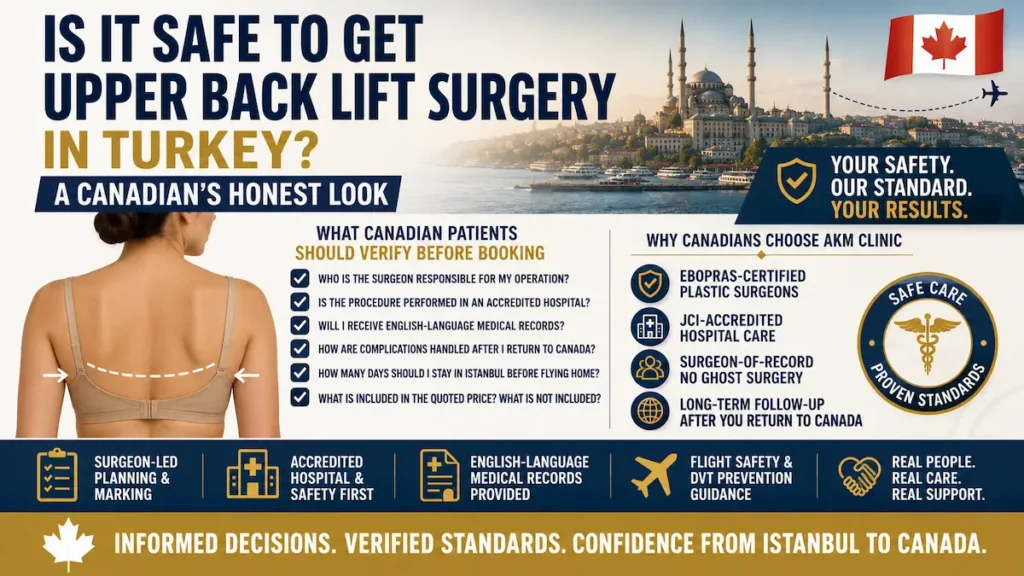
Is It Safe to Get Upper Back Lift Surgery in Turkey? A Canadian’s Honest Look
Upper back lift surgery in Turkey can be safe when the clinic, surgeon, hospital pathway, and follow-up system are carefully verified. Canadian patients should evaluate credentials, facility standards, medical records, travel insurance limitations, and aftercare before making a decision.
The Turkey Cosmetic Surgery Reality: How We Differ
Canadian patients are right to ask safety questions before travelling abroad for surgery. Turkey has excellent surgeons and accredited hospitals, but it also has high-volume commercial providers that may not meet the standards you expect.
That distinction matters. The question is not simply “Turkey or Canada?” The better question is: who is the surgeon, where is the procedure performed, what standards does the facility follow, and what happens after you fly home?
The Government of Canada’s guidance on travelling outside Canada for medical care encourages patients to consider risks such as follow-up, medical records, insurance limitations, and standards at the destination clinic. We address those points directly rather than asking patients to ignore them.
At AKM Clinic, we position upper back lift surgery within a regulated surgical pathway, not a transactional travel offer. We use structured consultation, surgeon-led planning, JCI-accredited hospital care, and long-term follow-up after you return to Canada.
For a broader safety framework, our guide on whether it is safe to get plastic surgery in Turkey explains the verification steps Canadian patients should use before booking any procedure abroad.
Post-Weight-Loss Body-Contouring Experience
Upper back lift surgery is not a beginner body-contouring procedure. It requires experience with post-weight-loss skin patterns, scar placement, and tension management.
Massive weight-loss patients often have thinner soft tissue, reduced skin elasticity, and longer incision lines. These factors make careful planning more important than aggressive tissue removal.
We assess the upper back in relation to the arms, chest, waist, and lower trunk. That wider view helps prevent mismatched results, where one area looks corrected while the surrounding tissue still appears loose.
Ghost Surgery in Turkey: How to Avoid It
“Ghost surgery” means the surgeon you chose is not the person who actually performs the critical parts of the procedure. This is a real concern in international surgery, and it should be addressed directly.
Before you book, you should know who will operate, what their credentials are, and where the surgery will take place. Vague answers are a red flag.
Our team maintains a surgeon-of-record approach. Your surgical plan, markings, procedure, and follow-up are connected to the surgeon responsible for your case. For more detail, read our ghost surgery verification guide.
EBOPRAS-Certified Surgeon Verification
Canadian patients are familiar with credential structures such as the Royal College of Physicians and Surgeons of Canada. In Europe, EBOPRAS certification provides a structured specialist standard for plastic surgery training and verification.
Credentials do not replace judgement, but they help you separate trained surgical specialists from providers using vague marketing labels. You should look for clear board certification, body-contouring experience, and documented patient results.
On our About AKM Clinic page, we explain our surgical leadership, clinical philosophy, and international patient support model. We encourage Canadian patients to verify credentials before making a decision.
What Canadian Patients Should Verify Before Booking
Before booking upper back lift surgery in Turkey, ask direct questions. A serious clinic should answer them clearly.
- Who is the surgeon responsible for my operation?
- Is the procedure performed in a hospital or accredited surgical facility?
- Will I receive English-language medical records?
- How are complications handled after I return to Canada?
- How many days should I stay in Istanbul before flying home?
- What is included in the quoted price?
- What is not included?
You should also speak with your Canadian family physician when possible, especially if you have anemia, diabetes, clotting history, autoimmune disease, or previous wound-healing issues.
We welcome careful patients. The more informed you are, the safer and more confident your decision becomes.
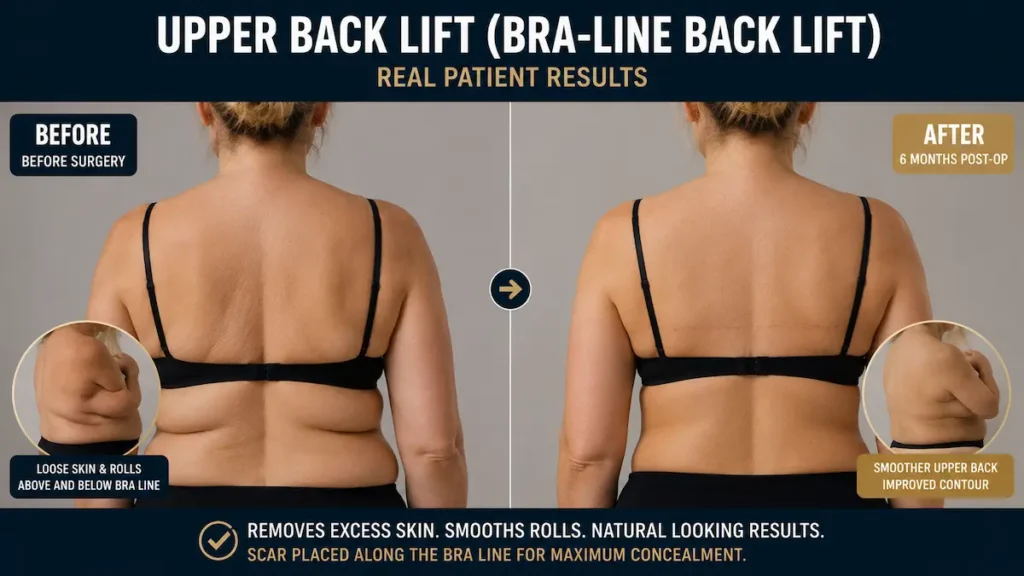
Realistic Expectations & Results
An upper back lift can significantly reduce loose upper-back rolls and improve clothing fit, but it cannot create scarless skin removal or prevent future changes from weight fluctuation and aging. The most satisfied patients understand both the contour benefit and the permanent scar trade-off.
Upper Back Lift Before and After: Realistic Outcomes
An upper back lift can create a smoother upper-back contour by removing loose folds that sit across the bra-line region. The change is often most visible in fitted clothing, swimwear, and side-back photographs.
It will not make the entire torso look smaller if the concern extends into the abdomen, lower back, or hips. In those cases, a broader 360 body lift discussion may be more appropriate.
The best results look balanced. We do not aim for an over-tight back that restricts movement or creates tension across the scar.
Bra-Line Back Lift Results: Rolls Removed, Scar Hidden
The signature result of a bra-line back lift is the removal of upper-back rolls with a scar positioned where clothing can often hide it. This is why incision planning matters so much.
Many patients feel most satisfied when they try on clothing that used to show bulging at the back. Bras, dresses, fitted tops, and swimwear often fit more smoothly.
The scar remains part of the result. It may be discreet in clothing, but it is still visible when the back is uncovered.
The Scar Is the Trade-Off
This procedure is not for patients who want skin removal without a scar. That option does not exist surgically.
The real decision is whether the upper-back rolls bother you more than a planned scar that can usually be concealed. For many post-weight-loss patients, the answer is yes. For others, it may be no.
“A good upper back lift result is not just a flatter back. It is a patient who understood the scar, accepted the trade-off, and chose the procedure because it matched her priorities.”
How Results and Scars Settle Over 6–12 Months
Your shape improves early, but the final result takes time. Swelling, tightness, and scar firmness can last for several months.
By three months, most patients see a clearer contour and better clothing fit. By six to twelve months, the scar usually softens and the tissues feel more natural.
Weight stability is essential. Significant weight gain or loss after surgery can stretch the tissues again and change the result.
Before & After Reference Gallery
Upper back lift does not always have a dedicated public gallery because it is a more specialized post-weight-loss procedure. When available, we review consented examples during consultation to help you understand realistic scar placement and contour change.
You can also review related post-weight-loss body-contouring patterns in our arm lift before and after gallery. Arm lift and upper back lift patients often share similar concerns: long scars, loose skin after weight loss, and the need for honest scar planning.
Photos are educational, but they are not promises. Your result depends on your skin quality, fold pattern, scar biology, weight stability, and how closely you follow aftercare instructions.
Upper Back Lift Cost 2026: Turkey vs Canada
Canadian patients researching back lift surgery cost often find two challenges at the same time: upper back lift surgery is rarely offered as a standalone procedure in many Canadian private clinics, and when it is available, pricing can vary widely. Toronto and Vancouver post-weight-loss back lift estimates commonly sit around CAD $12,000–$15,000, especially when facility, anesthesia, garment, follow-up, and combined-procedure fees are included.
At AKM Clinic in Istanbul, upper back lift pricing is technique-specific. A Bra-Line Back Lift is CAD $5,450, a Vertical Back Lift is CAD $6,150, an Extended Back Lift is CAD $6,150, and lipo-only back contouring is CAD $4,800. The right option depends on whether your concern is loose skin, fat volume, or a connected post-weight-loss laxity pattern.
For the full Canadian-dollar breakdown, including what is and is not included in your quote, see our upper back lift cost guide for Canadian patients. A dedicated upper back lift package URL was not confirmed in the approved package list, so package inclusions should be confirmed during your quote rather than linked as a standalone package page.
Provincial health plans such as OHIP, MSP, RAMQ, and AHCIP generally do not cover cosmetic upper back lift surgery. Rare post-bariatric exceptions may require strict documentation, symptoms, referrals, and long wait times.
Canadian-dollar pricing shown for planning clarity; your coordinator will confirm the final payment details before booking.
| Location / Option | Typical CAD Range | Notes |
|---|---|---|
| Toronto private clinics | CAD $12,000–$15,000 | Often quoted only after in-person consultation; standalone back lift may be uncommon. |
| Vancouver private clinics | CAD $12,000–$15,000 | Pricing varies by whether back lift is combined with arm, breast, or lower-body surgery. |
| AKM Bra-Line Back Lift | CAD $5,450 | For horizontal upper-back rolls with bra-line incision planning. |
| AKM Vertical Back Lift | CAD $6,150 | For side-back or vertical laxity patterns. |
| AKM Extended Back Lift | CAD $6,150 | For upper-back laxity connected to arm or chest contouring. |
| AKM Lipo-Only Back Contouring | CAD $4,800 | For fat-dominant back fullness with adequate skin elasticity. |
How to Find the Right Upper Back Lift Surgeon in Turkey: A Canadian Patient’s Checklist
Choosing the right surgeon is especially important for upper back lift surgery because scar placement, tissue tension, and post-weight-loss anatomy require procedure-specific experience. Canadian patients should verify credentials, hospital standards, case experience, and long-term follow-up before booking.
EBOPRAS Certification and RCPSC Equivalency
Canadian patients are used to checking whether a surgeon is certified through recognized systems such as the Royal College of Physicians and Surgeons of Canada. When you evaluate a surgeon in Turkey, look for a comparable specialist credential structure, not vague terms like “aesthetic expert.”
EBOPRAS certification is one of the strongest European signals for plastic surgery training. It does not mean the surgeon is licensed in Canada, but it helps Canadian patients understand that the surgeon has completed a formal specialist pathway.
Credentials should be paired with procedure experience. A certified surgeon who rarely performs post-weight-loss body contouring may not be the best fit for an upper back lift.
| Credential / Standard | What It Signals | Why It Matters for Canadians |
|---|---|---|
| RCPSC / FRCSC | Canadian specialist certification pathway | Familiar Canadian benchmark for specialist training. |
| EBOPRAS | European plastic surgery board certification | Useful equivalency framework when evaluating surgeons abroad. |
| JCI-accredited facility | International hospital safety benchmark | Supports safer surgery, sterile systems, and documented protocols. |
| Procedure-specific case experience | Hands-on expertise in the relevant operation | Critical for scar planning and post-weight-loss tissue handling. |
Post-Weight-Loss Body-Contouring Sub-Specialisation
Upper back lift surgery belongs to the post-weight-loss body-contouring family. It is not simply a skin-removal version of back liposuction.
Ask whether the surgeon regularly treats patients after major weight loss. These patients often require longer incisions, more careful tension management, and staged planning across several body zones.
The Canadian Society of Plastic Surgeons’ guidance on choosing a surgeon is a useful starting point for Canadian patients before comparing international credentials. The same verification mindset should apply when evaluating any clinic abroad.
A strong surgeon should be comfortable discussing the back, arms, chest, abdomen, and thighs as connected areas. That does not mean every area should be treated at once. It means the plan should make anatomical sense.
Bra-Line Scar Planning Skill
For a bra-line back lift, the scar is the central design issue. A technically safe surgery can still disappoint if the scar sits too high, too low, or in a position the patient’s clothing does not cover.
During consultation, ask how the incision is planned. The surgeon should consider your fold pattern, bra style, swimwear preferences, shoulder movement, and scar tolerance.
This is where experience matters. The goal is not only to remove skin. The goal is to remove the right skin and place the scar where it makes sense for your life.
“Upper back lift planning is not only about the fold we remove. It is about where the patient will live with the scar for years. We plan that line with clothing, posture, and movement in mind.”
Technique Range: Bra-Line, Vertical and Extended Combos
A clinic offering only one back-contouring method may try to fit every patient into that method. That can lead to under-correction, unnecessary scarring, or the wrong procedure.
The surgeon should be able to explain when a bra-line back lift, vertical back lift, liposuction-only approach, or extended back lift is appropriate. The explanation should be specific to your photos and goals.
If your laxity connects to the arms or chest, ask whether a combined plan is possible. Also ask whether a staged plan would be safer.
Real Patient Reviews and Documentation
Reviews are not a substitute for credentials, but they help you understand communication, aftercare, and the patient experience. This matters when you are travelling from Canada.
Look for comments about surgeon honesty, coordinator responsiveness, hospital experience, hotel recovery, and follow-up after returning home. These details often matter as much as the surgery itself.
You can review our international patient experience through our professional plastic surgery reviews. We also discuss realistic expectations and available body-contouring examples during consultation.
Aftercare Continuity From Istanbul to Canada
A good surgical plan does not end when you leave Istanbul. Upper back lift healing continues for months, and scar maturation can take a year or longer.
Our long-term virtual follow-up programme includes check-ins at 1, 3, 6, and 12 months. This helps us monitor swelling, scar behaviour, activity return, and any concerns that arise after you return home.
Our patient support structure is built for international patients. You should never feel that geography makes your recovery invisible.
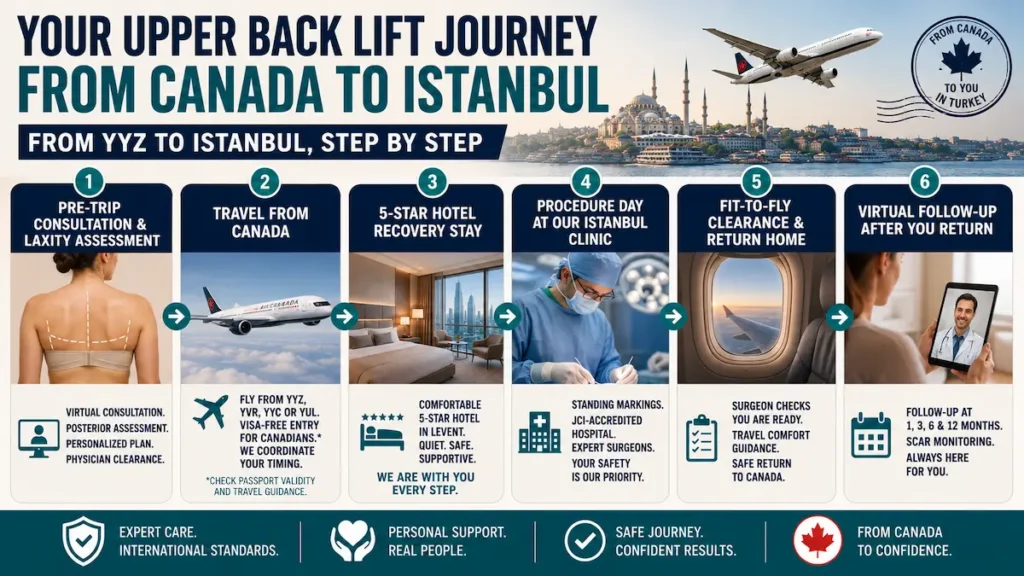
Your Upper Back Lift Journey From Canada: From YYZ to Istanbul, Step by Step
Travelling from Canada for an upper back lift requires more than booking a surgery date. The process includes virtual assessment, flight timing, pre-operative testing, hotel recovery, fit-to-fly clearance, and structured virtual follow-up after you return home.
Pre-Trip Consultation and Posterior Laxity Assessment
Your journey begins with a confidential virtual consultation. We ask for clear photos from the back, side, and front so our surgeons can assess the direction and severity of your upper-back laxity.
We also review your weight history, previous bariatric surgery, medications, smoking status, medical conditions, and goals. This helps us decide whether you need a bra-line back lift, vertical back lift, liposuction-only contouring, or a broader post-weight-loss plan.
For Canadian patients, we recommend speaking with your family physician before international surgery, especially if you have anemia, diabetes, clotting history, autoimmune disease, or previous wound-healing concerns.
Travel Logistics From Toronto, Vancouver, Calgary and Montreal
Most Canadian patients fly into Istanbul Airport from major hubs such as Toronto Pearson, Vancouver, Montreal, or Calgary. Flight schedules change, so you should confirm current options directly with your airline before booking.
Canadian passport holders can typically enter Türkiye visa-free for short stays. You should still check passport validity, airline rules, and current travel guidance before departure.
Our team helps coordinate your arrival timing around consultation, pre-operative testing, surgery, recovery, and fit-to-fly clearance. For a broader overview, see our Canadian patient journey guide.
5-Star Hotel Recovery Stay
After your arrival, our private transfer team brings you to your hotel or clinic appointment according to your schedule. Our 5-star hotel pathway is designed to reduce stress during the first days in Istanbul.
The Point Barbaros, in the Levent district, is familiar with international surgical guests. A quiet recovery environment matters after upper back lift surgery because sleeping, dressing, and garment use can feel awkward at first.
Our patient hosts, Aleyna, Emine, and Khadija, remain available for coordination. You have support for transfers, appointments, medication questions, and communication with the clinical team.
Procedure Day at Our Istanbul Clinic
On procedure day, your surgeon confirms the markings and reviews the plan again. The upper back is marked while standing, because skin folds shift when you lie down.
Your surgery is performed through our JCI-accredited hospital pathway. After the operation, we monitor your pain control, drains, dressings, mobility, and early recovery needs.
You can learn more about our facility standards on our Istanbul clinic page. We believe the clinical setting should be as carefully planned as the surgery itself.
Fit-to-Fly Clearance and Return Travel Comfort
Before you return to Canada, your surgeon checks the incision, swelling, drain status, and mobility. You should not fly if you are not medically ready.
For the return flight, we review movement, hydration, compression, medication timing, and how to sit without placing unnecessary pressure on the incision. Choose comfortable clothing that does not rub directly across the bra-line scar.
Once you are home, your follow-up continues virtually. We review photos, answer questions, and track scar maturation through scheduled 1, 3, 6, and 12 month check-ins.
Upper Back Lift Surgery Frequently Asked Questions (FAQ):
These answers address the most common questions Canadian patients ask before planning upper back lift surgery in Turkey, including scar visibility, travel timing, provincial coverage, pricing, J-Plasma alternatives, and combined-procedure options.
What is the difference between an upper back lift and a 360 body lift?
An upper back lift targets loose skin and rolls across the bra-line region and upper posterior trunk. A 360 body lift addresses the lower trunk, including the abdomen, hips, buttocks, and lower back.
Some post-weight-loss patients need both areas treated, but they are not the same operation. During consultation, we determine whether your concern is isolated to the upper back or part of a broader circumferential laxity pattern.
Will the scar be visible in normal clothing?
In a bra-line back lift, the incision is planned so the scar can often be hidden under a bra band, swimsuit, or structured garment. This is why pre-operative marking is so important.
The scar may still be visible when the back is uncovered or when wearing backless clothing. We discuss this honestly before surgery so you can decide whether the trade-off is acceptable.
Can J-Plasma replace an upper back lift?
J-Plasma may help patients with mild laxity and good skin quality. It cannot remove a true fold of redundant skin.
If your upper-back concern is mainly loose skin after major weight loss, an excisional upper back lift is usually more effective. We may discuss J-Plasma skin tightening only when your anatomy fits that indication.
How long do upper back lift results last?
Results can be long-lasting when your weight remains stable and your skin is given time to heal properly. The removed skin does not come back.
That said, aging, major weight change, pregnancy, and skin biology can affect the result over time. We plan surgery for durable improvement, not a frozen or over-tight appearance.
Does OHIP, MSP, AHCIP or RAMQ cover an upper back lift?
Provincial health plans generally do not cover cosmetic upper back lift surgery. In rare cases after massive weight loss, coverage may be considered only when there is documented medical necessity, symptoms, referrals, and strict provincial criteria.
Most Canadian patients pursuing an upper back lift internationally should plan for private payment. We recommend checking your provincial plan and speaking with your family physician if you believe your case has a functional medical component.
How much does an upper back lift cost in Toronto vs Istanbul?
Toronto and Vancouver private clinic estimates for post-weight-loss back lift surgery commonly range around CAD $12,000–$15,000, depending on whether the procedure is standalone or combined with other body-contouring surgery.
At AKM Clinic, technique pricing begins at CAD $5,450 for a Bra-Line Back Lift, CAD $6,150 for a Vertical Back Lift, CAD $6,150 for an Extended Back Lift, and CAD $4,800 for lipo-only back contouring. Canadian-dollar pricing shown for planning clarity; your coordinator will confirm the final payment details before booking.
Does Canadian travel insurance cover complications from elective surgery abroad?
Many Canadian travel insurance policies exclude elective cosmetic surgery and complications related to it. You should review your policy carefully before booking and ask the insurer direct written questions.
To reduce this concern, AKM Clinic provides complimentary complication insurance for all patients. This is separate from standard Canadian travel insurance and is designed to add an extra layer of protection around your surgical care. Your coordinator will explain the coverage terms, limits, and required documentation before you confirm your booking.
How long before I can fly home to Canada?
Fit-to-fly timing depends on your incision, drain status, mobility, pain control, swelling, and whether you had combined procedures. We do not clear patients to fly based only on a fixed number of days.
Before departure, your surgeon checks your healing and gives specific guidance for the long-haul flight. Walking, hydration, compression, medication timing, and comfortable clothing all matter.
Can I combine an upper back lift with an arm lift?
Yes, selected patients can combine an upper back lift with an arm lift. This may be useful when loose skin continues from the posterior arm into the armpit and upper back.
The decision depends on operative time, scar planning, healing capacity, and your travel timeline. We may recommend staging if combining both would make recovery too demanding.
Can I combine an upper back lift with a breast lift?
Yes, an upper back lift can sometimes be planned with a breast lift. This can address the front and back of the bra-line region in one clinical plan.
Combination surgery requires careful incision design. The surgeon must consider bra-line scar position, breast-lift scars, garment pressure, and safe healing before your return to Canada.
What happens if I gain weight again?
Significant weight gain can stretch the tissues again and change the contour. Significant weight loss after surgery can also create new looseness.
This is why we prefer patients to be at a stable, sustainable weight before surgery. Stable weight protects the result and reduces the chance of needing revision later.
Why is upper back lift surgery less common in Canada?
Upper back lift surgery is a specialized post-weight-loss body-contouring procedure. Many Canadian private clinics focus more heavily on tummy tuck, breast surgery, liposuction, or arm lift, so standalone back lift experience may be less visible.
In Istanbul, we often see international patients seeking more complete post-weight-loss contouring across several zones. That allows us to assess the upper back as part of a full-body surgical strategy rather than an isolated concern.
Medical Disclaimer: This page is for educational purposes only and does not replace medical advice, diagnosis, or treatment from a qualified physician. Upper back lift surgery is an elective surgical procedure with risks, including bleeding, infection, seroma, delayed wound healing, widened scars, asymmetry, numbness, and the need for revision surgery. Every patient heals differently. Your suitability for surgery depends on your medical history, weight stability, skin quality, anatomy, medications, smoking status, and travel timeline.