



If you are researching vaginoplasty, the first step is clarity. This guide covers vaginoplasty as vaginal tightening and internal vaginal canal restoration for women, most often after childbirth, aging-related laxity, or perineal changes. It does not cover gender-affirming vaginoplasty, which is a separate specialized field requiring a different clinical pathway.
We will explain how surgical tightening, colporrhaphy, and perineoplasty differ from laser or radiofrequency treatments often marketed as “vaginal rejuvenation.” We will also clarify how vaginoplasty differs from labiaplasty, which reshapes the external labia. These distinctions matter because each concern requires a different solution.
Private vaginoplasty in Toronto or Vancouver can cost CAD $8,000 to CAD $12,000 once surgeon, facility, anesthesia, and follow-up fees are included. At our Istanbul clinic, we provide a discreet all-inclusive clinical pathway for Canadian patients, with EBOPRAS-certified surgical standards, private transfers, 5-star hotel recovery, and long-term virtual follow-up.
Table of Contents
What Is Vaginoplasty? Scope, Anatomy & What This Guide Covers
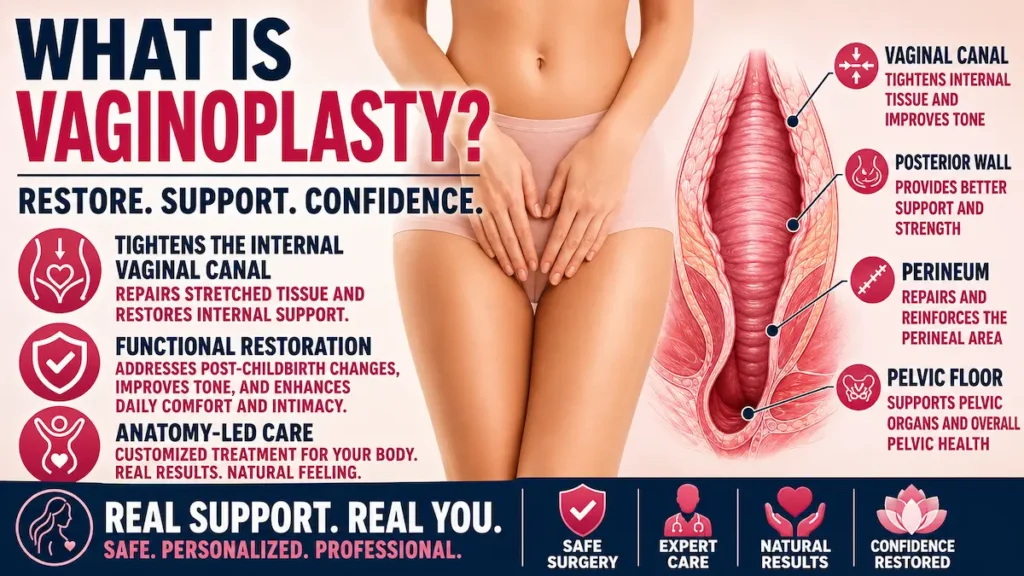
Vaginoplasty is a surgical procedure that tightens the internal vaginal canal and supporting tissues. It may involve anterior or posterior vaginal wall repair, pelvic-floor support, and perineal repair depending on the patient’s anatomy. The goal is functional restoration, not over-tightening.
At AKM Clinic, we approach vaginoplasty with a conservative, anatomy-led philosophy. We do not treat the procedure as a trend. We evaluate tissue laxity, childbirth history, pelvic-floor symptoms, comfort concerns, and whether a non-surgical or physiotherapy-first approach would be more appropriate.
Vaginoplasty Defined — Tightening the Internal Vaginal Canal
A vaginoplasty tightens the internal vaginal canal by repairing stretched tissue and reinforcing the muscular support layer. In many patients, this laxity develops after vaginal childbirth, especially after multiple deliveries, prolonged labour, large-baby delivery, or perineal tearing.
The procedure can reduce a sense of looseness, improve internal support, and restore a more secure feeling during daily life or intimacy. It does not change the external labia. If your concern is the size, shape, asymmetry, or discomfort of the labia, our labiaplasty in Turkey page is the more relevant guide.
Some patients use the phrase “vaginal rejuvenation” when they mean vaginoplasty. That phrase is broad and often confusing. It may describe surgery, laser treatment, radiofrequency, labiaplasty, or medspa procedures, even though these options work very differently.
Internal Anatomy 101 — Vaginal Walls, Pelvic Floor, and Perineum
The vaginal canal is supported by the anterior wall, posterior wall, pelvic-floor muscles, connective tissue, and the perineum. After childbirth or aging-related tissue change, these structures can stretch or weaken. The result may feel like looseness, reduced internal tone, or less support.
The perineum is the tissue between the vaginal opening and the anus. It may stretch, scar, or change shape after childbirth, especially after tearing or episiotomy. Perineoplasty can repair and reinforce this area when it is part of the patient’s concern.
Pelvic-floor function also matters. Vaginoplasty may tighten tissue, but it does not replace pelvic-floor physiotherapy, urogynaecology assessment, or treatment for prolapse or urinary incontinence. If your symptoms suggest a medical pelvic-floor disorder, we may recommend evaluation by a qualified local specialist before surgery.
| Area | What It Does | Common Concern | Possible Treatment Path |
|---|---|---|---|
| Vaginal canal | Provides internal tone and structure | Post-childbirth laxity | Vaginoplasty or colporrhaphy |
| Posterior vaginal wall | Supports the back wall of the canal | Looseness or reduced support | Posterior colporrhaphy |
| Perineum | Supports the vaginal opening and lower tissue | Childbirth tear or widened opening | Perineoplasty |
| Labia minora / majora | External genital tissue | Asymmetry, chafing, discomfort, external excess | Labiaplasty |
| Pelvic floor | Muscular support for pelvic organs | Weakness, heaviness, leakage, prolapse symptoms | Pelvic-floor physiotherapy or urogynaecology assessment |
Scope Clarification — Vaginoplasty for Women vs Gender-Affirming Vaginoplasty
This page does not discuss gender-affirming vaginoplasty. Gender-affirming surgery is a separate reconstructive field with different goals, anatomy, surgical techniques, aftercare, and lifelong follow-up needs. Patients seeking that pathway should consult a qualified gender-affirming surgical team.
Here, we focus on vaginoplasty for women who want internal tightening, post-childbirth repair, or functional restoration of the vaginal canal and perineum. This includes patients who describe looseness, reduced internal tone, a widened vaginal opening, or tissue changes after childbirth.
We make this distinction early because search engines and clinic websites often mix these topics together. A respectful scope boundary helps you avoid misleading information.
“Vaginal Rejuvenation” Explained — The Umbrella Term, Disambiguated
“Vaginal rejuvenation” is not one procedure. It is a marketing umbrella. It may refer to internal surgical tightening, external labial reshaping, laser treatments, radiofrequency treatments, or skin-tightening devices.
We prefer precise language. Vaginoplasty addresses the internal canal. Labiaplasty addresses the external labia. Energy-based treatments may target mild tissue laxity or surface concerns, but they cannot replace surgical tightening when the canal and perineal support are significantly stretched.
| Term Patients Search | Actual Target Area | Surgical? | Best For | Relevant AKM Page |
|---|---|---|---|---|
| Vaginoplasty | Internal vaginal canal and support tissue | Yes | Internal laxity, post-childbirth widening, perineal support | This page |
| Labiaplasty | External labia minora or labia majora | Yes | External discomfort, chafing, asymmetry, excess labial tissue | Labiaplasty in Turkey |
| Laser vaginal rejuvenation | Vaginal mucosa or surface tissue | No | Mild symptoms only, depending on medical suitability | J-Plasma and energy-based skin tightening |
| Radiofrequency vaginal rejuvenation | Surface-level heating of tissue | No | Mild laxity, not structural canal widening | Energy-device overview |
| Mommy makeover with intimate surgery | Body, breast, abdomen, and intimate areas | Usually yes | Post-childbirth combined restoration | Mommy Makeover in Turkey |
“The first question is not, ‘Which procedure sounds most popular?’ The first question is, ‘Which anatomical area is actually causing the concern?’ Internal laxity, external labial discomfort, and pelvic-floor symptoms are different problems.”
Why Canadian Women Choose Vaginoplasty: Functional & Aesthetic Reasons
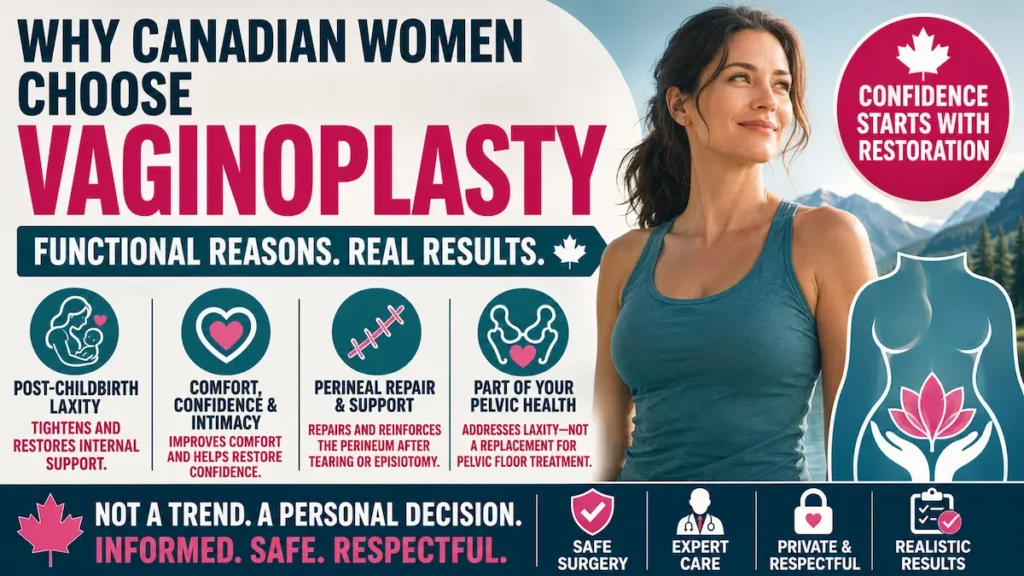
Canadian women who ask us about vaginoplasty are rarely looking for a vague “rejuvenation” promise. Most describe specific functional concerns. They want to feel comfortable, supported, and confident again after childbirth or tissue change.
We use a functional-first framework. Aesthetic confidence can be valid, but the conversation begins with symptoms, anatomy, safety, and realistic expectations. That approach protects patients from trend-driven surgery.
For Canadian patients comparing options, professional guidance from organizations such as the Society of Obstetricians and Gynaecologists of Canada and the Canadian Society of Plastic Surgeons’ guidance on choosing a surgeon can help frame intimate surgery as a health-informed decision rather than a beauty trend.
Post-Childbirth Laxity & Pelvic-Floor Tone
Vaginal childbirth can stretch the vaginal canal, supporting connective tissue, and perineal structures. In many women, the body heals well. In others, tissue remains loose, the vaginal opening feels wider, or internal support does not return to the pre-pregnancy baseline.
Vaginoplasty can tighten the internal canal when the concern is structural laxity. It may be combined with perineoplasty when the perineal body has stretched or scarred after tearing. The plan depends on examination findings, not a one-size-fits-all template.
If symptoms include urine leakage, pelvic pressure, bulging tissue, or suspected prolapse, surgery for cosmetic tightening may not be the first step. We may recommend pelvic-floor physiotherapy or assessment by a urogynaecologist in Canada.
Comfort, Confidence & Intimacy
Some patients describe less internal friction during intimacy, reduced confidence, or a sense that the vaginal canal feels more open than before childbirth. These concerns can be personal and difficult to discuss. We handle them with privacy and respect.
Vaginoplasty cannot guarantee sexual satisfaction. No ethical clinic should promise that. It can restore structural tone in carefully selected patients, which may support comfort and confidence when laxity is the anatomical concern.
Our role is to help you separate physical tissue change from relationship, hormonal, pelvic-floor, or psychological factors. Many patients need more than one type of support.
Perineal Repair After Tearing or Episiotomy
The perineum may change after childbirth, especially after tearing, episiotomy, or difficult healing. Some women notice a widened vaginal opening, irregular scar tissue, discomfort, or reduced support at the lower vaginal entrance.
Perineoplasty can repair and reinforce this area. It is often performed with vaginoplasty when both the internal canal and lower opening need support. In other patients, perineoplasty alone may be enough.
The aim is restoration. Over-tightening can cause pain, scarring, or discomfort. We plan conservatively to protect function.
When Vaginoplasty Is Combined With Pelvic-Floor Goals
Many patients use the term “pelvic floor” broadly. The pelvic floor is a complex muscle group. It supports the bladder, uterus, rectum, and vaginal canal. Vaginoplasty can address tissue laxity, but it is not a full pelvic-floor reconstruction.
If pelvic-floor weakness is mild and the main concern is internal vaginal laxity, vaginoplasty may be part of the plan. If symptoms suggest prolapse or urinary incontinence, a medical pathway is safer.
That distinction is central to our candidacy assessment. The right recommendation may be surgery, physiotherapy first, urogynaecology referral, or no procedure.
Honest Framing — What Surgery Can and Cannot Restore
Vaginoplasty can tighten internal tissues and repair the lower vaginal opening. It can improve structural tone in the right candidate. It cannot reverse all childbirth effects, treat every pelvic-floor condition, or guarantee changes in sexual function.
It also cannot change external labial shape. That is labiaplasty territory. It cannot remove abdominal skin, lift breasts, or repair diastasis recti. Those concerns belong to a broader post-childbirth plan such as a mommy makeover.
A careful recommendation protects you. If a clinic promises vaginoplasty as a universal fix for intimacy, confidence, urinary symptoms, and aesthetics, treat that as a red flag.
Am I a Good Candidate for Vaginoplasty?
The best candidate for vaginoplasty has a clear anatomical concern, realistic expectations, and good overall health. She understands the difference between internal laxity, pelvic-floor dysfunction, and external labial concerns. She is also ready for a private recovery period that includes temporary restrictions.
We never treat intimate surgery as a rushed decision. During consultation, we ask about childbirth history, symptoms, recovery goals, sexual comfort, pelvic-floor history, and future pregnancy plans. We may also advise local medical evaluation before travel.
Functional Candidacy
You may be a candidate if you feel persistent internal looseness after childbirth or tissue change, especially when it affects comfort, confidence, or daily function. You may also be a candidate if the vaginal opening feels widened after tearing or episiotomy.
Functional candidacy is not based on appearance alone. We look at symptoms, anatomy, tissue quality, and whether surgical tightening is likely to address the concern.
Patients who describe pain, pelvic pressure, urinary leakage, recurrent infections, or a bulging sensation need careful screening. These symptoms may indicate a medical condition that requires a different pathway.
Post-Childbirth Timing
Most patients should wait until the body has fully healed after childbirth. Tissue continues to remodel for months. Hormonal changes, breastfeeding, sleep disruption, and pelvic-floor recovery all affect how the body feels.
As a general guide, patients should not rush vaginoplasty in the early postpartum period. If you recently delivered, we may recommend waiting, pelvic-floor physiotherapy, and reassessment after healing stabilizes.
Timing also depends on future pregnancy plans. A later vaginal delivery can stretch tissues again and may compromise the result.
Completed-Family Consideration
Many women choose vaginoplasty after completing their family. This is not a strict rule, but it is a practical one. Pregnancy and vaginal delivery can affect the same tissues that surgery tightens.
If you plan another pregnancy soon, waiting may be the better decision. If your family is complete, the result is more likely to remain stable. We discuss this openly during consultation.
We do not use pressure-based language. The right timing should fit your body, health, and life plans.
Adult-Only Criteria — 18+
Vaginoplasty for aesthetic or functional restoration is an adult procedure. We do not provide intimate cosmetic surgery for minors. Mature consent, stable expectations, and psychological readiness are essential.
Adult patients should feel that the decision is their own. Surgery should not be requested because of partner pressure, social-media trends, or unrealistic comparison with edited images.
In intimate surgery, emotional readiness is part of safety. We treat it that way.
Emotional Readiness & Privacy
Many patients feel private, nervous, or embarrassed when discussing vaginoplasty. That is normal. Our consultation process is designed to be discreet, respectful, and clinically focused.
Before travelling, we encourage patients to reflect on their goals, recovery support, and comfort with follow-up communication. Emotional preparation matters as much as travel planning. Our guide to emotional preparation before plastic surgery can help you think through that process.
We also protect privacy by not posting public intimate before-and-after galleries. Consented examples may be discussed privately during consultation when appropriate.
When to Consider Pelvic-Floor Physiotherapy or Urogynaecology Instead
Vaginoplasty is not the right answer for every pelvic symptom. Urinary incontinence, pelvic organ prolapse, chronic pelvic pain, or persistent pain with intimacy may require assessment by a urogynaecologist or pelvic-floor physiotherapist.
If symptoms suggest a medical condition, we may recommend that you speak with your Canadian family physician before planning international surgery. That can feel slower, but it is safer.
Our goal is the right procedure for the right patient. Sometimes the best recommendation is not surgery.
Vaginoplasty Techniques Compared: Colporrhaphy vs Perineoplasty vs Laser vs RF
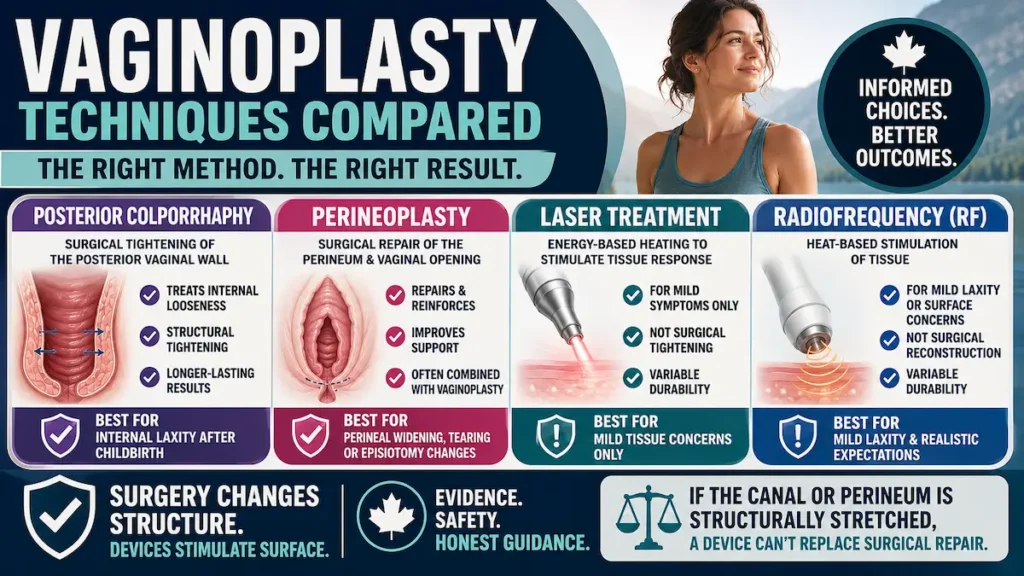
Vaginoplasty is not one single technique. The right method depends on whether the concern is internal canal laxity, perineal widening, mild tissue laxity, or a mix of concerns. Surgery and energy-based treatments are not interchangeable.
This section gives you the decision framework. It is the part Canadian patients often wish they had found earlier, before reading dozens of confusing clinic pages.
Anterior / Posterior Colporrhaphy
Colporrhaphy is a surgical repair of the vaginal wall. Anterior repair focuses on the front wall. Posterior repair focuses on the back wall. In aesthetic and functional vaginoplasty, posterior tightening is often relevant when the concern is internal looseness after childbirth.
The surgeon removes or repositions excess tissue, tightens the supporting layer, and closes the area with dissolvable sutures. The aim is controlled narrowing and stronger support, not excessive tightness.
Colporrhaphy is surgical. It requires healing time, activity restrictions, and temporary avoidance of intimacy. It is also the most structural option when the canal itself has stretched.
Perineoplasty
Perineoplasty repairs the perineal body and lower vaginal opening. It is often useful when childbirth tearing, episiotomy, or scar tissue has widened or weakened the entrance area.
Some patients need perineoplasty without full canal tightening. Others need perineoplasty with posterior colporrhaphy. The distinction is made by anatomy and symptoms.
Perineoplasty must be planned carefully. Too much narrowing can create discomfort. Conservative repair protects function and reduces the risk of pain.
Laser Vaginoplasty
Laser treatments use controlled energy to heat tissue and stimulate a wound-healing response. Some clinics market these treatments as “laser vaginoplasty” or “laser vaginal rejuvenation.” The language can make the treatment sound equivalent to surgery, but it is not.
Laser may be discussed for mild symptoms in carefully selected patients. It does not physically tighten the canal the way colporrhaphy does. It also cannot repair a stretched perineum or significant post-childbirth widening.
Patients should be cautious with broad claims. Energy-based vaginal rejuvenation has been the subject of safety and evidence concerns from regulators and professional societies.
Radiofrequency Vaginoplasty
Radiofrequency uses heat to affect tissue. Like laser, it is not the same as surgical tightening. It may be marketed for mild laxity or tissue quality, but it does not reconstruct deeper support.
RF treatments can appeal to patients who want no downtime. That does not make them the right option for structural laxity. A shorter recovery is only useful if the treatment can address the actual problem.
We discuss RF honestly. It may have a place for select mild cases, but it should not be sold as a substitute for surgery when surgery is what the anatomy requires.
Surgical Tightening vs Energy Devices — Honest Durability and FDA-Aware Framing
Surgical vaginoplasty changes tissue structure. Laser and RF treatments use energy to trigger surface-level tissue response. That difference affects durability, candidacy, and expectations.
The U.S. FDA medical device safety communications have warned against unsupported marketing of energy-based devices for vaginal “rejuvenation” or cosmetic vaginal procedures. ACOG guidance on elective female genital cosmetic surgery also emphasizes counselling patients about limited evidence, potential risks, and realistic expectations.
This does not mean every energy treatment is always inappropriate. It means patients deserve precise claims, not inflated promises.
| Technique | Method | Best For | Structural Tightening? | Typical Durability | AKM Position |
|---|---|---|---|---|---|
| Posterior colporrhaphy | Surgical tightening of the posterior vaginal wall | Internal laxity after childbirth | Yes | Longer-lasting, depending on tissue and future childbirth | Recommended when structural laxity is confirmed |
| Perineoplasty | Surgical repair of the perineum and lower vaginal opening | Perineal widening, tearing, episiotomy changes | Yes, at the entrance and support layer | Longer-lasting when properly healed | Often combined with vaginoplasty when anatomy requires it |
| Laser treatment | Energy-based heating of tissue | Mild tissue concerns only | No true surgical tightening | Variable; often requires repeated sessions | Discussed cautiously; not a substitute for surgery |
| Radiofrequency treatment | Heat-based tissue stimulation | Mild laxity or surface concerns | No true surgical reconstruction | Variable; maintenance may be needed | Consider only when symptoms are mild and expectations are realistic |
| Decision Point | Surgical Vaginoplasty | Laser / RF Energy Treatment |
|---|---|---|
| Main target | Internal support tissue and canal tone | Surface-level tissue response |
| Best candidate | Post-childbirth structural laxity or perineal widening | Mild symptoms without major widening |
| Downtime | Weeks of activity restriction | Shorter, depending on device and protocol |
| Durability | Typically longer-lasting | Variable and often session-dependent |
| Risk if over-promised | Over-tightening or unrealistic expectation | Paying for repeated treatments that cannot correct structural laxity |
“Energy devices and surgery should not be presented as interchangeable. If the canal and perineum are structurally stretched, a device cannot create the same repair as surgical tightening.”
How This Differs From Labiaplasty and J-Plasma
Vaginoplasty treats the internal canal. Labiaplasty treats external labial tissue. J-Plasma and other energy-based treatments are different again; they focus on tissue tightening through energy delivery, not surgical reconstruction of the canal.
For patients with both internal laxity and external labial discomfort, we may discuss a combined labiaplasty and vaginoplasty package. For patients with broader skin laxity or body-contouring goals, our J-Plasma skin tightening page is more relevant.
Choosing correctly protects both safety and results. The right plan starts with anatomy, not marketing terminology.
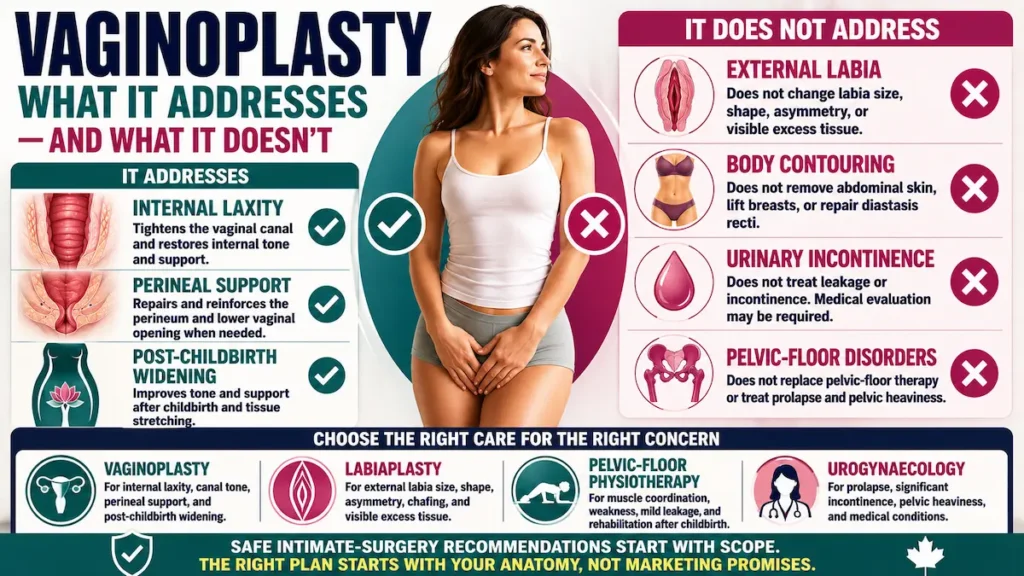
What Vaginoplasty Addresses — And What It Doesn’t
Vaginoplasty is most useful when the main concern is internal vaginal laxity. It can tighten the vaginal canal, support stretched tissue, and repair the perineal area when needed. It is not a universal pelvic-floor procedure.
This distinction matters. Some symptoms need surgical tightening. Others need pelvic-floor physiotherapy, urogynaecology assessment, or a different intimate procedure such as labiaplasty. We help you separate these concerns before recommending a treatment plan.
Internal Vaginal Canal Tone
The internal vaginal canal can lose tone after childbirth, aging, tissue stretching, or difficult healing. Patients may describe a feeling of looseness, reduced internal support, or a wider canal than they had before pregnancy.
Vaginoplasty can restore tone by tightening the supporting tissues and narrowing the canal in a controlled way. The goal is not to create an artificially tight result. The goal is balanced function, comfort, and natural-feeling support.
A proper plan depends on how much laxity is present, where it is located, and whether the perineum also needs repair. This is why a photo-only or template-based recommendation is not enough for intimate surgery.
Perineum & Pelvic-Floor Support
The perineum is often part of the concern after childbirth. Tears, episiotomy, scar tissue, or stretching can change the lower vaginal opening. Some patients feel that the opening is wider or less supported than before.
Perineoplasty can repair and reinforce this area. When combined with vaginoplasty, it can support the lower canal and entrance while keeping the result comfortable. Over-tightening is avoided because excessive narrowing can create pain.
Pelvic-floor support is more complex. Vaginoplasty can improve the local support structures it treats, but it does not replace pelvic-floor rehabilitation. If leakage, prolapse, or pelvic heaviness is present, a medical evaluation may be needed before surgery.
What It Does NOT Address — External Labia, External Skin Laxity, Incontinence
Vaginoplasty does not reshape the external labia. If your concern is visible labial asymmetry, chafing, excess labial tissue, discomfort in tight clothing, or irritation during exercise, the relevant procedure is labiaplasty.
Vaginoplasty also does not remove abdominal skin, lift the breasts, repair diastasis recti, or contour the waist. Those concerns may belong to a broader post-childbirth surgical plan, such as a mommy makeover.
Urinary incontinence needs special care. Mild stress leakage may improve with pelvic-floor therapy, but vaginoplasty should not be sold as an incontinence cure. If leakage is your main concern, we may recommend speaking with your family physician or a urogynaecologist in Canada before considering travel.
- Vaginoplasty addresses: internal laxity, canal tone, perineal support, post-childbirth widening.
- Labiaplasty addresses: external labia size, shape, asymmetry, chafing, and visible excess tissue.
- Pelvic-floor physiotherapy addresses: muscle coordination, weakness, mild leakage, and rehabilitation after childbirth.
- Urogynaecology addresses: prolapse, significant incontinence, pelvic heaviness, and medical pelvic-floor disorders.
“A safe intimate-surgery recommendation starts with scope. We need to know whether the concern is internal laxity, perineal change, external labial tissue, or a pelvic-floor medical condition before recommending any procedure.”
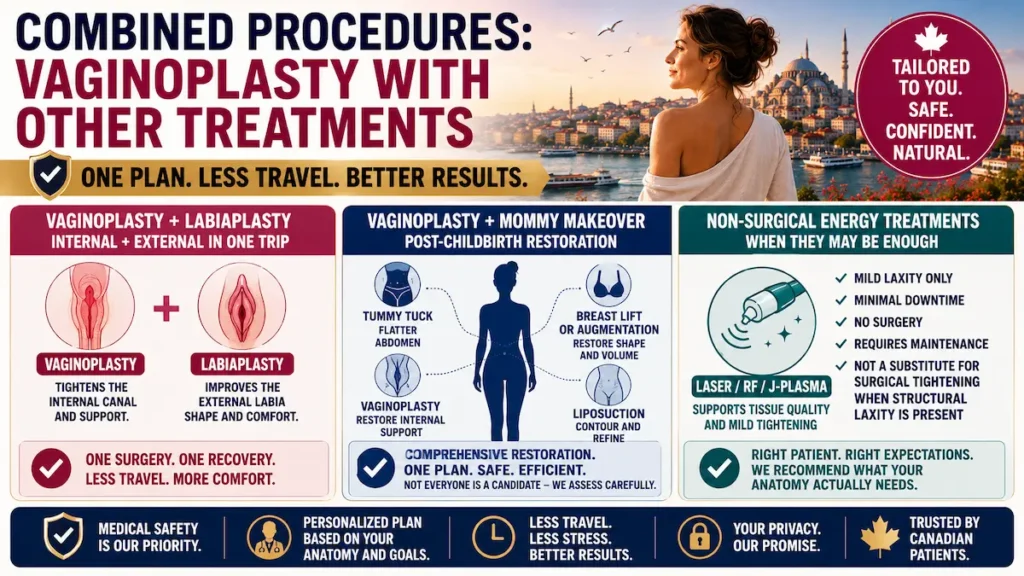
Combined Procedures: Vaginoplasty With Other Treatments
Some Canadian patients combine vaginoplasty with other procedures to reduce total travel time and recovery duplication. Combination surgery can be efficient, but it must be medically appropriate.
We evaluate combined procedures based on surgical time, anesthesia safety, tissue healing, mobility, and recovery complexity. More procedures are not always better.
Vaginoplasty + Labiaplasty — Internal + External in One Trip
Vaginoplasty treats the internal canal. Labiaplasty treats the external labia. Patients with both internal laxity and external labial discomfort may benefit from treating both in one surgical plan.
This combination can reduce duplicated anesthesia and travel, but it also requires a more careful recovery plan. Swelling, hygiene, and sitting comfort may be more sensitive.
For patients who need both, our labiaplasty and vaginoplasty package explains the combined pathway.
Vaginoplasty + Mommy Makeover — Post-Childbirth Restoration
Some patients consider vaginoplasty as part of broader post-childbirth restoration. A mommy makeover may include tummy tuck, breast lift, breast augmentation, liposuction, or intimate surgery depending on anatomy and goals.
Combining intimate surgery with larger body procedures requires careful planning. Mobility, hygiene, sleeping position, and total recovery burden must be considered. We may recommend staging procedures if one combined plan would be too demanding.
Our mommy makeover in Turkey guide explains the broader post-pregnancy procedure framework.
When Non-Surgical Energy Treatment May Suit Instead
Not every patient needs surgery. If symptoms are mild, tissue laxity is limited, and the patient understands the limits of the treatment, energy-based options may be discussed.
We are cautious with claims. Laser and radiofrequency treatments cannot replace surgical tightening when the canal or perineum is structurally stretched.
For patients comparing energy-based approaches, our J-Plasma skin tightening page gives a broader explanation of energy-device logic and limits.
Anesthesia for Vaginoplasty: General, Spinal, or Sedation
Vaginoplasty can be performed under different anesthesia models depending on the surgical plan, patient health, and comfort needs. Most surgical vaginoplasty procedures use general anesthesia or regional anesthesia with sedation. Energy-based procedures may use local anesthesia only.
Our anesthesia plan is selected after medical review. Canadian patients travelling to Istanbul complete pre-operative testing before surgery, and our medical team reviews medications, allergies, prior anesthesia history, and travel-related risk factors.
General Anesthesia
General anesthesia is commonly used when vaginoplasty involves internal tightening, colporrhaphy, or combined perineoplasty. It allows the surgeon to work precisely while the patient remains fully asleep and monitored.
This option is often appropriate for patients combining vaginoplasty with labiaplasty, mommy makeover surgery, or other procedures in one clinical pathway. It also helps reduce movement during delicate internal repair.
General anesthesia requires a full pre-anesthesia assessment. We review your medical history carefully, especially if you are travelling from Canada and will return on a long-haul flight after early healing.
Spinal / Sedation Options
Some patients may be candidates for spinal anesthesia or sedation-based approaches. These options depend on the extent of repair, patient comfort, and the anesthesiologist’s assessment.
Spinal anesthesia numbs the lower body while the patient remains sedated or relaxed. It can be useful in selected pelvic or perineal procedures. It is not automatically better than general anesthesia; it is simply different.
We do not choose anesthesia based on convenience alone. The safest option is the one that fits the procedure, the patient’s health, and the need for stable surgical conditions.
Local Option for Energy Procedures
Laser or radiofrequency treatments may be performed with local numbing or minimal sedation, depending on the device and patient comfort. This is one reason energy-based treatments are marketed as easier recovery options.
A shorter anesthesia plan does not mean the treatment is equivalent to surgery. Local energy treatment may suit mild concerns, but it cannot reconstruct a stretched canal or repair perineal support the way surgery can.
If you are comparing surgical vaginoplasty with energy-based “rejuvenation,” compare the target tissue first. Recovery length matters, but anatomical suitability matters more.
Pre-Anesthesia Assessment for Canadian Patients
Before surgery, Canadian patients complete pre-operative blood work and medical checks in Istanbul. We also review any records shared before travel. If you take blood thinners, hormone therapy, diabetes medication, or medication for blood pressure, these details must be discussed early.
Long-haul travel is part of the safety plan. Patients from Toronto, Vancouver, Montreal, Calgary, Ottawa, and other Canadian cities need careful fit-to-fly timing after surgery. We coordinate return-travel clearance with your healing stage.
We may advise extra planning if you have a history of clotting disorders, recent pregnancy, smoking, high BMI, anemia, or prior anesthesia complications. Safety comes before scheduling.
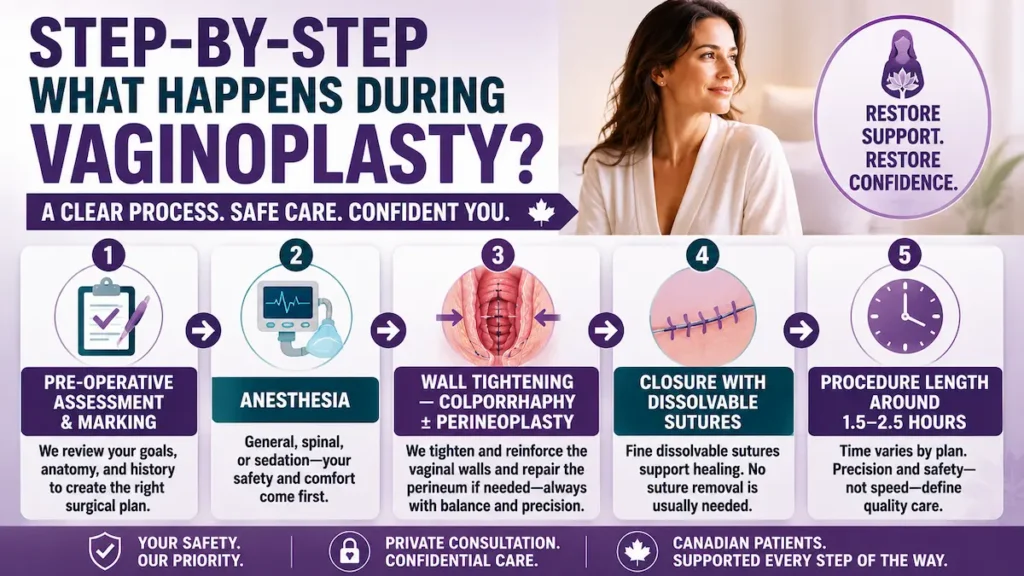
Step-by-Step: What Happens During Vaginoplasty?
Every vaginoplasty plan begins with a private consultation and a clear anatomy-based recommendation. The surgical steps vary depending on whether the patient needs posterior colporrhaphy, perineoplasty, or both.
Below is a general sequence. Your final plan may differ. We will explain your surgical pathway before you confirm treatment.
Pre-Operative Assessment & Marking
Before surgery, the surgeon reviews your goals, symptoms, childbirth history, and tissue concerns. The operative area is assessed privately and respectfully. The goal is to confirm whether internal tightening, perineal repair, or a combined approach is appropriate.
For Canadian patients, planning starts before travel through confidential communication and medical screening. Final confirmation happens in Istanbul after in-person assessment and pre-operative tests.
We also review practical recovery details. These include return-flight timing, hygiene, activity restrictions, intimacy restrictions, and whether you will need support at home in Canada during early healing.
Anesthesia
The anesthesia team prepares you according to the planned procedure. General anesthesia, spinal anesthesia, or sedation may be used depending on the surgical scope and medical assessment.
Monitoring continues throughout the procedure. Your vital signs, comfort, and safety are managed by the clinical team. For combined procedures, anesthesia planning is especially important because the operation may be longer.
Patients are not rushed. A calm surgical environment supports precision.
Wall Tightening — Colporrhaphy ± Perineoplasty
During colporrhaphy, the surgeon repairs and tightens the vaginal wall support layer. The most relevant repair for post-childbirth laxity is often posterior tightening, although the exact plan depends on anatomy.
If the perineum is widened, scarred, or weakened, perineoplasty may be added. This repairs the lower support tissue and vaginal entrance. The surgeon narrows and reinforces the area conservatively.
The central principle is balance. Tightening should restore support without causing pain, excess tension, or functional restriction.
Closure With Dissolvable Sutures
Once tightening and repair are complete, the surgeon closes the tissue using fine dissolvable sutures. These sutures gradually absorb as healing progresses. You do not usually need traditional suture removal.
The closure is designed to support healing, minimize irritation, and protect the repaired tissue. Early hygiene instructions are important because the area is sensitive and must heal in a clean, low-friction environment.
Swelling and mild spotting can occur in the first days. Your care team will explain what is expected and what should prompt medical contact.
Procedure Length — Around 1.5–2.5 Hours
An isolated vaginoplasty usually takes about 1.5 to 2.5 hours. A simpler perineoplasty may be shorter. A combined vaginoplasty and labiaplasty may take longer.
Procedure length is not the main quality marker. Precision, conservative tissue handling, sterile protocol, and safe anesthesia matter more than speed.
After surgery, you are monitored before discharge or transfer to recovery accommodation, depending on the plan. Our patient hosts help coordinate logistics so you can focus on rest.
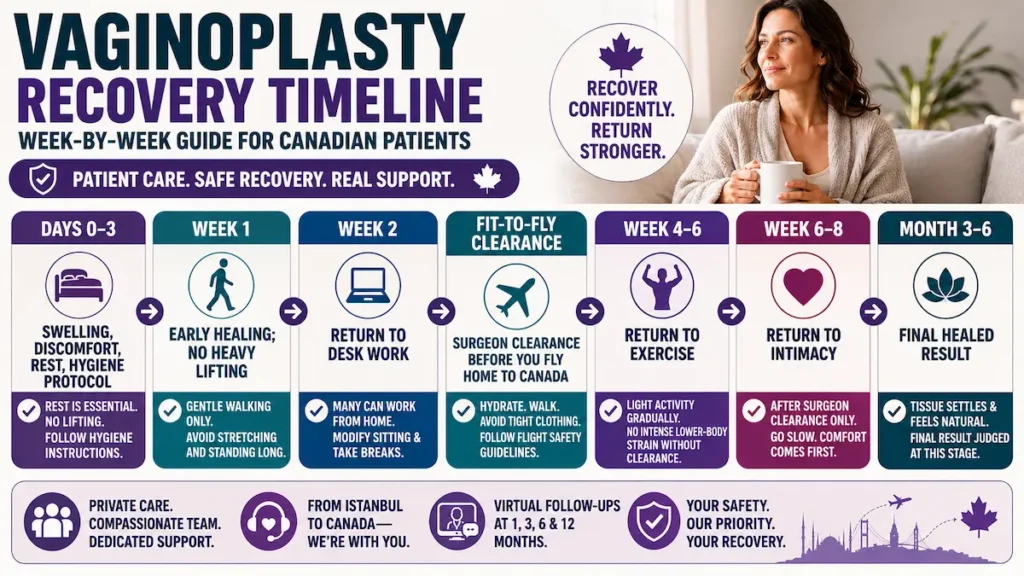
Vaginoplasty Recovery: Week-by-Week Timeline for Canadian Patients
Vaginoplasty recovery is private, gradual, and highly dependent on tissue healing. Most patients need several weeks of activity restrictions. Intimacy usually resumes only after surgeon clearance, often around 6 to 8 weeks.
Canadian patients must also plan for return travel. A long flight from Istanbul to Canada needs fit-to-fly clearance, hydration, movement planning, and realistic expectations about sitting comfort.
Days 0–3 — Swelling, Discomfort, Rest, Hygiene Protocol
The first 72 hours are the most sensitive. Swelling, bruising, mild spotting, and pressure-like discomfort can occur. Rest is essential.
You will receive specific hygiene instructions, medication guidance, and activity restrictions. Loose clothing is recommended. Friction should be minimized. You should avoid lifting, exercise, and unnecessary walking.
Our team remains available during this early phase. Canadian patients recovering in Istanbul often value having direct support before they fly home.
Week 1 — Early Healing; No Heavy Lifting
During the first week, swelling begins to settle but the tissues remain delicate. You may be able to walk gently, but heavy lifting, stretching, and prolonged standing are avoided.
Hygiene remains important. Follow the instructions exactly. Do not use products, creams, tampons, or internal treatments unless the surgical team approves them.
If you are travelling alone, our patient hosts can help coordinate appointments, transfers, and communication. You should not need to navigate recovery logistics by yourself.
Week 2 — Return to Desk Work
Many patients can return to remote or desk-based work around the second week, depending on swelling, discomfort, and the nature of their job. Jobs that require lifting, long standing, or physical strain need more time.
Sitting comfort varies. You may need a modified sitting position and short breaks. This matters for Canadian patients who return to office work or commute by car, GO Transit, TTC, SkyTrain, or commuter rail.
At this stage, healing is still active. Feeling better does not mean the repair is fully strong.
Fit-to-Fly Clearance for Canadian Return Travel
Before your return flight, we assess swelling, wound healing, mobility, discomfort, and general readiness. You should not fly simply because the ticket date arrived. You should fly when your surgeon clears you.
Long-haul flights require planning. You will be advised to hydrate, walk gently during the flight when safe, avoid tight clothing, and follow medication instructions. Our flight safety after surgery guide explains general post-operative travel considerations for Canadians.
Once you return home, aftercare continues virtually. Our post-op care after flying home resource explains how we monitor healing from a distance.
Week 4–6 — Return to Exercise
Light activity gradually resumes as swelling reduces and tissue strength improves. High-impact exercise, cycling, squats, heavy lifting, and intense lower-body training may need to wait longer.
Do not restart exercise based on a calendar alone. Clearance depends on healing. Some patients recover faster, while others need more time due to swelling, tissue sensitivity, or combined procedures.
Rushing activity can increase swelling or stress the repair. Slow is safer.
Week 6–8 — Return to Intimacy, Surgeon Clearance Only
Most patients are advised to avoid intercourse until at least 6 to 8 weeks, and only after surgeon clearance. This restriction protects internal healing and reduces the risk of pain, bleeding, or wound stress.
Even after clearance, the first return to intimacy should be gradual. Mild sensitivity or emotional hesitation can be normal. Communication, lubrication if approved, and patience are important.
No clinic should promise that vaginoplasty will automatically improve sexual function. It may help when structural laxity was the core concern, but intimacy is multifactorial.
Month 3–6 — Final Healed Result
By 3 to 6 months, swelling has usually settled and the repaired tissues feel more natural. The final result is better judged at this stage than in the first few weeks.
Scars are internal or discreet, depending on the repair. Tissue continues to soften. If you had combined labiaplasty or mommy makeover surgery, your overall recovery timeline may be longer.
We schedule long-term virtual follow-ups at 1, 3, 6, and 12 months. This allows our team to monitor your healing after you return to Canada.
| Recovery Stage | What You May Notice | Activity Guidance | Canadian Travel Note |
|---|---|---|---|
| Days 0–3 | Swelling, discomfort, mild spotting | Rest, hygiene, no lifting | Stay close to the clinic team |
| Week 1 | Early healing, reduced discomfort | Gentle walking only | Attend follow-up before flight planning |
| Week 2 | More comfort, still delicate tissue | Possible desk-work return | Modify sitting during travel and work |
| Week 4–6 | Improving strength and swelling | Gradual activity; no intense lower-body strain without clearance | Continue virtual follow-up from Canada |
| Week 6–8 | Internal healing more stable | Possible return to intimacy after clearance | Report pain, bleeding, or unusual symptoms |
| Month 3–6 | Final tone and tissue settling | Most normal activities resumed | Long-term review at 3 and 6 months |
Safety, Risks & Sensation
Vaginoplasty is a delicate intimate procedure. It can be safe in the right candidate, with the right surgeon, in the right facility. It still carries risks, and those risks must be discussed clearly before you travel.
Our approach is conservative. We prioritize function, sensation protection, sterile technique, and realistic expectations. We do not believe patients should be sold an over-tightened result or a vague promise of “rejuvenation.”
Common Side Effects — Swelling, Discomfort, Spotting
Swelling, tenderness, bruising, mild spotting, and a pressure-like sensation are common in the early recovery period. These effects usually improve gradually over the first few weeks.
You may feel more sensitive when sitting, walking, or changing position. Loose clothing helps. Rest, hygiene, and reduced friction are important during the first stage of healing.
Temporary changes in sensation can occur. Most early sensory changes are related to swelling and tissue healing, but persistent discomfort should be reported to the surgical team.
Sensation & Function — Honest, Evidence-Based Framing
Vaginoplasty should be planned to preserve comfort and function. The goal is structural support, not extreme narrowing. Excessive tightening can create discomfort, pain with intimacy, or long-term dissatisfaction.
No ethical clinic should guarantee sexual improvement. Sexual comfort and satisfaction depend on many factors, including hormones, pelvic-floor coordination, relationship dynamics, stress, lubrication, and tissue health.
When internal laxity is the main concern, surgical tightening may improve confidence or comfort for some patients. It is not a universal sexual-function treatment. We explain that distinction before surgery.
“The safest vaginoplasty result is not the tightest result. It is the result that restores support while protecting comfort, sensation, and natural function.”
Over-Tightening Risk & Why Surgical Judgement Matters
Over-tightening is one of the most important risks in vaginoplasty. It can cause pain, difficulty with intimacy, scar sensitivity, or a result that feels unnatural.
This is why surgical judgement matters more than aggressive correction. A careful surgeon evaluates tissue elasticity, childbirth history, perineal support, and the patient’s comfort goals. The plan should be tailored, not maximal.
At AKM Clinic, our Natural-First philosophy applies to intimate procedures too. We aim for restoration, not alteration. The repair should feel supportive, not restrictive.
Infection & Wound-Healing Precautions
The vaginal and perineal area requires careful hygiene after surgery. Infection risk is reduced through sterile surgical technique, appropriate medication guidance, and strict aftercare instructions.
You should avoid baths, swimming, tampons, intercourse, cycling, and intense exercise until the surgeon clears you. These restrictions are not optional. They protect the repair while tissues seal and strengthen.
Warning signs may include worsening pain, fever, foul-smelling discharge, heavy bleeding, spreading redness, or sudden swelling. If any of these occur after you return to Canada, contact our team and seek local medical care when needed.
Energy-Device Safety — FDA and ACOG Context
Energy-based treatments such as laser or radiofrequency are often marketed with broad “vaginal rejuvenation” claims. Patients should be cautious. These treatments are not the same as surgical repair, and they should not be presented as a structural substitute for vaginoplasty.
The U.S. FDA medical device safety communications have raised concerns about unsupported marketing of energy-based devices for vaginal rejuvenation or cosmetic vaginal procedures. ACOG’s clinical guidance on elective female genital cosmetic surgery also emphasizes patient counselling, realistic expectations, and careful discussion of limited evidence.
We discuss energy treatments in a limited, anatomy-based way. They may be considered for mild concerns in selected patients, but structural post-childbirth laxity usually requires a surgical approach if treatment is appropriate.
Why AKM’s Sterile Protocol + EBOPRAS Surgeon + JCI Standards Reduce Risk
Safety is not one feature. It is a system. Our surgical pathway includes pre-operative testing, surgeon-led planning, sterile operating-room protocols, anesthesiology review, and structured follow-up after you return to Canada.
Our procedures are performed in a JCI-accredited hospital partner environment. This matters for Canadian patients because the facility, sterilization protocols, anesthesia safety, and documentation standards must be verifiable before international surgery.
We also provide English-language discharge guidance and long-term virtual follow-up at 1, 3, 6, and 12 months. You can review our clinical safety framework on our technology and standards page.
| Risk or Concern | How It Can Happen | How We Reduce Risk | When to Seek Help |
|---|---|---|---|
| Swelling and discomfort | Normal tissue healing after internal repair | Medication guidance, rest, hygiene, follow-up | If pain worsens instead of improving |
| Infection | Bacterial exposure during healing | Sterile protocol, aftercare instructions, medication plan | Fever, foul odour, spreading redness, worsening pain |
| Over-tightening | Aggressive narrowing or poor surgical judgement | Conservative planning and function-first technique | Persistent pain, difficulty with intimacy after healing |
| Sensation changes | Swelling, scar sensitivity, tissue healing | Gentle tissue handling and realistic planning | Persistent numbness, pain, or hypersensitivity |
| Wound-healing delay | Smoking, diabetes, friction, early activity, infection | Pre-op screening and strict recovery restrictions | Open wound, bleeding, discharge, or delayed closure |
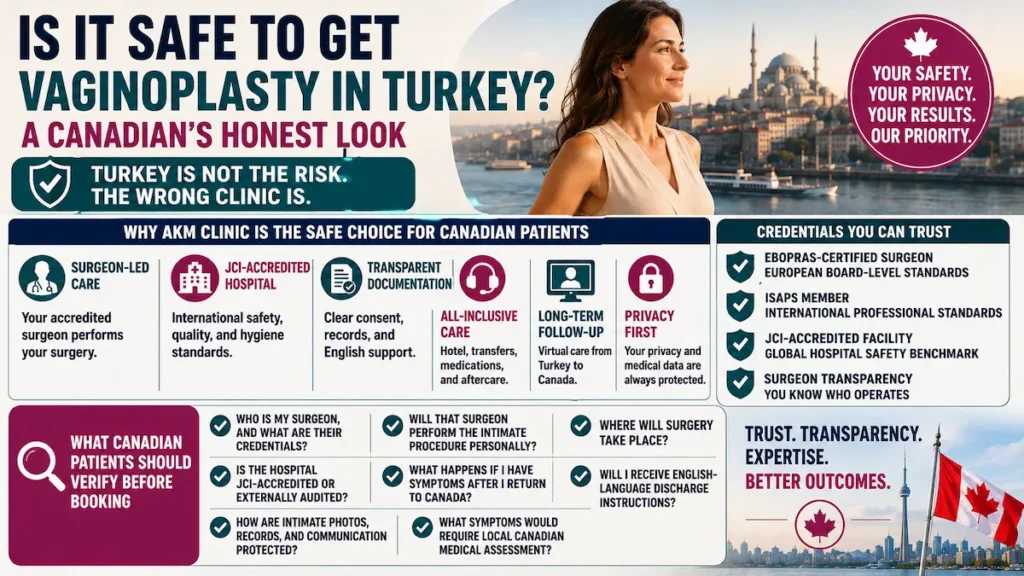
Is It Safe to Get Vaginoplasty in Turkey? A Canadian’s Honest Look
Turkey is one of the world’s major destinations for aesthetic and reconstructive surgery. That does not mean every clinic is equal. The country is not the risk; the wrong clinic is the risk.
Canadian patients should evaluate surgeon credentials, hospital standards, aftercare systems, and documentation before booking. This is especially important for intimate surgery, where privacy and function matter as much as the visible result.
The Turkey Cosmetic Surgery Reality — How AKM Differs
Some Canadian patients arrive with understandable concerns. They have read stories about rushed consultations, unclear surgeon identity, weak follow-up, or clinics that operate like sales offices. We take those concerns seriously.
Our model is surgeon-led and documentation-focused. We provide a tailored clinical protocol, explain realistic candidacy, and use an all-inclusive care pathway that includes hospital, hotel, transfers, medication guidance, and long-term virtual follow-up.
For a broader look at evaluating international surgery safely, our plastic surgery safety in Turkey guide explains how Canadian patients can compare facilities, credentials, and aftercare.
Ghost Surgery in Turkey — Making Sure Your Surgeon Operates
“Ghost surgery” means the patient believes one surgeon is operating, but another person performs part or all of the procedure without clear consent. This is a serious red flag in any country.
Before booking, confirm who your surgeon is, where surgery will take place, which hospital standards apply, and how documentation is handled. For intimate surgery, you should also ask who will be present in the operating room and how privacy is protected.
Our ghost surgery in Turkey resource explains the questions Canadian patients should ask before choosing any clinic abroad.
EBOPRAS-Certified Surgeon Verification
Canadian patients are used to RCPSC and provincial college frameworks. In Turkey and Europe, credential pathways are different, so the comparison must be explained clearly.
EBOPRAS certification reflects European board-level plastic surgery credentialing. It is not the same legal system as Canada’s RCPSC framework, but it gives Canadian patients a structured way to evaluate specialist training and professional standards.
You can review the broader credential framework in our plastic surgeon board certification guide. We recommend comparing credentials before discussing price.
| Credential / Framework | Region | What It Signals | What Canadian Patients Should Ask |
|---|---|---|---|
| RCPSC / FRCSC | Canada | Canadian specialist certification and fellowship pathway | Is the surgeon listed with the Royal College and provincial college? |
| EBOPRAS | Europe | European board-level plastic surgery examination and credentialing | Does the surgeon hold recognized specialist plastic surgery training? |
| ISAPS / international societies | International | Professional membership and international education engagement | Is membership current and relevant to the procedure? |
| JCI hospital accreditation | International | Hospital-level safety, process, and quality framework | Is surgery performed in a JCI-accredited facility? |
JCI-Aligned Facility Standards
Facility standards matter. A skilled surgeon still needs a safe operating environment, sterile instruments, trained anesthesia support, emergency protocols, and proper recovery monitoring.
Our procedures are performed in a JCI-accredited hospital partner setting. For Canadian patients, this provides an external quality benchmark when comparing international surgical options.
You can learn more about why accreditation matters in our JCI accreditation and hospital safety guide.
What Canadian Patients Should Verify Before Booking
Before booking vaginoplasty abroad, ask direct questions. A reputable clinic should answer without pressure or vague language.
- Who is my surgeon, and what are their credentials?
- Will that surgeon perform the intimate procedure personally?
- Where will surgery take place?
- Is the hospital JCI-accredited or otherwise externally audited?
- What happens if I have symptoms after I return to Canada?
- Will I receive English-language discharge instructions?
- How are intimate photos, records, and communication protected?
- What symptoms would require local Canadian medical assessment?
If a clinic avoids these questions, pressures you to book quickly, or treats vaginoplasty as a commodity, step back. Intimate surgery requires trust, not urgency.

Realistic Expectations & Results — Why We Don’t Post Public Before-and-After Photos
Vaginoplasty results are private. We do not publish public intimate before-and-after galleries. That is not a lack of transparency; it is a privacy and dignity policy.
During consultation, appropriate consented examples may be discussed privately when relevant. We do not use intimate imagery as public marketing content.
What Vaginoplasty Results Realistically Mean
A successful vaginoplasty restores internal support and improves structural tone in the right candidate. The result should feel natural, functional, and comfortable after healing. It should not feel over-tightened.
Some patients notice improved confidence because the anatomical concern has been addressed. Others value the repair of perineal changes after childbirth. Results vary based on tissue quality, childbirth history, healing, and future pregnancies.
Final assessment takes time. Early swelling can make the area feel different, and tissue softening continues over months.
Consent-Gated Private Results Policy
We understand that many patients search for “vaginoplasty before and after” images. For intimate procedures, we do not believe public galleries are the right way to build trust.
Instead, we provide discreet consultation, private explanation, and realistic outcome discussion. Any visual examples are handled only with consent and only in an appropriate private setting.
Your privacy is part of your care. It is not an afterthought.
Natural, Functional, Not Over-Tightened
Natural-First does not only apply to facial surgery. It also applies here. A well-planned vaginoplasty should restore tone while respecting anatomy and function.
Over-tightened results can cause discomfort. A natural result supports comfort, confidence, and normal function. We plan with those priorities in mind.
This is why we do not promise extreme narrowing. We promise careful assessment and conservative surgical judgement.
Healing Over 3–6 Months
Early healing takes weeks. Final tissue settling takes longer. By 3 to 6 months, most patients have a better sense of their final result.
Swelling, sensitivity, and scar firmness usually improve gradually. Internal sutures dissolve over time. Your comfort level should progress with healing, not overnight.
We monitor recovery through scheduled virtual follow-ups after you return to Canada. If healing does not follow the expected pattern, we guide you on next steps.
Verified Patient Experiences
Many patients prefer to read verified reviews rather than view intimate images. We respect that. Our patient feedback system focuses on care quality, communication, privacy, and follow-up.
Our Canadian patients often highlight the value of having a dedicated host, clear communication, and a structured recovery plan. You can review broader patient experiences on our professional plastic surgery reviews page.
For intimate surgery, comfort with the team matters. You should feel heard before you ever book a flight.
Vaginoplasty Cost 2026: Turkey vs Canada
Canadian patients researching vaginoplasty cost often find wide price variation between Toronto, Vancouver, Montreal, Calgary, and Istanbul. Domestic private quotes may appear simple at first, but surgeon fees, anesthesia, facility charges, medications, and follow-up can be billed separately.
At AKM Clinic, the all-inclusive vaginoplasty package is CAD $4,900, including 3 nights of accommodation, the surgical procedure, hospital and anesthesia fees, pre-operative tests, VIP transfers, post-operative medications, and 24/7 patient advocacy. Canadian-dollar pricing shown for planning clarity; your coordinator will confirm the final payment details before booking.
By comparison, private vaginoplasty in Toronto or Vancouver commonly ranges from CAD $8,000 to CAD $12,000 once all line items are included. Provincial plans such as OHIP, MSP, AHCIP, and RAMQ generally do not cover elective cosmetic vaginoplasty. Medically necessary pelvic-floor or reconstructive procedures follow different pathways and require Canadian medical assessment.
For a full breakdown of technique-level pricing, inclusions, and Canada-specific cost comparison, see our vaginoplasty cost in Turkey guide. Our vaginoplasty all-inclusive package page explains what is included before you travel.
| Location / Option | Typical CAD Range | Usually Included | Common Add-Ons |
|---|---|---|---|
| Toronto private clinic | CAD $8,000–$12,000 | Surgeon fee, sometimes facility estimate | Anesthesia, facility, medications, follow-up, travel support |
| Vancouver private clinic | CAD $9,000–$12,000 | Consultation and surgical quote structure varies | Anesthesia, facility, medications, revision policy, follow-up |
| AKM Clinic Istanbul — Vaginoplasty All-Inclusive | CAD $4,900 | Surgery, anesthesia, hospital, 3 hotel nights, VIP transfers, medication, support | International flights and personal spending |
| Laser or RF vaginoplasty at AKM | CAD $3,400 | Energy-based treatment pathway | Repeat sessions may be needed depending on indication |
| Vaginoplasty + Labiaplasty Combo | CAD $7,100 | Internal and external intimate surgery in one clinical pathway | International flights and personal spending |
We do not position vaginoplasty as a “cheap” procedure. It is intimate surgery and should be evaluated on surgeon experience, safety, privacy, and aftercare first. Transparent pricing simply helps Canadian patients plan responsibly.
How to Find the Right Vaginoplasty Surgeon in Turkey: A Canadian Patient’s Checklist
Choosing a surgeon for vaginoplasty is different from choosing a medspa treatment or a general aesthetic procedure. This is intimate surgery. You need a surgeon who understands tissue support, function, sensation, conservative narrowing, and privacy.
Canadian patients often start by comparing clinics in Toronto, Vancouver, or Montreal. That is reasonable. Once you consider surgery abroad, the same due diligence matters even more.
EBOPRAS Certification — The European Equivalent to RCPSC-Style Specialist Standards
In Canada, many patients look for RCPSC fellowship status or provincial college registration. For international surgery, you will see different credential systems. The goal is to understand what each one means, not simply compare acronyms.
EBOPRAS certification reflects European board-level plastic surgery assessment. It is not a Canadian licence, but it helps Canadian patients evaluate whether the surgeon has completed recognized specialist-level training and examination.
You can verify the Canadian reference framework through the Royal College of Physicians and Surgeons of Canada directory. For international comparison, our plastic surgeon board certification guide explains how Canadian patients can read credential signals abroad.
Intimate Procedure Experience
Ask whether the surgeon performs intimate procedures regularly. Vaginoplasty requires a different judgement set than facial surgery, breast surgery, or body contouring. The surgeon must understand internal support, perineal repair, scar sensitivity, and function.
Experience also matters in deciding when not to operate. A responsible surgeon should identify when symptoms suggest pelvic-floor physiotherapy, urogynaecology assessment, or medical investigation before elective surgery.
Canadian patients can also use the Canadian Society of Plastic Surgeons as a reference point for understanding the level of professional seriousness expected around plastic surgery decision-making.
Conservative Functional-First Philosophy
A safe vaginoplasty plan does not chase maximum tightness. It restores support while preserving comfort. The surgeon should explain how they prevent over-tightening and how they decide the amount of repair needed.
Ask direct questions:
- How do you decide how much tightening is appropriate?
- When do you recommend perineoplasty with vaginoplasty?
- How do you protect comfort and sensation?
- What symptoms suggest I should see a pelvic-floor specialist first?
- What would make you decline my surgery?
If the answer is always “yes,” that is not a good sign. A strong surgeon can say no.
Will the Surgeon Decline Inappropriate Surgery?
This is one of the strongest safety signals. A surgeon who performs vaginoplasty for anyone who asks may not be practising responsible medicine.
We may advise waiting if you recently gave birth, plan another pregnancy soon, smoke, have untreated pelvic-floor symptoms, or show signs of a medical condition that needs local assessment. We may also decline surgery if expectations are unrealistic or partner pressure is part of the decision.
A respectful “not yet” can protect you from regret.
“In intimate surgery, surgical restraint is a strength. If the anatomy does not match the request, the safest recommendation may be physiotherapy, specialist assessment, or waiting.”
Privacy-Respecting Reviews and Documentation
For intimate surgery, public before-and-after images are not the only way to evaluate a clinic. In fact, we believe public intimate galleries can compromise dignity.
Instead, look for verified reviews, clear communication, documented surgeon identity, hospital standards, and a privacy policy that explains how records and images are handled. Our broader patient review process is available through our professional plastic surgery reviews page.
During private consultation, consented examples may be discussed when appropriate. We do not use intimate imagery as public advertising.
Aftercare Continuity From Istanbul to Canada
Vaginoplasty recovery continues after you return home. That means aftercare cannot end at the airport.
Our care pathway includes English-language discharge guidance, 24/7 communication support, and structured virtual follow-ups at 1, 3, 6, and 12 months. If symptoms require local care in Canada, we guide you on what to share with your family physician or local provider.
You can learn more about our team, clinic philosophy, and long-term follow-up approach on our About AKM Clinic page.
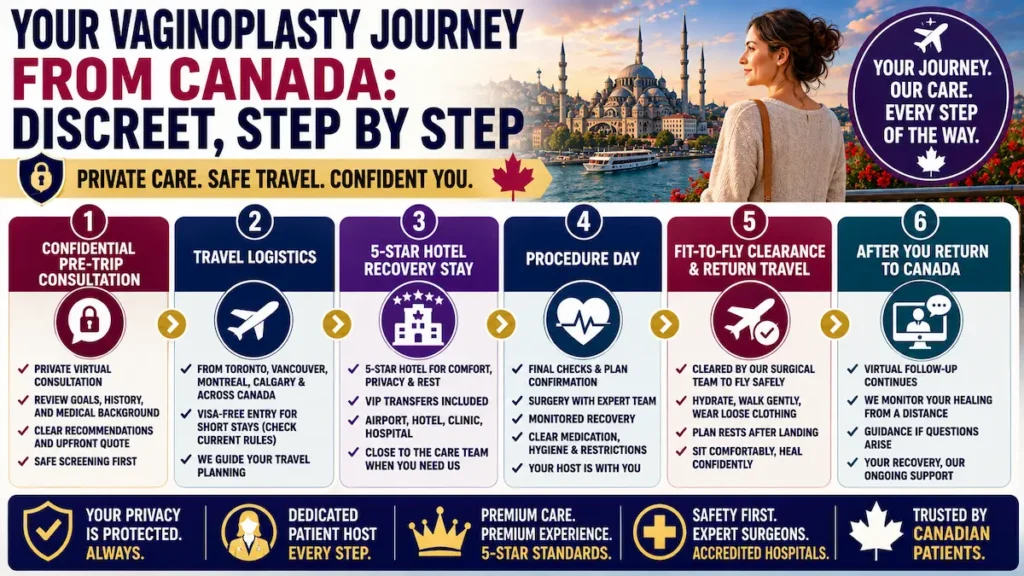
Your Vaginoplasty Journey From Canada: Discreet, Step by Step
Travelling from Canada for intimate surgery requires planning. Privacy, flight timing, hotel comfort, follow-up access, and fit-to-fly clearance all matter.
We structure the process so that you are not left to coordinate medical and travel logistics alone. Your patient host helps manage clinic visits, transfers, communication, and recovery support.
Confidential Pre-Trip Consultation
The process starts with a confidential virtual consultation. You share your goals, symptoms, childbirth history, medical background, and any relevant concerns. We explain whether vaginoplasty, perineoplasty, labiaplasty, energy treatment, or a non-surgical pathway may be appropriate.
We may ask for medical records or recommend local evaluation if your symptoms suggest prolapse, incontinence, chronic pelvic pain, or other medical concerns. This is part of safe screening.
Your quote is given before you travel. We do not believe patients should arrive in Istanbul without knowing the planned scope and estimated cost.
Travel Logistics — Toronto, Vancouver, Montreal, Calgary to Istanbul
Canadian patients commonly travel from Toronto Pearson, Vancouver, Montreal, Calgary, Ottawa, Edmonton, Winnipeg, Halifax, and surrounding cities. Flight schedules change, so you should verify current options with the airline before booking.
Canadian passport holders can typically enter Turkey visa-free for short stays, but you should confirm current entry rules before travel. Your passport should also have sufficient validity for international travel.
Our patient journey page explains the arrival process, appointment flow, and return-travel planning in more detail.
5-Star Hotel Recovery Stay
After arrival, you recover in a 5-star hotel environment selected for comfort and proximity to the clinic. A private recovery setting is especially important for intimate surgery because you need rest, privacy, and easy access to the care team.
VIP transfers are included between airport, hotel, clinic, and hospital appointments. You do not need to manage taxi routes or explain medical needs to drivers.
You can review the clinic and local care environment on our Istanbul clinic page.
Procedure Day
On procedure day, you complete final checks and meet the surgical team. The planned procedure is confirmed again before anesthesia. You should feel clear about what is being treated and what is not being treated.
After surgery, you are monitored during early recovery. Your medication plan, hygiene instructions, movement restrictions, and warning signs are explained before discharge.
Your patient host remains available for questions. That support matters during the first quiet recovery days.
Fit-to-Fly Clearance and Comfortable Return Travel
You should not fly home until the surgical team confirms you are ready. Fit-to-fly clearance considers swelling, wound healing, mobility, pain control, and general medical stability.
For the flight, wear loose clothing, hydrate, walk gently when safe, and avoid unnecessary pressure on the operative area. Sitting comfort varies, so plan your return schedule with rest time after landing in Canada.
After you return home, virtual follow-up continues. If a concern arises, your care team can guide you on whether it is expected healing, requires photos and monitoring, or needs local Canadian medical assessment.
Vaginoplasty Frequently Asked Questions (FAQ):
Does this page cover gender-affirming vaginoplasty?
No. This page covers vaginoplasty as internal vaginal tightening and post-childbirth restoration for women. Gender-affirming vaginoplasty is a separate specialised surgical field with different anatomy, goals, techniques, and follow-up needs.
What’s the difference between vaginoplasty and labiaplasty?
Vaginoplasty treats the internal vaginal canal and support tissues. Labiaplasty reshapes the external labia minora or labia majora. If your concern is external chafing, asymmetry, or labial excess, see our labiaplasty guide.
Is surgical vaginoplasty better than laser or RF “vaginal rejuvenation”?
It depends on the concern. Surgical vaginoplasty is more appropriate for structural internal laxity or perineal widening. Laser and RF may be discussed only for mild concerns and should not be presented as equivalent to surgery.
Will vaginoplasty affect sensation or sexual function?
Vaginoplasty may improve comfort or confidence in selected patients when internal laxity is the main issue. It cannot guarantee sexual improvement. Sensation depends on tissue healing, anatomy, hormones, pelvic-floor function, emotional factors, and relationship context.
How long is recovery, and when can I be intimate again?
Most patients need several weeks of activity restriction. Intimacy usually resumes around 6 to 8 weeks, only after surgeon clearance. Full tissue settling can take 3 to 6 months.
Should I wait until I’ve finished having children?
In many cases, yes. Future pregnancy or vaginal delivery can stretch the same tissues again. If you plan another pregnancy soon, waiting may protect your result and reduce the chance of needing revision later.
Does OHIP, MSP, AHCIP, or RAMQ cover vaginoplasty?
Elective cosmetic vaginoplasty is generally not covered by Canadian provincial health plans. Medically necessary pelvic-floor or reconstructive procedures follow different Canadian pathways and require local medical assessment.
How much does vaginoplasty cost in Toronto vs Istanbul?
Private vaginoplasty in Toronto or Vancouver commonly ranges from CAD $8,000 to CAD $12,000 once all line items are included. At AKM Clinic, the all-inclusive vaginoplasty package is CAD $4,900, with 3 hotel nights, hospital fees, anesthesia, VIP transfers, medications, and follow-up support included.
Does Canadian travel insurance cover complications from elective vaginoplasty in Turkey?
Many Canadian travel insurance policies exclude elective cosmetic surgery and complications related to it. You should review your policy carefully before booking and ask the insurer direct written questions.
To reduce this concern, AKM Clinic provides complimentary complication insurance for all patients. This is separate from standard Canadian travel insurance and is designed to add an extra layer of protection around your surgical care. Your coordinator will explain the coverage terms, limits, and required documentation before you confirm your booking.
Why don’t you show public before-and-after photos?
We do not publish public intimate before-and-after galleries because privacy and dignity matter. Appropriate consented examples may be discussed privately during consultation when relevant.
Is there a minimum age for vaginoplasty?
Yes. Vaginoplasty for cosmetic or functional restoration is an adult procedure. We do not perform intimate cosmetic surgery on minors. Mature consent and psychological readiness are essential.
Can I combine vaginoplasty with labiaplasty or a mommy makeover in one trip?
Yes. Vaginoplasty for cosmetic or functional restoration is an adult procedure. We do not perform intimate cosmetic surgery on minors. Mature consent and psychological readiness are essential.
Medical Disclaimer: This page is for educational purposes only and does not replace medical advice from your physician, gynaecologist, pelvic-floor physiotherapist, or urogynaecologist. Vaginoplasty is elective surgery and may not be appropriate for every patient. If you have urinary leakage, pelvic pressure, prolapse symptoms, chronic pelvic pain, abnormal bleeding, recurrent infections, or pain with intimacy, speak with a qualified Canadian health care provider before considering international surgery.