




Canadian patients researching a DHI hair transplant often compare three concerns at once: whether the Choi Implanter Pen truly offers more controlled placement than FUE, whether Turkey’s hair transplant reputation can be trusted, and whether Toronto or Vancouver pricing makes sense for 3,000 to 4,500 grafts. This guide explains how DHI works, who is a strong candidate, how it compares with FUE and Sapphire FUE, and why we treat it as a precision technique within our broader hair transplant programme in Turkey.
Table of Contents
What Is DHI Hair Transplant? Direct Hair Implantation Explained
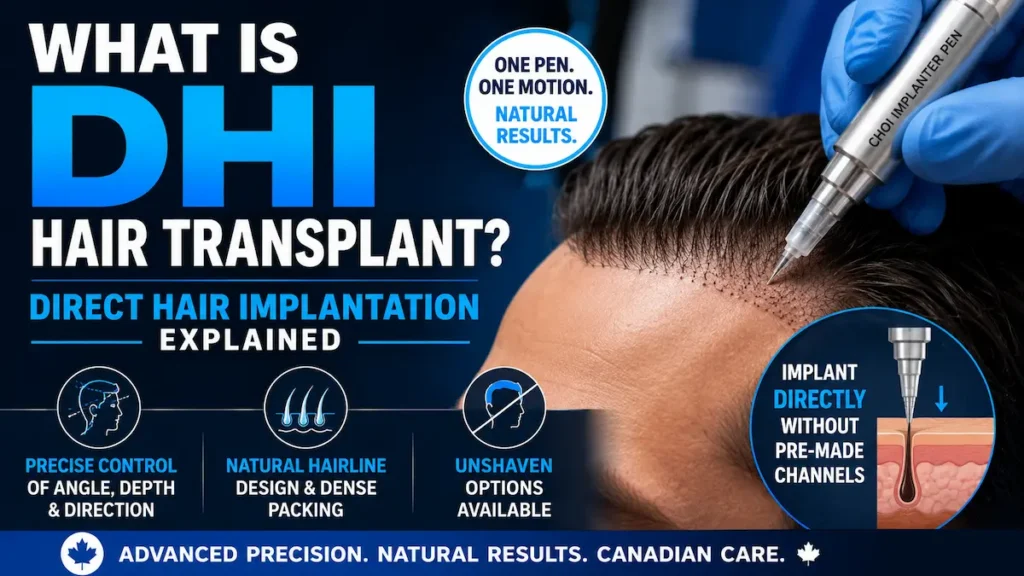
DHI, or Direct Hair Implantation, is a hair transplant technique that uses the Choi Implanter Pen to place follicular grafts directly into the scalp without pre-creating recipient channels. It allows controlled angle, depth, and direction, making it useful for dense hairline work and unshaven options.
How Direct Hair Implantation Works
In a DHI hair transplant, healthy follicular units are first extracted from the donor area, usually the back or sides of the scalp. These follicles are then loaded into a Choi Implanter Pen, a spring-loaded surgical tool that allows our team to implant the graft directly into the recipient area.
The defining feature is the implantation step. In standard FUE, the surgeon creates tiny recipient sites first, then places grafts into those openings. With the DHI method hair transplant approach, the Choi Pen allows channel creation and graft placement to happen in one controlled movement.
This does not make DHI automatically better for every patient. It makes DHI more suitable for specific goals: refined hairline design, dense frontal packing, selective crown work, and cases where preserving existing hair matters.
The Choi Implanter Pen Difference
The Choi Implanter Pen gives the surgical team fine control over three variables that affect natural-looking hair restoration:
- Angle: the direction in which each hair exits the scalp
- Depth: how deeply the follicle sits in the recipient tissue
- Distribution: how grafts are spaced for density without crowding
These details matter most at the frontal hairline. A natural hairline is not a straight line. It has micro-irregularity, softer single-hair grafts at the front, and a density gradient that becomes stronger behind the first rows.
At AKM Clinic, we use DHI when its precision supports the patient’s anatomy and goals. For some patients, FUE hair transplant or Sapphire FUE is a better match. The right method depends on donor density, hair calibre, graft count, and whether the patient wants a shaved or unshaven approach.
From Strip Surgery to FUE to DHI
Older hair transplant methods relied on strip harvesting, also called FUT. That technique removed a narrow strip of scalp from the donor area and left a linear scar. Modern follicular unit methods changed the standard by extracting grafts individually.
FUE removed the linear scar problem. DHI then refined the implantation stage by using the Choi Pen rather than manually placing grafts into pre-made channels. Robotic DHI exists as a modern sub-variant, but the value of any system still depends on planning, graft handling, and surgical judgment.
For Canadian patients, the key question is not “Which technique sounds most advanced?” The better question is: which technique protects my donor area, creates a realistic density plan, and avoids the over-harvested look associated with high-volume hair transplant mills?
Benefits of DHI Hair Transplant
Controlled Angle, Depth, and Direction
DHI’s main benefit is implantation control. Hair does not grow straight upward from the scalp. It follows regional direction patterns, especially around the temples, crown, and frontal hairline.
The Choi Pen helps our team place each graft with attention to that natural direction. This is especially useful for patients who want a conservative, age-appropriate hairline rather than an overly low or artificial design.
Higher Density Potential in Selected Cases
DHI can support dense packing in suitable candidates, particularly in the frontal zone. The technique can reduce the time grafts spend outside the body because follicles move efficiently from preparation to implantation.
Density still has limits. We do not promise “unlimited grafts” because that can damage the donor area. A calibrated graft count is safer, more honest, and more useful for long-term planning.
Useful for Unshaven and Professional Discretion Cases
Many Canadian patients from Toronto, Vancouver, Calgary, and Montreal ask whether they can return to work without an obvious shaved-head appearance. In selected cases, unshaven DHI hair transplant can reduce visible disruption to the existing hairstyle.
This is not possible for every patient. Larger graft counts often require more donor access. During consultation, we explain whether unshaven DHI is realistic or whether a partial shave will give a better clinical result.
“Our priority is not to place the maximum possible number of grafts in one session. Our priority is to design a natural hairline, protect the donor area, and choose the technique that gives the patient a result that still looks appropriate ten years from now.”
Am I a Good Candidate for DHI Hair Transplant?
A strong DHI candidate has stable hair loss, enough donor density, and a realistic goal for coverage. The technique is often useful for patients who want detailed hairline work, selective density improvement, or implantation between existing hairs.
Candidacy is never based on graft number alone. We assess your age, hair loss pattern, donor area strength, hair calibre, scalp health, and long-term progression risk before recommending DHI.
Patients with diffuse shedding, scalp inflammation, or suspected medical hair loss should first speak with a dermatologist. The Canadian Dermatology Association is a useful starting point for understanding when alopecia may need medical assessment before surgery.
Donor Area Density Requirements
Your donor area is the foundation of every hair transplant. In most patients, this area sits at the back and sides of the scalp, where follicles are more resistant to pattern hair loss.
DHI does not create new hair. It relocates existing follicles. That means we must protect the donor area carefully, especially for Canadian patients in their late 20s or 30s who may continue losing native hair over time.
During your virtual assessment, we review donor density from multiple angles. We also look for signs of thinning in the donor region itself. If the donor area is weak, a transplant may not be the safest first step.
Norwood Stage and Graft Planning
Men with Norwood Stage 2 to 5 hair loss are often suitable candidates for DHI, depending on donor density and expectations. Stage 6 or 7 patients may still qualify, but they usually need a more conservative density plan or a staged strategy.
For early-stage hair loss, we avoid aggressive hairline lowering. A hairline that looks good at age 29 can look unnatural at age 45 if future loss is ignored.
| Norwood Stage | Typical Pattern | DHI Candidacy | Planning Note |
|---|---|---|---|
| Stage 2 | Mild temple recession | Often suitable | Conservative hairline refinement |
| Stage 3 | Clear frontal recession | Strong candidate if donor is stable | Hairline density and temple balance |
| Stage 4 | Frontal loss with early crown thinning | Often suitable | Priority planning: front first, crown second |
| Stage 5 | Advanced frontal and crown loss | Case-dependent | May need staged grafting |
| Stage 6–7 | Extensive baldness | Selective cases only | Coverage over density; donor preservation is critical |
Hair Calibre, Curl Pattern, and Hairline Goals
Hair calibre affects visual density. Thick or wavy hair often creates stronger coverage with fewer grafts, while fine straight hair may need more careful spacing.
DHI can be useful for designing a soft, natural hairline because single-hair grafts can be placed at precise angles. We avoid overly straight, dense, or low hairlines that can reveal surgery later.
Female Pattern Hair Loss: When DHI for Women Works
DHI may help selected women with localized thinning, traction alopecia, or hairline recession. It is not automatically appropriate for diffuse female pattern hair loss, where the donor area may also be unstable.
For women, we often assess no-shave or partially shaven options because discretion matters. Patients who need a female-specific plan should review our dedicated hair transplant for women in Turkey guide.
When DHI Is Not Recommended
We do not recommend DHI when surgery is unlikely to produce a durable, natural result. This includes active alopecia areata, uncontrolled scalp inflammation, severe donor miniaturization, and unrealistic density goals.
Patients who expect teenage-level density from limited donor supply are not ideal candidates. Honest refusal is part of ethical hair restoration.
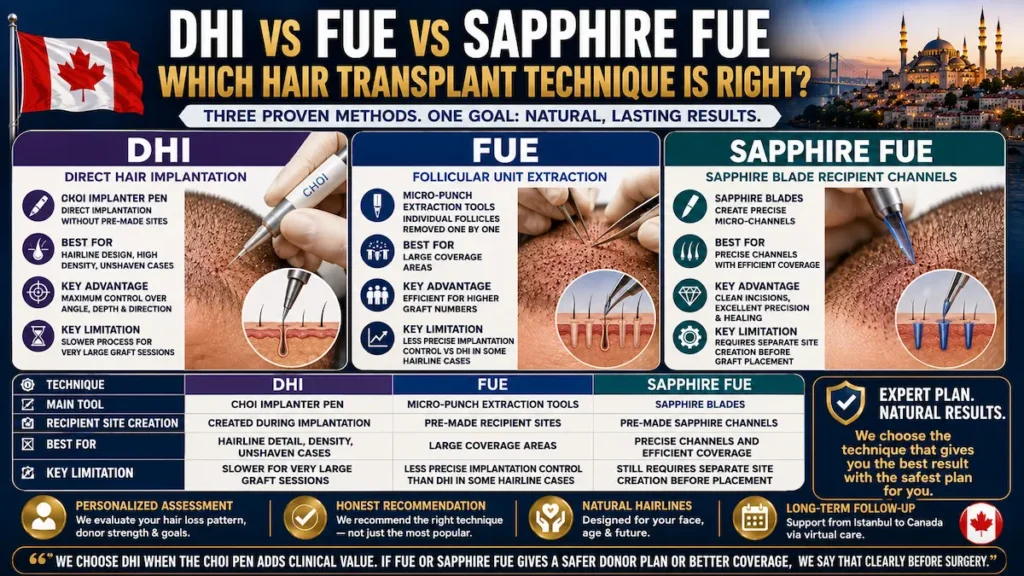
DHI vs FUE vs Sapphire FUE: Which Hair Transplant Technique Is Right?
DHI, FUE, and Sapphire FUE all relocate follicular units. The difference is how grafts are implanted and how recipient sites are prepared.
There is no single best hair transplant technique for every Canadian patient. The right method depends on hair loss pattern, donor strength, graft count, hairline detail, and whether shaving is acceptable.
DHI: Choi Implanter Pen and Direct Implantation
DHI uses the Choi Implanter Pen to place grafts directly into the scalp. This gives strong control over angle and depth, which can be helpful for frontal hairline design and dense packing in selected cases.
DHI may also be useful when placing grafts between existing hairs, because it can reduce the need for widespread recipient channel creation. That said, DHI is slower and more labour-intensive than standard FUE.
FUE: Manual Extraction and Surgeon-Opened Sites
FUE uses individual follicular unit extraction, followed by recipient site creation and graft placement. It is highly versatile and often works well for larger graft counts.
FUE can be the better choice when the goal is broad coverage over a large area. Patients comparing both techniques can read our deeper DHI vs FUE hair transplant guide for a focused technical comparison.
Sapphire FUE: Sapphire Blade Recipient Channels
Sapphire FUE is a variation of FUE where the recipient channels are created with sapphire blades rather than standard steel blades. The goal is precise channel creation with clean micro-incisions.
For some patients, Sapphire FUE offers a strong balance between coverage, incision control, and efficiency. We discuss this technique in more detail on our Sapphire FUE hair transplant page.
Technique Comparison Table
| Technique | Main Tool | Recipient Site Creation | Best For | Key Limitation |
|---|---|---|---|---|
| DHI | Choi Implanter Pen | Created during implantation | Hairline detail, density, unshaven cases | Slower for very large graft sessions |
| FUE | Micro-punch extraction tools | Pre-made recipient sites | Large coverage areas | Less precise implantation control than DHI in some hairline cases |
| Sapphire FUE | Sapphire blades | Pre-made sapphire channels | Precise channels and efficient coverage | Still requires separate site creation before placement |
“We choose DHI when the Choi Pen adds clinical value. If FUE or Sapphire FUE gives a safer donor plan or better coverage, we say that clearly before surgery.”
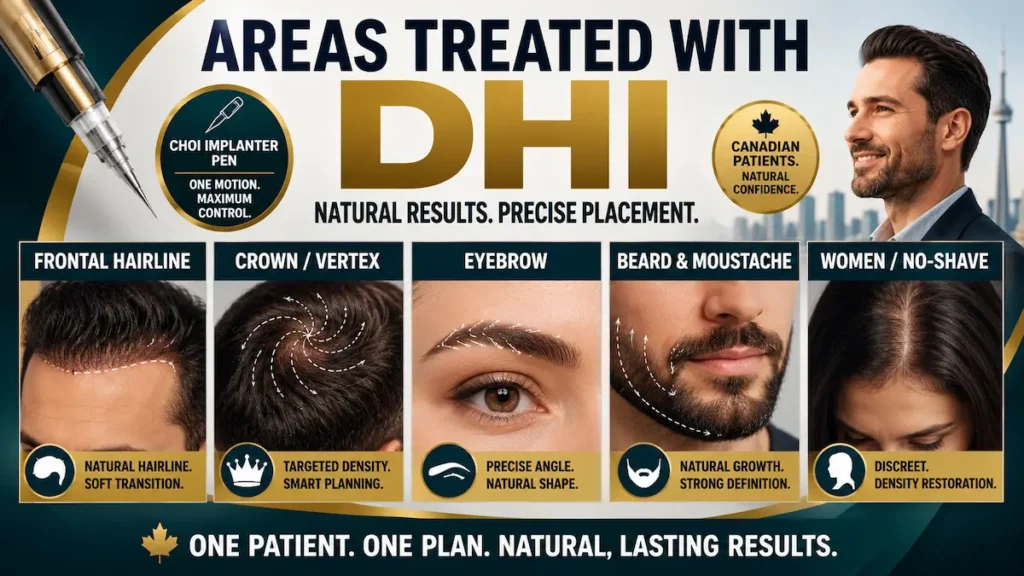
Areas Treated with DHI: Crown, Hairline, Eyebrow, and Beard
DHI can be used in several hair restoration zones, but each area requires a different density plan. The frontal hairline, crown, eyebrows, and beard do not grow in the same direction. That is why angle control matters.
We do not use one template for every patient. Our planning changes according to facial proportions, donor capacity, hair calibre, and the long-term pattern of hair loss.
Frontal Hairline Reconstruction
The frontal hairline is where DHI often shows its strongest value. The Choi Implanter Pen allows careful control of the angle and depth of single-hair grafts, which helps create a softer, more natural transition.
A natural hairline has small irregularities. It should not look like a drawn border. For Canadian patients who want to return to professional life in Toronto, Vancouver, Calgary, or Montreal without an obvious surgical look, this detail is essential.
For a deeper explanation of age-appropriate planning, our natural hairline design guide explains how surgeons avoid overly low, artificial, or aggressive hairlines.
Crown and Vertex Restoration
The crown is more complex than it appears. Hair grows in a spiral pattern, and density must be placed carefully to avoid wasting grafts in a large circular zone.
DHI can help in selected crown cases, especially when the goal is targeted density improvement. For advanced crown loss, we may recommend staged planning so the frontal hairline is not sacrificed for the crown.
This is where donor management matters. A patient with limited donor supply should not spend too many grafts on the crown too early.
Eyebrow Transplant with DHI
Eyebrow restoration requires very fine angle control. The hairs must lie flatter than scalp hair, and the direction changes from the inner brow to the tail.
DHI can be useful for eyebrow transplant because it supports precise placement. We usually select fine single-hair grafts to avoid a coarse or unnatural brow texture.
Patients interested in this anatomical area can review our dedicated eyebrow transplant in Turkey page, where we cover brow shape, density, and recovery in more detail.
Beard and Moustache Transplant with DHI
Facial hair restoration requires a different aesthetic logic than scalp restoration. Beard and moustache hairs grow at sharper angles and must follow the natural contour of the jaw, cheek, chin, and upper lip.
DHI may help with patchy beard correction, moustache density, or goatee shaping. The result should look masculine and natural, not overly dense or patterned.
For patients comparing facial hair restoration options, our beard and moustache transplant guide explains the planning process by zone.
Female DHI and No-Shave Density Restoration
Women often have different hair loss patterns than men. Some have traction alopecia at the hairline. Others have diffuse thinning, where the entire scalp density is reduced.
DHI can be helpful in selected women, especially when the donor area is strong and the thinning pattern is localized. It is not ideal for every case of female pattern hair loss.
Discretion is also more important for many female patients. No-shave or partial-shave DHI may be possible when graft numbers are moderate and donor access is adequate.
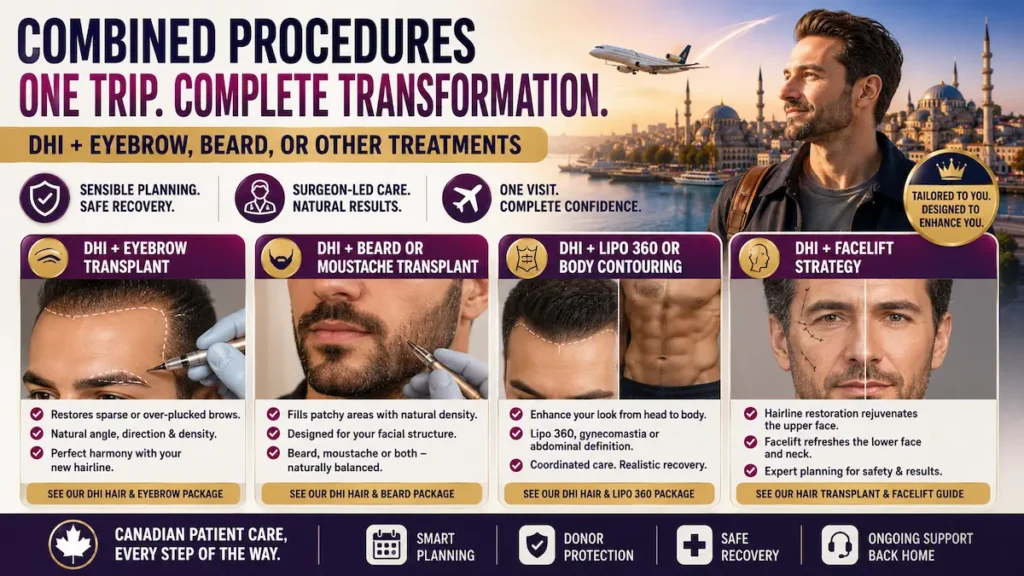
Combined Procedures: DHI + Eyebrow, Beard, or Other Treatments
Some Canadian patients choose DHI as a stand-alone procedure. Others use the trip to address more than one aesthetic concern during the same Istanbul visit.
Combination planning must be sensible. Hair restoration is usually lower physiological stress than major surgery, but graft protection, travel timing, and recovery comfort still matter.
DHI Hair Transplant + Eyebrow Transplant
DHI can be combined with eyebrow restoration when the patient has both scalp thinning and sparse brows. This may be useful for patients with over-plucked brows, scarring, traction-related brow loss, or naturally low eyebrow density.
Eyebrow work requires a different angle than scalp work. The hairs must sit flatter and follow the brow’s natural direction from head to arch to tail.
Our DHI hair and eyebrow transplant package explains how we structure this combined plan.
DHI Hair Transplant + Beard or Moustache Transplant
Patients with patchy facial hair may combine scalp restoration with beard or moustache transplantation. The goal is not to create an overly dense mask. It is to improve balance, coverage, and natural facial framing.
Beard and moustache grafts require careful direction planning. Hair at the jawline, cheek, chin, and upper lip does not grow in the same pattern.
For combined facial hair restoration, review our DHI hair transplant and beard transplant package.
DHI Hair Transplant + Lipo 360 or Body Contouring
Some male patients combine DHI with body contouring, especially Lipo 360, gynecomastia surgery, or abdominal definition procedures. This approach can make sense when the patient is already travelling from Canada and wants one coordinated care pathway.
We only recommend combination treatment when recovery logistics are realistic. A patient who needs to protect scalp grafts should not be placed into a recovery plan that creates unnecessary friction, sweating, or pressure.
Our DHI hair transplant and Lipo 360 package outlines one of the structured options available for suitable candidates.
DHI Hair Transplant + Facelift Strategy
Hairline restoration and facial rejuvenation can support each other when planned carefully. A recessed hairline may age the upper face, while a facelift can refresh the lower face and neck.
These procedures should not be combined casually. Incision placement, swelling, scalp tension, and recovery order all need surgeon-led planning.
For patients evaluating both concerns, our hair transplant and facelift combination guide explains how timing affects safety and outcome planning.
Anesthesia for DHI Hair Transplant: Local Only
DHI hair transplant is performed under local anesthesia. General anesthesia is not required, and that lowers the physiological burden for most healthy patients.
You remain awake during the procedure, but the scalp is numbed. Some patients describe pressure or vibration, but sharp pain should not be part of the experience once the local anesthetic has taken effect.
Why DHI Does Not Require General Anesthesia
DHI is a surface-level procedure involving the scalp. It does not require deep surgical dissection, intubation, or full-body anesthesia.
This matters for Canadian patients flying home after surgery. Avoiding general anesthesia can mean less nausea, less grogginess, and a simpler early recovery.
Tumescent Local Anesthesia in the Donor Area
Before extraction begins, the donor area is numbed with local anesthetic. A tumescent solution may also be used to create a safer working plane and reduce bleeding.
The same comfort principles apply to the recipient area before implantation. We monitor your comfort throughout the session and pause when needed.
Comfort During a Longer Procedure
A DHI session may take 6 to 8 hours, depending on graft count and complexity. The technique is detailed and slower than some high-volume FUE sessions.
During that time, the clinical team focuses on graft handling, hydration, and placement accuracy. Comfort breaks are part of the process.
Why “Awake DHI” Is Not a Separate Category
Some patients search for “awake hair transplant,” but DHI is already performed awake under local anesthesia. It is not the same as an awake facelift or awake tummy tuck, where local anesthesia changes the procedure category.
For DHI, the important distinction is not awake versus asleep. The real distinction is technique: Choi Pen implantation versus pre-made recipient channels.
“Because DHI is performed under local anesthesia, our focus shifts to precision, patient comfort, and graft survival. The anesthesia model should support the technique, not distract from the surgical plan.”
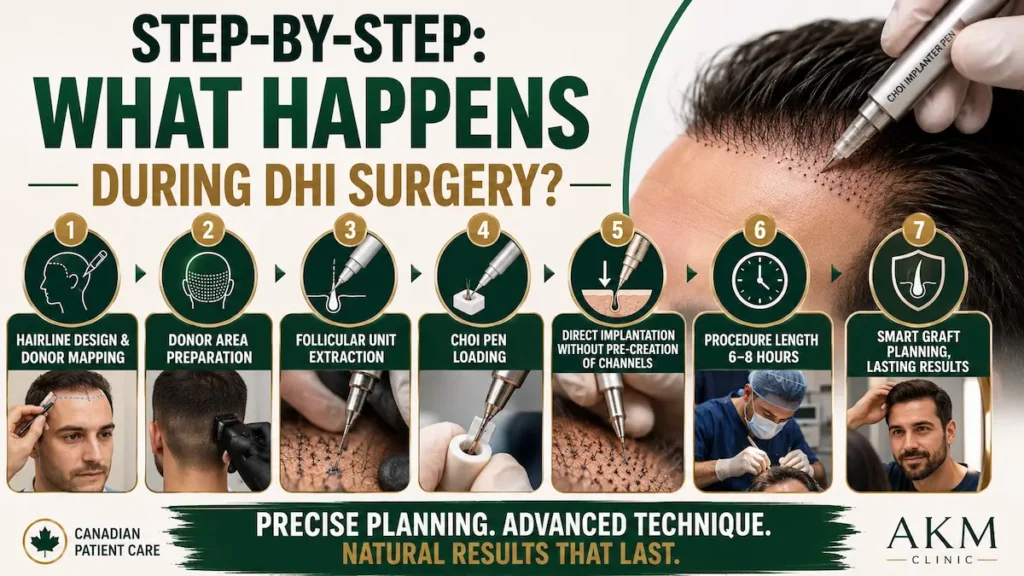
Step-by-Step: What Happens During DHI Surgery?
A DHI hair transplant is planned in stages. The visible result depends on decisions made before the first graft is extracted: hairline height, donor capacity, graft count, density distribution, and long-term hair loss risk.
At AKM Clinic, we do not treat DHI as a rushed graft-placement procedure. We treat it as a controlled surgical process where donor preservation and natural direction matter as much as density.
Hairline Design and Donor Density Mapping
Your procedure begins with hairline planning. We assess facial proportions, temple recession, forehead height, age, and future hair loss risk before marking the recipient area.
A strong DHI plan avoids the common mistake of placing the hairline too low. A conservative, age-appropriate hairline usually ages better than an aggressive teenage hairline.
We also map the donor area. This helps us estimate how many grafts can be safely extracted without creating visible thinning at the back or sides of the scalp.
Donor Area Preparation
The donor area is cleaned, trimmed as needed, and numbed with local anesthesia. In some patients, a partial-shave or unshaven approach may be possible.
Unshaven DHI is attractive for Canadian patients who want a discreet return to work. It is not always the best option for large graft counts, so we explain the tradeoff clearly during planning.
Follicular Unit Extraction
DHI still requires follicular unit extraction. The grafts must be removed from the donor area before they can be implanted with the Choi Pen.
Each follicular unit may contain one, two, three, or four hairs. Single-hair grafts are usually reserved for the front hairline, while multi-hair grafts are used behind them to create visual density.
Choi Implanter Pen Loading
After extraction, grafts are sorted and prepared for implantation. The follicles are loaded into the Choi Implanter Pen with careful attention to graft orientation.
This step is delicate. Rough handling can affect graft survival. Our team keeps grafts hydrated and minimizes unnecessary time outside the body.
Direct Implantation Without Recipient Site Pre-Creation
The Choi Pen allows implantation directly into the recipient area. The tool creates the opening and places the graft in one controlled movement.
This is the technical difference that separates DHI from FUE. In FUE, recipient sites are opened first and grafts are placed afterward. In DHI, the placement step is more integrated.
For hairline work, this can help with angle, depth, and direction. For broad coverage over a large bald area, FUE or Sapphire FUE may still be more efficient.
Procedure Length and Graft Count Planning
A typical DHI session may take 6 to 8 hours. Larger sessions can take longer, especially when the case requires dense frontal work or unshaven implantation.
We do not recommend excessive graft numbers simply to make a package look more impressive. Over-harvesting can permanently weaken the donor area.
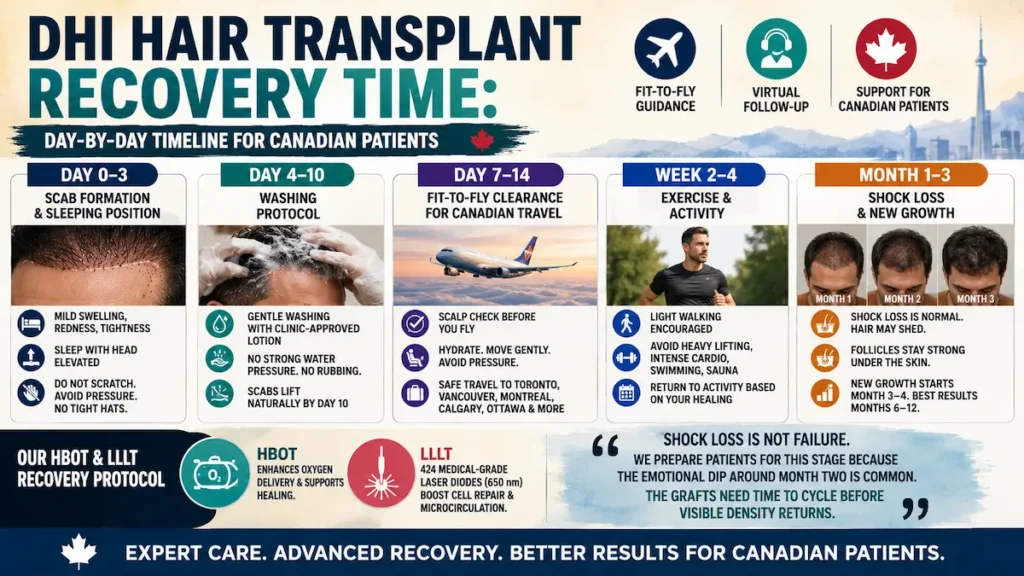
DHI Hair Transplant Recovery Time: Day-by-Day Timeline for Canadian Patients
DHI recovery is usually manageable, but it requires discipline. The first 10 days are the most important because grafts are settling, scabs are forming, and the scalp is still sensitive.
Canadian patients also need to plan around long-haul flights. We provide fit-to-fly guidance before you return home and continue virtual follow-up after you land in Canada.
Day 0–3: Scab Formation and Sleeping Position
During the first three days, mild swelling, redness, tightness, and scab formation are expected. You will sleep with your head elevated to reduce pressure on the recipient area.
Do not scratch the scalp. Do not wear a tight hat. The goal is simple: protect the grafts and avoid friction.
Day 4–10: Washing Protocol
Washing begins carefully, usually with a clinic-approved lotion and gentle rinsing technique. You should not use strong water pressure or rub the recipient area.
By day 10, most scabs should begin lifting naturally. For a deeper day-by-day guide, our washing hair after transplant article explains how to clean the scalp without disturbing grafts.
Our HBOT and LLLT Recovery Protocol
We use recovery technology to support healing after hair restoration. Hyperbaric Oxygen Therapy helps oxygen delivery to healing tissue, while Low-Level Laser Therapy supports cellular repair and scalp microcirculation.
Our LLLT system uses 424 medical-grade semiconductor laser diodes at 650 nm. This soft laser energy stimulates cellular ATP production without generating heat.
For DHI patients, the goal is to create a healthier environment for graft survival. You can read more about our recovery systems on our technology and standards page.
Day 7–14: Fit-to-Fly Clearance for Canadian Return Travel
Most DHI patients can travel within this window, depending on swelling, comfort, and graft stability. We confirm your scalp status before you fly.
For flights back to Toronto, Vancouver, Montreal, Calgary, or Ottawa, we recommend hydration, loose clothing, gentle movement during the flight, and avoiding pressure on the recipient area.
Our flight safety after surgery guide explains how we think about long-haul travel, circulation, and post-operative timing.
Week 2–4: Exercise and Activity
Light walking is encouraged early. Heavy lifting, intense cardio, swimming, sauna, and contact sports should wait until the scalp is more stable.
Sweat and friction can irritate the recipient area. We will give you a return-to-exercise timeline based on your graft count and healing progress.
Month 1–3: Shock Loss
Shock loss can worry patients because transplanted hairs may shed before new growth begins. This is usually part of the normal hair cycle.
The follicle remains under the skin while the hair shaft sheds. Early growth often begins around month 3 to 4, with stronger cosmetic improvement between months 6 and 12.
For a more detailed visual timeline, our hair transplant growth timeline guide explains what to expect month by month.
“Shock loss is not failure. We prepare patients for this stage because the emotional dip around month two is common. The grafts need time to cycle before visible density returns.”
Safety and Risks of DHI Hair Transplant
DHI hair transplant is a minimally invasive scalp procedure, but it is still a medical procedure. It requires sterile technique, careful donor planning, safe graft handling, and honest patient selection.
Most side effects are temporary. The problems Canadian patients worry about most usually come from poor planning, technician-only work, aggressive graft promises, or inadequate follow-up.
Common Short-Term Side Effects
Redness, swelling, scabbing, tightness, mild bleeding, and temporary numbness can happen after DHI. These effects usually improve during the first 7 to 14 days.
Itching is also common as the scalp heals. You should not scratch the recipient area because friction can disturb grafts during the early settling phase.
- Mild forehead swelling
- Scalp redness
- Small scabs around implanted grafts
- Temporary tenderness in the donor area
- Itching during healing
We explain which symptoms are expected and which require medical review. This matters when you are recovering in Istanbul and later when you return to Canada.
Shock Loss After DHI
Shock loss is one of the most misunderstood parts of hair transplant recovery. It can affect transplanted hairs and existing hairs around the recipient area.
The shedding phase does not mean the transplant has failed. In most cases, the follicle remains under the scalp while the visible hair shaft falls.
We prepare patients for this stage before surgery. A patient who knows shock loss may happen is less likely to panic during month two or three.
Folliculitis, Infection, and Rare Complications
Folliculitis can appear as small pimples or irritated bumps around grafts. Mild cases often respond to hygiene adjustments or medication, but persistent inflammation should be assessed.
Infection is uncommon when sterile protocols are followed. Necrosis is rare, but it can occur when blood supply is compromised, especially in unsafe high-density sessions or poorly selected patients.
This is why we avoid extreme density promises. The scalp has biological limits. More grafts do not always mean a better result.
Donor Area Over-Harvesting
Donor area damage is one of the biggest long-term risks in hair restoration. Once a donor area is over-harvested, it can be difficult or impossible to fully correct.
Over-harvesting happens when too many follicles are removed from one region or when extraction is not distributed carefully. The result can be patchiness, visible thinning, or a moth-eaten look.
We reject the idea of “unlimited grafts.” A safe DHI plan uses a calibrated graft count that protects your future options.
When DHI Goes Wrong: Red Flags in High-Volume Providers
Many Canadians have read stories about Turkey hair transplant clinics that operate like assembly lines. These concerns are valid. The safest response is not to dismiss them, but to explain how to verify a clinic properly.
Red flags include:
- Unclear surgeon identity before booking
- “Unlimited grafts” claims
- No medical review of donor density
- Technician-only procedures presented as surgeon-led care
- No written aftercare plan
- No clear complication pathway after you return home
Our approach is different. We prioritize surgeon-led planning, sterile surgical standards, realistic graft counts, and documented follow-up.
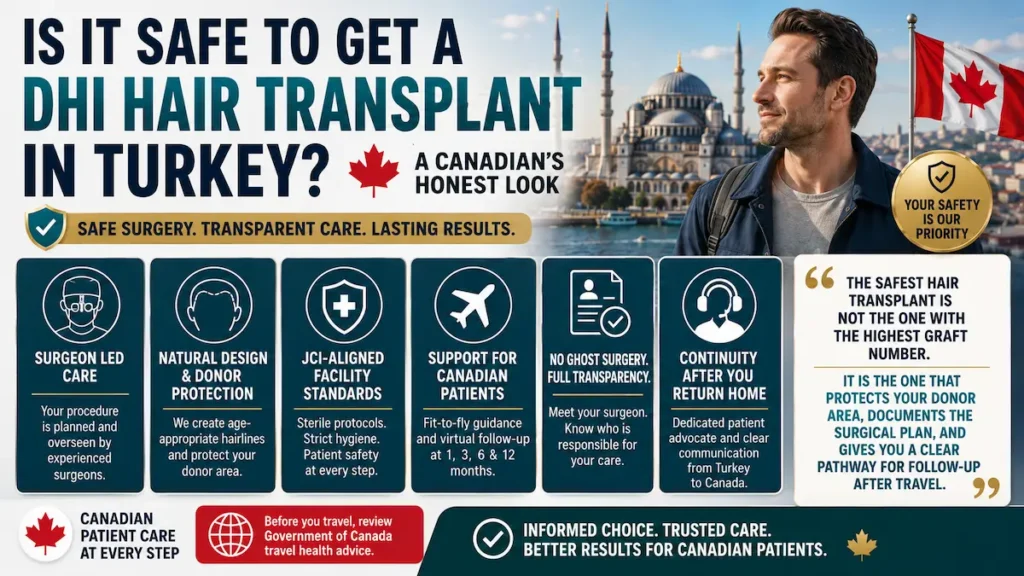
Is It Safe to Get a DHI Hair Transplant in Turkey? A Canadian’s Honest Look
Turkey is one of the world’s busiest destinations for hair restoration. That does not mean every clinic is equal. Canadian patients should separate Turkey’s strong surgical ecosystem from unsafe high-volume operators.
At AKM Clinic, we believe safety starts before you arrive. We review your photos, medical history, hair loss pattern, donor area, and goals before recommending a procedure.
Before travelling for elective care, Canadians should review official guidance from Government of Canada travel health resources, which discusses potential risks of receiving medical care outside Canada.
The Turkey Hair Transplant Industry Reality
Turkey’s hair transplant sector includes excellent surgeon-led clinics and lower-quality providers. Both exist. This is why Canadian patients should not choose based on price or graft number alone.
A safe DHI programme should answer these questions clearly:
- Who is responsible for the surgical plan?
- Who designs the hairline?
- Who performs or supervises extraction and implantation?
- How is the donor area protected?
- What happens if I have a concern after returning to Canada?
For a broader safety framework, our guide to plastic surgery safety in Turkey explains how Canadian patients can evaluate international clinics without relying on marketing claims.
Why We Differ from Hair Transplant Mills
Hair transplant mills often focus on volume. The patient is sold a large graft number, moved through a rushed process, and given limited access to the medical decision-maker.
We do not build DHI plans that way. Our planning starts with donor preservation and natural design. A transplant should still look appropriate as you age.
That means we may recommend fewer grafts than a patient expected. We may also recommend FUE, Sapphire FUE, medical therapy first, or no surgery if DHI is not the right option.
Ghost Surgery in Turkey Hair Transplants
Ghost surgery means the person patients believed would perform or supervise the procedure is not actually the person responsible in the operating room. This is a serious trust issue in international care.
Canadian patients should ask for surgeon identity, clinical role, and documentation before booking. Vague answers are a warning sign.
Our ghost surgery in Turkey guide explains what to ask, which documents to request, and how to confirm surgeon-of-record accountability.
Facility Standards and Sterile Protocol
DHI involves thousands of tiny skin openings. Sterility is not optional. It is central to infection prevention and graft survival.
Our procedures follow JCI-aligned facility standards, structured sterilization processes, and documented patient safety protocols. Instruments, graft handling surfaces, and procedure rooms must meet strict hygiene expectations.
We also provide English-language instructions so you understand how to protect the scalp during the early healing period.
Canadian Follow-Up After You Return Home
Cross-border care needs continuity. We provide virtual follow-up after you return to Canada, with planned check-ins at 1, 3, 6, and 12 months.
You can contact your patient advocate if you notice unusual redness, persistent swelling, discharge, fever, or sudden pain. If in-person care is needed in Canada, we help you organize the information your local physician may request.
We also recommend that Canadian patients inform their family physician before travelling, especially if they have a medical condition, take blood thinners, or have a history of wound-healing concerns.
“The safest hair transplant is not the one with the highest graft number. It is the one that protects the donor area, documents the surgical plan, and gives the patient a clear pathway for follow-up after travel.”
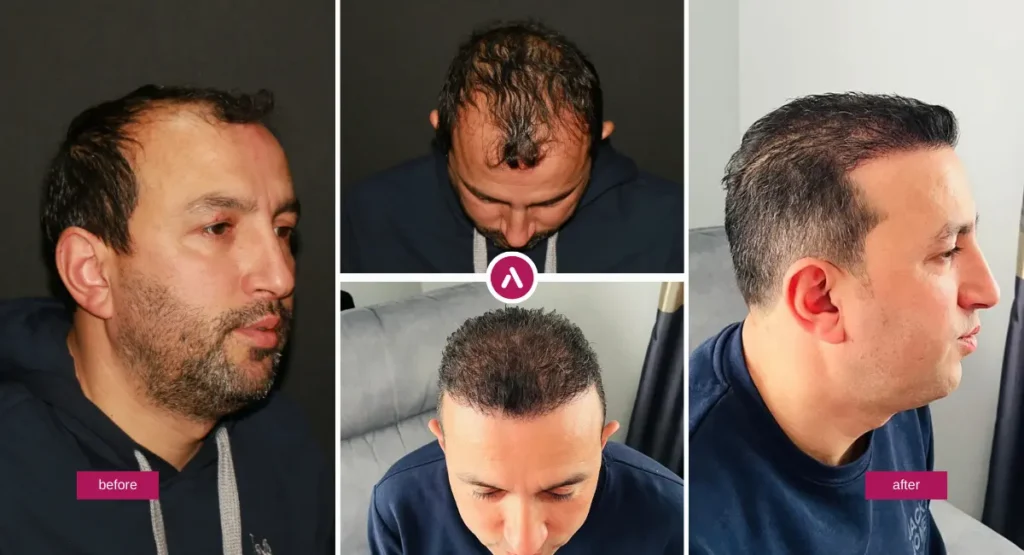
DHI Hair Transplant Before and After: Realistic Expectations
DHI hair transplant can create a natural, permanent improvement when the patient has a strong donor area and a realistic density plan. It cannot restore unlimited hair, reverse every future stage of hair loss, or create teenage density from limited donor supply.
The best results come from restraint. A conservative hairline, careful graft distribution, and donor preservation usually create a more natural long-term outcome than aggressive over-packing.
Is DHI Hair Transplant Permanent?
Transplanted follicles are typically taken from the donor region at the back and sides of the scalp. These hairs are genetically more resistant to androgenetic hair loss, which is why they usually continue growing after relocation.
That does not mean every surrounding native hair is protected. If your original hair continues thinning, you may need medical therapy, a second-stage procedure, or a revised styling plan later.
We explain this before surgery because permanence is often misunderstood. The transplanted hair can be long-lasting, but your overall hair pattern can still change with age.
DHI Hair Transplant Success Rate
Graft survival depends on extraction quality, graft hydration, implantation technique, scalp health, aftercare, and smoking status. DHI can support strong graft survival because the Choi Pen allows efficient placement when handled correctly.
Technique alone is not enough. A poorly planned DHI procedure can still fail if the donor area is over-harvested, grafts are mishandled, or the hairline is designed without future loss in mind.
At AKM Clinic, we focus on three success markers:
- Natural hairline shape
- Responsible donor preservation
- Visible growth that remains age-appropriate over time
Month-by-Month Growth Timeline
Hair transplant growth is slow. The most difficult part for many patients is the gap between early shedding and visible new growth.
| Timeline | What You May Notice | Patient Guidance |
|---|---|---|
| Days 1–10 | Redness, scabs, mild swelling | Protect grafts; follow washing protocol |
| Weeks 2–4 | Scabs clear; scalp looks calmer | Avoid harsh friction and intense exercise |
| Months 1–3 | Shock loss and temporary shedding | Do not judge results during this stage |
| Months 3–6 | Early new growth begins | Hair may look thin or uneven at first |
| Months 6–9 | Visible density improves | Most patients feel more confident by this stage |
| Months 12–18 | Final density and texture mature | Assess final result with the surgical team |
For a deeper month-by-month explanation, our hair transplant growth timeline guide covers the emotional and visual milestones Canadian patients often ask about.
DHI Hair Transplant Before and After
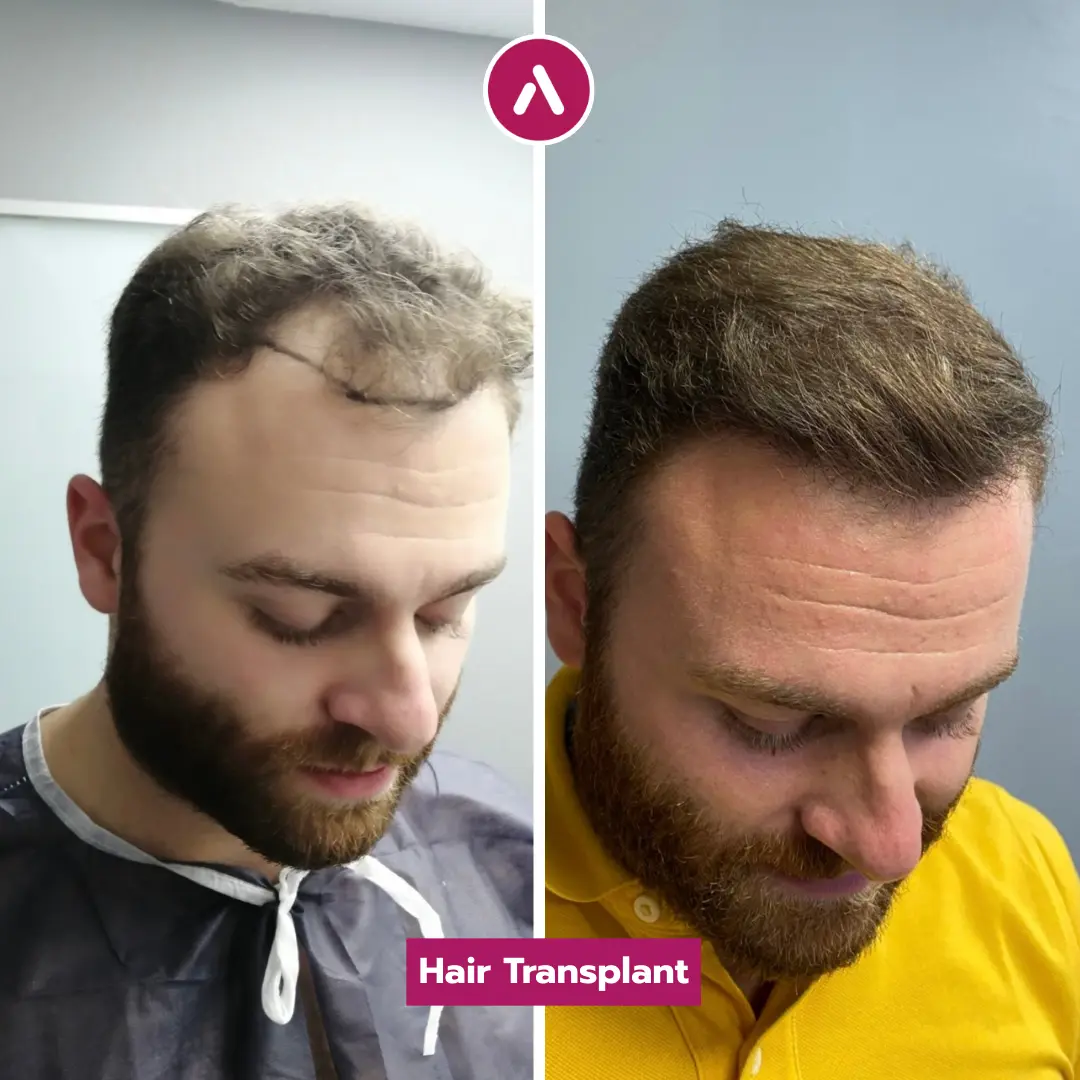
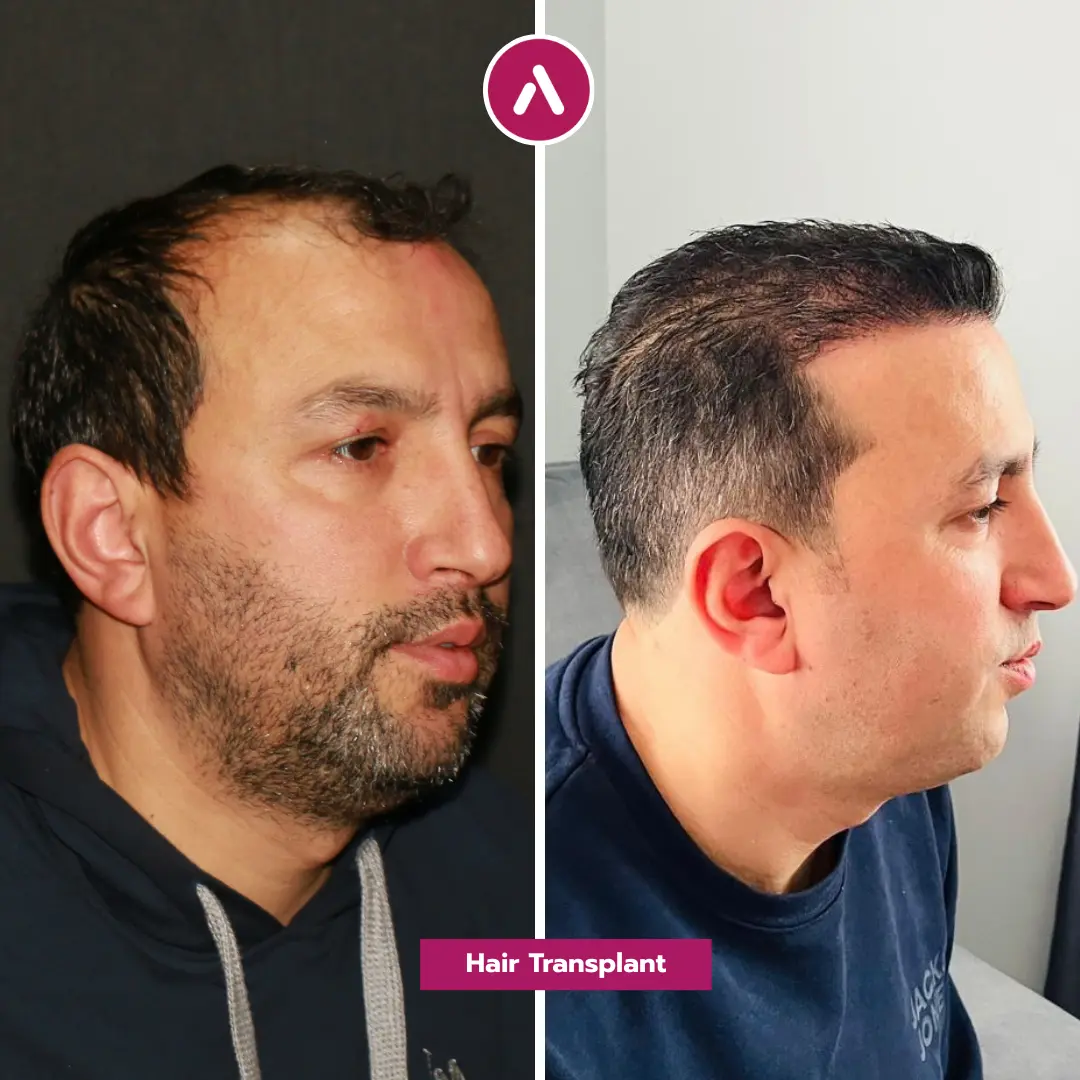
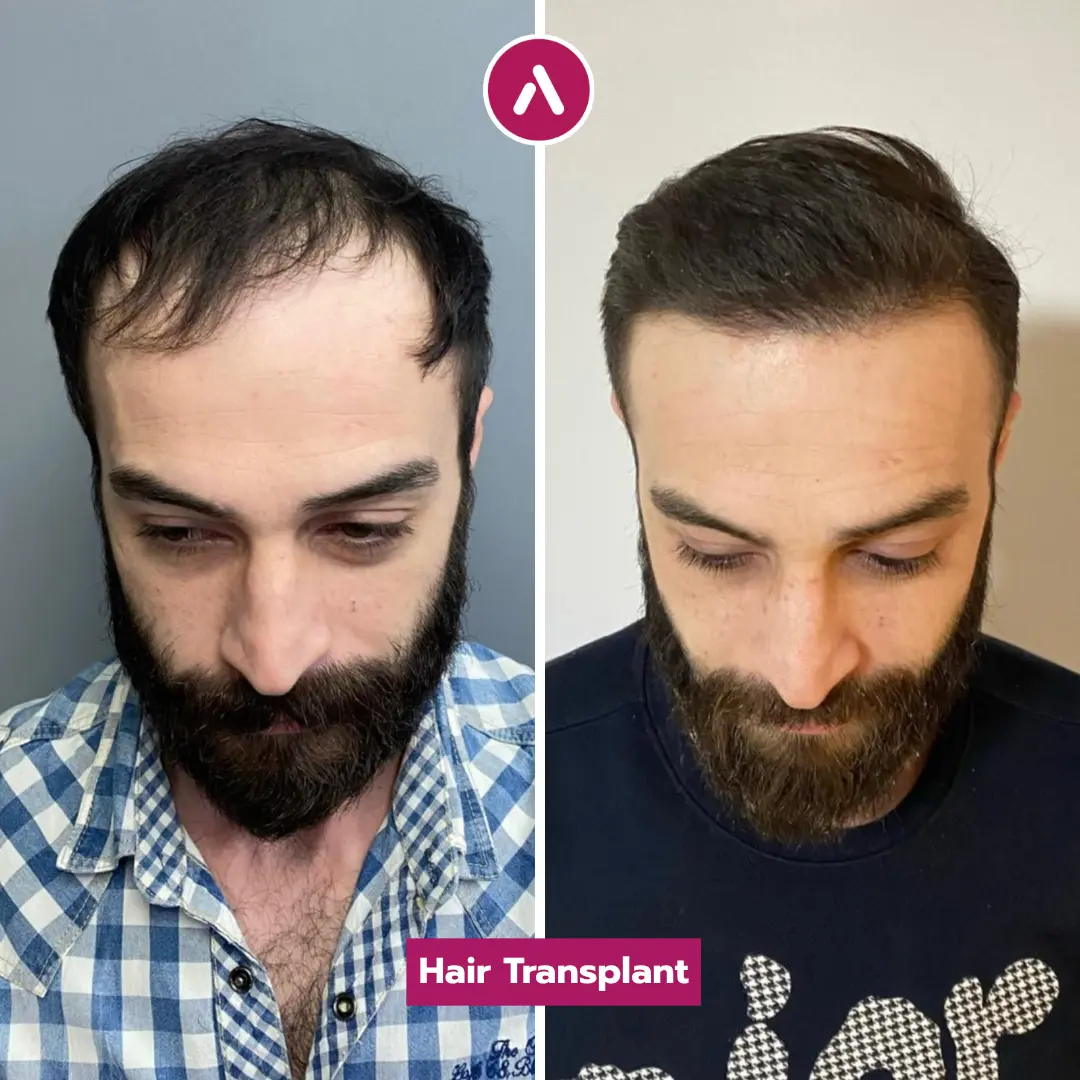
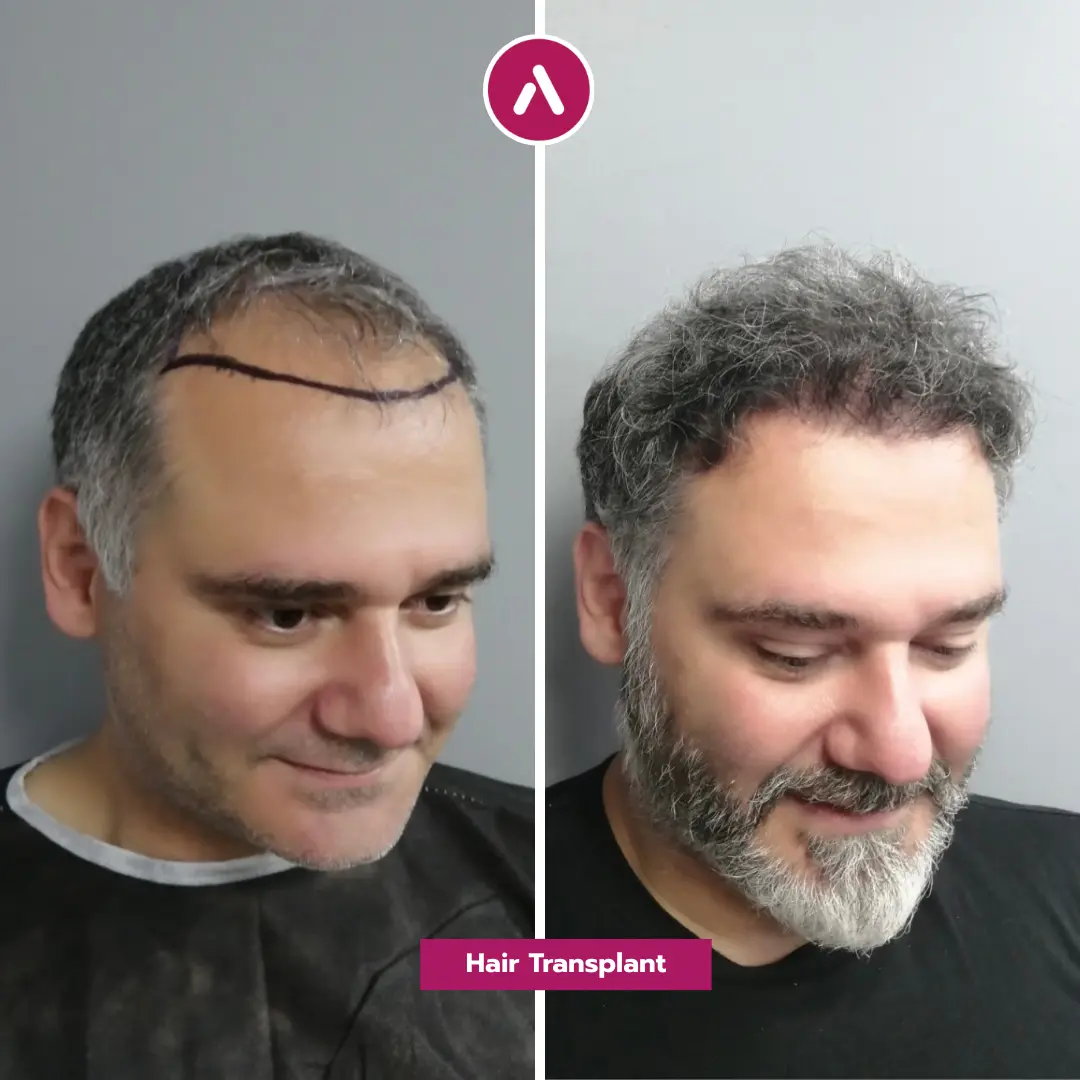
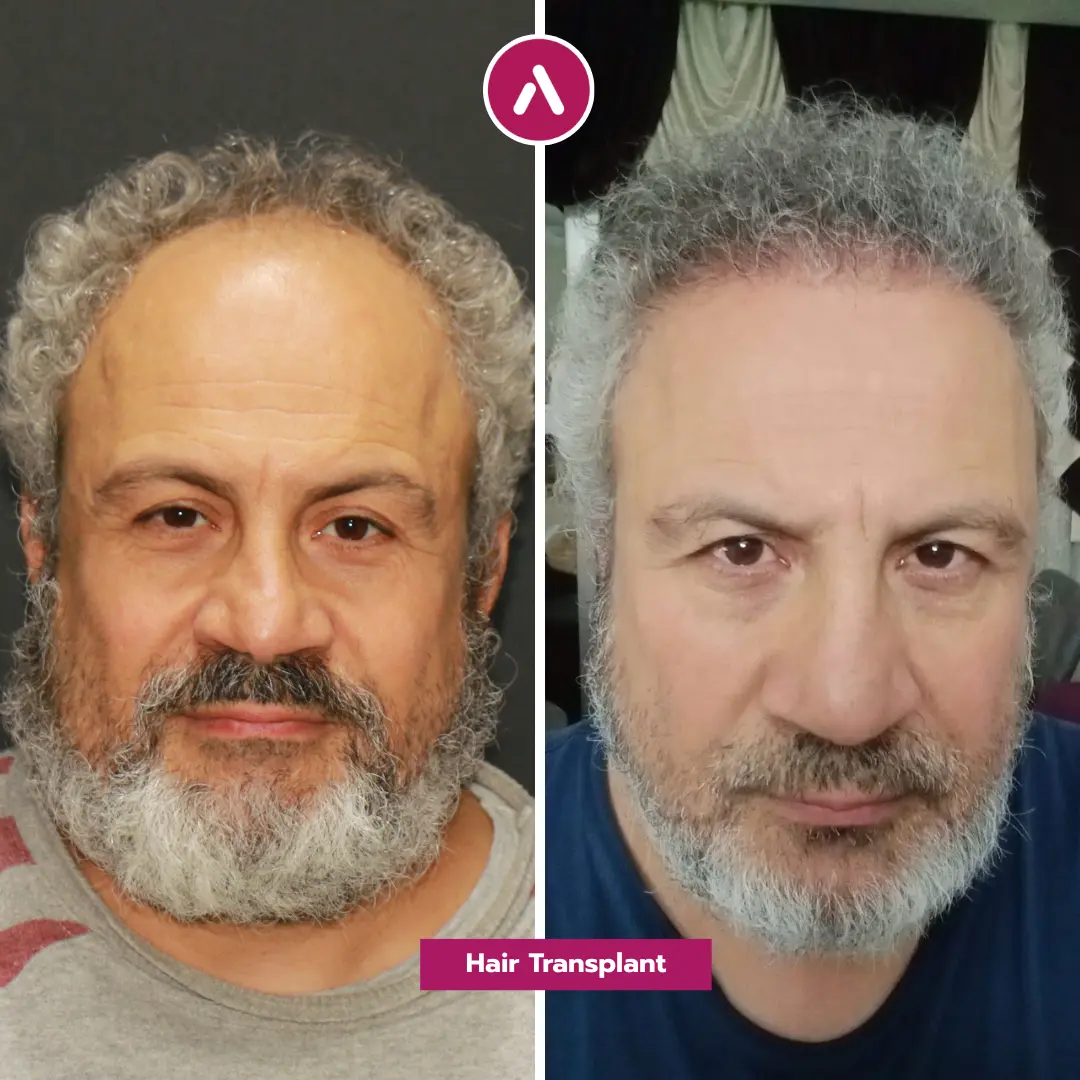
Before and after photos should be reviewed carefully. Good DHI results show natural direction, irregular hairline detail, and density that fits the patient’s donor capacity.
Be cautious with photos that show only one angle, wet hair, heavy styling products, or harsh lighting differences. A trustworthy gallery should help you understand both improvement and limitation.
You can review our visual outcomes in the hair transplant before and after gallery.
DHI Hair Transplant Cost 2026: Turkey vs Canada
Canadian patients researching DHI hair transplant cost often compare Istanbul with Toronto, Vancouver, Montreal, and Calgary. The main difference is not only the surgical fee. It is the full care pathway: consultation, procedure, hotel recovery, transfers, medications, and follow-up.
At AKM Clinic, the DHI Hair Transplant All-Inclusive Package is CAD $3,400. This includes the procedure, 5-star hotel accommodation, VIP transfers, post-operative medications, and 24/7 patient advocacy.
In Canada, private hair transplant pricing is commonly quoted per graft. A 3,000 to 4,500 graft case in Toronto or Vancouver can reach CAD $12,000–$18,000, depending on graft count, technique, surgeon involvement, and clinic model.
| Location | Typical DHI / Hair Transplant Pricing | What Patients Should Check |
|---|---|---|
| Toronto | CAD $12,000–$18,000 | Per-graft pricing, surgeon involvement, follow-up fees |
| Vancouver | CAD $12,000–$18,000 | Technique availability and total graft estimate |
| Montreal | Often comparable to major private Canadian markets | Language preference, surgeon role, aftercare structure |
| Calgary | Varies by clinic and graft count | Travel costs within Canada versus Istanbul pathway |
| AKM Clinic Istanbul | CAD $3,400 | All-inclusive clinical pathway with hotel and transfers |
For a full breakdown of graft-count pricing, travel costs, and hidden line items, see our DHI hair transplant cost guide. Patients comparing total trip value can also review our Turkey hair transplant trip cost calculator.
Our package page explains what is included in the DHI hair transplant all-inclusive package, including hotel stay, private transfers, and follow-up support.
How to Find the Best DHI Hair Transplant Surgeon in Turkey: A Canadian Patient’s Checklist
Many Canadian patients begin with local searches such as “DHI hair transplant near me” or “hair transplant Toronto.” That is understandable. Proximity feels reassuring.
For international care, proximity is replaced by verification. You should know who plans your surgery, who designs your hairline, who supervises graft handling, and how follow-up works after you return to Canada.
Verify the Surgeon’s Role Before You Book
The most important question is not only whether a clinic offers DHI. The real question is who controls the medical decisions.
Ask who evaluates your donor area, who designs your hairline, and who is accountable for the final graft plan. If the answer is vague, keep asking.
- Who is the surgeon of record?
- Who approves the graft count?
- Who designs the frontal hairline?
- Who supervises Choi Pen implantation?
- Who reviews your progress after you fly home?
At AKM Clinic, our planning process is surgeon-led. Your coordinator helps with logistics, but medical decisions are made through clinical assessment.
Understand Credential Frameworks: EBOPRAS, RCPSC, and ABHRS
Canadian patients are familiar with the Royal College of Physicians and Surgeons of Canada. In Turkey, credentialing follows a different system, so comparison requires context.
Canadian patients often compare international credentials against the specialist training expectations of the Royal College of Physicians and Surgeons of Canada.
For hair restoration-specific education, the International Society of Hair Restoration Surgery provides patient resources that can help Canadians prepare better questions before choosing a clinic abroad.
| Credential or Body | Region | What It Signals | How Canadian Patients Should Use It |
|---|---|---|---|
| RCPSC | Canada | Canadian specialist certification pathway | Useful benchmark for understanding structured specialist training |
| EBOPRAS / European Board pathways | Europe | Structured European surgical qualification frameworks | Compare training rigour, specialty relevance, and hospital privileges |
| ABHRS | International / United States-based | Hair restoration-specific board examination pathway | Useful when assessing hair restoration specialization |
| ISHRS | International | Professional education and standards in hair restoration | Helpful for patient education and due diligence questions |
Credentials alone do not guarantee a good result. They should be combined with portfolio review, donor-area ethics, facility standards, and transparent aftercare.
For more background on our team and clinical philosophy, see our About AKM Clinic page.
Check Choi Pen Experience, Not Just the Word “DHI”
DHI is sometimes used as a marketing label. The Choi Implanter Pen is only valuable when the team understands graft loading, angle control, depth control, and density planning.
Ask how the clinic decides between DHI, FUE, and Sapphire FUE. A trustworthy provider should not force every patient into one method.
If a clinic says DHI is always best, that is a red flag. The best DHI hair transplant clinic in Turkey should know when not to use DHI.
Review Before and After Photos Carefully
Look for before and after photos that show the hairline from multiple angles. Strong results should show natural direction, soft density transitions, and donor areas that still look healthy.
Be cautious with galleries that show only styled hair, wet hair, or dramatic lighting changes. A good portfolio should help you understand both improvement and limits.
You can also review patient experience context through our professional plastic surgery reviews page.
Ask About Aftercare from Istanbul to Canada
A DHI transplant does not end when the final graft is placed. Recovery takes months, and Canadian patients need a clinic that remains reachable after the flight home.
Our follow-up programme includes virtual check-ins at 1, 3, 6, and 12 months. Your patient advocate can also help you understand which symptoms are normal and which should be reviewed by a physician.
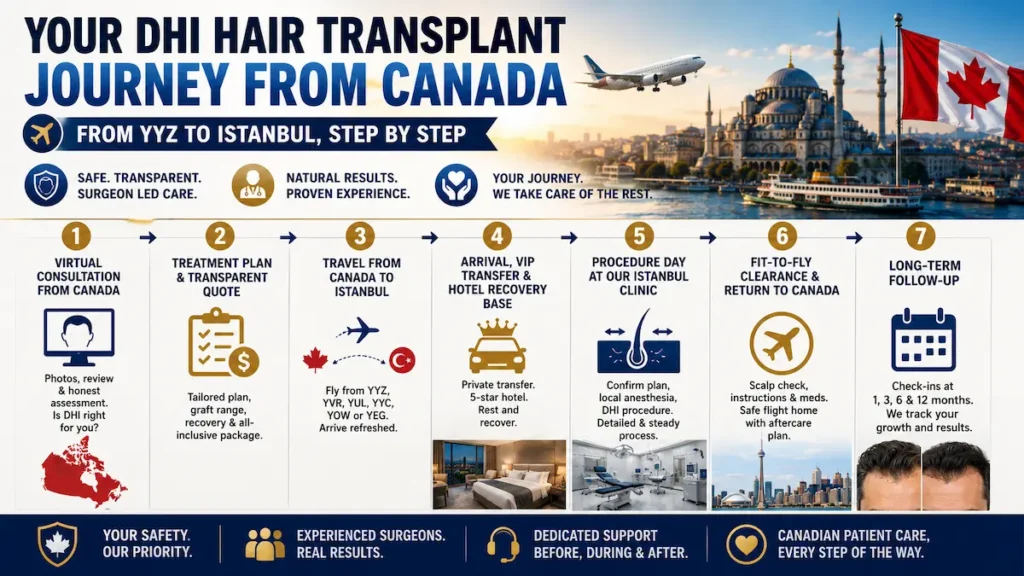
Your DHI Hair Transplant Journey from Canada: From YYZ to Istanbul, Step by Step
Travelling from Canada for DHI requires planning, but the pathway should feel organized. We manage the clinical and local logistics so you can focus on safe preparation and recovery.
Flights, entry rules, and airline schedules can change. We always recommend checking current airline and government information before booking travel.
Step 1: Virtual Consultation from Canada
Your first step is a remote assessment. You send photos of your hairline, temples, crown, donor area, and any previous transplant scars.
We review your likely Norwood or Ludwig pattern, donor density, hair calibre, and goals. If DHI is not the best option, we explain why.
This early honesty protects your donor area. It also helps you avoid travelling for a procedure that is not medically appropriate.
Step 2: Treatment Plan and Transparent Quote
After your assessment, we prepare a tailored clinical protocol. This includes the recommended technique, estimated graft range, recovery expectations, and cost structure.
For DHI, the all-inclusive programme is designed to reduce logistical uncertainty. It includes the procedure, 5-star hotel accommodation, VIP transfers, medications, and patient support.
You remain responsible for international flights and personal spending. We keep those boundaries clear before you book.
Step 3: Travel from Canada to Istanbul
Canadian patients commonly travel from Toronto Pearson, Vancouver, Montreal, Calgary, Ottawa, or Edmonton. Route availability varies by season and airline.
Many patients choose to arrive at least one day before the procedure. This gives time for rest, in-person consultation, and final medical checks.
Our patient journey page explains the broader travel and treatment timeline for international patients.
Step 4: Arrival, VIP Transfer, and Hotel Recovery Base
When you arrive in Istanbul, your private transfer takes you to your hotel or clinic appointment, depending on your schedule. You do not need to navigate the city alone after a long flight.
We work with 5-star hotel partners selected for international patient recovery. Your hotel stay gives you a quiet base during the first days after treatment.
You can review accommodation and transport details on our hotels and VIP transfers page.
Step 5: Procedure Day at Our Istanbul Clinic
On procedure day, we confirm the hairline plan, donor strategy, and graft distribution. The scalp is prepared and numbed with local anesthesia.
The DHI procedure may take most of the day. You should expect a detailed, steady process rather than a quick appointment.
Our Istanbul clinic page explains our location, clinical environment, and patient support structure.
Step 6: Fit-to-Fly Clearance and Return to Canada
Before you return home, we review your scalp, washing instructions, medication plan, and warning signs. We also explain how to protect the grafts during the flight.
On the aircraft, avoid pressure on the recipient area. Stay hydrated, move gently when safe, and avoid placing luggage or tight headwear against the scalp.
After you land in Canada, we continue remote follow-up. If you have general health concerns, your Canadian family physician remains an important part of your care network.
Step 7: Long-Term Follow-Up
DHI results mature slowly. Your early photos help us track redness, shedding, and growth milestones over time.
We schedule structured follow-up at 1, 3, 6, and 12 months. This helps us monitor shock loss, early regrowth, density improvement, and final maturation.
For common post-travel questions, our patient FAQs page provides additional guidance.
DHI Hair Transplant Frequently Asked Questions (FAQ):
How many grafts can be transplanted in a single DHI session?
The number depends on donor density, recipient area size, hair calibre, and surgical time. Many DHI cases fall within the 2,500 to 4,500 graft range, but the safe number is different for every patient.
We do not promise unlimited grafts. Protecting the donor area is more important than advertising a large number.
Is DHI hair transplant permanent?
Transplanted donor follicles are usually resistant to pattern hair loss, so they can grow long term after implantation. The surrounding native hair may still thin with age.
This is why we plan for the future. A stable result depends on both transplanted hair and long-term management of ongoing hair loss.
How long until I see final DHI results?
Early growth often begins around month 3 or 4. Visible density improves between months 6 and 9.
Most patients assess the final cosmetic result around 12 to 18 months. Crown growth can take longer than frontal hairline growth.
When can I return to work after DHI?
Many patients return to remote or desk-based work within several days, especially if they do not mind temporary redness or scabbing. Public-facing work may require more discretion.
If you choose unshaven or partial-shave DHI, your return-to-work plan may be easier. We will tell you whether that is realistic before you travel.
When can I exercise after DHI hair transplant?
Light walking is usually encouraged early. Intense workouts, heavy lifting, swimming, sauna, and contact sports should wait until the scalp is stable.
Sweat and friction can irritate the recipient area. We provide a staged exercise plan based on healing progress.
Does OHIP, MSP, AHCIP, or RAMQ cover DHI hair transplant?
Canadian provincial health plans generally do not cover elective hair transplant surgery. Hair restoration is usually considered cosmetic unless connected to a specific reconstructive indication.
Patients should verify their own provincial rules, but most DHI patients should expect to self-pay.
How much does DHI cost in Toronto or Vancouver compared with Istanbul?
Toronto and Vancouver private hair transplant quotes often depend on graft count and clinic model. A 3,000 to 4,500 graft case can reach CAD $12,000–$18,000.
At AKM Clinic, the DHI Hair Transplant All-Inclusive Package is CAD $3,400, with hotel, transfers, medications, and support included.
What is the difference between DHI and FUE?
Both techniques begin with individual follicular unit extraction. The difference is implantation.
In FUE, recipient sites are created first and grafts are placed afterward. In DHI, the Choi Implanter Pen creates the opening and places the graft in one controlled movement.
Is DHI better than FUE?
DHI is not automatically better. It can be better for selected hairline, density, and unshaven cases.
FUE may be more efficient for large coverage areas. Sapphire FUE may be better when channel precision and coverage efficiency are the main goals.
Can women get DHI hair transplant?
Yes, selected women can benefit from DHI, especially when hair loss is localized and the donor area is strong. Traction alopecia and frontal hairline thinning may respond well.
Diffuse female pattern hair loss requires caution. If the donor area is also thinning, surgery may not be the right first step.
Will I need to shave my head for DHI?
Not always. Unshaven or partially shaven DHI may be possible for selected patients with moderate graft needs.
Large graft sessions often require more donor access. We will explain the most realistic option during consultation.
How do I avoid Turkey hair mill scams?
Ask who designs your hairline, who approves your graft count, who supervises the procedure, and how the clinic handles follow-up after you return home.
Avoid clinics that promise unlimited grafts, hide the surgeon’s identity, or cannot explain why DHI is right for your specific case.
Can I combine DHI with eyebrow or beard transplant?
Yes, suitable patients can combine DHI scalp restoration with eyebrow, beard, or moustache transplantation. The plan depends on graft availability, procedure time, and recovery logistics.
We only recommend combined procedures when donor supply and healing expectations remain safe.
Medical Disclaimer: This guide is for educational purposes only and does not replace medical advice from a qualified physician. DHI hair transplant candidacy depends on donor density, hair loss pattern, scalp health, medical history, medications, smoking status, and realistic expectations. Canadian patients should speak with their family physician or dermatologist before travelling for elective surgery, especially if they have chronic medical conditions, take blood thinners, have a history of poor wound healing, or are being treated for active scalp disease. For medically driven hair loss concerns, the Canadian Dermatology Association provides patient information on alopecia and related scalp conditions.