
Labiaplasty Recovery: A Week-by-Week Timeline
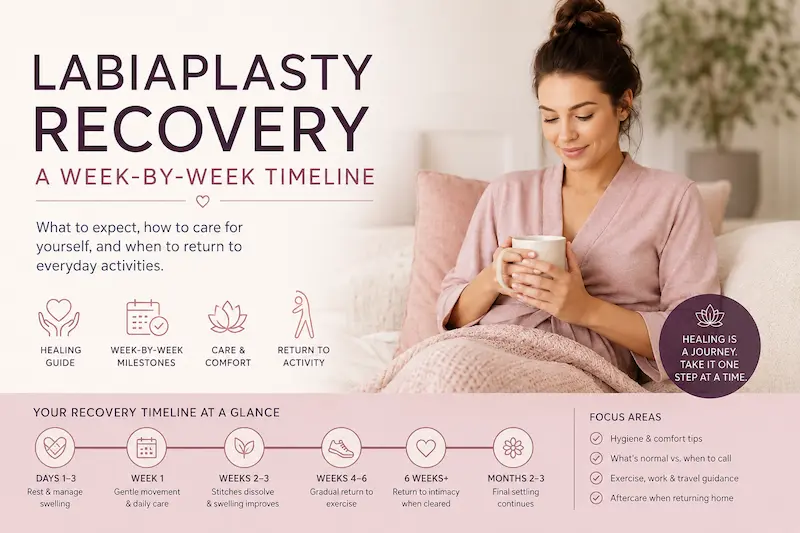
Most labiaplasty recovery follows a steady pattern: the first few days bring the most swelling, week one is about rest and gentle walking, weeks two to three bring visible settling, and most patients wait until around six weeks before sexual activity. Final softening can continue for several months.
Labiaplasty recovery is usually more manageable when you know what each stage is supposed to feel like. The area is delicate, swelling can look uneven, and healing often feels slower than it looks from the outside. That does not mean something is wrong.
This guide walks through the timeline in a discreet, clinical way. It focuses on swelling, dissolving stitches, hygiene, clothing, work, exercise, and sexual activity — not a full technique catalogue. For the procedure itself, start with AKM’s labiaplasty procedure.
For Canadian patients considering surgery in Istanbul, the recovery plan also needs to answer a practical question: what should be settled before you fly home? A good plan should include written aftercare instructions, virtual follow-up, warning signs, and a clear point of contact if your healing changes once you are back in Canada.
Table of Contents
What to Expect Right After Surgery
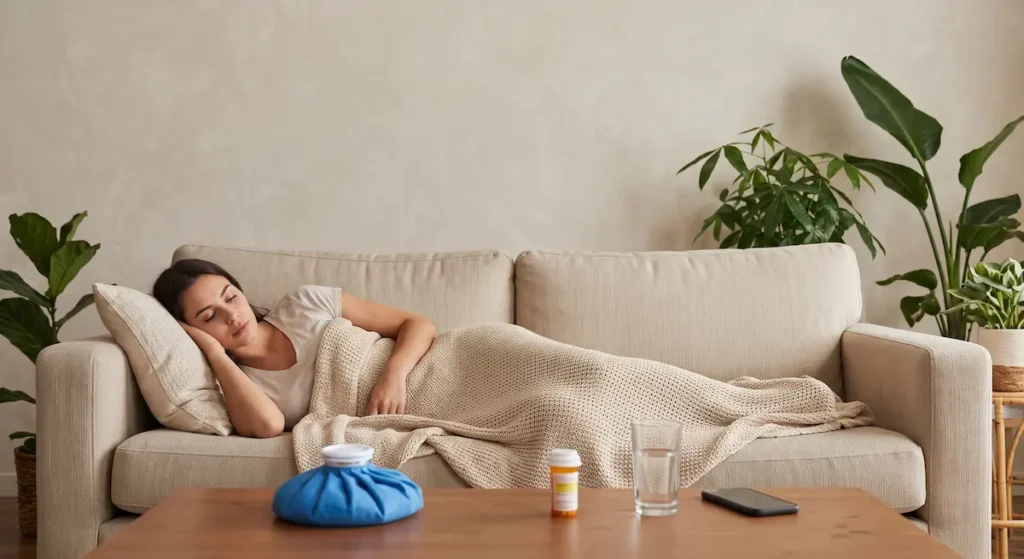
The first 24 to 72 hours are usually the most noticeable part of recovery. Swelling is expected. Mild bleeding, tenderness, bruising, and a tight or “too swollen” appearance can also happen early. The key is not to judge the final result in this window.
Labiaplasty is performed on tissue that naturally has folds, movement, moisture, and friction. That means the early recovery rules are simple but important: keep pressure low, keep the area clean, wear loose clothing, and avoid rushing back into activity.
Anesthesia wear-off
Most patients feel groggy, sensitive, or mildly uncomfortable as anesthesia wears off. In Canada, patients often think in terms of “how soon can I get back to normal?” but the first day is not a productivity day. It is a rest day.
Your surgical team may recommend prescription medication, acetaminophen, or another pain plan based on your health history. Avoid adding over-the-counter medication, supplements, or topical products unless your surgeon has approved them. Small choices matter here.
Early swelling and discomfort
Swelling often peaks in the first few days. One side may look larger than the other. The colour may look more purple, red, or bruised than you expected. That can be normal, especially while the tissue is reacting to surgery and fluid shifts.
Cold packs can help, but they should be buffered through clothing or a soft barrier. Never place ice directly on the vulvar skin. Short, protected cold intervals are safer than prolonged direct cold, which can irritate the tissue.
Why technique affects recovery
Recovery can vary depending on the amount of tissue removed, whether the trim or wedge method was used, whether clitoral hood reduction was included, and how your tissue heals. This article stays focused on recovery milestones; for the technique decision itself, our labiaplasty treatment page explains how trim and wedge techniques differ.
Technique affects swelling patterns, incision placement, and where tension sits during healing. Still, the broad milestones are similar for many patients: rest first, walking next, gentle activity later, and intimacy only once the tissue is strong enough.
Week-by-Week Timeline
A week-by-week timeline helps you separate normal healing from red flags. The dates below are general ranges, not a promise. Your surgeon’s instructions should always override a generic timeline, especially if you had combined procedures or delayed wound healing.
The timeline also assumes there is no infection, wound separation, or significant bleeding. If your recovery feels like it is moving backwards instead of forward, that is worth flagging early.
| Recovery stage | What is healing | Activity usually allowed | Care tip |
|---|---|---|---|
| Days 1–3 | Peak swelling, bruising, tenderness, light spotting | Rest, short walks, washroom trips | Use loose clothing, protected cold packs, and a pad if needed |
| Week 1 | Swelling begins to settle; itching or tightness may appear | Desk work for some patients, gentle walking | Keep hygiene simple; avoid friction, cycling, swimming, and tampons |
| Weeks 2–3 | Dissolvable stitches loosen; incision lines may feel firm | More normal daily movement, if comfortable | Do not test the incision with stretching, sex, or intense exercise |
| Weeks 4–6 | Scars strengthen; swelling is much lower but not fully gone | Gradual exercise return if cleared; intimacy often waits until around 6 weeks | Ask for clearance before intercourse, cycling, running, or swimming |
| Months 2–3 | Tissue softens; shape becomes more natural | Most routines, if healing is uncomplicated | Expect continued subtle settling rather than a sudden “final” day |
Days 1–3: peak swelling and rest
The first three days are usually the most swollen. The area may feel heavy, tight, or tender when you stand. Walking to the washroom is fine, but long errands, workouts, and social plans should wait.
Light spotting can happen. A pad is usually more comfortable than anything inserted internally. Tampons should be avoided until your surgeon specifically clears them, because early friction can disturb the incision line.
Sleep with pressure off the area as much as possible. Loose cotton underwear or no underwear under loose bottoms may be more comfortable, depending on your surgeon’s preference. Simple is better.
Week 1: desk work, walking, and early settling
By the end of the first week, many patients feel noticeably better. Swelling, itching, and soreness often start to calm. That said, better does not mean healed.
If your work is mostly desk-based, you may be able to return within about a week. If your job involves standing all day, lifting, uniforms that rub, or long commuting, you may need more time or modified duties.
For Canadian patients travelling home after surgery, this is the stage where aftercare clarity matters. Before leaving Istanbul, confirm your follow-up schedule, what photos to send if asked, what symptoms are urgent, and whether your surgeon wants you to avoid long walking days after arrival.
Weeks 2–3: dissolving stitches and less swelling
Weeks two and three can feel awkward. You may feel much more normal, but the tissue may still look uneven or feel firm. Dissolvable stitches may loosen, tiny knots may irritate, and the incision line can feel slightly raised.
Do not pull at stitches. Do not scrub the area. If a stitch feels sharp or catches on clothing, ask your surgical team what to do rather than trimming it yourself.
The American Society of Plastic Surgeons notes that dissolvable stitches used in this area are often gone by about three to four weeks, and that scar tissue can feel firm before softening over several months. You can read their recovery benchmark here: ASPS guidance on returning to activity after labiaplasty.
Weeks 4–6: exercise first, intimacy later
Weeks four to six are when many patients start asking: “Can I work out now?” The answer depends on the incision, swelling, discomfort, and your surgeon’s exam. A short walk and a spin class are not the same stress on healing tissue.
Low-impact movement may be cleared before higher-friction activity. Cycling, running, swimming, hot yoga, heavy lifting, and sexual activity usually need a more cautious timeline because they add pressure, moisture, stretching, or friction.
Sexual activity is commonly delayed until around six weeks or later, depending on healing. Some patients need longer. Waiting can be frustrating, but it protects the incision while scar strength is still developing.
Months 2–3: final settling begins
By months two and three, the labia usually look less swollen and more like the intended result. The tissue may still soften over time, and small differences between sides can continue to settle.
This is also when many patients stop thinking about recovery every day. That is a good sign. Still, if pain, thick discharge, a new opening, or worsening asymmetry appears after a period of improvement, contact your surgeon.
Healing is not a race. A smooth labiaplasty recovery usually comes from respecting each milestone, not forcing the next one because the surface looks better.
Hygiene, Clothing & Comfort
Good aftercare is not complicated, but it does need consistency. The goal is to keep the area clean, reduce friction, and avoid anything that traps moisture or puts pressure on the incision line. Small daily habits can make recovery feel much calmer.
During labiaplasty recovery, comfort is also a safety signal. If a garment, product, or activity increases stinging, pulling, or swelling, it is usually too much too soon.
Keeping the area clean
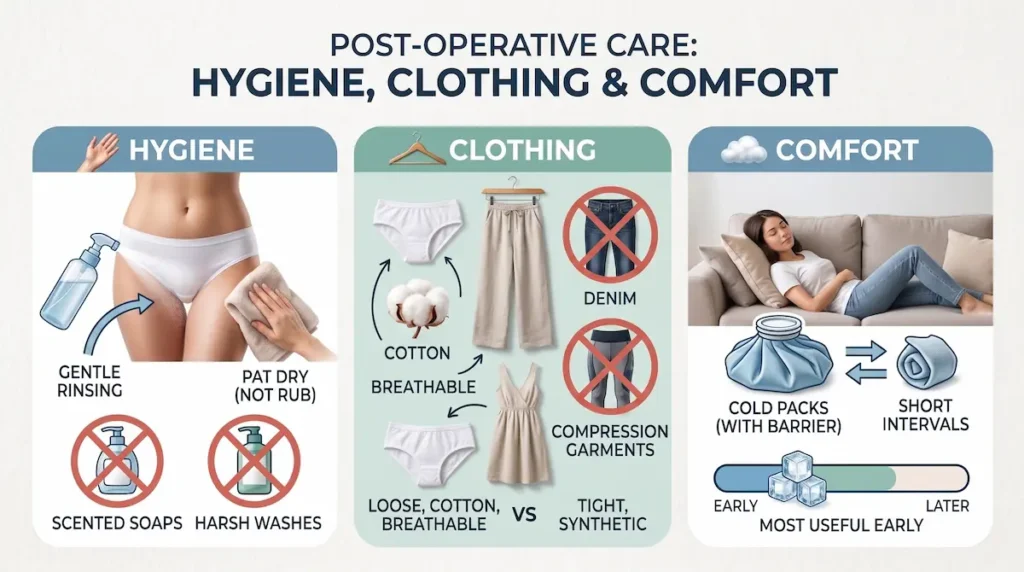
Your surgeon may recommend gentle rinsing after using the washroom, especially in the first week. Pat dry rather than rubbing. Avoid scented soaps, vaginal washes, exfoliants, antiseptic sprays, and home remedies unless your surgical team specifically recommends them.
Clean does not mean over-cleaned. The tissue needs a stable healing environment, and too much product can irritate the skin. Warm water and surgeon-approved care are usually enough.
Loose cotton clothing
Loose cotton underwear, soft trousers, and breathable sleepwear help reduce rubbing. Tight leggings, denim, compression garments not prescribed for this area, and synthetic underwear can create friction at exactly the wrong time.
Many patients feel best in loose clothing for the first few weeks, even if they are technically back at work. Sitting for long periods may still feel tender, so a lighter schedule or the option to stand and walk briefly can help.
Cold packs done safely
Cold packs can reduce early discomfort, but they should be used carefully. Wrap them in a soft cloth and use short intervals. Direct ice can irritate the skin and may cause more discomfort rather than less.
Cold is most useful early. Later in recovery, ongoing swelling is usually better managed by reducing friction, resting when needed, and following the activity limits your surgeon has set.
What’s Normal vs Worth Flagging
Not every uncomfortable symptom is a complication. Swelling, asymmetry, bruising, itching, firmness, and a strange-looking shape can all be part of normal healing. The question is whether symptoms are improving, staying stable, or getting worse.
A useful rule: normal healing tends to move in the right direction, even if slowly. A sudden change, new odour, increasing pain, or tissue that looks darker rather than better should be taken seriously.
Normal swelling and asymmetry
One side may swell more than the other. The incision line may look raised. The colour may shift from red or purple to yellowish bruising before fading. These changes can be unsettling, but they are often temporary.
Swelling also changes during the day. You may look more settled in the morning and puffier after walking, sitting, or travelling. For a deeper swelling-only guide, see how labiaplasty swelling progresses.
Common side effects to expect
Temporary itching, tightness, tenderness, mild spotting, and uneven swelling are common during early healing. Some patients also feel emotionally impatient around week two because the pain is lower, but the area still does not look final.
That mismatch is normal. You may feel ready before the tissue is ready.
Signs to contact your surgeon
Contact your surgeon if you notice worsening pain, spreading redness, pus-like discharge, a strong or unpleasant odour, fever, heavy bleeding, a new opening in the incision, or tissue that appears dark, grey, or black. Do not wait for these symptoms to “settle.”
For Canadian patients, this is why a written aftercare plan matters before leaving Turkey. Government of Canada travel guidance warns that patients returning from medical care abroad may need clear records and aftercare information so local providers can understand what was done if a problem appears at home.
Poor-result red flags
Early swelling can mimic asymmetry, so most patients should not judge the result in the first few weeks. However, persistent wound separation, worsening distortion, severe scarring, or a shape that becomes more uncomfortable over time should be reviewed.
This article does not cover poor outcomes in depth. If you are unsure whether a change is part of normal healing, ask your surgical team to review it.
| Sign | Often normal? | When to act |
|---|---|---|
| Uneven swelling | Yes, especially early | Ask your surgeon if it worsens suddenly or remains very one-sided |
| Itching near stitches | Often normal | Do not scratch; contact your team if there is rash, discharge, or worsening redness |
| Light spotting | Can be normal early | Seek advice for heavy bleeding or bleeding that increases after improving |
| Odour or pus-like discharge | No | Contact your surgeon promptly |
| Dark, grey, or black tissue | No | Contact your surgeon urgently |
Canada aftercare note: Before flying home, ask for written instructions, your procedure summary, medication details, warning signs, and the virtual follow-up schedule. This is especially important for patients returning to Canada after elective surgery abroad.
Getting Back to Activity Safely
Activity return should be gradual. The tissue may look closed before it is strong enough for friction, stretching, sweat, cycling, or sex. The safest timeline is based on healing, not just the calendar.
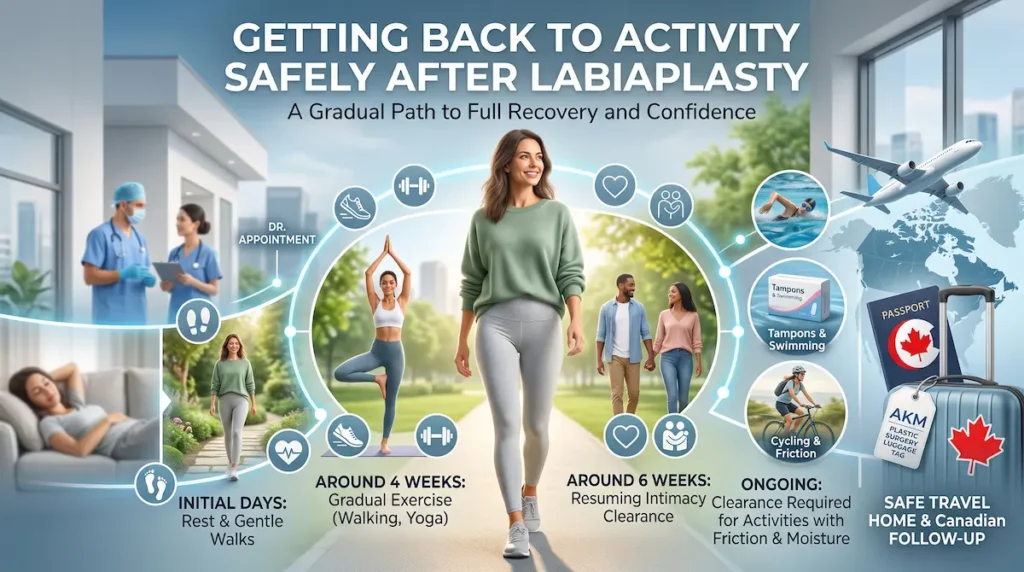
Most patients can do light walking early, build daily movement slowly, and wait for surgeon clearance before exercise and intimacy. This is where patience protects the result.
Exercise around four weeks
Gentle walking is usually encouraged early because it supports circulation and reduces stiffness. More intense exercise is different. Running, heavy lifting, lower-body training, cycling, and hot yoga can increase pressure and friction.
Many patients begin a gradual return to exercise around four weeks if healing is uncomplicated. Some need longer. If swelling increases after activity, scale back and tell your surgeon at follow-up.
Sex around six weeks
Sexual activity is often delayed until around six weeks, and sometimes longer. The issue is not only discomfort. Friction can irritate the incision line, increase swelling, and risk small wound openings if tissue strength is not ready.
When you are cleared, restart gently. Stop if there is sharp pain, bleeding, pulling, or swelling that feels worse afterwards. Healing confidence should build over time.
Tampons, swimming, and cycling
Tampons, swimming, baths, and cycling usually need extra caution because they involve moisture, pressure, insertion, or friction. Your surgeon may clear these at different points depending on your incision and healing progress.
Do not use a tampon just because bleeding has stopped. Do not swim because the skin “looks closed.” Clearance matters.
Flying home and recovery in Canada
If you are travelling from Istanbul back to Canada, plan the return around comfort and follow-up, not just flight availability. Long airport walks, lifting luggage, sitting for hours, and changing time zones can make swelling feel worse.
Before departure, confirm whether you should wear loose clothing for the flight, how often to walk during travel, what medication schedule to follow, and when to send follow-up photos. A discreet surgery still deserves a serious travel recovery plan.
Cost questions belong on the cost page
Recovery planning often leads to budget planning, especially for Canadian patients arranging time off work and travel. This article will not open a pricing table because its focus is healing. For that separate decision, use labiaplasty cost in CAD.
What to confirm with your surgical team: Ask how aftercare is handled after you return to Canada, when you can exercise, when sexual activity is allowed, what symptoms require urgent review, and how follow-up photos should be sent.
If you are comparing options, AKM’s board-certified plastic surgery team can review your recovery plan, travel timing, and aftercare needs during a virtual consultation. The goal is not to rush the process. It is to make every recovery milestone clear before surgery.
Frequently Asked Questions: Labiaplasty Recovery
These answers summarize the main recovery milestones. They are not a replacement for your own surgeon’s instructions, especially if you had a combined procedure, delayed healing, or a medical condition that affects wound repair.
How long is labiaplasty recovery?
Swelling and tissue firmness can continue to settle for several months. Cleveland Clinic notes that swelling may improve greatly by six weeks, while final settling can take longer.
When can I work out after labiaplasty?
High-friction activities need more caution. Running, cycling, swimming, heavy lifting, and hot yoga can irritate healing tissue even if you feel well.
When can I have sex after labiaplasty?
When you restart, go slowly. Stop if there is sharp pain, bleeding, pulling, or increased swelling afterward.
When do stitches dissolve?
Do not pull at stitches, even if they feel irritating. If a stitch catches on clothing or feels sharp, ask your surgical team what to do.
Can I use tampons during labiaplasty recovery?
Wait until your surgeon clears tampon use. The same caution applies to intercourse, swimming, baths, and cycling.
When does swelling go down?
Some swelling can remain for months, especially after activity or travel. That is why the final result should not be judged too early.
What warning signs should I not ignore?
A 2024 systematic review of labiaplasty outcomes found generally high satisfaction and low complication rates, but complications such as swelling, bleeding, hematoma, wound separation, and infection still require proper monitoring.
What should Canadian patients confirm before flying home?
You should also keep your procedure summary and medication list accessible during travel. If you need care after returning home, clear documentation helps a local provider understand what was performed.
Final Thoughts
Labiaplasty recovery is usually straightforward when the timeline is respected. The first few days are for swelling control and rest. Week one is for gentle movement and careful hygiene. Weeks two and three bring more comfort, but the incision is still healing. Weeks four to six are about gradual activity return, not testing limits.
For Canadian patients, the safest plan is one that includes both the surgical recovery and the return-home period. Ask clear questions before surgery. Know your warning signs. Keep follow-up structured.
AKM’s board-certified plastic surgery team can help you review your recovery timeline, travel schedule, and aftercare plan during a virtual consultation.
Medical disclaimer: This article is for educational purposes only and is not medical advice. Recovery timelines vary by anatomy, surgical technique, medical history, and aftercare. Always follow the instructions of your qualified healthcare provider or surgeon.
Related Procedures




Ready to Begin Your Journey?
Join the more than 2,000 patients who have trusted Dr. Akif Mehmetoğlu and the AKM Clinic team. Your journey begins with an informative, no-obligation conversation. Contact us today from across Canada to schedule your complimentary virtual consultation.
#1: Receive Your Personalized Quote
Start with a complimentary, no-obligation virtual consultation. Share your photos, and our surgical team will provide a fully personalized treatment plan and a transparent, all-inclusive pricing package quoted in Canadian dollars (CAD). There are no hidden fees.
#2: Secure Your Procedure Date
Once you are ready to proceed, our dedicated English-speaking patient coordinators will help you secure your procedure date. We will manage your logistical bookings in Istanbul, including your five-star hotel and private airport transfers.
#3: Arrive in Istanbul & Meet Your Surgeon
Arrive at Istanbul Airport (IST), where you will be greeted by your private driver. Settle into your hotel before your comprehensive in-person consultation. You will meet your specialist surgeon to finalize the details of your procedure and ensure your goals are aligned for a natural, subtle result.