
Buccal Fat Removal and Your Smile: Avoiding an Overdone Look
AI Summary
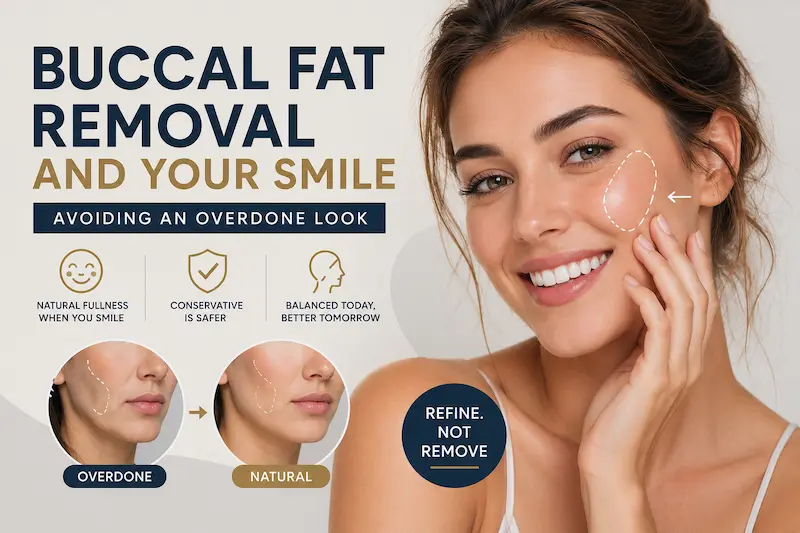
- Buccal fat removal smile results should refine cheeks while preserving natural expression.
- Conservative removal lowers the risk of hollow, gaunt, or overdone cheeks.
- Smile-safe planning evaluates cheek volume, facial motion, age, and anatomy before surgery.
- Recovery settling takes time, so final smile changes should not be judged too early.
Summary generated by AI, fact-checked by our medical experts
A good buccal fat removal smile result should look refined, not hollow. The goal is to soften lower-cheek fullness while preserving natural movement when you smile. Over-removal can make the cheeks look sunken, tight, or older than intended, especially in people with already slim faces.
Buccal fat removal is not just about creating sharper cheekbones. It changes the soft-tissue balance of the midface and lower cheek, which means it can affect how your face looks both at rest and in motion.
That is why conservative planning matters. At AKM Clinic, the goal is not a pulled, overly sculpted, or “operated-on” look. The philosophy is Natural-First: refine the face while protecting expression, proportion, and long-term facial harmony. You can learn more about how AKM approaches buccal fat removal before comparing this procedure with other facial contouring options.
This guide focuses on one specific concern: your smile. It explains how buccal fat supports the cheek during expression, what an overdone result can look like, and why removing less is often the safer aesthetic choice.
Table of Contents
How Buccal Fat Shapes Your Smile
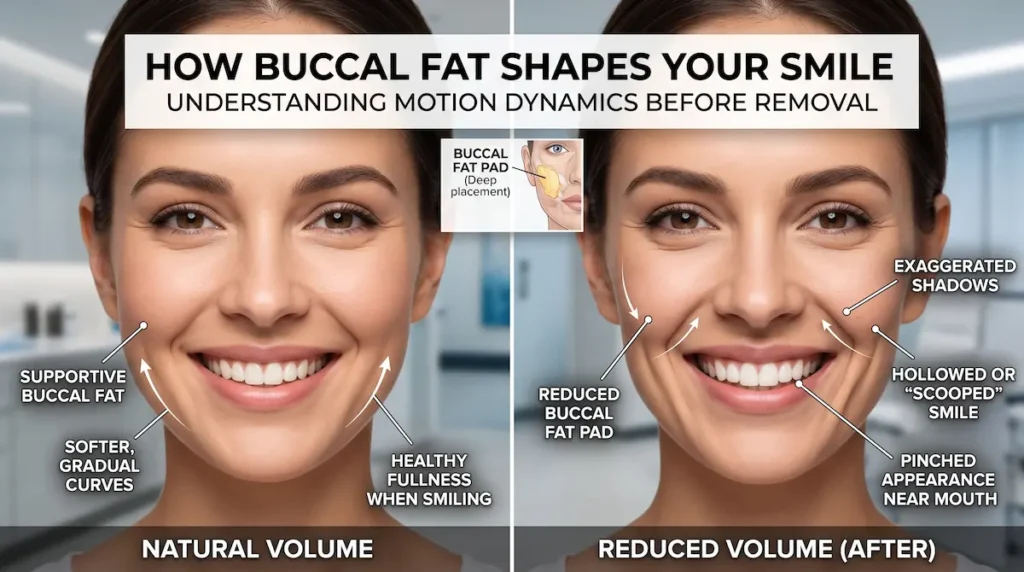
Your smile is not created by the lips alone. The cheeks lift, the corners of the mouth pull outward, and the midface soft tissue shifts upward. Buccal fat sits deep in the lower cheek, so even though it is not a “smile muscle,” it helps shape the fullness around the mouth when the face moves.
That is why the same amount of fat removal can look subtle on one person and too sharp on another. A rounder face with true lower-cheek fullness may tolerate a conservative reduction well. A narrow face may lose the small amount of softness that was keeping the smile balanced.
Where the buccal fat pad sits
The buccal fat pad is a deep pocket of fat in the lower cheek, below the cheekbone and near the area that rounds out the midface. It is accessed from inside the mouth, which is why the procedure does not create a visible facial scar.
Johns Hopkins describes buccal fat removal as an elective cosmetic procedure that removes all or part of the lower-cheek fat pad to narrow the lower face and emphasize the cheekbones and jawline. That general contouring effect is real, but it is not the same as simply “sharpening” the face without trade-offs. An overview of how buccal fat removal works is helpful for understanding the anatomy before focusing on smile changes.
Because the fat pad has volume, it contributes to the transition between the cheekbone, the lower cheek, and the corner of the mouth. Remove too much, and that transition can become abrupt.
Its role in a full vs hollow cheek
A full cheek is not automatically a problem. In many faces, soft lower-cheek volume makes the smile look healthy, youthful, and relaxed. The issue is not fullness itself; it is whether the fullness is out of proportion with the cheekbone, jawline, and overall facial width.
Conservative buccal fat removal aims to reduce the “puffy” lower-cheek effect without taking away all support. Think of it as adjusting shadow, not carving a hollow. The best result should still look like your face, just with cleaner lower-cheek definition.
A hollow cheek behaves differently. When you smile, the skin and soft tissue pull across a less-supported area. This can exaggerate shadows beside the mouth, make the midface look tighter, or create a drawn look that was not visible in relaxed photos.
What changes when you smile
At rest, a slightly sharper cheek may look attractive in photos. In motion, the same cheek can reveal whether too much volume has been removed. A natural smile has movement, softness, and gradual curves.
Over-resection can make the cheek look flat or scooped when the smile widens. In some cases, the area beside the mouth can look pinched, especially under bright light or side lighting. This is the “gone wrong buccal fat removal smile” concern many patients search for after seeing overly hollow celebrity or social media results.
The safest planning starts with a moving face assessment, not a single still image. A surgeon should evaluate your face while you smile, speak, and relax. A cheek that looks full in one selfie may be providing needed support in real life.
What “Overdone” Looks Like
An overdone buccal fat removal result usually does not look overdone because the incision is visible. It looks overdone because the cheek no longer matches the rest of the face. The lower cheek may look too hollow, the smile may appear less soft, or the face may look older than the patient expected.
This section is intentionally direct. Skeptical patients are right to ask what can go wrong, because the buccal fat pad does not behave like temporary filler. Once too much fat is removed, restoring natural fullness can be difficult and often requires a different corrective strategy.
The gaunt or sunken look
The most common overcorrection concern is a gaunt cheek. Instead of a refined contour, the face looks depleted. The cheekbone may appear sharper, but the lower cheek can look sunken or tired.
This risk is higher when the patient did not have enough true buccal fullness to begin with. A naturally narrow face, a low body-fat percentage, or early facial hollowing can all make the same procedure more aggressive in effect.
ASPS has cautioned that facial fat is valuable and that overly aggressive buccal fat removal can backfire as the face ages. The warning is not anti-procedure; it is pro-judgment. Why surgeons warn against aggressive buccal removal is exactly the point patients should understand before choosing a more dramatic reduction.
Why it shows more when smiling
A hollow cheek may be subtle at rest. Smiling can make it more obvious because the cheek tissues lift and tighten. If there is not enough soft-tissue volume left in the lower cheek, the smile can look sharper than intended.
This does not mean buccal fat removal “ruins” every smile. It means facial movement must be part of the plan. The surgeon should not only ask what you want your cheekbones to look like in a front-facing photo; they should also ask how natural you want your face to look in conversation, laughter, and side angles.
For most patients, the better goal is controlled definition. A face that still has softness when smiling tends to age better and look less obviously treated.
Why it can worsen over time
Facial fat naturally changes with age. The cheeks often lose volume, the skin becomes less elastic, and shadows deepen. If the buccal fat pad was removed too aggressively, those normal aging changes can make the lower face look even more hollow later.
This long-term issue is related to, but separate from, the smile-specific overcorrection concern covered here. For a deeper look at the decade-later aging question, see our guide on how aggressive removal ages the face.
The key point is simple: the buccal fat decision should be made for your future face, not only your current photo goals. A conservative result may look less dramatic in the first month, but it often gives the face more room to age naturally.
How Much Removal Is Safe?
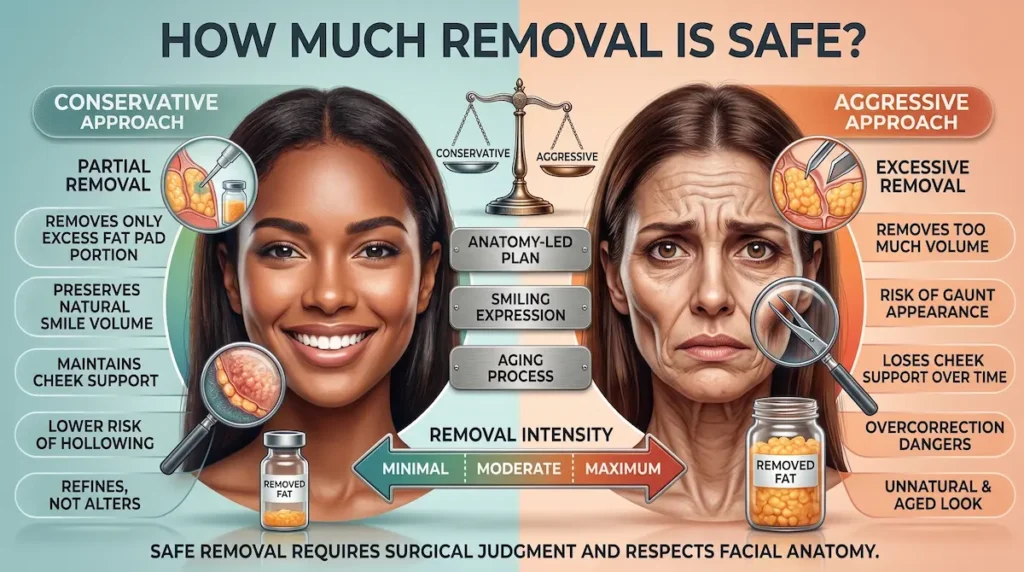
There is no universal “safe amount” of buccal fat that applies to every face. Safe removal depends on cheek fullness, facial width, age, skin quality, and how the cheeks move when you smile. The right plan is usually conservative, anatomy-led, and designed to leave enough volume for a natural expression.
This is where surgical judgment matters more than trends. A dramatic cheek hollow may photograph well from one angle, but the face has to work in real life: smiling, laughing, speaking, and aging.
Conservative vs aggressive resection
Conservative resection means removing only the portion of buccal fat that is clearly contributing to lower-cheek heaviness. The surgeon does not chase the deepest possible hollow. They stop while the cheek still has support.
Aggressive resection does the opposite. It removes too much volume in pursuit of a sharper contour. That may create immediate definition, but it also raises the risk of buccal fat removal overcorrection, especially when the patient’s natural face is already slim.
The difference is not only technical. It is aesthetic. Conservative planning asks, “How do we refine this face?” Aggressive planning asks, “How much can we remove?” Those are very different questions.
| Resection Approach | Effect on Smile and Cheek | Over-Time Risk |
|---|---|---|
| Minimal or partial removal | Softens lower-cheek fullness while preserving natural smile volume | Lower risk of hollowing if the patient is well selected |
| Moderate conservative removal | Creates visible cheek definition without a sharply scooped look | Balanced risk when planned around facial anatomy and age |
| Aggressive removal | Can make the cheek look hollow, tight, or overly carved when smiling | Higher risk of gauntness, especially as natural facial volume decreases |
| Removal in a naturally lean face | May exaggerate shadows beside the mouth rather than improve contour | High risk of an overdone or prematurely aged appearance |
Why surgeons leave a margin
A careful surgeon does not remove buccal fat simply because it is present. The buccal fat pad is a normal facial structure, not a flaw. Leaving a margin protects the cheek from looking empty.
This is especially important because the result must be judged after swelling settles. Early swelling can hide how much volume has been removed. A patient may not see the true contour for weeks or months, which is why “just take a little more” is not a safe mindset during planning.
At AKM Clinic, this is where the Natural-First philosophy becomes practical. The goal is refinement over alteration. A good result should not announce the procedure; it should make the face look more balanced without making the smile look less like you.
Partial removal philosophy
Partial removal is often the more elegant approach because it respects the cheek’s role in expression. Instead of hollowing the cheek completely, the surgeon reduces selected fullness while keeping enough volume to support movement.
This approach is particularly important for patients who want a subtle, natural result. A small change in the lower cheek can make the cheekbone look more defined without creating a harsh line beside the mouth.
It also gives the face more long-term flexibility. Since aging naturally changes facial fat and skin support, preserving some softness can help the result remain balanced over time.
Surgeon-led note: With buccal fat, restraint is not hesitation. It is protection. The safest aesthetic plan removes only what the face can afford to lose while preserving a natural smile, natural cheek movement, and enough volume for the years ahead.
Who’s at Higher Risk of Overcorrection?
Not every patient carries the same risk. Buccal fat removal tends to be more forgiving in genuinely round faces with lower-cheek fullness and good skin elasticity. It becomes riskier when the face is already narrow, the cheeks are already hollow, or the patient is chasing a highly sculpted look that does not match their anatomy.
This section is the part many marketing pages soften. It should not be softened. Some patients are better served by skipping buccal fat removal, choosing a different facial contouring plan, or waiting until their face matures.
Already slim or narrow faces
A slim face does not have much excess volume to spare. If the cheek is already narrow, removing buccal fat can deepen shadows rather than improve definition. The result may look sharper, but not necessarily better.
This is also why weight loss history matters. A patient who recently lost weight may still be adjusting to a new facial shape. Removing deep cheek fat too soon can compound facial thinning and make the lower face look depleted.
A narrow face with a strong cheekbone may need no buccal fat removal at all. In some cases, the issue is not cheek fullness but jawline, chin balance, skin laxity, or lighting in photos.
Older patients or early facial hollowing
Age is not an automatic disqualifier, but it changes the risk calculation. As the face matures, volume loss becomes more visible. Removing deep cheek fat in a face that is already beginning to hollow can make aging signs more noticeable.
Patients in their late 30s, 40s, and beyond need a particularly careful assessment. The question is not only “Will this look good now?” It is also “Will this still look balanced as the cheeks continue to change?”
For some patients, facial rejuvenation or skin-support planning may be more appropriate than fat removal alone. For men, the risk profile can also differ because masculine definition should look angular, not gaunt; that distinction is covered in more detail in our guide to conservative resection in men.
Unrealistic “chiseled” goals
The highest-risk patient is not always the oldest or thinnest patient. Sometimes it is the patient with the most unrealistic reference photos. A heavily contoured, filtered, or celebrity-inspired cheek hollow is not a surgical plan.
Buccal fat removal can reduce lower-cheek fullness. It cannot change bone structure, create a new jaw, or guarantee a permanent camera-ready shadow. If the requested result depends on extreme hollowing, the safer answer may be no.
This is where a strong consultation should feel honest, not flattering. A surgeon should be willing to explain when the procedure is likely to help, when it is likely to be too subtle, and when it could create overdone cheeks that are difficult to correct.
At AKM, that discussion is especially important for international patients who are planning surgery away from home. European Board-Certified Surgeons working to an ABPS-equivalent standard should be expected to discuss conservative resection, facial movement, and long-term balance before surgery is confirmed.

Protecting Your Result
The best way to protect your smile is to make the plan conservative before surgery, not corrective afterward. Buccal fat removal should be judged by balance: how the cheeks look at rest, how they move when smiling, and how the result may age as facial volume naturally changes.
A safe plan also respects what the procedure can and cannot do. Buccal fat removal can reduce lower-cheek fullness. It cannot guarantee a celebrity cheek hollow, replace jawline surgery, or create the same result in every face.
Choosing a conservative surgeon
A conservative surgeon should evaluate your face in motion, not only in still photos. They should look at your cheek fullness, facial width, age, skin elasticity, and smile pattern before recommending any amount of removal.
For US patients considering surgery abroad, surgeon credentials matter. Look for European Board-Certified Surgeons using an ABPS-equivalent standard, not vague cosmetic titles. The consultation should include a clear discussion of overcorrection, asymmetry, facial aging, and what happens if the safest answer is to remove very little.
At AKM Clinic, buccal fat removal is planned around a Natural-First approach: refinement over alteration. The goal is not the most hollow cheek possible. The goal is a face that still looks natural when you smile.
What to ask in consultation
Bring relaxed photos, smiling photos, and side-angle photos to your consultation. Do not rely only on filtered images or heavily contoured reference photos. Your surgeon needs to see how your natural cheek volume behaves.
- Ask whether your cheek fullness is truly buccal fat or whether it comes from overall facial fat, skin laxity, jaw structure, or masseter shape.
- Ask how much fat they plan to remove and whether partial removal is safer for your anatomy.
- Ask how your smile may change when swelling settles and the lower cheek becomes more defined.
- Ask whether your face is already at risk of hollowing because of age, low body fat, or narrow facial structure.
- Ask what they would recommend if you want a sharper jawline but are not a good buccal fat removal candidate.
Cost is a separate planning question, not the focus of this article. If you are comparing treatment planning with budget, review the cost of buccal fat removal rather than trying to estimate it from a smile-risk article.
Recovery and settling
Early swelling can temporarily hide the final contour. This matters because a result that looks soft in the first days may become more defined as swelling resolves. Patience is part of judging the outcome accurately.
Most patients should avoid judging the final smile too early. The cheeks need time to settle, and the tissues inside the mouth need time to heal. For a step-by-step recovery timeline, see our buccal fat removal page.
It is also useful to think about the smile area as a whole. Buccal fat removal affects the cheek beside the mouth, while procedures such as lip lift surgery affect a different part of the smile frame. If you are comparing smile-area procedures, treat them as separate decisions rather than mixing them into one.
Ask AKM how conservative buccal resection protects your smile in a consultation. A careful plan should explain not only what can be removed, but what should be preserved.
Frequently Asked Questions: Buccal Fat Removal Smile
These questions focus on smile changes and overcorrection. They do not replace a face-to-face examination, but they can help you prepare for a more useful consultation.
Can buccal fat removal ruin your smile?
The concern is usually not muscle damage. It is loss of soft-tissue support. If the lower cheek becomes too hollow, the smile can look sharper, tighter, or less natural than expected.
How much buccal fat removal is too much?
A conservative or partial removal plan is often safer than aggressive removal. The goal should be lower-cheek balance, not the deepest possible shadow.
Can overcorrection be reversed?
This is why choosing a conservative plan from the beginning is so important. It is easier to preserve natural cheek support than to rebuild it after excessive removal.
Will I look gaunt later?
That does not mean every patient will age poorly after buccal fat removal. Patients with true lower-cheek fullness and a conservative plan may maintain a balanced result. The key is patient selection.
Am I a high-risk candidate?
A strong consultation should identify these issues before surgery. If the surgeon cannot explain why you are a good candidate, you should pause.
How do I avoid an overdone look?
The safest aesthetic principle is simple: remove less than the face can afford to lose. A natural result should still have softness, movement, and proportion.
Medical disclaimer: This article is for educational purposes only and is not medical advice. Buccal fat removal results vary by anatomy, age, healing, and surgical planning. Always consult a qualified physician or surgeon before making decisions about cosmetic surgery.
Related Treatments


Ready to Start Your Own Transformation Journey?
Join the 2,000+ patients who trusted Dr. Akif Mehmetoğlu and the AKM Clinic team. Your journey to a more confident, revitalized you begins with a simple, no-obligation conversation. Contact us today from the USA for your free virtual consultation.
#1: Get Your Free Personalised Quote
Start with a free, no-obligation online consultation. Share your photos, and our surgical team will provide a fully personalised treatment plan and a transparent, all-inclusive price package. No hidden fees.
#2: Secure Your Date & VIP Booking
Once you're ready, our dedicated patient coordinators will help you secure your procedure date. We'll handle all your bookings, including your 5-star hotel and private VIP airport transfers.
#3: Arrive in Istanbul & Meet Your Surgeon
Arrive at Istanbul Airport (IST) and be greeted by your private driver. Settle into your hotel and prepare for your in-person consultation, where you'll meet your specialist surgeon to finalise the details for your "natural, subtle, and revitalized" new look.