
Labiaplasty Swelling: What's Normal and When It Settles
AI Summary
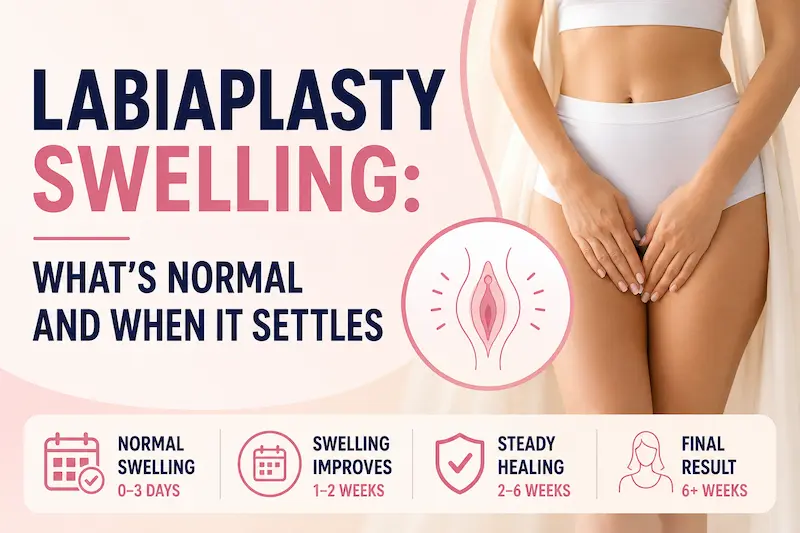
- Labiaplasty swelling peaks early, then usually improves over two weeks and settles near six weeks.
- Uneven swelling is common; one side may drain slower before the final result appears.
- Warning signs need prompt attention: worsening pain, heat, redness, discharge, odour, fever or chills.
- Safe recovery planning includes gentle aftercare, virtual follow-up and dedicated CAD cost guidance.
Summary generated by AI, fact-checked by our medical experts
Labiaplasty swelling is a normal, expected part of healing. It usually peaks in the first 2–3 days, improves noticeably over the first two weeks, and continues settling through about six weeks. Subtle swelling can last longer, and one side may look more swollen than the other early on.
That early unevenness can be unsettling, especially when the area is private and hard to assess objectively. But swelling does not show the final result. The labial tissue has a rich blood supply, delicate lymphatic drainage, and fine incisions that need time to calm down after surgery.
This guide focuses only on swelling: why it happens, what the usual labiaplasty swelling timeline looks like, why temporary asymmetry is common, how to reduce swelling safely, and when swelling becomes a warning sign. For the broader week-by-week healing plan, see the complete labiaplasty recovery timeline.
If you are researching how labiaplasty is performed at AKM, it helps to understand that swelling is not a complication by itself. It is part of tissue repair. The key is knowing the difference between normal swelling that improves and swelling that gets worse, feels hot, smells unusual, or comes with increasing pain.
Clinical note: Early asymmetry after labiaplasty is usually swelling, not the final shape. A board-certified plastic surgery team will normally judge the result after the tissue has softened, the incisions have matured, and both sides have had time to settle.
Table of Contents
Why Swelling Happens After Labiaplasty
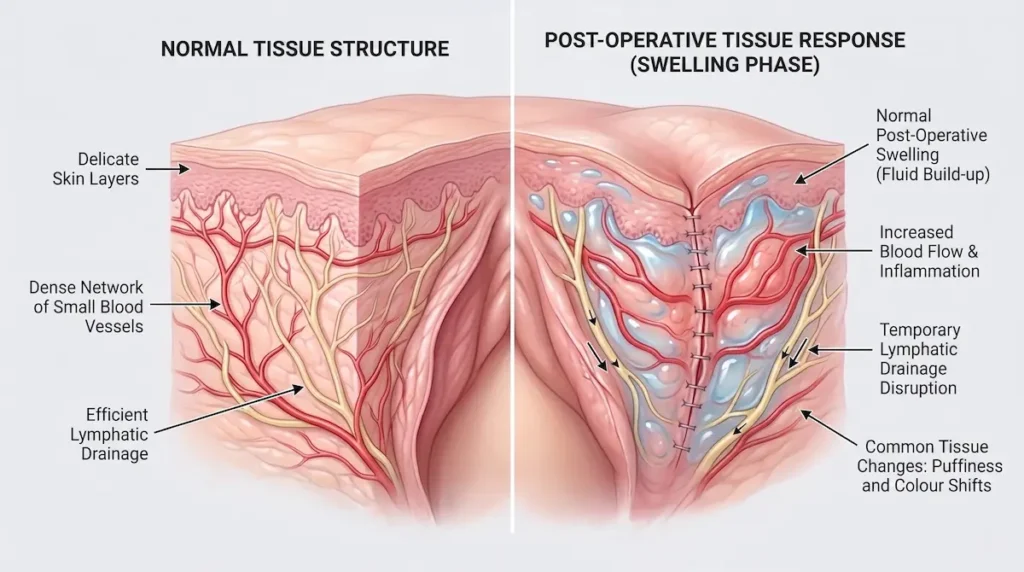
Swelling happens because labiaplasty is performed on delicate, highly vascular tissue. Even when the surgical plan is conservative and the closure is meticulous, the body still responds to tissue handling with temporary fluid build-up, inflammation, and increased blood flow to the healing area.
The area is rich in blood supply and lymphatic drainage
The labia are not like thicker skin on the abdomen or thigh. The tissue is thin, mobile, and supplied by many small blood vessels. That is helpful for healing, but it also means the area can swell quickly after surgery.
Lymphatic drainage also matters. Lymph vessels move excess fluid out of the tissue, but surgery temporarily disrupts that normal flow. When the lymphatic system slows down, fluid collects. This is why the area can look fuller, firmer, or puffier than expected in the first few days.
Swelling can also make the colour of the tissue look different. Mild bruising, pinkness, or a slightly darker tone can be part of early healing, especially when there is no spreading redness, fever, odour, or worsening pain.
Even gentle technique causes temporary edema
Some patients assume that swelling means the surgery was too aggressive. Not necessarily. Edema can occur even after careful surgery because the body is repairing an incision line and clearing normal post-operative fluid.
Technique still matters. A tissue-preserving approach, careful control of bleeding, and precise closure can reduce unnecessary trauma. But no responsible surgeon should promise a “no swelling” recovery. That would be unrealistic.
Published clinical data on labiaplasty recovery symptoms describe swelling, bruising, and pain as transient symptoms in a subset of patients, which supports the point that swelling is expected but should improve over time. You can review clinical data on labiaplasty recovery symptoms for broader context.
Why swelling often peaks in the first 48–72 hours
The first 48–72 hours are usually the puffiest phase. During this window, the body sends inflammatory cells and extra fluid into the treated area. The swelling may feel tight, tender, or uneven.
This is also when gravity and activity can make symptoms more noticeable. Standing for too long, sitting with pressure on the area, or wearing tight clothing can make the tissue feel more swollen by the end of the day.
For most patients, the peak does not mean something is wrong. A better sign is the direction of change. Normal swelling gradually softens, becomes less tender, and starts to look less dramatic after the first few days.
The Labiaplasty Swelling Timeline
The labiaplasty swelling timeline is not identical for every patient, but it usually follows a predictable pattern: strong early swelling, visible improvement in the first two weeks, steady settling through six weeks, and small refinements over the following months.
| Timeline | Expected Appearance | Is It Normal? | What to Do |
|---|---|---|---|
| Days 0–3 | Peak swelling, tenderness, possible mild bruising, uneven fullness | Usually normal if symptoms are not worsening sharply | Rest, use cold compresses only as directed, avoid pressure and tight clothing |
| Week 1–2 | Swelling begins to reduce; one side may still look fuller | Common | Continue gentle walking, hygiene instructions, and follow-up check-ins |
| Weeks 2–6 | Steady softening; tissue looks less puffy but not final | Expected | Avoid rushing exercise, intimacy, or friction until cleared by your surgeon |
| Six weeks and beyond | Most swelling has settled; subtle firmness or asymmetry may continue improving | Often normal if improving | Assess final shape later, not during early swelling |
Days 0–3 — peak swelling and tenderness
The first few days are usually the most dramatic. The labia can look swollen, bulky, or uneven, and the area may feel tender when sitting, walking, or changing position.
This phase can feel emotionally difficult because the early appearance may seem larger than before surgery. That is swelling, not the final result. The tissue is reacting to surgery, not showing its settled shape.
During these days, follow your surgical team’s instructions closely. Use cold packs only with a protective barrier if recommended, and never apply ice directly to the skin. Keep activity light. Short, gentle walks are different from errands, workouts, or long periods on your feet.
Week 1–2 — visible improvement begins
By the end of the first week, swelling often begins to look less intense. Tenderness usually improves too, although the area can still feel sensitive when clothing rubs or when you sit for too long.
This is also when uneven swelling after labiaplasty can become more obvious. One side may calm down faster than the other. That can happen because the two sides had different starting anatomy, different tissue tension, or slightly different drainage after surgery.
The goal at this stage is not to judge symmetry. It is to look for steady improvement. Swelling that is slowly decreasing is generally more reassuring than swelling that becomes hotter, more painful, more red, or associated with discharge.
Weeks 2–6 — steady settling
Between weeks two and six, swelling usually becomes less visible and less firm. The tissue starts to feel softer. Incision lines may still look pink or slightly raised, and the area can still react after activity.
This is the phase when many patients feel “mostly healed” but are not fully settled. That distinction matters. Feeling better does not mean the tissue is ready for friction, intense exercise, or intimacy before medical clearance.
If you are travelling back to Canada after surgery, this is where structured follow-up matters. Photo check-ins and clear symptom reporting help your team assess whether swelling is following the expected path.
Six weeks and beyond — subtle residual swelling
By around six weeks, most visible swelling has usually settled. The labia should look calmer and less puffy, but small areas of firmness, mild asymmetry, or sensitivity can continue to improve.
Final refinement often takes longer than patients expect. The tissue must soften, the scar line must mature, and lymphatic drainage must fully normalize. That is why a surgeon may wait several months before judging persistent asymmetry or discussing revision concerns.
At this stage, it is reasonable to ask your surgeon whether your healing looks on track. It is not reasonable to assume that every small difference is permanent.
Why It Can Look Uneven
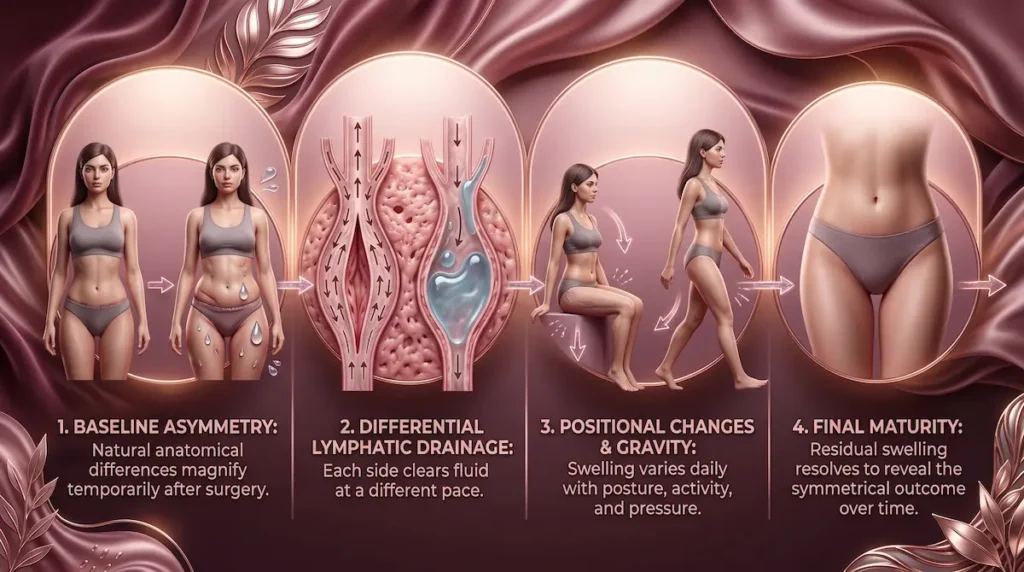
Uneven swelling after labiaplasty is one of the most common worries in early healing. One side may look larger, firmer, lower, or more sensitive than the other, even when the surgery itself was symmetrical and the incisions are healing normally.
The important point is timing. In the first few weeks, swelling is not a reliable way to judge the final contour. The labia are naturally asymmetric in many patients, and surgery can temporarily exaggerate that difference while each side heals at its own pace.
Why one side can swell more than the other
One side can swell more because the starting anatomy was different, the tissue tension was not identical, or one incision line had slightly more post-operative fluid. This does not automatically mean the result will be uneven.
Small day-to-day changes are common. A side that looks more swollen in the morning may feel tighter after sitting, walking, or wearing underwear that creates friction. Swelling can also shift with gravity, especially in the first two weeks.
What matters most is whether the trend is improving. A side that is slowly softening is usually less concerning than a side that becomes increasingly red, hot, painful, or associated with discharge.
How lymphatic drainage differs side to side
Lymphatic drainage is not perfectly identical on both sides of the body. After surgery, one side may clear fluid faster while the other holds onto swelling longer. This can create the impression that one labium is “too big” when it is simply more swollen.
That difference can last days or weeks. It may also come and go. Patients often notice more swelling after a longer day, a warm shower, extra walking, or sitting upright for extended periods.
This is why your surgical team may ask for photos from the same angle, in similar lighting, and at set intervals. Consistent comparison is more useful than checking the area repeatedly throughout the day.
Why early asymmetry is not the final result
Early asymmetry is usually a healing pattern, not a final outcome. The tissue still has to soften, the incision line has to mature, and residual swelling has to settle before shape can be judged fairly.
Most surgeons do not evaluate minor asymmetry for revision during early swelling unless there is a clear complication. Waiting is not dismissive. It is medically sensible, because operating too early can disturb tissue that is still healing.
If asymmetry persists after swelling has settled, it can be assessed properly during follow-up. Until then, the safer approach is to track improvement rather than compare both sides hour by hour.
How to Reduce Swelling Safely
Reducing swelling after labiaplasty is less about doing more and more about avoiding irritation. The tissue needs calm, cleanliness, low pressure, and enough time. Over-treating the area can make swelling worse.
Your surgeon’s instructions come first. The guidance below is general and should not replace your personalized aftercare plan, especially if you have specific medical conditions, medications, or healing concerns.
Cold compresses, elevation and rest
Cold compresses can help early swelling when used correctly. They should be wrapped, gentle, and used only for the amount of time your surgical team recommends. Direct ice on delicate tissue can injure the skin.
Rest matters most during the first few days. Keep activity light, avoid unnecessary errands, and change position slowly. Short walks are helpful for circulation, but long periods on your feet can increase throbbing and swelling.
Elevation can also help. When resting, slightly reducing pressure on the pelvic area and avoiding tight sitting positions may make the tissue feel less congested. Comfort is a useful guide: if a position increases pressure, change it.
What to avoid in the early phase
Avoid friction. Tight leggings, thong underwear, cycling, intense workouts, and prolonged sitting can all irritate the area. Even if discomfort is mild, repeated rubbing can prolong swelling.
Avoid heat in the early phase unless your surgeon says otherwise. Hot baths, saunas, steam rooms, and very warm compresses can increase blood flow and make swelling feel worse.
Avoid self-directed products on the incision line. Creams, oils, antiseptics, scar gels, or “healing” products may sound harmless, but they can irritate healing tissue if used too early. Ask before applying anything.
Why your surgeon’s aftercare instructions come first
Aftercare is individualized. Your instructions may differ depending on the technique used, the amount of tissue removed, whether dissolving sutures were placed, and how your first follow-up looks.
For Canadian patients travelling for surgery, this is especially important. Before leaving Istanbul, you should understand how to send photos, which symptoms require urgent contact, and when normal check-ins are scheduled after you return home.
At AKM Clinic, the follow-up model includes long-term virtual check-ins at 1, 3, 6, and 12 months as part of the broader patient journey. That helps patients avoid guessing during the weeks when swelling is still changing.
Simple habits that support settling
- Wear loose, breathable clothing: Reduce friction and pressure around the incision area.
- Keep walking gentle: Light movement supports circulation without overloading the tissue.
- Do not rush intimacy or exercise: Friction and pressure can restart swelling.
- Track symptoms, not just appearance: Pain level, heat, odour, discharge, and trend over time matter.
- Use follow-up photos sensibly: Same lighting, same angle, and spaced intervals are more useful than daily checking.
When Swelling Is a Warning Sign
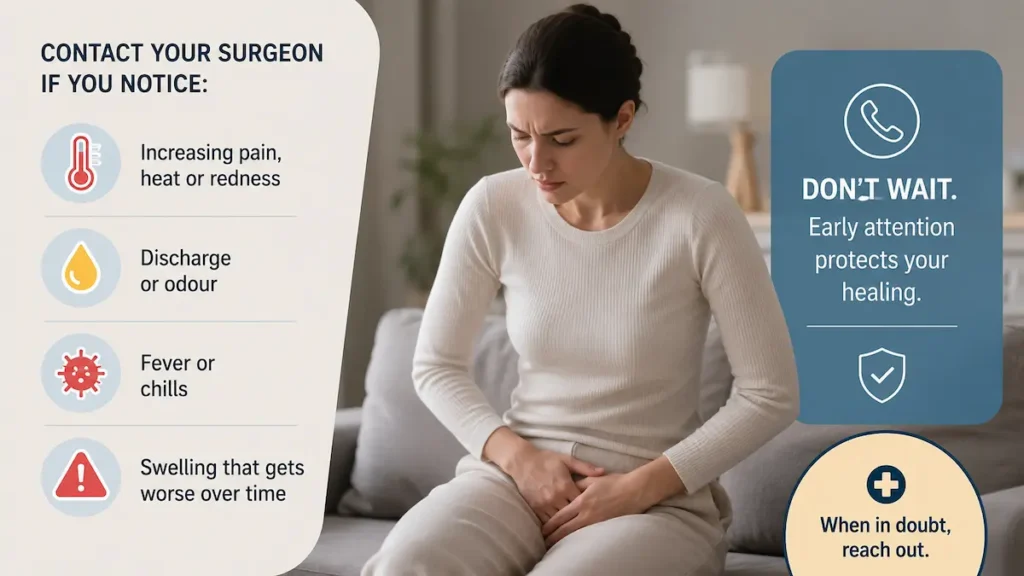
Most labiaplasty swelling improves gradually. A warning sign is different: swelling that becomes more painful, hotter, redder, firmer, or associated with discharge, fever, or odour. The direction of change matters more than one isolated day.
Do not wait for a scheduled check-in if symptoms are worsening. Contact your surgical team promptly, and seek appropriate local medical care in Canada if you have urgent symptoms.
Normal swelling vs concerning swelling
Normal swelling usually feels tight or tender but slowly improves. It may be uneven, more noticeable after activity, and more dramatic in the first few days. It should not feel progressively worse every day.
Concerning swelling often comes with other changes: increasing redness, heat, throbbing pain, thick discharge, unpleasant odour, fever, or a sudden one-sided increase in size. These signs need assessment.
Some bruising can be normal. A spreading area of dark colour, severe pain, or tissue that looks dusky and does not improve should be reported urgently.
Redness, worsening pain, discharge, fever and odour
Redness around an incision can be part of healing, but spreading redness is different. If the area becomes warmer, more painful, or more swollen instead of calmer, contact your surgeon.
Clear or slightly blood-tinged fluid can occur early. Thick yellow or green discharge, pus, or an unusual odour should not be ignored. Fever or chills after surgery also need prompt medical advice.
Swelling is only one part of the post-operative picture, so mention any of these symptoms as well when you contact your surgical team.
When to contact your surgical team
Contact your surgical team if swelling is getting worse after the initial peak, if pain is increasing instead of easing, or if one side suddenly becomes much larger, firm, or hot. Do the same if you notice discharge, odour, fever, or bleeding that does not settle.
For Canadian patients, the safest plan is to clarify before travel how post-operative messages are handled across time zones, what type of photos to send, and which symptoms require same-day attention.
At AKM Clinic, labiaplasty aftercare is planned through a board-certified plastic surgery team, with surgery performed in Istanbul and longer-term virtual follow-up after return home. This does not replace urgent local care when needed, but it reduces uncertainty during normal healing.
Persistent asymmetry and revision concerns
Persistent asymmetry is not judged in the first few weeks. Swelling can exaggerate natural side-to-side differences and make the area look uneven long before the final shape appears.
If a difference remains after swelling has mostly settled, your surgeon can assess whether it is normal variation, scar firmness, residual oedema, or a true contour concern. That assessment is usually more reliable after several months, not during the early inflammatory phase.
If you are worried about a result that looks increasingly distorted, painful, or unlike normal healing, contact your surgical team for a review rather than waiting for it to settle on its own.
Cost questions during follow-up
Swelling itself is not a reason to compare prices or choose revision too early. If you are still researching treatment planning and budgeting, use the dedicated labiaplasty cost in CAD page rather than trying to estimate costs from recovery symptoms.
Cost and technique decisions belong in consultation. Swelling decisions belong in aftercare: is it improving, stable, or worsening?
For broader context on labiaplasty outcomes, you can review larger clinical outcomes research on labiaplasty. Research can inform expectations, but your own recovery should still be judged by your surgeon’s post-operative instructions.
Frequently Asked Questions: Labiaplasty Swelling
The questions below address the swelling concerns patients most often search for after labiaplasty. They are general answers, not a substitute for a direct examination or advice from your surgical team.
How long does labiaplasty swelling last?
Why is one side more swollen after labiaplasty?
When does swelling go down?
Is uneven swelling normal?
When will I see my final result?
When should I call my surgeon?
Can I reduce swelling faster?
Can swelling come back after it improves?
Medical disclaimer: This article is for educational purposes only and is not medical advice. Recovery varies by patient, technique, anatomy, and health history. Always follow your surgeon’s instructions and seek qualified medical care for concerning symptoms.
Related Procedures




Ready to Begin Your Journey?
Join the more than 2,000 patients who have trusted Dr. Akif Mehmetoğlu and the AKM Clinic team. Your journey begins with an informative, no-obligation conversation. Contact us today from across Canada to schedule your complimentary virtual consultation.
#1: Receive Your Personalized Quote
Start with a complimentary, no-obligation virtual consultation. Share your photos, and our surgical team will provide a fully personalized treatment plan and a transparent, all-inclusive pricing package quoted in Canadian dollars (CAD). There are no hidden fees.
#2: Secure Your Procedure Date
Once you are ready to proceed, our dedicated English-speaking patient coordinators will help you secure your procedure date. We will manage your logistical bookings in Istanbul, including your five-star hotel and private airport transfers.
#3: Arrive in Istanbul & Meet Your Surgeon
Arrive at Istanbul Airport (IST), where you will be greeted by your private driver. Settle into your hotel before your comprehensive in-person consultation. You will meet your specialist surgeon to finalize the details of your procedure and ensure your goals are aligned for a natural, subtle result.