


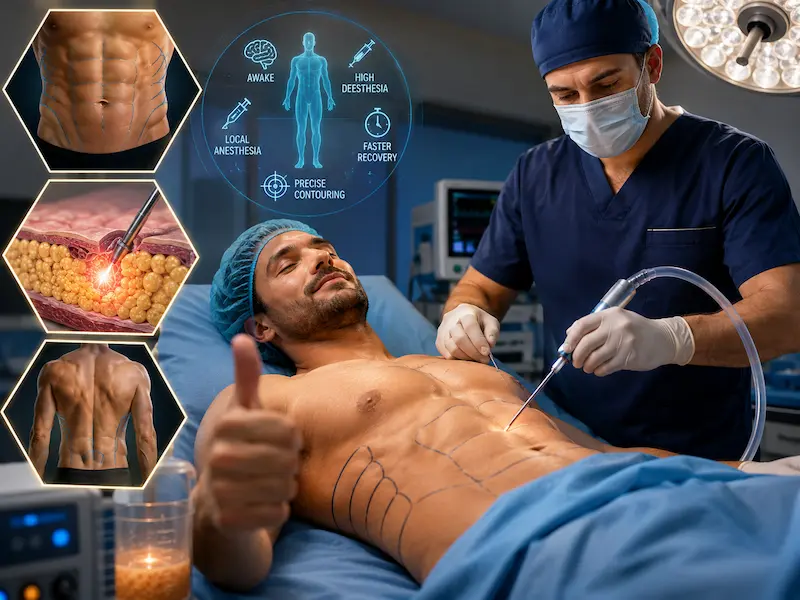
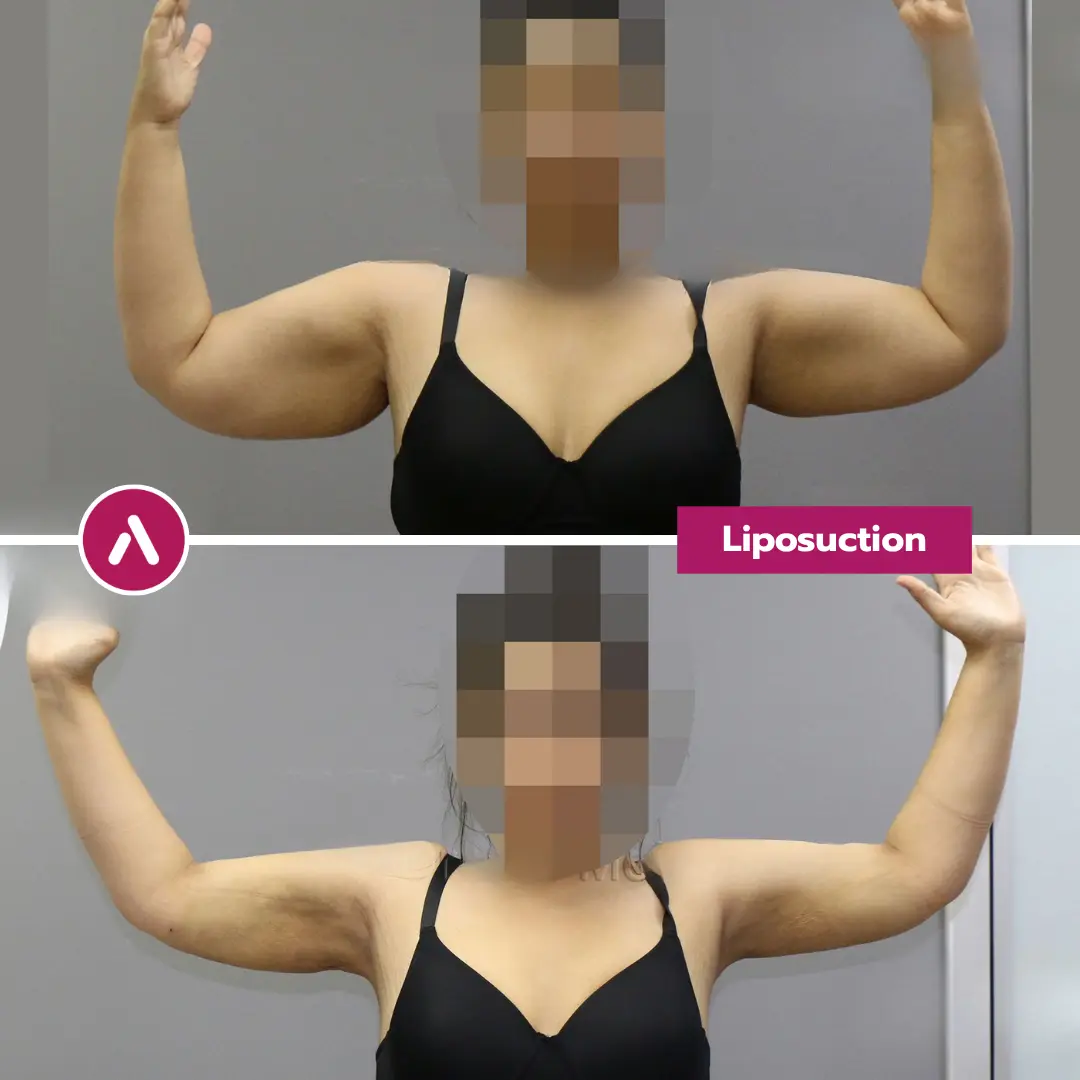
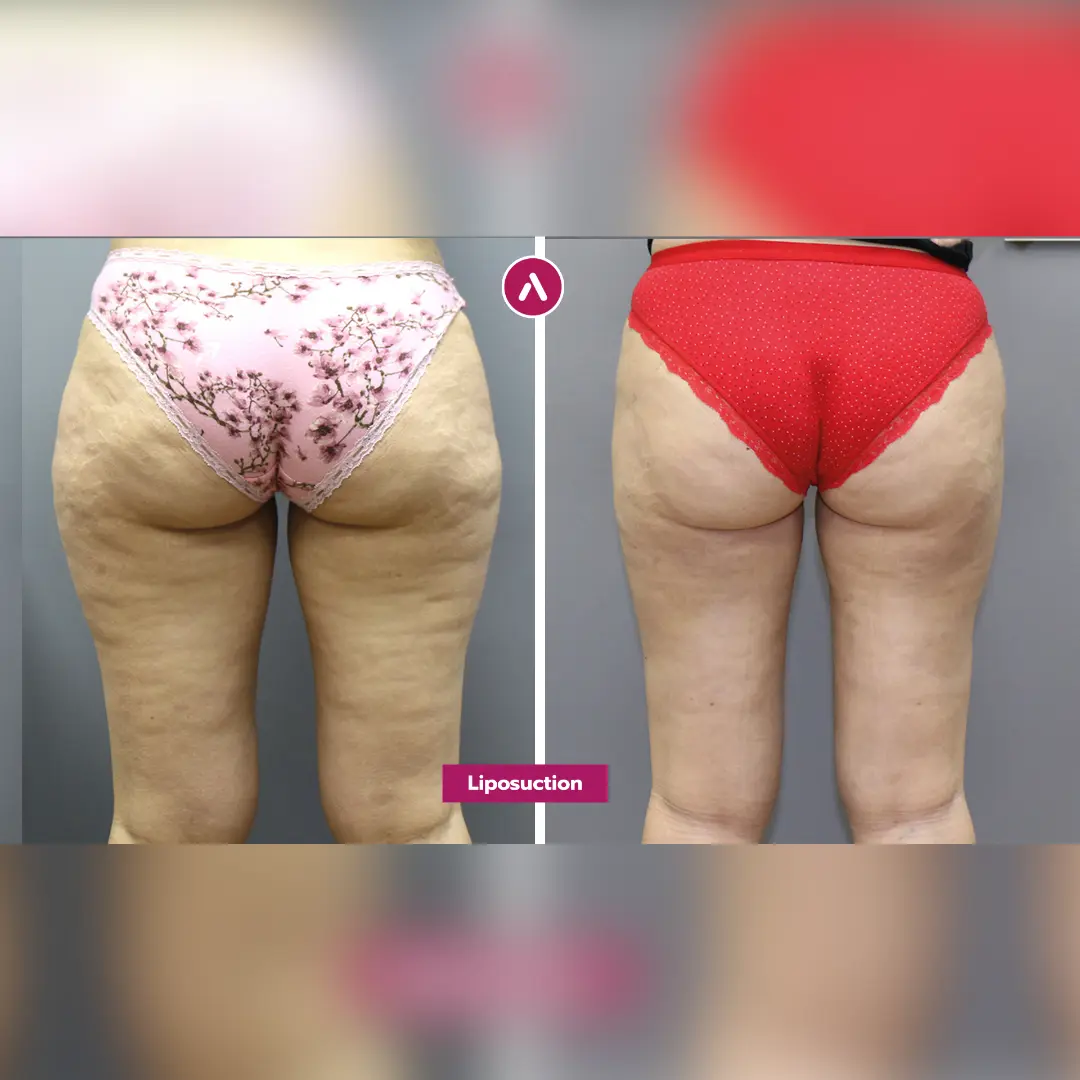
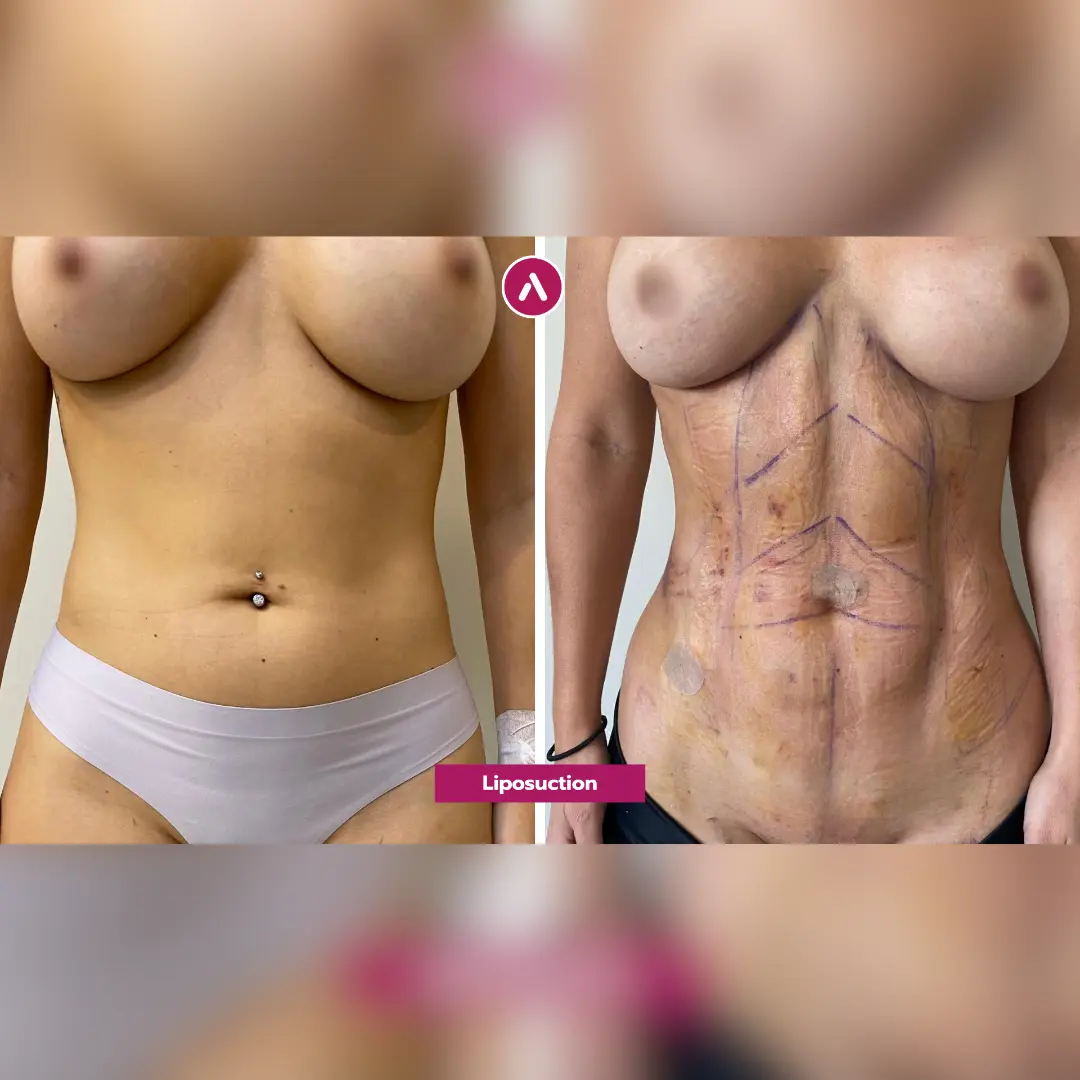
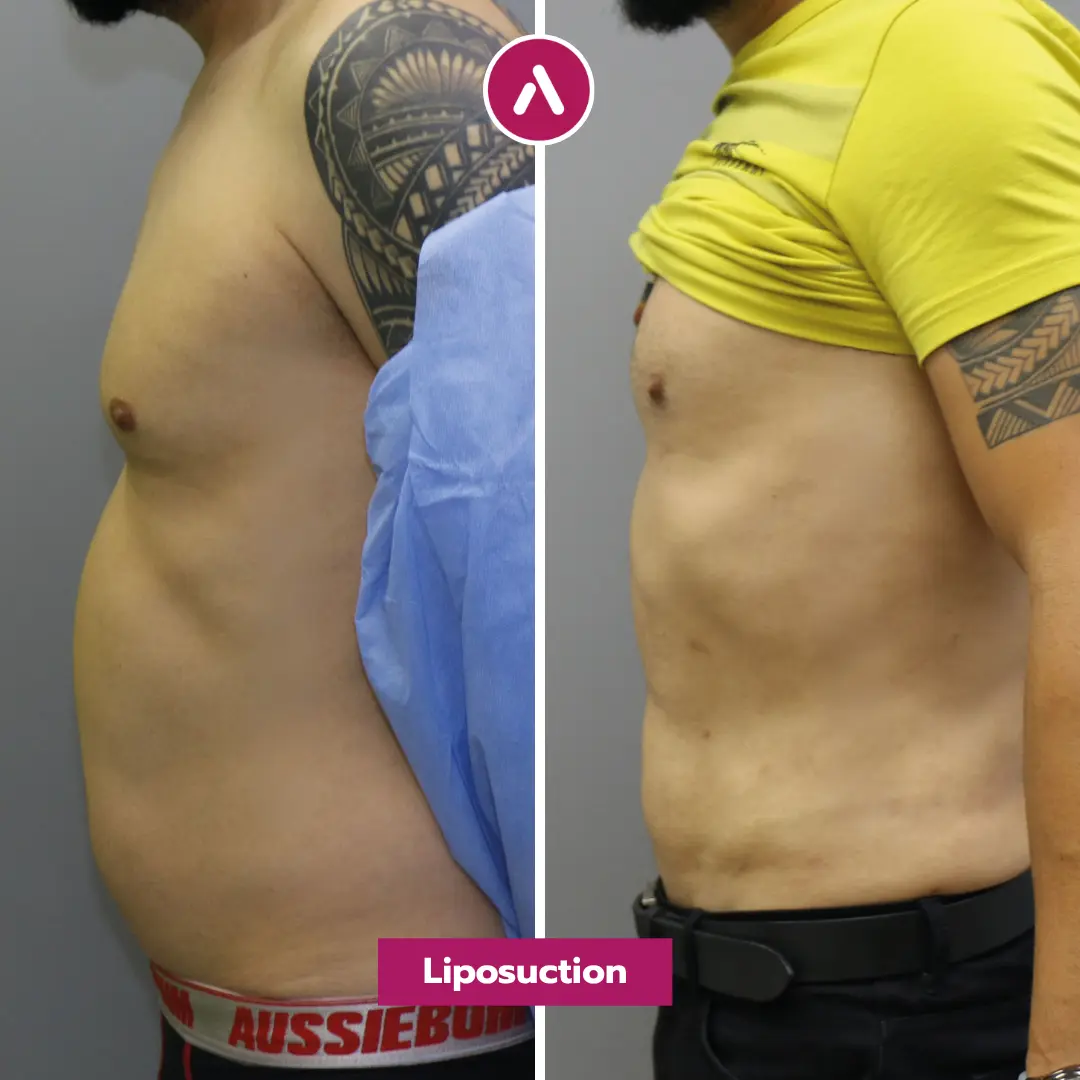
Awake high-definition liposuction is designed for patients who want body contouring without general anesthesia. Using tumescent local anesthesia, we numb the treatment area while you remain fully conscious and comfortable. This guide focuses on the awake experience: what you feel, who is suitable, how recovery differs, and how Canadian patients can plan the trip safely. For VASER technology, high-definition sculpting mechanics, and body-area results, see our dedicated VASER High-Definition Liposuction guide.
Table of Contents
What Is Awake High-Definition Liposuction?
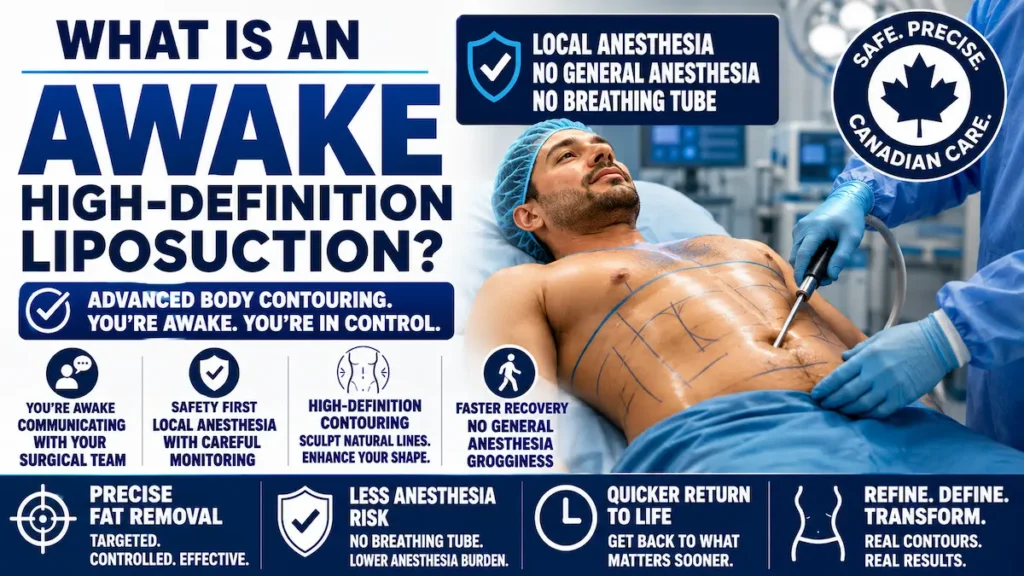
Awake liposuction, also called tumescent liposuction, removes fat under pure local anesthesia while you stay fully conscious. The treatment area is numbed with tumescent fluid, so no general anesthetic or breathing tube is required. It is best suited to small-to-moderate fat deposits where comfort, safety, and precise contouring can be managed under local anesthesia.
Awake Liposuction Defined
Awake liposuction means we perform fat removal while you remain conscious, breathing on your own, and able to communicate with the surgical team. You are not “put under.” Instead, the treatment area is carefully numbed using local anesthesia before fat removal begins.
This approach is different from standard liposuction under general anesthesia. The surgical goal may still be body contouring, but the anesthesia experience is lighter. Many Canadian patients ask about it because they are concerned about grogginess, nausea, intubation, or the idea of being fully asleep in another country.
Awake does not mean casual. It is still surgery. You still need pre-operative testing, sterile technique, careful dosing, compression garments, and post-operative monitoring. The advantage is that, for the right candidate, we can reduce the anesthesia burden while keeping the procedure medically controlled.
Tumescent Local Anesthesia Explained
Tumescent local anesthesia is the medical basis of awake liposuction. We inject a dilute local anesthetic solution into the fat layer. This solution expands and firms the tissue, numbs the area, and helps reduce bleeding during fat removal.
The word “tumescent” simply means swollen or firm. In liposuction, that temporary firmness makes fat easier to remove while protecting nearby tissues. It also allows many patients to avoid general anesthesia for selected treatment zones.
The key is proper dosing. Local anesthetic has safe dosage limits, and those limits matter more when treating larger areas. That is why awake liposuction is not automatically right for every patient or every body zone.
During your assessment, we consider:
- how many areas you want treated;
- how much fat needs to be removed;
- your height, weight, and medical history;
- your anxiety level and pain tolerance;
- whether a combined procedure would be safer under twilight or general anesthesia.
How “High-Definition” Fits Into the Awake Approach
High-definition liposuction focuses on contour, not just volume reduction. The goal is to refine natural lines around the abdomen, waist, flanks, back, arms, or chest. In selected patients, this can be done under tumescent local anesthesia.
That said, high-definition sculpting is not owned by anesthesia. The result comes from anatomy, fat distribution, skin quality, technique, and surgeon judgment. Awake anesthesia changes the experience of surgery; it does not replace the need for advanced contouring skill.
For the full explanation of ultrasound-assisted VASER technology, muscle-line definition, and high-definition body sculpting, see our VASER High-Definition Liposuction in Turkey page. This awake guide stays focused on what is different when the procedure is performed under local anesthesia.
Awake Liposuction vs Standard Liposuction
The main difference is anesthesia. Standard liposuction may be performed under general anesthesia, twilight sedation, or local anesthesia depending on the case. Awake liposuction uses pure local or tumescent local anesthesia, so you remain conscious throughout the procedure.
| Feature | Awake Liposuction | Standard Liposuction Under General Anesthesia |
|---|---|---|
| Consciousness | Fully awake and communicating | Fully asleep |
| Breathing tube | Not required | Usually required |
| Best suited for | Small-to-moderate areas and suitable candidates | Larger areas, complex cases, and combination surgery |
| Early recovery | No general anesthesia grogginess | May include nausea, grogginess, or longer observation |
| Comfort control | Local numbing plus constant communication | Full unconsciousness during surgery |
Neither option is “better” for every patient. The right choice depends on safety, area size, anatomy, and comfort. If your goals require a broader contouring plan, we may recommend twilight sedation or general anesthesia instead of awake liposuction.
For a broader overview of liposuction techniques, treatment zones, and body-contouring expectations, visit our Liposuction in Turkey for Canadians guide.
Benefits of Awake Liposuction
The main benefit of awake liposuction is avoiding general anesthesia when it is not medically necessary. For the right patient, this can make the early recovery smoother and reduce anxiety around surgery abroad. It also allows real-time communication between you and the surgical team.
No General Anesthetic
Many Canadian patients are not afraid of liposuction itself. They are afraid of general anesthesia. That concern is reasonable, especially when planning surgery outside Canada.
Awake liposuction avoids full unconsciousness. You do not need a breathing tube. You do not wake up disoriented from a general anesthetic, and you usually avoid the heavier “hangover” feeling some patients experience after deeper anesthesia.
This can be especially appealing if you have had nausea after anesthesia before. It may also suit patients who prefer a lighter medical pathway, provided the planned fat removal is appropriate for local anesthesia.
“Awake liposuction is not about doing more with less safety. It is about choosing the lightest safe anesthesia plan for the right patient, the right area, and the right amount of contouring.”
Faster Same-Day Recovery
Because there is no general anesthetic to recover from, many awake liposuction patients feel clear-headed sooner. You still need rest. You still need compression. You still need help walking back to your room or hotel.
The difference is the early recovery profile. Instead of waking from general anesthesia, you transition from procedure to observation while already conscious. This can make the first day feel more predictable.
Same-day mobility matters for Canadians travelling to Istanbul. Gentle walking after surgery supports circulation and lowers stiffness. We encourage careful movement early, while avoiding strain, lifting, or unnecessary activity.
Real-Time Comfort Feedback
Awake surgery allows you to communicate. You can tell us if you feel pressure, pinching, anxiety, or discomfort. That feedback helps the team adjust positioning, add local anesthetic when appropriate, or pause briefly.
Most sensations during awake liposuction are pressure, movement, vibration, and tugging. Sharp pain should not be ignored. Your ability to speak with the team is one reason awake procedures require careful patient selection.
Some people like being aware and involved. Others find it stressful. If the idea of hearing or feeling movement makes you anxious, twilight sedation may be a better fit. We do not force awake surgery on patients who would be more comfortable under another plan.
Lower Hospital and Anesthesia Burden
Awake liposuction often reduces the need for longer anesthesia recovery. It may also reduce hospital resource use for selected smaller cases. That can support a more efficient care pathway.
Cost is not the only reason to choose awake surgery, but it can matter. Canadian private quotes may separate surgeon fees, facility fees, anesthesia fees, garments, and follow-up. Our all-inclusive clinical pathway is structured to reduce that uncertainty.
For a full discussion of pricing, see the cost section below and our dedicated liposuction cost guide for Canadian patients.
Why This Matters for Canadian Patients Travelling Home
Patients flying back to Toronto, Vancouver, Montreal, Calgary, Edmonton, Ottawa, or Halifax need a recovery plan that respects long-haul travel. Awake liposuction does not remove every travel risk. It can, however, reduce the anesthesia-related load during the first recovery days.
Our Canadian pathway includes pre-operative testing, private transfers, compression guidance, post-operative checks, and fit-to-fly clearance before you return home. We also plan follow-up after you land in Canada, so you are not left managing recovery alone.
We built our awake surgery programme around this principle: the procedure is only one part of the plan. Safe recovery, mobility, records, and communication matter just as much.
Am I a Good Candidate for Awake Liposuction?
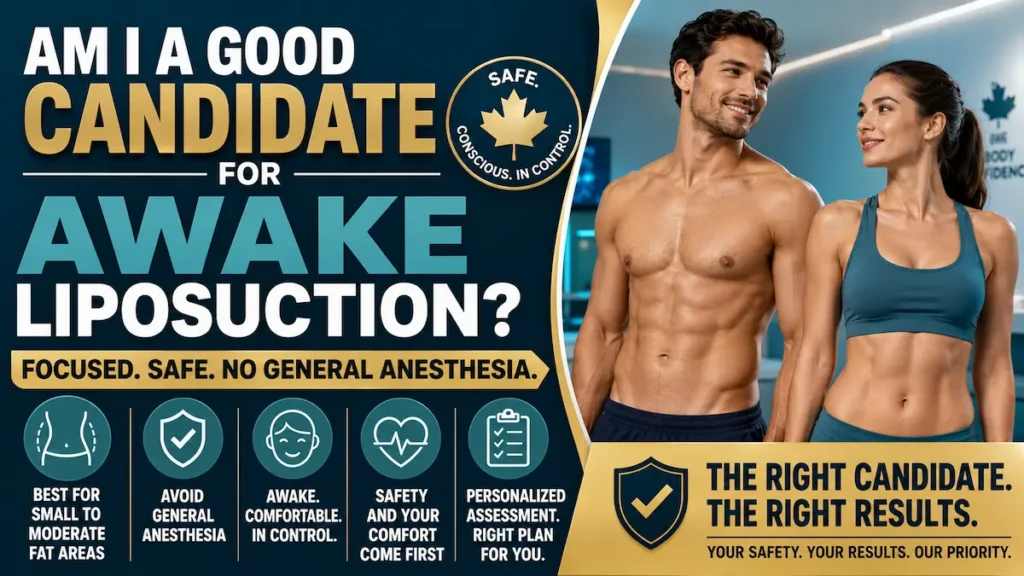
Awake liposuction works best when the treatment plan is focused, realistic, and medically appropriate for local anesthesia. It is not a shortcut for large-volume fat removal. It is a carefully selected option for patients who want contour refinement without general anesthesia.
During your consultation, we assess your anatomy, fat distribution, skin quality, medical history, and comfort level. We also ask why awake surgery matters to you. Some patients want to avoid general anesthesia because of previous nausea, recovery concerns, or anxiety about being fully asleep abroad.
Best Candidates: Small-to-Moderate Fat Areas
The ideal awake liposuction candidate has small-to-moderate fat deposits in defined areas. These may include the abdomen, flanks, waist, lower back, arms, or male chest. The goal is shaping, not major weight loss.
Awake liposuction is often suitable when the area can be numbed safely with tumescent local anesthesia. Larger treatment zones may require too much local anesthetic or too much operative time for a comfortable awake experience.
Good candidates usually have:
- stable body weight for at least three to six months;
- localized fat that does not respond to diet and exercise;
- reasonable skin elasticity;
- realistic expectations about swelling and final definition;
- a preference to avoid general anesthesia when safe.
If your goal is extensive 360-degree reshaping, a major fat-reduction session, or several combined procedures, we may recommend a different anesthesia plan. Safety comes first.
Patients Who Prefer to Avoid General Anesthesia
Some patients are medically healthy but uncomfortable with general anesthesia. Others have had nausea, grogginess, sore throat, or anxiety after past surgery. Awake liposuction can be useful for this group when the body-contouring plan is limited enough for local anesthesia.
This does not mean general anesthesia is unsafe. It means it may not be necessary for every liposuction case. The safest approach is the one that matches your anatomy, procedure length, and comfort profile.
For many Canadian patients, the decision is practical. They are travelling thousands of kilometres, recovering in a hotel, and planning a long-haul flight home. Avoiding general anesthesia can make the first recovery days feel more manageable for the right candidate.
Comfort, Anxiety, and Pain-Tolerance Factors
Awake surgery requires cooperation. You need to be comfortable staying still, hearing movement, and feeling pressure while the area remains numb. You do not need to be “tough,” but you do need to be calm enough to communicate clearly.
Some patients love the control of being awake. Others prefer to remember very little. Neither response is wrong.
We screen for anxiety because it affects safety and comfort. If the thought of being awake during surgery causes panic, twilight sedation or general anesthesia may be safer. The best anesthesia plan is not the most minimal plan; it is the plan you can tolerate well.
When Awake Liposuction Is Not the Right Choice
Awake liposuction is not recommended for every patient. It may not be appropriate if the treatment area is large, if several areas are being treated together, or if the expected fat removal volume is high.
It may also be unsuitable if you have significant medical risk factors, uncontrolled anxiety, a low pain threshold, or unrealistic expectations. Patients who expect dramatic body transformation from a small awake session may be disappointed.
We may advise against awake liposuction if you have:
- very large-volume fat removal goals;
- poor skin elasticity that requires skin removal rather than fat removal alone;
- multiple treatment areas requiring a long session;
- significant anxiety around surgical sounds or sensations;
- medical factors that require deeper monitoring or hospital-based anesthesia.
Being declined for awake liposuction does not mean you are not a candidate for liposuction. It may simply mean another anesthesia plan is safer.
Why We May Recommend Twilight or General Anesthesia Instead
Twilight sedation can be helpful for patients who want to avoid full general anesthesia but still prefer to be relaxed and less aware. It can also support longer or more sensitive procedures. For some patients, it is the best middle ground.
General anesthesia may be the right choice when contouring is extensive, when multiple procedures are combined, or when comfort and stillness are essential for surgical precision. We do not treat general anesthesia as a failure. It remains the safest option for many larger cases.
Our role is to recommend the safest anesthesia plan, not to sell the lightest one. You can explore the broader anesthesia spectrum in our Awake Surgery in Turkey for Canadians guide and our Twilight Surgery guide.
Awake vs Twilight vs General Anesthesia for Liposuction
Anesthesia choice changes the surgical experience, early recovery, and monitoring pathway. It does not change the basic biology of healing. Swelling, bruising, compression, and gradual definition still happen after liposuction, no matter which anesthesia plan is used.
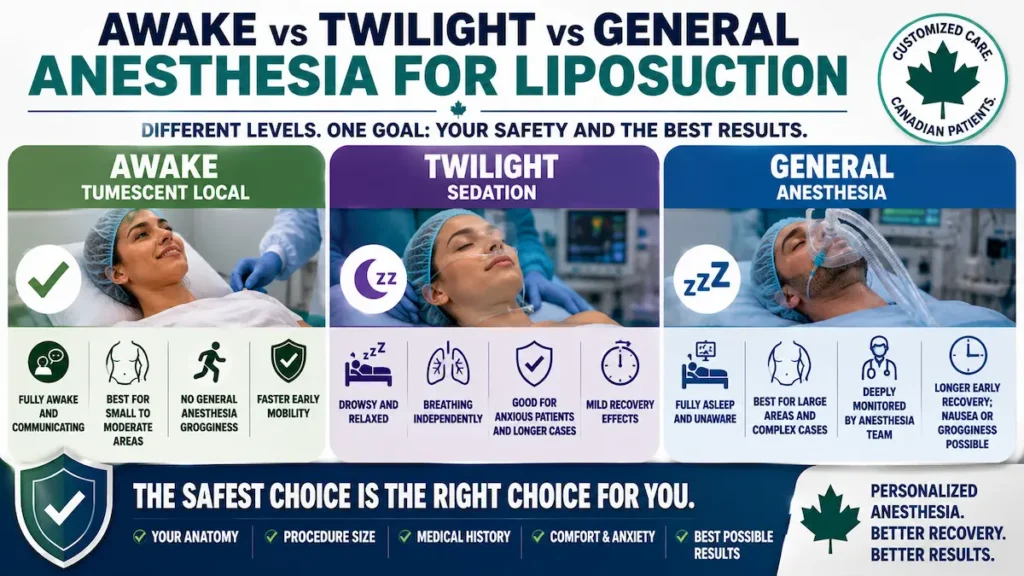
The difference is how your body moves through the procedure. Awake liposuction keeps you conscious with local numbing. Twilight sedation relaxes you while maintaining independent breathing. General anesthesia places you fully asleep under deeper monitoring.
Awake: Pure Local / Tumescent Anesthesia
Awake liposuction uses tumescent local anesthesia. The treatment area is numbed with a dilute anesthetic solution, and you remain fully conscious. You can speak with the team during the procedure.
This option is most appropriate for small-to-moderate areas. It can be a strong fit for patients who want to avoid a breathing tube, general anesthesia grogginess, or deeper sedation. It also allows immediate feedback if you feel discomfort.
Awake does not mean less planning. We still perform pre-operative screening, dosage calculations, sterile preparation, and post-operative observation. Local anesthesia has limits, and we respect them.
Twilight: Relaxed, Drowsy, Still Breathing Independently
Twilight sedation sits between awake and general anesthesia. You are not fully unconscious, but you are more relaxed and may remember little. Many patients describe it as drifting in and out while breathing on their own.
This may be appropriate if you are anxious, if the procedure is longer, or if the treatment area is more sensitive. It can also help patients who want to avoid general anesthesia but do not want full awareness.
Twilight sedation still requires monitoring. It is not “just a mild relaxer.” Your breathing, oxygen level, heart rate, blood pressure, and comfort must be observed throughout the procedure.
General Anesthesia: Fully Asleep
General anesthesia places you fully asleep. You are not aware of the procedure, and an anesthesia team controls and monitors the process closely. It is commonly used for larger liposuction cases and combination procedures.
General anesthesia may be the safest choice when the treatment plan is extensive. It can also support precise work when patient movement would compromise the result. Comfort and safety both matter.
The trade-off is early recovery. Some patients experience grogginess, nausea, sore throat, or a longer observation period. These effects are usually temporary, but they matter when planning travel and hotel recovery.
Which Option Is Safest?
No anesthesia option is safest for every patient. Awake is safer for some because it avoids general anesthesia. General anesthesia is safer for others because it allows better control during longer, more complex procedures.
The Canadian Anaesthesiologists’ Society’s explanation of what anesthesia involves helps Canadian patients understand why anesthesia planning should be individualized rather than chosen from marketing language. The American Society of Anesthesiologists’ guide to the types of anesthesia also explains, in patient-friendly terms, how anesthesia levels and monitoring differ.
The safest choice depends on:
- the number of areas treated;
- expected fat removal volume;
- procedure length;
- medical history;
- anxiety and pain tolerance;
- whether other procedures are being combined.
Canadian patients often ask for the least invasive anesthesia plan. We understand that. Our answer is always the same: the best plan is the lightest option that still protects safety, comfort, and surgical precision.
How We Choose the Right Anesthesia Plan
We choose anesthesia after reviewing your photos, goals, health background, and treatment areas. During your Istanbul consultation, we confirm the plan in person. If the physical exam changes the risk profile, we update the recommendation.
For example, a small waist contouring case may be ideal for awake liposuction. A full abdomen, flanks, back, and arm combination may be better under twilight or general anesthesia. The same patient could be suitable for one option in one year and another option after weight change or skin change.
Our anesthesia decision is guided by three questions:
- Can the area be numbed safely with local anesthesia?
- Can the patient remain comfortable and still?
- Will this anesthesia plan support the best surgical result?
| Anesthesia Option | Consciousness | Best For | Recovery Profile | AKM Position |
|---|---|---|---|---|
| Awake / Tumescent Local | Fully conscious and communicating | Small-to-moderate areas; patients who want to avoid general anesthesia | No general anesthesia grogginess; faster early mobility | Preferred when area size, anatomy, and comfort allow |
| Twilight Sedation | Drowsy, relaxed, usually breathing independently | Anxious patients, longer cases, or patients who want less awareness | Mild sedation recovery; usually lighter than general anesthesia | Useful middle option when pure awake is not ideal |
| General Anesthesia | Fully asleep | Larger areas, combination surgery, or complex contouring | Longer early recovery; possible nausea or grogginess | Recommended when safety, comfort, or surgical precision requires it |
“The question is not whether awake, twilight, or general anesthesia is universally better. The question is which plan gives this patient the safest procedure, the smoothest recovery, and the best contouring conditions.”
For a deeper comparison of local and general anesthesia in aesthetic surgery, read our Local vs General Anesthesia guide. Although that article focuses on facelift surgery, the same patient-safety questions apply to liposuction planning.
Combining Awake Liposuction With Other Procedures
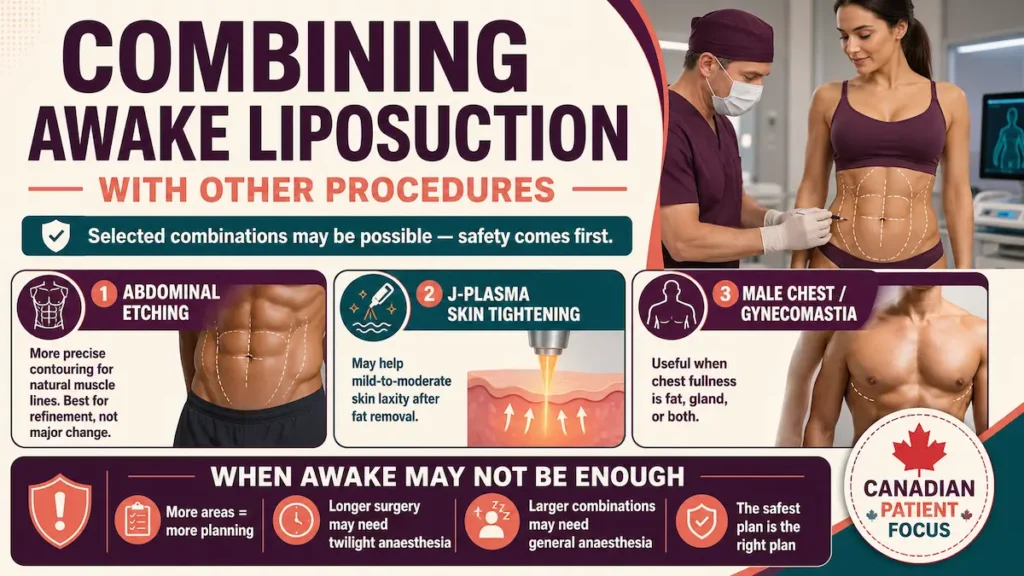
Awake liposuction can sometimes be combined with other procedures, but combination planning must be conservative. The more areas or techniques we add, the more important anesthesia selection becomes. A combined plan may still be possible, but it may no longer be appropriate under pure local anesthesia.
We evaluate combination surgery by treatment time, local anesthetic dose, blood-loss risk, recovery burden, and your ability to remain comfortable. We will not recommend an awake combination simply because it sounds convenient.
Awake Liposuction + Abdominal Etching
Awake liposuction and abdominal etching are closely related, but they are not identical. Liposuction removes localized fat. Abdominal etching uses more precise contouring to highlight natural muscle lines.
Some limited abdominal definition work may be possible under local anesthesia in carefully selected patients. The best candidates are already close to their target weight, have good skin quality, and want refinement rather than a dramatic transformation.
If your main goal is visible abdominal definition, review our Awake Abdominal Etching guide. That page explains how the awake approach applies to athletic abdominal contouring.
Awake Liposuction + J-Plasma Skin Tightening
Liposuction removes fat, but it does not remove loose skin. If your skin has mild-to-moderate laxity, energy-assisted tightening may be discussed as part of the plan. J-Plasma can help selected patients improve skin contraction after fat removal.
This decision depends on skin quality, age, weight history, treatment area, and how much tightening is needed. Some patients benefit from J-Plasma. Others need an excisional procedure such as a tummy tuck, arm lift, or thigh lift.
For details on when energy-assisted skin tightening is appropriate, visit our J-Plasma Skin Tightening guide.
Awake Liposuction + Gynecomastia Surgery
Male chest contouring may involve fat, glandular tissue, or both. Awake liposuction can treat fatty chest fullness in selected cases. True gynecomastia often requires gland excision as well.
When gland excision is needed, we assess whether the procedure can still be done comfortably under local anesthesia. Some patients are suitable for awake gynecomastia surgery. Others need a deeper anesthesia plan.
For the complete male chest decision framework, see our Gynecomastia Surgery guide and Awake Gynecomastia Surgery guide.
When Combination Surgery Requires Twilight or General Anesthesia
Combination surgery becomes more complex as procedure length increases. Treating multiple areas, adding skin tightening, or combining liposuction with excisional surgery can exceed what is safe or comfortable under tumescent local anesthesia.
Twilight sedation may be appropriate when the procedure is still moderate but the patient needs more comfort support. General anesthesia may be safer for larger combinations, longer sessions, or cases requiring extensive positioning.
We make this recommendation before surgery, not during a difficult moment. If awake is not the best option, we explain why and provide a safer alternative.
What Does Awake Liposuction Feel Like?
Awake liposuction should feel controlled, not frightening. You may feel pressure, vibration, movement, and a firm pushing sensation. You should not feel sharp, untreated pain.
The most important point is communication. Because you are conscious, you can tell us what you feel in real time. That feedback helps us adjust positioning, pause briefly, or add more local anesthesia when medically appropriate.
Before the Procedure: Numbing the Area
The first noticeable step is the tumescent local anesthesia. We inject a dilute numbing solution into the treatment area. This may feel like pressure, fullness, or mild stinging at the beginning.
As the area becomes numb, the tissue feels swollen and firm. This is expected. The fluid creates a safer working plane for fat removal and helps reduce bleeding.
We wait for the anesthetic effect before beginning liposuction. You are not rushed through this step. Proper numbing is what makes awake liposuction possible.
During Fat Removal: Pressure, Movement, and Vibration
During fat removal, most patients feel movement rather than pain. You may notice pushing, pulling, vibration, or a rhythmic back-and-forth sensation. These feelings can be strange, but they should remain tolerable.
If VASER is used as part of the plan, you may feel vibration or warmth-like awareness without a burning sensation. The technology discussion belongs to our VASER High-Definition Liposuction guide; on this page, the key point is that the awake patient experience is actively monitored.
Some areas are more sensitive than others. The abdomen and flanks often tolerate awake liposuction well. Areas with tighter tissue, scar tissue, or more fibrous fat may feel more intense.
What Should Not Feel Normal
Sharp pain is not something we ask you to “push through.” If you feel a sharp, burning, or sudden painful sensation, you tell us immediately. The team can pause and reassess the area.
Awake liposuction depends on honest feedback. It is not a test of endurance. The goal is safe contouring under local anesthesia, not unnecessary discomfort.
You should also tell us if you feel dizzy, panicked, nauseated, or unusually anxious. These symptoms may mean you need more support, a pause, or a different anesthesia approach in a future stage.
How We Monitor Comfort Throughout Surgery
Comfort monitoring starts before surgery. We ask about anxiety, previous anesthesia experiences, pain tolerance, and your expectations. During surgery, we continue checking in.
We monitor more than what you say. We also observe breathing, body tension, skin response, and general stability. Awake surgery still requires a surgical team that knows when to continue, when to pause, and when to change course.
Our patient hosts and clinical team also prepare you emotionally. Canadian patients often feel calmer when they know what sensations are normal before the procedure begins.
Why Awake Does Not Mean “No Medical Supervision”
Awake liposuction is still liposuction. It requires sterile preparation, surgical planning, vital sign awareness, local anesthetic dosing, and post-operative care. The absence of general anesthesia does not reduce the need for clinical discipline.
We do not treat awake surgery as a “walk-in” aesthetic service. It is part of our international surgical programme, supported by pre-operative tests, private transfers, compression protocols, and follow-up after you return to Canada.
“A good awake liposuction experience is not silent suffering. It is a monitored procedure where the patient is numb, informed, and able to communicate clearly throughout the case.”
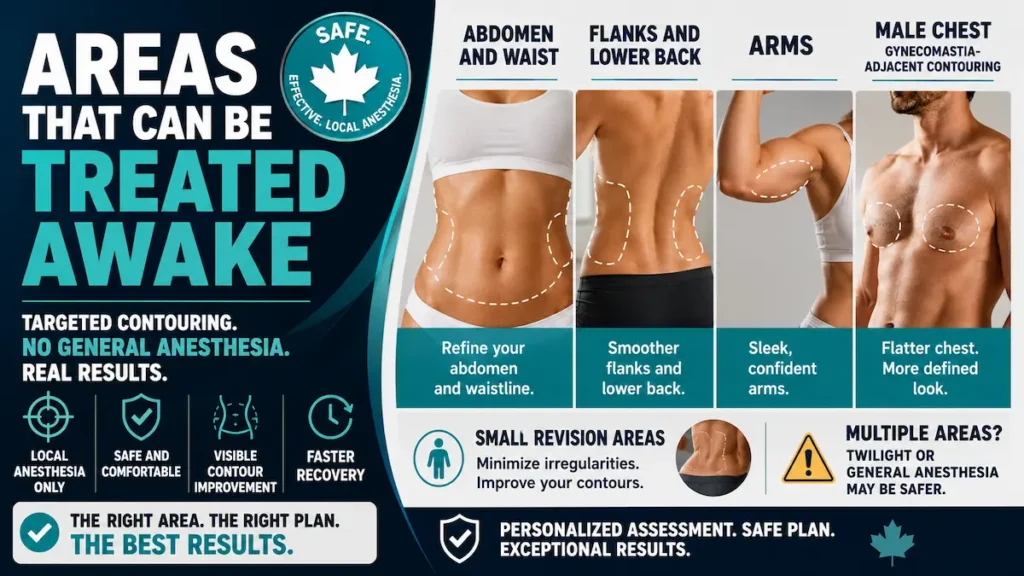
Areas That Can Be Treated Awake
Awake liposuction is best for treatment areas that can be numbed safely and completed within a reasonable operative time. The area should be limited enough for local anesthesia dosing, but meaningful enough to create a visible contour improvement.
Not every body zone is equally suited to awake treatment. Some areas tolerate tumescent local anesthesia very well. Others may be too large, too fibrous, or too uncomfortable for a pure-local plan.
Abdomen and Waist
The abdomen and waist are common awake liposuction areas for suitable patients. Small-to-moderate fat deposits can often be treated with tumescent local anesthesia, especially when the goal is refinement rather than major volume reduction.
The abdomen can also be part of a high-definition plan. In that case, the awake question becomes more specific: can the area be treated comfortably, safely, and precisely without general anesthesia? If the answer is no, we recommend another anesthesia plan.
For patients focused on etched abdominal lines, see our Awake Abdominal Etching guide. That page explains the awake approach for more athletic abdominal definition.
Flanks and Lower Back
The flanks, often called “love handles,” may respond well to awake liposuction. These areas are commonly treated for waist definition and smoother torso contour.
Lower back fat can be more variable. Some patients have soft, localized fullness that is suitable for local anesthesia. Others have broader fat distribution or tighter tissue that makes awake treatment less ideal.
When the flanks, lower back, and abdomen are all treated together, the plan may become too extensive for awake surgery. In that situation, twilight sedation or general anesthesia may provide better comfort and safety.
Arms
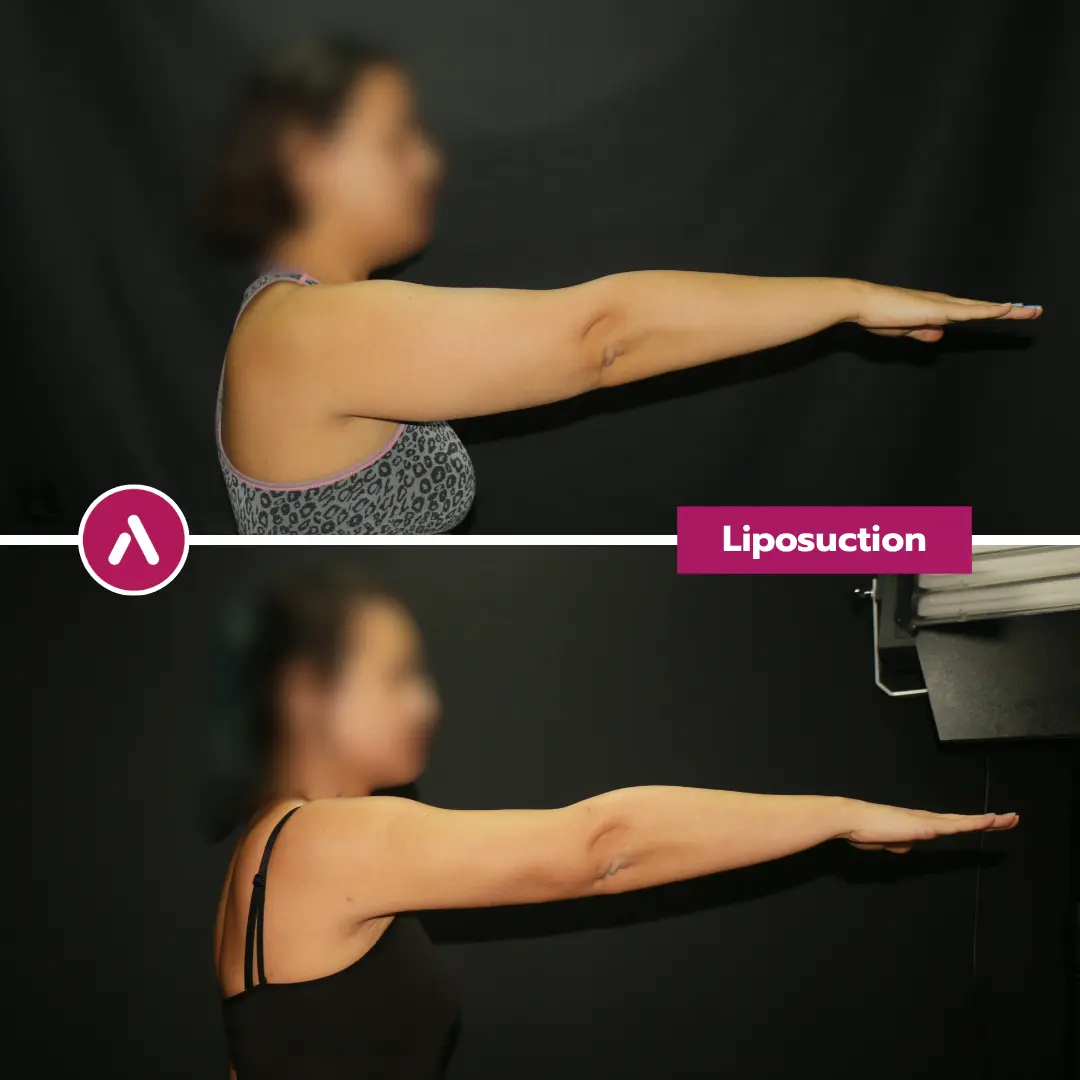
Arm liposuction can be suitable for awake treatment when the fat deposit is limited and skin quality is good. The best candidates have localized fullness rather than heavy skin laxity.
If there is significant loose skin, liposuction alone may not create the result you want. You may need skin tightening or an arm lift instead. We discuss this honestly during assessment.
For patients considering surgery for loose upper-arm skin, see our Arm Lift in Turkey guide or the Awake Arm Lift page if your main concern is avoiding general anesthesia.
Male Chest and Gynecomastia-Adjacent Contouring
Some male chest contouring can be performed awake, especially when the issue is mostly fat. True gynecomastia often involves glandular tissue, which may require direct excision in addition to liposuction.
This distinction matters. Fat can be suctioned. Firm gland usually cannot be corrected with liposuction alone.
Men from Toronto, Calgary, Vancouver, and Edmonton often ask whether awake liposuction can treat “puffy chest” concerns. The answer depends on whether the fullness is fat, gland, or both. See our Gynecomastia Surgery guide and Awake Gynecomastia Surgery page for the full decision framework.
Small Revision Areas
Awake liposuction can sometimes help small revision areas after previous fat removal. These cases require careful judgment because scar tissue changes how the cannula moves and how the tissue responds.
A small irregular pocket may be appropriate for local anesthesia. A larger revision with asymmetry, skin laxity, or scar tethering may need a different surgical plan.
Revision contouring should never be rushed. If you had liposuction elsewhere and are unhappy with the result, we usually recommend waiting until swelling has fully settled before making a correction plan.
When Multiple Areas Require a Different Anesthesia Plan
The more areas you add, the more important anesthesia planning becomes. Treating abdomen, flanks, back, arms, and chest in one session may exceed what is comfortable or safe under pure local anesthesia.
Combination treatment is not automatically wrong. It simply may require twilight sedation or general anesthesia. That recommendation protects your safety and helps the surgeon work with better control.
We are direct about these limits. Awake liposuction is an excellent option for selected cases, but it is not the best option for every contouring goal.
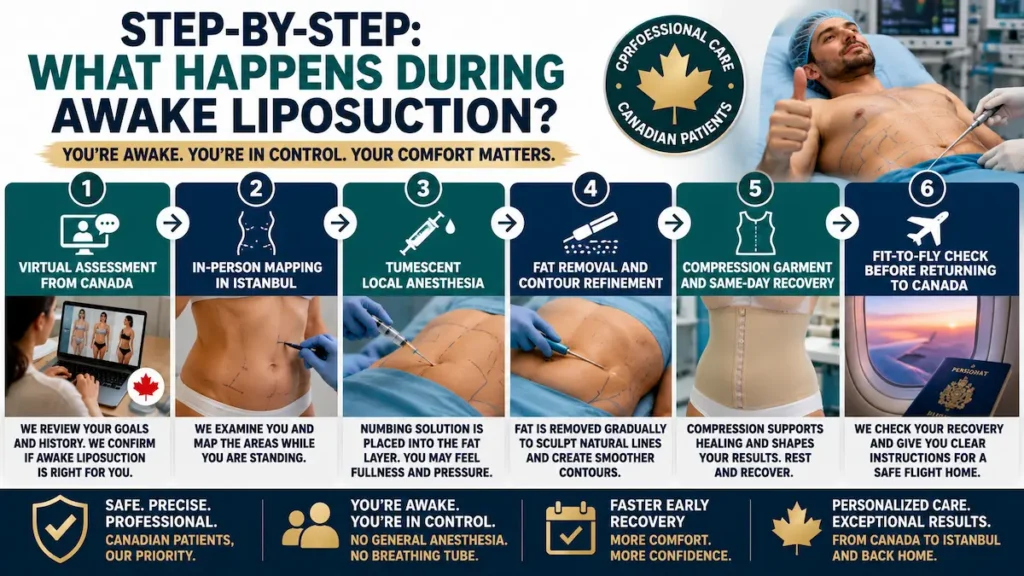
Step-by-Step: What Happens During Awake Liposuction?
Awake liposuction follows a structured clinical pathway. The experience is lighter than surgery under general anesthesia, but the planning is not lighter. We still map the body, confirm candidacy, prepare the area under sterile conditions, and monitor you through recovery.
The main difference is that you remain conscious. You can communicate with the team, and you do not wake up from a general anesthetic after the procedure.
Step 1: Virtual Assessment From Canada
Your first step is a remote assessment from Canada. You send photos, describe your goals, and share your medical history. We review the areas you want treated and decide whether awake liposuction is realistic.
This is also where we identify red flags. If the treatment plan appears too large for tumescent local anesthesia, we discuss twilight sedation or general anesthesia early. That honesty prevents disappointment later.
During this stage, you receive a tailored clinical recommendation and a transparent quote. We also explain what is included in the all-inclusive pathway, including pre-operative testing, hotel stay, private transfers, medications, compression garments, and follow-up.
Step 2: In-Person Mapping in Istanbul
When you arrive in Istanbul, we confirm the plan in person. Photos help, but they cannot replace physical examination. We assess fat thickness, skin elasticity, asymmetry, scar tissue, and the safest treatment area limits.
Your surgeon marks the areas while you are standing. This matters because fat distribution changes when you lie down. The markings guide the contouring plan and help us avoid over-treating an area.
If the in-person exam shows that your original awake plan is not safe, we tell you. We may reduce the treatment area, stage the procedure, or recommend a different anesthesia approach.
Step 3: Tumescent Local Anesthesia
After sterile preparation, we administer tumescent local anesthesia. The solution is placed into the fat layer through small access points. You may feel fullness, pressure, or mild stinging at the beginning.
The numbing step takes time. We do not begin fat removal immediately after the first injection. The local anesthetic needs time to spread evenly and create a comfortable working field.
Tumescent fluid also helps reduce bleeding and supports smoother cannula movement. This is one reason the technique is widely used in awake liposuction.
Step 4: Fat Removal and Contour Refinement
Once the area is numb, the fat-removal stage begins. You may feel pressure, vibration, movement, or tugging. These sensations are normal when they remain tolerable.
The surgeon removes fat gradually. The goal is contour control, not aggressive volume removal. Over-removing fat can create dents, irregularities, or unnatural definition.
If high-definition contouring is part of your plan, the surgeon works with the natural lines of your body. The awake anesthesia does not create the definition by itself. It simply allows the contouring to be performed without general anesthesia in selected patients.
Step 5: Compression Garment and Same-Day Recovery
After fat removal, we apply dressings and a compression garment. Some drainage from the small access points is expected during the first 24 to 48 hours. This fluid is mostly tumescent solution mixed with small amounts of blood-tinged drainage.
You rest under observation before returning to your hotel or recovery setting. Because you have not had general anesthesia, you may feel more alert than patients recovering from deeper anesthesia. You still need help and careful movement.
Compression is essential. It helps reduce swelling, supports the new contour, and keeps the treated area controlled while tissues settle.
Step 6: Fit-to-Fly Check Before Returning to Canada
Before you fly home, we check your recovery progress. We review swelling, bruising, drainage, mobility, pain control, and garment fit. We also make sure you understand your flight precautions.
Long-haul travel after surgery requires planning. You may need to walk during the flight, hydrate carefully, avoid heavy luggage, and continue wearing compression as directed.
Your discharge instructions are written in English, so you can share them with your Canadian family physician if needed. Our follow-up continues after you return home through scheduled virtual check-ins.
For the full travel pathway, see our Canadian patient journey guide and our hotel and VIP transfer overview.
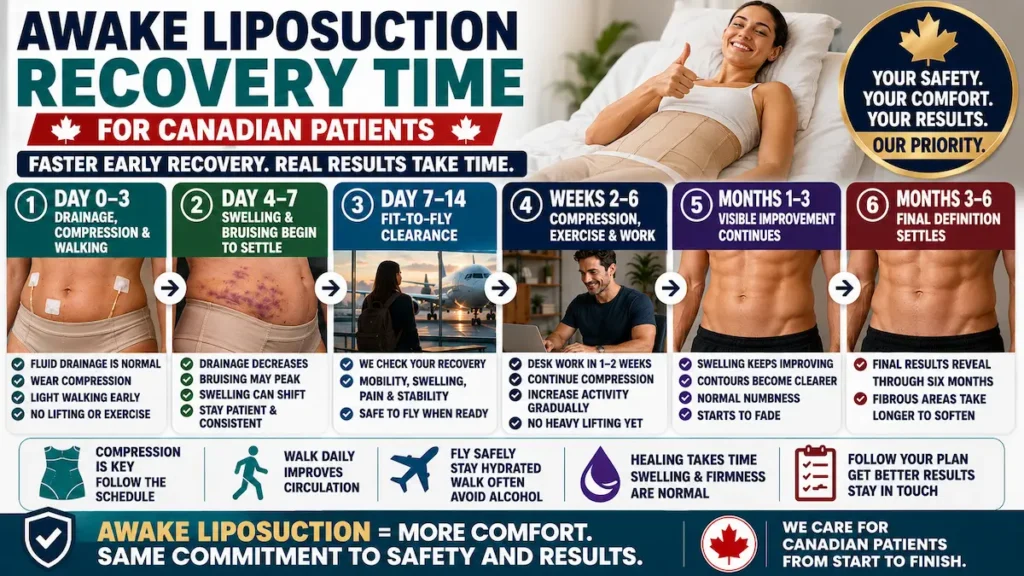
Awake Liposuction Recovery Time for Canadian Patients
Awake liposuction recovery is usually faster in the first 24 hours because there is no general anesthesia grogginess. The tissue recovery, however, still follows the biology of liposuction. Swelling, bruising, firmness, numbness, and gradual contour settling are normal.
Most Canadian patients should plan recovery around three priorities: compression, walking, and flight timing. You may feel well enough to move early, but that does not mean your tissues have fully healed.
Day 0–3: Drainage, Compression, and Walking
The first three days are the most active drainage phase. You may notice fluid leaking from the tiny access points, especially during the first 24 to 48 hours. This is expected after tumescent liposuction.
Compression garments are worn as instructed. They should feel supportive, not painfully tight. If a garment causes numbness, skin changes, or severe discomfort, you should contact the team.
Light walking begins early. Short, gentle walks support circulation and reduce stiffness. You should not lift luggage, exercise, or spend long periods lying completely still.
Day 4–7: Swelling and Bruising Begin to Settle
By days four to seven, drainage usually decreases. Bruising may become more visible before it improves. Swelling can shift downward because of gravity.
This is also when patients sometimes feel impatient. The area may look larger than expected because of swelling. This does not mean the procedure has failed.
You continue wearing compression and following activity restrictions. If you are flying home around this period, we check that your pain is controlled, your mobility is adequate, and there are no warning signs that need in-person attention.
Our HBOT/LLLT Recovery Protocol
Recovery technology matters for international patients. We utilize Hyperbaric Oxygen Therapy (HBOT) and Low-Level Laser Therapy (LLLT) as part of our recovery-focused approach when clinically appropriate.
HBOT helps deliver concentrated oxygen to healing tissues. It may support inflammation reduction and tissue repair after surgery. For patients preparing for a long-haul flight back to Canada, reduced edema and better tissue oxygenation can be valuable.
LLLT supports cellular repair through photobiomodulation. Our system uses 424 medical-grade semiconductor laser diodes at 650 nm, which stimulate cellular ATP production without heat. This may help with bruising, inflammation, and incision maturation.
These technologies do not replace proper surgery or aftercare. They support recovery when used as part of a broader protocol that includes compression, hydration, walking, nutrition, and follow-up.
For more detail, visit our technology and recovery standards page.
Day 7–14: Fit-to-Fly Clearance
Many Canadian patients return home during the second week, depending on the number of areas treated and their recovery progress. We do not clear you to fly based only on the calendar. We assess how you are healing.
Fit-to-fly clearance includes checking your mobility, swelling, pain level, garment fit, and general stability. If you are not ready, we explain why. Travel safety matters more than schedule convenience.
On the flight, you should walk periodically, drink water, avoid alcohol, and keep essentials within reach. You should not lift heavy carry-on luggage into an overhead bin.
For detailed flight guidance, read our flight safety after surgery guide for Canadian patients.
Weeks 2–6: Compression, Exercise, and Work
Most desk-based work can often resume within one to two weeks, depending on the extent of liposuction and your job demands. If your work involves lifting, standing all day, or physical labour, you may need more time.
Compression usually continues for several weeks. The exact schedule depends on the treated area and your surgeon’s instructions. Consistency matters more than rushing into smaller garments.
Light activity increases gradually. Strenuous exercise, heavy lifting, and high-impact training should wait until you are cleared. Returning too early can worsen swelling and delay contour definition.
Months 3–6: Final Definition Settles
Early improvement appears as swelling decreases. Final definition takes longer. Most patients see a clearer contour by three months, with further refinement through six months.
Small areas may settle faster than larger areas. Fibrous zones, revision areas, and high-definition contouring can take longer to soften. Numbness or firmness may also improve gradually.
Your result depends on healing, skin quality, compression compliance, and weight stability. Awake anesthesia can make the early experience easier, but the final contour still requires time.
Safety, Risks, and Tumescent Local Anesthesia Limits
Awake liposuction can be a safe option for selected patients, but it is not risk-free. The safety of the procedure depends on patient selection, local anesthetic dosing, sterile technique, surgical judgment, and honest limits. This is where careful planning matters most.
The goal is not to perform the largest possible awake procedure. The goal is to treat the right area, in the right patient, with the safest anesthesia plan.
Common Side Effects
Most side effects after awake liposuction are temporary. Swelling, bruising, tenderness, firmness, numbness, and drainage are expected in the early recovery period. These changes usually improve gradually over several weeks.
You may also feel tired during the first few days. That fatigue can come from surgery, travel, sleep disruption, compression garments, and normal healing demands. Even without general anesthesia, your body still needs recovery time.
Common short-term effects include:
- bruising around the treated area;
- swelling that may shift with gravity;
- temporary numbness or tingling;
- firmness or lumpiness during early healing;
- blood-tinged tumescent drainage;
- mild asymmetry while swelling settles.
These are usually manageable with compression, walking, hydration, medication guidance, and follow-up. If symptoms worsen instead of improving, we want to know early.
Tumescent Local Anesthesia Safety Limits
Tumescent local anesthesia has a strong safety record when used properly. It also has limits. Local anesthetic must be dosed according to your body weight, treatment area, expected absorption, and total procedure plan.
The American Society of Anesthesiologists’ statement on the continuum of depth of sedation explains why anesthesia depth, monitoring, and patient factors must be matched to the procedure. For Canadian patients, this complements the safety standards set out in the Canadian Anaesthesiologists’ Society’s Guidelines to the Practice of Anesthesia.
This is why awake liposuction is not ideal for unlimited areas. Treating too much at once can increase local anesthetic exposure, operative fatigue, fluid shifts, and comfort issues. More is not always safer.
| Planning Factor | Why It Matters | Awake Liposuction Implication |
|---|---|---|
| Treatment area size | Larger areas require more numbing solution and more time. | Small-to-moderate areas are usually better suited to awake treatment. |
| Number of areas | Multiple zones increase local anesthetic exposure and procedure length. | Combination plans may require twilight or general anesthesia. |
| Body weight and health history | Medication metabolism and dosing safety vary by patient. | Pre-operative screening is required before confirming candidacy. |
| Anxiety and tolerance | Awake patients must remain calm and communicative. | High anxiety may make twilight or general anesthesia safer. |
| Expected contouring complexity | High-definition work may require time, stillness, and precision. | Some HD cases can be awake; others need deeper anesthesia. |
Lidocaine Dosing and Monitoring
Lidocaine is commonly used in tumescent anesthesia. It numbs the treated area, but it must be used within safe limits. The dose is not guessed.
We calculate the anesthesia plan based on your medical background and treatment scope. We also monitor your response throughout the procedure. If the planned area would require too much local anesthetic, we change the plan.
Warning signs such as unusual dizziness, ringing in the ears, metallic taste, confusion, or heart rhythm symptoms must be taken seriously. These are rare in properly planned procedures, but patients should know that local anesthesia still requires medical respect.
Why Area Size Matters
Area size affects three things: anesthetic dose, procedure length, and comfort. A small waist or arm treatment can be very different from full abdomen, flanks, back, and chest contouring. The body does not care that a patient wants everything done awake; it responds to dose and duration.
This is why we sometimes recommend staging. Staging means treating one area first, then planning another session later. It can be safer than forcing too many zones into one awake procedure.
For Canadian patients, staging may not always be convenient because it requires more travel planning. We understand that. Still, we will not recommend an unsafe awake plan simply to fit one trip.
When Awake Liposuction Becomes the Wrong Choice
Awake liposuction becomes the wrong choice when the anesthesia plan no longer supports comfort, precision, or safety. This can happen because the treatment area is too large, the fat is too fibrous, or the patient is too anxious.
It can also happen when the desired result requires skin removal, not fat removal. Liposuction does not tighten major loose skin. If your main concern is lax skin after weight loss or pregnancy, another body-contouring procedure may be more appropriate.
We may recommend against awake liposuction if:
- you want high-volume fat removal;
- you need several areas treated in one session;
- your skin laxity is the main issue;
- your anxiety makes full awareness unsafe or unpleasant;
- your medical history requires deeper monitoring;
- your goals would be better served by VASER, J-Plasma, or excisional surgery under another anesthesia plan.
If skin tightening is a major part of your goal, our J-Plasma Skin Tightening guide may help you understand when energy-assisted tightening is considered.
How AKM Reduces Risk Through Screening and Sterile Protocols
Risk reduction begins before surgery. We review your medical history, medications, allergies, smoking status, BMI, previous surgeries, and travel timeline. We also confirm whether your goals match what awake liposuction can safely achieve.
At the procedure stage, sterile preparation, controlled access points, careful local anesthetic dosing, and measured fat removal all matter. After surgery, compression, walking, hydration, and follow-up reduce preventable problems.
Our protocols are designed for international patients. That means we think beyond the operating room. We plan for your hotel recovery, your return flight, and your follow-up once you are back in Canada.
“The safest awake liposuction plan is sometimes a smaller plan. Respecting local anesthesia limits protects the patient and usually produces a cleaner recovery.”
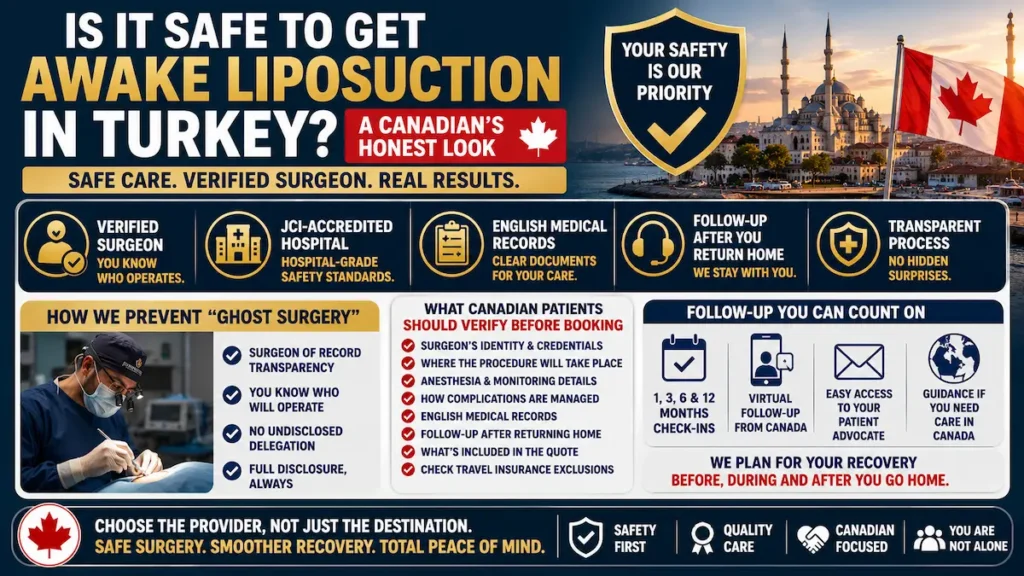
Is It Safe to Get Awake Liposuction in Turkey? A Canadian’s Honest Look
It can be safe to get awake liposuction in Turkey when the clinic is properly licensed, the surgeon is verified, the facility follows hospital-grade standards, and the aftercare plan continues after you return home. It is not safe when the clinic hides who operates, over-promises results, or treats international patients like transactions.
Canadian patients are right to ask hard questions. The Government of Canada guidance on medical care outside Canada advises travellers to consider infection risk, medical record quality, insurance limitations, and follow-up challenges after medical care abroad. We address those concerns directly in our process.
The Turkey Cosmetic Surgery Reality
Turkey has excellent surgeons and modern hospitals. It also has high-volume providers that do not meet the standards Canadian patients expect. Both realities exist at the same time.
That is why “Turkey” should not be judged as one single category. A safe experience depends on the clinic, surgeon, facility, screening, documentation, and aftercare. Geography alone does not protect you, and geography alone does not make care unsafe.
Our position is simple: choose the provider, not just the destination. Istanbul can offer excellent value, but only when the clinical pathway is transparent and surgeon-led.
For a broader discussion, read our guide to plastic surgery safety in Turkey for Canadian patients.
How We Prevent “Ghost Surgery” Concerns
“Ghost surgery” means the patient believes one surgeon will operate, but another person performs all or part of the procedure without proper disclosure. This concern is one of the most important questions in international cosmetic surgery.
We address it through surgeon-of-record transparency. You should know who is responsible for your treatment plan, who performs the procedure, and who manages your follow-up. You should not accept vague answers.
Before booking any clinic abroad, ask direct questions:
- Who is my surgeon of record?
- Will that surgeon perform the procedure?
- Which parts are delegated, if any?
- What are the surgeon’s credentials?
- Where will the procedure be performed?
- Will I receive English medical records?
For a focused checklist, see our ghost surgery in Turkey guide.
JCI-Aligned Facility Standards
Awake liposuction may avoid general anesthesia, but it still requires a sterile surgical environment. Infection prevention, instrument sterilization, emergency readiness, and recovery observation remain essential.
Our hospital partner is a JCI-accredited facility, and our clinic follows strict sterilization and patient-safety protocols. We also use pre-operative testing to identify risk factors before surgery.
Facility standards are especially important for Canadians because follow-up happens across borders. A clean initial surgery reduces the risk of complications that could become difficult to manage after you fly home.
English Medical Records and Discharge Summary
Medical records matter. Canadian patients should return home with clear documentation, not vague verbal instructions. This is useful if you need to speak with a family physician, walk-in clinic, or emergency department after returning to Canada.
We provide English-language discharge guidance and post-operative instructions. These documents summarize the procedure, medications, garment use, restrictions, and warning signs.
You should keep digital and printed copies while travelling. Do not pack all medical documents in checked luggage. Keep them in your carry-on bag with medications and essentials.
Follow-Up After You Return to Canada
One of the biggest fears in international surgery is feeling abandoned after returning home. We plan for that before you leave Istanbul. Follow-up is not an optional extra.
Our long-term virtual follow-up programme includes scheduled check-ins at 1, 3, 6, and 12 months. You can also contact your patient advocate if you are unsure whether a symptom is normal.
If you need in-person assessment in Canada, we guide you on what information to share with your local physician. We do not replace Canadian emergency care, but we make sure you are not navigating recovery without context.
What Canadian Patients Should Verify Before Booking
Before choosing any international provider, verify the basics. A polished website is not enough. You need documentation, names, facility information, and a realistic care plan.
Use this checklist before booking:
- Confirm the surgeon’s identity and credentials.
- Ask where the procedure will take place.
- Request details about anesthesia and monitoring.
- Ask how complications are managed.
- Confirm English medical records.
- Ask about follow-up after returning to Canada.
- Understand what is and is not included in the quote.
- Check whether your travel insurance excludes elective cosmetic complications.
For credential verification, our plastic surgeon board certification guide explains how Canadian patients can compare RCPSC, EBOPRAS, and other international credential pathways.
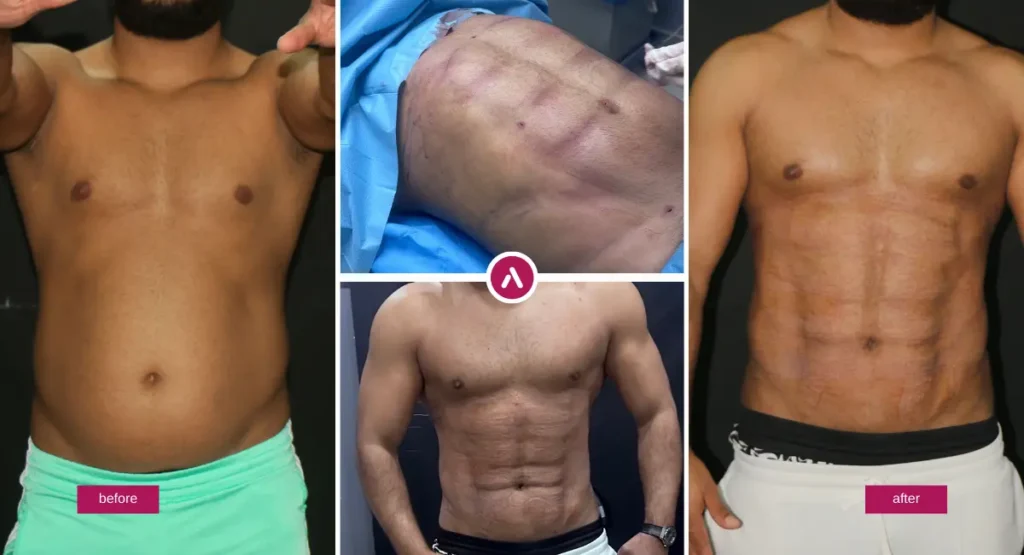
Awake Liposuction Before and After: Realistic Expectations and Results
Awake liposuction changes the anesthesia experience, not the biology of fat removal or healing. You may recover from anesthesia faster, but swelling, bruising, firmness, numbness, and gradual contour definition still take time.
The best results come from a realistic plan. Liposuction can refine shape. It cannot replace weight loss, tighten major loose skin, or create athletic definition when the underlying anatomy does not support it.
Awake Changes the Anesthesia Experience, Not the Biology of Healing
Patients sometimes assume that awake surgery means a dramatically faster final result. That is not accurate. Awake anesthesia can reduce grogginess and help early mobility, but your tissues still need weeks to months to settle.
Fat cells removed during liposuction do not grow back in the same way. However, remaining fat cells can enlarge with weight gain. Long-term results depend on stable weight, skin quality, exercise habits, and realistic body goals.
Swelling can temporarily hide definition. This is especially true in high-definition cases, where small contour lines matter. Early photos do not show the final result.
What High-Definition Liposuction Can Improve
High-definition liposuction can improve the visible relationship between fat, muscle lines, and body proportions. In selected patients, it can help define the waist, flanks, abdomen, arms, back, or chest.
The goal is not to make every patient look the same. Our Natural-First body-contouring philosophy respects your frame, gender expression, skin quality, and starting anatomy. Definition should look athletic, not artificial.
Awake high-definition liposuction may improve:
- localized fat deposits that persist despite exercise;
- waist and flank contour;
- mild-to-moderate abdominal definition;
- arm or upper-body refinement;
- male chest contour when fat is the main issue;
- small contour irregularities after previous procedures.
For a full explanation of VASER-assisted sculpting and high-definition contour planning, see our VASER High-Definition Liposuction guide.
What Awake Liposuction Cannot Do
Awake liposuction is not a substitute for major surgery. It cannot remove large amounts of loose skin, repair separated abdominal muscles, or produce dramatic weight loss. It also cannot guarantee visible abdominal lines in patients with higher body fat or poor skin tone.
If your main concern is loose abdominal skin after pregnancy or weight loss, a tummy tuck may be more appropriate. If your concern is skin laxity after fat removal, energy-assisted tightening or staged surgery may be discussed.
Awake liposuction is also not ideal for every high-definition case. Some complex sculpting plans require a longer procedure, broader treatment area, or deeper anesthesia for surgical precision.
We will tell you if awake is not the right approach. That honesty protects your result.
Before-and-After Photos and Result Timing
Before-and-after photos are useful, but they must be interpreted carefully. Lighting, posture, swelling, camera angle, and timing all change how results look. A day-seven photo cannot be compared with a six-month result.
We encourage patients to review procedure-specific galleries rather than relying only on social media. For liposuction examples, visit our liposuction before-and-after gallery.
During consultation, we explain what is realistic for your body. A patient with firm skin and localized fat may see crisp definition. A patient with skin laxity may need a different plan.
Why Final Definition Takes Several Months
Final definition takes time because swelling and tissue firmness resolve gradually. The treated area may feel hard, uneven, or numb for weeks. This does not necessarily mean something is wrong.
By three months, many patients see a more accurate outline. By six months, definition is usually clearer. Some minor firmness may continue improving beyond that point.
Your role matters. Compression, walking, nutrition, hydration, stable weight, and follow-up all influence recovery quality. Awake anesthesia can make the early days easier, but disciplined aftercare shapes the final outcome.
Awake Liposuction Cost 2026: Turkey vs Canada
Canadian patients researching awake liposuction cost often compare Toronto or Vancouver private-clinic pricing with Istanbul all-inclusive clinical pathways. The difference is not just the surgical fee. In Canada, quotes may separate surgeon fees, facility fees, anesthesia fees, compression garments, medications, and follow-up visits.
At AKM Clinic, awake or tumescent liposuction pricing is assessed by treatment area and complexity. For Canadian patients, reference pricing typically falls around CAD $4,800–$6,150 per area depending on the zone treated and whether high-definition planning is included. Canadian-dollar pricing shown for planning clarity; your coordinator will confirm the final payment details before booking.
By comparison, awake or tumescent liposuction in major Canadian private markets such as Toronto and Vancouver may range from CAD $8,000–$12,000 per area, especially when facility and anesthesia costs are billed separately. OHIP, MSP, RAMQ, and AHCIP generally do not cover cosmetic liposuction, because it is considered elective rather than medically necessary.
Our all-inclusive pathway is designed to make the total investment clearer. It includes the surgical procedure, anesthesia and facility costs, pre-operative testing, 5-star hotel accommodation, private VIP transfers, post-operative medications, compression garments, 24/7 patient advocacy, and long-term virtual follow-up.
For the complete breakdown, see our liposuction cost guide for Canadian patients. Your coordinator will also explain whether an 360 liposuction all-inclusive package is appropriate for your treatment scope.
| Location | Typical Awake/Tumescent Liposuction Cost | What Patients Should Check |
|---|---|---|
| Toronto | CAD $8,000–$12,000 per area | Facility fee, anesthesia fee, garment, follow-up, revision policy |
| Vancouver | CAD $8,500–$12,000 per area | Whether quote includes anesthesia, compression garments, and aftercare |
| Montreal | CAD $7,800–$10,000 per area | Surgeon credentials, language support, and total invoice structure |
| Calgary | CAD $7,000–$11,000 per area | Facility accreditation, anesthesia model, and follow-up plan |
| AKM Clinic Istanbul | CAD $4,800–$6,150 per area | All-inclusive clinical pathway |
How to Find a Surgeon Skilled in Awake Liposuction: A Canadian Patient’s Checklist
Awake liposuction requires more than liposuction experience. Your surgeon must understand body contouring, tumescent local anesthesia limits, awake patient comfort, and when to recommend a different anesthesia plan. The safest surgeon is not the one who says yes to every awake request.
Canadian patients often begin by searching for liposuction near them in Toronto, Vancouver, Montreal, Calgary, or Ottawa. After comparing total cost, anesthesia options, wait times, and aftercare, many begin looking at Istanbul. The key is to verify standards before you book.
Verify Surgical Credentials
Start with the surgeon’s credentials. In Canada, patients are used to RCPSC certification and provincial college oversight. International care requires a different verification framework.
The Royal College of Physicians and Surgeons of Canada is the Canadian reference point many patients know, and its public directory of certified specialists lets you confirm a Canadian surgeon’s credentials directly. For international surgery, we help patients compare that familiar framework with European Board certification, JCI facility standards, and documented surgical experience.
The Canadian Society of Plastic Surgeons’ liposuction procedure overview is a useful Canadian benchmark for procedure-specific safety expectations and the questions to ask before surgery.
At AKM Clinic, our surgical team includes European Board-Certified specialists and Facial Plastic Surgery Fellows. We use this credentialing framework to give Canadian patients a recognizable benchmark for training, accountability, and surgical discipline.
| Credential / Body | Region | What It Indicates | Why It Matters for Canadians |
|---|---|---|---|
| RCPSC | Canada | Specialist certification pathway for Canadian physicians and surgeons | Useful reference point for Canadian patients comparing training standards |
| EBOPRAS / European Board pathways | Europe | Structured European specialist certification and examination framework | Helps Canadian patients understand international surgeon qualifications |
| ISAPS / international societies | International | Professional membership and continuing education in aesthetic surgery | Supports cross-border verification, but should not replace board review |
| JCI-accredited facility | International hospital standard | External review of hospital safety and quality systems | Important when surgery and follow-up cross national borders |
Credentials should be specific. Avoid vague phrases like “internationally trained” if the clinic cannot name the training body, certification pathway, or facility standard.
Ask Who Performs the Procedure
Do not assume the surgeon you meet online performs the surgery. Ask directly. This is especially important for liposuction, where some clinics rely heavily on technicians or unclear delegation.
Ask these questions before you send a deposit:
- Who is my surgeon of record?
- Will that surgeon perform the liposuction?
- Who administers and monitors the tumescent local anesthesia?
- Will any part of the procedure be delegated?
- Who handles complications after I return to Canada?
A good clinic will answer clearly. If the answers feel evasive, keep looking.
Ask About Awake-Specific Case Selection
A surgeon skilled in awake liposuction should be willing to say no. This is one of the strongest safety signals. Awake is not appropriate for every area, every volume, or every patient.
Ask how the clinic decides between awake, twilight, and general anesthesia. If every case is marketed as awake regardless of size, that is a concern. Proper selection protects comfort and reduces risk.
Your assessment should include area size, expected treatment time, local anesthetic limits, anxiety profile, and medical history. If these details are not discussed, the evaluation is incomplete.
Ask About Local Anesthesia Monitoring
Local anesthesia is medical anesthesia. It must be calculated, administered, and monitored carefully. Tumescent fluid is not just “numbing water.” It contains medication that affects the body.
Ask how dosing is calculated. Ask whether vital signs are monitored. Ask what happens if you feel pain, anxiety, or symptoms during the procedure.
The clinic should be prepared to adjust, pause, or convert the plan when needed. Awake liposuction is safe only when the team respects the limits of local anesthesia.
Review Before-and-After Documentation
Before-and-after photos help you assess style, consistency, and realism. Look for patients with similar body type, skin quality, and fat distribution. Do not judge only by the most dramatic transformation on the website.
For liposuction results, review our liposuction before-and-after gallery. During consultation, we can discuss what is realistic for your frame and whether awake anesthesia is suitable for the level of definition you want.
Good documentation should show natural proportions. Be cautious of exaggerated claims, extreme photo editing, or results that appear too uniform across different body types.
Confirm Aftercare From Istanbul to Canada
Aftercare is where many international surgery plans fail. A safe clinic plans your recovery before the procedure, not after a problem appears.
Our follow-up system includes in-person checks before you fly home and scheduled virtual follow-ups after you return to Canada. Our patient hosts — Hande, Emine, and Khadija — help coordinate communication, logistics, and post-operative questions.
You should also confirm what happens if you need local assessment in Canada. We provide English discharge instructions so your Canadian physician can understand what was done and what to monitor.
“A surgeon skilled in awake liposuction knows the technique, but also knows the limits. The safest result often comes from choosing the right anesthesia plan before the first incision is made.”
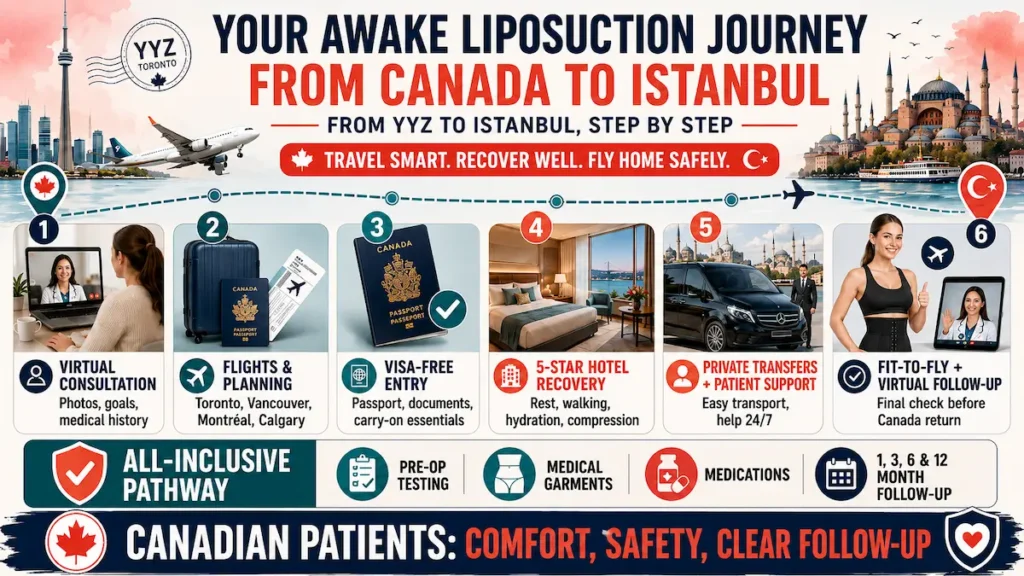
Your Awake Liposuction Journey From Canada: From YYZ to Istanbul, Step by Step
Travelling from Canada for awake liposuction requires more than choosing a surgery date. You need a plan for flights, arrival, hotel recovery, mobility, compression, documentation, and follow-up. Our all-inclusive clinical pathway is built around that full timeline.
Most Canadian patients begin with a remote consultation, then arrive in Istanbul for final examination and surgical confirmation. We manage the clinical logistics so you can focus on preparation and recovery.
Virtual Consultation and Photo Assessment
Your journey starts with a confidential virtual consultation. You send photos of the treatment areas, describe your goals, and share your medical history. We assess whether awake liposuction is realistic or whether another anesthesia plan is safer.
We also discuss your travel window. Canadian patients often need to coordinate work leave, childcare, flights, and recovery time. We help you understand how many days in Istanbul are appropriate based on your procedure plan.
If your goal requires VASER, J-Plasma, abdominal etching, gynecomastia surgery, or multiple areas, we explain whether those can be performed awake or whether a combined plan needs twilight or general anesthesia.
Flights From Toronto, Vancouver, Montreal, and Calgary
Many Canadian patients travel through Toronto Pearson, Vancouver, Montreal-Trudeau, or Calgary. Flight schedules change, so you should always check the latest airline options before booking. Turkish Airlines and other carriers may offer direct or connecting routes depending on your city and travel date.
Try to choose flights that allow recovery time after arrival. Avoid landing and going directly into surgery without adequate rest. Travel fatigue can affect hydration, blood pressure, and overall readiness.
For your return flight, choose comfort over the cheapest itinerary. Long layovers, rushed connections, and heavy carry-on luggage can make early recovery harder.
Visa-Free Entry for Canadian Citizens
Canadian citizens can enter Türkiye visa-free for short stays, but passport validity and airline rules still matter. We recommend checking official travel requirements before booking flights. Dual citizens and Canadian permanent residents travelling on non-Canadian passports should verify their own entry rules.
Bring printed and digital copies of your itinerary, hotel information, clinic contact details, and medical instructions. Keep medications and compression essentials in your carry-on bag, not checked luggage.
5-Star Hotel Recovery in Levent
Our pathway includes 5-star hotel accommodation, typically in the Levent district. The goal is comfort, privacy, and easy access to the clinic. You should not be navigating Istanbul traffic alone after surgery.
Your hotel recovery period is structured around rest, walking, hydration, garment use, and scheduled checks. You will still feel sore and swollen, even without general anesthesia. Plan quiet days.
We recommend loose clothing, slip-on shoes, and a small recovery kit. Avoid tight jeans, complicated outfits, or heavy shopping during the first days after liposuction.
Private Transfers and 24/7 Patient Advocacy
Private transfers are included so you do not need to arrange taxis while recovering. This matters after liposuction because bending, lifting bags, and walking long distances can increase discomfort.
Your patient advocate helps coordinate appointments, hotel communication, and post-operative questions. For many Canadians travelling alone, this support reduces the stress of being in a new city during recovery.
The all-inclusive pathway also includes pre-operative testing, anesthesia and facility fees, post-operative medications, support garments, and long-term virtual follow-up at 1, 3, 6, and 12 months.
Fit-to-Fly Clearance Before You Return
Before you fly back to Canada, we assess your recovery. We review pain control, swelling, mobility, bruising, garment fit, and any warning signs. Fit-to-fly clearance is a clinical decision.
During the flight, you should walk periodically, hydrate, avoid alcohol, and avoid lifting heavy luggage. Keep medications, documents, and a spare garment layer within reach.
After you return home, we continue follow-up virtually. If you develop urgent symptoms in Canada, seek local medical care immediately and contact us with updates. International follow-up works best when both sides communicate clearly.
Awake High Def Liposuction Frequently Asked Questions (FAQ):
What is awake liposuction?
Awake liposuction is liposuction performed under tumescent local anesthesia while you remain conscious. The treatment area is numbed, and fat is removed without general anesthesia. You can communicate with the surgical team during the procedure.
Is awake liposuction the same as tumescent liposuction?
They are closely related. Tumescent liposuction refers to the use of a dilute local anesthetic fluid in the fat layer. Awake liposuction uses that tumescent technique so the procedure can be performed without general anesthesia in selected patients.
Does awake liposuction hurt?
You should expect pressure, vibration, movement, and tugging. You should not feel sharp, untreated pain. If you feel significant discomfort, you can tell the team immediately so we can pause, reassess, or add local anesthesia when appropriate.
Am I awake the entire time?
Yes, in pure awake liposuction you remain conscious throughout the procedure. You are not asleep and you do not receive general anesthesia. If you prefer less awareness, twilight sedation may be a better option.
How much fat can be removed awake?
Awake liposuction is best for small-to-moderate fat deposits. The exact amount depends on the treatment area, your body weight, local anesthetic limits, and safety planning. Large-volume fat removal usually requires twilight or general anesthesia.
Is awake liposuction safer than general anesthesia?
It can be safer for selected patients because it avoids general anesthesia. It is not safer for every case. Large areas, complex contouring, high anxiety, or long procedures may be safer under twilight or general anesthesia.
Does OHIP, MSP, RAMQ, or AHCIP cover liposuction?
Canadian provincial health plans generally do not cover cosmetic liposuction. OHIP, MSP, RAMQ, and AHCIP may cover medically necessary treatment in limited circumstances, but elective body contouring is usually private-pay.
How much does awake liposuction cost in Toronto vs Istanbul?
Awake or tumescent liposuction in Toronto or Vancouver may range from CAD $8,000–$12,000 per area, depending on the clinic and what is included. At AKM Clinic, reference pricing is typically CAD $4,800–$6,150 per area.
Does Canadian travel insurance cover elective liposuction abroad?
Many Canadian travel insurance policies exclude elective cosmetic surgery and complications related to it. You should review your policy carefully before booking and ask the insurer direct written questions.
To reduce this concern, AKM Clinic provides complimentary complication insurance for all patients. This is separate from standard Canadian travel insurance and is designed to add an extra layer of protection around your surgical care. Your coordinator will explain the coverage terms, limits, and required documentation before you confirm your booking.
When can I fly back to Canada?
Flight timing depends on the number of areas treated, swelling, mobility, pain control, and garment fit. Many patients return during the second week, but we confirm fit-to-fly readiness in person before departure.
Can I combine awake liposuction with abdominal etching?
Sometimes. Limited abdominal etching may be possible awake in carefully selected patients. More extensive high-definition contouring may require twilight or general anesthesia for comfort, precision, and safety.
What if I become anxious during the procedure?
We screen for anxiety before recommending awake surgery. If you feel anxious during the procedure, you can communicate with the team. In some cases, we pause or adjust the plan. If anxiety is expected to be significant, we recommend twilight or general anesthesia instead.
Medical Disclaimer: This page is for educational purposes only and does not replace medical advice from a qualified physician. Awake high-definition liposuction, tumescent liposuction, VASER liposuction, J-Plasma, and related body-contouring procedures carry risks, and results vary by patient. Before travelling for surgery, Canadian patients should consult their family physician when appropriate, review medications and medical conditions, and understand that elective cosmetic surgery is usually not covered by provincial health plans or standard travel insurance.