
Lip Lift Scar: How Visible Is It and How Does It Heal?
AI Summary
- Lip lift scar placement sits under the nose, hidden in natural alar creases.
- Healing takes months; redness improves early, while full maturation can take one year.
- Safe aftercare matters: low-tension closure, sun protection, scar care, and follow-up reduce visibility.
- Cost stays separate; Canadian patients should review dedicated CAD pricing before planning surgery abroad.
Summary generated by AI, fact-checked by our medical experts
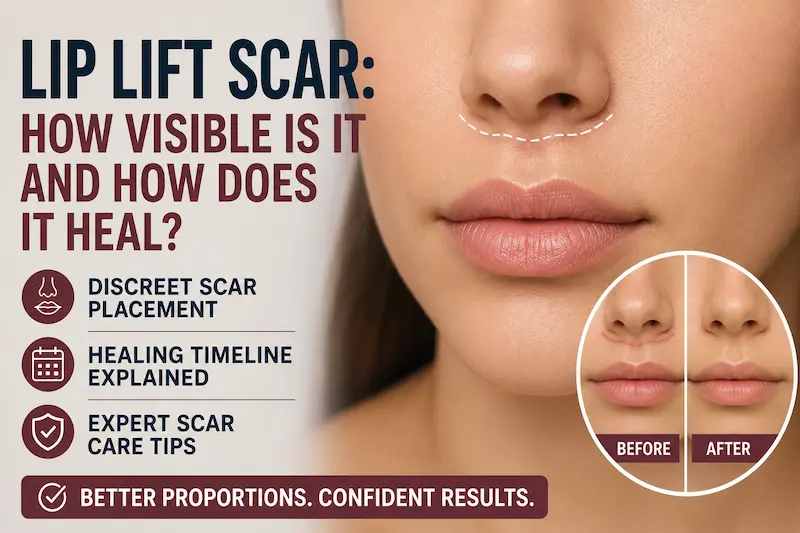
Direct answer: A lip lift scar sits along the base of the nose, where the nostrils meet the upper lip. In a well-planned subnasal, or bullhorn, lip lift, the incision follows the natural alar creases so the scar can soften into a fine line over several months. Full scar maturation may take up to a year.
For many Canadian patients considering a lip lift in Turkey, the scar is the real question. The goal is not simply to shorten the philtrum or show more upper lip. The goal is to do it without leaving an obvious line in the centre of the face.
That is why scar planning starts before the first incision. The surgeon has to read the base of the nose, the alar creases, the natural shadow under the nostrils, the patient’s skin quality, and the amount of lift being requested. Too much tension can widen a scar. Poor placement can make it harder to hide. Good planning makes the scar less noticeable in everyday conversation, photos, and close-up views.
This guide focuses only on the subnasal lip lift scar: where it sits, how it heals, how visible it usually is, and what can make it look better or worse. It does not cover the full lip lift technique, pricing, or decision-regret topic. Those deserve their own pages.
Table of Contents
Where a Lip Lift Scar Actually Sits
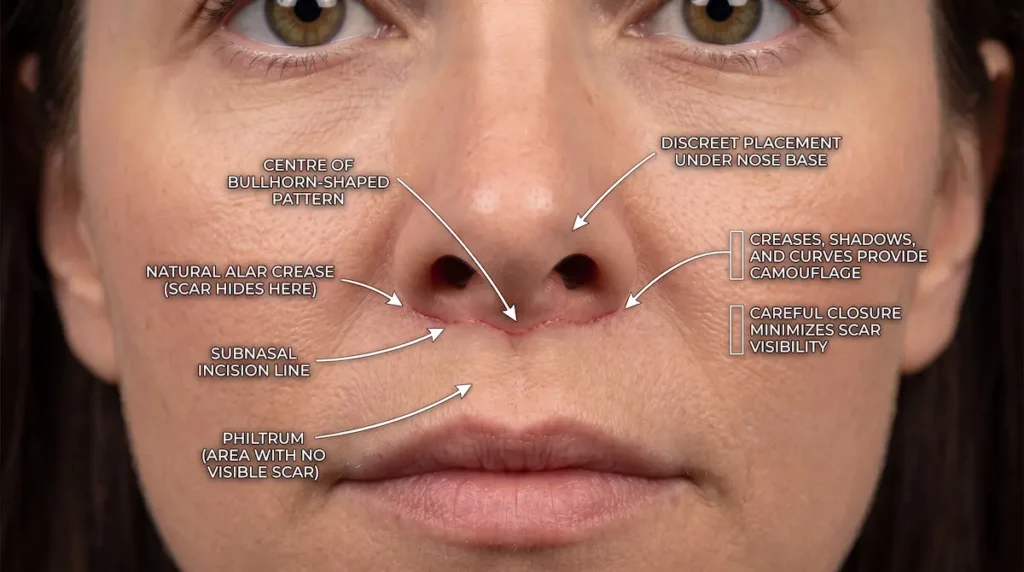
A subnasal lip lift scar sits directly beneath the nose, not across the visible pink part of the upper lip. This matters because the base of the nose already has curves, creases, and shadow. A carefully designed incision uses those natural borders to make the scar less obvious as it heals.
The most common pattern is called a bullhorn lip lift. Cleveland Clinic describes the bullhorn, or subnasal, lip lift as a technique where the surgeon makes a single bullhorn-shaped incision below the nose, then lifts the centre and sides of the upper lip. The location and number of incisions vary depending on the type of lip lift performed, which is why scar placement should be discussed before surgery.
Subnasal placement at the base of the nose
In a subnasal lip lift, the incision usually follows the crease where the nostrils meet the upper lip. This crease is useful. It gives the surgeon a natural hiding place.
Instead of placing the scar in a flat, exposed area, the incision can be planned inside the shadow line under the nose. When the scar is fresh, it may still look red, firm, or slightly raised. That is normal early on. Over time, the colour usually softens and the line becomes less visible.
The scar does not disappear in a literal sense. No surgical incision can promise that. The realistic goal is a fine, flat line that blends into the natural nasal base.
Why the bullhorn shape hides in the alar creases
The “bullhorn” name comes from the curved shape of the skin removed under the nose. The centre sits below the columella, while the outer ends curve into the alar creases at the sides of the nostrils.
Those side creases are important. If the incision ends are placed cleanly within them, the scar is less likely to look like a straight line across the face. A straight line draws the eye. A scar that follows natural anatomy is easier for the eye to ignore.
Surgeon note: In facial scar planning, the incision is only part of the result. The closure matters just as much. A low-tension closure, precise alignment, and careful aftercare all help a lip lift scar settle into the natural crease below the nose.
This is where surgeon selection becomes practical, not just cosmetic. Canadian patients should verify credentials and training carefully. The Canadian Society of Plastic Surgeons warns that the term “cosmetic surgeon” can be broad and that patients should check training, licensing, complication planning, and follow-up before agreeing to surgery.
AKM Clinic’s facial surgery team includes a European Board-Certified surgeon. European board certification is not the same as RCPSC certification, so check each surgeon’s training, licensing, and experience before you book.
Corner-lift scar vs subnasal scar
A corner lip lift is different. It lifts downturned mouth corners, so its small scars sit near the outer corners of the mouth. A subnasal lip lift, by contrast, works from the base of the nose and changes the vertical distance between the nose and upper lip.
That difference affects scar visibility. A corner-lift scar may move more with smiling and speaking because it sits beside the mouth. A subnasal scar sits higher, under the nose, where natural shadow can help camouflage it.
The right choice depends on the concern. If the goal is a shorter philtrum and more upper tooth show, the discussion usually centres on a subnasal lip lift. If the concern is a sad or downturned mouth, the corner lift may enter the conversation. Some patients also compare this with a related procedure that reshapes the smile area, but each procedure changes a different part of the lower face.
The Lip Lift Scar Healing Timeline
A lip lift scar does not fade in a straight line. It changes in stages. The first week can look red, swollen, and obvious. Weeks two to six usually bring softening, but the scar may still be pink. The slower, more reassuring change happens over months, as the scar flattens and the colour blends closer to the surrounding skin.
For Canadian patients travelling home after surgery, this timeline is also a planning tool. You need to know what is normal before you fly, what can be monitored by photo follow-up, and what should be raised with your surgeon.
First week — redness, swelling, crusting
A 1 week lip lift scar often looks more visible than patients expect. The upper lip may feel tight. The area under the nose may be swollen. There may be small scabs or crusting along the incision line.
This is not the final scar. It is early wound healing.
During this stage, the scar can look dark red or pink, especially on lighter skin tones. On deeper skin tones, the colour change may look brown, purple, or slightly darker than the surrounding skin. Mild asymmetry can also happen because swelling rarely settles evenly from side to side.
Most surgeons will ask patients to avoid heavy talking, excessive facial movement, smoking, alcohol, and anything that pulls on the incision. Cleveland Clinic also notes common early aftercare steps such as sleeping on the back with the head elevated, eating soft foods, and following incision-care instructions.
Weeks 2–6 — settling and early softening
By weeks two to six, swelling usually begins to settle. The incision may still look pink, but the edges should feel less angry. Many patients can use light camouflage makeup once the incision is fully closed and the surgeon has cleared it.
This is the stage where patience becomes hard. The scar is not fresh anymore, but it is not mature either. It may look slightly raised in some lighting. It may feel firm to the touch. It may also appear more visible in close-up photos than it does in real life.
That difference matters. Phone cameras can exaggerate facial redness, texture, and shadow. A scar that looks dramatic under bathroom lighting may be far less noticeable during normal conversation.
If the incision is closed and healing well, this is also when many surgeons begin structured scar care. Silicone gel may be recommended for some patients. Sun protection becomes non-negotiable because UV exposure can darken a healing scar and make colour mismatch last longer.
Months 3–12 — scar maturation and fading
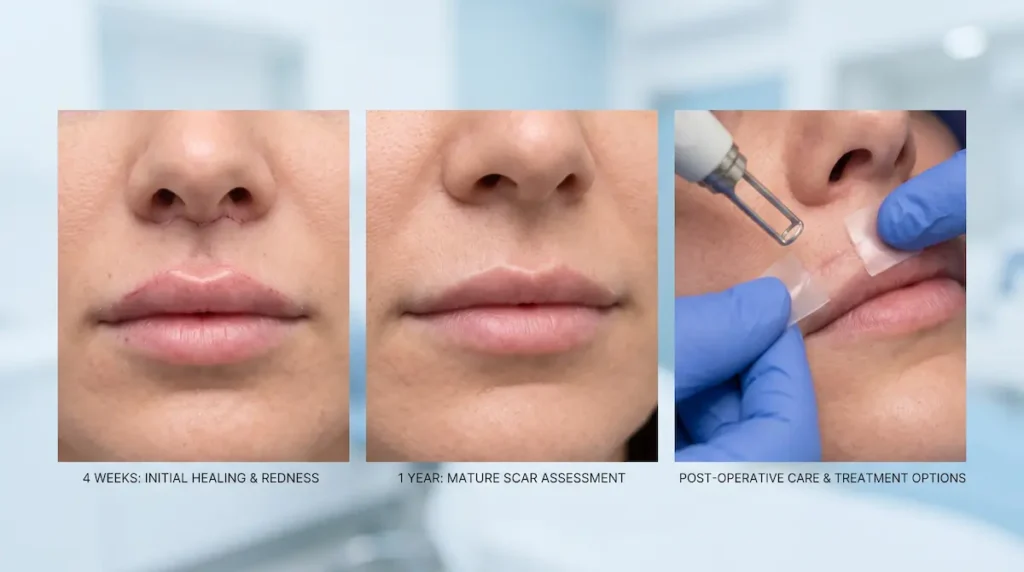
Scar maturation is slow. By three months, many lip lift scars look flatter and less red. By six months, the line often blends better with the base of the nose. By one year, most of the final fading and softening has occurred.
The phrase lip lift scar healing time can be misleading because “healed” means different things. The incision may be closed within weeks. The scar may look socially acceptable earlier than expected. But full maturation — flattening, colour settling, and softening — can take many months.
That is why a visible scar at four or six weeks does not automatically mean a bad result. It may simply mean the scar is still young.
Patients who have healed scars from other facial procedures often understand this better. Facial scars can look more noticeable before they soften. For a broader comparison, see how facial scars heal and fade over time.

How Visible Is It, Really?
A healed lip lift scar is usually most visible to the patient, not to everyone else. You see it in magnified mirrors, under bright bathroom lights, and in close-up photos. Other people usually see your face in movement, conversation, and natural light. That difference can make the scar feel more obvious than it actually is.
Still, it is a facial scar. It deserves honest expectations. A good result is not a scar that never existed. A good result is a scar that becomes flat, pale, and well hidden within the natural crease under the nose.
Why it often becomes a fine line
The subnasal area is one of the reasons the bullhorn lip lift remains widely used. A 2026 evidence-based review of surgical lip lift techniques notes that the characteristic bullhorn-shaped excision along the nasal base can conceal the scar within the alar creases while shortening the upper lip vertically.
That does not mean every scar heals the same way. It means the anatomy gives the surgeon a useful hiding place. The final result still depends on incision design, closure technique, tissue tension, skin biology, and aftercare.
The evidence-based review of bullhorn lip lift techniques also supports a key point for realistic planning: technique selection should be individualized. In other words, the best scar plan is not copied from a trend photo. It is matched to your nose base, philtrum length, upper-lip shape, and healing history.
What can make the scar more visible?
A lip lift scar can stay more visible for several reasons. Some are under the surgeon’s control. Some are under the patient’s control. Some come down to individual healing.
- High incision tension: If too much lift is attempted, the closure may be tight. Tension can widen a scar.
- Placement outside the natural crease: A line placed too low or too straight can be easier to notice.
- Sun exposure: UV exposure can darken a healing scar and prolong colour mismatch.
- Smoking or nicotine use: Nicotine can reduce blood flow and compromise wound healing.
- Picking or over-cleaning: Irritating the incision can delay healing and make redness last longer.
- Personal scar tendency: Some patients are more prone to thickened, hypertrophic, or darker scars.
Skin tone also affects how healing looks. In fair skin, the scar may look pink or red for months. In deeper skin tones, the concern may be post-inflammatory hyperpigmentation, where the scar looks darker than the surrounding skin. Neither automatically means the final result will be poor. It means the scar needs time and protection.
Realistic vs unrealistic scar expectations
Online lip lift scar photos can be useful, but they can also distort expectations. A photo taken at one week, with swelling and scabbing, tells you nothing about the one-year result. A heavily filtered “after” photo may hide texture that still exists in real life.
Use photos to understand stages, not to demand an identical outcome. Your scar will heal according to your anatomy, skin response, incision design, and aftercare. Two patients can have the same operation and very different early redness patterns.
The more helpful question is not, “Will I have no scar?” It is, “Will the scar be placed and closed in a way that gives it the best chance to fade discreetly?”
| Healing stage | What the scar may look like | What is usually normal | Care action |
|---|---|---|---|
| 0–1 week | Red, swollen, crusted, slightly raised | Tightness, mild asymmetry, visible incision line | Keep the incision clean, avoid pulling, sleep elevated, follow surgeon instructions |
| 2–6 weeks | Pink or darker line, less swelling, early firmness | Scar still visible, especially in close-up photos | Begin approved scar care only after closure; avoid sun exposure |
| 3–6 months | Flatter, softer, less red or less pigmented | Slow colour improvement, occasional firmness | Continue sunscreen and silicone if recommended; send follow-up photos if concerned |
| 1 year | Fine line blended into the nasal base | Most scar maturation complete, though minor texture may remain | Discuss revision only if the scar remains widened, raised, or poorly positioned |
Canada planning note: A visible scar concern should be discussed before you travel, not after the incision is healing. Ask how the incision will be placed, how closure tension is controlled, what scar-care products are allowed, and how post-op photos will be reviewed once you are back in Canada.
Helping the Scar Heal Well
Scar healing is not passive. The surgeon creates the incision and closes it; your body remodels it; your aftercare protects it. The best outcomes usually come from all three working together. That is especially important for a lip lift because the incision sits on a highly visible, mobile part of the face.
The goal is simple: keep the wound protected while it closes, reduce unnecessary tension, avoid inflammation, and protect the new scar from UV exposure while colour is still changing.
Silicone gel and sun protection
Silicone gel or silicone sheeting may be recommended once the incision is fully closed. Do not start early unless your surgeon says it is safe. A sealed incision is different from an open wound.
Sun protection matters just as much. A healing scar can darken with UV exposure, even in Canadian winter when the sun feels weak. Once your surgeon clears topical products, daily sunscreen and physical shade help prevent long-lasting colour change.
This is not about perfection. It is about not making the scar work harder than it has to.
What normal healing looks like
Normal healing can look imperfect. That is the part many patients are not prepared for. A scar can be red, firm, slightly raised, or uneven for weeks without being a bad scar.
Common normal findings include:
- mild redness or darker colour along the incision;
- temporary tightness under the nose;
- small crusts in the first week;
- itching as the wound closes;
- firmness that gradually softens over months;
- scar visibility that changes depending on lighting.
Normal does not mean ignore everything. It means watch the pattern. A scar that is slowly improving is usually behaving differently from a scar that is becoming more painful, more swollen, or more inflamed.
When to ask your surgeon about scar concerns
You should contact your surgical team if the incision opens, bleeds repeatedly, smells unpleasant, drains pus, becomes increasingly painful, or develops spreading redness. These are not “wait and see” issues.
You should also raise concerns if the scar becomes thick, rope-like, very itchy, widening, or sharply darker over time. Some scar concerns are easier to manage early than late, especially if the problem is irritation, tension, or inflammation.
Cleveland Clinic lists infection, permanent scarring, swelling that does not go away, nerve changes, bruising, asymmetry, and anesthesia reaction among possible lip lift risks. Those risks are uncommon when surgery is well planned, but they are exactly why aftercare instructions and follow-up matter.
Cleveland Clinic’s lip lift overview is a useful neutral reference for understanding procedure types, recovery, and possible side effects before you compare individual clinic claims.
Canadian credential check: Before booking any facial surgery abroad, confirm who performs the procedure, what their surgical training is, where the operation takes place, and what the complication plan looks like.
At AKM Clinic, lip lift planning is part of a broader facial harmony assessment. The clinic’s Natural-First philosophy aims for rejuvenation over alteration, avoiding an operated-on look. For a lip lift scar, that means the scar plan and the shape plan are connected: a conservative lift with a low-tension closure often protects both the scar and the final expression.
When You Might Not Be Happy With the Scar
Most lip lift scars improve gradually, but some patients feel disappointed if the scar stays wider, darker, raised, or more visible than expected. The right response depends on timing. A four-week scar is still immature; a one-year scar gives a fairer picture of the final result.
Scar concerns should be taken seriously, but not rushed. Early redness is common. A poorly placed or widened scar is different.
Why a scar may widen or stay visible
A lip lift scar can widen if the closure was under too much tension, if the patient healed with a thicker scar tendency, or if the incision was irritated during early recovery. Too much lip elevation can also create a trade-off: a stronger lift may place more pull on the wound edge.
That is why conservative planning matters. A natural-looking lift should improve upper-lip proportion without making the scar or expression look tight.
Scar revision options, without overpromising
If a mature scar remains raised, widened, or poorly positioned, your surgeon may discuss options such as silicone therapy, laser treatment, steroid treatment for selected raised scars, or surgical scar revision. These options are not instant fixes. They depend on scar type, skin response, and timing.
Most surgeons prefer to wait until the scar has matured before considering revision, unless there is a medical reason to intervene earlier. For many patients, that means reassessing closer to the 6–12 month mark.
Connecting scar concerns to broader lip lift regret questions
A scar is one part of satisfaction. Some patients are happy with the scar but not the amount of lift. Others like the shape but worry during the early red phase. Before deciding, it helps to understand the bigger picture of lip lift regrets, including proportion, tooth show, facial expression, and long-term expectations.
If cost enters your decision, keep it separate from the scar question. This article does not compare pricing, but Canadian patients can review lip lift cost in CAD on the dedicated cost page.
At AKM Clinic, lip lift planning is handled within a Natural-First facial approach: incision placement, scar visibility, and expression are considered together. The aim is not an overdone mouth. It is a shorter upper lip that still belongs to the rest of the face.
Frequently Asked Questions: Lip Lift Scar
These are the questions patients most often ask when they are deciding whether a lip lift scar is a reasonable trade-off. The answers below are general education, not personal medical advice.
Is a lip lift scar noticeable?
How long does a lip lift scar take to heal?
Can a lip lift scar be hidden with makeup?
Do lip lift scars fade completely?
What if my scar is visible?
Does a corner lip lift scar differently?
Final Thoughts
A lip lift scar is not a minor detail. It is the detail many patients worry about most — and rightly so. The scar sits in the centre of the face, so it should be planned with precision, closed with low tension, and protected through the full healing process.
For Canadian patients considering surgery abroad, the safest question is not “Will there be no scar?” It is: “Where will the scar sit, how will it be closed, how will I care for it, and how will follow-up work once I am home?”
If you are considering a lip lift, request a virtual consultation with AKM Clinic to discuss your philtrum length, scar placement, skin healing history, and realistic scar timeline before making a decision.
Medical disclaimer: This article is for educational purposes only and does not replace medical advice, diagnosis, or treatment. Healing, scarring, and surgical outcomes vary by patient. Always consult a qualified surgeon for advice based on your anatomy, medical history, and goals.
Related Procedures


Ready to Begin Your Journey?
Join the more than 2,000 patients who have trusted Dr. Akif Mehmetoğlu and the AKM Clinic team. Your journey begins with an informative, no-obligation conversation. Contact us today from across Canada to schedule your complimentary virtual consultation.
#1: Receive Your Personalized Quote
Start with a complimentary, no-obligation virtual consultation. Share your photos, and our surgical team will provide a fully personalized treatment plan and a transparent, all-inclusive pricing package quoted in Canadian dollars (CAD). There are no hidden fees.
#2: Secure Your Procedure Date
Once you are ready to proceed, our dedicated English-speaking patient coordinators will help you secure your procedure date. We will manage your logistical bookings in Istanbul, including your five-star hotel and private airport transfers.
#3: Arrive in Istanbul & Meet Your Surgeon
Arrive at Istanbul Airport (IST), where you will be greeted by your private driver. Settle into your hotel before your comprehensive in-person consultation. You will meet your specialist surgeon to finalize the details of your procedure and ensure your goals are aligned for a natural, subtle result.