
Upturned Nose: When to Leave It Alone and When to Consider Correction
AI Summary
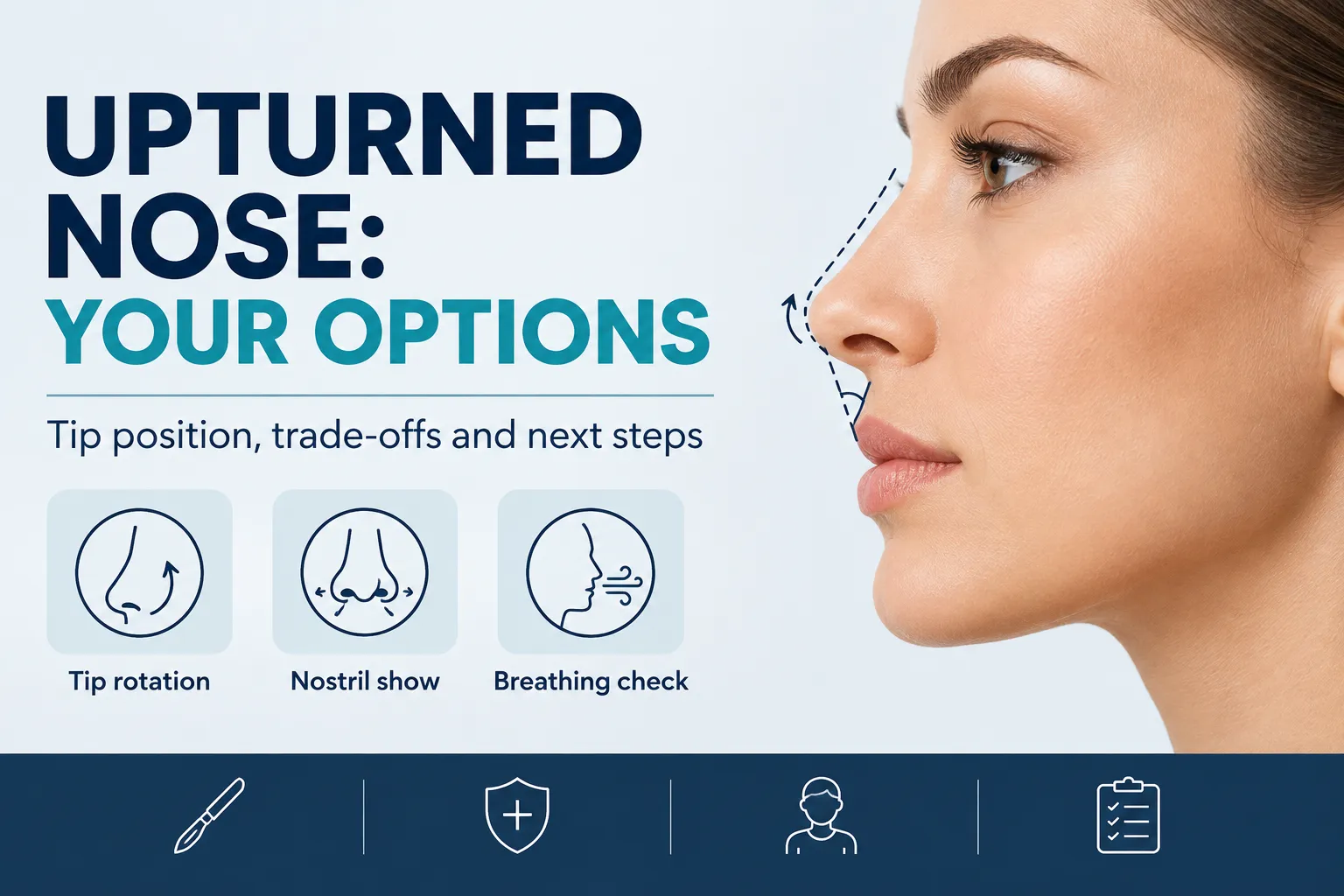
- An upturned nose has a tip that points upward and often shows more nostril. It is a shape, not a medical problem, and leaving it alone is a valid choice.
- Rhinoplasty can sometimes lower an upturned tip, but how much depends on your cartilage, skin and any previous surgery. Filler is not an equivalent.
- Surgery carries real risks, including breathing difficulty, an uneven result and the possible need for another operation. Results vary from person to person.
- At AKM Clinic, rhinoplasty is assessed by a facial plastic surgeon, with a final in-person check before you fly home and virtual follow-ups at 1, 3, 6 and 12 months.
Summary generated by AI, reviewed by our editorial team
An upturned nose has a tip that points upward, often leaving more of the nostrils on show. It is a shape, not a medical problem, and it does not need treatment on its own. If it bothers you, a rhinoplasty assessment can tell you whether lowering the tip is realistic for your nose. Breathing problems deserve a separate check.
Start with what bothers you. You might want less visible nostrils, feel your nose looks short, or notice a change after earlier surgery. Describe what you want to change and what you want to keep, rather than picking a nose from social media.
Give the trade-offs equal weight. Our guide to rhinoplasty in Turkey for Canadians covers the procedure and travel in full. This page stays on one question: what, if anything, to do about an upturned tip.
Table of Contents
What is an upturned nose, and does it need correction?
An upturned nose has a tip that points upward. That alone is not a reason for surgery. Before anything else, separate what you dislike about the look from any breathing concern. Then ask yourself whether the wish for change is your own or comes mostly from comparing yourself with others.
What makes a nose look upturned?
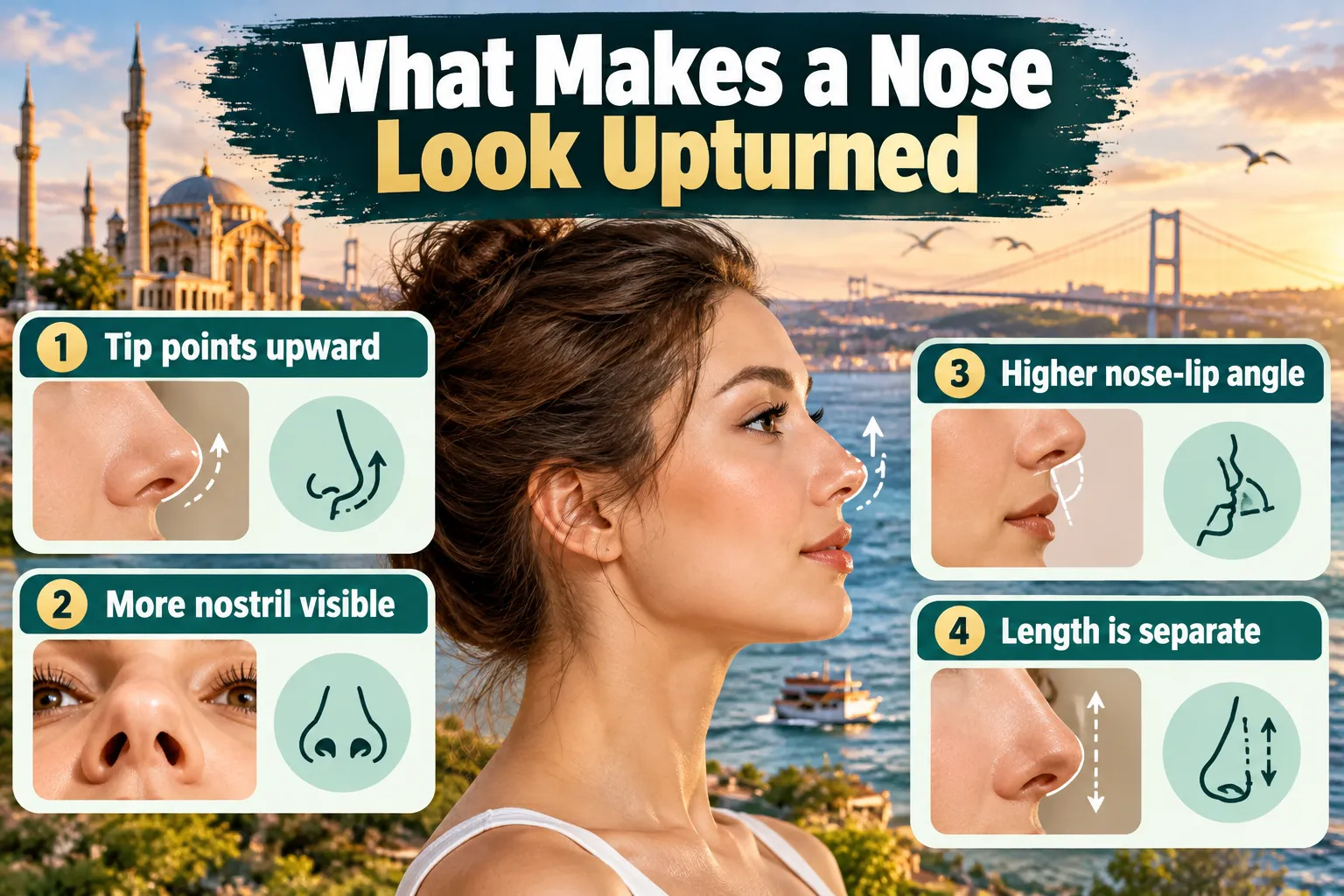
Surgeons describe the tip's direction as nasal tip rotation. A tip rotated upward is what most people mean by upturned. Surgeons often look at the nasolabial angle, the angle between your upper lip and the strip of skin between your nostrils (the columella). A higher angle tends to read as a more upturned tip.
You may notice it in two places. In profile, it shows as the direction of the tip. From the front, it shows as how much of your nostrils you can see. Some people notice only one of these. Tell the surgeon which one you mean.
Is an upturned nose the same as a short nose?
Not quite. Upturned describes where the tip points. Short describes the overall length from the top of the nose to the tip. The two can appear together, but they are different features and can call for different plans.
Try describing your concern without a label. Say whether you want less nostril showing, a different profile or simply a clearer picture of your anatomy before you decide.
For a bump on the bridge rather than a tip concern, see our honest guide to arched and aquiline noses.
When is leaving your nose unchanged a reasonable choice?
No treatment is a real option. Before you book anything, think about:
- What you like about your nose and would want to keep.
- Whether the concern affects your daily life or mostly shows up in photos.
- Whether you want an opinion without committing to surgery.
Keep breathing separate. If your nose feels blocked much of the time, ask for that to be assessed on its own terms. Do not assume the tip's shape is the cause.
Why does your nose look upturned?
Timing is the first clue. A good consultation separates a tip that has always looked upturned from one that changed after an injury or an operation. Nobody should assign a cause from a photo alone.
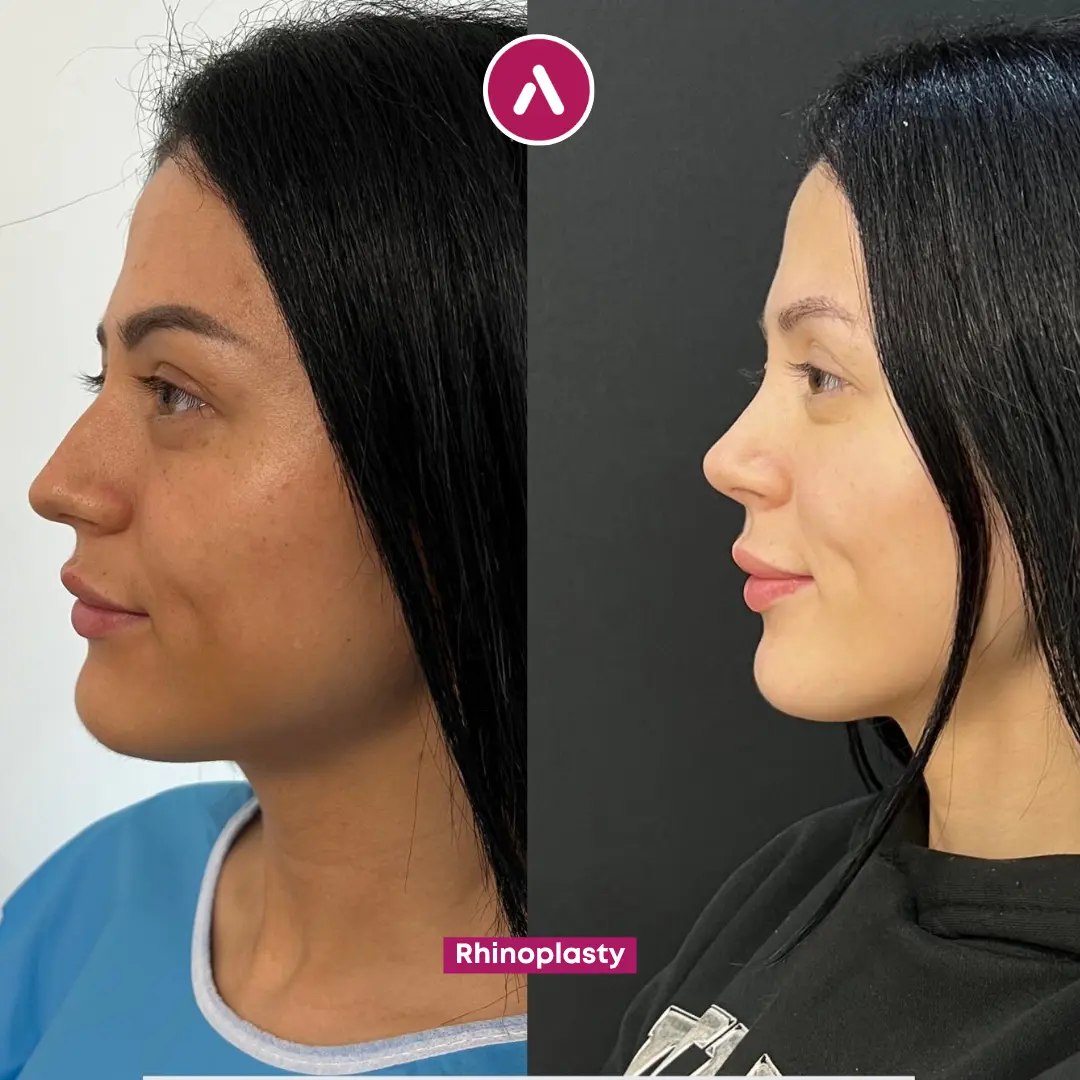
Has your nasal tip always pointed upward?
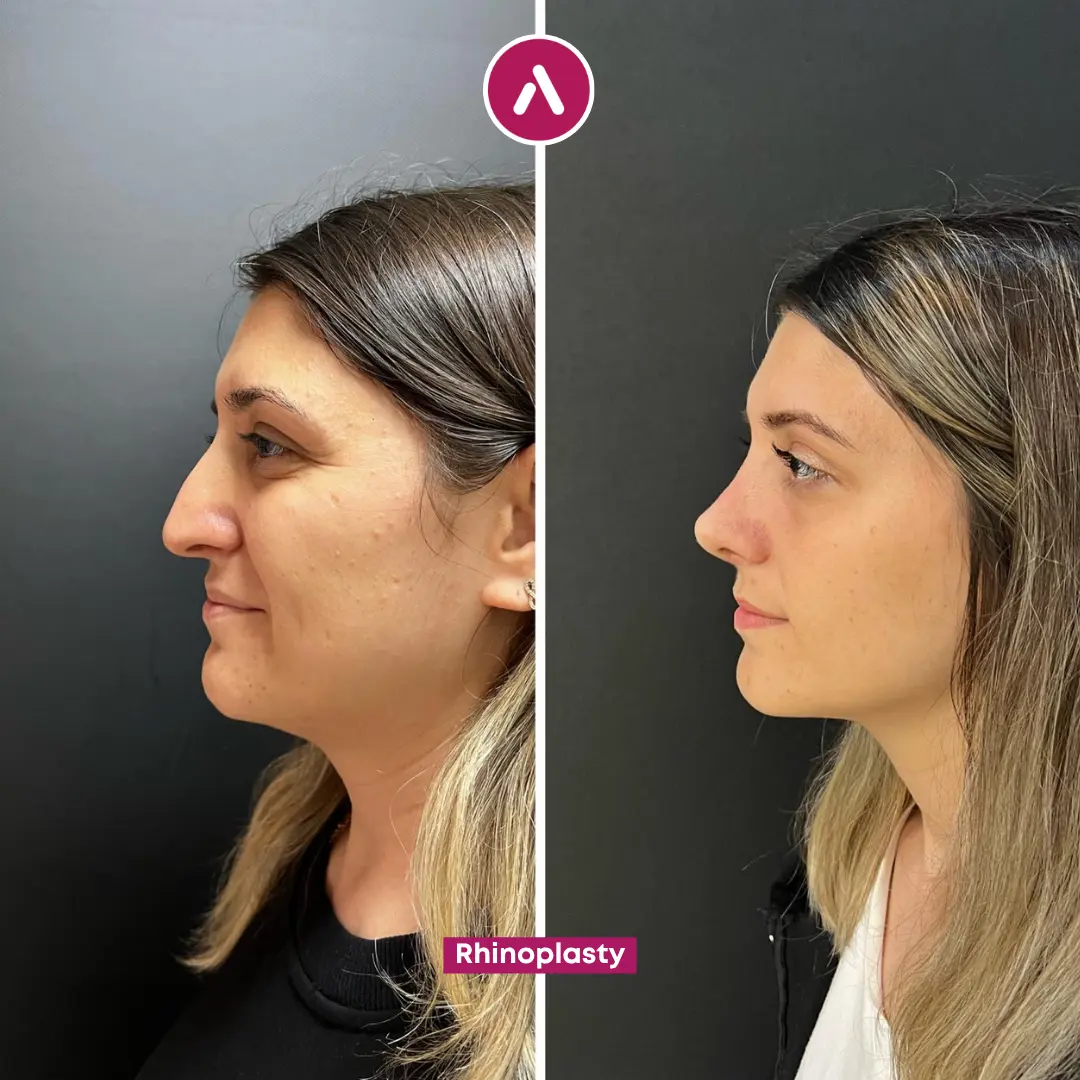
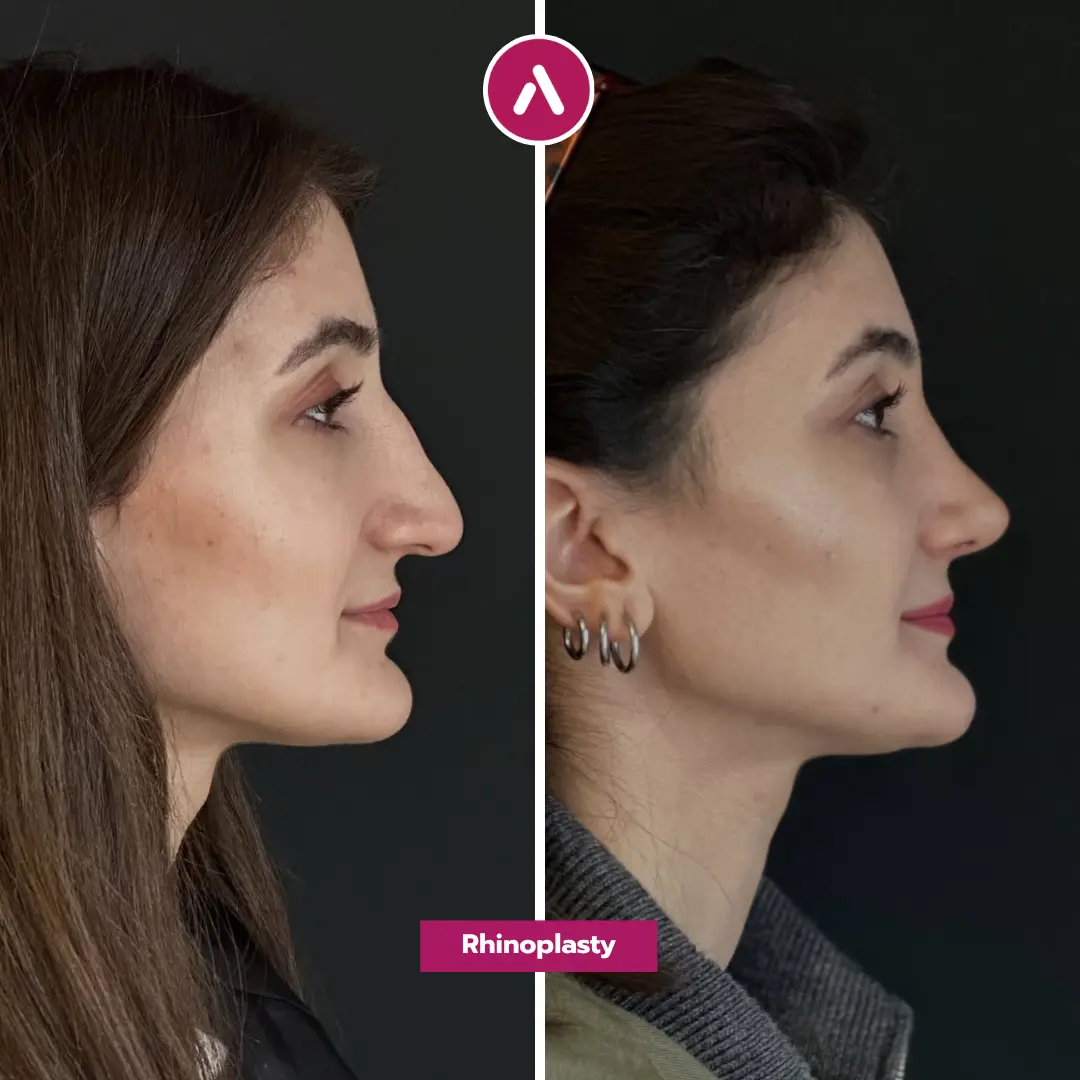
An upturned tip may simply be part of how your nose is built, shaped by its cartilage and bone. That does not mean it needs treatment. Tell the surgeon whether the look has stayed the same over the years and what, specifically, bothers you now.
Older photos help. Bring ordinary pictures that show your nose clearly, not only the ones you dislike. Say what you want to preserve as well: your profile, a family resemblance or how your nose looks from the front.
Did the change follow an injury or previous rhinoplasty?
An injury or earlier nose surgery can change where the tip sits. Explain what your nose looked like before, what happened and when you first noticed the difference.
Bring your records. That means the operative report and earlier photos where you have them, plus any later procedures, even minor ones. You do not need to work out what went wrong. Ask the surgeon which findings support their view and what is still uncertain.
What information helps explain the change?
Write a short history before your consultation. Include:
- When you first noticed the upturned look and whether it has changed.
- Previous nose surgery, injections or other procedures.
- Any injury to your nose.
- Breathing problems, when they began and what you notice.
- Your medical conditions, medications and any nicotine use.
- The change you want assessed and the features you want left alone.
Photos are a starting point. Ask what the surgeon still needs to examine in person before recommending anything. Plain words help most: saying you see more of your nostrils is more useful than deciding in advance which operation you need.
Can rhinoplasty lower an upturned nasal tip?
It may be possible, but how far the tip can come down depends on the cartilage, skin and structural support you have. Start with an assessment, not a target angle. Ask the surgeon to separate the change you want from the change your nose can reliably hold.
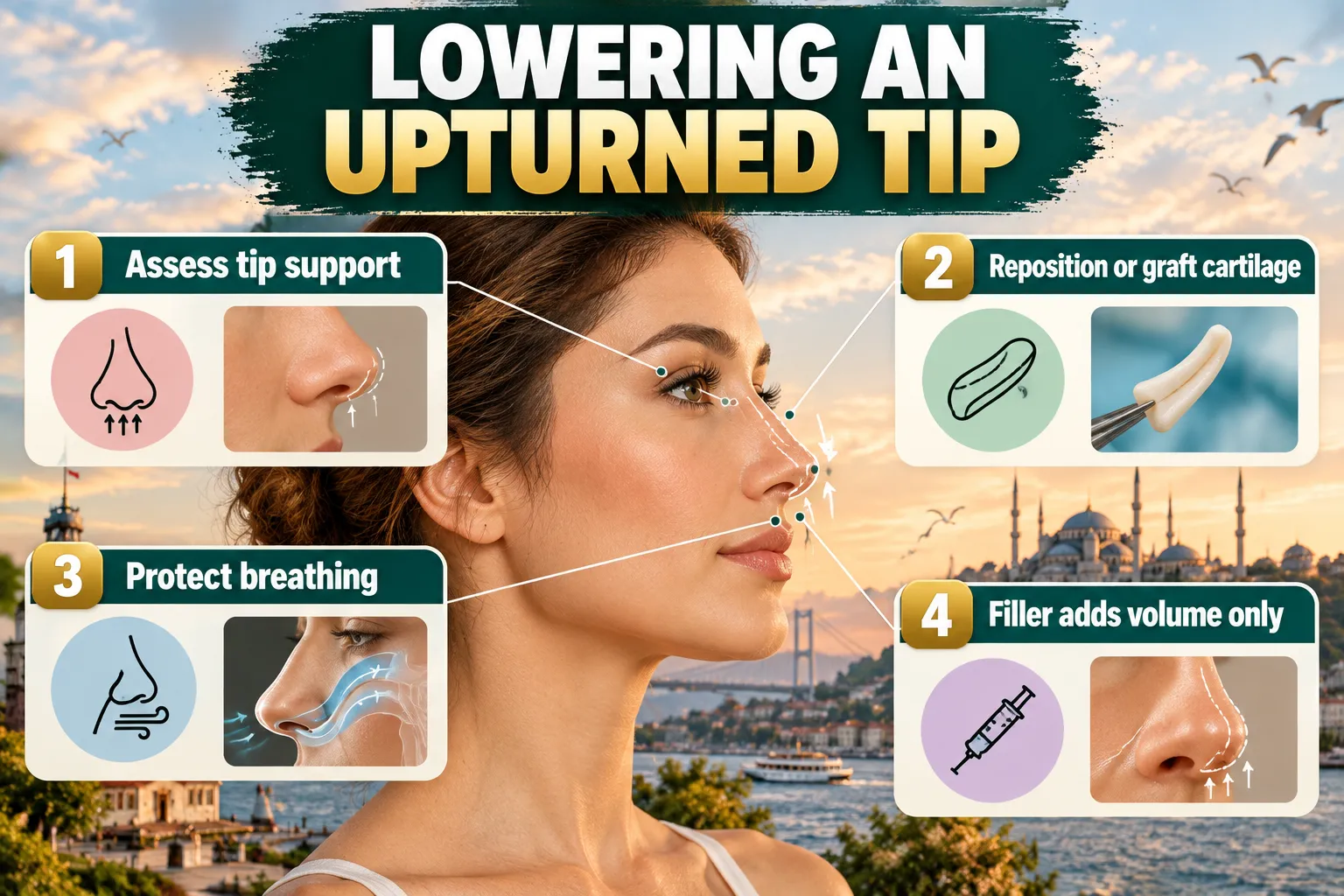
What would lowering the tip involve?
Lowering the tip is not the same as making the nose smaller. The surgeon changes the tip's position while keeping the framework that holds it up. Ask whether the plan aims to change the tip's rotation, the nostril show or both, and which features would stay as they are.
Get an explanation built around your nose, not a technique name. Useful questions:
- What currently holds my tip in its position?
- Would you reposition cartilage, add cartilage grafts for support, or both?
- If grafts are needed, where would the cartilage come from?
- How much do my skin and soft tissue limit the change?
- How could the plan affect my breathing?
Keep function in the conversation. Ask the surgeon to name any trade-off between the look you want and keeping good support and airflow.
How does previous surgery affect the treatment plan?
The starting point changes everything. A previous rhinoplasty can make lowering the tip more complex. A revision plan has to account for what was already done.
Do not assume correction simply reverses the first operation. If support was removed, it may need to be rebuilt. Ask what your old records show, what is still unclear and what the examination needs to confirm.
Results vary from person to person. Your surgeon may suggest a smaller change than you hoped for. Ask them to explain the limit. A conservative plan is not an incomplete one.
Can filler provide the same change?
Filler works differently. It adds volume under the skin; it does not move cartilage. It cannot change the structure that makes your tip point upward.
The safety question is serious. The U.S. Food and Drug Administration's page on dermal fillers warns that accidental injection into a blood vessel can block blood flow, with risks that include tissue damage, vision problems and stroke. Ask exactly what any injectable proposal would change and whether it touches your actual goal at all.
| Option | What it can change | What it cannot do | Main trade-off |
|---|---|---|---|
| Leave it as it is | Nothing, by choice | Change the shape | No surgical risk, no change |
| Makeup and contouring | Where the eye is drawn | Move the tip | Temporary, daily effort |
| Filler | Volume in a small area | Reposition cartilage | Blood-vessel risks; not a structural fix |
| Rhinoplasty | Tip position and support | Promise an exact result | Surgical risks, recovery, possible revision |
Who should consider upturned-nose surgery, and who should wait?
A clear preference is only the start. Before surgery, weigh the change you want against the risks you are prepared to accept. The consultation should show whether the plan fits your goals, your health and your ability to keep up with follow-up, not just whether you dislike your profile.
Are your goals specific and realistic?
Be precise. You might want less nostril show from the front while your nose still looks like yours. Say that plainly, and ask the surgeon what they would leave untouched.
Test your readiness with a few questions:
- Would I still want this without social media comparisons?
- Can I explain what bothers me in my own words?
- Would I accept a smaller change than I first imagined?
- Am I comfortable choosing no treatment after the consultation?
There is no deadline. If the result you want changes with every photo you see, give yourself time before booking.
What health and breathing issues need assessment?
Your health is part of the decision. The American Society of Plastic Surgeons' guidance on rhinoplasty candidates names good physical health, a fully grown face, not smoking and realistic goals as the things that make someone suitable.
Give the surgical team an honest history:
- Current medical conditions and any ongoing tests.
- Prescription medicines, over-the-counter products and supplements.
- Smoking, vaping and other nicotine use.
- Previous nose operations, injuries and past experiences with anesthesia.
- Breathing problems and when you notice them.
Never stop a medication on your own. Ask which instructions need sign-off from your usual prescriber in Canada, and get written guidance on nicotine and preparation.
Ask the surgeon to address breathing directly. That holds even if your only reason for coming is how the tip looks.
When might the surgeon advise against surgery?
Waiting should stay on the table. If the surgeon suggests sorting out a health question first, getting more tests or rethinking the change you asked for, ask them to explain why.
Consider holding off if:
- Someone else is pushing you toward it.
- You expect an exact copy of another person's nose.
- You are not ready to accept uncertainty or surgical risk.
- You cannot commit to the agreed follow-up.
A second opinion is reasonable. Get one if the plan is still unclear, your concerns felt brushed aside or you cannot explain the trade-offs afterward. Patient reviews can tell you about communication and support. They cannot tell you whether you are a good candidate or predict your result.
What if your nose looks too upturned after rhinoplasty?
Contact your surgical team first. If your nose looks more upturned than you expected, report it and do not try to fix it yourself. Ask what needs attention now and what the surgeon wants to watch before any talk of further treatment.
Could healing be affecting the appearance?
Swelling muddies the picture. Postoperative swelling can hide the final shape, and the nose keeps changing as it heals, as Mayo Clinic's rhinoplasty overview explains. That still does not tell you why your particular tip sits high.
Do not assume it will drop. Ask the surgeon what they can judge now, what is still uncertain, and whether the concern is tip position, nostril show or both. Ask for a clear review plan instead of a date when everything should look right.
Can nose taping after rhinoplasty lower the tip?
Do not copy an online routine. Some surgeons prescribe nose taping after rhinoplasty to help manage swelling. Use it only as your own surgeon instructs, and never as a home attempt to pull the tip down.
If taping was prescribed, ask about its purpose, how to place and remove it, and which signs should prompt a call. Do not add pressure or massage on your own. If you have already tried something, tell the surgeon exactly what you did.
What complications should you discuss before surgery?
Appearance is only half of it. The same Mayo Clinic overview lists bleeding, infection, a bad reaction to anesthesia, trouble breathing through the nose, numbness, an uneven-looking nose and the possible need for more surgery among the risks of rhinoplasty.
Ask how the team tells a disappointing look apart from a medical complication. Treat revision rhinoplasty as a possibility, not an automatic next step. A revision is another operation, and the same risks apply again. Ask who would arrange further assessment or treatment and whether it would cost extra.
What happens if something goes wrong?
Make your concern easy to assess. Send the treating team:
- What looks or feels different, including any change in breathing.
- When you first noticed it and whether it is getting worse.
- Any other symptoms and the medication you are taking.
- Photos from the angles the team asks for.
Ask who will review your message and whether you need an in-person exam. Depending on what they find, the next step may be watching and waiting, treating a complication or discussing further surgery. Do not assume a revision is needed or already included.
An emergency cannot wait for a reply. Shortness of breath, chest pain, an irregular heartbeat or heavy bleeding need emergency care where you are, right away. In Canada, that means calling your local emergency number or going to the nearest emergency department.
At AKM Clinic, your Patient Host is reachable on WhatsApp around the clock. That line is for coordination, not emergency care. Once home, see a local doctor if symptoms worsen and you cannot reach the treating team.
How can you judge whether a proposed tip change suits you?
Start with what you want to keep. Before agreeing to a tip change, ask the surgeon how it fits your whole face and the features you want to protect. A trending reference photo is the wrong yardstick.
What should before-and-after examples help you assess?
Use our rhinoplasty before-and-after cases to talk about changes you notice. Do not use them to choose a result you expect to be copied.
Look past the profile. Ask to go through front and angled views as well, and say what you like or dislike in each one. This sharpens how you describe your own preferences, including what you would not want touched.
Treat any image simulation as a talking tool. Ask which parts show the real goal and where the uncertainty lies. An edited photo is not a promise, and results vary from person to person.
What should your written treatment plan make clear?
Ask for the plan in plain language. You should be able to explain it to a friend without photos or medical jargon. It should answer:
- What concern are we treating: tip position, nostril show or something else?
- What change are you proposing, and what will you leave alone?
- Which parts of my request would you not recommend, and why?
- Which limits and risks apply to this particular plan?
- Who reviews concerns during follow-up, including after I am back in Canada?
- If more treatment is needed, how are arrangements and responsibilities agreed?
Keep the costs clear too. Ask for a personal quote that names the procedure and what it includes. Do not assume it covers any later treatment.
Do not sign if something does not match your understanding. Ask for a revised explanation and take the time to read it without pressure.
How can Canadians plan an upturned-nose consultation in Istanbul?
Book the assessment before the flight. Provincial health plans do not cover cosmetic changes to the nose, so you are choosing and paying for this privately, wherever you go. Before flying from Toronto (YYZ), Vancouver (YVR) or Montreal (YUL), find out who will assess you, what the plan includes and how care continues once you are home.

Who assesses rhinoplasty concerns at AKM Clinic?
Rhinoplasty is assessed by Dr. Göknil Gültekin. She is an otolaryngologist and facial plastic surgeon, a Fellow of the European Board of Otorhinolaryngology-Head and Neck Surgery and a Fellow of the European Academy of Facial Plastic Surgery. Her focus is primary, revision and preservation rhinoplasty.
Your preferences belong in that conversation. The clinic's Natural First approach holds that the most successful aesthetic surgery is one that goes unnoticed. That is an approach, not a promised result. Our overview of the clinic and its team gives more background before you consult.
What does your Patient Host organize?
It starts with a free online consultation using your photos. You then receive a personal treatment plan and quote. Your dedicated Patient Host arranges the date, hotel and transfers, as laid out in how the patient journey works.
The all-inclusive package covers the surgeon's and anesthesia fees, all pre-operative tests and post-operative check-ups, a five-star hotel with breakfast, private airport and clinic transfers, and a patient coordinator with translation around the clock. A private driver meets you at Istanbul Airport (IST) or Sabiha Gökçen (SAW). Recovery stays are at selected five-star hotels in Istanbul, among them the Point Barbaros Hotel.
After surgery, the medical team monitors you closely. You receive medication and written care instructions. Your Patient Host stays reachable on WhatsApp, day and night.
How does follow-up work after you return to Canada?
Every patient has a final in-person check-up with the doctor before flying home. Ask about your own return-travel timing. Do not treat your booking as fixed until the doctor has seen you.
Follow-up continues from home. The Patient Host schedules virtual appointments at 1, 3, 6 and 12 months so the doctor can check your healing and answer questions.
Settle responsibilities before you commit. Ask who would assess a complication in Canada, which medical records you will take home and who would arrange further treatment if it were needed.
Bring these to your consultation:
- The photos the clinic asks for.
- Records of any previous nose surgery.
- A list of your medications and supplements.
- A short note on the change you want assessed and the features you want to keep.
This article is general information about an upturned nose and is not a medical assessment of your own situation.
Frequently Asked Questions: Upturned Nose
Is an upturned nose the same as a button nose?
Not exactly. Upturned describes a tip that points upward. Button nose is an informal term for a small, rounded nose. The two can overlap, but they are not interchangeable. In a consultation, describe the feature itself, such as tip position or nostril show, rather than the label.
Why does my nose look more upturned in selfies?
A selfie is not an assessment. Holding the camera close, low or at an angle changes how a nose looks and how much nostril shows. Follow the clinic's photo instructions, and say whether you see the same thing in the mirror or only in selfies.
Why does my nasal tip move when I smile?
Many people notice their tip and nostrils shift when they smile. Tell the surgeon whether your concern shows at rest, when smiling or both. A short video can help, and it is worth saying what you want to keep about your expression.
Can nose exercises fix an upturned nose?
Exercises are not an established way to change the position of the nasal tip. Do not try to force the tip down with repeated pressure, especially after surgery. Ask the surgeon whether any treatment fits your concern, including what choosing none would mean.
Can makeup make an upturned nose less noticeable?
Contouring and highlighting can shift where the eye goes. Treat it as styling, not correction. Try it in ordinary light, not just in photos. If makeup does not give you the look you want, that alone is not a reason to choose surgery.
Can I wear glasses after surgery to lower my nasal tip?
No. Never use glasses to push the tip down. Ask before surgery how long glasses must stay off your nose and how to manage prescription lenses and sunglasses until then. Follow your surgeon's timing, not your own guess.
Where would a scar be after surgery for an upturned nose?
It depends on the approach. In closed rhinoplasty, the incisions sit inside the nose. Open rhinoplasty adds a small incision across the columella, the strip between the nostrils. Ask which approach your plan uses, where the incisions would go and how to care for any scar.
Related Procedures


Ready to Begin Your Journey?
Join the more than 2,000 patients who have trusted Dr. Akif Mehmetoğlu and the AKM Clinic team. Your journey begins with an informative, no-obligation conversation. Contact us today from across Canada to schedule your complimentary virtual consultation.
#1: Receive Your Personalized Quote
Start with a complimentary, no-obligation virtual consultation. Share your photos, and our surgical team will provide a fully personalized treatment plan and a transparent, all-inclusive pricing package quoted in Canadian dollars (CAD). There are no hidden fees.
#2: Secure Your Procedure Date
Once you are ready to proceed, our dedicated English-speaking patient coordinators will help you secure your procedure date. We will manage your logistical bookings in Istanbul, including your five-star hotel and private airport transfers.
#3: Arrive in Istanbul & Meet Your Surgeon
Arrive at Istanbul Airport (IST), where you will be greeted by your private driver. Settle into your hotel before your comprehensive in-person consultation. You will meet your specialist surgeon to finalize the details of your procedure and ensure your goals are aligned for a natural, subtle result.