



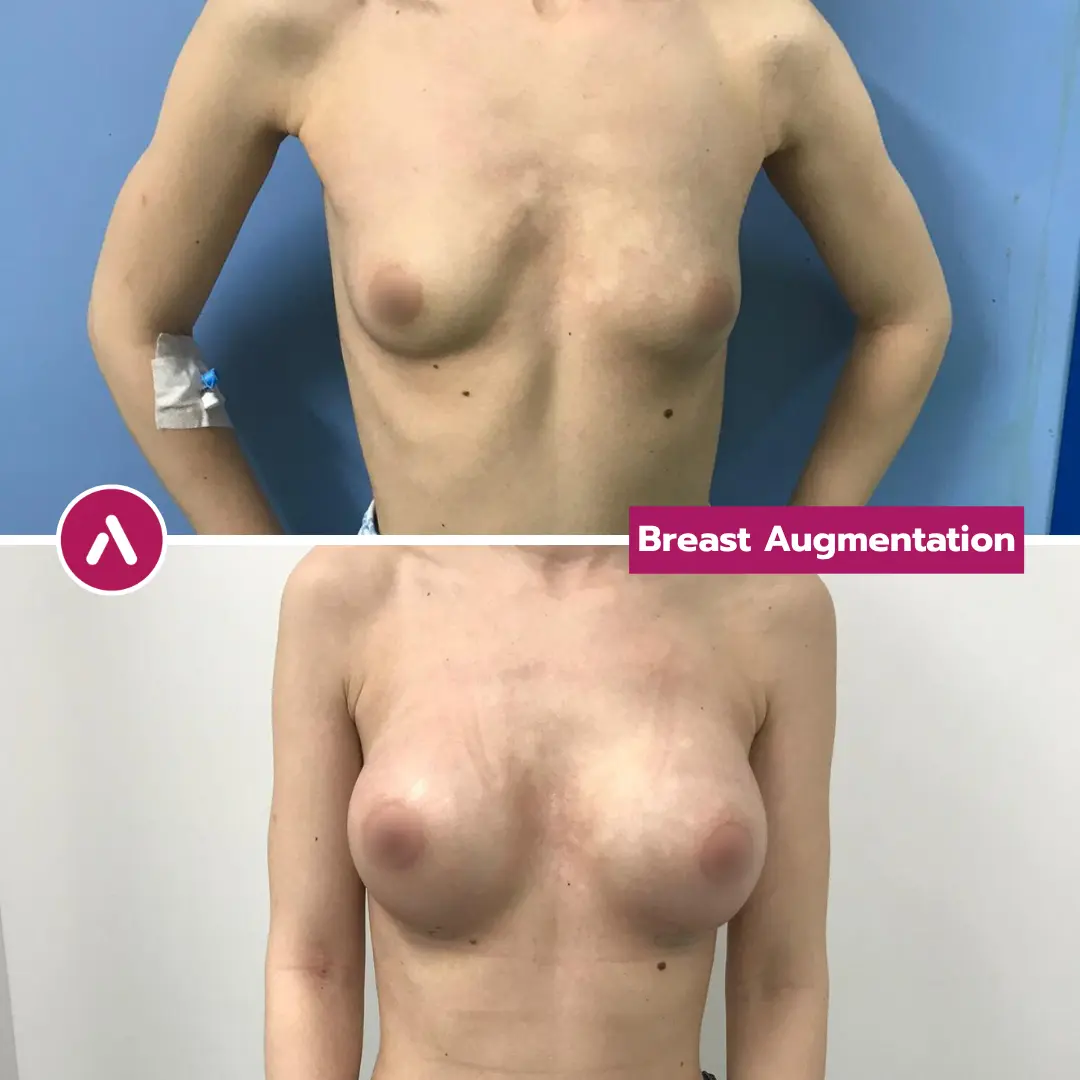
Canadian women researching breast augmentation increasingly ask the same practical question: is there a way to add natural breast volume without silicone or saline implants? Fat transfer breast augmentation, also called breast lipofilling, uses your own liposuctioned fat for subtle augmentation with no implant shell, no rupture risk, and no long-term implant replacement schedule. Toronto and Vancouver private clinics often focus on implant-based augmentation, while fat transfer offers a different path for patients who prefer autologous tissue. This guide explains how the procedure works, what one-session results can realistically achieve, how it compares with implants, and why Canadians choose AKM Clinic in Istanbul for VASER-assisted fat harvest combined with natural breast enhancement.
Table of Contents
What Is Fat Transfer Breast Augmentation? Lipofilling Explained
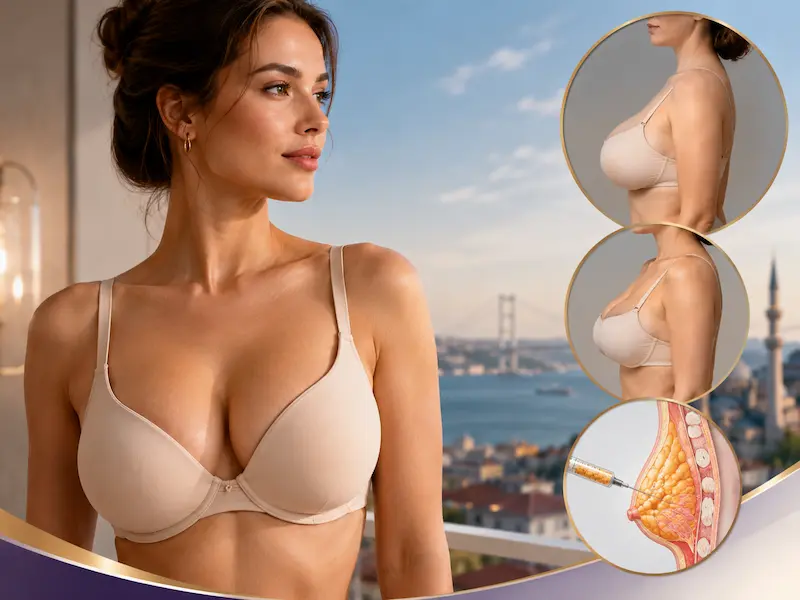
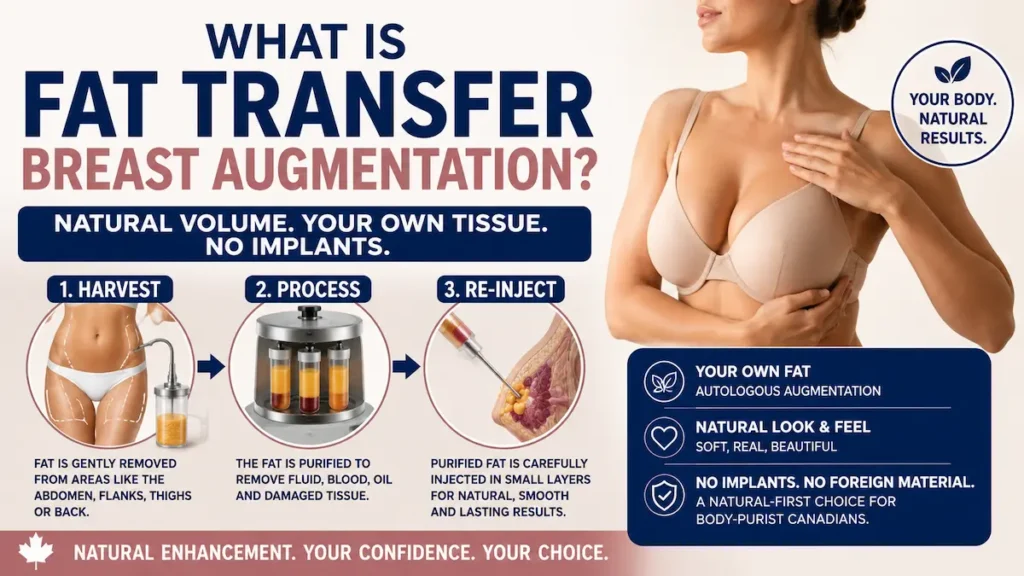
Fat transfer breast augmentation is a surgical procedure that increases breast volume using your own fat. The fat is harvested from a donor area, purified, and carefully injected into the breasts in small layers. This is different from implant-based breast augmentation, where a silicone or saline device creates volume. At AKM Clinic, we treat fat transfer as an autologous breast augmentation procedure, meaning the enhancement comes from your own living tissue.
Fat transfer breast augmentation, also called breast lipofilling, increases breast size using fat harvested from areas such as the abdomen, flanks, thighs, back, or bra-line region through liposuction. The fat is processed and re-injected into the breasts. The American Society of Plastic Surgeons’ fat transfer breast augmentation overview describes the procedure as using liposuctioned fat from other parts of the body to enhance the breasts, usually for patients seeking a relatively small increase with natural results.
How Fat Transfer Breast Augmentation Works
The procedure follows three core steps: harvest, process, and re-inject. First, our surgical team removes fat from donor areas such as the abdomen, flanks, thighs, or back using liposuction. In suitable patients, we may use VASER-assisted harvest to help separate fat gently while shaping the donor area.
Next, the fat is processed to separate healthy fat cells from fluid, blood, oil, and damaged tissue. The purified fat is then injected into the breasts in micro-parcels. Small-volume layering matters because each grafted fat parcel needs access to oxygen and blood supply to survive.
What “Lipofilling Breast” Means
“Lipofilling” is the term many European surgeons use for fat grafting. In breast surgery, lipofilling breast treatment means using fat as a biological filler to increase volume, improve contour, or soften irregularities. It is still surgery. It is not the same as a filler injection or a non-surgical breast treatment.
Because the tissue comes from your own body, fat transfer to breast tissue is considered autologous augmentation. Many Canadian patients like this distinction. They are not rejecting breast enhancement; they are choosing a method that fits a natural-first preference.
Autologous Augmentation: Your Own Tissue Instead of Implants
Autologous breast augmentation appeals to patients who want a softer change. The breast feels like breast tissue because the transferred volume is living fat. Once the surviving fat develops blood supply, it behaves like the rest of your body fat.
This also means your result can change with weight fluctuation. If you lose significant weight after surgery, transferred fat may shrink. If you gain weight, it may enlarge. We discuss this during consultation because stable weight is one of the most important predictors of predictable results.
How Fat Transfer Differs from Standard Breast Augmentation
Traditional breast augmentation uses an implant to create defined volume. Fat transfer breast augmentation uses your own tissue for a subtler increase. For patients who want a large size change, implants may still be the better option, and we explain that honestly during planning.
Fat transfer is strongest when the goal is natural fullness, mild asymmetry correction, upper-pole softening, or a modest increase of about one cup size. It can also be used with implants in a hybrid approach, but pure fat transfer is a distinct procedure with different limits and advantages.
Why Body-Purist and BII-Concerned Canadians Consider Fat Transfer
Some Canadian patients come to us after researching Breast Implant Illness, implant replacement timelines, rupture risk, or BIA-ALCL. Others are athletic patients who prefer not to place a device under the breast or muscle. Their goals are usually specific: natural shape, soft movement, and no foreign material.
Fat transfer does not remove every surgical risk. It has its own issues, including fat necrosis, oil cysts, calcifications, and partial volume loss. The difference is the material. We are working with your own fat, and that changes the decision framework for patients who want breast enhancement without implants.
Benefits of Fat Transfer Breast Augmentation Beyond Implant Alternatives
The biggest benefit of fat transfer breast augmentation is that it treats two areas at once. We remove unwanted fat from a donor area and use the best-quality fat to enhance the breasts. The result is not just breast volume. It can also create a more balanced waist-to-bust or hip-to-bust proportion.
This procedure is not for every patient. It works best for women with enough donor fat, good skin elasticity, and realistic expectations. For the right patient, it can deliver natural breast enhancement with no implant maintenance plan and no implant-related device concerns.
Natural Look and Feel
Fat transfer creates the softest breast augmentation result because the volume comes from your own fat. There is no implant edge, no shell, and no risk of capsular contracture around a device. The breast usually moves naturally because the added tissue integrates into the existing breast envelope.
This is one reason many patients who want a “quiet” result prefer breast fat transfer. The goal is not an obvious augmentation. The goal is a subtle increase that looks consistent with your frame.
No Foreign Material Risk
Fat transfer does not use silicone or saline implants. That means there is no implant rupture, no implant rotation, no implant replacement schedule, and no implant capsule. Patients who feel uneasy about long-term device surveillance often see this as a major advantage.
This does not mean the surgery is free of risk. Fat transfer has biological risks, including partial reabsorption and small areas of firmness. We explain these clearly because informed consent matters, especially for Canadian patients comparing options from home.
Simultaneous Body Contouring
The donor area is part of the result. If we harvest from the abdomen, flanks, thighs, or bra-line area, we also contour those zones. Many patients choose the procedure because they want breast enhancement and body shaping in one surgical plan.
At AKM Clinic, VASER-assisted harvest can be used when appropriate to support smoother fat removal and donor-site contouring. For a deeper explanation of the harvest technology itself, see our VASER High-Def Liposuction guide.
Long-Term Stability After Vascularization
The first months after breast fat transfer are a settling period. Some fat is naturally reabsorbed. The fat that survives and develops blood supply becomes long-term tissue, which is why final volume is judged after swelling decreases and vascularization stabilizes.
Most patients should expect a percentage of transferred fat to remain long-term, not all of it. This is why we plan conservatively, place fat in small parcels, and discuss whether a second session may be needed for larger volume goals.
MRI and Mammography Compatibility
Fat transfer avoids implant-related imaging issues because there is no breast implant to evaluate. Canadian patients still need routine breast screening according to age, risk profile, and family physician guidance. Screening does not stop after cosmetic breast surgery.
Fat grafting can sometimes create benign calcifications or oil cysts. A trained radiologist can usually distinguish these from concerning findings, especially when the patient provides a surgical history. We give patients English-language documentation so their Canadian care team understands what was done.
Am I a Good Candidate for Fat Transfer Breast Augmentation?
Fat transfer breast augmentation is selective. The best candidates have enough donor fat, healthy breast tissue, stable weight, and realistic expectations about volume. We assess both sides of the plan: where the fat will come from and how much the breasts can safely receive.
This is why online photos alone are not enough. Two patients may both want natural breast enhancement, yet only one may have the donor fat, skin elasticity, and breast envelope capacity for a strong result. During your virtual consultation, our team reviews your breast photos, donor areas, medical history, weight stability, and size goals before recommending fat transfer, implants, a lift, or a combined approach.
Ideal Candidate Profile
A strong candidate usually wants subtle, natural-looking breast fullness rather than dramatic enlargement. She has enough harvestable fat in areas such as the abdomen, flanks, thighs, back, or bra-line area. She also has breast skin that can accept added volume without becoming tight, distorted, or uneven.
Fat transfer works best when the goal is proportional enhancement. It is often suitable for patients who want to soften the upper pole, correct mild asymmetry, restore post-pregnancy volume, or add a modest cup-size increase. It is not the right choice for every patient who wants a fuller bust.
- Enough donor fat for safe harvest
- Stable weight for at least 3–6 months
- Good skin elasticity in the breast envelope
- Realistic expectation of modest volume gain
- No active breast disease or untreated systemic condition
- Willingness to follow recovery rules, including no underwire bras during early healing
Donor Area Assessment: Abdomen, Flanks, Thighs, and Back
Fat transfer is only possible if there is enough donor fat. The abdomen and flanks are common donor zones because they often provide both volume and contouring benefit. Inner thighs, outer thighs, back, and bra-line areas can also contribute when the patient’s anatomy allows it.
We do not harvest aggressively just to create breast volume. Over-harvesting can create irregularities, dents, and poor donor-site contour. Our planning balances breast enhancement with smooth body shaping.
VASER-assisted harvest may be used when appropriate because it can help separate fat with less mechanical trauma than forceful traditional suction. This donor-area technology is discussed in more depth in our VASER High-Def Liposuction guide.
Realistic Size Expectation: Usually One Cup Size per Session
Most fat transfer breast augmentation patients should expect about one cup size increase per session. Some achieve less, especially if they are very lean or have tight breast skin. Some may achieve more, but we do not plan surgery around the best-case scenario.
The reason is biology. Not every transferred fat cell survives. Some swelling is present early, so the breasts can look fuller during the first weeks than they will at 6 months. Final volume depends on how much fat vascularizes and becomes stable living tissue.
| Starting Breast Volume | Typical One-Session Goal | Best-Suited Strategy |
|---|---|---|
| Small A cup | Fuller A to small B | Fat transfer if donor fat is sufficient; implants if larger volume is desired |
| B cup | Fuller B to small C | Often ideal for natural breast fat transfer |
| C cup with mild deflation | Restored upper-pole fullness | Fat transfer alone or lift with fat transfer if sagging is present |
| Post-implant explant | Soft tissue replacement, not implant-equivalent volume | Explant with staged or same-session fat transfer |
When a Multi-Session Strategy Is Needed
A second fat transfer session may be recommended when the patient wants more than one cup size increase or when the first session is used to restore tissue quality after implant removal. We usually separate sessions by several months so the first transfer can settle and the surviving fat can stabilize.
This approach is not a failure. It is a safety and predictability strategy. Trying to place too much fat in one session can reduce fat survival because each micro-parcel needs access to oxygen and blood supply.
“The right fat transfer plan is not based on how much fat we can inject. It is based on how much fat the breast tissue can safely accept and nourish. That is what protects both shape and long-term survival.”
Skin Elasticity Requirement
Skin elasticity determines how much volume the breast can accept. Tight skin limits expansion. Loose skin can accept fat more easily, but if sagging is significant, added fat may make the breast heavier without improving nipple position.
This is the point where a breast lift may be the better foundation. Fat can add softness and upper-pole volume, but it cannot reposition a low nipple by itself. Patients with clear ptosis may need breast lift surgery with selective fat grafting.
Post-Pregnancy and Post-Weight-Loss Candidacy
Many Canadian patients choose fat transfer after pregnancy, breastfeeding, or weight changes. The goal is usually not a large “implant look.” It is often restoration: replacing lost upper fullness, improving symmetry, and creating a softer breast contour.
Timing matters. We generally recommend waiting until weight is stable and breastfeeding has fully stopped. The breasts should no longer be changing month to month. This gives us a clearer surgical target and a more reliable result.
When Fat Transfer Is Not Recommended
Fat transfer may not be recommended if the patient is very lean, has insufficient donor fat, smokes, has severe breast sagging, or wants a large size increase in one operation. It is also inappropriate when active breast disease, unstable weight, or uncontrolled medical conditions are present.
Patients with a strong preference for two or more cup sizes of enlargement may be better suited to implants or a hybrid plan. We explain this clearly during consultation. A natural-first approach still has to be honest.
- Insufficient donor fat
- Severe breast ptosis requiring lift-first planning
- Active smoking or nicotine use
- Uncontrolled diabetes or bleeding disorder
- Unrealistic expectation of dramatic volume
- Current breast mass or unresolved imaging concern
Fat Transfer vs Implants, Lift Combo, and Explant Strategies: The Decision Framework
Fat transfer breast augmentation is not simply “better” than implants. It is better for a specific patient profile. The decision depends on your volume goal, breast position, implant concerns, donor fat supply, recovery tolerance, and long-term maintenance preference.
Canadian patients often arrive after comparing implant augmentation in Toronto, breast lift options in Vancouver, and “natural breast augmentation” alternatives online. Our role is to separate the options clearly. Sometimes fat transfer is the right answer. Sometimes implants, lift, or a hybrid method will create a safer and more predictable result.
The Four-Strategy Decision Framework
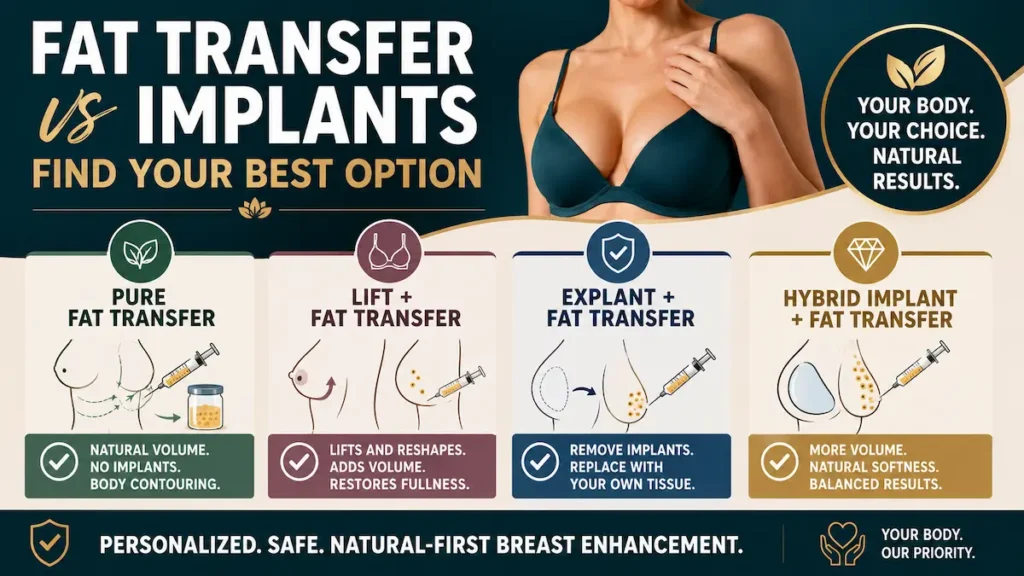
There are four main strategies for patients considering this procedure: pure fat transfer, breast lift with fat transfer, implant removal with fat transfer, and hybrid implant plus fat transfer. Each solves a different problem.
| Strategy | Best Candidate | Main Benefit | Main Limitation |
|---|---|---|---|
| Pure fat transfer | Wants subtle natural volume; has donor fat | No implant, soft feel, donor-area contouring | Usually one cup size per session |
| Lift + fat transfer | Has sagging plus volume loss | Improves nipple position and fullness | More scars than fat transfer alone |
| Explant + fat transfer | Wants implant removal and natural replacement | Removes implant while restoring some softness | May require staging for volume |
| Hybrid implant + fat | Wants larger volume but natural edges | Implant projection with fat-softened contour | Still includes implant maintenance considerations |
Fat Transfer vs Silicone and Saline Implants
Implants create more predictable volume. Fat transfer creates a more natural material profile. This is the core trade-off. A silicone or saline implant can reliably produce a larger cup-size change, while fat transfer depends on donor fat, tissue capacity, and fat survival biology.
Fat transfer avoids implant rupture, capsular contracture, implant rotation, and replacement planning. Implants may still be the best choice for patients who want a clear C-to-D or A-to-C transformation in a single operation. For a broader implant-focused discussion, see our Breast Augmentation in Turkey guide.
| Option | Material | Volume Capacity | Longevity | Risk Profile | AKM Offers |
|---|---|---|---|---|---|
| Fat transfer | Your own fat | Modest; usually about one cup size | Stable after vascularization, weight-dependent | Fat necrosis, oil cysts, partial reabsorption | Yes |
| Silicone implants | Cohesive silicone gel | High and predictable | Long-lasting but not lifetime devices | Capsular contracture, rupture, implant surveillance | Yes |
| Saline implants | Sterile saline in silicone shell | High and adjustable | Long-lasting but may deflate | Visible rippling, deflation, less natural feel in lean patients | Case-dependent |
| Hybrid augmentation | Implant + fat grafting | High, with softer edges | Implant maintenance plus fat stability | Combines implant and fat-transfer risks | Yes |
Breast Lift with Fat Transfer
Fat transfer adds volume. It does not lift the nipple. If the nipple sits low on the breast or points downward, a lift may be needed to reshape the breast envelope before or during fat grafting.
Breast lift with fat transfer is a strong option for post-pregnancy deflation, weight-loss changes, or mild-to-moderate sagging. The lift restores breast position. The fat transfer adds softness and upper-pole fullness without an implant. For incision patterns and lift candidacy, see our Breast Lift Mastopexy guide.
Breast Implant Removal with Fat Transfer
Some patients come to AKM Clinic because they no longer want breast implants. They may feel the implants are too large, too firm, outdated, or no longer aligned with their body image. Others are concerned about implant-related symptoms or device maintenance.
Breast implant removal with fat transfer can help replace some lost volume using the patient’s own tissue. The result is usually smaller than the implant volume, but it can look softer and more proportionate. In some cases, we recommend staging to improve fat survival and shape control.
Breast Implant Illness and BIA-ALCL Concerns
Breast Implant Illness, often called BII, describes a group of symptoms some patients associate with breast implants. Patients may report fatigue, joint pain, brain fog, rashes, or systemic discomfort. The medical discussion is complex, and not every symptom can be proven to come from the implant.
BIA-ALCL is a rare lymphoma associated mainly with certain textured breast implants. Health Canada explains that breast implant-associated anaplastic large cell lymphoma can develop next to a breast implant. Health Canada’s safety review also notes that its 2019 review found increased BIA-ALCL risk with macro-textured breast implants and led to suspension of Biocell macro-textured implant licences in Canada.
We do not dismiss these concerns. We also do not use fear-based marketing. For BII-concerned patients, fat transfer is one option because it avoids placing a new implant. The right plan depends on symptoms, imaging, implant history, skin quality, and expectations after removal.
Areas of Fat Harvest: VASER Hi-Def Donor Site Strategy
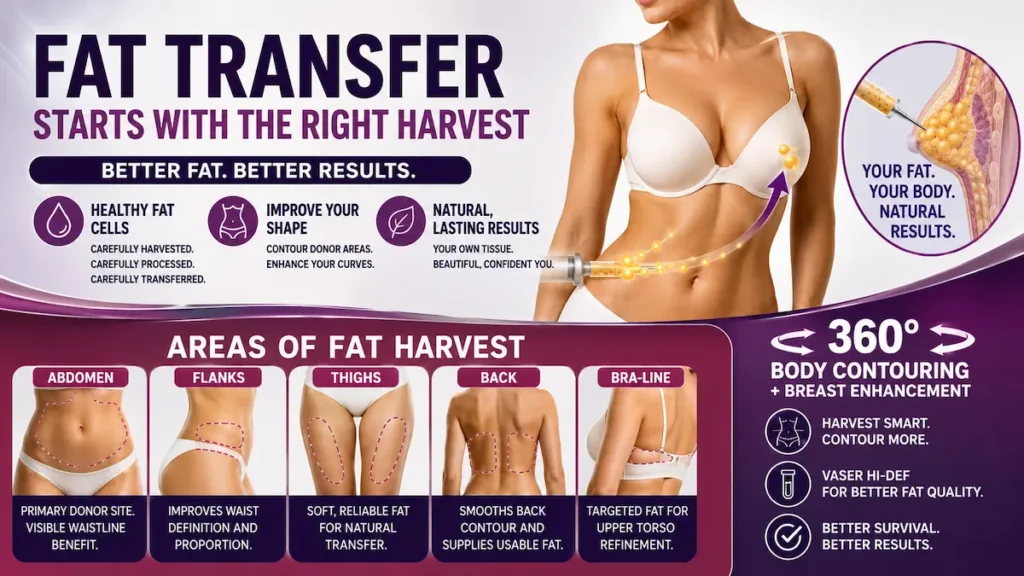
Fat transfer breast augmentation starts outside the breast. The donor area determines how much usable fat we can collect, how the body contour will improve, and how well the transferred fat may survive after purification. For Canadian patients, this is one of the most misunderstood parts of the procedure.
The best donor site is not always the area the patient dislikes most. We look for fat quality, safe harvest volume, skin elasticity, body proportions, and the overall silhouette. A good plan should improve both the breast and the donor area.
Abdomen as the Primary Donor Site
The abdomen is often the first donor area we assess. It usually provides a useful fat reserve, especially after pregnancy, weight fluctuation, or natural midsection fullness. For many patients, abdominal harvest also creates a visible waistline benefit.
We separate cosmetic preference from surgical practicality. Some patients want the abdomen treated because it is their main concern, but the available fat may be fibrous, limited, or unevenly distributed. Others have enough abdominal fat for both breast transfer and smooth contouring.
Flanks, Thighs, Back, and Bra-Line Fat
The flanks are another common donor area. Many Canadian patients describe this as the “love handle” area, especially around the waist and lower back. Harvesting from the flanks can improve the waist-to-bust ratio, which often makes the breast result look more proportional.
The thighs can be useful donor areas, especially for patients with lower-body fat distribution. Inner thigh fat is often softer, while outer thigh fat may offer more volume in selected body types. Back and bra-line fat can provide smaller but strategically useful fat pockets for upper-torso refinement.
Fat transfer requires donor-area discipline. A smaller amount of healthy, well-handled fat is better than a larger amount of damaged tissue.
VASER Hi-Def Harvest Advantage
VASER-assisted liposuction uses ultrasound energy to help separate fat before suction. In fat transfer breast augmentation, the goal is not only body contouring. The goal is to collect fat cells that remain suitable for purification and grafting.
At AKM Clinic, we use VASER selectively when it supports both donor-site contour and fat quality. This can be especially useful in areas where fat is fibrous or where smooth contouring matters. The technology does not replace surgical judgment.
“Fat transfer is not just injection. The result starts with harvest. If the donor fat is damaged before it reaches the breast, no injection technique can fully compensate for that.”
360 Body Contouring with Breast Fat Transfer
Some patients benefit from harvesting fat around the full midsection. This may include the abdomen, flanks, lower back, and waist. A 360 approach can improve the body frame while providing more graft material for the breasts.
This is not the same as treating every area aggressively. Fat transfer needs viable fat, and body contouring needs smooth transitions. We design the harvest pattern around both goals.
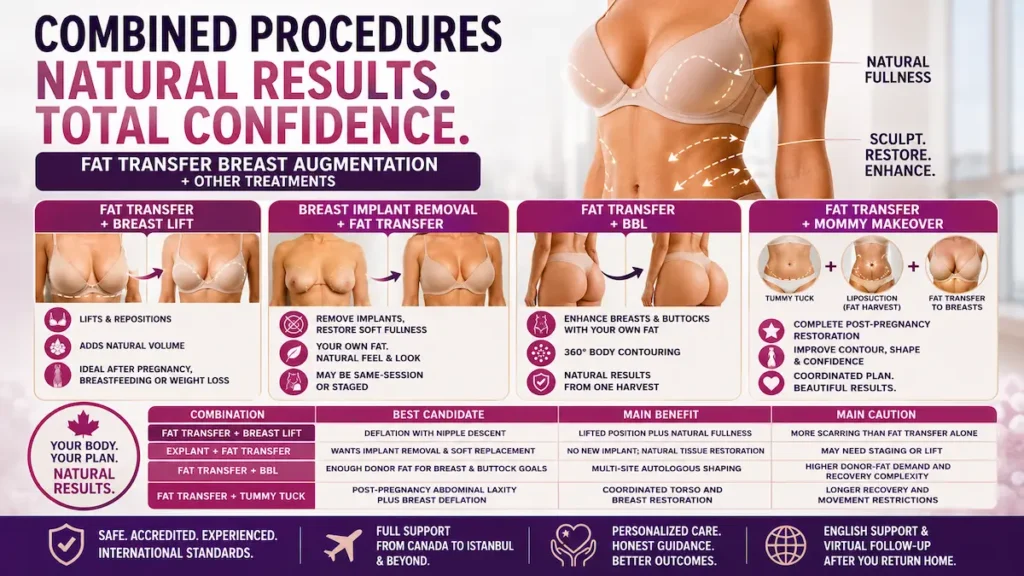
Combined Procedures: Fat Transfer Breast Augmentation + Other Treatments
Fat transfer breast augmentation often fits into a broader body or breast surgery plan. This is because the procedure already includes liposuction harvest. In selected patients, that fat can support breast volume while other procedures address sagging, implant concerns, abdominal laxity, or buttock shape.
Combination surgery must be planned carefully. More procedures mean longer anesthesia, more swelling, and a more demanding recovery. We recommend combinations only when the patient’s health, goals, and travel timeline support it.
Fat Transfer Breast Augmentation + Breast Lift
Breast lift with fat transfer is one of the most common combinations. It is useful when the breast has both volume loss and sagging. The lift repositions the nipple and reshapes the breast envelope. The fat transfer adds soft fullness.
This combination is especially relevant after pregnancy, breastfeeding, weight loss, or natural aging. Fat alone cannot lift a low nipple. A lift alone may improve position but not restore upper-pole fullness.
Breast Implant Removal + Fat Transfer
Explant with fat transfer is a strong option for patients who want implants removed but do not want to lose all breast volume. The plan may be same-session or staged. The choice depends on implant size, capsule condition, skin elasticity, breast position, and donor fat supply.
Patients should expect a smaller, softer result than large implants. Fat transfer can restore selected fullness, but it does not replace a large implant one-to-one. Some patients need a lift at the same time.
Fat Transfer Breast Augmentation + BBL
Fat transfer breast augmentation and BBL use the same biological principle: fat is harvested, processed, and transferred to a new area. The difference is the recipient site. Breast fat transfer requires conservative, layered placement. BBL focuses on buttock and hip contour.
Combining both may be possible for patients with enough donor fat. The limit is harvest volume, surgical time, and safe recovery. For buttock-focused planning, see our BBL in Turkey guide.
Fat Transfer Breast + Mommy Makeover Components
Some patients choose fat transfer as part of a post-pregnancy restoration plan. A tummy tuck may address abdominal skin and muscle separation, while liposuction harvest can provide fat for breast volume. This can create a coordinated body contouring plan.
For broader post-pregnancy planning, see our Mommy Makeover guide and Tummy Tuck guide.
Combination Planning Table
| Combination | Best Candidate | Main Benefit | Main Caution |
|---|---|---|---|
| Fat transfer + breast lift | Deflation with nipple descent | Lifted position plus natural fullness | More scarring than fat transfer alone |
| Explant + fat transfer breast | Wants implant removal and soft replacement | No new implant; natural tissue restoration | May need staging or lift |
| Fat transfer breast + BBL | Enough donor fat for breast and buttock goals | Multi-site autologous shaping | Higher donor-fat demand and recovery complexity |
| Fat transfer + tummy tuck | Post-pregnancy abdominal laxity plus breast deflation | Coordinated torso and breast restoration | Longer recovery and movement restrictions |
Anesthesia for Fat Transfer Breast Augmentation
Fat transfer breast augmentation is a combined procedure. It includes liposuction harvest, fat processing, and breast injection. Because it treats both donor and recipient areas, we usually perform it under general anesthesia for patient comfort, procedural control, and safety.
This is different from awake implant-based breast augmentation. Fat transfer requires position changes, sterile fat handling, and larger treatment fields. A relaxed, fully monitored anesthesia environment helps our team work precisely and helps the patient avoid discomfort during a longer operation.
Why Fat Transfer Usually Requires General Anesthesia
The procedure typically takes 3–5 hours, depending on harvest volume, donor-area count, processing method, and breast injection plan. Even when breast incisions are tiny, the liposuction portion can involve multiple body areas. Local anesthesia alone is not usually practical for this scope.
General anesthesia allows our team to manage the full procedure without rushing. We can complete the harvest, process the fat, and inject it in small layers while the patient remains still and comfortable. That stillness matters during micro-parcel placement.
Patients sometimes ask whether this can be done “awake.” For pure fat transfer breast augmentation, awake surgery is generally not the standard approach. If your main priority is an awake implant procedure, see our Awake Breast Augmentation guide.
Pre-Anesthesia Assessment for Canadian Patients
Before surgery, we review your medical history, medications, allergies, previous anesthesia experiences, smoking status, and any history of blood clots. Canadian patients should also tell us about family physician recommendations, recent bloodwork, and any breast imaging history.
Pre-operative testing is part of the clinical pathway. We may request blood tests, ECG, and additional clearance when medical history requires it. If a patient has anemia, uncontrolled diabetes, cardiovascular concerns, or active infection, surgery may be postponed.
Post-Anesthesia Recovery Protocol
After surgery, patients are monitored as they wake from anesthesia. The early focus is pain control, nausea prevention, hydration, safe walking, and compression garment placement. Because the donor areas may feel sore, we help patients stand and move gradually.
Most discomfort comes from the liposuction harvest zones, not the breast injection sites. The breasts may feel tight or swollen, but donor areas often feel more bruised. This is normal.
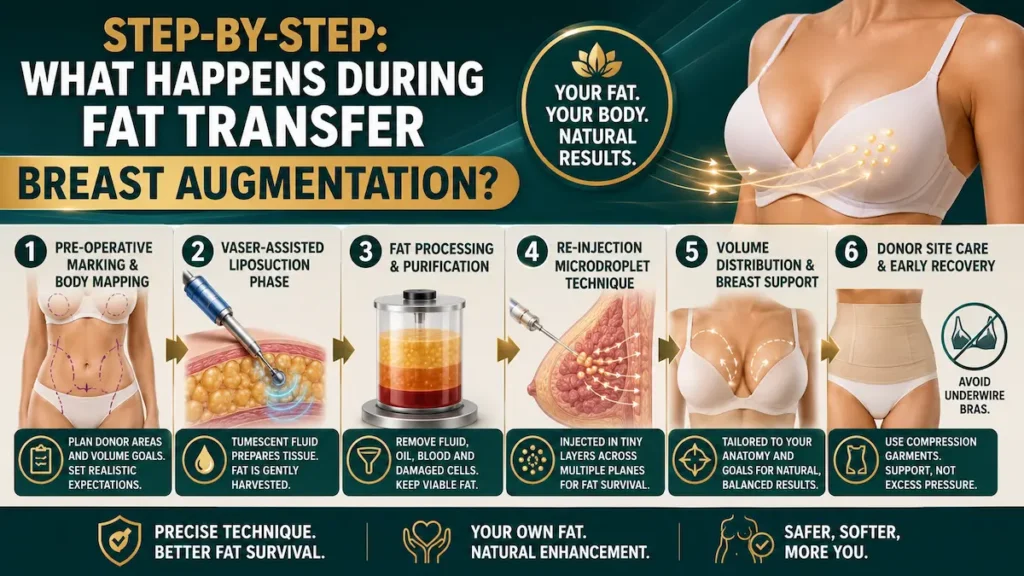
Step-by-Step: What Happens During Fat Transfer Breast Augmentation?
Fat transfer breast augmentation has a clear surgical sequence. We first plan the donor areas and breast volume goals. Then we harvest fat, process it, purify it, and inject it in small layers. Each step affects final survival and shape.
The procedure may look simple from the outside because the breast incisions are tiny. It is not simple technically. The outcome depends on fat handling, injection plane, breast tissue capacity, and donor-site control.
Pre-Operative Marking and Body Mapping
Before surgery, we mark the donor areas and breast injection zones. This is done while the patient is standing because gravity changes the body’s shape. Marking helps us see natural asymmetry, fat distribution, breast position, and contour transitions.
We also confirm the size goal. This is the moment where realistic expectations are reinforced. If the patient wants a result that fat transfer alone cannot safely achieve, we discuss alternatives before surgery begins.
VASER-Assisted Liposuction Phase
The first surgical phase is fat harvest. We introduce tumescent fluid into the donor areas to reduce bleeding and prepare the tissue. When VASER is used, ultrasound energy helps loosen fat before suction.
The surgeon then removes fat through small cannula access points. These entry points are usually only a few millimetres long. We place them in discreet areas when anatomy allows.
Fat Processing and Purification
Harvested fat cannot be injected immediately without preparation. It contains fluid, oil, blood, damaged cells, and tumescent solution. Processing separates healthier fat from material that should not be grafted.
Different methods may be used depending on the case. These can include decantation, filtration, and centrifuge-based separation. The principle is the same: keep viable fat, remove excess fluid and damaged material.
Re-Injection Using a Microdroplet Technique
The fat is injected into the breast in tiny threads or microdroplets across multiple tissue planes. This is often described as a layered grafting approach. It avoids placing a large pocket of fat in one area.
Layered placement helps the transferred cells sit close to vascularized tissue. Blood supply is what keeps fat alive. If too much fat is placed in one location, the centre of that deposit may not receive enough oxygen.
Volume Distribution and Breast Support
Not every patient wants volume in the same place. Some want upper-pole restoration after breastfeeding. Others want improved cleavage softness or correction of asymmetry. We distribute fat according to the patient’s anatomy and goals.
At the end of surgery, the donor areas are placed in compression garments. The breasts need support, but not excessive pressure. Heavy compression can compromise the newly transferred fat, so patients should avoid underwire bras during the early recovery period.
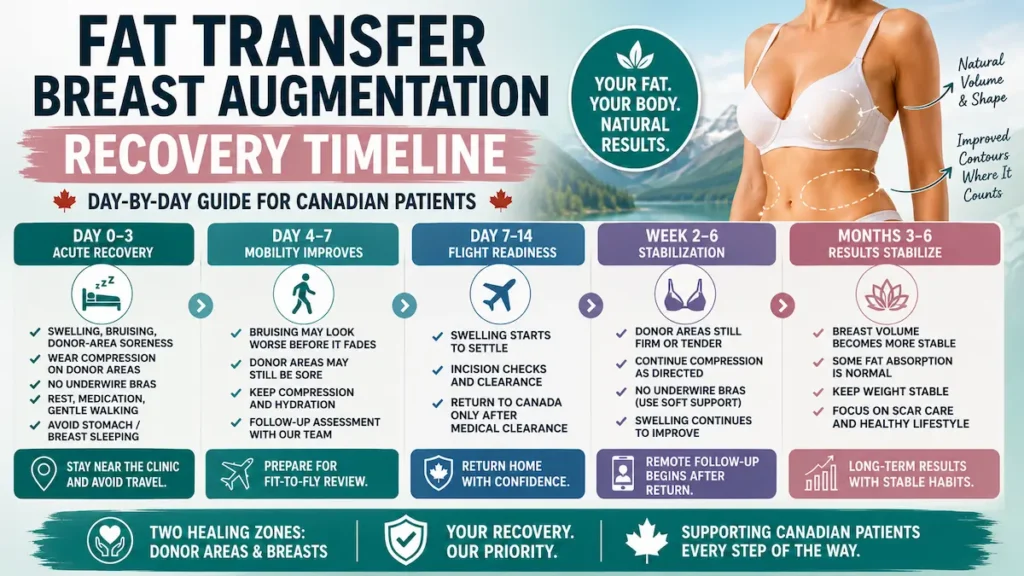
Fat Transfer Breast Augmentation Recovery Time: Day-by-Day Timeline for Canadian Patients
Fat transfer breast augmentation recovery has two healing zones: the donor areas and the breasts. Most patients feel more soreness in the liposuctioned areas than in the breasts. The breasts often feel swollen, firm, or tight, while the abdomen, flanks, thighs, or back may feel bruised and tender.
The recovery goal is not only comfort. It is also fat survival. The transferred fat needs gentle handling, stable circulation, and enough time to develop blood supply. This is why we give different instructions for the donor areas and the breasts.
Day 0–3: Acute Recovery Phase
The first three days are the most protective phase. You will rest, walk gently, hydrate, and follow the medication plan. Donor areas are placed in compression garments, while the breasts are supported without heavy pressure.
Swelling and bruising are expected. The donor zones may feel like an intense workout or deep bruise. The breasts may look larger than expected because early swelling is present. This is not the final size.
- Wear donor-area compression as instructed.
- Avoid sleeping on the stomach or breasts.
- Do not massage the breasts unless we specifically instruct it.
- Take prescribed medication on schedule.
- Contact your patient coordinator if pain, swelling, or fever feels unusual.
Day 4–14: Swelling, Mobility, and Fit-to-Fly Clearance
By days 4–7, many patients feel more independent. Bruising may become more visible before it fades. Donor areas can remain sore, especially when standing, bending, or changing position.
Many Canadian patients are assessed for return travel between days 7 and 14, depending on the extent of liposuction, breast swelling, combined procedures, and overall health. Fit-to-fly timing is not automatic. We assess mobility, pain control, swelling, wound status, and general recovery.
For broader flight safety planning after surgery, our post-operative flight safety guide explains what Canadian patients should prepare before a long return journey.
Our HBOT and LLLT Recovery Protocol
At AKM Clinic, we may integrate Hyperbaric Oxygen Therapy and Low-Level Laser Therapy into surgical recovery when clinically appropriate. HBOT supports oxygen delivery to healing tissue. LLLT supports cellular repair and inflammation control.
For international patients, recovery technology is not a luxury add-on. It is part of risk reduction. The return flight to Canada is long, and swelling control matters before travel. Our technology standards are explained in detail on our technology and recovery standards page.
Week 2–6: Compression Vest and No Underwire Bras
Weeks 2–6 are a stabilization period. Donor areas usually continue to need compression, especially if the abdomen, flanks, or thighs were treated. Compression supports swelling control and helps the skin adapt to the new contour.
The breasts need a different approach. We avoid underwire bras during early healing because wire pressure can irritate tissue and compress grafted areas. A soft, supportive bra is usually safer during this stage.
Months 1–6: Volume Stabilization and Exercise Return
By the first month, swelling begins to reduce, and the breast shape looks more natural. Some volume loss is expected as fluid decreases and some transferred fat is reabsorbed. This does not mean the procedure failed.
Between months 3 and 6, the result becomes more stable. The fat that survives this phase is more likely to remain long-term. Patients should keep weight stable during this period because major weight change can affect the new breast volume.
| Timeframe | What You May Notice | Recovery Priority | Canadian Travel Note |
|---|---|---|---|
| Day 0–3 | Swelling, bruising, donor-area soreness | Rest, medication, gentle walking | Stay near the clinic and avoid travel |
| Day 4–7 | Bruising becomes more visible; mobility improves | Compression, hydration, follow-up assessment | Prepare for fit-to-fly review |
| Day 7–14 | Swelling begins to settle | Flight readiness and incision checks | Return to Canada only after clearance |
| Week 2–6 | Donor areas still firm or tender | No underwire bras; continue compression | Remote follow-up begins after return |
| Months 3–6 | Breast volume stabilizes | Weight stability and scar care | Share updates through virtual follow-up |
Safety and Risks of Fat Transfer Breast Augmentation
Fat transfer breast augmentation avoids implant-specific risks, but it still carries surgical and biological risks. Canadian patients should understand both sides of the decision. Removing implants from the equation does not make surgery risk-free.
The main risks relate to fat behaviour, donor-area healing, infection prevention, and breast imaging interpretation. Our role is to reduce risk through careful patient selection, sterile technique, conservative grafting, and structured follow-up after you return home.
Common Side Effects
Swelling and bruising are expected after fat transfer. The donor areas often bruise more than the breasts because liposuction creates tissue trauma. The breasts may feel tight, full, or firm during the first weeks.
Temporary firmness can come from swelling, small fat clusters, or local tissue reaction. Many areas soften as healing progresses. If firmness persists, we assess whether it is normal scar tissue, fat necrosis, oil cyst formation, or another issue.
Fat Necrosis, Oil Cysts, and Calcifications
Fat necrosis occurs when some transferred fat does not develop enough blood supply and breaks down. It may feel like a small firm lump. In many cases, it is benign, but it still needs proper assessment.
Oil cysts can form when non-surviving fat liquefies and becomes enclosed by surrounding tissue. Fat transfer can also sometimes create calcifications in the breast. A radiologist should know that breast fat grafting was performed, which is why we provide English-language surgical records for Canadian patients.
Infection, Delayed Healing, and Asymmetry
Infection is uncommon but possible. Warning signs can include increasing redness, fever, worsening pain, unusual discharge, or one breast becoming much more swollen than the other. Donor areas can also become irritated or inflamed.
No two breasts are perfectly identical before surgery. Fat transfer can improve mild asymmetry, but it cannot guarantee mirror-image breasts. Differences in breast shape, rib position, skin tightness, and fat survival can affect the final result.
How Fat Transfer Breast Affects Mammography
Fat transfer may create imaging findings that need interpretation, such as oil cysts or benign calcifications. This is why documentation matters. A radiologist should know that breast fat grafting was performed.
Patients with a personal or strong family history of breast cancer may need more detailed pre-operative planning. We may request recent imaging or physician clearance before proceeding.
Why Surgeon Technique Determines Fat Survival
Fat survival depends on more than the patient’s body. Surgical technique is central. Gentle harvest, careful processing, small-particle placement, and conservative volume planning all influence how much fat remains long-term.
Injecting too much fat can be counterproductive. Overfilled tissue has less ability to nourish every grafted cell. The result may be more reabsorption, firmness, or irregularity. ASPS also positions fat transfer as most appropriate for patients seeking a relatively small increase in breast size, which matches our conservative planning model.
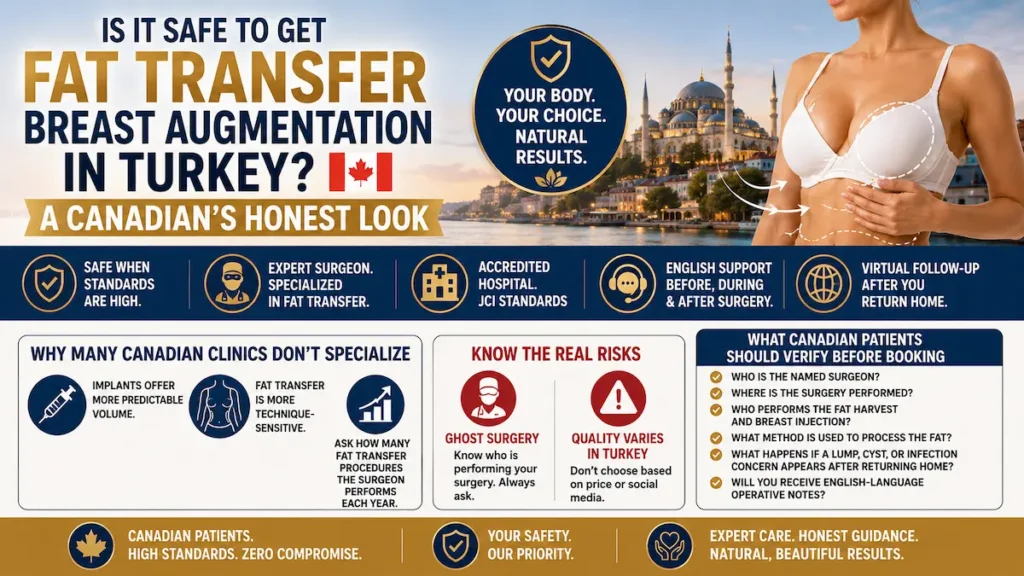
Is It Safe to Get Fat Transfer Breast Augmentation in Turkey? A Canadian’s Honest Look
Getting fat transfer breast augmentation in Turkey can be safe when the surgeon, facility, anesthesia team, sterilization protocol, and follow-up system meet international standards. It is not automatically safe because the procedure is popular in Istanbul. Canadian patients need to verify who is performing the surgery, where it is performed, and how complications are handled after returning home.
At AKM Clinic, we treat this concern directly. Fat transfer breast augmentation requires skill in both liposuction and breast fat grafting. A clinic that can place implants is not automatically qualified to perform high-quality autologous fat transfer.
Why Many Canadian Clinics Do Not Specialize in Fat Transfer
Many Toronto, Vancouver, and Calgary clinics offer implant-based breast augmentation more often than fat transfer. This is partly because implants provide a more predictable size increase in a single procedure. Fat transfer is more technique-sensitive and requires donor-area liposuction, fat processing, and breast grafting expertise.
This does not make Canadian clinics poor choices. It means the procedure is less commonly positioned as a primary breast augmentation method. Canadian patients comparing options should ask a direct question: how many fat transfer breast augmentation procedures does the surgeon perform each year?
The Surgeon Skill Gap
Implant surgery and fat transfer surgery solve volume in different ways. An implant creates a defined volume with a device. Fat transfer builds volume through many small graft deposits that need oxygen and blood supply. This makes surgical judgment central.
A strong fat transfer surgeon must understand donor-area contouring, fat viability, breast vascularity, and the limits of tissue capacity. During consultation, ask how the surgeon prevents overfilling. A serious answer should include micro-parcel placement and honest discussion of expected fat survival.
The Turkey Cosmetic Surgery Reality
Turkey has excellent surgeons and poor operators in the same market. That is true in many countries, but it becomes more visible in high-volume aesthetic destinations. Canadian patients should not judge a clinic by social media volume, low pricing, or hotel photos.
AKM Clinic is structured around surgeon-led care, JCI-accredited hospital standards, English-language documentation, and long-term virtual follow-up. For a broader safety checklist, our guide to plastic surgery safety in Turkey explains what Canadians should verify before booking any procedure abroad.
Ghost Surgery in Turkey Breast Procedures
Ghost surgery means a patient believes one surgeon is performing the operation, but another person performs key parts of it. This is one of the most important risks Canadian patients should ask about before travelling for surgery.
For fat transfer breast augmentation, this question matters because liposuction harvest, fat processing decisions, and breast injection planning all affect the result. Ask for the surgeon-of-record, credentials, facility name, and who performs each stage. Our ghost surgery prevention guide gives Canadian patients a practical checklist for this conversation.
What Canadian Patients Should Verify Before Booking
- Who is the named surgeon?
- Where is the surgery performed?
- Who performs the fat harvest and breast injection?
- What method is used to process the fat?
- What happens if a lump, cyst, or infection concern appears after returning home?
- Will you receive English-language operative notes?
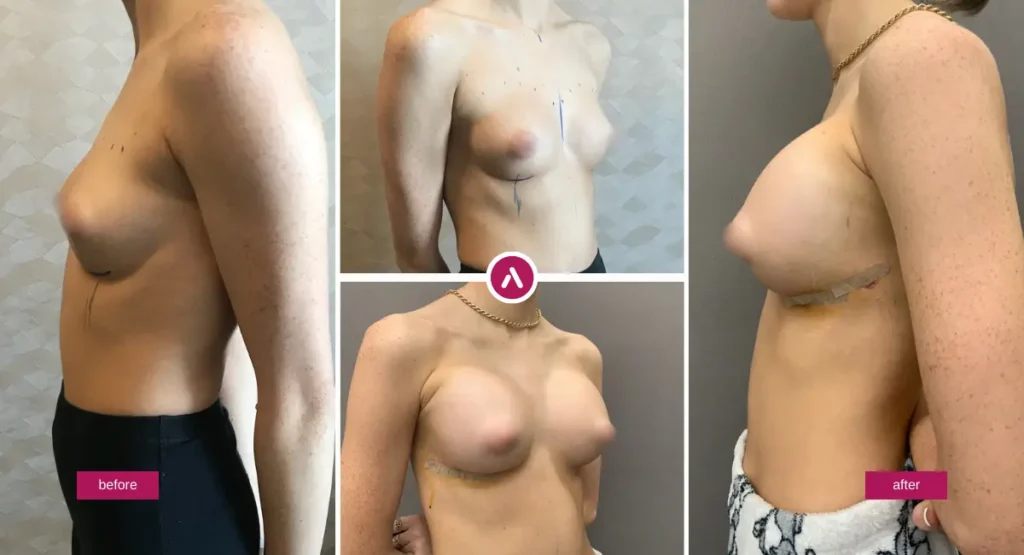
Realistic Expectations and 5-Year Longevity Reality
Fat transfer breast augmentation has a different longevity profile than implants. Implants create a defined device volume that remains until the implant is removed, replaced, ruptures, or changes position. Fat transfer creates living tissue volume that stabilizes after vascularization, then behaves like body fat.
This is why the first weeks can be misleading. Early swelling makes the breasts look fuller. Some transferred fat naturally reabsorbs. The stable result is judged months later, not during the post-operative swelling phase.
Initial Volume vs Final Volume
Immediately after surgery, the breasts may look larger than the final result. This is a mix of transferred fat, swelling, fluid, and tissue reaction. Patients sometimes feel excited by the early volume, but that is not the result we use for long-term planning.
As swelling decreases, the breasts soften and settle. Some fat does not survive and is naturally absorbed by the body. The remaining fat becomes the long-term result once it develops blood supply.
Fat Survival Science
Many patients retain a meaningful portion of transferred fat long-term, but no percentage is guaranteed. Survival depends on donor fat quality, graft handling, injection technique, breast tissue capacity, smoking status, blood supply, and weight stability.
Small fat parcels survive better than large clumps because they sit closer to oxygenated tissue. This is why microdroplet injection matters. The technique is slower, but it supports long-term integration.
| Time After Surgery | What Is Happening | What Patients Notice |
|---|---|---|
| 1 month | Swelling decreases; early reabsorption begins | Breasts look smaller than week 1 but still full |
| 3 months | Fat survival pattern becomes clearer | Shape softens and firmness improves |
| 6 months | Most swelling has settled | Volume feels more natural and stable |
| 12 months | Long-term vascularized fat is established | Result is close to final |
| 5 years | Surviving fat behaves like body fat | Stable if weight remains stable |
Breast Fat Transfer After 1, 5, and 10 Years
At one year, most patients can judge their true result. The swelling phase is over, the surviving fat has stabilized, and the breast texture usually feels natural. If a patient wants more volume, we may discuss a second session after the first result is stable.
After 5 years, the surviving transferred fat should behave like the patient’s other body fat. If weight has stayed stable, the breast volume often remains stable. If weight has changed significantly, breast volume may change too.
Ten years after fat transfer, the result depends on aging, weight, pregnancy history, menopause, and skin elasticity. The transferred fat does not expire, but the breast still ages.
Fat Transfer vs Implant 10-Year Stability
| Factor | Fat Transfer | Breast Implants |
|---|---|---|
| Material | Your own fat | Silicone or saline device |
| Typical volume change | Modest; often about one cup size | More predictable and larger |
| 10-year maintenance | No device replacement, but body changes continue | Implant surveillance and possible revision |
| Response to weight change | Volume may increase or decrease | Implant volume stays, breast tissue may change |
| Risks | Fat necrosis, oil cysts, partial reabsorption | Capsular contracture, rupture, implant malposition, device-related concerns |
Before and After Gallery
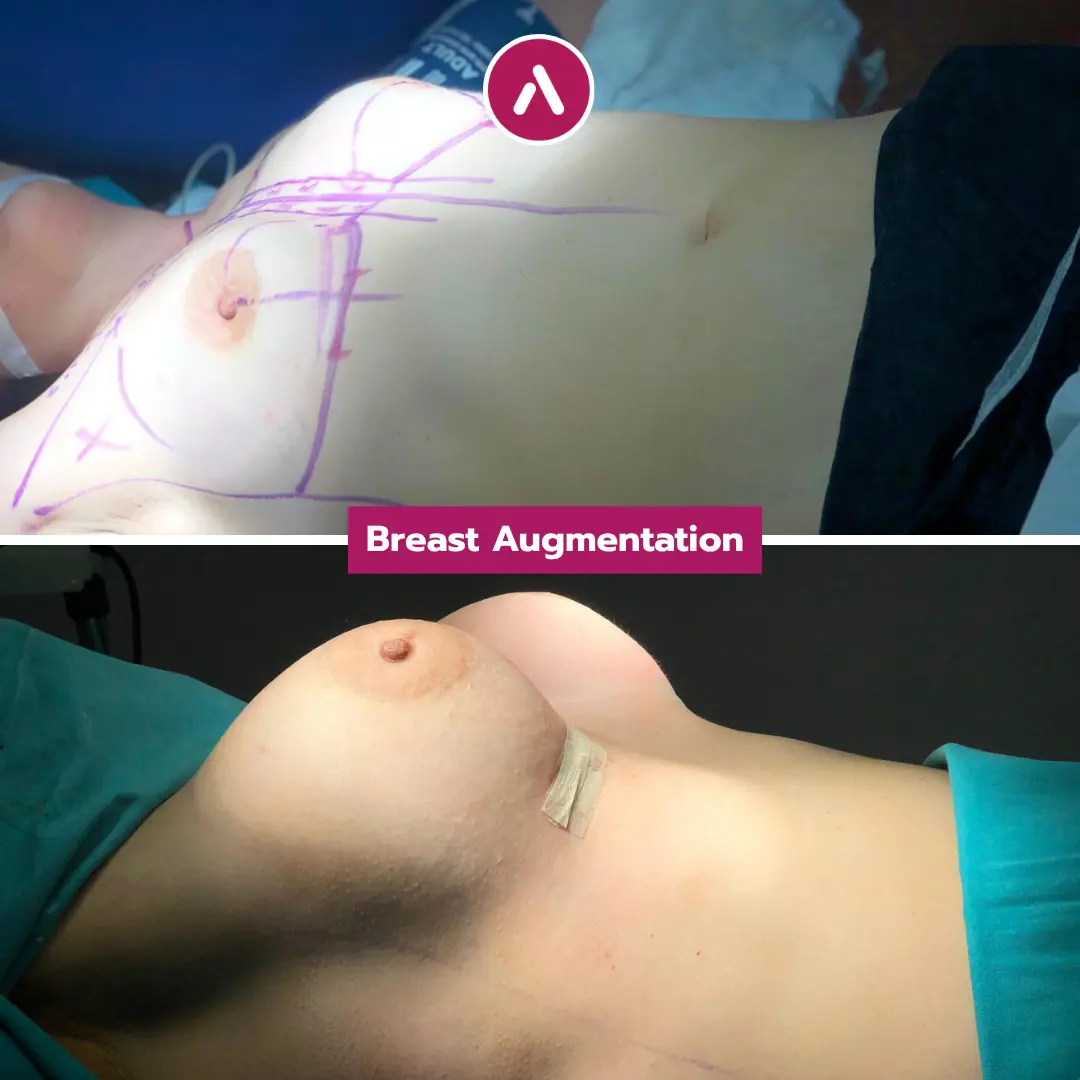
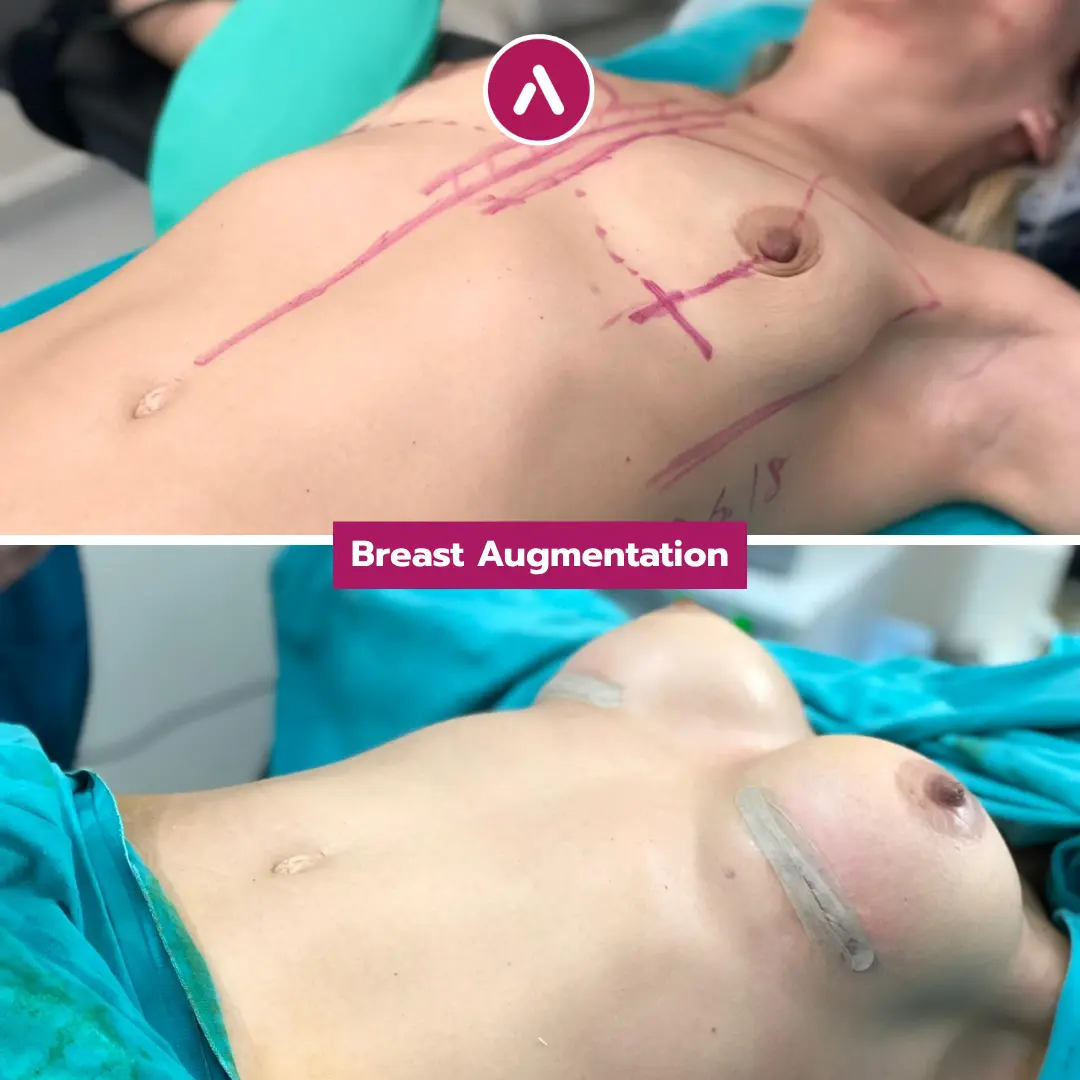
Before-and-after photos are helpful, but they must be interpreted carefully. Look for patients with a similar starting frame, breast size, donor fat distribution, and skin quality. A result from a patient with more donor fat may not apply to a very lean patient.
You can review procedure examples through our breast augmentation before-and-after gallery. During consultation, our team explains which cases are most relevant to your anatomy.
Fat Transfer Breast Augmentation Cost 2026: Turkey vs Canada
Canadian patients researching fat transfer breast augmentation cost often find two barriers at home: limited availability and high private-clinic pricing. Toronto and Vancouver breast surgery practices may offer fat transfer selectively, but many focus primarily on implant augmentation. When fat transfer is offered, the quote often reflects two procedures in one: liposuction harvest and breast grafting.
At AKM Clinic, Autologous Fat Transfer Breast Augmentation is priced at CAD $6,150. Composite Breast Augmentation, which combines fat grafting with implants for softer edges, is CAD $8,200. PRP-Enriched Fat Grafting is CAD $6,800, while Brava-Assisted Fat Transfer is CAD $9,550. Your quote depends on donor areas, grafting complexity, and whether the plan includes lift, explant, hybrid augmentation, or additional body contouring.
By comparison, private fat transfer breast augmentation in Toronto or Vancouver often falls in the CAD $12,000–$20,000 range when offered. Those quotes may not always include hotel, transfers, medications, compression garments, or extended virtual follow-up. At AKM Clinic, our comprehensive clinical pathway includes surgery, anesthesia, pre-operative tests, 5-star hotel accommodation, private VIP transfers, post-operative medications, support garments, and 1, 3, 6, and 12-month virtual follow-ups.
For the full Canadian dollar breakdown, see our fat transfer breast augmentation cost guide. For package inclusions, see the breast augmentation all-inclusive clinical pathway.
| Location | Typical Cost Range | What Usually Drives the Cost | Key Note for Canadians |
|---|---|---|---|
| Toronto | CAD $12,000–$20,000 | Surgeon fee, facility, anesthesia, liposuction harvest | Often billed in separate line items |
| Vancouver | CAD $13,000–$18,000 | Private clinic overhead and limited fat-transfer availability | High demand for natural breast surgery |
| Calgary / Edmonton | Varies by surgeon and scope | Private facility fees and anesthesia | Availability may be more limited than major metros |
| AKM Clinic Istanbul | CAD $6,150 (USD $4,500) | Fat harvest, processing, breast grafting, recovery pathway | Comprehensive care programme with hotel, transfers, and follow-up |
How to Find the Best Fat Transfer Surgeon in Turkey: A Canadian Patient’s Checklist
Many Canadian patients start with searches such as “fat transfer breast augmentation near me” or “breast fat transfer Toronto.” That is a reasonable first step. The better question is whether the surgeon performs fat transfer breast augmentation often enough to understand donor-area planning, fat survival, breast vascularity, and revision scenarios.
Fat transfer is not just breast augmentation without implants. It is a dual-skill procedure. The surgeon must perform high-quality liposuction harvest and high-quality breast grafting. Your checklist should verify both.
Credential Equivalency and Procedure-Specific Experience
Canadian patients are used to checking the Royal College of Physicians and Surgeons of Canada’s specialist certification framework at home. In Turkey and Europe, the equivalent credential pathway is different. EBOPRAS certification signals structured European board-level training in plastic, reconstructive, and aesthetic surgery.
That does not mean patients should accept acronyms without verification. The Canadian Society of Plastic Surgeons’ guidance on choosing a surgeon emphasizes the importance of choosing appropriately trained plastic surgeons, and the same mindset should apply when evaluating international care. Ask what the credential means, who issued it, and how it relates to breast surgery experience. For a broader credential framework, see our plastic surgeon board certification guide.
| Credential or Skill Area | What It Means | Why It Matters for Canadians |
|---|---|---|
| EBOPRAS | European board-level plastic surgery credential | Comparable structured specialist pathway to RCPSC-style expectations |
| Breast fat transfer case volume | Procedure-specific experience | More relevant than generic breast surgery volume alone |
| VASER harvest capability | Ultrasound-assisted donor fat harvest when appropriate | Supports donor contour and fat handling strategy |
| Explant + fat transfer experience | Ability to manage implant removal and tissue replacement | Important for BII-concerned or implant-revision patients |
Fat Transfer Sub-Specialization
Ask how often the surgeon performs fat transfer breast augmentation, not only breast augmentation. Implant surgery experience is valuable, but fat transfer has different technical demands. It requires careful harvest, processing, and injection planning.
The consultation should include donor-area assessment, breast tissue capacity, expected fat survival, and the possibility of staged treatment. If a clinic promises dramatic implant-like volume from one fat transfer session, be cautious.
International Membership and Verification
International memberships are not a substitute for surgical skill, but they can support due diligence. The ISAPS Find a Surgeon directory is one resource Canadian patients may use when researching aesthetic plastic surgeons internationally.
Use directories as a starting point, not the final answer. You should still verify procedure-specific experience, before-and-after documentation, hospital accreditation, anesthesia pathway, and follow-up support.
Aftercare Continuity from Istanbul to Canada
Aftercare is one of the biggest concerns for Canadian patients considering surgery abroad. We address this with English-language medical documentation, 24/7 patient advocacy, and structured virtual follow-up at 1, 3, 6, and 12 months.
This is especially useful after fat transfer because results evolve slowly. A concern at 3 weeks may be normal swelling. A firm area at 3 months may need monitoring. A stable result at 12 months gives a clearer picture of fat survival.
Red Flags to Avoid
- No named surgeon-of-record
- No explanation of harvest and processing method
- No discussion of fat survival limits
- No English-language operative records
- No long-term follow-up plan after returning to Canada
- Unrealistic promises of dramatic volume from fat alone
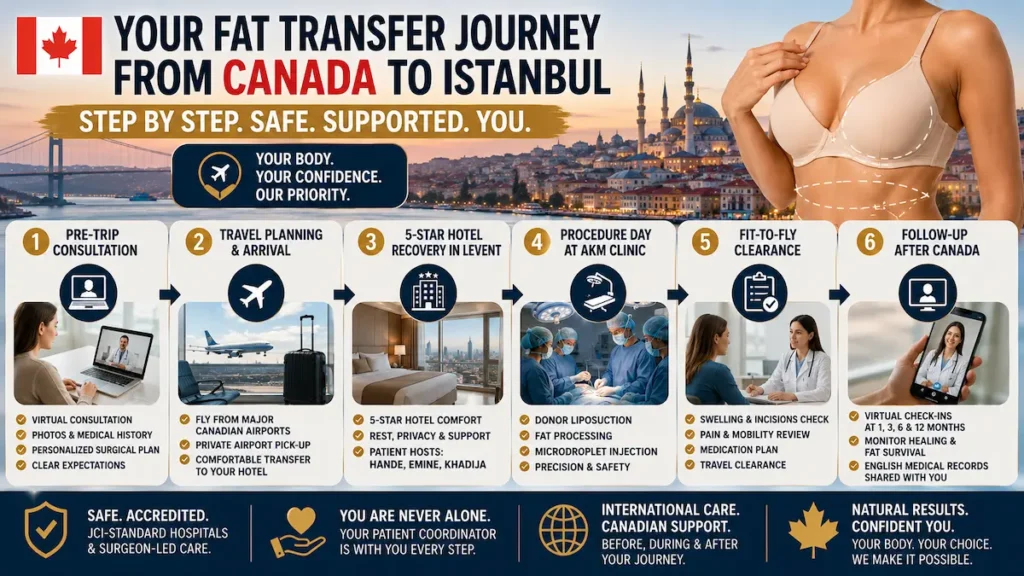
Your Fat Transfer Breast Journey from Canada: From YYZ to Istanbul, Step by Step
International surgery feels much safer when the logistics are clear before you leave Canada. Fat transfer breast augmentation requires careful timing because you are healing in two areas: the breast and the donor zones. Your travel plan must protect both.
At AKM Clinic, we organize the clinical and logistical pathway around this reality. You book your international flight, and our team coordinates the Istanbul-side details: virtual consultation, arrival support, hotel recovery, clinic transfers, post-operative checks, and long-term virtual follow-up after you return home.
Pre-Trip Consultation
Your first step is a virtual consultation. You send standardized photos of the breasts and potential donor areas, including abdomen, flanks, thighs, back, and bra-line zones. These images help us assess whether fat transfer is realistic for your anatomy.
You should also share weight history, pregnancy history, breastfeeding plans, implant history, mammography history, medication use, smoking status, and any known breast-health concerns. This helps us decide whether additional medical clearance or imaging is needed before travel.
Travel Logistics and Arrival in Istanbul
Most Canadian patients plan travel through major airports such as Toronto Pearson, Vancouver, Montreal, Calgary, Ottawa, or Edmonton. Flight routes can change seasonally, so we recommend checking current airline schedules before booking. Your coordinator helps you align arrival and surgery timing.
After landing in Istanbul, you are met by a private driver and taken to your hotel. This matters after a long-haul flight. You should not need to negotiate taxis, navigate a new city, or carry luggage while preparing for surgery.
For a broader overview of the process, our Canadian patient journey guide explains the Istanbul-side pathway in more detail.
5-Star Hotel Recovery in Levent
Recovery takes place in a 5-star hotel setting selected for international patient support. Hotel privacy matters after breast and donor-area surgery. You need space to rest, manage garments, take medication, and walk gently without unnecessary stress.
Our hotel pathway is designed for patients who may be travelling alone or with a companion. Patient hosts such as Hande, Emine, and Khadija support communication between you and the clinical team. To understand the accommodation and transfer structure, see our hotels and VIP transfers page.
Procedure Day and Fit-to-Fly Clearance
On procedure day, you are transferred to the surgical facility. The team reviews markings, donor areas, anesthesia plan, and post-operative instructions. Fat transfer breast augmentation usually includes donor-area liposuction, fat processing, and breast microdroplet grafting.
Before flying home, you must be assessed for travel readiness. We review swelling, donor-area discomfort, incision status, mobility, medication needs, and general recovery. Fit-to-fly clearance is not based only on the calendar.
Follow-Up After Returning to Canada
Fat transfer results evolve slowly, so follow-up matters. We monitor healing through virtual check-ins at 1, 3, 6, and 12 months. These appointments help us assess fat survival, donor-area contour, breast softness, symmetry, and any areas of firmness.
If a concern appears, your patient advocate helps you decide whether it can be monitored remotely or should be assessed locally. We provide English-language surgical records so Canadian physicians and imaging teams understand what was done.
Frequently Asked Questions About Fat Transfer Breast Augmentation
Fat transfer breast augmentation raises different questions than implant-based breast surgery. Canadian patients often ask about size limits, fat survival, mammography, travel insurance, provincial coverage, and what happens if they return home with a concern.
How big can my breasts get with one fat transfer session?
Most patients can expect about one cup size increase from one fat transfer breast augmentation session. Some patients achieve less if they are very lean, have tight breast skin, or have limited donor fat. Larger goals may require a second session or an implant-based strategy.
How long does fat transfer breast augmentation last?
Once transferred fat survives and develops blood supply, it can remain long-term. The key stabilization period is usually the first 3–6 months, with a clearer result at 12 months. After that, surviving fat behaves like the rest of your body fat.
What percentage of transferred fat survives long-term?
A typical long-term fat survival range is about 60–80%, depending on patient biology and surgical technique. Survival is influenced by donor fat quality, gentle harvest, processing method, microdroplet injection, smoking status, breast tissue capacity, and recovery discipline.
When can I return to work, exercise, and regular bras?
Many patients can return to desk-based work within 7–14 days, depending on donor-area soreness and the extent of surgery. Exercise returns gradually. Regular bras, especially underwire bras, should wait. We usually recommend avoiding underwire pressure for about 6 weeks.
Does OHIP, MSP, AHCIP, or RAMQ cover fat transfer breast augmentation?
Fat transfer breast augmentation for cosmetic volume enhancement is generally not covered by Canadian provincial health plans such as OHIP, MSP, AHCIP, or RAMQ. These plans may cover medically necessary or reconstructive procedures in specific circumstances, but cosmetic augmentation is usually private-pay.
How much does fat transfer breast augmentation cost in Toronto vs Istanbul?
Toronto and Vancouver private fat transfer breast augmentation can often fall in the CAD $12,000–$20,000 range when offered. At AKM Clinic, Autologous Fat Transfer Breast Augmentation is listed at CAD $6,150, with the final quote depending on donor areas, grafting complexity, and combined procedures.
Does Canadian travel insurance cover complications from elective fat transfer surgery in Turkey?
Many Canadian travel insurance policies exclude complications related to elective cosmetic surgery abroad. Patients should read the policy wording carefully and ask the insurer direct questions before booking.
Is fat transfer better than breast implants?
Fat transfer is better for patients who want modest, natural volume using their own tissue. Implants are better for patients who want a larger and more predictable size increase in one operation. The right choice depends on anatomy and goals.
Can I get fat transfer if I had my implants removed?
Yes, many patients can consider implant removal with fat transfer. The plan depends on implant size, capsule condition, breast skin, nipple position, tissue thickness, and donor fat availability. Some patients need a lift at the same time.
Will fat transfer interfere with mammography or breast cancer screening?
Fat transfer does not place a device inside the breast, but it can create benign imaging findings such as oil cysts or calcifications. You should always tell your radiologist and family physician that you had breast fat grafting.
Can fat transfer cause Breast Implant Illness?
Breast Implant Illness is associated with patient-reported symptoms after breast implant placement. Pure fat transfer breast augmentation does not use silicone or saline implants, so it does not introduce an implant device into the body.
Can I combine fat transfer with a breast lift, tummy tuck, or BBL in one trip?
Yes, selected patients can combine fat transfer breast augmentation with a breast lift, tummy tuck, BBL, or other body-contouring procedures. Combination surgery must be planned around health status, surgical time, donor fat supply, mobility, and return-flight safety.
What happens if I develop a lump after returning to Canada?
A lump after fat transfer may be benign fat necrosis, an oil cyst, scar tissue, or another breast finding. It should be evaluated rather than ignored. Contact our team and arrange local assessment if needed.
Can very lean patients get fat transfer breast augmentation?
Very lean patients may not have enough donor fat for meaningful breast augmentation. In some cases, small-volume fat transfer can still soften contours or correct minor asymmetry, but it may not create a visible cup-size increase.
Medical Disclaimer: This page is for educational purposes only and does not replace medical advice from a qualified physician. Fat transfer breast augmentation is a surgical procedure with risks, including infection, bleeding, fat necrosis, oil cysts, calcifications, asymmetry, contour irregularity, scarring, partial fat reabsorption, anesthesia-related complications, and the possible need for revision surgery.