




A tummy tuck can flatten and firm the abdomen after pregnancy, weight loss, or long-term skin stretching. A lighter version can sometimes be performed awake, using pure local anesthesia instead of general anesthesia.
Honesty matters here. A mini or less-extensive tummy tuck may suit the awake approach, while a full abdominoplasty with major muscle repair usually still requires general anesthesia.
This guide focuses on the awake experience: what it feels like, who qualifies, when local anesthesia is appropriate, and when we recommend a different pathway. For the surgical technique, muscle repair, scar planning, and full abdominoplasty results, visit our Tummy Tuck in Turkey guide for Canadian patients.
Table of Contents

What Is an Awake Tummy Tuck?
An awake tummy tuck is a tummy tuck performed under pure local anesthesia while you remain fully conscious. You are not put to sleep. You do not receive general anesthesia, and there is no breathing tube.
Local anesthetic is placed into the treatment area to numb the abdominal tissues. For selected patients, this can allow our surgeons to remove limited lower-abdominal skin and refine the contour while avoiding the grogginess and systemic effects of general anesthesia.
This approach is not the same as a standard full tummy tuck. A full abdominoplasty often involves a larger skin flap, wider tissue release, repositioning around the belly button, and significant muscle plication. Those steps usually require general anesthesia for safety, comfort, and surgical control.
Awake tummy tuck defined: pure local anesthesia, fully conscious
In an awake tummy tuck, “awake” means you stay alert and able to communicate. We use local anesthesia to numb the surgical area, then monitor comfort throughout the procedure.
You may feel pressure, pulling, vibration, or movement. You should not feel sharp pain. If your anatomy or anxiety level makes that unlikely, we do not force the awake route.
Our philosophy is simple: awake surgery is valuable only when it is the safest and most comfortable choice for the right patient. It is not a marketing shortcut.
How it differs from a standard tummy tuck under general anesthesia
A standard tummy tuck under general anesthesia allows the surgeon to perform a more extensive correction. This can include wider skin removal, full abdominal wall tightening, and more complex contouring.
An awake tummy tuck is usually more limited. It is best suited to patients with mild to moderate lower-abdominal skin laxity, smaller pockets of fat, and little or no need for major muscle repair.
For Canadian patients comparing options, this distinction matters. The question is not, “Can every tummy tuck be done awake?” The better question is, “Can my anatomy be treated safely under local anesthesia?”
Why this page focuses on anesthesia, not abdominoplasty technique
This page is part of our Awake Surgery in Turkey series. Its role is to explain the anesthesia pathway, not to repeat every technical detail from the main tummy tuck page.
The surgical biology remains the same. Skin still needs time to heal. Swelling still develops. Scars still mature over months. Awake anesthesia changes the experience and early recovery, not the basic wound-healing process.
For that reason, we keep technique discussion brief here. If you want to compare mini tummy tuck, full tummy tuck, extended tummy tuck, muscle repair, and scar placement, the main abdominoplasty guide is the better starting point.
Mini versus full tummy tuck: the key distinction
The awake approach is most realistic for mini or limited tummy tuck patterns. These usually focus on the lower abdomen below the belly button.
A full tummy tuck is different. It often treats the entire front abdominal wall and may include diastasis recti repair, which means tightening separated abdominal muscles. That level of correction usually belongs under general anesthesia.
During your virtual assessment, we review your photos, medical history, prior pregnancies, weight-loss history, scar position, and goals. If awake is not the right plan, we will say so before you travel.
Benefits of an Awake Tummy Tuck
The main benefit of an awake tummy tuck is avoiding general anesthesia when your anatomy allows it. For many Canadians, this reduces one of the biggest emotional barriers to surgery abroad.
Awake surgery can also support faster early mobility, less anesthesia-related grogginess, and a more direct same-day recovery experience. These benefits are meaningful for international patients who need to feel stable before flying back to Canada.
Still, awake is not automatically better. A general anesthesia tummy tuck may be safer for larger corrections, significant muscle repair, or patients who cannot stay comfortable while conscious.
Avoiding general anesthesia when clinically appropriate
Some patients feel comfortable with the surgical idea but nervous about being fully asleep. They worry about nausea, intubation, slower wake-up, or the general anesthesia risk profile.
For the right candidate, local anesthesia avoids those specific concerns. You remain breathing on your own, stay conscious, and recover without the heavy “anesthesia hangover” some patients experience after general anesthesia.
This is especially appealing for Canadian patients travelling from Toronto, Vancouver, Montreal, Calgary, Edmonton, Ottawa, or Halifax. A shorter anesthesia burden can make the first recovery days feel more manageable.
Less grogginess and faster early mobility
Early walking matters after body surgery. It supports circulation, reduces stiffness, and helps lower travel-related risks for long-haul patients.
Because awake surgery avoids general anesthesia, many patients feel clearer sooner after the procedure. They can usually eat, drink, communicate, and begin gentle movement earlier than they might after a longer general anesthetic.
That does not mean recovery is effortless. You still need compression, wound care, careful movement, and follow-up. Awake does not make a tummy tuck minor surgery.
Potentially shorter facility time
A limited awake tummy tuck may require less facility time than a full abdominoplasty under general anesthesia. There is no general anesthesia induction, no intubation, and usually a shorter monitored wake-up period.
This can make the care pathway feel lighter. It may also reduce some anesthesia-related costs, depending on the final surgical plan.
Your quote is always tied to your anatomy and procedure scope. If your plan changes from awake to general anesthesia because it is safer, we explain that before confirming surgery.
Why Canadian patients ask about awake body surgery abroad
Canadian patients are often careful researchers. Many have already compared private clinics in Toronto or Vancouver, reviewed provincial coverage rules, and learned that cosmetic tummy tuck surgery is usually not covered by OHIP, MSP, AHCIP, or RAMQ.
They are not simply looking for a lower price. They want a safer-feeling plan, clearer communication, and a clinical team that will not oversell what local anesthesia can do.
At AKM Clinic, that honesty is part of our Natural-First philosophy. We would rather recommend general anesthesia than advertise an awake tummy tuck to someone who is not a good candidate.
Honest limits: awake is not always the safer choice
Awake surgery is safest when the procedure is limited enough for local anesthesia to cover comfortably. It becomes less appropriate when the surgical field is large, the repair is deep, or the expected discomfort is too high.
Patients who need major muscle tightening, extensive skin removal, or combined procedures may do better with general anesthesia or, in selected cases, a different staged plan.
This is why your consultation is not just a price quote. It is a clinical screening process. The safest anesthesia plan is the one that matches your anatomy, your comfort level, and the actual surgery needed.
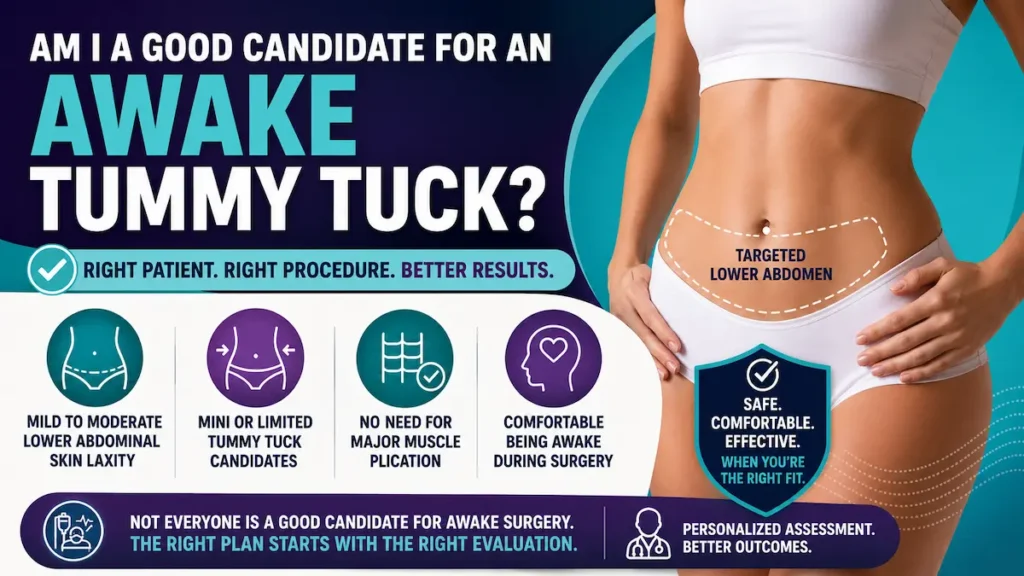
Am I a Good Candidate for an Awake Tummy Tuck?
The best candidates for an awake tummy tuck are patients who need a limited correction. This usually means lower-abdominal skin laxity, a small amount of localized fat, and little or no need for major abdominal muscle repair.
Awake surgery is not simply a preference. It is a candidacy decision. We need to confirm that local anesthesia can keep you comfortable while giving the surgeon enough control to treat the area safely.
For many Canadian patients, the word “awake” sounds reassuring because it avoids general anesthesia. That reassurance is valid only when the surgical plan is small enough for pure local anesthesia.
Patients with mild to moderate lower abdominal skin laxity
Awake tummy tuck candidacy usually begins with the amount and location of loose skin. Patients with a small fold of lower-abdominal skin, often below a C-section scar or below the belly button, may be better candidates than patients with looseness across the entire abdomen.
A limited skin excess can sometimes be removed with local anesthesia because the surgical field is smaller. The incision is usually shorter, the tissue release is more controlled, and the overall surgical stress is lower.
If your skin laxity extends above the belly button, around the flanks, or into a larger overhanging apron, the awake pathway becomes less realistic. In that situation, we usually discuss a standard or extended tummy tuck under general anesthesia through the main tummy tuck surgery pathway.
Mini or limited tummy tuck candidates
A mini tummy tuck is the clearest match for the awake approach. It usually focuses on the lower abdomen and avoids the wider tissue dissection used in a full abdominoplasty.
This does not mean every mini tummy tuck should be awake. Your comfort, tissue thickness, scar history, medical background, and anxiety level still matter.
It means the procedure is more technically compatible with pure local anesthesia. If your goals fit a mini correction, we can evaluate whether an awake tummy tuck is reasonable.
Patients who do not need major muscle plication
Muscle plication is one of the biggest dividing lines. It means the surgeon tightens separated abdominal muscles, often after pregnancy or major weight change.
Major plication creates deeper discomfort and requires more surgical exposure. For that reason, a full tummy tuck with significant diastasis recti repair usually belongs under general anesthesia.
If you have mild skin laxity but no major abdominal wall separation, awake may remain on the table. If you need a deeper muscle repair, we will explain why general anesthesia is safer and more comfortable.
Anxiety tolerance: being awake is not for everyone
Awake surgery requires psychological readiness. You do not see the operation, but you know it is happening. You may hear surgical sounds, feel pressure, and notice movement.
Some patients find that reassuring because they stay in control. Others find it stressful. Both reactions are normal.
If you are highly anxious, claustrophobic, or uncomfortable with the idea of being conscious during surgery, twilight sedation or general anesthesia may be a better match. We do not consider that a failure. It is part of matching the plan to the person.
When general anesthesia is the better clinical plan
General anesthesia is often the better choice for a full abdominoplasty, extended tummy tuck, fleur-de-lis tummy tuck, major muscle repair, or multiple combined procedures.
It gives the surgeon more time, deeper control, and a more stable operating environment for large corrections. It can also protect the patient from discomfort during deeper work.
The goal is not to avoid general anesthesia at all costs. The goal is to choose the safest anesthesia for the procedure you actually need.
“A good awake candidate is not just someone who wants to avoid general anesthesia. A good candidate is someone whose anatomy allows a limited correction under local anesthesia without compromising comfort or surgical quality.”
When Can a Tummy Tuck Be Done Awake?
A tummy tuck can be done awake only when the planned correction is limited enough for local anesthesia to control pain safely. In practice, this usually means a mini or less-extensive tummy tuck rather than a full abdominoplasty.
The honest answer is conditional. Yes, an awake tummy tuck is possible for selected patients. No, it is not appropriate for every tummy tuck.
This distinction protects you. Clinics that promise every full tummy tuck can be done awake are ignoring the difference between a lighter skin-removal procedure and a deeper abdominal reconstruction.
Mini tummy tuck under local anesthesia
A mini tummy tuck under local anesthesia focuses on the lower abdomen. It may remove a smaller amount of skin and, in selected cases, refine a limited fat pocket.
Because the surgical field is smaller, the local anesthetic can often cover the area more predictably. The surgeon can work without the deeper exposure usually required for a full abdominoplasty.
This is the scenario where awake tummy tuck is most realistic. It is also why your photo assessment must evaluate how much correction you need, not just whether you prefer local anesthesia.
Limited skin and fat removal without major plication
Awake tummy tuck works best when the goal is limited skin removal and modest contour improvement. If a small amount of fat is involved, local infiltration can sometimes support careful refinement.
That said, awake tummy tuck is not the same as awake high-definition liposuction. Liposuction primarily removes fat. A tummy tuck removes skin and closes an incision under tension.
If fat removal is the main goal, our Awake High-Definition Liposuction guide may be more relevant. If loose skin is the main concern, awake tummy tuck may be considered.
Full abdominoplasty with muscle repair: why general anesthesia is usually required
A full abdominoplasty treats more than a small lower-belly fold. It may involve wide skin elevation, belly button repositioning, larger skin removal, drain or drainless closure planning, and abdominal wall tightening.
Those steps create more discomfort and require more surgical control. Local anesthesia alone is usually not the safest or most humane option for that level of correction.
Major muscle plication is the clearest reason to choose general anesthesia. If your main concern is diastasis recti after pregnancy, we will assess you carefully and explain whether awake surgery is realistic.
“The safest surgeon is not the one who says yes to awake surgery every time. The safest surgeon is the one who knows when local anesthesia is enough — and when it is not.”
Awake tummy tuck versus twilight sedation
Awake surgery means pure local anesthesia. You remain fully conscious and do not receive sedation. Twilight sedation is different: you are relaxed, drowsy, and less aware, but not under full general anesthesia.
For patients who are not ideal for fully awake surgery but want to avoid a full general anesthetic, twilight may be discussed in selected procedures. The final decision depends on the procedure, medical history, and safety profile.
To understand the anesthesia spectrum in more detail, see our guide to Twilight Surgery in Turkey and our comparison of local versus general anesthesia.
Awake tummy tuck versus awake liposuction
Awake liposuction and awake tummy tuck are often confused, but they solve different problems. Liposuction removes fat. A tummy tuck removes skin and may address deeper abdominal structure.
Local anesthesia is often easier to use for liposuction because the target layer is fat. A tummy tuck involves skin excision and closure, which can create more tension and a different pain profile.
This is why we may recommend awake high-definition liposuction for a patient with firm skin and fat fullness, but a standard tummy tuck for a patient with loose skin and muscle separation.
Decision table: awake, twilight, or general anesthesia
| Clinical scenario | Most likely anesthesia path | Why | AKM position |
|---|---|---|---|
| Small lower-abdominal skin fold | Awake / pure local may be possible | Limited surgical field | Assess for awake candidacy |
| Mini tummy tuck with minimal fat refinement | Awake may be possible | Lower tissue burden and smaller incision | Good candidate group if anxiety is low |
| Full tummy tuck with major muscle plication | General anesthesia usually recommended | Deeper repair and wider exposure | Do not over-promise awake suitability |
| Extended or fleur-de-lis tummy tuck | General anesthesia | Larger skin removal and longer operative time | Use main tummy tuck pathway |
| Fat fullness with good skin elasticity | Awake liposuction may be better | Fat removal, not skin excision, is the main goal | Consider awake HD liposuction |
| High anxiety about being conscious | Twilight or general may be safer emotionally | Comfort and cooperation matter | Do not force awake surgery |
The table is a guide, not a diagnosis. Your final plan depends on a surgeon-led assessment, medical history review, and honest discussion of comfort.
If your abdomen needs a full structural repair, general anesthesia may be the responsible choice. If your correction is limited, awake may offer a lighter pathway with less anesthesia burden.

Areas Treated in an Awake Tummy Tuck
An awake tummy tuck is usually a targeted lower-abdominal procedure. It is not designed to replace every type of abdominoplasty.
The best match is a patient with localized looseness below the belly button, often after pregnancy, a C-section, or moderate weight change. The treatment area must be small enough for local anesthesia to work predictably.
If your concern involves the full abdomen, upper-abdominal looseness, a larger overhanging fold, or significant muscle separation, we usually discuss a standard tummy tuck plan instead.
Lower abdominal skin redundancy
The main area treated in an awake tummy tuck is the lower abdomen. This is the area between the belly button and the pubic line.
Some patients describe this as a small fold, pouch, or loose skin shelf that does not improve with exercise. It may sit above a C-section scar or appear after weight loss.
When the skin excess is limited, our surgeons may be able to remove it under pure local anesthesia. The goal is a cleaner lower-abdominal contour, not a full abdominal reconstruction.
Small lower-belly fat pockets when combined with local liposuction
Some awake tummy tuck plans include a small amount of local fat refinement. This may help smooth the lower abdomen around the skin excision area.
The key word is small. Large-volume liposuction, 360 contouring, or high-definition abdominal shaping belongs in a different treatment plan.
If fat is your main concern and your skin is still firm, awake high-definition liposuction may be more appropriate than awake tummy tuck. If skin looseness is the main concern, skin removal becomes the priority.
What awake tummy tuck does not usually address
An awake tummy tuck does not usually address upper-abdominal looseness, major diastasis recti, extensive stretch-marked skin above the belly button, or a larger abdominal apron.
It also does not create the same transformation as a full abdominoplasty. A mini or limited tummy tuck can improve a specific lower-abdominal problem, but it cannot tighten the entire abdomen.
This is why we avoid promising full tummy tuck results through a local-only procedure. The result must match the surgical scope.
When to choose the main tummy tuck page instead
You should start with our main Tummy Tuck in Turkey page if you want to understand full abdominoplasty, extended tummy tuck, muscle repair, belly button repositioning, or post-pregnancy abdominal reconstruction.
That page explains the technique itself. This page explains the awake anesthesia pathway.
Many Canadian patients read both. That is the best approach if you are unsure whether your anatomy needs a limited awake correction or a standard tummy tuck under general anesthesia.

Can You Combine an Awake Tummy Tuck with Other Procedures?
Some patients want to combine an awake tummy tuck with other body procedures in one trip. This can be possible in selected cases, but combination surgery changes the anesthesia decision.
The more procedures you combine, the more we think about operative time, local anesthetic limits, swelling, mobility, comfort, and fit-to-fly safety. Awake surgery is not automatically the best pathway for a larger combined plan.
Our approach is conservative. If combining treatments makes pure local anesthesia less appropriate, we may recommend staging, twilight sedation, or general anesthesia instead.
Awake tummy tuck plus awake high-definition liposuction
Awake tummy tuck and awake high-definition liposuction can overlap in selected lower-abdominal contouring plans. This is most realistic when fat removal is limited and skin excision remains small.
If the main concern is fat fullness with good skin elasticity, awake high-definition liposuction may be the better primary treatment. If the main concern is loose lower-abdominal skin, the tummy tuck component becomes more relevant.
Large-volume liposuction, 360 contouring, or extensive abdominal etching may require a separate plan. You can compare the anesthesia pathway in our Awake High-Definition Liposuction guide.
Awake tummy tuck within an awake mommy makeover plan
An awake mommy makeover is a carefully selected combination of procedures performed without general anesthesia. It may include lighter breast, abdominal, or body-contouring work for the right patient.
That does not mean a full mommy makeover can always be done awake. Combining breast surgery, abdominal skin removal, liposuction, and muscle repair can quickly exceed what local anesthesia should handle.
If you are considering post-pregnancy restoration, start with the broader Mommy Makeover in Turkey guide, then review the Awake Mommy Makeover pathway if your goals are more limited.
When combining procedures requires twilight or general anesthesia
Combination surgery becomes more complex as treatment areas increase. Longer surgery means more local anesthetic exposure, more swelling, more movement limitations, and more recovery planning.
General anesthesia may be safer when the procedure includes full abdominoplasty, major muscle plication, breast surgery, larger liposuction areas, or several body zones at once.
Twilight sedation may be discussed for selected procedures, but it is not a replacement for general anesthesia in every case. The anesthesia plan must follow the clinical scope.
Why staging can be safer for selected patients
Staging means separating procedures into different surgical sessions. It can reduce operative time, improve comfort, and allow each area to heal before the next step.
For Canadian patients, staging may feel inconvenient because it can mean another trip. Yet it may be the safer choice when a single combined surgery would push the limits of local anesthesia or early mobility.
We discuss staging when it protects the result. A responsible plan is not always the fastest plan.
Anesthesia: Pure Local, Twilight, or General?
The anesthesia decision is the heart of this page. Awake tummy tuck uses pure local anesthesia. Twilight and general anesthesia are different pathways.
Each option has a role. The right choice depends on the procedure size, your medical history, your anxiety level, and the amount of correction needed.
We do not present one anesthesia type as universally superior. We choose the pathway that protects safety, comfort, and surgical quality.
Pure local anesthesia explained
Pure local anesthesia means medication is placed into the surgical area to block pain signals. You stay awake and breathe on your own.
You may feel touch, pressure, stretching, or movement. These sensations are expected. Sharp pain is not.
During an awake tummy tuck, our team checks your comfort throughout the procedure. If local anesthesia cannot provide safe and humane comfort, the awake pathway is not appropriate.
What tumescent local anesthesia does
Tumescent local anesthesia uses a diluted anesthetic solution placed into the tissue. It helps numb the area and can reduce bleeding during selected procedures.
It is commonly used in body contouring and liposuction-style procedures. In a limited awake tummy tuck, it may support a more comfortable lower-abdominal correction.
There are limits. Local anesthetic has safe dosing thresholds. A responsible clinic respects those thresholds instead of trying to stretch local anesthesia beyond its safe range.
Twilight sedation as a middle option
Twilight sedation is not the same as awake surgery. With twilight, you are relaxed and drowsy. You may remember little, but you are not under full general anesthesia.
For some patients, twilight can be a middle ground between pure local and general anesthesia. It may help patients who are anxious about being fully awake but do not need the depth of general anesthesia.
Twilight is procedure-dependent. Because this page focuses on pure local awake tummy tuck, we keep sedation discussion brief. For the broader anesthesia spectrum, see our Twilight Surgery guide.
General anesthesia for full abdominoplasty
General anesthesia is usually the correct pathway for a full tummy tuck. This is especially true when the plan includes major muscle repair, wide skin elevation, or extensive contouring.
General anesthesia allows a controlled operating environment for deeper work. It also protects the patient from discomfort during a longer procedure.
For patients who need full abdominal repair, avoiding general anesthesia should not be the main goal. The main goal should be a safe, complete, well-planned result.
How our surgeons choose the safest pathway
Our surgeons begin with your anatomy, not your preferred anesthesia. We look at the skin excess, fat distribution, muscle separation, scar history, BMI, medical background, and comfort level.
If the correction is limited and you are psychologically comfortable being awake, pure local anesthesia may be considered. If the correction is larger, general anesthesia may be recommended.
This decision is made before you travel whenever possible. We use virtual consultation and photo review to avoid surprises after you arrive in Istanbul.
| Anesthesia type | Consciousness level | Best suited for | Recovery profile | AKM position |
|---|---|---|---|---|
| Pure local / awake | Fully conscious | Mini or limited tummy tuck in selected patients | No general-anesthesia grogginess; local recovery still required | Useful when anatomy and comfort level match |
| Twilight sedation | Drowsy, relaxed, partially aware | Selected procedures where pure local may not be comfortable enough | Less intense than general anesthesia, but still requires monitoring | Considered when clinically appropriate |
| General anesthesia | Fully asleep | Full abdominoplasty, major muscle repair, extended correction | Longer wake-up and monitoring, but better control for major surgery | Recommended when it is the safer plan |
For patients who want to understand how Canadian anesthetic practice frames monitoring, safety, and professional standards, the Canadian Anaesthesiologists’ Society is a useful professional reference. For a broader explanation of anesthesia levels, the American Society of Anesthesiologists provides patient-facing education on local, sedation, and general anesthesia.
“Awake surgery is not about avoiding anesthesia at any cost. It is about using the lightest safe anesthesia that still allows the surgeon to do the right operation well.”
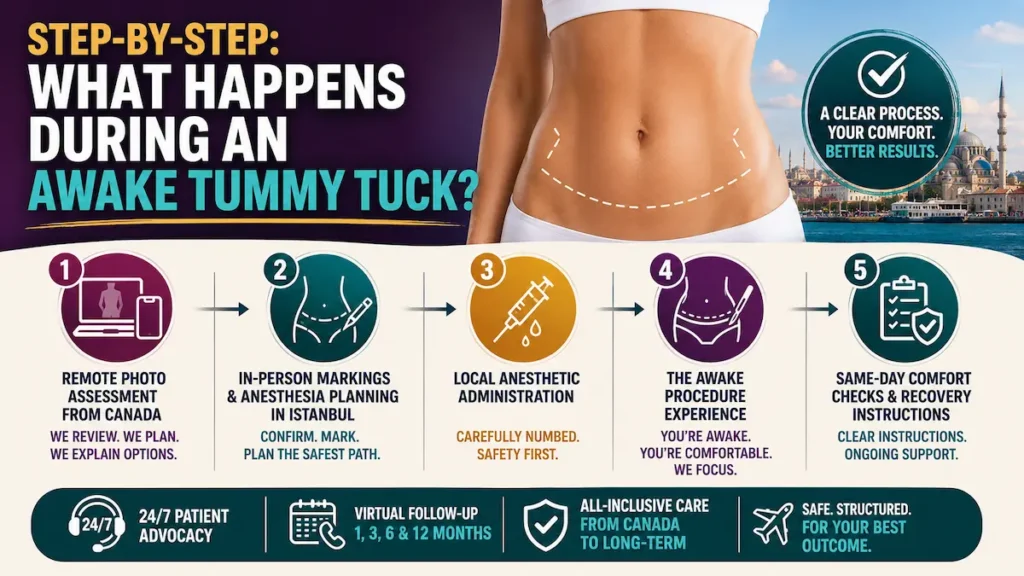
Step-by-Step: What Happens During an Awake Tummy Tuck?
An awake tummy tuck begins before you arrive in Istanbul. We first need to confirm that your abdomen, medical history, and comfort level make local anesthesia realistic.
If your photos suggest a full abdominoplasty, major muscle plication, or larger skin removal, we will not present awake surgery as the default. That protects you from disappointment and protects surgical safety.
When awake candidacy looks reasonable, your plan moves through a structured pathway: virtual assessment, final in-person examination, local anesthesia, limited correction, and monitored early recovery.
Remote photo assessment from Canada
Your first step is a remote consultation from Canada. You send standardized photos, describe your goals, and share relevant medical details.
We review the amount of lower-abdominal skin, prior scars, fat distribution, pregnancy history, weight stability, and signs of muscle separation. These details help us decide whether awake tummy tuck is even a responsible option.
This is also when we explain alternatives. You may be better suited to standard tummy tuck, awake high-definition liposuction, or a staged plan.
In-person markings and anesthesia planning in Istanbul
After arrival, your surgeon performs a final in-person examination. This confirms whether the virtual plan still matches your actual anatomy.
Markings are made while you are standing. This helps the surgeon judge skin excess, lower-abdominal tension, and incision placement.
Your anesthesia plan is reviewed again. If the in-person exam shows that local anesthesia would not be enough, we discuss a safer pathway before proceeding.
Local anesthetic administration
Before surgery begins, the treatment area is carefully numbed. Local anesthetic is placed in a controlled way, respecting safe dosing limits.
You may feel pressure or a stinging sensation during the initial numbing phase. That is usually the least comfortable part of the awake process.
Once the area is numb, the goal is comfort during the procedure. You may feel pressure, movement, or tugging, but you should not feel sharp pain.
The awake procedure experience
During an awake tummy tuck, you remain conscious and able to communicate. The surgical area is draped, so you do not watch the operation.
Some patients prefer quiet. Others appreciate gentle reassurance from the team. We adjust communication to your comfort level.
The procedure itself is limited by design. Awake tummy tuck is not the setting for aggressive full-abdominal reconstruction.
Same-day comfort checks and recovery instructions
After the procedure, we check your comfort, walking ability, incision area, and early swelling. You receive clear instructions before leaving the clinical setting.
You will usually wear compression and move carefully. You should expect tightness and soreness, even though general anesthesia was avoided.
Your coordinator remains available after discharge. Our care model includes 24/7 patient advocacy and long-term virtual follow-up at 1, 3, 6, and 12 months as part of the all-inclusive clinical pathway.
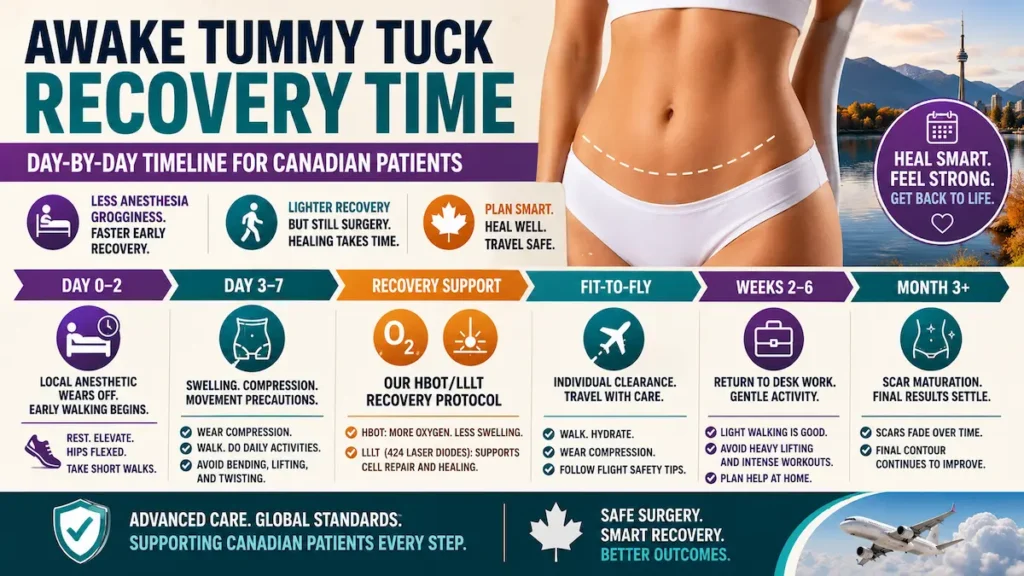
Awake Tummy Tuck Recovery Time: Day-by-Day Timeline for Canadian Patients
Awake tummy tuck recovery is usually lighter than full abdominoplasty recovery, but it is still surgery. You have an incision, swelling, tissue healing, and movement limits.
The advantage is mainly in early anesthesia recovery. You avoid general-anesthesia grogginess, but your abdomen still needs time to heal.
Canadian patients should plan recovery around their return flight, desk work, child care, exercise, and compression garment use.
Day 0–2: local anesthetic wears off, early walking begins
On the day of surgery, the local anesthetic gradually wears off. Tightness, soreness, and swelling become more noticeable.
Early walking is encouraged in short, gentle intervals. This supports circulation and helps reduce stiffness.
You should rest with your upper body slightly elevated and your hips flexed. This position reduces tension on the lower-abdominal incision.
Day 3–7: swelling, compression, and movement precautions
Swelling often increases during the first week. Bruising may appear around the lower abdomen or treated fat areas.
Your compression garment helps control swelling and supports the healing tissues. It should be worn exactly as instructed.
Movement remains careful. You can walk, use the bathroom, and perform basic daily activities, but bending, lifting, and twisting should be minimized.
Our HBOT/LLLT Recovery Protocol
We use advanced recovery tools to support tissue healing and reduce inflammatory downtime. These technologies are especially valuable for international patients preparing for a long-haul return flight.
Hyperbaric Oxygen Therapy, or HBOT, increases oxygen availability in the bloodstream. This can support tissue repair, reduce edema, and help the body recover after surgery.
Low-Level Laser Therapy, or LLLT, uses 424 medical-grade semiconductor laser diodes at 650 nm. This supports cellular ATP production, which is part of the body’s repair process.
These tools do not replace careful surgery or wound care. They support your recovery environment. You can learn more through our technology and safety standards page.
Fit-to-fly timing for Canadian patients
Fit-to-fly clearance is individual. We look at your walking ability, swelling, incision condition, pain control, and overall stability before advising travel.
For a limited awake tummy tuck, some patients may be travel-ready sooner than a full abdominoplasty patient. Still, long-haul flights from Istanbul to Toronto, Montreal, Vancouver, or Calgary require caution.
You should walk during the flight when safe, hydrate, avoid heavy luggage, and follow compression instructions. Our flight safety after surgery guide explains the broader travel considerations.
Weeks 2–6: return to desk work and gentle activity
Many patients can return to remote or desk-based work before they return to strenuous activity. The exact timing depends on swelling, incision tension, and the amount of skin removed.
Light walking is usually encouraged. Core exercise, heavy lifting, and intense lower-body training should wait until your surgeon clears you.
If you have young children, plan help at home. Even a limited tummy tuck can make lifting and sudden movements uncomfortable for several weeks.
Month 3+: scar maturation and final contour settling
By three months, swelling has usually improved significantly. The lower-abdominal contour looks more settled, although final refinement continues.
Scars mature slowly. They may look pink, firm, or raised early on, then soften and fade over time.
Awake anesthesia does not eliminate the scar. Scar quality depends on incision planning, closure technique, genetics, tension, aftercare, and time.
Safety & Risks of Awake Tummy Tuck
An awake tummy tuck can reduce general-anesthesia exposure, but it is not risk-free. It is still surgery.
The main safety question is whether local anesthesia can cover the planned correction without pushing comfort, dosage, or surgical control beyond responsible limits. If the answer is no, awake is not the right pathway.
Our goal is not to make every patient an awake candidate. Our goal is to match the anesthesia plan to the procedure your abdomen actually needs.
Local anesthesia dosing limits
Local anesthetic must be used within safe dosing limits. More is not always better.
During an awake tummy tuck, the treatment area is numbed carefully and progressively. The dose is calculated around your size, medical history, treatment area, and procedure length.
A responsible surgeon does not keep expanding the surgical plan simply because a patient prefers local anesthesia. If the correction becomes too large for safe local dosing, we recommend another pathway.
Pain control and intraoperative comfort
Awake surgery should not mean enduring pain. You may feel pressure, pulling, vibration, warmth, or movement, but sharp pain should be addressed immediately.
Comfort is monitored throughout the procedure. You can communicate with the team, and the team can adjust positioning, local anesthesia, or the surgical pace.
Some patients do not tolerate the awake experience well, even when the area is numb. Anxiety can turn pressure into distress. That is why psychological readiness is part of candidacy.
Why awake is not appropriate for every full tummy tuck
A full tummy tuck can involve deeper work than local anesthesia can comfortably cover. Muscle repair, belly button repositioning, and wider skin elevation increase surgical intensity.
Trying to force that level of correction into an awake format can compromise the patient’s experience and the surgeon’s ability to work precisely. That is not a safe trade-off.
If your best result requires full abdominoplasty, we will say so. The anesthesia plan should serve the surgery, not the other way around.
Swelling, bruising, bleeding, infection, and wound-healing risks
Awake anesthesia changes how you experience surgery, but it does not remove surgical risks. Swelling, bruising, bleeding, infection, numbness, fluid collection, wound-healing delay, and scar thickening are still possible.
The American Society of Plastic Surgeons lists abdominoplasty as a surgical procedure that requires proper candidacy, risk review, and post-operative care. That same seriousness applies even when the procedure is limited and performed under local anesthesia.
These risks are usually manageable when they are anticipated early. You receive clear aftercare instructions, medication guidance, and direct coordinator support.
You should contact us promptly if you notice increasing pain, fever, spreading redness, unusual drainage, one-sided calf swelling, shortness of breath, or sudden worsening after initial improvement.
How we reduce risk with screening, sterile standards, and monitoring
Risk reduction starts before surgery. We screen medical history, medications, smoking status, BMI, prior surgeries, clotting risk, and realistic candidacy.
Our procedures are performed in a JCI-accredited hospital partner environment, supported by sterile protocols and clinical monitoring. We do not treat awake surgery as a shortcut around medical standards.
We also use recovery support such as HBOT and LLLT when appropriate. These technologies support healing, but they do not replace careful patient selection, sterile technique, and responsible aftercare.
“The safest awake tummy tuck is the one we are willing to decline when the patient needs more than local anesthesia can responsibly provide.”

Is It Safe to Get an Awake Tummy Tuck in Turkey? A Canadian’s Honest Look
Canadian patients are right to ask safety questions before travelling for surgery. The Government of Canada advises patients to understand medical records, infection risks, follow-up limitations, insurance exclusions, and legal differences when receiving care abroad.
We do not dismiss those concerns. We address them directly through credential verification, surgeon-of-record transparency, JCI-accredited hospital standards, English-language documentation, and structured follow-up after you return home.
The core issue is not simply “Turkey versus Canada.” The core issue is clinic selection. A safe pathway depends on the surgeon, facility, screening, documentation, and aftercare system.
The difference between country risk and clinic selection risk
A poor outcome can happen in any country when the wrong clinic performs the wrong procedure for the wrong candidate. Geography alone does not protect you.
Turkey has both high-quality surgical centres and lower-standard providers. The difference matters. Your job as a Canadian patient is to verify the clinic before you book, not after you arrive.
Our role is to make that verification easier. We provide a clear clinical plan, transparent pricing, hospital standards, and a care pathway that continues after you fly home.
Surgeon-of-record transparency and avoiding ghost surgery
“Ghost surgery” means the person advertised as your surgeon is not the person performing the key surgical steps. This is one of the biggest concerns in international cosmetic surgery.
You should know who is assessing you, who is operating, and who is responsible for your follow-up. If a clinic cannot answer those questions clearly, that is a red flag.
Our surgeon-of-record approach keeps responsibility visible. For a deeper due-diligence framework, read our guide to ghost surgery in Turkey.
JCI-aligned safety protocols and sterile operating standards
For a Canadian patient, facility standards matter as much as surgeon skill. A tummy tuck involves incisions, tissue handling, and post-operative wound care.
We operate through a JCI-accredited hospital partner and follow strict sterilization protocols. These standards help reduce avoidable infection and perioperative risk.
You can also review our technology and safety standards to understand how we approach sterile field management, recovery support, HBOT, and LLLT.
Canadian-style documentation and discharge summaries
Clear documentation matters when you return to Canada. Your family physician or local clinician may need to understand what was done, what medications were used, and what follow-up is expected.
We provide English-language discharge information and post-operative guidance. This helps reduce confusion if you need local medical support at home.
It also gives you a record for your own health file. Medical travel should never leave you without documentation.
What to verify before travelling from Canada
Before booking an awake tummy tuck abroad, verify the surgeon, facility, anesthesia plan, aftercare access, refund and revision policies, and what happens if the final in-person exam changes the surgical plan.
You should also ask what the clinic will do if you are not an awake candidate. A trustworthy answer should include alternatives, not pressure.
For broader safety planning, read our Canadian guide to plastic surgery safety in Turkey and our surgeon credential checklist on plastic surgeon board certification.
| What to verify | Why it matters | What to ask |
|---|---|---|
| Surgeon identity | Prevents ghost surgery concerns | Who will perform the operation? |
| Awake candidacy criteria | Protects against over-promising | What makes me suitable or unsuitable for local anesthesia? |
| Facility standards | Supports infection prevention and emergency readiness | Where will the procedure be performed? |
| Aftercare plan | Reduces post-op abandonment risk after returning to Canada | Who do I contact at 2 a.m. if I am worried? |
| Change-of-plan policy | Protects you if awake is not appropriate after examination | What happens if I need general anesthesia instead? |
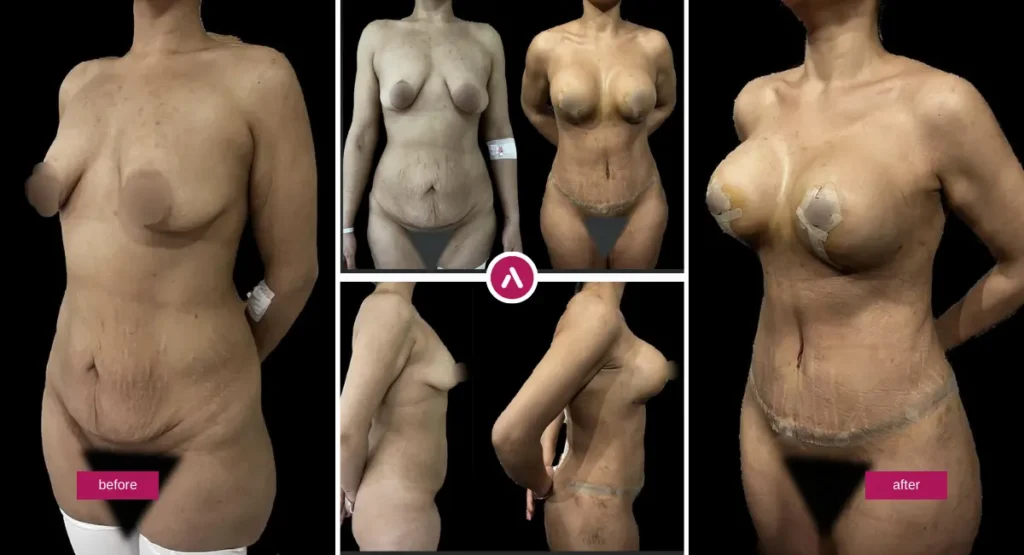
Awake Tummy Tuck Before and After: Realistic Expectations
An awake tummy tuck changes how surgery is delivered. It does not change how the body heals.
You still have an incision. You still develop swelling. You still need compression, scar care, and movement precautions.
The best way to think about awake tummy tuck is simple: local anesthesia may make the surgical day lighter, but it does not turn a tummy tuck into a non-surgical treatment.
The result depends on the technique and candidacy
Your result depends on the amount of loose skin, the quality of the skin, the incision plan, the closure technique, and whether the procedure selected actually matches your anatomy.
If you only need a limited lower-abdominal correction, an awake tummy tuck may create a cleaner, flatter lower-belly contour. If you need full abdominal wall repair, awake surgery will not produce the same result.
This is why we treat candidacy as the foundation. A smaller procedure done honestly is better than a larger result promised through the wrong anesthesia pathway.
Awake does not remove the need for scar care
Every tummy tuck creates a scar. Awake anesthesia does not remove that reality.
For a limited awake tummy tuck, the scar may be shorter than a full abdominoplasty scar, depending on skin excess and incision design. It is still a surgical scar that matures over months.
Scar care may include compression, silicone-based products, sun protection, gentle massage when cleared, and follow-up monitoring. LLLT may also support scar maturation as part of our recovery protocol.
Why mini tummy tuck results differ from full abdominoplasty results
A mini tummy tuck usually focuses below the belly button. It can improve a lower-abdominal fold or small pouch, but it does not usually reposition the belly button or tighten the entire abdominal wall.
A full abdominoplasty can treat upper and lower abdominal looseness, larger skin excess, and significant diastasis recti. That is why it usually requires general anesthesia.
If your goal is a full post-pregnancy abdominal reconstruction, a mini awake approach may under-treat you. In that case, the main tummy tuck surgery guide is the more relevant pathway.
When to expect swelling to settle
Early swelling is expected during the first week. It can make the lower abdomen feel firm, tight, or uneven.
Most patients see steady improvement over the first month. The final contour continues to refine over three to six months as tissue softens and inflammation resolves.
Your timeline depends on the amount of skin removed, whether liposuction was added, your activity level, smoking status, nutrition, and how closely you follow recovery instructions.
Before-and-after guidance: use the tummy tuck gallery cautiously
Before-and-after photos help patients understand contour change, incision position, and realistic tissue behaviour. They should never be read as a guarantee.
Awake tummy tuck patients should be especially careful when reviewing full abdominoplasty photos. A full tummy tuck result may not represent what a limited awake procedure can achieve.
Use our tummy tuck before-and-after gallery as an educational reference, then ask during consultation which examples are closest to your anatomy and surgical scope.
Awake Tummy Tuck Cost 2026: Turkey vs Canada
Awake tummy tuck pricing depends on whether your anatomy is suitable for a limited local-anesthesia correction. At AKM Clinic, the awake tummy tuck reference price is CAD $7,500, based on our current awake surgery pricing framework.
By comparison, private tummy tuck pricing in Toronto commonly falls around CAD $15,000–$17,000, while Vancouver private clinic pricing may reach CAD $17,000–$20,000 depending on surgeon fees, anesthesia, facility costs, and follow-up arrangements. Canadian provincial health plans such as OHIP, MSP, AHCIP, and RAMQ usually do not cover cosmetic tummy tuck surgery.
Our all-inclusive clinical pathway includes the surgical procedure, anesthesia and facility fees, pre-operative tests, 5-star hotel accommodation with breakfast, VIP airport-hotel-clinic transfers, post-operative medications, support garments, 24/7 patient advocacy, and long-term virtual follow-up at 1, 3, 6, and 12 months.
Flights and personal spending are not included. Final candidacy also matters: if your examination shows that a full abdominoplasty under general anesthesia is safer, your surgical plan and pricing may change before surgery is confirmed.
For a fuller breakdown of abdominoplasty pricing, visit our tummy tuck cost guide for Canadian patients. You can also review the tummy tuck all-inclusive package for package-specific details.
| Location / pathway | Typical CAD range | What often affects price | Important note |
|---|---|---|---|
| AKM Clinic Istanbul — Awake Tummy Tuck | CAD $7,500 | Limited correction, local anesthesia suitability, package inclusions | Only for selected candidates |
| Toronto private clinics | CAD $15,000–$17,000 | Surgeon, anesthesia, facility, follow-up, procedure scope | Often quoted in separated line items |
| Vancouver private clinics | CAD $17,000–$20,000 | Higher urban overhead, anesthesia and facility costs | Package-style inclusions vary by clinic |
| Full abdominoplasty under general anesthesia | Varies by scope | Muscle repair, belly button repositioning, extended skin removal | May replace awake plan if clinically safer |
Canadian-dollar pricing shown for planning clarity; your coordinator will confirm the final payment details before booking.
How to Find the Best Awake Tummy Tuck Surgeon in Turkey: A Canadian Patient’s Checklist
The best awake tummy tuck surgeon is not the one who promises local anesthesia to everyone. The safest choice is a surgeon who can explain when awake surgery is appropriate, when it is not, and why.
For Canadian patients, this matters because cross-border surgery requires more verification than a local private clinic visit. You need to confirm credentials, facility standards, anesthesia planning, aftercare, and documentation before you travel.
Use this checklist to evaluate whether a clinic is approaching awake tummy tuck as a careful clinical pathway or as a marketing phrase.
Board certification and RCPSC-equivalent credential review
Canadian patients are used to checking physician credentials through provincial colleges and the Royal College of Physicians and Surgeons of Canada. International surgery requires a similar mindset.
The Royal College of Physicians and Surgeons of Canada gives Canadian patients a familiar benchmark for specialist-level training and certification. The Canadian Society of Plastic Surgeons can also help patients understand how plastic surgery credentials are framed in Canada.
In Turkey, you should ask about board certification, surgical training, hospital authorization, and international memberships. You should also confirm that your surgeon has experience with both body contouring and anesthesia-specific patient selection.
At AKM Clinic, our surgical team is built around European Board-Certified Surgeons and a JCI-accredited hospital partner. We explain these credentials in Canadian terms so you can compare them against the standards you already understand.
Experience with both awake and general anesthesia pathways
A surgeon who only promotes awake surgery may miss the bigger clinical picture. A qualified surgeon should be comfortable recommending local anesthesia, twilight sedation, or general anesthesia depending on the patient.
This is especially important for tummy tuck surgery because the procedure range is wide. A mini tummy tuck and a full abdominoplasty are not the same operation.
Ask whether the clinic can safely provide an alternative if your exam shows that awake surgery is not appropriate. If the answer is vague, be cautious.
Honest candidacy screening: the most important sign
Honest screening is the strongest safety signal. A trustworthy team will ask about pregnancy history, weight changes, C-section scars, smoking, BMI, medications, clotting history, anxiety level, and prior abdominal surgery.
They will also ask for photos. A clinic that gives a fixed awake tummy tuck promise without reviewing your abdomen is not taking candidacy seriously.
At AKM Clinic, we would rather decline an awake pathway than perform an underpowered procedure. That is part of responsible surgery.
Evidence of sterile standards and aftercare continuity
Awake surgery still requires sterile standards. The absence of general anesthesia does not make infection prevention less important.
Before booking, ask where the procedure is performed, what sterilization protocols are used, how complications are handled, and who follows you after you return to Canada.
Our clinical pathway includes 24/7 patient advocacy, post-operative instructions, English-language documentation, and scheduled virtual follow-ups at 1, 3, 6, and 12 months. This continuity is especially important after international surgery.
Red flags: clinics that promise every tummy tuck can be awake
Be careful with any clinic that says every tummy tuck can be done awake. That is not clinically realistic.
Other red flags include unclear surgeon identity, pressure to book quickly, vague facility details, no written aftercare plan, no explanation of local anesthetic limits, and no policy for changing the plan if awake is not suitable.
The strongest reassurance is not a bold promise. It is a clear explanation of limits.
| Checklist item | Why it matters | Green flag | Red flag |
|---|---|---|---|
| Surgeon credentials | Confirms training and accountability | Board certification and clear surgeon-of-record | Only a sales coordinator speaks for the surgeon |
| Awake candidacy review | Prevents unsafe over-promising | Photo review, medical history, anatomy-based plan | Awake surgery promised before assessment |
| Anesthesia flexibility | Protects comfort and surgical quality | Clinic can explain local, twilight, and general options | Only one pathway is promoted for all patients |
| Facility standards | Supports sterile surgery and emergency readiness | JCI-accredited hospital partner or equivalent facility standard | Unclear operating location |
| Aftercare continuity | Matters after you return to Canada | Written follow-up schedule and 24/7 contact | No clear plan after discharge |
“A clinic that can safely perform awake surgery must also know when not to perform it. That judgement is what Canadian patients should verify before they book.”
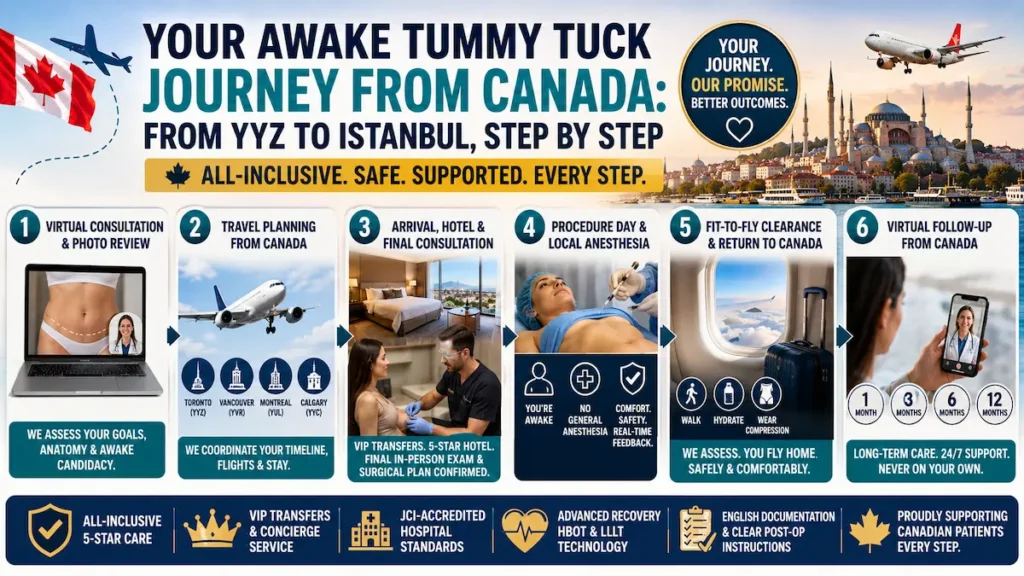
Your Awake Tummy Tuck Journey from Canada: From YYZ to Istanbul, Step by Step
Travelling from Canada for surgery requires a clear plan. The clinical result matters, but the logistics matter too.
Our all-inclusive clinical pathway is designed to reduce stress around arrival, accommodation, transfers, recovery, and follow-up. You should not be arranging medical transportation or interpreting post-operative instructions on your own.
For awake tummy tuck patients, the journey begins with candidacy. We first determine whether local anesthesia is realistic. Only then do we build the travel plan.
Virtual consultation and photo review
Your journey starts with an online consultation and photo assessment. You send clear front, side, and angled photos of your abdomen, along with your medical history and goals.
We assess whether your concern looks like lower-abdominal skin laxity, fat fullness, muscle separation, or a combination. This determines whether awake tummy tuck, standard tummy tuck, liposuction, or another pathway is more appropriate.
If awake does not appear safe or realistic, we explain that before you travel. That transparency helps Canadian patients plan responsibly.
Travel planning from Toronto, Vancouver, Montreal, or Calgary
Canadian citizens can generally enter Turkey visa-free for short stays, but you should always check current travel requirements before booking. Flight schedules also change, so confirm routes directly with your airline.
Many patients fly from Toronto Pearson, Vancouver, Montreal, or Calgary through Istanbul Airport. Your exact route depends on your city, flight availability, recovery timeline, and travel companion support.
We help coordinate the surgical timeline so your hotel stay, pre-op appointment, procedure, recovery checks, and fit-to-fly clearance are logically sequenced. For more detail, review our Canadian patient journey overview.
Arrival, hotel, and final in-person consultation
After you arrive in Istanbul, your private transfer brings you to your hotel. Our all-inclusive pathway includes 5-star hotel accommodation with breakfast and VIP transfers between the airport, hotel, clinic, and hospital partner.
Your final in-person consultation confirms the surgical plan. This is where your surgeon checks skin laxity, incision position, comfort expectations, and anesthesia suitability one more time.
If the in-person findings do not match the virtual plan, we discuss the safest alternative. The plan must fit your body as it is, not just the plan you hoped for.
Procedure day and local anesthesia experience
On procedure day, the team reviews your markings, medications, consent, and anesthesia plan. You remain awake during the local anesthesia process and surgery.
You should expect numbing, pressure, movement, and a sense that work is being done. You should not feel sharp pain.
The team communicates with you throughout the procedure. Awake surgery allows real-time feedback, but it also requires that you feel calm enough to participate comfortably.
Fit-to-fly clearance and return to Canada
Before you return to Canada, we assess your incision, swelling, comfort, walking ability, and overall recovery. Fit-to-fly clearance is based on your actual condition, not a fixed calendar promise.
For long-haul travel, you should avoid heavy luggage, walk when safe, stay hydrated, and follow compression instructions. Arrange help at home if you have children, stairs, or physically demanding work.
After you land, our long-term follow-up continues virtually. You are not expected to manage uncertainty alone from Toronto, Vancouver, Montreal, Calgary, Ottawa, Edmonton, or any other Canadian city.
Awake Tummy Tuck Frequently Asked Questions (FAQ):
Can a full tummy tuck be done awake?
Usually, no. A full tummy tuck often involves wide skin elevation, belly button repositioning, and major muscle repair, which generally require general anesthesia.
Awake tummy tuck is more realistic for mini or limited lower-abdominal corrections. If your anatomy needs full abdominoplasty, we will recommend the safer pathway.
Does an awake tummy tuck hurt?
You should not feel sharp pain during an awake tummy tuck. Local anesthesia is used to numb the treatment area before surgery begins.
You may feel pressure, tugging, vibration, stretching, or movement. If you are anxious about being conscious during surgery, twilight or general anesthesia may be a better fit.
What is the difference between awake tummy tuck and mini tummy tuck?
"Awake" describes the anesthesia method. "Mini tummy tuck" describes the surgical scope.
A mini tummy tuck is often the type of tummy tuck most compatible with awake local anesthesia because it is more limited than a full abdominoplasty.
Is local anesthesia safer than general anesthesia?
Local anesthesia avoids some general-anesthesia risks, such as intubation and prolonged grogginess. That can be helpful for the right patient.
It is not always safer for every operation. If the procedure is too large for local anesthesia, general anesthesia may be the safer and more comfortable choice.
Does OHIP, MSP, AHCIP, or RAMQ cover awake tummy tuck?
Canadian provincial health plans usually do not cover cosmetic tummy tuck surgery. Coverage may be considered only in specific medically necessary or reconstructive circumstances, and rules vary by province.
If you are unsure, speak with your family physician or provincial plan before booking. AKM Clinic does not determine Canadian public coverage.
How much does awake tummy tuck cost in Turkey versus Toronto?
At AKM Clinic, awake tummy tuck is listed at CAD $7,500 for selected candidates. Toronto private tummy tuck pricing commonly ranges around CAD $15,000–$17,000, depending on surgeon, facility, anesthesia, and scope.
Final pricing depends on candidacy. If your plan changes from awake to standard abdominoplasty, the quote may change before surgery is confirmed.
Does Canadian travel insurance cover elective surgery complications abroad?
Many Canadian travel insurance policies exclude elective cosmetic surgery and complications related to it. You should review your policy carefully before booking and ask the insurer direct written questions.
To reduce this concern, AKM Clinic provides complimentary complication insurance for all patients. This is separate from standard Canadian travel insurance and is designed to add an extra layer of protection around your surgical care. Your coordinator will explain the coverage terms, limits, and required documentation before you confirm your booking.
How soon can I fly back to Canada?
Fit-to-fly timing depends on your procedure scope, swelling, walking ability, incision condition, and overall recovery. A limited awake tummy tuck may allow earlier travel than a full abdominoplasty, but clearance is individual.
We assess you before departure. Long-haul flights require careful hydration, walking when safe, and avoidance of heavy luggage.
Can I combine awake tummy tuck with liposuction?
Small areas of fat refinement may be combined in selected patients. Larger liposuction areas or 360 body contouring may require a different anesthesia plan.
If fat is your main concern, awake high-definition liposuction may be more appropriate than awake tummy tuck.
What happens if I am not a good awake candidate?
We explain why and recommend a safer alternative. That may be standard tummy tuck, general anesthesia, twilight sedation, liposuction, staging, or no surgery.
A good consultation should protect you from the wrong procedure. Being declined for awake surgery can be a sign of responsible care.
Will I still have a tummy tuck scar?
Yes. Awake anesthesia does not remove the need for an incision or scar.
A limited awake tummy tuck may create a shorter scar than a full abdominoplasty, depending on your anatomy. Scar maturation usually takes months.
How do I verify my surgeon before travelling?
Ask who will operate, where the procedure will be performed, what credentials the surgeon holds, what anesthesia pathway is planned, and what happens if awake surgery is not appropriate after examination.
You should also review facility standards, aftercare access, written documentation, and patient reviews. Start with our About AKM Clinic page, our Istanbul clinic overview, and our professional plastic surgery reviews.
Medical Disclaimer: This page is for educational purposes only and does not replace a medical consultation. Awake tummy tuck suitability can only be confirmed after a surgeon-led assessment of your anatomy, medical history, medications, anxiety tolerance, and surgical goals. If you live in Canada, speak with your family physician before travelling for elective surgery, especially if you have medical conditions, take prescription medication, smoke, or have a history of clotting, wound-healing problems, or prior abdominal surgery.