
Buccal Fat Removal 10 Years Later: How Your Face Changes With Age
AI Summary
- Buccal fat removal 10 years later depends on facial ageing, volume loss, and cheek support.
- Higher-risk patients include lean faces, younger patients, weight fluctuation, or aggressive cheek-slimming goals.
- Conservative planning helps reduce hollowing risk while keeping results balanced as the face ages.
- Recovery and CAD cost should be reviewed separately during a personalized consultation.
Summary generated by AI, fact-checked by our medical experts
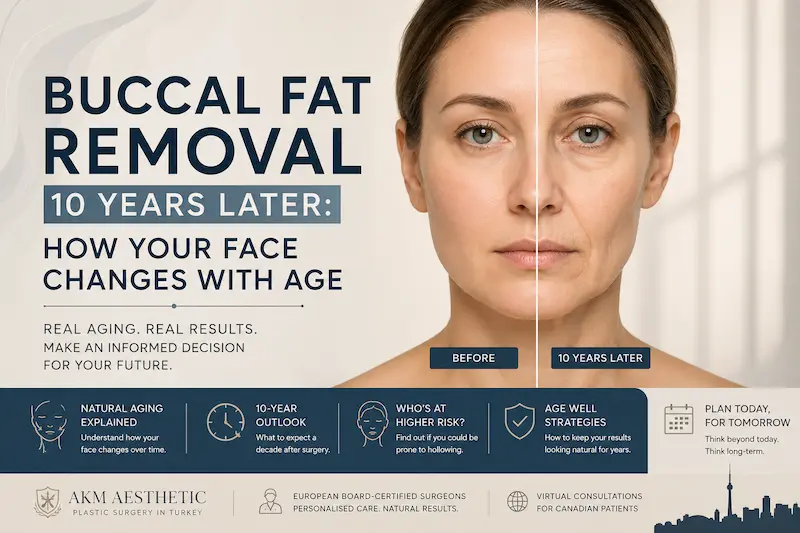
Quick answer: Buccal fat removal 10 years later can look natural in the right candidate, but the result depends on how your face ages. Because facial fat, skin elasticity, and bone support change over time, an over-reduced cheek can look hollow or tired years later, especially in naturally lean faces.
If you are researching buccal fat removal 10 years later, you are probably asking the right question. The issue is not only how your cheeks will look after swelling settles. It is how today’s sharper contour will interact with your face at 35, 45, 55, and beyond.
At AKM’s buccal fat removal procedure, the long-term plan matters as much as the immediate cheek definition. A rounder lower cheek can sometimes hide bone structure. But facial fullness is also part of what keeps the face looking soft, healthy, and supported with age.
This guide is written for Canadian patients who want a careful, evidence-led answer before making a decision. We will look at how faces naturally age, what can happen a decade after buccal fat removal, who carries a higher risk of hollowing, and which questions to ask before committing to surgery.
Surgeon-led perspective: The safest long-term buccal fat result is rarely the most dramatic one on day one. A conservative plan respects the fact that the face will keep changing after surgery.
Table of Contents
How Faces Age Naturally
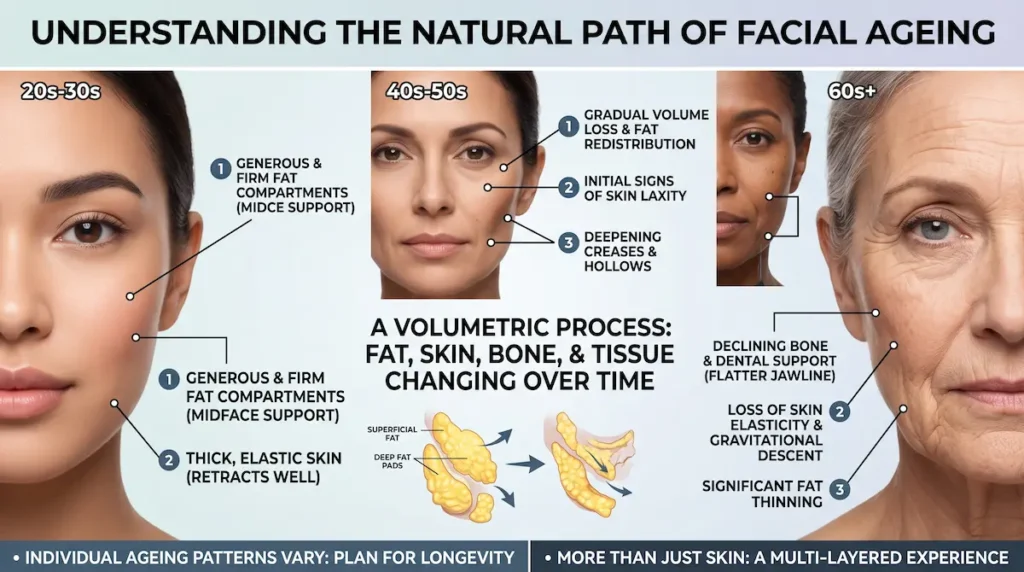
Before judging buccal fat removal in isolation, it helps to understand what aging already does to the face. Cheeks do not simply “drop” with time. They lose support in layers: fat compartments shift or thin, skin elasticity declines, bone support changes, and soft tissue becomes less resistant to gravity. That is why a face can look more angular with age even without surgery.
Facial fat pads change over time
The face contains separate fat compartments rather than one smooth sheet of fat. Some sit superficially under the skin, while others sit deeper and help support the midface. Clinical research on facial fat compartments describes aging as a volumetric process, not just a skin-laxity problem.
In practical terms, this means that cheek fullness often decreases or redistributes with age. A face that looked softly full in the late 20s may look more sculpted in the 40s without any procedure. That natural change is one reason surgeons are cautious about removing too much buccal fat too early.
The buccal fat pad sits in the lower cheek, beneath the cheekbone area. Removing part of it can slim the lower face and make the cheek hollow more visible. Johns Hopkins describes buccal fat removal as an elective procedure that narrows the lower cheek and can emphasize the cheekbones and jawline.
Bone and skin support also decline
Facial aging is not only about fat. The cheekbone, jawline, and dental support all influence how soft tissue sits. As structural support changes, the overlying tissue can look flatter, less lifted, or more shadowed.
Skin elasticity matters too. Younger, thicker skin can often tolerate cheek slimming better because it retracts and holds shape. Thinner or less elastic skin may show hollowness more clearly after volume is removed. This is why two people can have the same amount of buccal fat removed and age very differently.
For Canadian patients comparing options from Toronto, Vancouver, Calgary, or smaller cities, this is a key consultation point. The question is not just “Can the fat be removed?” It is “Will my face still look balanced when natural volume loss continues?”
Everyone hollows somewhat, but not at the same pace
Some hollowing is part of normal facial aging. The pace depends on genetics, weight stability, skin quality, sun exposure, smoking history, and baseline facial structure. A person with naturally full cheeks may keep a balanced look for many years after conservative buccal fat reduction. A person with a narrow face may not have that same buffer.
This is where long-term planning becomes essential. The goal should not be to chase the sharpest cheek hollow possible. It should be to create a contour that still belongs to your face as the surrounding tissue changes.
ASPS has specifically warned against being too aggressive with buccal fat removal, framing facial fat as something that can become more valuable with age. That caution is especially relevant for patients in their 20s and early 30s who are choosing surgery before their natural facial aging pattern is fully visible.
Buccal Fat Removal a Decade Later
Ten years after buccal fat removal, the procedure itself has not “worn off” in the way temporary injectables do. The buccal fat that was removed does not simply come back. What changes is the face around it. That is why the same surgical result can look refined in one person and too hollow in another as the years pass.
Early definition can become deeper hollowing
In the first year, many patients focus on cheek definition. The swelling fades, the lower cheek looks slimmer, and the jawline may appear more visible. For a patient with genuinely full lower cheeks, that can look balanced.
A decade later, the same reduction sits within an older facial framework. If the midface has lost volume, the skin has thinned, or weight has dropped, the cheek hollow can look deeper than intended. This is the main reason some patients notice their face hollowing with age and later regret the procedure.
This does not mean every patient will look gaunt. It means the result is highly anatomy-dependent. Conservative removal in a full, round face can age gracefully. Aggressive removal in a narrow or already angular face can create a tired or prematurely aged appearance over time.
Who tends to stay happy long-term
Patients who stay happy with buccal fat removal years later usually have a few things in common. They had true fullness in the lower cheek, not just temporary puffiness. Their surgeon removed fat conservatively rather than chasing a dramatic hollow. They also had enough cheekbone and jaw support to keep the face balanced after slimming.
Stable weight helps as well. Major weight loss after buccal fat removal can make the face look more depleted because other facial fat compartments may shrink. The buccal area has already been reduced, so the combined effect can become more visible.
Age at surgery matters. Someone in their late 30s or 40s may already show their natural volume-loss pattern, making planning more predictable. A very young patient may not yet know whether their face will naturally become leaner with age.
Why some patients regret it
Regret usually comes from a mismatch between the desired short-term look and the long-term face. A patient may like the carved cheek look in filtered photos, then later feel that the same hollow makes them look older, more tired, or less healthy in natural light.
Another regret driver is overcorrection. If too much fat is removed, the smile and cheek movement can look sharper than expected. That overlap belongs to a separate risk discussion, which we cover in our guide to overcorrection and the gaunt look.
The most honest answer is this: buccal fat removal can be worth it for the right face, but it is unforgiving in the wrong one. Unlike a haircut or a temporary filler plan, cheek fat removal changes a structural part of facial volume. A decade later, that decision still matters.
Who’s at Higher Risk Long-Term?
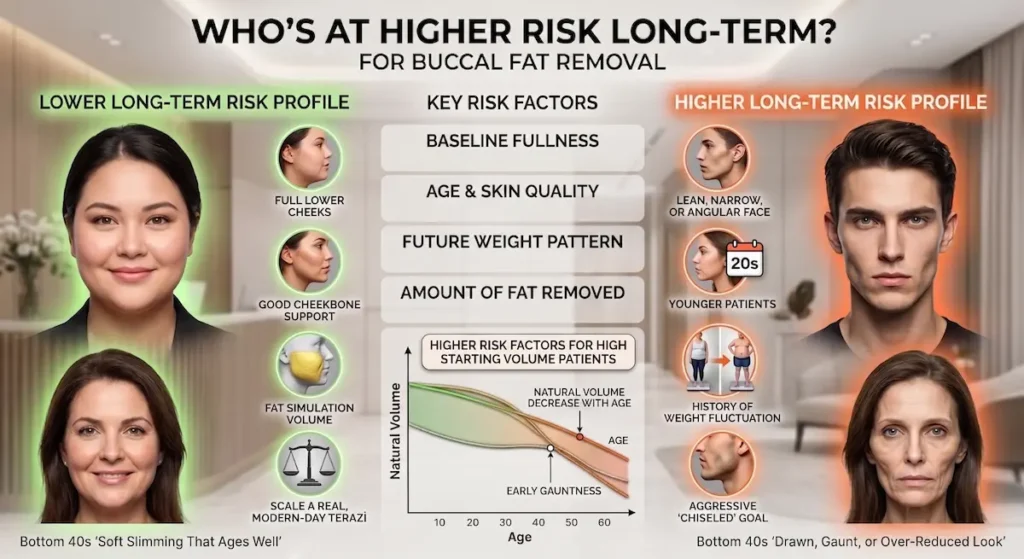
Buccal fat removal is not automatically risky, but it is not equally suitable for every face. Long-term risk depends on baseline cheek fullness, age, skin quality, weight pattern, and how much fat is removed. A careful plan separates patients who may age well after conservative reduction from those who may be better served by leaving cheek volume alone.
Naturally lean faces
A lean or narrow face has less margin for volume loss. If the cheek hollow is already visible when the face is relaxed, removing buccal fat may deepen that hollow rather than create balanced definition. This can make the lower face look drawn instead of sculpted.
The same is true for patients with prominent cheekbones but limited soft-tissue fullness underneath them. The face may already have natural contour. In that case, buccal fat removal can shift the result from “defined” to “over-reduced.”
A practical self-check is not enough to decide, but it can raise useful questions. If your cheeks already look shadowed in overhead lighting, after exercise, or after a small amount of weight loss, your long-term risk may be higher.
Younger patients removing “future” volume
Younger patients often request buccal fat removal because they feel their cheeks look too round in photos. The challenge is that early facial fullness can be protective. It may be the same volume that helps the face look rested later.
For someone in their early 20s, it can be difficult to predict how much natural slimming will happen by the 30s or 40s. Many faces become less full with age even without surgery. Removing buccal fat too early may reduce volume before the face has declared its natural ageing pattern.
This does not mean young patients can never be candidates. It means the threshold should be higher. A Canadian patient considering surgery before major natural facial changes have appeared should ask for a long-term assessment, not just a front-facing photo review.
Aggressive resections
The amount removed matters. Conservative buccal fat removal aims to reduce fullness while preserving facial softness. Aggressive removal chases a sharper hollow and carries a higher chance of looking harsh later.
ASPS has cautioned that facial fat should be treated carefully because volume becomes more important as the face ages. That warning aligns with a conservative surgical philosophy: remove only what creates disproportion, not everything that can technically be removed.
At AKM, this is where the consultation should focus on facial architecture rather than trends. The surgeon should evaluate cheek fullness, jawline, midface volume, skin thickness, and whether the patient’s goal is realistic over the next decade.
| Patient profile | Likely 10-year outcome | Risk level |
|---|---|---|
| Full lower cheeks, stable weight, good cheekbone support | Cheek definition may remain balanced if reduction is conservative | Lower |
| Round face with thick skin and mild genetic fullness | Soft slimming may age naturally if enough volume is preserved | Low to moderate |
| Young patient with baby-face fullness but no mature ageing pattern yet | Result may look good early but could become too hollow as natural volume decreases | Moderate |
| Already slim, angular, or narrow face | Higher chance of a drawn or tired look over time | Higher |
| History of major weight fluctuation or planned weight loss | Future weight loss may amplify cheek hollowing | Higher |
| Aggressive “chiseled cheek” goal | Short-term definition may become long-term gauntness | Higher |
Aging Well After the Procedure
A good buccal fat removal result should not depend on staying the same age, weight, or skin quality forever. It should be planned with change in mind. The face will continue to age after surgery, so the best long-term strategy is to preserve enough volume for movement, expression, and natural softness.
Conservative removal as long-term insurance
Conservative removal means the surgeon is not trying to empty the cheek. The goal is to soften disproportionate lower-cheek fullness while leaving support behind. This approach may not create the most dramatic immediate hollow, but it usually gives the face more room to age well.
This is especially important for patients who are deciding based on photos. Lighting, makeup, lens distortion, and social media filters can exaggerate cheek hollows. A result that looks striking in one still image may look too severe in normal conversation.
For Canadian patients, the key consultation question is simple: “How much volume do I need to keep?” Not “How much can you remove?” That shift in wording changes the whole decision.
Volume options later
If hollowing appears years later, there may be ways to restore softness, such as carefully planned volume replacement. That said, needing correction later should not be treated casually. It may involve additional procedures, cost, downtime, and variability.
For this reason, the best plan is prevention. Buccal fat removal is not easily “reversed” in a simple one-step way. Once cheek fat is removed, later volume work may improve balance, but it is not the same as putting the original fat pad back exactly as it was.
This is why long-term planning belongs before surgery, not after regret. Patients should be cautious of any plan that promises a permanently perfect cheek contour without acknowledging natural ageing.
Skin quality and lifestyle still matter
Buccal fat removal changes one layer of the face. It does not stop sun damage, collagen decline, weight loss, smoking-related skin changes, or general facial ageing. Good skin care and weight stability still influence how the result matures.
Sun protection is especially important in Canada, where seasonal UV exposure can be underestimated outside summer. Daily sunscreen, smoking avoidance, adequate protein intake, and stable weight all support better long-term facial quality.
These steps will not replace good surgical judgement, but they help protect the result. A conservative procedure paired with healthy ageing habits is more likely to look integrated than an aggressive procedure followed by repeated correction attempts.
Long-term planning note: Buccal fat removal should make the face look more proportionate, not permanently hollow. If a result only looks good while the patient is young and full-faced, the plan may be too aggressive.
Before you travel: Ask exactly which board certification your surgeon holds and how that training compares with certification by the Royal College of Physicians and Surgeons of Canada (RCPSC). A certification from another country is not the same as RCPSC certification, but asking the question gives you a useful way to check training, scope, and accountability.
Is It Worth It for You?
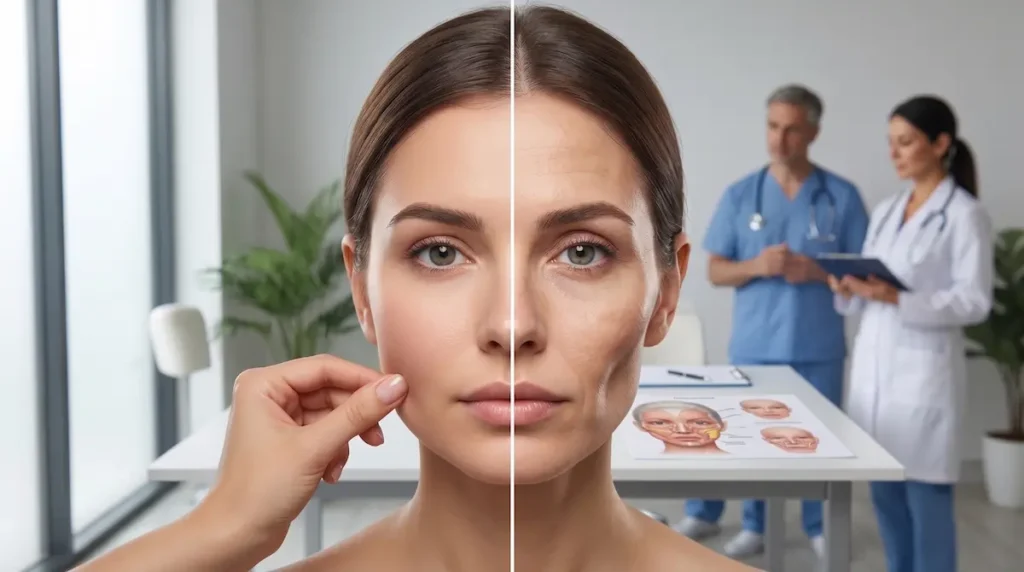
Whether buccal fat removal is worth it depends less on the trend and more on your anatomy. The right patient may enjoy a cleaner lower-cheek contour for years. The wrong patient may trade temporary sharpness for long-term hollowness. This decision should be made with your future face in mind, not only your current photos.
Weighing now versus 10 years from now
Start with the honest trade-off. Buccal fat removal may reduce lower-cheek fullness, but it also removes volume that could matter later. If your face is genuinely full and your goal is subtle refinement, the procedure may fit your anatomy. If your face is already slim, the same procedure may create more risk than benefit.
Ask yourself how your family tends to age. Do cheeks stay full into midlife, or do faces become narrow early? Have you recently lost weight, or do you plan to? Do you like your face in motion, or only in carefully lit photos? These details matter.
For patients comparing facial procedures, it may also help to read why some patients have lip lift regrets. Different procedures have different anatomy, but the decision principle is similar: a result should still suit you years after the first excitement fades.
Questions to ask in consultation
A good consultation should feel specific. You should not receive the same answer as every other patient asking for sharper cheeks. Your surgeon should explain whether your fullness is truly buccal fat, general facial fullness, masseter bulk, weight-related fullness, or simply youthful volume.
- Do I have true buccal fat fullness, or is my cheek shape coming from another structure?
- How much volume would you leave behind?
- Am I at higher risk of hollowing as I age?
- Would my result still look balanced after future weight loss?
- How would my plan differ if I were 10 years older?
- What follow-up support will I have after returning to Canada?
If you are male, the assessment should also account for different goals around jawline, cheek definition, and lower-face structure. Our guide on how the male face responds differently explains why masculine definition should not be confused with an over-hollow cheek.
Consultation checkpoint: Ask your surgeon to explain the long-term facial aging plan in plain language. It is also reasonable to ask what documentation you will receive before flying home and how virtual follow-up is handled after surgery.
Recovery in brief
Recovery is usually more straightforward than the long-term decision. Swelling, cheek firmness, and temporary asymmetry can happen early, then settle gradually. Still, healing is not the same as final aging. A cheek can heal normally in the first months and still look different years later as natural volume changes continue.
For the post-operative timeline, swelling expectations, diet, and when to return to routine activities, see the recovery section of our buccal fat removal procedure page. This article stays focused on the 10-year outlook rather than early healing.
Cost should also be reviewed separately, because pricing depends on the surgical plan and should not drive the anatomy decision. For a CAD-only overview, see buccal fat removal cost in CAD.
How to make a careful decision
Buccal fat removal is most defensible when it solves a specific anatomical issue: persistent lower-cheek fullness that remains despite stable weight and does not match the rest of the face. It is less defensible when it is used to copy a filtered, heavily contoured, or trend-driven look.
Review clinical guidance before deciding. ASPS explains why facial fat matters as you age, while Johns Hopkins outlines who buccal fat removal suits from a patient-education perspective.
The safest answer may be yes, no, or not yet. A surgeon who is willing to say “not yet” can be a stronger choice than one who treats every full cheek as a surgical target.
Discuss your long-term facial aging with AKM before deciding, in a virtual consultation.
Frequently Asked Questions: Buccal Fat Removal 10 Years Later
These answers are designed for quick comparison, but they cannot replace an individual facial assessment. Buccal fat removal depends heavily on anatomy, age, weight stability, and how much cheek volume should be preserved.
Does buccal fat removal age you?
Will I look gaunt in 10 years?
Do people regret buccal fat removal?
Is buccal fat removal reversible?
Should younger patients wait?
How do I age well after buccal fat removal?
Medical Disclaimer: This article is for educational purposes only and is not medical advice. Buccal fat removal results, risks, recovery, and long-term aging patterns vary by patient. Always consult a qualified medical professional for an individual assessment before choosing surgery.
Related Procedures

Ready to Begin Your Journey?
Join the more than 2,000 patients who have trusted Dr. Akif Mehmetoğlu and the AKM Clinic team. Your journey begins with an informative, no-obligation conversation. Contact us today from across Canada to schedule your complimentary virtual consultation.
#1: Receive Your Personalized Quote
Start with a complimentary, no-obligation virtual consultation. Share your photos, and our surgical team will provide a fully personalized treatment plan and a transparent, all-inclusive pricing package quoted in Canadian dollars (CAD). There are no hidden fees.
#2: Secure Your Procedure Date
Once you are ready to proceed, our dedicated English-speaking patient coordinators will help you secure your procedure date. We will manage your logistical bookings in Istanbul, including your five-star hotel and private airport transfers.
#3: Arrive in Istanbul & Meet Your Surgeon
Arrive at Istanbul Airport (IST), where you will be greeted by your private driver. Settle into your hotel before your comprehensive in-person consultation. You will meet your specialist surgeon to finalize the details of your procedure and ensure your goals are aligned for a natural, subtle result.