




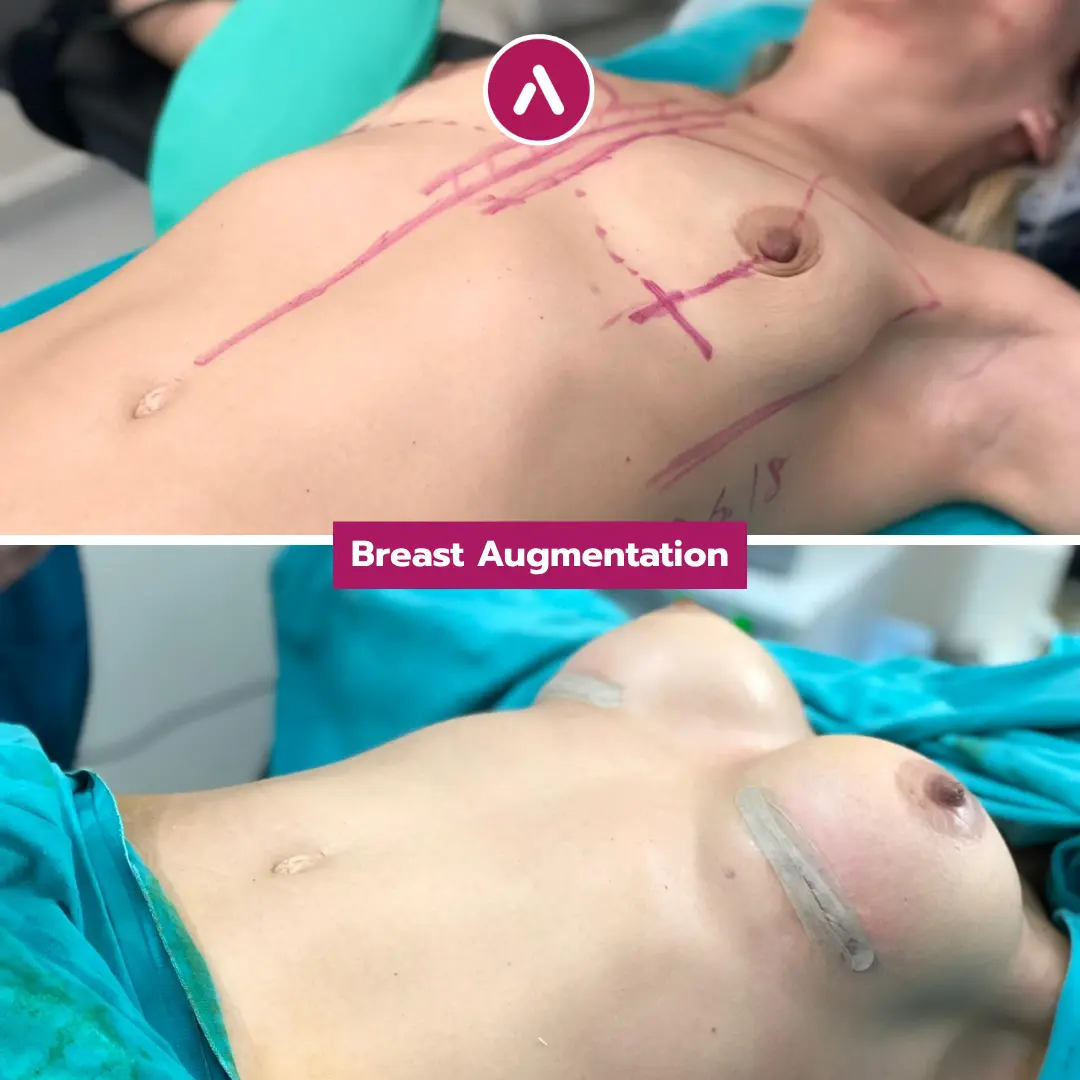
Many Canadian women after pregnancy, breastfeeding, or significant weight loss face a dual concern: breasts that have lost volume and dropped lower on the chest. A breast lift alone restores position but not fullness; implants alone can make sagging more visible if the nipple and breast envelope are not lifted. Augmentation mastopexy addresses both issues in one clinical plan. This guide explains single-stage versus staged surgery, implant sizing in a lift context, realistic scars, recovery, and why Canadians compare Vancouver or Toronto pricing with Istanbul before deciding.
Table of Contents
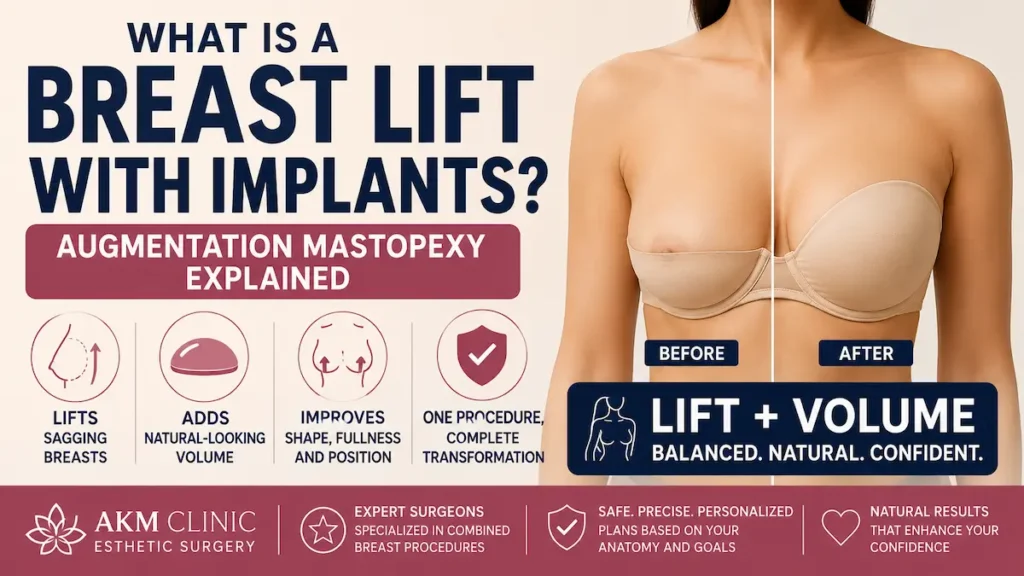
What Is a Breast Lift with Implants? Augmentation Mastopexy Explained
Breast lift with implants, also called augmentation mastopexy, combines a breast lift with implant placement for patients who have both sagging and volume loss. It can be performed as a single-stage procedure or staged over two surgeries, depending on ptosis severity, implant size, tissue quality, and blood supply safety.
How augmentation mastopexy works: lift and implant combined
A breast lift with implants has two separate surgical goals. The lift raises the breast position, removes excess skin, reshapes the lower breast, and moves the nipple-areola complex to a more balanced height. The implant restores volume, especially in the upper breast where post-pregnancy or weight-loss deflation often appears most noticeable.
In a lift-only procedure, we reshape the breast using your existing tissue. In implant-only breast augmentation, we add volume but do not correct meaningful sagging. Augmentation mastopexy combines both, which makes it especially relevant for patients who describe their breasts as “deflated and dropped.”
At AKM Clinic, our planning starts with anatomy, not implant size. We assess nipple position, skin elasticity, breast footprint, lower-pole stretch, and the amount of soft-tissue support available before we recommend a single-stage or staged clinical protocol.
Medical terminology: breast lift with implants, mastopexy augmentation, and breast augmentation mastopexy
Patients often see several terms for the same combined procedure. “Breast lift with implants” is the most patient-friendly name. “Augmentation mastopexy,” “mastopexy augmentation,” and “breast augmentation mastopexy” are medical terms used to describe the same core idea: lifting the breast while adding implant-based volume.
The word “mastopexy” refers to the breast lift component. The word “augmentation” refers to volume enhancement, usually with silicone implants. Together, the terms describe a more complex operation than either breast lift or breast augmentation alone.
This matters because the combined procedure has a different risk profile. The surgeon must balance implant pressure with skin tightening, nipple blood supply, scar placement, and long-term implant support. That is why choosing a surgeon who regularly performs combined breast procedures is more important than simply choosing a surgeon who offers implants.
Why “deflated and dropped” breasts often need both lift and volume
Pregnancy, breastfeeding, weight change, and natural aging can stretch the breast skin envelope. Over time, the nipple may sit at or below the breast fold, and the upper breast may appear empty. This creates two separate concerns: position and volume.
An implant can fill the breast, but it cannot reliably lift a low nipple. A lift can raise the nipple and tighten the breast envelope, but it cannot create the same upper-pole fullness as an implant. Patients who need both corrections are usually better served by augmentation mastopexy than by either procedure alone.
This is where honest assessment matters. If a patient has moderate or severe ptosis, implant-only surgery can create an unnatural shape because the implant sits higher while the breast tissue continues to hang lower. We avoid that mismatch by planning the lift and implant together.
Breast lift with implants vs lift-only vs implant-only vs fat transfer
Breast surgery is not one decision. It is a decision tree. Some patients need volume only, some need lift only, and others need both. A smaller group may prefer fat transfer instead of implants, especially if they want subtle enhancement using their own tissue.
| Procedure | Adds Volume? | Corrects Sagging? | Scar Level | Best For | Related AKM Guide |
|---|---|---|---|---|---|
| Breast Lift Only | No | Yes | Moderate, based on incision type | Patients with sagging but enough natural breast volume | Breast Lift Mastopexy in Turkey |
| Breast Augmentation Only | Yes | No, except very mild laxity | Usually smaller implant incision | Patients with good nipple position and volume loss only | Breast Augmentation in Turkey |
| Breast Lift with Implants | Yes | Yes | Lift scar plus implant incision planning | Patients with both sagging and deflation | This guide |
| Fat Transfer Breast Augmentation | Yes, usually subtle | Limited lifting effect | Tiny liposuction and injection access points | Patients who want modest, implant-free volume | Fat Transfer Breast Augmentation in Turkey |
| Breast Reduction with Lift | No; removes volume | Yes | Lift or reduction scar pattern | Patients with heaviness, pain, and sagging | Breast Reduction in Turkey |
Our role is to recommend the option that fits your anatomy. We do not push implants when a lift-only approach is more appropriate, and we do not recommend a lift-only plan when volume loss is the main concern.
Benefits of Breast Lift with Implants
The main benefit of breast lift with implants is that it corrects two concerns at once. It raises the breast and restores volume in a coordinated way. For many Canadian patients, that combined correction feels more complete than choosing either a lift or augmentation alone.
Restored volume and position
A lift repositions the breast. An implant restores fullness. Together, they can create a breast shape that looks higher, fuller, and better supported.
This is especially useful after pregnancy or weight loss, when the skin envelope has stretched and the breast tissue has lost density. The result should not look overly round or artificial. Our Natural-First approach aims for proportion, not exaggeration.
Upper pole fullness
Upper pole fullness refers to the gentle fullness in the top portion of the breast. A lift can improve shape, but it cannot always recreate upper breast volume if that tissue has been lost. Implants can fill that area more predictably.
In combined surgery, implant selection must be conservative and anatomical. Larger implants can increase tension on lift incisions and may raise revision risk. For that reason, we often favour balanced implant sizes that support a natural contour.
Post-pregnancy and post-breastfeeding restoration
Many patients considering breast lift with implants describe the same pattern: their breasts became smaller, flatter, and lower after breastfeeding. This is not simply a size issue. It is also a skin and support issue.
Augmentation mastopexy can restore lost fullness while repositioning the nipple and tightening the lower breast. For many mothers, this procedure becomes part of a broader body restoration plan, sometimes combined with a tummy tuck or liposuction through a Mommy Makeover in Turkey.
Post-weight-loss deflation correction
Significant weight loss can leave the breast with loose skin, reduced tissue volume, and downward nipple position. Adding an implant without lifting the breast can worsen the visual mismatch. A lift without volume may leave the breast smaller than the patient wants.
A combined procedure can be a better fit when the goal is to restore shape, height, and proportion after body change. We assess weight stability first because future weight fluctuation can affect both the lift result and implant support.
One comprehensive result vs a compromised single-procedure outcome
Some patients try to choose the smaller procedure first. That can be reasonable in mild cases. In moderate or severe sagging, it may lead to a compromised result and a second surgery later.
Breast lift with implants allows the surgical plan to address volume and ptosis together from the start. The key is not doing more surgery than necessary. The key is doing the right surgery for the anatomy in front of us.
“In augmentation mastopexy, the most important decision is not simply implant size. It is whether the breast tissue, nipple position, and skin envelope can safely support a lift and implant in the same operation.”
Am I a Good Candidate for a Breast Lift with Implants?
You may be a good candidate for breast lift with implants if your breasts have both sagging and volume loss. This usually means the nipple sits low, the upper breast looks empty, and the breast tissue has stretched downward. The procedure is designed for that dual pattern.
Good candidacy also depends on your health. We assess smoking status, weight stability, breast tissue quality, medical history, medication use, and your plans for future pregnancy or breastfeeding. A safe result starts before surgery.
When you have both sagging and volume loss
Breast sagging is called ptosis. Volume loss is different. You can have one without the other, but many post-pregnancy and post-weight-loss patients have both.
A breast lift with implants may be appropriate when:
- Your nipples point downward or sit at the level of the breast fold.
- The upper breast looks flat or empty.
- Your breast skin feels stretched or loose.
- You want more fullness than a lift-only procedure can provide.
- You want a fuller result but do not want an oversized implant look.
During your virtual consultation, we review front, side, and angled photos to estimate ptosis grade and tissue support. Final planning happens in person in Istanbul after physical examination and pre-operative testing.
Why implants alone may not fix sagging
Implants add volume. They do not reliably move a low nipple or tighten excess skin. In mild laxity, an implant may create enough filling to improve shape. In moderate or severe sagging, implant-only surgery can make the breast look heavier.
This is the “saggy breast with implants but no lift” problem many patients worry about. The implant sits where the pocket is created, while stretched breast tissue may still hang below it. That mismatch can look unnatural.
We avoid that by assessing nipple position first. If the nipple is too low, adding volume without lifting the breast envelope is usually the wrong plan.
Why a lift alone may not restore fullness
A breast lift raises and reshapes the tissue you already have. It can make the breast look firmer, higher, and more youthful. It cannot replace volume that has been lost after breastfeeding, weight loss, or aging.
If your main concern is upper breast emptiness, a lift alone may not deliver the fullness you want. You may like the position but still feel the breast looks small or flat in clothing. That is where an implant can help.
Some patients choose a lift-only procedure because they prefer no implant. That is valid. In those cases, our dedicated Breast Lift Mastopexy in Turkey guide explains how lift-only reshaping works without adding volume.
Ptosis grade and volume assessment
Ptosis grade helps us decide whether you need a lift, what incision pattern is appropriate, and whether a single-stage plan is safe. Volume assessment helps us choose whether an implant should be added and what size range makes sense.
| Assessment Factor | What We Look For | Why It Matters | Likely Treatment Direction |
|---|---|---|---|
| Mild ptosis | Nipple slightly low but still near the breast fold | Skin tightening needs may be limited | Small implant, lift, or combined plan depending on goals |
| Moderate ptosis | Nipple at or below the fold | Implant alone usually cannot correct position | Breast lift with implants often considered |
| Severe ptosis | Nipple points downward and breast tissue hangs low | Blood supply and tension planning become critical | Staged plan may be safer, depending on implant size |
| Volume loss | Upper breast flatness or deflation | Lift alone may not restore fullness | Implant or fat transfer may be discussed |
This table is a guide, not a diagnosis. Your final plan depends on examination, tissue thickness, breast width, skin quality, and your preferred aesthetic.
Skin quality and tissue considerations
Combined breast lift and implant surgery places demands on the skin and soft tissue. The breast envelope must be tightened, but it must also support the implant. That balance is delicate.
Thin skin, stretch marks, severe laxity, smoking history, or very large implant goals can increase risk. In those cases, our surgeons may recommend a smaller implant, a staged plan, or a lift-only approach first.
We take a conservative view of tissue safety. A result that looks full on day one is not successful if it creates wound healing problems, bottoming out, or early revision risk.
When auto-augmentation may be an alternative
Auto-augmentation mastopexy uses your own breast tissue to create upper breast fullness during a lift. It does not use an implant. It can be a good option for patients who have enough natural tissue but want a higher, rounder shape.
This option does not create the same volume increase as an implant. It is more about reshaping than enlarging. It may suit patients who want a natural breast lift result without foreign material.
If you want modest volume without implants, we may also discuss Fat Transfer Breast Augmentation in Turkey. Fat transfer can add subtle fullness, but it does not correct significant sagging on its own.
Disqualifying conditions and safety concerns
Not every patient is ready for augmentation mastopexy. Safety comes first. We may delay or decline surgery if risk factors make the combined procedure unsafe.
- Active smoking or recent nicotine use
- Uncontrolled diabetes
- Unstable weight
- Active breast disease or abnormal breast screening requiring investigation
- High surgical risk from heart, lung, or clotting conditions
- Unrealistic expectations about size, scars, or recovery
Smoking is especially important. Nicotine reduces blood flow, and blood supply is already a key concern in combined lift and implant surgery. We require honest disclosure so we can protect nipple viability and incision healing.
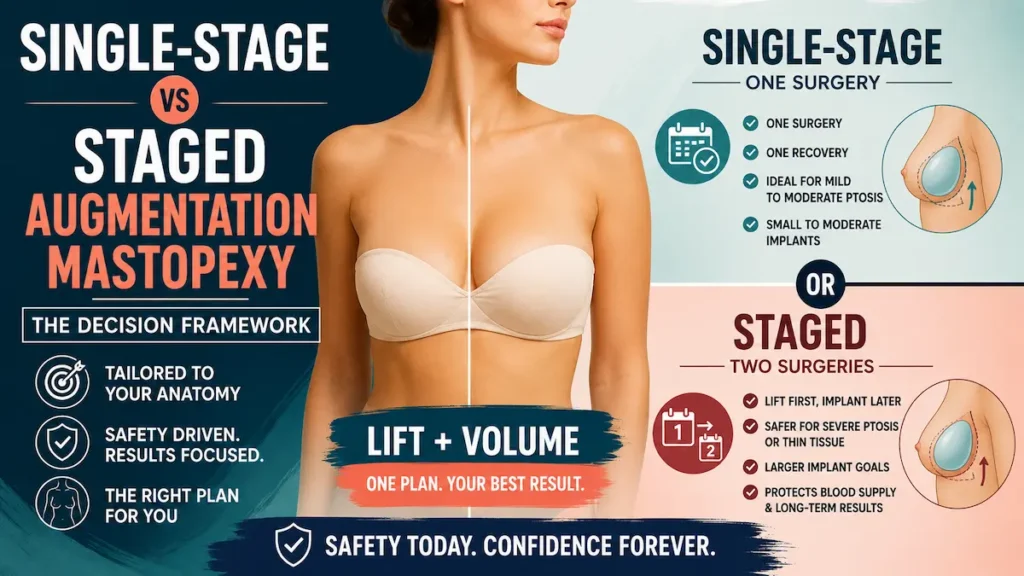
Single-Stage vs Staged Augmentation Mastopexy: The Decision Framework
The most important planning question in breast lift with implants is whether both procedures should happen in one surgery or in two stages. Single-stage surgery means the lift and implant are done together. Staged surgery means the lift is performed first and the implant is placed after healing.
There is no one-size answer. A single-stage plan can be efficient and safe for the right patient. A staged plan can be safer for patients with severe ptosis, thin tissue, or larger implant goals.
The core clinical decision: one surgery or two?
Augmentation mastopexy asks the breast to do two opposite things at once. The lift tightens the skin envelope. The implant adds volume and pressure inside that envelope. Good planning means balancing those forces.
If the breast has mild or moderate ptosis and the implant size is reasonable, one surgery may be appropriate. If the breast has severe sagging or the patient wants a larger implant, staging may reduce tension and protect blood supply.
| Approach | Number of Surgeries | Blood Supply Safety | Revision Risk | Total Recovery | Best Candidate |
|---|---|---|---|---|---|
| Single-stage augmentation mastopexy | One | Good when tissue quality is strong and implant size is moderate | Can be higher if tension is underestimated | One combined recovery period | Mild-to-moderate ptosis, smaller implants, healthy non-smoker |
| Staged breast lift with implants | Two | Often safer for severe ptosis or larger implant goals | Can be lower because each step heals separately | Two shorter recovery periods across several months | Severe sagging, thin tissue, higher tension risk, larger implant preference |
We explain both options during consultation. If staging is safer, we say so clearly. It may not be the fastest plan, but it can be the better plan.
Single-stage augmentation mastopexy
Single-stage surgery combines the lift and implant in one operation. The surgeon places the implant, reshapes the breast, removes excess skin, repositions the nipple-areola complex, and closes the incisions in a coordinated plan.
The main benefit is efficiency. You have one anesthesia event, one travel period, one recovery timeline, and one main surgical fee structure. For Canadian patients travelling from Vancouver, Toronto, Calgary, or Edmonton, that can be logistically appealing.
Single-stage surgery may work well when:
- Ptosis is mild to moderate.
- The patient wants a small or moderate implant.
- Skin quality is strong enough to support closure.
- The patient is a non-smoker.
- The breast tissue has adequate thickness and blood supply.
The tradeoff is tension. The surgeon must avoid over-tightening the lift while also avoiding an implant that places too much pressure on the incision lines. That is where surgical judgment matters.
Staged breast lift with implants
A staged plan separates the lift and implant into two operations. The first surgery lifts and reshapes the breast. After the tissue heals and the nipple blood supply stabilizes, the second surgery places the implant.
This approach is often considered when the breast has severe ptosis, the skin is thin, or the patient wants a larger implant than we would safely place during a single-stage lift. It gives the breast time to settle before volume is added.
Staging may be recommended when:
- The nipple sits very low on the breast.
- Large amounts of skin must be removed.
- The patient wants a larger implant size.
- The skin envelope is thin or overstretched.
- The surgeon is concerned about blood supply or wound tension.
The downside is time. A staged plan requires two surgical dates and may require a second trip to Istanbul. For some Canadian patients, that is less convenient. For others, the safety benefit is worth the extra planning.
Auto-augmentation mastopexy as a no-implant hybrid
Auto-augmentation is a useful middle path for selected patients. Instead of adding an implant, the surgeon repositions existing breast tissue to create a fuller upper breast shape. It is still a lift, but with internal reshaping that mimics some fullness.
This can be helpful for patients who want better shape but do not want implants. It does not increase size like an implant. It works best when there is enough native breast tissue to reposition.
For patients who want a more substantial size increase, implant-based augmentation mastopexy is usually more predictable. We discuss the difference clearly so patients do not expect implant-like fullness from a no-implant technique.
How our surgeons choose: ptosis, implant size, and risk profile
Our planning process weighs three main factors: how much lifting is needed, how much implant volume is desired, and how much risk the tissue can safely tolerate. These factors are connected.
A patient with mild ptosis and a moderate implant goal may be a strong single-stage candidate. A patient with severe ptosis and a large implant goal may be better served by staging. A patient who wants a subtle, natural-first result may need a smaller implant than she originally expected.
“The safest augmentation mastopexy plan respects the breast’s blood supply. If the lift is extensive and the implant goal is large, staging can protect the result instead of compromising it.”
We would rather recommend a slightly slower plan than create avoidable risk. For Canadian patients, this honesty is important. The right answer is not always the quickest answer.
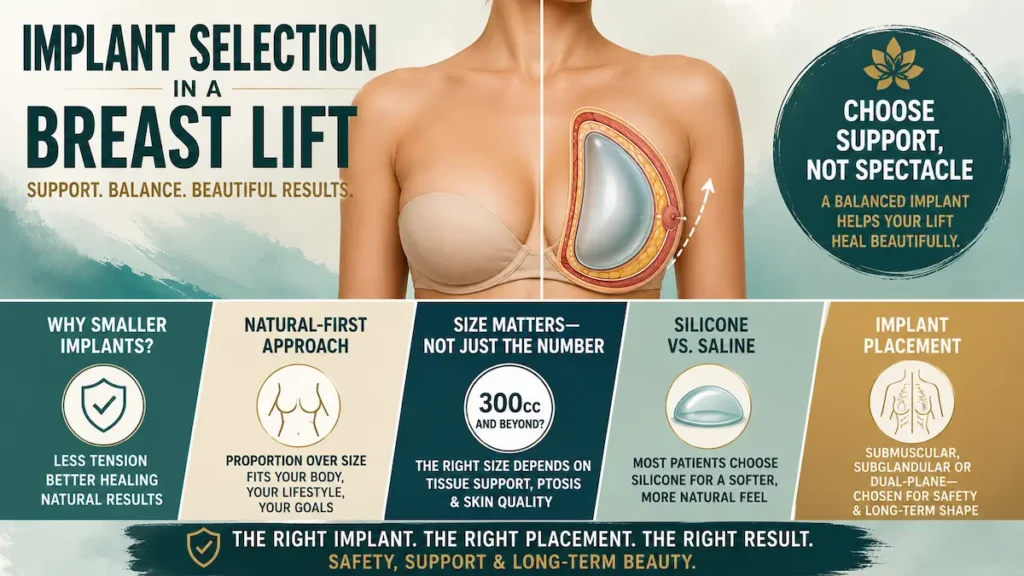
Implant Selection in a Lift Context
Implant selection is different when a breast lift is part of the same operation. In a standard breast augmentation, the main question is often volume. In augmentation mastopexy, the question is volume plus tissue support, skin tension, nipple position, and scar safety.
A larger implant is not always the better implant. The goal is to choose a size and placement that support the lift result instead of fighting against it.
Why smaller implants are often preferred in combined procedures
Breast lift with implants creates two forces at once. The lift tightens and reshapes the breast envelope. The implant expands that same envelope from the inside. If the implant is too large, it can increase tension on the incisions and place more stress on the lower breast.
For this reason, smaller or moderate implants are often safer and more natural-looking in a combined procedure. They can restore upper pole fullness without overloading the lift. This helps protect scar healing and long-term breast shape.
Our Natural-First approach favours proportion. We recommend implant sizes that fit the patient’s chest width, breast footprint, skin quality, and lifestyle rather than choosing volume from a photo alone.
Breast lift with small implants for a natural-first result
A breast lift with small implants can be ideal for patients who want a fuller shape without a dramatic size change. This approach works well when the patient wants upper breast softness, better bra fit, and improved projection but does not want an obviously augmented look.
Small implants can also be useful when the lift itself is extensive. The more skin that must be tightened, the more carefully the implant size must be controlled. This is especially true in patients with thin tissue or severe stretching after pregnancy or major weight loss.
Small does not mean underwhelming. In the right anatomy, a modest implant can create a more refined result because it works with the lift instead of overpowering it.
300cc and beyond: tissue support limits
Many patients arrive with a number in mind, such as 300cc implants. Cup size, however, is not a reliable surgical measurement. The same implant can look very different depending on breast width, height, tissue thickness, and ribcage shape.
In augmentation mastopexy, implant size also affects safety. A 300cc implant may be reasonable for one patient and excessive for another. The deciding factor is not the number alone; it is how that volume interacts with the lifted breast envelope.
If a patient wants a larger size but has severe ptosis, thin tissue, or stretched skin, we may recommend staging. That allows the lift to heal before implant pressure is added.
Silicone vs saline in lift context
Most international breast augmentation patients choose silicone implants because they tend to feel softer and more natural than saline. In a lift context, silicone can be helpful because the goal is usually natural fullness rather than a very round, high-tension look.
Implant type should still be chosen carefully. FDA-approved implant materials, implant profile, shell texture, diameter, and projection all matter. Health Canada also regulates breast implant safety information, which many Canadian patients review before travelling.
This guide focuses on the combined lift-and-implant decision. For a deeper discussion of implant types, profiles, and placement, see our Breast Augmentation in Turkey guide.
Submuscular vs subglandular placement with a lift
Implants can be placed under the breast gland, under the chest muscle, or in a dual-plane position. In combined lift surgery, placement depends on tissue thickness, implant size, ptosis pattern, and the desired upper pole shape.
Submuscular or dual-plane placement may provide more soft-tissue coverage in thin patients. Subglandular placement may be considered when the patient has enough tissue and the anatomy supports it. There is no universal best placement.
We choose implant placement after evaluating both the augmentation goal and the lift requirement. The safest plan is the one that protects tissue, respects blood supply, and creates a stable long-term shape.
“Implant size in a breast lift should be chosen for support, not spectacle. A balanced implant can improve fullness while allowing the lift to heal with less tension.”
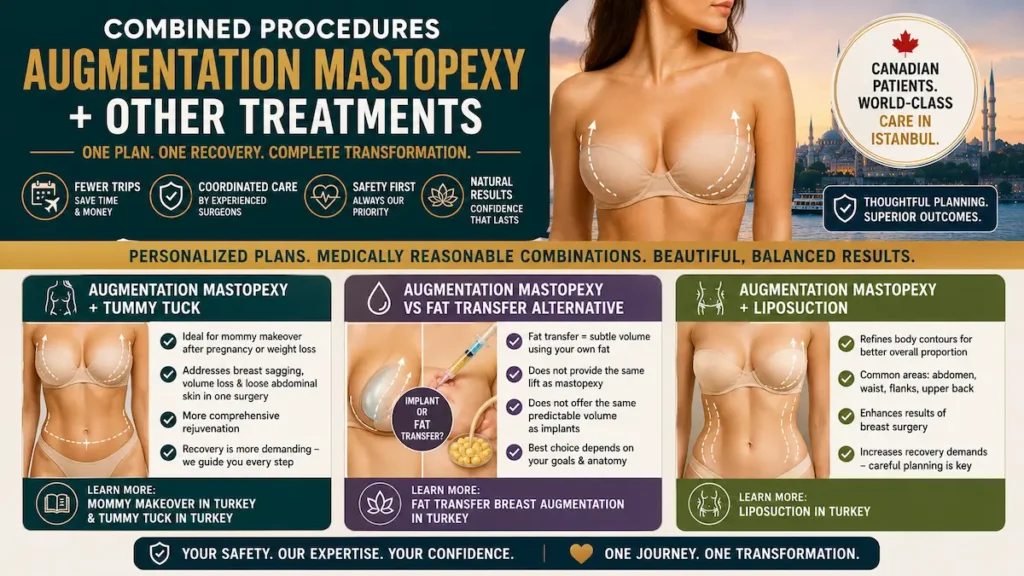
Combined Procedures: Augmentation Mastopexy + Other Treatments
Breast lift with implants is often planned as a standalone procedure, but some patients combine it with other treatments during the same Istanbul trip. This can reduce total travel time and create one coordinated recovery plan. It is not appropriate for everyone.
Combined surgery depends on total operative time, anesthesia safety, blood loss, BMI, medical history, and recovery demands. We recommend combining procedures only when the overall plan remains medically reasonable.
Augmentation mastopexy + tummy tuck
Breast lift with implants and tummy tuck are common components of a mommy makeover. This combination may suit patients who have breast deflation, breast sagging, loose abdominal skin, and muscle separation after pregnancy or weight change.
The benefit is one comprehensive body restoration plan. The tradeoff is a more demanding recovery. You must protect the chest and abdomen at the same time, which affects sleeping position, mobility, childcare, and return-to-work timing.
If you are considering this route, our Mommy Makeover in Turkey guide explains how breast and abdominal procedures can be planned together. Our Tummy Tuck in Turkey guide covers the abdominal side in more detail.
Augmentation mastopexy vs fat transfer alternative
Some patients want fuller breasts but feel unsure about implants. Fat transfer can be an option when the goal is subtle volume and the patient has enough donor fat. It uses liposuction to harvest fat, then transfers purified fat into the breast.
Fat transfer does not create the same lift as mastopexy, and it does not provide the same predictable volume as implants. It may be useful for soft contouring, implant edge blending, or modest implant-free enhancement.
If your main concern is sagging plus major upper-pole deflation, breast lift with implants may be more predictable. If your main concern is subtle, natural volume without implants, see our Fat Transfer Breast Augmentation in Turkey guide.
Augmentation mastopexy + liposuction
Liposuction can be combined with breast lift with implants when body contouring is part of the patient’s broader goal. Common areas include the abdomen, waist, flanks, or upper back. This can improve overall proportion around the chest and torso.
Combining liposuction with augmentation mastopexy increases recovery demands. Compression garments, swelling, fluid shifts, and mobility limitations must be managed carefully. It may not be ideal for patients who need a very conservative recovery.
For patients considering body contouring alongside breast surgery, our Liposuction in Turkey guide explains technique options, recovery, and candidate selection.
Anesthesia for Breast Lift with Implants
Breast lift with implants is usually performed under general anesthesia. This gives the surgical team a controlled environment for implant placement, lift reshaping, nipple repositioning, and layered closure. It also allows the patient to remain fully comfortable during a longer combined operation.
Canadian patients often ask whether this procedure can be done awake. For most augmentation mastopexy cases, general anesthesia remains the safer and more predictable standard.
Why combined surgery usually requires general anesthesia
Augmentation mastopexy involves multiple surgical steps. The surgeon creates an implant pocket, places the implant, removes excess skin, reshapes the breast, repositions the nipple-areola complex, and closes the tissue in layers. That level of work requires reliable anesthesia and monitoring.
General anesthesia allows precise control of breathing, comfort, and movement during surgery. It also helps the surgical team complete the lift and implant components without rushing or compromising accuracy.
For selected patients, awake breast augmentation may be possible as a separate procedure. Combined breast lift with implants is different because the lift component adds incision planning, tissue movement, and blood supply considerations. You can review the anesthesia-specific option in our Awake Breast Augmentation in Turkey guide.
Single-stage vs staged anesthesia considerations
Single-stage surgery involves one anesthesia event. That can be appealing for Canadian patients because it means one trip, one recovery period, and one main operation. It is one reason many patients ask for the lift and implants at the same time.
Staged surgery involves two anesthesia events, separated by several months. The tradeoff is that each operation is smaller. The lift heals first, then the implant is added once the tissue has settled.
Our surgeons and anesthesia team review the full risk picture before recommending either path. The safer option depends on the patient’s anatomy, medical history, implant goals, and tolerance for a two-step plan.
Pre-anesthesia assessment for Canadian patients
Before surgery, we review your medical history, medications, allergies, smoking or nicotine use, prior anesthesia experience, and relevant test results. We may ask for additional information from your Canadian family physician if you have a complex history.
Patients travelling from Canada should be honest about supplements, cannabis use, blood thinners, weight-loss medications, and hormone therapy. These details can affect anesthesia safety, bleeding risk, and clot risk during long-haul travel.
Pre-operative testing is part of the all-inclusive clinical pathway. It helps us confirm that surgery can proceed safely before the procedure begins.
AKM anesthesiology team and monitoring standards
Our procedures are performed in a JCI-accredited hospital partner facility, with appropriate anesthesia monitoring throughout surgery. This includes vital sign monitoring, oxygenation, fluid management, and recovery observation after the operation.
For international patients, we also consider the return flight. A patient who has had general anesthesia and combined breast surgery needs time to recover before long-haul travel. Fit-to-fly clearance is given only after in-person review.
We do not frame anesthesia as a minor detail. It is a central part of surgical safety, especially for Canadian patients travelling across time zones for elective surgery.
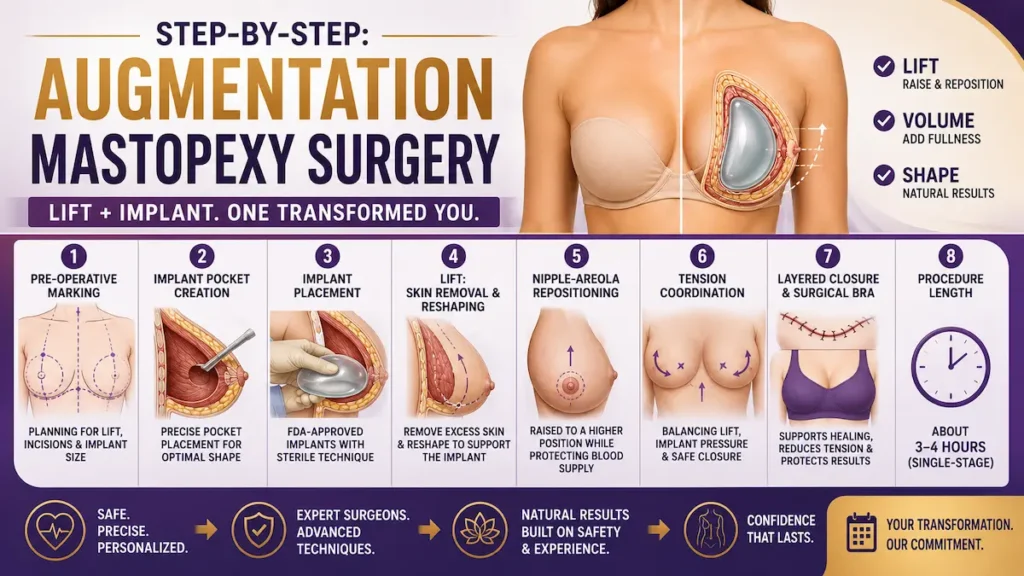
Step-by-Step: What Happens During Augmentation Mastopexy Surgery?
The surgical sequence depends on the chosen plan. In single-stage augmentation mastopexy, the implant and lift are completed in one operation. In a staged plan, the lift is performed first and the implant is placed during a second procedure after healing.
The steps below describe a typical single-stage pathway. Your individual plan may differ based on your anatomy and surgeon recommendation.
Pre-operative marking and implant size confirmation
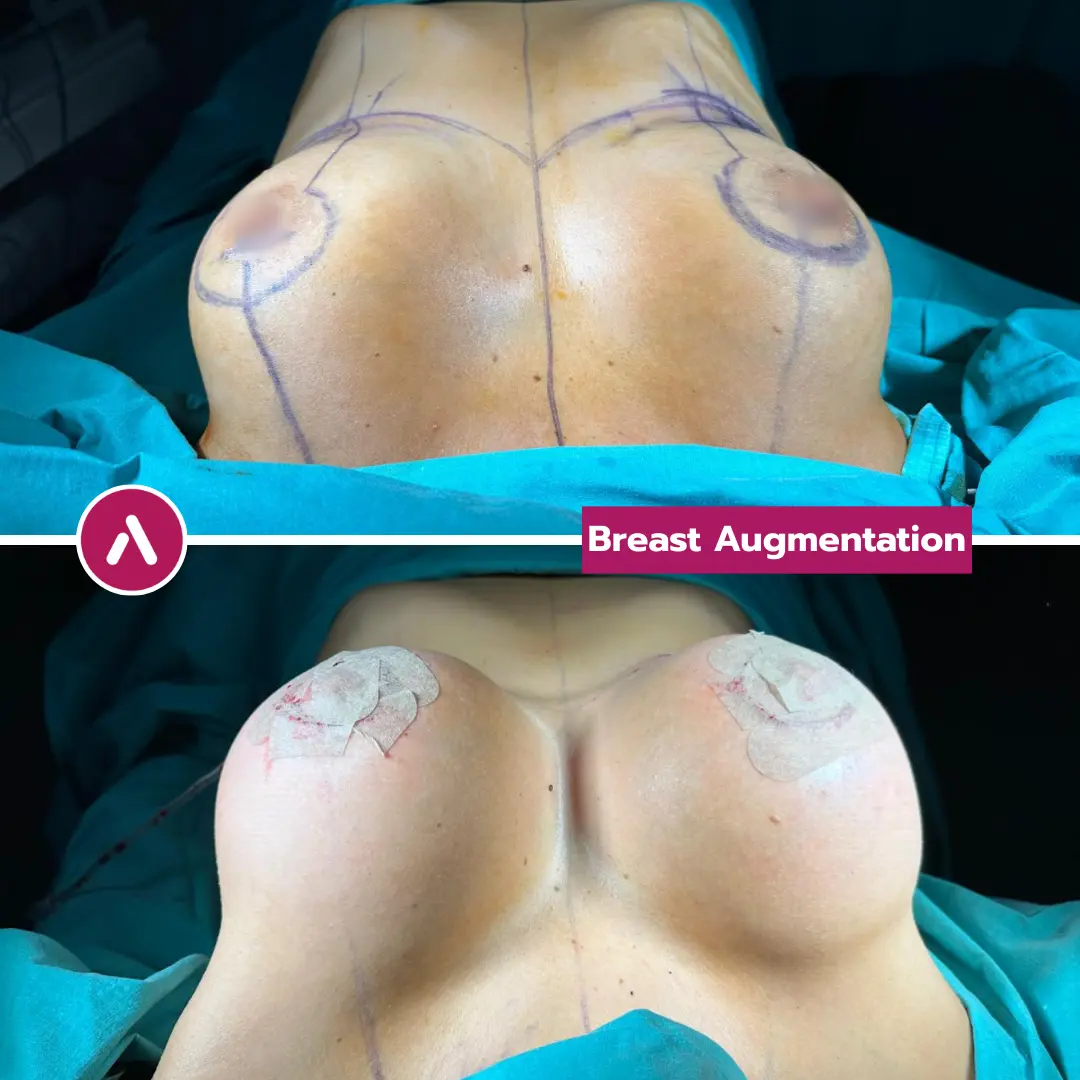
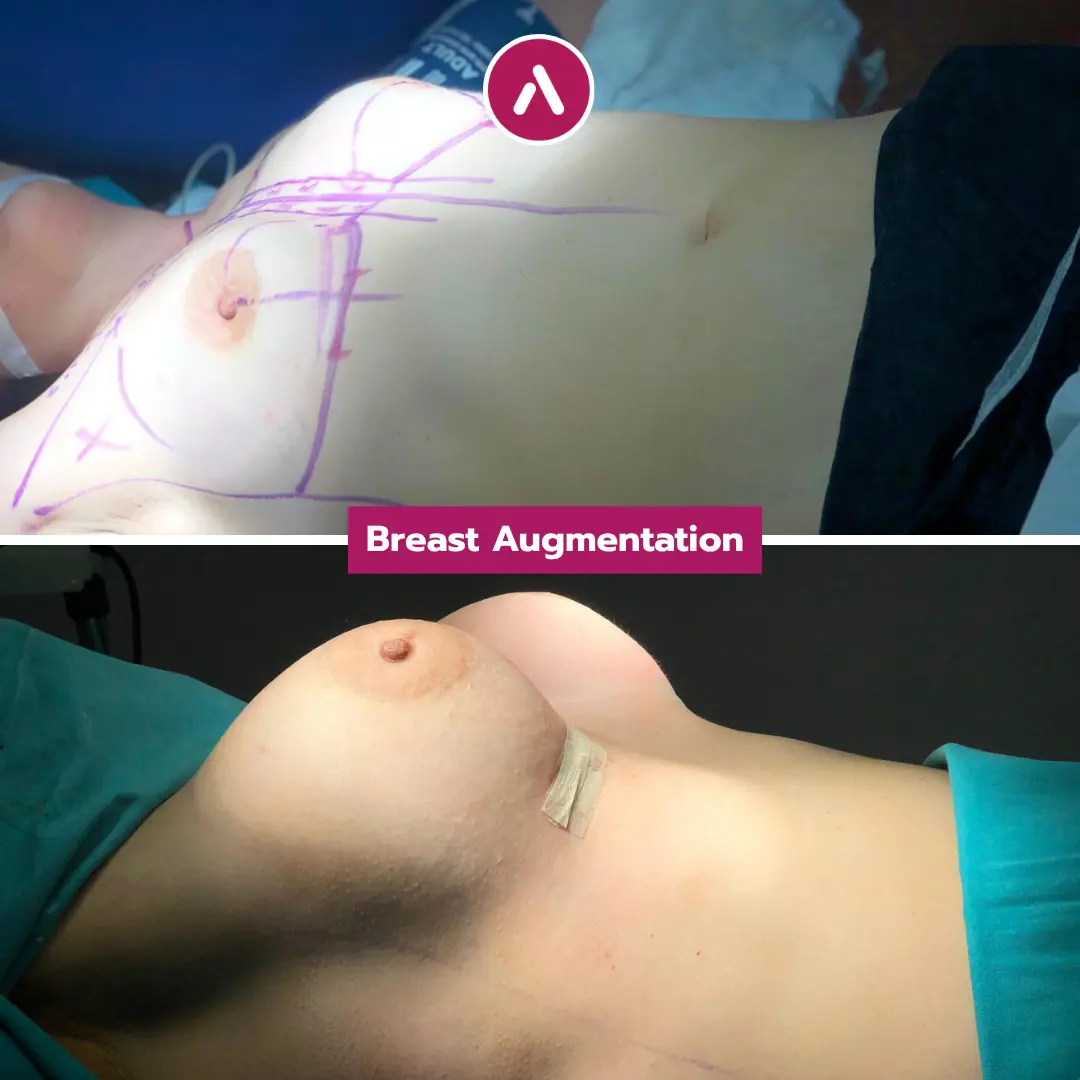
Before surgery, the surgeon marks the breast while you are standing. These markings guide nipple position, incision pattern, breast fold alignment, implant pocket planning, and skin removal. Standing marks are important because breast position changes when lying down.
Implant size is confirmed after final measurements and discussion. We consider breast base width, chest proportions, tissue thickness, and the lift pattern. The goal is to choose the implant that fits the planned lift safely.
Implant pocket creation
Once anesthesia is started, the surgeon creates the implant pocket. This may be submuscular, subglandular, or dual-plane depending on the plan. The pocket must be precise because implant position affects breast shape and symmetry.
In combined procedures, pocket planning must account for the lift. If the implant sits too low, the breast can bottom out. If it sits too high, the result may look disconnected from the natural breast tissue.
Implant placement
The implant is placed using sterile technique. Our team uses FDA-approved implant materials and follows strict handling protocols to reduce contamination risk. Implant size, profile, and placement are matched to the surgical plan.
After placement, the surgeon checks symmetry, projection, and how the implant interacts with the breast tissue. Adjustments may be made before the lift component is finalized.
The lift component: skin removal and tissue reshaping
The surgeon removes excess skin according to the selected incision pattern. This may involve a lollipop or anchor-type approach, depending on ptosis severity. The breast tissue is reshaped to create a more supported contour around the implant.
This step is not simply “tightening skin.” The surgeon must shape the breast envelope so it supports the implant and avoids excessive tension on the closure.
Nipple-areola repositioning
The nipple-areola complex is moved to a higher, more balanced position while keeping its blood supply attached through a tissue pedicle. This is one of the most important safety steps in breast lift surgery.
In combined lift and implant procedures, the surgeon must protect nipple circulation while also managing the added pressure of the implant. This is why severe ptosis may sometimes be safer as a staged plan.
Tension coordination
Tension coordination is the key technical challenge in augmentation mastopexy. The breast must be lifted enough to correct sagging, but not tightened so much that circulation or wound healing is compromised.
Implant pressure, skin removal, tissue thickness, and incision closure all interact. A careful plan reduces the risk of widened scars, delayed healing, implant malposition, and early revision.
Layered closure and surgical bra
After shaping is complete, the surgeon closes the incisions in layers. Layered closure supports healing and helps reduce tension on the skin. Dressings are applied, and a surgical bra is placed for support.
The surgical bra is not optional. It helps control swelling, supports the breast position, and protects the incisions during early healing. You will receive instructions on how long to wear it and when it can be removed for hygiene.
Procedure length
A single-stage breast lift with implants usually takes about three to four hours. Complex cases may take longer, especially when asymmetry, severe ptosis, or implant pocket adjustments are involved.
After surgery, you are monitored in recovery before transfer to your room or hotel pathway, depending on the plan. Our clinical team reviews pain control, mobility, dressings, and immediate recovery instructions before discharge.
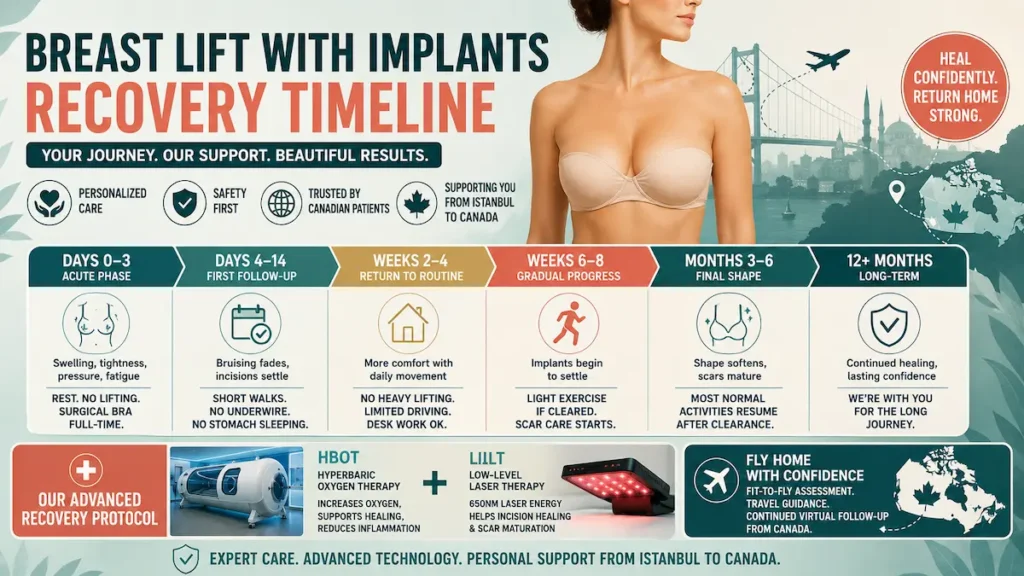
Breast Lift with Implants Recovery Timeline for Canadian Patients
Recovery after breast lift with implants is usually longer than recovery after breast lift alone. The implant adds internal pressure, while the lift adds incision healing and skin tightening. Your body needs time for both processes.
Most Canadian patients should plan for a focused recovery period in Istanbul before returning home. Your exact timeline depends on whether your procedure is single-stage or staged, your implant size, your incision pattern, and how your tissue responds during the first week.
| Recovery Stage | What You May Notice | Typical Restrictions | AKM Support |
|---|---|---|---|
| Days 0-3 | Swelling, tightness, pressure, fatigue | No lifting, no overhead arm movement, surgical bra full-time | Pain control, dressing checks, mobility guidance |
| Days 4-14 | Bruising begins to fade, incisions settle | Short walks only, no underwire, no sleeping on stomach | Follow-up review, fit-to-fly assessment |
| Weeks 2-4 | More comfort with daily movement | No heavy lifting, no chest exercise, limited driving | Virtual check-in after return to Canada |
| Weeks 6-8 | Implants begin to settle | Gradual return to light exercise if cleared | Scar-care guidance and progress monitoring |
| Months 3-6 | Shape softens, scars mature, swelling reduces | Most normal activity resumes after clearance | Long-term virtual follow-up |
Days 0-3: acute phase
The first three days are the most restricted. You may feel chest pressure, tightness, swelling, and fatigue. This is expected because the breast tissue has been lifted and an implant has been placed.
Your surgical bra stays on as instructed. It supports the new breast position and reduces unnecessary movement across the incision lines. You should avoid lifting your arms high, carrying luggage, pushing heavy doors, or sleeping on your stomach.
Short, gentle walking is encouraged. Movement helps circulation and lowers clot risk, which matters for patients preparing for a long return flight to Canada. Rest still comes first.
Days 4-14: first follow-up and suture care
During the second recovery phase, swelling usually remains visible but starts to feel more manageable. Bruising may change colour as it resolves. The breasts can look high, firm, or uneven at this stage.
Incisions are checked during follow-up. We review dressings, skin colour, nipple sensation, swelling pattern, and early healing. If you are travelling from Canada, this in-person review is a key part of fit-to-fly planning.
You should still avoid lifting, stretching, or twisting. Do not rush into sightseeing. A calm recovery schedule is safer than trying to use your Istanbul stay like a regular vacation.
Our HBOT and LLLT recovery protocol
Recovery technology matters in combined breast surgery because the tissue is healing under more tension than in implant-only surgery. We use Hyperbaric Oxygen Therapy (HBOT) and Low-Level Laser Therapy (LLLT) as part of our advanced recovery approach when clinically appropriate.
HBOT increases oxygen delivery to healing tissues. This can help reduce inflammation and support tissue repair during the early post-operative period. For international patients, the goal is not to rush healing, but to support safer recovery before long-haul travel.
LLLT uses 650nm low-level laser energy to stimulate cellular repair. At AKM Clinic, our LLLT system uses 424 medical-grade semiconductor laser diodes. In breast lift with implants recovery, LLLT is especially relevant for incision support and scar maturation.
For a deeper explanation of how these technologies support post-operative healing, see our guide to Hyperbaric Oxygen Therapy benefits and our scar-focused article on minimizing scars with LLLT laser support.
Day 7-14: fit-to-fly clearance for Canadian return travel
Canadian patients usually need a clear post-operative review before flying home. We assess incision condition, swelling, pain control, mobility, medication use, and any signs of delayed healing. Fit-to-fly clearance is never automatic.
Long flights from Istanbul to Vancouver, Toronto, Calgary, or Edmonton increase the importance of walking, hydration, and clot-risk reduction. You should avoid lifting carry-on luggage into overhead bins. Ask for airport assistance when needed.
Your return flight should be planned around clinical clearance, not the cheapest ticket. Our flight safety after surgery guide explains the travel side in more detail for Canadian patients.
Weeks 2-4: return to sedentary work
Many patients can return to remote or desk-based work within two to three weeks, depending on discomfort and fatigue. If your job involves lifting, reaching, patient care, childcare, retail work, or fitness instruction, you may need more time.
Driving should wait until you are off sedating pain medication, can move comfortably, and can react safely. Seatbelts may feel uncomfortable across the chest. Use soft padding if advised, but do not place pressure directly on incisions.
At this stage, the breasts may still look firm or high. That is normal. The implant has not fully settled, and the lift component is still healing.
Weeks 4-6: driving and light activity
By weeks four to six, many patients feel more mobile. Light lower-body movement may resume if your surgeon clears it. Upper-body workouts, push-ups, heavy grocery bags, and lifting children should still be avoided until you receive medical approval.
Underwire bras are usually delayed because they can irritate the incision line under the breast. A supportive surgical bra or approved soft bra remains safer during early scar healing.
If you are back in Canada by this stage, your virtual check-ins help us monitor your progress. We may ask for photos taken in consistent lighting so we can review symmetry, scar colour, swelling, and breast position.
Weeks 6-8: implant settling
Implants do not reach their final position immediately. They often start high and firm, then gradually soften and settle. This is sometimes called “drop and fluff,” although the timing varies from patient to patient.
Because a lift tightens the breast envelope, settling can be slower than in a standard breast augmentation. This does not mean something is wrong. It means the implant and lifted tissue are adapting together.
Do not judge your final result at six weeks. Early anxiety is common, especially if one side settles faster than the other. We track progress over months, not days.
Months 3-6: final shape and scar maturation
Between three and six months, swelling continues to decrease, breast shape becomes softer, and the scars begin to fade from red or pink toward a lighter tone. Scars are still immature at this stage. Full scar maturation can take 12-24 months.
Most patients feel more comfortable buying new bras around the three-month mark, but final sizing may continue to shift. Waiting prevents frustration and unnecessary spending.
Your long-term follow-up programme continues after you return to Canada, with virtual check-ins at 1, 3, 6, and 12 months. This helps us monitor healing from Istanbul while you recover at home.
“Recovery after breast lift with implants is not just implant settling and not just scar healing. It is both at the same time, which is why we monitor tissue tension, breast position, and incision quality together.”
Safety, Risks & Scars of Augmentation Mastopexy
Breast lift with implants is more complex than breast augmentation alone or breast lift alone. It combines implant pressure with skin tightening, nipple repositioning, and scar healing. That combination can create beautiful outcomes for the right patient, but it also requires honest risk discussion.
We do not describe this procedure as simple. We describe it as anatomy-dependent. The safest plan respects tissue quality, blood supply, implant size, and realistic healing limits.
Common side effects
Common early side effects include swelling, bruising, tightness, pressure, temporary nipple sensitivity changes, and incision tenderness. The breasts may sit high, feel firm, or look slightly uneven during the first few weeks. This is part of early healing.
Some patients feel more pressure than expected because the implant expands the tissue while the lift tightens it. That does not mean the implant is too large. It means the combined procedure has a more intense early recovery than lift-only surgery.
You should contact your coordinator if you notice increasing redness, one-sided swelling, fever, drainage, severe pain, or sudden breast shape change. Early communication matters.
Why combined procedures can have higher revision rates
Augmentation mastopexy asks the breast to heal under competing forces. The lift removes skin and tightens the breast envelope. The implant adds volume and weight. If those forces are not balanced well, revision risk increases.
Possible reasons for revision include implant malposition, widened scars, asymmetry, bottoming out, recurrent sagging, or dissatisfaction with implant size. Some revisions are minor. Others require a more formal corrective surgery.
This is why we take the single-stage versus staged decision seriously. If the tissue cannot safely support the lift and implant together, staging may reduce the risk of preventable revision.
Breast lift with implants scars
Scars are part of breast lift with implants. Any claim of a scarless breast lift with implants should be treated with caution. The lift component requires skin removal, and skin removal requires incisions.
The scar pattern depends on ptosis severity and incision choice. A lollipop pattern creates a scar around the areola and down the lower breast. An anchor pattern adds a scar along the breast fold. Severe sagging usually needs more skin removal, which means more scar length.
Scars are usually most visible in the first three to six months. They may look red, pink, raised, or firm. Over 12-24 months, they typically soften and fade, although scar quality varies by genetics, skin tone, tension, smoking history, and aftercare.
We use layered closure, controlled tension, surgical bra support, and scar-care guidance to support healing. LLLT may also be used when appropriate to support scar maturation.
Blood supply concerns and nipple viability
Nipple blood supply is one of the most important safety issues in breast lift surgery. During a lift, the nipple-areola complex is moved while remaining attached to a tissue pedicle that carries blood flow. That blood flow must be protected.
Adding an implant increases pressure inside the breast. If the lift is extensive and the implant is large, circulation can be stressed. This is why severe ptosis and large implant goals may be safer in a staged plan.
Nicotine is a major concern because it narrows blood vessels and reduces oxygen delivery. Patients must disclose smoking, vaping, nicotine patches, and nicotine gum. Hiding nicotine use can create serious wound-healing risk.
Implant-specific risks
Because augmentation mastopexy includes implants, implant-specific risks must also be discussed. These include capsular contracture, implant rupture, implant malposition, rippling, infection, and the possible need for future implant replacement.
Capsular contracture occurs when scar tissue around the implant tightens more than expected. It can make the breast feel firm or change shape. Implant rupture risk depends on implant type, age, trauma, and long-term wear.
We use FDA-approved implant materials and strict implant-handling protocols. Canadian patients may also review Health Canada’s breast implant safety information before deciding. For implant types, profiles, and placement details, our Breast Augmentation in Turkey guide covers the topic more fully.
Patients who want a broader North American context can also review breast implant safety and procedural education from the American Society of Plastic Surgeons’ breast augmentation resource. We recommend using these resources to prepare better consultation questions, not to self-diagnose candidacy.
Wound healing and tension complications
Wound healing problems are more likely when the skin closure is under excessive tension. In breast lift with implants, tension can come from skin removal, implant pressure, swelling, or weak tissue quality. This can lead to delayed healing, widened scars, or small wound openings.
Most small wound concerns can be managed with dressing care and close follow-up. Larger wound issues are less common but can require more intensive treatment. Prevention starts with conservative planning.
We reduce tension risk by matching implant size to tissue support, choosing the appropriate incision pattern, using layered closure, and recommending staging when single-stage surgery would be too aggressive.
How we reduce risk at AKM Clinic
Risk reduction begins with patient selection. We evaluate ptosis, tissue quality, smoking history, medical conditions, medications, implant goals, and travel timing before recommending a plan. If a patient is not a safe candidate, we say so.
Our procedures are performed in a JCI-accredited hospital partner facility with sterile surgical protocols, pre-operative testing, and monitored recovery. Our all-inclusive clinical pathway also includes post-operative medications, support garments, 24/7 patient advocacy, and long-term virtual follow-up after you return to Canada.
We also focus on documentation. You receive clear post-operative instructions and follow-up access through your patient host. Canadian patients should keep their records available for their family physician or local provider if questions arise after returning home.
“The goal in breast lift with implants is not to place the biggest implant the tissue can tolerate. The goal is to choose the implant the tissue can heal with.”
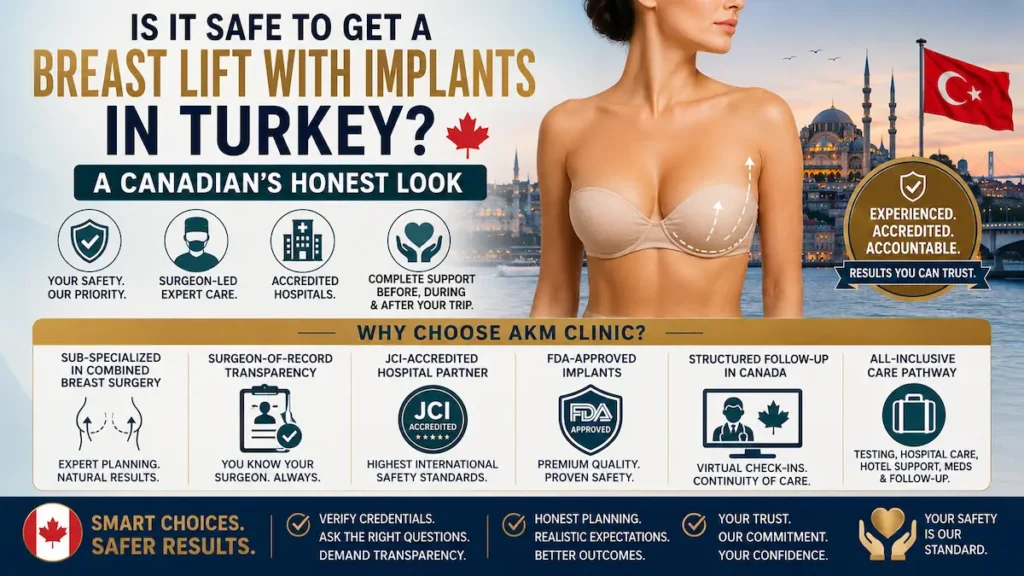
Is It Safe to Get a Breast Lift with Implants in Turkey? A Canadian’s Honest Look
Breast lift with implants in Turkey can be safe when the procedure is performed by qualified surgeons in an accredited hospital setting, with proper screening, sterile protocols, and structured follow-up. It is not safe when patients choose clinics based only on price, social media images, or vague promises.
Canadian patients are right to ask harder questions. You are travelling for elective surgery, crossing health care systems, and returning home after a long flight. That requires a clinic that treats safety as a clinical system, not a marketing claim.
The Turkey cosmetic surgery reality and how AKM differs
Turkey is one of the world’s most active destinations for aesthetic surgery. That volume creates advantages, including experienced surgeons, efficient hospital systems, and competitive pricing. It also means clinic quality varies widely.
Some clinics operate with high case volume, limited surgeon access, and rushed consultation processes. That model is not appropriate for a combined breast procedure. Augmentation mastopexy requires careful planning, not a template.
At AKM Clinic, we follow a surgeon-led process. Your plan is based on ptosis severity, tissue quality, implant goals, medical history, and travel timing. We also provide a structured all-inclusive clinical pathway that includes pre-operative testing, hospital care, hotel recovery support, medications, garments, and follow-up.
For a broader safety discussion, our guide on whether it is safe to get plastic surgery in Turkey explains the verification steps Canadian patients should take before booking any procedure abroad.
Why combined breast surgery requires sub-specialization
Breast lift with implants is not simply a breast augmentation plus extra skin removal. It is a combined procedure with a higher planning burden. The surgeon must protect nipple blood supply, place the implant accurately, reshape the tissue, and close the skin without excessive tension.
This is why experience matters. A surgeon who performs straightforward implant cases may not be the right choice for severe ptosis, asymmetric breasts, thin skin, or staged augmentation mastopexy planning.
During consultation, Canadian patients should ask direct questions:
- How often do you perform augmentation mastopexy?
- Do you offer both single-stage and staged approaches?
- When would you refuse single-stage surgery?
- How do you protect nipple blood supply?
- What revision risks apply to my anatomy?
Clear answers matter more than polished before-and-after photos. A careful surgeon explains limits as clearly as benefits.
Ghost surgery risk and how to avoid it
Ghost surgery means the patient believes one surgeon is operating, but another person performs part or all of the procedure without clear consent. Canadian patients often worry about this when researching surgery abroad. That concern is valid.
To reduce this risk, confirm who your surgeon is, who performs each part of the operation, where the surgery takes place, and how the hospital documents the procedure. You should never feel unsure about who is responsible for your care.
At AKM Clinic, we use a surgeon-of-record model. Your surgical plan, consent process, hospital pathway, and follow-up are connected to your assigned surgical team. Our ghost surgery in Turkey guide gives Canadian patients a practical checklist for verifying this before travel.
EBOPRAS-certified plastic surgeon verification
Canadian patients are familiar with provincial regulation and credentials such as RCPSC certification. Turkey uses a different system, so the key is not to look for the exact same title. The key is to verify equivalent specialist training, hospital privileges, society membership, and documented procedure experience.
European Board certification and international fellowship training can provide meaningful reassurance when paired with verifiable hospital standards. Credentials alone are not enough, but they are a starting point.
Canadian patients can also review the Canadian Society of Plastic Surgeons’ guidance on choosing a surgeon when comparing plastic surgery credential expectations and patient education standards. For international procedure context, the International Society of Aesthetic Plastic Surgery’s Find a Surgeon directory provides global aesthetic surgery resources that can help patients compare terminology across countries.
| Credential Area | What Canadian Patients Recognize | International Equivalent to Look For | Why It Matters |
|---|---|---|---|
| Specialist training | RCPSC framework | European Board certification, specialty fellowship training | Shows structured specialist education and examination standards |
| Hospital setting | Accredited Canadian hospital or licensed surgical centre | JCI-accredited hospital partner facility | Confirms external safety and facility standards |
| Procedure experience | Documented surgical volume and case review | Before-and-after portfolio, consultation discussion, combined-procedure experience | Shows familiarity with augmentation mastopexy complexity |
| Patient follow-up | Local post-operative visits | In-person Istanbul review plus virtual follow-up after return to Canada | Protects continuity of care across borders |
Credential verification should feel transparent. If a clinic avoids the topic, that is a red flag.
JCI-aligned standards and procedure documentation
Facility quality matters as much as the surgeon. Breast lift with implants requires sterile implant handling, anesthesia monitoring, infection-prevention protocols, and appropriate post-operative observation. These standards reduce risk during and after surgery.
Our procedures are performed in a JCI-accredited hospital partner facility. We also use FDA-approved implant materials and strict sterile handling. For Canadian patients, this matters because implant-related infection can have serious consequences and may require removal or revision.
Procedure documentation is also important. You should leave Istanbul with clear post-operative instructions, medication guidance, implant information, and contact access. These documents can help your Canadian family physician understand what was done if you need local support.
What Canadian patients should verify before booking
Before travelling for breast lift with implants, verify the clinic as carefully as you would verify a private clinic in Toronto or Vancouver. Do not rely on one Instagram page or a single testimonial. Ask structured questions.
- Who is my surgeon, and what are their credentials?
- Will my surgery be performed in a hospital or a clinic room?
- Is the facility accredited?
- Are the implants FDA-approved?
- How is nipple blood supply protected in combined procedures?
- Do you offer staged surgery when single-stage is unsafe?
- What happens if I have a concern after returning to Canada?
- Will I receive written discharge instructions and implant details?
Our answer to these questions is built into the care pathway. You begin with a virtual consultation, receive a tailored clinical recommendation, complete pre-operative testing in Istanbul, recover with patient host support, and continue with virtual follow-up after returning home.
That structure does not remove all risk. No surgery can. It does reduce avoidable risk by replacing uncertainty with planning, documentation, and access to the clinical team.
“For Canadian patients, safety in augmentation mastopexy depends on two forms of honesty: honest anatomy assessment before surgery and honest access to follow-up after surgery.”
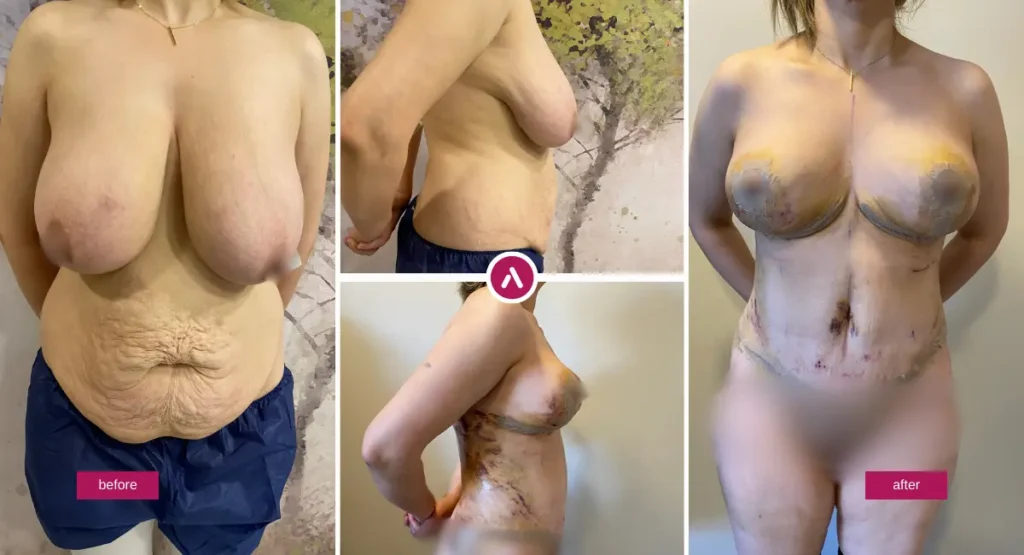
Realistic Expectations & Results
Breast lift with implants can create a fuller, higher, better-supported breast shape. The result should still fit your frame. Our Natural-First approach focuses on proportion, breast balance, and soft upper-pole fullness rather than an exaggerated implant look.
The best results come from matching the procedure to the anatomy. If the breast needs lifting, volume, and skin tightening, augmentation mastopexy can be powerful. If only one of those issues is present, a smaller procedure may be more appropriate.
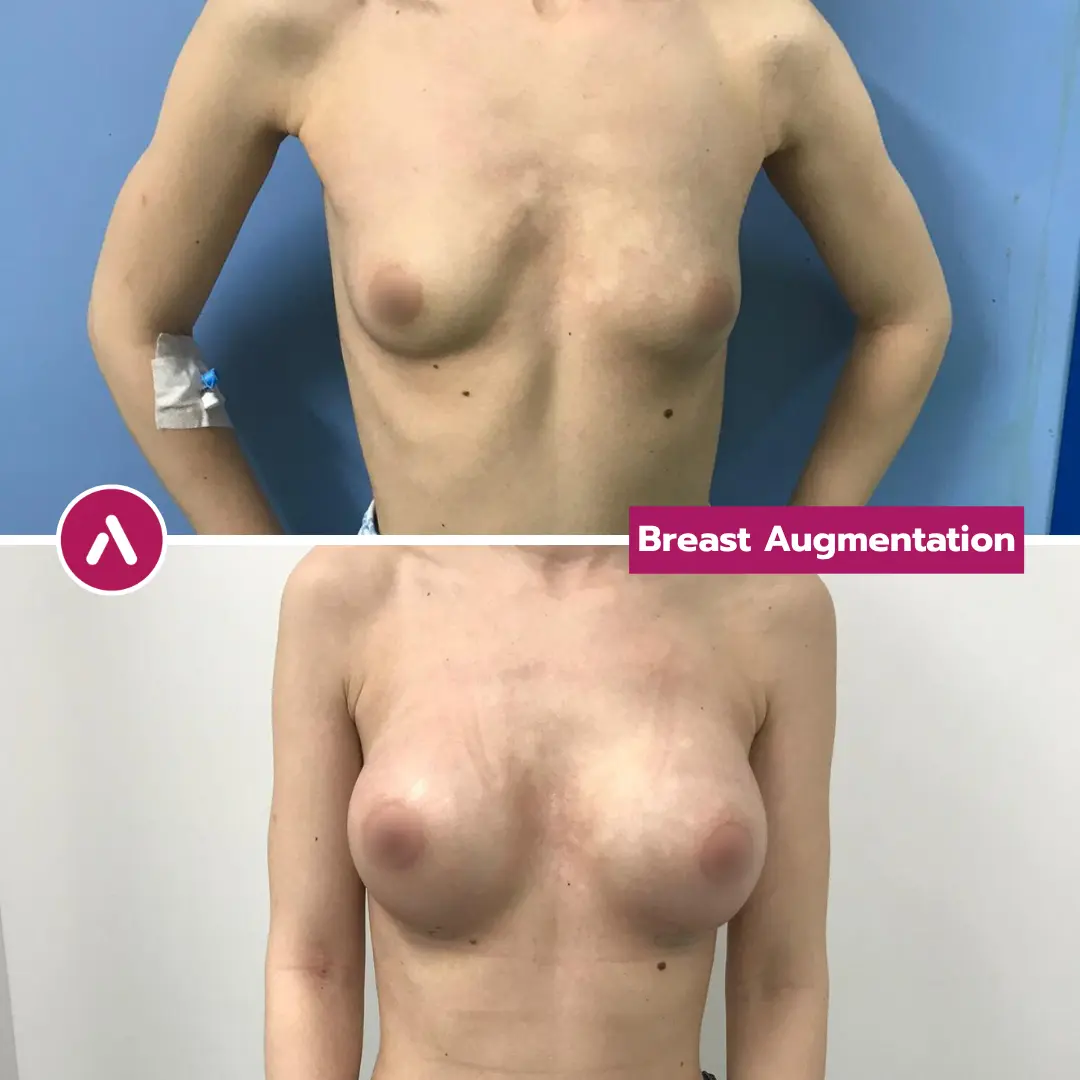
Breast lift with implants before and after: realistic outcomes
Before-and-after photos should show more than size change. Look at nipple position, lower breast shape, scar placement, breast symmetry, implant proportion, and how naturally the upper breast transitions into the chest.
Early photos can be misleading because implants sit high and scars look fresh. Three-month photos show better shape. One-year photos show more meaningful scar maturation and implant settling.
When reviewing any gallery, compare patients with a similar starting point. A patient with mild ptosis and thick tissue will not heal or look the same as a patient with severe sagging, thin tissue, and large implant goals.
Small implants before and after
Small implants can create a refined result in augmentation mastopexy. They are often chosen when the patient wants fullness without a highly augmented appearance. They can also reduce tension on lift incisions.
For many Canadian patients, the goal is not to look “done.” The goal is to feel restored in clothing, swimwear, and daily life. A smaller implant can help achieve that quiet, proportional result.
This approach is not right for everyone. If a patient wants a major cup-size increase, we discuss whether single-stage surgery is safe or whether a staged plan would protect the breast tissue better.
How long results last: implant lifespan and lift longevity combined
A breast lift with implants does not stop aging. Skin continues to age, gravity continues to act, and weight changes can affect breast shape. Pregnancy after surgery can also stretch the breast envelope again.
The lift component can remain stable for many years when weight is stable and the implant size is appropriate. The implant component has its own timeline. Breast implants are not lifetime devices, and replacement or revision may be needed in the future.
Long-term stability depends on several factors:
- Implant size and weight
- Skin elasticity
- Breast tissue thickness
- Weight stability
- Pregnancy or breastfeeding after surgery
- Supportive bra use
- Genetics and scar quality
A natural-first implant size often ages better than an oversized implant because it places less stress on the lower breast and incision lines.
When implant replacement or lift revision becomes needed
Some patients may need implant replacement years later because of implant aging, rupture, capsular contracture, or personal preference. Others may request a revision because of recurrent sagging, scar concerns, asymmetry, or size changes.
Revision does not mean the first surgery failed. Breast tissue changes over time. Implants also need monitoring. The important point is to understand that augmentation mastopexy is a long-term commitment, not a one-time beauty treatment.
We discuss this before surgery so patients can make informed decisions. A result that looks good now should also make sense for your life five, ten, and fifteen years from now.
Scar maturation timeline
Scars usually look most visible during the early healing phase. They may be pink, red, raised, itchy, or firm. This is common in the first months.
By three to six months, many scars begin to flatten and soften. By 12-24 months, they typically reach a more mature appearance. Some patients form darker, wider, or thicker scars because of genetics, skin tone, tension, or healing biology.
| Time After Surgery | Scar Appearance | What Helps |
|---|---|---|
| 1-3 weeks | Red or pink, tender, early incision healing | Dressings, surgical bra, avoiding tension |
| 1-3 months | Often firmer and more visible | Scar care after clearance, sun protection, LLLT when appropriate |
| 6-12 months | Gradual fading and softening | Consistent aftercare and weight stability |
| 12-24 months | More mature final scar quality | Revision only if medically or aesthetically warranted |
Before and after gallery
Before-and-after images are useful when they are interpreted correctly. They should support your consultation, not replace it. Photos cannot show tissue quality, blood supply, implant pocket planning, or how a scar feels.
For visual context, you can review our breast surgery before-and-after gallery. During consultation, we help you understand which examples are relevant to your anatomy and which are not.
Breast Lift with Implants Cost 2026: Turkey vs Canada
Canadian patients researching breast lift with implants cost often compare private quotes in Vancouver, Toronto, Calgary, and Edmonton before looking at Istanbul. In Canada, augmentation mastopexy is typically billed through separate line items: surgeon fee, anesthesia, facility fee, implant cost, post-operative garments, medications, and follow-up visits.
At AKM Clinic, breast lift with implants techniques are listed at CAD $7,650, depending on the incision pattern and surgical plan. CAD figures reflect the 2026 exchange context. Your quote is confirmed after photo assessment and surgeon review.
| Location | Typical Private Range | What Patients Should Check |
|---|---|---|
| Vancouver BC | Often CAD $13,000-$18,000+ | Whether implants, anesthesia, facility, garments, and follow-up are included |
| Toronto | Often CAD $12,000-$18,000+ | Whether the quote is surgical fee only or full procedure cost |
| Calgary | Often CAD $11,000-$17,000+ | Whether revision policy and implant fees are clear |
| Edmonton | Often CAD $10,000-$16,000+ | Whether aftercare visits are included |
| AKM Clinic Istanbul | CAD $7,650 technique-level reference | Includes surgeon-led planning, hospital pathway, and coordinated recovery support |
Single-stage surgery usually costs less than a staged plan because there is one operation and one recovery period. A staged plan may cost more overall because the lift and implant are separated. That added cost can be justified when it improves tissue safety.
For the full cost breakdown, including what is included in the clinical pathway, see our breast lift with implants cost in Turkey guide. If you are comparing a bundled option, our breast lift with implants package page explains the package pathway.
How to Find the Best Augmentation Mastopexy Surgeon in Turkey: A Canadian Patient’s Checklist
Choosing a surgeon for breast lift with implants is different from choosing a surgeon for implant-only augmentation. Augmentation mastopexy requires lift planning, implant planning, nipple blood supply protection, scar placement, and long-term tissue support. The skill bar is higher.
Canadian patients often begin by comparing private clinics in Vancouver or Toronto. That research is useful. It gives you a framework for evaluating credentials, facility standards, and communication quality before you compare international options.
EBOPRAS certification and RCPSC equivalency framing
Canada uses a structured specialist framework through the Royal College of Physicians and Surgeons of Canada. Turkey and Europe use different credentialing systems, so you should look for comparable signs of specialist training rather than identical titles.
At AKM Clinic, our surgical team includes European Board-Certified specialists and fellowship-trained surgeons. We explain credentials in practical terms so Canadian patients can understand how international training compares with the standards they already know.
Useful verification points include:
- Specialty training and board certification
- Hospital operating privileges
- Experience with combined breast procedures
- Before-and-after cases showing similar anatomy
- Clear consent process and surgeon-of-record documentation
You can also review the Royal College of Physicians and Surgeons of Canada’s specialist certification framework when comparing how specialist standards are described across countries.
You can learn more about our clinical philosophy, surgical team, and international patient standards on our About AKM Clinic page.
Combined-procedure volume
A surgeon may be experienced in breast implants but perform fewer lift-with-implant cases. That difference matters. Augmentation mastopexy has more variables than standard augmentation, including skin removal, nipple elevation, implant weight, and scar tension.
Ask how often the surgeon performs combined breast lift and implant procedures. Ask whether they manage mild, moderate, and severe ptosis. Ask how they decide when a staged plan is safer than a single-stage plan.
High procedure volume does not replace judgment, but it can signal familiarity with different breast shapes and tissue challenges. The consultation should feel specific to your anatomy, not like a preset implant recommendation.
Does the surgeon offer both single-stage and staged approaches?
This is one of the most important questions. A surgeon who only offers single-stage surgery may be more likely to force every patient into one pathway. A surgeon who only offers staging may create unnecessary delay for patients who could safely have one procedure.
The best plan comes from offering both options and knowing when each is appropriate. Mild-to-moderate ptosis with modest implant goals may fit a single-stage procedure. Severe ptosis, thin tissue, or larger implant goals may require staging.
During consultation, listen for honest boundaries. A safe surgeon can explain when they would refuse a single-stage procedure and why.
Auto-augmentation capability
Auto-augmentation is not the same as implant augmentation. It uses existing breast tissue to create a fuller shape during a lift. It can be helpful for patients who want better upper breast contour but do not want implants.
A surgeon who understands auto-augmentation can offer more nuanced planning. Instead of reducing every patient to “implant or no implant,” they can discuss lift-only reshaping, internal support, fat transfer, and staged implant placement.
This matters for patients who are unsure about implants. The consultation should help you compare reasonable options, not pressure you into the most dramatic choice.
Real patient reviews and combined-procedure documentation
Reviews are helpful, but they should not be your only evidence. Look for consistency in communication, aftercare, recovery support, and expectation management. For Canadian patients, follow-up after returning home is especially important.
Before-and-after photos should show patients with similar starting anatomy. If you have severe ptosis, photos of mild augmentation cases are not enough. If you want small implants, photos of large-volume results may not guide your decision.
You can review broader patient experiences through our professional plastic surgery reviews page. During consultation, our team helps you understand which results are relevant to your clinical profile.
Aftercare continuity from Istanbul to Canada
Aftercare should not end when you leave Istanbul. Breast lift with implants requires scar monitoring, implant settling review, swelling assessment, and guidance on returning to activity. This is especially important when you fly back to Canada before final healing is complete.
Our long-term virtual follow-up programme includes check-ins at 1, 3, 6, and 12 months. Your patient host helps coordinate questions, photo updates, and communication with the clinical team.
Before booking any international surgery, ask what happens if you have a concern after returning home. You should know who to contact, what records you receive, and how your surgeon reviews post-operative photos.
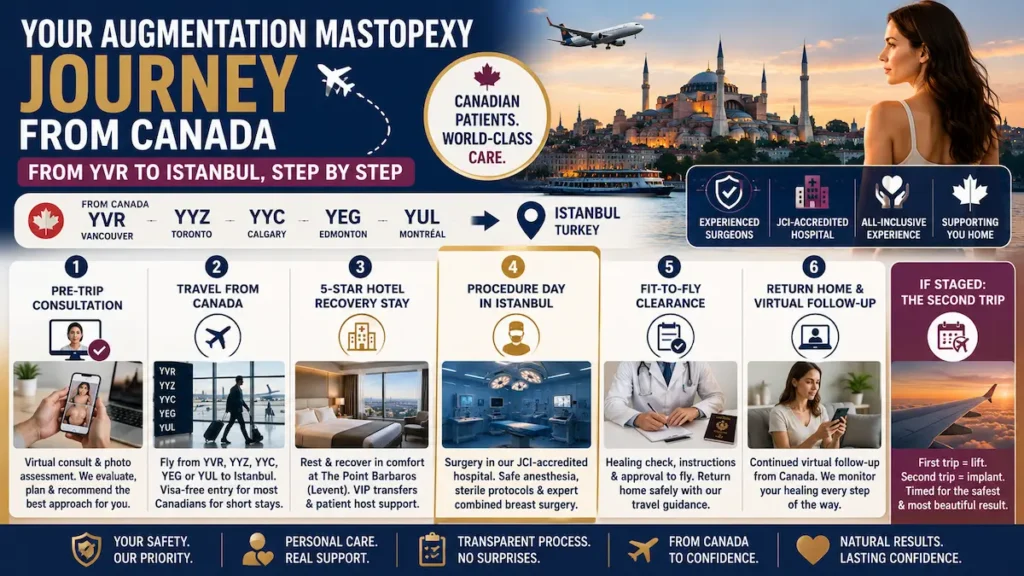
Your Augmentation Mastopexy Journey from Canada: From YVR to Istanbul, Step by Step
Breast lift with implants requires careful travel planning. You are not just booking surgery. You are planning pre-operative assessment, hotel recovery, fit-to-fly timing, and post-operative support after returning to Canada.
Many Canadian patients researching this procedure come from British Columbia, Ontario, Alberta, and Quebec. Vancouver interest is especially strong for breast lift with implants, so this section uses YVR as the lead example while also applying to YYZ, YYC, YEG, and YUL travellers.
Pre-trip consultation and photo assessment
Your process begins with a virtual consultation and photo assessment. We review front, side, and angled photos to assess ptosis, volume loss, asymmetry, skin quality, and likely incision needs.
This stage is where we discuss whether single-stage or staged surgery may be appropriate. We also ask about medical history, nicotine use, medications, supplements, allergies, pregnancy plans, and prior breast surgery.
Photo assessment does not replace the in-person consultation. It helps us create a preliminary plan so you can decide whether travelling to Istanbul makes sense before you commit.
Travel logistics from Vancouver, Toronto, Calgary, and Edmonton
Canadian patients typically travel through major airports such as Vancouver International (YVR), Toronto Pearson (YYZ), Calgary International (YYC), Edmonton International (YEG), or Montréal-Trudeau (YUL). Flight schedules can change, so you should confirm current routes before booking.
Canadian passport holders can usually enter Turkey visa-free for short stays, but passport validity and airline requirements should be checked before travel. We recommend leaving buffer time in your itinerary rather than arriving too close to surgery day.
Our patient journey guide explains the broader travel process, including consultation, arrival, pre-operative testing, surgery day, recovery, and return travel.
5-star hotel recovery stay
After arrival, your recovery environment matters. Breast lift with implants patients need quiet rest, easy access to support, and minimal physical strain. Carrying bags, walking long distances, or managing transfers alone can increase discomfort.
Our all-inclusive clinical pathway includes 5-star hotel accommodation at The Point Barbaros in the Levent district, private VIP transfers, and support from patient hosts including Hande, Emine, and Khadija. This structure reduces logistical stress during the first recovery days.
You can review accommodation and transfer details through our hotels and VIP transfers page.
Procedure day at our Istanbul clinical facility
Before surgery, you complete your in-person consultation, measurements, pre-operative tests, and final surgical planning. The surgeon confirms incision pattern, implant size range, placement strategy, and whether the plan remains single-stage or staged after physical examination.
Your procedure is performed in our JCI-accredited hospital partner facility. The surgical team follows sterile protocols, implant-handling standards, anesthesia monitoring, and recovery observation appropriate for combined breast surgery.
To understand our clinical environment in more detail, visit our Istanbul clinic page.
Fit-to-fly clearance and return travel
Return travel is based on healing, not a fixed calendar promise. Before you fly home, we assess incisions, swelling, pain control, mobility, and overall recovery. If there is a concern, we may advise delaying travel.
During the flight home, avoid lifting luggage into overhead bins. Walk periodically, stay hydrated, wear your surgical bra as instructed, and follow your medication plan. Airport assistance is reasonable after combined breast surgery.
Once you return to Canada, your virtual follow-up continues. We may ask for standardized photos so the clinical team can monitor swelling, scars, implant settling, and breast position.
If staged: planning the second trip
If you choose a staged plan, the first trip usually focuses on the breast lift. The second trip places the implant after the tissues have healed and the breast shape has stabilized. The interval is commonly several months, depending on your surgeon’s recommendation.
Staging requires more planning, but it can be safer for patients with severe ptosis or larger implant goals. It also allows more precise implant selection after the breast has settled from the lift.
We discuss timing before the first surgery so Canadian patients can plan work, childcare, flights, and budget with fewer surprises.
Frequently Asked Questions (FAQ):
What’s the difference between a breast lift, implants, and a lift with implants?
A breast lift raises and reshapes sagging breasts but does not add volume. Breast implants add volume but do not reliably correct moderate or severe sagging. Breast lift with implants does both: it lifts the breast and adds implant-based fullness.
Should I get the lift and implants in one surgery or two?
That depends on your ptosis severity, implant size goal, skin quality, tissue thickness, and blood supply safety. Mild-to-moderate ptosis with moderate implant goals may suit single-stage surgery. Severe ptosis, thin tissue, or larger implant goals may be safer as a staged plan.
Can implants alone fix sagging breasts without a lift?
Implants can improve very mild laxity, but they do not move a low nipple or remove excess skin. If the nipple sits at or below the breast fold, implant-only surgery may create an unnatural shape. A lift is usually needed when sagging is moderate or severe.
What size implants should I get with a lift?
The right size depends on your breast width, tissue support, skin elasticity, lift pattern, and aesthetic goal. Smaller or moderate implants are often safer in augmentation mastopexy because they create less tension on the lift closure. We do not choose size from photos alone.
Does OHIP, MSP, AHCIP, or RAMQ cover augmentation mastopexy?
Canadian provincial health plans generally do not cover cosmetic breast lift with implants. Coverage may apply to medically necessary reconstructive breast surgery in limited circumstances, such as post-mastectomy reconstruction, but elective augmentation mastopexy is usually private-pay.
How much does a breast lift with implants cost in Vancouver or Toronto vs Istanbul?
Private augmentation mastopexy quotes in Vancouver and Toronto often reach CAD $12,000-$18,000 or more once surgeon, anesthesia, facility, implant, garment, and follow-up fees are included. At AKM Clinic, the technique-level breast lift with implants reference is CAD $7,650, with final quotes confirmed after assessment.
Does Canadian travel insurance cover complications from elective augmentation mastopexy in Turkey?
Many Canadian travel insurance policies exclude complications related to elective cosmetic surgery abroad. You should read your policy carefully and ask the insurer direct questions before booking. Our team provides surgical documentation and follow-up support, but insurance coverage is your responsibility to verify.
Why does a lift with implants have a higher revision rate?
The procedure combines two forces: tightening the breast envelope and adding implant volume. If the implant is too large, the skin is too tight, or the tissue support is weak, risks such as widened scars, implant malposition, recurrent sagging, or asymmetry can increase. Careful planning reduces avoidable risk.
How bad are the scars compared to a lift alone?
The scar pattern is usually similar to a breast lift because the lift component determines the incisions. A lollipop pattern creates an areola and vertical scar. An anchor pattern adds a scar along the breast fold. Scars usually fade over 12-24 months, but they do not disappear completely.
When can I return to work and exercise?
Many patients return to desk-based work in two to three weeks, depending on pain, fatigue, and job demands. Exercise returns gradually. Lower-body light activity may begin earlier after clearance, but upper-body training, chest exercise, heavy lifting, and intense workouts usually require a longer pause.
How long do results last?
Results can last many years, but aging, gravity, weight change, pregnancy, and implant aging still matter. Breast implants are not lifetime devices. Future implant replacement, lift revision, or scar revision may be needed depending on your body and preferences.
Can I combine augmentation mastopexy with a tummy tuck in one trip?
Yes, some patients combine breast lift with implants and tummy tuck as part of a mommy makeover. This requires careful screening because recovery is more demanding. We assess total surgical time, anemia risk, clot risk, BMI, support at home, and travel timing before recommending a combined plan.
Where can I read official Canadian safety information about breast implants?
Canadian patients can review Health Canada’s breast implant safety information before deciding. This can help you prepare better questions about implant type, long-term monitoring, rupture, capsular contracture, and future replacement.
Medical Disclaimer: This page is for educational purposes only and does not replace a consultation with a qualified physician or surgeon. Breast lift with implants is a surgical procedure with risks, including bleeding, infection, scarring, implant complications, nipple sensation changes, wound healing delay, asymmetry, and the possibility of revision surgery.