
No-Shave FUE Hair Transplant: Is the Unshaven Method Right for You?
AI Summary
- No shave FUE hair transplant supports discreet donor-area recovery for suitable small-to-medium graft plans.
- Best candidates have enough donor hair length, focused thinning, and realistic density goals.
- Key trade-offs include longer sessions, possible higher cost, and greater team precision.
- Safer planning compares shaved, partial shave, and unshaven options before choosing.
Summary generated by AI, fact-checked by our medical experts
A no shave FUE hair transplant is designed for people who want hair restoration without shaving the whole head. It can be a strong option if privacy matters, your hair is long enough to camouflage the donor area, and your graft plan is focused. It is not the easiest version of FUE. It takes longer, needs a highly organized team, and is not suitable for every hair-loss pattern.
For many Canadian patients, the question is not only “Will it grow?” It is also: “Can I return to work without everyone noticing?” That is exactly where the unshaven method becomes interesting. The technique aims to protect your usual appearance during the early recovery window, especially around the donor area. The trade-off is precision and time.
This guide explains who the unshaven approach suits, where it falls short, how it compares with partial shave FUE, and what to ask before booking. For the broader technique behind extraction and implantation, see the FUE method behind the no-shave option.
Quick answer: No-shave FUE can be right for patients who need a discreet recovery, have enough surrounding hair to hide the donor area, and need a small-to-medium graft session. It is usually less practical for very large sessions, diffuse thinning, or donor hair that is too short, fine, curly, or difficult to separate safely.
Table of Contents
What a No-Shave FUE Hair Transplant Actually Is
A no-shave FUE hair transplant is a version of follicular unit extraction where grafts are taken without shaving the entire donor area. The goal is simple: keep enough existing hair intact so the work is less visible in daily life. The surgery is still FUE. Follicular units are still extracted one by one and implanted into thinning areas. What changes is the preparation of the donor hair.
This matters because standard FUE usually relies on a shaved donor zone. Shaving gives the team a clear field: follicle direction, spacing, density, and extraction angles are easier to see. With an unshaven hair transplant, the team works between longer hairs. That makes the session more discreet, but also more technically demanding.
There are two main ways clinics describe this method. In a pretrimmed approach, selected donor hairs are shortened individually before extraction while the surrounding hair remains long. In a direct nonshaven approach, the graft is extracted through longer hair with minimal visible trimming. A peer-reviewed comparison of two unshaven FUE harvesting methods describes these approaches as distinct technical options, which is why a good consultation should clarify exactly what “no shave” means in your case.
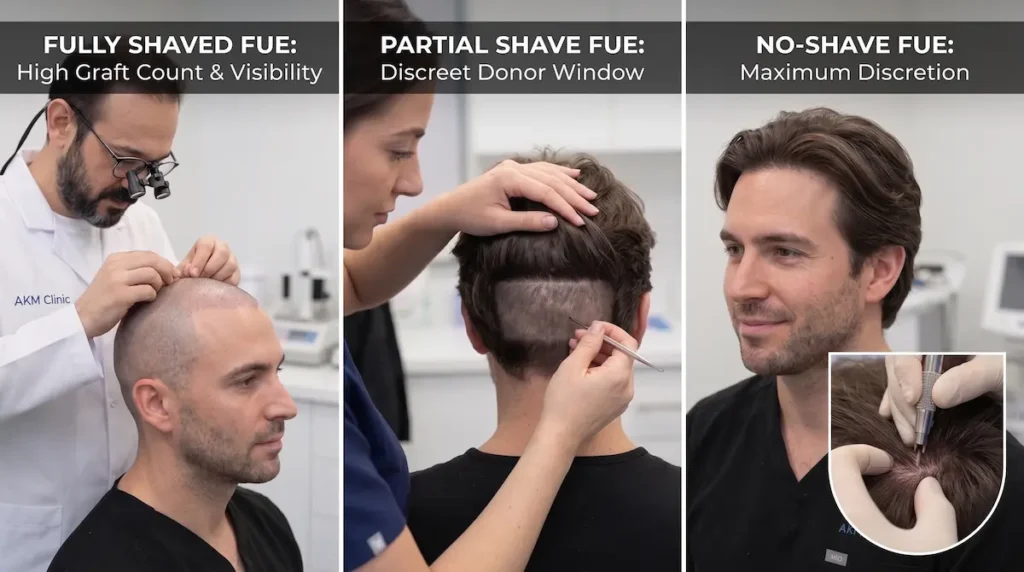
A third option sits between shaved and fully unshaven FUE: partial shave FUE. In this approach, a small donor “window” is shaved under longer surrounding hair. When the hair falls back over it, the shaved area is often easier to conceal. For many patients, this is the practical compromise: more efficient than full no-shave FUE, but still more private than a fully shaved session.
No-shave FUE is sometimes confused with DHI. They are related, but not identical. FUE describes how grafts are extracted. DHI describes a method of implantation using an implanter pen. A patient can have shaved FUE, partial shave FUE, unshaven FUE, shaved DHI, or selected unshaven DHI planning depending on the case. For a technique-level comparison, read how DHI and FUE differ.
Standard FUE vs no-shave FUE
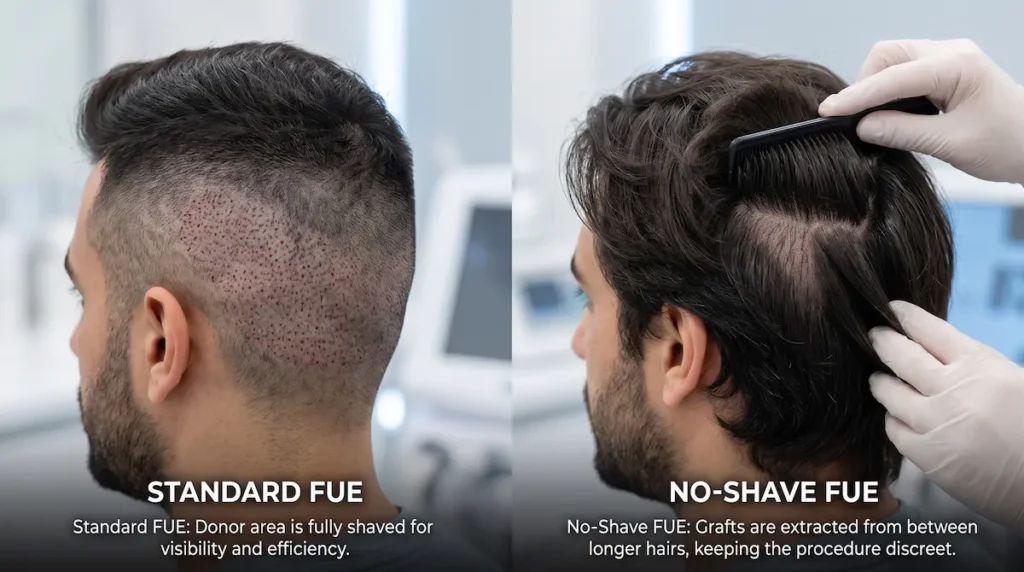
In standard FUE, the donor area is clipped short so the team can extract grafts efficiently. This can support larger sessions because the surgical field is clearer and faster to manage. The drawback is visibility: the shaved donor area may be obvious for the first part of recovery, especially if you usually wear your hair longer.
In no-shave FUE, the team preserves the visible length of the donor hair. That can help camouflage the extraction sites. The recipient area may still show redness, swelling, and crusting, especially in the first 7–10 days. So the phrase “no shave” should not be misunderstood as “no signs at all.” It mainly reduces the shaved-head look.
Pretrimmed vs direct nonshaven harvesting
With pretrimmed harvesting, only the hairs selected for extraction are shortened. This can help the team identify and remove grafts more predictably while leaving neighbouring hair long. With direct nonshaven harvesting, the graft is taken without individually cutting the visible hair shaft first. This may preserve the long-hair appearance more fully, but it can be slower and requires careful handling.
The right choice depends on hair length, donor density, curl pattern, colour contrast between hair and skin, graft count, and the surgeon-led team’s experience. The method should serve graft quality first. Privacy is important, but healthy graft handling is the priority.
What does not change
The biological goal is the same as standard FUE: move healthy follicular units from the donor zone into areas affected by hair loss. The grafts still need safe extraction, careful storage, correct angle control, and stable implantation. No-shave planning changes access and visibility; it does not remove the need for surgical precision.
“Unshaven harvesting is not just standard FUE with longer hair left in place. It changes the rhythm of the case. The team must protect graft quality while working with less visibility, which is why patient selection matters.”
Am I a Good Candidate for a FUE Hair Transplant?
Not sure if surgery abroad is the right step for you? Answer a few quick questions about your concerns, health history, and goals, and our team will help you understand which treatment options may suit you best — before you book a single flight.
Who the Unshaven Method Suits
The unshaven method suits patients whose main priority is discretion and whose graft needs are realistic for this approach. It is often considered by people in client-facing jobs, executives, teachers, health-care professionals, public speakers, performers, and anyone who cannot easily explain a shaved scalp at work. It can also be useful for women and for men who wear their hair longer.
The best candidate usually has enough donor hair length to cover the extraction zone, a defined target area, and a graft number that does not push the limits of a no-shave session. Hairline refinement, temple work, mild frontal thinning, and selected smaller crown cases may fit this category. More advanced Norwood patterns often need a broader plan.
This is where honest planning matters. An unshaven hair transplant can be appealing, but it should not force a compromised graft count. If you need a large session to restore the front, mid-scalp, and crown, a shaved or partial shave approach may deliver a cleaner surgical plan. The goal is not to avoid shaving at all costs. The goal is to choose the method that protects both privacy and long-term density.
Crown cases deserve extra caution. The crown has a swirl pattern, and the hair angles change quickly. It can take a high graft count to create visible coverage, and the result depends heavily on planning density, direction, and donor supply. If your main concern is the vertex, review crown sessions and their graft demands before assuming no-shave FUE is enough.
Good candidates for no-shave FUE
You may be a good candidate if you have longer hair in the donor area, want a discreet return to normal routines, and need a focused number of grafts. This might include hairline softening, temple reinforcement, small scar camouflage, or early thinning where the recipient area is limited. Patients who can allow several days of reduced social exposure after surgery tend to manage expectations better.
Women often ask about no-shave planning because a full donor shave can be socially and emotionally difficult. In suitable cases, preserving hair length can make the process feel more manageable. The same principle applies to men who wear medium or long hairstyles and want to avoid the obvious “post-transplant” look.
Less suitable candidates
No-shave FUE may be less suitable if you need a high graft count, have very short donor hair, have diffuse thinning throughout the donor zone, or have hair that is difficult to separate safely during extraction. It may also be less practical if the donor area has low density or if previous procedures have already reduced the available graft supply.
Patients with tight schedules should also be careful. No-shave does not mean instant recovery. The donor area may be better hidden, but the recipient area still goes through redness, crusting, shedding, and early growth phases. A discreet donor zone is helpful, but it does not make the process invisible from every angle.
The Canadian planning mindset
For Canadian patients travelling to Istanbul, the best consultation is practical, not promotional. Ask how many grafts can be safely harvested without shaving, whether partial shave FUE would give a better balance, and how your return through YYZ or another Canadian airport fits the first-week appearance. A careful plan should explain the limits, not just the convenience.
In Canada, patients are used to checking specialist training through Royal College and provincial college pathways. For treatment abroad, ask for the same clarity: the surgeon’s specialist training, documented experience with your procedure, and a clear complication and follow-up plan.
The Trade-Offs: Graft Limits, Time, and Team Skill
No-shave FUE is attractive because it protects privacy, but it is not automatically the “better” version of FUE. It is a more selective version. The main trade-offs are graft capacity, surgical time, visibility, and cost logic. In simple terms: the less hair you shave, the more carefully the team must work around existing hair.
That extra complexity matters. The donor area is not an unlimited bank. Each graft removed must be chosen with future density, donor balance, and long-term hair loss in mind. With a no-shave hair transplant, the team has less open visibility than in a shaved session, so the plan must be realistic from the beginning.
Why no-shave sessions often use fewer grafts
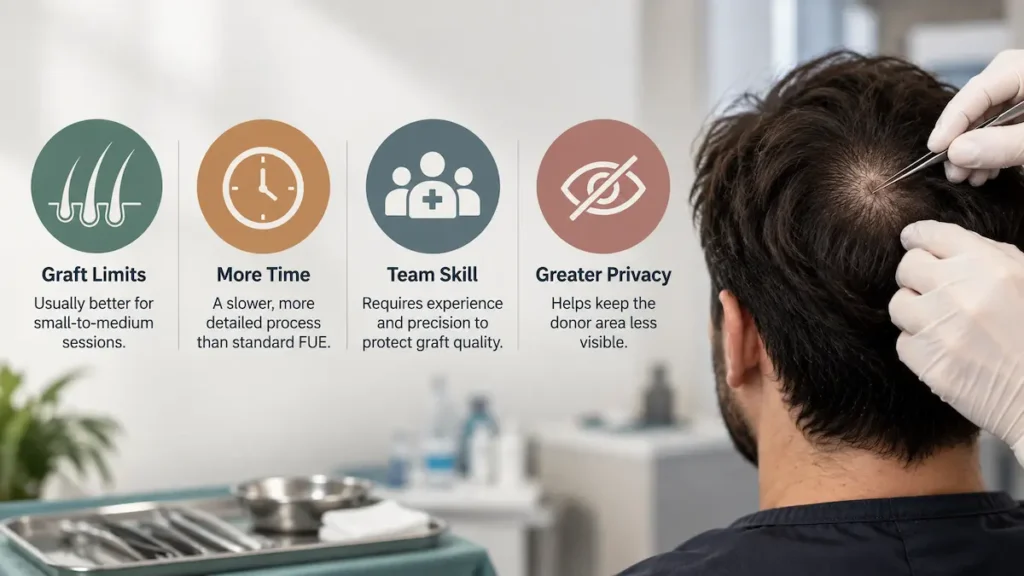
Fully unshaven FUE is usually slower than standard FUE. Longer donor hair can obscure follicle angles, and selected grafts may need to be isolated one by one. This makes the process more labour-intensive. It can still be precise, but it does not usually suit every high-graft case.
For small-to-medium sessions, that slower pace may be worthwhile. For very large sessions, it may create unnecessary time pressure. A clinic that recommends no-shave FUE for everyone is simplifying the decision too much. Your graft count should come first.
There is no universal graft ceiling that applies to every patient. Hair calibre, curl, density, donor length, thinning pattern, and the surgical team’s workflow all change the answer. Still, the principle holds: as the graft number rises, a shaved or partial shave plan often becomes more efficient and predictable.
Team skill and graft safety
Unshaven FUE requires a different operating rhythm. The team must separate long hair, identify the correct graft angle, extract without excessive trauma, and keep the donor pattern even. That takes patience. Speed should not come at the expense of graft quality.
One concern in any FUE session is transection, which means damaging the follicular unit during extraction. The risk is not unique to no-shave FUE, but limited visibility can make technique more demanding. In a clinical discussion of nonshaven FUE experience, surgeons describe the method as a practical option with specific workflow demands rather than a universal replacement for shaved FUE; that is why surgeon-reported experience with nonshaven FUE supports careful case selection.
Donor planning also matters. Removing too many grafts from a narrow area can create visible thinning, especially if you later cut your hair shorter. A no-shave approach may hide the donor zone in the first days, but it should not hide poor planning. For more on donor appearance, see what unshaven harvesting means for donor marks.
Over-harvesting is not only a hair transplant issue; it is a planning issue. Once grafts are removed, they do not regenerate in the donor zone. That is why a careful team thinks about the next 10–20 years, not just the first post-op selfie. This is especially important for younger men with progressive Norwood patterns.
Whatever area is being restored, the principle is the same: density has to be managed, not just moved.
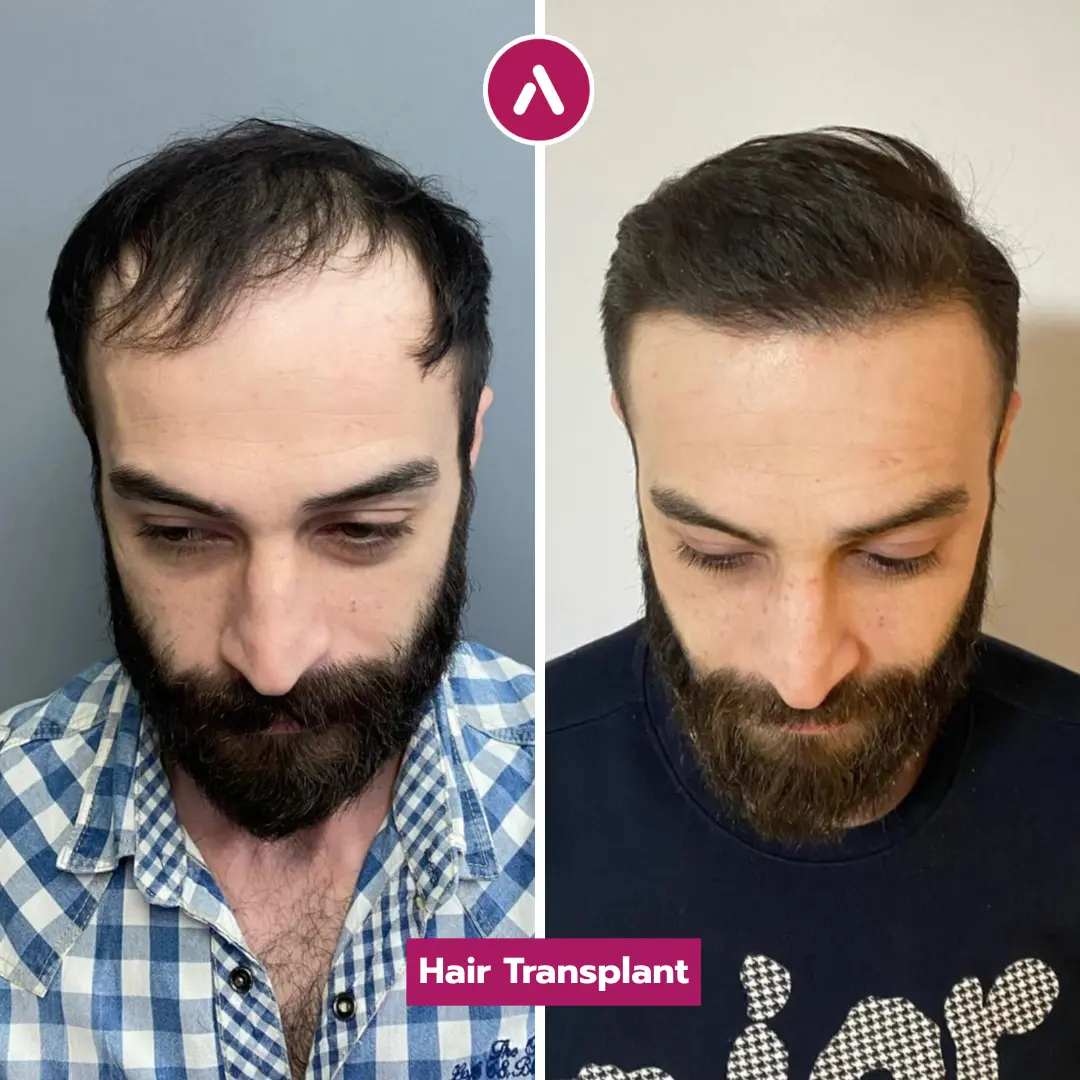
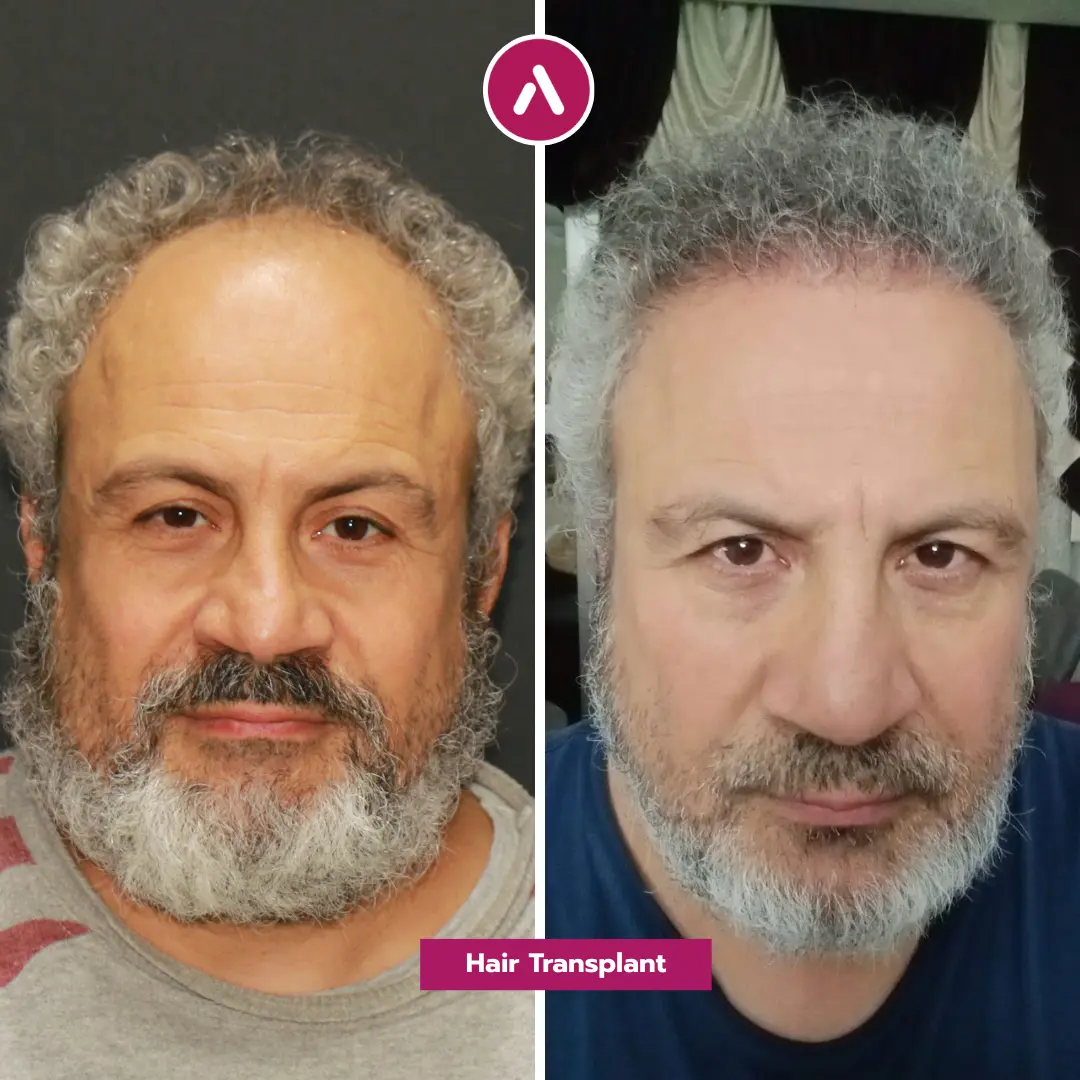
The cost logic behind no-shave FUE
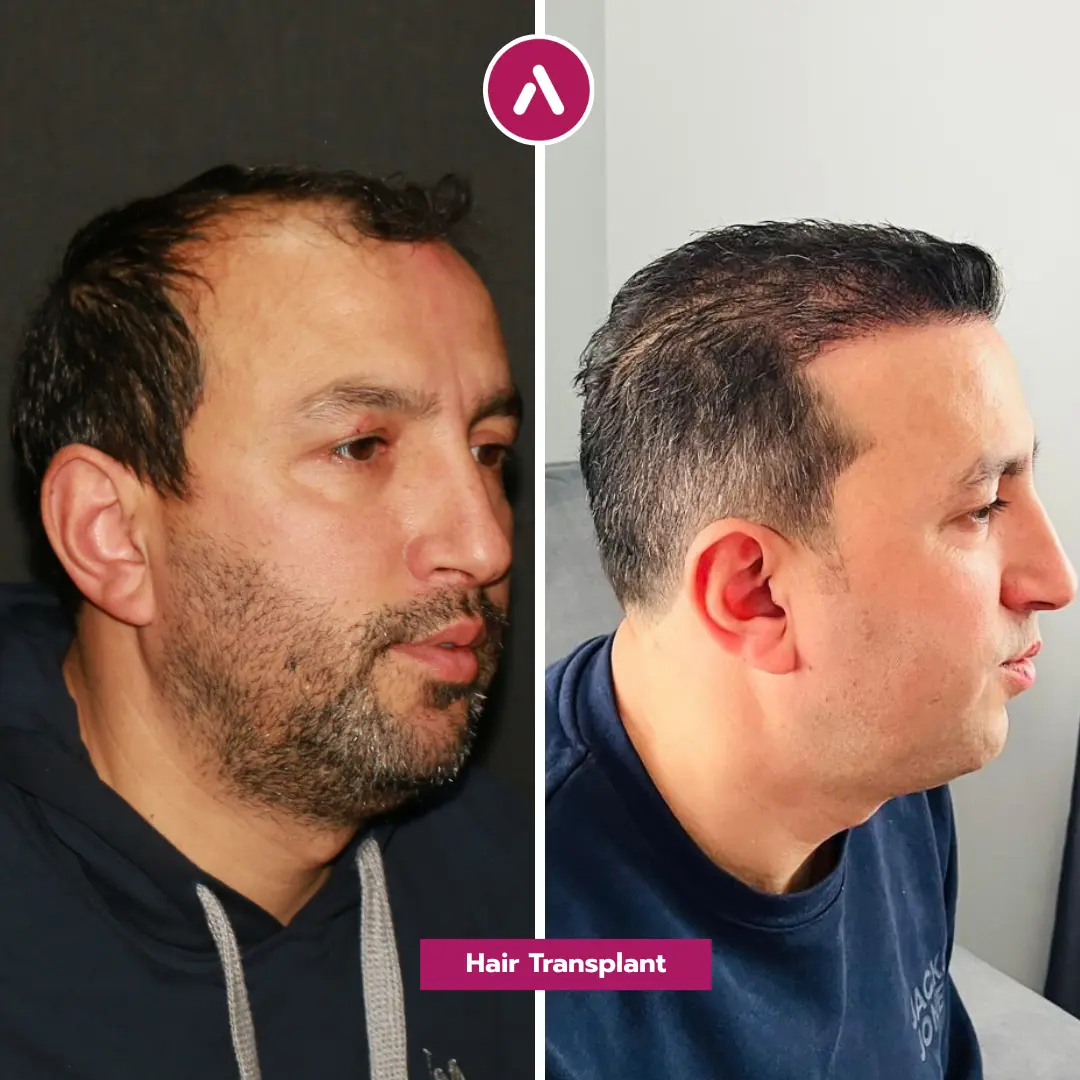
No-shave FUE may cost more than standard FUE because it often takes longer and requires more detailed handling. That does not mean it is automatically better. It means the planning and operating time can be different. The right question is not “Which is the premium option?” but “Which method gives me the safest graft plan with the level of privacy I need?”
Because this article is focused on candidacy and decision-making, it will not open a price table here. Cost depends on graft needs, technique, and package details. The transparent next step is to review FUE hair transplant pricing in CAD once your graft plan is estimated.
| Approach | Typical Graft Capacity | Session Time | Visibility in Days 1–10 | Best Fit |
|---|---|---|---|---|
| Shaved FUE | Highest practical capacity for larger sessions | Most efficient for the team | Donor shave is visible until early regrowth | Large graft plans, advanced patterns, maximum access |
| Partial shave FUE | Moderate to high, depending on the hidden window | More efficient than fully unshaven | Usually hidden by longer surrounding hair | Patients who want privacy without limiting the plan too much |
| No-shave FUE | Usually best for small-to-medium focused sessions | Longest and most detail-heavy | Least obvious in the donor area when hair length is suitable | Visible professions, women, longer hairstyles, discreet return |
Accelerate Your FUE Hair Transplant Recovery
We use advanced Hyperbaric Oxygen Therapy (HBOT) as part of our recovery protocol, helping to support healing and reduce downtime for suitable patients. Patient safety guides every clinical decision we make.
Recovery and the “Discreet Return”
The biggest reason patients ask for no-shave FUE is the discreet return to work and social life. That is a valid goal. Still, the early recovery period should be understood clearly. The donor area may be easier to hide, but the recipient area still heals in a visible way.
During the first 7–10 days, small crusts can form around the implanted grafts. There may be redness, mild swelling, and a shiny or pink tone in the recipient area. If the work is only behind the hairline or between existing hairs, it may be easier to camouflage. If the hairline itself is treated, the front can be harder to hide at close range.
What people may notice in the first 10 days
In the donor area, longer hair can often cover tiny extraction points. This is where the unshaven method helps most. If your hair is thick enough and styled naturally, someone may not notice the donor work unless they look closely.
The recipient area is different. New grafts need protection. Scabs are normal. The area can look textured until washing clears the crusts. If your work involves bright lighting, close face-to-face contact, or public appearances, plan your calendar with more margin than you think you need.
Many patients can work remotely after a few days, but in-person meetings may need more thought. Hats are not always allowed immediately, and they must not rub the grafts. Your team should give instructions based on graft placement, not generic advice.
Washing and aftercare
Washing is important, but this article will not turn into a full first-wash guide. The key idea is that washing must protect the implanted grafts while helping crusts clear at the right time. Too much force can disturb healing; too little cleaning can leave crusts longer than necessary.
Your clinic should give a written plan for the first wash, shampoo choice, pressure level, and when you can return to normal hair care. If you are travelling back to Canada, ask what to do if crusting lasts longer than expected after your flight.
When it becomes less noticeable
The donor area is often the first part to look discreet, especially in no-shave and partial shave plans. The recipient area takes longer. By around day 10, many crusts have usually cleared, but redness can last longer depending on skin tone, density, and the area treated.
After the early healing phase, transplanted hairs often shed before regrowth begins. This can worry patients who expected constant improvement from day one. Shedding is part of the normal cycle. The visible change comes later, as new growth begins over the following months.
A discreet return is possible for the right patient, but it should be planned honestly. If you have a wedding, board presentation, media appearance, or major event within two weeks, tell your coordinator and surgical team before deciding on the method. The answer may still be no-shave FUE. Or it may be to move the surgery date.
Travel planning for Canadian patients
Canadian patients should think beyond the operating day. Your recovery plan has to include the hotel period, the flight home, airport visibility, sleep position, swelling, and how to manage care after landing. If you fly through YYZ, YVR, YUL, or another Canadian airport, the goal is not to look untouched. The goal is to feel prepared and avoid preventable stress.
Ask for a written day-by-day outline before you travel. It should cover washing, medication, swelling, what is normal, what is not normal, and how to contact the team after returning home. This is where a surgeon-led plan and clear documentation matter more than marketing language.
Shaved, Partial, or Unshaven? Making the Decision
The best hair transplant method is not the one that sounds most discreet. It is the one that matches your graft needs, donor supply, hair length, lifestyle, and tolerance for visible recovery. No-shave FUE is one option. Partial shave FUE is another. A fully shaved session may still be the most efficient and safest choice for larger restorations.
This decision should be made after donor analysis, hair-loss staging, and a realistic graft estimate. If the plan is too small, you may keep privacy but lose density. If the plan is too aggressive, you may protect the short-term look while risking donor overuse. Balance matters.
Choose shaved FUE if access and graft number matter most
Shaved FUE is often the most practical choice for patients who need a larger number of grafts. It gives the team clear access and visibility, which can help with speed, distribution, and donor management. The drawback is obvious: you will look like you had your hair cut very short.
For some patients, that is acceptable. They may work remotely, take time off, or simply prefer the most efficient surgical route. A shaved session can also be easier if your donor hair is short already, if you have high contrast between hair and scalp, or if your pattern requires broad coverage.
Choose partial shave FUE if you want a practical compromise
Partial shave FUE often makes sense when you want privacy but do not want to restrict the surgical plan too much. The team shaves a hidden donor window, then uses longer surrounding hair to cover it. For many patients, this gives a better balance than fully unshaven FUE.
This approach can allow more efficient extraction than full no-shave FUE while still avoiding the obvious shaved-donor look. It is especially useful if your hair is long enough at the back and sides to fall over the shaved zone. Your styling habits matter here. If you wear a very short fade, a hidden window may not stay hidden.
Choose no-shave FUE if privacy is the strongest priority
No-shave FUE may be the right choice if you need a focused number of grafts and cannot have a visibly shaved donor area. This is common for public-facing roles, women who do not want a donor shave, and patients who want to keep their normal hairstyle during the early recovery period.
The key is honesty. If your graft needs are too high, the unshaven method can become inefficient. If your donor hair is too short, it may not hide much. If your recipient area is at the frontal hairline, people may still notice scabbing even if the donor area is discreet.
| Question to Ask | Why It Matters | What a Clear Answer Should Include |
|---|---|---|
| How many grafts do I realistically need? | No-shave FUE is usually better for focused sessions. | A graft estimate by zone: hairline, temples, mid-scalp, crown. |
| Is my donor hair long enough to hide extraction? | Privacy depends on coverage, not just the surgical label. | Hair length, density, styling pattern, and donor visibility. |
| Would partial shave give a better result? | It may improve access without fully exposing the donor area. | A comparison of shaved, partial shave, and unshaven options. |
| Will the recipient area still be visible? | Scabs and redness can reveal surgery even when the donor is hidden. | A day 1–10 appearance plan and return-to-work guidance. |
| How will you protect my donor area long-term? | Future hair loss may require more grafts later. | Donor density assessment and conservative extraction planning. |
Consultation checklist for Canadian patients
- Ask for your estimated graft count by zone, not just one total number.
- Ask whether no-shave, partial shave, or shaved FUE gives the strongest plan for your pattern.
- Ask how long your donor hair should be before surgery.
- Ask what will be visible at work on days 3, 7, and 10.
- Ask how the team handles aftercare once you are back in Canada.
- Ask what signs require urgent review after you return home.
At AKM Clinic, the consultation should lead to a method recommendation, not a one-size-fits-all package. If no-shave FUE is realistic, the plan should explain why. If partial shave or shaved FUE is safer, that should be said clearly. The most discreet option is only valuable if the graft plan still makes surgical sense.
Frequently Asked Questions: No Shave FUE Hair Transplant
These questions address the practical concerns patients usually have before choosing a no-shave or unshaven FUE plan. They focus on candidacy, graft limits, effectiveness, shaving, and what is realistic after surgery.
Is a no-shave FUE hair transplant right for you?
Can you get an FUE hair transplant without shaving your head?
How many grafts can you get with no-shave FUE?
Is unshaven FUE less effective?
Does a no-shave hair transplant cost more?
Do you have to shave for DHI?
Will people know I had a hair transplant?
Is no-shave FUE better for women?
Final Thoughts: Privacy Is Important, but Planning Comes First
No-shave FUE is a useful option for the right patient. It can protect your normal appearance, reduce the obvious shaved-donor look, and make the early return to work or social life easier. But it is not a shortcut, and it is not the best method for every graft plan.
The strongest candidates have realistic density goals, enough donor hair length, and a focused treatment area. They also accept the trade-off: more time, more technical demand, and sometimes a higher cost than standard FUE. If a partial shave or fully shaved plan would protect graft quality better, that should be part of the conversation.
For Canadian patients, the safest next step is a surgeon-led virtual consultation with clear graft mapping, donor assessment, and return-to-Canada aftercare planning. Ask AKM whether your graft count, hair length, and privacy needs make no-shave FUE a realistic option.
Have Specific Questions About FUE Hair Transplant?
Chat directly with our dedicated patient coordinators about your FUE Hair Transplant. Whether you're weighing your options from Ontario, British Columbia, or Alberta, you'll get clear, personalized answers — straight from the team who will look after you, not a call centre.
Medical disclaimer: This article is for general educational purposes only and does not replace a personal medical consultation. Hair transplant suitability, graft survival, healing, and cosmetic outcomes vary from patient to patient. A qualified surgical team should assess your donor area, diagnosis, medical history, and goals before recommending a technique.
Related Procedures
Awake Abdominal Etching
A Canadian patient guide to awake abdominal etching in Istanbul: pure local anesthesia, comfort, recovery, cost, safety, and fit-to-fly planning.
Hair Transplant For Women
Explore hair transplant for women in Turkey with no-shave FUE and DHI, female hairline design, donor assessment, recovery timeline, and Canada-to-Istanbul care.
Eyebrow Transplant
Eyebrow transplant in Turkey for Canadians: FUE vs DHI, microblading comparison, cost vs Toronto, and AKM Clinic’s surgeon-led brow restoration pathway.
Beard and Moustache Transplant
Beard Moustache transplant in Turkey for Canadians from CAD $4,800. FUE/DHI facial hair restoration with 5-star stay, VIP transfers, and follow-up.
Ready to Begin Your Journey?
Join the more than 2,000 patients who have trusted Dr. Akif Mehmetoğlu and the AKM Clinic team. Your journey begins with an informative, no-obligation conversation. Contact us today from across Canada to schedule your complimentary virtual consultation.
#1: Receive Your Personalized Quote
Start with a complimentary, no-obligation virtual consultation. Share your photos, and our surgical team will provide a fully personalized treatment plan and a transparent, all-inclusive pricing package quoted in Canadian dollars (CAD). There are no hidden fees.
#2: Secure Your Procedure Date
Once you are ready to proceed, our dedicated English-speaking patient coordinators will help you secure your procedure date. We will manage your logistical bookings in Istanbul, including your five-star hotel and private airport transfers.
#3: Arrive in Istanbul & Meet Your Surgeon
Arrive at Istanbul Airport (IST), where you will be greeted by your private driver. Settle into your hotel before your comprehensive in-person consultation. You will meet your specialist surgeon to finalize the details of your procedure and ensure your goals are aligned for a natural, subtle result.