
No-Shave FUE Hair Transplant: Is the Unshaven Method Right for You?
AI Summary
- No shave FUE hair transplant helps selected patients keep donor preparation discreet.
- Best for smaller sessions, longer hair, women, and public-facing UK patients.
- Trade-offs include longer surgery time, lower graft capacity, and possible higher cost.
- Safe planning matters: donor mapping, aftercare, and honest suitability protect long-term results.
AI-generated summary, fact-checked by our medical experts.
A no shave FUE hair transplant allows selected patients to have follicles harvested without shaving the whole head, making the early recovery period easier to hide at work and in social life. It can be a strong option for longer hair, public-facing roles, women, and smaller to mid-sized sessions. The trade-off is real: it takes longer, requires precise team rhythm, and is not ideal for every graft count.
If you are comparing this discreet method with standard FUE, start with the FUE technique behind every AKM session. The core principle is the same: individual follicular units are extracted from the donor area and implanted into thinning zones. What changes is the visibility of preparation, the pace of harvesting, and the level of technical control required.
This guide is written for patients who need a practical answer, not a glossy promise. You will learn what an unshaven hair transplant actually means, who is likely to benefit, where partial shave FUE fits, and when a fully shaved session may still give the cleaner plan.
Table of Contents
What a No Shave FUE Hair Transplant Actually Is
A no-shave FUE hair transplant is a variation of follicular unit extraction designed to reduce visible shaving. The surgeon still removes follicular units one by one from the donor area. The difference is in how the surrounding hair is managed before extraction.
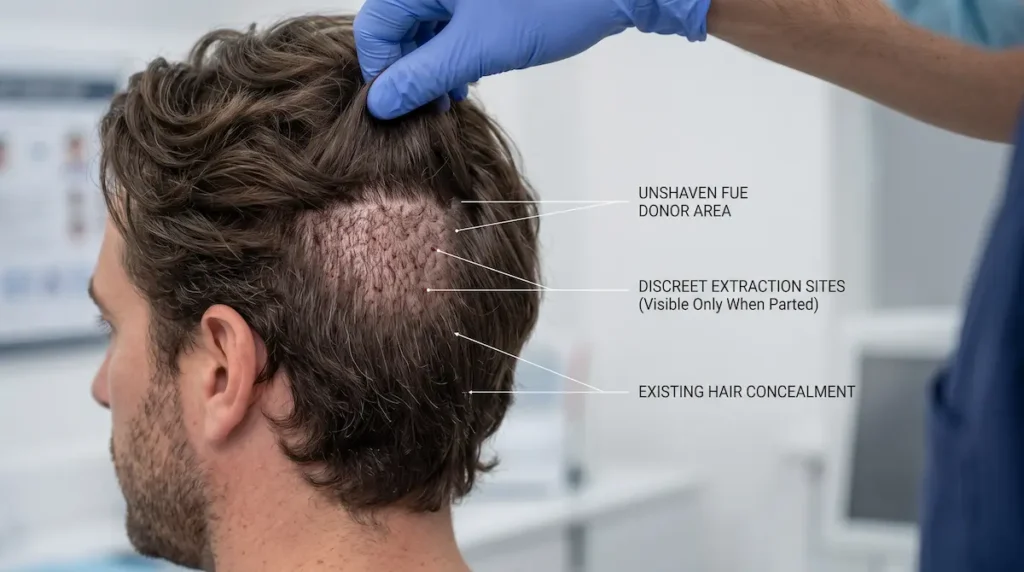
In a standard FUE session, the donor area is usually clipped very short so the team can see follicle angle, density, spacing, and punch position clearly. In an unshaven FUE hair transplant, the team works around longer hair. This can help the donor area blend in during the first days after surgery, especially when the patient wears the hair long enough to cover the extraction zone.
Standard FUE vs unshaven FUE
Standard FUE gives the team maximum visibility. It is efficient for larger graft numbers because the donor area is open, mapped, and easier to harvest in a consistent pattern. For patients needing broad coverage across the frontal third, mid-scalp, and crown, this can be the more practical route.
Unshaven FUE protects discretion. It may suit someone who cannot return to a boardroom, clinic, classroom, studio, or client-facing role with a visibly shaved donor area. The recipient area can still show redness or crusting, so the method is discreet rather than invisible. That distinction matters.
The medical goal does not change. Graft survival still depends on careful extraction, low transection, correct hydration, efficient implantation, and a realistic density plan. A hidden donor area is useful only if graft quality is protected.
Pretrimmed vs direct non-shaven extraction
There are two common ways to perform non-shaven extraction. In a pretrimmed method, selected donor hairs are cut short among the longer surrounding hairs before extraction. The trimmed follicles are then harvested while the untrimmed hair helps cover the donor zone.
In a direct non-shaven method, the punch works around longer hair and trims or manages the shaft during the extraction movement. A published comparison of these two approaches found similar mean transection rates between pretrimmed and direct non-shaven FUE, although the direct method was faster for punching small sample sets in that study. This does not mean every clinic can reproduce the same result. Technique depends heavily on case selection and operator skill.
For a patient, the practical question is simple: which method gives the team enough control for your hair calibre, curl, angle, density, and target graft count? A tidy-looking donor area should not come at the expense of damaged grafts.
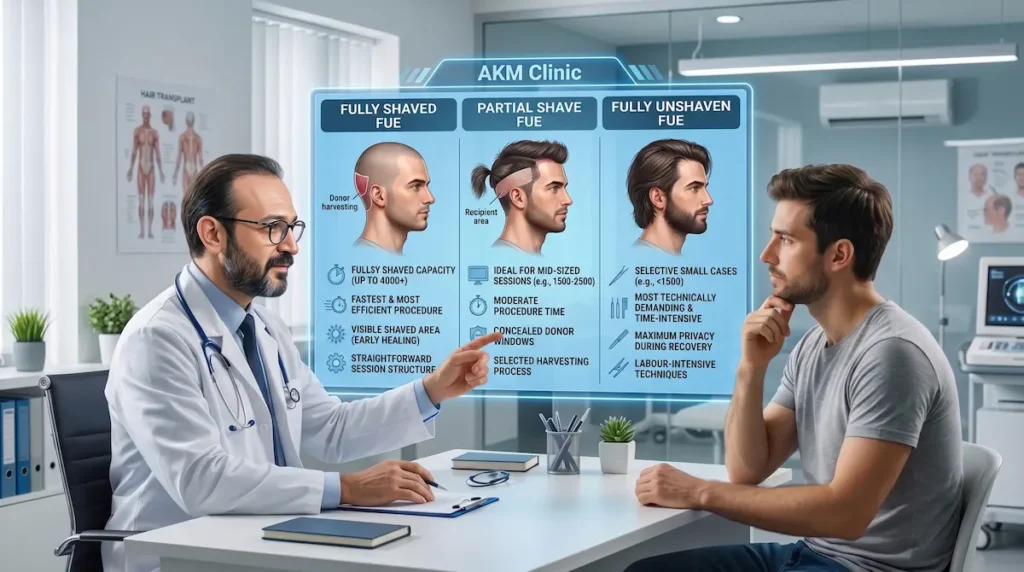
Partial shave FUE: the hidden-window compromise
Partial shave FUE sits between fully shaved and fully unshaven surgery. The team clips a small donor “window” that longer surrounding hair can cover. It is often easier to perform than a fully unshaven harvest, while still reducing obvious signs of preparation.
This can be the most sensible compromise for many UK patients. You may be able to keep your usual hairstyle, avoid a dramatic change in the donor area, and still allow the surgical team a clearer working field. It is less purist than fully unshaven FUE, but often more efficient.
Partial shaving also helps when the target is not huge. Temple reinforcement, a modest hairline adjustment, or a limited density boost may fit this approach well. Larger Norwood patterns can quickly outgrow it.
What does not change during no-shave FUE
The extraction plan still has to respect the donor area. Over-harvesting can create visible thinning, patchiness, and long-term donor weakness. The team must distribute extraction evenly rather than chasing convenience in one dense patch.
The implantation plan also remains the same in principle. Hairline design, angle, direction, density, and graft handling still matter more than the label attached to the method. For patients deciding between implantation methods, DHI versus FUE explained can help separate extraction technique from implantation style.
“Unshaven harvesting is not simply standard FUE with longer hair left in place. It asks for a different team rhythm. The donor area may look more discreet, but the grafts still need the same respect: clean extraction, minimal trauma, and a plan that does not overload the safe donor zone.”
Am I a Suitable Candidate for a FUE Hair Transplant?
Answer a few brief questions about your concerns, health, and goals to discover which treatment options may suit you best.
Who the Unshaven Method Suits
The unshaven method suits patients whose need for discretion is strong enough to justify the extra time and planning. It is not a shortcut. It is a trade-off: less visible preparation in exchange for a more demanding harvesting process and, in many cases, a lower practical graft ceiling.
Good candidacy starts with the donor area. Hair that has enough length, density, and coverage can hide a partial or unshaven harvest more easily. Very sparse donor hair, very short hairstyles, tight curls, extreme contrast between scalp and hair colour, or large graft needs can make the method less suitable.
In practical terms, no shave hair transplant candidacy starts with three questions: how many grafts you need, whether your donor hair can cover the extraction field, and whether the recipient area can be styled discreetly.
Public-facing roles and social privacy
A no shave hair transplant is often appealing to patients who cannot easily explain a shaved scalp. This includes people in client meetings, healthcare, teaching, hospitality, media, performance, leadership, and public roles. It can also help patients who simply value privacy and do not want hair restoration to become a topic of conversation.
The method can reduce the visible change at the back and sides of the head. That said, it does not erase the early signs of surgery. The recipient area may still show crusts, redness, short implanted hairs, or mild swelling for several days. If your goal is to look completely untouched the next morning, expectations need adjusting.
A better target is a planned, discreet return. That means choosing the right hairstyle, allowing time for the recipient area to calm, and understanding what colleagues or friends may notice under bright light.
Women and patients with longer hair
Women often ask about an unshaven hair transplant because a shaved donor area can feel socially and emotionally harder to manage. Longer hair may cover a hidden donor window, allowing the patient to maintain a familiar appearance during early healing.
The same logic applies to men who wear medium or longer hairstyles. If the hair can fall naturally over the extraction zone, the donor area can be easier to conceal. Short back-and-sides styles give much less cover, so the benefit may be limited.
For women with diffuse thinning, planning must be especially careful. The team has to assess whether the donor area is stable and dense enough to supply grafts safely. If thinning affects the donor zone, surgery may not be the right first step.
Smaller to mid-sized sessions
The unshaven method is usually more realistic for smaller to mid-sized sessions. Common examples include a refined hairline, temple-point reinforcement, mild frontal density work, or selected thinning patches. Some small crown cases may also fit, although crown work often needs more grafts than patients expect.
The crown is a special case because the spiral pattern can swallow grafts quickly. If you are mainly worried about vertex thinning, read about crown sessions and their graft demands before assuming a no-shave plan will be enough.
Patients with early Norwood patterns may be good candidates when the goal is strategic reinforcement rather than maximum coverage. Patients with advanced hair loss often need a staged plan, a shaved session, or a blend of approaches.
Who may not be suitable
A fully unshaven approach may not be suitable if you need a very high graft count in one sitting. The longer harvesting time can become inefficient, and the team may have less freedom to select and distribute grafts evenly. In those cases, a shaved or partial shave plan may protect the result better.
It may also be unsuitable if your donor hair is too fine to hide extraction marks, too short to cover a window, or too curly for safe high-volume unshaven harvesting. Curl is not an automatic barrier, but it makes follicle angle harder to predict. More caution is needed.
Patients who prioritise maximum density above all else may also prefer a shaved session. Discretion is valuable. So is surgical control. The right choice depends on which priority should lead your plan.
The Trade-Offs: Graft Limits, Time, and Team Skill
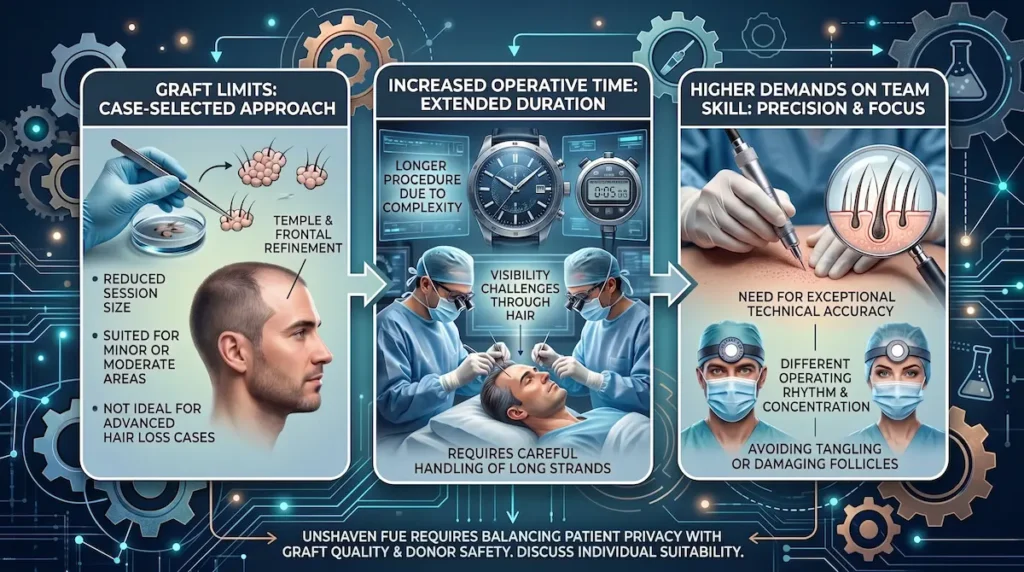
No-shave FUE sounds simple from the outside: keep the hair long, take the grafts, and let the patient leave without a shaved look. In practice, it is slower and more demanding than that. The team has to see follicle angle through longer hair, isolate the correct units, extract without unnecessary trauma, and keep the donor area evenly balanced.
This is why the method is best discussed as a trade-off, not an upgrade for everyone. It can offer privacy. It can protect your normal hairstyle. It can also limit how many grafts are sensible in one session.
Why fewer grafts may be realistic per session
In a shaved FUE session, the donor field is open. The team can move quickly across a broad safe zone, spacing extractions evenly and selecting grafts according to calibre, hair count, and direction. That visibility supports larger sessions.
With an unshaven hair transplant, the working field is partly hidden by the patient’s own hair. Every movement takes more concentration. The surgeon and technicians have to separate longer strands, identify the intended follicular units, and avoid tangling or damaging neighbouring hairs. Small errors add up.
For that reason, many no-shave plans stay in the small to mid-sized range. A frontal refinement may fit. A temple fill may fit. A dense rebuild for advanced hair loss may not.
Published experience with non-shaven FUE shows that surgeons often select cases based on the treatment area, patient preference, donor condition, and purpose of transplantation. In surgeon-reported experience with nonshaven FUE, the method is presented as a case-selected approach rather than a universal replacement for shaved harvesting. The question is not, “Can this be done without shaving?” It is, “Can this be done without shaving while still protecting graft quality and donor safety?”
Why harvesting takes longer
The extra time comes from visibility and handling. Longer hair has to be moved, held aside, trimmed selectively, or worked around. The punch must still follow the follicle’s angle beneath the skin. That angle can be harder to judge when the shaft is not uniformly clipped.
In a study comparing two unshaven FUE methods, researchers described pretrimmed and direct non-shaven extraction as distinct approaches rather than one single technique. That distinction is useful for patients. “No-shave” is not one fixed method; it is a family of ways to reduce visible shaving.
Longer operating time is not automatically unsafe. Skilled teams can manage it well. The concern is fatigue, rushed handling, or trying to force too many grafts into a method that was chosen for discretion rather than volume.
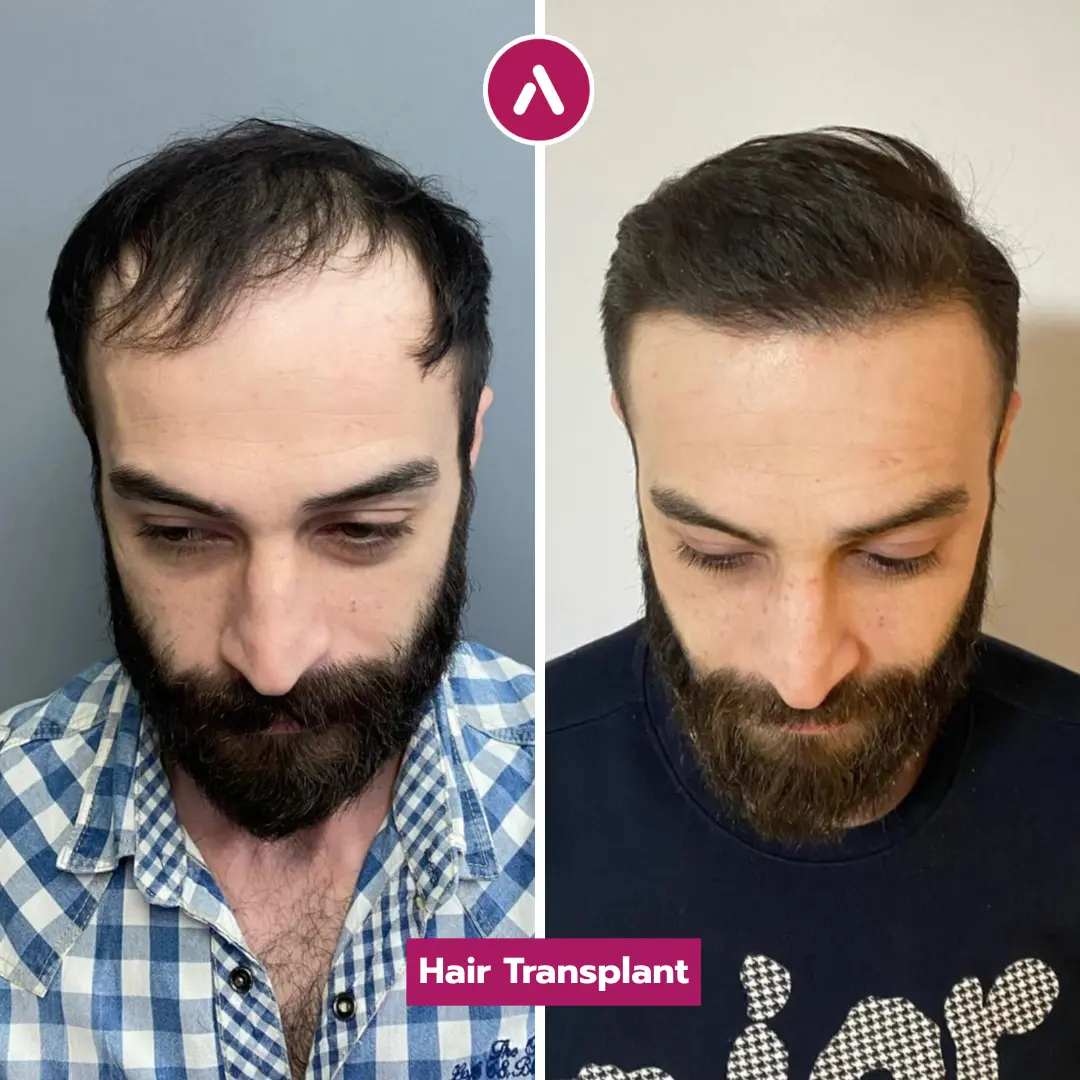
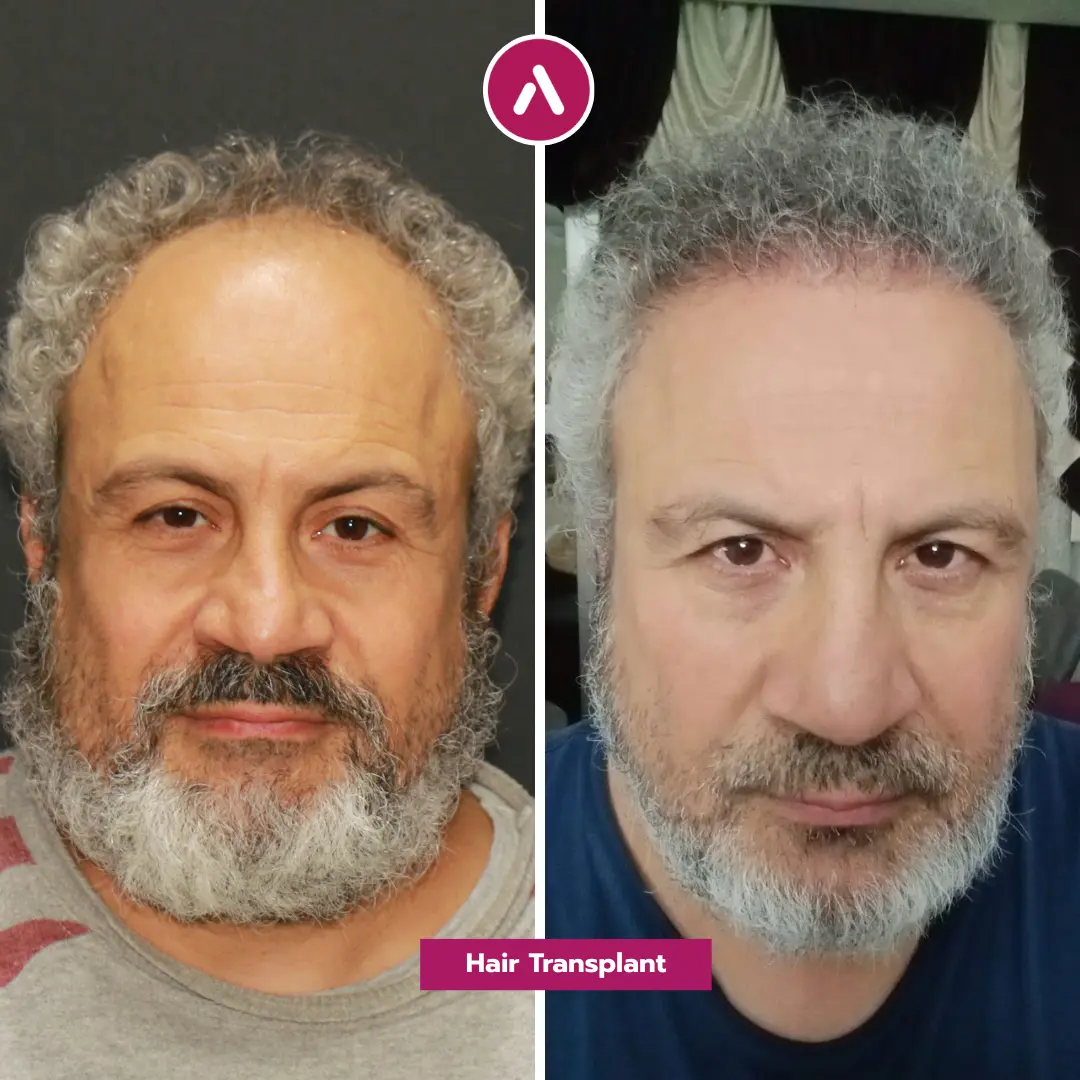
Transection control and team rhythm
Transection means the follicular unit is cut or damaged during extraction. It is one of the technical details patients rarely see, yet it matters. A graft that looks neat at the surface still needs an intact follicle under the skin.
In unshaven FUE, transection control depends on magnification, punch angle, assistant timing, hydration, and the discipline to reject a plan if the donor characteristics are not suitable. A careful team will adjust the method rather than promise the same graft number to everyone.
This is also where experience shows. A team used to shaved FUE may be technically strong, but no-shave harvesting asks for a different rhythm. The hair has to be managed while the follicle is isolated. The donor pattern has to remain even. The grafts must not spend unnecessary time out of the body.
If donor scarring and extraction marks are part of your concern, read what unshaven harvesting means for donor scars. This article stays focused on the unshaven decision, but donor safety should still sit at the centre of that decision.
Why cost logic differs
No-shave FUE can require more time, more staff focus, and more selective graft handling. That is why the pricing logic may differ from a standard shaved session. It is not about paying for a label. It is about whether the chosen method changes the operating time and technical workload.
Cost should be discussed transparently, but the more useful question for this page is clinical: does the extra discretion justify the limits for your case?
For some patients, yes. For others, a partial shave gives most of the privacy with fewer compromises. For high graft numbers, a standard shaved session may be the more honest recommendation.
UK patient safety note: Before travelling for surgery, UK patients should ask who will perform the procedure, how the surgeon’s training compares with GMC-equivalent expectations, what aftercare is included, and how concerns are handled once they return home. A discreet donor area is helpful only when the wider care plan is clear.
Accelerate Your FUE Hair Transplant Recovery
We utilise advanced Hyperbaric Oxygen Therapy (HBOT) to minimise downtime and enhance your healing process. Safety is our primary commitment.
Recovery and the “Discreet Return”
The main appeal of no-shave FUE is the return to daily life without a dramatic shaved look. That does not mean there are no visible signs. It means the signs may be easier to manage, especially around the donor area.
The donor area can often be hidden by surrounding hair. The recipient area is different. If grafts are placed into the hairline, temples, or crown, those zones may show redness, crusting, short implanted hairs, or mild swelling during the first days.
What shows during days 1–10
In the first few days, the donor area may look surprisingly normal when covered by longer hair. Under the hair, there may still be small extraction points, mild redness, tenderness, or tiny scabs. That is expected after follicular extraction.
The recipient area is usually more obvious. Newly implanted grafts form small crusts. The skin can look pink. If the hairline has been treated, there may be no way to hide every sign without careful styling, remote work, or a short social pause.
Patients sometimes assume “unshaven” means “undetectable”. It does not. It means the donor preparation is less visible. The recipient area still needs time to settle.
Recipient-area crusting vs donor concealment
This difference is central to planning. If you only need density behind an existing hairline, longer surrounding hair may help cover the recipient zone too. If you are rebuilding a frontal hairline, the new grafts sit at the edge of the face. They are harder to hide.
Temple work can be discreet from the front in some hairstyles, but not all. Crown work may be hidden by existing length, although crown graft numbers can climb quickly. That is why crown planning should be handled with restraint rather than wishful thinking.
Hair colour and contrast also play a role. Dark hair against light scalp can show crusting more clearly. Lighter hair, greying hair, or lower contrast may make early signs softer. Lighting matters too.
Washing and aftercare
Aftercare protects grafts. In the first days, washing is usually controlled and gentle, following clinic instructions rather than normal shower habits. Patients should not scrub the recipient area or pick crusts.
This page will not expand into a full washing protocol, because that is a separate aftercare topic. The decision here is whether the no-shave route gives enough discretion for your work and social calendar while still allowing proper care.
Local anaesthesia, swelling, sleeping position, medication, and washing instructions should all be explained before surgery. Follow-up arrangements should also be clear before you travel, especially if you are returning to the UK soon after your early checks.
When it tends to look socially discreet
Many patients look more socially presentable once early crusting has cleared and redness has softened. For some, that is around the second week. For others, it takes longer, especially if the recipient area is exposed or the skin stays pink.
The donor area is often easier to disguise sooner, provided the surrounding hair is long enough. A barber-style short cut removes that advantage. If discretion is the reason you want this method, do not cut the donor hair too short before surgery.
The transplanted hairs usually shed in the early phase before regrowth begins later. That shedding can feel alarming, but it is part of the broader hair transplant cycle.
Practical UK planning point: If your role is visible, plan your return around the recipient area, not only the donor area. A hidden donor zone helps, but the hairline or temples may still need time before meetings, events, or close-up video calls feel comfortable.
Shaved, Partial, or Unshaven? Making the Decision
The best method is the one that gives enough surgical access for a strong result while matching your need for privacy. A fully unshaven plan is not automatically better. A shaved plan is not automatically less refined. The right answer depends on graft count, donor quality, hairstyle, work schedule, and how much visible change you can accept for a short period.
This is where consultation matters. The team should assess your Norwood pattern, donor density, hair calibre, curl, hair length, contrast between scalp and hair colour, and the exact zones you want to restore. Then the method can be chosen around your anatomy rather than around a marketing phrase.
For patients weighing unshaven hair transplant pros and cons, the key balance is privacy versus surgical access. A discreet donor area is helpful, but it should never compromise graft handling, donor safety, or the long-term restoration plan.
| Approach | Typical graft capacity | Procedure time | Visibility during days 1–10 | Cost logic |
|---|---|---|---|---|
| Fully shaved FUE | Usually the most flexible for larger sessions | Most efficient because the donor area is fully visible | Shaved donor area is obvious until hair starts growing back | Often the most straightforward session structure |
| Partial shave FUE | Often suitable for small to mid-sized sessions | Longer than shaved FUE, but usually more efficient than fully unshaven | A hidden donor window can be covered by longer surrounding hair | May reflect extra planning and more selective harvesting |
| Fully unshaven FUE | Usually most realistic for selected smaller or moderate cases | Longest and most technically demanding | Donor area can be highly discreet, but recipient crusting may still show | May cost more because of time, labour, and technical complexity |
Use graft count as the first filter
If you need a small hairline refinement, temple support, or a modest density boost, no-shave planning may be realistic. If you need extensive coverage, the graft count may push the plan towards partial shave or full shave. That is not a failure. It is surgical honesty.
Patients often ask for a number: “How many grafts can be done without shaving?” There is no universal answer. A few thousand grafts may be possible in selected cases, but some patients need fewer and some should not be planned that way at all. Hair characteristics decide a lot.
Thin donor hair, low density, high curl, or a large recipient area can reduce the practical limit. A good plan protects the donor area for the future, not only the next ten days.
Weigh privacy against surgical access
Privacy has value. For many patients, keeping hair length helps them feel more in control of the process. It can reduce questions from colleagues, clients, friends, or family members. That emotional comfort matters.
Still, surgical access matters too. The team needs visibility to extract cleanly, spread harvesting safely, and handle grafts without unnecessary delay. If privacy makes the surgery less controlled, the plan should change.
Partial shave FUE can be the quiet compromise. It may allow the team to work with better visibility while longer hair hides the donor window. For many people, that balance is more sensible than insisting on a fully unshaven session.
Consider your hairstyle before surgery
Longer hair gives the method its main advantage. If your back and sides are already very short, there may be little to hide the donor area with. Growing your hair out before surgery can make partial or unshaven harvesting more discreet.
Ask your clinic how long the donor hair should be before travel. Do not assume your normal haircut is suitable. A few extra centimetres can make a meaningful difference when covering a hidden donor window.
Hairline styling also matters. If the recipient area is at the front, you may need to change how you part, brush, or frame your hair during early healing. Discretion is planned before surgery, not improvised after it.
Ask the right questions in consultation
Before choosing a no shave hair transplant, ask direct questions. How many grafts are realistic without shaving? Would partial shave FUE be safer or more efficient? How will the donor area be mapped? Who performs the extraction? What happens if the team decides the donor hair is not suitable on the day?
You should also ask how your result will be planned over time. Hair loss can continue. A conservative graft plan may protect you better than chasing dense coverage in one session. This is especially important for younger patients or anyone with active androgenetic hair loss.
Cost should be discussed transparently, but this article is not a price guide. For the relevant UK cost page, refer to the session pricing context for FUE hair transplant. The clinical decision comes first: choose the method that protects your grafts, donor area, and long-term plan.
Patients comparing Istanbul with a Harley Street consultation should compare credentials, aftercare, operating theatre standards, and follow-up arrangements rather than a headline method. The question is not which option sounds more discreet. The question is which plan is safer for your donor area and realistic for your graft target.
Patients worried about donor depletion should also understand the risk of over-harvesting. Whether grafts are taken for scalp or beard work, the principle is the same: the safe donor zone is limited and should be treated carefully.
Consultation checklist: Ask whether your graft count, donor density, hair length, curl pattern, and work schedule make no-shave FUE a realistic option. If the answer is “partial shave” or “fully shaved”, that may be the more responsible plan for your result.
AKM Clinic note: AKM Clinic’s planning process is built around individual assessment, surgery in Istanbul, and post-operative follow-up. Patient reviews of the clinic are publicly visible on Trustpilot. Your suitability should still be based on donor mapping, graft needs, and medical history rather than a fixed promise.
Frequently Asked Questions: No Shave FUE Hair Transplant
These questions reflect the decisions patients usually face before choosing a no-shave or unshaven FUE plan. The answers are intentionally practical: what can be hidden, what cannot, and where the method has limits.
Is a no-shave FUE hair transplant right for you?
It may not be right if you need extensive graft numbers, have very sparse donor hair, wear a very short haircut, or need maximum surgical access for a large restoration. In those cases, partial shave or shaved FUE may be safer and more efficient.
Can you get an FUE hair transplant without shaving your head?
The key is case selection. A clinic should not promise no-shave FUE before assessing your donor area, hair length, graft target, and thinning pattern. The plan should be individual.
How many grafts can you get with no-shave FUE?
The safe answer comes from donor mapping. Your team should assess density, calibre, hair angle, future hair loss risk, and the areas being restored before giving a realistic graft estimate.
Is unshaven FUE less effective?
The risk is choosing the method for discretion when the case needs more access. If the team cannot harvest safely or efficiently without shaving, the result may be compromised. That is why honest candidacy matters more than the label.
Does a no-shave hair transplant cost more?
Price should not be the main reason to choose or reject the method. First decide whether it is clinically suitable. Then compare what is included, who performs each step, how aftercare works, and what support you have once you return to the UK.
Do you have to shave for DHI?
This is why FUE, DHI, shaved, partial shave, and unshaven should not be mixed together loosely. Extraction method, implantation method, and shaving pattern are separate decisions that should be planned together.
Will people notice I had a hair transplant?
Most discreet-return plans work by combining the right method, enough time away from close scrutiny, suitable styling, and realistic expectations. No-shave FUE reduces visible preparation. It does not make surgery vanish.
Is no-shave FUE suitable for the crown?
If your main concern is crown loss, your consultation should include graft demand, donor reserve, hair direction, and future progression. The crown can use up grafts quickly when it is over-planned.
How should UK patients check safety before travelling?
For UK patients, a cautious pre-travel checklist should include credential checks, aftercare planning, a clear complication pathway, and realistic discussion of graft limits. Do not rely on the phrase “no-shave” alone.
AKM Clinic uses a surgeon-led consultation process and a care pathway built around planning, travel coordination, surgery in Istanbul, and post-operative follow-up. Ask AKM whether your graft count and hair length make no-shave FUE a realistic option.
For the right patient, a no shave FUE hair transplant can make hair restoration more discreet without changing the core principles of FUE. The method is strongest when graft numbers, donor density, hair length, and lifestyle all support it. If those factors do not align, partial shave or shaved FUE may be the more responsible choice.
Have Specific Questions About FUE Hair Transplant?
Speak directly with our dedicated patient coordinators regarding FUE Hair Transplant. Receive instant guidance and personalised support.
Medical Disclaimer: This article is for general educational purposes only and does not replace a personalised consultation. Hair transplant suitability depends on donor density, diagnosis, age, hair-loss stability, medical history, medication use, and realistic expectations. Results vary between patients.
Related Treatments

Awake Abdominal Etching in Turkey
UK guide to awake abdominal etching in Istanbul: HD sculpting, tumescent local anaesthesia, twilight sedation, recovery phases, HBOT/LLLT and GBP costs.
Hair Transplant For Women in Turkey
Hair transplant for women guide: FUE/DHI/Sapphire, recovery timeline, plus UK vs Turkey cost comparison. See inclusions and request a GBP quote.
Eyebrow Transplant in Turkey
Surgeon-led Eyebrow Transplant guide for UK patients. Compare fees (Turkey vs UK) and request an all-inclusive quote in GBP.
Beard Moustache Transplant in Turkey
Compare Beard Moustache Transplant cost in £ (UK vs Turkey) and see our FUE/DHI approach, recovery timeline and VIP package. Get a free quote.
Ready to Begin Your Own Transformation Journey?
Join the 2,000+ patients who have trusted Dr Akif Mehmetoğlu and the AKM Clinic team. Your journey to a more confident, naturally restored you begins with a simple, no-obligation conversation. Contact us today from the UK for your free virtual consultation.
#1: Get Your Free Personalised Quote
Start with a free, no-obligation online consultation. Share your photos, and our surgical team will provide a fully personalised treatment plan and a transparent, all-inclusive price package. There are no hidden fees.
#2: Secure Your Date & VIP Booking
Once you are ready, our dedicated patient coordinators will help you secure your procedure date. We will handle all your bookings, including your 5-star hotel accommodation and private VIP airport transfers.
#3: Arrive in Istanbul & Meet Your Surgeon
Arrive at Istanbul Airport (IST) and be greeted by your private driver. Settle into your hotel and prepare for your in-person consultation, where you will meet your specialist surgeon to finalise the details for your "natural, subtle, and restored" new look.