
Botched Neck Lift: Warning Signs, Causes and Revision Options
AI Summary
- A botched neck lift can mean an unsatisfactory look or a real complication. Rapid swelling or breathing trouble needs emergency care, while a stable appearance concern needs a surgical review.
- Uneven contours, a pulled look, returning bands and poor scars can come from different tissue layers, so more tightening is not automatically the answer.
- A fair revision assessment starts with your operation report, dated photos and an in-person examination. Some patients should wait or are not good candidates.
- Revision carries its own risks and cannot restore an earlier appearance exactly. Results vary, so Canadians should get the quote, aftercare and follow-up terms in writing.
Summary generated by AI, reviewed by our editorial team
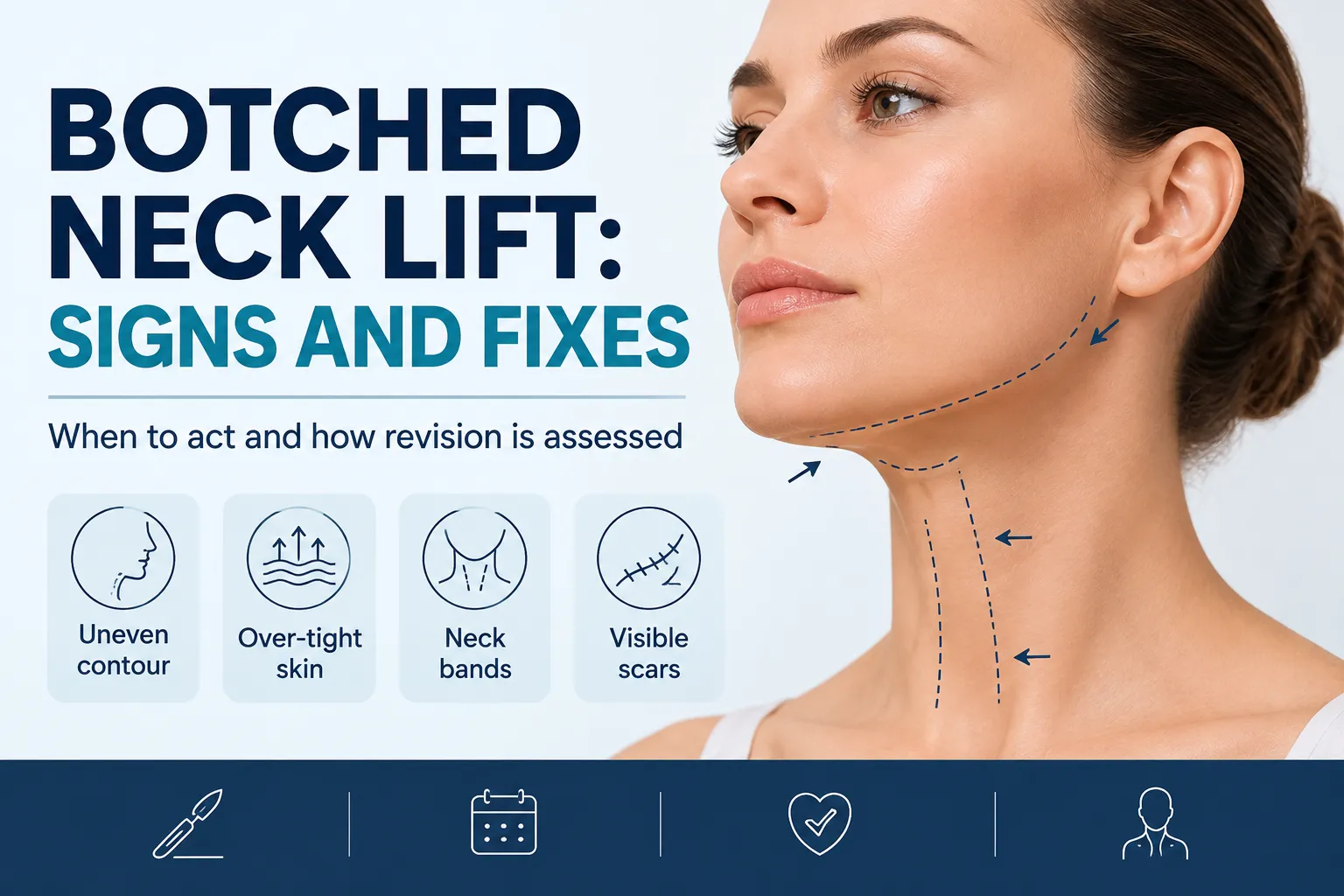
A botched neck lift is a result that looks uneven, over-tight, lumpy or banded, or a recovery with a genuine complication. Tell the two apart first. Rapid swelling or trouble breathing needs emergency care today. A stable appearance concern needs an unhurried surgical review before anyone talks about revision.
Photographs alone will not settle the question. Keep your operation report, discharge notes and dated pictures in one place, because every useful conversation starts there. Our overview of neck lift surgery in Istanbul for Canadians covers the operation itself. This article stays narrower: warning signs, a fair assessment and the honest limits of correction.
Ready to Discuss Your Neck Lift?
Our surgical calendar books up well in advance, so planning early gives you the widest choice of dates. Request a consultation to map out your ideal travel window — built around your flights from Toronto (YYZ), Vancouver (YVR), or Montréal (YUL) — with no obligation to proceed.
Table of Contents
What does a botched neck lift actually look like?
Patients use the phrase for very different things. One person means a neck that looks pulled. Another means a lump under the chin, a band that came back or a scar that spread. It is a description, not a diagnosis, so separate what you see from what you feel and raise both with a surgeon.
Is this healing, or an unsatisfactory neck lift result?
Early appearance misleads. Healing tissue can look and feel different for a while after neck surgery, and that can distort the contour until it settles. Our own neck lift page gives an estimated recovery time and a typical return to work. Those figures describe getting back to daily life, so ask your surgeon when your contour can be judged fairly.
Track the pattern, not one bad day. Note whether a concern is improving, unchanged or becoming more noticeable, and whether it affects how your neck feels or moves. Vague reassurance without an explanation is not enough.
Which contour changes deserve a surgical review?
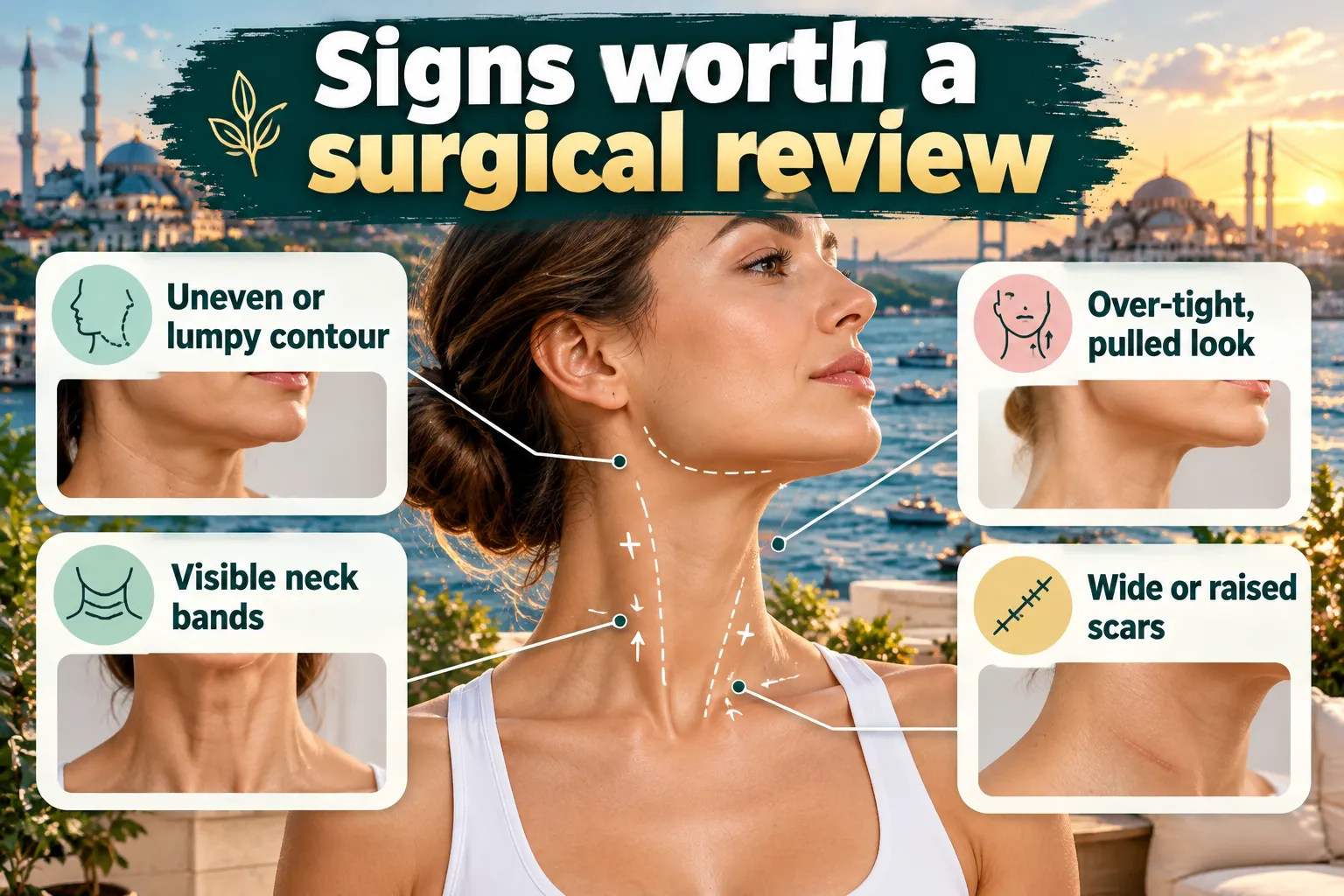
Be specific about what troubles you. The American Society of Plastic Surgeons includes unfavourable scarring, contour irregularities, skin loss, nerve injury and the possibility of revisional surgery among the known risks of neck lift surgery. Bring concrete observations to the review:
- Uneven contour: point to the difference between the sides, or the particular lump, hollow or ridge you notice.
- Conspicuous scars: show which area concerns you and whether it has changed.
- Visible neck bands: say whether you see them at rest, when you move or both.
- An over-tight look: show where the skin looks pulled, and keep that separate from any feeling of tightness.
These are starting points, not verdicts. Ask the surgeon to explain each concern on its own. Different problems may need different answers.
Why a photograph cannot establish what went wrong
Photos help you explain a concern. They cannot replace an examination, and they cannot show what caused a disappointing result. Bring your pre-operative pictures if you have them, along with images that show how the area has changed since surgery.
Keep the comparison fair. Use similar lighting, distance and head position, and include more than your worst angle. Tightness, altered sensation and changes with movement do not show up well on camera, so describe them in words.
When should you seek urgent help after a neck lift?
Safety comes before any talk of revision. A handful of symptoms after neck surgery cannot wait for an email reply or a booked consultation. If one appears, get seen in person, locally, the same day.
Rapid neck swelling or difficulty breathing
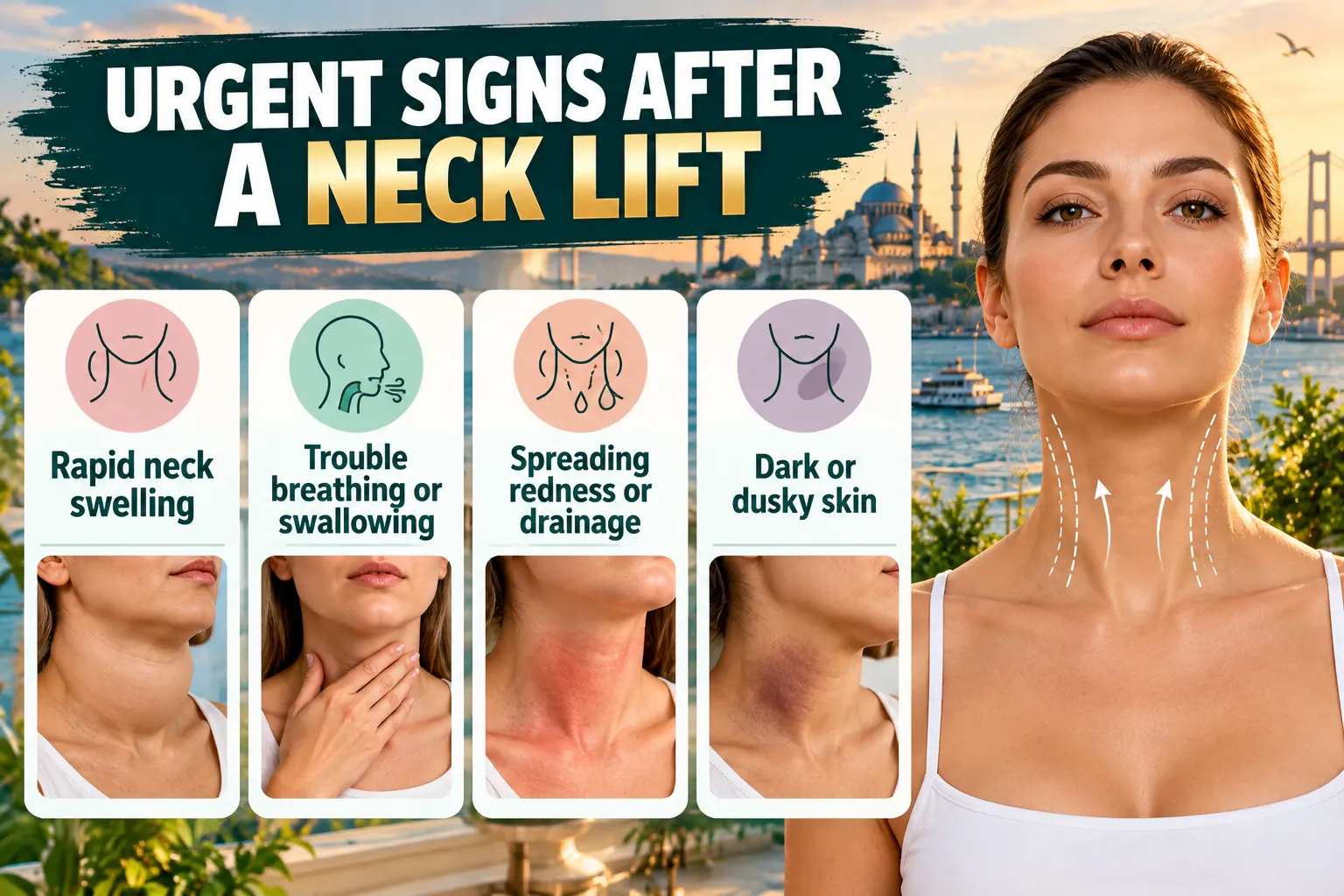
Do not wait for an online reply. Call your local emergency number if your neck swells quickly, especially with trouble breathing or swallowing. Never try to fly back to your surgical clinic first.
A hematoma is a collection of blood under the skin. Mayo Clinic describes it as the most common complication of face-lift surgery, usually forming within 24 hours, and notes that prompt surgical treatment helps protect the skin and other tissues (Mayo Clinic on face-lift risks). Tell the emergency team that you recently had neck surgery and when the change began.
Worsening pain, wound changes or unusual skin colour
Some changes need a clinician within hours. Contact your surgical team or a local doctor promptly about increasing pain, spreading redness, drainage, a wound that opens or skin that turns dark or dusky. Say when it started and whether it is spreading, because a photo without context helps little.
Skin necrosis means tissue dying because too little blood reaches it. Bruising can also darken the skin. Do not try to tell them apart by colour at home.
Use this guide to pick your next step. If you are unsure which row fits, choose the more urgent one.
| Concern | Action |
|---|---|
| Rapid neck swelling, trouble breathing or swallowing, chest pain or shortness of breath | Seek emergency assessment now. |
| Increasing pain, spreading redness, drainage, an opening wound or concerning skin changes | Contact your surgical team or a local clinician promptly. |
| A stable appearance concern without new or worsening symptoms | Arrange a scheduled surgical review. |
What to do if you are already back in Canada
Get local care first. Do not wait for an overseas appointment or a return flight. Once you have been seen, tell your surgical team and ask them to send your operation details to the treating clinician.
Bring your discharge summary and medication list. Photos and messages support an in-person assessment but do not replace it. Before you leave, ask what treatment you need, who reviews you next and which changes should bring you back.
A Comprehensive Guide to Neck Lift
From the procedure steps to your post-operative aftercare, review every detail of how our surgical team performs Neck Lift in Istanbul. A clear, start-to-finish overview, so you know exactly what to expect before you travel.
Why can a neck lift leave an uneven or over-tight result?
Start with the cause, not the label. A neck has several layers, and an uneven result does not automatically mean it needs more tightening. Ask your surgeon which layer they think is responsible, and why.
Skin, neck muscle and fat can create different problems
A neck lift can work on three things: fat under the chin, the platysma (the thin sheet of muscle at the front of the neck) and the skin draped over both. Each layer can be the source of a different complaint. Name yours precisely, whether it is loose skin under the chin, a vertical band, a hollow, a ridge or a pulled look near an incision.
- Hollows or lumps: fat removed unevenly, or too much taken from under the chin.
- A stretched, pulled look: skin set under more tension than the tissue beneath it supports.
- Bands at rest or in motion: platysma bands that were not addressed or have returned.
- Widened or raised scars: incisions that healed under tension or healed poorly.
Each of these may play a part in how your neck looks. They are possibilities, not your diagnosis. Ask which one the surgeon believes applies to you and what remains uncertain.
How healing and surgical complications affect appearance
Healing belongs in the explanation too. Complications such as bleeding, infection, poor wound healing or nerve injury are among the possible risks of surgery. A risk list still cannot explain your individual result.
Ask the surgeon to separate an appearance concern from a documented complication. If they put your contour down to scar tissue, leftover laxity or tension, ask which findings support that view. Another explanation may still be possible.
Why further tightening may not address the cause
More tightening is not a diagnosis. Fat, loose skin and muscle bands are separate problems, and each one needs to be assessed on its own. Ask for a problem-specific explanation before anyone discusses correction:
- Which structure accounts for the uneven or over-tight appearance?
- What would more tightening change, and what would it leave untouched?
- How does the explanation account for both the contour and the tightness you feel?
Keep the goal concrete. Describe the change you want and leave the surgical manoeuvre to the surgeon. Then ask them to explain any gap between your goal and their plan.
How is a neck lift assessed before revision?
A good revision consultation starts with records, not a proposed fix. It establishes what the first operation involved, defines your current concern and asks whether revision surgery makes sense at all. Expect the surgeon to say what they still do not know.
What records and photographs should you provide?
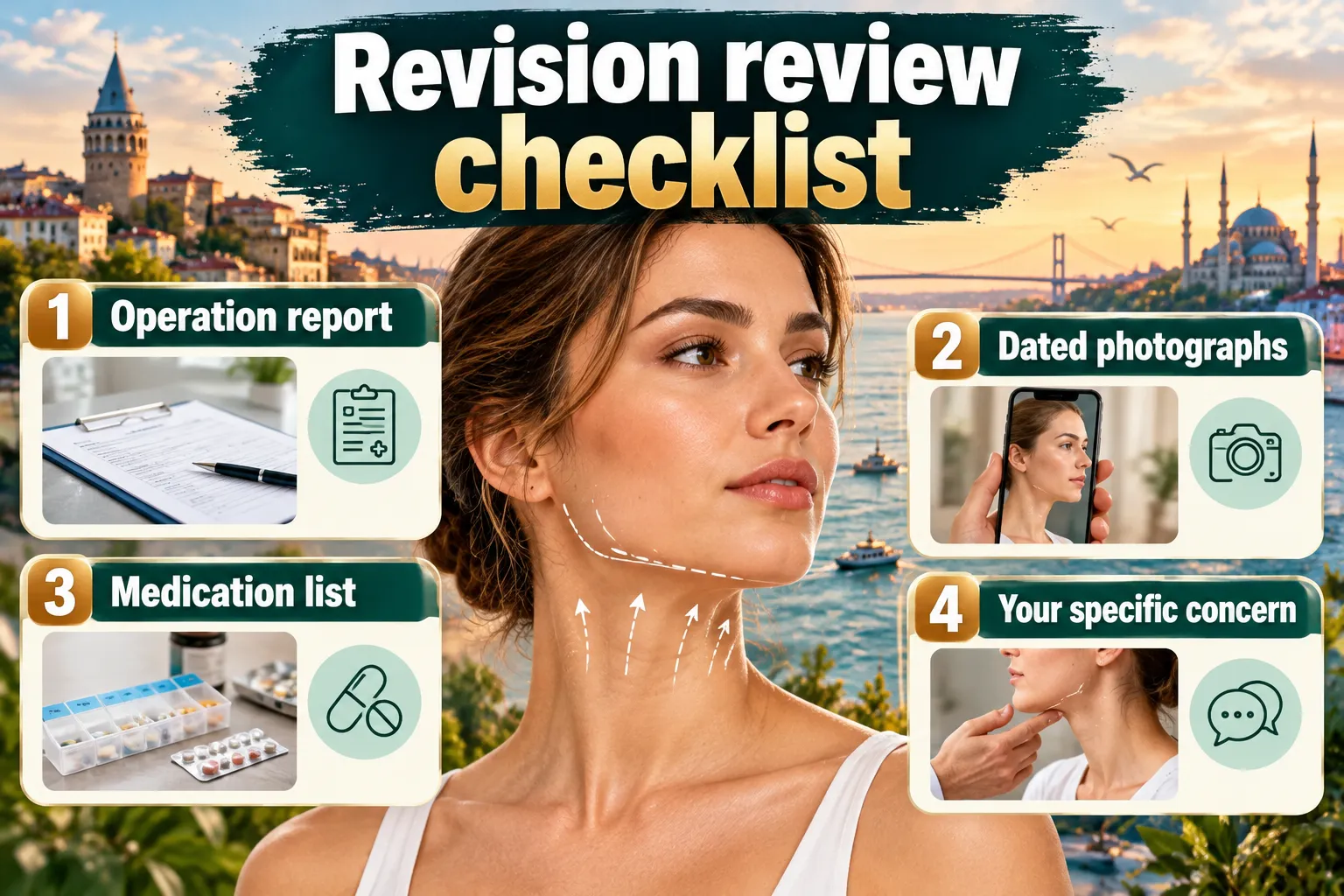
Gather what you can before the appointment. A surgeon cannot plan around tissue they know nothing about. Prepare a folder with:
- Your operation report, surgery date and discharge summary, if you have them.
- Details of earlier neck or facial procedures, including injectable treatments.
- Your current medications, supplements, allergies and relevant health history.
- A record of complications, treatments received and advice already given.
- Photographs from before surgery and during recovery, labelled with dates.
- A short description of what bothers you and whether it has changed.
Say exactly what you mean. Is it the look at rest, a change with movement, discomfort or a scar? If records are missing, say so rather than guessing which technique your original surgeon used.
What needs an in-person examination?
An online consultation organizes the questions. It cannot confirm that you need another operation or that a particular correction is possible. Ask which parts of the assessment need a hands-on examination before you book any travel.
In the room, the surgeon should assess your scars, skin quality, neck movement and contour. They should also ask about tightness, altered sensation and everyday function. Do not assume imaging or blood tests are routine; ask what any proposed test is for.
Eyelid problems are a separate question. For complications after lower eyelid surgery, see our guide to fixing a botched lower eyelid result.
When should elective revision be delayed or declined?
Waiting can be the right call. If a wound or healing problem is still unresolved, ask what care it needs first and who will oversee it.
Some patients are not good candidates, at least for now. Smoking, poorly controlled medical conditions that slow healing and expectations no operation can meet all count against revision.
Before you agree to anything, clarify:
- Whether any health issue needs attention first.
- Whether you can follow the proposed aftercare.
- Which of your expectations the surgeon considers achievable, and which not.
- Why the suggested timing suits your circumstances.
A refusal is information, not an insult. If revision is deferred or declined, ask for the reason and what would change the decision.
Can a poor neck lift result be corrected?
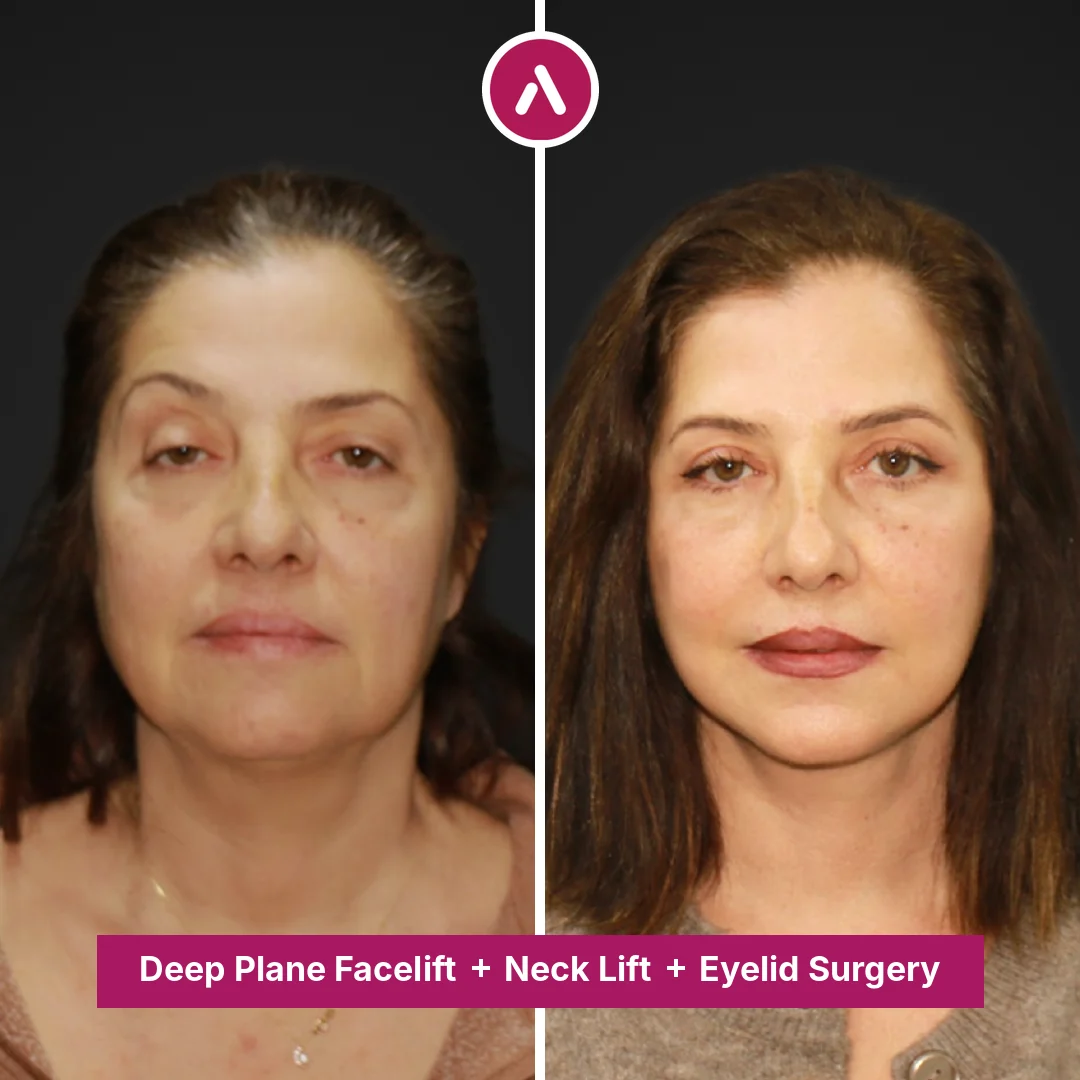
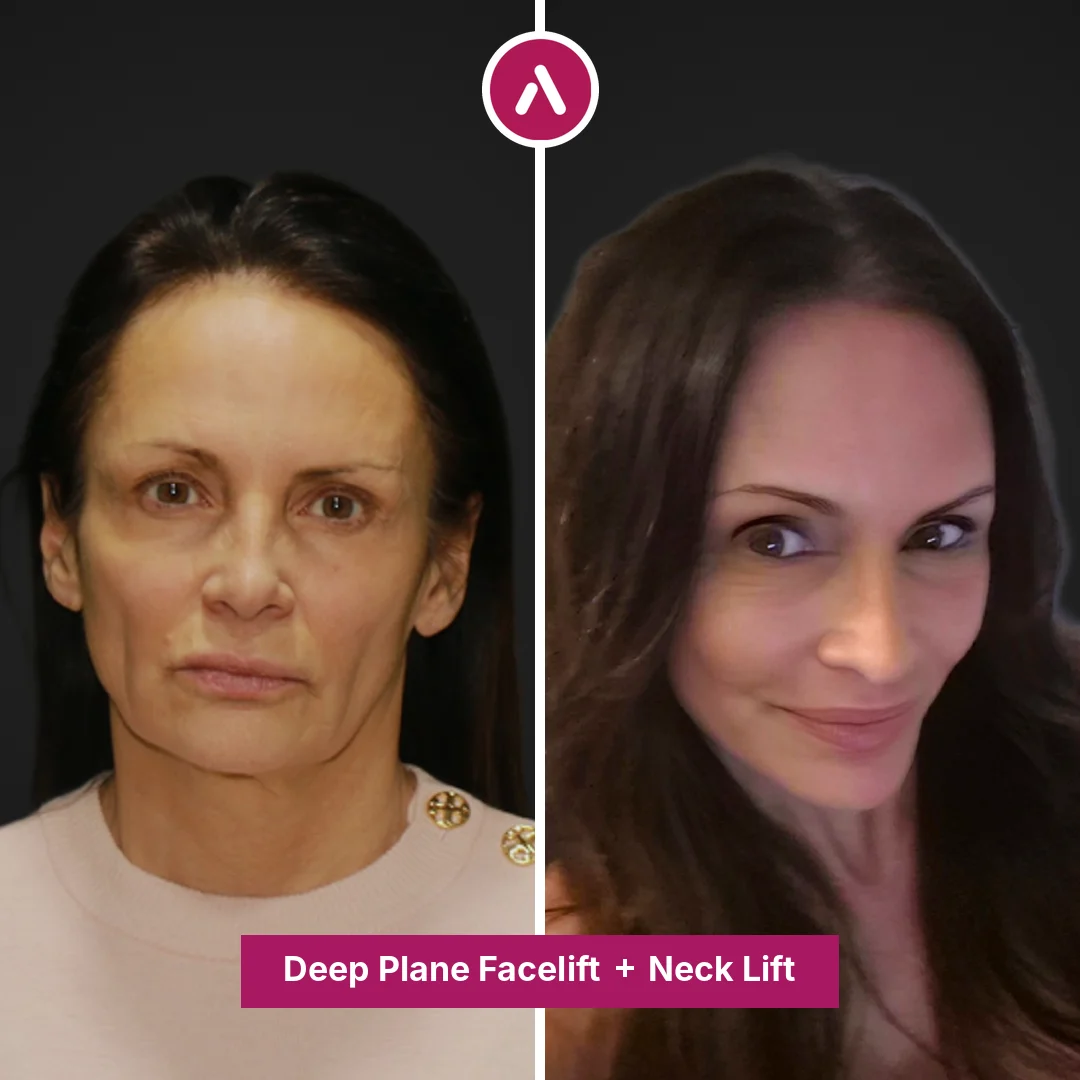
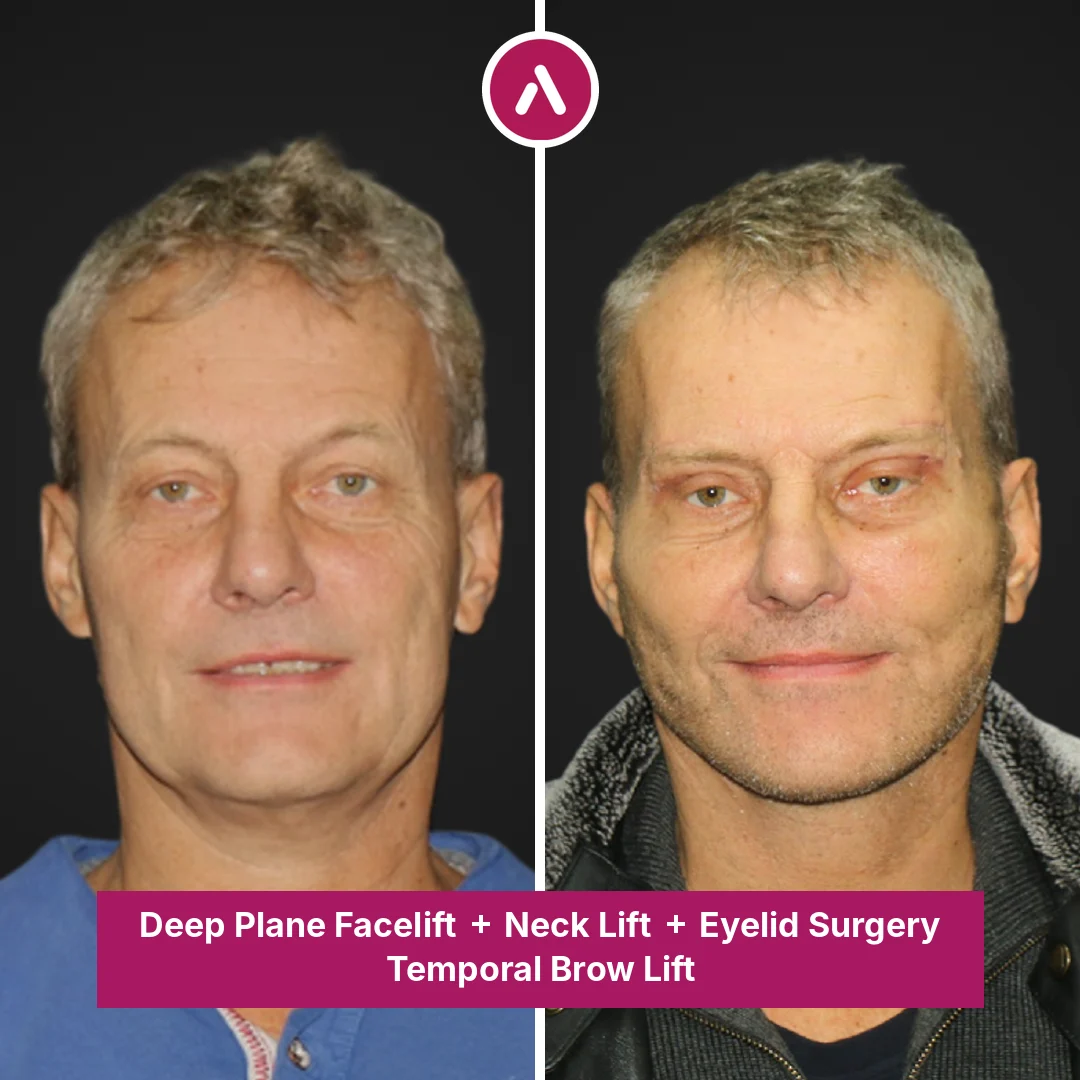
Sometimes. Correction does not always mean another operation, and any further surgery has limits of its own. Ask for a plan that separates what may improve with time, what treatment could address and what may stay as it is.
When observation or targeted treatment may be appropriate
Time is sometimes the treatment. For a stable concern, ask whether scheduled reviews make more sense than intervening now, and which changes should bring your appointment forward.
Scars have their own options. The American Society of Plastic Surgeons describes scar revision approaches that include topical treatments, injections, surface treatments and surgical revision, depending on the scar. Ask which, if any, suits your incision. Follow your clinician's wound-care instructions rather than starting something on your own.
What revision surgery may aim to improve
Keep the goal specific. Name what you hope a revision would improve, such as leftover looseness, bands, contour or a scar, and let the surgeon's examination show what is realistic for you. A technique name is not a plan.
Ask what would actually change. Each proposed step should connect to one of your concerns, with its alternatives and trade-offs, such as a smoother contour at the cost of a longer scar. Request a plain-language account of the intended correction and its limits.
What revision cannot promise
Like any operation, further surgery carries risks such as bleeding, infection, poor wound healing, nerve injury and unfavourable scarring. Weigh those against the concern you want fixed. Revision is not an automatic next step.
Results vary from person to person. Ask what the surgeon expects to leave unchanged, whether the improvement could be modest and what happens if you are still unhappy afterwards.
Where HBOT and low-level laser therapy fit
AKM Clinic offers hyperbaric oxygen therapy (HBOT) and a low-level laser therapy (LLLT) system with 424 medical-grade laser diodes at 650 nm, used for skin healing. Having a device is not a reason to use it in your case. Ask whether either is proposed, for what purpose, what evidence supports that use and whether it appears in your written plan.
Do not assume either is part of revision care. Get any device-based treatment explained on its own, and decide on it separately.
Discover If Neck Lift Is Right for You
Share your photos and medical history to receive a personalized assessment from our European Board-Certified surgical team — surgeons whose credentials align with the surgical standards Canadian patients expect from the Royal College of Physicians and Surgeons of Canada (RCPSC). An honest evaluation of whether this procedure suits your anatomy, your health, and your goals.
What should you check before choosing a revision surgeon?
Look for a clear explanation, not a sweeping promise. After a revision consultation you should understand the proposed correction, its limits and who looks after you. That includes the months after you are back in Canada.
Verify qualifications and relevant surgical experience
Start with what you can verify. Ask for the surgeon's exact specialty and the authority that issued it. A broad label such as cosmetic surgeon tells you little.
Keep Canadian and Turkish credentials apart. A Canadian surgeon's specialty can be checked with the Royal College of Physicians and Surgeons of Canada and the provincial regulator. Turkish specialist certificates, like those our doctors hold, are issued by the Republic of Turkey Ministry of Health and are not Canadian certification.
At AKM Clinic, our neck lift information is medically reviewed by Dr. Akif Mehmetoglu, a dermatosurgeon (Specialist Certificate in Dermatology and Venereology, Republic of Türkiye Ministry of Health) who has worked in facial aesthetics since 2013. The clinic counts more than 2,000 facial surgeries since 2013. Ask how a surgeon's training relates to your specific problem. That applies to us as much as anyone, so use these questions:
- What is your specialty, and where can I verify it?
- What experience do you have with concerns like mine?
- Who performs the operation and who provides post-operative care?
- Who takes responsibility if I need an unplanned assessment?
- How will I receive the agreed plan in writing?
Ask for a clear explanation of the proposed correction
Ask for the reasoning in plain language. You should be able to explain back what the surgeon proposes, why, and what they would leave unchanged.
Request a discussion of alternatives, material risks and the option of not operating. Ask whether the plan could change after an in-person examination. Detail matters more than certainty.
Our Natural First approach aims at rejuvenation, not alteration. It is a philosophy, not evidence that complications cannot happen.
Read photographs and reviews with appropriate caution
Read selectively. Ask whether images show concerns like yours and whether they show first operations or revisions. Do not assume a neck lift photo shows corrective work.
Our neck lift before and after cases can help you form questions. They cannot predict your result, because results vary between individuals.
Patient reviews describe experiences. They are not complication rates and do not replace credential checks. Watch how clearly a team explains uncertainty, not how reassuring a review sounds.
Plan Your 4-5 Day Neck Lift Stay in Istanbul
Get a clear, day-by-day itinerary covering arrival, surgery, recovery, and your fit-to-fly clearance — built around your flight dates from Toronto (YYZ), Vancouver (YVR), or Montréal (YUL). You will know exactly what each day holds before you ever leave home.
What should Canadians arrange before revision in Istanbul?
Start with records, not flights. For a stable, non-urgent concern, gather your documents and questions before discussing an assessment in Istanbul. An online consultation is not a promise of revision surgery.
Begin with an assessment, not a travel booking
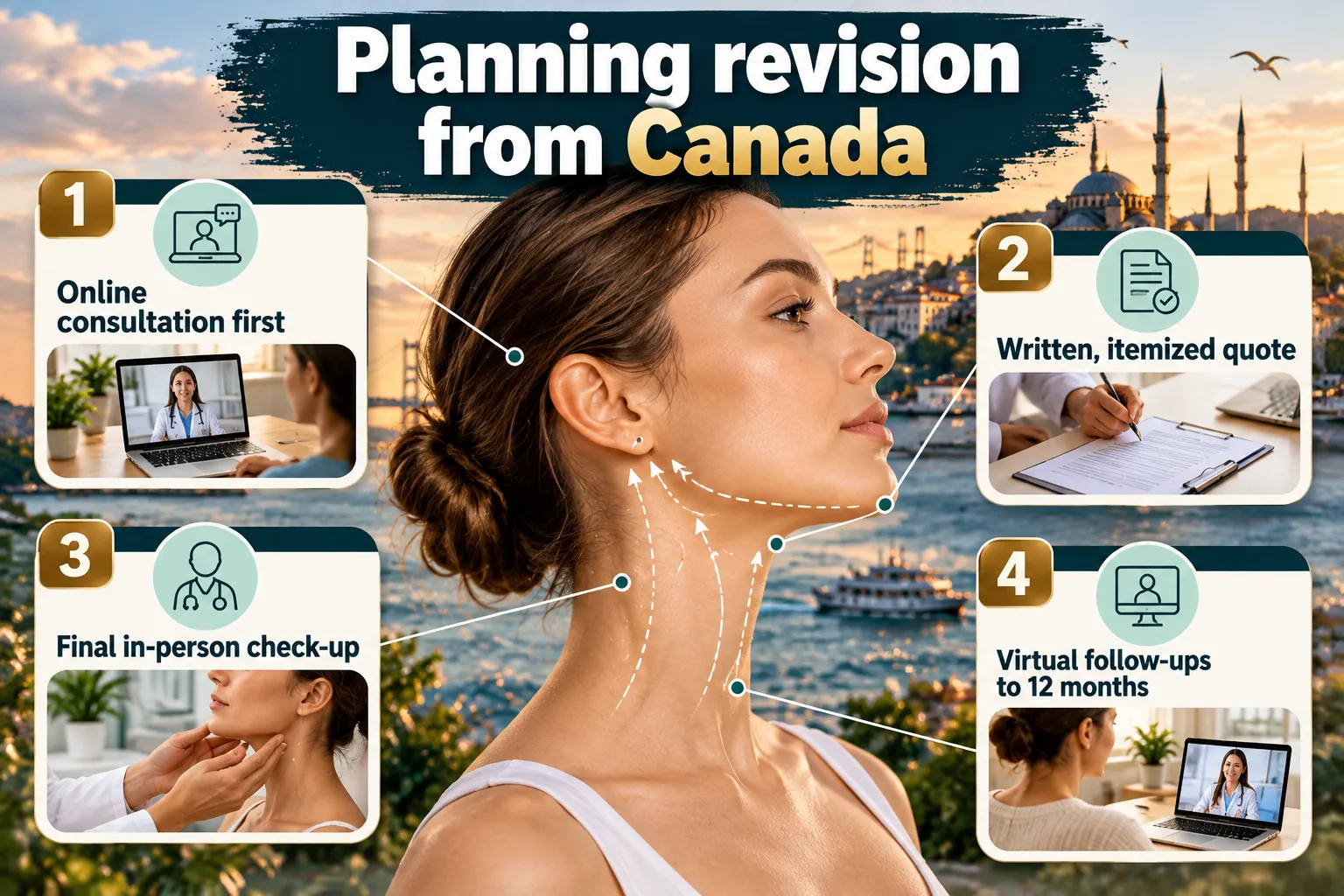
Your dedicated Patient Host arranges a free online consultation with photos, then a personal treatment plan and quote. Only after that come the date, hotel and transfers. The step-by-step patient journey shows how the sequence works, so ask what stays provisional until you are examined in person.
Clarify the revision quote and package boundaries
Ask for a written, individual quote. Our neck lift cost page lists published prices by technique, and it does not set the price of a revision. The MACS facelift and neck lift package is a separate combined operation, not a correction plan.
Check line by line. The all-inclusive package covers the surgeon's and anesthesia fees, pre-operative tests, post-operative check-ups, a five-star hotel with breakfast, private transfers and a patient coordinator with translation around the clock. Ask which of these apply to a revision, and who pays for unplanned treatment, a longer stay or a changed flight. Get the answers in writing.
Plan your stay and discharge arrangements
Keep accommodation and medical care separate in your mind. A private driver meets you at Istanbul Airport (IST) or Sabiha Gökçen (SAW), and recovery stays are at selected five-star hotels such as the Point Barbaros Hotel. After surgery the medical team monitors you closely, and you leave with medication, compression garments and written care instructions.
The Patient Host is on WhatsApp around the clock. Before you fly home, you have a final in-person check-up with the doctor. Ask when you will be cleared for the long flight back to Toronto, Vancouver or Montreal, and how a later departure would affect your hotel, transfers and ticket.
Agree on follow-up after returning to Canada
Plan past the scheduled calls. Once you are home, the Patient Host books virtual follow-ups at 1, 3, 6 and 12 months so the doctor can check healing and answer questions. Provincial health plans do not cover cosmetic surgery, so agree in advance how a local assessment would be arranged and paid for.
Keep these together before you leave Istanbul:
- Your operation report and discharge instructions.
- Your medication list and follow-up schedule.
- Written terms for additional care and expenses.
- Your questions about local assessment and sharing records.
To compare a first operation with a revision in more depth, our Istanbul neck lift procedure page sets out techniques and recovery. If you suspect a botched neck lift, this article is general education, not a diagnosis or a personal treatment recommendation.
Frequently Asked Questions: Botched Neck Lift
Can I get a second opinion if my original surgeon says my neck lift result is normal?
Yes. You can ask for an independent assessment at any point. Bring your operation report, dated photos and a clear description of your concern. Ask the second surgeon what they consider expected healing, what needs investigation and whether they would watch or treat.
Does an unusual neck contour prove surgical negligence?
No. An unusual contour on its own does not prove negligence. Contour irregularities are a known risk of the operation. Finding out what happened takes your records and an examination. Negligence is a separate legal question, so seek independent legal advice rather than relying on photos or online opinions.
Can revision surgery reuse my existing neck lift incisions?
That depends on an individual examination. Ask whether existing incisions could be reused, whether new ones would be needed and how scar length might change. Do not assume a revision means no new scars.
Should I massage a lump after a neck lift?
Only if your treating surgeon has advised it for that specific lump. Ask whether it needs examining first, and get written instructions if massage is recommended. Do not copy routines from social media.
Can a thread face lift correct a poor neck lift result?
Do not treat a thread face lift as an automatic fix. Ask a surgeon to name the specific problem first. Then ask whether threads would address it, what they would leave unchanged and how your previous surgery affects the recommendation.
Will a neck lift revision stop my neck from ageing?
No. A revision usually targets a specific concern and does not change how your tissues age over time. Ask what improvement is realistic for you and what may stay the same. Results vary individually.
Will my provincial health plan cover a cosmetic neck lift revision?
Provincial health plans do not cover cosmetic surgery, and dissatisfaction with an earlier result does not change that. Ask your plan directly about any care considered medically necessary, and get written answers before committing money. Also ask the clinic what its revision quote includes.
Have Specific Questions About Neck Lift?
Chat directly with our dedicated patient coordinators about your Neck Lift. Whether you're weighing your options from Ontario, British Columbia, or Alberta, you'll get clear, personalized answers — straight from the team who will look after you, not a call centre.
Related Procedures

Neck Lift
Neck lift in Turkey for Canadians: compare CAD pricing, platysmaplasty, Nefertiti Botox limits, recovery, safety, and Istanbul care.
Facelift
Explore Facelift in Turkey for Canadian patients, including SMAS vs deep plane techniques, CAD pricing, recovery, surgeon credentials and safety.
SMAS Facelift
SMAS facelift in Turkey guide for Canadians: techniques, recovery, safety, cost, and surgeon selection at AKM Clinic Istanbul for a natural lower-face lift.

Revision Facelift
Correct a botched or unsatisfactory facelift in Turkey. Revision facelift for Canadians from CAD $5,500–$9,550 with surgeon-led planning.
Ready to Begin Your Journey?
Join the more than 2,000 patients who have trusted Dr. Akif Mehmetoğlu and the AKM Clinic team. Your journey begins with an informative, no-obligation conversation. Contact us today from across Canada to schedule your complimentary virtual consultation.
#1: Receive Your Personalized Quote
Start with a complimentary, no-obligation virtual consultation. Share your photos, and our surgical team will provide a fully personalized treatment plan and a transparent, all-inclusive pricing package quoted in Canadian dollars (CAD). There are no hidden fees.
#2: Secure Your Procedure Date
Once you are ready to proceed, our dedicated English-speaking patient coordinators will help you secure your procedure date. We will manage your logistical bookings in Istanbul, including your five-star hotel and private airport transfers.
#3: Arrive in Istanbul & Meet Your Surgeon
Arrive at Istanbul Airport (IST), where you will be greeted by your private driver. Settle into your hotel before your comprehensive in-person consultation. You will meet your specialist surgeon to finalize the details of your procedure and ensure your goals are aligned for a natural, subtle result.