
Thigh Lift Scars After 1 Year: What Healing Really Looks Like

AI Summary
- Thigh lift scars usually flatten and fade after 1 year, but do not disappear completely.
- Scar placement matters: groin-crease scars hide better; vertical scars treat more loose skin.
- Healing takes time: colour, firmness, and texture often keep improving into year two.
- Scar care and revision may help widened, raised, painful, or poorly positioned scars.
Summary generated by AI, fact-checked by our medical experts
Thigh lift scars after 1 year are usually flatter, lighter in colour, and less raised than they were in the early healing phase — but they do not disappear. A groin-crease scar may hide well under underwear, while a vertical inner-thigh scar usually remains more visible. The final look depends on incision placement, skin tension, wound healing, scar care, and how much loose skin had to be removed.
At one year, the scars are mature enough to judge honestly, but not always finished; many keep softening into the second year.
For Canadian patients comparing local body-contouring options with surgery abroad, the honest question is not “Will I have a scar?” You will. The better question is: Where will the scar sit, how will it behave over 12–24 months, and what can be done to keep it stable?
This guide focuses only on scar appearance and scar healing. It does not replace a consultation, and it does not open the full recovery, cost, or before-and-after gallery topic. For the procedure itself, see how a thigh lift is performed at AKM Clinic.
Table of Contents
What Thigh Lift Scars Look Like After 1 Year
At the 1-year mark, thigh lift scars are usually far calmer than they were in the first few months. The colour often shifts from red, purple, or bright pink to pale pink, beige, light brown, or silvery white, depending on your natural skin tone. The texture should feel flatter and softer. A scar may still be slightly firm in places, but it should not feel increasingly thick, hot, open, or actively inflamed.
This is why 1 year is a useful checkpoint. Earlier than that, the scar is still changing quickly. By 12 months, you can usually see the “direction” of healing: whether the line is settling into a fine crease, widening under tension, darkening with pigment, or staying raised as a hypertrophic scar.
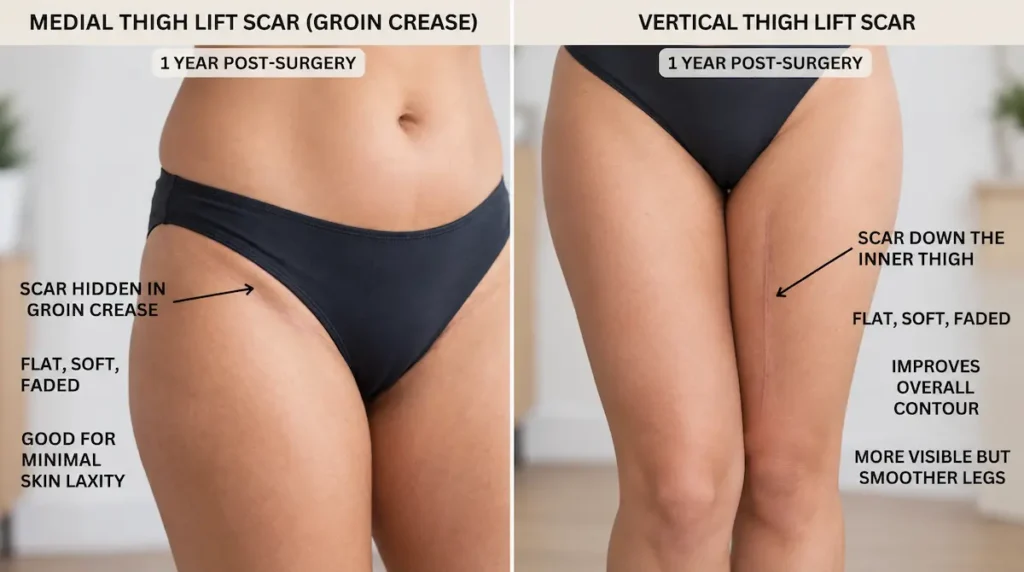
The realistic 12-month picture: flat, pale, not invisible
A good 1-year scar is often described as a thin line rather than a wound. It may still be easy for you to notice because you know exactly where to look. That does not mean others will see it in normal clothing, swimwear, or movement.
Still, “barely visible” is not the same as “invisible.” Inner-thigh skin moves, rubs, sweats, and stretches. That makes scar maturation less predictable than a scar in a quieter area of the body. A thigh lift trades loose skin for a controlled scar. The quality of that trade depends on planning and healing.
Groin-crease scars vs vertical inner-thigh scars
A short medial thigh lift scar usually sits in or near the groin crease. This type of scar can often be hidden under underwear or a swimsuit bottom, especially when the loose skin is limited to the upper inner thigh.
A vertical scar is different. It runs down the inner thigh and is used when there is more significant loose skin. It can improve contour in a way a short groin incision cannot, but it is more visible. This is the key trade-off: the more skin that must be removed, the more likely a longer incision becomes.
That does not make a vertical inner thigh lift scar “bad.” It means expectations should be set before surgery. For patients with major weight loss or substantial laxity, the more honest goal may be smoother, more comfortable legs with a visible but well-healed scar — not scar-free thighs.
Why “after 1 year” is the honest comparison point
At 6 weeks, thigh lift scars often look worse than patients expected. At 3 months, they can still be pink, ropey, or firm. At 6 months, they usually begin to calm down, but they may not match the surrounding skin yet.
By 1 year, swelling has usually settled enough for the scar line to be assessed more fairly. If the scar is flat, closed, softening, and gradually fading, it is often still improving. If it is wide, pulled downward, raised, painful, or distorting nearby tissue, that is when revision planning may start to become a reasonable discussion.
“A stable thigh lift scar is rarely about one single factor. It comes from careful incision placement, low-tension closure, proper anchoring, and patient follow-through with scar care. The goal is not a scar-free thigh; it is a scar that heals quietly and sits where it was planned.”
A Comprehensive Guide to Thigh Lift (Thighplasty)
From the procedure steps to your post-operative aftercare, review every detail of how our surgical team performs Thigh Lift (Thighplasty) in Istanbul. A clear, start-to-finish overview, so you know exactly what to expect before you travel.
Where the Scars Sit — and Why Placement Matters
Scar placement matters because the inner thigh is a high-movement area. Walking, sitting, bending, sweating, and friction all affect the incision line. A scar that is beautifully placed on the operating table can widen or drift if too much tension is placed on it during healing. That is why incision planning is as much about stability as it is about concealment.
Clinical descriptions of thighplasty commonly distinguish between horizontal groin-crease approaches and longer vertical medial-thigh approaches, with anatomy and laxity determining the incision choice. A surgical reference on the clinical anatomy of thigh lift incisions describes how horizontal incisions may sit near the groin crease, while vertical patterns address more extensive laxity along the medial thigh.
Horizontal or crescent scar in the groin crease
A limited medial thigh lift usually uses a horizontal or crescent-shaped incision near the groin crease. For the right patient, this can be a discreet placement. The scar may be hidden by underwear, a bikini bottom, or the natural fold where the upper thigh meets the groin.
This incision is best suited to upper-inner-thigh looseness. It is not designed to remove loose skin down the entire inner thigh. Trying to force too much correction through a short groin incision can increase tension, which may raise the risk of widening or downward migration.
Patients often like this option because the scar sounds easier to hide. That can be true. But a short scar must still be stable. In the groin, moisture and movement make aftercare especially important.
Vertical medial thigh scar for more severe laxity
A vertical medial scar runs down the inner thigh. It may stop partway down or extend closer to the knee, depending on the amount and distribution of loose skin. This pattern is usually considered when upper-thigh tightening alone would not solve the problem.
Patients with major weight loss often need this kind of correction because their loose skin is not confined to the groin crease. The vertical scar is more visible, but it allows a surgeon to remove skin along the length of the thigh, not just lift from above.
This is where realistic planning matters. If you have loose skin from the groin to the knee, choosing the shortest possible scar may leave the lower inner thigh untreated. If you choose the correction that matches the anatomy, the scar may be longer — but the contour improvement may be more meaningful.
The trade-off: more tightening usually means a longer scar
There is no honest thigh lift consultation without this trade-off. A longer scar is not automatically a worse choice. A shorter scar is not automatically a better one. The right incision is the one that matches the amount of loose skin, the direction of pull, and your willingness to accept visibility in exchange for contour.
If you are comparing the inner thigh lift procedure with so-called scarless thigh lift options, keep the boundary clear: non-excisional treatments may help mild skin laxity, but they cannot remove significant loose skin in the way surgery can.
A stable scar begins before the incision is made. For Canadian patients travelling for surgery, that means asking how the incision will be positioned, how tension will be managed, what garment plan will be used, and how follow-up will continue after you return home.
The Month-by-Month Healing Timeline
Thigh lift scar healing is not a straight line. The scar often looks neat in the first week, then more red, firm, or raised in the second and third months before it softens again. This middle phase can feel discouraging, but it is often part of normal scar maturation.
The timeline below describes common patterns, not a guarantee. Your skin tone, age, weight stability, incision length, garment use, tension on the wound, and any early healing problems can all change how thigh lift scars mature.
| Healing phase | Typical scar appearance | Usually normal? | What helps |
|---|---|---|---|
| Weeks 1–6 | Red or pink, slightly raised, tight, taped, tender, sometimes crusted | Yes, if the incision is closed, clean, and improving | Protect the incision, avoid friction, wear garments as instructed, keep follow-up appointments |
| Months 2–4 | Firm, pink, darker, itchy, rope-like, or more noticeable than expected | Often yes; this is a common “looks worse before better” phase | Silicone once fully closed, gentle scar care if cleared, sun protection, patience |
| Months 6–12 | Flatter, softer, lighter in colour, less raised; some widening may become clearer | Usually yes, but persistent thickening or distortion should be assessed | Continue scar care, protect from UV exposure, review any widening or migration |
| After 2 years | More mature, paler, softer, and closer to final appearance | Yes, this is closer to the long-term result | Consider revision only if the scar is stable but remains widened, raised, painful, or misplaced |
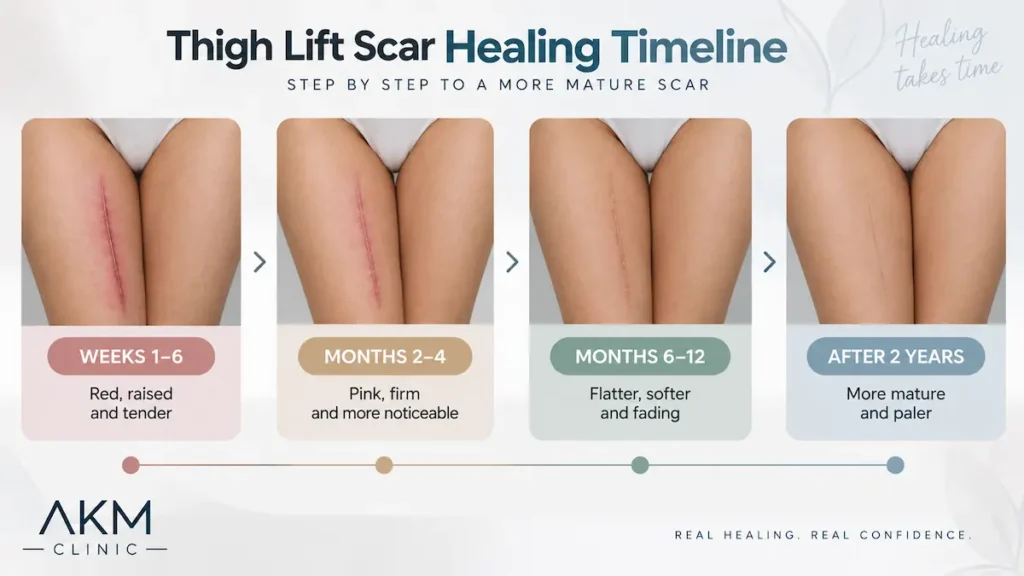
Weeks 1–6: red, raised, tight
In the first 6 weeks, the scar is still an active wound repair site. It may look red or pink, feel tight, and sit slightly raised. The groin crease can feel especially sensitive because the area moves every time you walk, sit, stand, or climb stairs.
Some crusting, mild itching, and pulling sensations can be normal. Increasing redness, spreading warmth, drainage with odour, fever, or wound opening should not be ignored. Those signs need surgical review, especially in a high-friction area like the inner thigh.
This is also the stage when your behaviour matters most. Too much hip abduction, wide stepping, aggressive stretching, or early return to strenuous activity can put extra tension on the incision. A scar that is repeatedly pulled in the first weeks may widen later.
Months 2–4: the firm, pink “looks worse before it gets better” phase
Many patients feel most worried around months 2–4. The scar can look darker, thicker, or more raised than it did early on. This is not always a setback. Collagen is still being remodelled, and the scar may be at its most active.
Itching can also peak in this phase. That does not automatically mean a problem. It can reflect nerve recovery and scar activity. Still, if itching comes with a rapidly raised scar, expanding redness, pain, or drainage, it should be checked.
For Canadian patients returning home after surgery abroad, this is the period when remote follow-up matters. Photos taken in consistent light can help the surgical team compare scar colour, thickness, and symmetry over time.
Months 6–12: flattening, fading, and softening
By months 6–12, the scar should usually start looking less “active.” The colour often softens. Firm ridges begin to flatten. The scar may feel less tight during walking or sitting, and the surrounding skin often feels more natural.
This is also when scar width becomes easier to judge. A thin scar may stay close to the original incision line. A widened scar may look stretched, especially in the groin crease or along a vertical inner-thigh incision. Widening does not always mean poor surgery; sometimes it reflects skin tension, movement, healing biology, or early wound separation.
If you are comparing scar patterns across body contouring procedures, remember that each area behaves differently. You can compare how scars from another skin-removal procedure mature in our arm lift scar healing timeline, but a thigh scar sits in a more mobile and humid area, so it needs its own expectations.
What thigh lift scars after 2 years may look like
Thigh lift scars after 2 years are usually closer to their final state. They may be lighter, softer, and less raised than at 1 year. In some patients, the change between year 1 and year 2 is subtle. In others, especially those prone to slow scar maturation or post-inflammatory pigmentation, the second year can still bring visible improvement.
If a scar remains red, thick, painful, itchy, raised beyond the incision border, or visibly distorted after 18–24 months, it may need a specific scar assessment. Options can include silicone, steroid treatment, laser, microneedling, or surgical revision, depending on the scar type. Not every scar needs surgery.
The main point is patience. A 1-year scar is meaningful, but it is not always the final word.
Discover If Thigh Lift (Thighplasty) Is Right for You
Share your photos and medical history to receive a personalized assessment from our European Board-Certified surgical team — surgeons whose credentials align with the surgical standards Canadian patients expect from the Royal College of Physicians and Surgeons of Canada (RCPSC). An honest evaluation of whether this procedure suits your anatomy, your health, and your goals.
Why Some Thigh Lift Scars Widen or Migrate
Some thigh lift scars heal as fine lines. Others widen, drop lower than planned, or pull on nearby tissue. This does not happen randomly. The inner thigh is one of the more challenging areas for scar stability because it combines tension, moisture, friction, and constant motion.
A literature review of medial thigh lift complications notes that wound-related issues, including dehiscence and scar concerns, are recognized problems in medial thigh lift surgery. It also discusses the importance of fixation techniques in reducing downward scar displacement and related contour problems. This is why scar planning must be anatomical, not cosmetic only.
Tension, movement, and moisture in the groin crease
Scar widening often starts with tension. If the closure is under too much pull, the scar can stretch as collagen remodels. The groin crease is especially vulnerable because it moves in several directions. Sitting flexes the hip. Walking pulls the inner thigh. Getting in and out of a car can tug on the incision.
Moisture adds another challenge. Sweat and friction can irritate the scar line, especially in the first months. This does not mean the scar will automatically heal badly, but it does explain why aftercare instructions can feel strict.
Compression garments, activity limits, hygiene, and careful dressing use are not small details. They help protect the scar while the body builds strength under the skin.
What thigh lift scar migration means
Thigh lift scar migration means the scar shifts downward from its intended position, especially in the groin crease. In more severe cases, this can pull on nearby tissue and create distortion. Patients may describe the scar as “dropping,” “stretching,” or no longer sitting in the crease.
This is one reason the medial thigh lift scar is not just a skin-line issue. The deeper closure and fixation matter. Surgical anchoring helps the scar resist downward pull. Without stable support, the groin scar may be more likely to widen, descend, or become more visible than expected.
Scar migration is different from normal fading. A fading scar changes colour and texture. A migrating scar changes position or pulls on surrounding anatomy. That distinction is important during follow-up.
Early wound separation and the final scar
Wound separation, also called dehiscence, can affect the final scar. Even a small area that opens and heals slowly may leave a wider or thicker mark. This is why early reporting matters. A small wound problem managed quickly may heal more cleanly than one hidden for weeks.
The inner thigh is exposed to friction from walking and clothing. For patients with swelling, fluid shifts, or a history of massive weight loss, tissue tension can be higher. That does not mean a poor outcome is inevitable, but it does mean the plan should be realistic from the beginning.
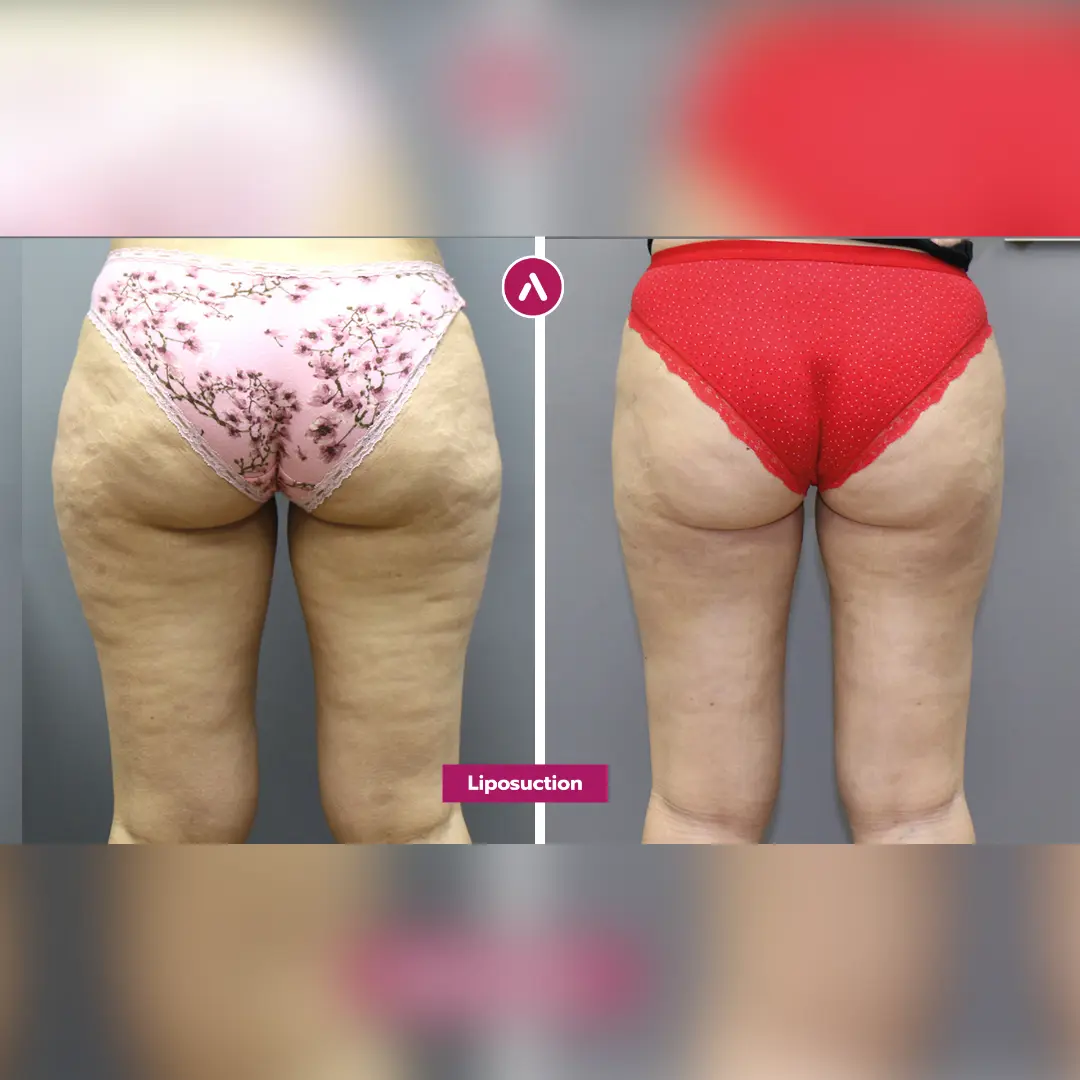
Not every patient seeking thigh contouring needs a thigh lift. For example, liposuction for lipedema addresses a different problem and creates different scar expectations. Loose skin, fat distribution, tissue quality, and diagnosis all matter.
Canadian patient note: Before travelling, ask how your incision will be anchored, what scar pattern is realistic for your anatomy, how follow-up photos should be taken once you are back in Canada, and what signs should trigger an urgent local assessment. A careful plan does not guarantee a perfect scar, but it reduces guesswork.
Caring for Scars — and When Revision Is Worth It
Scar care does not erase thigh lift scars, but it can support better maturation. The goal is to keep the scar closed, calm, protected, and under as little avoidable tension as possible while collagen remodels. Simple measures, done consistently, often matter more than dramatic treatments.
Before starting any scar product, the incision must be fully closed. Silicone, massage, and topical products used too early can irritate the wound or trap moisture. Your surgeon’s timing should guide you, especially for groin-crease incisions where sweat and friction are common.

Silicone, sun protection, and avoiding early tension
Silicone gel or silicone sheets are commonly used after surgical incisions once the skin has sealed. They may help reduce raised, firm, or hypertrophic scar behaviour in some patients. They are not a quick fix. They work slowly, and only when used as directed.
Sun protection matters too. UV exposure can darken a healing scar and make colour mismatch more persistent. This applies even if the scar is usually covered. Swimwear, shorts, and summer travel can expose areas you may not think about during normal dressing.
Tension control is just as important. In the early weeks, avoid movements that pull the thighs wide apart unless your surgical team has cleared them. This includes deep squats, wide lunges, aggressive stretching, and sudden side steps. A scar that is repeatedly stretched while weak may heal wider.
When scar revision may be considered
Scar revision is usually not discussed seriously until the scar has matured, often at least 12 months after surgery. Sometimes waiting longer is wise, especially if the scar is still improving. Revising an active scar too early can restart the healing process before the tissue is stable.
Revision may be worth discussing if the scar is widened, raised, painful, tethered, pulled out of position, or causing distortion. A revision cannot remove the fact that surgery creates a scar. It may, however, replace a wide or poorly placed scar with a thinner, better-positioned one if the underlying tension can be controlled.
For a hypertrophic scar or pigment concern, non-surgical treatments may be tried first. These can include silicone, steroid injections, laser, microneedling, or other scar-focused care depending on the scar type and skin tone. Keloid-prone patients need especially careful planning.
Setting expectations before surgery
The best time to talk about scars is before the operation, not after the incision is already healing. Ask where the scar will sit when you stand, sit, walk, and wear underwear or swimwear. Ask what scar pattern matches your skin laxity. Ask how the team handles remote scar checks after you return to Canada.
Cost should not drive incision choice. A shorter scar that leaves untreated loose skin may be disappointing. A longer scar that is planned honestly may suit the anatomy better. For budget planning only, you can review thigh lift pricing in CAD, but this article is focused on scar healing rather than procedure pricing.
What to ask before surgery: Where will my scar sit? Is a groin-only incision enough for my loose skin? Would a vertical medial scar give a better contour? How will the closure be anchored? What should I do if I notice widening, drainage, darkening, or wound separation after I return home?
For Canadian patients, the most reassuring consultation is often the most specific one. General promises such as “minimal scars” are less useful than a clear explanation of incision position, scar trade-offs, follow-up, and how results may vary based on your anatomy.
Frequently Asked Questions: Thigh Lift Scars
What do thigh lift scars look like after 1 year?
Do thigh lift scars go away?
Why is my thigh lift scar widening?
Can thigh lift scars migrate?
What do thigh lift scars look like after 2 years?
Can a bad thigh lift scar be fixed?
Is a medial thigh lift scar always visible?
Can loose skin thigh lift scars be avoided with non-surgical treatment?
Final Thoughts: A Good Scar Is Planned, Protected, and Given Time
Thigh lift scars are not all the same. A short groin scar, a vertical inner-thigh scar, and a scar after major weight loss each behave differently. After 1 year, most scars should look flatter, softer, and less red, but they may keep improving into the second year.
The most realistic goal is not a scar-free result. It is a scar that is placed thoughtfully, closed with low tension, protected during early healing, and followed carefully after you return home. For many patients, that trade-off can be worthwhile when loose inner-thigh skin affects comfort, clothing fit, or confidence.
If you are considering a thigh lift, ask AKM how your incision would be planned to keep the scar as hidden and stable as your anatomy allows.
Have Specific Questions About Thigh Lift (Thighplasty)?
Chat directly with our dedicated patient coordinators about your Thigh Lift (Thighplasty). Whether you're weighing your options from Ontario, British Columbia, or Alberta, you'll get clear, personalized answers — straight from the team who will look after you, not a call centre.
Medical disclaimer: This article is for general education only and is not a diagnosis or treatment plan. Surgical risks, scar behaviour, and healing timelines vary by patient. Always follow your surgeon’s instructions and seek urgent medical advice for spreading redness, fever, foul-smelling drainage, wound opening, black tissue, severe pain, or any sudden change in your incision.
Related Procedures

Awake High-Def Liposuction
Awake high-definition liposuction in Turkey for Canadians. Learn how tumescent local anesthesia works, who is a good candidate, recovery time, cost vs Canada.

Liposuction
Compare liposuction in Turkey vs Canada: Lipo 360, VASER, recovery, safety, CAD pricing, and travel planning for Canadian patients.

J-Plasma
Learn how J-Plasma skin tightening, Renuvion works, who it suits, recovery, safety, and CAD cost vs Canada at AKM Clinic Istanbul.

Upper Back Lift
Upper back lift in Turkey for Canadians. Bra-line back lift from CAD $5,450 with scar planning and virtual follow-up.
Ready to Begin Your Journey?
Join the more than 2,000 patients who have trusted Dr. Akif Mehmetoğlu and the AKM Clinic team. Your journey begins with an informative, no-obligation conversation. Contact us today from across Canada to schedule your complimentary virtual consultation.
#1: Receive Your Personalized Quote
Start with a complimentary, no-obligation virtual consultation. Share your photos, and our surgical team will provide a fully personalized treatment plan and a transparent, all-inclusive pricing package quoted in Canadian dollars (CAD). There are no hidden fees.
#2: Secure Your Procedure Date
Once you are ready to proceed, our dedicated English-speaking patient coordinators will help you secure your procedure date. We will manage your logistical bookings in Istanbul, including your five-star hotel and private airport transfers.
#3: Arrive in Istanbul & Meet Your Surgeon
Arrive at Istanbul Airport (IST), where you will be greeted by your private driver. Settle into your hotel before your comprehensive in-person consultation. You will meet your specialist surgeon to finalize the details of your procedure and ensure your goals are aligned for a natural, subtle result.