
Hair Transplant Scars: What FUE Donor Marks Really Look Like
AI Summary
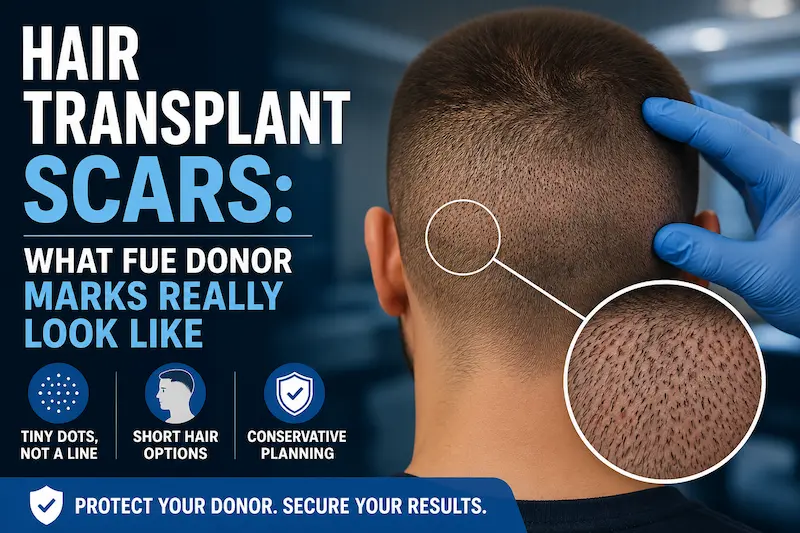
- Hair transplant scars are real, but FUE usually leaves tiny donor dots, not one linear scar.
- Visibility depends on planning, including punch size, donor density, healing biology and haircut length.
- Conservative harvesting protects safety, future graft supply and natural-looking short-hair options.
- Existing scars can improve with SMP, hairstyle changes, selective grafting or revision assessment.
Summary generated by AI, fact-checked by our medical experts
Quick answer: Hair transplant scars are real, even with modern FUE. The difference is that FUE usually leaves tiny round donor dots instead of one long FUT line. How visible those marks become depends on punch size, harvest density, spacing, skin healing, and how short you cut your hair afterwards.
For many Canadian patients, the worry is not only “Will it scar?” It is more practical: “Can I still wear my hair short?” “Will the donor area look patchy?” “Will people notice if I get a fade?” Those are fair questions. A good FUE hair transplant consultation should answer them before a single graft is removed.
FUE is often marketed as scarless. That word is misleading. FUE avoids the long linear strip scar associated with FUT, but each extracted follicular unit still heals through a tiny circular wound. In most well-planned cases, these marks are small, pale, and scattered enough to be hidden by surrounding hair. In poorly planned cases, they can become visible as white dots, patchiness, or a thin "moth-eaten" donor zone.
This guide explains what FUE donor marks actually look like, why some men show more scarring than others, and how conservative donor management protects your options for short hair, future density, and possible second procedures.
Table of Contents
What a Hair Transplant Scar Actually Is
A hair transplant scar is the healed mark left after grafts are removed or placed. In this article, we are focusing on the donor area: the back and sides of the scalp where follicles are harvested for transplantation. Every surgical harvest creates some form of healing response. The key question is not whether healing marks exist, but whether they are small, spread out, and well-hidden by the remaining donor hair.
Why every extraction leaves some mark
In FUE, each follicular unit is removed through a small circular opening made with a punch. The opening closes as the skin heals, leaving a tiny dot of scar tissue. In many patients, that dot becomes a pale, flat mark that blends into the scalp. It may be almost invisible under normal hair length. Under a bright bathroom light, with the hair clipped very short, it can become easier to see.
That is normal biology, not a failed result. Skin heals by forming collagen. The amount of visible colour change, texture change, or pale dotting depends on how your skin heals, the size of the extraction site, and how much nearby hair remains to camouflage the area.
The International Society of Hair Restoration Surgery notes that FUE does not create a linear scar, but it is not scarless. That distinction matters because honest planning starts with realistic expectations, not marketing language. You can read their patient-facing explanation of FUE and scarring here: ISHRS on whether FUE is scarless.
FUE dot scars vs FUT linear scars
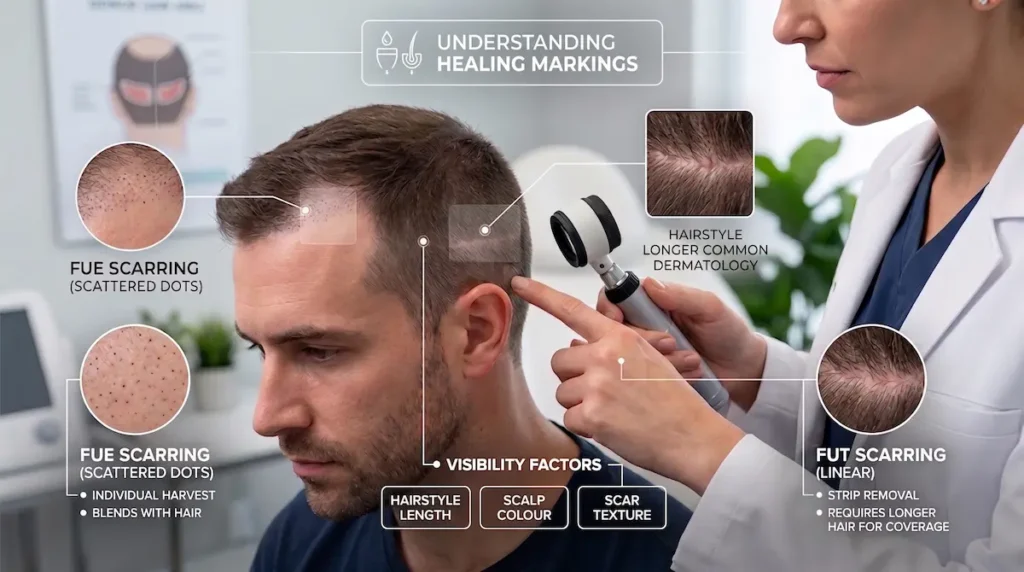
The easiest way to understand hair transplant scars is to compare FUE with FUT. FUT, often called the strip method, removes a narrow strip of scalp from the donor area and closes it with stitches. That usually leaves one linear scar. FUE removes follicular units one by one, leaving many tiny round marks instead of a single line.
| Scar type | Typical pattern | Visibility with short hair | Best camouflage options |
|---|---|---|---|
| FUE donor marks | Small round dots spread across the donor zone | Often subtle at moderate clipper lengths; more visible with very close shaving | Keeping slight length, SMP, careful second-stage planning, selective grafting into scars |
| FUT linear scar | One horizontal line at the back of the scalp | Can show clearly with cropped hair if the line is wide or pale | Longer hair coverage, trichophytic closure, scar revision, FUE into the line, SMP |
A peer-reviewed review of FUE technique explains that FUE extracts individual follicular units rather than removing a strip, while the implantation step remains similar to traditional transplantation. That is why the donor scar pattern changes so dramatically between FUE and FUT. For the technical background, see this peer-reviewed overview of the FUE technique.
Where the donor area sits
The classic scalp donor area sits across the back and sides of the head, where hair is typically more resistant to androgenetic hair loss. This zone is not unlimited. It has a finite number of grafts that can be removed without thinning the area too much.
That is why donor management matters. A patient may be focused on the hairline today, but the donor zone has to support the result for years. It may also need to support the crown, temples, or a future touch-up. If too many grafts are removed from one section, the scar issue is no longer just white dots. The whole area can begin to look depleted.
That is the difference between a transplant that looks clean at six months and one that still looks natural when the hair is cut shorter later.
Discover If Hair Transplant Is Right for You
Share your photos and medical history to receive a personalized assessment from our European Board-Certified surgical team — surgeons whose credentials align with the surgical standards Canadian patients expect from the Royal College of Physicians and Surgeons of Canada (RCPSC). An honest evaluation of whether this procedure suits your anatomy, your health, and your goals.
What FUE Donor Marks Really Look Like
FUE donor marks are usually not dramatic scars. In a well-managed case, they look like tiny pale dots scattered through the back and sides of the scalp. Most people will not notice them at normal social distance, especially when the hair has a little length. The issue becomes more visible when the hair is clipped very close, when the donor has been overharvested, or when the patient’s skin heals with stronger colour or texture contrast.
Tiny pale dots up close
Fresh FUE extraction sites look red or pink at first. They may have tiny scabs during the early healing stage. Once the skin closes and the scabs fall away, the marks usually fade into small pale dots. In lighter skin, they may look slightly white. In darker skin, they can appear lighter or, in some cases, darker during the healing phase before settling.
These dots are easiest to spot when the surrounding hair is very short and the lighting is direct. They are often much harder to notice when the hair is left a few millimetres longer. That is why a patient who plans to wear a skin fade needs a different donor-area discussion than a patient who usually keeps the back and sides at a moderate clipper length.
Skin colour, hair colour, hair calibre, and scalp contrast all matter. Thick dark hair on a similar-toned scalp hides donor marks better than fine hair on high-contrast skin. Curl pattern can also help or hurt camouflage, depending on how the hair lies after cutting.
Visibility at different hair lengths
The question “Can I shave my head after FUE?” needs a careful answer. Many patients can wear short hair after FUE, but a wet shave or skin fade gives the scars the least cover. Even tiny dots can show when there is no hair length to break up the contrast.
At a longer clipper setting, the remaining donor hair overlaps the extraction sites and softens the view. At a very close buzz cut, the dots may become visible as a fine speckled pattern. That does not mean the surgery was done badly. It means FUE leaves distributed scars, and very close shaving reveals the skin surface.
- Longer than a close buzz: donor marks are usually well hidden if harvesting was conservative.
- Short clipper cut: tiny dots may be visible up close, especially under direct light.
- Skin fade or wet shave: FUE marks are most likely to show because there is almost no hair cover.
- Patchy donor area: this suggests overharvesting or poor spacing, not just normal FUE dotting.
This is why a good surgeon should ask how you actually wear your hair in Canada day to day: office length, gym buzz cut, barber fade, hats in winter, and whether you would ever shave your head if hair loss progressed.
The “moth-eaten” look after overharvesting
The most concerning FUE donor problem is not a single dot. It is the “moth-eaten” look: a patchy, thinned-out donor area where too many grafts were removed or where extraction was not evenly distributed. Instead of tiny marks hidden among healthy hair, the whole donor zone starts to look sparse.
This can happen when a clinic chases a high graft number without respecting the patient’s donor density. It can also happen when grafts are taken outside the safe donor zone, where hair may thin later. Once that area thins, both the scars and the lack of coverage become more obvious.
Medical literature on hair transplant complications describes overharvesting and harvesting beyond the safe donor area as technical errors in FUE. It also notes that FUE can produce pinpoint white scars and a moth-eaten donor appearance when overharvesting occurs. That is exactly why donor planning should be conservative, not aggressive.
Clinical perspective: A strong FUE result is not measured only by the number of grafts placed in the front. It is also measured by what the donor area still looks like after healing. Conservative harvesting protects coverage, future transplant options, and the ability to wear shorter hair with confidence.
For a hair loss patient, the practical takeaway is simple: do not judge a hair transplant plan by graft count alone. Ask how the grafts will be distributed, how the donor density will be protected, and what haircut length is realistic after healing.
Why Some Scars Show More Than Others
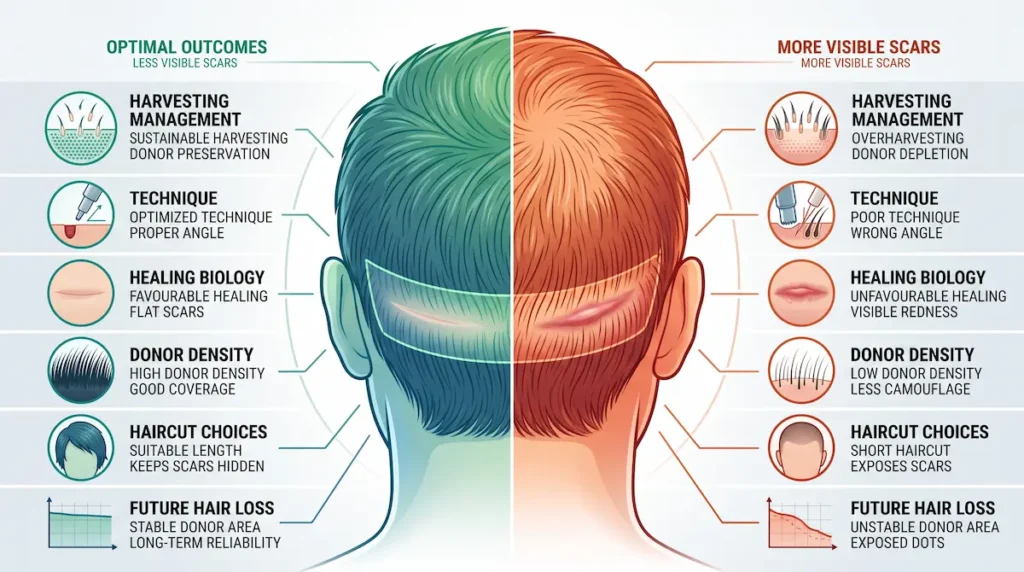
Not all FUE scars behave the same way. Two men can have the same number of grafts removed and end up with very different donor-area visibility. The difference usually comes down to technique, donor density, healing biology, and haircut choices. This is where the details matter. A tiny extraction mark is one thing; a thinned-out donor zone is another.
Punch size and technique
The punch is the small circular instrument used to release each follicular unit from the scalp. A smaller punch may create a smaller wound, but size alone does not make a result safer. If the punch is too small for the hair calibre or curl pattern, it can damage grafts. If it is too large, it may leave larger white dots. The surgeon has to balance graft survival with donor scarring.
Angle matters as well. Hair follicles do not always exit the skin in the same direction they travel underneath it. Curly, wavy, or coarse hair can be more technically demanding because the follicle may curve below the skin surface. If the extraction angle is misjudged, the graft can be damaged and the surrounding wound can be less tidy.
That is why FUE should not be judged as a simple “dot scar” procedure. It is a donor-management procedure. The surgeon is working with limited tissue, variable hair direction, and a finite graft supply.
Overharvesting and donor depletion
Overharvesting is the main reason FUE scars become visibly unattractive. It happens when too many follicular units are removed from the donor zone, or when grafts are taken too close together. The result may look like generalized thinning, patchiness, or a “moth-eaten” pattern rather than clean, scattered dot marks.
This can be especially frustrating because the donor area is supposed to be the patient’s long-term reserve. Once it is depleted, it cannot simply be refilled like a storage tank. A second procedure becomes harder. Short hairstyles become less forgiving. The contrast between pale extraction dots and reduced hair density can become more obvious.
Patients sometimes ask for the highest possible graft number because they want strong frontal coverage in one session. That is understandable. But a responsible plan weighs today’s hairline against tomorrow’s donor supply. If male pattern hair loss continues, the crown or mid-scalp may need attention later. A depleted donor area limits those options.
For a deeper look at this zone, see what happens to the donor area after a transplant.
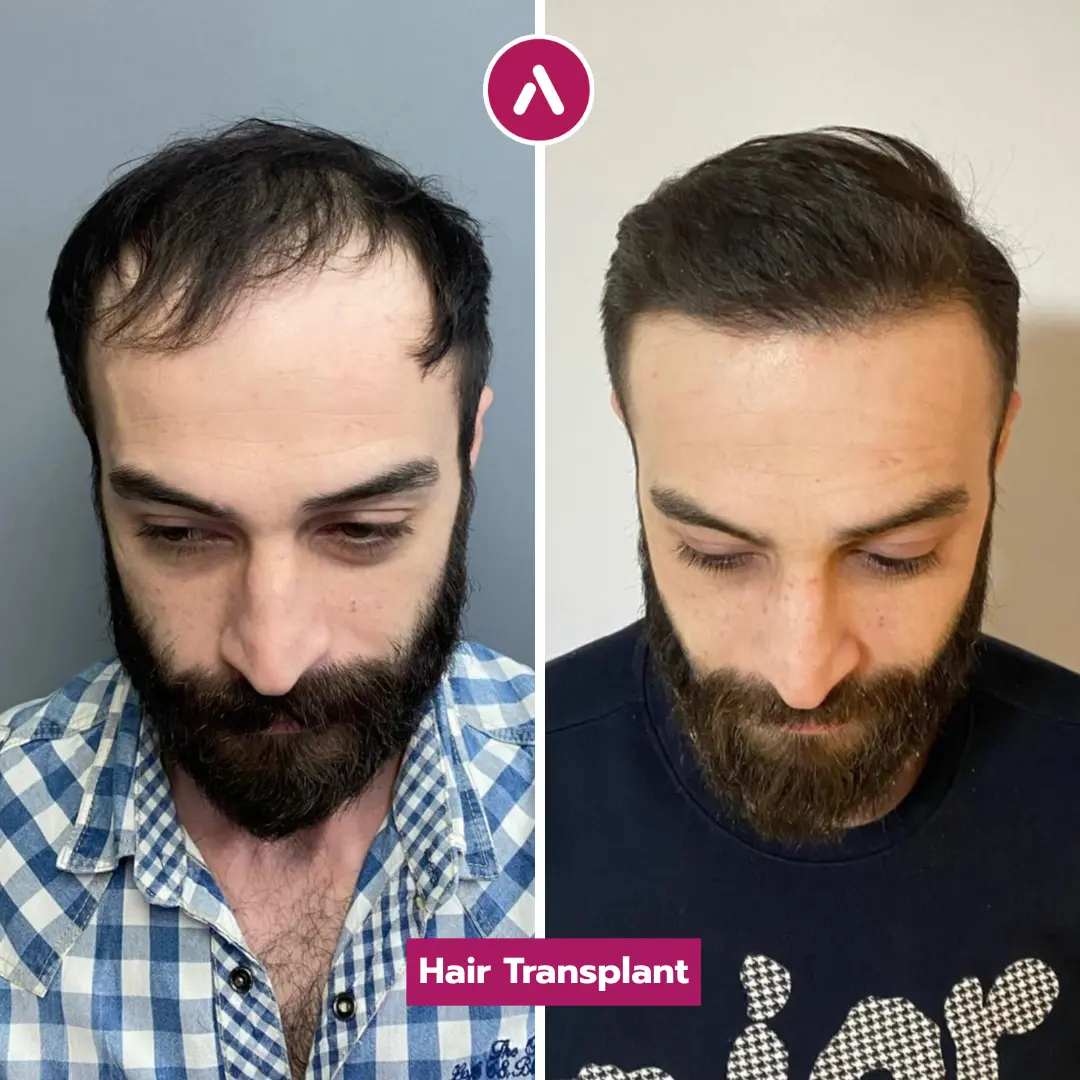
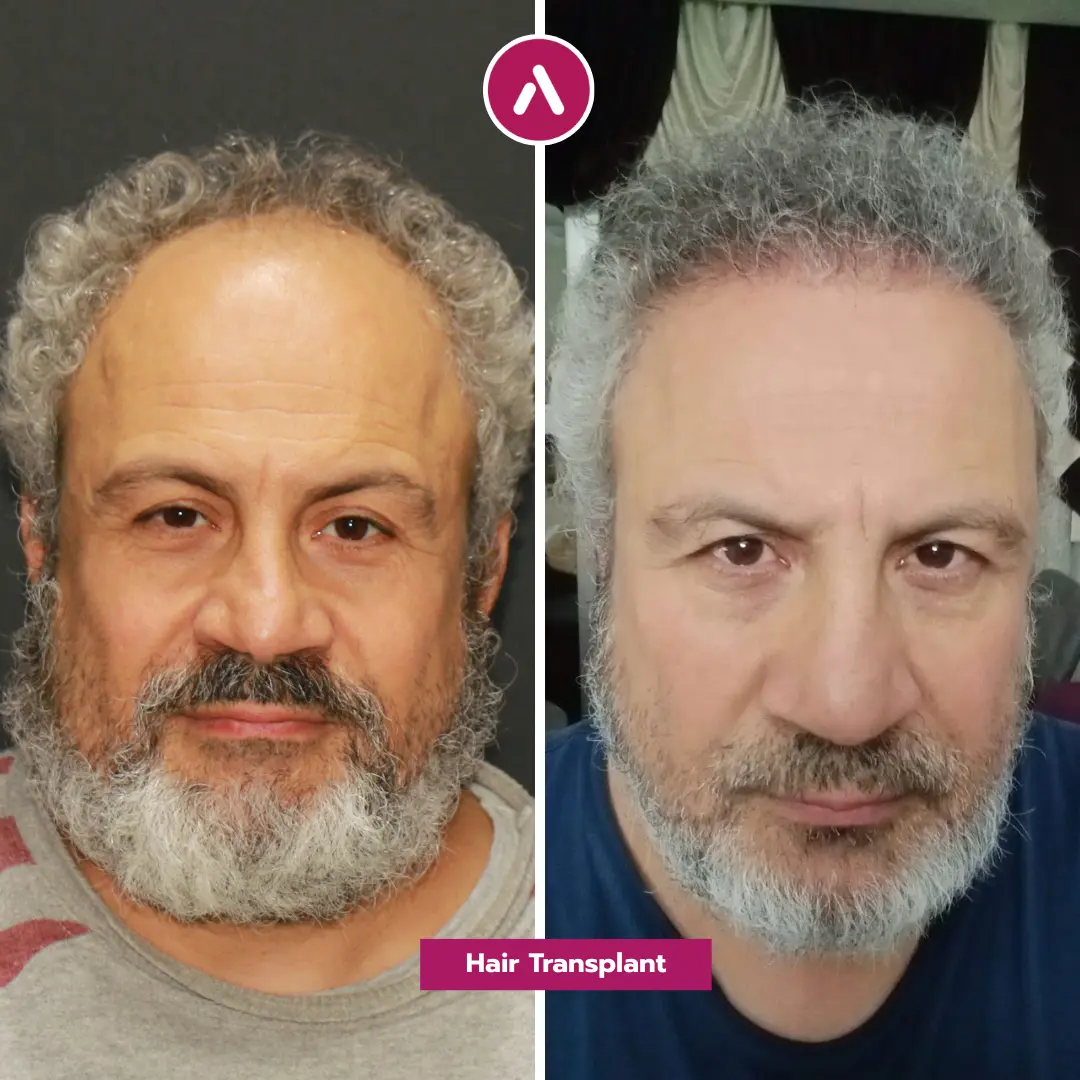
Skin type, healing, and keloid tendency
Skin healing is personal. Some patients form flat, pale marks. Others develop more visible colour contrast, lingering redness, or raised scar tissue. A history of hypertrophic scars or keloids should always be discussed before surgery, even though extensive keloid formation after FUE is uncommon.
Skin colour can also affect what the donor marks look like while they mature. In some patients, early marks look pink or red. In others, they can look lighter or darker than the surrounding scalp. Most settle with time, but the final contrast depends on your healing response and how much hair remains to cover the area.
Scalp characteristics matter too. Fine hair provides less camouflage than thick hair. Low donor density offers less cover than high density. A high skin-to-hair contrast makes white dots easier to notice. This is why two men with the same graft count may have very different donor visibility after healing.
Scarring and future hair loss
FUE donor marks can become more visible years later if surrounding donor hair thins with age. This is not always a surgical mistake. It can happen because the “cover” around the healed dots becomes weaker over time. That is why safe donor-zone planning matters so much.
If grafts are taken from an unstable area, those transplanted hairs may not behave as reliably in the recipient zone, and the donor scars may become exposed as native hair thins. For a hair loss patient, that means the question is not only “How many grafts can I get?” It is also “Will this donor area still look natural if my hair loss progresses?”
You can read more about the long-term behaviour of transplanted follicles in our guide to how permanent the results are.
A Well-Coordinated Hair Transplant Experience
From private airport transfers to comfortable, well-appointed hotel accommodation, we handle every detail of your stay. The result is a seamless all-inclusive clinical pathway in Istanbul — so you can focus on your procedure and recovery while we manage the logistics.
How Surgeons Minimize Donor Scarring
Good FUE is conservative, measured, and future-focused. The goal is not to remove the most grafts possible in a single day. It is to remove the right number of grafts from the right areas, with spacing that lets the donor region keep enough visual density. This is where the difference between a technician-led harvest and a surgeon-led plan becomes visible years later.
Graft spacing discipline
Spacing is one of the biggest donor-area safeguards. If extraction sites are too close together, the remaining hair cannot camouflage the healed dots. Even if each individual punch mark is small, the overall zone can look thinned.
A disciplined FUE harvest distributes extractions across the safe donor area instead of creating dense clusters of removal. The edges of the donor zone also need care. If the surgeon removes too aggressively at the margins, the transition into non-donor hair can look unnatural, especially with short haircuts.
Think of the donor area as a forest. Removing a few trees across a wide area may still leave the forest looking full. Removing too many trees from one patch creates a clearing. FUE scarring follows the same visual logic.
Punch diameter selection
Punch diameter should be chosen according to hair calibre, follicle spacing, curl pattern, and graft quality. A small punch may sound better to patients, but it is not automatically better if it increases transection or damages follicles. A larger punch may be appropriate for certain hair types, but it can increase the visible size of donor dots if used carelessly.
The right choice is individualized. A patient with coarse, curly hair may need a different extraction approach than a patient with fine, straight hair. A patient who wants a close fade may need an even more conservative harvest pattern than someone who wears the donor area longer.
This is also where no-shave techniques need realistic framing. They can help conceal the immediate post-op donor area, but they do not erase the need for safe extraction planning. To understand when they are useful, see our guide to no-shave harvesting options.
Long-term donor management philosophy
A strong donor plan starts with restraint. The surgical team should assess donor density, hair calibre, scalp laxity, hair loss pattern, age, family history, and the likelihood of future progression. A 28-year-old with active loss should not be planned the same way as a 48-year-old with stable loss.
For Canadian patients comparing local and international options, this is a key safety filter. A high graft count may sound efficient, but it can be a red flag if the clinic does not explain where those grafts will come from and how the remaining donor hair will look after healing.
A careful plan also considers the possibility of a second transplant. If the front is rebuilt now and the crown thins later, the donor area may need to support another session. Aggressive harvesting today can close that door too early.
Board-certified team note: Donor hair is not unlimited. The safest FUE plans protect density first, then build coverage. A result that looks impressive from the front but leaves the back patchy is not a well-balanced hair transplant.
What to ask before surgery
Before travelling for FUE, ask practical donor-area questions. You do not need to know every surgical detail, but you should understand the logic behind the plan.
- How will my donor density be measured?
- How many grafts can be removed safely, not just technically?
- Will extractions be spread evenly across the safe donor zone?
- What haircut length should I expect to maintain after healing?
- Do I have enough donor reserve for future hair loss?
- What is the plan if I need crown or temple work later?
At AKM Clinic, donor planning is framed around natural-looking coverage, conservative harvest patterns, and long-term follow-up rather than one-session overcorrection. For Canadian patients, the consultation should also include a clear plan for virtual review after returning home, so donor healing can be monitored beyond the first few weeks.
That does not mean every tiny dot can be prevented. It means the donor area is treated as part of the final result, not as a hidden source of grafts.

How to Hide or Improve an Existing Scar?
If a donor scar is already visible, the solution depends on the problem. Tiny FUE dots, a patchy overharvested donor area, and a wide FUT line are not treated the same way. The first step is to identify whether the issue is colour contrast, missing density, scar texture, or poor donor distribution.
SMP and trichopigmentation
Scalp micropigmentation, often shortened to SMP, uses medical-style pigment placement to reduce the contrast between pale donor marks and the surrounding scalp. It does not remove the scar. It changes how the eye reads the area.
SMP can be useful for small FUE dots, a widened FUT line, or mild donor thinning after overharvesting. The key is subtlety. If the pigment is too dark, too dense, or placed in an unnatural pattern, it can look obvious under bright light. The best SMP work blends with your natural hair colour, scalp tone, and haircut length.
For men who keep their hair very short, SMP can make donor marks less distracting. For men who wear the back and sides longer, a haircut adjustment may be enough. This is why scar camouflage should be planned around your actual lifestyle, not just a clinic photo.
Adjusting haircut length
The simplest camouflage is often a small change in hair length. A skin fade may expose FUE dots. A slightly longer clipper setting may hide them. This is not a failure; it is how donor coverage works.
Ask your barber to test different lengths gradually rather than going straight to the shortest setting. Check the donor area in natural light, bathroom light, and overhead gym lighting. Scars can look different depending on the angle and brightness.
If the donor area looks clean at a moderate length but speckled at a wet shave, the issue may be normal FUE dot visibility. If it looks patchy even with some length, the problem may be donor depletion from overharvesting.
FUE into scar tissue or revision options
Some scars can be improved by placing grafts into the scar tissue. This is more common with FUT linear scars, but selected FUE-related gaps can also be softened with careful grafting. Scar tissue has a different blood supply than normal scalp, so survival can be less predictable. It must be planned carefully.
In some cases, a revision may be considered. A wide FUT line may be revised surgically. A patchy FUE donor area may need a combination of SMP, conservative graft redistribution, and realistic haircut planning. There is no single fix that works for every donor scar.
This is also why poor donor planning in any hair restoration procedure matters. The same principle applies when evaluating what poor donor planning can lead to in facial hair restoration: the donor supply must be respected from the beginning.
When not to chase another procedure
A visible donor scar can make patients want an immediate repair. Pause first. If the transplant is still early, redness, scabbing, and colour change may continue to settle. If the donor area is depleted, taking more grafts can make the problem worse.
A second procedure should only be considered after the donor zone is fully assessed: density, scar pattern, scalp contrast, and remaining graft reserve. In some cases, the safest answer is not more surgery. It may be a better haircut, SMP, or simply waiting for scar colour to mature.
If you are comparing repair options, do not start with price. Start with donor diagnosis. You can review the cost of an FUE hair transplant separately, but scar repair planning should be based on what your donor area can safely support.
AKM’s donor-area consultation approach
At AKM Clinic, FUE scar planning begins before extraction. The team assesses donor density, hair calibre, future hair loss risk, and the haircut style you want to maintain. For Canadian patients, the goal is not only a strong hairline in photos. It is a donor area that still looks natural after you return home, visit your own barber, and live with the result long term.
If you already have visible donor marks from a previous transplant, a virtual consultation can help separate normal FUE dotting from overharvesting, FUT scar widening, or donor depletion. From there, the plan may involve observation, SMP, selective grafting, or a more conservative revision pathway.
Ask AKM how conservative FUE harvesting protects your donor area before committing to a graft number.
Frequently Asked Questions: Hair Transplant Scars
These are the questions patients usually ask once they understand that FUE is not truly scarless. The answers are practical, because the real concern is how the donor area will look in daily life — under short hair, bright light, and future hair loss.
Do FUE scars ever fully disappear?
Can I shave my head after FUE?
How big are FUE scars?
Can a bad donor scar be fixed?
Does scarring affect a second transplant?
How long until donor marks fade?
Are FUT scars worse than FUE scars?
What is the best way to prevent hair transplant scars from showing?
Have Specific Questions About Hair Transplant?
Chat directly with our dedicated patient coordinators about your Hair Transplant. Whether you're weighing your options from Ontario, British Columbia, or Alberta, you'll get clear, personalized answers — straight from the team who will look after you, not a call centre.
Medical disclaimer: This article is for educational purposes only and is not personal medical advice. Hair transplant healing, scar visibility, graft survival, and donor-area outcomes vary by patient. Always consult a qualified medical professional before deciding on FUE, FUT, scar revision, SMP, or any surgical procedure.
Related Procedures

Awake Abdominal Etching
A Canadian patient guide to awake abdominal etching in Istanbul: pure local anesthesia, comfort, recovery, cost, safety, and fit-to-fly planning.
Facelift
Explore Facelift in Turkey for Canadian patients, including SMAS vs deep plane techniques, CAD pricing, recovery, surgeon credentials and safety.
Hair Transplant For Women
Explore hair transplant for women in Turkey with no-shave FUE and DHI, female hairline design, donor assessment, recovery timeline, and Canada-to-Istanbul care.
Beard and Moustache Transplant
Beard Moustache transplant in Turkey for Canadians from CAD $4,800. FUE/DHI facial hair restoration with 5-star stay, VIP transfers, and follow-up.
Ready to Begin Your Journey?
Join the more than 2,000 patients who have trusted Dr. Akif Mehmetoğlu and the AKM Clinic team. Your journey begins with an informative, no-obligation conversation. Contact us today from across Canada to schedule your complimentary virtual consultation.
#1: Receive Your Personalized Quote
Start with a complimentary, no-obligation virtual consultation. Share your photos, and our surgical team will provide a fully personalized treatment plan and a transparent, all-inclusive pricing package quoted in Canadian dollars (CAD). There are no hidden fees.
#2: Secure Your Procedure Date
Once you are ready to proceed, our dedicated English-speaking patient coordinators will help you secure your procedure date. We will manage your logistical bookings in Istanbul, including your five-star hotel and private airport transfers.
#3: Arrive in Istanbul & Meet Your Surgeon
Arrive at Istanbul Airport (IST), where you will be greeted by your private driver. Settle into your hotel before your comprehensive in-person consultation. You will meet your specialist surgeon to finalize the details of your procedure and ensure your goals are aligned for a natural, subtle result.