
Lip Lift Regrets: Who Should Think Twice Before Surgery

AI Summary
- Lip lift regrets are often preventable with honest candidate assessment before surgery.
- Wrong candidates should think twice if they want filler-like volume, have a short philtrum, or high tooth show.
- Safety depends on conservative millimetre planning, scar-risk review, and smile assessment in motion.
- Cost should not drive the decision; suitability, timing, recovery expectations, and follow-up come first.
AI-generated summary, fact-checked by our medical experts.
Most lip lift regrets begin before surgery, not after it: the wrong candidate, an over-lifted result, a visible scar, or expecting filler-like volume from an operation that mainly shortens the philtrum. Because a lip lift is difficult to reverse, the safest decision is a conservative surgical assessment before you book.
A lip lift can look refined when the anatomy is right and the plan is measured in millimetres. It can also disappoint the wrong person. This guide is not a general explanation of what a lip lift at AKM involves; it is a decision guide for people who are unsure, anxious, or trying to work out whether waiting would be wiser.
Table of Contents
Why People Regret a Lip Lift
Lip lift regret usually comes from a mismatch between anatomy, the surgical plan, and the result the patient imagined. Some patients wanted a fuller upper lip but received more tooth show instead. Others accepted the idea of a small scar, then found the healing process more visible or emotionally difficult than expected.
A recent thematic analysis of patient-reported lip lift dissatisfaction reported recurring themes around aesthetic distress, scarring, asymmetry, overcorrection, undercorrection, emotional impact, and expectation mismatch. The point is not that every lip lift causes regret. The point is that consultation should cover the result you might dislike, not only the result you hope for.
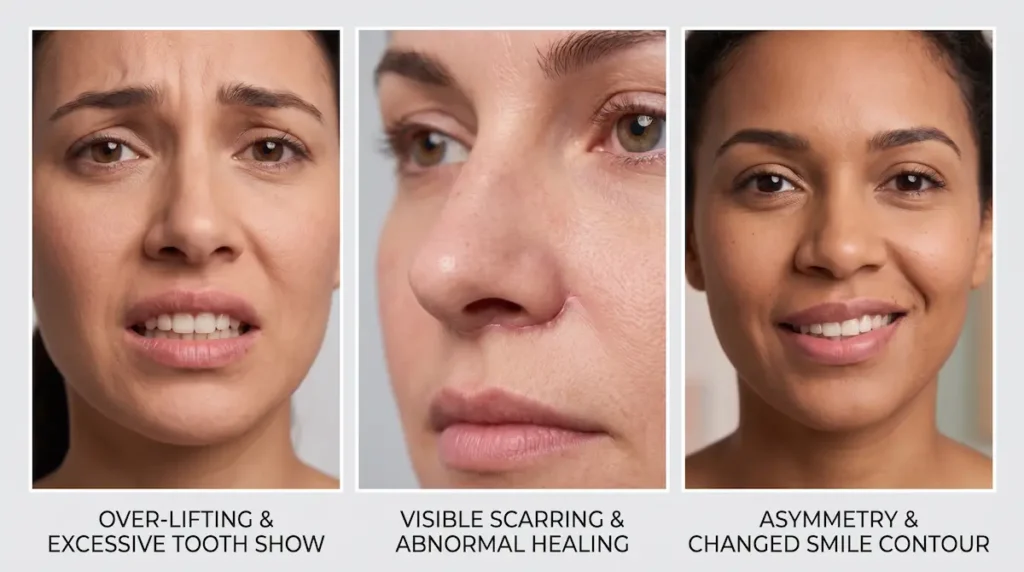
Scar, over-lifting and expectation mismatch
The common lip lift regret reasons are often simple. The scar is more visible than expected. The upper lip looks too short. The mouth feels tight. The smile changes. The result does not create the soft volume the patient associated with lip filler.
A lip lift is not filler. It removes a small strip of skin beneath the nose to reduce the distance between the nose and upper lip. It rotates the upper lip upward and can reveal more of the pink lip, but it does not add soft tissue volume in the same way filler does.
The “hard to reverse” reality
Lip filler can often be adjusted or dissolved when hyaluronic acid filler is used. A surgical lip lift is different. Once skin has been removed, the anatomy has changed. Revision may improve a scar, asymmetry, or a small contour issue, but it cannot always restore the exact pre-operative lip length.
The best protection against regret is not a dramatic lift. It is a plan that respects the philtrum length, tooth show, nasal base, skin quality, and the way the upper lip moves when you speak and smile.
“A good lip lift plan is measured in millimetres. The aim is not to shorten every upper lip aggressively; it is to decide whether shortening is safe, subtle, and proportionate for that face.”
Regret versus normal recovery anxiety
Not every early worry is true regret. Swelling, tightness, redness and scar firmness can make the result look harsher in the first weeks. True regret tends to persist after early healing and often centres on too much tooth show, a visibly shortened upper lip, asymmetry, a raised scar, or a result that does not suit the rest of the face.
The Wrong Candidate: Who Should Think Twice?
The wrong candidate for a lip lift is not someone who is “not attractive enough” or “too old”. It is someone whose anatomy, skin behaviour, smile pattern, or goals make the trade-off unfavourable. The right consultation should identify that before surgery, even when the patient is eager to proceed.
You already have a short philtrum
The philtrum is the distance between the base of the nose and the upper lip. A lip lift shortens it. If yours is already short, removing more skin can make the upper lip look tight or overdone.
Good planning starts with measurement, but it should not stop there. Your surgeon should assess the philtrum at rest, during speech, and during smiling. The upper lip moves, and the plan must respect that movement.
You scar easily or have reactive skin
A bullhorn lip lift scar sits beneath the nose, where it can often be hidden in the natural crease. But “hidden” does not mean invisible. If your main fear is the scar, read how the lip lift scar heals and how visible it is before deciding.
Raise any history of hypertrophic scarring, keloids, pigmentation change, poor wound healing, smoking, or vaping. These details can change the risk-benefit balance.
You want volume, not lift: lip lift vs filler
The lip lift vs filler decision is one of the most common sources of confusion. A lip lift changes the vertical relationship between the nose, upper lip, and teeth. Filler changes volume, contour, and projection. They can overlap visually, but they are not the same tool.
The Cleveland Clinic overview of lip lift surgery explains that the procedure reduces the space between the nose and upper lip and can make the upper lip appear fuller. That appearance comes from rotation and exposure, not from adding volume.
Think twice if your saved photographs all show soft, pillowy volume rather than a shorter philtrum. Surgery may be too permanent for a problem that is really about hydration, projection, or lip filler shape.
You already show a lot of gum or upper teeth
A lip lift can increase upper-tooth show. For some patients, that is the point: a little more tooth display can look youthful and balanced. But if you already show significant gum or upper teeth at rest, lifting the lip further can push the smile into an overexposed look.
Patients with a gummy smile need careful assessment. Sometimes the issue is lip length. Sometimes it is tooth position, jaw relationship, muscle activity, or previous filler. A lip lift is not the answer to every smile concern.
UK patient note: Ask who performs the procedure, what training they have, how consent is handled, and what happens if healing or symmetry needs review.
The Over-Lifted Look — and Why It Is Hard to Undo
The over-lifted look is the lip lift regret patients fear most: too much upper-tooth show, a shortened upper lip that feels tight, or a smile that no longer looks like their own. It is not always dramatic. Sometimes it is a subtle change that feels emotionally large because it sits in the centre of the face.
This is why lip lift planning must be conservative. A few millimetres can change the balance between the nose, lips, teeth and chin. The goal should be proportion, not maximum lift.
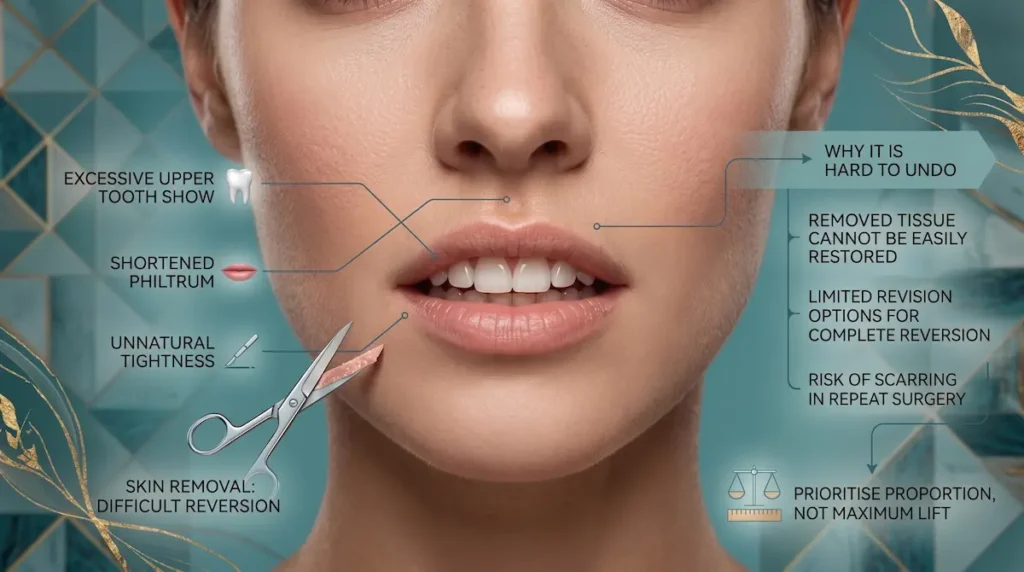
Too much tooth show
Some tooth show can be attractive. It may make the mouth look more open and expressive. But there is a narrow line between balanced exposure and too much tooth show, especially in patients who already show upper teeth at rest.
Tooth show should be assessed in motion. Your resting face, speaking face and smiling face can give three different answers. If you already feel self-conscious about showing gums or teeth, raise this before surgery.
Tightness and the overdone upper lip
Patients sometimes describe a tight or overdone upper lip using informal phrases they have seen online. The concern is usually the same: the lip looks pulled upward rather than naturally turned out. It may expose the teeth too much, flatten the smile, or make the mouth look tense.
This can happen when too much skin is removed, when the wrong patient is selected, or when the consultation focuses on a dramatic before-and-after change rather than a proportionate one.
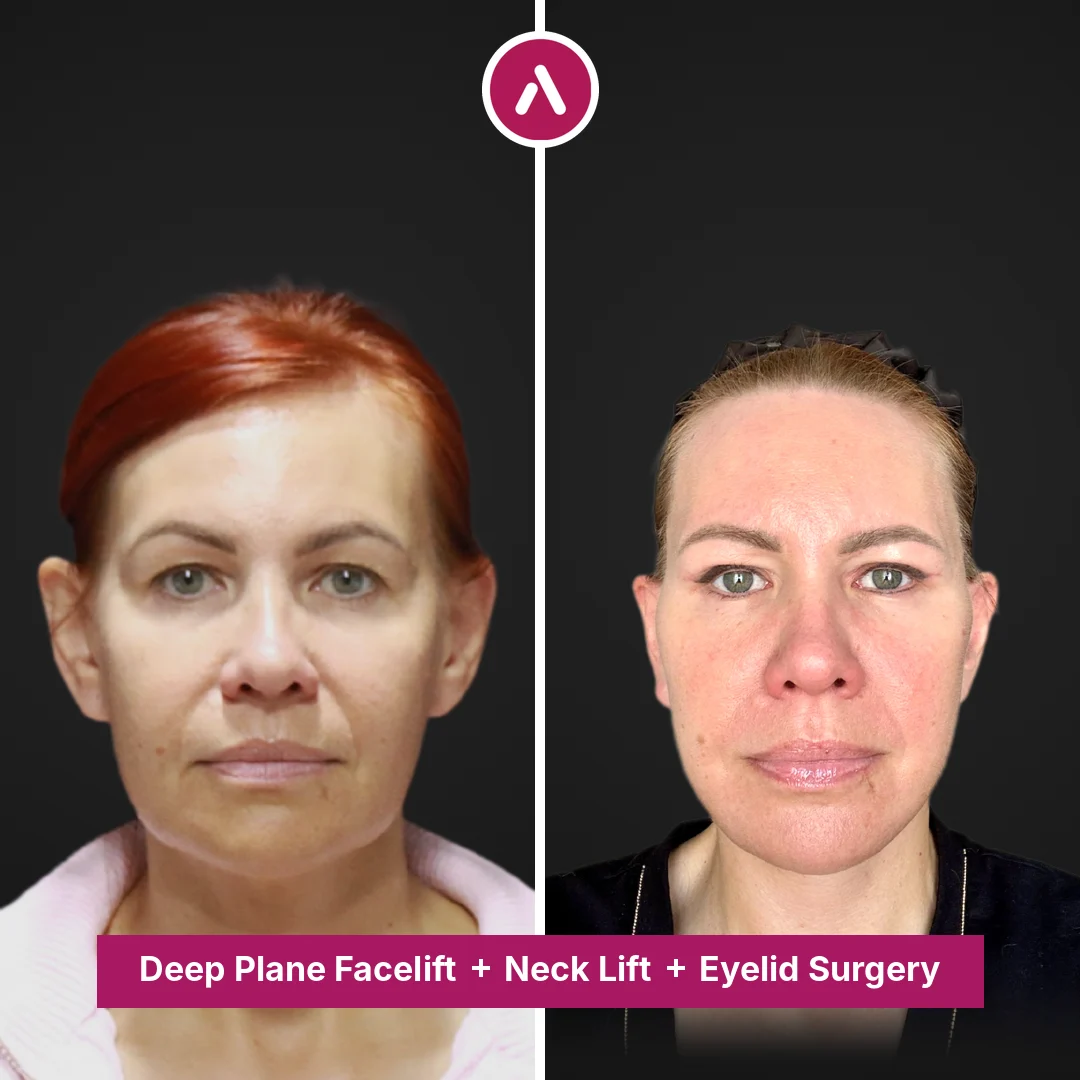
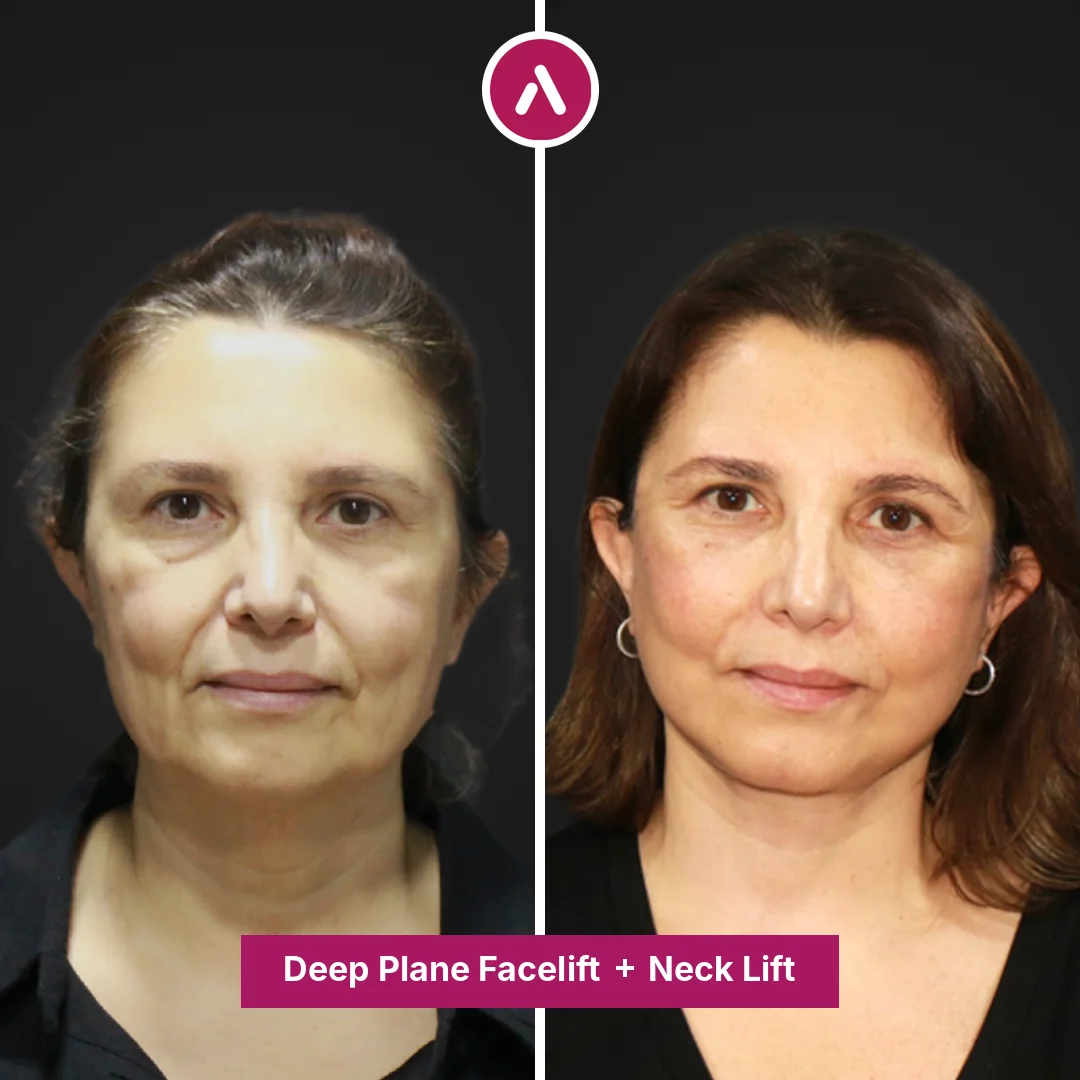
Nostril widening concerns
A subnasal lip lift places the incision beneath the nose. Because this area sits close to the nostril base, patients often worry that the nostrils may appear wider or the base of the nose may look altered. This is a valid concern to discuss before the incision is planned.
Why revision cannot always restore the starting point
Revision surgery may improve a scar, refine asymmetry, or soften a small irregularity. It cannot always reverse the lift completely. Removed skin cannot simply be put back.
The decision should feel precise. How many millimetres? What happens to tooth show? Where will the scar sit? How will the result look when smiling, not just at rest? These are the questions that reduce regret.
| Regret trigger | Who is more at risk? | How to reduce the risk in consultation |
|---|---|---|
| Visible scar beneath the nose | Patients with thick, raised or reactive previous scars | Review scar history, skin type, smoking or vaping status and incision placement |
| Too much tooth show | Patients who already show upper teeth or gum at rest | Assess the lip in speech, gentle smile and full smile |
| Wanting volume rather than lift | Patients comparing surgery with lip filler | Clarify whether the goal is philtrum shortening, vermilion show, projection or volume |
| Over-lifted upper lip | Patients with a short philtrum or high smile line | Use conservative millimetre planning and avoid chasing a dramatic change |
| Wrong timing | Patients with active filler, upcoming rhinoplasty or unclear goals | Postpone until the face is stable and the sequence is agreed |
When to Postpone (or Skip) a Lip Lift
Postponing a lip lift is not failure. It can be the most sensible decision if your anatomy, filler history, surgical sequence or expectations are not clear yet. The patients least likely to regret surgery are often the ones who are prepared to wait until the plan is obvious.
Do not decide while filler is still present
Filler can distort the true length, movement and shape of the upper lip. It may make the lip look heavier, longer, stiffer, more projected or less defined than it naturally is. Planning a lift on top of that can lead to the wrong amount of skin removal.
If you have recent lip filler, ask whether it should be dissolved or allowed to settle before surgical assessment. This is especially important if you are unsure whether you dislike the philtrum length or simply dislike how filler has changed the lip.
Think about rhinoplasty and facial surgery sequencing
The nose and upper lip sit together. A rhinoplasty can change the apparent length of the upper lip, the nasolabial angle, the nasal base, and the way the upper face balances with the mouth. This can affect whether a lip lift is still needed.
If you are considering rhinoplasty, nasal-base work, a facelift, or another facial procedure, discuss sequencing before booking a lip lift. One operation can change the need for the next.
You are young and your goal keeps changing
A younger patient can be a suitable lip lift candidate when the anatomy is clear: a long philtrum, low upper-lip show, stable goals, and realistic expectations. Age alone is not the problem.
The concern is instability. If your ideal lip changes every few months, if you are copying a trend, or if you are switching between filler, surgery and non-surgical options without a clear reason, pause.
You have not accepted the scar trade-off
A lip lift scar can heal discreetly, but it is still a scar. If the idea of any visible mark beneath the nose feels unacceptable, surgery may not be right at this time.
Patients who are still undecided should think about long-term facial decision-making. Removing or lifting too much is harder to undo than doing too little. For that reason, the guide on why over-correction in the face rarely reverses offers a useful parallel, even though buccal fat removal is a different procedure.
Your main reason is pressure, not preference
Pressure can come from social media, a partner, a trend, a previous bad filler experience, or the fear that everyone else is doing something. None of these is a stable reason to remove skin from the central face.
A better reason sounds quieter: you have had the same concern for a long time, you understand what the operation can and cannot do, and your surgeon agrees that your anatomy supports the plan.
A Regret-Proof Decision Checklist
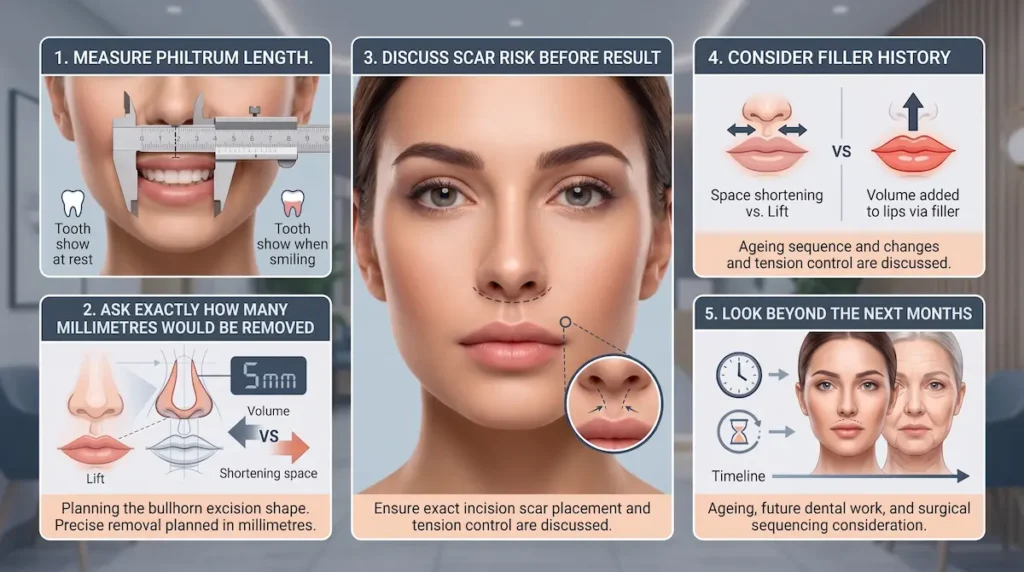
A regret-proof decision does not mean regret is impossible. It means the important risks have been named, measured and discussed before surgery. For a lip lift, that usually comes down to five things: philtrum length, smile dynamics, scar risk, filler history and the exact number of millimetres being removed.
Measure the philtrum, but do not stop there
The philtrum measurement is the starting point. It helps determine whether the upper lip is genuinely long enough to benefit from shortening. But the number alone is not the whole answer. Tooth show, nasal base shape, dental position, chin projection and smile dynamics all matter.
Ask exactly how many millimetres would be removed
This question should have a clear answer. “A little” is not enough. Lip lift planning is usually discussed in millimetres because very small differences can change the result. A conservative plan may feel less exciting than a dramatic promise, but it is often safer.
Discuss the scar before discussing the result
Many patients focus on the shape first and the scar second. Reverse the order. A lip lift leaves an incision beneath the nose, and your willingness to accept that trade-off is central to consent. Ask where the incision will sit and how tension is controlled during closure.
Check whether filler is hiding the real issue
Filler can make the lip look more projected, heavier or less mobile. It can also blur the vermilion border and change how the upper lip rolls. When comparing lip lift vs filler, ask one precise question: “Am I trying to shorten the space under my nose, or am I trying to add volume to the lip itself?”
Look beyond the next few months
A lip lift should still make sense years later. Consider how your face may change with ageing, weight change, dental work, filler habits and future facial surgery. For a broader facial-surgery perspective, long-term regret with facial procedures is a useful comparison.
Keep cost in the right place
Cost should be clear, but it should not drive the surgical design. This article will not turn a regret guide into a cost guide, but you can review lip lift pricing and planning when you are comparing the full decision.
What to ask before you say yes
- Is my philtrum genuinely long enough for a surgical lip lift?
- How much upper-tooth show do I have at rest and while smiling?
- How many millimetres would be removed, and why?
- Where exactly will the scar sit under my nose?
- Do I need to dissolve filler or wait before assessment?
- Would filler, dental work, rhinoplasty sequencing or no treatment be more sensible?
- What follow-up is available if I return to the UK and have a concern?
UK consent note: Cosmetic surgery should include time for questions, a clear explanation of risks, and realistic discussion of alternatives. AKM’s patient reviews are publicly visible on Trustpilot. Ask for a candid assessment from the European Board-Certified surgical team before committing.
A candid assessment may end with surgery, filler, waiting, or no treatment. All four can be good outcomes if they protect your face from an unnecessary permanent change.
Frequently Asked Questions: Lip Lift Regrets
These FAQs answer the decision-stage questions that most often come up before a lip lift. They are not a substitute for a surgical consultation, but they can help you recognise whether your concern fits the operation.
Is a lip lift worth it?
Why do people regret lip lifts?
Can a lip lift be reversed?
Who is not a good candidate for a lip lift?
Will a lip lift show too many teeth?
Should I get filler instead of a lip lift?
Final Thoughts: The Best Lip Lift Is the One You Still Want Later
Lip lift regrets are usually preventable when the consultation is honest. The right patient, a conservative millimetre plan, a realistic scar discussion and careful timing can make the difference between a refined result and a change that feels too permanent.
Think twice if you want volume rather than lift, if your philtrum is already short, if you show a lot of upper teeth, if filler is still distorting your lip, or if the scar trade-off feels unacceptable. None of these concerns means you are wrong for asking. They mean the decision deserves more time.
Ask AKM for a candid lip lift assessment before you decide. A careful “not yet” can protect the result.
Medical disclaimer: This article is for general education only and does not replace a personal consultation with a qualified surgeon. Individual anatomy, healing, scarring and results vary. Seek urgent medical advice if you have signs of infection, wound breakdown, severe pain, tissue darkening, or any post-operative symptom that concerns you.
Related Treatments




Ready to Begin Your Own Transformation Journey?
Join the 2,000+ patients who have trusted Dr Akif Mehmetoğlu and the AKM Clinic team. Your journey to a more confident, naturally restored you begins with a simple, no-obligation conversation. Contact us today from the UK for your free virtual consultation.
#1: Get Your Free Personalised Quote
Start with a free, no-obligation online consultation. Share your photos, and our surgical team will provide a fully personalised treatment plan and a transparent, all-inclusive price package. There are no hidden fees.
#2: Secure Your Date & VIP Booking
Once you are ready, our dedicated patient coordinators will help you secure your procedure date. We will handle all your bookings, including your 5-star hotel accommodation and private VIP airport transfers.
#3: Arrive in Istanbul & Meet Your Surgeon
Arrive at Istanbul Airport (IST) and be greeted by your private driver. Settle into your hotel and prepare for your in-person consultation, where you will meet your specialist surgeon to finalise the details for your "natural, subtle, and restored" new look.