
Lip Lift Regrets: Who Should Think Twice Before Surgery
AI Summary
- Lip lift regrets are preventable with anatomy-led candidacy, scar tolerance, and conservative millimeter planning.
- Wrong candidates should pause with a short philtrum, high tooth show, or gummy smile risk.
- Lip lift vs filler matters because surgery lifts permanently, while filler addresses temporary volume concerns.
- Discuss cost only after candidacy so pricing never overrides safety, timing, and realistic expectations.
Summary generated by AI, fact-checked by our medical experts
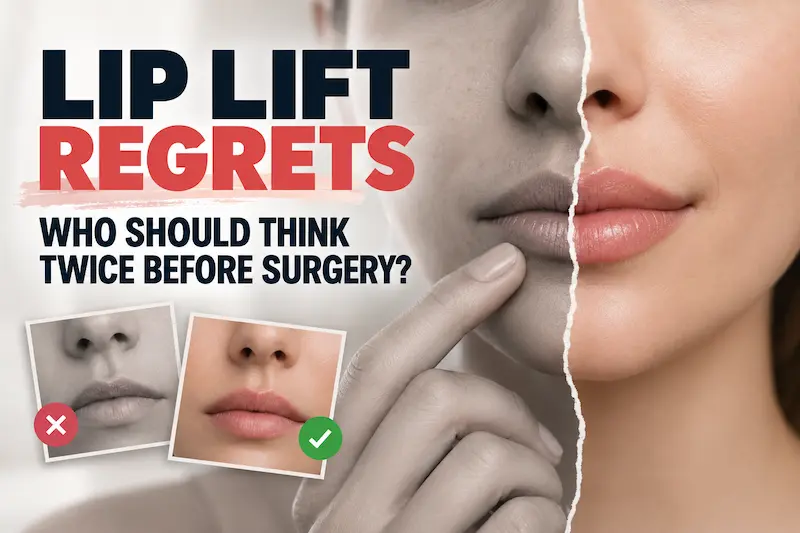
Lip lift regrets usually come from three preventable problems: the wrong candidate, an over-lifted result, or a scar that looks more visible than expected. A lip lift can be a beautiful, permanent change for the right face. It can also feel unforgiving when the upper lip is already short, the goal is actually volume, or the surgical plan removes too much skin.
This guide is not here to scare you away from surgery. It is here to help you pause before a permanent facial decision. A lip lift consultation should start with anatomy, not trends: philtrum length, tooth show at rest, smile movement, scar risk, filler history, and how the upper lip fits with the nose and chin. You can also read what a lip lift at AKM involves before you book.
That matters because a lip lift is not filler. Filler can usually be adjusted or dissolved. A lip lift removes skin under the nose to shorten the space between the nose and upper lip. Once tissue is removed, revision is harder, less predictable, and rarely as simple as “putting it back.”
The best lip lift decisions are conservative. They are measured in millimeters, discussed in plain language, and made only after the patient understands what can improve, what may not change, and what could look worse if the wrong face is lifted.
Table of Contents
Why People Regret a Lip Lift
People rarely regret a lip lift because the idea was “bad.” They regret it when the idea did not match their anatomy, their expectations, or the surgeon’s measurements. That difference can be small on paper. On the face, it is obvious.
A lip lift changes the relationship between the nose, upper lip, teeth, and smile. It can shorten a long philtrum, increase upper tooth show, and make the red part of the upper lip appear more visible. It does not create soft, pillowy volume in the same way lip filler does. It also does not behave like a temporary treatment that fades quietly if you dislike it.
Patient-reported dissatisfaction studies point to the same themes again and again: scar concerns, asymmetry, nasal-base changes, too much or too little lift, and an emotional mismatch between what the patient expected and what appeared in the mirror. A recent PubMed-indexed review, a thematic analysis of patient-reported lip lift dissatisfaction, found recurring complaints around scarring, nasal or alar distortion, asymmetry, and lift amount. In plain terms, most lip lift regret reasons are not mysterious. They are usually visible before surgery if the consultation is honest enough.
That is why the first question is not “Is a lip lift worth it?” The better question is: worth it for which face, which goal, and which risk tolerance?

Regret can be surgical, emotional, or timing-related
Not every worry in the first few weeks is true regret. Early swelling, tightness, numbness, redness, and a stiff smile can make the result look strange before it settles. That phase can feel alarming, especially when the incision is under the nose and every facial movement reminds you it is there.
True regret tends to persist after healing. The scar remains more visible than expected. The upper lip looks too short. The smile shows more teeth or gum than the patient wanted. The nostrils look wider or more exposed. The result may photograph well from one angle but feel unnatural in real conversation.
Those problems carry a different emotional weight because the upper lip sits in the center of the face. You see it when you speak, smile, drink, apply makeup, and look at photos. A small overcorrection can become a daily annoyance.
The scar is a common surprise
A subnasal lip lift scar is designed to sit in the natural crease under the nose. In many patients, it fades into a fine line. Still, “designed to hide” is not the same as “guaranteed invisible.” Skin type, incision tension, sun exposure, healing behavior, and surgical closure all matter.
If scar visibility is your biggest fear, pause before surgery. Read how the lip lift scar heals and how visible it is before you make a decision. A patient who can accept a fine line under the nose may be comfortable with the trade-off. A patient who would feel distressed by any visible mark may not be ready.
Volume expectations create another source of disappointment
A lip lift can make the upper lip look fuller because more vermilion shows. That is an appearance of added height, not true volume. If your goal is plumpness, hydration, or a softer lip body, lip lift vs filler becomes a serious decision.
Some patients choose surgery because they are tired of repeated filler appointments. That can be reasonable. Others choose surgery because they dislike thin lips but do not actually have a long philtrum. That is risky. A short upper lip lifted further may look tight instead of fuller.
Good planning separates “I want more red lip show” from “I want more lip volume.” They are not the same request.
The Wrong Candidate: Who Should Think Twice?
The wrong candidate is not someone who “should never care” about their lips. It is someone whose anatomy, healing profile, or goal makes a lip lift more likely to disappoint than help. This is the section to read slowly.
A lip lift works best when there is a clear anatomical reason to shorten the upper-lip skin: a long philtrum, low upper tooth show, age-related elongation, or a flat upper lip that needs more visible vermilion rather than more injected volume. Without that problem, the procedure may create one.
You already have a short philtrum or a short upper lip
A too-short lip lift result can happen when the starting philtrum was already compact or when too much skin was removed. The upper lip may look pulled, tense, or overly exposed. The mouth can lose softness. Tooth show may become excessive.
This is why millimeter planning matters. A conservative surgeon does not chase a social-media ratio on every face. They measure at rest, during speech, and during smile. They look at the nose base, dental show, chin projection, and the way the upper lip moves.
Someone with a naturally short upper lip may still want refinement, but the margin for error is smaller. In that face, filler adjustment, orthodontic or dental assessment, a corner-focused plan, or no surgery may be the wiser answer.
You want volume, not lift
A lip lift is a lifting operation. It shortens the skin distance between the nose and the upper lip. It can expose more of the pink lip, but it does not fill the lip body the way hyaluronic acid filler can.
If your main complaint is “my lips are flat,” “my lips look dry,” or “I want a softer cushion,” filler may answer the goal more directly. If your complaint is “my upper lip disappears because the skin above it is too long,” a lip lift may make more sense.
This distinction prevents one of the most common lip lift regret reasons: choosing a permanent lift for a volume problem.
You have a strong tendency toward raised or widened scars
Any surgery can leave a scar. A lip lift places that scar in a highly visible area. If you have a history of hypertrophic scars, keloid-type scarring, poor wound healing, or strong post-inflammatory pigmentation, your surgeon should discuss that risk directly.
Scar-prone patients are not automatically excluded, but they need a more cautious conversation. Incision design, low-tension closure, aftercare, sun avoidance, and realistic scar expectations become central to the decision.
If the thought of a visible subnasal line feels unacceptable, surgery may not be worth the emotional trade-off.
You already show a lot of upper teeth or have a gummy smile tendency
A lip lift can increase upper tooth show. That is often one of the reasons patients want it. The problem begins when the patient already shows enough tooth at rest or has a lip that rises high during smiling.
In that case, the procedure can exaggerate tooth exposure or make the smile look strained. Lip lift gummy smile risk is especially important when the upper lip is mobile, the teeth are prominent, or gum show is already part of the smile pattern.
A good consultation should check the face in motion, not just in still photos. Regret often appears during speaking and smiling, not in the carefully posed before-and-after angle.
| Regret Trigger | Risk Profile | Prevention Step |
|---|---|---|
| Scar surprise | Scar-prone skin, high tension, strong fear of visible marks | Review scar placement, healing history, and aftercare before booking |
| Over-lifted look | Already-short philtrum, high tooth show, very mobile upper lip | Use conservative millimeter planning and assess the smile in motion |
| Wrong goal | Patient wants plumpness rather than upper-lip elevation | Compare lip lift vs filler before choosing permanent surgery |
| Timing mistake | Recent filler, planned rhinoplasty, unclear facial goals | Postpone until filler dissolves and the full facial plan is stable |
The safest patient is not the one who wants surgery the most. It is the one who understands the trade-off clearly and still feels comfortable with the plan.
The Over-Lifted Look — and Why It’s Hard to Undo
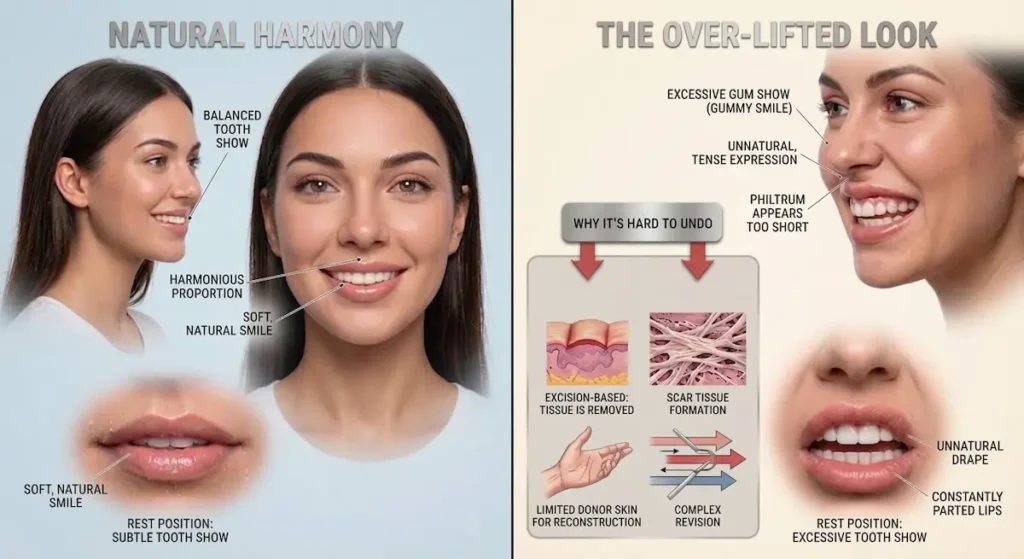
An over-lifted lip is one of the clearest sources of lip lift regret. It can happen when too much skin is removed, when the starting philtrum was already short, or when the smile was not evaluated in motion. The result may look sharp in a still photo but tight, toothy, or unnatural during speech.
This is where lip lift surgery becomes less forgiving than many patients expect. The operation is based on excision: a measured strip of skin is removed under the nose, then the remaining skin is closed to raise the upper lip. If the lift is too aggressive, the issue is not just swelling. The anatomy has been changed.
Too much tooth show can age the mouth instead of refreshing it
A small increase in upper tooth show can make the mouth look more youthful. Too much can do the opposite. If the upper lip sits too high at rest, the mouth may appear tense, dry, or constantly parted.
Some patients describe this as a “pulled” mouth. Others notice that their smile feels less relaxed. The upper lip may no longer drape naturally over the teeth, especially when speaking or laughing.
That does not mean every visible-tooth result is wrong. Many patients want more tooth show. The problem is proportion. A lip lift should harmonize with the nose, teeth, chin, and smile pattern, not force the mouth into one fashionable measurement.
The “too short” result is difficult to camouflage
A too-short lip lift result is hard to hide because the central upper lip anchors the expression of the whole lower face. Makeup cannot lengthen the philtrum. Filler can sometimes soften the red lip, but it cannot reliably restore the exact skin length removed during surgery.
Revision may be possible in selected cases, but it is more complex than the first operation. Scar tissue, limited available skin, nostril shape, and the patient’s starting anatomy all affect what can be improved.
This is why conservative planning is not timid. It is protective. In facial surgery, a small undercorrection can sometimes be refined later. An overcorrection can become a long-term problem.
“A lip lift is planned in millimeters, but the result is lived every day. Conservative measurement, low-tension closure, and a clear discussion of tooth show are safer than trying to correct an over-lifted lip later.”
Nostril widening and nasal-base distortion are real concerns
The incision sits directly below the nose. Because of that, the lip lift does not only affect the lip. If tension is poorly controlled, the nostril base can appear wider, pulled, or more exposed. Some patients become more aware of asymmetry that was subtle before surgery.
This is one reason the consultation should include front, side, and smiling views. The surgeon should look at the alar base, nostril shape, columella, and how the upper lip moves when you speak. A plan based only on a cropped lip photo is not enough.
The goal should be a refreshed upper lip, not a mouth that announces surgery. AKM’s philosophy for facial procedures follows the same idea: rejuvenation over alteration.
Over-correction is a pattern across facial procedures
Over-correction is not unique to lip lifts. Facial procedures often look best when they preserve motion, softness, and proportion. Removing too much, lifting too far, or chasing a narrow trend can create a result that feels dated faster than a conservative change.
This is why patients considering several facial refinements should think in terms of balance. A lip lift may change how the cheeks, nose, chin, and smile are perceived. For a broader example of why restraint matters in facial aesthetics, read why over-correction in the face rarely reverses.
The regret-proof question is simple: would this result still look natural when you speak, laugh, and age? If the answer is unclear, wait.
When to Postpone or Skip a Lip Lift
Some patients are good candidates later, but not today. Timing can be the difference between a confident decision and an avoidable lip lift regret. If filler, rhinoplasty plans, age, or unclear goals are influencing your choice, postponing can be the most responsible step.
Postponing is not failure. It gives your anatomy and expectations time to become easier to read. For a permanent procedure in the center of the face, that is often wise.
Wait if you still have active or recent lip filler
Lip filler can distort the true starting point. It may make the upper lip look heavier, longer, fuller, or less mobile than it really is. If you plan a lip lift while filler is still present, the surgeon may be measuring a temporary version of your face.
This is one of the most important lip lift vs filler issues. Patients sometimes want surgery because they are unhappy with repeated filler, migration, or a bulky upper lip. But the first step may be dissolving filler and reassessing the natural lip after swelling settles.
Once the filler effect is gone, the real question becomes clearer: do you need less distance between the nose and upper lip, or did you simply dislike the filler shape?
Postpone if you are planning rhinoplasty
The nose and upper lip are neighbors. Rhinoplasty can change nasal tip rotation, columella show, nostril shape, and the angle between the nose and upper lip. A lip lift can also influence how the nose base is perceived.
If you already know you want rhinoplasty, discuss sequencing before committing to a lip lift. In some cases, nose surgery should happen first. In others, the surgeon may plan both as part of a broader facial strategy. The wrong order can create measurements that no longer make sense once the second procedure is done.
The safest plan is individualized. Avoid making a permanent lip decision around a nose that you already intend to change.
Wait if your goal changes every time you see a new photo
A clear goal protects you. If one week you want a dramatic upper-lip show, the next week you want subtle fullness, and the week after that you want a completely different celebrity shape, surgery is premature.
Lip lift regret often starts before the operation, when the patient is chasing a moving target. A surgical plan needs stable priorities: shorter philtrum, more vermilion show, better upper-lip balance, improved tooth display, or correction of age-related elongation.
If you cannot name the problem without referencing a trend, wait. Bring photos if they help, but use them to describe direction, not to demand a copy.
Consider skipping surgery if you cannot accept any scar risk
Even with careful closure, there is no ethical way to promise a scar-free lip lift. The incision may heal beautifully. It may also remain more visible than you hoped, especially in strong light, without makeup, or during early healing.
If any visible mark under the nose would feel unacceptable, surgery may not match your risk tolerance. That is not a weakness. It is useful self-knowledge.
Patients who do best usually understand the trade-off: a shorter upper lip and more visible vermilion in exchange for a permanent incision line hidden as well as possible under the nose.
Try a temporary option first if you are unsure what you want
If your anatomy is borderline or your goal is mainly fullness, a non-surgical trial may help. Filler is not the same as a lip lift, and it cannot perfectly preview surgery. Still, it can teach you something about proportion, volume, and how comfortable you feel with a changed mouth.
Botulinum toxin “lip flip” treatments are also sometimes discussed, but they are temporary and modest. They do not replace surgery for a long philtrum. They may, however, help a cautious patient learn whether they like subtle upper-lip change before choosing a permanent incision.
Is a lip lift worth it? For the right anatomy and the right expectation, it can be. For a patient who is unsure, scar-averse, filler-distorted, or still planning other facial surgery, waiting is often the better decision.
Your Regret-Proof Decision Checklist
A regret-proof lip lift decision is not based on excitement alone. It is based on anatomy, measurements, scar tolerance, timing, and a clear understanding of what the operation can and cannot do. This checklist helps you slow the decision down before you commit to a permanent change.
Use it before your consultation, not after you have already chosen a surgery date. The most important questions are simple, but they reveal a lot: Is your philtrum truly long? Do you want lift or volume? Can you accept a scar under the nose? Has filler changed your current lip shape? Are you comfortable with a conservative result?

Confirm the exact problem you want corrected
Start with one sentence: “I am considering a lip lift because…” The answer should be specific. “My philtrum is long and my upper teeth barely show at rest” is a different reason than “I want bigger lips.”
If the goal is upper-lip height, vermilion show, and better balance between the nose and mouth, a lip lift may fit. If the goal is softness, hydration, or cushion-like fullness, filler may be a better first conversation.
This distinction helps prevent lip lift regret before it begins. Surgery should solve the right problem, not a nearby one.
Ask for conservative millimeter planning
A lip lift should be measured, not guessed. Your surgeon should explain how much skin would be removed, where the incision would sit, how much tooth show is expected, and how your smile could change.
Conservative planning is especially important if your upper lip is already short, your teeth show at rest, or your smile rises high. A few millimeters can change the mouth dramatically. More lift is not automatically better.
Ask this directly: “What result are you trying to avoid on my face?” A thoughtful answer tells you more than a polished promise.
Review scar risk before you review photos
Before-and-after photos can be useful, but they do not tell the whole scar story. Lighting, makeup, camera angle, and healing stage can hide details. A strong consultation should explain scar placement and healing behavior in plain language.
The Cleveland Clinic describes lip lift risks as including scarring, asymmetry, infection, bleeding, nerve damage, and dissatisfaction with results. That does not mean these outcomes are expected. It means the risks and limits of a lip lift should be discussed before surgery, not minimized afterward.
If scar risk is your biggest concern, spend extra time on the scar discussion. A beautiful shape may still feel like a bad trade if the incision line bothers you every day.
Check whether your decision is being influenced by temporary filler
If you have current filler, old filler, migrated filler, or recently dissolved filler, your natural lip may not be easy to judge yet. This can lead to poor planning. A lip that looks heavy from filler may not need lifting once the filler is gone.
Ask whether your surgeon wants to reassess you after filler has fully settled or dissolved. A careful pause can protect the final result.
The decision should be made on your stable anatomy. Not on swelling. Not on migration. Not on frustration with a treatment that may be reversible.
Think beyond the first photo
The first result photo is not the whole story. A lip lift must work in daily life: talking, eating, smiling, laughing, wearing no makeup, and aging. It should still feel like your mouth.
Facial procedures can age in different ways. Skin quality, dental changes, volume loss, and personal style all shift over time. For a broader view of facial-procedure decision-making, read about long-term regret with facial procedures.
This does not mean you should avoid all permanent procedures. It means the plan should be natural enough to live with after the trend has passed.
Discuss cost only after candidacy is clear
Cost matters, especially when planning surgery abroad. But price should not decide whether your face is anatomically right for a lip lift. Candidacy comes first. Then logistics.
If you are comparing options, use a proper cost page rather than a vague quote from a forum or social media post. AKM provides lip lift pricing and planning details separately so this article can stay focused on regret prevention.
A low-risk decision is not simply the fastest option. It is the option that fits your anatomy, timing, expectations, and tolerance for permanent change.
Bring these questions to your consultation
- Is my philtrum actually long enough to benefit from a lip lift?
- How many millimeters would you remove, and why?
- How much upper tooth show do I have now at rest and when smiling?
- Am I at risk of a lip lift gummy smile result?
- Would filler, filler dissolution, or waiting make more sense first?
- Where exactly would my scar sit under the nose?
- How would you reduce tension on the incision?
- What result would look overdone on my face?
- Is rhinoplasty or another facial procedure likely to change the plan?
- What are my realistic revision options if I dislike the result?
The best consultation should not pressure you into surgery. It should leave you clearer about whether a lip lift is right for you, whether you should wait, or whether a different approach fits your goal better.
Frequently Asked Questions: Lip Lift Regrets
These questions cover the most common concerns patients have before surgery. They are designed to help you separate temporary fear from true risk factors for lip lift regret.
Is a lip lift worth it?
Why do people regret lip lifts?
Can a lip lift be reversed?
Who is not a good candidate for a lip lift?
Will a lip lift show too many teeth?
Should I get filler instead of a lip lift?
Can I get a lip lift if I already have filler?
How do I avoid lip lift regrets?
Final Thoughts: The Best Lip Lift Decision Is the One You Do Not Have to Rationalize Later
Lip lift regrets are usually preventable when the decision is slow, measured, and anatomy-led. The right patient can love the result: a shorter upper lip, more visible vermilion, and a refreshed mouth that still looks natural. The wrong patient may feel that a few millimeters changed too much.
Think twice if your upper lip is already short, your smile already shows a lot of gum or teeth, your main goal is volume, you still have active filler, or you would be distressed by any visible scar. Those are not small details. They are the difference between a confident choice and a permanent compromise.
At AKM Clinic, lip lift planning focuses on proportion, conservative measurement, and natural-first facial balance. AKM Clinic has been based in Istanbul since 2013, works with European Board-Certified Surgeons in an ABPS-equivalent framework, and its patient reviews are publicly visible on Trustpilot. Ask AKM whether your anatomy truly fits a lip lift, or whether waiting, dissolving filler, or choosing another option would protect your result.
Medical disclaimer: This article is for educational purposes only and does not replace a personal medical consultation. Every patient’s anatomy, healing pattern, scar behavior, and surgical risk profile are different. Results vary. A board-certified or appropriately credentialed surgeon should evaluate your face in person or through a detailed virtual consultation before any treatment decision.
Related Treatments




Ready to Start Your Own Transformation Journey?
Join the 2,000+ patients who trusted Dr. Akif Mehmetoğlu and the AKM Clinic team. Your journey to a more confident, revitalized you begins with a simple, no-obligation conversation. Contact us today from the USA for your free virtual consultation.
#1: Get Your Free Personalised Quote
Start with a free, no-obligation online consultation. Share your photos, and our surgical team will provide a fully personalised treatment plan and a transparent, all-inclusive price package. No hidden fees.
#2: Secure Your Date & VIP Booking
Once you're ready, our dedicated patient coordinators will help you secure your procedure date. We'll handle all your bookings, including your 5-star hotel and private VIP airport transfers.
#3: Arrive in Istanbul & Meet Your Surgeon
Arrive at Istanbul Airport (IST) and be greeted by your private driver. Settle into your hotel and prepare for your in-person consultation, where you'll meet your specialist surgeon to finalise the details for your "natural, subtle, and revitalized" new look.