
Lip Lift Scar: How Visible Is It and How Does It Heal?
AI Summary
- Lip lift scar placement is under the nose, hidden in natural nasal creases.
- Healing takes months; redness fades gradually, with final scar maturation near one year.
- Safe scar care includes surgeon-cleared silicone, sun protection, and avoiding early tension.
- Cost should not drive choice; prioritize expert planning, low-tension closure, and follow-up.
Summary generated by AI, fact-checked by our medical experts
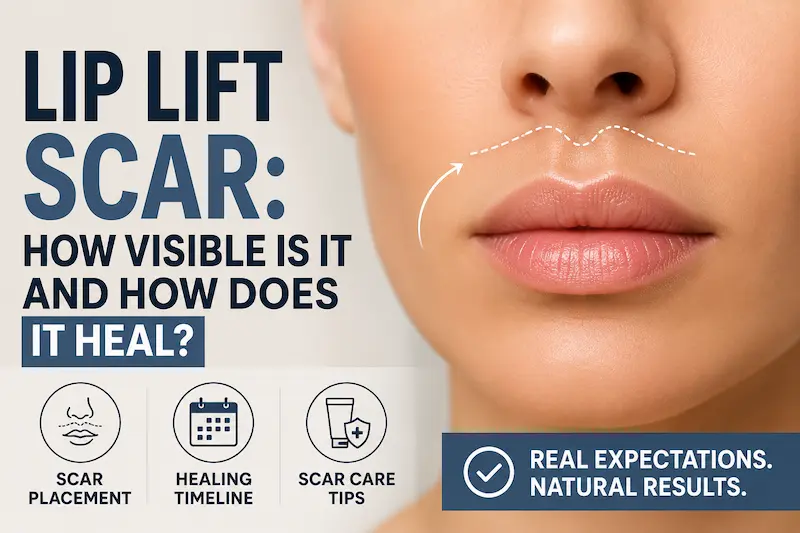
A lip lift scar usually sits along the base of the nose, following the natural crease where the nostrils meet the upper lip. In a well-planned bullhorn lip lift, the incision is designed to hide in the alar creases and typically fades into a fine line over several months. Full scar maturation can take up to a year.
That does not mean the scar is invisible from day one. Early redness, swelling, tiny scabs, and tightness are normal parts of healing. What matters most is where the incision is placed, how much tension is placed on the closure, how carefully you protect the area while it heals, and whether your expectations match real scar biology.
This guide focuses only on the subnasal lip lift scar: where it sits, how visible it tends to be, what it looks like week by week, and what can make it heal better or worse. For the full procedure overview, including candidacy and how the lift changes upper-lip proportions, see how a lip lift is performed.
Table of Contents
Where a Lip Lift Scar Actually Sits
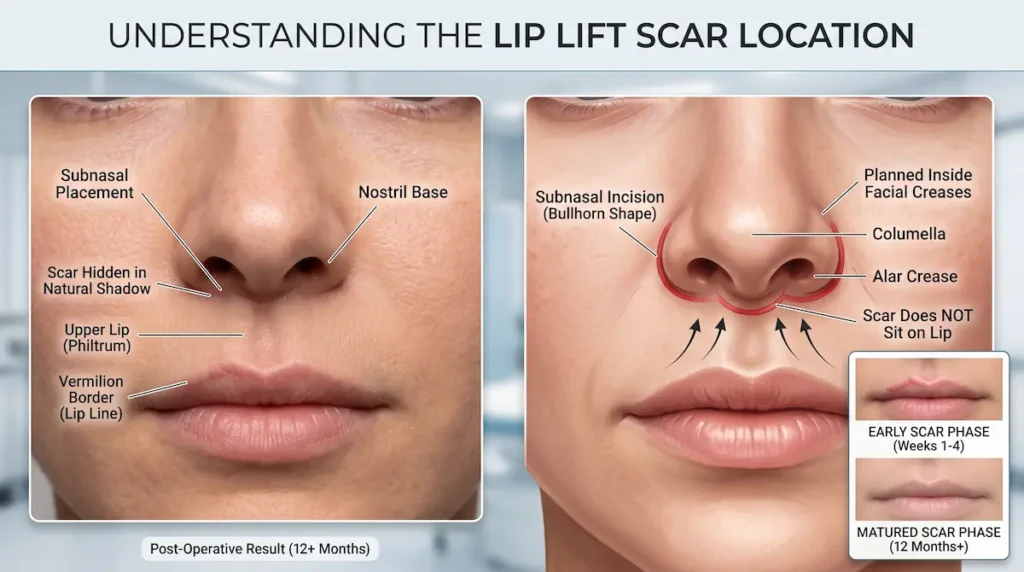
The location of the scar is the first reason a lip lift can look natural. A subnasal lip lift does not place the incision on the pink part of the lip. Instead, the scar is planned at the border where the upper lip skin meets the base of the nose, using a curved shape that follows the nostrils and the natural folds beside them.
This matters because scars hide best when they sit inside a real facial crease. The base of the nose already has shadow, contour, and texture. A carefully placed incision can blend into that anatomy as it heals.
The subnasal placement: under the nose, not on the lip
Most people imagine a lip lift scar as a line across the upper lip itself. That is not how a standard bullhorn lip lift scar is positioned. The incision sits just under the nose, usually tracing the curve beneath the nostrils and across the base of the columella.
The goal is to shorten the distance between the nose and the upper lip while keeping the scar in the least distracting position possible. In everyday conversation, most people look at the eyes and mouth movement. A fine scar hidden under the nose is generally less noticeable than a line placed directly on the lip border.
In the early phase, however, the incision can look more obvious than patients expect. It may appear pink, slightly raised, or shiny. That early look is not the final scar.
Why the bullhorn shape helps conceal the scar
The bullhorn incision gets its name from its curved outline. Instead of a straight horizontal line, it follows the natural shape of the nostril base. That design is intentional. Straight scars across a curved facial area tend to draw the eye. Curved scars that sit within natural shadows are usually easier to camouflage.
The outer arms of the incision are often tucked into the alar creases, the folds beside the nostrils. This is where surgical judgment matters. If the incision is too low, it may sit on flatter skin and become more visible. If it is too high or too tight, the nostril base can look pulled.
Board-certified team note: A lip lift scar is not minimized by the incision shape alone. It depends on precise placement, low-tension closure, careful wound care, and patience during scar maturation. The best scar is planned before the first incision is made.
Corner lip lift scar vs. subnasal lip lift scar
A corner lip lift is different. It targets downturned mouth corners and places small scars near the outer corners of the mouth. A subnasal bullhorn lip lift targets the central upper lip and places the scar under the nose.
That distinction is important because patients often compare the two online without realizing they leave scars in completely different locations. A corner scar moves with smiling and speaking. A subnasal scar sits in a more stable crease under the nose.
Patients considering multiple smile-area procedures should also understand that each procedure changes a different part of facial expression. For example, buccal fat removal affects cheek fullness and smile contour, not the upper-lip skin-to-nose distance.
The Lip Lift Scar Healing Timeline
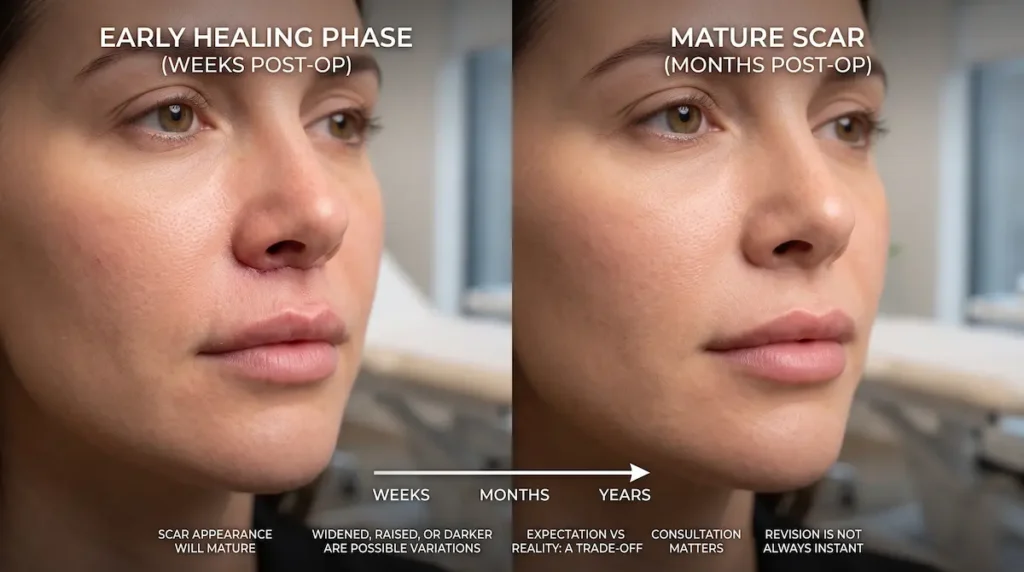
A lip lift scar heals in stages. It does not fade in a straight line day by day. It may look calm one week, more red the next, then slowly soften again. That fluctuation is normal because scars go through inflammation, collagen remodeling, and maturation.
Most patients judge the scar too early. The first week tells you almost nothing about the final result. Even the first month can be misleading. A better way to think about healing is in phases: fresh incision, early settling, remodeling, then long-term fading.
Week 0–1: redness, swelling, crusting, and tightness
During the first week, the scar is new. The area under the nose may be swollen, tender, red, or lightly bruised. Small crusts can form along the incision line. You may also feel tightness when smiling, speaking, brushing your teeth, or making large facial expressions.
This stage can be emotionally uncomfortable because the upper lip may look stiff or over-lifted. That early appearance is usually swelling, not the final result. The incision may look darker or more obvious than expected because fresh skin healing is active and visible.
The key during this stage is restraint. Do not pick crusts. Do not stretch the upper lip to “test” it. Do not apply makeup directly over a healing incision unless your surgeon has cleared it. The scar is still fragile.
Weeks 2–6: the scar starts settling, but it may still be pink
By weeks two to six, the incision is usually closed, swelling starts to decrease, and the scar begins to look more organized. This is also when many patients become impatient. The scar may still be pink. It may feel firm. It may look slightly raised in certain lighting.
That is not unusual. Scar tissue is building collagen and reorganizing itself. The upper lip also moves constantly during eating, talking, laughing, and brushing teeth, so the healing area needs time to soften.
At this stage, your surgeon may clear you for scar-care steps such as silicone gel or silicone sheets. Timing matters. Silicone should not be used on an open wound. Once the incision is fully sealed, consistent scar care can support a flatter, softer-looking scar.
Months 3–6: color fades and the line becomes finer
Between three and six months, many lip lift scars become easier to ignore. Redness fades. Firmness softens. The line can begin blending into the shadow under the nose.
This is the phase where daily photos can be misleading. In harsh bathroom lighting or with the head tilted back, the scar may still be visible. At normal social distance, it may be much harder to notice. Both can be true.
Scar quality also varies from person to person. Some patients heal with a thin pale line. Others develop more pigment, more redness, or thicker scar tissue. Skin tone, sun exposure, genetics, smoking, aftercare, and closure tension all play a role.
Months 6–12: final maturation and long-term fading
Scar maturation can continue for a full year. Even after the scar looks “healed,” collagen is still remodeling under the surface. The scar may continue to flatten, soften, and lose color.
By one year, the final scar is usually much closer to its long-term appearance. It should not be judged against edited online photos or immediately post-makeup images. A realistic goal is not a magically scarless lift. A realistic goal is a fine, well-placed line that blends into the nasal base and does not distract from the lip shape.
For a broader view of facial scar behavior, including how scars change over months rather than days, see how facial scars heal and fade over time.
| Healing stage | Typical scar appearance | What is usually normal | Helpful care focus |
|---|---|---|---|
| 0–1 week | Red, swollen, crusted, tight | Bruising, small scabs, mild tenderness, visible incision line | Keep the area clean, avoid picking, follow surgeon instructions |
| 2–6 weeks | Pink, firm, slightly raised or shiny | Scar still visible, tightness while smiling, gradual swelling reduction | Start cleared scar care only after the incision is fully closed |
| 3–6 months | Finer line, less red, softer texture | Scar visible in harsh lighting but less noticeable socially | Silicone, sun protection, gentle handling, patience |
| 1 year | Mature fine line under the nose | Mostly faded scar, though not always completely invisible | Assess final scar quality; consider revision only if truly needed |
How Visible Is It, Really?
A well-healed lip lift scar is usually subtle, but “subtle” is not the same as “nonexistent.” Every surgical incision creates a scar. The realistic question is whether that scar becomes a fine line hidden in the nasal base or remains visible enough to bother you.
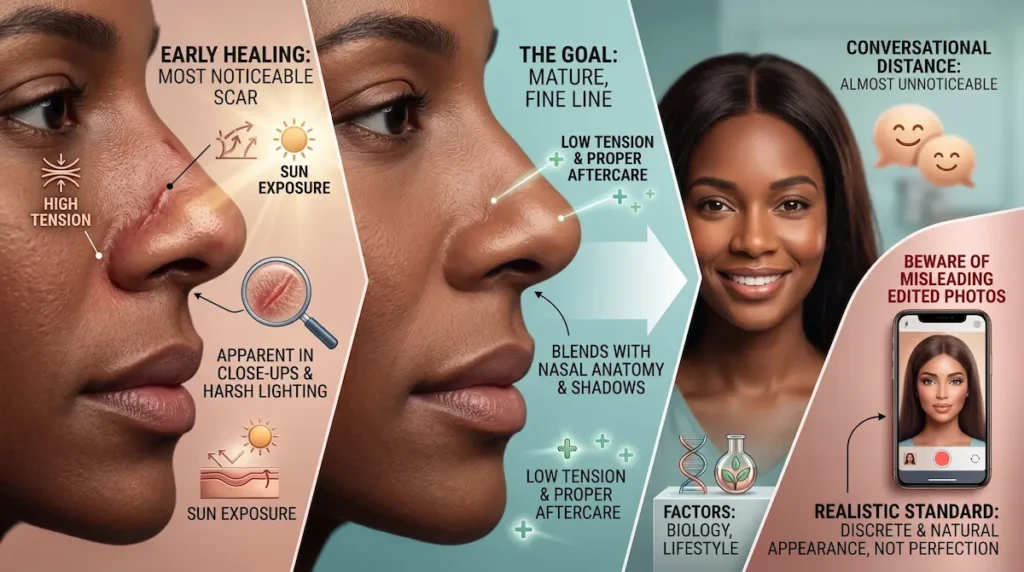
Most patients find that the scar is most noticeable during early healing and gradually becomes less distracting over time. The final appearance depends on surgical planning, closure tension, skin biology, and aftercare. It also depends on how you look at it. A scar that is visible in a close-up selfie with overhead lighting may be almost unnoticeable at normal conversational distance.
Why many lip lift scars become a fine line
The subnasal area gives surgeons a natural place to hide the incision. There is already shadow under the nose. There are curves around the nostrils. There is also a natural crease where the upper lip skin meets the nasal base.
When the incision follows that anatomy, the eye reads it as part of the normal nose-lip transition. As redness fades and the scar flattens, it can look like a delicate crease rather than a surgical line.
This is why technique matters more than marketing language. No incision is truly “scarless.” A precise incision, conservative skin removal, layered closure, and low tension give the scar a better chance of healing quietly.
What makes a lip lift scar more visible?
Several factors can make the scar stand out. Some are under the surgeon’s control. Others are part of your own healing pattern.
- High closure tension: If too much skin is removed or the closure is tight, the scar can widen or become raised.
- Incision placement: A scar placed too low on flatter upper-lip skin is usually harder to hide.
- Sun exposure: Fresh scars can darken or stay red longer when exposed to UV light.
- Smoking or nicotine use: Reduced blood flow can slow healing and increase wound complications.
- Thicker scar biology: Some patients naturally form hypertrophic or more pigmented scars.
- Picking or stretching the incision: Early trauma can disrupt fine healing.
The scar also sits in an active facial zone. You speak, smile, eat, laugh, and brush your teeth every day. That movement does not mean the scar will heal poorly, but it does explain why gentle handling during the first weeks matters.
Realistic expectations vs. edited online photos
Online photos can be misleading. Many “after” images are taken under soft lighting, with makeup, from flattering angles, or after enough time has passed for the scar to mature. Early scar images are less common because patients often avoid sharing that phase.
A realistic expectation is this: the scar should become progressively less noticeable, but it may not disappear completely. If you lift the nose, stretch the upper lip, stand under harsh light, or examine the area with a magnifying mirror, you may still see a line.
That does not necessarily mean the result is poor. The standard is whether the scar blends naturally into the nasal base and whether the lip shape looks balanced without a visibly “operated-on” look.
For a neutral medical overview of lip lift types and scar location, Cleveland Clinic’s lip lift procedure guide is a helpful patient-education reference.
Helping the Scar Heal Well
Scar care is not about making biology disappear. It is about giving the incision the best possible conditions to heal flat, soft, and pale. The most important steps are simple: protect the incision, avoid unnecessary tension, follow your surgeon’s instructions, and be patient.
Do not start scar treatments too early. A fresh incision needs to close first. Once your surgeon confirms that the wound is sealed, scar care can become more active.
Silicone gel and sun protection
Silicone gel or silicone sheeting is commonly used after surgical incisions once the skin is fully closed. It can help support a flatter, softer scar in some patients. Consistency matters more than intensity. Using it as directed for weeks or months is usually more useful than applying it randomly.
Sun protection is just as important. The upper lip and nasal base are exposed areas. A healing scar can darken, redden, or develop uneven color if it gets too much sun. Once the incision is closed and your surgeon allows it, daily broad-spectrum sunscreen and physical protection, such as a hat, can help reduce discoloration risk.
ASPS scar-healing guidance also emphasizes sun protection during scar maturation, especially in the first months after surgery. You can review ASPS guidance on how scars heal after plastic surgery for a broader overview.
Normal healing vs. concerning healing
Some redness, firmness, itching, and mild tightness can be normal during scar maturation. The scar may also look worse before it looks better, especially around the active collagen-building phase.
Still, there are signs that deserve prompt review. Increasing pain, spreading redness, pus, wound opening, fever, a foul smell, or sudden worsening swelling should be discussed with your surgical team. A scar that remains thick, raised, painful, or widening over time should also be evaluated.
Do not try to self-treat a healing incision with harsh skincare actives. Retinoids, exfoliating acids, peroxide, alcohol-based products, and aggressive massage can irritate the area if used too early. Your surgeon’s clearance comes first.
Makeup and camouflage: when it helps
Makeup can be useful once the incision is fully closed and your surgeon says it is safe. A thin layer of color-correcting concealer can reduce redness during the mid-healing phase. Mineral makeup or lightweight formulas may feel more comfortable than heavy products.
The rule is simple: do not cover an open wound. Makeup over a healing incision can trap bacteria, irritate the skin, and delay recovery. Wait until the skin barrier is sealed.
Even when makeup is allowed, remove it gently. Scrubbing the scar line every night can create friction. Use a mild cleanser and avoid stretching the upper lip aggressively.
What your surgeon can do to minimize the scar
Good scar care starts before surgery. During consultation, your surgeon should assess your philtral length, nostril shape, alar crease anatomy, smile dynamics, skin thickness, and scar history. That assessment helps determine whether a lip lift is a good idea and how much lift is safe.
During surgery, scar quality depends on incision design, tissue handling, layered closure, and tension control. A conservative lift often heals better than an overdone lift. Removing too much skin may create a dramatic early change, but it can also place more stress on the scar.
At AKM Clinic, the planning philosophy for facial procedures is natural-first: rejuvenation over alteration. In a lip lift, that means the incision should be planned around your own nasal base and lip movement, not around a template.
When You Might Not Be Happy With the Scar
Some patients are unhappy with their lip lift scar because it is wider, darker, more raised, or more visible than expected. Others dislike the scar because they expected the procedure to be completely scarless. Those are two different problems. One is scar quality. The other is expectation mismatch.
This is why preoperative counseling matters. A lip lift can create a beautiful change in upper-lip proportion, but it is still surgery on the face. The scar is a trade-off, and the patient needs to understand that trade-off before deciding.
Why scars become widened or visible
A widened scar can happen when the incision heals under too much tension. This may be related to aggressive skin removal, strong lip movement early in healing, wound separation, infection, nicotine use, or individual healing tendencies.
A darker scar can be related to inflammation or sun exposure. A raised scar can reflect a stronger collagen response. A depressed or irregular scar may result from wound healing problems or uneven tissue remodeling.
None of these issues should be judged too early. Many scars that look disappointing at six weeks look much better at six months. Time is part of the treatment plan.
When scar revision may be considered
Scar revision is not usually considered in the early healing phase. Most surgeons prefer to wait until the scar has matured unless there is a wound problem that needs medical attention. For many patients, that means waiting close to a year before deciding whether revision is worthwhile.
Revision may involve removing the widened scar and closing it more precisely, using laser treatment for redness or texture, or treating raised scar tissue with medical scar therapies. The right option depends on the scar type.
Revision should be conservative. Chasing a “perfect” scar can create more tissue trauma. The goal is improvement, not erasing the fact that surgery happened.
The scar question and lip lift regrets
Visible scarring is one of the reasons some patients regret a lip lift. But scar-related regret is often tied to a bigger issue: the patient wanted a fuller upper lip without fully accepting the permanent incision under the nose.
That does not mean the procedure is a bad choice. It means it is the right choice only for the right anatomy, the right expectations, and the right tolerance for a small facial scar. Patients who want a temporary change, no incision, or zero scar risk may be better suited to non-surgical options.
For a broader decision-making discussion, including expectation-setting and who should pause before surgery, read our guide to lip lift regrets.
Cost should not drive the scar decision
A lip lift scar lives in the center of the face. That is not the place to choose based on price alone. Surgical planning, facial anatomy, closure technique, aftercare access, and realistic counseling matter more than finding the lowest fee.
If you are comparing options, review what is included, who performs the procedure, where surgery takes place, and how follow-up is handled. For pricing context without turning this scar guide into a cost article, see the cost of a lip lift.
The most useful consultation question is not “Will there be a scar?” There will be. The better question is: “Where exactly would my incision sit, how much tension would be on it, and what is my personal risk of a visible scar?”
Frequently Asked Questions: Lip Lift Scar
Most lip lift scar questions come down to the same concern: how the scar will look in real life, not just in clinical photos. The answers below are written for patients comparing options carefully and trying to understand what is normal, what improves with time, and what deserves a surgeon’s review.
Is a lip lift scar noticeable?
Long term, a well-placed subnasal scar often blends into the natural crease under the nose. It may still be visible if you look very closely, tilt the head back, or examine it under harsh light. At normal social distance, many mature scars are difficult to notice.
How long does a lip lift scar take to heal?
A useful timeline is this: week one looks fresh, weeks two to six look pink and active, months three to six show visible improvement, and the one-year mark is closer to the final scar. Healing is gradual.
Can makeup hide a lip lift scar?
Do not apply makeup to an open or crusted incision. That can irritate the wound and may increase the risk of delayed healing. Once makeup is allowed, remove it gently and avoid scrubbing the scar line.
Do lip lift scars fade completely?
Some patients heal with a nearly imperceptible scar. Others retain a faint line, slight color difference, or texture change. Genetics, skin tone, sun exposure, nicotine use, and closure tension all influence the final look.
What if my lip lift scar is still visible?
If the scar remains thick, widened, raised, dark, painful, or irregular after enough healing time has passed, ask your surgeon about options. Depending on the scar, treatment may include silicone care, laser treatment, steroid-based therapy, or surgical scar revision. The right choice depends on the scar type.
Does a corner lip lift scar heal differently?
This article focuses on the subnasal lip lift scar. If your main concern is downturned corners rather than upper-lip length, your surgeon should explain how the scar location and movement pattern differ before you choose the procedure.
What does a 1 week lip lift scar look like?
That early look is not the final scar. The first week is about wound protection, not judging the result. Avoid picking, stretching, or covering the incision with makeup unless your surgeon specifically says it is safe.
Can scar care really make a difference?
The bigger picture is surgical planning. A published review of lip lift techniques highlights that upper-lip surgery depends on patient selection, incision design, and outcome assessment — all of which affect whether the final result looks natural. You can review the evidence-based review of lip lift techniques for a technical overview.
If you are considering a lip lift, ask AKM where your incision would sit, how much lift is safe for your anatomy, and what your personal scar-healing risks look like. A careful consultation should show you the trade-off clearly: more upper-lip show in exchange for a small, permanent scar under the nose.
AKM’s European Board-Certified, ABPS-equivalent facial surgery team plans lip lift incisions around each patient’s nasal base, skin quality, and smile dynamics. The goal is not an exaggerated or “operated-on” mouth. It is a natural upper-lip proportion with the scar placed where it has the best chance to blend.
Ask AKM where your lip lift incision would sit and how it would heal in your free virtual consultation.
Medical disclaimer: This article is for educational purposes only and is not medical advice. Scar healing, recovery time, and surgical results vary from person to person. Always consult a qualified surgeon before deciding on cosmetic surgery or starting scar treatment.
Related Treatments


Ready to Start Your Own Transformation Journey?
Join the 2,000+ patients who trusted Dr. Akif Mehmetoğlu and the AKM Clinic team. Your journey to a more confident, revitalized you begins with a simple, no-obligation conversation. Contact us today from the USA for your free virtual consultation.
#1: Get Your Free Personalised Quote
Start with a free, no-obligation online consultation. Share your photos, and our surgical team will provide a fully personalised treatment plan and a transparent, all-inclusive price package. No hidden fees.
#2: Secure Your Date & VIP Booking
Once you're ready, our dedicated patient coordinators will help you secure your procedure date. We'll handle all your bookings, including your 5-star hotel and private VIP airport transfers.
#3: Arrive in Istanbul & Meet Your Surgeon
Arrive at Istanbul Airport (IST) and be greeted by your private driver. Settle into your hotel and prepare for your in-person consultation, where you'll meet your specialist surgeon to finalise the details for your "natural, subtle, and revitalized" new look.