
Lip Lift Scar: How Visible Is It and How Does It Heal?
AI Summary
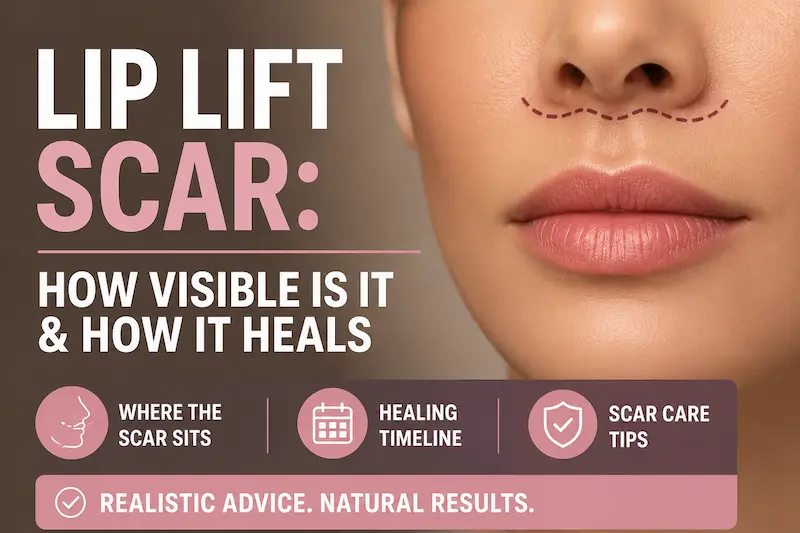
- A lip lift scar usually sits under the nose and fades into a fine line.
- Healing takes 6–12 months, with redness and firmness common during early scar maturation.
- Scar care reduces visibility: silicone, sun protection and avoiding irritation support cleaner healing.
- Visible scars need review; widening, raised texture or colour changes may require specialist treatment.
AI-generated summary, fact-checked by our medical experts.
A lip lift scar usually sits directly under the nose, hidden along the natural crease where the nostrils meet the upper lip. In most well-planned subnasal lip lifts, it heals from a pink, firm line into a much finer scar over 6–12 months. It should fade, but it will not become truly “scarless”.
A lip lift can make the upper lip look more defined, shorten the distance between the nose and lip, and show more of the pink lip without relying on filler. For many patients, though, the deciding question is not only how the lip will look. It is this: will people see the scar?
The honest answer is that every surgical incision creates a scar. The aim is to place that incision where the face already has a natural shadow: under the base of the nose, around the alar creases, and away from the most visible part of the lip. That is why incision planning is one of the most important parts of a carefully planned lip lift procedure.
This guide explains where the scar sits, what it looks like in the first days and weeks, how it changes over a year, and what can make it more noticeable. It is written for patients who want a realistic view before travelling for surgery, not a polished promise that scars never happen.
Table of Contents
Where a Lip Lift Scar Actually Sits
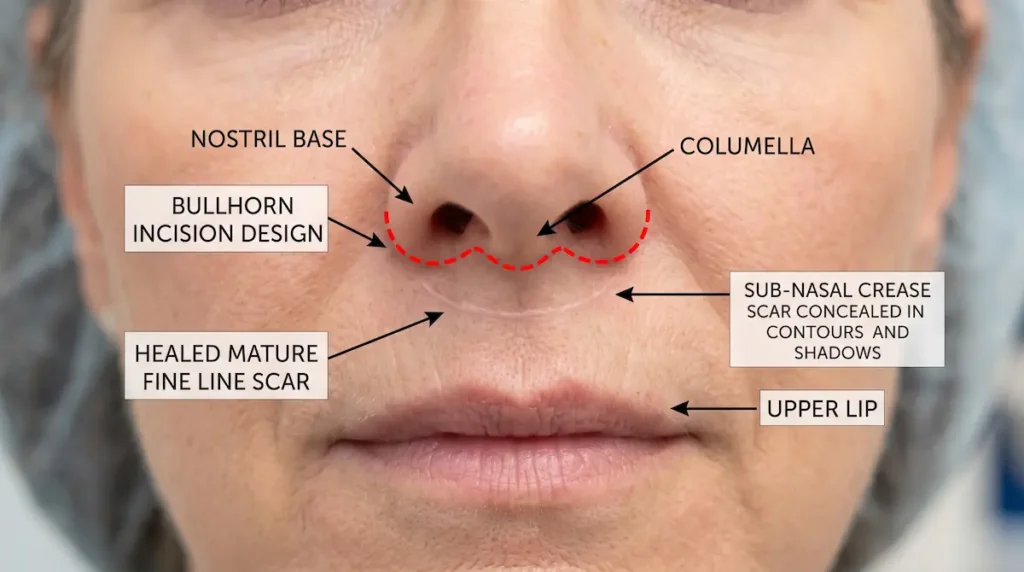
The scar from a classic subnasal lip lift sits in the crease directly beneath the nose. This is not random placement. It is chosen because the underside of the nose already has curves, shadows, and skin folds that help disguise a fine line once healing has matured.
The most common design is often called a “bullhorn” incision because the removed strip of skin follows a curved shape under the nostrils. In skilled hands, the incision does not simply run as a straight line across the upper lip. It follows the base of the nose, curves around the nostril wings, and aims to hide within the natural alar crease.
Subnasal placement under the nose
In a subnasal lip lift, the incision is placed at the junction between the upper lip skin and the nasal base. The surgeon removes a measured strip of skin, then closes the incision so the upper lip sits slightly higher.
This placement matters because the area under the nose is less exposed than the central upper lip. In conversation, people usually look at the mouth as it moves, not at the small shadow under the nostrils. A fine, pale scar in that crease is often difficult to notice at social distance after full healing.
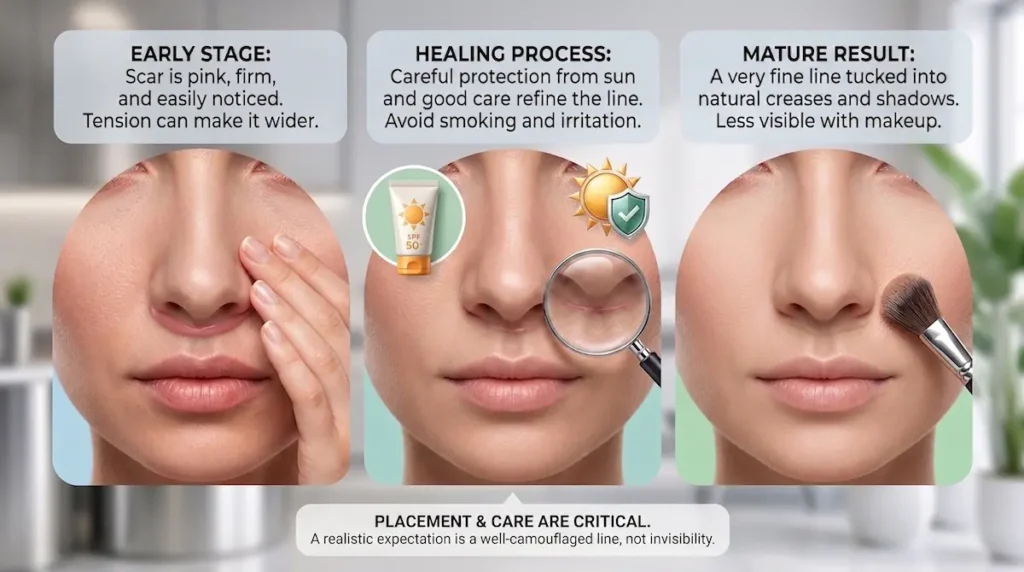
That said, the scar is still on the face. During the early weeks, it can look pink, slightly raised, or firmer than the surrounding skin. That phase is expected. The goal is not to judge the final scar at day 10 or week three, but to understand how scar maturation works.
Why the bullhorn shape hides in the alar creases
A well-designed bullhorn incision uses the nose’s natural curves to break up the scar line. The small turns around the nostril base prevent the scar from looking like one obvious horizontal cut.
There are two details patients should ask about during consultation. First, how will the incision sit around the nostril base? Second, how will the closure reduce tension on the scar?
Tension is a major reason scars widen. If the wound edges are pulled too tightly, the scar may stretch as it heals. Careful layered closure, conservative skin removal, and respect for the patient’s anatomy all help minimise that risk.
Board-certified team note: The least visible lip lift scars are not created by hiding the incision alone. They come from matching the incision to the nasal base, avoiding excessive skin removal, and closing the wound with low tension so the scar can mature into a fine line.
Corner-lift scar vs subnasal scar
A corner lip lift is different. Instead of lifting the central upper lip from under the nose, it addresses downturned mouth corners through small incisions near the edges of the mouth.
That means the scar location, visibility, and healing pattern are not the same. A subnasal scar hides under the nose; a corner-lift scar sits closer to an expressive part of the mouth. This article focuses on the subnasal lip lift scar, because that is the scar most patients mean when they search for “lip lift scar”.
It is also helpful to separate lip lift scars from other smile-area concerns. For example, cheek hollowing, smile shape, and an overdone lower-face look belong to a different discussion around procedures such as buccal fat removal and smile balance. Here, the focus stays narrow: the scar under the nose, how it heals, and how visible it is likely to be.
The Lip Lift Scar Healing Timeline
A lip lift scar changes more slowly than most patients expect. The incision may close quickly on the surface, but the deeper scar tissue continues to remodel for months. That is why the scar can look red or firm early on, then soften and fade long after the stitches are gone.
Most patients should think in stages rather than days. The first week is about wound closure. Weeks two to six are about settling. Months three to twelve are about scar maturation. A scar that worries you at week four may look very different by month six.
| Healing stage | Typical scar appearance | What is usually normal | Helpful care focus |
|---|---|---|---|
| 0–1 week | Pink or red line, swelling, crusting, stitches or skin glue | Tightness, mild tenderness, uneven swelling | Keep the area clean, avoid pulling the upper lip, follow wound-care instructions |
| 2–6 weeks | Redder or firmer line; early thickening may appear | Scar looking more noticeable before it improves | Ask when silicone scar care can start; protect the area from sun |
| 3–6 months | Scar begins to soften, flatten, and lose colour | Residual pinkness or firmness, especially in fair or reactive skin | Consistent silicone use if advised, SPF, patience |
| 6–12+ months | Finer, paler line under the nose | Slow fading; final scar still not completely invisible | Review with surgeon if scar stays raised, wide, or very red |
First week — redness, swelling, crusting
During the first week, the scar is not trying to look pretty. It is trying to close. The area under the nose can look swollen, tight, shiny, or slightly crusted. Bruising may extend into the upper lip, and the lip may feel stiff when you smile or speak.
This is also the period when patients are most tempted to over-check the incision. Try not to judge symmetry or scar quality too early. Swelling can make one side look more raised than the other, and dried blood or ointment can make the line seem darker than the actual scar.
Your surgeon’s instructions come first. In general, patients are told to avoid stretching the upper lip, picking at crusts, smoking, or applying unapproved products to the wound. The incision needs calm conditions in order to seal.
Weeks 2–6 — settling and early scar softening
Weeks two to six can be emotionally tricky. The stitches may be out, swelling may be improving, and the lip shape may start to show — but the scar can look more obvious than expected. It may become redder, firmer, or slightly raised as collagen builds.
This does not automatically mean the scar is healing badly. Scar tissue often looks active before it settles. The body is laying down collagen, increasing blood flow, and strengthening the wound. That process can create temporary colour and firmness.
This is the stage when your surgeon may clear you to begin silicone gel or silicone strips, depending on whether the skin is fully closed. Do not start too early without approval. Scar products are meant for closed skin, not an open or crusted wound.
Months 3–12 — fading and full maturation
From month three onwards, most lip lift scars begin to behave more quietly. The line softens. Redness fades. The scar flattens into the crease beneath the nose. Make-up is usually easier to apply once the skin is fully healed, although patients should still be gentle with the area.
By six months, many patients feel much less aware of the scar. By twelve months, the scar is closer to its final appearance. Some scars continue to refine beyond a year, especially if they were raised or red earlier in healing.
The final scar depends on several factors: surgical design, closure tension, genetics, skin tone, aftercare, sun exposure, and whether the patient develops thickened or hypertrophic scarring. None of these should be ignored. A beautiful lip lift result still needs a realistic scar discussion.
How Visible Is It, Really?
The visibility of a lip lift scar depends on more than the fact that an incision was made. It depends on where the incision is placed, how much tension sits on the closure, how your skin heals, and how carefully the scar is protected during the first year.
For many patients, the mature scar becomes a fine line tucked under the nose. It may be easy to miss in everyday conversation. But “less visible” is not the same as “invisible”, and a responsible consultation should make that distinction clear.
Why it usually becomes a fine line
The subnasal area gives the surgeon a helpful hiding place. The base of the nose has natural curves and shadows, and the alar creases break up the scar line. When the scar fades to a pale colour and flattens, it can blend into that anatomy well.
Another reason the scar often settles well is that the incision is not placed on the wet-pink lip itself. It sits on skin that behaves more like facial skin. Once the surface is fully healed, careful make-up placement can also soften temporary redness.
In fair skin, the scar may be pink for longer before fading. In deeper skin tones, the concern may be post-inflammatory pigmentation or a darker line rather than redness. Both patterns can improve, but they may need time and careful sun protection.
What can make the scar more noticeable
A visible lip lift scar usually comes from one or more risk factors. Some are surgical. Some are biological. Some are behavioural during recovery.
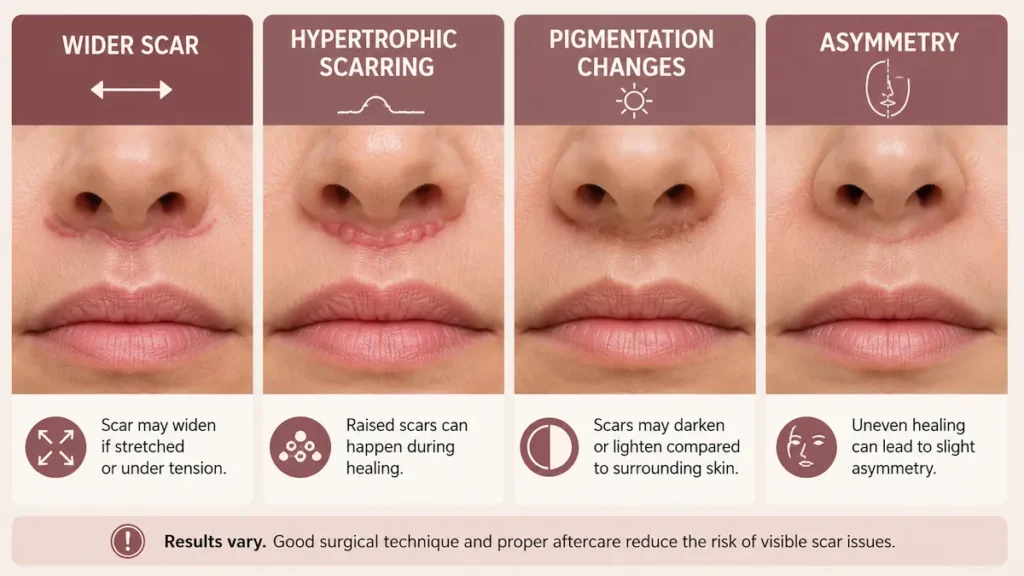
- High tension on the closure: If too much skin is removed, the scar can widen as the wound heals.
- Poor incision placement: A scar that does not sit neatly in the nasal base crease is harder to camouflage.
- Thick or raised scar tendency: Some patients naturally form hypertrophic or more reactive scars.
- Smoking or nicotine use: Reduced blood flow can impair wound healing and affect scar quality.
- Sun exposure: UV exposure can make a healing scar stay darker or more noticeable.
- Picking, stretching, or early irritation: Pulling the upper lip or disturbing crusts can delay clean healing.
This is why scar outcome is not just an afterthought. It should shape the surgical plan from the beginning. A patient who wants a very dramatic lift may need to understand the trade-off: more lift can mean more tension, and more tension can mean a more visible scar.
Realistic vs unrealistic expectations
A realistic expectation is that the scar will be noticeable to you early on. You will see it in the mirror because you know where to look. You may inspect it closely, especially while it is pink or firm.
An unrealistic expectation is that the scar will vanish completely, or that no one ever forms a visible scar after a lip lift. Surgery cannot offer that. Good surgery can reduce scar visibility; it cannot delete the biology of wound healing.
A better question is not “will there be no scar?” but “is my anatomy suitable for a scar that hides well under the nose?” That question is exactly what should be assessed in consultation.
Helping the Scar Heal Well
Good scar healing starts in the operating theatre, but it continues at home. The first few weeks are about protecting the incision. The following months are about scar maturation: controlling colour change, reducing thickness, and avoiding unnecessary irritation.
UK patients often compare overseas surgery with a Harley Street-style consultation standard: clear consent, realistic risks, and a follow-up plan. That standard is appropriate here. A lip lift scar sits on the face, so aftercare should never be vague.
Silicone gel and scar-care timing
Silicone gel and silicone sheeting are commonly used once the wound is fully closed. They help create a controlled healing environment over the scar and may reduce raised or thickened scar behaviour in suitable patients.
The timing matters. Silicone is not something to apply over an open wound, wet crust, or irritated incision unless your surgeon specifically instructs you. Many patients begin scar therapy only after the skin has sealed and the surgeon has checked the incision.
The NHS notes that scar treatments such as silicone gels or sheets may help some scars, while also being clear that scars cannot usually be removed completely. That is the right frame for a lip lift scar: improvement, not erasure. You can read the NHS overview of scar care here: NHS guidance on scars and scar treatment.
Sun protection and colour change
Sun exposure can make a healing scar stay darker, redder, or more obvious. This is especially relevant for a lip lift scar because the area under the nose catches light during normal daily activity.
Once your surgeon confirms the incision is fully closed, sun protection becomes part of scar care. A high-SPF product, shade, and avoiding direct sun on the healing scar can help prevent long-term colour contrast.
Do not underestimate small daily exposure. Walking outside, sitting near a bright window, or taking a sunny holiday during early healing can all affect pigmentation. Scar care is not dramatic. It is consistent.
Normal healing vs signs to raise with your surgeon
Some scar activity is normal. Mild redness, firmness, itching, tightness, and a slightly raised feel can happen during the early collagen-building phase. These changes often calm down gradually.
There are, however, signs worth raising with your surgical team. These include worsening redness spreading beyond the incision, increasing pain, yellow or green discharge, fever, wound opening, a scar that is rapidly thickening, or a scar that is widening week by week.
For UK patients travelling for surgery, this is where planning matters. Before surgery, confirm who reviews your incision photos, how quickly you can contact the team, and what happens if your scar looks abnormal after you return home. BAAPS guidance on cosmetic tourism also encourages patients to think carefully about aftercare access before having surgery abroad.
At AKM, the facial surgery philosophy is conservative and natural-first. The aim is not an “operated-on” mouth, but a measured change that respects the nose-lip relationship and the realities of scar healing.
When You Might Not Be Happy With the Scar
Most lip lift scars improve steadily, but not every scar matures in the way a patient hopes. A scar may stay red for longer, feel raised, widen slightly, or sit in a place that feels more visible than expected. This does not always mean the surgery has failed, but it does deserve a calm review.
This is also where scar anxiety can overlap with wider decision regret. Sometimes the issue is truly the scar. Sometimes the scar becomes the focus because the patient feels the lift was too strong, too subtle, or not what they imagined. Those are different problems, and they need different solutions.
Why a scar may widen, raise, or stay red
A widened scar usually suggests tension during healing. This can happen when too much lift is attempted for the patient’s tissue, when the closure is under strain, or when the upper lip is stretched too much during early recovery.
A raised scar may reflect a hypertrophic healing tendency. This is more likely in patients who have a history of thick scars elsewhere, although it can also happen without a strong history. Raised scars often improve with time and treatment, but they should be assessed rather than ignored.
A red scar is not automatically a bad scar. Many facial scars stay pink for months while blood supply and collagen activity settle. The concern is persistent angry redness, increasing thickness, spreading inflammation, or symptoms such as pain, heat, discharge, or wound opening.
When scar revision is considered
Scar revision is rarely judged in the first few weeks. Surgeons usually prefer to let the scar mature before deciding whether revision is appropriate, unless there is an urgent wound-healing problem.
Once the scar has matured, options may include steroid treatment for raised scars, laser or light-based treatments for redness, medical tattooing in selected cases, or surgical scar revision if the line is wide or poorly positioned. The right approach depends on the scar pattern.
Revision should not be framed as a guaranteed “erase button”. It creates a new scar in place of the old one. The question is whether a revised scar is likely to heal in a more favourable direction.
How visible scarring connects to broader lip lift regret
A visible scar can contribute to regret, but regret after a lip lift is rarely about the scar alone. It may involve the amount of tooth show, the nose-lip distance, the change in smile, or the feeling that the result does not match the patient’s face.
That is why pre-operative planning matters so much. A good consultation should discuss scar placement, scar risk, lift amount, and the limits of the procedure in the same conversation. Patients who want a dramatic change must understand that aggressive lifting can increase tension, and tension can affect the scar.
For a deeper discussion of decision-making, expectation setting, and when patients feel unsure afterwards, read our guide to lip lift regret and how to avoid it. If your main question is financial planning rather than scar visibility, use the dedicated lip lift cost guide instead of trying to compare prices inside a scar-healing article.
If you are considering surgery from the UK, ask specifically where your incision would sit, how much lift is realistic for your anatomy, how aftercare is handled after you return home, and what the plan would be if your scar heals more visibly than expected.
Frequently Asked Questions: Lip Lift Scar
These are the scar-specific questions patients most often ask before a subnasal lip lift. The answers are general and cannot replace a personal scar-risk assessment, but they can help you ask better questions in consultation.
Is a lip lift scar noticeable?
How long does a lip lift scar take to heal?
Can it be hidden with make-up?
Do lip lift scars fade completely?
What if my scar is visible?
Does a corner lip lift scar heal differently?
Final Thoughts
A lip lift scar is usually manageable when the procedure is planned conservatively, the incision is placed in the natural crease under the nose, and the closure is designed to reduce tension. The scar is most visible early on, then gradually softens and fades over many months.
The most trustworthy answer is not “there is no scar”. The trustworthy answer is: there is a scar, it is deliberately hidden, it needs time, and its final appearance depends on surgical planning, biology, and aftercare.
If you are weighing a lip lift from the UK, ask AKM where your incision would sit, how your scar risk would be assessed, and what aftercare support would be available after you travel home.
Medical Disclaimer: This article is for general educational information only and is not a substitute for medical advice, diagnosis, or treatment. A lip lift scar, healing timeline, scar visibility, and final surgical result can vary from person to person depending on anatomy, skin type, surgical technique, aftercare, medical history, and individual wound healing.
If you are considering a lip lift, speak with a qualified surgeon for a personalised assessment. If you already had surgery and notice increasing pain, spreading redness, discharge, wound opening, fever, or a scar that is rapidly thickening or widening, contact your surgical team or seek appropriate medical care promptly.
Related Treatments


Ready to Begin Your Own Transformation Journey?
Join the 2,000+ patients who have trusted Dr Akif Mehmetoğlu and the AKM Clinic team. Your journey to a more confident, naturally restored you begins with a simple, no-obligation conversation. Contact us today from the UK for your free virtual consultation.
#1: Get Your Free Personalised Quote
Start with a free, no-obligation online consultation. Share your photos, and our surgical team will provide a fully personalised treatment plan and a transparent, all-inclusive price package. There are no hidden fees.
#2: Secure Your Date & VIP Booking
Once you are ready, our dedicated patient coordinators will help you secure your procedure date. We will handle all your bookings, including your 5-star hotel accommodation and private VIP airport transfers.
#3: Arrive in Istanbul & Meet Your Surgeon
Arrive at Istanbul Airport (IST) and be greeted by your private driver. Settle into your hotel and prepare for your in-person consultation, where you will meet your specialist surgeon to finalise the details for your "natural, subtle, and restored" new look.