
Knee Liposuction: Slimming a Stubborn, Tricky Area
AI Summary
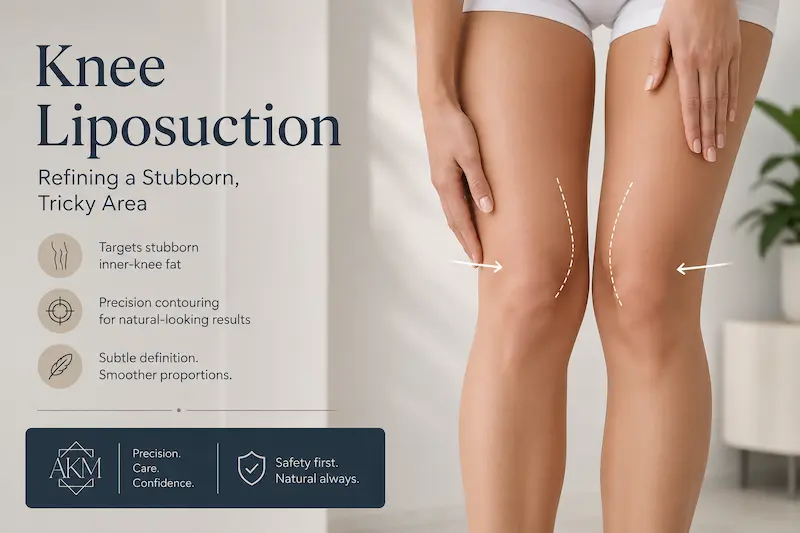
- Knee liposuction targets stubborn inner-knee fat for subtle, natural-looking lower-leg balance.
- Best candidates have localized fat, stable weight, and good skin elasticity.
- Precision technique minimizes contour irregularities in this shallow, delicate fat layer.
- Recovery support includes compression, swelling guidance, virtual follow-up, and clear home-care instructions.
Summary generated by AI, fact-checked by our medical experts
Quick answer: Knee liposuction targets the small fat pad on the inner knee that often resists diet and exercise. Because the fat layer is thin and the area is delicate, results are usually subtle. The goal is not to dramatically reshape the leg, but to refine proportion when skin elasticity is good.
Knee liposuction is best understood as a precision contouring procedure. It can soften a heavy inner-knee bulge, make the transition from thigh to lower leg look smoother, and help the legs appear more balanced in fitted clothing. It cannot change bone structure, correct knock knees, treat fluid retention, or tighten loose skin on its own.
At AKM Clinic, knee contouring is assessed within the wider framework of precise liposuction planning: where the fat sits, how elastic the skin feels, how the knee relates to the calves and ankles, and whether a conservative approach can create a clean, natural-looking line. For Canadian patients comparing options carefully, that distinction matters. Small areas leave little room for overcorrection.
Table of Contents
Why Knee Fat Is So Stubborn
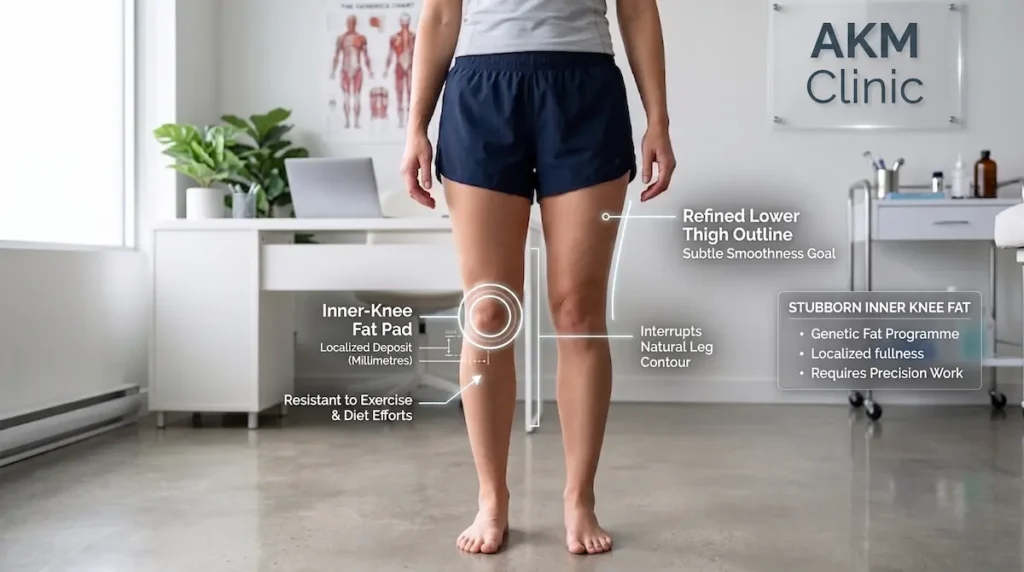
The inner knee is a small area, but it can change the whole outline of the leg. A slight pad of fat beside the kneecap or just above the inner knee can make the leg look heavier than it is, especially when standing straight, wearing shorts, or choosing slim trousers.
This area is frustrating because it often does not respond evenly to weight loss. A patient may lose weight from the waist, face, or upper body first while the inner knees remain soft. That does not mean anything is “wrong”; it simply reflects how fat distribution is genetically programmed.
The inner-knee fat pad
The fat treated in knee liposuction is usually the small, localized deposit on the inner side of the knee. It sits close to a highly visible contour line, where the lower thigh narrows toward the joint. Even a modest amount of fullness can interrupt that line.
Because the area is small, the surgeon is not removing a large volume of fat. The work is more like editing than debulking. A few millimetres of over-removal can create the wrong shadow, so the target is smoothness rather than maximum extraction.
Why diet and exercise may not change it
Exercise strengthens the muscles around the knee and thigh, but it cannot selectively remove fat from one spot. Squats, cycling, Pilates, and walking may improve tone and posture, yet the inner-knee pad can remain if your body naturally stores fat there.
Weight loss can help when the knee fullness is part of overall body fat. But when the deposit is localized and the rest of the leg is proportionate, further weight loss may make the face, breasts, or upper body look leaner while the knees still bother you. That is the classic “stubborn area” pattern.
What knee lipo actually slims
Knee lipo can refine the soft fullness around the inner knee. It may make the knee look cleaner in profile, reduce a small bulge above or beside the joint, and improve the transition into the upper calf.
It does not make the entire leg thin. It also does not replace calf contouring or ankle slimming when fullness is lower down the leg. Those are different anatomical areas with different limits.
Discover If Liposuction Is Right for You
Share your photos and medical history to receive a personalized assessment from our European Board-Certified surgical team — surgeons whose credentials align with the surgical standards Canadian patients expect from the Royal College of Physicians and Surgeons of Canada (RCPSC). An honest evaluation of whether this procedure suits your anatomy, your health, and your goals.
Is Knee Liposuction Right for You?
The right candidate for knee liposuction has a very specific pattern: localized fat, good skin recoil, stable weight, and realistic expectations. If the issue is swelling, loose skin, bone alignment, or muscle shape, removing fat will not solve it and may make the area look less smooth.
This is where a careful consultation matters. The best question is not “Can fat be removed here?” It is “Will removing this small amount of fat make the knee look better once the skin settles?”
A good candidate: localized fat and good elasticity
You may be a strong candidate if the fullness is soft, pinchable, and clearly localized to the inner knee. The surrounding skin should feel reasonably firm and able to retract after the fat layer is reduced.
Good elasticity does not mean perfect skin. It means the skin has enough bounce to redrape smoothly after conservative fat removal. Canadian plastic surgery guidance commonly frames liposuction as best suited to isolated fat deposits in patients with good skin tone and elasticity, which is especially relevant in a small area like the knee.
Why this is a tricky, low-fat area
The knee is not the abdomen or flank. There is less fat to work with, less space to blend, and more risk that a tiny irregularity will show when the leg bends or catches light.
That is why knee liposuction should be conservative. A surgeon should remove enough fat to soften the bulge, but leave enough tissue to keep the contour smooth. The goal is a quieter knee line, not a hollowed-out joint.
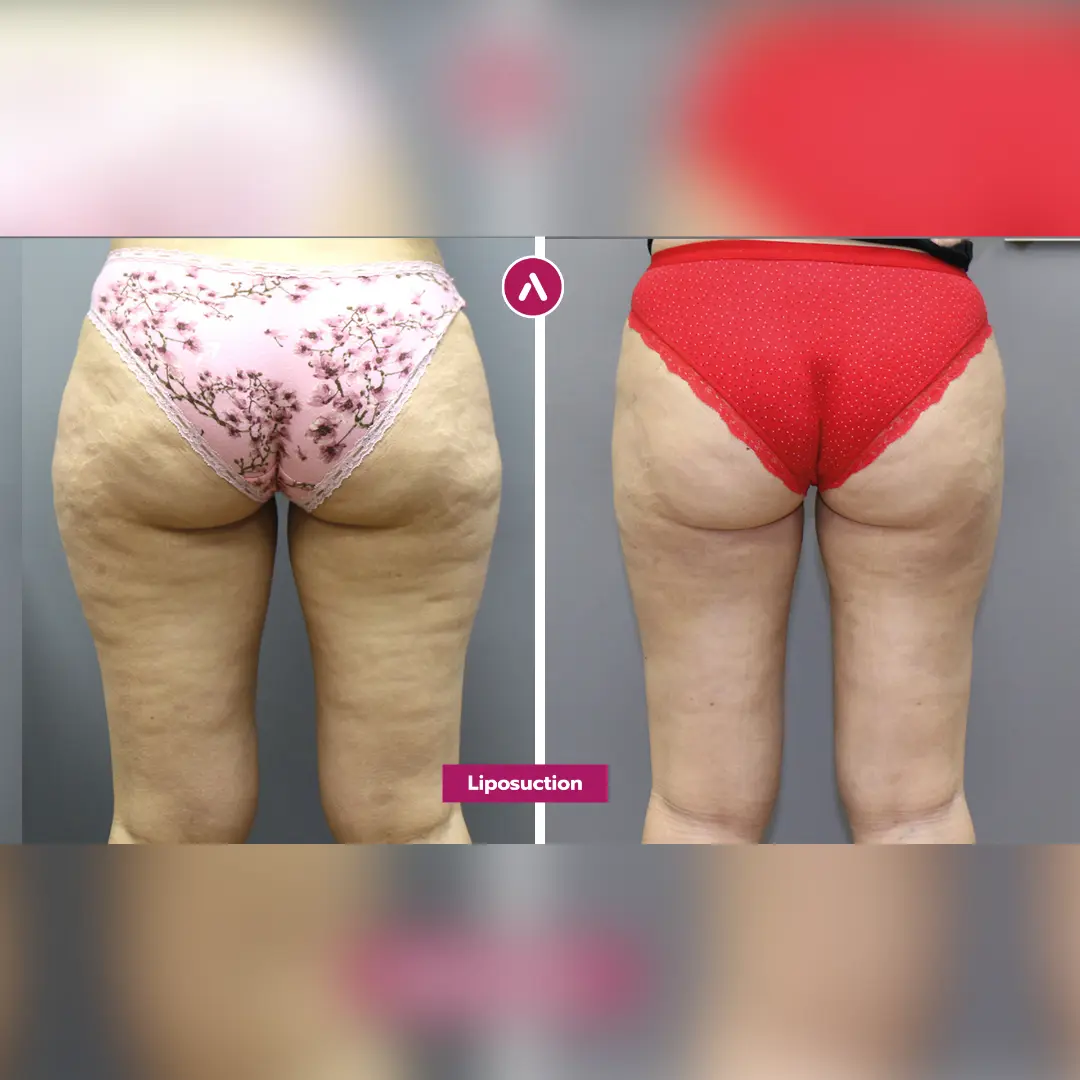
When knee liposuction does not work well
Knee liposuction is limited when the fullness comes from fluid retention, chronic swelling, joint anatomy, prominent bone structure, or loose skin. It also will not correct leg alignment issues such as knock knees. Those are structural or medical concerns, not fat-removal problems.
If the skin is already crepey, hanging, or lax, removing fat can leave the area looking emptier rather than smoother. In that case, the honest answer may be to avoid knee lipo, delay surgery, or consider a different treatment plan after examination.
| Assessment point | Good candidate signal | Limited candidate signal | Realistic expectation |
|---|---|---|---|
| Fat pattern | Soft, localized inner-knee fullness | General leg size or diffuse heaviness | Local refinement, not full-leg slimming |
| Skin quality | Firm skin with good recoil | Loose, crepey, or hanging skin | Smoother contour only if skin redrapes well |
| Cause of fullness | Pinchable fat pad | Oedema, joint shape, or bone alignment | Liposuction helps fat, not structure or swelling |
| Goal | Subtle balance around the knee | Dramatic thigh gap or leg-shape change | Natural proportion, not a new leg shape |
In knee liposuction, restraint is part of the result. The knee is a low-fat precision area, so the safest aesthetic plan is usually conservative fat removal, smooth blending, and respect for the natural shape of the leg.
Why the Knee Is a Precision Area
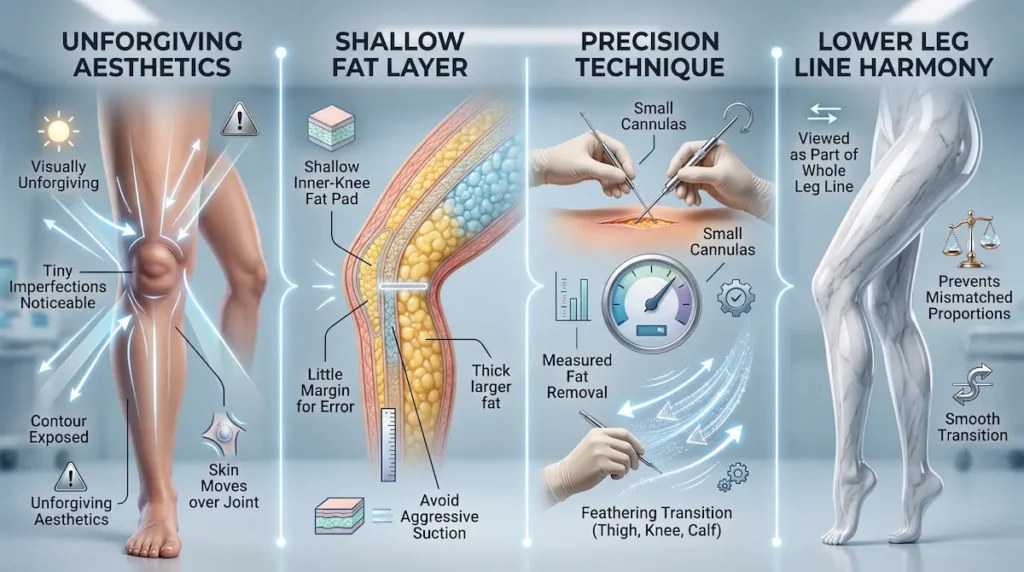
The knee is visually unforgiving. A tiny depression, ridge, or uneven shadow can be more noticeable here than in a larger body area because the skin moves over a joint and the contour is exposed from multiple angles.
That is why technique matters as much as candidacy. A good result depends on small cannulas, measured fat removal, careful blending, and a surgeon who knows when to stop.
The fat layer is thin
The inner-knee fat pad is usually shallow. Once the surgeon enters that layer, there is not much margin for aggressive suction. Removing too much can create a dent or make the knee look older rather than slimmer.
Peer-reviewed lower-leg liposuction literature has described poor outcomes such as contour irregularity, dimpling, grooves, and asymmetry when the lower leg is over-treated. That is the risk a conservative plan is designed to avoid. See this review of lower-leg liposuction outcomes for context.
Conservative removal and small cannulas
For knee liposuction, the cannula should be small and the movement controlled. The surgeon is not chasing a high-volume number. They are feathering the transition between the inner thigh, knee, and upper calf.
Incision placement is also planned carefully. Entry points are usually tiny, but they still need to be positioned where they can heal discreetly and give the surgeon the right angle. The details of whether liposuction leaves scars are covered separately; in this article, the key point is that access should serve precision.
The risk of contour irregularity if overdone
Overcorrection is the main aesthetic risk in a small area. If too much fat is removed, the inner knee can look scooped, uneven, or mismatched from one side to the other. It may also create an awkward contrast with the calf or ankle.
That is why knee liposuction should be planned as part of the whole lower-leg line. Sometimes the knee is the main issue. Sometimes the patient is actually seeing a proportion issue involving the calf, ankle, or thigh. A precise diagnosis prevents the wrong procedure from being blamed for the wrong problem.
For Canadian patients travelling for cosmetic surgery, the same caution applies to planning and follow-up. Ask how your surgeon documents the surgical plan, what aftercare you receive before flying home, and who reviews your progress after you return to Canada. AKM’s long-term virtual follow-up structure is designed around that international-patient reality.
A Well-Coordinated Liposuction Experience
From private airport transfers to comfortable, well-appointed hotel accommodation, we handle every detail of your stay. The result is a seamless all-inclusive clinical pathway in Istanbul — so you can focus on your procedure and recovery while we manage the logistics.
What Realistic Results Look Like
Realistic knee liposuction results are usually subtle, but that does not make them unimportant. For the right patient, a small reduction beside the inner knee can make the whole leg look more balanced. The change is often most noticeable in photographs, fitted clothing, swimwear, and the way the lower thigh transitions into the calf.
The best result looks natural. It should not make the knee appear carved, hollow, or disconnected from the rest of the leg. A refined knee still looks like your knee, just smoother and lighter in the area that felt disproportionately full.
Subtle definition vs dramatic change
Knee lipo is not designed to create a completely new leg shape. It is designed to refine a small contour problem. Patients who are happiest with the procedure usually understand that distinction before surgery.
If you are expecting a dramatic thigh gap, a corrected bone angle, or a major reduction in overall leg size, knee liposuction will likely feel underwhelming. If your goal is to soften a stubborn inner-knee bulge and improve leg proportion, the procedure may be a better fit.
How the result settles over weeks and months
Early swelling can hide the final contour. The knee and lower leg can hold swelling longer than expected because fluid naturally travels downward with gravity. That means the area may look puffy before it looks refined.
Most patients see early shape changes within weeks, but the final contour takes longer. The skin needs time to redrape, swelling must settle, and the treated tissue has to soften. A calm timeline helps prevent judging the result too early.
How knee contour affects overall leg proportion
The knee sits between the thigh and the lower leg, so a small contour improvement can affect how the whole leg reads. A smoother inner knee may make the calf look more proportionate or reduce the “heavy at the joint” appearance.
That said, the knee cannot be judged alone. If fullness continues into the calf or ankle, knee-only treatment may create an incomplete result. This is why lower-leg planning sometimes includes discussion of nearby areas, but the surgical plan should stay conservative and anatomy-led.
Research on lower-limb liposuction has long emphasized that this region requires careful planning because contour, symmetry, and tissue thickness vary across the leg. For background, see this peer-reviewed discussion of lower-limb liposuction principles.
Scarring is usually minimal because liposuction uses small entry points, but scar placement still matters in visible body-contouring areas. If you are comparing how different cosmetic procedures plan incisions, AKM’s guide to arm lift scar placement and healing shows the same principle in a procedure with longer incisions.

Recovery & Protecting Your Result
Knee liposuction recovery is usually manageable, but it has its own rhythm. The lower leg is active, gravity affects swelling, and the knee bends constantly. Even if the treated area is small, the aftercare should not be treated casually.
Your recovery plan should include compression, walking guidance, swelling expectations, follow-up photos, and clear instructions about when to contact the clinic. Canadian patients should also ask how their care is coordinated before and after flying home.
Lower-leg compression and swelling
Compression helps control swelling and supports the new contour while the tissue settles. Around the knee, the garment must be snug enough to help, but not so tight that it digs into the joint or creates pressure lines.
Swelling may move downward into the calf or ankle. That can be annoying, but it is often part of normal fluid movement after lower-limb liposuction. Elevation, gentle walking, and following your surgeon’s compression plan are usually more useful than trying to rush the process.
Activity timeline
Light walking is usually encouraged early because it supports circulation. Strenuous lower-body exercise, high-impact training, and long standing periods are typically delayed until your surgeon clears them.
The exact timeline depends on the amount treated, your baseline health, and whether knee liposuction was combined with another area. A small knee-only procedure may feel easier than larger-volume liposuction, but the knee still needs time to settle without unnecessary irritation.
When the final shape becomes visible
You may notice a difference early, but the final result should be judged in months, not days. Swelling, firmness, and mild unevenness can all improve gradually as the tissues calm down.
If the knee looks slightly puffy at first, that does not automatically mean the procedure failed. If it looks sharply indented, increasingly painful, very red, hot, or asymmetrical in a worsening way, that is different. Those are reasons to contact your surgical team.
Because this is not a cost-focused article, we will not open a pricing table here. If you are comparing total planning details for Canada, review AKM’s liposuction cost information in CAD separately and keep the medical suitability decision separate from the fee.
Planning follow-up from Canada
For patients travelling from Canada, the safest plan is not just the operation. It is the full pathway: pre-operative assessment, surgery in Istanbul, early post-operative checks before flying, and long-term virtual follow-up after returning home.
Ask what photos you should send, how often your progress is reviewed, what symptoms should trigger urgent contact, and what documentation you should bring back to your local physician if needed. A careful clinic will not treat aftercare as an afterthought.
For a precision area like the knee, the best outcome often comes from doing less, not more. Conservative removal, smooth blending, and honest follow-up protect the contour better than aggressive fat extraction.
AKM Clinic’s body-contouring planning is led by European Board-Certified Surgeons in a framework that is RCPSC-equivalent, with surgery performed in Istanbul. For liposuction cases, the team’s dermatosurgical understanding of skin behaviour, tissue response, and scar healing supports the “less but precise” approach that small areas require.
If your concern is the inner knee specifically, ask AKM whether your knees are suited to precise, conservative liposuction — or whether the appearance comes from skin laxity, swelling, calf/ankle proportion, or structure instead.
Frequently Asked Questions: Knee Liposuction
These questions reflect the most common concerns patients have before considering knee liposuction. The answers stay focused on the knee area only, because other leg-contouring procedures have different limits and recovery patterns.
Does knee liposuction work?
Will knee liposuction leave loose skin?
How long is knee lipo recovery?
Can knee liposuction fix knee shape or knock knees?
Are knee liposuction results permanent?
Does knee lipo leave scars?
Conclusion: Knee Liposuction Is Small-Area Surgery, Not a Small Decision
Knee liposuction can be worthwhile for the right patient: someone with a localized inner-knee fat pad, good skin elasticity, stable weight, and realistic expectations. It is not a solution for swelling, loose skin, muscular calves, bone structure, or overall leg size.
The safest aesthetic approach is conservative. The knee is too visible and too delicate for aggressive fat removal. A good plan should refine the leg line without creating hollows, dents, or an over-operated look.
For Canadian patients, the decision should include more than the before-and-after goal. Ask about candidacy, compression, follow-up after returning home, documentation, and what happens if swelling or contour concerns appear later. Good surgery is planned beyond the operating room.
Have Specific Questions About Liposuction?
Chat directly with our dedicated patient coordinators about your Liposuction. Whether you're weighing your options from Ontario, British Columbia, or Alberta, you'll get clear, personalized answers — straight from the team who will look after you, not a call centre.
Medical disclaimer: This article is for educational purposes only and is not medical advice, diagnosis, or a treatment plan. Results vary by anatomy, skin quality, healing response, and surgical assessment. Always consult a qualified surgeon before deciding whether knee liposuction is appropriate for you.
Next step: Book a free virtual consultation with AKM Clinic to find out whether your knee fullness is caused by localized fat, skin laxity, swelling, or lower-leg proportion — and whether precise knee liposuction is the right option for your anatomy.
Related Procedures

Awake Gynecomastia
Awake gynecomastia surgery in Turkey for Canadian men. Learn how local anesthesia, discreet recovery, CAD pricing, and fit-to-fly care work at AKM Clinic.

Awake Abdominal Etching
A Canadian patient guide to awake abdominal etching in Istanbul: pure local anesthesia, comfort, recovery, cost, safety, and fit-to-fly planning.

Awake Mommy Makeover
Explore awake mommy makeover in Turkey for Canadians. Learn which postpartum procedures suit local anesthesia, and AKM’s all-inclusive CAD pricing.

Awake Tummy Tuck
Awake tummy tuck in Turkey from CAD $7,500. Learn candidacy, local anesthesia limits, recovery, and Canada-to-Istanbul care.
Ready to Begin Your Journey?
Join the more than 2,000 patients who have trusted Dr. Akif Mehmetoğlu and the AKM Clinic team. Your journey begins with an informative, no-obligation conversation. Contact us today from across Canada to schedule your complimentary virtual consultation.
#1: Receive Your Personalized Quote
Start with a complimentary, no-obligation virtual consultation. Share your photos, and our surgical team will provide a fully personalized treatment plan and a transparent, all-inclusive pricing package quoted in Canadian dollars (CAD). There are no hidden fees.
#2: Secure Your Procedure Date
Once you are ready to proceed, our dedicated English-speaking patient coordinators will help you secure your procedure date. We will manage your logistical bookings in Istanbul, including your five-star hotel and private airport transfers.
#3: Arrive in Istanbul & Meet Your Surgeon
Arrive at Istanbul Airport (IST), where you will be greeted by your private driver. Settle into your hotel before your comprehensive in-person consultation. You will meet your specialist surgeon to finalize the details of your procedure and ensure your goals are aligned for a natural, subtle result.