
Knee Liposuction: Slimming a Stubborn, Tricky Area
AI Summary
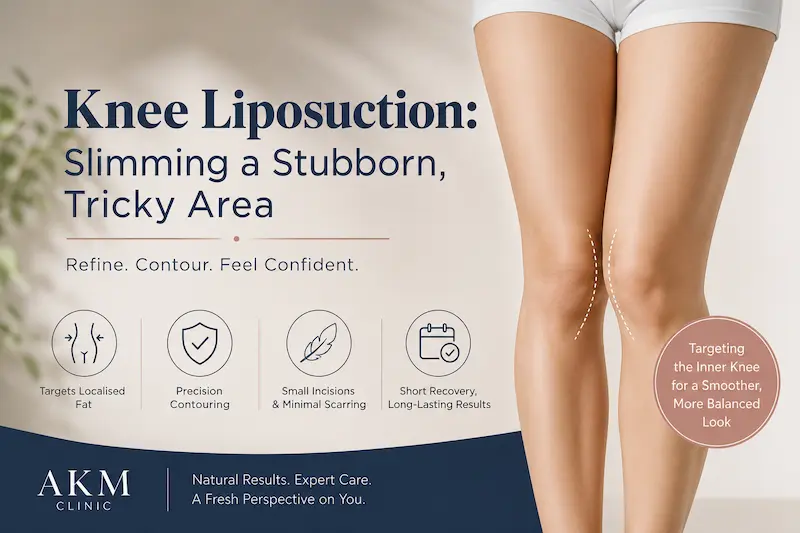
- Knee liposuction refines localised inner-knee fat, improving leg proportion without dramatic reshaping.
- Best candidates have stable weight, good skin elasticity and a small, pinchable fat pad.
- Safety depends on precision: conservative removal, small cannulas and careful lower-leg assessment reduce irregularities.
- Recovery is gradual, with compression, gentle activity and swelling improvement over weeks to months.
AI-generated summary, fact-checked by our medical experts.
Knee liposuction is a small-area body-contouring procedure for people who have a stubborn pocket of fat around the inner knee, not a way to change the whole leg. Because the knee has a thin fat layer, delicate contour transitions and visible skin movement, the best results are usually subtle: a cleaner line, better leg proportion and less heaviness around the knee.
For UK patients comparing private options at home with treatment abroad, the key question is not simply “Can this area be liposuctioned?” It is “Is this fat, is the skin elastic enough, and will conservative contouring actually improve the shape?” That is the lens AKM uses when assessing small, high-precision areas like the knee; for the wider picture, see an overview of how liposuction works.
This guide focuses only on the knee area: who suits it, why it is technically tricky, what realistic results look like, and how recovery works. It does not replace a consultation, and it will not try to turn knee liposuction into a dramatic leg-transformation promise. The knee rewards restraint.
Table of Contents
Why Knee Fat Is So Stubborn
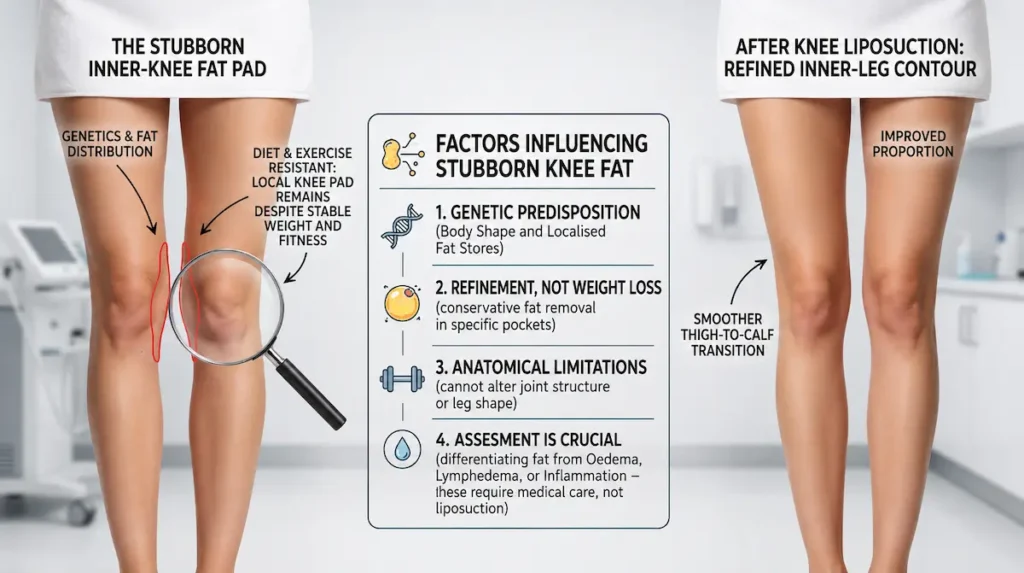
Knee fat is frustrating because it often sits in a small, localised pocket rather than spreading evenly across the leg. Even when weight is stable and exercise habits are strong, the inner-knee pad can remain visible because of genetics, fat distribution and the way the lower thigh blends into the knee. Liposuction can refine this transition, but it cannot rewrite the underlying structure of the joint.
The inner-knee fat pad
The area most people mean when they ask about knee liposuction is the soft fullness on the inside of the knee. It can make the lower thigh look heavier, blur the line between the thigh and calf, or create a small bulge that shows in skirts, shorts or fitted trousers.
This is not the same as general leg size. A patient may have slim thighs and calves but still carry a small pad at the medial knee. That is why knee liposuction is usually approached as a refinement procedure rather than a volume-reduction procedure.
When the concern extends below the knee, the assessment changes. Some patients are better served by looking at contouring the calves or slimming the ankles as separate lower-leg questions, because each area has its own anatomy and limits.
Why diet and exercise may not change it
Exercise can strengthen the leg and improve posture, but it cannot choose where fat disappears first. The knee pad may remain even when the rest of the body responds well to training. This is one reason patients often describe it as “stubborn” rather than “large”.
UK guidance is clear that liposuction is not a weight-loss method. NHS and BAAPS patient information both frame liposuction as most relevant for selected patients with localised fat, not as a substitute for losing weight or improving general fitness. That distinction matters even more around the knee, where there may be only a small amount of fat to remove safely.
If the fullness is caused by swelling, lymphoedema, joint inflammation or general fluid retention, liposuction may not be the right first answer. Oedema can fluctuate through the day, worsen with standing, or feel tight rather than pinchable. That needs medical assessment, not cosmetic contouring.
What knee lipo actually slims
Knee liposuction removes a conservative amount of superficial fat around the knee, most often from the inner-knee area. The aim is to soften the bulge and improve the transition from thigh to lower leg. It is not designed to make the knee joint smaller, straighten the legs, or create a dramatic “thigh gap”.
Good results are usually seen as proportion changes. The knee looks less puffy. The inner-leg line may appear cleaner. Clothes may sit more smoothly around the lower thigh. These improvements are real, but they are measured in refinement rather than spectacle.
That is why consultation photographs and a hands-on examination matter. A surgeon needs to confirm that the concern is fat, that the skin is likely to contract smoothly, and that removing fat will not create a hollow, uneven or aged-looking knee contour.
Discover If a Liposuction Is Right for You
Share your photos and medical history to receive a personalised assessment from our European Board-certified facial surgery team.
Is Knee Liposuction Right for You?
The right candidate for knee liposuction is not simply someone who dislikes their knees. The best candidate has a small, clearly localised fat pad, stable weight, realistic expectations and enough skin elasticity for the area to settle smoothly after fat removal. If the problem is bone shape, significant laxity or swelling, liposuction may disappoint.
Good candidates: localised fat and good elasticity
A strong candidate can usually pinch a small, soft pocket at the inner knee. The surrounding skin still has spring. Weight has been stable, and the goal is not to shrink the entire leg but to make the knee blend more neatly with the thigh and calf.
Skin quality is central. The knee bends, stretches and folds with every step, so loose or crepey skin can become more obvious if fat is removed too aggressively. In a good candidate, the skin has enough elasticity to redrape without looking deflated.
| Assessment point | Good candidate signal | Limited candidate signal | Realistic next step |
|---|---|---|---|
| Fat pattern | Small, localised inner-knee pad | Diffuse leg heaviness or swelling | Confirm fat versus oedema before planning surgery |
| Skin elasticity | Skin springs back after a gentle pinch | Loose, crepey or hanging skin | Discuss whether liposuction alone is enough |
| Leg structure | Soft-tissue bulge affects proportion | Concern is mainly bone, joint angle or knock knees | Liposuction will not change skeletal alignment |
| Expectation | Wants subtle refinement | Expects a completely different leg shape | Reset goals before proceeding |
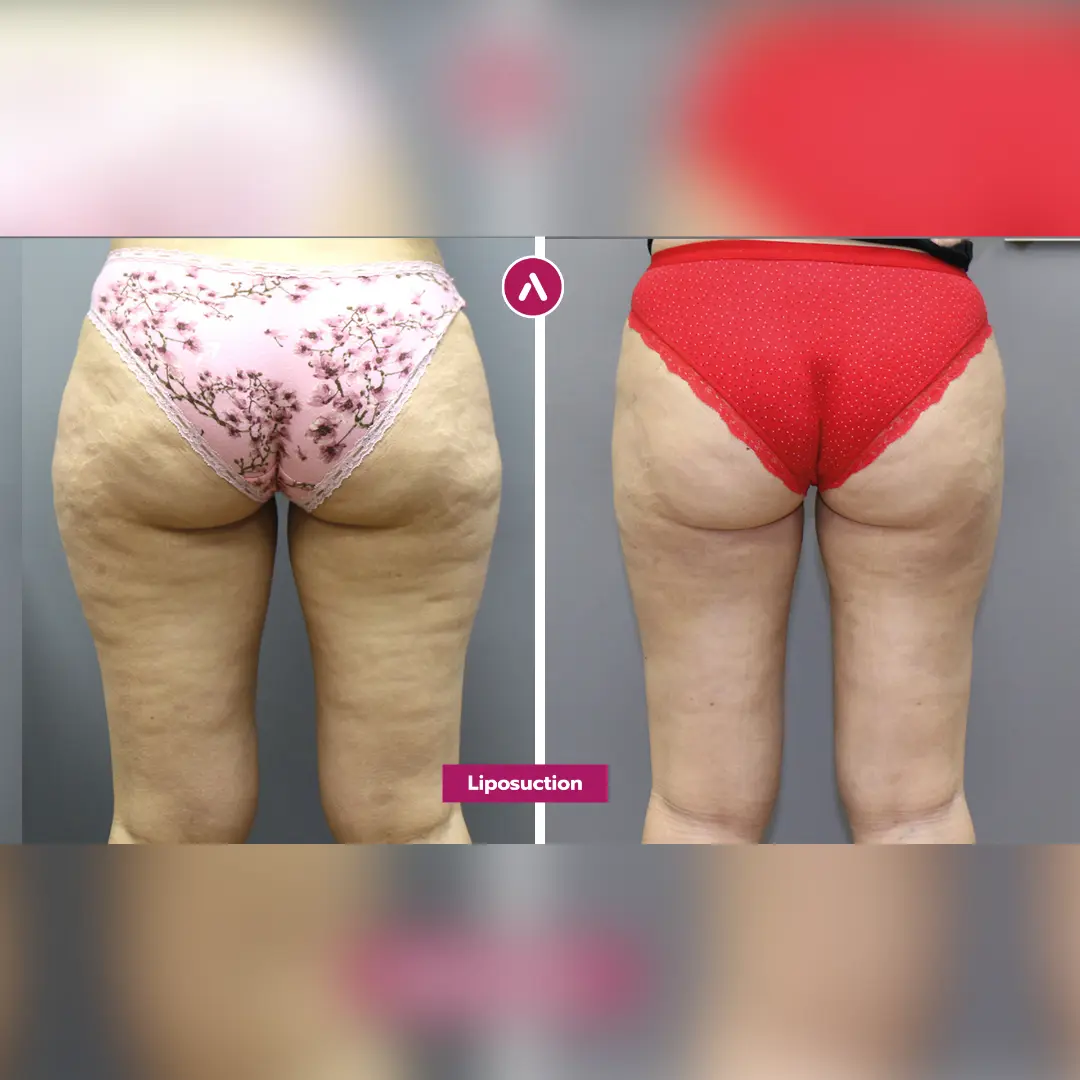
Why the knee is a tricky, low-fat area
The knee is not like the abdomen or flanks, where there may be a thicker fat layer and more room for contouring. Around the knee, small changes can be visible. Too little removal may look unchanged; too much can create dimpling, shadowing or a hollow beside the kneecap.
This is why conservative planning matters. A precise result depends on small cannulas, controlled passes and an understanding of how the knee moves when standing, walking and bending. The goal is to blend, not carve.
The knee is a low-fat, high-visibility area. A careful surgeon removes just enough to soften the contour, while preserving the smooth transition between the lower thigh, knee and calf.
When it does not work: oedema, bone structure or laxity
Knee liposuction does not treat every kind of knee fullness. If the area is swollen because of fluid, inflamed because of joint issues, or shaped mainly by bone alignment, fat removal will not solve the underlying problem. It may even make the mismatch more obvious.
Marked skin laxity is another limit. If the skin already folds around the knee, removing fat may leave less support underneath. In those cases, the consultation should be honest: the best decision may be to avoid liposuction, delay surgery, or consider a different body-contouring plan.
For UK patients travelling for surgery, this is the point to clarify before booking. Ask whether your surgeon thinks the fullness is genuinely fat, how much can safely be removed, and what the plan is if your skin elasticity is borderline.
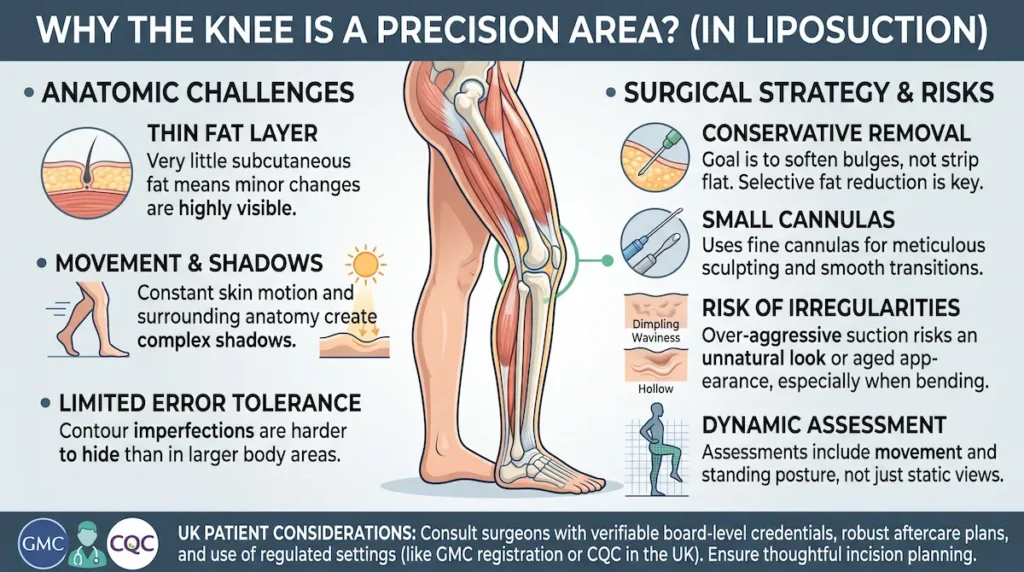
Why the Knee Is a Precision Area
The knee is a precision area because there is very little room for error. The fat layer is thin, the skin moves constantly, and the surrounding anatomy creates shadows that can make even small irregularities visible. In this region, good liposuction is less about “taking more” and more about knowing exactly when to stop.
Thin fat layer and nearby structures
Lower-limb liposuction has to respect the natural transition from the lower thigh into the knee and calf. Unlike the abdomen, where a surgeon may be working across a broader surface, the knee has a narrow contour zone. A few millimetres can change how the area reflects light.
The inner knee is also close to important soft-tissue structures. This is one reason experienced surgeons treat it with particular caution. Peer-reviewed lower-limb liposuction literature explains why lower-leg liposuction demands careful assessment, especially around the knee, calf and ankle, where contour errors are harder to hide than in larger body areas.
For the patient, that means a good consultation should include standing photographs, movement-based assessment and a direct discussion of what is fat versus what is anatomy. A knee that looks full because of joint shape, bowing, knock-knee alignment or swelling will not be corrected by suctioning fat.
Conservative removal and small cannulas
Knee liposuction is usually performed with small cannulas and controlled, selective fat removal. The goal is to soften the bulge without stripping the area flat. The peer-reviewed principles of lower-limb liposuction support this conservative approach: removing too much can create an uneven contour, a sharp hollow or an aged look around the joint.
This is also where incision planning matters. Liposuction uses small cannula entry points rather than long cuts, but even small marks should be placed thoughtfully. Patients who are especially concerned about visibility can read more about whether liposuction leaves scars, because scar appearance depends on entry-point placement, skin healing and aftercare.
UK patients often compare this to the standards they expect from private consultations in London or Harley Street: clear explanation, conservative planning and no pressure to operate if the anatomy is not suitable. The same standard should apply when travelling abroad. Ask how the surgeon avoids over-resection and how they assess knee contour while you are standing, not only lying down.
Risk of contour irregularity with aggressive removal
The main aesthetic risk in this area is not usually that too little fat is removed. It is that too much is removed from a region where skin, movement and light expose small errors. Over-aggressive suction can leave dimpling, waviness or a hollow beside the kneecap.
Contour irregularity can be particularly noticeable when the leg bends. A result that looks acceptable on a still photograph may look less smooth when walking, sitting or wearing fitted clothing. That is why knee liposuction should be planned around real-life movement, not just a static front-view image.
It is reasonable to ask your surgeon how many entry points they expect, where they will sit, and how the contour will be blended into the lower thigh and calf. This is the same principle seen in other body-contouring procedures: the incision or entry point may be small, but placement still shapes the final impression. For a comparison with a procedure that uses longer incisions, see how arm lift incisions are placed and hidden.
UK patient note: At home, patients often look for GMC registration and CQC-regulated settings when assessing cosmetic surgery providers. For treatment abroad, the practical equivalent is to verify the surgeon’s board-level credentials, hospital accreditation, anaesthesia pathway and aftercare plan before paying a deposit.
Experience a Seamless Liposuction Journey
From VIP airport transfers to 5-star hotel accommodation, we manage every detail. Enjoy a premier medical travel experience in Istanbul.
What Realistic Results Look Like
Realistic knee liposuction results are subtle, balanced and easiest to appreciate in proportion to the whole leg. The knee should look lighter and cleaner, not carved out. A good result makes the inner-knee pad less distracting while preserving a natural transition from the lower thigh into the calf.
Subtle definition versus dramatic leg change
Knee liposuction should not be sold as a dramatic leg reshaping procedure. It does not slim the entire thigh, change the calf muscle, correct skeletal alignment or create a different knee joint. It removes a small amount of localised fat from a precise area.
For the right patient, that can still feel worthwhile. The inner leg may look straighter in clothes. The knee may look less heavy from the front. The lower thigh may blend more smoothly into the rest of the leg. These are refined improvements, not a full lower-body transformation.
This distinction is important for patients who may be picturing a smoother silhouette in dresses, swimwear or fitted trousers. The best mindset is not “I want completely different legs.” It is “I want this stubborn pad to stop interrupting my leg line.”
How results settle over weeks and months
Early swelling can make the knee look puffy, firm or uneven. That is normal after liposuction, especially in the lower leg where fluid can linger because of gravity and daily movement. It is common for the area to look worse before it looks better.
Most patients see a clearer outline as swelling settles over the first several weeks. Final refinement takes longer. Small-area liposuction around the knee may continue to soften and define over several months as the tissues heal and the skin adjusts.
| Time after surgery | What the knee may look like | What is usually normal | Helpful focus |
|---|---|---|---|
| First 1–2 weeks | Swollen, bruised, firm or uneven | Yes, especially in the lower leg | Compression, short walks and rest |
| Weeks 3–6 | Less puffiness; shape starts to show | Yes, but minor asymmetry may remain | Follow garment and activity advice |
| Months 2–3 | More natural contour and softer tissue | Yes, gradual settling is expected | Compare progress photos, not daily changes |
| Months 3–6+ | Final refinement becomes clearer | Yes, subtle changes can continue | Maintain stable weight and leg strength |
Effect on overall leg proportion
The most successful knee liposuction results are judged by proportion. The inner knee should no longer draw the eye. The thigh, knee and lower leg should look more continuous. The change may be modest in isolation but meaningful in the context of the whole leg.
Some patients combine the consultation with a broader lower-leg assessment. That does not mean every area should be treated. In fact, careful surgeons often advise the opposite: treat only the areas where fat removal will genuinely improve balance. More areas do not automatically mean a better result.
Photography can help set expectations. Ask to see images taken standing, from front and oblique angles, under consistent lighting. Avoid judging results only from heavily posed or flexed images. The knee is a moving joint; the result has to look natural in motion.
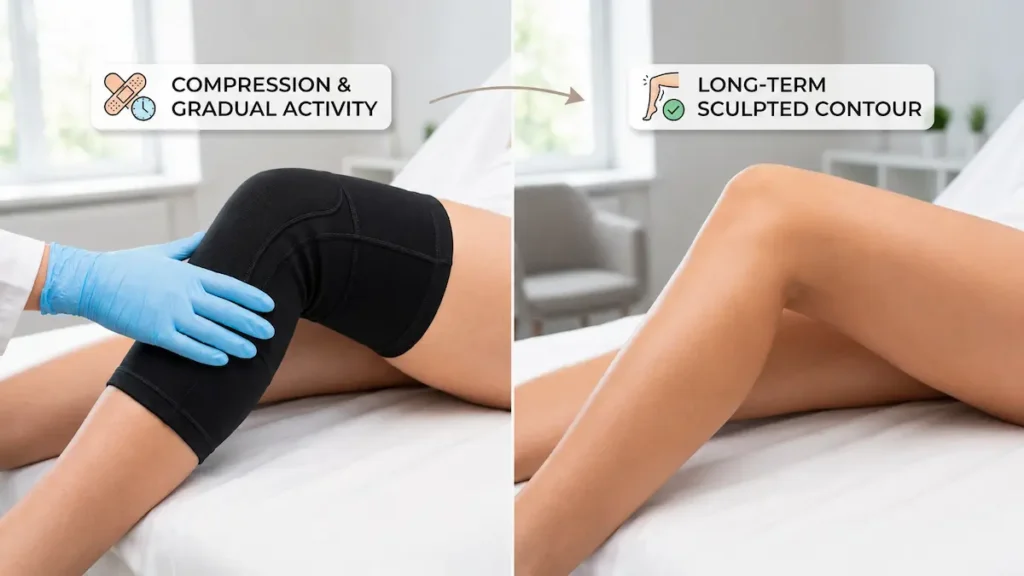
Recovery & Protecting Your Result
Knee liposuction recovery is usually manageable, but the lower leg can swell differently from the abdomen or waist. Gravity, walking and the constant bending of the knee all influence how the area settles. A smooth result depends not only on the procedure, but also on compression, sensible activity and giving the tissue enough time to soften.
Compression and swelling in the lower leg
Compression is often used after liposuction to help control swelling and support the new contour while tissues settle. Around the knee, the garment or wrap must be fitted carefully. Too loose, and it may not help much. Too tight or uneven, and it may create pressure marks or discomfort.
Swelling can travel downward into the lower leg, especially after long periods standing or sitting. UK patients flying home after surgery should be given clear instructions on movement, hydration, compression and when to seek medical advice. This should be discussed before travel, not improvised at the airport.
AKM’s planning for international patients includes pre-operative testing, post-operative checks and fit-to-fly review in Istanbul before departure. For body-contouring patients, that follow-up matters because early swelling can look alarming even when healing is progressing normally.
Activity timeline
Gentle walking is usually encouraged early because it supports circulation, but strenuous lower-body exercise is delayed until the surgeon clears it. The exact timing depends on the amount treated, bruising, swelling, anaesthesia plan and your general health.
A typical recovery pattern may look like this: short walks in the first days, desk-style work once comfortable, gradual return to normal daily movement over the following weeks, and more demanding exercise only after clinical review. If discomfort increases sharply, swelling worsens on one side, or the leg becomes hot, red or painful, you should contact your surgical team promptly.
Do not judge the result too early. The knee may look puffy at first, especially when viewed at the end of the day. Progress photos taken weekly under the same lighting are more useful than checking the mirror several times a day.
When the final shape becomes clear
Some improvement can be visible within weeks, but the final shape around the knee usually takes months to mature. The skin needs time to contract, swelling needs time to drain, and the treated tissue needs time to soften. This is normal.
Stable weight helps protect the result. Liposuction removes fat cells from the treated area, but remaining fat cells can still enlarge with weight gain. A patient who maintains weight, stays active and follows aftercare instructions is more likely to keep a smooth, proportionate contour.
Cost questions are best handled separately because price depends on the treatment plan, anaesthesia, hospital pathway and whether another area is treated at the same time. For a dedicated pricing page, see how much liposuction costs. This article stays focused on the knee area itself.
UK patient note: Before travelling for knee liposuction, ask what happens after you return home: who reviews your photos, how soon follow-up is scheduled, and what symptoms should prompt urgent local medical care. Good aftercare is part of surgical quality, not an optional extra.
Frequently Asked Questions: Knee Liposuction
These FAQs answer the common knee liposuction questions patients ask before consultation. They are intentionally direct, because this area is easy to overpromise. If your concern is not caused by a small, localised fat pad, the honest answer may be that knee liposuction is not the right procedure.
Does knee liposuction work?
Will knee liposuction leave loose skin?
How long is knee lipo recovery?
Can knee liposuction fix knee shape or “knock knees”?
Are knee liposuction results permanent?
Does knee lipo leave scars?
Is knee liposuction painful?
Can knee liposuction be combined with other areas?
Thinking About Knee Liposuction in Turkey?
Knee liposuction is best approached as a precise contouring decision, not a trend. The right question is not “Can fat be removed here?” but “Will removing fat here make the leg look smoother, or will it expose a skin, swelling or structure problem?”
At AKM Clinic in Istanbul, small-area liposuction planning is based on anatomy, skin elasticity, proportion and safe aftercare for international patients. The aim is natural refinement: less heaviness around the inner knee, a smoother lower-thigh transition and a result that still looks like your leg.
If you are considering knee liposuction from the UK, request a virtual consultation with clear standing photographs. Ask specifically whether your concern is fat, oedema, laxity or structure. That answer should guide the plan.
Have Specific Questions About Liposuction?
Speak directly with our dedicated patient coordinators regarding Liposuction. Receive instant guidance and personalised support.
Medical disclaimer: This article is for general educational information only and is not personal medical advice, diagnosis or treatment. Results vary from patient to patient. Always consult a qualified medical professional before choosing surgery, and seek urgent medical care if you develop concerning symptoms after any procedure.
Related Treatments

Awake Gynaecomastia Surgery in Turkey
UK-focused guide to awake gynaecomastia surgery in Istanbul: local anaesthesia safety, excision vs liposuction, recovery, and £(GBP) cost context.

Awake Abdominal Etching in Turkey
UK guide to awake abdominal etching in Istanbul: HD sculpting, tumescent local anaesthesia, twilight sedation, recovery phases, HBOT/LLLT and GBP costs.

Awake Mummy Makeover in Turkey
UK-focused guide to an awake mummy makeover using tumescent local anaesthesia with optional conscious sedation. Explore tummy tuck, liposuction and breast options, recovery timelines and costs in GBP.
Awake Tummy Tuck in Turkey
UK guide to Awake Tummy Tuck under twilight sedation at AKM Clinic, Istanbul—techniques, combinations, recovery timeline, risks, aftercare and GBP planning.
Ready to Begin Your Own Transformation Journey?
Join the 2,000+ patients who have trusted Dr Akif Mehmetoğlu and the AKM Clinic team. Your journey to a more confident, naturally restored you begins with a simple, no-obligation conversation. Contact us today from the UK for your free virtual consultation.
#1: Get Your Free Personalised Quote
Start with a free, no-obligation online consultation. Share your photos, and our surgical team will provide a fully personalised treatment plan and a transparent, all-inclusive price package. There are no hidden fees.
#2: Secure Your Date & VIP Booking
Once you are ready, our dedicated patient coordinators will help you secure your procedure date. We will handle all your bookings, including your 5-star hotel accommodation and private VIP airport transfers.
#3: Arrive in Istanbul & Meet Your Surgeon
Arrive at Istanbul Airport (IST) and be greeted by your private driver. Settle into your hotel and prepare for your in-person consultation, where you will meet your specialist surgeon to finalise the details for your "natural, subtle, and restored" new look.