
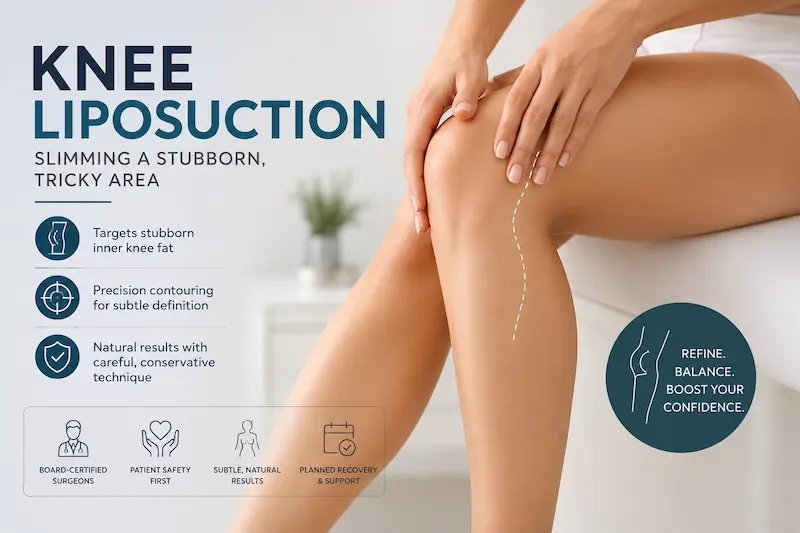
Knee Liposuction: Slimming a Stubborn, Tricky Area
AI Summary
- Knee liposuction refines stubborn inner knee fat for smoother, more balanced leg proportion.
- Best candidates have localized fat, stable weight, and firm, elastic skin.
- Safety depends on precision because the knee is a thin, high-visibility contouring area.
- Recovery focuses on swelling control, compression, gentle activity, and realistic final results over months.
Summary generated by AI, fact-checked by our medical experts
Knee liposuction targets the small fat pad on the inner knee that often resists diet and exercise. Because the fat layer is thin and the area is delicate, results are usually subtle and depend heavily on skin elasticity. The goal is refined leg proportion, not a dramatic reshaping of the entire lower leg.
For the right candidate, knee liposuction can soften a heavy inner-knee contour and make the transition from thigh to calf look cleaner. But it is not a fix for swelling, bone structure, knee alignment, or loose skin. That distinction matters. A small area can still require a highly precise plan.
At AKM Clinic, knee contouring is considered within an overview of how liposuction works, but the knee deserves its own discussion because it behaves differently from broader areas like the abdomen or flanks. Less fat is removed. More judgment is required. Good results come from restraint.
Table of Contents
Why Knee Fat Is So Stubborn
The knee is not usually the first area people think of when they hear “liposuction,” yet it can make a visible difference in how the leg looks in shorts, dresses, workout clothes, and fitted pants. The inner knee can hold a small, persistent pad of fat that makes the leg look heavier than the rest of the body suggests.
The inner-knee fat pad
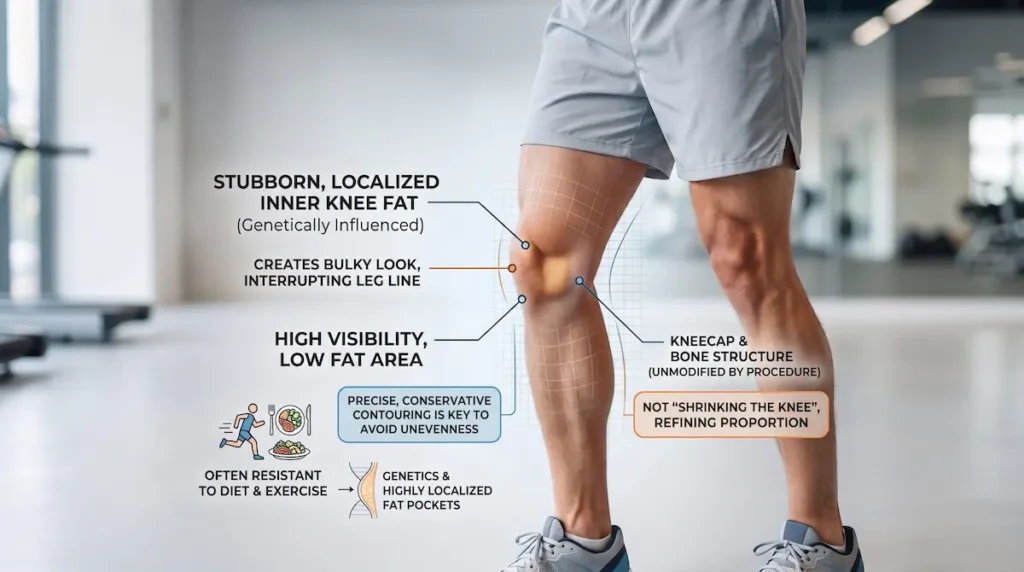
The fat treated with knee liposuction is usually not spread around the entire knee. It is most often a small pocket on the inner side, just above or beside the knee joint. This pocket can interrupt the line between the lower thigh and upper calf, creating a rounded or bulky look even in patients who are otherwise close to their ideal weight.
This is why the result is usually described as refinement. The surgeon is not “shrinking the knee.” They are reducing a localized fat pad so the leg reads as smoother and more balanced.
Why diet and exercise may not change it
Localized fat around the knees can be genetically influenced. A patient may lose weight, build muscle, and improve overall body composition, yet still notice a soft pad near the inner knee. That does not mean exercise has failed. It means this particular area may not respond evenly to weight loss.
This is similar to other lower-leg contouring concerns. Some patients notice stubborn fullness in nearby areas and research contouring the calves or slimming the ankles, but each area has its own anatomy and limitations. The knee is especially unforgiving because the fat layer is thin and the surface contour is easy to see.
What knee liposuction actually slims
Knee liposuction can reduce a soft, pinchable fat pocket around the inner knee. It cannot change the kneecap, the joint itself, leg alignment, or the underlying bone structure. It also cannot tighten loose skin in a meaningful way if elasticity is poor.
Think of the procedure as contour editing, not leg reconstruction. A conservative reduction may make the knee look lighter and the leg line more continuous, especially when viewed from the front or slightly angled. The best result is one that looks natural enough that no one notices the procedure — they simply see a better proportion.
Planning principle: The knee is a low-fat, high-visibility area. Removing too much can create dents or unevenness, so the goal is precise, conservative contouring rather than aggressive fat removal.
Discover If a Liposuction Is Right for You
Share your photos and medical history to receive a personalized assessment from our European board-certified facial surgery team.
Is Knee Liposuction Right for You?
Knee liposuction is most satisfying when the concern is truly localized fat. A good candidate usually has stable weight, good skin elasticity, and a specific inner-knee contour issue rather than generalized leg heaviness. The consultation should answer one central question: is the fullness coming from fat that can be safely reduced?
Good candidates: localized fat and good skin elasticity
A strong candidate can usually pinch a small, soft pad around the inner knee. The skin should feel reasonably firm and spring back after being released. This matters because liposuction removes fat; it does not remove extra skin.
ASPS describes ideal liposuction candidates as adults near their ideal weight with firm, elastic skin, good muscle tone, good general health, and specific body-contouring goals. That principle applies even more strongly to small precision areas like the knee, where a small mismatch between fat removal and skin retraction can be visible.
| Candidate Signal | What It Suggests | Realistic Knee Liposuction Outcome |
|---|---|---|
| Small, pinchable inner-knee fat pad | Likely fat-based fullness | Good potential for subtle slimming |
| Firm, elastic skin | Skin may retract better after fat removal | Smoother, more refined contour |
| Stable weight | Results are easier to maintain | More predictable long-term proportion |
| Generalized swelling around the knee | May be fluid, inflammation, or medical swelling | Liposuction may not be appropriate |
| Loose or crepey skin | Skin laxity may be the main issue | Lipo alone may disappoint |
| Knock-knee appearance or bony prominence | Likely structural rather than fat-based | Liposuction cannot correct alignment |
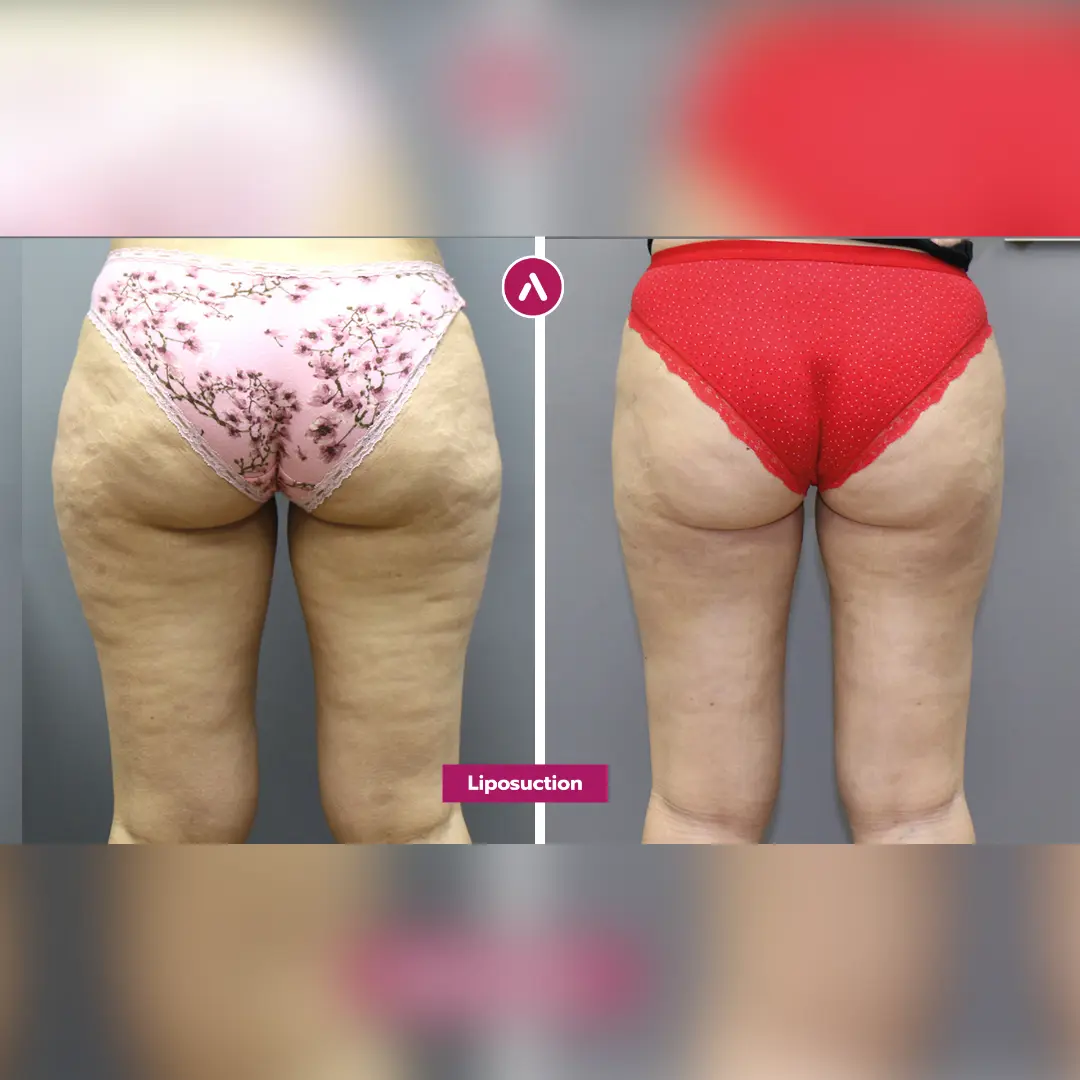
Why it is a tricky, low-fat area
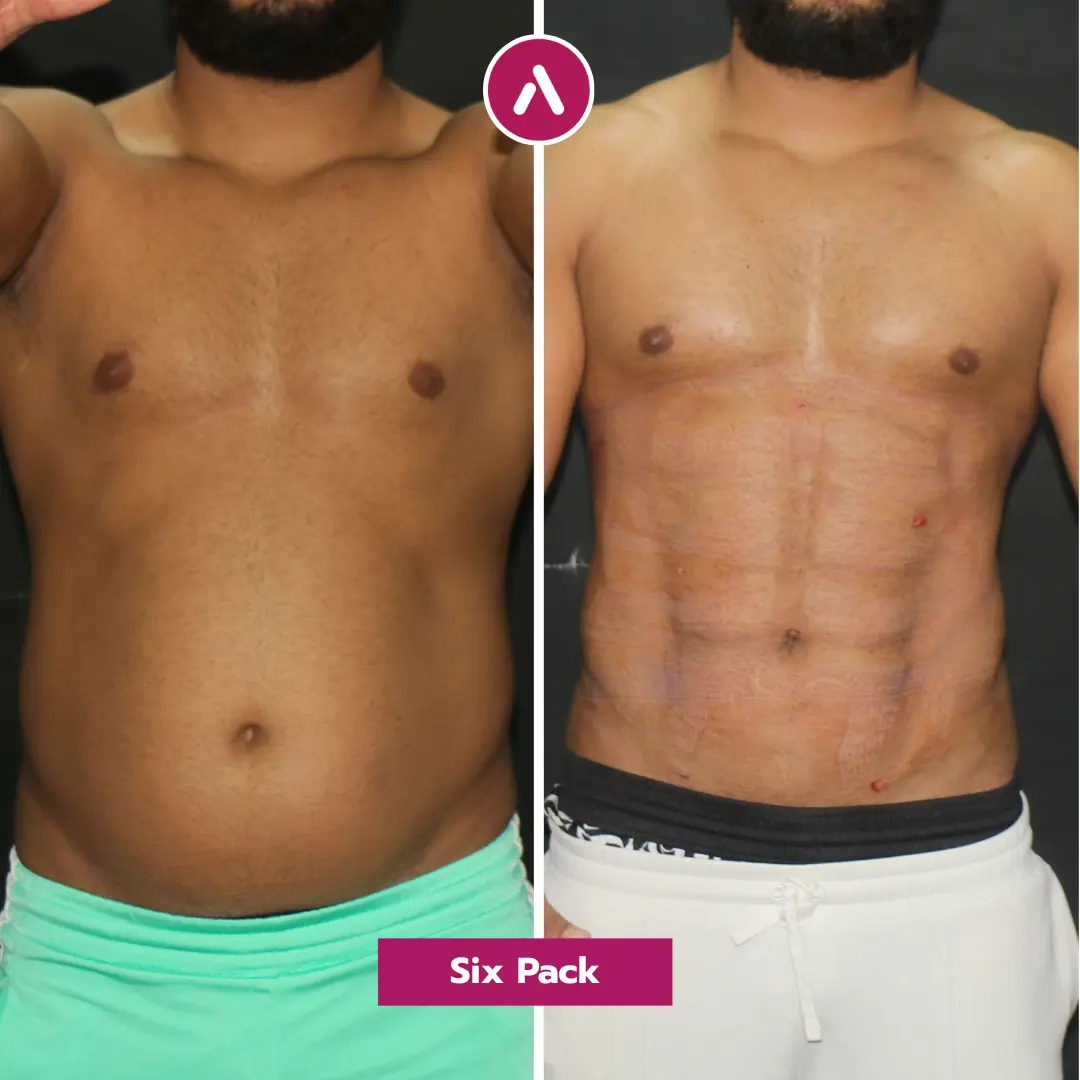
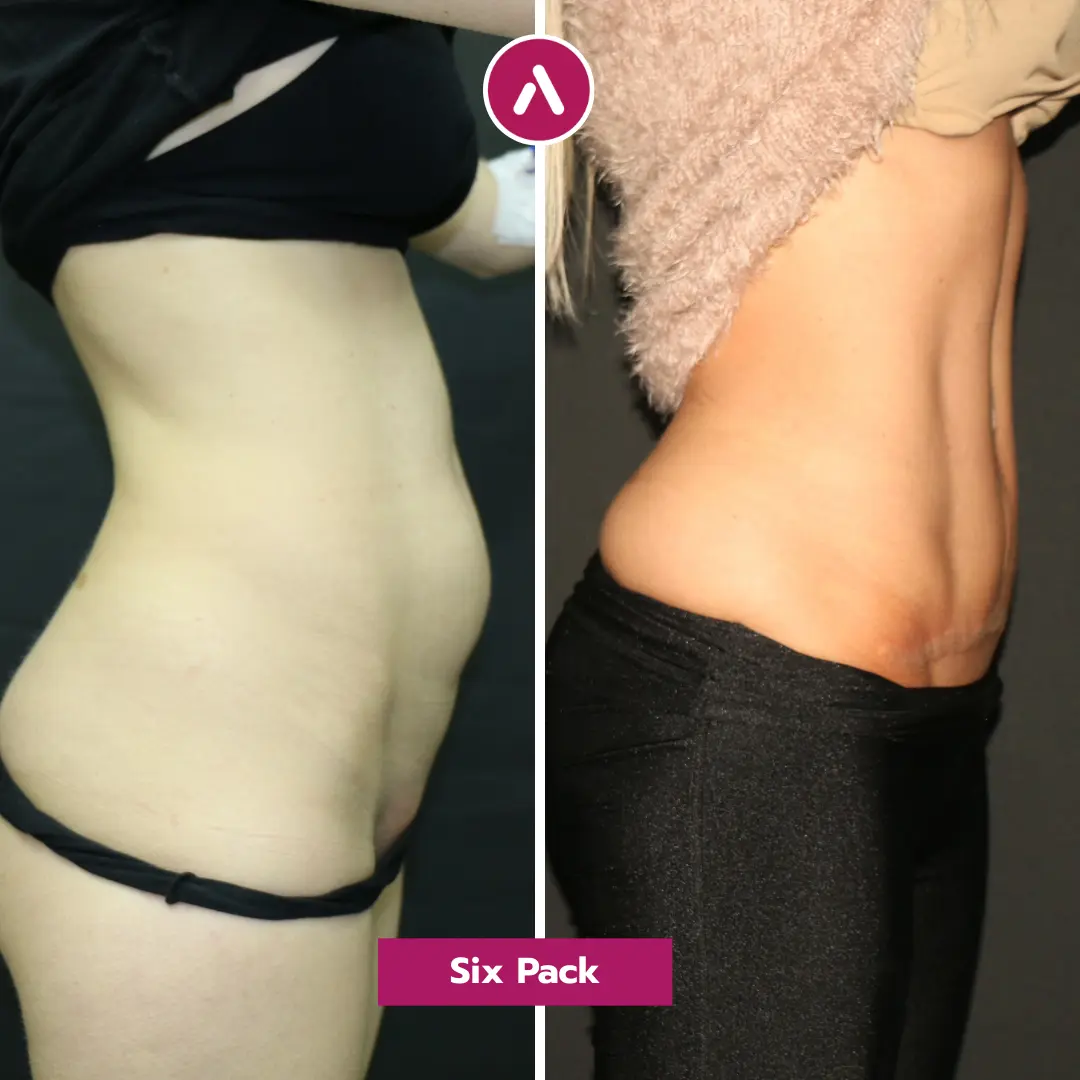
The knee does not offer the same margin for error as the abdomen or flanks. There is less fat to remove, less surface area to blend, and more risk that over-removal will show as a dip, groove, or uneven transition. The surgeon must preserve a smooth contour while reducing only what is necessary.
That is why “Can you remove all the fat?” is the wrong question. The better question is: “How much can be safely removed while keeping the knee smooth?” In this area, the right amount is often less than the patient expects.
When knee liposuction will not work well
Knee liposuction is not the right solution for every knee concern. If the area is swollen because of fluid retention, lymphatic issues, inflammation, arthritis, or another medical cause, cosmetic fat removal will not address the real problem. If the shape is caused by bone structure or leg alignment, liposuction cannot change that either.
Skin laxity is another important boundary. If the skin is already loose, removing fat may make the area look softer or more deflated. In those cases, the honest recommendation may be to avoid knee liposuction or to consider a different treatment plan after a surgeon evaluates the whole leg.
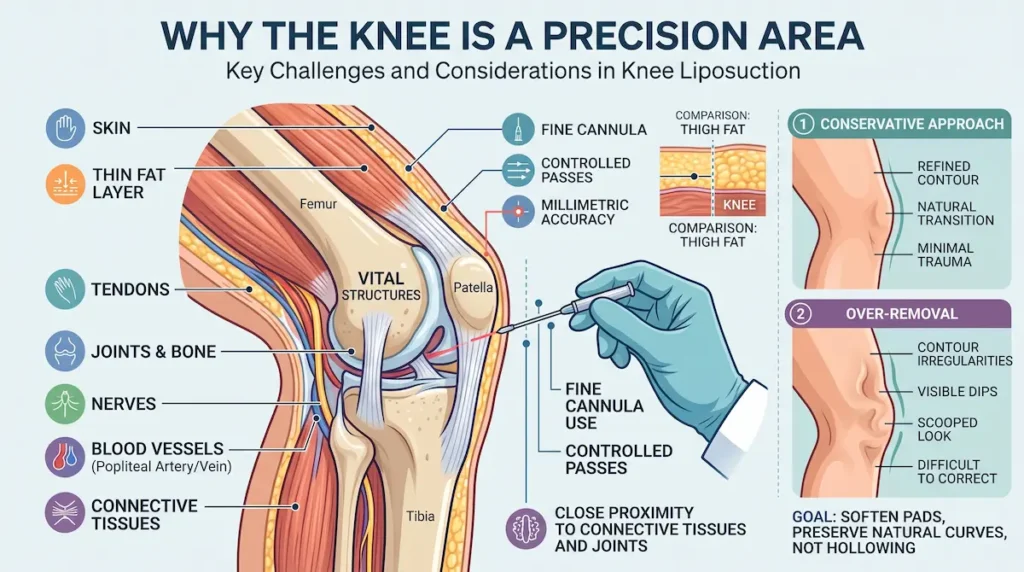
Why the Knee Is a Precision Area
The knee looks simple from the outside, but surgically it is a demanding area. There is little room to hide over-removal, asymmetry, or uneven blending. A small improvement can look elegant; an aggressive approach can look obvious.
The fat layer is thin
In larger areas, surgeons may have more fat to work with and more surface area to blend. Around the knee, the fat layer is much thinner. That means every pass of the cannula matters.
The goal is not to hollow the knee or create a sharp groove. It is to soften a localized pad while keeping a natural transition into the thigh and calf. A smooth result usually comes from removing less fat than a patient imagines, not more.
Nearby structures require conservative technique
The knee is close to important connective tissues, vessels, and joint structures. For this reason, knee liposuction should be planned as a delicate contouring procedure rather than a high-volume fat-removal surgery. Small cannulas and controlled passes help reduce trauma and improve precision.
US patients often ask whether a more powerful liposuction device automatically means a better result. Not necessarily. Technology can help, but judgment is still the main safety tool. At AKM Clinic, VASER High-Definition Liposuction is used to support precise fat emulsification and contouring, but the treatment plan still depends on anatomy, skin quality, and safe limits.
Why over-removal can cause contour irregularities
Removing too much fat around the knee can create visible dips, waviness, or a “scooped” look. These problems can be harder to correct than the original fullness because the area has little spare tissue. The best knee liposuction result is usually the one that does not announce itself.
This is also why incision planning matters. The entry points are tiny, but their placement should still be thoughtful. Patients who are concerned about visible marks can read more about whether liposuction leaves scars. The same principle applies across body-contouring procedures: small incisions can heal well when they are placed with care, while poor placement can make even minor scars more noticeable. For a comparison with a body-contouring procedure that uses longer incisions, see how arm lift incisions are placed and hidden.
Contouring principle: In knee liposuction, the safest-looking result often comes from a conservative plan. The aim is to refine the inner knee without flattening the natural curves that make the leg look normal in motion.
Experience a Stress-Free Liposuction Journey
From VIP airport transfers to 5-star hotel accommodations, we handle every detail. Enjoy a seamless medical travel experience in Istanbul.
What Realistic Results Look Like
Realistic knee liposuction results are usually subtle, clean, and proportion-focused. The change may be most noticeable in photos, fitted clothing, or when the knees are viewed from the front. Patients expecting a dramatic lower-leg transformation may be disappointed; patients wanting a smoother inner-knee line are more likely to be satisfied.
Subtle definition, not dramatic reshaping
Knee liposuction can make the leg look more continuous from thigh to calf. It may reduce the soft bulge that draws attention to the inner knee. But it will not create a new leg shape from scratch.
For example, if the lower leg looks heavy because of muscular calves, ankle swelling, or bone structure, knee liposuction will not solve those issues. If the concern is a small, localized inner-knee pad, the procedure may make the leg look lighter and more balanced.
Why results settle over weeks and months
Early swelling can blur the result. In the first few weeks, the knee may look puffy, firm, or uneven. That does not automatically mean the final contour is poor. The lower leg can hold swelling longer than some other areas because fluid has to move upward against gravity.
Most patients see early shape improvement once swelling starts to calm, but the more refined contour develops gradually. The final look often becomes clearer over several months as tissue softens, swelling fades, and the skin adapts to the smaller fat layer.
How knee contour affects overall leg proportion
The knee sits at the visual midpoint between the thigh and lower leg. Even a small change here can influence how the whole leg reads. A bulky inner knee can make the thigh look heavier; a smoother knee transition can make the leg line look cleaner without changing the entire limb.
This is why the consultation should include the full leg, not just a close-up of the knee. The surgeon should look at the thigh, calf, ankle, skin elasticity, and natural alignment. A balanced result depends on proportion.
| Expectation | Realistic? | Why |
|---|---|---|
| Smoother inner-knee contour | Yes, in the right candidate | Localized fat can be reduced conservatively |
| Dramatically thinner legs | Usually no | The knee is a small, low-fat area |
| Correction of knock knees | No | Leg alignment is structural, not fat-based |
| Tighter loose skin | No, not reliably | Liposuction removes fat; it does not excise skin |
| Better thigh-to-calf transition | Often possible | Reducing the inner-knee pad can improve proportion |

Recovery & Protecting Your Result
Recovery after knee liposuction is usually manageable, but the lower leg has its own rhythm. Swelling may travel downward, compression can feel different around the knee joint, and final definition takes time to appear. The key is to protect the contour while tissues settle.
Compression and swelling around the lower leg
Compression is commonly used after liposuction to help control swelling and support the treated tissues. Around the knee, the garment must fit well without digging into the crease or creating pressure lines. Too much pressure in the wrong place can be uncomfortable; too little support may allow swelling to linger.
Lower-leg swelling can feel frustrating because gravity pulls fluid downward. Some patients notice puffiness near the knee, calf, or ankle in the early recovery phase. This does not always mean the result is uneven. It often means the tissue is still healing.
Activity timeline after knee lipo
Most patients are encouraged to walk soon after surgery, but strenuous lower-body exercise usually waits until the surgeon clears it. The exact timeline depends on the extent of treatment, whether other areas were treated at the same time, and how the patient is healing.
Gentle movement supports circulation. High-impact workouts, deep squats, running, or aggressive stretching too early can increase swelling and irritation. A safe recovery plan should be personalized rather than copied from someone else's timeline.
When final shape becomes visible
Early improvement may appear within weeks, but the polished contour usually takes longer. The knee can look firm, puffy, or slightly uneven before it softens. Final shape is typically judged over months, not days.
To protect the result, patients should keep weight stable, follow compression instructions, attend follow-up appointments, and avoid rushing back into intense activity. If cost is part of the decision, you can see how much liposuction costs at AKM Clinic.
For research-minded patients, lower-leg liposuction deserves careful assessment because unfavorable outcomes are more likely when anatomy, skin quality, or swelling patterns are misread. Peer-reviewed literature also emphasizes the need for careful evaluation in lower-leg liposuction; see why lower-leg liposuction demands careful assessment and peer-reviewed principles of lower-limb liposuction.
Patient-safety note: Knee liposuction should be planned around your anatomy, not around a trend photo. A precise plan, conservative removal, and realistic recovery expectations are what make a small-area contouring procedure look natural.
Frequently Asked Questions: Knee Liposuction
These answers are written for patients considering knee liposuction as a small-area contouring procedure. They do not replace a medical consultation, but they can help you ask more focused questions when you meet your surgeon.
Does knee liposuction work?
Will knee liposuction leave loose skin?
How long is knee lipo recovery?
Can knee liposuction fix knee shape or knock knees?
Are knee liposuction results permanent?
Does knee lipo leave scars?
Final Thoughts
Knee liposuction is best understood as precision refinement. It can slim the inner knee and improve leg proportion in the right candidate, but it is not a solution for every lower-leg concern. The best results usually come from conservative fat removal, good skin elasticity, and a surgeon who is willing to say no when anatomy is not suitable.
If you are considering knee liposuction, ask AKM Clinic whether your knee fullness is fat-based, whether your skin is likely to retract well, and what level of change is realistic for your leg shape. A free virtual consultation can help you understand whether this small but tricky area is worth treating.
Have Specific Questions About Liposuction?
Chat directly with our dedicated patient coordinators regarding Liposuction. Get instant answers and personalized support.
Medical disclaimer: This article is for educational purposes only and is not medical advice. It does not diagnose, treat, or replace an in-person or virtual consultation with a qualified medical professional. Surgical suitability, risks, recovery, and results vary by patient. Always follow your surgeon's instructions and seek medical care promptly if you develop concerning symptoms.
Related Treatments
Awake Gynecomastia Surgery in Turkey
Awake gynecomastia guide: local anesthesia vs general, technique options, recovery timeline, risks, and cost/value insights for expert patients.
Awake Abdominal Etching in Turkey
Learn what awake abdominal etching is, who it’s for, recovery timeline, risks, and USA vs Turkey value—plus how to choose a qualified surgeon.

Awake Mommy Makeover in Turkey
Learn what an awake mommy makeover in Turkey includes, twilight sedation vs general anesthesia, recovery timeline, scars, risks, and value vs NYC/LA/Miami.
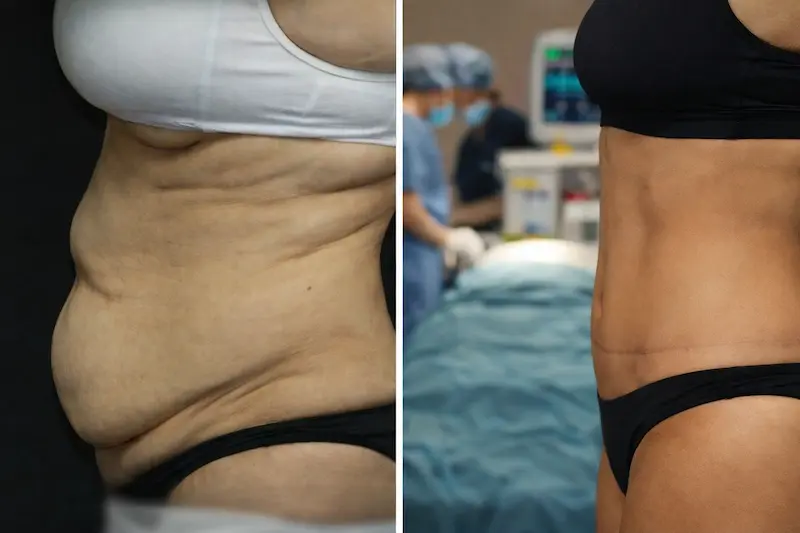
Awake Tummy Tuck in Turkey
Learn how an awake tummy tuck works, who qualifies, anesthesia options, step-by-step surgery, recovery timeline, risks, scars, and cost comparison.
Ready to Start Your Own Transformation Journey?
Join the 2,000+ patients who trusted Dr. Akif Mehmetoğlu and the AKM Clinic team. Your journey to a more confident, revitalized you begins with a simple, no-obligation conversation. Contact us today from the USA for your free virtual consultation.
#1: Get Your Free Personalised Quote
Start with a free, no-obligation online consultation. Share your photos, and our surgical team will provide a fully personalised treatment plan and a transparent, all-inclusive price package. No hidden fees.
#2: Secure Your Date & VIP Booking
Once you're ready, our dedicated patient coordinators will help you secure your procedure date. We'll handle all your bookings, including your 5-star hotel and private VIP airport transfers.
#3: Arrive in Istanbul & Meet Your Surgeon
Arrive at Istanbul Airport (IST) and be greeted by your private driver. Settle into your hotel and prepare for your in-person consultation, where you'll meet your specialist surgeon to finalise the details for your "natural, subtle, and revitalized" new look.