
Nose Types: A Clear Guide to Shapes and Surgical Limits
AI Summary
- Nose types such as straight, aquiline, concave, bulbous, upturned, broad and crooked describe appearance only. They are not diagnoses or beauty rankings.
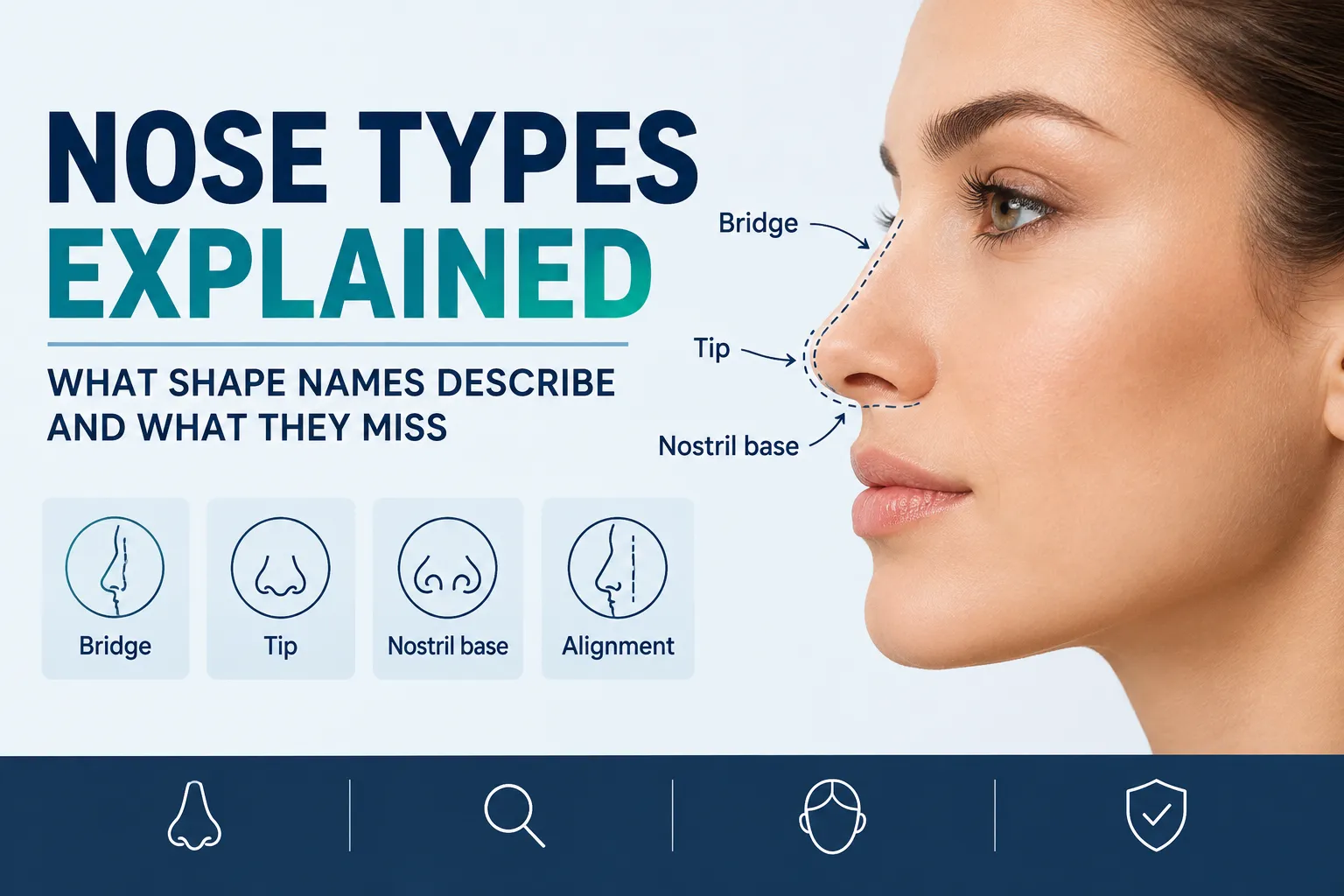
- Most noses fit more than one label, because each word refers to a different part: the bridge, the tip, the nostril base or the alignment.
- A nose's outside shape does not show how well it breathes. Breathing is assessed separately, from your symptoms and an examination.
- Before a consultation, note what you see from the front, side and below, what you want to keep, your health history and any old injuries.
Summary generated by AI, fact-checked by our medical experts
Nose types are everyday names for how a nose looks: straight, aquiline or arched, concave, rounded or bulbous at the tip, upturned, broad or crooked. Most noses fit more than one. The labels describe appearance only. They are not a diagnosis, a beauty ranking or a sign that anything needs fixing.
Start with what you notice, not with a category. You might see a raised bridge, a rounded tip or a wide nostril base. You might also see features you want to keep exactly as they are. If you are already weighing surgery, our guide to rhinoplasty in Turkey for Canadians covers the procedure itself.
This guide sticks to the vocabulary. It explains what the common names refer to, how to describe your own nose in plain words, why shape says little about breathing and where the limits of surgery sit. Use it to prepare for a conversation.
Table of Contents
What do nose types actually describe?
Nose types are shorthand for appearance. They are not a medical classification, and there is no agreed list: popular guides disagree on how many shapes exist and what to call them. Treat the names as vocabulary that helps you point to a feature.
Why your nose can fit more than one description
The words overlap because they describe different parts. A nose can be straight along the bridge and round at the tip, and both descriptions are true at once. You do not have to pick one category for the whole nose.
Online lists also use the same word in different ways. Fleshy, bulbous and button can mean slightly different things depending on who wrote the list. A plain description, such as a small bump halfway down the bridge, leaves less room for misunderstanding.
Which parts of the nose do the names refer to?
Three landmarks cover most of the names. The bridge is the upper line of the nose. The tip is the end that projects forward, and the nostril base is the lower area around the openings.
Underneath, the nose is built from bone in its upper part and cartilage lower down, with skin over both. Shape names only describe the surface you see. They tell you nothing about how thick the skin is or how firm the cartilage is.
Does having a particular nose type mean you need surgery?
No. A label creates no obligation to change anything. Nose surgery can aim at appearance, at breathing or at both, and a shape name tells you neither.
Choosing no treatment is a perfectly reasonable outcome. Before you book anything, put your concern in your own words and list what you would want to preserve. A feature can be noticeable without being a problem.
What are the different nose shapes called?
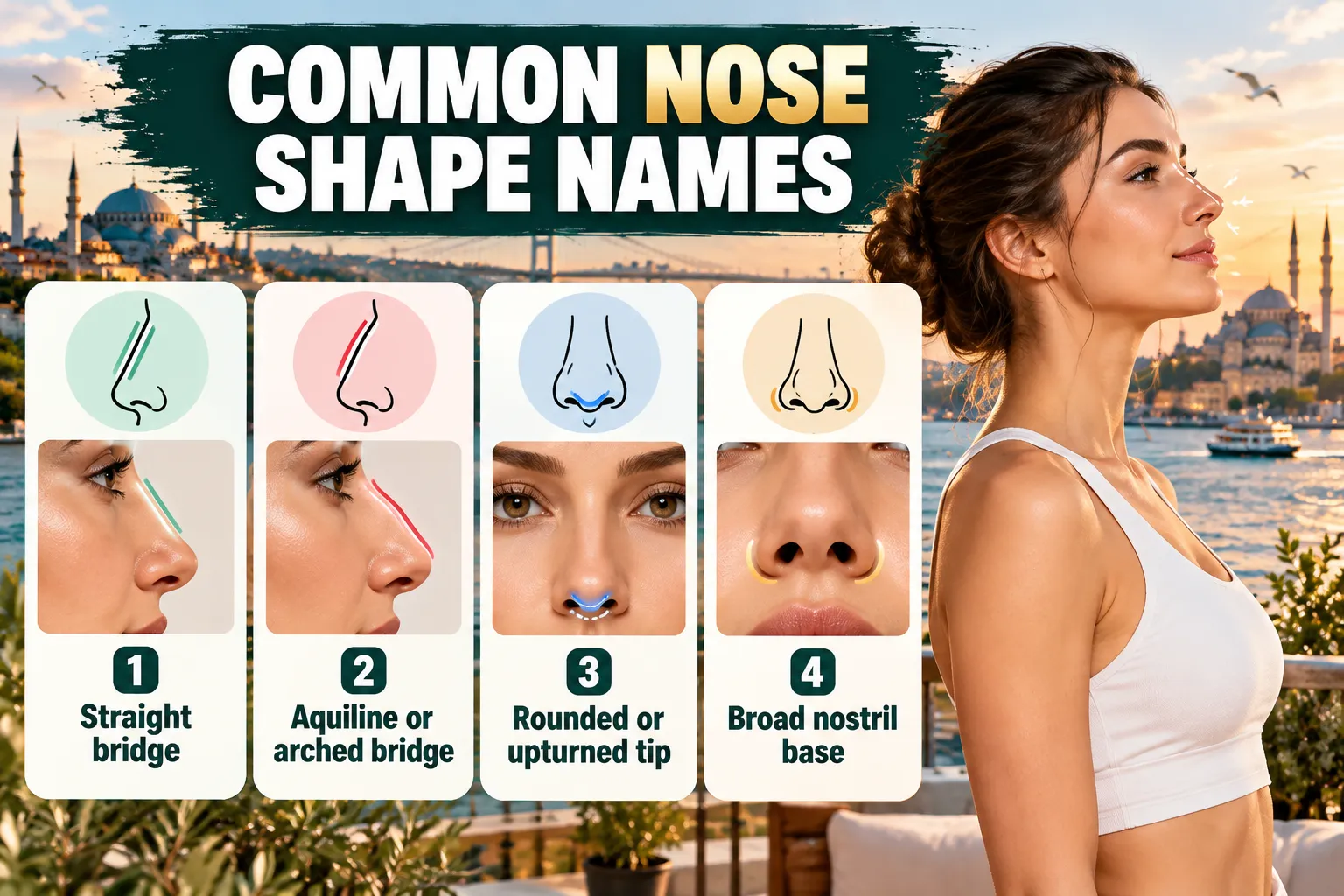
Most names describe one of four things: the line of the bridge, the shape or angle of the tip, the width or the alignment. Knowing which part a word refers to matters more than the word itself. Aquiline says nothing about your nostrils. Broad rarely describes the whole nose.
Straight, aquiline and concave bridges
The nasal bridge is what people usually mean when they talk about a straight, arched or scooped profile. Each word describes a different line. None of them is the preferred shape.
You will also see Greek and Roman in nose-shape guides. Greek usually means a bridge that looks straight. Roman usually means a prominent, outward-curving bridge, which overlaps with aquiline and arched.
| Common description | What it usually describes | What the label does not tell you |
|---|---|---|
| Straight or Greek | A bridge that looks fairly straight in profile, without an obvious hump or inward curve. | The width from the front, the tip shape or the nostril outline. |
| Aquiline, arched, humped or Roman | An outward-curving, or convex, bridge; humped usually stresses a raised area along that line. | Whether the tip points down or how broad the nose looks. |
| Concave or scooped | A bridge that curves inward rather than running straight or curving outward. | The tip direction, the overall size or the alignment from the front. |
Keep bridge and tip apart. An aquiline bridge does not come with a downturned tip by default. A concave bridge can sit above a tip that points either way.
Rounded, pointed and upturned tips
The nasal tip has its own vocabulary. One set of words covers its outline, another its direction. Neither set tells you anything about the bridge.
- Rounded or bulbous: a visibly full, rounded tip, sometimes broad at the end.
- Pointed: a tip with a narrower, more sharply defined outline.
- Upturned: a tip that seems to angle upward in profile.
- Downturned: a tip that seems to angle downward in profile.
Button and snub are looser terms. Button usually suggests a small, rounded nose or tip, while snub suggests a short nose with a tip that turns up. Usage varies, so add detail if you use either.
A rounded tip can also be upturned. Outline and direction are separate questions, and a single nickname can blur them.
Broad bases and different nostril shapes
Broad needs a location. It might refer to the bridge, the tip, the nostril base or several areas at once. A broad base does not mean a broad bridge.
Nostril words describe the visible opening and outline: rounded, oval, elongated or flared, where flared means the sides spread outward. These are descriptions only. They are not instructions to change anything.
Some online lists tie these features to ethnicity. That is not helpful. Describe the feature itself rather than using ancestry as shorthand for it.
Crooked or asymmetric noses
Crooked means the nose seems to depart from a straight line. Asymmetric is broader and covers any visible difference between the two sides. The terms overlap, but they are not the same.
Your description might involve a bridge that leans, a tip that sits off-centre or nostrils that look different. Name what you see. Leave the cause to the examination.
A nose can look straight in profile and still sit off-centre from the front. Straight and symmetrical are different claims.
How can you describe your own nose shape clearly?
Start with observations. A few ordinary photographs and a short list of notes tell a surgeon more than any category. Write down the feature that catches your eye, the view where you see it and what you would rather leave alone.
What to notice from the front, side and base
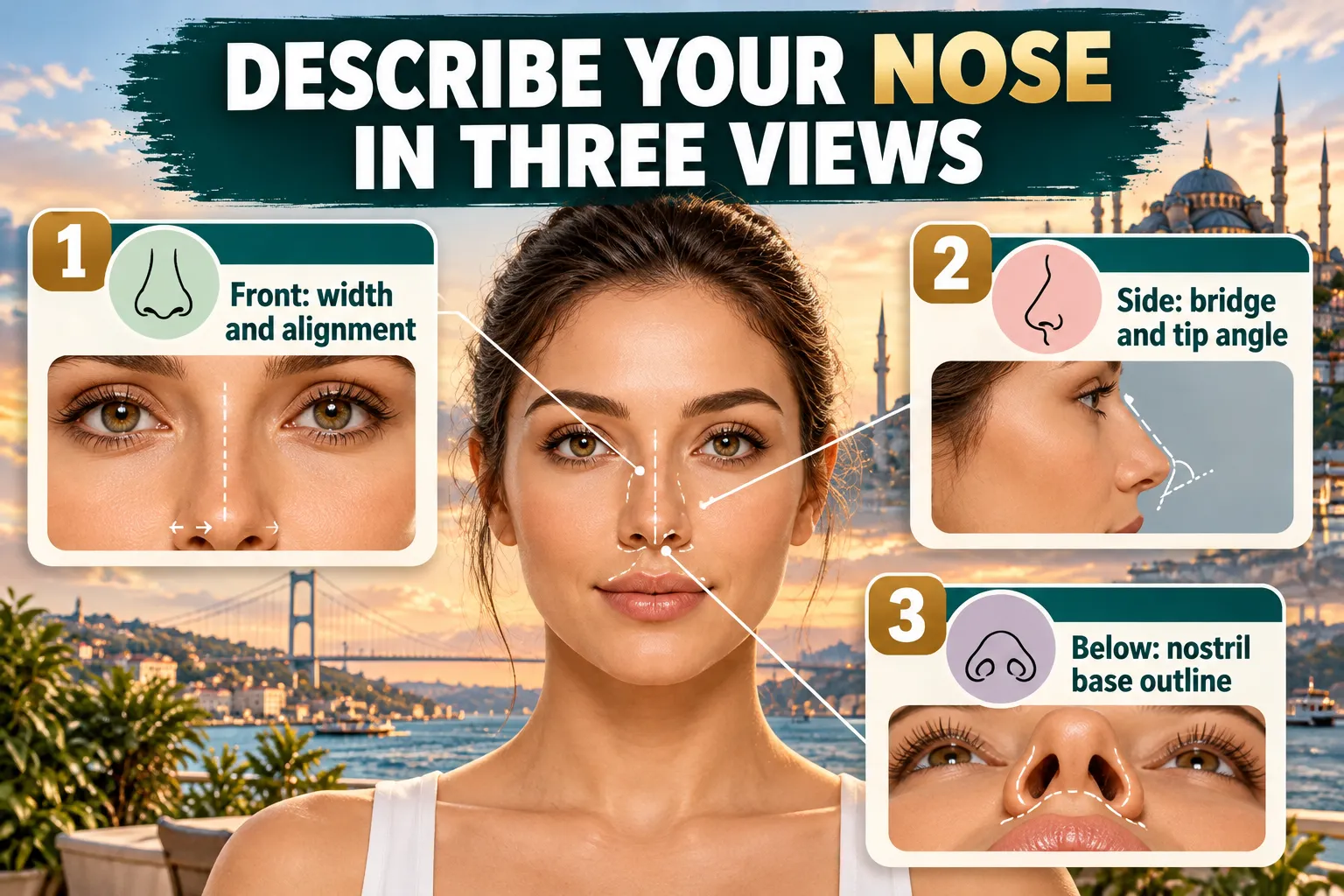
Look at one view at a time. From the front, note width and alignment. From the side, follow the bridge line and the angle of the tip; from below, describe the outline of the nostril base.
Keep the notes neutral and specific. Useful examples:
- A raised area along the bridge in profile.
- A rounded tip seen from the front.
- A broad nostril base in the view from below.
- A slight lean when looking straight ahead.
You do not need technical language. If something bothers you in only one view, write that down rather than calling your whole nose too big.
How to describe size, width and projection separately
Size is really three measurements. Width is how broad an area looks, and length runs from the top of the nose to the tip. Projection is how far the nose stands out from the face. Keeping them apart makes your concern much easier to understand.
Then add what you want to keep. Perhaps the bridge bothers you but the tip does not. Perhaps you want a narrower base without losing a profile your family recognizes.
What photographs cannot establish
Photos are a starting point. They cannot show skin thickness, cartilage strength or what is happening inside the nose. Lighting and camera angle also change how a nose looks.
Leave those judgments to the examination. Bring your notes along with the photos. Keep what you see separate from what you would like, so the conversation starts from facts rather than guesses.
Does the shape of your nose tell you how well it works?
Not on its own. Nose types describe what you see, while breathing is assessed from your symptoms and an examination of the inside of the nose. Keep the two conversations separate, even if they end up in one plan.
Why an external shape is not a breathing diagnosis
A shape label is not a test. Calling your nose broad, narrow or crooked does not tell anyone whether there is a blockage or what might cause one. That question is answered by examining the inside as well as the outside.
The septum is the wall of cartilage and bone that divides your two nasal passages. It sits inside, out of view. Whether it plays any part in your breathing is something only an examination can show.
Which symptoms should you mention at assessment?
Describe what you notice in daily life. Bring these points to the online consultation and the in-person assessment:
- Persistent blockage or difficulty breathing through your nose.
- Any difference you notice between the two sides.
- Previous nasal injuries, even ones you never had treated.
- Previous nasal surgery or other procedures.
Use your own words. Say when the problem shows up, at night or during exercise for example, without trying to name the cause. Then describe your appearance goal separately so neither gets lost.
How an old injury changes the discussion
Mention any old injury, even if your main concern is cosmetic. A childhood knock that was never treated still gives the surgeon useful context. It may help explain an asymmetry.
Do not assume every asymmetry needs functional work. Ask what the examination shows, what remains uncertain and whether the plan addresses appearance, breathing or both.
One practical point for Canadians: provincial health plans do not cover cosmetic surgery. If breathing is your main concern, a visit to your family doctor at home first is reasonable. It also gives you notes to share at consultation.
A Comprehensive Guide to Rhinoplasty (Nose Job)
From the procedure steps to your post-operative aftercare, review every detail of how our surgical team performs Rhinoplasty (Nose Job) in Istanbul. A clear, start-to-finish overview, so you know exactly what to expect before you travel.
How much can rhinoplasty change your nose shape?
A good deal, within limits set by your anatomy. The American Society of Plastic Surgeons' rhinoplasty overview lists changes to nose size, bridge humps or depressions, tip shape, nostril width and asymmetry, and describes surgery to improve impaired breathing. A shape label cannot tell you how much of that applies to you.
Which features can a surgical plan address?
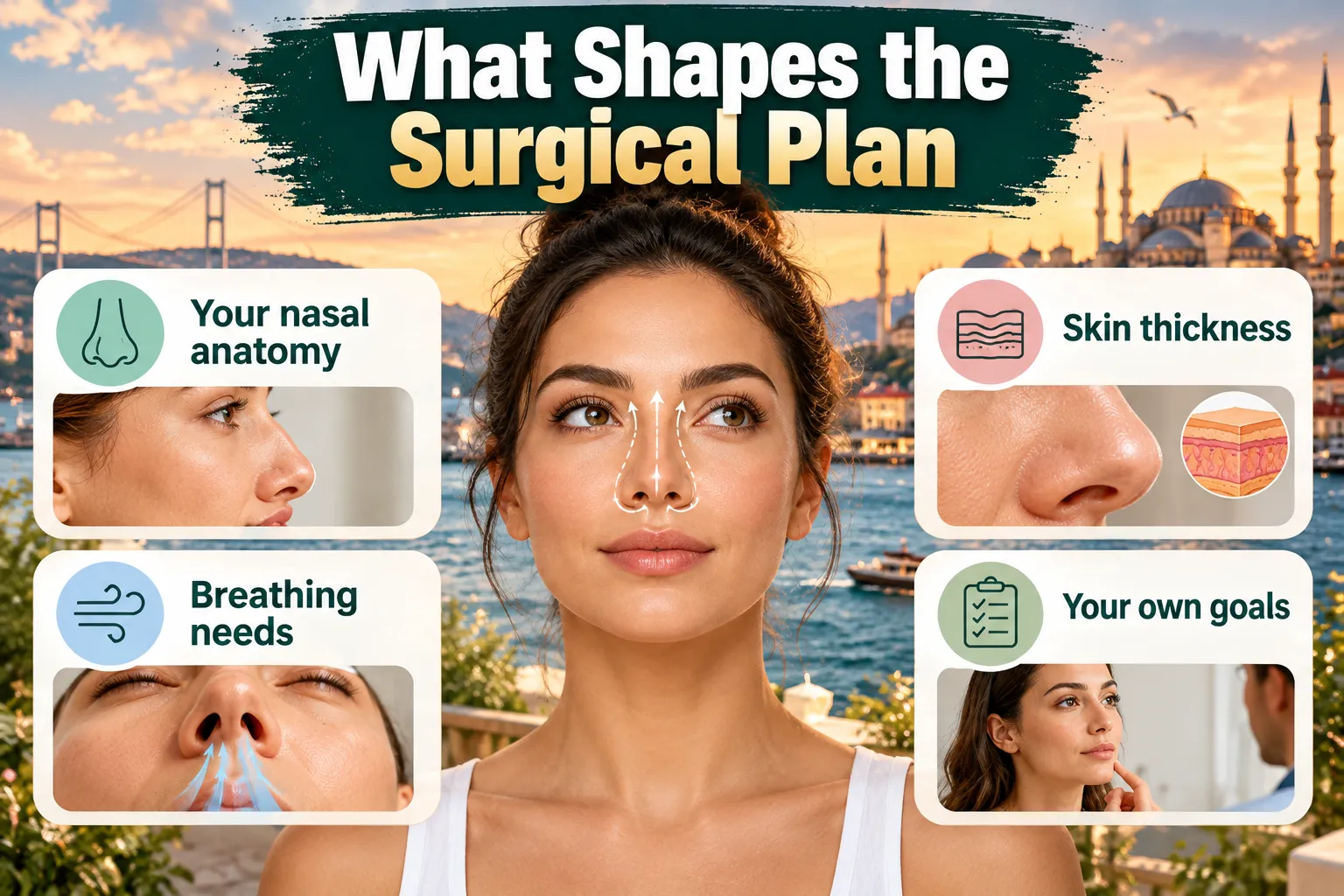
Be specific about the feature. A plan built around one detail looks very different from one that changes several. Before your consultation, sort your priorities:
- Which part of the bridge line concerns you?
- What, if anything, would you change about the tip?
- Does your concern involve the nostril base?
- Which features do you want to keep?
Ask for the reasoning, not only a technique name. A sound plan explains why each change answers your concern. It also says what the surgeon would leave untouched.
Why skin and support limit the result
Smaller is not always the goal. Ask how your skin thickness, the support your cartilage gives, any asymmetry and any previous surgery affect the plan. Ask, too, whether the plan adds support anywhere rather than only reducing.
Ask where the limits lie. A careful surgeon will tell you which changes they would advise against, and why.
Keep breathing in view. Reducing size should not become the only measure of success, because breathing difficulty appears among the risks listed further down.
What before-and-after photographs can tell you
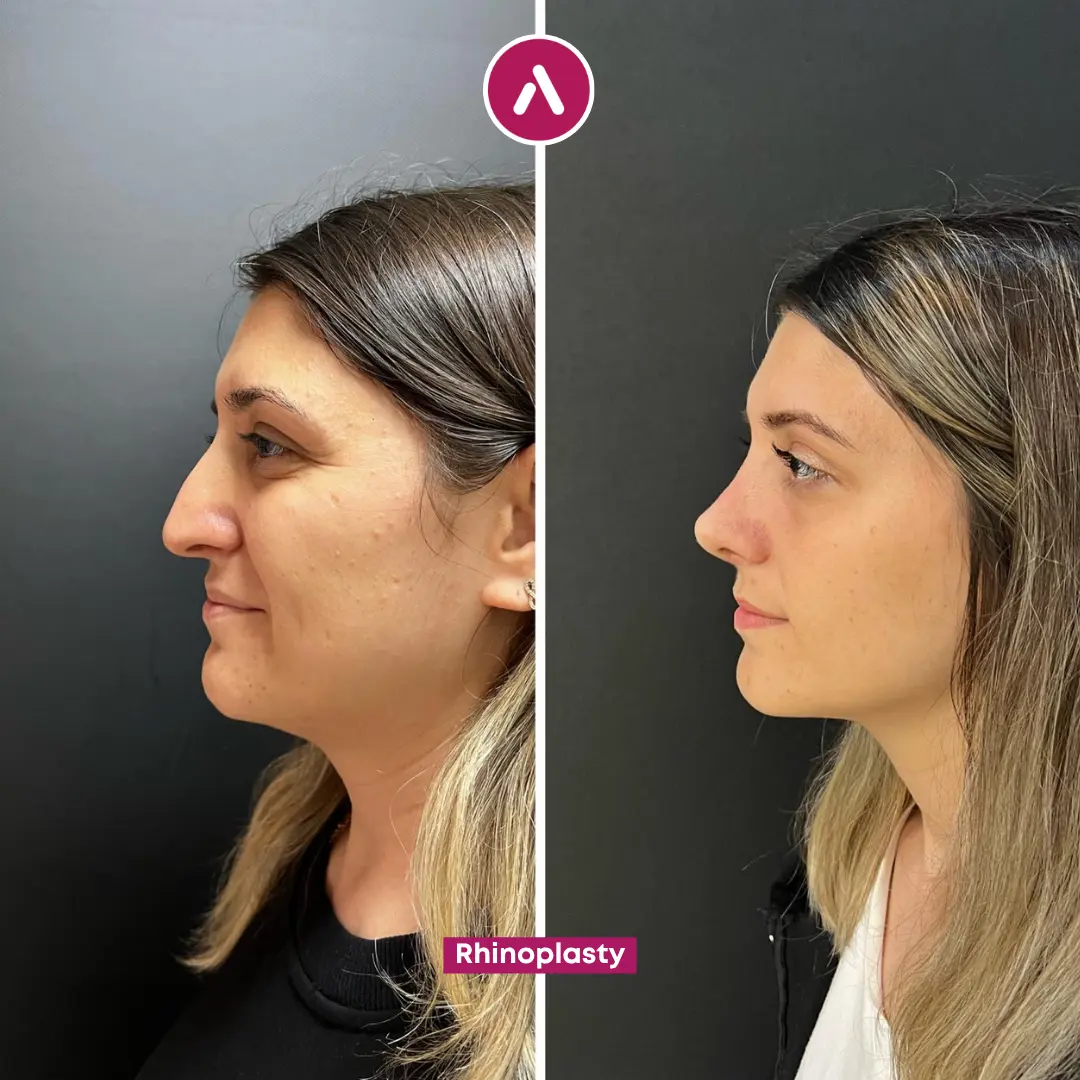
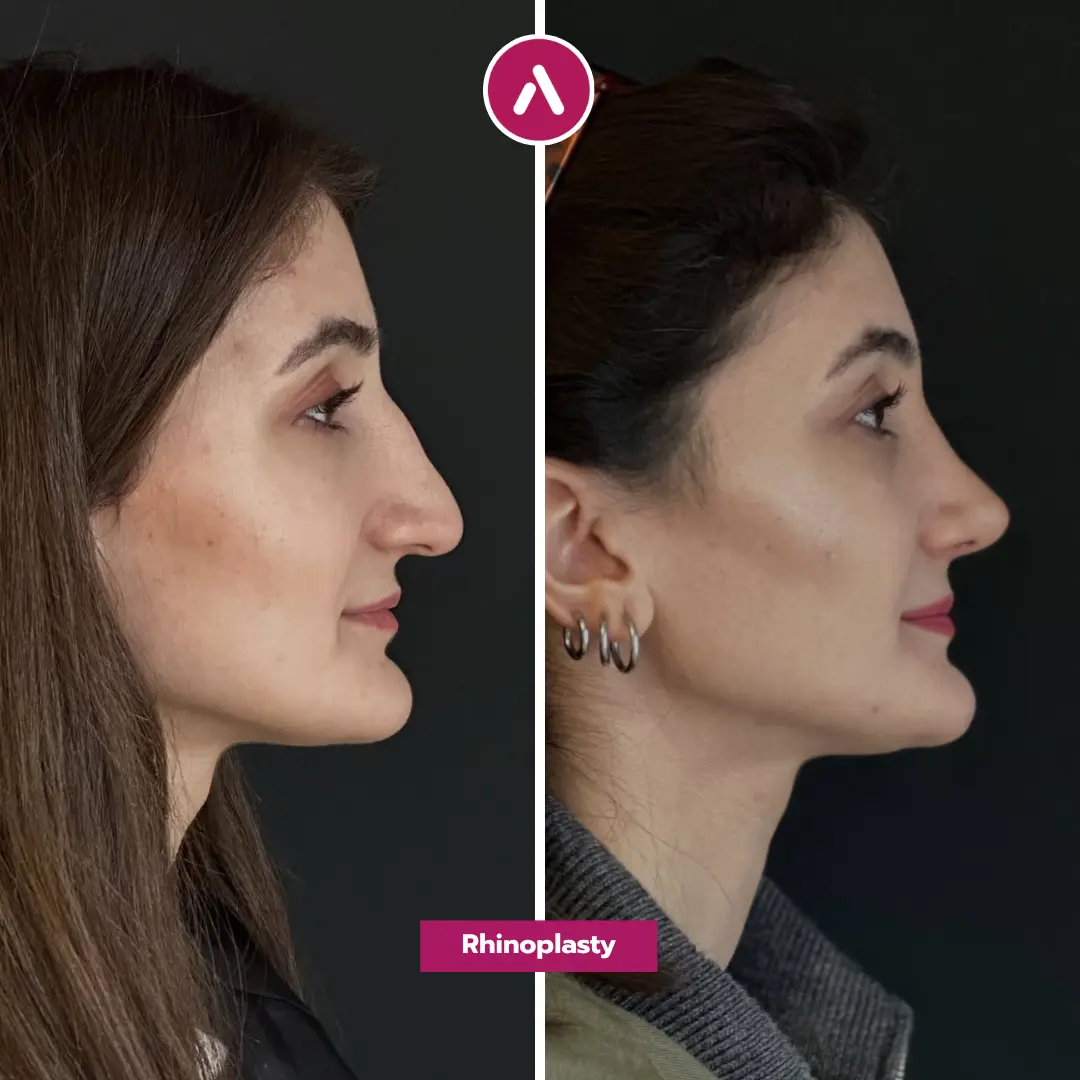
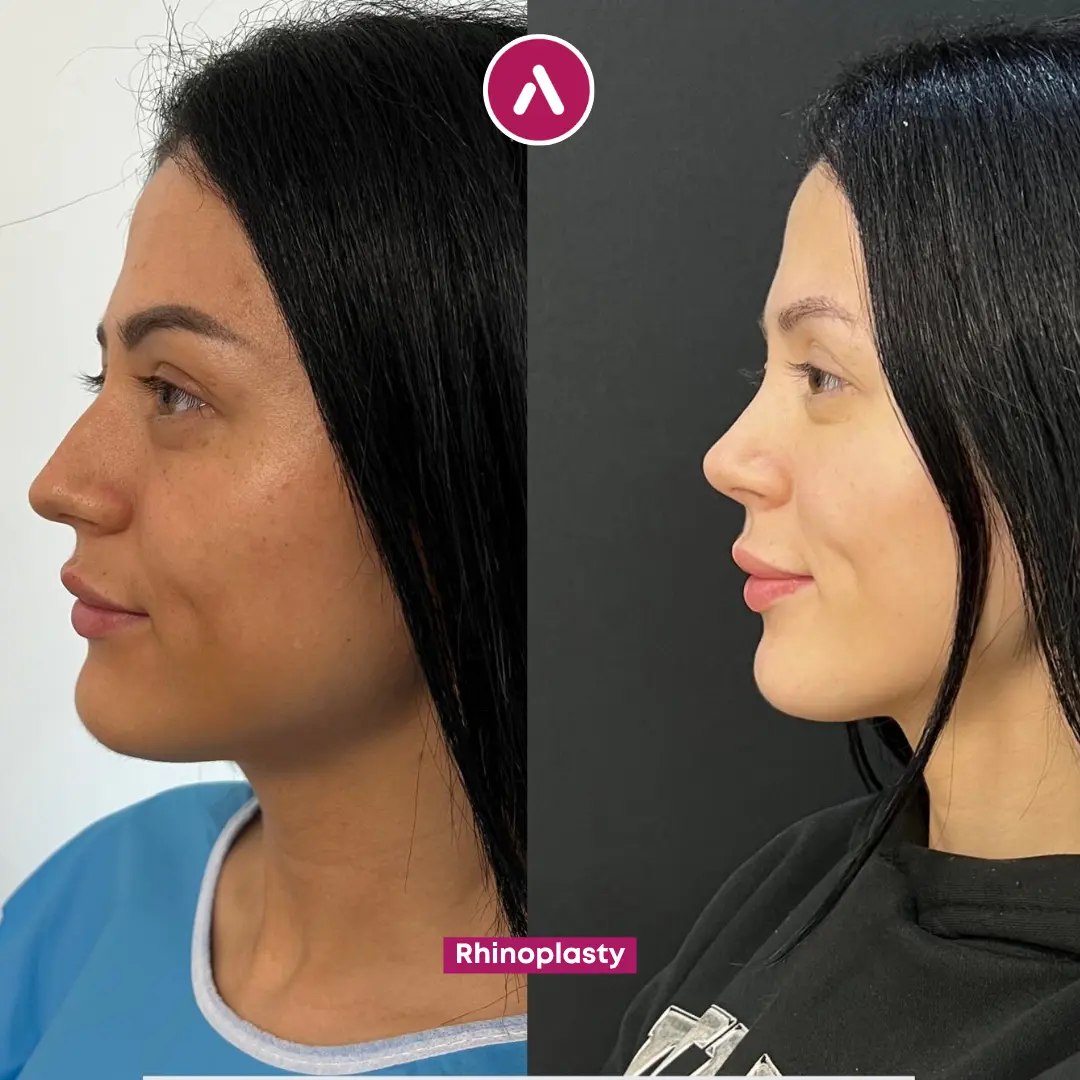
Our rhinoplasty before-and-after cases can help you point to changes you would like to discuss. They are not a menu to copy.
Results vary individually. Another person's photo cannot predict yours, because their skin, cartilage and proportions are not yours.
Look beyond the profile. Ask how a change would show from the front, and which visible differences would likely remain.
Who assesses nose-shape goals at AKM Clinic?
At AKM Clinic, rhinoplasty is the field of Dr. Göknil Gültekin, an otolaryngologist and facial plastic surgeon. Her credentials include the European Board of Otorhinolaryngology-Head and Neck Surgery and Fellowship of the European Academy of Facial Plastic Surgery. Her focus is primary, revision and preservation rhinoplasty, and our page about the clinic and its team gives more background.
Your goals still get assessed individually. The clinic's Natural First approach favours rejuvenation over alteration, on the view that a good result goes unnoticed. That is a philosophy, not a promise of a particular look.
Dreaming of a Natural-Looking Rhinoplasty (Nose Job)?
Our philosophy is simple — rejuvenation, not alteration. We believe the best work is the work no one can point to. See how our surgical team creates subtle, refreshed results that honour the features already making you who you are.
When might changing your nose shape be the wrong decision?
More often than online lists suggest. A label is never a reason to operate. If you feel pressured, cannot say what you want changed or are uneasy about the trade-offs, pausing is the sensible move.
Which expectations or health concerns call for a pause?
Your reasons should be your own. Ask yourself whether you would still want this without anyone else's comments. You can leave a consultation undecided.
Expect questions about your general health, smoking and expectations, and answer them openly. Ask whether anything in your history would make postponing wiser. Think honestly about whether you can follow the aftercare instructions while away from home. A first inquiry is not confirmation that you are a suitable candidate.
What risks matter beyond the final appearance?
Think beyond the profile. Mayo Clinic's rhinoplasty guide lists risks that include:
- Bleeding and infection.
- An adverse reaction to anesthesia.
- Difficulty breathing through the nose.
- Permanent numbness in and around the nose.
- An uneven-looking nose.
- Pain, discolouration or swelling that may persist, and scarring.
- A hole in the septum, called a septal perforation.
- The need for additional surgery.
At AKM Clinic, rhinoplasty is done under general anesthesia, so mention any past reactions. Ask which risks weigh most in your case. Ask too what would happen if you were unhappy with the result, who would assess it and whether further treatment might be considered. Do not assume a revision is included.
Questions About Safety and Surgery Abroad?
Speak directly with our patient safety coordinator about anesthesia options, risk management, and the travel logistics for your safe return home to Canada after your Rhinoplasty (Nose Job). No call centres — just a clinical coordinator who knows your file.
What happens if healing or breathing becomes a concern?
Do not judge healing alone. If something worries you, send photos and a description to the medical team and ask for a clinical review. Reassurance from a coordinator is not a doctor's assessment.
Urgent symptoms are different. The ASPS guidance on rhinoplasty recovery advises immediate medical attention for shortness of breath, chest pain or an unusual heartbeat. Get local care first, wherever you are, and message the team afterwards.
After surgery, our medical team monitors you closely. You receive medication and written care instructions. The Patient Host is reachable on WhatsApp around the clock, and every patient has a final in-person check-up with the doctor before flying home.
Settle the details before you book. Ask who reviews a suspected complication and where you would be seen once back in Canada. Ask separately how any further treatment, and its costs, would be handled.
The clinic also lists hyperbaric oxygen therapy (HBOT) and a low-level laser therapy system among its recovery technologies. Ask whether either is part of your plan. Do not assume it is routine for nasal surgery.
Our patient reviews page offers practical context about the journey. Reviews describe experiences. They are not evidence of medical safety.
Ready to Discuss Your Rhinoplasty (Nose Job)?
Our surgical calendar books up well in advance, so planning early gives you the widest choice of dates. Request a consultation to map out your ideal travel window — built around your flights from Toronto (YYZ), Vancouver (YVR), or Montréal (YUL) — with no obligation to proceed.
What should Canadians prepare for a nose-shape consultation?
Bring specific goals rather than a nose-type label. What you notice, what you hope to change and what you want to keep is enough to start. Everything else comes from the examination.
What information should you send before travelling?
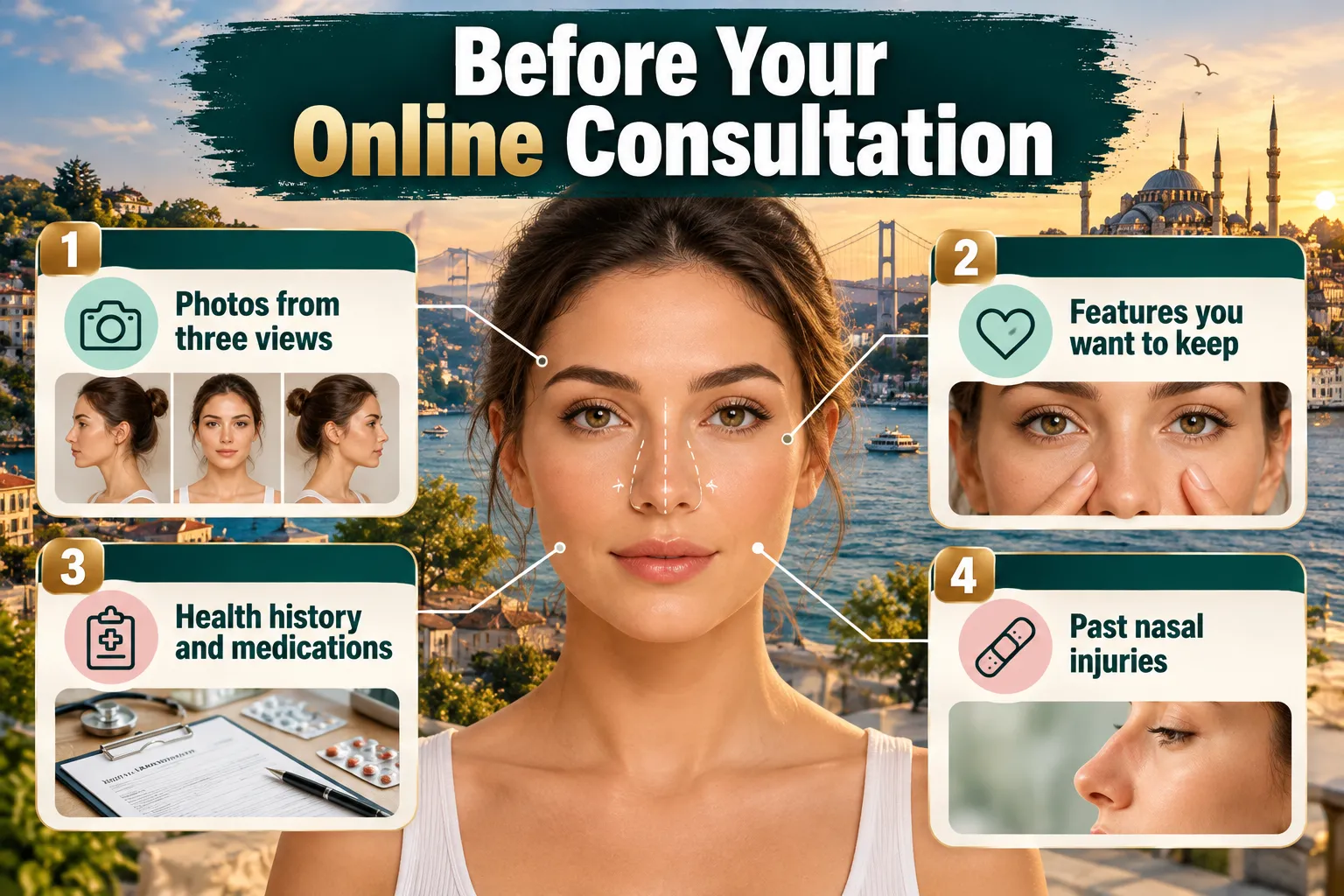
The first step is a free online consultation with photos, organized by a dedicated Patient Host. Prepare these alongside your photos:
- Your main concern and the features you want to preserve.
- Your medical history, including relevant conditions and allergies.
- Medications and supplements you take.
- Details of previous nasal injuries, surgery or other nasal procedures.
- Any breathing concerns you want assessed separately from appearance.
After that, you receive a personal treatment plan and quote. The Patient Host then arranges the date, the hotel and the transfers. Our step-by-step patient journey shows how it fits together.
Which questions should your treatment plan answer?
Ask for explanations you can follow. Your questions should separate your preferences from what the surgical team considers feasible:
- What can reasonably change, and what should stay as it is?
- Does my breathing need a separate assessment?
- Which risks apply to my circumstances?
- What could the in-person examination find that would change the initial plan?
- Who do I contact if I need an assessment after returning to Canada?
Online planning is preliminary. Photographs support the discussion, but they do not confirm candidacy. Only the in-person assessment and an agreed operative plan do that.
How will assessment and follow-up fit your return home?
Plan the trip around healing. Patients fly in from Toronto (YYZ), Vancouver (YVR), Montreal (YUL) and other cities. A private driver meets you at Istanbul Airport (IST) or Sabiha Gökçen (SAW), and recovery stays are at selected five-star hotels.
According to the clinic's rhinoplasty details, the operation takes about 3 hours under general anesthesia, with 1 night in hospital. You will also need to plan for some time off work while you recover. If you want to know how long a nose job takes to heal overall, our rhinoplasty page for Canadian patients gives a recovery time of 3-6 months.
Every patient has a final in-person check-up with the doctor before flying home. Back in Canada, your Patient Host schedules virtual follow-ups at 1, 3, 6 and 12 months so the doctor can check healing and answer questions.
This article is general education, not individual medical advice.
Frequently Asked Questions: Nose Types
Can nose types tell you someone's ancestry?
No. Words such as straight, aquiline and broad describe appearance, not identity. Avoid using them to place anyone in an ethnic group. If you are considering surgery, say which family features you want to keep.
Does your nose shape change as you get older?
It can. If older and newer photos show a difference, bring both to your consultation and explain what bothers you.
Are nose types different for men and women?
The same labels apply to everyone. A straight bridge or a rounded tip is not a gender category. Describe the features you prefer rather than asking for a standard male or female nose.
Can nose exercises or shaping clips change your nose type?
Nose exercises and clips are not an established way to reshape adult nasal bone or cartilage. Stop any device that causes pain or affects your breathing. For a lasting change, ask for an assessment.
Can nose filler make a nose smaller?
No. Filler adds volume rather than removing tissue, so it can only disguise an irregular contour. Injection into a blood vessel is a serious risk. Discuss it fully before treating filler as an alternative to surgery.
Can I use a celebrity photo to explain the nose shape I want?
Yes, as a discussion aid. Use it to point to a bridge line or tip you like, and say which of your own features you want to keep. Ask what is realistic for your anatomy rather than expecting a copy.
Does nose shape say anything about personality?
No. Labels such as aquiline, button or broad describe appearance, not kindness, confidence or character. Personality charts based on facial features are entertainment, not a basis for judging yourself or anyone else.
Have Specific Questions About Rhinoplasty (Nose Job)?
Chat directly with our dedicated patient coordinators about your Rhinoplasty (Nose Job). Whether you're weighing your options from Ontario, British Columbia, or Alberta, you'll get clear, personalized answers — straight from the team who will look after you, not a call centre.
Related Procedures

Rhinoplasty (Nose Job)
Considering rhinoplasty in Turkey? See CAD pricing, recovery timeline, surgeon credentials, and travel steps for Canadian patients.
SMAS Facelift
SMAS facelift in Turkey guide for Canadians: techniques, recovery, safety, cost, and surgeon selection at AKM Clinic Istanbul for a natural lower-face lift.
Facelift
Explore Facelift in Turkey for Canadian patients, including SMAS vs deep plane techniques, CAD pricing, recovery, surgeon credentials and safety.

Revision Facelift
Correct a botched or unsatisfactory facelift in Turkey. Revision facelift for Canadians from CAD $5,500–$9,550 with surgeon-led planning.
Ready to Begin Your Journey?
Join the more than 2,000 patients who have trusted Dr. Akif Mehmetoğlu and the AKM Clinic team. Your journey begins with an informative, no-obligation conversation. Contact us today from across Canada to schedule your complimentary virtual consultation.
#1: Receive Your Personalized Quote
Start with a complimentary, no-obligation virtual consultation. Share your photos, and our surgical team will provide a fully personalized treatment plan and a transparent, all-inclusive pricing package quoted in Canadian dollars (CAD). There are no hidden fees.
#2: Secure Your Procedure Date
Once you are ready to proceed, our dedicated English-speaking patient coordinators will help you secure your procedure date. We will manage your logistical bookings in Istanbul, including your five-star hotel and private airport transfers.
#3: Arrive in Istanbul & Meet Your Surgeon
Arrive at Istanbul Airport (IST), where you will be greeted by your private driver. Settle into your hotel before your comprehensive in-person consultation. You will meet your specialist surgeon to finalize the details of your procedure and ensure your goals are aligned for a natural, subtle result.