
Different Types of Noses: Shapes, Features and What They Mean
AI Summary
- Different types of noses, such as straight, aquiline, button, bulbous and upturned, are everyday labels for single features. They are not diagnoses or treatment recommendations.
- Describe the bridge, tip, nostrils and projection separately. Most noses combine several descriptions rather than fitting one category.
- Nose shape describes appearance, not breathing. A blocked nose needs an internal examination, whatever the outside looks like.
- Before a rhinoplasty consultation, note what you want assessed and what you want kept, and ask about limits, risks and aftercare. Results vary individually.
AI-generated summary, fact-checked by our medical experts.
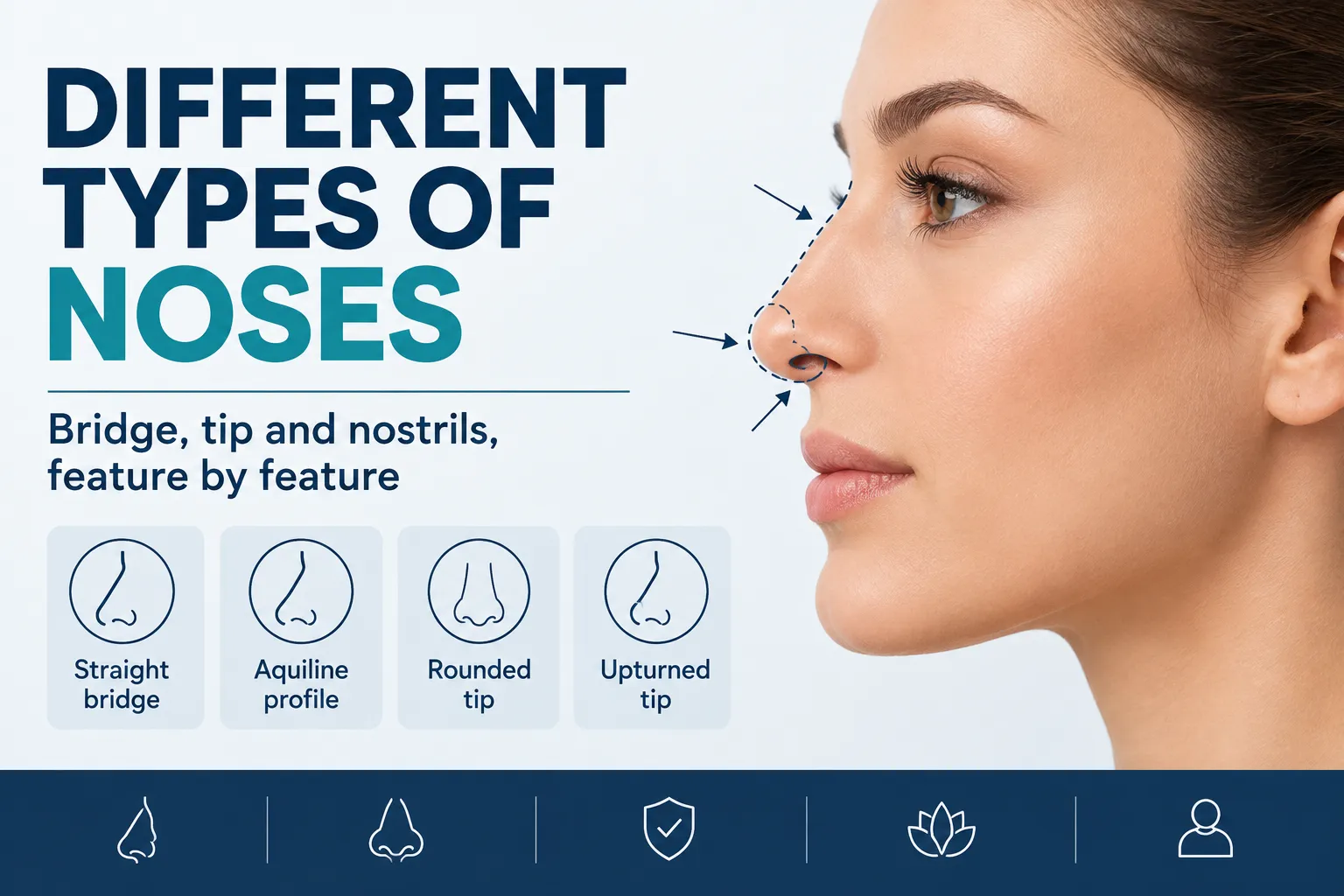
Different types of noses include straight (often called Greek), aquiline or Roman, button, bulbous and upturned shapes. These everyday labels describe single features such as the bridge profile, the outline of the tip or the direction it points. They are not diagnoses. Use them to explain what you notice, without assuming your nose needs changing.
Most online guides list around twelve nose shapes, and some stretch to eighteen. The names overlap. Few noses fit one label neatly, and a straight bridge with a rounded tip is two descriptions, not a third category.
Keep appearance and breathing as separate questions. If you are already weighing surgery, our rhinoplasty guide for UK patients covers the operation, recovery and practical planning. This page has a narrower job. It gives you clear words for your own nose and better questions to take into a consultation.
Everything You Need to Know About Rhinoplasty (Nose Job)
From surgical stages to aftercare, discover how AKM Clinic delivers world-class Rhinoplasty (Nose Job) in Istanbul.
Table of Contents
How are different types of noses described?
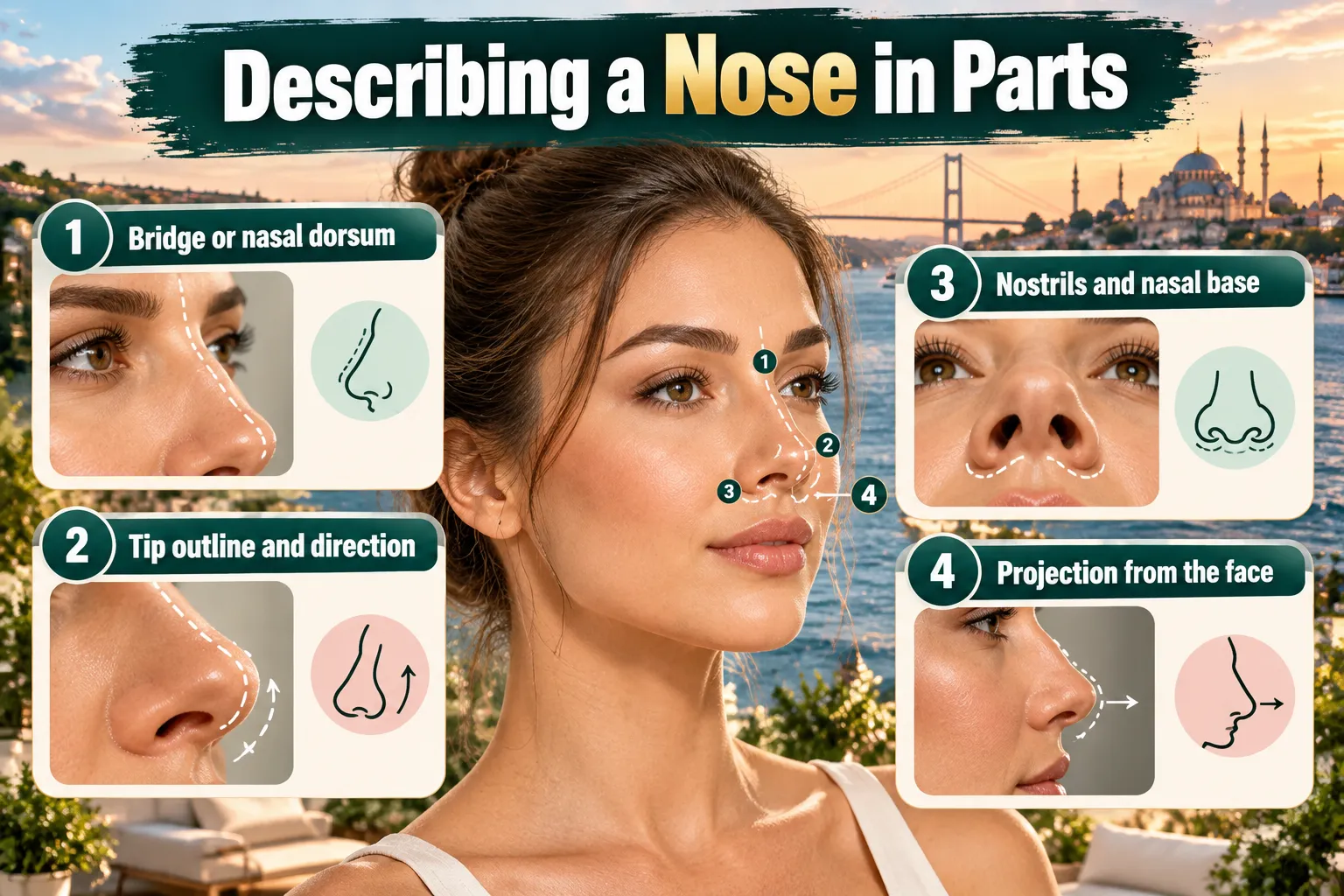
A surgeon looks at a nose in parts. The bridge, tip, nostrils and projection each get their own description, and only then does the surgeon judge how they sit together and with the rest of your face. You can use the same method at home with a mirror and a few photographs.
Which parts of your nose define its shape?
The bridge is called the nasal dorsum. Under the skin, the upper part of the nose is bone and the lower part is cartilage. Mayo Clinic's overview of rhinoplasty also notes that surgical planning weighs your other facial features and the skin on your nose. The shape you see is the sum of all three layers.
Describe each area in plain language:
- Bridge: its outline between the eyes and the tip.
- Tip: its outline and the direction it points.
- Nostrils and nasal base: the openings and the underside around them.
- Projection: how far the nose extends forwards from the face.
Combine descriptions freely. A straight bridge and a rounded tip are separate features of the same nose, and both can be accurate at once.
What does nose orientation mean?
Nose orientation describes direction, not size. It covers where the tip points in profile and whether the nose looks centred from the front.
Be specific about the view. 'The tip points down in profile' tells a surgeon far more than 'my nose sits wrong'. A visible difference is something to discuss. It is never, on its own, a reason you must change your appearance.
Which views help you describe your nose?
One profile photo is not enough. Organise your observations around three views:
- Front: the bridge, the tip outline and any visible asymmetry.
- Profile: the bridge outline, tip direction and projection.
- Base: the nostril outlines and the underside of the tip.
Ask the clinic which photographs it needs. Rather than hunting for a label that fits every view, note the feature you want assessed and anything you want kept. That gives the consultation a clear starting point.
What do Greek, Roman and aquiline nose shapes mean?
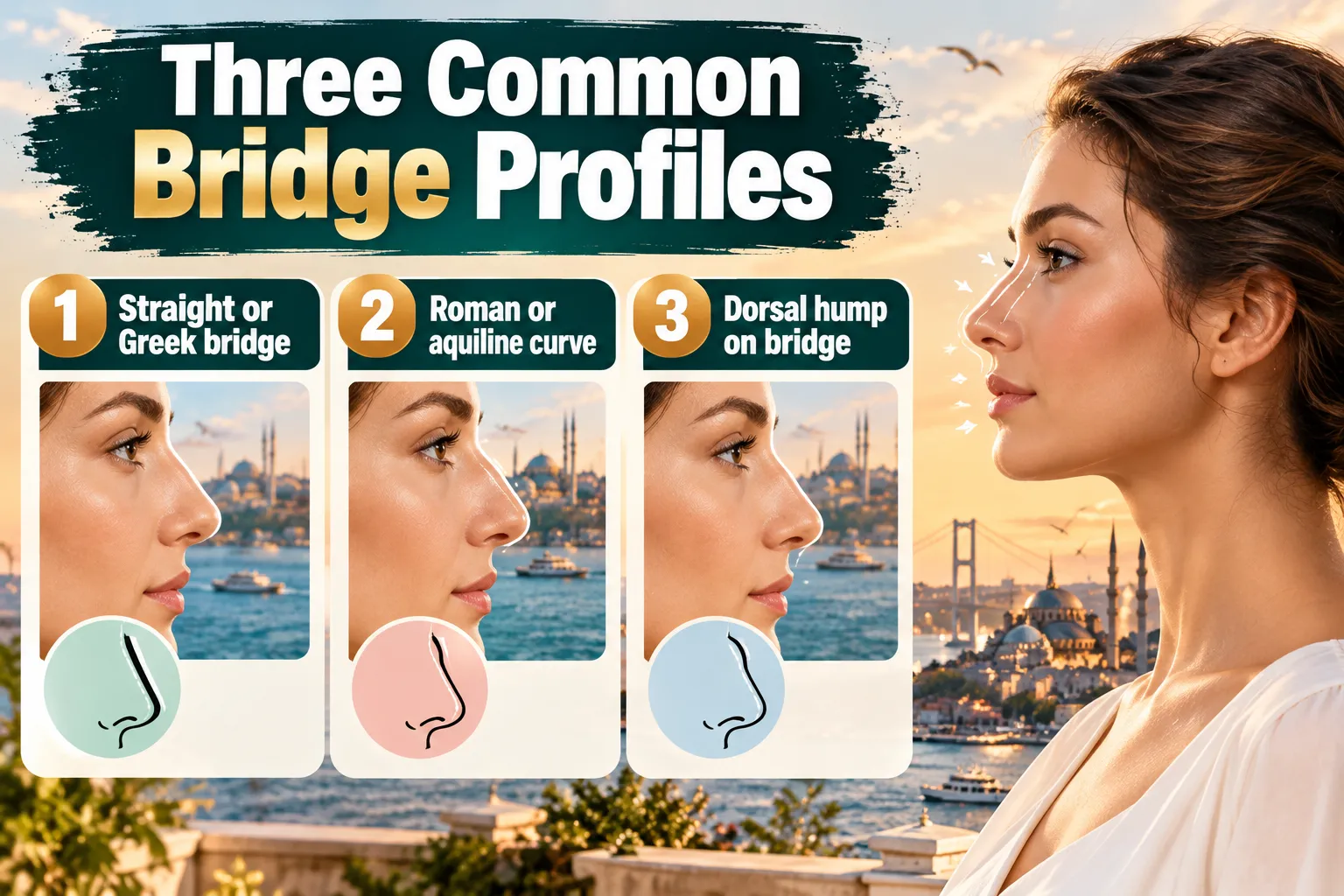
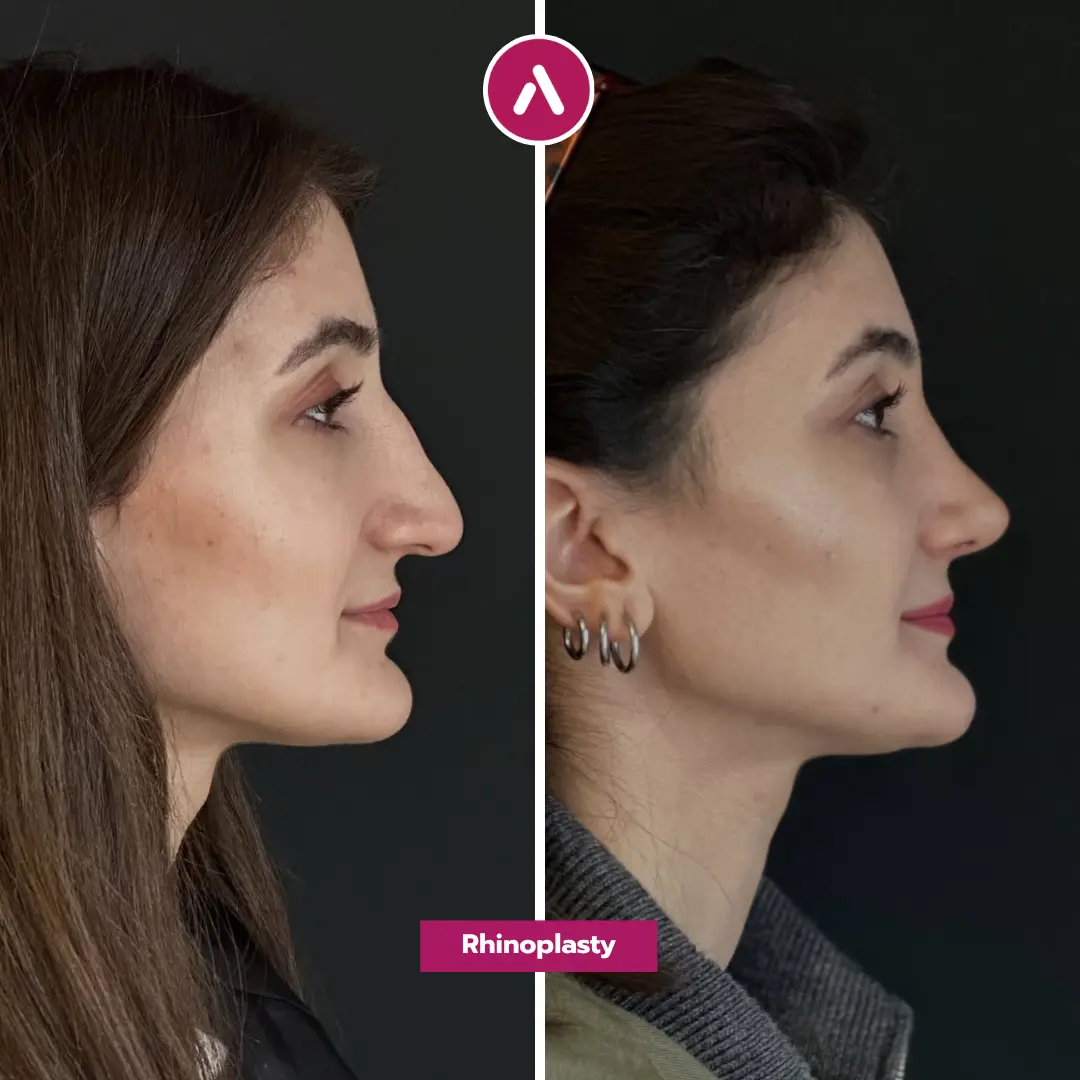
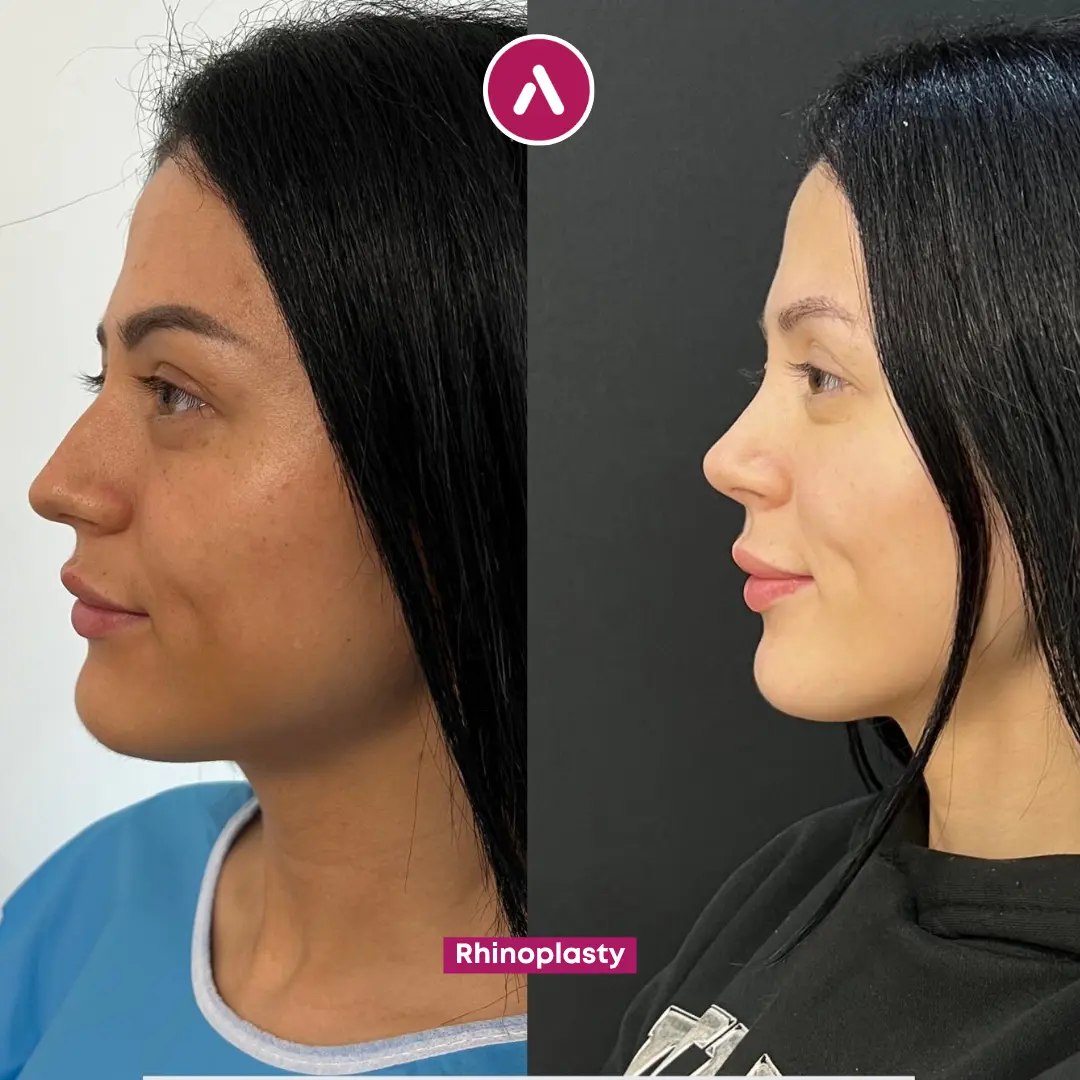
Greek, Roman and aquiline are familiar names for the bridge in profile. Their meanings overlap. They make a reasonable starting vocabulary, but a precise description of the curve or prominence you mean will always be more useful than a single label stretched over your whole nose.
Is a Greek nose the same as a straight nose?
In everyday use, a Greek nose usually means a fairly straight bridge seen from the side. Straight is the clearer word. It names the feature directly, without leaning on a historical term that different people read differently.
Use the label loosely. If you like your straight bridge, say so: a feature you want preserved matters as much as one you want changed.
How do Roman and aquiline nose descriptions overlap?
Roman and aquiline usually refer to a prominent bridge with a convex profile, meaning an outward curve. Neither is an exact specification. Some people use the two interchangeably, while others save aquiline for a more noticeably arched outline.
| Common term | Feature it usually describes | What the label leaves unanswered |
|---|---|---|
| Straight or Greek | A fairly straight bridge in profile | Which stretch of the bridge looks straight |
| Roman or aquiline | A prominent, outward-curving bridge | Where the curve begins and how pronounced it is |
| Bumpy bridge or dorsal hump | A visible prominence along the bridge | Whether you mean a distinct bump or a broader curve |
These names are not ancestry labels. Don't use them to guess someone's background, and don't attach personality traits or a ranking of attractiveness to them. For your own consultation, a curved bridge I want to keep says more than any historical name.
What does a bumpy nose describe?
Bumpy is a broad, everyday word. Surgeons often call a distinct prominence on the bridge a dorsal hump, but people also say bumpy for an outline that simply looks uneven. Location matters. A prominence near the top and a curve further down are different findings, even if you call both bumpy.
Note where you see it, whether it is a distinct bump or a longer curve, and whether you want to talk about changing it or keeping it. You don't need a nose-type label to explain that clearly.
Button nose, bulbous nose or drooping tip: what is the difference?
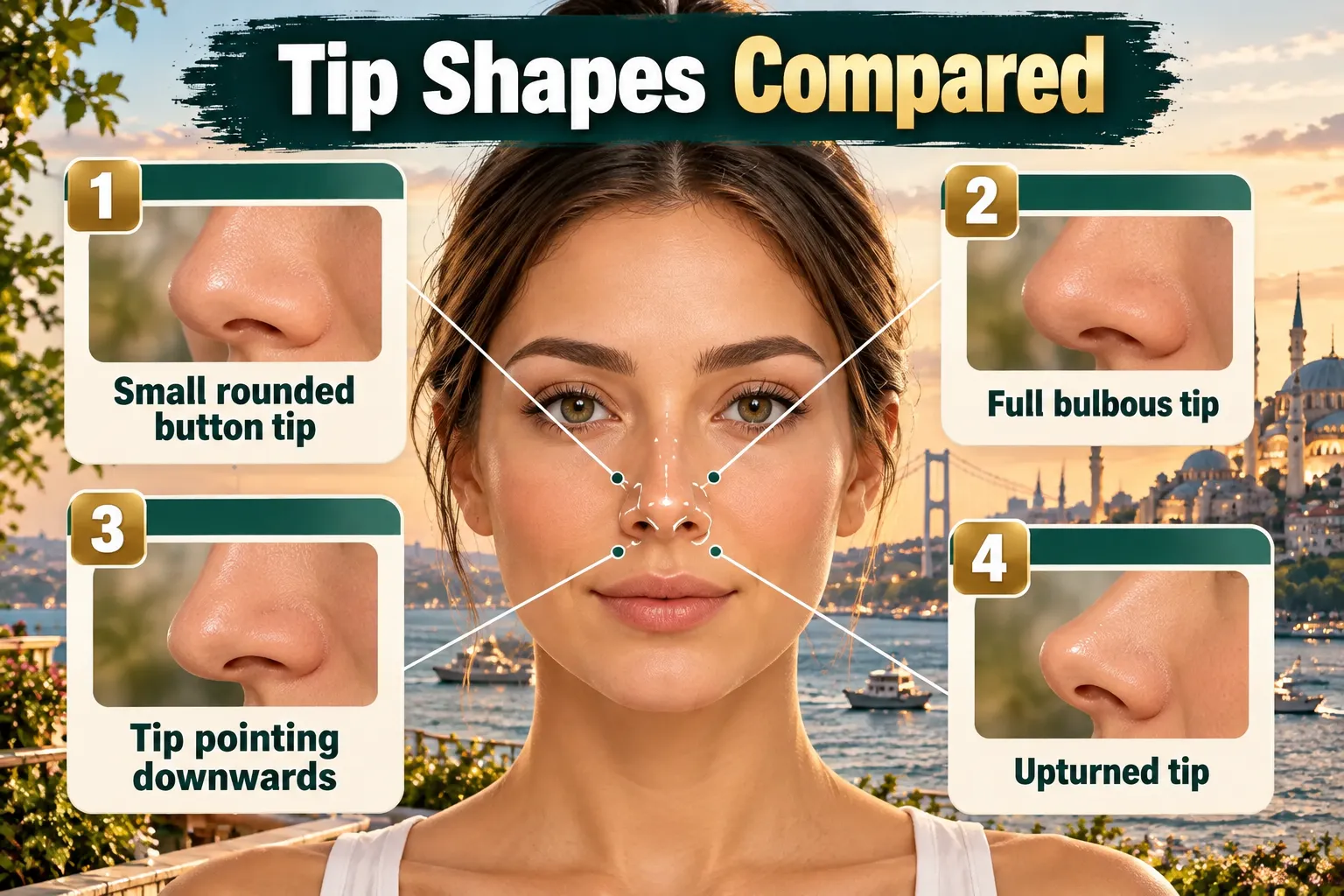
These labels describe different aspects of the nasal tip: how big it looks, its outline or its direction. They are not interchangeable. Button usually suggests a small-looking tip, bulbous describes roundness, and drooping describes a downward direction, so more than one may fit you.
What does a button or upturned nose look like?
People say button nose for a small, rounded tip, sometimes with an upward tilt. Upturned is about direction rather than size. The terms overlap in conversation but don't mean quite the same thing.
If you like a button nose in a reference image, say which part appeals. Is it the rounded outline, the small size or the upward tilt? You can borrow one feature without adopting the whole label.
What does bulbous nose mean?
Bulbous tip is a common description of a rounded or full-looking nasal tip. It describes an outline, not a cause. The word alone doesn't explain why the tip looks that way or which change, if any, would suit you.
That is where individual assessment comes in. As the Mayo Clinic overview cited above explains, planning takes account of your skin and facial features as well as the shape itself. Telling the surgical team that the tip looks rounded from the front is a far better starting point than asking them to fix a bulbous nose.
Is a fleshy nose the same as a rounded tip?
Not necessarily. Fleshy is loose, and people use it for very different things: a full tip, a broad outline or simply a feature that feels prominent to them.
Choose neutral wording instead. You can describe what you see without calling it a fault, and you can ask for an assessment before you have decided on any treatment.
What does a drooping nasal tip describe?
A drooping tip points downwards, most visibly in profile. Direction is the distinction. It says nothing about size or roundness, and it shouldn't be used to assume a cause.
Try wording your concern like this:
- The tip looks rounded from the front.
- The tip points down in profile.
- The tip looks more prominent than the bridge.
These are observations, not diagnoses. Add which feature you want assessed and which you want to keep.
What do wide, narrow and asymmetrical noses describe?
Width, length and left-to-right symmetry are three different things. Keep them apart. Instead of one label for your whole nose, note where it looks wide or narrow, how long it appears and which features seem uneven.
Does wide mean the bridge, the nostrils or both?
Be precise about location. Wide can refer to the bridge, the tip or the nasal base, the lower part of the nose around the nostrils. Narrow needs the same clarification.
Instead of asking for a smaller nose, name the feature you mean:
- Bridge width: the upper part looks broad or narrow.
- Nostril width: the nostrils look wider than you would like.
- Tip width: the end of the nose looks broad.
- Visible asymmetry: a feature looks different on each side.
Keep what you see apart from what you think caused it. If your bridge looks off-centre or your nostrils differ in outline, describe that without assuming an old injury. Working out the cause is the surgeon's job.
What does the term Nubian nose describe?
Nubian nose is an imprecise label you will meet in many online lists. It is not a diagnosis. Don't treat it as a complete description, and don't use it to identify anyone's ethnicity.
Describe the real features instead: the bridge profile, the tip outline and the nasal base. If you bring an example photo, point to the feature you mean. People read this term in very different ways.
Are types of nose different for women and men?
The same vocabulary works for everyone. Straight, narrow, wide and asymmetrical are descriptions, not rules for how a woman or a man should look, and they shouldn't harden into fixed feminine or masculine templates.
Start from your own preferences. You might want to discuss width while keeping a strong bridge, or ask about asymmetry without wanting a different overall outline. Say both clearly.
If anyone calls a feature too masculine or too feminine, ask them to name the feature. Then judge it against your concerns, not against a gendered label.
Can your nose shape explain breathing problems?
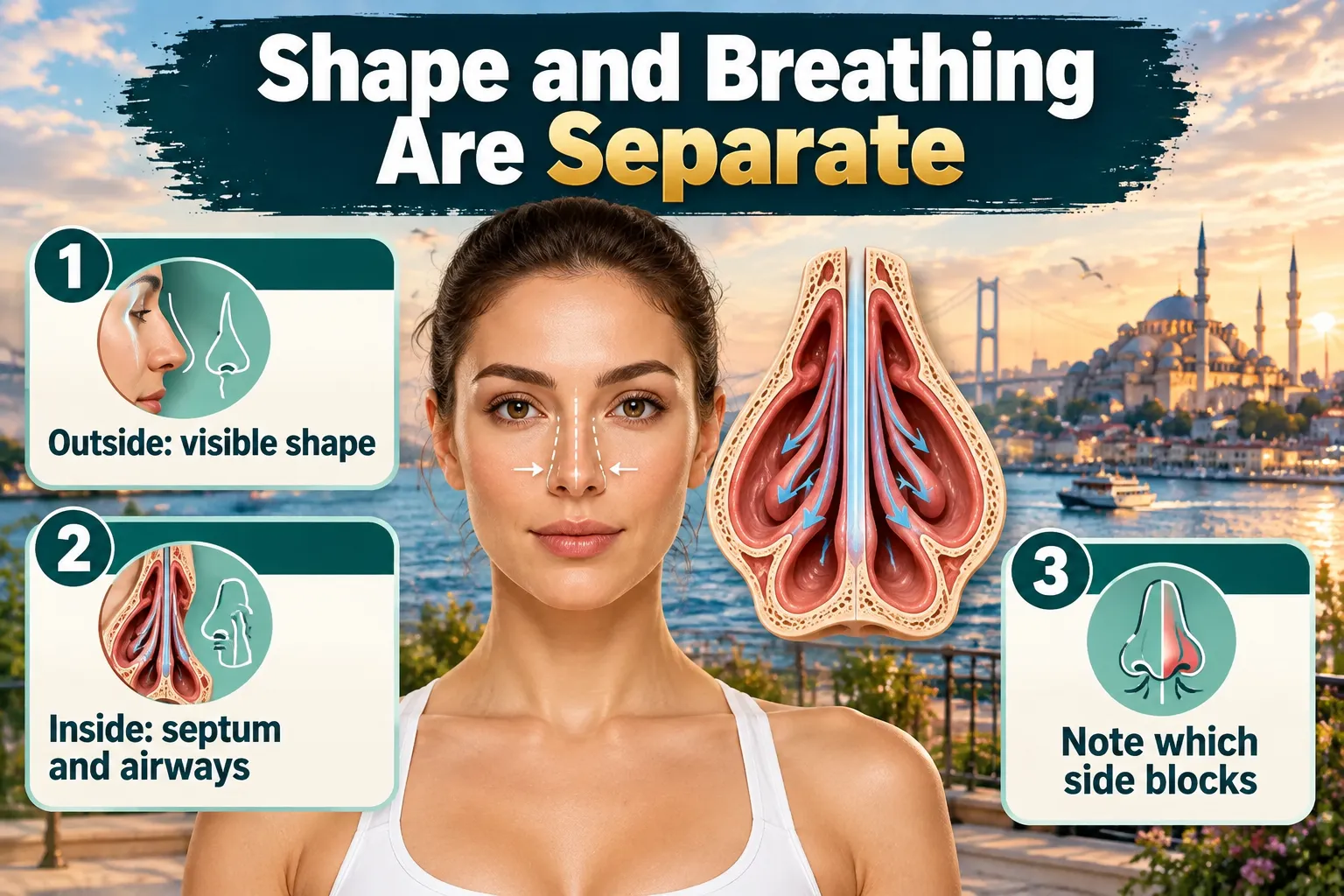
A shape label describes how a nose looks, not how well air moves through it. Rhinoplasty can be done to change appearance, to improve breathing or both, as the Mayo Clinic overview above sets out. So a proper assessment looks inside your nose as well as at it.
Can a straight-looking nose still feel blocked?
Yes. Don't judge your breathing by the bridge. If your nose looks straight but feels blocked, describe the blockage itself rather than looking for another nose type to explain it.
Mention any difference between the two sides, even if your appearance concern is elsewhere. In the UK, if breathing is your main problem, your GP is a sensible first step.
Does a crooked nose always mean a deviated septum?
No. The septum is the wall of cartilage and bone that divides your two nasal passages. A bent septum, known as a deviated septum, is an internal finding. An uneven bridge or unequal-looking nostrils on the outside don't confirm one.
Ask your surgeon to explain external and internal findings separately. If breathing symptoms persist, get them examined. Don't assume that changing the visible shape will fix them.
What should you tell the surgical team about breathing?
Bring observations, not a self-diagnosis. Before your consultation, note:
- Whether the blockage affects one side or both, and whether it is constant or comes and goes.
- When you first noticed it and how it has changed.
- Any previous nasal injury, surgery or treatment, and what happened afterwards.
- Your appearance concerns, listed separately, including features you want to keep.
At AKM Clinic, Dr Göknil Gültekin is an otolaryngologist and facial plastic surgeon. She is a Fellow of the European Board of Otorhinolaryngology-Head and Neck Surgery and a Fellow of the European Academy of Facial Plastic Surgery, and her focus is primary, revision and preservation rhinoplasty. You can read more about the clinic and its surgical team.
Ask for a clear line between any change to appearance and any treatment proposed for breathing.
Entrust Your Rhinoplasty (Nose Job) to Board-Certified Experts
Undergo your procedure with total confidence. Meet our European Board-certified surgeons, who have performed over 2,000 successful procedures.
What can rhinoplasty change about your nose type, and what are its limits?
A useful surgical aim names a specific feature. It doesn't name a new category of nose. A label is not a surgical plan, so start by separating the change you want from the uncertainty and the risks you are willing to accept.
Can surgery change a feature without copying another nose?
Rhinoplasty can reshape bone, cartilage, skin or all three, according to the same Mayo Clinic overview. What is realistic still depends on your own anatomy. Reference photos help you explain a preference, but they are a talking point, not a blueprint for someone else's nose.
Ask what may stay as it is. Results vary from person to person, and no surgeon can promise an exact match, perfect symmetry or a set improvement in breathing. The techniques themselves are explained on our main rhinoplasty treatment page.
How should you interpret nose-shape results photographs?
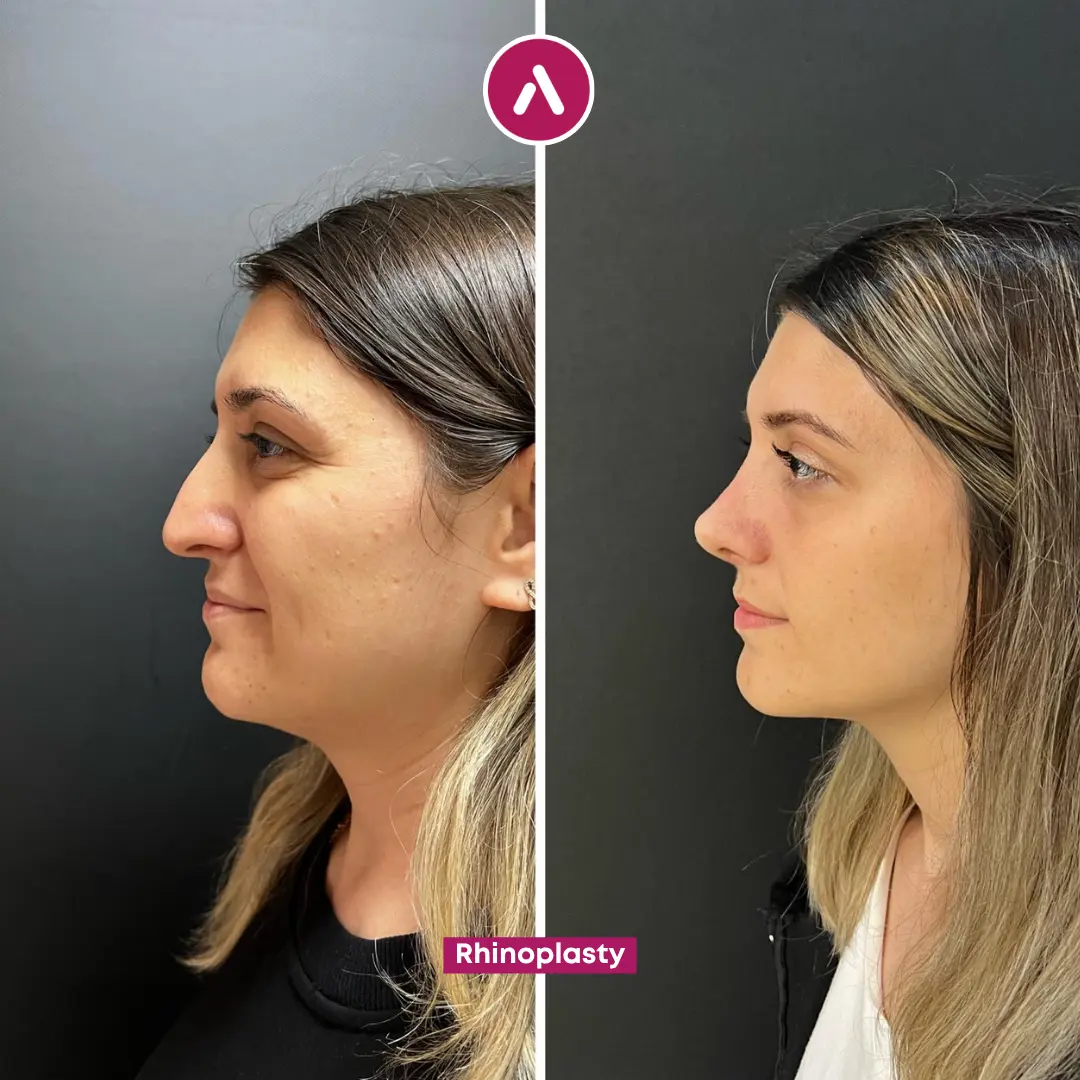
Use the rhinoplasty before-and-after gallery to discuss individual cases. Don't use it to predict your own result.
Keep your questions specific. What was the original concern? What did the agreed aim involve? Was the starting point anything like yours? Sharing a shape label with another patient doesn't mean sharing their treatment plan.
What risks could outweigh the change you want?
Give the trade-off real thought. Mayo Clinic's list of rhinoplasty risks includes bleeding, infection, a reaction to anaesthesia, difficulty breathing through the nose, numbness, scarring and an appearance you are unhappy with. Ask which of these matter most in your case. Ask, too, how the team would respond if one happened.
Consider pausing if any of these apply:
- You can't yet describe a change you personally want.
- Someone else is pushing you to go ahead.
- You would only accept an exact copy of a reference photo.
- You aren't prepared to accept possible complications or a result you dislike.
This isn't a suitability checklist. Ask the surgeon whether the benefit justifies the risks for you, including the option of leaving your nose alone. You don't need to decide during the consultation.
Have Safety Concerns Regarding Surgery Abroad?
Speak directly with our Patient Safety Coordinator regarding anaesthesia options, risk management, and travel safety following Rhinoplasty (Nose Job). Your peace of mind is our priority.
What happens if healing or breathing causes concern?
Contact the treating team promptly. While you are in Istanbul, the medical team monitors you closely and your Patient Host is on WhatsApp around the clock. Don't wait for a scheduled virtual review if a symptom is getting worse.
Urgency changes the next step. If you are struggling to breathe, call 999 or go to A&E. For heavy bleeding that won't stop, follow the NHS advice on nosebleeds and get care where you are, rather than waiting for a reply from abroad.
Settle responsibilities before you consent. Ask who assesses a complication, how local care would be coordinated after you get home and what any further treatment would involve. Ask for this in writing, and never assume corrective surgery is included.
Accelerate Your Rhinoplasty (Nose Job) Recovery
We utilise advanced Hyperbaric Oxygen Therapy (HBOT) to minimise downtime and enhance your healing process. Safety is our primary commitment.
How can you explain your nose shape at an AKM consultation?
Bring a description, not a request for a named nose type. List the feature you want assessed and the features you want to keep. That way the conversation starts from your priorities rather than from a template.
Which photographs and concerns should you share?
Start in your own words. You might want to discuss the bridge in profile while keeping your tip as it is. You might want to ask about a difference between the sides without wanting a smaller nose overall.
Your Patient Host arranges a free online consultation with photos, followed by a personal treatment plan and quote. Ask which views to send. Keep appearance concerns apart from breathing symptoms and any previous nasal treatment.
Our guide to how the patient journey works explains the wider process. Use the consultation to sharpen your priorities, not to pick a technique in advance.
What should your personal treatment plan clarify?
Ask for a clear written explanation. By the end, you should be able to describe the proposed change, its limits and who looks after you if something worries you, without leaning on a shape label.
- What change are you proposing, and how does it match my priorities?
- Which features may stay unchanged?
- What are my individual risks, and when would you advise against going ahead?
- Who would assess a concern after I return to the UK?
For orientation, the clinic's rhinoplasty page lists general anaesthesia, around 3 hours of surgery, 1 night in hospital and a period of recovery at home before most people return to work. Full recovery takes 3 to 6 months. Your own plan may differ.
Travel comes after the clinical decision. The all-inclusive package covers the surgeon's and anaesthesia fees, pre-operative tests, post-operative check-ups, a five-star hotel with breakfast, private transfers and a dedicated coordinator with translation. A private driver meets you at Istanbul Airport (IST) or Sabiha Gökçen (SAW), and our page on recovery hotels and private transfers covers the practical details.
How are checks in Istanbul and follow-ups at home organised?
Know the arrangements before you fly. After surgery you receive medication, any compression garments needed and written care instructions.
The clinic also offers hyperbaric oxygen therapy and a low-level laser therapy system with 424 medical-grade diodes at 650 nm. Ask whether either is relevant to your care rather than assuming it is routine. The clinic's technology and standards page describes both.
Before flying home, every patient has a final in-person check-up with the doctor. Use it to ask how to raise a concern from the UK and which symptoms mean you should get in touch straight away.
Follow-up carries on at home. Your Patient Host schedules virtual appointments at 1, 3, 6 and 12 months so the doctor can check healing and answer questions. This article is general information, not personal medical advice, and results vary from person to person.
Frequently Asked Questions: Different Types of Noses
How many types of noses are there?
There is no official total. Online guides often list around twelve shapes, and some list eighteen, but the labels overlap and describe different features. A straight bridge and a rounded tip can both describe the same nose.
What is the rarest type of nose?
Treat such claims with caution. A real ranking would need clear definitions, a defined population and reliable research, not an online list of loosely named shapes. Calling a shape the rarest tells you little about your own nose.
What is the most desirable nose type?
There isn't a universal ideal. Preferences differ, and you don't need to adopt anyone else's. If you are considering surgery, describe what matters to you and what you want to keep, rather than asking for a fashionable label.
Does your nose shape say anything about your personality?
No. A shape label describes appearance, not character. Terms like Roman, button or aquiline say nothing about confidence or temperament, so keep them practical and use them only to describe the bridge, tip or nostrils.
Can your nose shape change as you get older?
Yes. The way the nose looks can change as you get older. That doesn't mean you need treatment. If you notice a new change, mention when it began and any symptoms that came with it.
Can nose exercises or nose clips permanently change your nose shape?
For adults, it is worth being cautious about claims that exercises or off-the-shelf clips can permanently reshape the nose. Be wary of promises based on promotional photos. Ask a qualified clinician what evidence supports a device before you try it.
Can nose filler make a large nose smaller?
No. Dermal filler adds volume and can disguise some contour irregularities, but it cannot reduce the size of a nose. If a smaller nose is your aim, say so early, and ask what filler cannot do and what its risks are.
Have Specific Questions About Rhinoplasty (Nose Job)?
Speak directly with our dedicated patient coordinators regarding Rhinoplasty (Nose Job). Receive instant guidance and personalised support.
Related Treatments

Rhinoplasty (Nose Job) in Turkey
Explore Rhinoplasty in Istanbul with European Board Certified Surgeons, 3D planning, and our Rapid Recovery & Safety Protocol (HBOT + LLLT).
SMAS Facelift in Turkey
Discover the SMAS facelift in Turkey. Achieve natural rejuvenation with European Board Certified surgeons. Compare UK vs Turkey costs and recovery today.

Facelift in Turkey
Explore facelift techniques (deep plane, SMAS), scars, recovery timelines and sedation options. UK-focused safety pathway and aftercare at AKM Clinic, Istanbul.
Revision Facelift in Turkey
Revision facelift in Turkey with a safety-first plan: structural correction, discreet scars, and fast recovery.
Ready to Begin Your Own Transformation Journey?
Join the 2,000+ patients who have trusted Dr Akif Mehmetoğlu and the AKM Clinic team. Your journey to a more confident, naturally restored you begins with a simple, no-obligation conversation. Contact us today from the UK for your free virtual consultation.
#1: Get Your Free Personalised Quote
Start with a free, no-obligation online consultation. Share your photos, and our surgical team will provide a fully personalised treatment plan and a transparent, all-inclusive price package. There are no hidden fees.
#2: Secure Your Date & VIP Booking
Once you are ready, our dedicated patient coordinators will help you secure your procedure date. We will handle all your bookings, including your 5-star hotel accommodation and private VIP airport transfers.
#3: Arrive in Istanbul & Meet Your Surgeon
Arrive at Istanbul Airport (IST) and be greeted by your private driver. Settle into your hotel and prepare for your in-person consultation, where you will meet your specialist surgeon to finalise the details for your "natural, subtle, and restored" new look.