
Labiaplasty Swelling: What's Normal and When It Settles
AI Summary
- Labiaplasty swelling usually peaks in 2–3 days and improves clearly within weeks.
- Uneven swelling is often normal during early healing and usually settles gradually.
- Red flags need prompt review, including fever, worsening pain, bleeding, or unusual discharge.
- Safe recovery depends on aftercare, gentle activity, low friction, and surgeon guidance.
Summary generated by AI, fact-checked by our medical experts
Labiaplasty swelling is a normal, expected part of healing. It usually peaks in the first 2–3 days, improves noticeably over the first two weeks, and mostly settles by around six weeks. Subtle swelling can still linger for several months. Temporary unevenness between sides is common and rarely reflects the final result.
If you are researching labiaplasty, swelling is often the part that feels hardest to interpret. The area is private, sensitive, and naturally variable, so even normal healing can look more dramatic than patients expect in the mirror.
This guide focuses on one question only: what swelling after labiaplasty should look like, how the timeline usually unfolds, why one side may look more swollen than the other, and when swelling becomes a warning sign. For the procedure itself, see how labiaplasty is performed at AKM Clinic.
We will keep the tone clinical and respectful. No scare tactics. No vague reassurance either. Swelling is normal — but the pattern matters.
Table of Contents
Why Swelling Happens After Labiaplasty
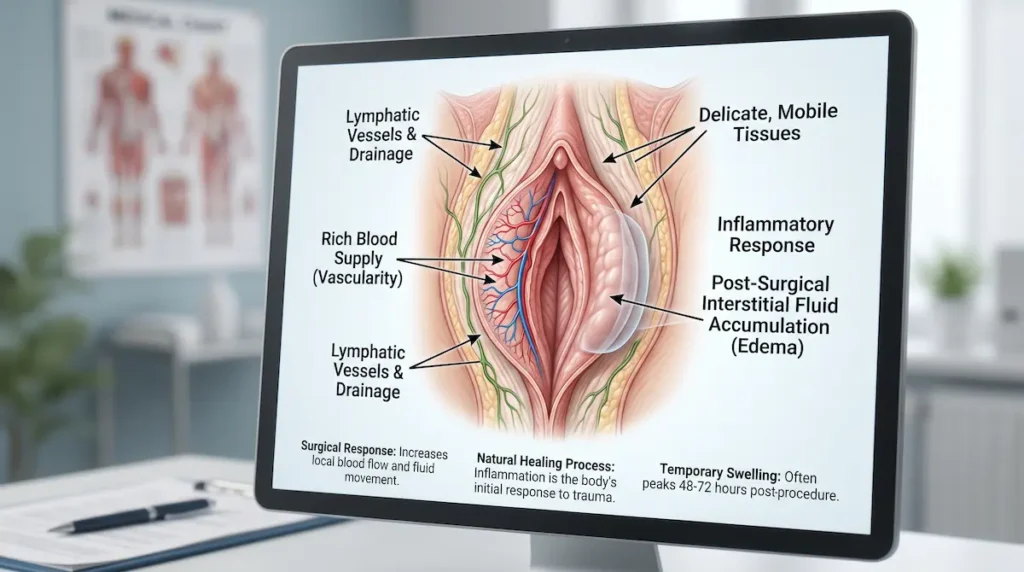
Swelling happens because labiaplasty reshapes delicate external genital tissue. Even when the procedure is performed with a conservative technique and careful closure, the body still responds to surgical trauma with inflammation, fluid movement, and increased local blood flow.
The labia are not thick, immobile skin. They are thin, vascular, flexible tissues that move when you walk, sit, use the bathroom, or change position in bed. That is why swelling can look more visible here than it might after a small incision on a less mobile area of the body.
The area has a rich blood and lymph supply
The vulvar region has a strong blood supply. That helps healing, but it also means fluid can collect quickly after surgery. In the first few days, your body sends inflammatory cells and healing fluid to the area. The result is fullness, puffiness, tenderness, and sometimes temporary discoloration.
Lymph drainage also matters. Lymph vessels help move extra fluid away from healing tissue. After surgery, that drainage can be temporarily slowed. One side may drain fluid faster than the other, which is one reason early uneven swelling is common.
A 2015 study in Aesthetic Surgery Journal reported transient symptoms after labiaplasty, including swelling, bruising, and pain, while overall complication rates remained low in that series. For a patient, the key word is transient: early swelling can look intense, but it is usually part of the short-term healing response, not the final result.
Even gentle technique still creates edema
Some patients assume that swelling means something was done too aggressively. Not necessarily. Edema is expected after almost any surgery, especially in soft tissue with a rich blood supply.
Good surgical technique can reduce trauma, protect tissue, and support smoother healing. It cannot make the body skip inflammation altogether. The goal is controlled swelling that gradually improves, not zero swelling from day one.
This is also why the first look in the mirror can be misleading. The labia may look larger than before surgery, more rounded, thicker, or uneven. That can feel alarming if you expected an immediate refined shape. Early healing does not work that way.
Peak swelling usually arrives in the first 48–72 hours
Swelling often gets worse before it gets better. Many patients feel reasonably comfortable right after surgery, then notice more puffiness on day two or day three. That timing is typical.
The American Society of Plastic Surgeons notes that swelling after labiaplasty generally peaks around 2–3 days and then gradually decreases over the following weeks. That is why the third day can look more swollen than the first day, even when healing is on track.
What matters is the direction after the peak. Swelling should slowly soften, look less tense, and become easier to tolerate. It does not have to improve every single hour. It should improve across days and weeks.
From AKM's board-certified plastic surgery team: Early swelling after labiaplasty can make the labia look larger, uneven, or unfamiliar. That is almost never the final shape. We evaluate the result only after the swelling has had time to calm and the tissue has softened.
The Labiaplasty Swelling Timeline
The swelling timeline is not identical for every patient, but it does follow a recognizable pattern. Most people experience the fullest swelling in the first week, steady improvement through weeks two to six, and smaller residual changes over the next few months.
This section stays focused on swelling. For work, walking, exercise, hygiene, and return-to-intimacy milestones, see the full labiaplasty recovery timeline.
| Timeline | Expected swelling appearance | Usually normal? | What to focus on |
|---|---|---|---|
| 0–3 days | Most noticeable swelling; tissue may look puffy, tight, enlarged, or uneven | Yes, if pain is controlled and symptoms are not worsening sharply | Rest, keep pressure off the area, follow your surgeon's cold-compress instructions |
| 1–2 weeks | Swelling begins to soften; bruising or temporary color change may fade | Yes, gradual improvement is expected | Loose clothing, gentle hygiene, short walks, no friction-heavy activity |
| 2–6 weeks | Most visible swelling continues to reduce; asymmetry often becomes less obvious | Yes, lingering swelling can still be present | Avoid rushing exercise, cycling, swimming, or sexual activity until cleared |
| 6 weeks+ | Most swelling is gone, but subtle firmness or fullness may remain | Often yes, if it keeps improving | Judge the final contour later, not during early healing |
Days 0–3: the fullest phase
The first three days are usually the most swollen. The labia may look puffy, rounded, shiny, or larger than expected. One side may look more swollen than the other. Sitting can feel awkward, and walking may feel slow.
This stage is not the time to judge symmetry. Fluid is still moving into the healing tissue. Sutures are fresh. The area has not settled.
Some light spotting, mild bruising, temporary color change, and controlled soreness can occur during this early window. Severe pain, rapidly expanding swelling, heavy bleeding, fever, or foul discharge are not part of routine swelling and should be reported to your surgeon.
Week 1–2: visible improvement begins
By the end of the first week, swelling often starts to feel less tight. You may still see puffiness, but the area usually feels less angry and less full. This is also when patients begin to feel more reassured — not because everything looks final, but because the trend is moving in the right direction.
During the second week, the tissue may look irregular from day to day. Morning swelling may look different from evening swelling. A longer day on your feet may temporarily increase fullness. That does not mean you reversed healing; it means the tissue is still reactive.
Cleveland Clinic notes that initial swelling, soreness, and temporary discoloration decrease over the first couple of weeks, while most swelling is gone by about six weeks. That longer view is useful: week two is better, but not final.
Weeks 2–6: the steady settling phase
Weeks two through six are where the biggest emotional shift often happens. The shape becomes easier to recognize. Puffiness decreases. The edges feel less firm. Unevenness may begin to soften.
This is also the period when patients can accidentally do too much. Exercise, cycling, running, swimming, and sexual activity can create friction, heat, and pressure before the tissue is ready. Even if swelling looks improved, the deeper healing process is still active.
Your surgeon's clearance matters more than a general timeline. If your recovery is slower, that does not automatically mean something is wrong. It may simply mean your tissue needs more time.
Six weeks and beyond: subtle residual swelling
By six weeks, most visible swelling has usually settled. That does not always mean the final result has arrived. Small areas of fullness, firmness, or slight unevenness can continue to refine over several months.
Cleveland Clinic states that while most swelling is gone after six weeks, complete swelling resolution before final results can take four to six months. That is why a six-week check is a milestone, not the finish line.
The safest way to think about the timeline is simple: early swelling should improve, mid-stage swelling should soften, and final refinement should be judged in months, not days.
Why It Can Look Uneven
Uneven swelling after labiaplasty is one of the most common reasons patients worry early in recovery. One side may look thicker, longer, more raised, or more bruised than the other. That can feel unsettling, especially if your main goal was a more balanced appearance.
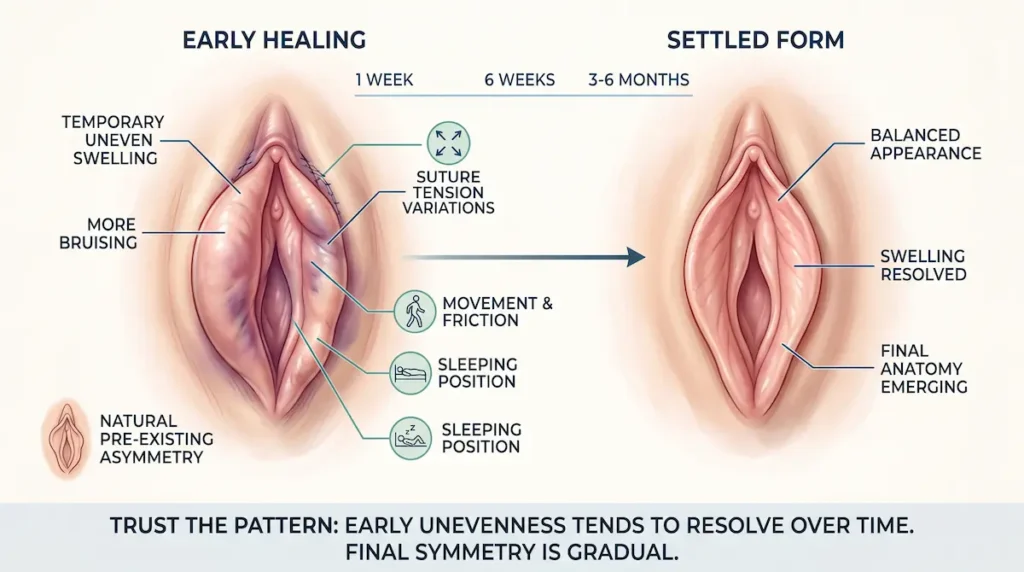
In the early weeks, asymmetry is often swelling, not the final anatomy. The two sides of the labia do not always heal at the same speed, and the tissue can respond differently depending on suture tension, movement, sleeping position, bruising, and natural pre-existing asymmetry.
One side may swell more than the other
The body is not perfectly symmetrical before surgery, and healing rarely becomes perfectly symmetrical right after surgery. One side may have had slightly more tissue removed. One side may have more bruising. One side may experience more friction when you walk or sit.
Even small differences can look more dramatic because the labia are delicate, thin, and highly mobile. A few millimeters of swelling may be easy to ignore elsewhere on the body. In this area, it can feel significant.
This is why surgeons usually avoid judging labiaplasty symmetry too early. At one week, the swelling pattern can dominate the view. At six weeks, the shape is easier to read. At three to six months, the tissue is much closer to its settled form.
Temporary asymmetry is different from a poor result
Temporary asymmetry improves as swelling decreases. A poor result tends to persist after the tissue has healed and softened. Those are different situations, and timing is what separates them.
During the first several weeks, it is reasonable to see one side look more puffy, firm, or raised. It is also common for one side to feel more sensitive. These differences should gradually narrow as inflammation settles.
Persistent asymmetry after healing may need a separate evaluation. That is not something to diagnose in the first few days. A 2025 long-term review of labiaplasty outcomes found that postoperative asymmetry was among the more commonly reported complications, but most patients in the reviewed studies had no postoperative complications. The takeaway is balanced: asymmetry can occur, but early uneven swelling is not the same thing as a lasting deformity.
Photos can exaggerate early swelling
Many patients take daily photos after surgery. That can help track progress, but it can also create anxiety. Lighting, angle, leg position, and camera distance can make one side look much larger than it is.
If you are tracking swelling, take photos in the same position, under the same lighting, and no more often than your care team recommends. Comparing every hour usually creates more worry than clarity.
A better question is not, "Does it look perfect today?" The better question is, "Is the swelling trending down across the week?" Healing is a pattern, not a single photo.
How to Reduce Swelling Safely
You cannot force labiaplasty swelling to disappear overnight. You can, however, avoid the common habits that make it worse. The safest swelling plan is simple: reduce pressure, avoid friction, follow your surgeon's aftercare instructions, and give the tissue time.
There is no aggressive trick that speeds healing without risk. In fact, over-managing the area can backfire. Too much touching, wiping, checking, icing, or activity can irritate the tissue and keep swelling active for longer.
Use cold compresses only as instructed
Cold therapy can help in the first 24–48 hours, but it needs to be done carefully. The skin in this area is delicate. Ice should never be placed directly on the labia, and prolonged cold exposure can damage tissue.
Most surgeons recommend short, buffered cold-compress sessions early on. That may mean a cold pack wrapped in a soft cloth, used for limited intervals. Your own surgeon's instructions should come first, because technique and closure style can change the aftercare plan.
If cold makes the area sting, burn, or feel numb in a concerning way, stop and ask your care team. The goal is comfort and swelling control, not tissue stress.
Rest with pressure off the area
Position matters. Sitting upright for long periods can increase pressure and make swelling feel worse. Lying down with your pelvis supported, taking short gentle walks, and avoiding prolonged pressure on the surgical area can help the tissue calm.
Short walks are usually helpful because they support circulation. Long walks, stairs, squatting, gym activity, cycling, or anything that creates friction can trigger more swelling during the early recovery window.
Loose clothing also matters. Tight leggings, fitted underwear, seams, and rough fabrics can rub against the incision line. Choose soft, breathable, loose garments until your surgeon clears you to return to normal clothing.
Keep hygiene gentle, not excessive
Clean healing tissue needs gentle care. It does not need harsh scrubbing, strong soaps, fragrance, or repeated wiping. Over-cleaning can irritate the area and increase swelling.
Use the cleansing method your surgeon recommends. Many patients are advised to rinse gently, pat dry carefully, and avoid products that sting or disrupt healing tissue. Do not apply creams, ointments, herbal products, or scar treatments unless your surgeon approves them.
Swelling improves best when the tissue is protected, dry enough, and left alone between care steps. Less friction often means less inflammation.
Avoid heat, friction, and early activity
Heat increases blood flow and can make swelling worse. Hot baths, saunas, steam rooms, hot tubs, and intense workouts are not part of early labiaplasty recovery. Swimming is also usually restricted until the incisions are fully healed and your surgeon clears you.
Sexual activity, tampon use, cycling, horseback riding, running, and heavy lower-body exercise create direct pressure or friction. Even if you feel better, the tissue may not be ready.
ASPS recovery guidance commonly places return to sexual activity around six weeks, depending on healing and surgeon clearance. That timeline is not about being overly cautious. It protects the incision line while deeper swelling settles.
When Swelling Is a Warning Sign
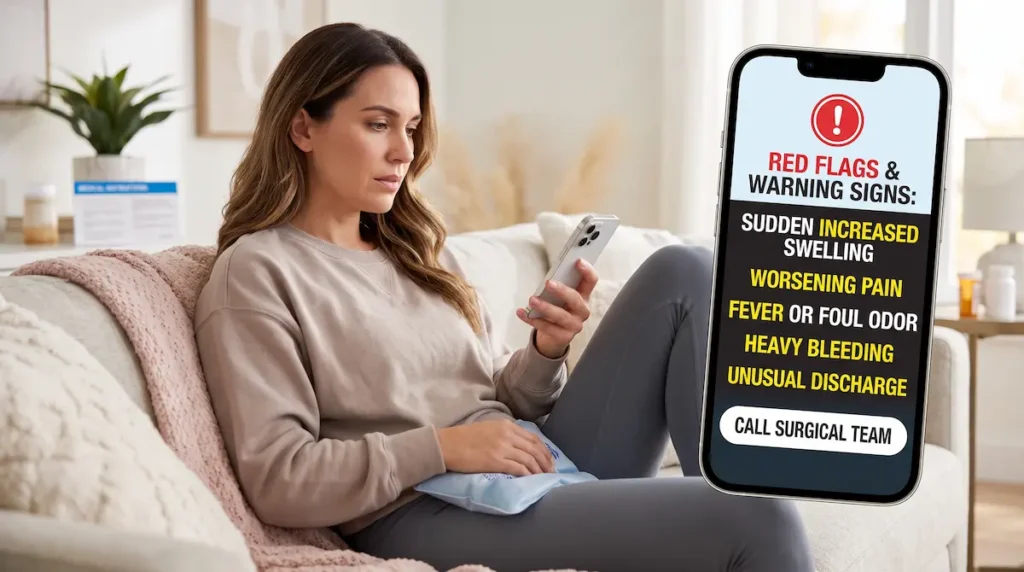
Most swelling after labiaplasty is normal. The warning sign is not swelling by itself; it is swelling that behaves badly. A sudden increase, severe one-sided swelling, worsening pain, heavy bleeding, fever, foul odor, or drainage that looks infected should be raised with your surgeon promptly.
This section is not meant to make you anxious. It is meant to help you separate normal healing from symptoms that deserve attention. If something feels wrong, contact your surgical team rather than waiting for the next scheduled check-in.
Normal swelling vs concerning swelling
Normal swelling usually peaks early, then slowly improves. It may fluctuate after activity. It may look uneven. It may feel firm or tender. It should still trend toward less tightness, less pressure, and less discomfort over time.
Concerning swelling tends to move in the opposite direction. It may suddenly expand, feel increasingly painful, become hot and red, or come with unusual discharge. Swelling with fever, chills, spreading redness, or a foul smell is not something to watch silently.
Other symptoms, such as mild bruising, itching, temporary sensitivity, and discomfort, can overlap with normal healing.
Call your surgeon if symptoms worsen instead of improve
A simple rule helps: swelling that gradually improves is usually reassuring; swelling that suddenly worsens should be checked. This is especially true if it is paired with increasing pain, bleeding, pus-like discharge, wound separation, or fever.
Cleveland Clinic lists excessive swelling, increased bleeding, discolored discharge, fever, and wound opening among signs that should prompt medical contact after labiaplasty. Those signs are different from ordinary puffiness in the first week.
If you are an international patient, access matters. AKM's care model includes post-op monitoring while you are in Istanbul and long-term virtual follow-up after you return home. For a swelling concern, photos and symptom details can help the team decide whether you need reassurance, a care adjustment, or urgent review.
Do not diagnose a "botched" result during peak swelling
Early swelling can make almost any labiaplasty look distorted. The labia can appear too large, too thick, uneven, or unfamiliar. That does not mean the result is poor.
A true poor result is evaluated after healing, not during the inflammatory peak. Concerns such as persistent asymmetry, over-resection, painful scarring, or wound separation need a different discussion than normal swelling. If your concern is less about temporary swelling and more about outcome quality, raise it with your surgeon rather than trying to judge it yourself while the tissue is still swollen.
The timing matters. At three days, swelling is expected. At three weeks, swelling is still settling. At three months, the result is clearer. Your surgeon can help you decide when a concern is early healing and when it needs a longer-term plan.
Cost should not drive swelling decisions
After surgery, the priority is safe healing. Do not delay asking for help because you are worried about extra cost, travel logistics, or feeling embarrassed. Swelling questions are common, and your care team expects them.
If you are still in the decision stage and comparing providers, pricing should be reviewed separately from recovery education. You can see the cost of labiaplasty, but this swelling guide should not be used as a price comparison page.
The better question is whether your package includes structured aftercare, direct access to a patient coordinator, and surgeon-led guidance if swelling does not follow the expected pattern. Recovery support is part of safety, not an optional extra.
What AKM evaluates before clearing you to fly home
For patients traveling from the United States, the key concern is not just how swelling looks on day one. It is whether the swelling pattern is stable, whether the incisions look healthy, whether pain is controlled, and whether you understand your aftercare plan before leaving Istanbul.
AKM performs surgery in Istanbul and supports patients through pre-op testing, post-op checks, hotel-based recovery, and long-term virtual follow-up. For labiaplasty, the team focuses on discreet monitoring, wound safety, swelling progression, and clear instructions for hygiene, activity, and symptom reporting.
If swelling is outside the expected range, your plan may be adjusted. That may mean additional observation, a change in aftercare instructions, or surgeon review before travel. The safest recovery is the one that responds to your actual healing pattern, not a generic calendar.
Frequently Asked Questions: Labiaplasty Swelling
These answers are written for patients trying to understand swelling specifically. They do not replace your surgeon's instructions or an in-person medical assessment.
How long does labiaplasty swelling last?
Subtle residual swelling can last longer. ASPS notes that while the most distorting swelling is usually gone by six weeks, residual swelling may take up to six months to disappear fully. That means the final contour should be judged in months, not days.
Why is one side more swollen after labiaplasty?
If one side is mildly larger but slowly improving, that is usually part of normal healing. If one side suddenly becomes much more swollen, very painful, hot, red, or tense, contact your surgeon.
When does swelling go down enough to see results?
The final result often takes longer. Small areas of firmness, fullness, or unevenness can continue to refine for several months, especially if your swelling lasted longer than average in the first few weeks.
Is uneven swelling normal after labiaplasty?
The important question is whether the unevenness is improving. Temporary swelling should gradually soften. Persistent asymmetry after full healing is a separate issue and should be evaluated by your surgeon at the appropriate follow-up stage.
How can I reduce swelling after labiaplasty?
Avoid hot baths, saunas, cycling, running, sexual activity, and tight clothing until your surgeon clears you. Healing is not a race. Rushing activity is one of the easiest ways to keep swelling active.
When should I call my surgeon about swelling?
Ordinary swelling should gradually improve. Swelling that moves sharply in the wrong direction deserves medical review.
Final Thoughts: Judge Swelling by the Trend, Not the Day
Labiaplasty swelling can look intense early on. That does not mean something is wrong. The first 48–72 hours are often the puffiest, the first two weeks usually bring visible improvement, and the six-week mark is when most patients can finally see a clearer shape.
Still, the final result takes patience. Residual swelling can remain for months, and early unevenness rarely tells the full story.
The safest mindset is to track the trend. Is swelling gradually softening? Is pain controlled? Are the incisions staying clean and closed? Are symptoms improving across weeks? Those questions are more useful than judging one mirror check on one difficult day.
At AKM Clinic, labiaplasty patients are cared for by a board-certified plastic surgery team in Istanbul, with structured post-op monitoring and long-term virtual follow-up. If you are considering surgery from the United States, ask how swelling will be monitored, what symptoms should trigger contact, and what support you will have after returning home.
Medical disclaimer: This article is for educational purposes only and does not replace medical advice, diagnosis, or treatment. Healing varies from patient to patient. Always follow your surgeon's instructions, and seek medical care promptly if you notice concerning symptoms.
Related Treatments

Ready to Start Your Own Transformation Journey?
Join the 2,000+ patients who trusted Dr. Akif Mehmetoğlu and the AKM Clinic team. Your journey to a more confident, revitalized you begins with a simple, no-obligation conversation. Contact us today from the USA for your free virtual consultation.
#1: Get Your Free Personalised Quote
Start with a free, no-obligation online consultation. Share your photos, and our surgical team will provide a fully personalised treatment plan and a transparent, all-inclusive price package. No hidden fees.
#2: Secure Your Date & VIP Booking
Once you're ready, our dedicated patient coordinators will help you secure your procedure date. We'll handle all your bookings, including your 5-star hotel and private VIP airport transfers.
#3: Arrive in Istanbul & Meet Your Surgeon
Arrive at Istanbul Airport (IST) and be greeted by your private driver. Settle into your hotel and prepare for your in-person consultation, where you'll meet your specialist surgeon to finalise the details for your "natural, subtle, and revitalized" new look.