
Labiaplasty Recovery: A Week-by-Week Timeline
AI Summary
- Labiaplasty recovery typically takes six weeks, with final swelling settling over several months.
- Aftercare matters: gentle hygiene, loose cotton clothing and careful cold-pack use support comfortable healing.
- Activity returns gradually: desk work first, then exercise and sexual activity after surgeon clearance.
- Safety red flags: worsening pain, fever, foul discharge or wound opening need prompt medical advice.
AI-generated summary, fact-checked by our medical experts.
Labiaplasty recovery usually takes about 6 weeks for most everyday restrictions to ease, although swelling and final settling can continue for several months. Many patients return to desk work within 1–2 weeks, avoid strenuous exercise for 4–6 weeks, and wait for surgeon clearance before sexual activity.
Because the area is delicate, the best recovery plan is calm, practical and not rushed. In this guide, we will walk through the first few days, each recovery milestone and the signs that deserve medical attention, so you know what is normal and what should be checked.
This article focuses only on recovery. If you are still researching the procedure itself, you can read more about what labiaplasty involves at AKM, including how the procedure is planned by the surgical team in Istanbul.
Most patients do not struggle because recovery is unusually painful. They struggle because they expect the area to look “finished” too early. Labiaplasty healing is usually steady, but the tissue needs time, space and patience.
Table of Contents
What to Expect Right After Surgery
The first 24–72 hours set the tone for labiaplasty recovery. This is when swelling, tenderness and sensitivity are usually most noticeable, and when small choices — how you rest, clean the area and move around — can make recovery more comfortable.
Labiaplasty may be performed under local anaesthesia with sedation or general anaesthesia, depending on your case and surgeon’s recommendation. After the anaesthetic wears off, the area may feel warm, tight, swollen or bruised. Sitting, passing urine and walking may feel awkward at first. That does not automatically mean something is wrong.
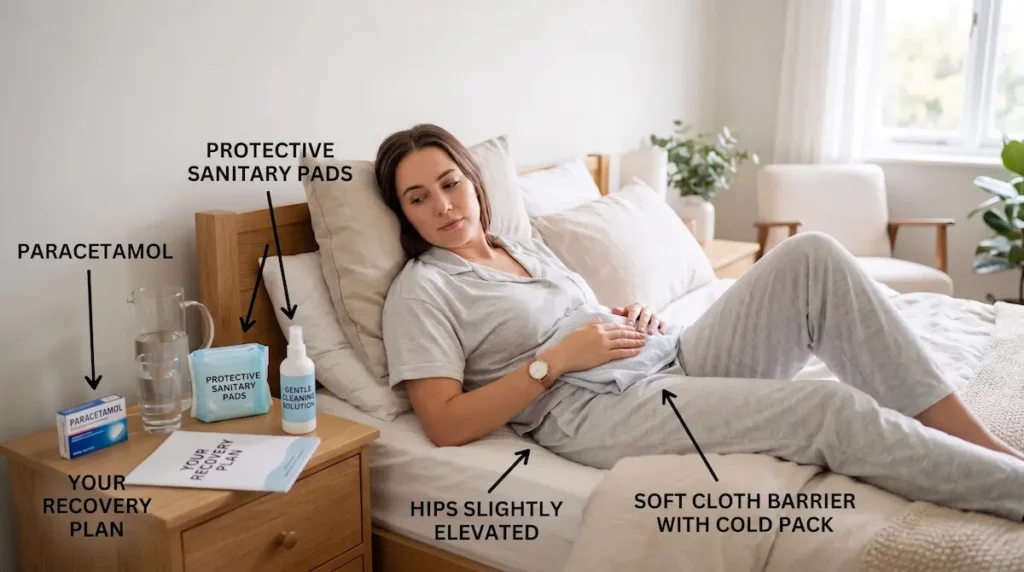
The early aim is simple: reduce friction, keep the area clean and avoid anything that pulls on the incisions. You may be advised to rest with your hips slightly elevated, use a protective sanitary pad for light spotting and walk only short distances around your room during the first day.
Anaesthesia wearing off
As the anaesthesia fades, mild to moderate discomfort can appear. Many patients describe this as soreness, stinging or pressure rather than sharp pain. Your surgeon will give you a pain-control plan, and UK patients are often familiar with paracetamol-based routines, although you should only take medication approved by your surgical team.
Avoid judging your result at this stage. The labia may look larger than before surgery because swelling is at its peak. One side may look more swollen than the other. Early asymmetry is common and usually reflects tissue inflammation rather than the final shape.
Early swelling and discomfort
Swelling often peaks during the first few days. Bruising, mild spotting and tenderness when sitting can also happen. The area may feel more sensitive after walking or using the toilet, which is why gentle cleaning and loose clothing matter from day one.
Cold packs can be useful, but they must be used safely. Never place ice directly on the skin. Use a soft cloth barrier and follow your surgeon’s instructions on timing. Too much cold exposure can irritate delicate tissue.
Why technique can affect recovery
Recovery can vary depending on how much tissue was removed, whether the labia minora alone were treated and whether other areas, such as the clitoral hood, were addressed. This article will not go into technique selection in detail, but if you are comparing approaches, our labiaplasty treatment page explains how trim and wedge techniques differ.
The important point for recovery is that your aftercare instructions are tailored to the exact surgery you had. Do not compare your day-three swelling with someone else’s online photo. Their anatomy, technique and tissue response may be completely different.
Week-by-Week Timeline
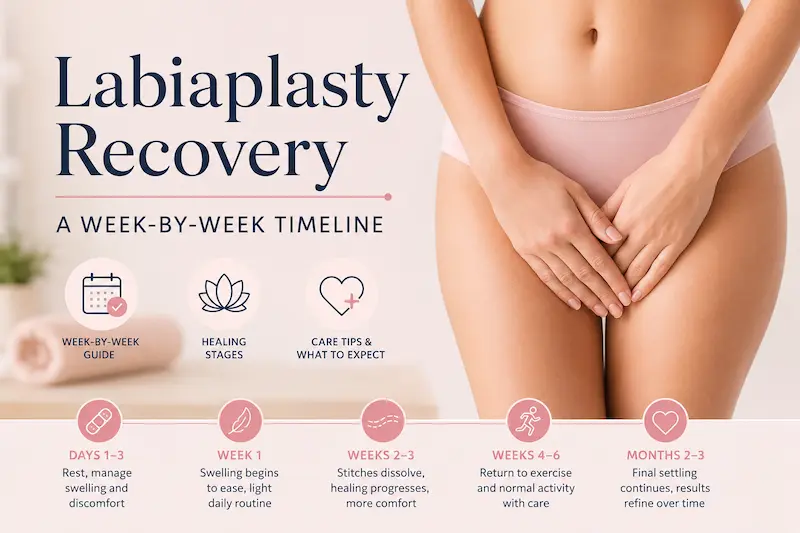
Labiaplasty healing is easiest to understand in stages. The first week is about rest and swelling control. Weeks 2–3 are about the incisions becoming more settled. Weeks 4–6 are when many patients begin returning to more activity, but only if the tissue is ready.
| Recovery stage | What is healing | Typical activity level | Care tip |
|---|---|---|---|
| Days 1–3 | Peak swelling, tenderness, light spotting | Rest, short walks only | Use loose clothing, gentle rinsing and surgeon-approved cold packs |
| Week 1 | Bruising and swelling begin to ease | Light desk work may be possible for some patients | Avoid long sitting, tight underwear and unnecessary friction |
| Weeks 2–3 | Dissolvable stitches soften or begin to shed | Gentle walking, more normal daily routine | Keep hygiene simple; do not scrub or use perfumed products |
| Weeks 4–6 | Incisions gain strength; swelling continues to reduce | Exercise and sexual activity only when cleared | Restart activity gradually, not all at once |
| Months 2–3 | Residual swelling and firmness continue settling | Most usual routines are back, if healing is uncomplicated | Wait for final refinement; the area may still change subtly |
Days 1–3: rest, swelling and protection
The first three days are usually the most swollen. You may notice bruising, tenderness, mild bleeding on a pad and sensitivity when passing urine. A peri bottle or gentle rinse with lukewarm water may make toilet trips more comfortable, if your surgeon recommends it.
Keep movement light. Short walks are helpful for circulation, but this is not the time for errands, stairs more than necessary or long periods upright. The less friction the incisions face, the calmer the early swelling tends to be.
Week 1: returning to a quiet routine
By the end of the first week, pain and swelling usually start to feel more manageable. Some patients with desk-based work feel ready to return, especially if they can work from home, wear loose clothing and take breaks from sitting.
That said, “back to work” does not mean “fully healed”. If your job involves standing for long periods, lifting, commuting on crowded transport or wearing fitted workwear, you may need more time. Plan recovery around your actual day, not just your job title.
Weeks 2–3: stitches, itching and visible improvement
Dissolvable stitches often begin to soften, loosen or shed around this stage. Mild itching can happen as the skin heals. Do not pull at stitches, trim them yourself or scrub the area. If a stitch feels sharp or irritating, ask your surgical team what to do.
Swelling may still make the labia look uneven. This can be frustrating, especially if one side settles faster. In most cases, this is part of normal healing. The result is still changing.
Weeks 4–6: gradual return to more activity
Many patients are cleared for more activity somewhere between weeks 4 and 6, depending on incision healing. Strenuous exercise, cycling, swimming, heavy lifting and sexual activity should not be restarted simply because the calendar says it is week four. Clearance matters.
This is also the stage where patients sometimes feel well enough to overdo it. A sudden increase in swelling after a long walk, workout or friction from tight clothing is a sign to slow down. Healing tissue does not respond well to pressure.
Months 2–3: final settling continues
By months 2–3, the area usually feels much more normal, but small changes can continue. Residual swelling, firmness along the incision line or sensitivity may gradually soften over the following months.
Final appearance is not judged in the early weeks. A calmer, more realistic expectation is to look for steady improvement: less swelling, less tenderness, more comfort in clothing and fewer reminders during daily life.
Hygiene, Clothing and Comfort
Good aftercare during labiaplasty recovery is not complicated, but it does need consistency. The goal is to keep the area clean, dry enough to heal, and protected from friction while the incisions are still delicate.
You do not need harsh products, complicated routines or repeated checking in the mirror. In fact, over-cleaning can irritate the tissue. Simple care, done gently, is usually better than doing too much.
Keeping the area clean
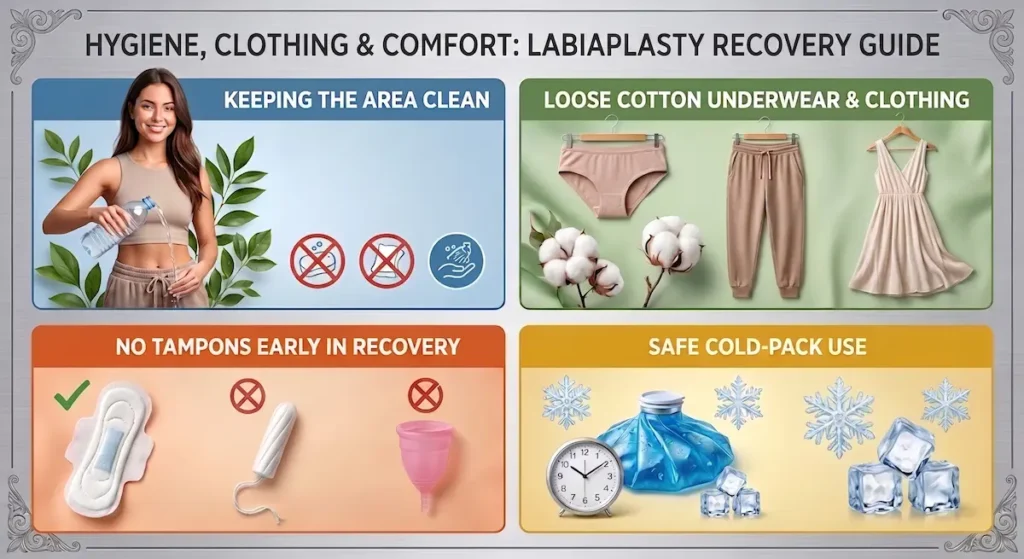
Your surgeon will give you specific wound-care instructions. In many cases, patients are advised to rinse gently with clean water after using the toilet, then pat dry rather than rub. Some surgeons recommend a peri bottle for comfort during the first week.
Avoid perfumed soaps, scented wipes, vaginal sprays and exfoliating products. These can sting, disrupt the skin barrier and make the area more inflamed. Clean does not mean aggressively scrubbed.
Hand hygiene matters too. Wash your hands before touching the area, changing a pad or applying any medication. It sounds basic, but it is one of the easiest ways to reduce infection risk.
Loose cotton underwear and clothing
Friction is one of the main reasons recovery can feel more uncomfortable than it needs to. Tight knickers, fitted trousers, leggings and shapewear can rub against the incision lines and increase swelling.
For the first couple of weeks, soft cotton underwear and loose trousers, joggers or dresses are usually more comfortable. The fabric should not press into the labia when you sit, walk or bend.
Many patients underestimate sitting. A long train journey, a full day at a desk or sitting upright for hours can create pressure. Build in breaks where you can stand, recline or change position.
No tampons early in recovery
Tampons, menstrual cups and anything inserted vaginally are usually avoided during the early recovery period. Your surgeon will tell you when it is safe to restart them. Until then, sanitary pads are typically the safer option if you have your period.
This is not just about comfort. The tissue around the surgical area is healing, and inserting products too early can create pressure, introduce bacteria or disturb nearby incisions.
Safe cold-pack use
Cold packs can reduce early swelling and tenderness when used correctly. They should be wrapped in a soft cloth and applied only for the time your surgeon recommends. Direct ice on delicate tissue can cause irritation or cold injury.
Think of cold therapy as support, not a shortcut. It may help the first few days feel easier, but it will not make swelling disappear overnight. Normal swelling still needs time to settle.
What Is Normal vs Worth Flagging?
One of the hardest parts of recovery is knowing whether something is part of normal healing or a reason to contact your surgical team. Mild swelling, bruising, itching and asymmetry can be expected. Worsening pain, fever, bad odour or wound opening should not be ignored.
This section is deliberately direct. Reassurance is useful only when it is honest. If something feels wrong, it is safer to ask your surgeon than to wait because you feel embarrassed.
| Symptom or sign | Usually normal? | What to do |
|---|---|---|
| Swelling that is worse in the first few days | Yes, commonly expected | Rest, elevate when advised and avoid friction |
| One side looking more swollen than the other | Often normal early on | Monitor for steady improvement; mention it at follow-up |
| Mild spotting on a pad | Can be normal | Use pads as advised; report heavy or persistent bleeding |
| Itching around the stitch line | Often part of healing | Do not scratch; ask your surgeon if it becomes intense |
| Increasing pain after initial improvement | No | Contact your surgeon promptly |
| Foul smell, pus or coloured discharge | No | Seek medical advice urgently |
| Fever, chills or feeling unwell | No | Contact your surgeon or urgent medical service |
| Incision opening or tissue turning dark | No | Send photos to your surgical team and follow urgent advice |
Normal swelling and asymmetry
Swelling is expected after labiaplasty, and it rarely reduces evenly on both sides. One labium may look fuller, firmer or more raised for a while. That can be unsettling, but early asymmetry often improves as inflammation settles.
For a deeper look at swelling alone, including why it can fluctuate during the first weeks, read the guide to how swelling progresses in detail. This recovery article keeps the wider timeline in focus.
Common side effects to expect
Temporary bruising, tenderness, numbness, itching and light spotting can happen. Some patients also feel emotional in the first week because the area looks swollen and unfamiliar. That reaction is common, especially when you are tired and trying not to move too much.
If you are unsure whether a symptom is part of normal healing, ask your surgical team rather than guessing.
Signs to contact your surgeon
Contact your surgical team if pain is getting worse instead of better, bleeding is heavy, the area becomes hot and increasingly red, or you notice discharge with a bad smell. Fever, chills or feeling generally unwell should also be taken seriously.
Do not wait for your scheduled follow-up if something clearly changes. A quick photo review or video check can help your team decide whether reassurance, a prescription or an in-person assessment is needed.
Poor-result red flags
Some concerns are not emergencies but still deserve proper review. These include wound separation, persistent asymmetry after swelling has had time to settle, painful scar tissue or a result that pulls during movement. A systematic review of labiaplasty outcomes reinforces why technique, anatomy and complication monitoring should be discussed carefully rather than treated as minor details.
Because this article is focused on recovery, it will not analyse revision surgery or poor outcomes in depth. If that is your concern, discuss your symptoms directly with a qualified surgeon.
Getting Back to Activity Safely
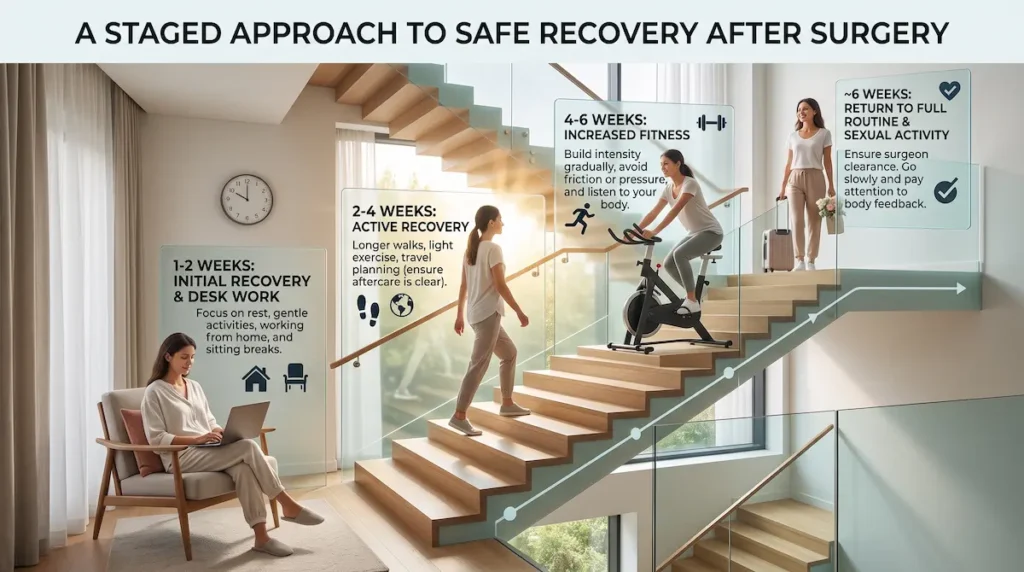
Returning to normal life is not a single date on a calendar. It is a staged process: walking first, then work, then exercise, then sexual activity, with each step depending on how the tissue is healing.
The safest mindset is gradual. Feeling better is a good sign, but it does not mean the incisions have full strength yet. Your surgeon’s clearance should guide each milestone.
Returning to work
Many patients with desk-based work can return within 1–2 weeks, especially if they can work from home and take sitting breaks. This broadly aligns with ASPS guidance on labiaplasty recovery stages, which notes that recovery varies but many patients return to their normal routine within 1–2 weeks. More physical jobs may require longer. Commuting also matters: a crowded Tube journey or long train ride can be more demanding than the work itself.
Before returning, think through the practical details. Can you wear loose clothing? Can you take breaks? Can you avoid lifting? Can you manage the toilet routine comfortably? These small factors often decide whether going back feels smooth or stressful.
Exercise at around 4–6 weeks
Gentle walking is usually encouraged early, but strenuous exercise is different. Running, weight training, cycling, Pilates, yoga stretches and gym classes can all create friction, pressure or pulling around the healing tissue.
Many patients begin easing back into exercise around 4–6 weeks, but only when their surgeon confirms it is safe. Start with low-impact activity and build gradually. If swelling increases or the area throbs afterwards, scale back.
Sexual activity at around 6 weeks
Sexual activity is usually delayed until the incisions are fully closed, tenderness has reduced and your surgeon has cleared you. For many patients, that is around 6 weeks, but the timing can vary.
Do not rush this milestone. Even if the area looks healed from the outside, deeper tissue may still be sensitive. Restarting too early can cause pain, bleeding, swelling or small wound disruption.
When you do resume, go slowly, use lubrication if advised and stop if there is pain. Discomfort is feedback. Listen to it.
Travel and follow-up planning
If you are travelling for surgery, your aftercare plan should be clear before you book. Ask when you will be checked in person, what symptoms require urgent contact and how photo or video follow-ups are handled after you return home.
At AKM, surgery is performed in Istanbul with post-operative support and long-term virtual follow-up. You can also review the dedicated page for labiaplasty costs in Turkey if you need pricing information separately; this recovery guide does not cover costs.
What to ask before surgery
Before travelling, ask your surgeon how they manage bleeding risk, infection prevention, stitch care and follow-up if you are returning to the UK. You should also ask what photos they need if you have a concern after flying home.
For UK patients, the important question is not whether the surgeon uses the same title system as the UK. It is whether the standards are clear. AKM uses a board-certified plastic surgery team based in Istanbul, and you can ask which qualifications your surgeon holds before you travel.
A smooth recovery is usually less about doing one perfect thing and more about not rushing several small things: sitting too long, exercising too soon, wearing tight clothing or restarting sex before the tissue is ready.
If you are unsure whether your recovery timeline is realistic, request a personalised consultation and ask AKM about the recovery plan, follow-up schedule and aftercare support before making a decision.
Frequently Asked Questions: Labiaplasty Recovery
These quick answers cover the questions patients most often ask during labiaplasty recovery. They are general guidance only; your own surgeon’s instructions should always take priority because your technique, anatomy and healing pattern may differ.
How long is labiaplasty recovery?
Many patients feel well enough for quiet daily life before they are fully healed. That distinction matters. Feeling more comfortable is not the same as having strong, mature tissue.
When can I work out after labiaplasty?
When you restart, do less than you think you can. A short, low-impact session is safer than returning to your full routine immediately. If swelling or throbbing increases afterwards, your body is asking for more time.
When can I have sex after labiaplasty?
Restart gently. Pain, bleeding or sharp pulling are reasons to stop and contact your surgeon for advice.
When do stitches dissolve?
If a stitch catches on underwear or feels sharp, ask your surgical team what to do. A small irritation is usually easy to manage when it is handled properly.
Can I use tampons after labiaplasty?
This is partly about comfort and partly about protecting the healing tissue. Anything inserted too early can increase pressure, friction or irritation around the surgical area.
When does swelling go down?
Do not use the first week as your reference point for the final result. The early appearance can be swollen, uneven and unfamiliar. That is why follow-up timing matters.
What should I ask my surgeon before travelling for labiaplasty?
This recovery guide does not cover package details. If you are comparing the financial side separately, use the dedicated cost page rather than relying on recovery articles for pricing information.
Final Thoughts
Labiaplasty recovery is usually manageable when the timeline is realistic. The first few days are about swelling control and rest. The first few weeks are about protecting the incisions. Weeks 4–6 are about careful, surgeon-cleared return to activity.
The most important rule is not to rush the milestones that create friction: exercise, cycling, tampons and sex. A slower return often means a smoother recovery.
AKM’s board-certified plastic surgery team plans aftercare around your anatomy, your procedure and your travel schedule. If you are considering surgery abroad, ask about the recovery plan before you make a decision — not after the operation is booked.
Medical disclaimer: This article is for general educational information only and is not medical advice. Labiaplasty recovery varies from patient to patient. Always follow the instructions of your own qualified surgeon and seek urgent medical help if you develop worsening pain, fever, heavy bleeding, foul-smelling discharge, wound opening or any symptom that concerns you.
Related Treatments



Ready to Begin Your Own Transformation Journey?
Join the 2,000+ patients who have trusted Dr Akif Mehmetoğlu and the AKM Clinic team. Your journey to a more confident, naturally restored you begins with a simple, no-obligation conversation. Contact us today from the UK for your free virtual consultation.
#1: Get Your Free Personalised Quote
Start with a free, no-obligation online consultation. Share your photos, and our surgical team will provide a fully personalised treatment plan and a transparent, all-inclusive price package. There are no hidden fees.
#2: Secure Your Date & VIP Booking
Once you are ready, our dedicated patient coordinators will help you secure your procedure date. We will handle all your bookings, including your 5-star hotel accommodation and private VIP airport transfers.
#3: Arrive in Istanbul & Meet Your Surgeon
Arrive at Istanbul Airport (IST) and be greeted by your private driver. Settle into your hotel and prepare for your in-person consultation, where you will meet your specialist surgeon to finalise the details for your "natural, subtle, and restored" new look.