
Gynecomastia vs Chest Fat: How to Tell the Difference
AI Summary
- Gynecomastia vs chest fat depends on glandular tissue, fatty tissue, or a mixed pattern.
- Safe self-checking helps identify clues, but medical assessment confirms the cause.
- Treatment choice changes by tissue type: liposuction, gland removal, or combined planning.
- Cost and next steps depend on anatomy, symptoms, and a surgeon-led consultation.
Summary generated by AI, fact-checked by our medical experts
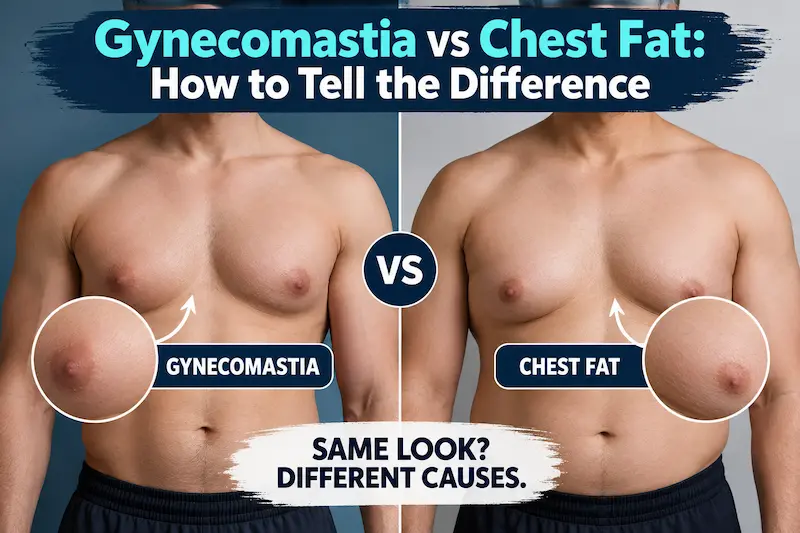
Gynecomastia vs chest fat comes down to tissue type: gynecomastia usually feels like a firm, rubbery disc under the nipple, while chest fat, also called pseudogynecomastia, feels softer and more spread out across the chest. The difference matters because fat may respond to weight loss or liposuction, while glandular tissue usually needs surgical removal.
If your chest looks fuller than you want, it is easy to assume it is just fat. It is also easy to panic and assume it is true gynecomastia. Neither guess is reliable. The male chest can hold fat, glandular tissue, loose skin, or a mix of all three, and each pattern points to a different solution.
This guide is written for Canadian patients who want a careful, evidence-led way to understand the signs before booking a consultation. It does not diagnose you. It helps you decide what to look for, what questions to ask, and when to speak with a doctor rather than relying on a mirror test alone.
For a broader overview of treatment options, recovery, and surgical planning, see gynecomastia surgery at AKM Clinic. This article stays focused on the difference between glandular gynecomastia and fatty chest fullness.
Table of Contents
Gynecomastia vs Chest Fat — What’s Actually Different?
The real difference is anatomical. Gynecomastia means enlargement of glandular male breast tissue, often felt directly under or around the nipple-areola complex. Chest fat, or pseudogynecomastia, is fatty tissue without the same firm glandular disc. Both can create a rounded or “puffy” chest, which is why visual checks alone can be misleading.
Glandular tissue feels different from fat
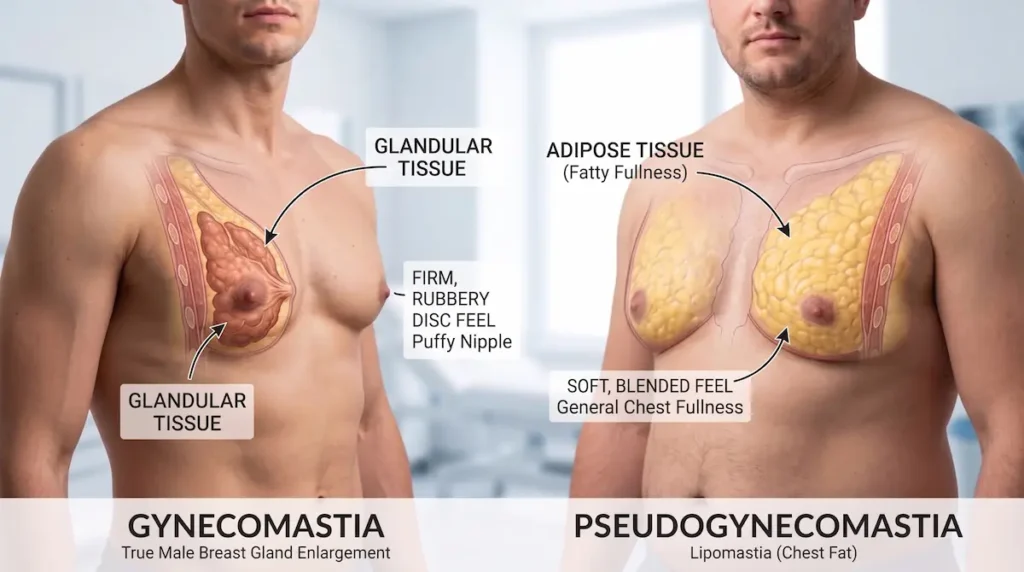
True gynecomastia often has a firmer centre. Many men describe it as a rubbery, coin-like, or disc-shaped area under the nipple. It may feel tender, especially during puberty, after hormonal shifts, or with certain medications.
Chest fat usually feels softer. It tends to blend into the surrounding chest, side chest, and upper abdomen rather than sitting as a defined lump under the areola. In pseudogynecomastia, the nipple may still look full, but the fullness comes mainly from fatty tissue.
Why both can look like “male breasts”
The mirror does not show tissue type. A man with higher body fat can develop rounded chest fullness that looks similar to gynecomastia. Another man with a leaner frame may have small but stubborn glandular tissue that pushes the areola forward. Both can create puffy nipples.
That is why surgeons look at more than shape. They assess tissue feel, symmetry, skin quality, areola position, weight history, medication history, and whether the fullness changes with fat loss.
Gynecomastia, pseudogynecomastia, and lipomastia
The terms can sound more confusing than they are:
- Gynecomastia: glandular male breast tissue enlargement, often with a firm or rubbery feel beneath the nipple.
- Pseudogynecomastia: chest enlargement caused mainly by fat rather than glandular tissue.
- Lipomastia: another term often used for fatty male chest fullness.
- Mixed gynecomastia: a combination of glandular tissue and fat, which is very common in real consultations.
| Feature | Gynecomastia | Chest Fat / Pseudogynecomastia |
|---|---|---|
| How it feels | Firm, rubbery, or disc-like tissue under the nipple | Soft, diffuse fat spread across the chest |
| Typical look | Puffy nipple, projected areola, rounded gland area | General chest fullness, often with side-chest fat |
| Weight loss effect | May improve a little, but the firm gland often remains | Usually improves as overall body fat decreases |
| Common treatment direction | Gland removal is usually needed if tissue is persistent | Liposuction may be enough if skin quality is good |
| Self-check limit | Needs clinical confirmation | Still needs assessment if the diagnosis is unclear |
“The question is not simply whether the chest is full. The question is what the fullness is made of. Fat, gland, and skin each need a different plan.”
Canadian patient note: If you are comparing options from Canada, look for a surgeon-led assessment rather than a photo-only promise. A photo can suggest whether your chest is fat-dominant or gland-dominant, but a physical exam is still the most reliable way to confirm the tissue pattern.
Ready to Discuss Your Gynecomastia?
Our surgical calendar books up well in advance, so planning early gives you the widest choice of dates. Request a consultation to map out your ideal travel window — built around your flights from Toronto (YYZ), Vancouver (YVR), or Montréal (YUL) — with no obligation to proceed.
How to Tell at Home Without Diagnosing Yourself?
You can look for clues at home, but you cannot safely diagnose gynecomastia from a mirror, gym progress photo, or online checklist. Use these signs as a starting point. If you feel a hard, one-sided, painful, fast-growing, or irregular lump, or if there is nipple discharge, book a medical evaluation rather than treating it as cosmetic chest fat.
Feel: firm disc versus soft, spread-out fullness
Gently feel around the areola and under the nipple. True gynecomastia often feels like a firmer area centred beneath the nipple. It may be round, rubbery, or resistant compared with the surrounding fat.
Chest fat feels more even. There may be no clear edge, no central disc, and no distinct gland-like resistance. The fullness may extend into the lower chest, side chest, or upper abdomen.
A more detailed self-check is covered in the pinch test for glandular tissue. This article will not repeat the full technique, because the pinch test is only one clue and can be misleading if you have mixed fat and gland.
Look: puffy nipples and areola changes
Puffy nipples can happen in both gynecomastia and pseudogynecomastia, but the pattern may differ. With glandular tissue, the areola may look pushed forward by a firmer mound underneath. The nipple area may stay puffy even when the rest of the chest is lean.
With chest fat, the areola may look full because the entire chest is fuller. The nipple may flatten or look less prominent as overall body fat decreases.
Weight change: what happens when you get leaner?
If your chest fullness shrinks clearly with weight loss, pseudogynecomastia is more likely. Fat responds to a sustained calorie deficit, exercise, and overall body composition changes.
If your waist, face, and abdomen become leaner but the nipple-area mound stays almost the same, glandular gynecomastia becomes more likely. That pattern is common in men who say, “I lost weight everywhere except my chest.”
Symmetry: one side versus both sides
Gynecomastia can be one-sided or more obvious on one side, but a new, hard, irregular, or fast-changing one-sided lump should not be ignored. Chest fat is more often bilateral and follows your overall fat pattern, although one side can still look slightly different.
The safe rule: if the change is new, hard, one-sided, painful, associated with discharge, or growing quickly, speak with a doctor. Do not assume it is simply gyno or fat.
Common Causes — and When It’s Not Just Fat
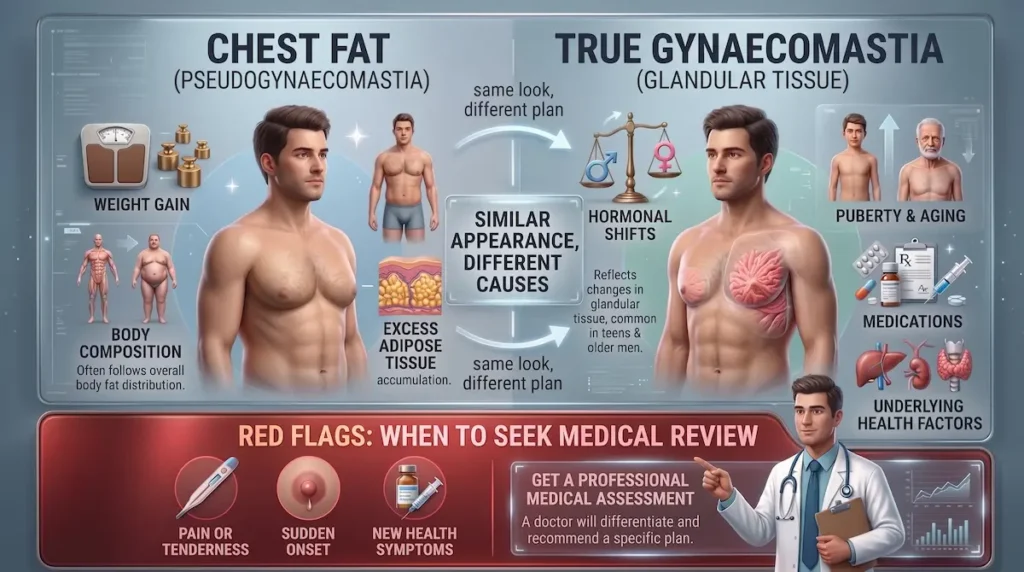
Chest fat usually follows body-fat distribution. Gynecomastia often reflects a hormonal, medication-related, developmental, or age-related change in glandular tissue. Understanding the cause does not mean you can self-treat it, but it helps explain why two men with similar-looking chests may need different plans.
Puberty, aging, and hormonal shifts
Gynecomastia is common during puberty, when hormone levels change quickly. In many teenagers, it improves on its own. In others, glandular tissue persists into adulthood and becomes a long-term concern.
It can also appear or become more noticeable with aging. As testosterone levels, weight, medication use, and body composition change, some men develop new chest fullness later in life.
Weight gain and pseudogynecomastia
Weight gain can create chest fat without true glandular enlargement. This is pseudogynecomastia. It may be frustrating, but the treatment logic is different: if the main issue is fat, weight management and body contouring may be more relevant than gland excision.
Some patients have both. A man may gain fat over the chest and also have a firm gland under the nipple. This mixed pattern is one reason online before-and-after comparisons can be misleading.
Medications, steroids, and health factors
Some medications, anabolic steroids, hormonal treatments, and underlying medical conditions can contribute to gynecomastia. Liver, kidney, thyroid, and endocrine issues may also need consideration in certain cases.
If your chest changed suddenly, started after a new medication, or is associated with pain, nipple discharge, testicular symptoms, or other health changes, the first step is medical review. Cosmetic planning comes later.
Safety note: Medical references such as the StatPearls review on gynecomastia distinguish true gynecomastia from pseudogynecomastia and emphasize clinical assessment when symptoms or exam findings are concerning.
A Comprehensive Guide to Gynecomastia
From the procedure steps to your post-operative aftercare, review every detail of how our surgical team performs Gynecomastia in Istanbul. A clear, start-to-finish overview, so you know exactly what to expect before you travel.
Why the Difference Changes Your Treatment
The reason gynecomastia vs chest fat matters is simple: fat and gland do not respond to the same treatment. Fat can shrink with weight loss and can often be removed with liposuction. Glandular tissue is denser, more fibrous, and usually does not disappear just because you lose weight.
That is why a good consultation does not start with “Do you want surgery?” It starts with “What tissue is actually creating the shape?” Once that is clear, the treatment plan becomes more precise.
Fat-dominant fullness may respond to weight loss or liposuction
If the fullness is mostly chest fat, the first question is whether your weight is stable. If you are actively losing weight, your chest may continue to change. A surgeon may advise waiting until your weight has settled before planning body contouring.
If your weight is stable and the issue is localised fat, liposuction may be enough. This is more likely when the chest feels soft, the areola is not strongly projected by a firm gland, and the skin still has enough elasticity to contract after fat removal.
Chest fat rarely exists in isolation. Many men also have flank, abdomen, or side-chest fullness that affects how the torso looks as a whole. For a body-contouring perspective outside the gynecomastia topic, see how flank liposuction changes the waistline.
Glandular tissue usually needs excision
If there is a firm glandular disc under the nipple, liposuction alone may flatten the surrounding fat but leave the central puffy nipple behind. That is the classic reason some men feel disappointed after “just lipo” for gynecomastia.
In gland-dominant cases, surgical excision of the gland is usually part of the plan. In mixed cases, surgeons may combine liposuction with gland removal so the chest looks flatter and smoother rather than hollow around a remaining gland.
The American Society of Plastic Surgeons describes this same basic treatment split: liposuction is used when fatty tissue is the main issue, while excision is used when glandular tissue, excess skin, or areola reduction must be addressed. See the ASPS explanation of liposuction and excision for gynecomastia surgery for a clinical overview.
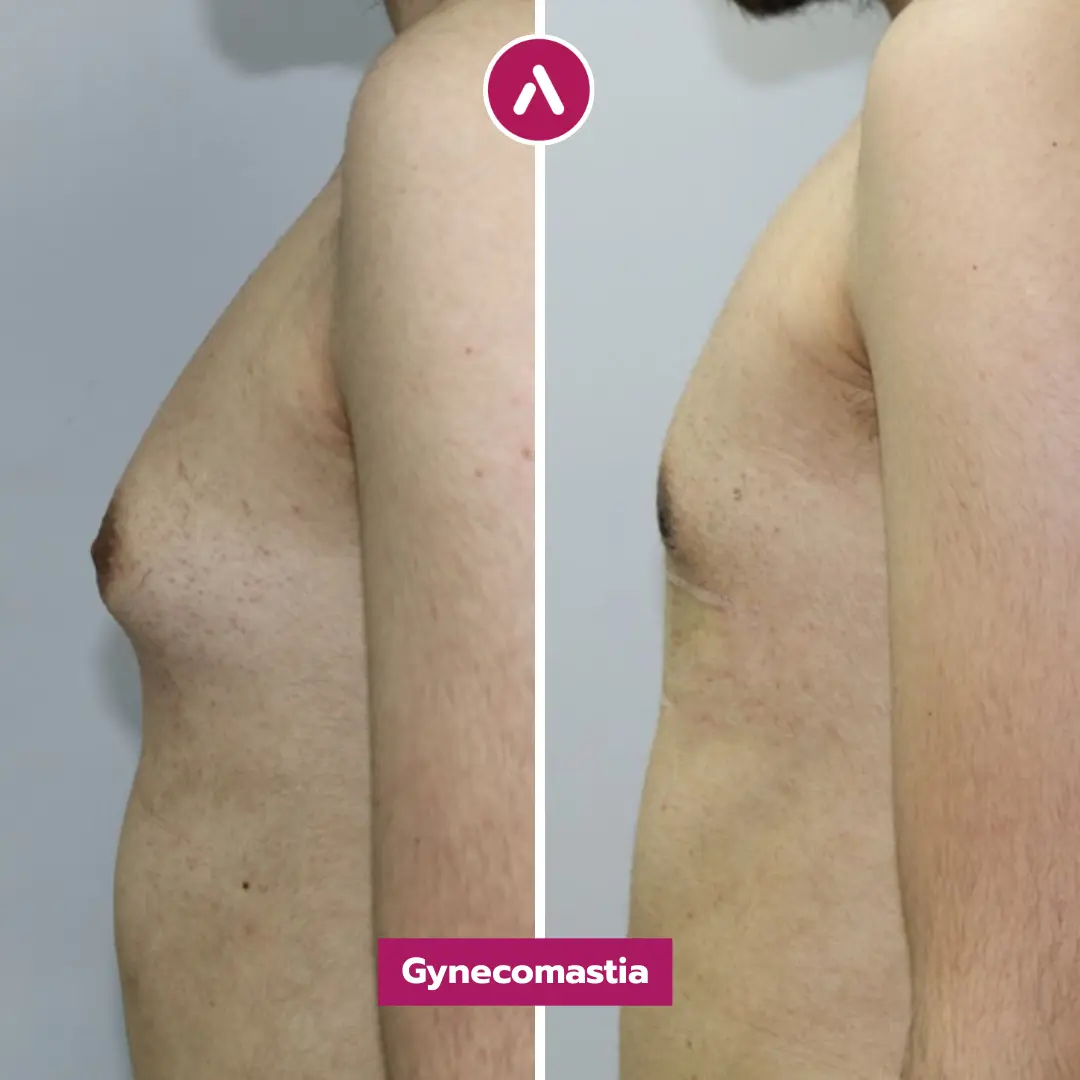
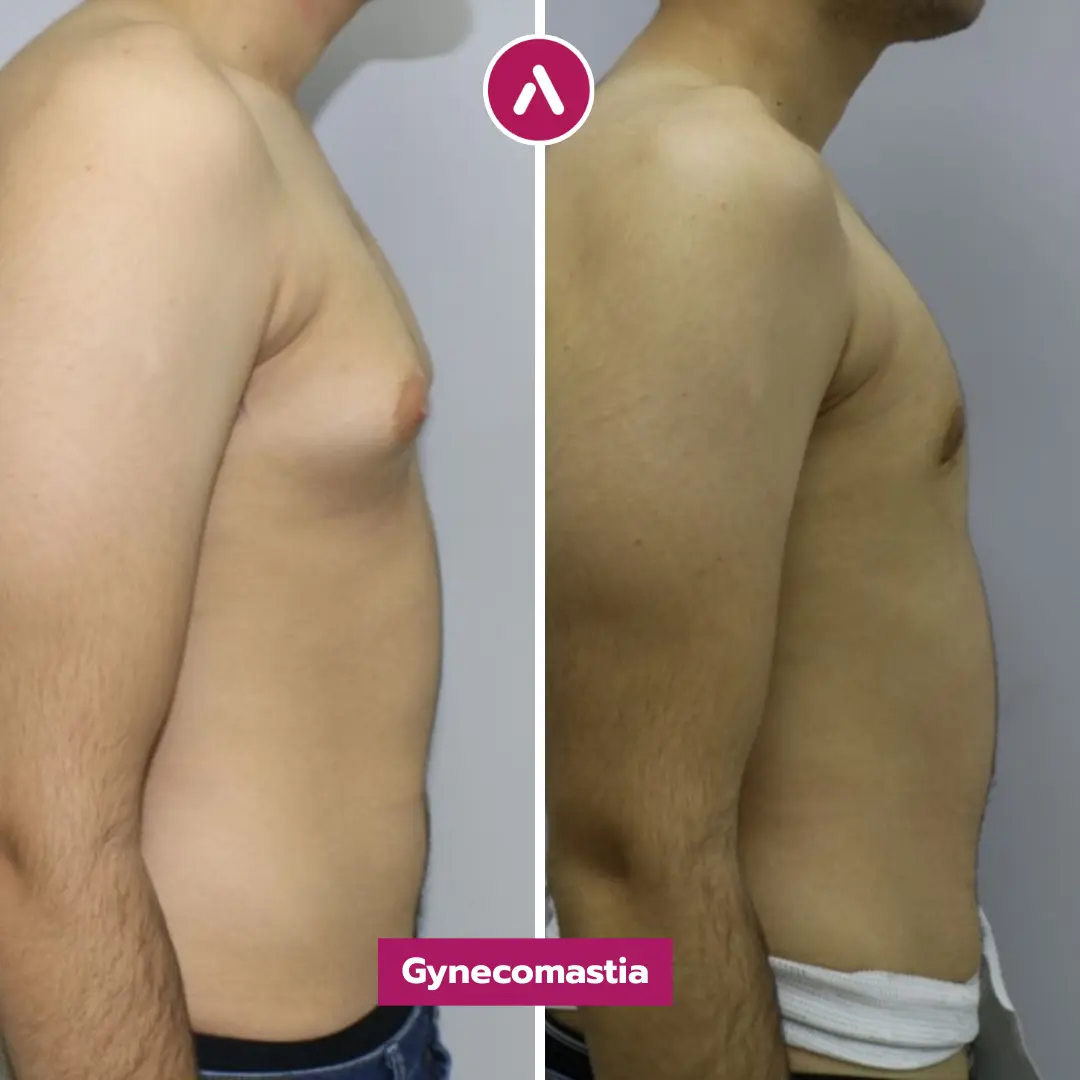
Mixed cases are common
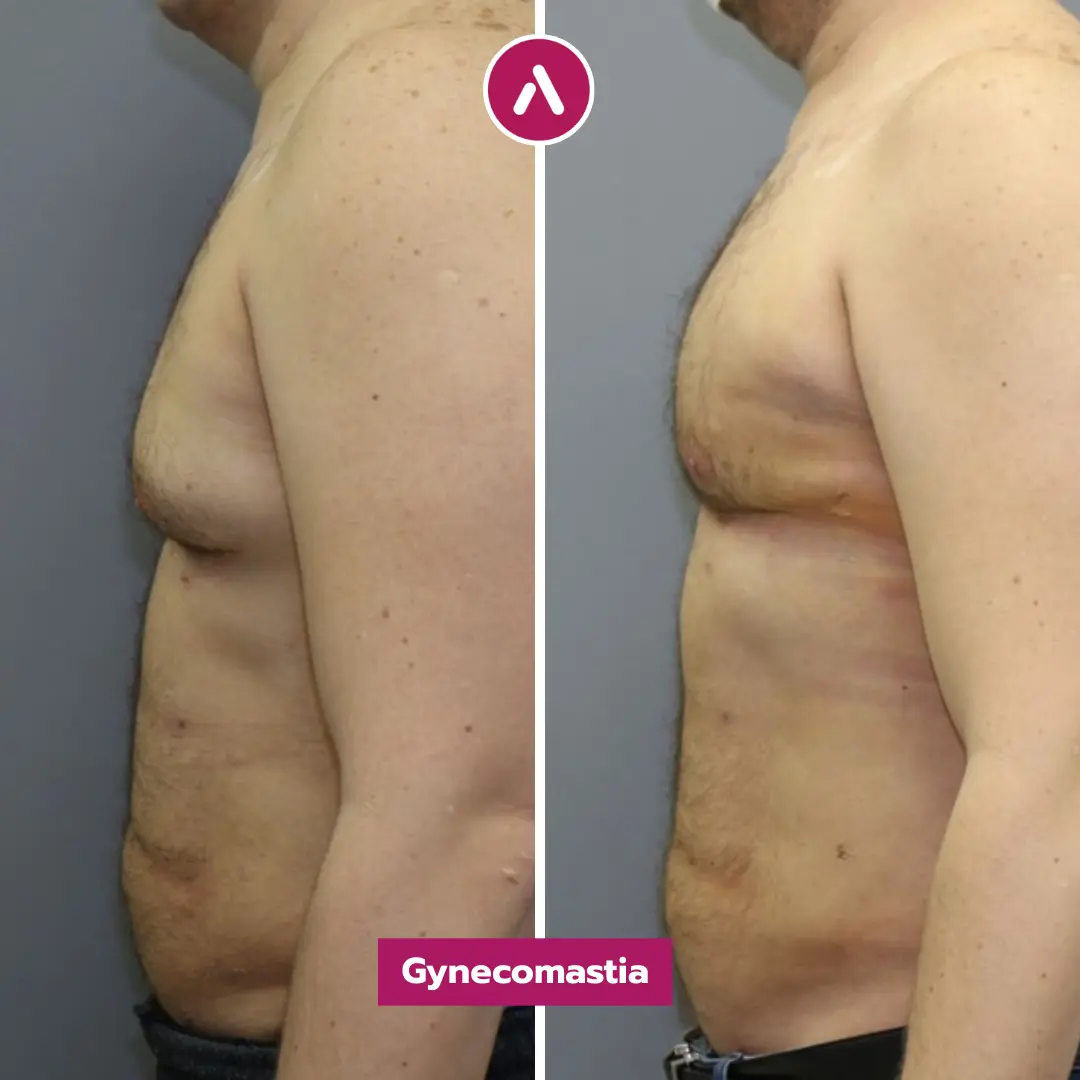
Many patients do not fit neatly into one category. You may have soft chest fat around the lower chest and a firmer gland directly beneath the nipple. You may also have loose skin after weight loss, which changes the surgical plan again.
This is why “is it gyno or fat?” can be the wrong question. A better question is: “How much of this is fat, how much is gland, and how much is skin?” Each component affects the result.
Grades matter, but they are a separate topic
Gynecomastia grade describes severity: how much tissue is present, whether there is skin excess, and how much the chest projects. Grade helps guide treatment, but this article is not a grading guide.
If you already know you have gynecomastia and want to understand severity, our gynecomastia surgery page explains the grading system in more detail.
Scars depend on the tissue plan
Fat-dominant treatment usually uses small liposuction incisions. Gland excision often uses an incision along part of the areola border. If there is significant loose skin, the scar pattern may be different.
Scarring is important, but it should not be used to choose the wrong treatment. Avoiding gland removal when gland is the real problem may leave the puffy nipple unchanged. For a focused scar discussion, ask your surgeon where the incisions would sit for your tissue pattern.
“A flatter chest is not only about removing volume. It is about removing the right kind of tissue while respecting skin quality, nipple position, and the natural contour of the male chest.”
For Canadian patients, ask whether your case is fat-dominant, gland-dominant, or mixed. A careful surgeon should be able to explain why liposuction alone is enough — or why it is not.
What to Do Next
Once you understand the likely difference between gynecomastia and chest fat, the next step is not to rush into a treatment. It is to get a structured assessment. That assessment should confirm the tissue type, rule out medical red flags, and explain what result is realistic for your chest.
Think of this stage as evidence-gathering. Photos, weight history, tissue feel, symptoms, and medical history all help build the picture.

Start with your health history
Before any cosmetic decision, write down when the chest fullness started. Was it present since puberty? Did it appear after weight gain? Did it begin after a medication change, steroid use, or hormonal treatment? Has it changed quickly?
Also note symptoms. Tenderness, nipple discharge, a hard one-sided lump, skin dimpling, or rapid growth should be discussed with a medical doctor. Aesthetic planning should not skip that step.
Use photos, but do not rely on photos alone
Photos can help with an initial online consultation, especially for international patients travelling from Canada. They show chest shape, nipple position, skin laxity, side-chest fat, and asymmetry.
They do not confirm tissue feel. A photo cannot fully distinguish a firm gland from dense fat. That is why virtual assessment is useful for planning, but the final plan should be confirmed during an in-person examination.
Ask the right consultation questions
Bring direct questions. A careful consultation should not make you feel rushed or sold to. Ask:
- Does my chest look fat-dominant, gland-dominant, or mixed?
- Is liposuction alone likely to flatten the nipple area?
- Will gland removal be needed?
- Do I have skin laxity that could limit the result?
- What scar pattern would match my tissue type?
- Do I need medical evaluation before cosmetic treatment?
- How will follow-up work after I return to Canada?
Understand cost without making this a cost article
Cost depends on what has to be treated. Fat-only contouring, gland excision, mixed gynecomastia surgery, skin tightening, and severe cases do not all require the same plan.
This article will not open a price table because the search intent here is diagnosis and decision-making, not cost comparison. For a CAD-specific cost discussion, use gynecomastia surgery pricing for Canadian patients.
Do not treat stubborn chest fullness as a fitness failure
Many men delay asking for help because they feel they should be able to fix the chest with more training. If the issue is glandular tissue, more bench press will not remove it. Building the pectoral muscle may improve the frame, but the gland can still project through the areola.
At the same time, surgery is not a substitute for weight stability. If chest fat is the main issue, getting closer to a stable weight before treatment may produce a better long-term contour.
Choose a plan that matches your anatomy
The safest and most satisfying plan is the one that matches the tissue problem. Fat needs fat reduction. Gland needs gland removal. Loose skin may need a different scar trade-off. Mixed cases need a balanced approach.
That is the practical answer to gynecomastia vs chest fat: the right diagnosis protects you from the wrong treatment.
Next step: Ask AKM Clinic for a virtual assessment to understand whether your chest fullness appears fat-dominant, gland-dominant, or mixed — and what questions should be confirmed in person before treatment.
Frequently Asked Questions: Gynecomastia vs Chest Fat
These answers are designed to help you understand the difference between glandular gynecomastia and chest fat. They are not a substitute for a medical examination, especially if your symptoms are new, one-sided, painful, or changing quickly.
How do I know if I have gynecomastia or just chest fat?
Can chest fat look like gynecomastia?
Does gynecomastia go away with weight loss?
Is it gyno or fat if it feels soft?
Can liposuction treat gynecomastia?
What is pseudogynecomastia?
What are puffy nipples a sign of?
When should I see a doctor about male breast tissue?
Can exercise fix gynecomastia?
What should I ask during a consultation?
Final Takeaway: Gynecomastia vs Chest Fat
Gynecomastia vs chest fat is not just a wording issue. It is the difference between glandular tissue, fatty tissue, skin laxity, or a mixed pattern. That difference changes whether weight loss, liposuction, gland excision, or a combined approach is most appropriate.
If your chest feels soft and changes with weight, pseudogynecomastia may be more likely. If you feel a firm disc under the nipple that stays despite fat loss, true gynecomastia becomes more likely. Either way, the goal is not guesswork. The goal is a clear assessment and a plan that matches your anatomy.
Have Specific Questions About Gynecomastia?
Chat directly with our dedicated patient coordinators about your Gynecomastia. Whether you're weighing your options from Ontario, British Columbia, or Alberta, you'll get clear, personalized answers — straight from the team who will look after you, not a call centre.
Medical disclaimer: This article is for general education only and does not diagnose gynecomastia, breast disease, or any medical condition. Results and treatment needs vary individually. Speak with a qualified clinician if you have pain, discharge, rapid change, a hard lump, or any health concern.
Related Procedures

Awake Gynecomastia
Awake gynecomastia surgery in Turkey for Canadian men. Learn how local anesthesia, discreet recovery, CAD pricing, and fit-to-fly care work at AKM Clinic.

Awake Abdominal Etching
A Canadian patient guide to awake abdominal etching in Istanbul: pure local anesthesia, comfort, recovery, cost, safety, and fit-to-fly planning.

Awake Tummy Tuck
Awake tummy tuck in Turkey from CAD $7,500. Learn candidacy, local anesthesia limits, recovery, and Canada-to-Istanbul care.

Sapphire Hair Transplant
Explore Sapphire FUE hair transplant in Turkey for Canadians. Learn costs, recovery, Sapphire vs DHI vs FUE, safety, and AKM Clinic’s all-inclusive pathway.
Ready to Begin Your Journey?
Join the more than 2,000 patients who have trusted Dr. Akif Mehmetoğlu and the AKM Clinic team. Your journey begins with an informative, no-obligation conversation. Contact us today from across Canada to schedule your complimentary virtual consultation.
#1: Receive Your Personalized Quote
Start with a complimentary, no-obligation virtual consultation. Share your photos, and our surgical team will provide a fully personalized treatment plan and a transparent, all-inclusive pricing package quoted in Canadian dollars (CAD). There are no hidden fees.
#2: Secure Your Procedure Date
Once you are ready to proceed, our dedicated English-speaking patient coordinators will help you secure your procedure date. We will manage your logistical bookings in Istanbul, including your five-star hotel and private airport transfers.
#3: Arrive in Istanbul & Meet Your Surgeon
Arrive at Istanbul Airport (IST), where you will be greeted by your private driver. Settle into your hotel before your comprehensive in-person consultation. You will meet your specialist surgeon to finalize the details of your procedure and ensure your goals are aligned for a natural, subtle result.