
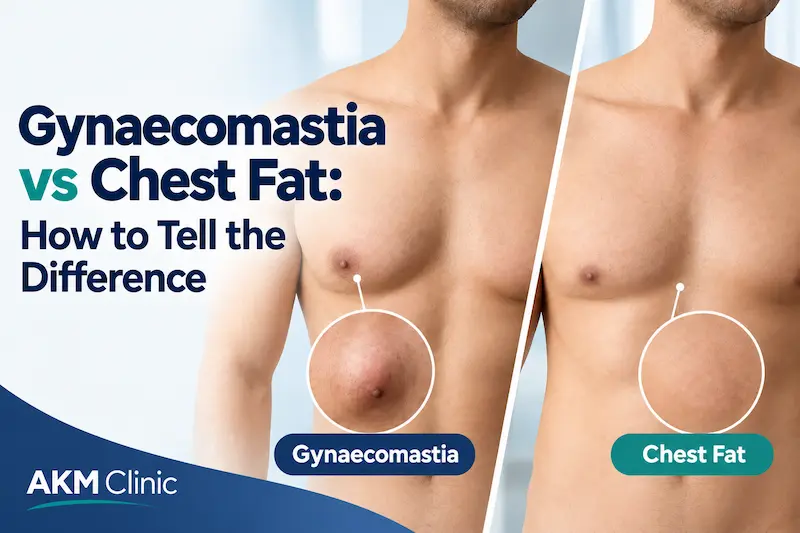
Gynaecomastia vs Chest Fat: How to Tell the Difference
AI Summary
- Gynaecomastia vs chest fat depends on firm glandular tissue versus softer, diffuse fat.
- Safe assessment first: pain, discharge, rapid growth or one-sided lumps should be checked by a GP.
- Treatment differs: chest fat may suit weight loss or liposuction; gland often needs excision.
- Cost planning should follow tissue diagnosis, not assumptions from photos or self-checks.
AI-generated summary, fact-checked by our medical experts.
Gynaecomastia vs chest fat is usually a question of tissue: true gynaecomastia often feels like a firm, rubbery disc under the nipple, while chest fat feels softer and more spread across the chest. You cannot diagnose it by touch alone, but this difference helps you decide when to lose weight, speak to a GP, or ask a surgeon about treatment.
Many men describe both problems with the same phrase: “man boobs”. That phrase may be common, but it hides an important distinction. A fuller male chest can come from glandular breast tissue, fatty tissue, loose skin, or a mix of all three. The right next step depends on which tissue is actually causing the shape.
This guide explains the practical signs without pretending that a home check is a medical diagnosis. If the chest shape has bothered you for years and you are already comparing treatment options, you can also read more about how gynaecomastia surgery works at AKM. Here, though, the focus stays narrow: gland or fat?
Quick answer: Gynaecomastia usually means enlarged glandular tissue beneath the nipple and areola. Chest fat, also called pseudogynaecomastia or lipomastia, is softer fat spread more generally across the chest. Gland often stays even after weight loss; fat usually changes more with body weight.
Table of Contents
Gynaecomastia vs Chest Fat — What’s Actually Different?
This section explains the tissue difference behind two chests that may look similar in a mirror. The aim is not to label your body from a photograph, but to understand why one chest may respond to weight loss while another keeps a firm, puffy area under the nipple.
Glandular tissue vs fat
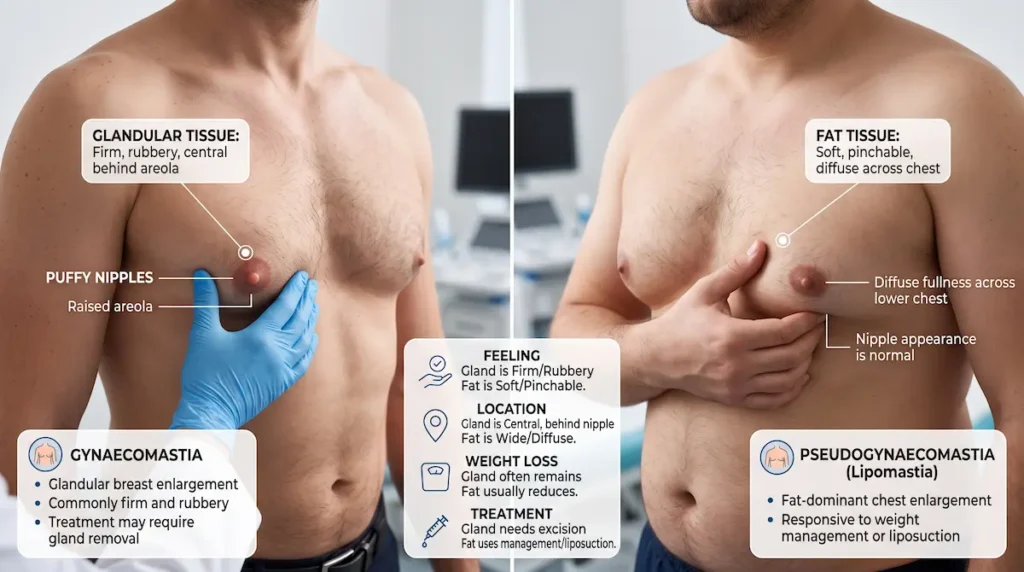
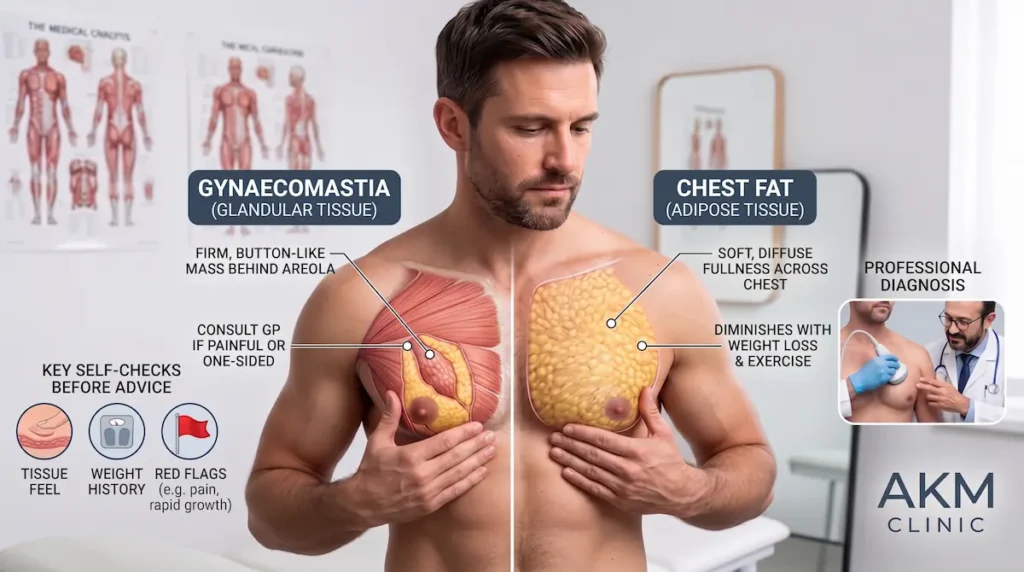
True gynaecomastia involves glandular breast tissue. It often sits directly behind the nipple-areola complex, so the fullness may look central rather than evenly spread across the whole chest. Patients often describe it as a firm, rubbery, disc-like area under the nipple.
Chest fat behaves differently. It is usually softer, more diffuse and less clearly centred under the areola. It may sit across the lower chest, side chest and upper abdomen, especially if overall body fat has increased. In clinical language, this fat-dominant pattern is often called pseudogynaecomastia or lipomastia.
The difference is recognised in clinical assessment: NCBI’s StatPearls review of gynaecomastia notes that pseudogynaecomastia needs to be differentiated from gynaecomastia, because fat-only enlargement is not the same as glandular breast enlargement.
Why both can look like “man boobs”
Two men can have the same outline in a fitted T-shirt but very different anatomy underneath. One may have a soft, fat-dominant chest after weight gain. Another may be lean elsewhere but still have a raised areola or puffy nipple because glandular tissue remains behind the nipple.
This is why the visual appearance alone is unreliable. A chest can look rounded because of fat, gland, skin laxity, or posture. It can also look more obvious under gym lighting, in tight tops, or when the nipple is warm and relaxed. Cold can temporarily make the nipple contract, which may hide the problem for a few minutes without changing the underlying tissue.
Gynaecomastia, pseudogynaecomastia and lipomastia
The terms sound technical, but the distinction is straightforward:
- Gynaecomastia refers to enlargement of male breast tissue, usually with a glandular component.
- Pseudogynaecomastia describes a chest that looks enlarged mainly because of fat, without the same glandular enlargement.
- Lipomastia is another term often used for fat-dominant male chest fullness.
- Mixed gynaecomastia means gland and fat are both contributing to the shape.
In real consultations, mixed cases are common. A man may have a firm gland under the nipple and soft fat around it. That is why an honest assessment looks at feel, distribution, weight history, skin quality and, when needed, imaging or blood tests rather than one sign alone.
| Feature | True gynaecomastia | Chest fat / pseudogynaecomastia |
|---|---|---|
| How it may feel | Firm, rubbery or disc-like tissue under the nipple | Soft, pinchable fat spread more generally across the chest |
| Where fullness sits | Often central, beneath the areola | Often wider across the chest, side chest or upper abdomen |
| Nipple appearance | Puffy nipples or a raised areola may be more noticeable | Nipple may look normal, though fat can still push the area forward |
| Response to weight loss | May improve slightly, but gland often remains | Usually changes more with overall fat loss |
| Likely treatment direction | May need gland removal, sometimes with liposuction | Weight management or liposuction may be discussed if fat is localised |
Ready to Schedule Your Gynaecomastia?
Our surgical dates fill up quickly due to high international demand. Secure your consultation today to arrange your preferred travel dates.
How to Tell at Home — Without Diagnosing Yourself
This section gives you a safe way to think about the difference at home. It is a sense-check, not a diagnosis. The question is not “Can I prove this alone?” but “Do my signs suggest fat, gland, or a mixed pattern that deserves a proper assessment?”
Feel: firm disc vs soft, diffuse fat
Start with the feel of the tissue. Glandular tissue often sits as a firmer pad or disc directly behind the nipple. It can feel more rubbery than the surrounding fat and may be tender in some men, especially during puberty or periods of hormonal change.
Fat feels less defined. It blends into the surrounding chest and can usually be pinched over a wider area. If the fullness continues smoothly from the chest into the armpit area or upper abdomen, that points more towards a fat-dominant pattern, although mixed cases are still possible.
This article keeps the test simple: firm central tissue raises suspicion for gland; soft widespread tissue suggests fat.
Appearance: puffy nipples and areola changes
Puffy nipples often make men think immediately of gynaecomastia. That instinct is understandable. A raised or dome-like areola can happen when glandular tissue pushes forward from behind the nipple.
Still, puffy nipples are not a perfect sign. Warmth, posture, skin laxity and fat can all change how the nipple looks. A soft chest with some nipple projection may still be fat-dominant. A lean chest with a small raised areola may have a glandular component. That is why appearance should be read together with feel and weight history.
Look for symmetry too. Gynaecomastia can affect one or both sides, but a new one-sided lump, rapid change, skin dimpling, nipple discharge or bleeding should not be treated as a cosmetic concern first. Those signs need medical review.
Weight-change test: fat changes, gland often remains
Your weight history gives useful clues. If the chest becomes smaller when you lose body fat and larger when you gain weight, fat is probably playing a major role. This does not rule out gland; it simply means fat is part of the shape.
If you are lean, train consistently, and still have a firm puffy area under the nipple, glandular gynaecomastia becomes more likely. The same is true if the chest fullness began during puberty and stayed even after your weight changed.
One useful question is: how to know if you have gynaecomastia rather than ordinary chest fat? The practical answer is to combine three signs: a firm subareolar disc, a puffy or raised areola, and limited change after weight loss. If all three apply, book a clinical assessment rather than relying on gym routines or fat-loss plans alone.
“If there is a disc-like tissue under your fingers, liposuction alone is often not enough. A careful assessment should separate fat, gland and skin before any treatment plan is made.”
— AKM Clinic board-certified plastic surgery team
Common Causes — and When It’s Not Just Fat
This section explains why male breast enlargement happens and where the safety line sits. Most cases are not dangerous, but the cause still matters. A chest shape linked to puberty, ageing or weight gain is different from a new painful lump or nipple discharge.
Puberty, ageing, medicines, steroids and hormones
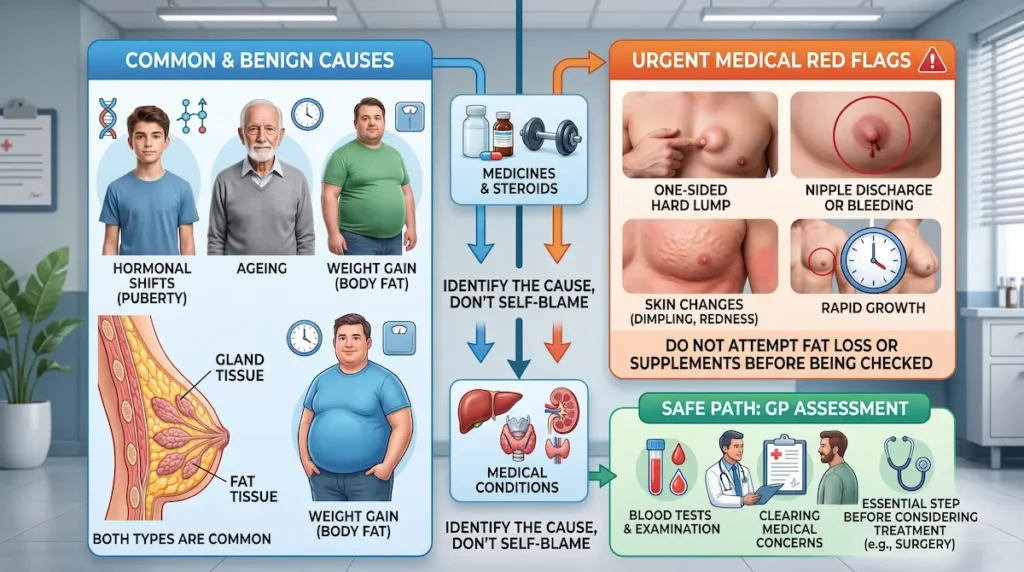
Gynaecomastia often appears during hormone shifts. Puberty is a common time. Many teenagers notice breast tissue enlargement on one or both sides, and in many cases it settles over time. Men over 50 may also notice changes as hormone balance, body fat and medicine use change with age.
Other causes include being overweight, anabolic steroid use, some prescribed medicines, and medical conditions affecting the thyroid, liver or kidneys. The NHS lists hormone changes, being overweight, certain medicines, some medical conditions and anabolic steroid use among recognised causes in its gynaecomastia symptoms and causes guidance.
This is the point where self-blame becomes unhelpful. Some men do have a fat-dominant chest related to weight gain. Others have glandular tissue that would not disappear even with disciplined training. The task is to identify the cause accurately, not to moralise it.
One-sided hard lump, nipple discharge or rapid growth
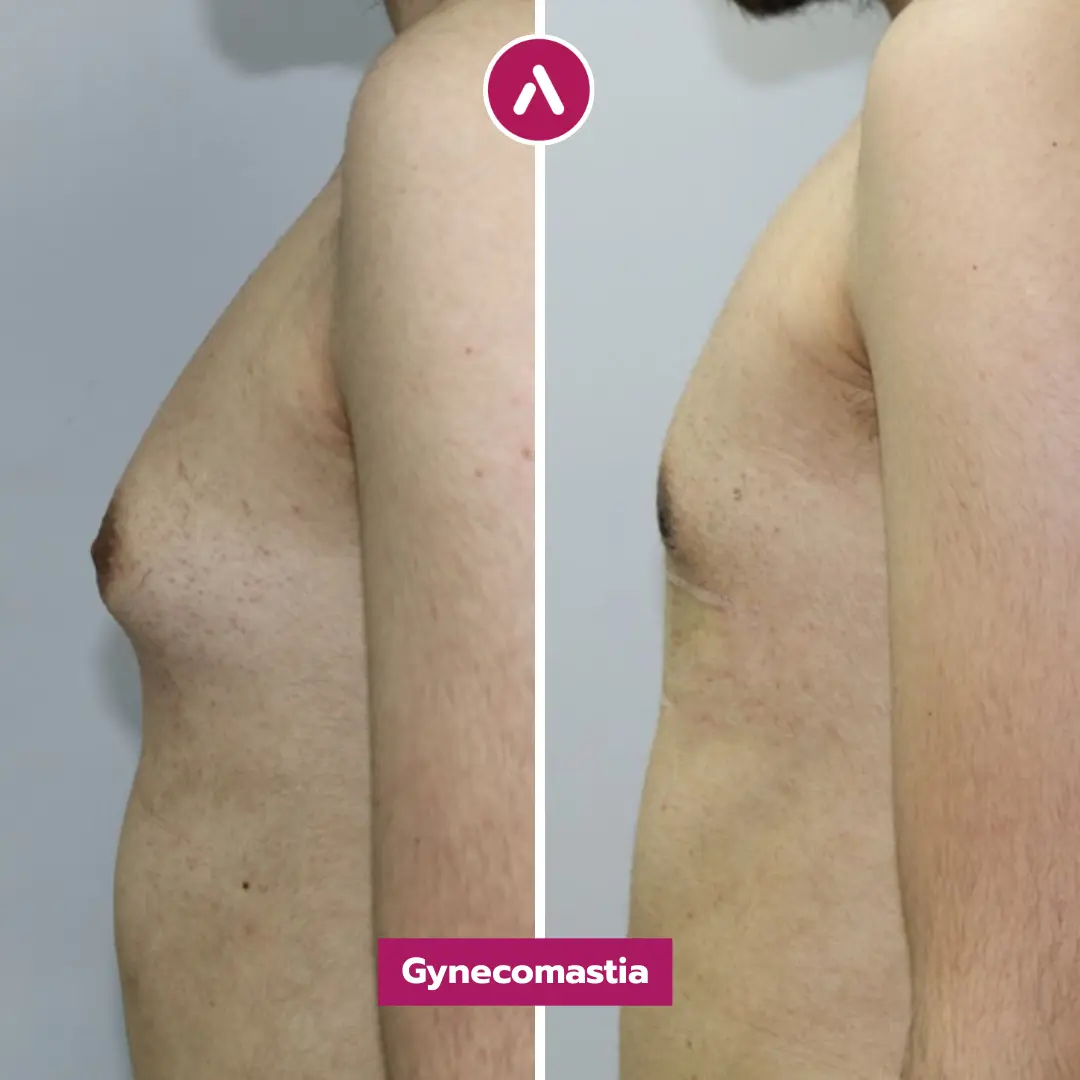
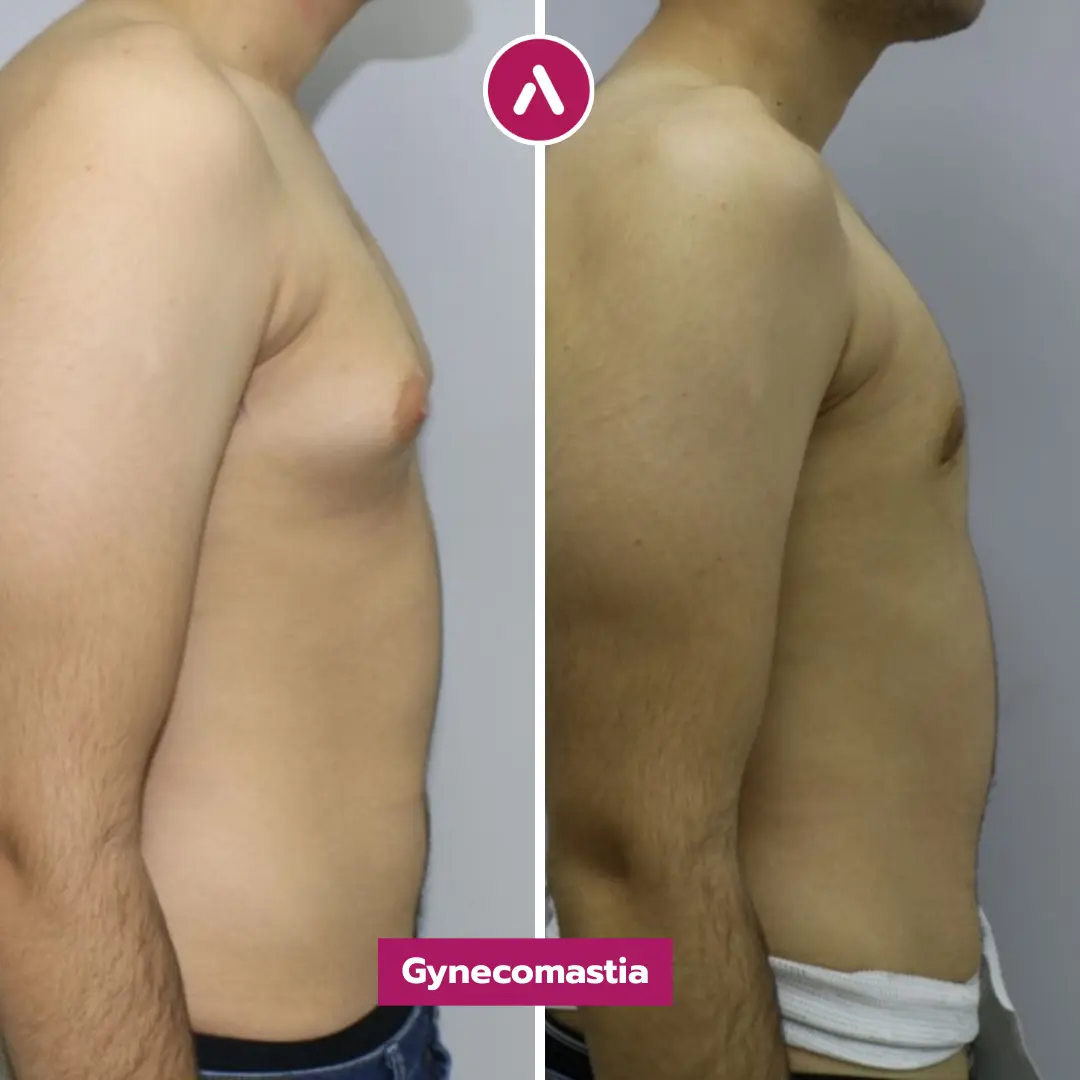
Some signs should move the discussion away from cosmetic treatment and towards medical review. See a GP if you have persistent pain in the breast or nipple, a lump in the breast or nipple, skin changes such as dimpling or redness, discharge, bleeding, or a fast change on one side.
These symptoms do not automatically mean something serious. They do mean you should not try to solve the problem with fat loss, supplements, compression tops or surgery research before being checked. A safe route starts with assessment.
When a GP or endocrine assessment matters
A GP may ask about timing, weight change, medicines, supplements, steroid use, alcohol, recreational drugs and other symptoms. Depending on the picture, blood tests or further assessment may be suggested. This is especially relevant when gynaecomastia appears suddenly in adulthood, is painful, is one-sided, or is linked with other symptoms.
For UK patients considering surgery abroad, this step is still relevant. A surgeon can assess tissue type and chest shape, but medical red flags should be cleared first. If the problem is mainly gland and has been stable for a long time, the conversation can then move towards treatment options, scars, grades and cost in the correct specialist setting.
Everything You Need to Know About Gynaecomastia
From surgical stages to aftercare, discover how AKM Clinic delivers world-class Gynaecomastia in Istanbul.
Why the Difference Changes Your Treatment
This section connects the tissue difference to treatment planning. A fat-dominant chest, a gland-dominant chest and a mixed chest may all look similar in clothing, but they are not managed in the same way. The wrong assumption can lead to a disappointing result.
Fat-dominant cases and liposuction
If the chest fullness is mainly soft fat, the first question is whether overall fat loss can improve it. Many men notice the chest changing when their weight changes, especially if the fat sits across the lower chest, side chest and upper abdomen.
If a man is already at a stable, healthy weight but still has localised fat on the chest, liposuction may be discussed. Liposuction removes fat through small cannula entry points, but it does not remove dense glandular tissue in the same way. That is the key limitation.
In general, glandular tissue is firm and dense, while fatty tissue is soft. Diffuse fatty enlargement is usually treated with liposuction, while excess glandular tissue may need excision.
The same principle applies in other stubborn fat zones. The article on how liposuction treats stubborn fat zones explains why fat removal works best when the problem is truly localised fat rather than loose skin or gland.
Glandular tissue and excision
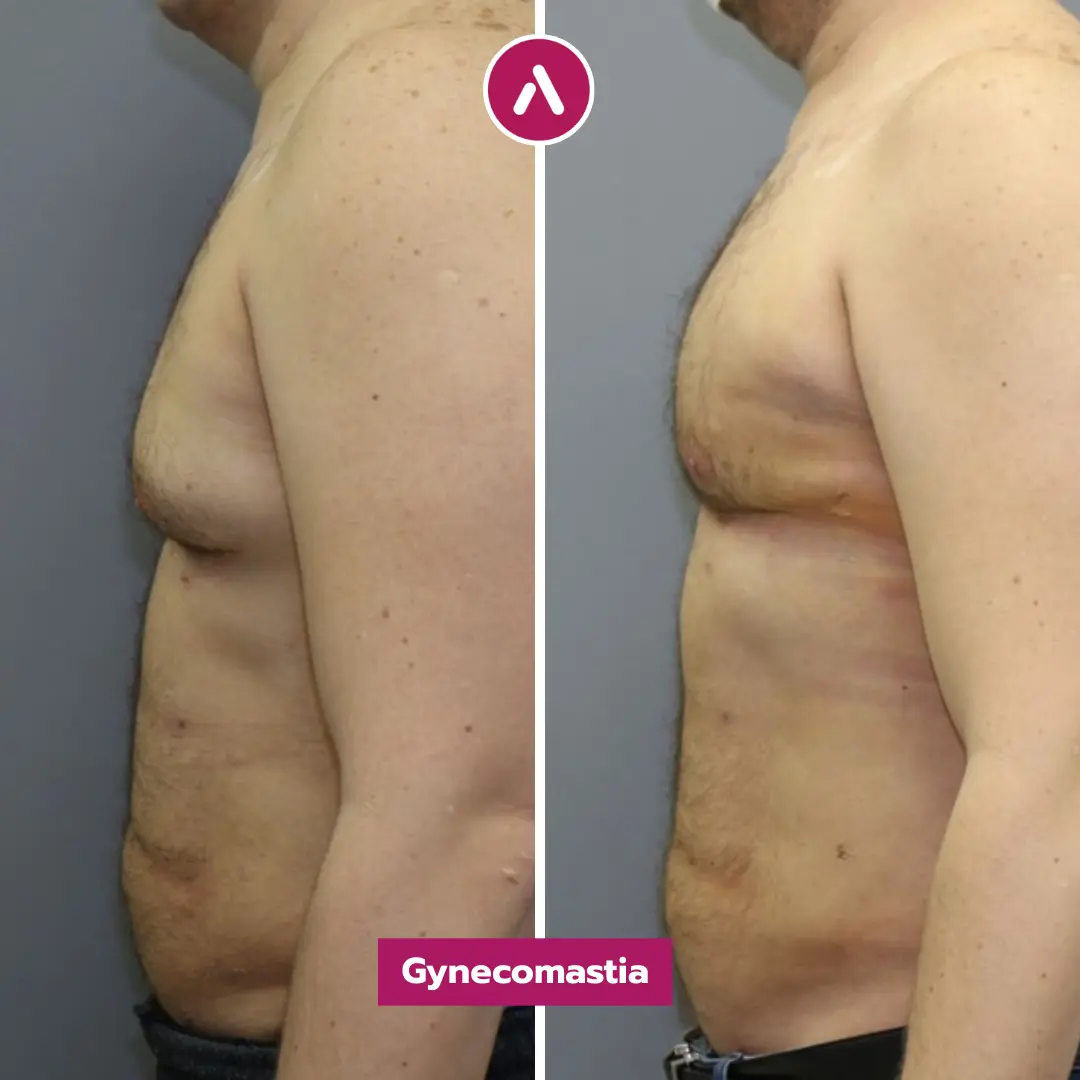
If the main problem is a firm gland under the nipple, liposuction alone may leave the most visible part behind. This is why many gland-dominant cases need excision: careful removal of the dense tissue through an incision placed near the areola.
That does not mean every case needs the same operation. Small, central glandular tissue is different from a wider chest with fat, gland and loose skin. The surgeon’s job is to decide how much of the shape comes from each layer before recommending a plan.
ASPS makes the same treatment distinction in its procedure guidance: liposuction may be used when excess fatty tissue is the main issue, while excision is recommended when glandular breast tissue or excess skin must be removed. See the ASPS overview of gynaecomastia surgery procedure steps for that surgical distinction.
Scar concerns are natural here. If gland removal is likely, read how scars are planned on our gynaecomastia surgery page before you compare techniques. A realistic scar conversation is part of safe planning, not an afterthought.
Mixed cases and realistic outcomes
Mixed gynaecomastia is common: soft fat around the chest plus a firmer gland directly behind the nipple. In these cases, a combined plan may be needed. Liposuction shapes the fatty layer, while excision addresses the gland that keeps the areola pushed forward.
Severity also matters. Mild puffy nipples are not the same as a larger, drooping chest with skin excess. For that reason, the grades of gynaecomastia can help you understand why two men with “the same problem” may receive different recommendations.
Good planning is conservative. It should aim for a flatter, more masculine chest contour without over-resection, dents, tethering or an operated look. Results vary, and skin quality plays a major role in how the chest settles after treatment.
UK safety note: The NHS advises seeing a GP for breast or nipple pain that is not going away, a lump, skin changes, discharge or bleeding. Cosmetic planning should wait until those signs have been checked.
What to Do Next
This section turns the information into a practical next step. If you are asking “is it gyno or fat?”, the safest answer is to gather evidence: how it feels, how it behaves with weight change, whether there are red flags, and what a qualified clinician sees on assessment.
Start with an honest self-check
Use a mirror, your weight history and touch, but keep the limits clear. A chest fat or gyno test at home can suggest a direction; it cannot replace an examination. Do not press aggressively, repeatedly check the same area, or let the test become a daily source of anxiety.
Write down three things before seeking advice:
- whether the tissue feels firm and central or soft and diffuse;
- whether the chest changes when your weight changes;
- whether there is pain, discharge, rapid growth, skin change or a one-sided lump.
If any red-flag sign is present, speak with a GP first. If the issue is stable, long-standing and mainly aesthetic, a surgical assessment can then focus on tissue type, skin quality and realistic outcomes.
Use photographs, examination and imaging when needed
For international patients, a photo-based pre-assessment can be useful, but it has limits. Photographs show contour, nipple position, asymmetry and skin laxity. They do not reliably show whether the tissue is gland, fat or both.
A proper examination is still the strongest step. In some cases, ultrasound or medical tests may be advised, especially where symptoms are new, painful, one-sided or linked with hormonal concerns. That is not a delay tactic. It protects you from treating a medical question as if it were only an aesthetic one.
At AKM Clinic, the chest is assessed by a board-certified plastic surgery team. For UK patients, the relevant comparison point is a surgeon-led pathway with clear credentials, theatre safety, aftercare planning and documentation you can take home.
Questions to ask before choosing treatment
Before deciding on surgery, ask direct questions. You should understand the tissue diagnosis, the technique, the scar position, the likely recovery, and what happens if your case is mixed rather than purely fatty or glandular.
- Do I appear to have fat, gland, loose skin, or a combination?
- Would liposuction alone treat the nipple-area fullness?
- Would gland excision be needed to flatten the areola?
- Where would the incision sit, and how visible is the scar likely to be?
- What happens if I lose more weight before or after treatment?
- What aftercare is arranged once I return to the UK?
The NHS notes that male breast reduction is not usually available on the NHS and is not suitable for men who have large breasts simply from being overweight. This is one reason tissue assessment matters before you compare private options. For NHS context, see its page on male breast reduction surgery.
Cost is part of planning, but this article is not a pricing guide. For that separate topic, use the dedicated page on gynaecomastia surgery pricing in the UK context. Here, the decision starts with anatomy.
AKM Clinic is based in Istanbul and works through a surgeon-led assessment model. Its patient reviews are publicly visible on Trustpilot. The consultation should still be personal: your tissue pattern, not a generic label, should guide the plan.
Frequently Asked Questions: Gynaecomastia vs Chest Fat
This section answers the practical questions men often ask before they book a consultation. The answers stay focused on the difference between gland and fat, rather than turning into a full surgery, recovery or pricing guide.
How do I know if I have gynaecomastia or just chest fat?
Can chest fat look like gynaecomastia?
Does gynaecomastia go away with weight loss?
Is it gyno or fat if it is soft?
What does pseudogynaecomastia mean?
Can liposuction treat gynaecomastia?
Are puffy nipples always gynaecomastia?
When should I see a doctor about male breast tissue?
Is “man boobs or fat” the same question as gynaecomastia?
What should I ask AKM in a consultation?
Next step: Ask AKM whether your chest is fat, gland, or both — and what that means for treatment. A virtual consultation can help you understand whether weight loss, liposuction, gland removal or a combined approach is the right discussion to have.
Have Specific Questions About Gynaecomastia?
Speak directly with our dedicated patient coordinators regarding Gynaecomastia. Receive instant guidance and personalised support.
Medical disclaimer: This article is educational and cannot diagnose gynaecomastia, breast disease or a hormonal condition. If you have pain, a hard one-sided lump, nipple discharge, bleeding, skin changes or rapid growth, speak with a GP or qualified medical professional before considering cosmetic treatment.
Related Treatments

Awake Gynaecomastia Surgery in Turkey
UK-focused guide to awake gynaecomastia surgery in Istanbul: local anaesthesia safety, excision vs liposuction, recovery, and £(GBP) cost context.

Awake Abdominal Etching in Turkey
UK guide to awake abdominal etching in Istanbul: HD sculpting, tumescent local anaesthesia, twilight sedation, recovery phases, HBOT/LLLT and GBP costs.

Awake Tummy Tuck in Turkey
UK guide to Awake Tummy Tuck under twilight sedation at AKM Clinic, Istanbul—techniques, combinations, recovery timeline, risks, aftercare and GBP planning.

Sapphire Hair Transplant in Turkey
Learn how Sapphire Hair Transplant uses sapphire blades for precise channels, natural hairlines, and a clear recovery timeline—plus cost/value in Turkey.
Ready to Begin Your Own Transformation Journey?
Join the 2,000+ patients who have trusted Dr Akif Mehmetoğlu and the AKM Clinic team. Your journey to a more confident, naturally restored you begins with a simple, no-obligation conversation. Contact us today from the UK for your free virtual consultation.
#1: Get Your Free Personalised Quote
Start with a free, no-obligation online consultation. Share your photos, and our surgical team will provide a fully personalised treatment plan and a transparent, all-inclusive price package. There are no hidden fees.
#2: Secure Your Date & VIP Booking
Once you are ready, our dedicated patient coordinators will help you secure your procedure date. We will handle all your bookings, including your 5-star hotel accommodation and private VIP airport transfers.
#3: Arrive in Istanbul & Meet Your Surgeon
Arrive at Istanbul Airport (IST) and be greeted by your private driver. Settle into your hotel and prepare for your in-person consultation, where you will meet your specialist surgeon to finalise the details for your "natural, subtle, and restored" new look.