
Quick summary: Searching for English speaking plastic surgeons Turkey is not enough. Canadian patients should verify whether the surgeon can explain risks, technique, recovery, and consent directly in English—not only through a coordinator or translator.
Clear surgeon-level communication protects your decision-making, your safety, and your expectations before travelling from Canada to Istanbul.
For Canadian patients, language is not a minor convenience. It is part of surgical safety. Aesthetic surgery requires nuanced discussion: what bothers you, what result would look natural, what risks apply to your anatomy, and what recovery will involve once you return to Toronto, Vancouver, Montreal, Calgary, or another Canadian city.
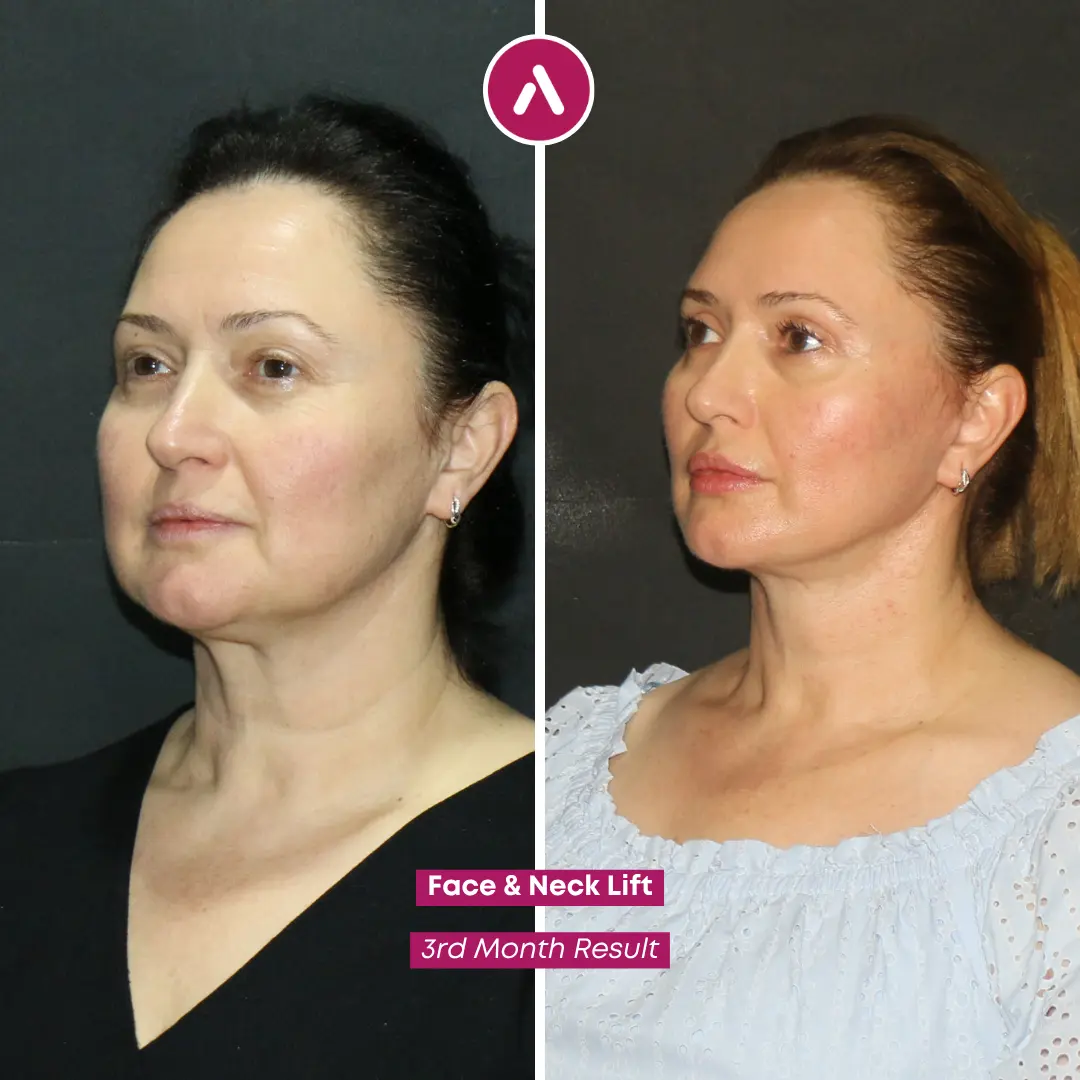
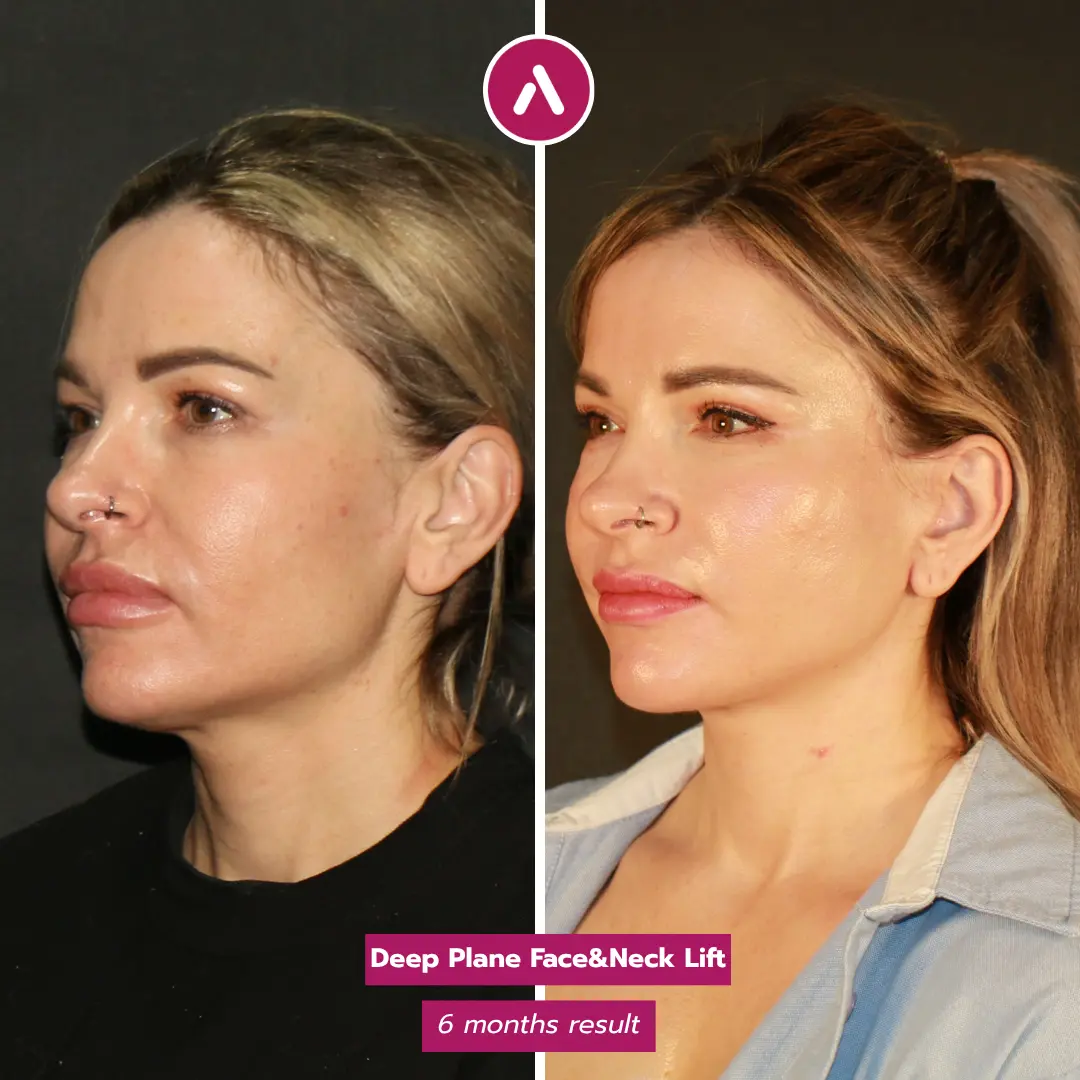
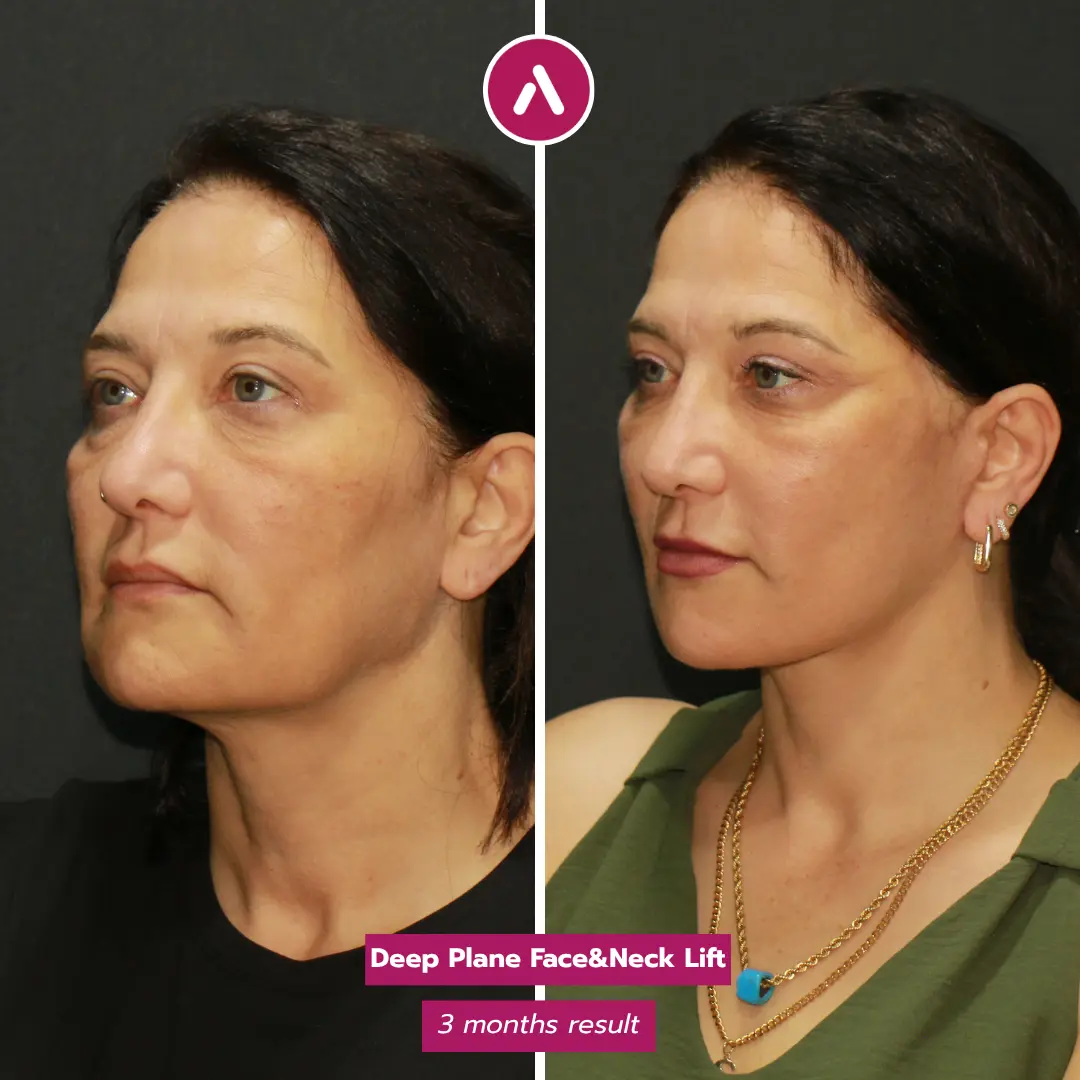
A clinic may advertise English-speaking service because its coordinators speak English. That is helpful, but it is not the same as direct communication with the surgeon. Before booking, you need to know who will answer your medical questions.
At AKM Clinic’s surgical team, the goal is not only technical planning. It is also clear, direct communication before the patient commits to treatment. That matters especially for international patients who cannot simply drive back to the clinic after returning home.
Table of Contents
Why Direct Surgeon Communication Matters?
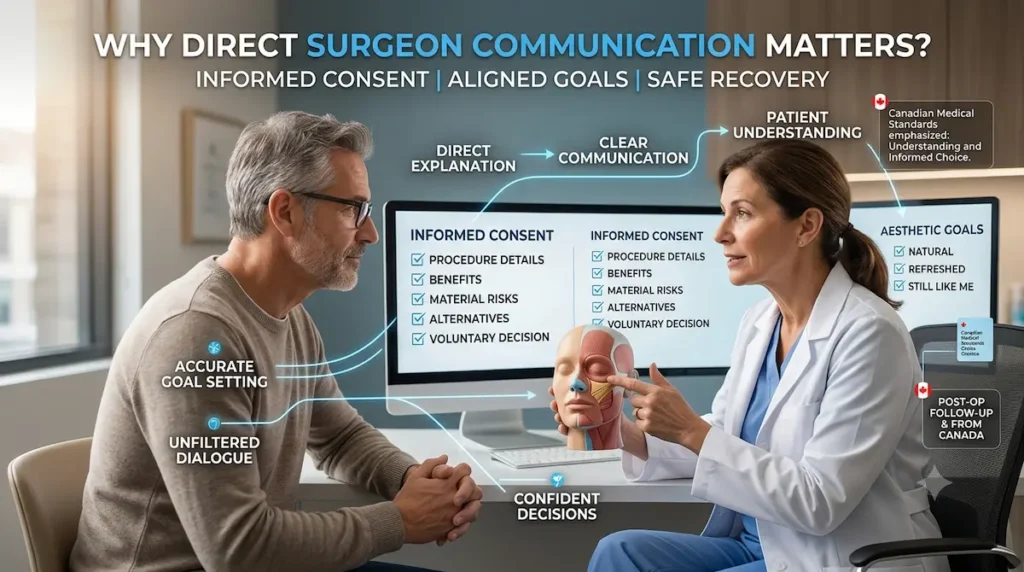
Direct communication with your surgeon helps you understand the procedure before you consent to it. It also helps the surgeon understand your goals without losing detail through translation. For a Canadian patient, this is especially important because informed consent standards in Canada place strong emphasis on clear explanation, patient understanding, and voluntary decision-making.
Informed Consent Depends on Understanding
Informed consent is more than signing a form. It means you understand the proposed procedure, expected benefits, material risks, alternatives, and what may happen if you choose not to proceed.
Canadian medical guidance emphasizes that valid consent requires the patient to be properly informed. The Royal College of Physicians and Surgeons of Canada highlights the importance of patient understanding, informed decision-making, and clear communication during the consent process.
If the surgeon cannot explain those points clearly in English, you may technically sign a consent form without truly understanding it. That is not acceptable for a major surgical decision.
Canadian patient note: If you would expect a surgeon in Ontario, British Columbia, Quebec, or Alberta to explain risks directly, apply the same standard when evaluating a surgeon in Turkey.
Explaining Nuanced Aesthetic Goals
Aesthetic goals are difficult to translate perfectly. “Natural,” “refreshed,” “not pulled,” and “still like me” mean different things to different people. The surgeon needs to hear your wording directly.
This is especially important for facial procedures. A facelift, rhinoplasty, eyelid surgery, or brow lift can change how you are perceived. Small misunderstandings can create large differences in outcome.
Direct English communication allows you to describe what you want—and what you do not want. It also lets the surgeon push back if your goal is unrealistic or unsafe.
Communication During Recovery and Follow-Up
Good communication does not end after surgery. You may have swelling, bruising, tightness, numbness, or emotional ups and downs during recovery. You need to know what is normal and what requires attention.
For Canadian patients, follow-up continues after the flight home. That means your post-operative instructions must be clear enough to follow from Canada.
Written instructions help, but they do not replace the ability to ask questions. If a concern appears at home, direct and accurate communication matters again.
“A patient should never feel that their medical questions are being filtered through a sales conversation. Surgeon-level communication is part of patient safety.”
The Difference Between an English-Speaking Coordinator and an English-Speaking Surgeon
Coordinators play an important role in international surgery. They help with scheduling, hotels, transfers, documents, and practical support. The problem begins when the coordinator becomes the only English-speaking person the patient ever meets.
Why Many Clinics Route Communication Through Sales Teams
Some clinics use English-speaking sales or coordination teams because they are easier to scale than surgeon-led consultations. The patient receives fast replies, polished messages, and reassuring answers.
That may feel efficient. It can also hide an important gap. The person answering may not be the person performing the surgery.
Before booking, ask who is giving medical advice. A coordinator can explain logistics. A surgeon should explain surgical judgement.
The Risks of Communication Through Multiple Layers
Every extra layer creates room for misunderstanding. Your concern goes to the coordinator, then to the surgeon, then back through the coordinator. Meaning can shift at each step.
This matters most when discussing risk, limitations, and recovery. Aesthetic surgery is not a script. Your anatomy, health history, medications, and expectations all affect the plan.
For the broader safety context, see the broader safety evaluation process.
When Translators Are Helpful—and When They Are Not Enough
Translators can be useful during hospital logistics, nursing interactions, and administrative steps. They can reduce stress during a busy appointment.
They are not a substitute for surgeon fluency during informed consent. You should still be able to ask the surgeon direct questions and understand the answer.
Organizations such as the International Society of Aesthetic Plastic Surgery (ISAPS) emphasize transparency, patient communication, ethical practice, and informed consent as core elements of patient safety. Language clarity supports all three.
How Canadian Patients Can Verify Fluency Before Booking?
Fluency should be tested before you send a deposit or book flights. A clinic that is confident in its surgeon communication should have no problem arranging a direct video conversation. This is where you move beyond marketing claims and verify how communication actually works.
Request a Direct Video Consultation With the Surgeon
Ask for a video consultation where the surgeon personally explains your case. This should not be limited to a coordinator summarizing the plan.
During the call, pay attention to whether the surgeon can answer without relying on someone else for every medical point. A translator may still be present, but the surgeon should be able to engage with you directly.
For the full remote assessment process, see our guide to how virtual consultations work.
Ask Open-Ended Medical Questions
Yes-or-no questions are too easy to answer. Use open-ended questions that require explanation.
- Why do you recommend this technique for my anatomy?
- What result would be unrealistic in my case?
- What complications should I understand before deciding?
- How will recovery affect my return flight to Canada?
- What should I do if I notice swelling or asymmetry at home?
These questions reveal whether the surgeon can explain clinical judgement in plain English. They also show whether the clinic welcomes informed patients.
For a broader question list, review our essential consultation questions.
Watch for Red Flags During the Conversation
Some warning signs appear quickly. The clinic may avoid scheduling a surgeon call, answer only through voice notes from a coordinator, or provide vague responses to specific medical questions.
Another red flag is excessive reassurance. A good surgeon can explain benefits and limitations in the same conversation.
Language confidence should not feel scripted. You are looking for a surgeon who can discuss your case, not repeat marketing phrases.
| Communication checkpoint | What to verify | Good sign | Warning sign |
|---|---|---|---|
| Virtual consultation | Surgeon-level English fluency | The surgeon answers open-ended questions directly | Only the coordinator speaks |
| Pre-operative planning | Ability to explain technique and alternatives | You receive a clear rationale for the plan | Answers stay generic or scripted |
| Surgery day | Final consent and plan confirmation | The surgeon confirms the plan in language you understand | You feel rushed or unclear before signing |
| Recovery in Istanbul | Clarity of post-op instructions | You know what is normal and what is urgent | Instructions are vague or inconsistent |
| Follow-up from Canada | Ongoing access to medical guidance | You can send photos and receive structured guidance | Communication slows after payment or departure |
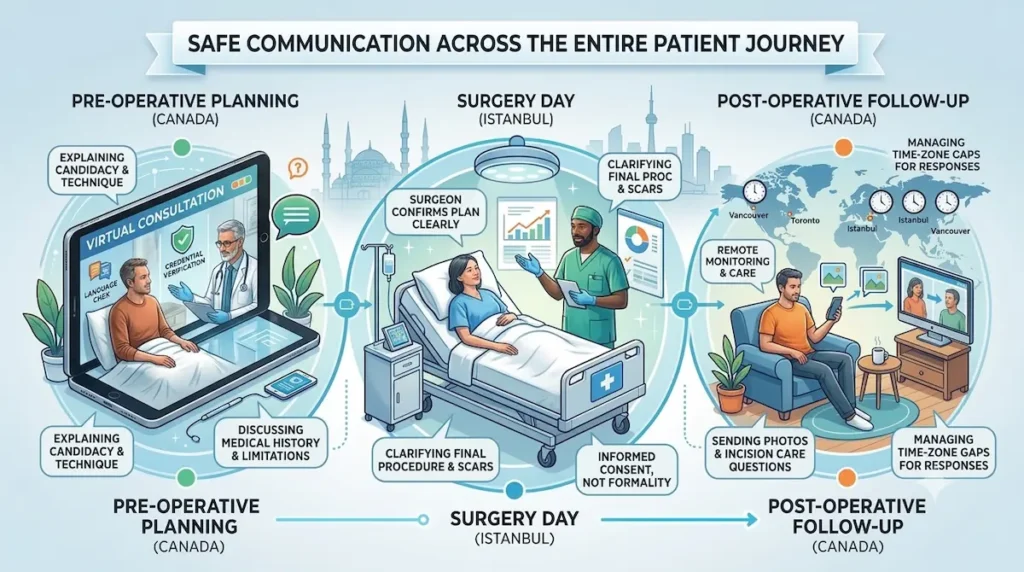
Communication Across the Entire Patient Journey
English fluency matters at every stage, not only during the first consultation. The questions change as you move from planning to surgery, then from recovery in Istanbul to follow-up in Canada. A safe communication model should support the full timeline.
Pre-Operative Planning
Before travelling, your surgeon should be able to explain your candidacy, recommended technique, expected recovery, and limitations. This is also the right time to discuss your medical history.
Do not separate language verification from credential verification. A fluent but underqualified surgeon is not enough. A qualified surgeon who cannot communicate directly also creates risk.
Use language checks alongside independently verifying surgeon credentials.
Communication on Surgery Day
Surgery day is not the time to discover communication gaps. You may be nervous, tired from travel, or processing final instructions.
The surgeon should confirm the plan clearly before the procedure. This includes the surgical area, technique, expected scars, recovery limits, and any last-minute changes based on the in-person examination.
If something changes from the virtual plan, you should understand why. Consent should never feel like a formality.
Post-Operative Follow-Up From Canada
Most Canadian patients return home while swelling is still evolving. That means remote communication is part of the care plan.
You may need to send photos, clarify incision care, ask about discomfort, or confirm when to resume work and exercise. The clinic should explain how these questions are handled once you are back in Canada.
Canadian patient note: Istanbul is ahead of Toronto, Vancouver, Montreal, Calgary, and Halifax. Ask how the clinic manages time-zone gaps for post-op questions after you return home.
For the full support sequence, review communication throughout the patient journey.
What Canadian Patients Should Specifically Test?
Verifying English fluency is not about judging accent or perfection. Many excellent surgeons speak English as an additional language. What matters is whether the surgeon can explain medical details clearly enough for you to make an informed decision.
Medical Terminology Fluency
Ask the surgeon to explain your procedure in simple language. Then ask one more technical follow-up question.
For example, if you are considering a facelift, ask how the deeper tissue layer is repositioned. If you are considering rhinoplasty, ask how function and appearance are balanced.
The answer should be understandable without sounding oversimplified. A surgeon who can translate technical knowledge into plain English is easier to trust.
Risk and Complication Discussions
This is one of the strongest fluency tests. Ask the surgeon what could go wrong and how those risks are managed.
A safe answer should include realistic risks, prevention steps, and what the clinic does if a concern appears. It should not sound dismissive.
For Canadian patients, this standard aligns with the expectation that risks are explained before consent. To understand credentials alongside communication, read our guide to understanding board certification.
Recovery Instructions and Expectations
Recovery instructions must be specific. Ask what you can do during the first week, when you can fly home, what symptoms are normal, and what symptoms require urgent attention.
This is particularly important if you are returning to Canada before the final result appears. Swelling, bruising, tightness, and asymmetry can all change over time.
If the surgeon cannot explain recovery clearly, you may feel abandoned after departure. That anxiety is preventable.
AKM Clinic’s English-Speaking Communication Model
AKM Clinic supports international patients through both surgeon-level medical communication and patient advocate guidance. The distinction matters. Surgeons answer surgical questions, while patient advocates help coordinate the practical steps around travel, hotel, transfers, documents, and follow-up.
Direct Surgeon Access
AKM Clinic’s model is built around a surgeon-led consultation process. This structure allows Canadian patients to discuss anatomy, technique, limitations, and expected outcomes with the medical team before making a decision. It also supports AKM’s Natural-First philosophy: rejuvenation over alteration.
That philosophy requires careful communication. A natural result depends on shared understanding, not a generic template.
Support From Patient Advocates
Patient advocates are still important. At AKM Clinic, Hande, Emine, and Khadija help international patients understand the logistics around booking, travel, hotel coordination, and follow-up.
This support can reduce stress for Canadians travelling long-haul from YYZ, YVR, YUL, YYC, or smaller Canadian airports. It also helps patients feel supported between medical appointments.
The key point is role clarity. Advocates support the journey. Surgeons guide medical decisions.
Communication Continuity Before and After Returning to Canada
AKM Clinic’s follow-up structure includes long-term virtual check-ins at 1, 3, 6, and 12 months. This is useful for Canadian patients who need structured guidance after returning home.
Patients can continue sharing progress photos and asking recovery questions remotely. This does not replace urgent local medical care when needed, but it helps bridge the distance between Istanbul and Canada.
For a broader decision framework, compare language fluency with evaluating clinics beyond marketing claims.
Canadian patient note: Before booking, confirm who answers medical questions after you return to Canada. The answer should name the clinical team, not only a general support inbox.
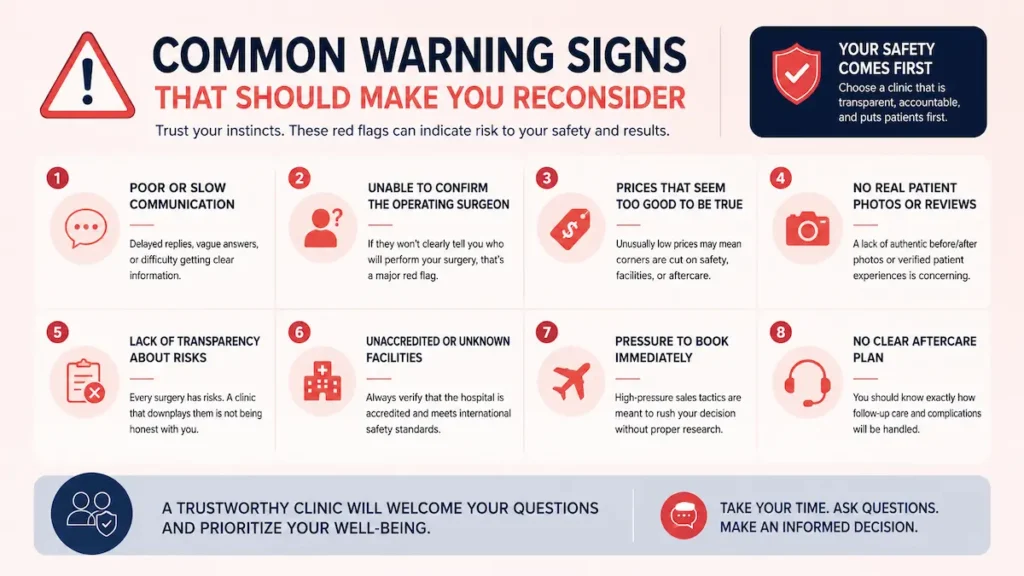
Common Warning Signs That Should Make You Reconsider
Clear communication should remain consistent from the first inquiry to the final follow-up. If a clinic becomes vague, avoids direct surgeon access, or changes its tone after payment, pause before committing. Language red flags often point to broader transparency problems.
Refusal to Arrange Direct Surgeon Calls
A clinic may say the surgeon is too busy for video consultations. That is a concern.
For an international patient, a direct conversation is part of due diligence. You should be able to hear the surgeon explain the plan before travelling to another country for surgery.
Generic or Scripted Answers
Scripted answers often sound polished but do not address your anatomy. Watch for replies that repeat the same phrases without answering your specific concern.
Good communication feels specific. The surgeon should discuss your photos, medical history, goals, limitations, and recovery plan.
Communication Changes After Deposit Payment
Pay attention to what happens after you commit. Some clinics communicate quickly before payment, then slow down or become less specific afterward.
This is not just frustrating. It may signal how post-op communication will feel once you are back in Canada.
For related safety concerns, read our guide to the broader safety evaluation process.
Frequently Asked Questions: English Speaking Plastic Surgeons Turkey
These questions help Canadian patients separate genuine surgeon-level communication from general English-speaking clinic support. Use them before booking, not after arrival.
Do Turkish plastic surgeons generally speak English?
Many Turkish plastic surgeons speak English, especially those who treat international patients. The important question is not whether the clinic has English-speaking staff. It is whether the surgeon can communicate directly with you in English.
How can I verify a surgeon's English fluency?
Request a direct video consultation. Ask open-ended questions about technique, risk, recovery, and alternatives. If the surgeon answers clearly without relying entirely on a coordinator, that is a positive sign.
Is a translator enough for informed consent?
A translator can help, but should not replace direct surgeon communication. For informed consent, you need to understand the procedure, risks, alternatives, and recovery expectations clearly.
Should I insist on a video consultation?
Yes. For Canadian patients travelling internationally, a video consultation is one of the most practical ways to verify communication, clinical fit, and trust before booking flights.
What if I have questions after returning to Canada?
Ask before booking how follow-up works from Canada. You should know who reviews your photos, how quickly the clinic responds, and what symptoms require local medical care.
How does AKM Clinic handle English-speaking patients?
AKM Clinic uses a model that combines surgeon-led medical communication with patient advocate support from Hande, Emine, and Khadija. This separates surgical decision-making from travel coordination.
Can language barriers affect surgical outcomes?
They can. Poor communication may affect expectation setting, consent, recovery instructions, and complication reporting. Even if the surgery is technically well performed, unclear communication can damage the patient experience.
What are the biggest communication red flags?
Major red flags include refusal to arrange surgeon contact, vague answers, over-reassurance, inconsistent instructions, and communication that becomes weaker after payment.
How important is English fluency compared with credentials?
Both matter. Credentials show training and qualification. English fluency helps you understand the plan, risks, and recovery. A safe choice requires both verification steps.
Next step: Request a direct video consultation with the surgeon before booking. Use the conversation to verify English fluency, clinical judgement, and whether the communication style gives you confidence.
Medical Disclaimer: This page is provided for general educational purposes only and does not replace an in-person medical consultation, diagnosis, or personalized treatment plan. All surgery carries risks, and outcomes vary between individuals. Suitability for a plastic surgery, procedure selection, and anesthesia choice can only be determined after a full clinical assessment by a qualified surgeon. Always follow your clinician’s instructions and seek urgent medical attention if you develop concerning symptoms during recovery.