
If you are researching how to verify surgeon credentials Turkey before travelling from Canada, the safest approach is simple: do not rely on a clinic’s website alone. Use the clinic’s claims as a starting point, then confirm the surgeon’s licence, specialty training, society memberships, hospital affiliation, and reputation through independent sources.
Canadian patients are used to provincial medical colleges, specialist directories, and a public healthcare culture where credentials can be checked. International cosmetic surgery requires the same habit. Before booking, review AKM Clinic’s surgeon credentials, then use the verification steps below to confirm that the information is traceable, current, and consistent.
Quick Summary: You do not have to take surgeon credential claims on faith. A Canadian patient can verify a Turkish surgeon by checking board certification, professional society memberships, hospital affiliation, publications, and independent reviews before paying a deposit.
The practical goal is not to become a medical regulator. It is to confirm that the surgeon is real, qualified, appropriately specialized, and actually connected to the facility where your procedure will take place.
Table of Contents
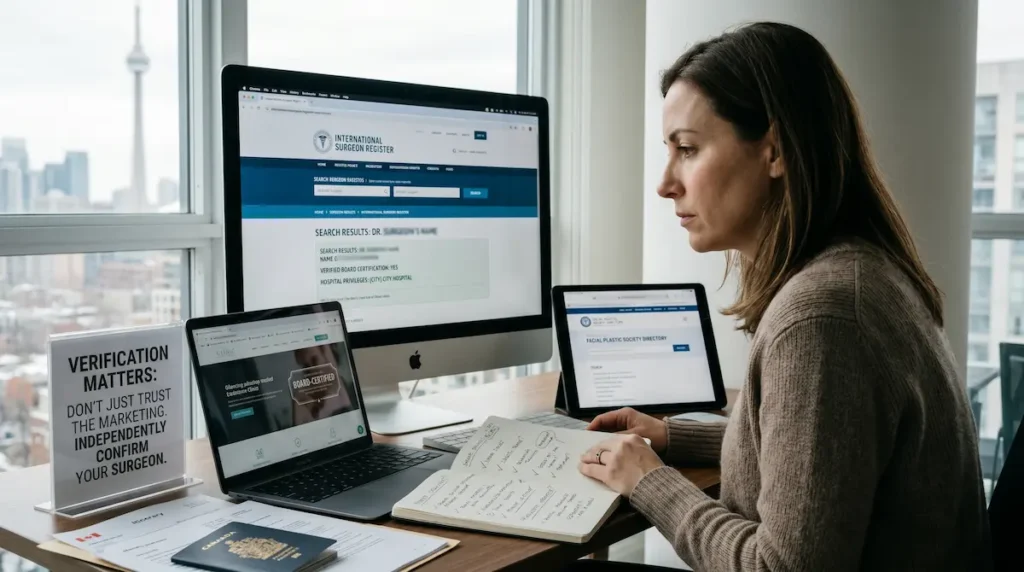
Why Independent Verification Matters?
Independent verification is the difference between trusting a marketing page and making a documented medical decision. For a Canadian patient travelling from Toronto, Vancouver, Montreal, Calgary, or Ottawa, that distinction matters. You are crossing borders for elective surgery, so your due diligence should be more careful, not less.
A good clinic should welcome this process. Transparent providers understand that sceptical patients are safer patients. If a clinic reacts defensively when you ask for verifiable credentials, that response tells you something.
Why clinic claims need third-party confirmation
A clinic website can summarize credentials, but it should not be the only source. Claims such as “board-certified,” “internationally trained,” or “specialist surgeon” need context. Which board? Which training? Which specialty?
Your first task is to collect the surgeon’s full legal name, specialty title, and the exact credential being claimed. Turkish names may use characters such as “ğ,” “ş,” or “ö,” so ask the coordinator for the correct spelling and any common English transliteration. A registry search can fail simply because a name was entered incorrectly.
What credential fraud looks like
Credential fraud is rarely obvious at first glance. It often appears as vague language, unverifiable badges, expired memberships, or impressive-sounding certificates that are not recognized specialty qualifications.
Watch for phrases that avoid specifics. “European-trained” is not the same as European board certification. “International member” is not the same as an active surgical society member. “Our team performs the surgery” is not the same as naming the operating surgeon.
The 20-minute verification principle
Most serious red flags can be detected quickly. In 20 minutes, you can search the surgeon’s name, compare the clinic biography with society directories, review hospital claims, and check whether independent reviews mention the same doctor.
That short check will not replace a consultation. It will, however, help you decide whether the consultation is worth your time. For a more complete decision framework beyond surgeon credentials, see our guide to the broader clinic evaluation framework.
Canadian patient note
In Canada, patients often rely on provincial Colleges of Physicians and Surgeons to confirm a doctor’s licence. Turkey uses a different medical system, so the verification path is different. The mindset should remain familiar: confirm identity, specialty, facility, and complaint-free reputation before proceeding.
If you are evaluating a facial procedure such as deep plane facelift, credential verification should also be procedure-specific. A general plastic surgery credential is useful, but complex facial surgery requires deeper review. For that angle, use our procedure-specific surgeon evaluation guide.
Step 1 — Verify Board Certification
Board certification is the first serious filter. It tells you whether the surgeon completed recognized specialty training and passed a formal assessment process. It does not guarantee a perfect result, but without it, the risk conversation changes immediately.
Canadian patients should understand one key point. A Turkish surgeon will not normally appear in Canadian provincial college directories unless they also practise in Canada. You are not trying to prove Canadian licensing. You are trying to compare the foreign credential against a familiar Canadian standard.
Checking Turkish medical registration
Start by asking the clinic for the surgeon’s full legal name, medical licence documentation, and specialty title in Turkish and English. For plastic surgery, look for a specialty designation related to plastic, reconstructive, and aesthetic surgery. For facial plastic surgery, ENT and facial plastic training may also be relevant, depending on the procedure.
Then cross-check the name through Turkish professional resources, including the Turkish plastic surgery society directory where applicable. If the directory is not easy to use in English, ask the clinic coordinator to show you where the surgeon appears. A transparent clinic should be able to point you to the correct listing or explain the documentation clearly.
EBOPRAS registry verification
EBOPRAS refers to the European Board of Plastic Reconstructive and Aesthetic Surgery. If a surgeon claims EBOPRAS status, ask for the exact certificate or fellowship details and confirm whether the name appears on the relevant EBOPRAS fellow search pathway.
Treat EBOPRAS as a serious European credential, not as a Canadian licence. It is useful because it shows examination-based specialty recognition within a European framework. It should still be checked alongside the surgeon’s actual operating experience.
Cross-referencing with the Royal College framework
The Royal College of Physicians and Surgeons of Canada provides a useful reference point for Canadian readers because its public directory shows how specialist certification is treated in Canada. A Turkish surgeon will usually not be listed there, but the Royal College model helps you ask better questions.
Ask: What is the surgeon’s specialty? Which board examined them? Which professional body can verify it? How long have they practised in that specialty? Those are the same categories Canadians expect at home.
For a deeper explanation of certification language, see our guide to understanding board certification standards.
Step 2 — Confirm Society Memberships
Professional society membership is not the same as board certification. It is still worth checking. Reputable societies often require documentation, peer review, or specialty eligibility before accepting members.
The value of society membership is pattern recognition. If the surgeon’s clinic biography, public directory listings, conference activity, and patient reviews all align, confidence increases. If every claim appears only on the clinic’s own website, confidence should decrease.
ISAPS member search
ISAPS, the International Society of Aesthetic Plastic Surgery, offers a public Find a Surgeon directory. Search by the surgeon’s full name and country. If you cannot find the name, ask the clinic whether the membership is active, expired, pending, or held under a different spelling.
An active ISAPS profile is a positive signal. It means the surgeon has passed a society-level membership process. It does not replace your review of training, hospital affiliation, procedure volume, or complication protocols.
EAFPS and specialty society databases
For facial surgery, EAFPS membership can be relevant because facial plastic surgery overlaps with ENT training, rhinoplasty, revision rhinoplasty, and facial rejuvenation. This is especially important when evaluating procedures such as preservation rhinoplasty or revision nasal surgery.
Society databases vary in how public they are. Some are searchable. Others require direct confirmation. The practical rule is simple: if a credential is being used to earn your trust, the clinic should help you verify it.
What membership does and does not guarantee
Membership tells you the surgeon has met a defined society threshold. It does not tell you whether the surgeon is the right match for your anatomy, goals, risk profile, or procedure.
Use memberships as one layer. Then look for procedure-specific proof: before-and-after documentation, long-term follow-up, patient reviews, complication management policies, and clear surgical planning.
Step 3 — Verify Hospital Affiliation
Surgeon credentials matter, but the operating environment matters too. A qualified surgeon working in a weak facility is still a risk. For international patients, hospital affiliation is one of the most important safety checks.
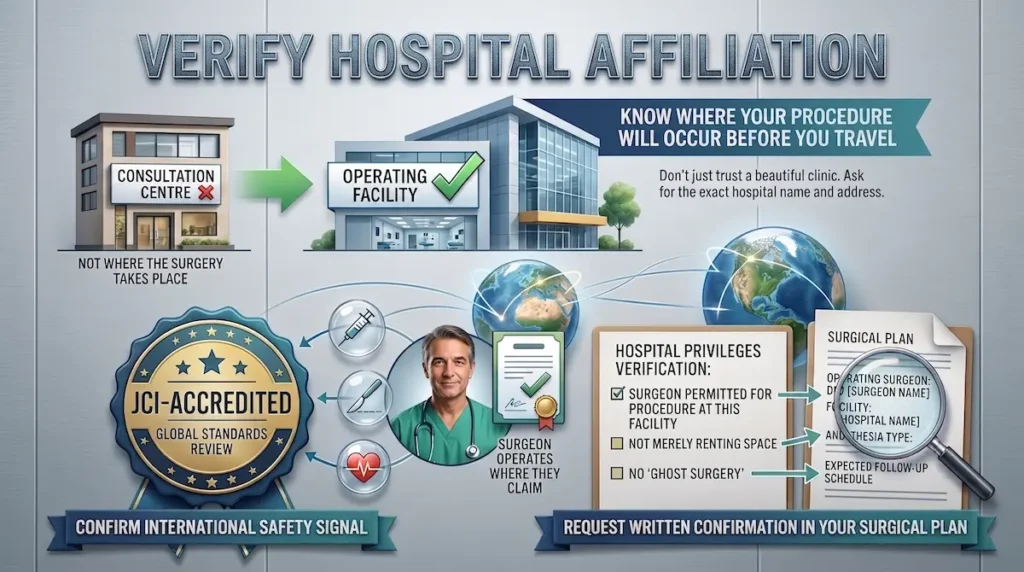
Ask where the surgery will be performed, not just where the consultation happens. Many clinics have a beautiful consultation centre, while the actual procedure takes place elsewhere. You need the name of the operating facility before you travel.
Confirming JCI-accredited facility affiliation
JCI accreditation is an international hospital safety signal. It does not mean the surgeon is automatically ideal, but it indicates that the facility has undergone a structured standards review.
Ask for the exact hospital name, address, and accreditation status. Then confirm whether your procedure will take place there. If the answer changes between consultation and booking, pause.
Checking the surgeon operates where they claim
A hospital affiliation claim should connect three things: the surgeon, the procedure, and the facility. The surgeon should be permitted to perform that procedure at that location.
This is where vague answers become risky. “We work with several hospitals” may be true, but it is not enough. You need to know which hospital is assigned to your case and who will be in the operating theatre.
Hospital privileges verification
Hospital privileges mean the facility allows the surgeon to operate there. Privileges are usually procedure-specific or specialty-specific. They help confirm that the surgeon is not merely renting space without appropriate oversight.
You can ask the clinic for written confirmation in your surgical plan. The document should identify the operating surgeon, facility, procedure, anesthesia type, and expected follow-up schedule.
This step also protects you from ghost surgery, where the person promoted during consultation is not the person performing the operation. For that specific risk, read our guide to verifying who actually performs your surgery.
| Verification Step | What to Check | Where to Check | Pass Signal | Fail Signal |
|---|---|---|---|---|
| Board certification | Specialty training, board status, licence documentation | Surgeon documents, Turkish professional directories, EBOPRAS where claimed | Name, specialty, and credential match across sources | Vague title, no documentation, or inconsistent specialty |
| Society membership | ISAPS, EAFPS, or relevant specialty memberships | Public member search or direct society confirmation | Active listing under the correct name | Expired, unverifiable, or unrelated membership |
| Hospital affiliation | Operating facility, accreditation, surgical privileges | Clinic documents, hospital information, accreditation listings | Facility and surgeon are named in your plan | Facility not disclosed before payment |
| Reputation trail | Reviews, publications, conference activity, before-and-after proof | Review platforms, PubMed, clinic galleries, consultation documents | Consistent identity and procedure-specific proof | Only social media claims, no traceable history |
Step 4 — Find Published Work and Reputation
Credentials confirm eligibility. Reputation helps you understand how that training shows up in practice. For Canadian patients, the best reputation check combines publications, conference activity, patient reviews, and communication quality.
Do not judge a surgeon by one glowing testimonial or one negative comment. Look for patterns. A credible surgeon usually leaves a consistent trail across professional work, patient outcomes, and clinic documentation.
PubMed and journal searches
Search the surgeon’s name in PubMed, Google Scholar, and the journal titles listed in their biography. Publications are not mandatory for every excellent surgeon, but they can support claims of academic involvement or specialty focus.
Be precise. Search both Turkish spelling and English transliteration. If the surgeon has a common name, add the specialty, city, or procedure name to narrow the results.
Conference presentations
Conference activity can support claims of professional engagement. If a surgeon says they speak internationally, ask which congresses, what topics, and whether the presentations relate to your procedure.
This matters most for complex surgery. Revision rhinoplasty, deep plane facelift, and combined facial rejuvenation require a level of judgment that should be visible in training, case volume, and professional activity.
Independent review cross-referencing
Reviews should be used carefully. Look for details, not adjectives. Strong reviews often mention the surgeon, coordinator, procedure, recovery period, and follow-up experience.
Compare independent reviews with the clinic’s own claims. If patients repeatedly mention the same surgeon, the same facility standards, and the same follow-up structure, that consistency helps. Review verified patient reviews and reputation as part of your due diligence.
Communication is also part of reputation. You should be able to ask detailed questions and receive clear answers in English. If language support is a concern, see our guide to verifying English-language communication.
“A well-informed patient is not a difficult patient. If someone is trusting us with surgery after travelling from Canada, they should feel comfortable asking for credentials, hospital details, and a clear explanation of who will perform the operation.”
Canadian patient note
Think like you would at home. If you were choosing a private specialist in Toronto or Vancouver, you would want a name, specialty, facility, and follow-up plan. The same standard should apply before travelling to Istanbul.
Red Flags During Verification
Red flags do not always mean a clinic is unsafe. Sometimes they mean the clinic has poor administration or weak English documentation. Either way, unresolved red flags should delay booking.
Your goal is not to find a perfect clinic with no administrative friction. Your goal is to avoid major uncertainty around surgeon identity, training, facility safety, and aftercare.
Unverifiable claims
Be cautious with credentials that sound impressive but cannot be checked. “World famous,” “celebrity surgeon,” or “international expert” are marketing phrases unless supported by directories, publications, society listings, or documented case experience.
A clinic should be able to explain the credential in plain language. If the coordinator cannot tell you what a board, society, or certificate actually means, ask for written documentation.
Mismatched names or facilities
A mismatch does not automatically prove wrongdoing. Turkish names may be transliterated differently, and some surgeons work across multiple hospitals. Still, every mismatch must be explained before you proceed.
Pay attention if the surgeon named in your consultation differs from the surgeon named in your consent form. The same applies if the operating hospital changes without a medical or scheduling explanation.
Refusal to provide credentials
Refusal is different from delay. A busy clinic may need time to collect documents. A clinic that refuses to identify the operating surgeon, facility, or medical qualifications is asking you to accept unnecessary risk.
This is the point where you should stop. No discount, hotel upgrade, or fast booking slot should outweigh basic credential transparency.
How AKM Supports Credential Verification?
AKM Clinic’s “Natural-First” approach is built around surgeon-led planning, verifiable credentials, and a structured patient journey. For Canadian patients, the most useful part of that model is documentation. You should know who your surgeon is, where your procedure is performed, and how follow-up works after you return home.
AKM’s surgical leadership includes Dr. Akif Mehmetoğlu, founder and dermatosurgeon. During consultation, patients can request documentation related to the surgeon’s background, hospital setting, care team, and long-term follow-up pathway.
Credential documents to request
Ask for the surgeon’s full name, specialty, relevant board or society memberships, and the operating facility assigned to your case. You can also ask which parts of the procedure are performed by the surgeon and which parts are supported by the clinical team.
For Canadian patients, this should be handled before flights are booked. Documentation should be reviewed while you still have time to compare options calmly.
How virtual consultation helps verification
A proper virtual consultation should do more than confirm your preferred procedure. It should help you understand why a technique is recommended, what the surgeon’s experience is, and how your risk profile will be handled.
Use the consultation to ask for the documents listed above. Then compare the answers against your independent checks.
What transparency should feel like
Transparency feels specific. You should receive names, dates, facility details, aftercare steps, and realistic limitations. You should not feel pressured to book before your verification questions are answered.
If you are satisfied with the credential check, the next step is a procedure-specific assessment. If you are still uncertain, pause and ask for clarification.
Request AKM’s full credential documentation in a consultation
Canadian patients can request surgeon credentials, hospital details, and follow-up information before confirming travel. A careful consultation should reduce uncertainty, not increase it.
Review AKM Clinic’s credentials and request a virtual consultation
Frequently Asked Questions: Verify Surgeon Credentials Turkey
These questions focus on credential verification only. For consultation questions, procedural risks, and aftercare details, use this guide alongside your surgeon consultation checklist.
How do I check if a surgeon is board certified?
Ask for the surgeon’s full legal name, specialty title, board certificate, and licence documentation. Then cross-check the name through relevant professional directories or society databases. If EBOPRAS or another board is claimed, ask for the exact credential and verify it through the appropriate board pathway.
Is ISAPS membership verifiable online?
Yes. ISAPS provides a public surgeon search tool. Search by name and country, then confirm that the listing matches the surgeon you are considering. If there is no listing, ask the clinic whether the membership is active, expired, pending, or held under a different spelling.
What if I cannot find the surgeon in any registry?
Do not assume the surgeon is unsafe immediately. Name spelling, specialty type, and directory limitations can cause false negatives. Ask the clinic to explain where the credential can be verified. If they cannot provide any route to verification, that is a serious concern.
How do I verify AKM’s surgeons specifically?
Start with the clinic’s surgeon biography, then request supporting documentation during your virtual consultation. Confirm the operating surgeon, facility, specialty training, and procedure experience. The information should be consistent across your consultation notes, consent documents, and clinic communications.
Does Turkish certification equal Canadian standards?
It is not a one-to-one match because the systems are different. Canadian certification is tied to Canadian licensing and specialist regulation. Turkish and European credentials should be evaluated on their own terms, then compared against the categories Canadians expect: specialty training, board assessment, hospital privileges, and continuing professional activity.
What is the biggest red flag?
The biggest red flag is refusal to identify who will perform your surgery. A clinic may have multiple surgeons, but your case should still name the operating surgeon before you commit. If that information is withheld until arrival, do not proceed.
Can the clinic provide verifiable documentation?
A transparent clinic should provide the surgeon’s name, specialty, relevant credentials, facility details, and follow-up structure. Some documents may be in Turkish, but the clinic should be able to explain them in English and help you understand what they prove.
Medical Disclaimer: This page is provided for general educational purposes only and does not replace an in-person medical consultation, diagnosis, or personalized treatment plan. All surgery carries risks, and outcomes vary between individuals. Suitability for a plastic surgery, procedure selection, and anesthesia choice can only be determined after a full clinical assessment by a qualified surgeon. Always follow your clinician’s instructions and seek urgent medical attention if you develop concerning symptoms during recovery.