
Dog Ears After a Tummy Tuck: Why They Happen and How They're Fixed
AI Summary
- Dog ears after tummy tuck are small scar-end folds, often from flank laxity or incision planning.
- Prevention starts pre-op with flank assessment, incision-length planning, and honest scar-versus-contour trade-offs.
- Minor revision may help once swelling settles, using skin excision or conservative liposuction when appropriate.
- Safe recovery depends on patient-specific follow-up, realistic expectations, and prompt review of fluid-like swelling.
Summary generated by AI, fact-checked by our medical experts
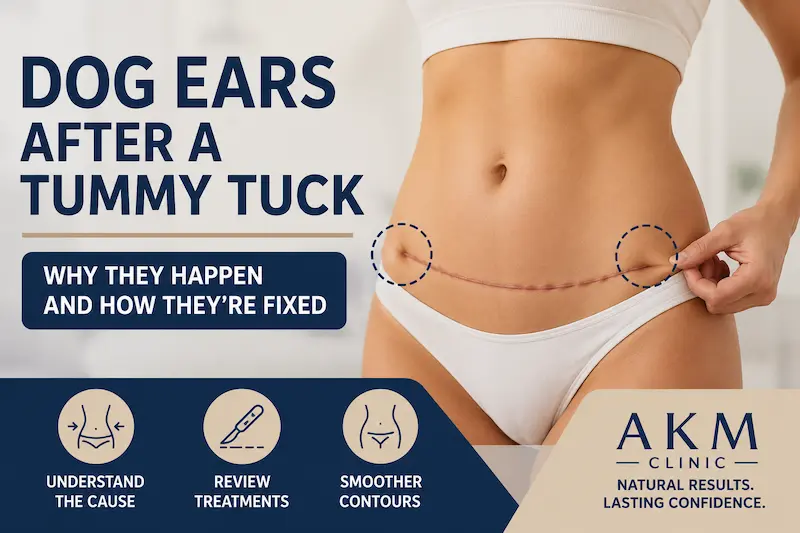
Dog ears after tummy tuck are small folds of extra skin, and sometimes fat, that sit at the outer ends of a tummy tuck incision. They can look like little puckers, tabs, or raised corners along the scar line. In many cases, they are minor and correctable; the key is knowing whether you are seeing early swelling, residual fat, or a true dog ear.
Quick answer: Dog ears after a tummy tuck usually form when the incision is not long enough to fully smooth the skin transition at the hips or flanks. Small dog ears may soften as swelling settles, but persistent folds are typically corrected with a minor revision, often under local anesthesia, once healing is mature.
A tummy tuck is designed to remove loose abdominal skin and tighten the front of the abdomen, but the body is three-dimensional. The skin removed from the centre of the abdomen has to blend smoothly into the sides. That transition zone is where dog ears can appear. For a broader overview of how a tummy tuck is performed, AKM’s treatment guide explains the procedure itself; this article stays focused on dog ears only.
For Canadian patients considering surgery in Turkey, this detail matters. You want a flatter abdomen, yes, but you also want a scar plan that respects your hip shape, flank laxity, and aftercare once you return home. Dog ears are not always a sign of a “bad” tummy tuck. Sometimes they are the visible result of a real surgical trade-off: keeping the scar shorter versus extending it far enough to create a smoother contour.
Table of Contents
What “Dog Ears” After a Tummy Tuck Are?
A dog ear is a small bunching of tissue at the end of a surgical incision. After a tummy tuck, it usually appears at one or both outer ends of the lower abdominal scar, close to the hip or flank area. It can be made of loose skin, residual fat, swelling, or a mix of all three. The appearance may be subtle when standing straight, then more obvious when bending, twisting, or wearing fitted clothing.

The small fold at the outer end of the incision
During a tummy tuck, the surgeon removes a section of loose skin from the lower abdomen and closes the remaining tissue in a smoother line. The challenge is that the skin at the sides does not always flatten perfectly into the new incision. If extra tissue remains at the end of the closure, it can bunch outward.
That bunching is what patients call a dog ear. It may look like:
- A small triangular fold at the end of the scar
- A raised corner where the incision stops
- A soft pucker that sticks out under leggings or swimwear
- A firm lump near the flank that becomes more noticeable after swelling improves
Dog ears can happen on one side or both sides. They may also be uneven. One side of the body often carries more skin laxity or flank fullness than the other, so perfectly symmetrical healing is not guaranteed.
Why the name sounds worse than the issue usually is
The term “dog ear” sounds dramatic, but the issue itself is often small. It describes shape, not danger. A dog ear is not the same as infection, tissue death, or a deep wound complication. It is usually a contour problem at the scar edge.
That distinction matters for skeptical patients who are rightly cautious about cosmetic surgery abroad. A dog ear can be frustrating, especially after investing time, travel, and recovery into a tummy tuck. But in most cases, it is not medically urgent. It becomes a concern when it is persistent, visible after swelling has settled, or bothersome enough to affect clothing fit or confidence.
Early after surgery, the incision ends may look raised or puckered simply because the tissues are swollen. This is why surgeons usually avoid judging the final contour too soon. The first few weeks are not the final result.
Dog ear vs leftover fat vs true loose skin
Not every raised area at the end of a tummy tuck scar is a true dog ear. The cause changes the fix. This is where a careful exam, and sometimes photo follow-up, matters.
- True dog ear: extra skin bunches at the end of the incision and remains after swelling improves.
- Residual fat: the skin may be smooth, but a small pocket of fat creates fullness near the flank.
- Temporary swelling: the area looks puffy during early healing but gradually settles.
- Loose flank skin: laxity extends beyond the abdomen into the sides, meaning a standard scar may not fully correct it.
This is why dog ears should not be judged in isolation. The surrounding abdomen, hips, flank tissue, scar length, and healing stage all matter. If the raised area feels fluid-like, changes quickly, or appears with new swelling, it may not be a dog ear at all. In that case, it is worth reading about another common post-op fluid issue so you know what to flag with your surgical team.
Why Dog Ears Form?
Dog ears form because skin removal and scar placement have to meet the shape of the patient’s body. The abdomen is not a flat sheet. It curves into the waist, hips, and flanks. If the incision stops before the loose tissue has been fully tapered, a fold can remain at the edge. Sometimes the surgeon sees this risk clearly before surgery; sometimes the final behaviour of the tissue only becomes obvious as swelling settles.
When the incision is too short for the amount of skin removed
The most common reason is simple geometry: the incision is not long enough to smooth the skin transition. A shorter scar may sound appealing before surgery, but if the patient has skin laxity extending toward the hips, stopping the incision too early can create bunching at the end.
This is the honest trade-off:
- A shorter scar may be easier to hide, but it can leave extra tissue at the sides.
- A longer scar may smooth the flanks better, but it creates more scar length.
Neither choice is automatically right or wrong. The best plan depends on anatomy. A patient with mild central abdominal laxity may do well with a shorter incision. A patient with loose skin extending around the sides may need a longer incision to avoid dog ears. This is one reason pre-op marking is so important.
The same principle is discussed in surgical literature on dog-ear correction: the end of an incision is where tissue mismatch becomes most visible, and small changes in design can affect whether the skin lies flat. A peer-reviewed discussion of dog-ear correction techniques explains how tissue excess at wound ends can require specific planning rather than a one-size-fits-all closure approach: a peer-reviewed technique for correcting dog ears.
Flank laxity and body shape
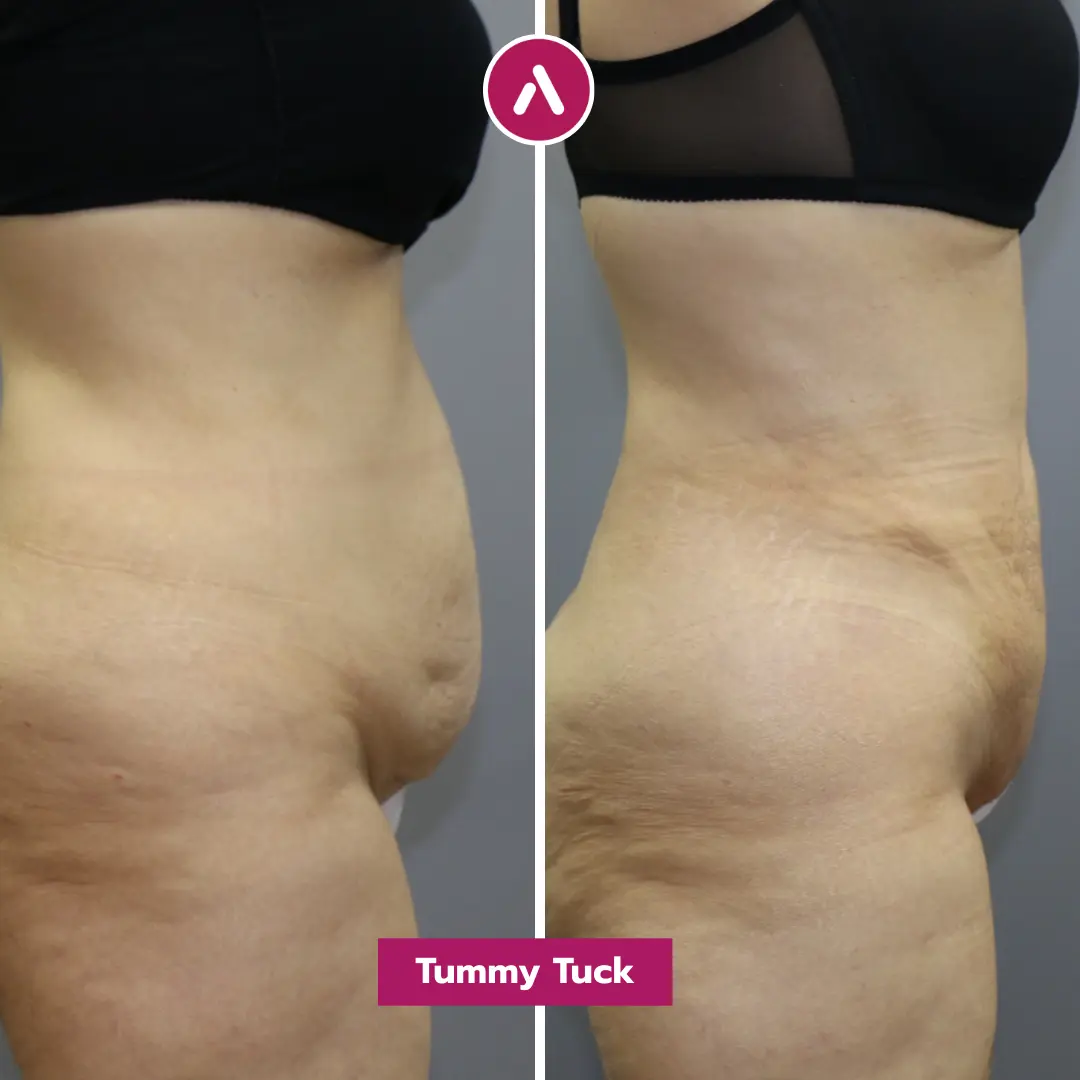
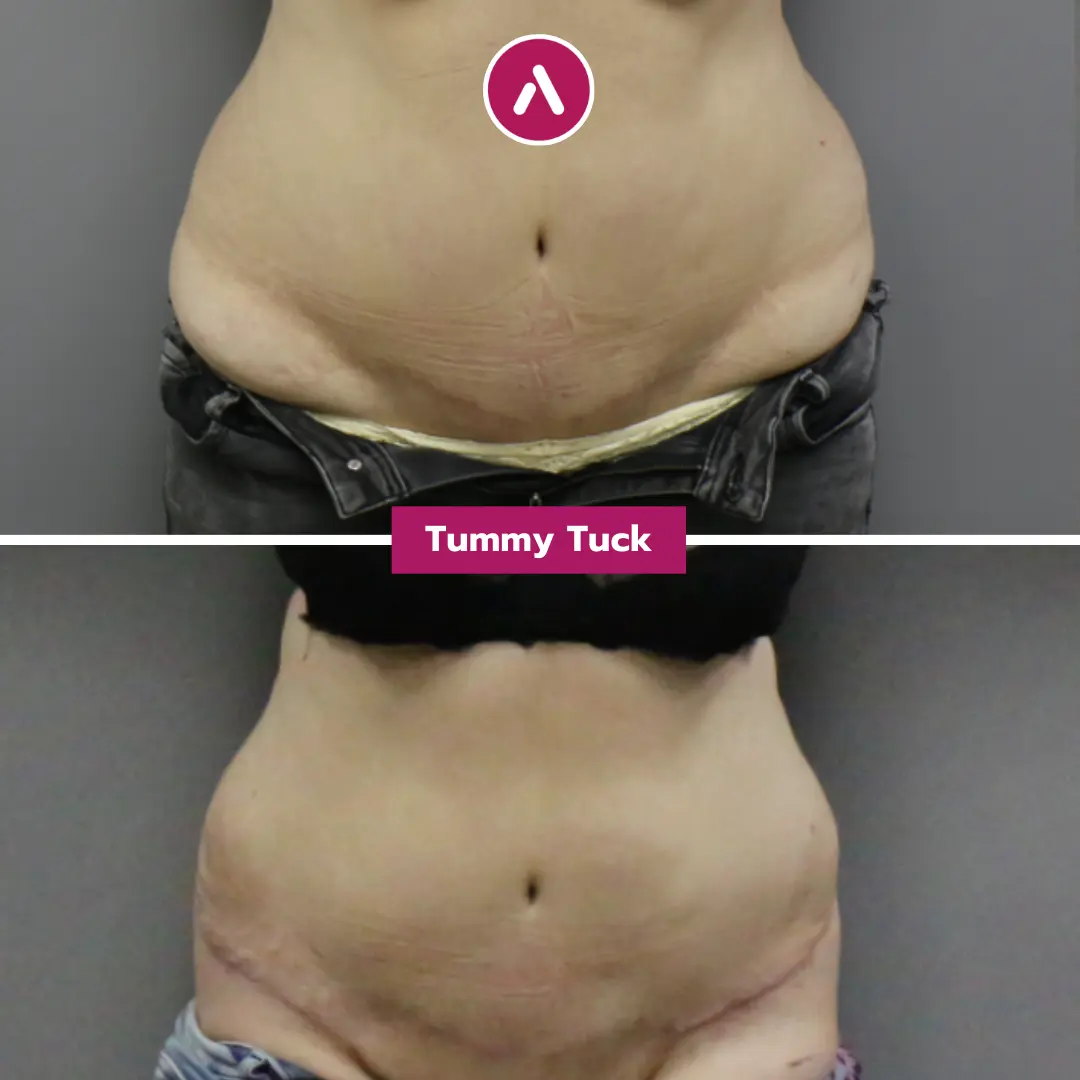
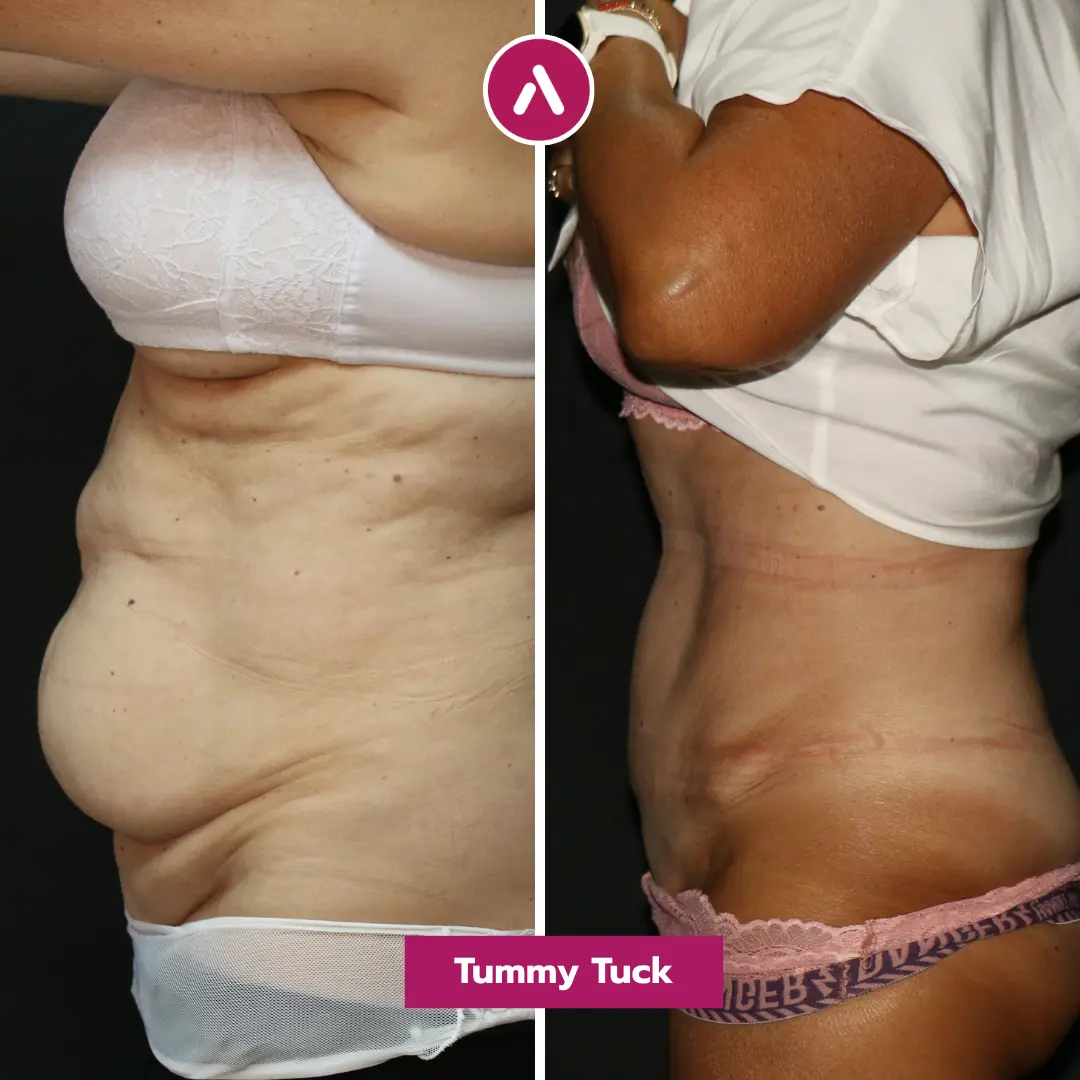
Flank laxity means the skin and soft tissue on the sides of the waist are loose. This is common after pregnancy, major weight loss, or years of weight fluctuation. If the abdomen is tightened but the flanks still have loose tissue, the transition between the flat front and the softer side can create a dog-ear shape.
Body shape also plays a role. Patients with a straighter waist-to-hip transition may have different scar-edge behaviour than patients with fuller hips or more side tissue. A tummy tuck can improve the abdomen, but it cannot make flank skin disappear unless the incision is planned far enough to include that laxity.
This is where expectation-setting matters. A surgeon may recommend extending the scar slightly to avoid a visible fold. Some patients prefer that. Others accept the possibility of a small revision later because they strongly prefer a shorter initial scar. The decision should be made before surgery, not discovered after the fact.
Higher BMI, weight changes, and residual fat
Dog ears are more likely when there is more soft tissue at the sides of the incision. A higher BMI, recent weight loss, or ongoing weight fluctuation can all make tissue behaviour less predictable. Even when the front of the abdomen tightens well, the sides may still carry fat or laxity.
Residual fat can also mimic or worsen a dog ear. If the skin edge is smooth but the side of the scar still has fullness, the issue may be fat rather than loose skin. In that situation, revision may involve liposuction rather than skin excision. Later in this article, we will separate those options clearly so you understand why one patient may need a tiny scar extension while another may need fat contouring.
General swelling can confuse the picture too. After a tummy tuck, swelling does not disappear in a straight line. It shifts with posture, activity, compression, salt intake, and time of day. Before assuming the contour is permanent, it helps to understand how swelling settles over time.
How Surgeons Prevent Them?
Preventing dog ears starts before the first incision. A careful surgeon looks beyond the front of the abdomen and studies how the skin behaves across the hips, waist, and flanks. The goal is not simply to remove loose skin; it is to create a smooth transition from the tightened abdomen into the natural side contour. That planning is especially important for patients who have had pregnancy-related stretching, major weight loss, or side tissue that extends past the underwear line.

Incision-length planning
Incision length is one of the biggest factors in dog-ear prevention. A tummy tuck incision must be long enough to remove the loose lower abdominal skin without leaving a gathered edge at the sides. If the surgeon stops too early, the skin may have nowhere to go except outward.
This does not mean every patient needs a long scar. It means the scar should match the anatomy. A slim patient with central laxity may need a shorter incision, while a patient with flank laxity may need the incision to extend farther toward the hips to create a flatter, cleaner edge. ASPS also notes that tummy tuck scarring depends on incision placement and healing over time, which is why scar planning should be discussed before surgery: what to expect from a tummy tuck scar.
In consultation, this is a useful question to ask:
- “Will keeping my scar shorter increase my risk of dog ears?”
A transparent answer is a good sign. A board-certified plastic surgery team should be willing to explain the trade-off, not promise a short scar and a perfectly smooth side contour for every body type.
Tissue transition at the flanks
The flanks are the side areas between the waist and hips. They are often the reason dog ears happen. Even when the abdominal skin is tightened beautifully, the flank tissue may remain softer, fuller, or looser. If that side tissue is not blended into the closure, a small fold can appear at the incision end.
Surgeons reduce this risk by planning the closure in a way that tapers the tissue gradually. The goal is not a sudden stop at the edge of the scar. It is a smooth fade from the tightened abdomen into the natural body contour.
For some patients, residual fat at the flank also contributes. If the issue is fat rather than loose skin, careful contouring may be part of the prevention plan. This is where liposuction can be useful, but only when it is used thoughtfully. The purpose is not to over-thin the sides; it is to reduce a bulky transition that could exaggerate a dog ear later.
The honest trade-off: a shorter scar vs a smoother contour
This is the part patients are not always told clearly enough. Sometimes, preventing dog ears requires a slightly longer scar. That may sound disappointing at first, but it can be the better aesthetic decision if the alternative is a visible fold at the scar end.
“In dog-ear prevention, the question is often not ‘short scar or long scar?’ It is ‘where does the scar need to end for the tissue to lie flat?’ A shorter incision can be attractive, but a smooth flank transition sometimes requires accepting a little more length.”
This is not about choosing the longest possible incision. It is about matching the incision to the skin pattern. For a skeptical patient, the safest mindset is not “smallest scar at all costs.” It is “the most appropriate scar for my anatomy.”
| Prevention factor | What it means | Why it matters | What to ask in consultation |
|---|---|---|---|
| Incision length | The scar extends far enough to taper the loose tissue | A scar that stops too soon can leave a fold at the edge | “Is my flank laxity likely to need a longer incision?” |
| Flank assessment | The side waist and hip tissue are evaluated, not just the front abdomen | Dog ears often come from side tissue that was not fully blended | “Will my sides be addressed in the plan?” |
| Residual fat control | Small fat pockets near the scar edge may be contoured if appropriate | Fat can mimic or worsen a dog-ear shape | “Is this loose skin, fat, or both?” |
| Weight stability | Surgery is planned when weight is reasonably stable | Weight changes can alter skin tension and contour after surgery | “Should I wait until my weight has been stable longer?” |
For Canadian patients travelling for surgery, the consultation should also cover what happens if a small dog ear remains after healing. A responsible plan includes photo follow-up, timing guidance, and clear criteria for whether a minor touch-up is worth considering.
How Dog Ears Are Fixed?
Dog-ear correction depends on what is causing the raised edge. A true skin dog ear is usually corrected by removing a small wedge of extra tissue and extending or refining the scar. If the issue is residual fat, liposuction may be the better tool. If the issue is swelling, the correct “treatment” may simply be time. The right fix starts with the right diagnosis.
Minor office revision under local anesthesia
Persistent dog ears are often corrected with a small revision under local anesthesia. The surgeon numbs the area, removes the extra fold of skin, and closes the incision so the edge lies flatter. This may slightly lengthen the scar, but the goal is to trade a pucker for a smoother line.
This type of correction is usually much smaller than the original tummy tuck. It does not normally mean “redoing” the whole abdomen. It is more like refining the end of the scar once the body has declared its final shape.
That said, timing matters. Surgeons typically wait until swelling has settled and the scar is more mature before revising a dog ear. If revision is done too early, the tissue may still be changing, which can lead to overcorrection or unnecessary scar extension.
Liposuction for residual fat
If the scar end looks bulky because of a small pocket of fat, skin excision alone may not solve the contour. In that case, conservative liposuction may help reduce the fullness. This is especially relevant when the dog-ear area feels soft and thick rather than like a thin fold of extra skin.
Liposuction is not the fix for every dog ear. It cannot remove true loose skin. It can, however, help when residual fat is creating a raised side contour. For a deeper explanation of the fat-removal side of this decision, see how liposuction removes residual fat.
The key word is conservative. Over-aggressive fat removal around the scar edge can create dents, unevenness, or a hollow transition. A small contour problem should not be replaced with a larger contour problem.
Why timing matters: waiting until swelling settles
Early swelling can imitate a dog ear. This is why most surgeons do not rush to revise the incision ends in the first few weeks. The abdomen, hips, and flanks can all stay swollen for months, and the scar line often looks tighter, thicker, or more puckered before it relaxes.
A practical timeline often looks like this:
- First few weeks: swelling and firmness can make the scar ends look raised.
- First 3 months: the contour starts to soften, but asymmetry may still be present.
- 3–6 months: many small puckers improve as swelling settles and scar tissue relaxes.
- 6–12 months: persistent dog ears are easier to judge and plan for correction.
This is also why comparing the incision ends too early can create unnecessary worry. One side may settle faster than the other. A small raised area that looks obvious at week four may be much less visible by month four.
However, “wait and see” does not mean ignoring new symptoms. A dog ear should not feel like a growing fluid pocket, become hot and red, or come with fever or worsening pain. Those signs belong in a different category and should be discussed with your surgical team. If your concern is around the navel rather than the scar ends, how the belly button heals explains what is normal in that area and what is not.
Choosing the right correction: skin, fat, or swelling
The table below separates the common scenarios. This is not a substitute for a medical exam, but it can help you describe what you are seeing more clearly during follow-up.
| What you notice | Likely issue | When it is assessed | Typical solution |
|---|---|---|---|
| Thin fold or tab at the scar end | True skin dog ear | Usually after swelling settles | Minor skin excision or scar-end revision |
| Soft fullness near the flank | Residual fat | After contour stabilizes | Conservative liposuction if appropriate |
| Puffy, changing swelling on one or both sides | Post-op swelling | Early recovery | Time, compression, activity guidance |
| Fluid-like swelling or wave sensation | Possible seroma | Prompt surgical review | Assessment; aspiration if needed |
In other words, dog-ear correction is usually straightforward, but it should not be guessed. The same-looking bump can have different causes. A careful surgical team will separate skin excess from fat fullness from healing-related swelling before recommending the fix.
Revision & Realistic Expectations
Dog-ear revision is usually a refinement, not a full restart. The goal is to smooth the scar end, reduce a visible pucker, or contour a small pocket of fullness after the main tummy tuck result has settled. For Canadian patients travelling for surgery, the realistic question is not only “Can it be fixed?” but also “When should it be judged, how is follow-up handled, and what kind of correction would actually match the problem?”

Minor correction vs full revision
Most dog ears do not require a full tummy tuck revision. A small, persistent fold at the scar end can often be corrected by removing a small amount of extra skin and closing the area more smoothly. This may add a short extension to the scar, but it can make the end of the incision lie flatter under clothing.
A full revision is different. That is more likely when the concern is not just a small dog ear but a broader contour issue: loose skin across the lower abdomen, poor scar placement, major asymmetry, or remaining laxity that was not fully addressed. Those situations need a more detailed surgical assessment.
Cost is a separate decision point and should not be mixed into the medical explanation of dog ears. For that reason, this article will not open a pricing breakdown. Patients comparing options can review the cost of a tummy tuck separately.
Recovery after dog-ear correction
Recovery after a small dog-ear correction is usually lighter than recovery after the original tummy tuck. The treated area is smaller, the tissue dissection is limited, and local anesthesia is often enough. Still, it is not “nothing.” The area still needs time to close, soften, and fade.
Typical recovery considerations include:
- Keeping the small incision clean and protected
- Avoiding friction from tight waistbands during early healing
- Following activity limits from the surgical team
- Using scar care only once the incision is fully closed
- Continuing photo follow-up if you have already returned to Canada
Patients often want to judge the correction immediately, but scar edges can look raised at first. A smoother contour is the goal, not an invisible scar overnight. Final scar colour and softness can continue to change for months.
Can dog ears come back?
A corrected dog ear is unlikely to “come back” in the same way if the underlying skin and fat issue was properly addressed. But the body can change. Weight gain, weight loss, pregnancy, and natural skin laxity can all affect the abdomen and flanks over time.
There is also a difference between recurrence and under-correction. If a small fold remains after revision, it may mean the original correction was intentionally conservative. Surgeons sometimes choose a cautious approach to avoid making the scar longer than necessary. That can be reasonable, but it should be explained clearly before the revision.
Before deciding on any touch-up, look at the entire result: the abdomen, the side contour, the scar position, and how the area behaves in movement. Seeing real healed tummy tuck results can also help you understand how scar-end contour, swelling, and body shape vary between patients.
For Canadian patients: Ask whether your surgeon is part of a European Board-Certified, RCPSC-equivalent surgical team, and confirm how minor concerns are assessed after you return home. This should include photo follow-up, clear timelines, and guidance on when a raised scar end is normal healing versus a persistent dog ear.
AKM Clinic’s approach is based on natural-looking body contouring, careful incision planning, and structured long-term virtual follow-up at 1, 3, 6, and 12 months. Surgery is performed in Istanbul, with recovery support designed for international patients. The aim is not the shortest possible scar at any cost; it is a scar plan that fits the patient’s anatomy and creates a smoother, more balanced contour.
Frequently Asked Questions: Dog Ears After Tummy Tuck
These questions address the most common concerns patients have when they notice a raised fold or pucker at the end of a tummy tuck incision. They are meant to help you understand the issue, not to diagnose your own result from photos alone.
Are dog ears after a tummy tuck a surgical mistake?
Will dog ears go away on their own?
When can dog ears be fixed?
Can dog ears come back?
Dog ears vs seroma — how can you tell?
Does insurance cover dog-ear revision?
Considering a tummy tuck and worried about dog ears? Book a free virtual consultation with AKM Clinic to discuss your abdominal skin, flank laxity, scar placement, and whether your anatomy is more likely to need a shorter or extended incision plan.
Medical disclaimer: This article is for educational purposes only and is not a diagnosis or personal medical advice. Healing patterns and surgical results vary from person to person. If you notice worsening swelling, fluid build-up, redness, fever, increasing pain, wound opening, or any symptom that concerns you after surgery, contact your surgeon or seek qualified medical care promptly.
Related Procedures




Ready to Begin Your Journey?
Join the more than 2,000 patients who have trusted Dr. Akif Mehmetoğlu and the AKM Clinic team. Your journey begins with an informative, no-obligation conversation. Contact us today from across Canada to schedule your complimentary virtual consultation.
#1: Receive Your Personalized Quote
Start with a complimentary, no-obligation virtual consultation. Share your photos, and our surgical team will provide a fully personalized treatment plan and a transparent, all-inclusive pricing package quoted in Canadian dollars (CAD). There are no hidden fees.
#2: Secure Your Procedure Date
Once you are ready to proceed, our dedicated English-speaking patient coordinators will help you secure your procedure date. We will manage your logistical bookings in Istanbul, including your five-star hotel and private airport transfers.
#3: Arrive in Istanbul & Meet Your Surgeon
Arrive at Istanbul Airport (IST), where you will be greeted by your private driver. Settle into your hotel before your comprehensive in-person consultation. You will meet your specialist surgeon to finalize the details of your procedure and ensure your goals are aligned for a natural, subtle result.