
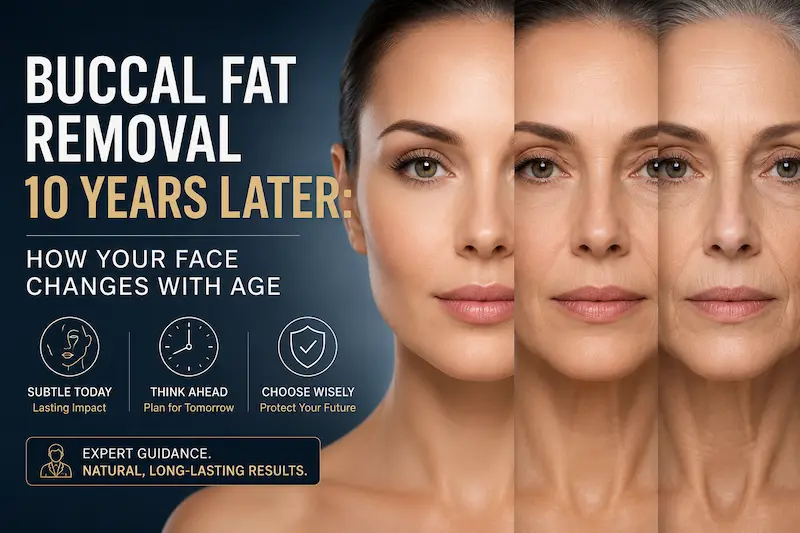
Buccal Fat Removal 10 Years Later: How Your Face Changes With Age
AI Summary
- Buccal fat removal 10 years later depends on conservative planning and natural facial aging.
- Higher-risk patients include lean faces, younger patients, and aggressive fat removal cases.
- Long-term results depend on anatomy, volume preservation, and realistic expectations.
- Pricing is separate; consultation should focus on candidacy, safety, and future facial balance.
Summary generated by AI, fact-checked by our medical experts
Quick answer: Buccal fat removal 10 years later can look natural when the right patient had conservative fat removal, but it can look hollow or prematurely aged when too much volume was removed from an already lean face. The key question is not only how your cheeks look now, but how your face is likely to age over the next decade.
Buccal fat removal sits in a tricky category of facial surgery. The change can be subtle, elegant, and confidence-building for someone with persistent lower-cheek fullness. But the same procedure can feel like a mistake years later if it removes volume that the face would have needed with age.
That is why AKM’s buccal fat removal procedure is not planned around a trend photo or a “snatched” cheek goal alone. A responsible plan considers bone structure, cheek fullness, skin quality, age, facial width, and how much volume the face can safely give up without looking gaunt later.
This guide focuses on the long view: what happens to the face ten years after buccal fat removal, who tends to age well after it, who is at higher risk of regret, and what to ask before deciding.
Table of Contents
How Faces Age Naturally
Before you can judge what buccal fat removal may look like a decade later, it helps to understand what would happen to the face even without surgery. Aging is not just about wrinkles. It is also about volume, support, and the way facial fat pads shift over time.
Fat-pad loss over time
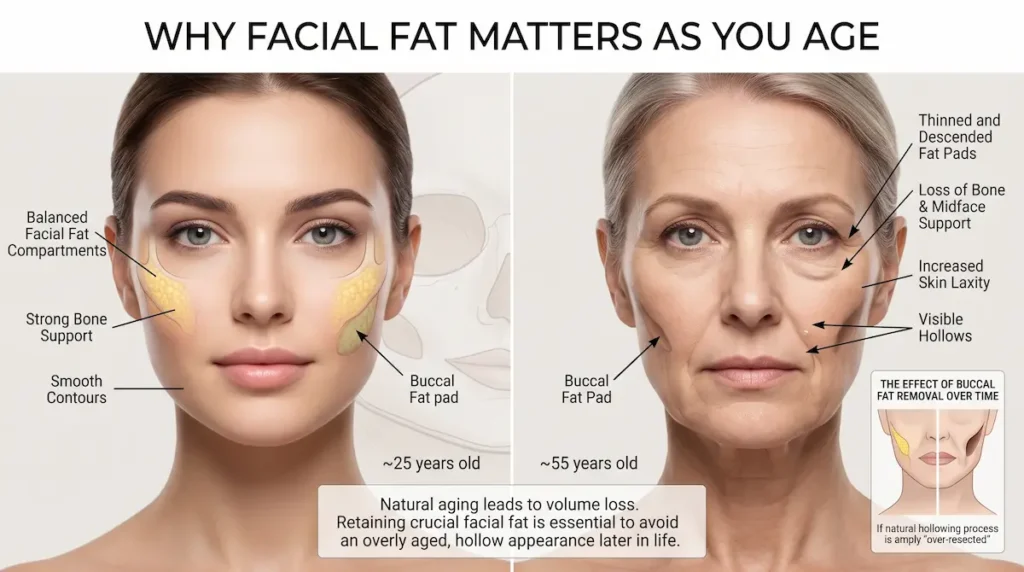
A youthful face usually has a balance of bone support, soft tissue, and fat. The cheeks look smooth because different fat compartments create gentle transitions between the lower eyelid, cheekbone, midface, and lower cheek.
With age, some of that facial fat becomes thinner, descends, or changes position. This is why a face that looked full at 25 may look more angular at 40, even if body weight stays stable. The change is gradual. Most people notice it first as flatter cheeks, deeper shadows, or a sharper contrast between the cheekbone and the hollow beneath it.
The buccal fat pad is one of the deeper fat compartments in the lower cheek. Removing part of it can reduce roundness in the lower face. That may be attractive in the right patient. The issue is that the rest of the face will keep aging after surgery, and that natural volume loss can make a once-subtle result look more dramatic later.
Bone and skin changes
Facial aging is not only about fat. Bone support changes slowly, too. The midface and jawline can lose some structural projection over time, while skin becomes less elastic and less able to “snap back” over the underlying shape.
When the skin is firm and the cheek has enough surrounding volume, conservative buccal fat removal may create a clean contour. When skin becomes thinner or looser years later, a deep cheek hollow can become more visible. This is one reason the same procedure can age differently from patient to patient.
Think of the face as a layered structure. Bone gives support, fat gives softness, and skin gives the surface envelope. If one layer loses too much support, the whole facial balance changes.
Why everyone hollows somewhat
Some degree of hollowing is normal with age. It does not mean the face is unhealthy or that surgery caused every change. The question is whether buccal fat removal amplifies that hollowing in a way that looks sharper than the patient expected.
This is where candidacy matters. A patient with a naturally round lower cheek and strong midface support may still look balanced years later. A patient with a narrow face, low body fat, or early cheek hollows may have less reserve. Removing buccal fat in that setting can make future volume loss more noticeable.
US plastic surgery guidance often emphasizes this point: facial fat is not just “extra.” It helps the face age softly. The American Society of Plastic Surgeons has warned patients and surgeons against being too aggressive with buccal fat removal because over-resection can create an older or more hollow appearance as the face changes with time. The society’s article explains why facial fat matters as you age.
Buccal Fat Removal a Decade Later
Ten years after buccal fat removal, the result usually falls into one of three broad patterns. Some patients still look naturally contoured. Some notice a stronger cheek hollow than they expected. Others feel regret because the face looks thinner, older, or less soft than it did before.
How early definition can become hollowing
In the first year, the result may look like improved cheek definition. The lower face appears less round, and the cheekbone may look more visible because the area beneath it has less fullness. For the right patient, this can create a refined contour without making the face look operated-on.
Over the next decade, normal aging continues. The midface may lose volume, the skin may thin, and the lower cheek may look less padded. If the original buccal fat removal was conservative, the face may still look balanced. If the removal was aggressive, the same contour can start to look hollow rather than defined.
This is the difference between a cheek shadow and a cheek cave. A soft shadow can look elegant. A deep hollow can make the face look tired, older, or underweight, even when the patient feels healthy.
Who stays happy long-term
Long-term satisfaction is more likely when the patient was carefully selected from the beginning. Good candidates often have persistent lower-cheek fullness that does not change much with weight loss, a balanced midface, and enough soft-tissue reserve to tolerate a modest reduction.
They also tend to want refinement, not a dramatic transformation. That matters. Buccal fat removal is not designed to create a new bone structure, replace jawline surgery, or mimic a heavily edited social media face. It is a small-volume facial contouring procedure, and its best results usually look quiet.
Johns Hopkins describes buccal fat removal as a procedure that may suit people with fuller, rounder cheeks, while also noting that people with narrow faces may risk a gaunt appearance. That candidacy distinction becomes even more important when you are thinking ten years ahead. Read the overview from Johns Hopkins on who buccal fat removal suits.
Who regrets it
Regret usually comes from a mismatch between the short-term goal and the long-term face. A patient may like the early slimming effect, then feel unhappy years later when the cheeks continue to lose volume naturally.
Regret is more likely when the face was already slim, the patient was very young at the time of surgery, or the surgeon removed too much fat. It can also happen when the patient expected a sculpted jawline but received cheek hollowing instead. Those are different things.
For that reason, the consultation should include a direct conversation about aging. Not just “Will my cheeks look slimmer?” but “How might this look when I am 40, 50, or 60?”
Who’s at Higher Risk Long-Term?
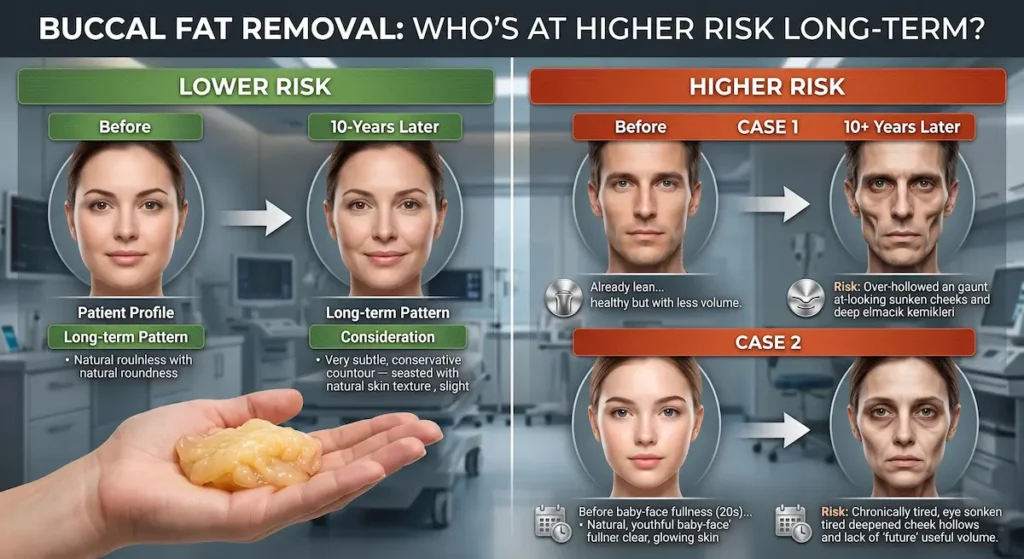
Not every patient has the same 10-year risk profile. The people most likely to look natural long-term usually have enough cheek volume to begin with, realistic goals, and a conservative surgical plan. The people most likely to feel over-hollowed later often had surgery when their face was already lean, narrow, or still changing.
Naturally lean faces
A lean face may already have visible cheekbone shadows, a narrow lower cheek, or limited softness between the cheekbone and jawline. In that face type, even a small reduction can make the cheek look sharper than intended.
This does not mean every slim patient is automatically a poor candidate. It means the margin for error is smaller. A surgeon has to ask whether the cheek fullness is truly caused by excess buccal fat or whether the patient is trying to change a facial structure that buccal fat removal cannot safely change.
For a patient with a naturally lean face, the more important question may be: “Will removing this fat improve balance, or will it simply remove softness?” Those are not the same thing.
Younger patients removing “future” volume
Younger patients often seek buccal fat removal because the lower cheeks feel too full in photos. But a face in the early 20s is not the same face that person will have ten or twenty years later.
Baby-face fullness often softens on its own. Weight changes, hormonal changes, and normal facial maturation can all reduce lower-cheek roundness without surgery. If buccal fat is removed before the face has fully settled, the patient may be giving up volume that would have become useful later.
This is why age matters in a long-term plan. The goal is not to chase the sharpest cheek possible at 25. It is to create a result that still looks healthy at 35, 45, and beyond.
Aggressive resections
The most avoidable long-term problem is aggressive removal. Buccal fat is not like a surface pocket that can simply be emptied without consequence. It is part of the cheek’s deeper support and softness.
When too much is removed, the early result may look dramatic. That can be exciting at first. Over time, though, the hollow can deepen as the rest of the face loses volume naturally.
This is where the smile and overcorrection conversation matters. If you are worried about looking too hollow when you smile, read more about overcorrection and the gaunt look. That topic is closely related, but this article stays focused on the 10-year aging pattern.
| Patient profile | Likely 10-year outcome | Risk level |
|---|---|---|
| Round lower cheeks, stable weight, strong midface support | Often ages with a natural, subtle contour when removal is conservative | Lower |
| Full cheeks but weak consultation goals, wants a dramatic “snatched” look | May like the early result but feel too hollow as natural volume declines | Moderate |
| Narrow face, low body fat, visible cheek hollows before surgery | Higher chance of a gaunt or tired appearance over time | Higher |
| Very young patient with baby-face fullness | Risk of removing volume before the face naturally matures | Moderate to higher |
| Male patient seeking sharper definition | Can work well in selected cases, but masculine definition should stay angular rather than sunken | Depends on facial width and fat distribution |
Male faces need their own discussion because the goal is usually angularity, not hollowness. If that applies to you, review how the male face responds differently before making a decision.
Conservative buccal fat removal is not about doing less for the sake of doing less. It is about preserving enough facial volume so the result can age naturally instead of becoming sharper every year.
Aging Well After the Procedure
If you already had buccal fat removal, or you are strongly considering it, the goal is not to fear aging. The goal is to plan for it. A natural result ten years later depends on how the procedure was performed, how your face changes, and how you care for the surrounding skin and soft tissue over time.
Conservative removal as insurance
The best long-term strategy begins before surgery. Conservative removal leaves support behind. It respects the fact that the face will continue to lose and shift volume over time.
At AKM Clinic, the Natural-First philosophy is especially relevant for this procedure. The aim is refinement rather than an operated-on or over-sculpted look. For a face procedure, that conservative planning can also reflect the advantage of surgeon-led facial analysis and dermatosurgical experience.
Dr. Akif Mehmetoğlu’s facial surgery background supports this long-view approach, particularly in procedures where skin quality, facial fat, and natural aging all affect the final appearance. The point is not to remove as much as possible. The point is to remove only what the face can afford to lose.
Volume options later
Some patients who feel too hollow years after buccal fat removal ask whether the result can be reversed. The honest answer is complicated. Removed buccal fat does not simply grow back in the same way.
There may be ways to soften hollowing later, such as carefully planned volume restoration. But those are separate procedures with their own limits, risks, and maintenance needs. They should not be treated as a simple undo button.
That is why the best correction is prevention. If the face is not a good candidate now, waiting may be wiser than relying on future fixes.
Skincare and lifestyle basics
Skincare cannot replace lost facial fat, but it can support the surface quality of the face as it ages. Daily sunscreen, smoking avoidance, stable weight, and consistent skin care can help the skin envelope age more evenly over the underlying contour.
Weight swings matter, too. Significant weight loss after buccal fat removal can make the cheeks appear more hollow. Significant weight gain may change the rest of the face while the removed buccal area stays relatively less full, creating uneven proportions.
Good long-term planning is practical. Protect the skin. Keep weight stable when possible. Most importantly, choose facial contouring only when it fits the face you are likely to have in the future, not just the face you want in one photograph.

Is It Worth It for You?
The right question is not “Is buccal fat removal good or bad?” The better question is whether it fits your anatomy, your age, your facial volume, and your tolerance for how your face may change over the next decade.
Weighing now vs 10 years
Buccal fat removal can be worthwhile for someone whose lower-cheek fullness is out of balance with the rest of the face. In that case, a careful reduction may help the cheekbone and jawline read more clearly without making the face look carved out.
It may not be worthwhile if the goal is to copy a temporary beauty trend. Trends change faster than faces age. Surgery does not.
A good consultation should slow the decision down. Look at your face at rest, smiling, and in three-quarter view. Ask what would happen if you lost weight later. Ask what would happen as cheek volume naturally declines. Ask whether waiting would give a more predictable answer.
If you are comparing this decision with other facial procedures, it may also help to read why some patients have lip lift regrets. The procedure is different, but the decision-making principle is similar: the best result should still make sense years later.
Questions for consultation
Bring direct questions. A strong surgeon should not be offended by them. Long-term planning is part of safe facial surgery.
- Is my cheek fullness truly from the buccal fat pad, or from overall facial structure?
- Am I already showing early cheek hollowing?
- Would partial removal be safer than a more aggressive reduction?
- How might my result look after natural facial volume loss?
- Do I have enough midface support to age well after this?
- Would another approach suit my goals better?
For US patients, it is worth asking exactly which board certification your surgeon holds and what it covers. At AKM, surgery is performed in Istanbul, and your surgeon’s training and qualifications should be explained clearly before you decide. Medical credentials should be precise, not promotional.
You should also ask about cost in the right place. This article is not a pricing guide, but patients who are comparing options can review buccal fat removal pricing in Turkey separately.
Recovery in brief
Recovery affects the early look, not the 10-year outcome by itself. Swelling can temporarily hide the final contour, and the cheeks may look uneven or firm while tissues settle.
The long-term result should not be judged in the first few weeks. Early swelling can make the face look fuller, while later settling can make the cheek hollow more visible. That is why short-term recovery photos rarely tell the full story.
For a separate breakdown of swelling, diet, activity, and healing milestones, see the recovery timeline on our buccal fat removal procedure page.
Frequently Asked Questions: Buccal Fat Removal 10 Years Later
These are the questions patients most often ask when they are worried less about the first month and more about how buccal fat removal may age over time.
Does buccal fat removal age you?
Conservative removal in a well-selected patient is more likely to age naturally. Aggressive removal in a narrow or low-volume face carries a higher risk of a gaunt look.
Will I look gaunt in 10 years?
If you have full lower cheeks, stable weight, and strong facial support, a conservative result may remain balanced. A proper consultation should assess that risk before surgery, not after.
Do people regret buccal fat removal?
Patients who stay happy long-term usually wanted subtle refinement and had enough cheek volume to begin with.
Is buccal fat removal reversible?
This is why conservative planning matters. Prevention is easier than trying to rebuild lost softness years later.
Should younger patients wait?
Waiting can make the decision clearer. If fullness remains stable after facial maturation and weight is steady, candidacy can be assessed more reliably.
How do I age well after buccal fat removal?
Still, skin care cannot replace removed facial fat. The most important decision is the first one: remove only what the face can safely lose.
Key Takeaway
Buccal fat removal can look refined 10 years later when it is performed conservatively on the right face. It can also create regret when it removes volume from a face that was already lean or still maturing.
The safest approach is long-term thinking. Your cheeks should not just look better in next month’s photos. They should still belong to your face years from now.
Discuss your long-term facial aging with AKM before deciding, in a consultation. A careful facial assessment can help determine whether buccal fat removal suits your anatomy or whether preserving volume is the wiser choice.
Medical disclaimer: This article is for educational purposes only and is not medical advice. Cosmetic surgery results vary by anatomy, age, skin quality, healing, and surgical plan. Always consult a qualified medical professional before deciding on any procedure.
Related Treatments




Ready to Start Your Own Transformation Journey?
Join the 2,000+ patients who trusted Dr. Akif Mehmetoğlu and the AKM Clinic team. Your journey to a more confident, revitalized you begins with a simple, no-obligation conversation. Contact us today from the USA for your free virtual consultation.
#1: Get Your Free Personalised Quote
Start with a free, no-obligation online consultation. Share your photos, and our surgical team will provide a fully personalised treatment plan and a transparent, all-inclusive price package. No hidden fees.
#2: Secure Your Date & VIP Booking
Once you're ready, our dedicated patient coordinators will help you secure your procedure date. We'll handle all your bookings, including your 5-star hotel and private VIP airport transfers.
#3: Arrive in Istanbul & Meet Your Surgeon
Arrive at Istanbul Airport (IST) and be greeted by your private driver. Settle into your hotel and prepare for your in-person consultation, where you'll meet your specialist surgeon to finalise the details for your "natural, subtle, and revitalized" new look.