
Buccal Fat Removal 10 Years Later: How Your Face Changes With Age
AI Summary
- Buccal fat removal 10 years later depends on anatomy, ageing, and conservative fat reduction.
- Higher hollowing risk affects lean faces, younger patients, and aggressive resections.
- Safer long-term planning prioritises facial volume, cheek softness, and natural ageing balance.
- Worth it for suitable patients when consultation assesses structure, recovery, and future facial changes.
AI-generated summary, fact-checked by our medical experts.
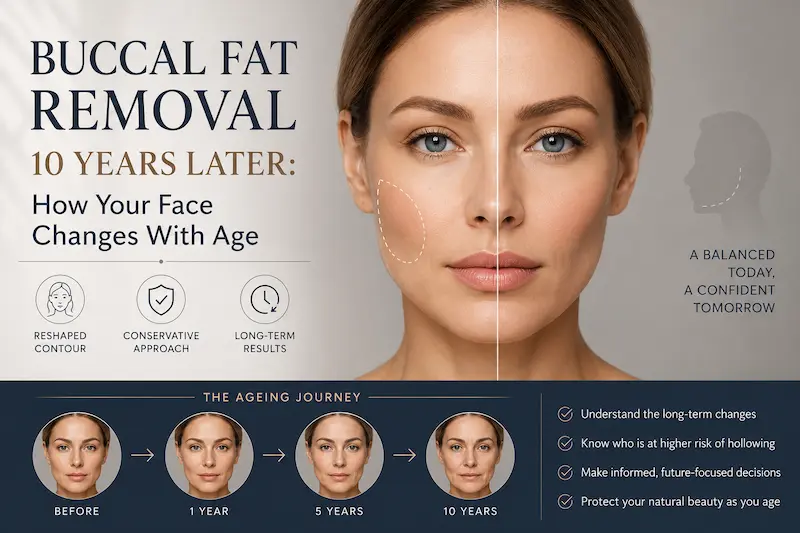
Quick answer: Buccal fat removal 10 years later does not look the same on every face. Some patients keep a refined, balanced cheek contour; others notice hollowing as natural facial fat, skin elasticity and bone support change with age. The long-term result depends less on the trend and more on anatomy, age, facial volume and how conservatively the fat was reduced.
Buccal fat removal can be a subtle facial-contouring procedure when it is planned carefully. The concern is not simply “Will I look older?” but “Will the volume I remove today be volume I might need later?” That question matters because faces naturally lose fullness over time.
This guide is written for UK patients who are researching the procedure seriously, not chasing a quick cheek-slimming trend. We will focus on the ten-year ageing trajectory: how cheeks change, why some people regret buccal fat removal, and which facial profiles are more likely to age well after surgery.
If you are still comparing the procedure itself, start with AKM's buccal fat removal procedure. Here, the focus is narrower: what may happen years later.
Table of Contents
How Faces Age Naturally
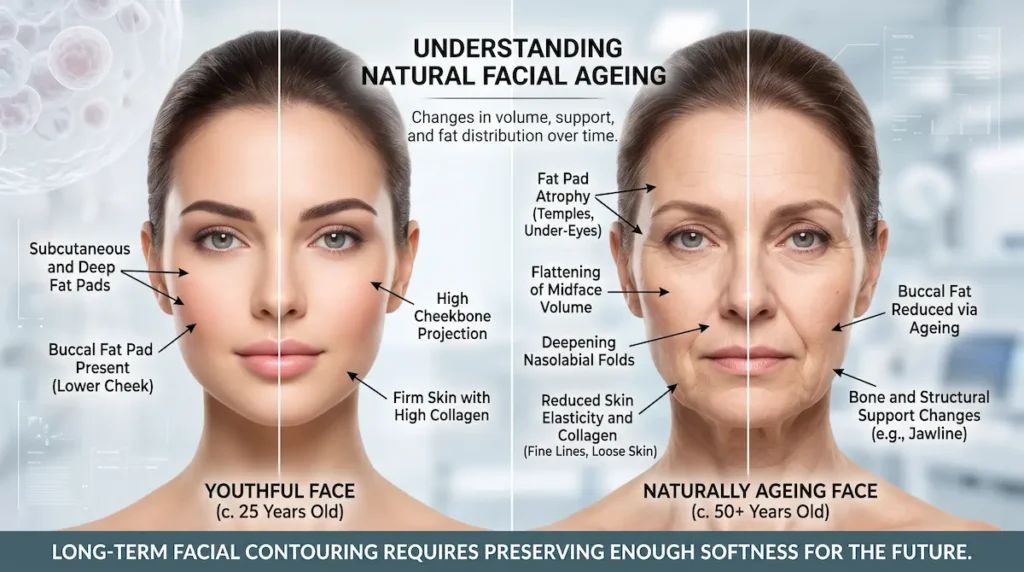
Before judging buccal fat removal in isolation, it helps to understand what time does to the face anyway. Ageing is not only about wrinkles or loose skin. It is also about a slow change in facial volume, support and proportion.
The cheeks are especially sensitive to these changes. A face that looks softly full at 25 may look more sculpted at 35 without any surgery at all. By the 40s and 50s, that same natural slimming can become more visible around the midface, temples, under-eyes and lower cheeks.
Fat-pad loss over time
The face contains several fat compartments. Some sit closer to the skin, while others are deeper and help support the cheeks from underneath. With age, these compartments can shrink, shift or appear less evenly distributed.
That is why facial fat is not simply “extra fullness”. In the right place, it softens transitions between the cheekbone, lower cheek and jawline. It also helps the face look rested rather than drawn.
The buccal fat pad sits in the lower cheek. Reducing it can make a round face look more defined, but it also removes part of a volume reserve that will not naturally grow back. ASPS has warned that aggressive buccal fat removal can look appealing early on but may contribute to an overly hollow appearance as facial fat continues to atrophy with age: why facial fat matters as you age.
Bone and skin changes
Facial ageing is not only soft tissue. Bone support also changes gradually. The cheeks, jaw and eye area can lose some of their youthful structural support, which makes existing volume loss look more noticeable.
Skin changes add another layer. Collagen and elastin decline over time, so the skin may not drape over the cheek in the same firm, smooth way it once did. A small hollow that looks elegant in youth can become sharper when skin quality changes.
This is why a conservative plan matters. The best long-term outcome is usually not the most dramatic early hollow. It is the result that still looks balanced when the face naturally becomes leaner.
Why everyone hollows somewhat
Some degree of hollowing is normal. It can show first around the temples, under the eyes, the upper cheek or the area beside the mouth. Weight loss, genetics, smoking, sun exposure and stress can make it appear earlier or more strongly.
Buccal fat removal interacts with that natural process. It does not stop ageing, and it cannot control how the rest of the face will lose volume. It simply changes the starting point from which the face continues to age.
That is the key idea behind the ten-year question. A patient with genuinely full lower cheeks may still look balanced years later after partial reduction. A patient who is already narrow, lean or angular may have less margin for volume loss.
Long-term facial contouring is not about removing as much fat as possible. It is about preserving enough softness for the face you will have in ten years, not only the face you have today.
Buccal Fat Removal a Decade Later
Ten years after buccal fat removal, the result is shaped by two things working together: the fat that was removed and the natural facial ageing that happened afterwards. The procedure itself may be stable, but the face around it does not stay frozen in time.
This is why two patients can have very different long-term outcomes. One may still look softly defined and balanced. Another may feel that the lower cheeks look too hollow once the midface, temples or under-eye area have also lost volume.
How early definition can become hollowing
In the first months after surgery, cheek definition can feel exciting. A round lower face may look slimmer. The jawline may appear clearer. Photographs can look more sculpted.
Years later, that same reduction may read differently if the rest of the face has also thinned. The lower cheek can look more concave, the cheekbone transition can appear sharper, and the face may lose some of the softness that once made the contour look natural.
This does not mean buccal fat removal always ages the face. It means the procedure has to be planned around future facial volume, not only the current cheek fullness. Johns Hopkins notes that people with naturally thin faces may not be good candidates because removing buccal fat can contribute to a gaunt appearance as they age: Johns Hopkins on who buccal fat removal suits.
Who stays happy
Patients who tend to stay happy long term usually have one or more protective factors. They may have genuinely full lower cheeks, thicker soft-tissue coverage, stable weight and a face shape that benefits from small-volume reduction rather than dramatic hollowing.
They also tend to have realistic expectations. They do not expect buccal fat removal to create a new jawline by itself, replace weight management, or change the whole lower face. They understand that the result should look like a refined version of their own anatomy.
The happiest long-term patients are often those whose surgeons were conservative. Partial reduction, careful patient selection and a willingness to say “no” to unsuitable faces can matter more than the procedure itself.
Who regrets it
Regret usually appears when the original goal was too aggressive for the anatomy. A patient may have wanted a sharply carved look in their 20s, then found the same hollowness less flattering in their 30s or 40s.
Some regret is also linked to misunderstanding. Buccal fat removal is not a lift, not a skin-tightening treatment and not a full-face contouring plan. If the concern was loose skin, jowling, weak chin projection or overall facial heaviness, removing cheek fat alone may not address the real issue.
There is also an emotional side. Facial trends move quickly, but surgery does not. That is why it is useful to think about buccal fat removal in the same way you would think about long-term regret after any facial surgery: the decision should still make sense when the trend fades. Our guide to lip lift regrets looks at the same question for another facial procedure.
Who's at Higher Risk Long-Term?
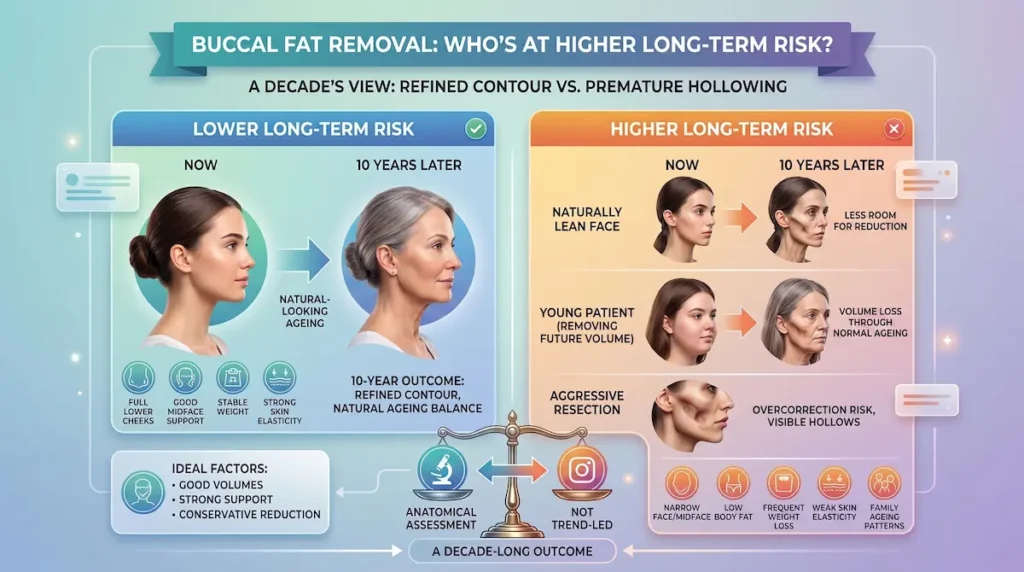
Long-term risk is not random. Certain facial profiles have less room for cheek-fat reduction and are more likely to look hollow as the years pass. This is where a proper consultation should become anatomical, not cosmetic-trend led.
A safe plan looks at facial width, cheekbone support, lower-cheek fullness, age, skin quality, weight history and family ageing patterns. The aim is not to remove fat because it is present. The aim is to decide whether reducing it will still look balanced later.
Naturally lean faces
If your face is already slim, narrow or angular, buccal fat removal may not give you “definition”. It may remove softness that your face is already short on.
This matters particularly in people with visible cheekbones, a narrow midface, low body fat or a strong tendency to lose facial fullness with weight changes. In those cases, the lower cheek may look flattering now because it provides balance, not because it is excessive.
Men also need a specific assessment because masculine definition should not become a hollow or tired look. For that angle, see how the male face responds differently.
Younger patients removing “future” volume
Younger patients often have more facial fullness than they will have later. That does not automatically make them good candidates. Sometimes the fullness they dislike is temporary youth volume that would have softened naturally over time.
This is one reason the ten-year question is so important. A result that looks sharply contoured at 24 may feel too severe at 34 if the patient also loses facial volume through normal ageing, weight loss or lifestyle changes.
A careful surgeon should discuss whether waiting, reducing less, or choosing no surgery is the wiser option. The right answer may be disappointing in the moment. It can be protective in the long run.
Aggressive resections
The amount removed matters. A conservative reduction can soften excessive lower-cheek fullness while preserving enough volume for natural movement and future ageing. An aggressive reduction can create a more obvious hollow, especially when smiling or speaking.
This is closely linked to overcorrection. If too much fat is removed, the cheek may look drawn rather than defined. That risk can become more visible as the rest of the face loses support.
For the smile-specific risk, read overcorrection and the gaunt look. This article stays focused on the ten-year ageing trajectory, but the two concerns often overlap.
| Patient profile | Likely 10-year outcome | Risk level |
|---|---|---|
| Full lower cheeks, stable weight, good midface volume | May keep a refined contour if reduction is conservative | Lower |
| Round face but weak skin elasticity or frequent weight loss | Definition may shift towards hollowing as volume changes | Moderate |
| Already slim, narrow or angular face | Higher chance of a drawn or prematurely aged look | Higher |
| Very young patient wanting a sharply carved trend-driven result | Current definition may feel too severe as natural fullness fades | Higher |
| Aggressive fat removal rather than partial reduction | Greater risk of visible hollowing, especially with age | Higher |
Ageing Well After the Procedure
Ageing well after buccal fat removal starts before surgery, not years afterwards. The most important decision is how much fat is reduced, whether the face truly needs it, and whether the plan protects future facial softness.
A good result should not depend on extreme cheek hollowing. It should still look natural in motion, in soft light, in profile and as the rest of the face continues to mature.
Conservative removal as insurance
Conservative buccal fat removal means the surgeon treats the fat pad as valuable anatomy, not as something to remove completely. This approach is especially important for patients who want definition without looking tired later.
In practical terms, that may mean partial reduction rather than aggressive excision. It may also mean advising against the procedure if the lower cheek fullness is actually giving the face balance.
At AKM Clinic, the “Natural-First” philosophy is built around rejuvenation over alteration. For facial procedures, the aim is not a pulled, wind-swept or operated-on look. It is a result that keeps the face recognisable and proportionate over time.
Volume options later
If hollowing develops years after buccal fat removal, patients sometimes ask whether it can be reversed. The honest answer is that the removed buccal fat pad does not simply grow back.
There may be ways to improve facial volume later, but they are separate treatment decisions. They can involve different techniques, different risks and a different recovery process. This article will not turn into a filler or fat-transfer guide, because the question here is whether the original buccal fat decision is likely to age well.
The better strategy is prevention. If your anatomy is borderline, preserving cheek softness now is usually wiser than trying to rebuild it later.
Skincare and lifestyle basics
Skincare will not replace lost buccal fat. It can, however, support the skin quality that helps the face age more evenly.
Sun protection, stable weight, not smoking, good nutrition and consistent skin care all influence how sharply hollowing appears over time. A face with healthier skin often tolerates contour changes better than a face with early laxity or heavy sun damage.
Weight stability is particularly important. Large weight loss after buccal fat removal can make the lower cheeks look more hollow than expected. If you are planning major weight changes, it is sensible to discuss timing before surgery.
UK patient note: When comparing buccal fat removal abroad with UK private options, use a safety benchmark rather than a price-first mindset. Ask how the surgeon assesses long-term facial ageing, what aftercare is included, and what happens if you have concerns once you are back in the UK.
Is It Worth It for You?
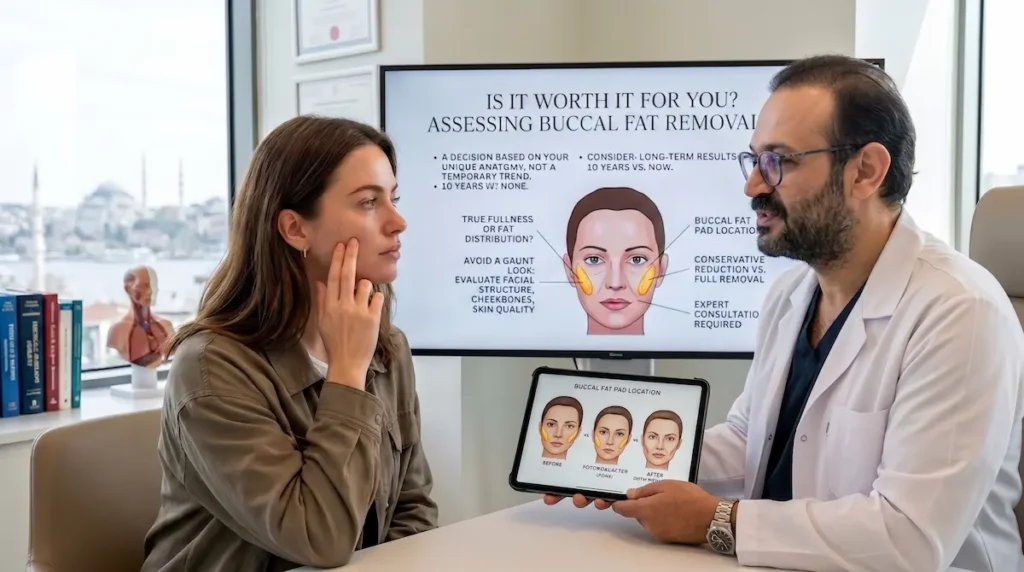
Whether buccal fat removal is worth it depends on your anatomy, not on a universal yes or no. The procedure can be satisfying for the right face, but it can be unforgiving when used on a face that does not have enough lower-cheek fullness to spare.
The best consultation should slow the decision down. It should help you imagine not only your cheek contour this year, but also how that contour may look after natural ageing, weight changes and skin-quality changes.
Weighing now versus 10 years
Start with the honest trade-off. Buccal fat removal may give more definition now, but it also removes tissue that could soften the face later.
If your cheeks are genuinely full and stay full even at a stable, healthy weight, a conservative reduction may suit you. If your face already looks slim in certain lighting, or if older relatives tend to hollow strongly with age, caution is sensible.
Ask yourself a simple question: would you still want the same amount removed if sharper cheek hollows were not fashionable? If the answer is uncertain, it may be better to wait.
Questions for consultation
A proper consultation should include more than a quick look at your cheeks. The surgeon should assess your full facial structure, including cheekbone projection, jaw shape, skin quality, age, weight stability and how your face moves when you smile.
You can use these questions to make the conversation more specific:
- Do I have true buccal fullness, or is my face simply round because of overall facial fat distribution?
- Would partial reduction be safer than full removal in my case?
- How might my cheeks look if I lose facial volume over the next decade?
- Am I at higher risk of a hollow or gaunt look because of my face shape?
- Would you advise against this procedure for my anatomy?
- What aftercare and follow-up are included once I return to the UK?
Surgeon-credential check: UK patients should avoid vague claims. Look for a clear explanation of the surgeon’s training, case suitability process and follow-up pathway. AKM’s facial surgery is led by European Board-Certified Surgeons in a GMC-equivalent framework, with surgery performed in Istanbul.
Recovery in brief
Recovery is usually shorter than many larger facial surgeries, but it still affects the final appearance. Swelling can temporarily hide the true contour, so early judgement is unreliable.
The cheeks may look fuller at first, then gradually refine as swelling settles. Final contour takes time. For a deeper timeline, see the recovery section of our buccal fat removal procedure page.
Cost is also part of planning, but it should not drive the decision. This is a long-term facial-contour procedure, not a quick beauty purchase. If you need the UK cost context, use the dedicated guide to buccal fat removal pricing in Turkey rather than relying on generic estimates.
If your goal is subtle, long-lasting refinement, the next step is an anatomy-led consultation. AKM can assess whether buccal fat removal suits your facial ageing pattern and whether a conservative plan would protect your long-term result.
Frequently Asked Questions: Buccal Fat Removal 10 Years Later
These questions cover the long-term concerns most patients raise before choosing buccal fat removal. The answers stay focused on ageing, hollowing and regret risk rather than general procedure details.
Does buccal fat removal age you?
It is more likely to create an aged look when performed aggressively on a face that is already slim, narrow or beginning to lose volume. Conservative planning lowers that risk.
Will I look gaunt in 10 years?
If you have genuinely full lower cheeks and the reduction is modest, the result may remain balanced. The key is not whether buccal fat removal is “good” or “bad”. It is whether your face has enough volume to spare.
Do people regret buccal fat removal?
Regret is less likely when the consultation includes long-term facial ageing, not just immediate cheek definition.
Is buccal fat removal reversible?
Some patients explore later volume-restoration options, but these are separate treatments with their own limitations. The better approach is to avoid over-removal in the first place.
Should younger patients wait?
Waiting can reveal whether the cheek fullness is a lasting anatomical feature or simply youth-related volume.
How do I age well after buccal fat removal?
After surgery, stable weight, sun protection, not smoking and consistent skin care can help support overall facial ageing. They cannot replace removed buccal fat, but they can help the face age more evenly.
Medical Disclaimer: This article is for general educational purposes only and is not a substitute for personalised medical advice. Buccal fat removal outcomes vary according to anatomy, age, surgical technique, healing, lifestyle and long-term facial ageing. Always consult a qualified medical professional before deciding whether a procedure is appropriate for you.
Related Treatments


Ready to Begin Your Own Transformation Journey?
Join the 2,000+ patients who have trusted Dr Akif Mehmetoğlu and the AKM Clinic team. Your journey to a more confident, naturally restored you begins with a simple, no-obligation conversation. Contact us today from the UK for your free virtual consultation.
#1: Get Your Free Personalised Quote
Start with a free, no-obligation online consultation. Share your photos, and our surgical team will provide a fully personalised treatment plan and a transparent, all-inclusive price package. There are no hidden fees.
#2: Secure Your Date & VIP Booking
Once you are ready, our dedicated patient coordinators will help you secure your procedure date. We will handle all your bookings, including your 5-star hotel accommodation and private VIP airport transfers.
#3: Arrive in Istanbul & Meet Your Surgeon
Arrive at Istanbul Airport (IST) and be greeted by your private driver. Settle into your hotel and prepare for your in-person consultation, where you will meet your specialist surgeon to finalise the details for your "natural, subtle, and restored" new look.