
If you are searching for the best deep plane facelift clinic in Turkey, the real question is not which clinic has the most polished before-and-after photos. It is whether the facility, hospital pathway, sterilization system, recovery infrastructure, and patient advocacy model can withstand serious scrutiny from a Canadian patient. That standard matters most when you are travelling from Toronto, Vancouver, Montreal, Calgary, or Ottawa for a procedure that requires precise surgical planning and careful recovery support.
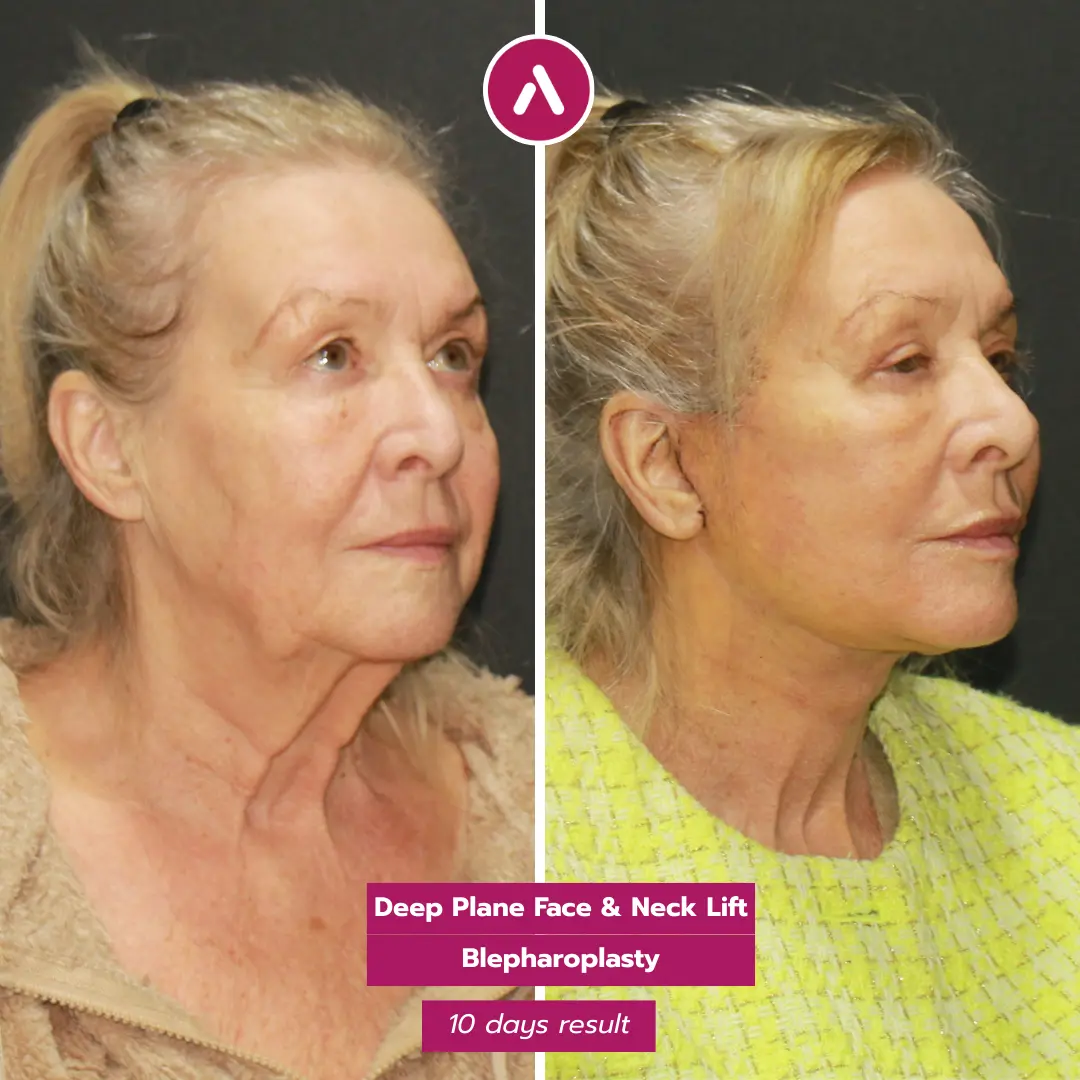
A deep plane facelift is not a casual outpatient beauty treatment. It is a structural facial rejuvenation procedure that works beneath the superficial muscle layer, so the clinic environment must be evaluated differently from a simple med-spa or injection centre. Canadian patients can begin with AKM Clinic’s deep plane facelift overview at AKM Clinic, then assess the facility itself: accreditation, operating room protocols, inpatient capacity, and post-op support.
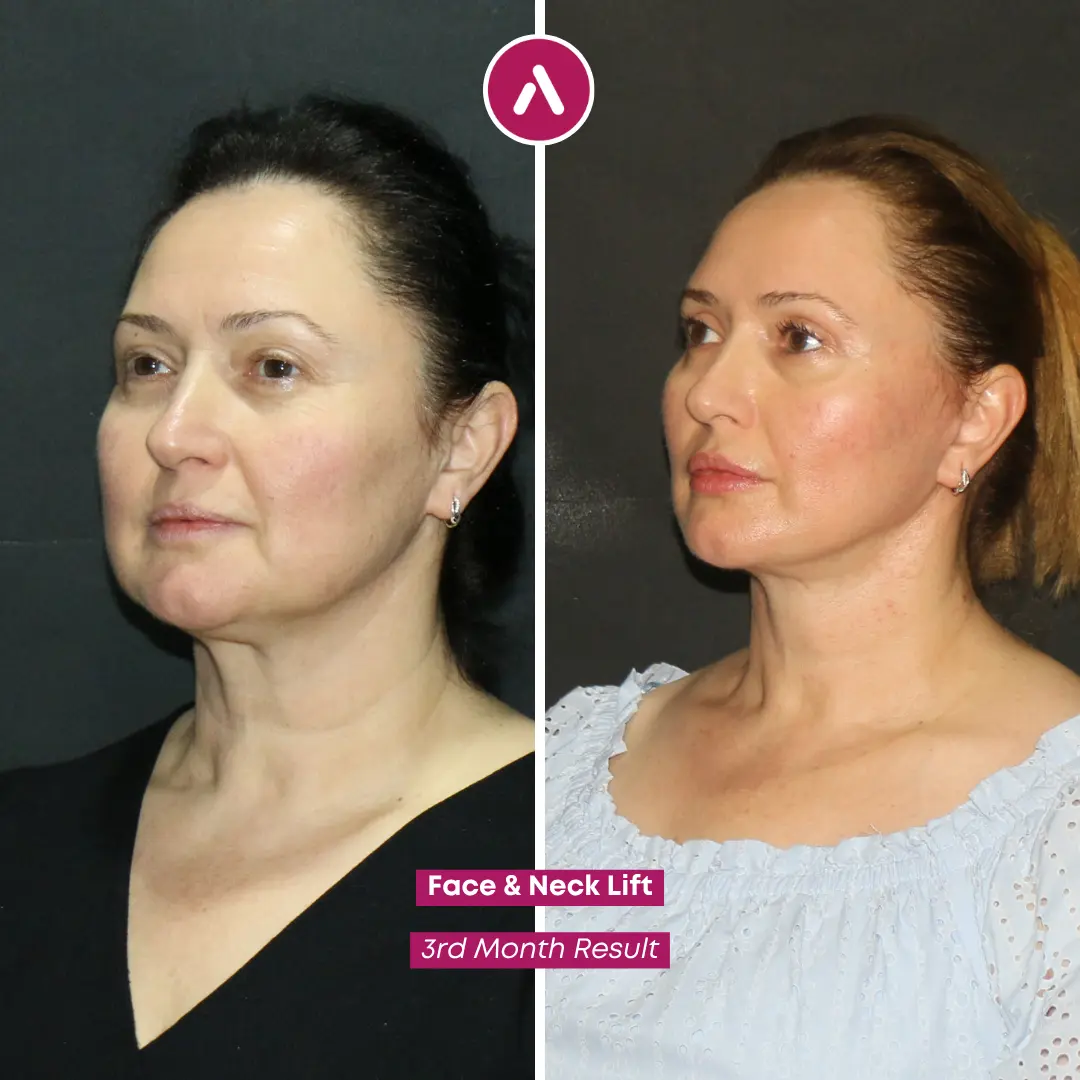
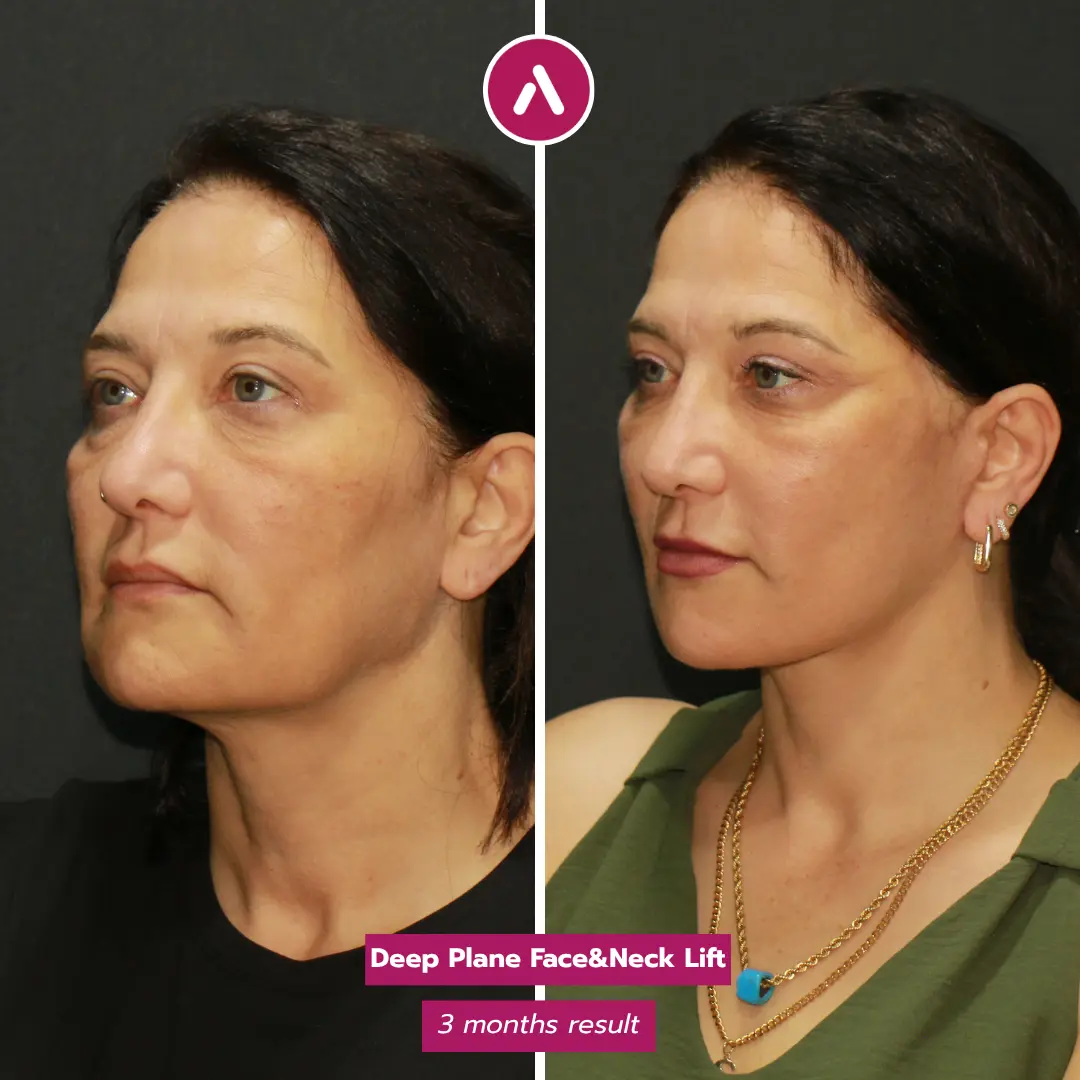
This article focuses only on clinic-level evaluation. Surgeon credentials are a separate decision layer. For that individual credential review, use the dedicated surgeon guide linked below rather than mixing facility standards with personal surgical qualifications.
Quick summary: Choosing a deep plane facelift clinic in Turkey requires evaluating institutional standards beyond marketing claims. Canadian patients should verify JCI accreditation, operating room sterilization protocols, hospital partnerships, recovery infrastructure, and 24/7 patient advocacy systems.
AKM Clinic’s model is built around a JCI-accredited surgical pathway, structured recovery support, HBOT and LLLT technology, and a patient host system designed for international patients returning to Canada.
Table of Contents
JCI Accreditation — The Non-Negotiable Standard
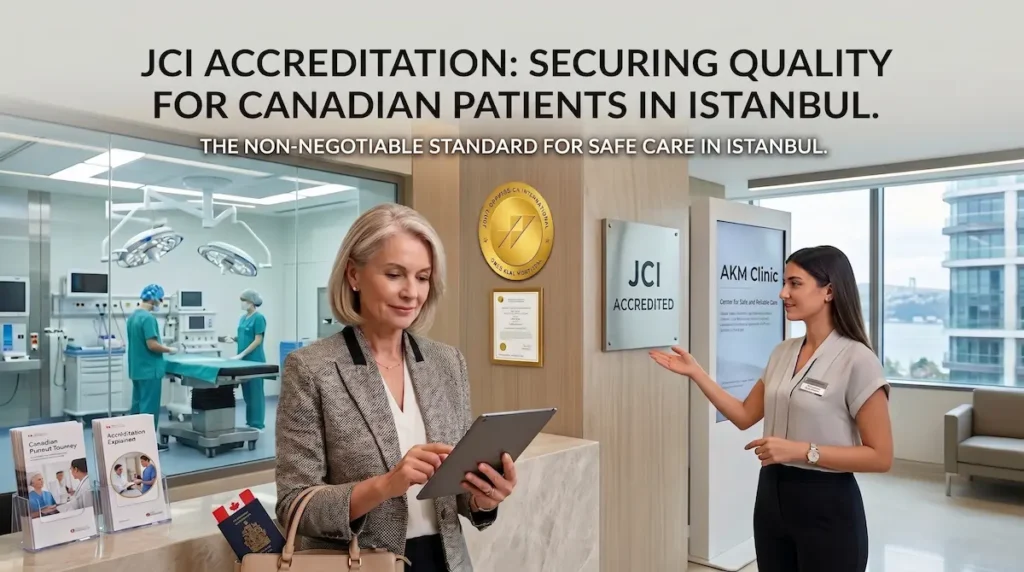
For Canadian patients, accreditation should be the first filter. A clinic can have strong branding, a busy social media presence, and persuasive testimonials, yet still fail the facility-level checks that matter during surgery and recovery. JCI accreditation gives international patients a framework for asking better questions before they book.
| What Canadians Should Verify | AKM Clinic Facility Standard |
|---|---|
| Accreditation pathway: Is the surgical environment externally assessed for patient safety and quality? | AKM Clinic performs surgery through a JCI-accredited hospital pathway for international patients. |
| Operating room safety: Are sterilization, instrument handling, and surgical field controls documented? | AKM Clinic applies a zero-compromise sterile field policy with multi-stage sterilization protocols. |
| Hospital capacity: Can the facility support overnight monitoring and escalation if needed? | Deep plane facelift patients are managed through a hospital-based pathway rather than a cosmetic-only room. |
| Recovery infrastructure: Is recovery supported beyond discharge? | Patients receive structured follow-up, patient host access, and recovery technology support. |
| International communication: Can Canadian patients reach someone after they leave Istanbul? | AKM Clinic provides 24/7 advocacy and North American support access for post-op questions. |
What Joint Commission International accreditation actually requires
Joint Commission International, or JCI, is an international accreditation body that evaluates healthcare organizations against patient safety and quality standards. Its standards are built around measurable expectations, including care delivery, facility processes, risk reduction, and continuous quality improvement. Canadian patients can review the official Joint Commission International standards before comparing any Istanbul clinic.
That matters because “international clinic” is not a regulated phrase. Any provider can use it. Accreditation is different because it requires external assessment and ongoing compliance rather than self-description.
Why JCI matters for Canadian patients accustomed to provincial standards
Canadian patients are used to a healthcare system where facilities are regulated through provincial colleges, ministries, and inspection frameworks. Ontario patients may know the College of Physicians and Surgeons of Ontario. British Columbia patients may recognize the CPSBC’s private facility accreditation structure. Quebec patients often think in terms of CMQ and provincial oversight.
Turkey does not operate under OHIP, MSP, RAMQ, or AHCIP. That does not automatically make care unsafe, but it does mean Canadians need a different verification model. JCI gives patients a familiar concept: external standards, facility review, and safety benchmarks.
Canadian Callout: Compare systems, not slogans
In Ontario, out-of-hospital premises are subject to inspection requirements through CPSO before certain procedures can be performed. Canadian patients should use that mindset abroad. Ask what equivalent external facility review exists, who performs surgery, where surgery takes place, and what happens if post-op monitoring is needed.
How to verify JCI status independently
A clinic’s website is a starting point, not the final proof. Ask for the exact hospital name, not just the phrase “JCI-accredited hospital.” Then verify whether that facility is listed through JCI’s official channels or request documentation from the clinic coordinator.
This is also where cannibalization matters. A clinic can have a strong facility while still requiring separate surgeon evaluation. For individual credentials, fellowship background, board certification, and surgical volume, use for the surgeon-level evaluation criteria, see our deep plane facelift surgeon guide. For a deeper explanation of facility accreditation itself, read JCI accreditation explained for Canadian patients.
Operating Room and Sterilization Standards
Deep plane facelift surgery relies on controlled access to deeper facial tissue planes. That makes infection prevention, instrument processing, operating field discipline, and traceability central to the clinic decision. The best facility is not the one that talks most about luxury. It is the one that can explain how risk is reduced before, during, and after the procedure.
CDC-aligned sterilization protocols
AKM Clinic’s internal standards describe strict multi-stage sterilization protocols and the use of autoclaves for surgical instruments. For a Canadian patient, this is the type of detail worth asking about directly. You should not be satisfied with “everything is sterile.” Ask how instruments are processed, logged, stored, and prepared before surgery.
A safe clinic should be able to explain its sterilization flow in plain language. That includes cleaning, packaging, autoclave processing, sterile storage, and handling inside the operating theatre. These steps are not decorative. They are basic infection prevention.
Operating field integrity standards
The operating field is the immediate sterile environment around the patient and surgical team. In facial surgery, this field must be protected throughout the case because the incision areas sit close to hair, ears, and skin folds that naturally carry bacteria. Good technique helps. System discipline helps more.
AKM Clinic’s documented approach includes a zero-compromise sterile field policy. That means the clinic’s safety model is not based on the surgeon alone. It depends on the whole team following the same field integrity process from preparation to dressing.
Equipment certification and traceability
Canadian patients should ask whether surgical equipment is maintained, certified, and traceable. This includes autoclaves, monitoring devices, anesthesia-related equipment, and recovery technologies. If a clinic cannot explain how equipment is inspected or maintained, that is a facility-level warning sign.
For a broader risk analysis before choosing any Turkish provider, review AKM’s Canadian safety perspective on Turkish cosmetic surgery. The safest choice is not built on one claim. It is built on many verifiable systems working together.
Hospital Partnership and Inpatient Capacity
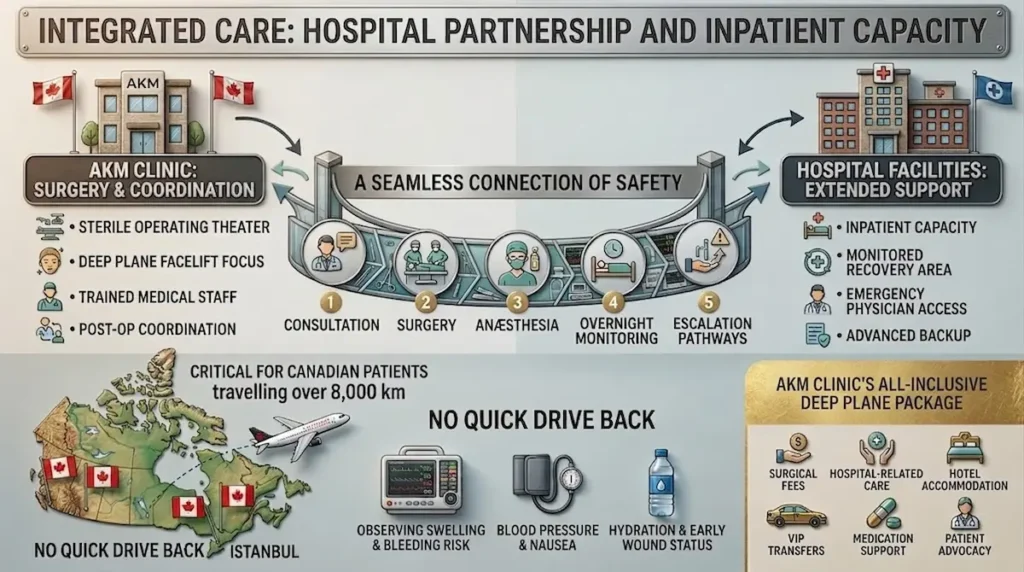
A deep plane facelift clinic should not be evaluated as a stand-alone storefront. The safest model connects consultation, surgery, anesthesia, overnight monitoring, and escalation pathways into one coordinated system. For Canadians travelling more than 8,000 km from home, that institutional connection is a major part of the decision.
“For international patients, surgical skill is only one part of safety. The facility must support the surgeon with sterile operating conditions, monitored recovery, trained nursing, and a clear escalation pathway if the patient needs more observation.”
Why outpatient-only clinics are insufficient for deep plane work
Some cosmetic procedures can be safely performed in a limited outpatient setting. A deep plane facelift deserves a higher threshold. The procedure works in deeper tissue planes, often involves the lower face and neck, and may require more post-op observation than a short minor treatment.
That does not mean every patient needs a long hospital stay. It means the clinic should have access to proper inpatient capacity when it is clinically appropriate. If a provider cannot clearly explain where surgery occurs, who monitors the patient afterward, and how complications are escalated, Canadian patients should pause.
AKM’s overnight monitoring infrastructure
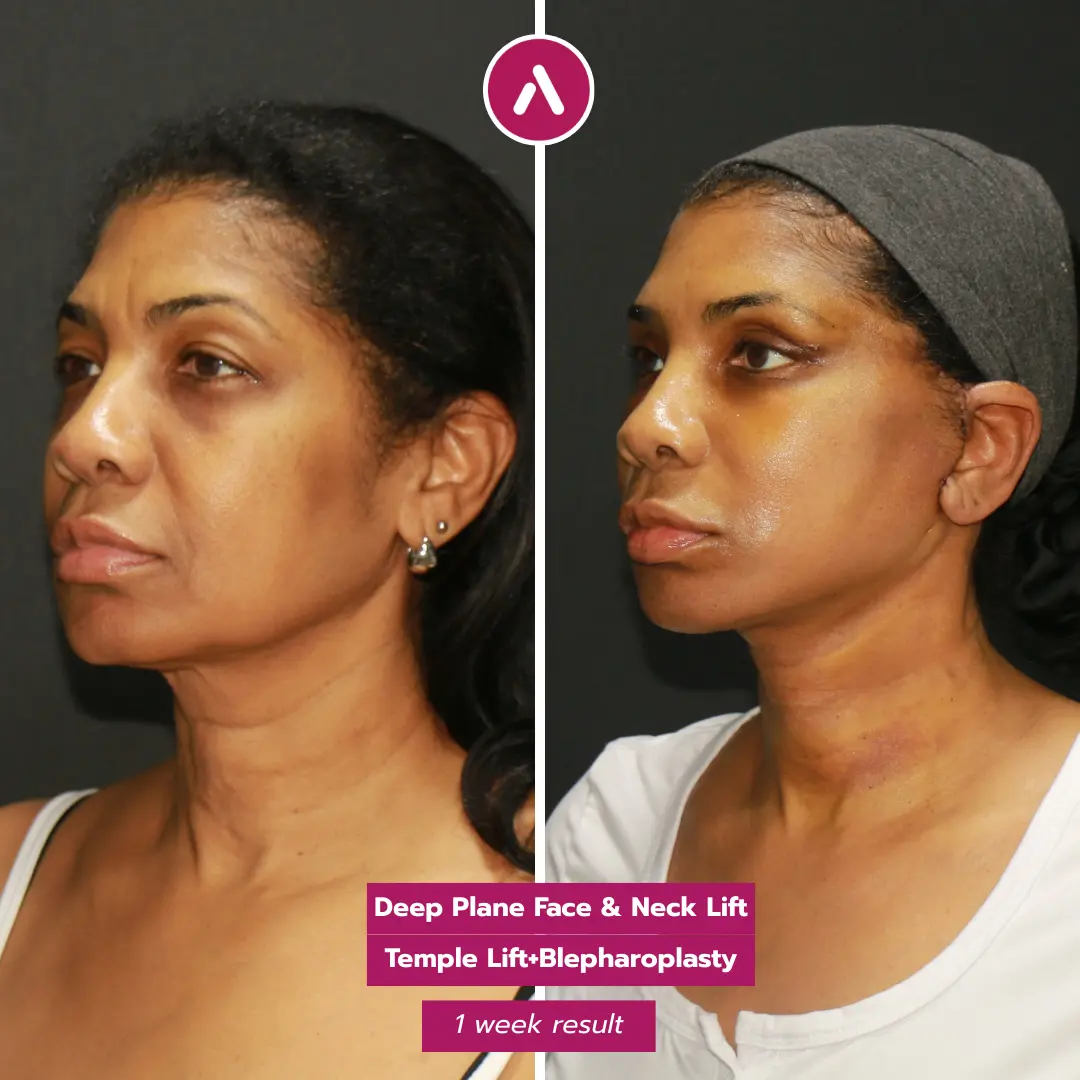
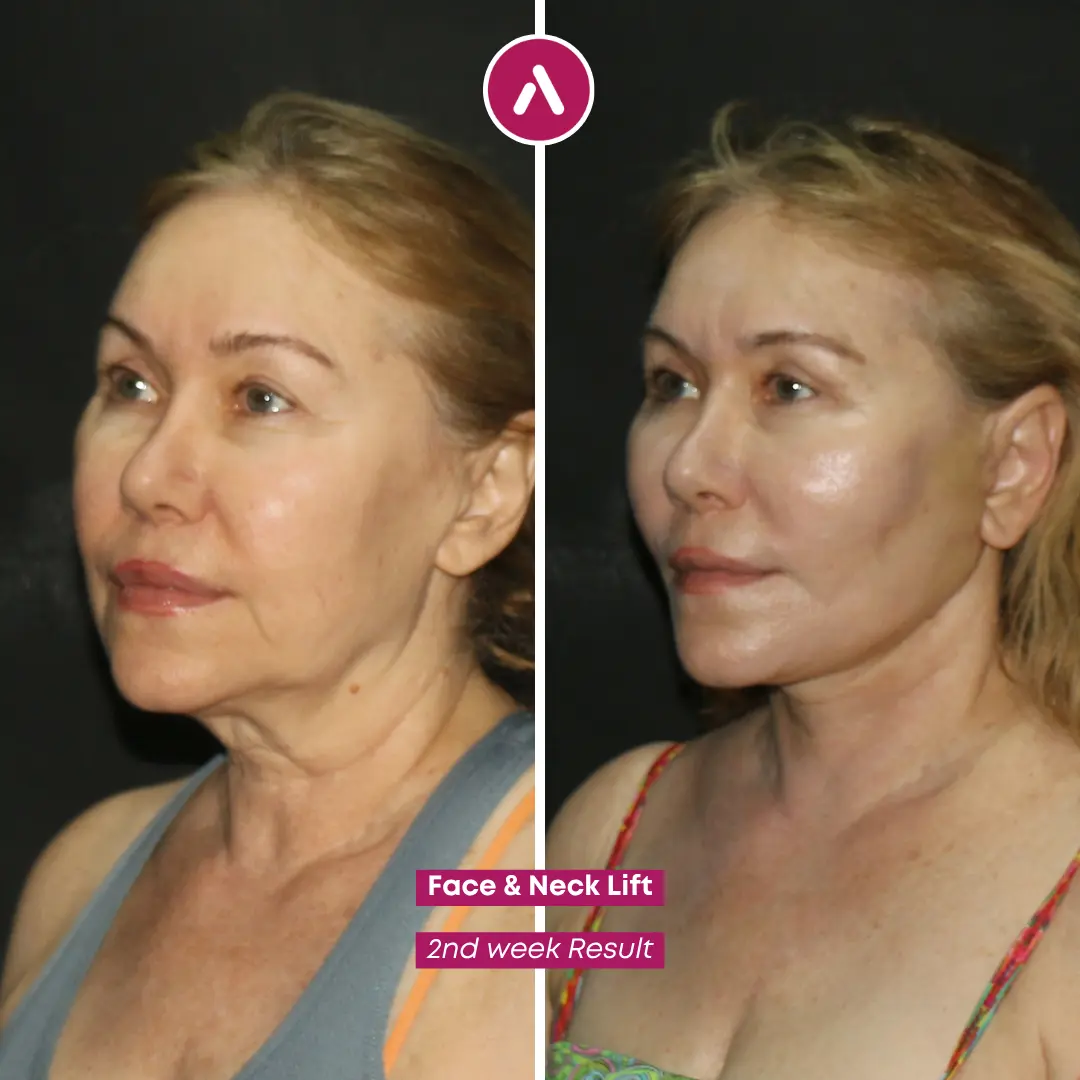
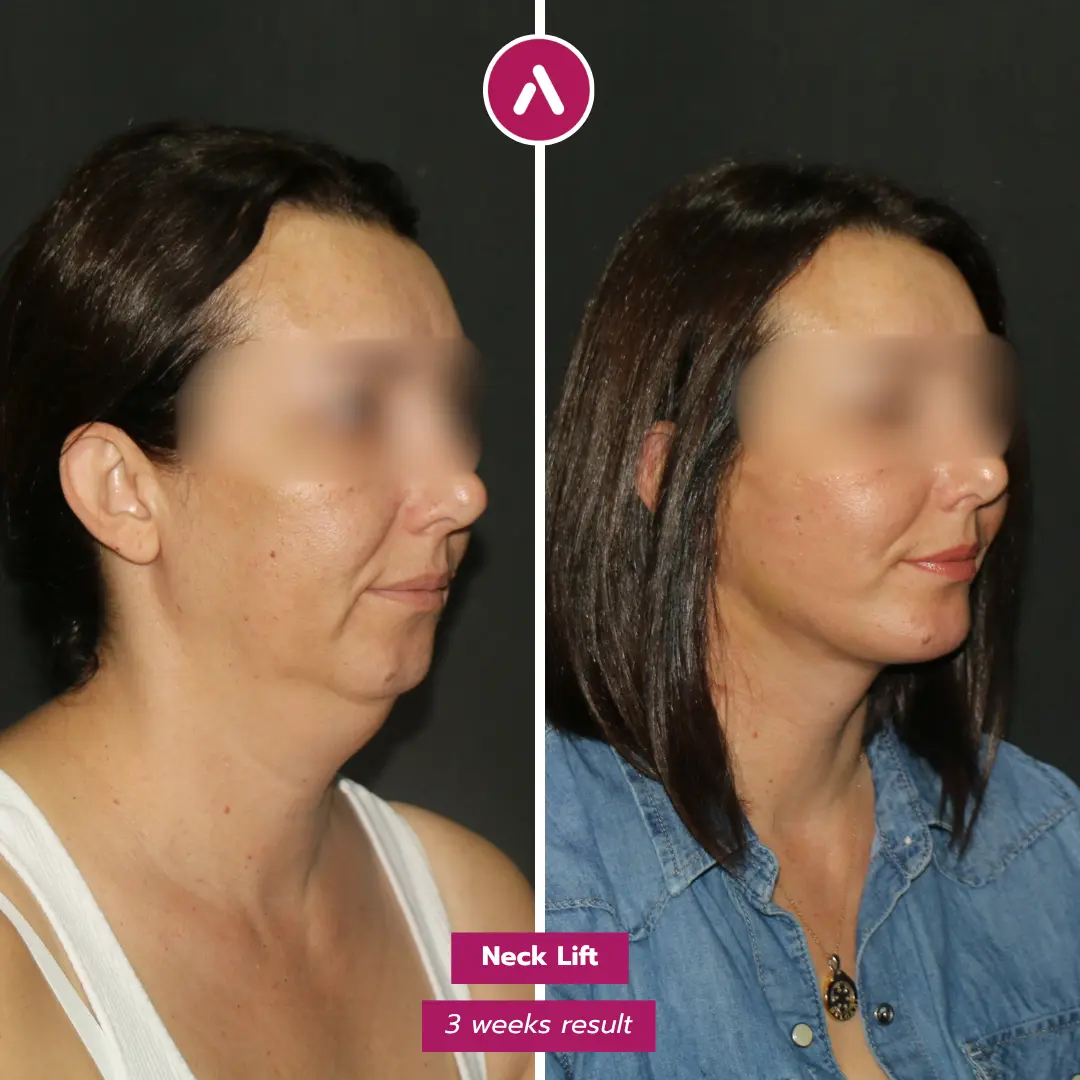
AKM Clinic’s model includes hospital-based surgical care with structured post-operative observation. For deep plane facelift patients, this creates a safer bridge between the operating theatre and hotel recovery. It also gives the medical team time to observe swelling, bleeding risk, blood pressure, nausea, hydration, and early wound status before the patient returns to the hotel environment.
This matters for patients from Toronto, Vancouver, Montreal, Calgary, and Ottawa because there is no quick drive back to a Canadian clinic after discharge. The first post-op night carries practical importance. A monitored setting reduces avoidable uncertainty.
Emergency escalation protocols
No responsible clinic should describe complications as impossible. The better question is how quickly the team can recognize a concern and act. Canadian patients should ask about emergency physician access, hospital transfer processes, anesthesia backup, nursing ratios, and direct surgeon availability.
AKM Clinic’s all-inclusive Deep Plane Facelift package is listed at CAD $7,500 in the AKM Clinic Packages List. That figure is relevant here because the value is not only the operation itself. It reflects a coordinated structure that includes surgical fees, hospital-related care, hotel accommodation, VIP transfers, medication support, and patient advocacy.
Canadian Callout: Ask the same questions you would ask in Canada
If you were choosing a private surgical facility in Ontario, British Columbia, or Quebec, you would ask who accredits the site, where anesthesia is provided, and what happens if you need extra monitoring. Bring that same standard to Istanbul. The geography changes. The safety questions should not.
Recovery Infrastructure — Hotel and Aftercare
The facility decision does not end when surgery ends. For a Canadian patient, recovery infrastructure is part of clinical safety because the early healing period happens in a foreign city. The hotel, transport system, nursing access, communication model, and recovery technologies all affect how comfortably and safely a patient moves through the first week.
The Point Barbaros 5-star recovery environment
AKM Clinic works with The Point Barbaros, a 5-star hotel environment selected for international medical guests. The purpose is not luxury for its own sake. A calm, predictable recovery setting reduces stress, limits unnecessary movement, and gives patients privacy during swelling, bruising, and early fatigue.
Canadian patients should think practically here. After a deep plane facelift, you do not want to manage taxis, unfamiliar neighbourhoods, language barriers, or complicated transfers. A structured hotel pathway helps patients focus on rest, wound care, hydration, and follow-up appointments.
On-site nursing and 24/7 advocate access
A good recovery system gives patients a clear answer to one anxious question: “Who do I contact if something feels wrong tonight?” AKM Clinic’s patient support model is built around 24/7 access and dedicated patient advocacy. That is especially important for patients travelling solo from Canada.
This advocacy model also helps avoid unnecessary panic. Early recovery sensations can feel strange: tightness, numbness, pressure, asymmetric swelling, and bruising changes. A trained team can distinguish expected healing from symptoms that need medical attention.
HBOT and LLLT integration into the recovery week
AKM Clinic’s recovery infrastructure includes Hyperbaric Oxygen Therapy (HBOT) and Low-Level Laser Therapy (LLLT). HBOT supports oxygen delivery to healing tissues and helps reduce inflammation. LLLT uses 650 nm medical-grade laser diodes to support cellular ATP production and tissue repair.
For Canadian patients preparing for a long-haul return flight, this recovery technology stack is more than a comfort feature. It is part of a risk-reduction strategy designed to support tissue healing, reduce edema, and improve readiness for travel. You can review our recovery infrastructure standards for more detail on how AKM Clinic integrates HBOT and LLLT into surgical aftercare.
Canadian Callout: Recovery support matters before the flight home
A patient flying back to YYZ, YUL, YVR, or YYC is not recovering in the same context as someone who lives 20 minutes from the clinic. Long-haul travel adds swelling, fatigue, and mobility considerations. A clinic’s recovery plan should account for that before surgery is booked.
Patient Advocacy and Communication Standards
A facility can be clinically strong and still feel unsafe to an international patient if communication breaks down. Canadians are often used to continuity through a family physician, a provincial health portal, or a familiar clinic system. In Istanbul, that continuity must be built through patient advocacy, translation support, written instructions, and long-term follow-up.
Hande, Emine, and Khadija — the patient host system
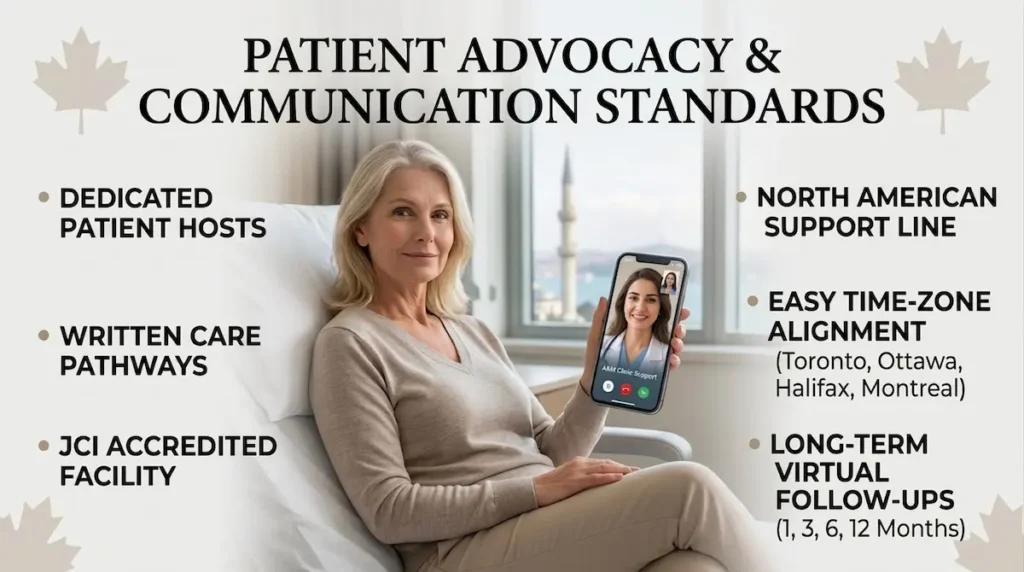
AKM Clinic’s patient host system includes Hande, Emine, and Khadija. Their role is practical: helping patients move through appointments, transport, hotel recovery, questions, timing, and post-operative communication. For a Canadian patient, that support reduces the sense of being alone in a different healthcare system.
This is part of AKM Clinic’s institutional structure, not a concierge add-on. In a strong clinic model, the patient host is connected to the medical team and knows when a concern needs clinical review. That distinction matters.
North American support line accessibility
AKM Clinic maintains a North American support line through its New York office. For Canadian patients, this helps with time-zone alignment after returning home. A patient in Toronto, Ottawa, Halifax, or Montreal should not have to wait through a full Istanbul business day to ask a recovery question.
Communication access also affects booking confidence. A serious clinic should be able to explain package inclusions, hotel nights, medication support, follow-up timing, and what is not included. AKM Clinic’s model is transparent: international flights, companion travel, and personal spending are not included.
Long-term follow-up programme structure
Deep plane facelift recovery does not end at the airport. AKM Clinic uses virtual follow-up checkpoints at 1, 3, 6, and 12 months. This gives Canadian patients a structured line of communication after they return to regular life in Canada.
For a wider facility-level comparison, see AKM’s guide to broader Canadian clinic evaluation criteria. The same principles apply here: verify the facility, confirm the recovery pathway, and make sure communication does not disappear after payment.
Canadian Callout: Provincial oversight versus international advocacy
In Canada, provincial bodies such as CPSO, CPSBC, and CMQ shape expectations around facility standards and physician accountability. Abroad, patients must recreate that confidence through verification: hospital accreditation, written care pathways, named patient hosts, and clear post-op contact channels. The College of Physicians and Surgeons of Ontario is a useful reference point for how Canadians think about medical oversight.
Choosing the best deep plane facelift clinic in Turkey should feel more like a facility audit than a beauty-shopping exercise. Ask about JCI accreditation. Ask where surgery happens. Ask who monitors you overnight. Ask who answers your WhatsApp message at 11 p.m. after you return to your hotel.
The right clinic will not be offended by those questions. It will already have the answers.
CTA: Verify AKM Clinic’s facility credentials, recovery infrastructure, and patient advocacy model before booking your consultation.
Frequently Asked Questions: Best Deep Plane Facelift Clinic in Turkey
Canadian patients usually ask facility-level questions before they ask aesthetic questions. That is reasonable. A natural-looking result only matters if the clinical setting, recovery pathway, and communication standards are strong enough to support it.
How do I verify JCI accreditation?
Ask for the exact name of the hospital where surgery will be performed. Then check the hospital’s accreditation status through Joint Commission International’s official resources or request documentation from the clinic coordinator.
Is overnight hospital stay included?
AKM Clinic’s deep plane facelift pathway includes hospital-based surgical care and post-operative monitoring. The exact length of observation depends on the patient’s surgical scope, anesthesia plan, and clinical status after surgery.
What is AKM’s relationship with the partner hospital?
AKM Clinic coordinates surgery through a JCI-accredited hospital pathway. This means the surgical environment, anesthesia support, and recovery observation are connected to a hospital system rather than a cosmetic-only room.
How is infection prevention managed?
AKM Clinic uses multi-stage sterilization protocols, autoclave processing, and strict sterile field discipline. Canadian patients should ask any clinic they are considering to explain these steps clearly before booking.
Who can I reach 24/7 during recovery?
AKM Clinic provides 24/7 patient advocacy through its support and coordination team. Patients are guided by named hosts such as Hande, Emine, and Khadija during the Istanbul portion of care.
What separates AKM from a typical “clinic” in Istanbul?
The key difference is infrastructure. AKM combines a JCI-accredited surgical pathway, hospital monitoring, 5-star hotel recovery support, HBOT and LLLT technology, and long-term virtual follow-up for international patients.
Can I tour the facility virtually before booking?
Canadian patients can request a virtual consultation and ask for facility information before confirming dates. A serious clinic should be comfortable explaining where surgery takes place, how recovery is managed, and who supports the patient after discharge.
Medical Disclaimer: This page is provided for general educational purposes only and does not replace an in-person medical consultation, diagnosis, or personalized treatment plan. All surgery carries risks, and outcomes vary between individuals. Suitability for facelift surgery, procedure selection, and anesthesia choice can only be determined after a full clinical assessment by a qualified surgeon. Always follow your clinician’s instructions and seek urgent medical attention if you develop concerning symptoms during recovery.