

If you’re searching for the best deep plane facelift clinic in Turkey, you’re already asking the right question—but the “best” isn’t only about an impressive before/after gallery. For a deep plane facelift, the clinic’s facility standards (sterilization, anesthesia safety, emergency readiness, and post-op monitoring) are inseparable from the final outcome. In other words: beautiful results need a safe system behind them.
This facility review is written for the patient who thinks like an investigator—someone who wants proof, process, and transparency. We’ll focus on what you can verify, what you should ask, and what a high-standard clinic in Istanbul should be able to explain clearly—without vague promises. You’ll also see why modern medical science supports structured safety protocols and why “technology” only matters when it’s built on fundamentals.
What this review covers: facility infrastructure only — sterile processing, anesthesia governance, intra-op monitoring, first-night observation, escalation and transfer planning, and post-travel follow-up. It does not cover pricing tiers, package contents, or surgeon-by-surgeon comparison; those live on separate pages linked throughout. If you are at the stage of comparing quotes rather than facilities, start with the deep plane facelift cost breakdown for Turkey instead and return here once you have two or three clinics on your shortlist.
If you want to understand the procedure itself before evaluating which facility to trust with it — including the technique-specific anatomy, the composite-flap dissection sequence, and the recovery timeline — start with our complete deep plane facelift technique manual at AKM Clinic, which catalogs the procedural steps, candidacy criteria, and the surgical anatomy this facility-evaluation guide assumes you already understand as baseline.
Facility-first mindset: The safest clinic is the one that can show you its system—sterility workflow, anesthesia monitoring standards, and what happens if something unexpected occurs.
Table of Contents
How to Choose the Best Deep Plane Facelift Clinic in Turkey (Safety-First Criteria)
Deep plane facelift surgery is technically demanding and recovery-sensitive. Even with an excellent surgeon, outcomes can be compromised by weak anesthesia protocols, poor infection control, or inadequate post-op monitoring. If you're evaluating the best deep plane facelift clinic Turkey searches you're seeing online, use the criteria below to separate "marketing" from real infrastructure.
This guide is the facility-evaluation half of your decision. The individual-credentials half — board certifications, fellowship training, ISAPS membership, surgeon-specific case volumes, and how to verify a single surgeon's qualifications independently of the clinic's facility infrastructure — is documented in our companion guide on verifying individual deep plane facelift surgeon credentials and fellowship training. Read both: a great clinic with the wrong surgeon is unsafe, and a great surgeon in the wrong facility is equally exposed.
Why a Deep Plane Facelift Is Facility-Dependent (Not Just Surgeon-Dependent)
A deep plane facelift isn’t a quick, surface-level procedure. It involves deeper structural work that requires:
- Consistent anesthesia safety (monitoring, medication checks, airway planning, blood pressure control).
- Strict sterile technique and instrument processing (to reduce infection risk).
- Clear escalation pathways (what the team does if a complication is suspected).
- Post-op observation designed to catch issues early (especially in the first 24–48 hours).
This is why “best” should mean: the clinic can explain its system in detail, and it matches what a cautious, evidence-based approach would require.
The Non-Negotiables: Anesthesia, Monitoring, Sterility, Emergency Pathways
Here’s what a serious facility should be able to articulate—calmly, clearly, and specifically:
- Anesthesia & monitoring: Who provides anesthesia, what monitoring is used continuously during surgery, and how risks are assessed pre-op.
- Sterilization & hygiene protocols: How instruments are cleaned/sterilized, how sterility is maintained during surgery, and what “zero-compromise” means in daily practice.
- Emergency readiness: The clinic’s response plan for bleeding concerns, blood pressure spikes, medication reactions, or airway issues.
- Transfer plan: If a higher level of care is needed, what the pathway is (who decides, how fast, and where).
Expert-patient clue: Clinics that avoid specifics ("Don't worry, we've never had a problem") are less reassuring than clinics that can describe a robust plan. A 2024 systematic review published in the National Library of Medicine examining modern surgical site infection prevention strategies and evidence-based protocol gaps documented that intraoperative antibiotic redosing during prolonged procedures significantly lowered surgical site infection risk versus no redosing — and reinforced that systematic protocols, checklist-based verification, and standardized timing decisions consistently outperform ad-hoc clinical judgment. Scientific research and clinical best practices consistently favor systems thinking: risk reduction comes from protocols, checklists, and early detection—not optimism.
A Verification Checklist You Can Use Before Booking (Documents + Questions)
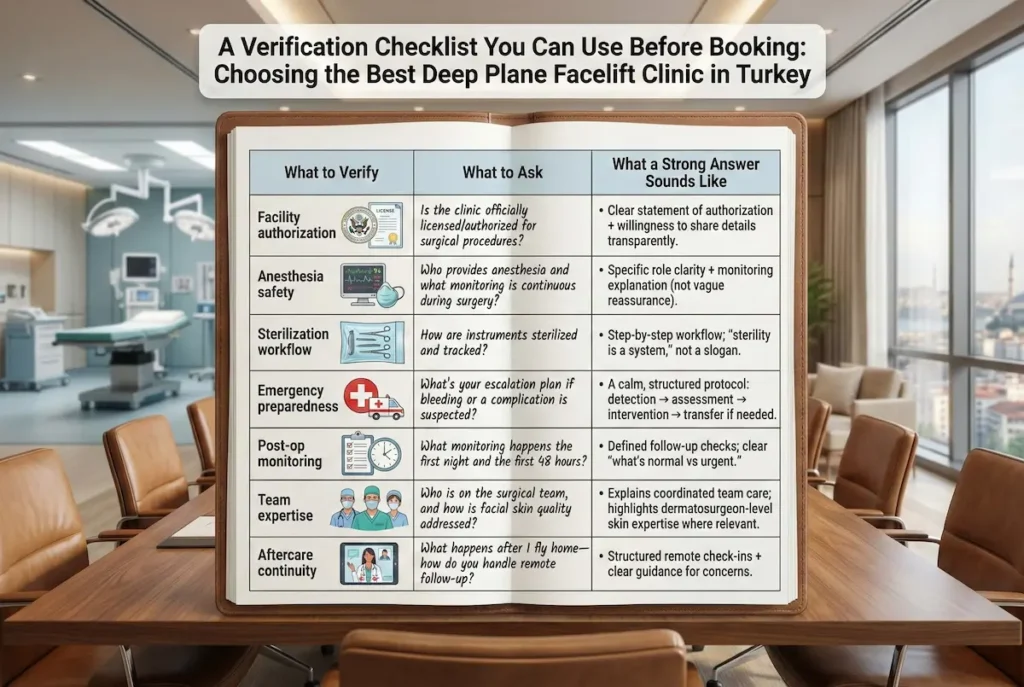
If you're deciding between options for the best deep plane facelift clinic in Istanbul, use this checklist to guide your calls and messages. A high-standard clinic won't be offended—these are reasonable, safety-driven questions.
Beyond facility-specific questions, there's a broader catalog of pre-op questions every international patient should run through during consultation — covering procedure logistics, recovery expectations, payment terms, and aftercare continuity. Our complete comprehensive patient FAQ database covering every stage of the AKM facelift journey consolidates the questions our coordinators have answered most frequently, organized by procedure phase from initial inquiry through 12-month follow-up.
| What to Verify | What to Ask | What a Strong Answer Sounds Like |
|---|---|---|
| Facility authorization | Is the clinic officially licensed/authorized for surgical procedures? | Clear statement of authorization + willingness to share details transparently. |
| Anesthesia safety | Who provides anesthesia and what monitoring is continuous during surgery? | Specific role clarity + monitoring explanation (not vague reassurance). |
| Sterilization workflow | How are instruments sterilized and tracked? | Step-by-step workflow; “sterility is a system,” not a slogan. |
| Emergency preparedness | What’s your escalation plan if bleeding or a complication is suspected? | A calm, structured protocol: detection → assessment → intervention → transfer if needed. |
| Post-op monitoring | What monitoring happens the first night and the first 48 hours? | Defined follow-up checks; clear “what’s normal vs urgent.” |
| Team expertise | Who is on the surgical team, and how is facial skin quality addressed? | Explains coordinated team care; highlights dermatosurgeon-level skin expertise where relevant. |
| Aftercare continuity | What happens after I fly home—how do you handle remote follow-up? | Structured remote check-ins + clear guidance for concerns. |
In AKM Clinic's patient stories, one pattern repeats: "expert patients" tend to choose clinics that can demonstrate process and consistency—not just attractive photos. For example, Barbara (USA) described doing extensive research and valuing a system that delivered a comfortable, controlled recovery and a natural result.
The verification checklist above covers facility-side due diligence. For the parallel due diligence on the surgical team — including how to look up Turkish Plastic Surgery Society (TPCD) registration, ISAPS membership status, EBOPRAS board certification, and the cross-reference databases that catch fraudulent credential claims — our complete walkthrough of step-by-step verification process for Turkish plastic surgeon credentials with public-database lookups shows exactly which official registries to check before you book.
Patient-style outcome language (natural result): "It looks like nothing happened… just 20 years younger."
Beyond curated patient quotes, the most credible facility-evaluation evidence is third-party review aggregation that cannot be selectively edited by the clinic. The full audit-trail of verified Trustpilot, Google, and structured patient reviews — filterable by procedure type, recovery technology used, and follow-up timestamp — is available on our third-party verified review aggregation hub for AKM Clinic facility outcomes, where each entry includes surgery date and is independently verifiable rather than testimonial-style copy.
Red Flags vs. Green Flags: How to Validate a Facelift Facility Before You Book
Online galleries can look similar, so the safest decision comes from verifying how a clinic operates day-to-day. Whether you’re aiming for the best facelift clinic in turkey or a more specialized plan like deep plane facelift turkey, focus on measurable standards: licensing, anesthesia governance, sterile processing, and a documented complication-response pathway.
How to Read Reviews Like an Expert Patient
When you scan facelift in turkey reviews, prioritize comments that describe processes (pre-op testing, first-night monitoring, follow-up access) over vague praise. Consistent mentions of clear instructions, timely responses, and organized post-op checks are stronger signals than “VIP” language alone.
Facility Proof You Can Request (Without Feeling Awkward)
Ask for a written patient journey: what happens pre-op, intra-op, and during the first 72 hours. Confirm who provides anesthesia, what continuous monitoring is used, and how emergencies are handled. A trustworthy clinic answers calmly and specifically, and can explain transfer planning if higher-level care is needed.
What’s Included: Clarity Prevents Last-Minute Surprises
Request a simple inclusions list: post-op visits, medications, recovery support, and how urgent concerns are managed. Clear terms reduce anxiety and help you compare clinics fairly—especially around aftercare, re-check appointments, and remote follow-up once you’re home.
Communication & Continuity for International Patients
For deep plane facelift istanbul travelers, continuity matters as much as the procedure. Ensure you’ll receive a post-op schedule, “normal vs urgent” guidance, and structured remote follow-ups after you return home. The best facilities don’t rely on reassurance; they rely on protocols, documentation, and a team that stays reachable throughout recovery.
Where Deep Plane Facelift Surgery Actually Happens in Istanbul (Clinic Room vs. Full Surgical Facility)
Istanbul complicates facility evaluation in one specific way: the address on the website is often not the address where you will be operated on. Three arrangements are common, and they carry very different monitoring capabilities.
- Consultation-only office + partner surgical hospital. The clinic you meet in Nisantasi, Etiler or Levent handles consultation and dressing changes; the operation takes place in a contracted hospital with its own anesthesia department and inpatient beds. This is the arrangement AKM Clinic uses for deep plane cases.
- Licensed day-surgery centre. Operation and same-day discharge under one roof. Workable for shorter procedures, but ask directly what happens if you need overnight observation rather than a taxi to your hotel at 8pm.
- Procedure room in a medical aesthetics centre. Suitable for injectables and thread lifts, not for a composite-flap dissection under general anesthesia. If a clinic offers deep plane surgery in a room with no piped medical gas, no anesthesia machine and no recovery bay, that answer alone ends the evaluation.
The question that separates these three in one sentence: "What is the name and address of the building where my surgery will be performed, and can I see the recovery area before I consent?" A facility working within a contracted hospital will name it without hesitation. A clinic that answers with the consultation address when asked about the operating address is telling you something.
For a deep plane facelift specifically, the reason this matters is duration and depth. The dissection runs beneath the SMAS and releases the retaining ligaments; combined face and neck cases regularly run several hours under general anesthesia, followed by a night where blood pressure spikes are the single most important thing anyone can watch for. That night needs a nurse and a monitor, not a hotel room and a phone number.
Operating Room & Sterilization Standards (What You Should Expect to See)
When patients search for the best deep plane facelift clinic in Turkey, they often focus on best surgeon credentials and before/after photos—and they should. But for a deep plane facelift, the operating room and sterilization standards are just as outcome-critical. The reason is simple: a clean, well-controlled OR reduces infection risk, supports safe anesthesia delivery, and creates a predictable environment for meticulous facial work.
Beyond a clinic's own internal protocols, the most rigorous external verification of facility safety is third-party hospital accreditation. The Joint Commission International (JCI) is the global gold standard for hospital accreditation, and the specific safety criteria, audit cycle, and infection-control requirements that JCI-accredited Istanbul hospitals must meet are catalogued on our complete breakdown of JCI accreditation criteria as the gold standard for facelift facility safety verification, which lists the JCI-accredited Istanbul hospitals where AKM Clinic's deep plane facelift surgeries are performed and the audit-trail evidence patients can request.
Sterilization Workflow: Instrument Processing, Infection-Control Protocols
Sterilization is not a single step—it’s a chain of steps. Breaks in the chain create risk. A serious clinic should be able to describe (and ideally document) how instruments are handled from the moment they leave the OR to the moment they return, sterile and ready.
- Segregation of “dirty” vs. “clean” zones: Instruments should move through a controlled process, not the same “general” area.
- Validated sterilization cycles: The clinic should follow established protocols for sterilization cycles and handling.
- Packaging and storage integrity: Sterile instruments must be sealed and stored in a way that prevents contamination before use.
- Single-use items where appropriate: Some consumables should not be reused—this is a standard safety logic.
How an expert patient thinks: In medicine, infection prevention is a systems problem. A clinic’s confidence should come from protocols and traceability—not from “we’ve never had an issue.”
What to listen for: A clinic that is truly structured will describe its workflow in a calm, procedural way—like a pilot explaining a pre-flight checklist. That “checklist culture” is aligned with what medical science has learned about reducing preventable errors.
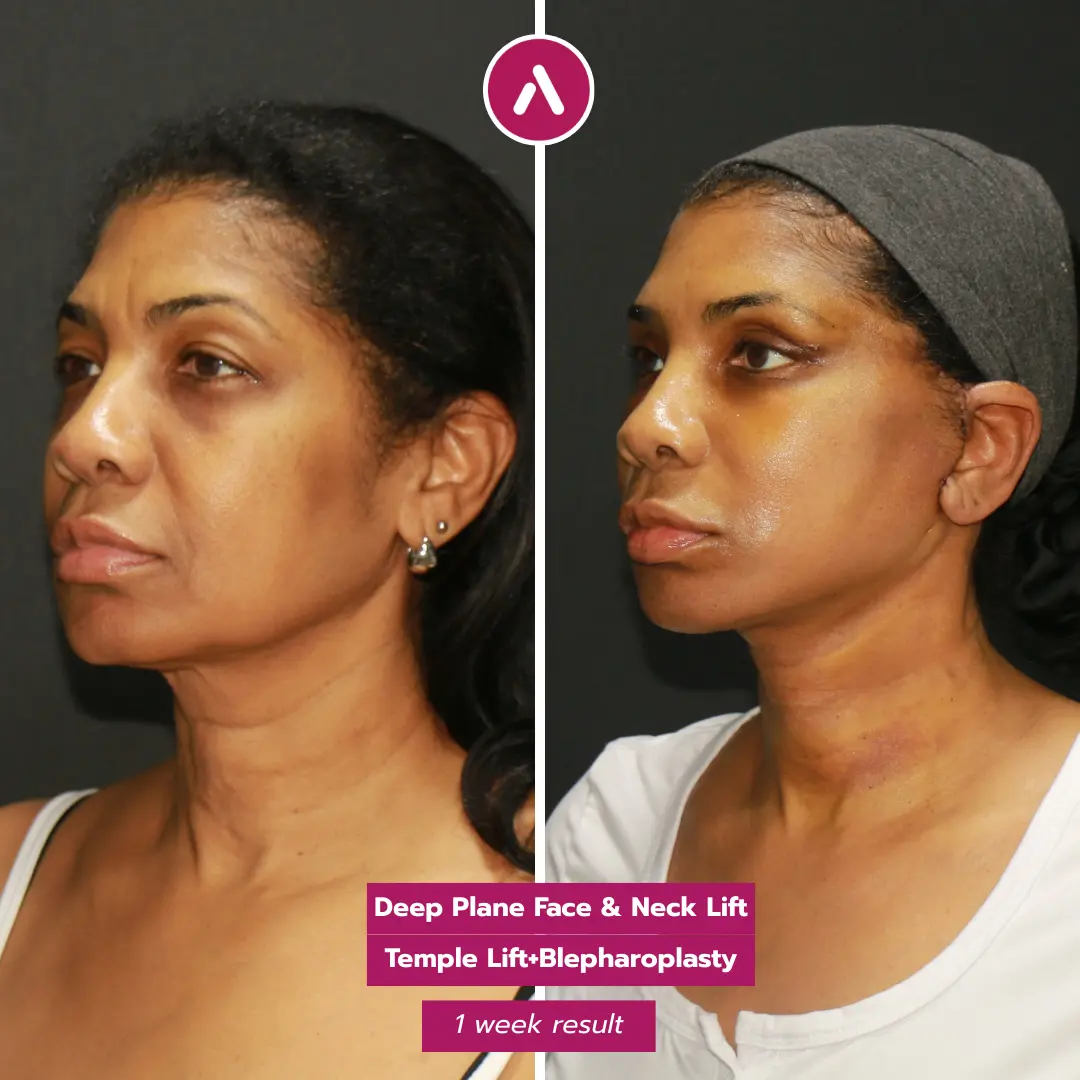
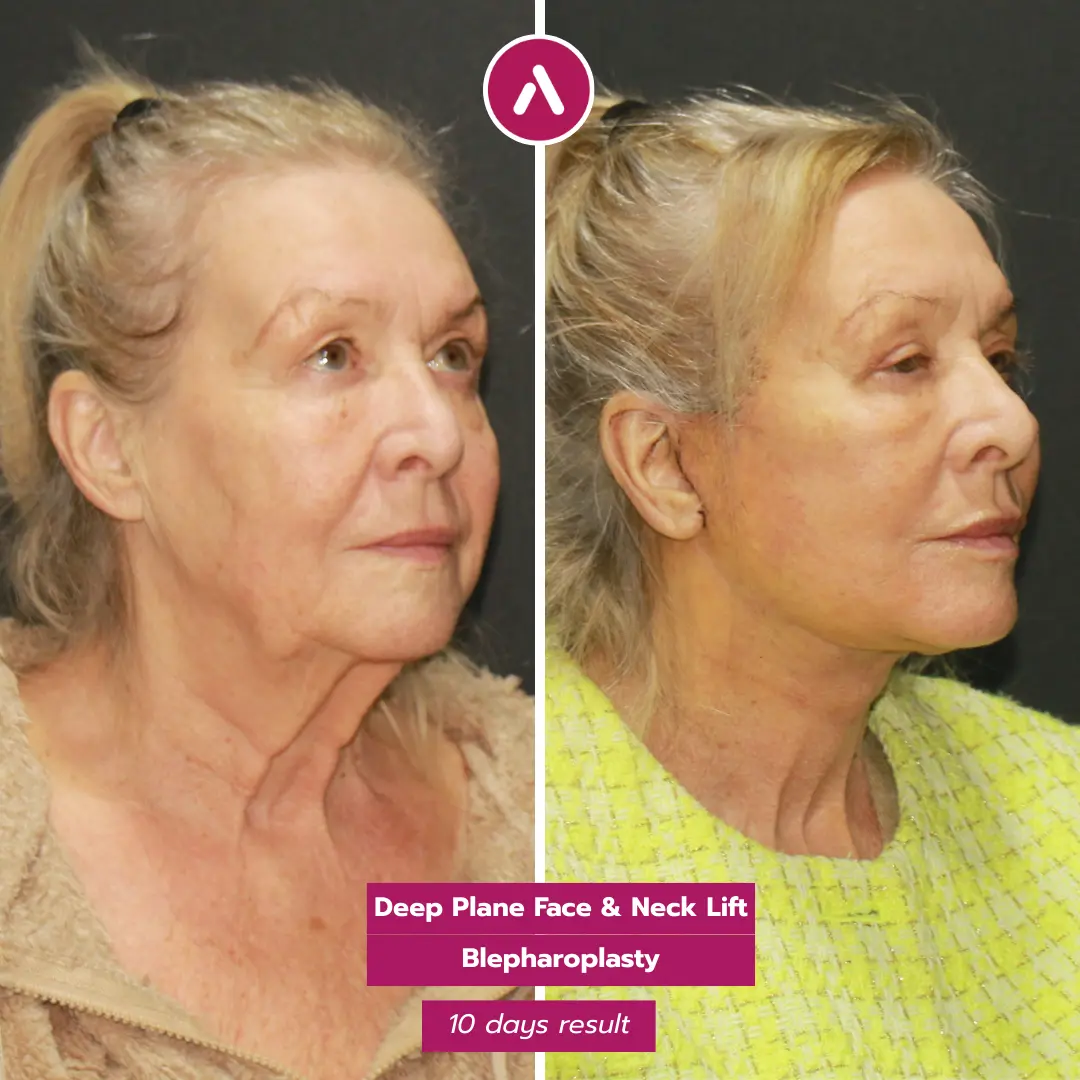
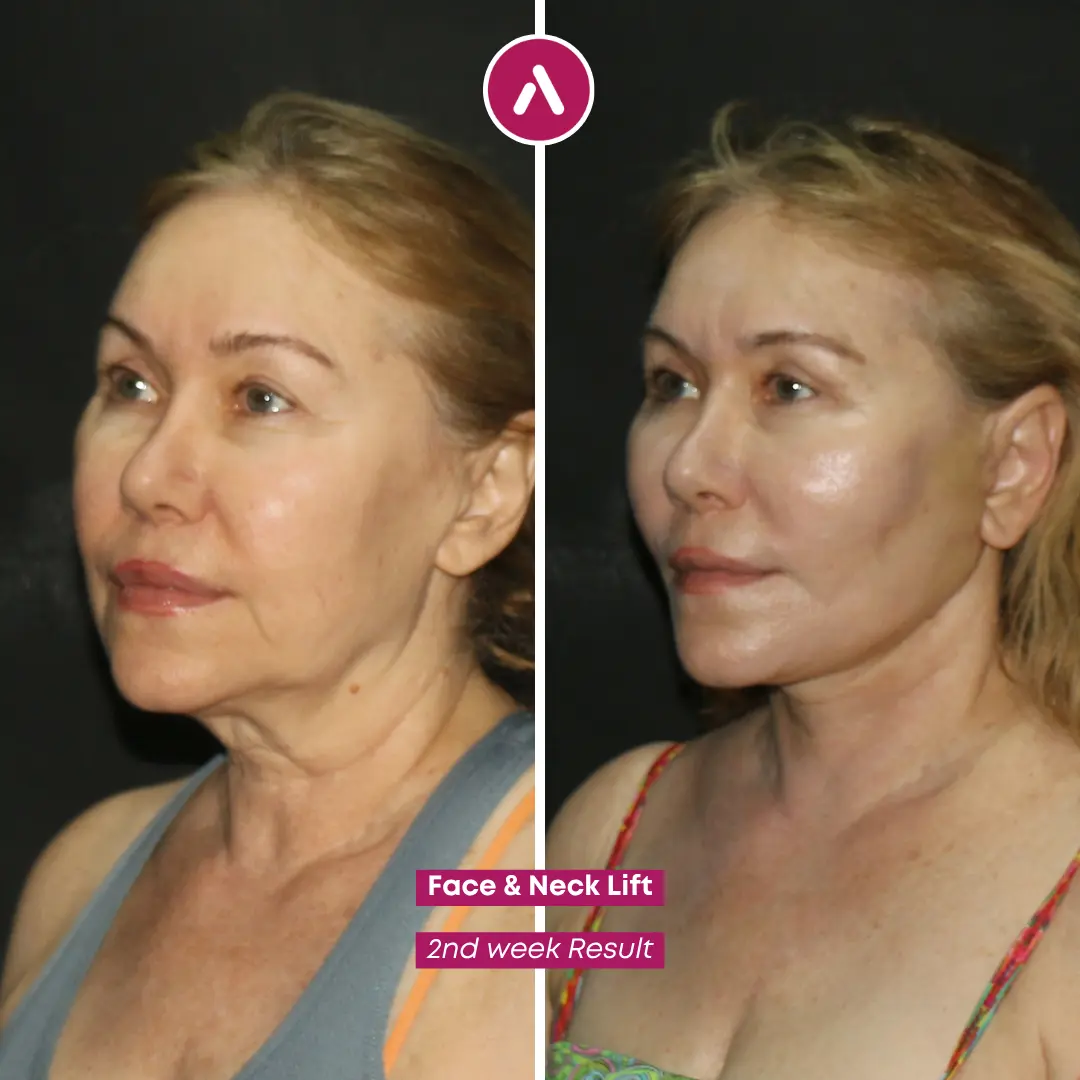
These three cases are a sample. The complete photo set — organised by age band, whether a neck lift or eyelid surgery was combined, and the post-op interval at which each photo was taken — sits on the full deep plane facelift before and after gallery. If you want to see the same standard applied to results photographed years rather than months after surgery, the documented longevity of deep plane facelift results page tracks what holds and what softens over time.
OR Safety: Monitoring Equipment, Surgical Counts, “No-Guesswork” Processes
The operating room is where small details prevent big problems. In a deep plane facelift, precision matters—and so does a controlled environment that supports precision.
- Continuous monitoring during surgery: A safe OR is equipped for real-time patient monitoring—not “spot checks.”
- Surgical counts and standardized steps: A disciplined surgical process includes verification steps designed to reduce avoidable mistakes.
- Consistent temperature and patient warming logic: Maintaining stable patient physiology supports safer anesthesia and smoother recovery.
- Clear role assignment: Who is responsible for what during surgery should be defined (surgeon, anesthesia provider, circulating nurse, etc.).
Ask the clinic to walk you through the OR workflow as if you were auditing it: who performs the instrument count, at what points it is repeated, and where it is recorded. A team that runs counts will describe them in seconds. A vague answer here is itself a data point.
Medication Safety: Traceability, Allergy Checks, Antibiotic Policy
Medication safety is a quiet differentiator between average and excellent facilities. Before surgery, a strong clinic should do a structured review of:
- Allergies and sensitivities (including latex and medication reactions).
- Supplements and blood-thinning agents (many “natural” supplements affect bleeding).
- Antibiotic strategy (what is used, when, and why—without overuse).
- Post-op prescriptions that are tailored to your health profile, not generic templates.
This matters because deep plane facelift recovery depends on protecting tissues and maintaining stable physiology. The best outcomes are supported by boring, consistent safety habits.
| Facility Detail | Why It Matters for Deep Plane Facelift | What You Can Ask |
|---|---|---|
| Sterile processing workflow | Reduces infection risk and protects healing | “Can you explain your instrument sterilization process from start to finish?” |
| OR monitoring standards | Supports anesthesia safety and stable recovery | “What monitoring is continuous during surgery, and who is responsible for it?” |
| Medication/allergy review | Prevents avoidable reactions and bleeding issues | “How do you assess allergy risks and supplement/medication interactions pre-op?” |
| Standardized OR protocols | Minimizes preventable errors through repeatable systems | “Do you use structured checklists and step verification in the OR?” |
In short: if a clinic claims to be the best clinic for deep plane facelift in Turkey, it should be able to demonstrate a facility culture where safety is routine, measurable, and repeatable—not dependent on luck or individual personality.
Anesthesia & Emergency Readiness (The Part Most Clinics Don’t Explain)
When people compare the best deep plane facelift clinic in Turkey options, they often assume anesthesia is “standard everywhere.” In reality, anesthesia safety is a core differentiator—because it’s a system: pre-op risk evaluation, continuous intra-op monitoring, medication controls, and a team that is trained for rapid, calm responses if something deviates from normal. If you’re searching for the Turkey best deep plane facelift clinic, this section is one of the most important “facility questions” you can ask.
Who Provides Anesthesia and What “Safe Monitoring” Actually Includes
For deep plane facelift surgery, safety starts before you ever enter the operating room. A high-standard clinic should have a structured pre-op evaluation and clear anesthesia planning—especially if you have hypertension, thyroid issues, prior anesthesia reactions, or you're taking medications/supplements that affect bleeding.
Anesthesia choice itself is also a facility-evaluation question: clinics offering both general anesthesia and local-anesthesia (awake) deep plane options provide patients with risk-stratified flexibility based on cardiovascular fitness and personal preference. The full procedural protocol, candidacy criteria, and lower anesthesia risk profile of the local-anesthesia option are documented on our awake deep plane facelift technique with local anesthesia and IV sedation protocol page, which catalogs the patient profiles for whom this approach reduces general-anesthesia exposure.
During surgery, safe monitoring is not a vague promise. At a minimum, you want the clinic to explain that monitoring is continuous and that the team is trained to interpret what the monitors mean (not just record numbers). While the exact setup can vary by case, a clinic aiming to be the best deep plane facelift clinic Turkey should be comfortable discussing the following categories:
- Cardiovascular monitoring: ongoing rhythm and blood pressure tracking to keep physiology stable.
- Oxygenation and ventilation monitoring: ensuring breathing and oxygen delivery are continuously assessed.
- Temperature and comfort management: stable body temperature supports smoother recovery.
- Documented medication checks: allergy review, interaction screening, and clear dosing protocols.
What to ask directly: “Who will be responsible for anesthesia during my surgery, and how will I be monitored continuously from start to finish?”
Why this matters: In medical science, the strongest safety improvements come from standardized protocols and early detection—not from assuming “it will be fine.” Clinics that can explain their anesthesia planning clearly usually operate with stronger systems overall.
Emergency Preparedness: What a Serious Clinic Has in Place “Just in Case”
Talking about emergencies isn’t fear-based—it’s professionalism. The safest environments are the ones that plan for low-probability events with high-impact consequences. If a clinic positions itself as the best deep plane facelift clinic in Istanbul, it should be prepared to explain (without hesitation) how it manages unexpected situations.
In a facility review, here’s what “prepared” typically looks like:
- Emergency equipment readiness: the OR and recovery area should have immediate access to essential emergency equipment (and staff trained to use it).
- Emergency medications and protocols: clear steps for allergic reactions, blood pressure spikes, nausea/vomiting risk control, and other anesthesia-related events.
- Bleeding vigilance: structured observation and rapid response pathways if bleeding is suspected.
- Team drills and role clarity: who leads, who assists, who documents, and how decisions are escalated.
One of the biggest “green flags” is when a clinic can describe emergency preparedness in a calm, routine way—because it suggests the team has rehearsed it and treats it as standard clinical practice.
| Readiness Area | Why It Matters | What a Strong Clinic Can Explain |
|---|---|---|
| Anesthesia escalation | Protects airway and vital stability | Clear chain-of-command and immediate intervention logic |
| Bleeding response | Early action can protect outcome and safety | Monitoring frequency + rapid evaluation pathway |
| Recovery monitoring | First hours are the most observation-sensitive | Who checks you, how often, and what triggers escalation |
| Equipment + training | Tools are only useful if teams are trained | Staff readiness, role clarity, and protocol familiarity |
Transfer Planning: What a Clinic Should Have Ready (Even If It’s Never Used)
Here’s a question many patients don’t think to ask: “If I need a higher level of care, what happens?” The best answer is never “That won’t happen.” The best answer is a clear plan—because transfer planning is a hallmark of mature clinical governance.
If you’re evaluating the best clinic for deep plane facelift in Turkey, look for transparency on:
- Decision-making: who decides that transfer is needed and on what criteria.
- Speed and logistics: how transport is arranged and how quickly it can occur.
- Clinical handover: how information is communicated to the receiving facility to prevent delays.
Expert-patient takeaway: A clinic that has a transfer pathway isn’t “less safe.” It’s more professional—because it acknowledges that safety is a continuum.
Best Deep Plane Facelift Clinic: Recovery Facilities & Post-Op Monitoring
A deep plane facelift is not “done” when the last stitch is placed. The first 24–72 hours are where safety systems and structured monitoring protect both your health and your aesthetic outcome. This is why patients looking for the best deep plane facelift clinic in Turkey should evaluate the recovery environment as carefully as the operating room. If a clinic claims to be the best deep plane facelift clinic Turkey (or the best clinic for deep plane facelift in Turkey), it should be able to explain exactly how it monitors you, what it looks for, and how it responds—without panic, and without minimizing risk.
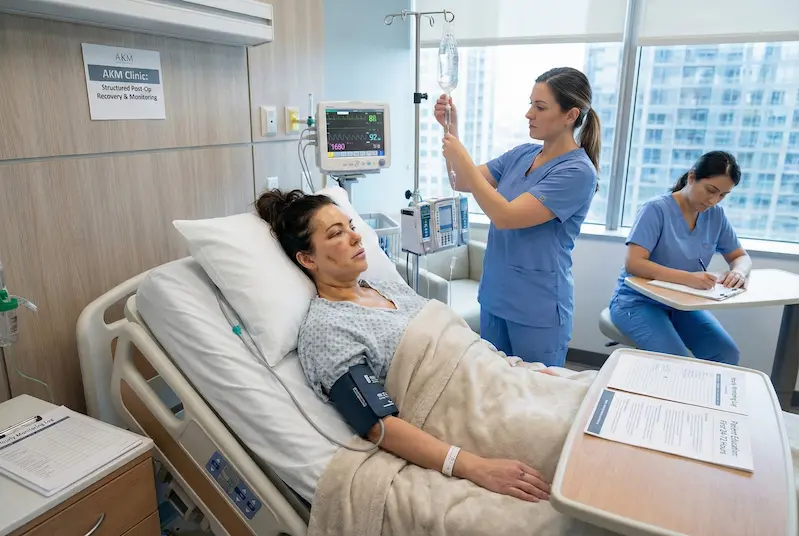
The First 48 Hours: Who Is Watching, and What They Are Watching For
| Window | Who is present | What is being checked | Question to ask before you book |
|---|---|---|---|
| 0–2 h post-op | Anesthesia provider + recovery nurse | Airway, oxygenation, emergence from anesthesia, first blood pressure readings | "Am I in a monitored recovery bay or moved straight to a room?" |
| 2–12 h | Ward or clinic nurse on scheduled rounds | Blood pressure trend, drain output if used, dressing tightness, nausea control, pain trend | "At what interval are observations recorded overnight?" |
| 12–24 h | Nurse + surgeon review | Facial symmetry against baseline, skin colour under the flap, incision line, swelling pattern | "Does the surgeon see me before discharge, or a colleague?" |
| 24–48 h | Clinic visit / hotel-based nurse check | Any sudden unilateral swelling or pain change, blood pressure again, sleep position compliance | "Who do I call at 3am, and does that number reach a clinician?" |
The single most useful sentence you can extract from a clinic is the observation interval overnight. "Hourly for the first four hours, then every two hours" is a protocol. "The nurse checks on you" is not. Hematoma after a deep plane facelift is time-sensitive — it is recognised by a change from the previous recorded observation, which is only possible if previous observations exist on paper.
Private Recovery Setup: Comfort + Clinical Observation (What “Good” Looks Like)
Comfort matters—but in a safety-driven facility, comfort supports monitoring rather than replacing it. A strong post-op environment typically includes:
- Structured nursing checks (not “call us if you need something”).
- Clear observation routines designed for early detection of issues.
- Privacy that doesn’t isolate you from clinical oversight.
- Patient education on what to expect hour-by-hour, especially for swelling, bruising, and pressure sensations.
If you’re comparing the best deep plane facelift clinic in Istanbul options, ask how the first night is handled. A clinic with a real system will describe a consistent plan rather than improvising based on staff availability.
Green flag: “We monitor you on a schedule and we document what we’re checking.”
Yellow flag: “If something feels wrong, just let us know.”
Early Complication Detection: Hematoma, Blood Pressure Control, Breathing & Safety Checks
No one likes discussing complications, but serious clinics do—because preparedness is part of quality. Deep plane facelift aftercare is often centered around early detection and prevention. A facility that merits “best” status should be able to explain how it watches for:
- Bleeding/hematoma risk: Early signs can be subtle; rapid recognition matters.
- Blood pressure spikes: Blood pressure stability supports safer healing and reduces stress on tissues.
- Airway/breathing comfort and safety: Particularly relevant in the immediate post-anesthesia period.
- Hydration and nausea control: Vomiting and dehydration can complicate early recovery and comfort.
In clinical practice, many of the most avoidable issues are prevented by routine monitoring and prompt response. This is one reason scientific research and safety programs emphasize checklists and structured observation: consistency saves outcomes.
| What’s Monitored | Why It Matters After Deep Plane Facelift | What You Should Hear From the Clinic |
|---|---|---|
| Swelling pattern & symmetry | Helps identify changes that may need evaluation | “We check routinely and we know what’s normal vs concerning.” |
| Blood pressure stability | Supports safe tissue recovery | “We monitor BP and manage spikes proactively.” |
| Pain level and changes | Sudden shifts can indicate a need for assessment | “We track trends, not just a single score.” |
| Nausea, dizziness, hydration | Impacts comfort and overall stability | “We have a standard plan for nausea and fluids.” |
| Incision checks | Protects wound healing and scar quality | “We inspect incisions at defined intervals.” |
Pain, Swelling, Bruising Management: What’s Normal vs. What’s Urgent
One of the biggest sources of anxiety—especially for the “expert patient”—is uncertainty. A high-quality clinic should give you clear guidance in plain language. While every patient is different, you should leave surgery knowing:
- What “expected” swelling and bruising looks like in the first week.
- Which sensations are normal (tightness, pressure, mild asymmetry early on).
- Which changes are urgent and require immediate review.
- How to reach the team quickly (and what response time looks like).
This is where the best facilities stand out: they don’t just say “You’ll be fine.” They teach you how to interpret your recovery—so you feel calm, informed, and in control. That’s a major reason discerning patients searching best deep plane facelift clinic Turkey often choose clinics that behave like medical teams, not like travel operators.
Practical takeaway: Your recovery plan should feel like a protocol, not a guess. If the clinic can’t describe “normal vs urgent” clearly, keep looking.
The AKM Clinic Care Pathway (From Arrival to Fit-to-Fly)
Patients searching for the best deep plane facelift clinic in Turkey (or phrasing it as best deep plane facelift clinic Turkey / Turkey best deep plane facelift clinic) are usually trying to answer one practical question: “What will my experience look like from the moment I land until it’s safe to fly home?” A high-standard clinic should be able to map that journey clearly—because predictable outcomes come from predictable systems.
Below is how a structured, safety-first pathway should look in a facility that’s designed for international patients and aligned with a “process over promises” mindset.
Pre-Op Evaluation: Medical Clearance, Labs, Medication Planning
A facility that aims to be the best deep plane facelift clinic in Istanbul should not treat pre-op like paperwork. It’s a clinical gate that prevents avoidable problems. Before surgery, you should expect a structured evaluation that covers:
- Medical history review (including prior anesthesia experiences and relevant conditions).
- Medication and supplement screening (especially anything affecting bleeding, blood pressure, or sleep).
- Pre-op tests when clinically appropriate (based on your health profile and planned anesthesia approach).
- A risk discussion you can understand (what’s common, what’s rare, and how the clinic responds).
Expert-patient standard: The safest clinics don’t “sell” surgery—they qualify you for it. That mindset is consistent with what scientific research shows about reducing preventable complications: selection, preparation, and protocol matter.
Arrival in Istanbul: Surgeon-Led Planning + Facility Walkthrough Mindset
For international patients, the best clinics organize the journey so you can focus on preparation and recovery rather than logistics. In a mature care pathway, you should expect:
- Planned transfers between airport, hotel, and clinic (so you’re not navigating alone post-travel).
- In-person meeting to finalize the plan (your facial anatomy, goals, incision strategy, and recovery priorities).
- Clear pre-op instructions (what to stop, what to continue, eating/drinking rules, and skin prep guidance).
If you’re evaluating the best clinic for deep plane facelift in Turkey, ask for the clinic’s “patient journey” in writing. Transparency is part of facility quality.
Post-Op Day-by-Day in Istanbul: What a Structured Follow-Up Looks Like
After a facelift, early aftercare is where clinics prove their standards. A strong facility pathway typically includes:
- Immediate recovery monitoring with documented checks (not informal observation).
- Planned post-op visits to assess swelling patterns, incision integrity, and overall stability.
- Medication + garment guidance that is specific to your procedure and your health profile.
- Clear escalation rules (what triggers an urgent assessment and how fast you’ll be seen).
Some clinics also integrate supportive recovery technologies (for example, HBOT and low-level laser therapy) as part of a broader healing protocol. The key point—especially for skeptical, safety-focused patients—is that technology should sit on top of strong fundamentals, not replace them. We’ll break this down in the next section.
If you want to see what those days actually look like rather than how they are described, our day-by-day deep plane facelift recovery record with dated photographs follows swelling and bruising through the Istanbul stay and the weeks after. Patients who prefer their recovery structured around scheduled chamber sessions can compare that against the deep plane face and neck lift package with HBOT support, which sets out how many sessions are scheduled and on which post-op days.
Fit-to-Fly: Practical Safety Criteria (Not a Guess)
“Fit-to-fly” should never be a casual green light. A clinic that truly deserves “best” status will frame travel clearance around clinical stability and individualized recovery—because facial surgery recovery isn’t identical for every patient.
While specifics vary by case, a professional fit-to-fly conversation generally includes:
- Stable overall condition (no red-flag symptoms, stable blood pressure, controlled nausea/pain).
- Incision and swelling assessment consistent with expected healing at your stage.
- Clear instructions for flight day (hydration, movement, medication schedule, what to avoid).
- Post-flight plan (how to contact the team and what to do if concerns arise at home).
After You Return Home: Remote Follow-Up and Continuity of Care
For an “expert patient,” continuity after you leave Turkey matters almost as much as the in-clinic experience. A strong program should offer structured remote follow-up milestones (for example: check-ins at 1 month, 3 months, 6 months, and 1 year) and clear guidance on what you should report in between.
This is one of the quiet signs you may be dealing with the best deep plane facelift clinic Turkey candidates: they don’t disappear after the airport—they maintain a long-term view of healing and results.
Technology That Supports Healing (HBOT & LLLT—When It's Truly Helpful)
Recovery-support technologies should never be marketed as a substitute for surgical excellence — but in a well-run facility, they can measurably improve the early recovery experience. Hyperbaric Oxygen Therapy (HBOT) and Low-Level Laser Therapy (LLLT) are both evidence-aligned adjuncts that support tissue oxygenation, inflammation control, and skin recovery when properly integrated into a surgeon-led aftercare plan. The complete day-by-day recovery protocol — including how HBOT chamber sessions and LLLT diode array treatments are sequenced through the first 14 days — is documented in our deep-dive on structured HBOT and LLLT integration protocols for accelerated post-facelift healing, which translates the facility-evaluation criteria above into the exact recovery experience an AKM patient receives.
HBOT: How Hyperbaric Oxygen Therapy May Support Recovery (and Why It’s Not “Magic”)
HBOT (Hyperbaric Oxygen Therapy) involves breathing oxygen in a pressurized environment. The clinical idea is to increase oxygen delivery to tissues during periods when healing demands are higher. In the context of facelift recovery, clinics may use HBOT as an added layer of support for tissue health and wound healing—especially when they’re aiming to optimize recovery conditions as part of a broader safety protocol.
At AKM Clinic, HBOT is positioned as a recovery-support tool within their care standards—used to reinforce tissue support and healing conditions rather than to “promise” a result. The most responsible framing is the one aligned with scientific research principles: HBOT may support healing processes, but outcomes still depend on surgical technique, patient factors, and aftercare compliance.
- Tissue support during healing: Increasing oxygen availability can be used to support tissues in a high-demand recovery phase.
- Recovery optimization mindset: It’s most meaningful when integrated into a structured post-op pathway (monitoring + wound care + risk control).
- Realistic expectations: HBOT is not a replacement for complication management or clinical observation—it's an adjunct.
Expert-patient filter: If a clinic markets HBOT as “guaranteeing” a perfect recovery, that’s a red flag. If they describe it as a supportive tool within a safety-first protocol, that’s far more credible.
LLLT: Low-Level Laser Therapy for Post-Facelift Skin Healing (What It Can Support)
LLLT (Low-Level Laser Therapy) is designed to deliver light energy to tissue without heat damage. In post-surgical settings, clinics may use LLLT to support cellular activity and calm inflammation as part of a recovery protocol. AKM Clinic describes using an advanced dermatological LLLT system for post-surgical skin healing, with an emphasis on non-thermal support.
For facelift patients, the practical value of LLLT is typically framed around recovery support—helping the skin environment settle and encouraging conditions associated with healthy healing.
- Accelerated cellular repair support: LLLT is commonly discussed in terms of supporting cellular energy processes during healing.
- Collagen-support logic: Clinics may use LLLT with the goal of supporting collagen-related healing pathways over time.
- Reduced inflammation approach: Used strategically, it may help support swelling/redness control as part of a broader recovery plan.
For a skeptical, detail-oriented patient comparing the best deep plane facelift clinic in Istanbul options, the key question is not “Do you have LLLT?” It’s: How exactly do you use it, for whom, and as part of which protocol?
The Cautious Patient’s Standard: How to Evaluate Recovery Tech Without Getting “Sold”
If you’re deciding between clinics that claim to be the best clinic for deep plane facelift in Turkey, use these practical criteria to evaluate HBOT/LLLT claims:
| What to Ask | Why It Matters | What a High-Standard Answer Sounds Like |
|---|---|---|
| “Is this technology routine for every patient, or case-dependent?” | One-size-fits-all protocols are rarely evidence-aligned | “We individualize it based on your case and recovery needs.” |
| “What is it meant to support—comfort, swelling, wound healing?” | Clarifies realistic outcomes vs. marketing claims | “It supports recovery conditions; it doesn’t replace medical monitoring.” |
| “How does this fit into your complication detection and follow-up plan?” | Tech is valuable only within a strong care pathway | “It complements our structured observation and aftercare schedule.” |
| “Who oversees its use—clinical team or non-medical staff?” | Safety and appropriateness depend on medical oversight | “It’s integrated into clinical care under medical supervision.” |
Bottom line: HBOT and LLLT can be meaningful “extras” when they sit on top of strong fundamentals. That’s the difference between a clinic that merely advertises technology—and a clinic that uses technology as part of a disciplined, patient-centered system.
Who Operates Matters Just As Much As Where
Even the best-equipped facility cannot protect a patient from a hidden operator. "Ghost surgery" — where the surgeon you consulted is replaced by an unidentified colleague during the actual procedure — remains a documented risk in some medical tourism settings. The contractual safeguards, identity verification protocols, and red-flag warning signs that protect international patients from this specific risk are catalogued on our complete contractual and verification safeguards against ghost surgery in Turkish medical tourism, which documents the surgeon-identity confirmation step that should be built into your pre-op contract before you sign anything.
Beyond the surgeon's identity, the depth of their formal credentialing is equally important. Board certification is the formal verification that a surgeon has completed accredited training, passed standardized examinations, and committed to ongoing medical education. Our complete breakdown of plastic surgery board certification standards across EBOPRAS, ABPS, and Turkish Plastic Surgery Society pathways explains how these certifications differ, what each covers, and what level of facelift training each pathway typically guarantees.
Proof & Transparency (What You Can Ask For—and What We’re Comfortable Showing)
If you’re trying to identify the best deep plane facelift clinic in Turkey, you’ll eventually run into the same problem: many clinics look “excellent” online. The difference between a clinic that markets well and a clinic that is genuinely safe and consistent usually shows up in one place—transparency. Not dramatic promises. Not influencer reels. Transparent clinics can explain their process, show their standards, and answer direct questions without defensiveness.
Before/After Standards That Prevent Misleading Comparisons (Angles, Lighting, Timelines)
Before/after photos can be useful—but only if they’re presented ethically. A trustworthy clinic should be comfortable explaining:
- Timepoint: How many weeks/months post-op is the “after” image? (Early swelling can mislead; true refinement takes time.)
- Consistency: Are lighting, angle, and facial expression comparable? (Small differences can exaggerate results.)
- Procedure clarity: What exactly was done—deep plane facelift alone, or combined procedures (neck lift, eyelids, etc.)?
- Realistic variation: Results differ by anatomy, skin quality, age, and healing behavior. Clinics should say that clearly.
Expert-patient rule: If the clinic cannot tell you the timeline and procedure details behind a photo, you’re not seeing “proof”—you’re seeing marketing.
A science-informed patient mindset (and the logic of scientific research) favors controlled comparisons. In real medicine, you don’t evaluate outcomes using “best-looking moment” photos—you evaluate them with context.
What Real Patient Stories Reveal About Care Quality (Testimonials as “Process Proof”)
Testimonials are most valuable when they reveal the process, not just the emotion. Look for details about: pre-op assessment, the first night of monitoring, how questions were answered, and whether the patient felt guided during recovery.
For example, one AKM Clinic patient (Barbara, USA) is described as an “expert patient” who researched globally for years before deciding. Her testimonial highlights structured care and a calm recovery experience. In her own words, she described her result as:
“...probably 20 years younger.”
Another patient (Sarah) compared her experience and emphasized both natural results and a surprisingly manageable recovery, noting she:
“...only took painkillers for probably one day.”
These types of statements matter because they’re outcome-adjacent and process-adjacent: they hint at pain control, swelling management, and supportive follow-up. That’s the kind of “proof” an expert patient actually trusts.
Clear Inclusions: Aftercare Plan, Visit Schedule, and Complication Management Clarity
One of the most practical ways to judge whether a clinic deserves “best” status is to ask for the care pathway in writing. A transparent clinic can clearly define:
- What is included in the package (and what isn’t) with no ambiguity.
- Post-op visit schedule while you’re in Istanbul (who you see and why).
- Aftercare responsibilities (your role vs. the clinic’s role).
- How concerns are handled (what triggers urgent review, and how quickly you’ll be assessed).
- Remote follow-up once you return home (check-in cadence and access channels).
| Transparency Item | Why It Matters | What You Should Receive |
|---|---|---|
| Written care pathway | Shows the clinic operates with systems | A step-by-step timeline from pre-op to fit-to-fly + remote follow-up |
| Clear inclusions/exclusions | Prevents last-minute uncertainty | A simple list of what’s covered (and what’s not) |
| Complication-response clarity | Reduces fear and prevents delays | Explicit escalation guidance: what’s urgent, where to go, who to contact |
| Before/after context | Prevents misleading expectations | Procedure list + timeline + consistent photo standards |
Ultimately, the best deep plane facelift clinic in Istanbul won’t ask you to “trust blindly.” It will give you enough structure, documentation, and clarity to make a confident decision—because transparency is part of safety.
Ready to Experience a World-Class Facility?
Knowing what to look for is the first step; finding a clinic that actually delivers it is the next. If you are ready to see how our safety-first infrastructure is designed for international patients, explore our main Deep Plane Facelift in Turkey hub to plan your secure and comfortable journey with AKM Clinic.
Frequently Asked Questions (FAQ): Best Deep Plane Facelift Clinic in Turkey
If you’re narrowing down the best deep plane facelift clinic in Turkey, these are the questions “expert patients” ask to validate facility standards, team structure, and real-world safety—especially when comparing the best deep plane facelift clinic in Istanbul listings they see online.
Is a deep plane facelift safer in a clinic or a hospital setting?
What licenses/authorizations should a Turkish clinic have?
Do I need ICU access for a facelift—what’s the realistic risk?
Who administers anesthesia and what monitoring should be used?
How many days should I stay in Istanbul after a deep plane facelift?
Can HBOT/LLLT replace proper medical monitoring?
What documents should I receive before traveling for surgery?
How long does it take to see “final” deep plane facelift results?
What should I look for when reading deep plane facelift turkey reviews?
What makes recovery safer for international patients after surgery?
How can I evaluate credibility when reading akm clinic turkey reviews?
Planning your trip? If you’re considering deep plane facelift istanbul turkey, request a written patient journey covering pre-op evaluation, day-by-day follow-up, and post-travel continuity.
What should a clinic have in place for complication management if something goes wrong after I fly home?
How do I check whether an Istanbul clinic is authorised for surgical procedures?
Is a physician-led clinic different from a chain beauty centre for facelift surgery?
Continuity beyond the OR is what separates a procedure from a journey. The full operational pathway — from pre-op virtual consultation, through arrival logistics in Istanbul, daily recovery touchpoints, fly-home clearance protocol, and the 12-month structured remote follow-up cadence — is documented step-by-step on our complete AKM patient journey blueprint with facility, surgeon, and aftercare integration, which translates the facility-evaluation framework above into a single coordinated pathway from consultation to one-year outcome review.