For many British patients, finding the best deep plane facelift clinic in Turkey is not really about finding the lowest quote. It is about identifying a clinic where surgical judgement, patient safety, operating theatre standards, and aftercare all feel consistent with what they would expect from a premium private setting in the UK. In practice, the better question is not “Who looks the most glamorous online?” but “Which clinic is genuinely built to deliver safe, subtle, consultant-led facial rejuvenation?”
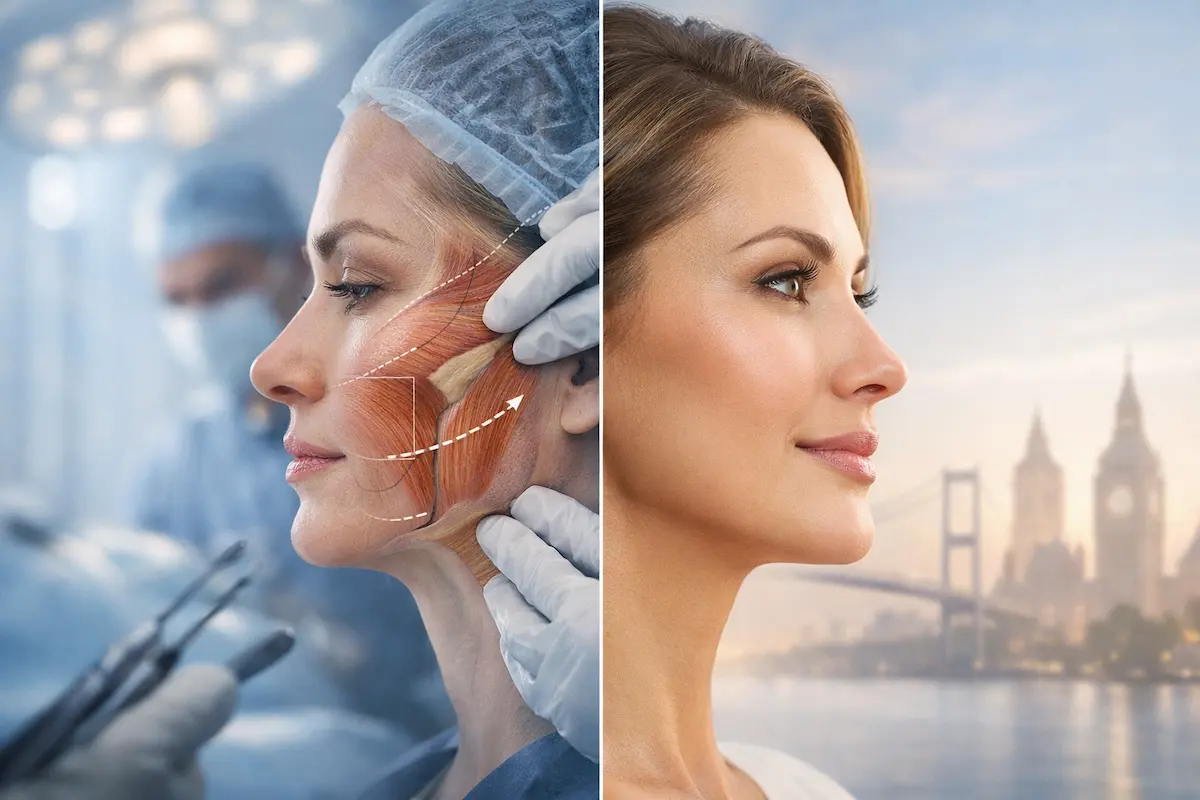
A deep plane facelift is not a surface procedure. The dissection passes beneath the SMAS to release retaining ligaments, which means nerve anatomy, haemostasis, tissue tension and anaesthesia planning all shape the result. Judge a clinic on those variables: who assesses you before surgery, how the theatre is run, how the first 48 hours are monitored, and who answers you in week three when a cheek feels firmer than the other side.
For British patients comparing London or Harley Street against Istanbul, the issue is usually value, not simply cost. A clinic may appear polished on Instagram, yet the true quality markers are harder to fake: properly run operating theatres, direct consultant access, natural before-and-after consistency, transparent pricing, and reliable post-op care in Turkey for British citizens once the patient has travelled home. This is exactly why searches such as best deep plane facelift clinic Turkey, Turkey best deep plane facelift clinic, and best clinic for deep plane facelift in Turkey have become more sophisticated.
British patients are increasingly acting like expert patients. They want to know whether the best deep plane facelift clinic in Istanbul can offer more than convenience. They want proof of structure, judgement, and continuity of care. They want a private cosmetic clinic in Istanbul with British standards, not a package that looks attractive at first glance but feels vague once serious questions begin.
The best facelift clinic is rarely the loudest. It is the one that can explain, in calm and precise terms, how it protects the patient at every stage.
Table of Contents
What Should UK Patients Look for in a Deep Plane Facelift Clinic?
Before comparing clinics, British patients need a clear framework. “Best” is an appealing word, but it becomes useful only when it is broken down into clinical criteria. A proper facility review should therefore look beyond social media popularity and ask whether the clinic is structured to support safe surgery, refined results, and credible continuity of care from consultation to recovery.
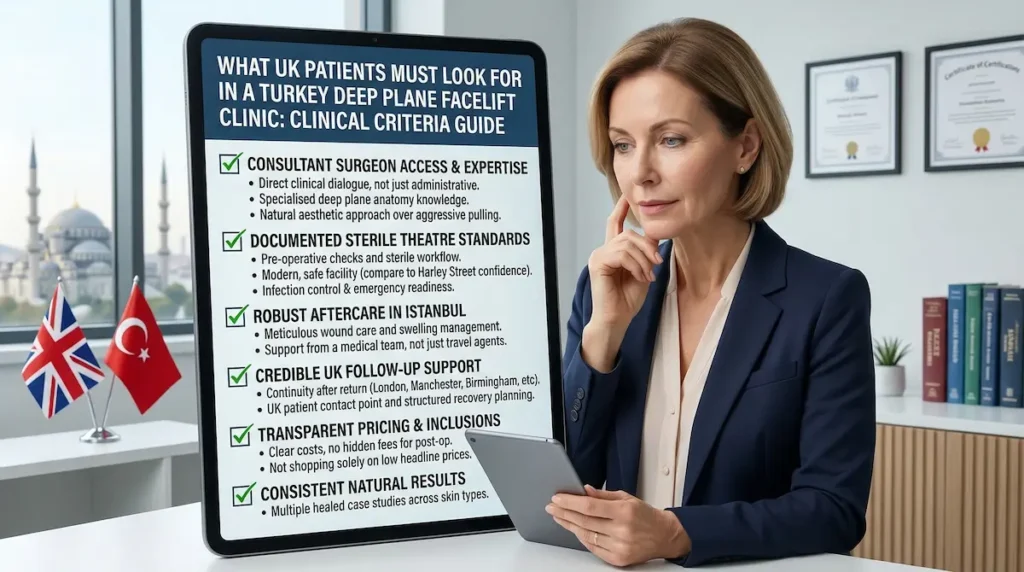
Just as importantly, patients should remember that even the most impressive facility can only be judged properly alongside the expertise of the operating consultant. In other words, the search for the right clinic often overlaps with the search for the best deep plane facelift surgeon in Turkey, because surgical judgement, anatomical precision, and a natural aesthetic approach are central to both safety and outcome quality.
Five checks before you trust a facelift in Turkey review
- Named surgeon: the review states who operated, not only the clinic or agency name.
- Procedure named correctly: deep plane, SMAS, mini lift and thread lifts are not comparable outcomes.
- Timing stated: ask at what week or month the photos and comments were made.
- Neck included or not: jawline satisfaction usually depends on whether the neck was treated in the same session.
- Aftercare described: the review explains who answered questions once the patient was back in the UK.
Why “Best” Means More Than a Low Price
A low headline quote can be tempting, particularly when UK private facelift prices are high. However, the most discerning patients know that facial surgery is not the place to shop on headline cost alone. A deep plane facelift requires advanced anatomical understanding, careful elevation of deeper tissues, disciplined haemostasis, and experienced judgement throughout the procedure. These are not details that can be reduced to a discount code.
When British patients search for the best deep plane facelift clinic Turkey, they are often trying to solve several concerns at once: safety, naturalness, surgeon credibility, and whether they will still feel supported after flying back to Manchester, London, Birmingham, or Glasgow. Price remains part of the conversation, of course, but the more meaningful question is whether the clinic delivers a better total standard of care for the investment.
This is especially important for patients who have seen alarming stories about cosmetic surgery abroad. The lesson from those cases is usually not that treatment outside the UK is inherently unsafe. Rather, it is that patients can make poor decisions when they focus on promotional language instead of asking structured clinical questions. The safest approach is to judge the clinic like an informed reviewer, not like a consumer scrolling for bargains.
| What looks impressive online | What actually matters in clinic selection |
|---|---|
| Luxury-looking interiors | Documented operating theatre standards and sterile workflow |
| Very low starting prices | Transparent pricing with clear inclusions and exclusions |
| Highly edited before-and-after posts | Consistent, natural results across multiple healed cases |
| Fast replies from sales staff | Direct access to medically informed answers and consultant review |
| Travel package language | Structured planning for recovery, follow-up, and return-to-UK support |
Harley Street Standards vs Istanbul Value
For many British patients, Harley Street is not merely a location. It symbolises a certain expectation: professionalism, discretion, consultant-led care, and confidence in the surrounding systems. That is why the strongest Istanbul clinics do not try to imitate budget travel marketing. Instead, they position themselves around competence, consistency, and the ability to deliver the same sense of reassurance at a more accessible price point.
Viewed properly, the comparison is not “UK equals quality and Turkey equals value”. The more accurate comparison is whether an Istanbul clinic can combine Harley Street-style attention to standards with a more efficient cost structure. That is the lens through which a serious British patient should evaluate the best deep plane facelift clinic in Istanbul. A polished waiting area may be pleasant, but it is not what creates a good facelift outcome. What matters is whether the facility is organised around anatomy, sterility, teamwork, and meticulous post-operative management.
This is where the phrase private cosmetic clinic in Istanbul with British standards becomes meaningful. It should not be empty branding. It should mean clear communication, proper consent, realistic expectation-setting, consultant accountability, and recovery planning that respects how British patients actually travel and heal. In other words, the clinic should feel internationally minded, but specifically understandable to someone arriving from the UK healthcare culture.
Facility Quality, Surgeon Access, and Aftercare as the Real Decision Factors
The most valuable facility review criteria usually come down to three things: how safely the clinic operates, how directly the patient can access the surgeon, and how thoroughly the clinic manages recovery. If any one of those is weak, the patient experience can feel uncertain even when the operation itself goes well.
First, facility quality means more than a building. It refers to systems: pre-operative checks, sterile preparation, theatre discipline, emergency readiness, and a calm clinical team that knows its role. Secondly, surgeon access matters because facial surgery is intensely individual. British patients should not feel they are discussing a complex operation through layers of vague administration. The best clinics allow medically meaningful dialogue, especially when the patient is comparing deep plane lifting with other facelift approaches.
Thirdly, strong recovery support is essential. A clinic may perform excellent surgery, but if the follow-up becomes distant once the patient leaves Istanbul, trust quickly erodes. This is why post-op care in Turkey for British citizens is not a minor extra; it is a core quality marker. A robust model includes wound-care guidance, swelling management, scar support, review scheduling, and practical communication channels after the flight home. For many patients, the presence of a UK based patient contact point adds another layer of reassurance because it makes the journey feel less remote and less transactional.
- Ask about surgeon access: Will your consultation questions be answered clinically and clearly?
- Ask about facility systems: How is theatre sterility maintained, and what is the emergency pathway?
- Ask about follow-up: Who supports you after you return to the UK, and how quickly can concerns be reviewed?
Inside the Facility: Safety, Hygiene, and Operating Theatre Standards
If the first section is about how to think like an expert patient, this section is about what to examine inside the clinic itself. British patients often focus on surgeon reputation, quite rightly, but the facility environment matters almost as much. A strong surgeon working within weak systems is still a risk. The best clinic for deep plane facelift in Turkey should therefore demonstrate not only aesthetic judgement, but also serious infrastructure.
Sterile Operating Theatres and Zero-Compromise Infection Control
Every reputable facelift clinic should be able to explain its infection control philosophy in straightforward terms. For UK patients, this starts with the operating theatre environment. Washed-down promotional phrases such as “luxury”, “VIP”, or “boutique” tell you very little. What matters is whether the clinic runs with disciplined sterile protocols, clear theatre zoning, proper preparation of instruments, consistent team roles, and a genuine zero-compromise attitude to hygiene.
This is particularly important in facial surgery because even a technically well-executed result can be undermined by preventable complications. Incision quality, tissue handling, dressing care, and early monitoring all matter. The patient may not see those systems directly, but they feel their effect in smoother recovery, lower stress, and fewer surprises. In the language of science and surgical quality assurance, the aim is not simply to “avoid problems” but to reduce avoidable variability wherever possible.
A serious clinic should also speak in precise, comprehensible language. British patients tend to respond well when a facility explains exactly how its operating theatres are run rather than relying on glamour-focused imagery. Clarity is reassuring. Vagueness is not.
JCI-Level Expectations, CQC-Equivalent Thinking, and Emergency Readiness
Patients from the UK often compare overseas clinics against the systems they recognise at home. They may not expect a Turkish clinic to mirror the NHS or a London private hospital in every administrative detail, but they do expect an equivalent seriousness of approach. That means the facility should be able to demonstrate internationally benchmarked standards in patient preparation, monitoring, escalation pathways, and clinical governance.
In practical terms, British patients should be looking for a clinic that thinks in a CQC-style way, even when it operates in a different country. Is there a clear process for medical assessment before surgery? Is patient suitability taken seriously? Is there a defined response if a concern appears during recovery? Can the clinic explain how it manages pain relief, dressing care, swelling, bruising, and the early signs that would prompt further review?
Emergency readiness is another point that deserves direct attention. High-end medical travel should never depend on good luck. A facility should be prepared, structured, and calm under pressure. The patient may never need those systems, which is ideal, but the existence of those systems is one of the strongest indicators that the clinic is run properly.
| Facility question | Why it matters to a UK patient |
|---|---|
| How are patients assessed before surgery? | Shows whether suitability and risk are being taken seriously |
| How are operating theatres kept sterile? | Indicates discipline, infection control, and team standards |
| What is the recovery observation process? | Clarifies how closely you are monitored in the early period |
| Who do I contact after I return home? | Reveals whether follow-up is organised or improvised |
| Is there a UK based patient contact point? | Provides psychological reassurance and practical continuity |
Istanbul, Antalya or a Package Agency: What the Setting Changes
UK enquiries usually come down to three models. A consultant-run clinic in Istanbul, where the surgeon, theatre and follow-up sit under one roof. A resort-city option in Antalya, often built around a hospital contract rather than a facial specialist. Or an agency that books you into whichever theatre has availability that week.
The practical test is simple: ask which building you will be operated in, who owns it, and whether your consultation, surgery and post-op reviews all happen in the same place. If the answer changes depending on who you ask, the clinic is a booking layer rather than a clinical one. For UK patients this also affects flights, because Istanbul offers direct daily routes from most major British airports for the return trip and any later review visit.
Why a Consultant-Led Clinical Environment Matters More Than Hotel-Like Marketing
One of the clearest differences between a strong clinic and a weak one is whether the environment feels clinically led or commercially led. This distinction matters enormously in deep plane facelift surgery. Consultant-led care means the surgical plan is tailored around anatomy, skin quality, tissue descent, neck definition, scar placement, and the patient’s desired level of change. Commercially led care, by contrast, tends to flatten these details into a “package”.
British patients are usually more reassured when the clinic feels calm, direct, and medically literate. They want to know who is responsible for their procedure, who answers the difficult questions, and who remains accountable during recovery. That matters far more than whether the clinic photographs well. In a good facility, the patient should sense that the operation is being managed by specialists, not by branding.
This is also the point at which trust and natural outcomes begin to connect. A consultant-led team is usually better positioned to deliver the subtle, identity-preserving result that so many UK patients seek. Rather than chasing a dramatic “done” look, the focus is on restoring facial structure, improving jawline continuity, softening heaviness, and keeping the result believable in daylight, conversation, and ordinary life. That is what most British patients actually mean when they search for the Turkey best deep plane facelift clinic.
Ultimately, the best clinic for a British patient is not the one that promises the biggest transformation in the boldest language. It is the one that can show, step by step, how its systems protect the patient and support a refined outcome. Safety, theatre discipline, consultant accountability, and continuity of care are not extras. They are the foundation.
Who Leads the Procedure? Surgeon Credentials and Clinical Leadership
For a British patient, the question is never simply whether a clinic offers a deep plane facelift. The more important question is who is actually leading the operation, how that surgeon is trained, and whether the clinic can explain qualifications in terms that make sense from a UK perspective. This is where many superficial clinic comparisons fall apart. A truly strong facility does not hide behind generic wording such as “our team” or “our specialists”. It identifies who is responsible, what their focus is, and how their expertise translates into real-world safety and aesthetic judgement.
For that reason, British patients should not assess a clinic and its lead surgeon as separate considerations. In most cases, the standard of care, the clarity of communication, and the consistency of results are shaped by the consultant’s own training and surgical philosophy. Anyone trying to identify the best deep plane facelift surgeon in Turkey should therefore look closely at how that expertise is reflected in the clinic’s overall clinical leadership and patient pathway.
Understanding UK Board-Certified Equivalent Surgeons
When British patients search for the best clinic for deep plane facelift in Turkey, they are often trying to decode a confusing international landscape of titles and credentials. In practical terms, they want to know whether the surgeon’s training and specialist standing are broadly comparable to the level of reassurance they would seek in the UK. That is why the phrase UK board-certified equivalent surgeons matters. It gives patients a way to interpret expertise without pretending that two healthcare systems use identical labels.
At AKM Clinic, Dr. Akif Mehmetoğlu is presented as a UK board-certified equivalent surgeon, with a professional focus on subtle facial rejuvenation rather than over-correction. For the British patient who fears looking “done”, that matters enormously. It suggests a clinical philosophy built around refinement, facial balance, and restraint rather than dramatic change. In facial surgery, that kind of judgement is not secondary to technique; it is part of the technique.
In other words, the Turkey best deep plane facelift clinic is not simply the one that performs the operation. It is the one that can explain why the surgeon’s judgement is suited to the sort of natural result UK patients typically prefer. That is especially relevant in deep plane work, where the surgery involves deeper anatomical layers and therefore demands a high level of precision, respect for facial structure, and consistency in tissue handling.
| Credential factor | Why it matters to UK patients |
|---|---|
| UK board-certified equivalent level | Helps patients interpret international expertise through a familiar trust framework |
| Facial specialisation | Suggests greater focus on subtle, identity-preserving results |
| Consultant-led planning | Reduces uncertainty and improves accountability |
| Clear surgical philosophy | Indicates whether the clinic values rejuvenation over exaggeration |
European Board Certifications, Facial Specialisation, and High-Volume Experience
Credentials only matter when they map onto facial work. Ask how many deep plane cases the consultant performs each month, whether the neck is routinely included, and who marks, dissects and closes. Detailed credential comparison for UK readers sits in our dedicated guide on choosing a deep plane facelift surgeon in Turkey, and the consultant’s own profile is on Dr Akif Mehmetoglu’s page. This facility review stays focused on the clinic environment: theatre, monitoring, recovery and follow-up.
For a patient comparing the best deep plane facelift clinic in Istanbul with a Harley Street consultation, the meaningful issue is not whether the city is London or Istanbul. It is whether the surgeon has the technical foundation to manage deep anatomy, preserve harmony, and avoid the heavy-handed decisions that create an artificial result. This is where specialisation makes a difference. Facial surgery is a field in which millimetres matter, and high-level aesthetic judgement often depends on repeated, focused experience.
From the perspective of medical science, outcomes in complex aesthetic surgery are rarely determined by one variable alone. They reflect anatomy, planning, tissue handling, recovery management, and the surgeon’s ability to match technical choices to a particular face. For British patients, that is why an expert, facially focused team is more meaningful than a clinic that simply advertises a long menu of procedures.
Rejuvenation, not alteration, is the standard that matters most for the British patient who wants to look fresher, not different.
How to Avoid Ghost Surgery and Delegated Operating
One of the most important concerns for British patients is whether the named surgeon will genuinely perform the critical parts of the operation. This is not paranoia. It is a sensible question, particularly for someone who has read too many alarming headlines about cosmetic surgery abroad. If you are evaluating the best deep plane facelift clinic Turkey, you should ask directly who performs the markings, who carries out the dissection, who manages closure, and who remains responsible if questions arise after surgery.
A consultant-led model is especially important in deep plane facelift surgery because this is not a procedure that should feel delegated or interchangeable. The best clinics are explicit about surgical accountability. They do not rely on vague promises or broad reassurances. They explain the chain of responsibility in clear language.
This is also why specialist communication matters so much. A clinic that genuinely serves the UK market should be comfortable answering difficult questions without sounding defensive. That level of transparency is one of the strongest signs that a private cosmetic clinic in Istanbul with British standards is built around trust rather than presentation.
What Makes AKM Clinic Relevant for British Patients?
Not every technically capable clinic is automatically a good match for British patients. UK patients bring a particular set of expectations: clear explanations, subtle aesthetic goals, pricing transparency in pounds, concern about anaesthesia, concern about flying home, and concern about whether support will still exist once they are back in the UK. A clinic becomes relevant to this audience only when its systems, communication style, and recovery model are clearly designed around those realities.
Twilight Anaesthesia and the Walk-In Walk-Out Deep Plane Facelift Approach
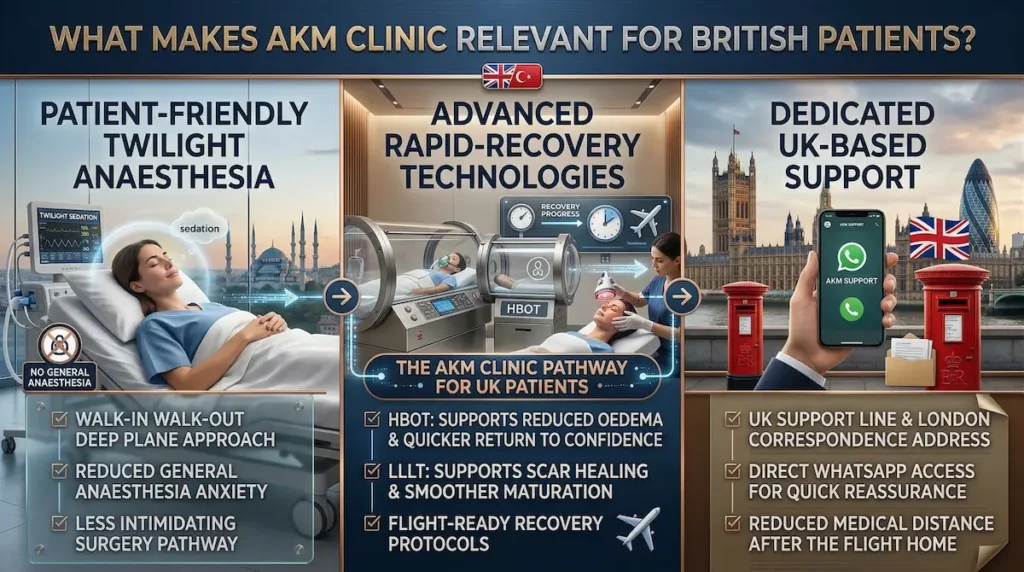
One of the clearest differentiators in AKM Clinic’s positioning is its emphasis on Twilight anaesthesia cosmetic surgery. For many British patients, general anaesthesia is a genuine source of anxiety, sometimes even more than the surgery itself. The idea that a deep plane facelift may be performed under local anaesthesia with light intravenous sedation is therefore highly relevant. It reframes the procedure in a way that feels more controlled, less physiologically heavy, and easier to understand.
This is one reason terms such as walk-in walk-out facelift Turkey and deep plane facelift without general anaesthesia resonate so strongly with the UK audience. They suggest not a casual procedure, but a more measured and patient-friendly pathway. For the right candidate, that can mean a smoother overall experience and a reduced sense of intimidation around surgery day.
From a strategic perspective, this also helps explain why some British patients searching for the best deep plane facelift clinic in Turkey are not simply asking about surgical fame. They are looking for a clinic that understands their concerns about sedation, post-operative grogginess, and return travel. In that sense, Twilight anaesthesia (conscious sedation) is not merely a technical detail. It is part of the clinic’s broader relevance to the British patient journey.
HBOT and LLLT: Faster Recovery, Less Oedema, and Better Scar Support
Recovery support is another area where AKM Clinic positions itself differently. Hyperbaric Oxygen Therapy, or HBOT, is presented as a key part of the clinic’s rapid-recovery strategy, particularly for reducing post-operative oedema and helping patients move through the early healing phase with less visible disruption. Low-Level Laser Therapy, or LLLT, is used to support scar quality by stimulating fibroblast activity and improving the healing environment around incisions.
For the British patient, these details matter because they address a practical fear: not only “Will my operation go well?” but also “How presentable and comfortable will I be when I travel home?” This is where scientific research and practical patient care intersect. Patients do not need laboratory language in order to appreciate a clinically sensible recovery plan. They simply need to understand that the clinic has invested in supportive technologies rather than leaving healing entirely to chance.
These technologies are especially relevant when discussing post-op care in Turkey for British citizens. A clinic that includes structured support for swelling, bruising, scar quality, and flight-readiness is offering more than the operation itself. It is offering a more complete model of treatment. That distinction is central to any serious facility review.
- HBOT: supports reduced oedema, lymphatic comfort, and a quicker return to social confidence.
- LLLT: supports scar healing and smoother incision maturation.
- Flight-ready recovery protocols: help British patients prepare more confidently for the journey home.
UK Support Line, London Correspondence Address, and WhatsApp Access
One of the strongest trust markers for UK patients is the sense that help remains accessible after the flight back. This is why AKM Clinic’s UK-facing support structure matters so much. A UK based patient contact point, a London correspondence address, and direct WhatsApp access all reduce the feeling of medical distance. They make the journey feel less like a one-off trip and more like a properly supported process.
This is highly relevant for patients searching not only for the best deep plane facelift clinic Turkey, but also for dependable post-op care in Turkey for British citizens. The operation may take place in Istanbul, yet reassurance often depends on what happens afterwards. If a patient has a question about swelling, scar care, plasters, sleeping position, or the normal timeline of recovery, they want to know that someone will answer clearly and promptly.
For sceptical British patients, this sort of support can be the difference between interest and commitment. It signals that the clinic understands emotional reassurance as well as surgical logistics. In a marketplace full of broad promises, local-style accessibility is one of the most convincing signs of a private cosmetic clinic in Istanbul with British standards.
How to Judge Results Like an Expert Patient
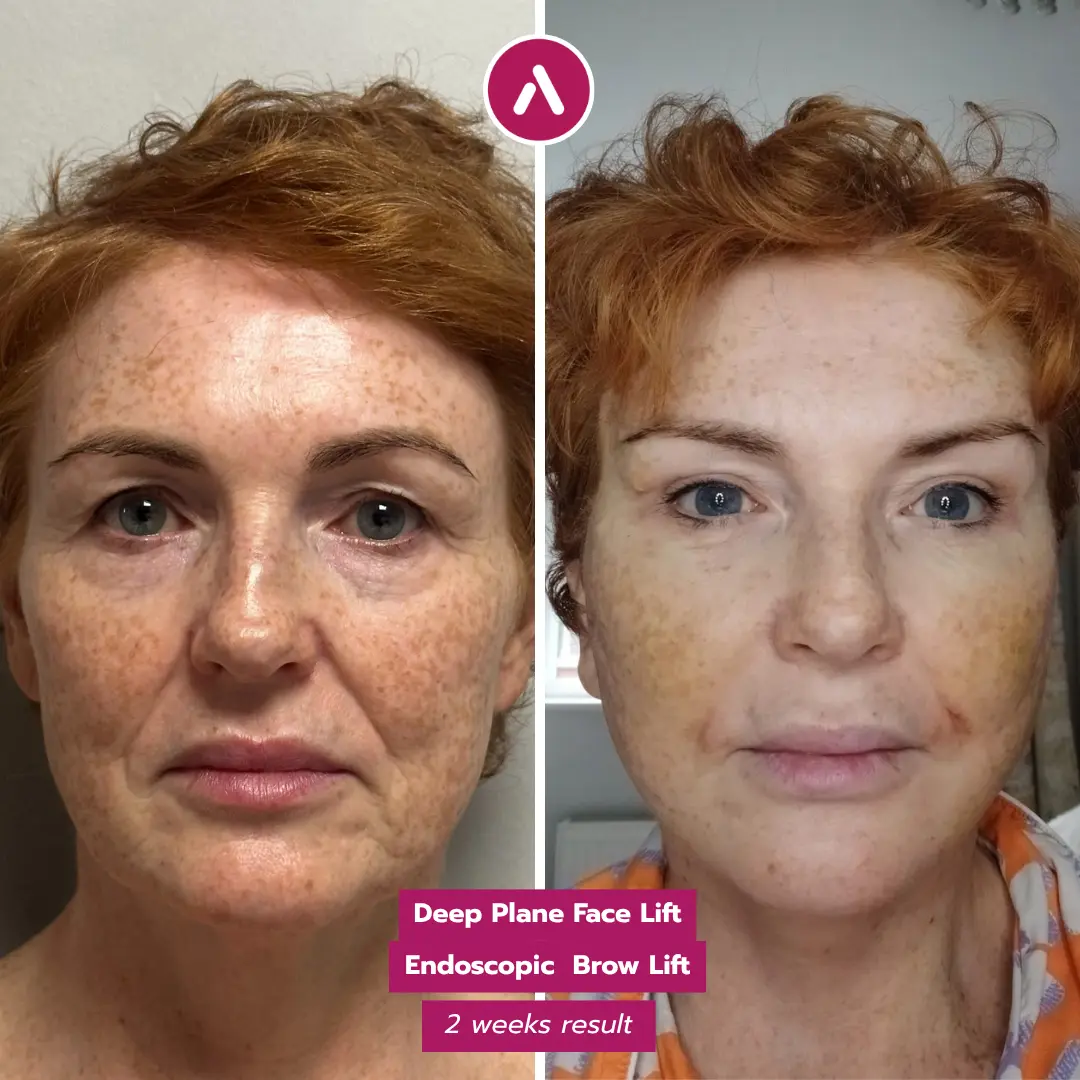
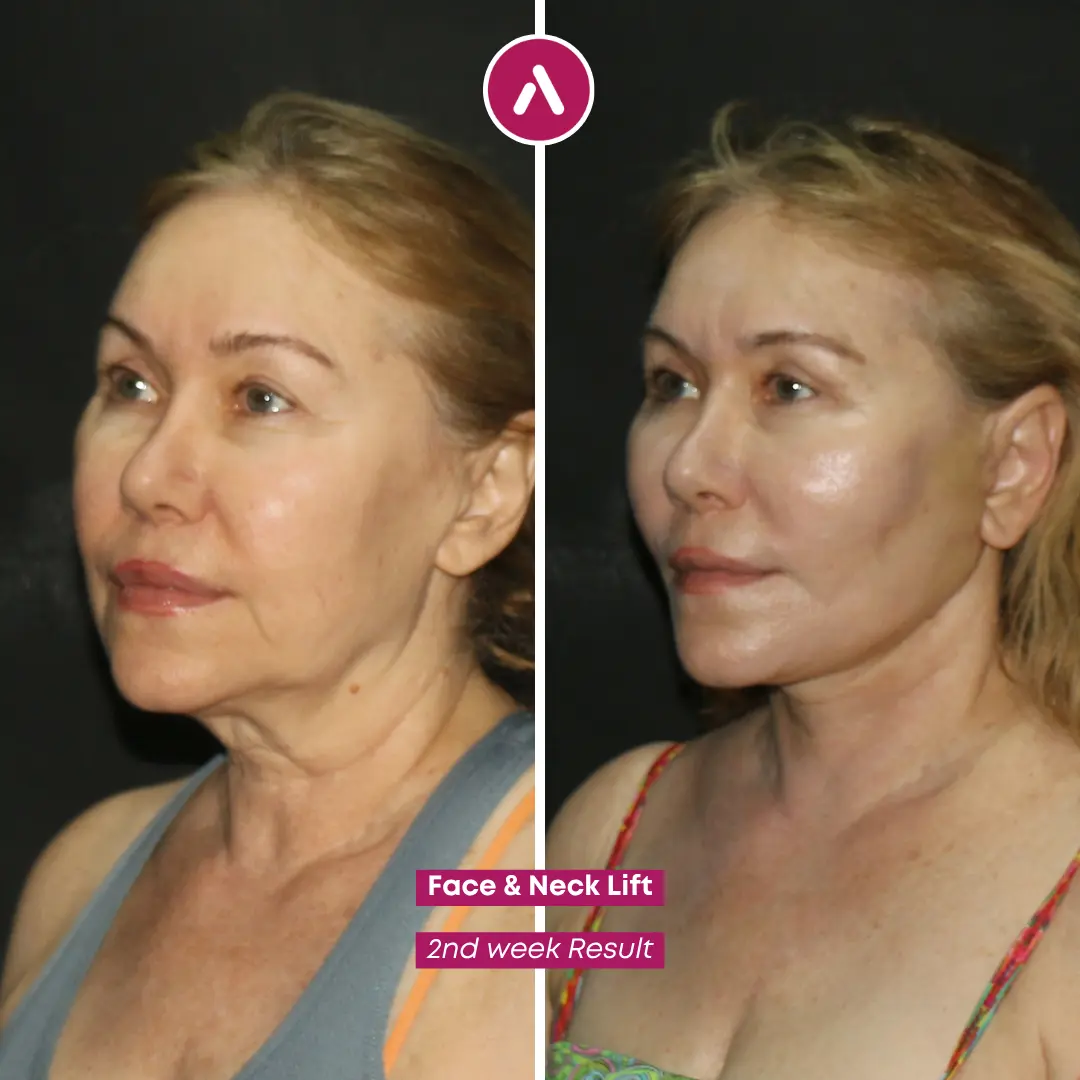
Results should never be judged only by whether someone appears younger. British patients are usually looking for something more specific: to look fresher, less tired, and more defined, without looking as though they have obviously had surgery. This is why expert patients evaluate results structurally. They look at how the face moves, how the jawline connects to the neck, how the cheeks sit in relation to the eyes, and whether the overall change still looks believable in everyday life.
For many British patients, this is also the point at which clinical judgement becomes more important than marketing claims. A gallery may look impressive at first glance, but the real question is whether the results reflect consistency, restraint, and anatomical understanding across different faces and age groups. That is why anyone searching for the best deep plane facelift surgeon in Turkey should focus on outcomes that look elegant, balanced, and believable rather than overly dramatic.
What Natural, Subtle Rejuvenation Really Looks Like
In UK aesthetics, “natural” is not an empty compliment. It usually means the result preserves identity. Friends may say the person looks rested or well, but they should not struggle to recognise the face. That is why so many British patients prefer subtle facial rejuvenation Turkey rather than a visibly “lifted” appearance.
A good deep plane facelift does not simply pull. It restores. The midface sits higher, early jowls soften, the jawline becomes cleaner, and the neck appears more continuous with the lower face. The best result is often the one that looks obvious to the patient but unremarkable to everybody else. That is not a limitation. It is the goal. If you are still comparing techniques before reading results, the practical differences in lift vector and longevity are set out in SMAS vs deep plane facelift, and expected durability in how long a deep plane facelift lasts. The full treatment overview sits on our deep plane facelift in Turkey page.
This is also why the best clinic for a discerning UK patient is not necessarily the one posting the most dramatic transformations. It is the one producing refined, consistent outcomes that still look human, expressive, and socially believable six months later.
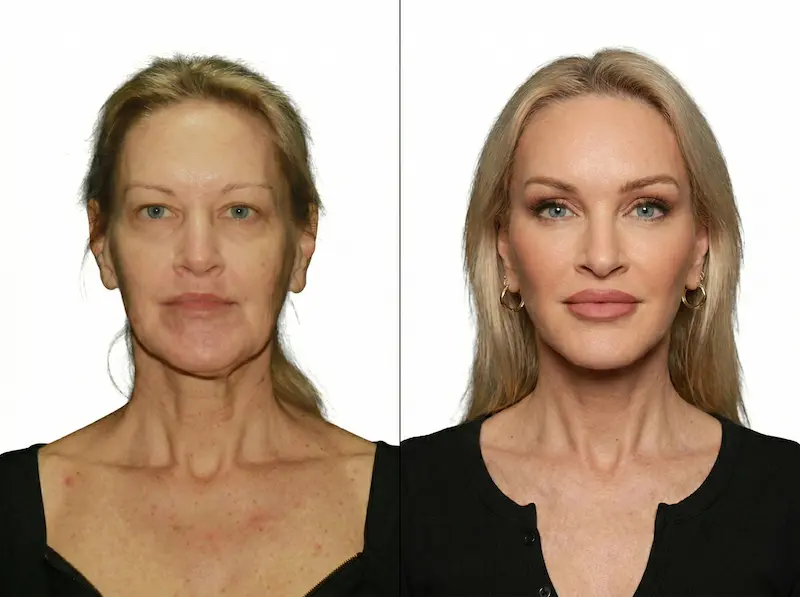
How to Read Before-and-After Photos Beyond Lighting and Angles
Before-and-after galleries can be useful, but only if you read them carefully. It is easy to be impressed by flattering lighting, make-up, altered posture, or images taken too soon after surgery to reveal the true texture and balance of the final result. Expert patients look beyond those surface effects. They ask whether the angle is genuinely comparable, whether the head position is consistent, and whether the result still appears natural rather than merely tighter.
This is particularly important when comparing the best deep plane facelift clinic in Istanbul against other options. A clinic should be able to show outcomes that demonstrate more than temporary tightening. The real signs of quality are structural improvement and visual harmony: a smoother cheek-to-jaw transition, less heaviness around the lower face, discreet scars, and no “wind-swept” distortion.
Where possible, healed results are always more valuable than immediate post-operative images. A skilled patient learns to ask not “Which photo is most impressive?” but “Which result still looks elegant after the swelling has settled?”
| What to examine in photos | What it may reveal |
|---|---|
| Midface position | Whether the lift restores support rather than just creating tension |
| Jawline continuity | Whether jowls and lower-face heaviness have been addressed convincingly |
| Neck transition | Whether the result looks smooth and coherent from profile view |
| Scar visibility | Whether incision placement and healing support have been handled well |
| Expression and identity | Whether the face still looks like the patient, only fresher |
Why Midface Lift, Jawline Continuity, and Scar Quality Matter
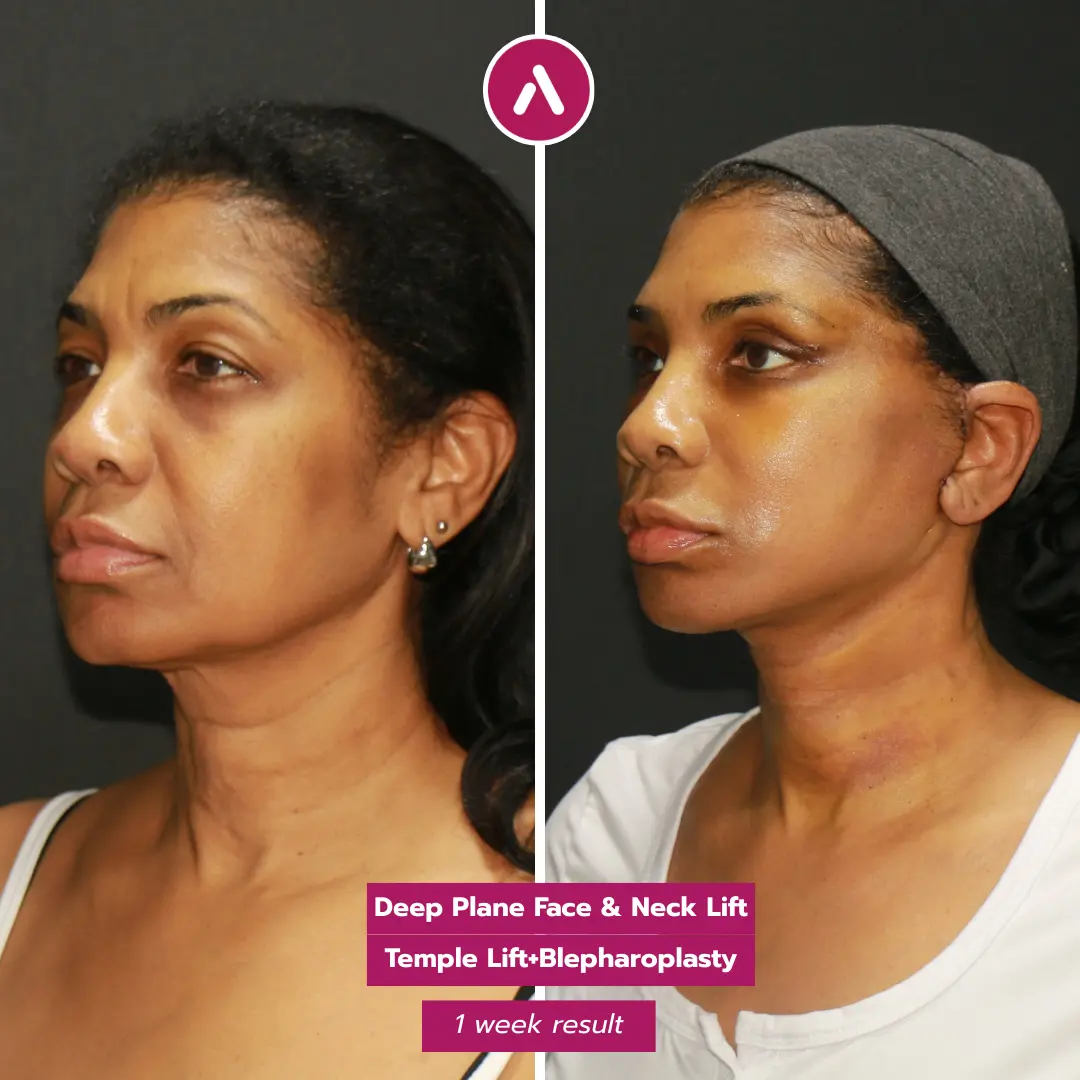
When British patients say they want a “good facelift”, they are often responding to three highly visible concerns: descent in the midface, loss of jawline definition, and fear of obvious scars. These concerns are sensible because they affect the way surgery is perceived in ordinary social settings. People may not consciously name the midface, but they notice when the central face looks supported and the lower face looks less heavy.
Jawline continuity matters because it is one of the most convincing signs of genuine rejuvenation. A good result should not create a hard, artificial line. It should create smoother definition that works from the front view as well as the three-quarter profile. Scar quality matters for the same reason. In facial surgery, the result should not announce itself through visible signs of treatment.
Case analyses associated with UK patients also highlight a pattern that British readers find reassuring: local anaesthesia pathways, HBOT-supported recovery, reduced bruising, smoother contours, and the avoidance of a pulled or wind-swept look. That combination supports the sort of result expert patients usually value most — fresher, sharper, and quieter, rather than theatrical.
Cost, Value, and the Full Journey from the UK
For most British patients, cost matters, but value matters more. The real comparison is not simply “Turkey is cheaper than London”. It is whether a clinic can offer consultant-led surgery, strong operating theatre standards, thoughtful recovery planning, and dependable communication at a level that feels comparable to private UK care. That is why searches such as best deep plane facelift clinic Turkey and best clinic for deep plane facelift in Turkey are usually value-driven rather than bargain-driven.
Facelift London vs Istanbul Quality: What Are You Actually Comparing?
When patients compare Harley Street with Istanbul, they often begin with price and then quickly realise that price alone is an incomplete metric. A proper comparison should include who performs the surgery, whether the clinic is consultant-led, what the recovery support looks like, whether advanced scar and swelling management are available, and how easy it is to stay in contact once the patient is back in the UK.
In practical terms, facelift London vs Istanbul quality is a question about systems as much as location. A Harley Street address may imply prestige, but prestige is only meaningful when it is matched by clinical substance. In the same way, Istanbul becomes compelling only when the clinic can demonstrate that it operates as a private cosmetic clinic in Istanbul with British standards, rather than merely offering a lower quote.
For the British expert patient, the better question is therefore this: what level of care is included around the operation itself? If the answer includes direct surgeon access, careful anaesthesia planning, proper theatre standards, structured recovery technologies, and organised communication after return travel, then the value equation starts to look very different from a simple headline-price comparison.
| Comparison point | Typical premium UK private model | AKM Clinic value model |
|---|---|---|
| Surgical setting | Prestige location and consultant-led care | Consultant-led care with Istanbul cost efficiency |
| Anaesthesia approach | Often centred around standard theatre pathways | Twilight anaesthesia pathway for suitable cases |
| Recovery support | May be charged separately or arranged in stages | HBOT/LLLT-led recovery planning integrated into the journey |
| Communication after surgery | Usually local but not always immediate | WhatsApp access, UK support structure, and organised follow-up |
| Overall value | Premium price for premium care | Premium care proposition with stronger international value |
All-Inclusive GBP Pricing vs Hidden Extras
British patients tend to be highly alert to hidden costs. A quote can seem attractive at first, only for additional charges to appear later for medication, garments, follow-up appointments, transfers, accommodation, or recovery support. That is why transparent pricing in pounds matters so much. It is not just a convenience; it is a trust signal. Line-by-line inclusions and the current GBP range are kept up to date on our deep plane facelift cost page, and the combined face and neck options are listed under the all-inclusive deep plane facelift package.
For many patients, the appeal of Istanbul is strongest when the clinic presents an all-inclusive cosmetic surgery GBP framework rather than a fragmented list of extras. This helps the patient compare like with like. It also reduces the stress of planning from abroad, because the financial picture is clearer before travel begins.
That said, informed patients should still ask detailed questions. Does the quoted price include consultations, pre-operative checks, theatre fees, aftercare appointments, compression garments if needed, hotel arrangements, transfers, medication, or recovery-support sessions? A trustworthy clinic will answer these questions precisely. Clarity is a major part of perceived value.
Travel Logistics, Recovery Planning, and Returning Home Safely
The full patient journey does not end when the surgery is completed. For UK patients, one of the most practical concerns is how recovery interacts with air travel. They want to know when they can fly, how visible swelling may be, how dressings are managed, and whether they will still feel supported once they are no longer physically in Istanbul. That is why the best clinic for a British patient plans the journey as carefully as the operation.
Here, logistics and clinical thinking overlap. The clinic should provide a sensible recovery timetable, realistic expectations about oedema and bruising, guidance on rest, hydration, walking, medication, and clear instructions on when to seek advice. This is where post-op care in Turkey for British citizens becomes part of the clinic’s core value rather than an afterthought.
For many patients, the greatest comfort comes from knowing that return travel has been anticipated rather than improvised. A clinic that understands flight-ready recovery protocols, direct travel planning, and the emotional experience of going home after surgery is much more likely to feel safe and competent from a UK perspective.
Facelift in Turkey Reviews: How to Read Them Before You Book
Most UK patients start with reviews, not with anatomy. Typing facelift in Turkey reviews into Google returns Trustpilot pages for agencies, Facebook group threads, and directory listings with hundreds of clinics under one profile. None of those sources tell you who held the scalpel. That is the gap worth closing before you send a deposit.
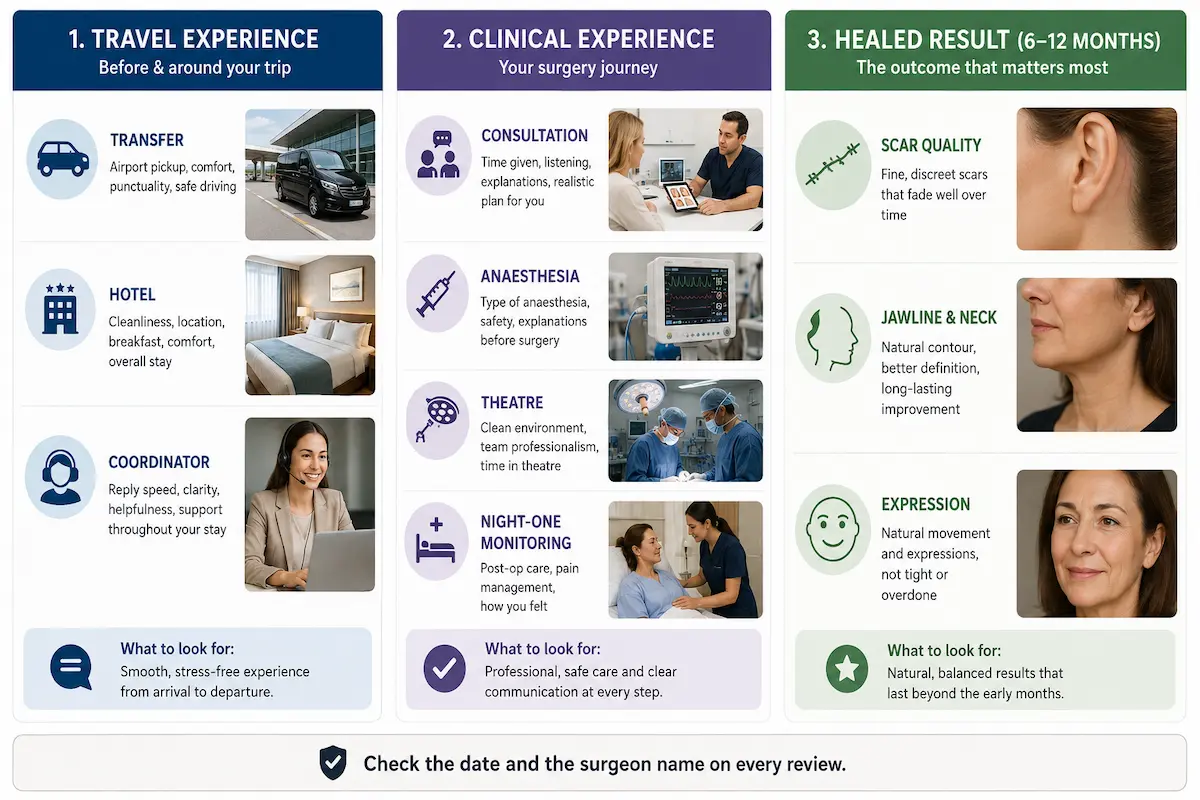
Reviews become useful when you separate three different things: the travel experience (transfers, hotel, coordinator replies), the clinical experience (consultation depth, anaesthesia, theatre, night-one monitoring), and the healed result at six to twelve months. A five-star review written on day three of recovery says almost nothing about scar quality or midface support.
| Review source | What it can prove | What it cannot prove |
|---|---|---|
| Agency or directory profiles | Logistics, communication speed, complaint handling | Which surgeon operated, or the surgical technique used |
| Facebook and forum threads | Real prices quoted, honest recovery timelines, unfiltered swelling photos | Whether the poster was a deep plane or SMAS case |
| Clinic-published patient stories | Named surgeon, procedure detail, follow-up pathway | Independent verification, so cross-check against third-party threads |
| Video testimonials | Face in motion, expression, scar visibility at the filmed stage | Long-term stability if filmed within the first weeks |
When you read a deep plane facelift Turkey reviews thread, look for four specifics: the named consultant, the anaesthesia used, whether the neck was addressed in the same operation, and how the patient describes week two rather than day one. A detailed account of Istanbul from a UK patient who compared quotes first is more informative than a one-line score; Sarah’s deep plane facelift story and this 14-day deep plane facelift recovery diary follow that structure day by day.
Real UK Patient Reassurance: Trust Signals, Stories, and Red Flags
British patients often trust lived experience as much as they trust formal credentials. That does not mean testimonials should replace clinical judgement, but it does mean they play a meaningful role in decision-making. A strong facility review should therefore examine not only credentials and systems, but also whether real patients describe the clinic in ways that align with safety, transparency, and natural results.
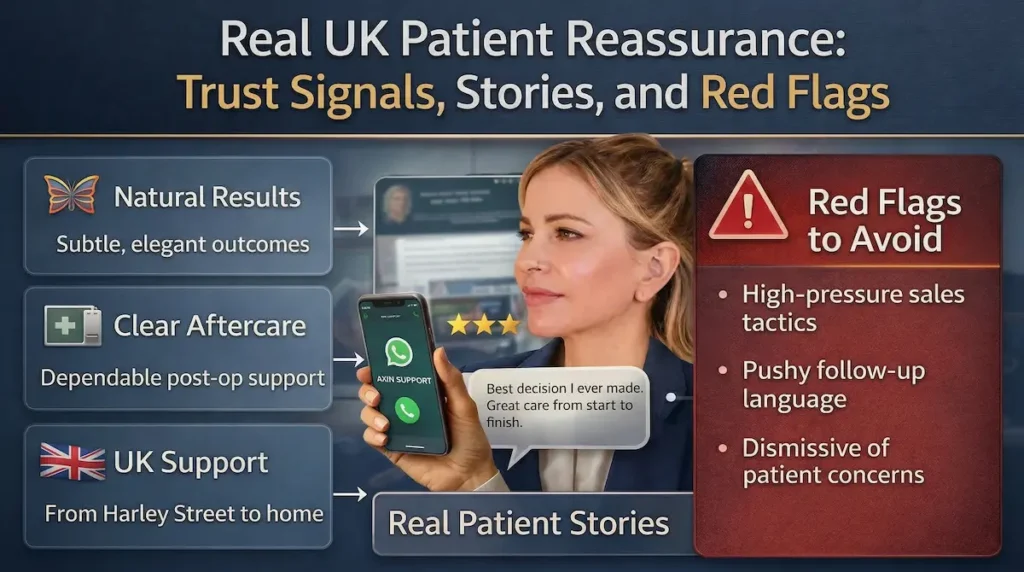
For this reason, patient stories are often most useful when they reinforce what strong clinical evidence already suggests. When testimonials consistently mention clear communication, natural outcomes, and dependable aftercare, they help confirm that the clinic’s standards are real rather than simply advertised. For British readers trying to identify the best deep plane facelift surgeon in Turkey, this combination of lived experience and clinical credibility can provide a far more reliable basis for decision-making than marketing language alone.
Sarah’s Perspective: Choosing Istanbul Over Harley Street Pricing
Sarah’s story is especially relevant for the UK audience because it mirrors the thought process of many British patients. She had prior experience with surgery in the UK and was specifically looking to avoid high Harley Street fees while still achieving subtle facial rejuvenation. Her conclusion was not based on bargain-hunting; it was based on comparative value and the confidence that the result would remain natural.
Her experience also speaks to a wider UK concern: whether Istanbul can genuinely compete with London on quality, not just on price. For a sceptical reader, that question matters more than any glamorous marketing line. Sarah’s account is reassuring precisely because it frames the decision as a rational comparison rather than an impulsive leap.
Considering facelift London vs Istanbul quality, I would confidently choose Turkey over the UK.
Why Peer-to-Peer Validation Matters for the Sceptical British Patient
Another notable pattern in UK patient journeys is the importance of peer-to-peer reassurance. Stella’s case underlines this clearly. A direct connection with a previous UK patient created a level of trust that standard advertising rarely achieves. British patients often want to hear how another person handled the same fears they have: distance, safety, communication, and what it felt like to come home and continue healing.
This is especially significant for readers who are still weighing whether the best deep plane facelift clinic in Istanbul can genuinely feel accessible and safe. Hearing that another British patient valued transparent all-inclusive pricing, smooth logistics, and clear communication can often answer emotional doubts that even a detailed clinical explanation cannot fully resolve.
That does not replace due diligence, but it does support it. For the sceptical patient, peer validation acts as a bridge between technical credibility and real-life reassurance.
Red Flags That Suggest a Clinic Is Not Truly UK-Ready
Just as trust signals matter, so do warning signs. A clinic may market heavily to British patients without actually understanding what UK patients need. This is where expert patients gain an advantage: they know how to spot inconsistencies early.
- Vague credential language: the clinic avoids naming the consultant or explaining specialist qualifications clearly.
- No clear aftercare pathway: there is little detail about support once the patient returns to the UK.
- No UK-facing accessibility: there is no UK based patient contact point, no credible local communication structure, and no organised continuity.
- Price without substance: the quote is emphasised far more than surgical method, safety systems, or recovery planning.
- Overdone aesthetic examples: before-and-after galleries prioritise dramatic change over subtle rejuvenation.
By contrast, a clinic that is genuinely UK-ready will usually communicate in a calmer, more precise way. It will explain theatre standards, consultant responsibility, recovery planning, and what support exists once the patient is back home. That sort of structure is far more persuasive than sales language.
Frequently Asked Questions (FAQ): Best Deep Plane Facelift Clinic in Turkey
Below are the questions British patients most often ask when comparing the best deep plane facelift clinic in Turkey with premium UK private options. The answers are intentionally concise and written in clear en-GB style.
Is a deep plane facelift in Turkey safe for UK patients?
It can be, provided you choose a consultant-led clinic with strong operating theatre standards, clear sterility protocols, and structured aftercare rather than a price-led package.
How can I verify a surgeon’s qualifications from the UK?
Ask for full surgeon names, specialist credentials, European board details where relevant, and a clear explanation of who performs the key parts of the operation.
What should a proper operating theatre standard include?
It should include sterile workflow, disciplined infection control, trained theatre staff, patient monitoring, and a clear escalation plan if a concern arises.
Can a deep plane facelift be performed without general anaesthesia?
In selected cases, yes. Some specialist clinics perform deep plane facelift surgery under local anaesthesia with Twilight sedation, which many British patients find more reassuring.
How soon can I fly back to the UK after surgery?
The timeline varies by patient and procedure details, so you must follow your surgeon’s advice. A responsible clinic will give a personalised travel plan rather than a generic promise.
What aftercare should I expect once I return home?
You should expect structured follow-up guidance, rapid answers to recovery questions, scar-care advice, and clear instructions on what is normal and what needs review.
Is choosing Turkey only about price, or can quality genuinely match Harley Street?
For many British patients, the appeal is not cheapness but value. The strongest clinics aim to combine premium standards, subtle results, and organised care with a more efficient overall cost structure.
Where can I find independent facelift in Turkey reviews?
Use more than one channel: third-party review platforms for logistics, closed patient groups for unedited recovery photos, and clinic-published case pages for surgical detail. Then check that the surgeon named in the review is the surgeon named in your own quote.
Are deep plane facelift Turkey reviews reliable if they are only a few weeks old?
Early reviews mostly describe swelling, bruising and communication. Scar maturation and final contour take months, so weight healed cases and follow-up photos more heavily than day-five posts.
Do reviews differ between Istanbul and Antalya clinics?
Istanbul carries most of the facial surgery volume and direct UK flight options, which is why deep plane facelift Istanbul reviews are more numerous. Volume alone is not a quality marker, so still verify the individual consultant and the theatre setting.
Medical Disclaimer: This page is provided for general educational purposes only and does not replace a face-to-face medical consultation, diagnosis, or personalised treatment plan. All surgery carries risks and outcomes vary between individuals. Suitability for a facelift surgery, procedure selection, and anaesthesia choice can only be determined after a full clinical assessment by a qualified surgeon. Always follow your clinician’s instructions and seek urgent medical attention if you develop concerning symptoms during recovery.