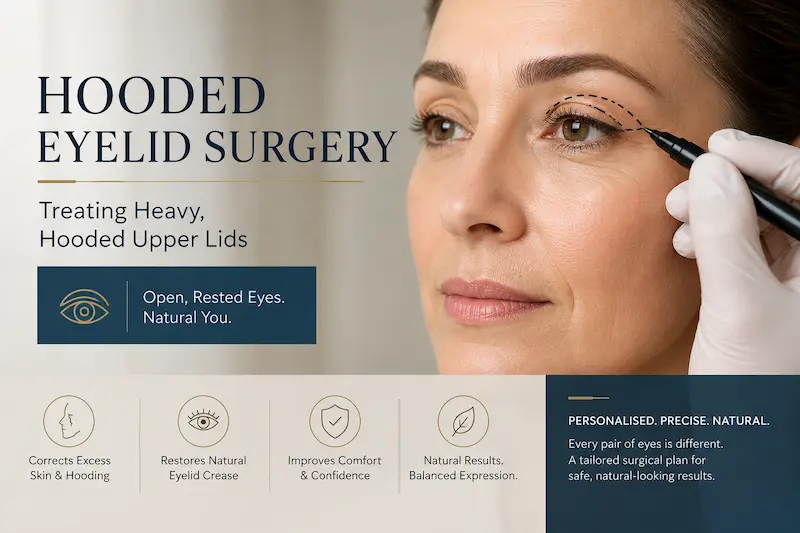
Hooded eyelid surgery treats heavy upper lids by correcting the cause of the hooding: extra eyelid skin, bulging fat, a descended brow, or true ptosis. The right procedure may be upper blepharoplasty, a brow lift, ptosis repair, or a carefully planned combination.
For many Canadian patients, the confusing part is not deciding whether the eyelids look heavy. That is usually obvious in photos, mirrors, and makeup application. The harder question is why they look heavy. A lid that folds over the crease may be a skin problem. A brow that has dropped over time can create the same look from above. A weak eyelid-lifting muscle can make the eye itself sit lower.
That distinction matters. AKM’s blepharoplasty approach is built around matching the correction to the anatomy, not simply removing skin because the upper lids look crowded. For an expert patient, the goal is a rested, open upper eye that still looks like her own face — not a hollow, over-operated, or surprised expression.
This guide explains what causes hooded upper lids, how hooding differs from true ptosis, when upper blepharoplasty is enough, when a brow lift may be the better fix, and what Canadian patients should ask before travelling for surgery.
Table of Contents
What Makes Upper Eyelids Look Hooded?
Upper eyelids look hooded when tissue above the lash line folds down, crowds the natural crease, or rests close to the upper eyelashes. The visible effect can be mild, such as makeup transferring into the crease, or more functional, such as the lid skin feeling heavy by the end of the day.
But “hooded eyes” is a visual description, not a diagnosis. Several different anatomical changes can create the same folded look. A good consultation separates the cause before choosing the treatment.
Excess skin, also called dermatochalasis
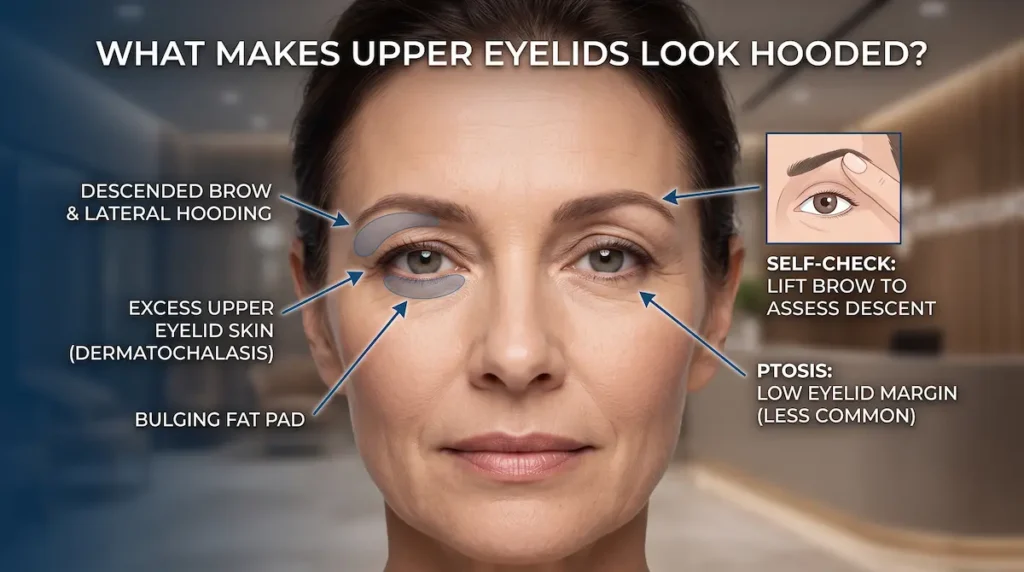
The most common cause of hooded upper lids is extra, lax skin on the upper eyelid. Clinically, this is often called dermatochalasis. The skin stretches, loses elasticity, and begins to fold over the natural lid crease.
This can happen with age, genetics, repeated swelling, skin quality changes, or long-term sun exposure. Some people notice it in their 30s. Others do not see it until their 50s or 60s. The timing varies.
In a skin-dominant hood, the eye itself usually opens normally. The problem is the extra fold sitting on top of the eyelid. This is the scenario where upper blepharoplasty often helps most directly, because the operation can remove a measured amount of redundant skin while preserving enough tissue for comfortable eye closure.
Bulging fat in the upper lid
Some heavy upper lids are not caused by skin alone. Fat pads around the eye can push forward, creating a puffy or swollen upper lid. This may make the lid look heavier even if the skin excess is moderate.
Fat bulging needs careful judgement. Removing too much fat can make the upper eye look hollow, especially as the face naturally loses volume with age. For that reason, modern upper eyelid surgery is usually conservative with fat. The plan is not to “empty” the lid. It is to restore a cleaner contour while keeping the eye soft.
A descended brow
A low brow can mimic hooded eyelids. This is especially common at the outer third of the brow, where the tail drops and pushes skin down over the outer upper lid. Patients often describe this as “lateral hooding” or heaviness at the outer corner.
The key clue is position. If the brow itself sits low and the upper lid skin improves when the brow is gently lifted, then removing eyelid skin alone may not fully solve the problem. It may even make the brow look lower by leaving the original cause untreated.
That is why brow position must be checked before upper eyelid surgery. In some patients, upper blepharoplasty is the right answer. In others, a lateral brow lift may be the better correction, either alone or in combination with eyelid surgery.
A mirror self-check, not a diagnosis
A simple mirror check can help you understand the possibilities. Look straight ahead in relaxed lighting. Do not raise your eyebrows. Notice whether the fold comes mainly from the eyelid skin, the outer brow, or the eyelid margin itself sitting low over the pupil.
Then gently lift the outer brow with one finger. If the hooding improves dramatically, brow descent may be a major driver. If the brow lift changes little but the upper lid still has a loose fold, extra eyelid skin may be the main issue. If the eyelid margin covers more of the pupil on one side, true ptosis may need to be assessed.
This self-check is only a starting point. A proper exam looks at brow position, lid crease, skin excess, eyelid muscle function, eye dryness, facial symmetry, and whether the heaviness affects vision.
| Cause of Hooding | Telltale Sign | Typical Fix |
|---|---|---|
| Excess upper eyelid skin | Loose fold covers the crease but the eye opens normally | Upper blepharoplasty |
| Bulging upper lid fat | Puffy or heavy-looking upper lid, often near the inner corner | Conservative fat contouring during blepharoplasty |
| Descended brow | Outer hooding improves when the brow is gently lifted | Lateral brow lift, sometimes combined with blepharoplasty |
| True ptosis | Eyelid margin sits low over the pupil | Ptosis evaluation and possible muscle repair |
Hooding vs True Ptosis
Hooding and ptosis are often mixed up because both can make the eyes look tired or half-open. They are not the same problem. Hooding usually means extra tissue sits over the upper lid. True ptosis means the eyelid margin itself is too low because the lifting mechanism is weak, stretched, or not working properly.
This difference changes the surgical plan. Removing skin can improve hooding, but it does not repair a weak eyelid-lifting muscle. Treating ptosis like simple hooding can leave the patient disappointed, because the lid may still sit low after the skin has healed.
Skin problem vs muscle problem
In hooded eyes caused by dermatochalasis, the eyelid margin may sit in a normal position while the skin above it folds downward. Patients often say their lids feel heavy, their crease has disappeared, or eyeliner smudges because the fold covers the lid platform.
In true ptosis, the upper eyelid margin drops closer to the pupil. One eye may look smaller than the other. The patient may unconsciously raise the eyebrows or tilt the head back to see better. The issue is not simply extra skin; it is lid elevation.
For a more detailed comparison, the linked guide on hooding versus true ptosis explains why blepharoplasty and ptosis repair are different operations, even though patients may describe both as “heavy eyelids.”
Why the distinction changes the surgery
Upper blepharoplasty focuses on the skin, muscle, and sometimes fat of the upper eyelid. Ptosis repair focuses on the muscle or tendon system that lifts the eyelid. A brow lift focuses on the tissue above the eyelid. These are related areas, but they solve different problems.
That is why a precise pre-operative assessment matters. If extra skin is the main issue, upper blepharoplasty can create a cleaner fold and reduce the heavy-lid look. If the brow is low, brow lifting may be needed to avoid removing too much eyelid skin. If ptosis is present, the lid-lifting mechanism may need its own plan.
A natural result comes from respecting those boundaries. Too much skin removal can pull the upper lid tight. Too much fat removal can make the eye look hollow. Ignoring brow position can leave outer hooding behind.
The most natural hooded-lid result usually comes from a modest correction matched to the cause: skin for skin excess, brow support for brow descent, and muscle assessment when the eyelid margin itself sits low.
What a proper exam checks
A hooded eyelid assessment should not be a quick glance at the lid fold. It should include how the brow sits at rest, how much skin is truly redundant, whether fat is bulging, how well the eyes close, and whether dry eye symptoms are present.
Clinical references on upper eyelid blepharoplasty also emphasize evaluation of eyelid position, brow ptosis, skin excess, fat, and ocular history. This is especially relevant for Canadian patients comparing local assessment with surgery abroad, because the consultation must be specific enough to guide both the procedure and the aftercare plan.
A careful exam may also include photographs and, when vision is affected, visual field documentation through an eye-care professional. Cosmetic goals matter, but function should not be guessed. If the lid fold blocks peripheral vision or causes forehead strain, that should be assessed before any surgical decision is made.
Blepharoplasty or Brow Lift?
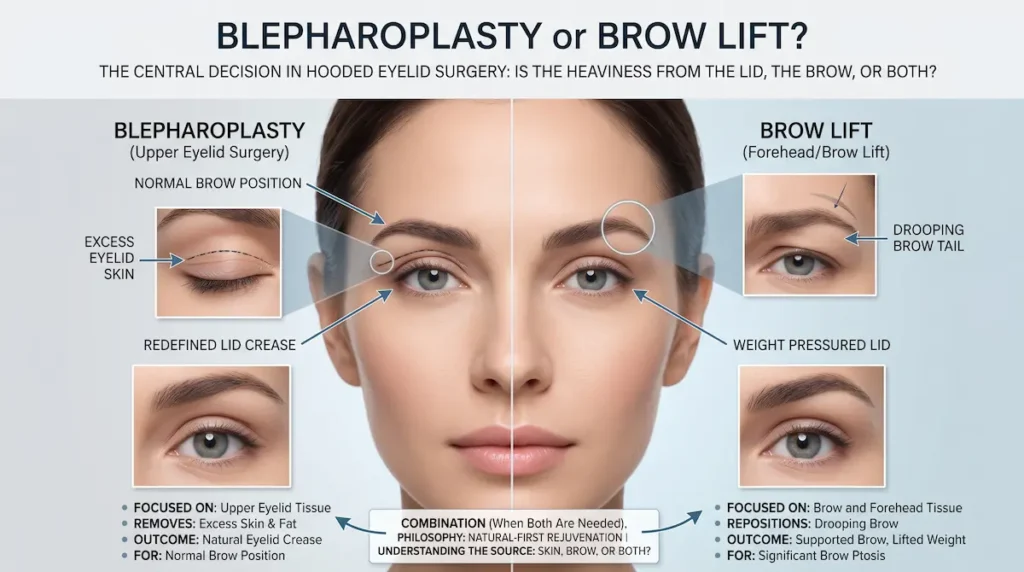
The central decision in hooded eyelid surgery is whether the heaviness comes from the eyelid, the brow, or both. This is where many patients are surprised. The area that bothers them is the upper lid, but the source of the problem may sit higher, at the brow.
Upper blepharoplasty and brow lift surgery can both make the eye area look more open, but they do not work in the same way. Blepharoplasty refines the eyelid itself. A brow lift repositions the tissue above the eyelid. Choosing between them depends on anatomy, not preference alone.
When upper blepharoplasty is enough
Upper blepharoplasty is usually enough when the brow sits in a reasonable position and the main issue is extra upper lid skin. In that case, removing a carefully measured strip of skin can restore the crease, reduce folding, and make the lid feel lighter.
This does not mean the surgeon should remove every fold. The upper eyelid needs enough skin to blink comfortably and close fully during sleep. A small amount of natural fullness is also part of a normal, youthful-looking eye.
For patients whose hooding is mostly skin-related, the best result often looks subtle. Friends may notice that the face looks more awake, but they should not immediately think, “She had eyelid surgery.” That is the point.
When the brow is the real cause
If the outer brow has dropped, the upper lid can look hooded even when there is not much extra eyelid skin. This is especially common in people who constantly raise their eyebrows to keep the eyes feeling open.
In this situation, eyelid surgery alone can under-correct the problem. It may remove some skin, but the brow continues pressing downward. The remaining hooding can make the result feel incomplete.
A brow-focused plan may be more appropriate when the heaviness is strongest at the outer lid, when the brow tail sits below its natural support point, or when manually lifting the brow improves the lid fold. For some patients, a conservative lateral brow lift gives a cleaner correction than removing extra eyelid skin.
When both may be combined
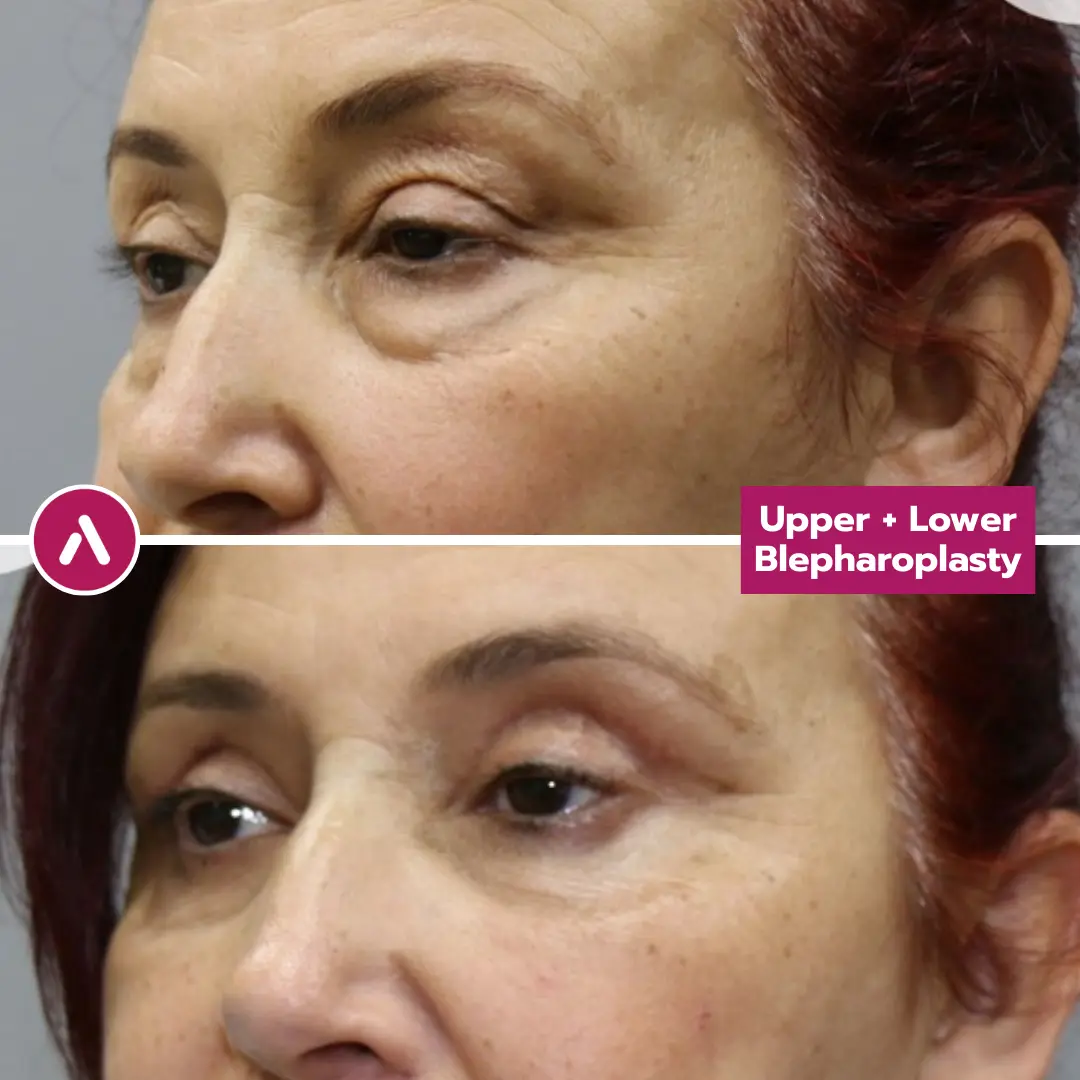
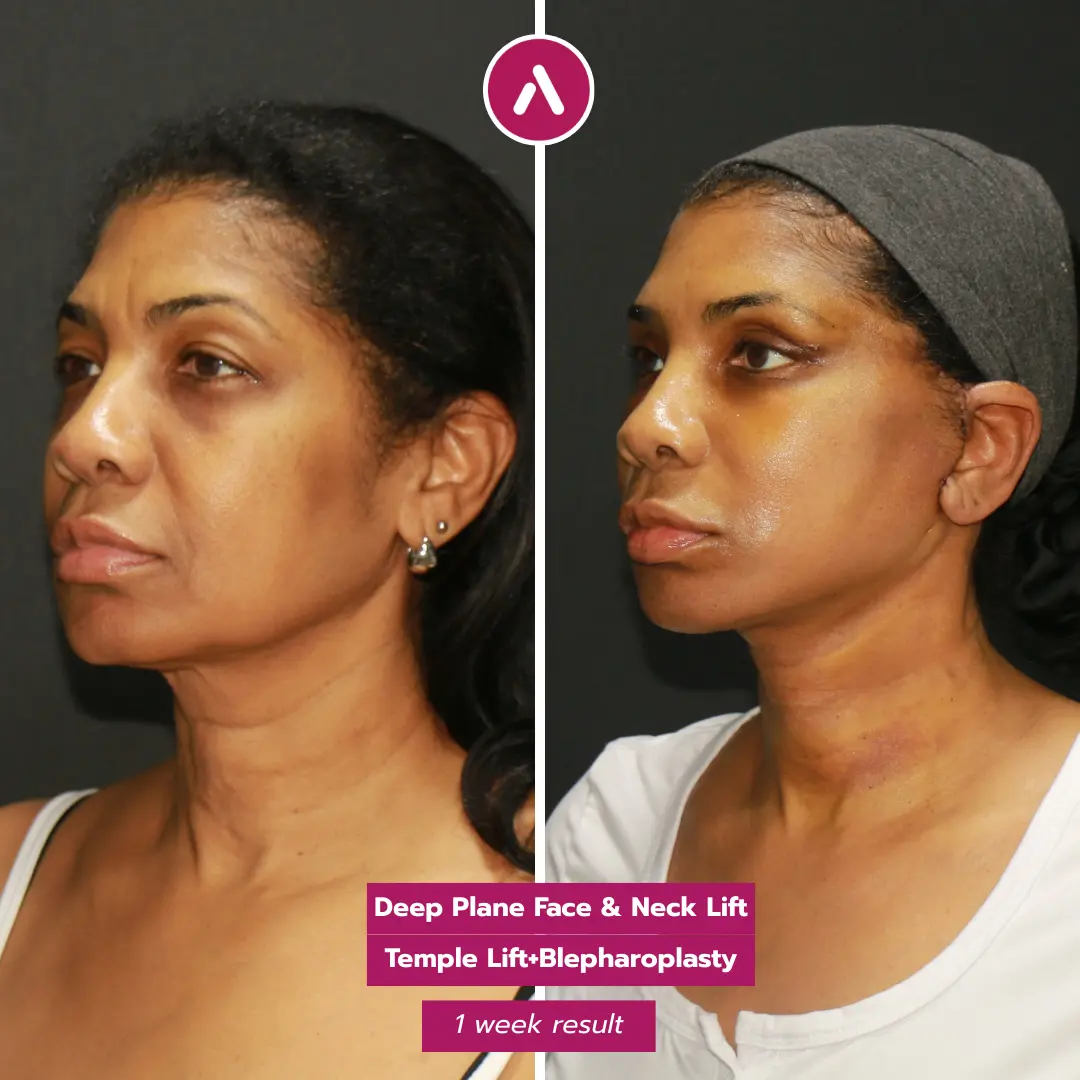
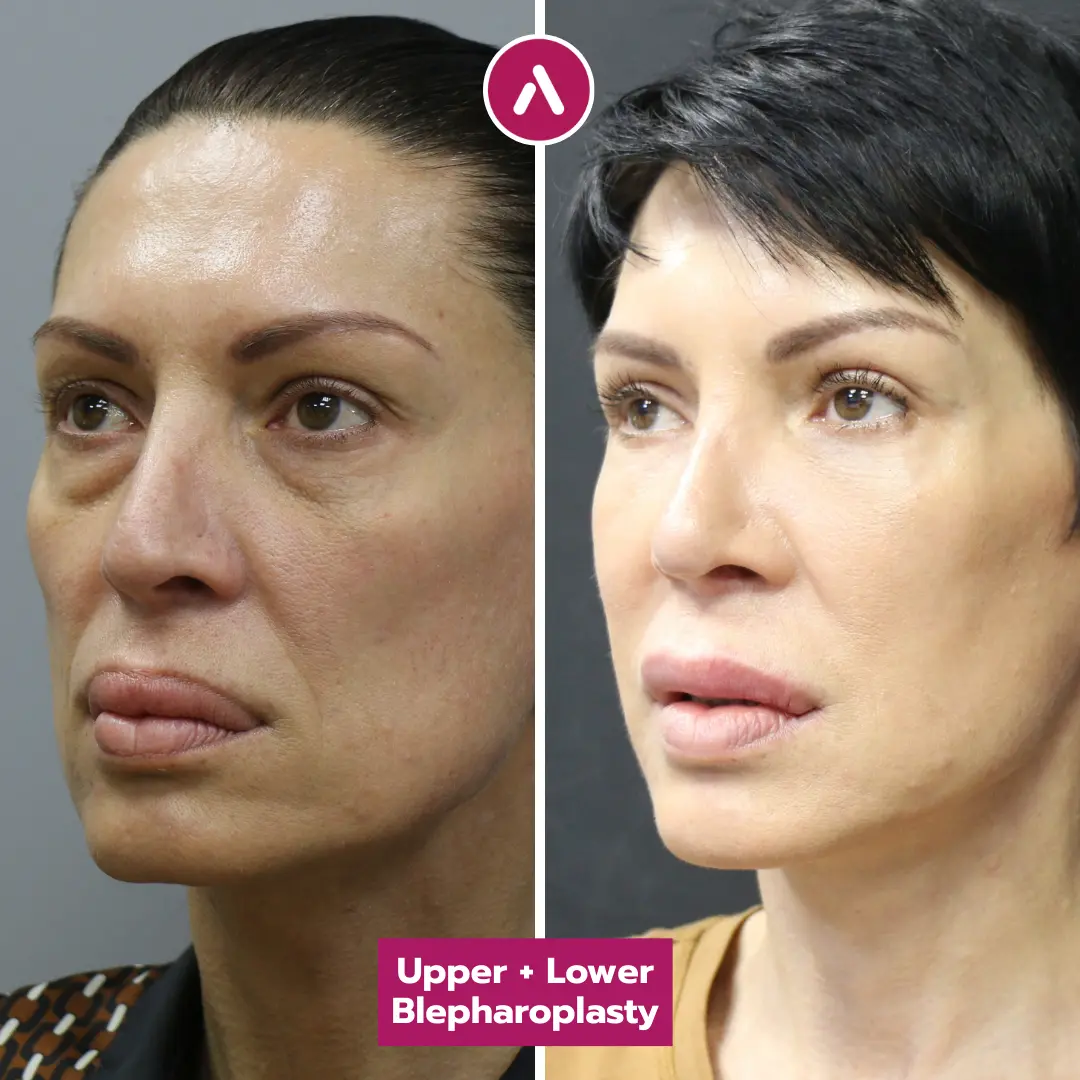
Some patients have both eyelid skin excess and brow descent. In those cases, the plan may involve a conservative upper blepharoplasty plus a brow lift. The goal is balance: support the brow from above, then refine the true excess at the lid.
Combination planning requires restraint. If the brow is lifted and too much eyelid skin is removed at the same time, the eye can look tight. If too little is done, the patient may still feel hooded. The surgical design has to account for how both tissues will settle together.
Canadian patients considering surgery abroad should ask to see the logic behind the plan. It is reasonable to ask: “Is my hooding coming from skin, brow descent, fat, or ptosis?” A clear answer is more valuable than a long list of procedures.
How AKM frames the decision
AKM Clinic’s facial surgery philosophy is Natural-First: rejuvenation over alteration. For hooded upper lids, that means the plan should preserve the patient’s eye character while reducing the heaviness that makes the face look tired.
Because eyelids sit in the centre of expression, millimetres matter. The surgeon must consider lid closure, brow position, crease height, existing asymmetry, eye shape, and skin quality. A technically successful operation that changes the person’s expression too much is not a good aesthetic result.
For face and eye-area procedures, the dermatosurgical perspective is useful because the skin envelope is not treated as a disposable layer. It is part of the expression, movement, and final scar quality. The safest-looking plan is often the most anatomically conservative one.
Realistic Results & Risks
Hooded eyelid surgery can make the upper eye look lighter, clearer, and more rested. It can reveal more of the lid platform, reduce the fold that sits on the lashes, and improve the sense of heaviness. What it should not do is erase every sign of age or make the eyes look like someone else’s.
Realistic expectations protect both the aesthetic result and the patient experience. Heavy upper lids usually improve well when the cause is correctly identified. Problems are more likely when the wrong structure is treated, too much tissue is removed, or pre-existing eye symptoms are ignored.
What hooded-lid surgery can improve
When the issue is excess upper lid skin, surgery can reduce the fold that hides the crease. Patients may find that eyeliner sits more cleanly, mascara transfers less often, and the upper eye looks less weighed down in photos.
If bulging fat contributes to the heaviness, careful contouring can soften the puffy appearance. The word “careful” matters. A smooth upper lid is not the same as a hollow one.
If the brow is part of the problem and is treated appropriately, the outer eye can look more open without pulling the eyelid into an unnatural shape. Good planning respects the whole upper third of the face, not just the eyelid crease.
What it cannot fix
Upper blepharoplasty cannot repair true ptosis if the eyelid-lifting mechanism is weak. It also cannot fully correct a low brow if the brow is the main source of the hooding. This is why diagnosis comes before design.
It also cannot change every feature around the eyes. Fine lines, skin texture, under-eye hollowness, lower lid bags, and brow asymmetry may need different treatments or may be best left alone. A hooded-lid procedure should not become a catch-all operation.
For some patients, the most honest recommendation is a smaller procedure than expected. For others, it is a different procedure. Occasionally, it is no surgery at all until dry eye, thyroid eye disease, unstable health issues, or unrealistic goals are addressed.
Over-resection and the hollow-eye risk
One of the biggest risks in upper eyelid surgery is taking too much. Too much skin removal can make the eyes difficult to close comfortably. Too much fat removal can create a hollow, skeletonized look that may age the face rather than refresh it.
This is especially important for patients who already have deep-set eyes, thin skin, or visible upper orbital hollowing. In these cases, a heavy lid may still need correction, but the plan should be more conservative. The goal is to reduce crowding, not strip away all fullness.
Over-resection can also affect expression. Eyes that look overly round, startled, or tight may signal that the natural lid balance has been disrupted. A softer correction usually ages better.
Complications to know without assuming the worst
Most patients heal without major problems, but eyelid surgery is still surgery. Possible risks include bruising, swelling, asymmetry, visible scarring, dry eye flare-ups, irritation, difficulty closing the eyes, under- or over-correction, and the need for revision.
The point is not to make the procedure sound frightening. It is to make the decision informed. A patient who understands risks can ask better questions, prepare properly, and recognize when healing is outside the expected range.
For a deeper discussion of poor outcomes, warning signs, and revision concerns, AKM’s guide to what can go wrong with eyelid surgery covers complications in more detail. This hooded-lid article stays focused on upper-lid cause, planning, and fit.
Canadian callout: document function separately from cosmetic goals
Canadian patients often ask whether hooded eyelids are cosmetic or functional. The answer depends on the case. If upper lid skin blocks the visual field, causes forehead strain, or interferes with daily activities, that functional concern should be documented through the appropriate local clinician before any private treatment decision.
That documentation may include standardized photographs, symptom history, and visual field testing when indicated. Aesthetic surgery abroad should not replace a local medical assessment when vision is genuinely affected. Keep those two tracks clear: medical function on one side, cosmetic preference on the other.
This clarity also helps with expectations. Surgery can be planned for a more open upper eye, but no ethical clinic should promise insurance eligibility, universal coverage, or a guaranteed visual outcome. Results vary by anatomy and healing.
Is It Right for You?
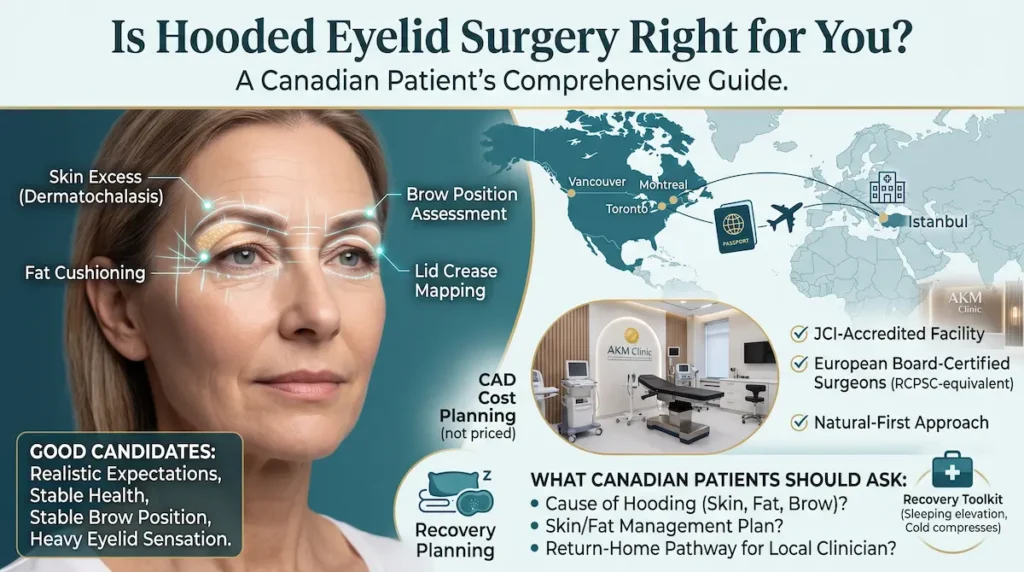
The right candidate for hooded eyelid surgery is not simply someone with heavy upper lids. The right candidate is someone whose anatomy has been properly mapped: skin, fat, brow, and lid position all assessed before the plan is chosen.
For Canadian patients, this step matters even more when surgery involves travel. You need a clear diagnosis, a conservative surgical plan, and a return-home pathway that makes sense once you are back in Canada.
Good candidates
You may be a good candidate if your upper lid skin folds over the crease, makes your eyes look consistently tired, or creates a heavy sensation that does not improve with rest. You may also be a candidate if the fold interferes with makeup, photographs, or your sense of facial expression.
Good candidates usually have stable health, realistic expectations, and no uncontrolled eye-surface problems. Dry eye, thyroid eye disease, diabetes, blood-thinning medication, smoking, and previous eyelid surgery all need careful review before a plan is finalized.
It also helps when the goal is specific. “I want my upper lids to feel less heavy” is clearer than “I want different eyes.” Hooded-lid correction should refine the upper eye, not erase the features that make your face recognizable.
What Canadian patients should ask before travelling
Before travelling for eyelid surgery, ask the surgeon to explain what is causing the hooding. Is it dermatochalasis, fat, brow descent, true ptosis, or a combination? Ask how that diagnosis changes the surgical design.
You should also ask how much skin will be removed, whether fat will be preserved or reduced, how your brow position affects the plan, and what happens if asymmetry is present before surgery. Pre-existing asymmetry is common. Surgery can improve balance, but it cannot make both eyes mathematically identical.
For travel planning, ask when you will be checked before flying home, what symptoms should prompt urgent contact, and what information you should bring back for your local clinician. A responsible plan includes both the operation and the recovery handoff.
Recovery in brief
Upper eyelid recovery is usually easier than many larger facial operations, but the early appearance can still be dramatic. Bruising, swelling, tightness, watery eyes, and uneven swelling are common in the first days. The eyelids often look more settled after the first couple of weeks, while scar maturation continues for months.
This article is not a recovery deep-dive, but the recovery conversation should happen before surgery. You should know how to sleep, how to clean the incision area, when you can return to desk work, when to avoid exercise, and when swelling should be improving rather than worsening.
Some patients also compare hooded-lid correction with other upper-eye aesthetic procedures, such as a related upper-eye aesthetic procedure. That comparison should be made carefully, because each procedure changes a different structure and creates a different look.
Cost questions without turning the decision into price shopping
Cost is a practical part of planning, especially for Canadians comparing private options at home with surgery abroad. Still, this article is not a pricing guide. The safer question is not only “What does it cost?” but “What does the plan include, who performs it, where is it performed, and how is follow-up handled?”
For the dedicated pricing breakdown, use AKM’s page on blepharoplasty cost in CAD. Keep the clinical decision separate from the price comparison. A lower-cost plan is not good value if the diagnosis is wrong.
RCPSC-equivalent review and return-home planning
Canadian patients should look for a credential framework they can understand. AKM frames its surgical care around European Board-Certified Surgeons, described for Canadian readers as RCPSC-equivalent rather than RCPSC-certified. That distinction is important. It is accurate, transparent, and avoids implying a Canadian certification that does not apply.
Ask how your brow position will be assessed, whether ptosis is suspected, and whether eye symptoms need local evaluation before travel. Ask what documents you receive after surgery. Operative notes, medication instructions, aftercare guidance, and follow-up timing can make the return home smoother.
At AKM Clinic in Istanbul, surgery is performed in a JCI-accredited facility with a Natural-First approach. The goal is not a pulled or operated-on eye area. The goal is to reduce heaviness while preserving expression, lid function, and facial identity.
Frequently Asked Questions: Hooded Eyelid Surgery
These answers cover the most common questions Canadian patients ask when they are comparing hooded eyelid surgery, upper blepharoplasty, brow lifting, and ptosis assessment. They are general education, not a personal diagnosis.
What causes hooded eyes?
Hooded eyes can be caused by extra upper eyelid skin, bulging fat, a low brow, true ptosis, or a combination of these factors. Genetics, aging, skin laxity, facial anatomy, and brow descent can all contribute.
Is hooding a skin problem or a muscle problem?
It depends. If the eyelid margin opens normally but excess skin folds over the crease, the issue is usually skin-dominant hooding. If the eyelid margin itself sits low over the pupil, true ptosis may be involved, which is a muscle or tendon-related problem.
Do I need a brow lift instead of blepharoplasty?
You may need a brow lift if the brow, especially the outer brow, is pushing skin down over the upper lid. A simple mirror check can give clues, but only a clinical exam can confirm whether brow lifting, upper blepharoplasty, or both are appropriate.
Will insurance or vision matter in Canada?
Vision can matter if the upper lid skin blocks the visual field or causes functional symptoms. However, eligibility for any provincial coverage or reimbursement depends on local rules, documentation, and clinical assessment. A cosmetic surgery consultation abroad should not promise Canadian coverage.
How long do hooded eyelid surgery results last?
Results often last for many years, but aging continues. Skin can loosen, brow position can change, and facial volume can shift over time. A conservative, anatomy-matched correction usually ages more naturally than an aggressive one.
Can hooded eyelid surgery look natural?
Yes, when the procedure is matched to the cause of the hooding and the correction is conservative. Natural results avoid excessive skin removal, preserve appropriate fullness, respect brow position, and maintain the patient’s original eye character.
Can upper blepharoplasty make my eyes look hollow?
It can if too much fat is removed or if the patient already has deep-set eyes and thin upper-lid tissue. Modern planning is usually more conservative with fat because some upper-eye fullness helps the result look softer and age better.
How do I know if I have true ptosis?
A clue is that the upper eyelid margin sits lower than expected, sometimes covering part of the pupil. One eye may appear smaller, or you may raise your eyebrows to compensate. A clinician can measure eyelid position and levator function to confirm it.
Is hooded eyelid surgery painful?
Most patients describe tightness, swelling, and mild discomfort rather than severe pain. Pain levels vary, and your surgeon should explain the anesthesia plan, medication instructions, and what symptoms would be unusual during recovery.
What should I send for a virtual consultation?
Clear photos are useful: front-facing, side views, eyes open at rest, eyes closed, brows relaxed, and any view showing asymmetry. Avoid raising your eyebrows for the main photos. The goal is to show how the lids and brows sit naturally.
Medical Disclaimer: This article is for educational purposes only and is not personal medical advice. Hooded eyelid surgery, blepharoplasty, brow lift surgery, and ptosis repair must be planned after an individual assessment by a qualified clinician. Results, healing, risks, and suitability vary from patient to patient.
If your eyelids affect your vision, cause pain, or change suddenly, seek local medical assessment before making cosmetic surgery plans. For elective surgery abroad, confirm your diagnosis, surgical plan, travel timing, and return-home follow-up before booking.