
Cauliflower ear surgery corrects the lumpy, folded ear shape that can develop after repeated trauma to the outer ear, especially in wrestling, boxing, MMA and Brazilian jiu-jitsu. Early auricular hematomas may be treated with drainage and compression; once the cartilage has hardened, surgical reshaping is usually needed to improve contour, symmetry and comfort.
For many athletes, cauliflower ear is treated like a badge. That does not make it harmless. The same injury that changes the ear’s shape can also cause pain, recurrent swelling, infection risk and, in some cases, narrowing around the ear canal. The real question is not whether the ear looks “tough.” It is whether the deformity is stable, whether it bothers you, and whether correction is still anatomically realistic.
This guide is written for Canadian patients comparing local options with how ear reshaping is planned at AKM in Istanbul. It focuses only on cauliflower ear correction, also called wrestler’s ear repair. It is not a general ear pinning guide. Prominent ears and trauma-thickened ears are different problems, and the surgical plan should reflect that.
Surgeon-led principle: early hematoma drainage is prevention. Once scarred cartilage has formed, the goal changes from prevention to careful reshaping. A cauliflower ear should not be treated like a standard cosmetic ear pinning case.
Table of Contents
What Cauliflower Ear Actually Is?
Cauliflower ear is not simply an ear that sticks out. It is a deformity of the outer ear caused by trauma, bleeding and abnormal healing within the ear’s cartilage framework. Before deciding on surgery, it helps to understand the chain of events that turns a swollen sports injury into a firm, irregular ear shape.
Blunt trauma, auricular hematoma and cartilage damage
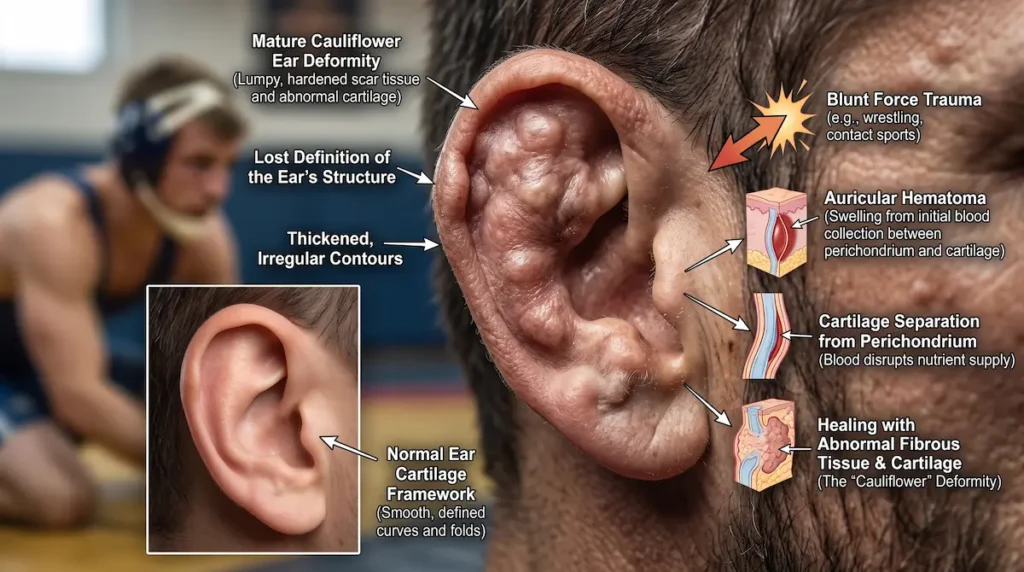
The outer ear, or auricle, is mostly cartilage covered by a thin layer of skin and soft tissue. During contact sports, the ear can be compressed, twisted or struck. That force can shear the skin and perichondrium away from the cartilage underneath.
When that separation happens, blood may collect between the cartilage and its nourishing tissue layer. This pocket of blood is called an auricular hematoma. At first, it may look like a soft, swollen, reddish or purple area on the ear. It can feel tender or tense.
The problem is the blood supply. Cartilage does not heal like skin or muscle. It depends on the surrounding tissue for nutrition. If a hematoma separates the layers and is left untreated, the cartilage may lose support and begin to heal in a distorted way.
That is why a fresh swollen ear after wrestling practice, sparring or grappling should not be ignored. A small hematoma can still create a larger shape problem if the pocket refills or is never properly compressed.
Why fibrous cartilage creates the “cauliflower” look
As the injury heals, the body lays down scar-like tissue and new cartilage in an irregular pattern. Instead of a smooth rim, clean antihelical fold and defined bowl of the ear, the surface can become thick, folded, nodular and asymmetrical. This is where the name comes from.
The appearance varies. Some people have a small thickened ridge along the upper ear. Others develop a bulky, collapsed shape that changes the entire outline of the ear. In more severe cases, the thickened cartilage can partly block the conchal bowl or make earbuds, helmets or headgear uncomfortable.
Colour changes may settle, but the structural change does not usually flatten on its own once the tissue has matured. Massage, compression and time can help a fresh swelling phase, but they cannot reliably remodel established fibrocartilage.
Cauliflower ear vs prominent ears
Prominent ears are usually present from childhood. They happen when the ear cartilage projects away from the side of the head or when the natural folds of the ear are underdeveloped. Standard otoplasty often corrects this by reshaping or suturing the cartilage so the ear sits closer to the head.
Cauliflower ear is different. It is acquired after trauma. The issue is not simply projection; it is abnormal bulk, scarred cartilage, lost definition and surface irregularity. That is why cauliflower ear correction often requires removing, thinning or sculpting hardened tissue before the ear can be reshaped.
This distinction matters for expectations. A prominent-ear otoplasty tries to create a balanced ear position. Cauliflower ear surgery tries to restore a more normal contour from a damaged cartilage framework. The result can be a meaningful improvement, but the ear may not become identical to an uninjured ear.
Why It Happens — And Why Prompt Care Matters?
Cauliflower ear usually starts as a preventable injury. The frustrating part is that many athletes wait because the ear “doesn’t hurt that much” or because swelling seems normal after contact sports. By the time the cartilage becomes firm, the treatment pathway is different. Early care aims to prevent deformity; later surgery aims to improve one that has already formed.
Sports that commonly cause wrestler’s ear
Wrestling is the classic association, but it is not the only risk. Any sport that repeatedly compresses or strikes the outer ear can cause an auricular hematoma. Common examples include boxing, MMA, Brazilian jiu-jitsu, rugby and other grappling-heavy activities.
The highest-risk movements are not always dramatic blows. Friction from head positioning, mat pressure, clinch work, takedowns and tight headgear can all irritate the same area repeatedly. Over time, a small untreated swelling may be re-injured before it has healed.
Some athletes are more prone than others because of ear shape, training frequency, previous hematomas or inconsistent protective headgear. A history of one cauliflower ear also increases the need for prevention on both sides. Once the cartilage has been injured, repeated trauma tends to be less forgiving.
The untreated hematoma cascade
A fresh auricular hematoma creates a space between layers of tissue. If that space is drained but not compressed, fluid can collect again. If it is never drained, the body may organize the blood into firmer scar tissue. Either path can leave the cartilage with less normal support.
This is why professional care matters. Simply piercing or draining the ear at home is risky and incomplete. It can introduce infection, fail to remove the full collection, or leave the pocket open to refill. Proper management usually involves assessment, drainage when appropriate, compression or bolster support, and follow-up to check that the fluid has not returned.
In an acute setting, Canadian emergency and sports-medicine guidance generally emphasizes re-evaluation after drainage because recurrence is common. Emergency Care BC advises close follow-up after ear hematoma treatment and temporary limits on physical activity and contact sports. That follow-up window is not a formality. It is part of preventing the deformity.
Why waiting can make the deformity permanent
In the first hours and days after injury, the ear may still be in a reversible phase. The goal is to restore the skin and perichondrium back against the cartilage so healing can happen flat. Compression is what helps remove the dead space where blood or fluid would otherwise recollect.
As days pass, the tissue becomes more organized. The ear feels less soft and more rubbery or firm. Once that hardened tissue has developed, draining it like a fresh hematoma will not correct the shape. At that stage, surgery has to address the scarred cartilage itself.
That is the practical dividing line. A soft, recent swelling belongs with urgent medical assessment. A firm, long-standing cauliflower ear belongs with surgical evaluation. Mixing those two situations leads to poor advice and unrealistic expectations.
For athletes still training, timing is also strategic. Returning too early to contact sport can restart the cycle. Even after acute drainage, headgear and activity restrictions are often recommended while the ear settles. After established cauliflower ear surgery, return-to-sport timing is more individualized because the operation is reconstructive, not just a simple drainage procedure.
How Cauliflower Ear Surgery Corrects It?
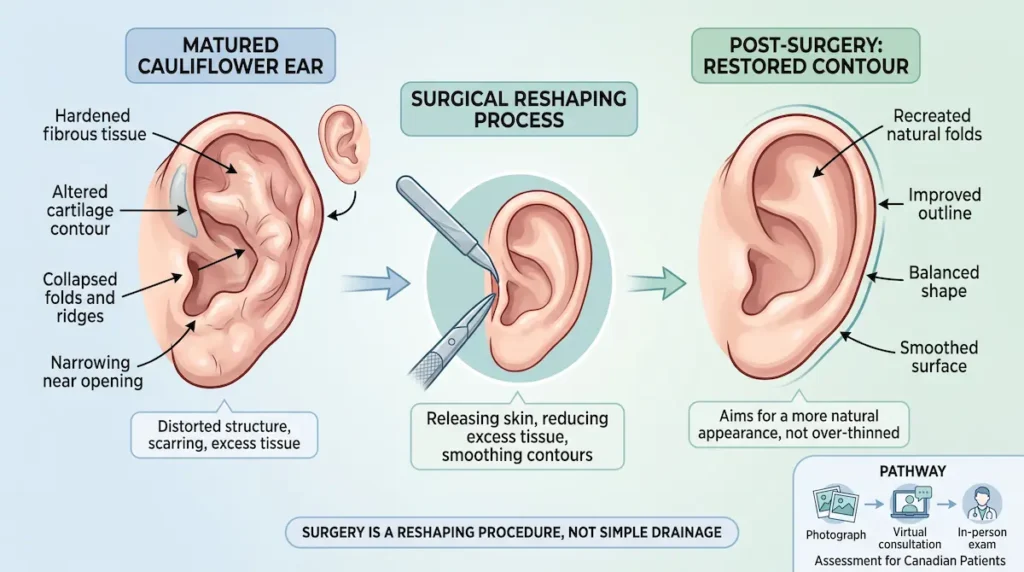
Once cauliflower ear has matured, the goal is no longer simple drainage. The ear has usually developed firm fibrous tissue, distorted cartilage and altered surface contours. Surgery is therefore planned as a reshaping procedure, not as a quick swelling treatment.
Assessment comes before reshaping
A good surgical plan starts with the pattern of deformity. Some ears have a localized lump along the upper rim. Others have thickening through the conchal bowl, collapsed folds, irregular cartilage ridges or narrowing near the ear opening.
Your surgeon also checks skin quality. Long-standing cauliflower ear can stretch the skin envelope, thin certain areas and make others feel tightly stuck to the cartilage underneath. That affects how much correction is possible in one operation.
For Canadian patients travelling for surgery, this assessment should happen in two steps: first through photographs and a virtual consultation, then again in person before the final plan is confirmed. AKM’s surgical pathway uses this staged approach so the operative plan is based on both image review and direct examination.
What the operation usually changes
Cauliflower ear surgery may involve releasing the skin from scarred cartilage, reducing excess fibrous tissue, smoothing bulky areas and recreating a more natural ear contour. The exact manoeuvre depends on where the deformity sits. A thickened upper rim is not repaired the same way as a collapsed conchal bowl.
In some cases, the surgeon removes or thins hardened cartilage. In others, sutures are used to support a cleaner fold or improve the ear’s outline. The goal is a more balanced shape, not an over-thinned ear that looks artificial or fragile.
Clinical overviews describe established cauliflower ears as challenging to correct because the tissue is scarred and three-dimensional. That is why this operation needs careful judgment, not just a generic ear pinning template. You can see the medical basis for this distinction in the NCBI clinical overview of cauliflower ear.
Anesthesia, comfort and surgical setting
Depending on the severity of the deformity and the patient’s comfort level, cauliflower ear correction may be performed under local anesthesia with sedation or another anesthesia plan. The choice is individualized. A small, localized deformity is different from a heavily scarred ear that needs broader cartilage work.
At AKM, ear surgery is performed in Istanbul in a JCI-accredited medical setting. For Sam, the cautious patient, that detail matters because revision-style ear reshaping depends on sterile technique, pressure dressing discipline and clear follow-up, not only on the operation itself.
The credential frame should also be understood correctly. AKM works with European Board-Certified surgeons, described for Canadian readers as RCPSC-equivalent. That does not mean “certified by the RCPSC.” It means the training and board framework is presented as an international equivalent, which is the accurate way to state it.
How It Differs From Prominent-Ear Otoplasty?
Cauliflower ear surgery and prominent-ear otoplasty both belong to the ear reshaping family, but they solve different problems. Confusing them is one of the easiest ways to create unrealistic expectations. A trauma-thickened ear is not just a normal ear sitting too far from the head.
Different starting anatomy
In prominent-ear otoplasty, the cartilage is usually structurally normal but under-folded or over-projecting. The surgeon’s task is to create or strengthen the natural fold and bring the ear into a more balanced position. The surface of the cartilage is usually smooth.
In cauliflower ear, the cartilage framework has been damaged and reshaped by trauma. The ear may be thick, bumpy, folded, asymmetrical or partly collapsed. Instead of simply repositioning cartilage, the surgeon often has to remodel scarred tissue before the ear can look smoother.
This is also why a cauliflower ear result is judged differently. The aim is meaningful contour restoration and improved symmetry. In a long-standing wrestler’s ear, expecting the ear to look exactly like an untouched ear is usually not realistic.
Different surgical difficulty
Prominent-ear otoplasty is typically more predictable because the surgeon is working with cleaner cartilage planes. Cauliflower ear surgery can be less predictable because scar tissue may vary in thickness from one part of the ear to another. The skin may also be less mobile.
That does not mean correction is not worthwhile. It means the operation should be planned conservatively. Removing too much cartilage can create weakness, sharp edges or contour dents; removing too little may leave the ear bulky.
Scars are usually placed as discreetly as possible, often behind the ear or within natural folds when the anatomy allows. Still, any incision can form a scar. Patients who want to understand how visible scars mature around the upper face and head may find this related guide on how scars in the upper face and head area heal useful, while remembering that ear skin and brow skin do not heal identically.
| Factor | Cauliflower Ear Surgery | Prominent-Ear Otoplasty |
|---|---|---|
| Main issue | Trauma-related thickening, scarred cartilage and irregular contour. | Ear projection or underdeveloped natural folds. |
| Typical cause | Repeated blunt trauma or untreated auricular hematoma. | Natural cartilage shape present from childhood. |
| Surgical goal | Smooth, reduce and reshape damaged cartilage for a more natural outline. | Set the ear closer to the head and create a balanced fold. |
| Technical challenge | Higher, because scar tissue and cartilage distortion vary by case. | Usually more predictable when cartilage quality is normal. |
| Result expectation | Improvement in contour and symmetry; not always a perfect match to an uninjured ear. | More predictable change in ear position and projection. |
| Recovery focus | Pressure dressing, swelling control and avoiding repeat trauma. | Headband use, swelling control and protecting the new ear position. |
Different expectations for symmetry
With standard otoplasty, the patient often wants the ears to sit closer to the head and look more even from the front. With cauliflower ear, the priority may be different: a smoother rim, less bulk, better helmet comfort or a less recognizable trauma deformity.
Exact symmetry is not always possible. One ear may have more scarred cartilage, less skin flexibility or a different injury pattern. The honest goal is improvement that still looks natural for your face and ear anatomy.
This is especially important for athletes who still train. Surgery can improve an old deformity, but it does not make the ear immune to new hematomas. If the sport continues, protection and quick response to new swelling remain part of the long-term plan.
Recovery, Results & Preventing Recurrence
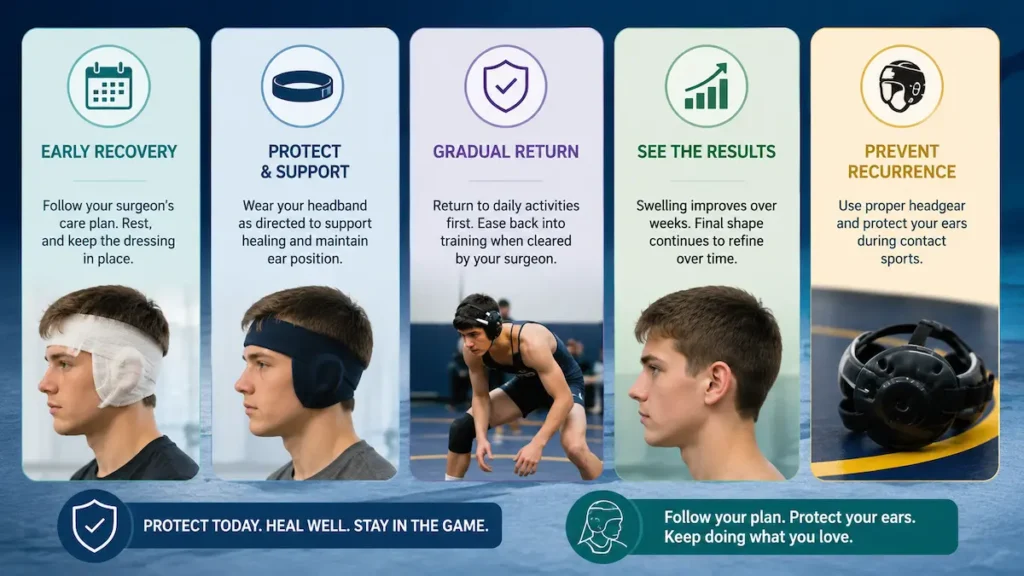
Recovery is not only about letting the incision heal. It is also about holding the reshaped cartilage in the right position while swelling settles and the tissues adhere. For cauliflower ear correction, pressure and protection are part of the result.
Pressure dressing and headband support
After surgery, the ear is usually supported with a pressure dressing or moulded dressing. This helps reduce dead space where fluid could collect. It also protects the new contour while the tissues begin to heal.
Some patients later transition to a soft headband or protective ear support, depending on the surgeon’s instructions. This is not cosmetic fussiness. Pressure support helps the ear heal in the shape the surgeon created.
For a deeper explanation of this part of aftercare, read AKM’s guide to why the recovery headband matters after ear surgery. The exact schedule may differ for cauliflower ear because the cartilage has already been injured and scarred.
What the first weeks may look like
Early recovery usually involves swelling, tenderness, bruising and temporary changes in ear colour. The ear may look overcorrected or bulky at first because swelling hides the final contour. That is normal in the early stage.
Most patients should expect a staged recovery rather than an instant final result. The incision closes first, then swelling softens, then the ear definition becomes clearer. Final contour can continue refining for several months.
For acute hematoma treatment, emergency guidance emphasizes drainage, compression, follow-up and temporary limits on activity to reduce recurrence. For established cauliflower ear surgery, your surgeon’s timeline is more individualized, but the principle is similar: protect the ear while it is vulnerable. Emergency Care BC outlines the logic behind drainage, compression and activity restriction in its acute ear hematoma aftercare guidance.
Returning to wrestling, MMA or contact sport
This is the question athletes care about most. It is also the question that should not be answered casually. Returning too early can restart swelling, split healing tissue or create a new hematoma over the repaired area.
Contact sport should resume only when your surgeon clears it. That decision depends on the extent of cartilage work, wound healing, swelling, sport type and whether protective headgear can be worn reliably. A recreational BJJ athlete and a professional fighter may need different plans.
Once cleared, protective headgear becomes non-negotiable. It may not prevent every injury, but it reduces friction and blunt trauma to the outer ear. If new swelling appears after training, it should be assessed quickly rather than watched for weeks.
How visible are scars and final results?
Incisions are usually planned to be discreet, but scar behaviour varies. Skin tone, tension, healing biology and whether the ear is re-injured can all affect the final mark. The ear also has curves and shadows that may hide scars better than flat skin.
Patients comparing scar maturation across facial and neck procedures can review head-and-neck scar healing timelines, but the ear has its own healing pattern. A cauliflower ear correction scar should be judged by its location, thickness and how it blends with the ear’s natural folds.
The final result should look smoother, less bulky and more balanced. It should not look “operated-on” or overly sharpened. AKM’s Natural-First philosophy matters here: the goal is restoration, not an artificial ear shape.
Cost, consultation and deciding whether it is worth it
Cost depends on the severity of the deformity, whether one or both ears need work, and how much cartilage reshaping is required. Because this article is focused on the condition and correction pathway, it will not open a full cost table here. Canadian patients can review otoplasty cost in CAD separately.
In consultation, bring clear photos from the front, side and back, plus close-up images of the affected ear. Tell your surgeon whether you still train, what headgear you use, and whether the ear has had previous drainage. These details change the plan.
The best candidate is not simply someone who dislikes the appearance. It is someone whose deformity is stable, whose expectations are realistic, and who is willing to protect the ear during healing. That combination gives surgery the best chance to improve contour without inviting recurrence.
For cauliflower ear, the safest expectation is improvement, not erasure. Surgery can smooth and reshape damaged cartilage, but continued trauma can damage the ear again. The operation and the athlete’s prevention plan need to work together.
Frequently Asked Questions: Cauliflower Ear Surgery
These answers are general education for Canadian patients considering cauliflower ear correction. Your surgeon’s advice comes first, especially if the ear is newly swollen, painful, infected, draining fluid or recently injured.
Can cauliflower ear be fixed with surgery?
Yes. Established cauliflower ear can often be improved with surgery that reduces thickened scar-cartilage tissue and reshapes the outer ear. The goal is a smoother, more natural contour, not a promise that the ear will look exactly as it did before the injury.
Fresh swelling is different. If the ear injury is recent and soft, urgent assessment for auricular hematoma may prevent a permanent deformity. Once the cartilage has hardened, drainage alone is usually not enough.
Is cauliflower ear surgery the same as otoplasty?
It is related to otoplasty, but it is not the same as standard prominent-ear correction. Prominent-ear otoplasty usually repositions a structurally normal ear that projects too far from the head. Cauliflower ear surgery reshapes an ear that has been damaged by trauma and healed with irregular cartilage thickening.
That makes the planning more case-specific. Your surgeon may need to thin, release, smooth or support scarred cartilage before the ear can look more balanced.
Can cauliflower ear come back after surgery?
It can, especially if you return to wrestling, MMA, boxing, rugby or grappling without protecting the ear. Surgery corrects the existing deformity; it does not make the cartilage immune to new trauma.
Protective headgear, prompt evaluation of new swelling and respecting return-to-sport restrictions are the main ways to reduce recurrence risk. Athletes should treat any new soft swelling as time-sensitive.
How long is recovery after cauliflower ear surgery?
Recovery depends on how much cartilage reshaping is needed. Many patients can expect swelling, tenderness, dressings and activity restrictions in the early phase, with contour continuing to refine over weeks to months.
Contact sport is usually restricted until your surgeon clears the ear as stable enough for impact risk. That timeline should be personalized because a minor contour correction and a heavily scarred wrestler’s ear are not the same operation.
Can early cauliflower ear be treated without surgery?
Early auricular hematoma may be managed with professional drainage, compression and follow-up before it becomes a permanent cauliflower ear. This is not a do-it-yourself situation. Incomplete drainage or poor compression can allow fluid to recollect.
If the ear is already firm, folded and long-standing, non-surgical measures are unlikely to remodel the cartilage. At that point, correction usually requires surgical reshaping.
Is the surgery painful?
During surgery, anesthesia is used to keep you comfortable. Afterward, soreness, pressure, bruising and swelling are expected, especially because the ear cartilage has been manipulated.
Pain should be manageable with the aftercare plan your surgical team provides. Severe worsening pain, spreading redness, fever, pus-like drainage or sudden swelling should be reported promptly.
Will I need a headband after cauliflower ear surgery?
Many ear reshaping procedures use a dressing, headband or pressure support after surgery. For cauliflower ear, pressure is especially important because the ear must heal without fluid collecting under the skin again.
Your surgeon will tell you exactly how long to wear it. Do not stop early because the ear “looks fine” in the mirror. The deeper tissue may still be healing.
Will insurance in Canada cover cauliflower ear surgery?
Coverage depends on your province, the medical reason for treatment and whether the procedure is considered reconstructive, functional or cosmetic. This article cannot give insurance advice.
If hearing, ear canal narrowing, recurrent infection or pain is part of your concern, document it with a qualified clinician in Canada before planning elective correction abroad. Bring that documentation to your surgical consultation.
Medical Disclaimer: This article is for educational purposes only and is not a substitute for medical advice, diagnosis or treatment. Cauliflower ear, auricular hematoma, ear infection and post-traumatic ear deformity should be assessed by a qualified health care professional. Results, recovery timelines and surgical options vary by anatomy, injury history, scar tissue, sport participation and healing response.
If your ear is newly swollen after trauma, painful, red, warm, draining fluid, worsening quickly or affecting hearing, seek urgent medical care. For elective cauliflower ear correction, consult a qualified surgeon who can examine your ear and explain your personal risks, limitations and aftercare plan.