
How Long Does a Breast Lift Last? What to Realistically Expect
AI Summary
- How long does a breast lift last? Many years, but ageing and gravity gradually change results.
- Stable weight and timing help preserve breast lift longevity, especially around pregnancy planning.
- Supportive aftercare and surgical planning protect shape, skin quality, and realistic long-term outcomes.
- A second lift may help if recurrent ptosis affects comfort, symmetry, or confidence.
Summary generated by AI, fact-checked by our medical experts
If you are asking how long does a breast lift last, the most realistic answer is: many years, but not forever. A breast lift can restore a higher, firmer breast position, but gravity, ageing, skin quality, pregnancy, and weight changes continue to affect the breasts over time. The best results usually come when surgery is timed around a stable weight and realistic long-term expectations.
A breast lift procedure, also called mastopexy, reshapes and repositions sagging breast tissue. It does not stop the natural ageing process. That distinction matters, especially for Canadian patients comparing private cosmetic options and trying to understand whether the result is worth planning for long term.
This guide is written for patients who want more than a vague “it lasts 10 years” answer. We will look at what “lasting” actually means, why two patients can age differently after the same operation, and which choices help your result hold as well as possible.
Table of Contents

How Long Does a Breast Lift Last?
A breast lift result is best understood as a reset, not a pause button. The surgery moves the nipple-areola complex and breast tissue into a more lifted position, but it cannot make skin, ligaments, or breast tissue immune to time. That is why the answer is measured in years of improved shape, not a guaranteed expiry date.
The honest answer: many years, but not forever
Most patients can expect a breast lift to last for many years. Some maintain a pleasing shape for a decade or longer, while others notice recurrent sagging sooner because of heavier breast tissue, weaker skin support, pregnancy, or major weight changes.
The key point is that a breast lift does not “wear off” suddenly. Results usually change gradually. The upper breast may soften, the lower pole may stretch, and the nipple position may sit a little lower than it did in the early post-operative months.
What “lasting” really means after mastopexy
Patients often imagine longevity as one fixed number. In reality, surgeons assess durability through several signs:
- whether the nipple remains above or near the breast fold;
- whether the lower breast pole has stretched again;
- whether the breast still has a natural lifted contour in clothing;
- whether asymmetry has become more noticeable over time;
- whether the patient feels the breast shape still matches her body.
A breast lift can still be considered successful even if the breasts soften with age. Natural settling is expected. Recurrent ptosis, or repeat sagging, becomes a concern when the breast position drops enough that the patient again feels unsupported, heavy, or unhappy with breast shape.
Why no surgeon can promise an exact number
No responsible surgical team can guarantee that a breast lift will last a specific number of years. The result depends on biology as much as technique. Skin elasticity, collagen strength, breast volume, weight stability, hormonal changes, and future pregnancies all influence the long-term outcome.
That does not mean longevity is random. Surgical planning matters. So does timing. A patient who is at a stable weight, has completed planned pregnancies, and has moderate breast weight often has a better foundation for a longer-lasting result than someone whose body is still changing significantly.
Surgeon-led perspective: A breast lift lasts longest when the operation is planned around tissue quality, breast weight, and timing. The goal is not to fight biology with an over-tight result, but to create a lifted shape that can age naturally and still look balanced years later.
Am I a Good Candidate for a Breast Lift (Mastopexy)?
Not sure if surgery abroad is the right step for you? Answer a few quick questions about your concerns, health history, and goals, and our team will help you understand which treatment options may suit you best — before you book a single flight.
What Affects How Long It Lasts?
The durability of a breast lift is not controlled by one factor. It is the combined effect of your skin, breast tissue, lifestyle, surgical plan, and future body changes. This is why two patients can have the same procedure and a very different long-term result.
Skin quality and tissue support
Skin quality is one of the biggest predictors of how long a breast lift holds. If the skin has strong elasticity, it can better support the new breast shape. If the skin is thin, stretched, sun-damaged, or affected by major weight loss, it may stretch again sooner.
The deeper support structures also matter. Breast tissue is supported by skin, connective tissue, and the internal shape created during surgery. Research on recurrent breast ptosis points to the challenge of maintaining breast position over time because the same tissue forces that caused sagging can continue after surgery.
For readers who want the technical background, a systematic review of how long lift results last discusses factors linked to recurrent ptosis after mastopexy, while research on breast support explains why breasts can sag again over time.
Gravity and breast weight
Breast weight affects longevity. Larger, heavier breasts place more tension on the skin envelope and internal support. Over time, gravity pulls on that weight. This can gradually stretch the lower pole and reduce the upper-pole fullness that many patients notice after surgery.
This is why a lift on smaller or moderate-volume breasts may hold differently than a lift on heavier breasts. It is also why some patients consider reduction, implant removal, or reshaping at the same time as mastopexy. Those decisions belong in a personalized consultation, not a generic rule.
Ageing over time
Ageing continues after surgery. Collagen changes, skin becomes less elastic, and breast tissue naturally softens. These changes are normal. They do not mean the surgery failed.
A well-planned lift should age in a way that still looks proportionate. The best long-term results usually do not look overly tight at the start. They look lifted, supported, and natural, with enough respect for how the body will continue to change.
| Factor | How it can affect longevity | What you can do |
|---|---|---|
| Skin quality | Weaker or stretched skin may allow earlier recurrent sagging. | Discuss realistic lift durability and scar tension during consultation. |
| Breast weight | Heavier tissue places more pull on the lifted breast shape. | Ask whether breast volume affects your long-term plan. |
| Ageing | Natural softening and tissue relaxation continue after surgery. | Expect gradual change, not a frozen result. |
| Weight changes | Gain or loss can stretch or deflate the breast envelope. | Plan surgery close to a maintainable weight. |
| Pregnancy | Breast enlargement and deflation can alter the lifted position. | Consider timing if future pregnancy is likely. |
Pregnancy and Weight Changes
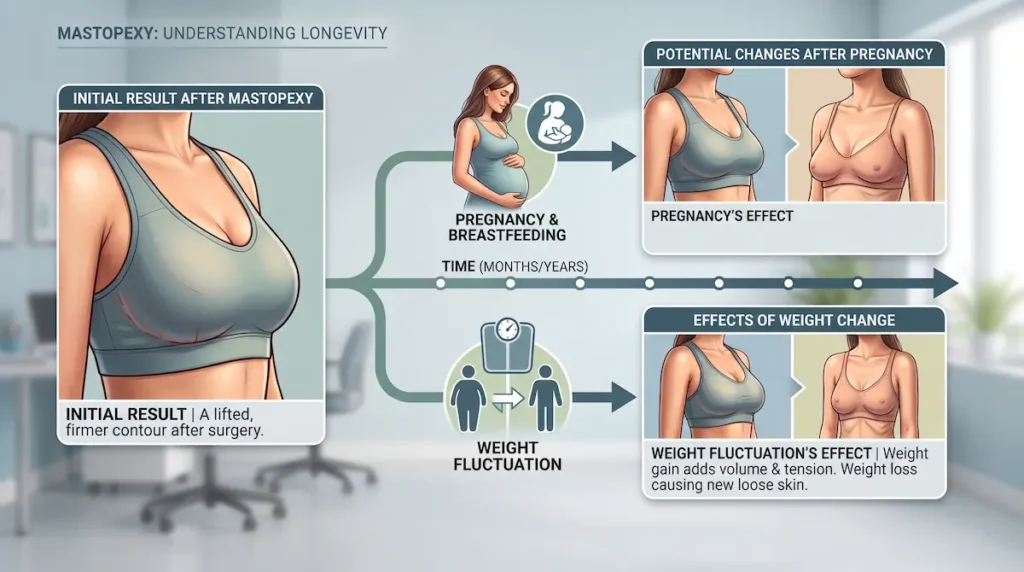
Pregnancy and weight fluctuation are two of the most common reasons breast lift results change earlier than expected. This does not mean a breast lift is fragile. It means the breasts respond to hormones, volume changes, and skin stretching just like the rest of the body.
How pregnancy can change a breast lift result
Pregnancy can enlarge the breasts, stretch the skin, and then leave the breast envelope looser once milk production and breast fullness settle. For some patients, the lift still looks good afterwards. For others, pregnancy can create new sagging, upper-pole deflation, or asymmetry.
Because of this, many surgeons advise waiting until after planned pregnancies before having mastopexy, especially if your goal is the longest possible result. It is not a strict rule. It is a timing conversation.
If you are not sure whether you want more children, a consultation should focus on trade-offs: how much sagging bothers you now, how soon pregnancy might happen, and whether you would accept the possibility of a revision later.
Weight gain and weight loss can both matter
Weight gain can increase breast volume and place more tension on the lifted tissues. Weight loss can reduce volume, leaving the breast skin looser than before. Either direction can affect breast lift longevity.
The most stable results usually occur when surgery is performed close to a maintainable weight. That does not mean your weight must be perfect. It means your body should not be in the middle of a major change.
This is especially relevant for patients who have lost a significant amount of weight. The skin may already have reduced elasticity, and the breast shape may need a more tailored surgical plan than a standard lift alone.
Timing surgery around family planning and stability
The best timing is personal. Some patients choose surgery before children because they do not want to wait years to feel comfortable in their body. Others wait until pregnancy and breastfeeding are complete because they want the lift to last as long as possible.
A careful consultation should not pressure you either way. It should explain the likely effect of future pregnancy and weight change so you can make the decision with open eyes.
Canada-focused planning note: For Canadian patients travelling for private elective surgery, documentation matters. Ask for a clear surgical summary, post-operative instructions, medication list, and follow-up plan you can keep for your records once you return home.
A Well-Coordinated Breast Lift (Mastopexy) Experience
From private airport transfers to comfortable, well-appointed hotel accommodation, we handle every detail of your stay. The result is a seamless all-inclusive clinical pathway in Istanbul — so you can focus on your procedure and recovery while we manage the logistics.
Can You Make It Last Longer?
You cannot stop gravity or ageing, but you can make choices that protect your result. Some of those choices happen before surgery, such as timing and technique. Others happen afterwards, such as weight stability, support, and long-term follow-up.
Maintain a stable weight
Stable weight is one of the most practical ways to protect a breast lift result. Repeated cycles of gaining and losing weight can stretch the breast skin and change volume. The more stable the breast envelope stays, the more predictably the lifted shape tends to age.
This does not require an extreme lifestyle. It means aiming for a weight range you can realistically maintain. If you are still actively losing weight, it may be better to wait until your body settles before choosing surgery.
Use supportive bras when they matter most
A supportive bra will not “hold the surgery in place” permanently, but it can reduce daily strain on breast tissue. This is especially useful during exercise, higher-impact activity, and periods when the breasts feel heavier because of hormonal change.
Think of support as maintenance. It is not a replacement for good surgical planning, but it helps reduce repetitive pulling on the skin over time.
Choose the right surgical plan, not the tightest result
Patients sometimes assume a tighter lift will last longer. That is not always true. Over-tightening can place too much tension on incisions and tissues, which may affect scar quality and comfort. A durable result comes from balanced reshaping, not simply pulling the skin tighter.
For some patients, internal tissue support and reshaping can help the breast hold its new position more effectively. For others, the limiting factor is the original breast shape. Conditions such as tuberous breast anatomy may require a more specific plan because the underlying shape affects the long-term result.
Understand what non-surgical options can and cannot do
Non-surgical options may improve skin texture or create a temporary lifted appearance in mild cases, but they cannot reposition the nipple or reshape stretched breast tissue the way surgery can. This distinction matters when comparing breast lift longevity with non-surgical lift alternatives.
If your sagging is mild, it may be reasonable to discuss a non-surgical approach first. If the nipple sits low or the breast envelope has clearly stretched, a non-surgical treatment is unlikely to create the same structural change as mastopexy.
Consider whether you want fullness with or without implants
A breast lift raises and reshapes the existing breast tissue. It does not automatically add upper-pole volume. Some patients want lift only; others want more fullness. That choice can affect how the result looks over time.
If you prefer to avoid implants, the plan should focus on reshaping your own tissue and setting realistic expectations about fullness. If you would like more volume without implants, our guide to fat transfer breast augmentation explains that separate option.
Planning principle: Long-lasting breast lift results come from matching the operation to the tissue. A board-certified plastic surgery team should assess skin quality, breast weight, nipple position, and long-term goals before recommending the surgical pattern.

Will You Need a Second Lift?
Some patients never choose another breast lift. Others decide on a revision years later because their body has changed, their breasts have settled, or a new asymmetry has become more noticeable. A second lift is not a sign that the first operation failed; it can be part of normal long-term tissue ageing.
Signs of recurrent ptosis
Recurrent ptosis means the breast has sagged again after a previous lift. It can be mild or significant. The most common signs include a lower nipple position, increased lower-pole heaviness, stretched skin, or a breast shape that no longer feels supported in clothing.
Asymmetry can also become more noticeable over time. Breasts are naturally sisters, not twins, and ageing can affect each side differently. If asymmetry is a key concern, raise it at consultation so the surgeon can assess balance and proportion on each side.
Revision versus waiting
Not every change needs a revision. Mild settling is normal. If the breast still looks proportionate and you feel comfortable, waiting may be the most sensible choice.
A revision becomes more relevant when sagging affects comfort, clothing fit, self-confidence, or symmetry enough that the trade-off of another surgery feels worthwhile. The decision should be based on anatomy and goals, not on a fixed calendar date.
What a repeat lift usually involves
A second lift may involve removing stretched skin, reshaping the breast envelope, adjusting nipple position, or revising scars from the previous surgery. The exact plan depends on the original incision pattern and how the breast has changed.
Revision surgery can be more complex because the tissue has already been operated on. Blood supply, scar tissue, and remaining skin quality all matter. This is why repeat surgery should be planned carefully by an experienced, board-certified plastic surgery team.
How cost fits into the decision
Cost is part of real-world planning, but it should not drive the medical decision by itself. A longevity-focused consultation should first answer whether you need a lift, whether the timing is right, and what result is realistic for your tissue.
For pricing details, use the dedicated page for what a breast lift costs. This article stays focused on result longevity rather than comparing prices or packages.
What to confirm before travelling from Canada: Ask whether your surgeon is European Board-Certified and RCPSC-equivalent, how your breast tissue quality affects longevity, what follow-up schedule is used after you return home, and which symptoms should prompt urgent contact.
Frequently Asked Questions: How Long Does a Breast Lift Last?
Breast lift longevity is easiest to understand when the common questions are answered directly. The main theme is consistency: a breast lift can create a long-lasting change, but the result continues to live with your body.
How long does a breast lift last?
The result changes gradually. You should expect some softening over time, even when the operation is well planned and well performed.
Do breast lifts last forever?
This is why realistic planning matters. A natural, well-supported result that ages gracefully is usually a better goal than an overly tight result that looks forced early on.
Will pregnancy ruin my breast lift?
If future pregnancy is likely, discuss timing carefully. Waiting until after planned pregnancies can help the result last longer, but the right choice depends on your priorities and timeline.
Can a breast lift be redone?
Revision surgery requires careful planning because the tissue has already been operated on. Scar tissue, blood supply, skin quality, and the previous incision pattern all matter.
Does weight loss affect breast lift results?
The most predictable results usually happen when surgery is performed at a stable, maintainable weight. If you are actively losing weight, it may be better to wait until your body has settled.
How can I make breast lift results last longer?
The surgical plan matters too. A board-certified plastic surgery team should assess your tissue quality, breast volume, nipple position, and long-term goals before recommending the technique.
Does a breast lift change breast size?
If breast heaviness is a major concern, your surgeon may discuss whether reduction, reshaping, or another approach is more appropriate for your goals.
Will my breasts drop after a lift?
Recurrent ptosis usually develops later and is more likely when the skin stretches again, the breasts remain heavy, weight changes occur, or pregnancy changes breast volume.
What is the best age to get a breast lift?
Age matters less than readiness. Your body should be stable enough that the result has a fair chance to last.
Is a breast lift worth it if results are not permanent?
A good consultation should help you decide whether the likely years of improvement are worth the surgery, recovery, scars, and future maintenance considerations.
Final Thoughts: Think in Years, Not Guarantees
A breast lift can be a long-lasting procedure, but it should not be framed as permanent. The most realistic expectation is a lifted, reshaped breast position that holds for many years and then gradually changes with your body.
For Canadian patients, the smartest decision is not simply asking how many years the result will last. It is asking whether your timing, tissue quality, weight stability, and surgical plan are aligned. That is where longevity is won or lost.
If you are considering mastopexy, ask AKM how your breast tissue, skin quality, pregnancy plans, and long-term goals affect your expected result. A free virtual consultation can help you understand whether now is the right time and what kind of outcome is realistic for your anatomy.
Have Specific Questions About Breast Lift (Mastopexy)?
Chat directly with our dedicated patient coordinators about your Breast Lift (Mastopexy). Whether you're weighing your options from Ontario, British Columbia, or Alberta, you'll get clear, personalized answers — straight from the team who will look after you, not a call centre.
Medical disclaimer: This article is for educational purposes only and is not medical advice, diagnosis, or a substitute for consultation with a qualified surgeon. Breast lift results vary from patient to patient. Always follow your own surgeon's instructions and seek medical care promptly if you develop concerning symptoms after surgery.
Related Procedures

Awake Breast Lift
Considering an awake breast lift in Turkey? Learn how AKM Clinic performs breast lift surgery under pure local anesthesia for suitable Canadian patients.

Awake Breast Augmentation
Awake breast augmentation in Turkey for Canadians: pure local anesthesia, candidacy, safety, recovery, cost vs Canada, and when general anesthesia is better.

Awake Mommy Makeover
Explore awake mommy makeover in Turkey for Canadians. Learn which postpartum procedures suit local anesthesia, and AKM’s all-inclusive CAD pricing.

Awake Tummy Tuck
Awake tummy tuck in Turkey from CAD $7,500. Learn candidacy, local anesthesia limits, recovery, and Canada-to-Istanbul care.
Ready to Begin Your Journey?
Join the more than 2,000 patients who have trusted Dr. Akif Mehmetoğlu and the AKM Clinic team. Your journey begins with an informative, no-obligation conversation. Contact us today from across Canada to schedule your complimentary virtual consultation.
#1: Receive Your Personalized Quote
Start with a complimentary, no-obligation virtual consultation. Share your photos, and our surgical team will provide a fully personalized treatment plan and a transparent, all-inclusive pricing package quoted in Canadian dollars (CAD). There are no hidden fees.
#2: Secure Your Procedure Date
Once you are ready to proceed, our dedicated English-speaking patient coordinators will help you secure your procedure date. We will manage your logistical bookings in Istanbul, including your five-star hotel and private airport transfers.
#3: Arrive in Istanbul & Meet Your Surgeon
Arrive at Istanbul Airport (IST), where you will be greeted by your private driver. Settle into your hotel before your comprehensive in-person consultation. You will meet your specialist surgeon to finalize the details of your procedure and ensure your goals are aligned for a natural, subtle result.