
How Long Does a Breast Lift Last? What to Realistically Expect

AI Summary
- How long does a breast lift last? Results can last years, but ageing and gravity continue.
- Longevity depends on anatomy: skin quality, breast weight, pregnancy and weight changes shape outcomes.
- Stable timing helps: complete major weight loss or family plans before surgery where possible.
- A second lift may help if recurrent drooping returns after full healing and lifestyle changes.
AI-generated summary, fact-checked by our medical experts.
If you are asking “how long does a breast lift last”, the honest answer is this: a breast lift is long-lasting, but it is not permanent. Most patients enjoy a higher, firmer breast shape for many years, yet gravity, ageing, skin quality, pregnancy, breastfeeding and weight changes can all affect how well the result holds over time.
A breast lift, also called a breast uplift or mastopexy in the UK, reshapes and raises breasts that have dropped because of stretched skin and weakened tissue support. It can make the breast sit higher on the chest and reposition the nipple to a more balanced level. What it cannot do is stop the body from ageing.
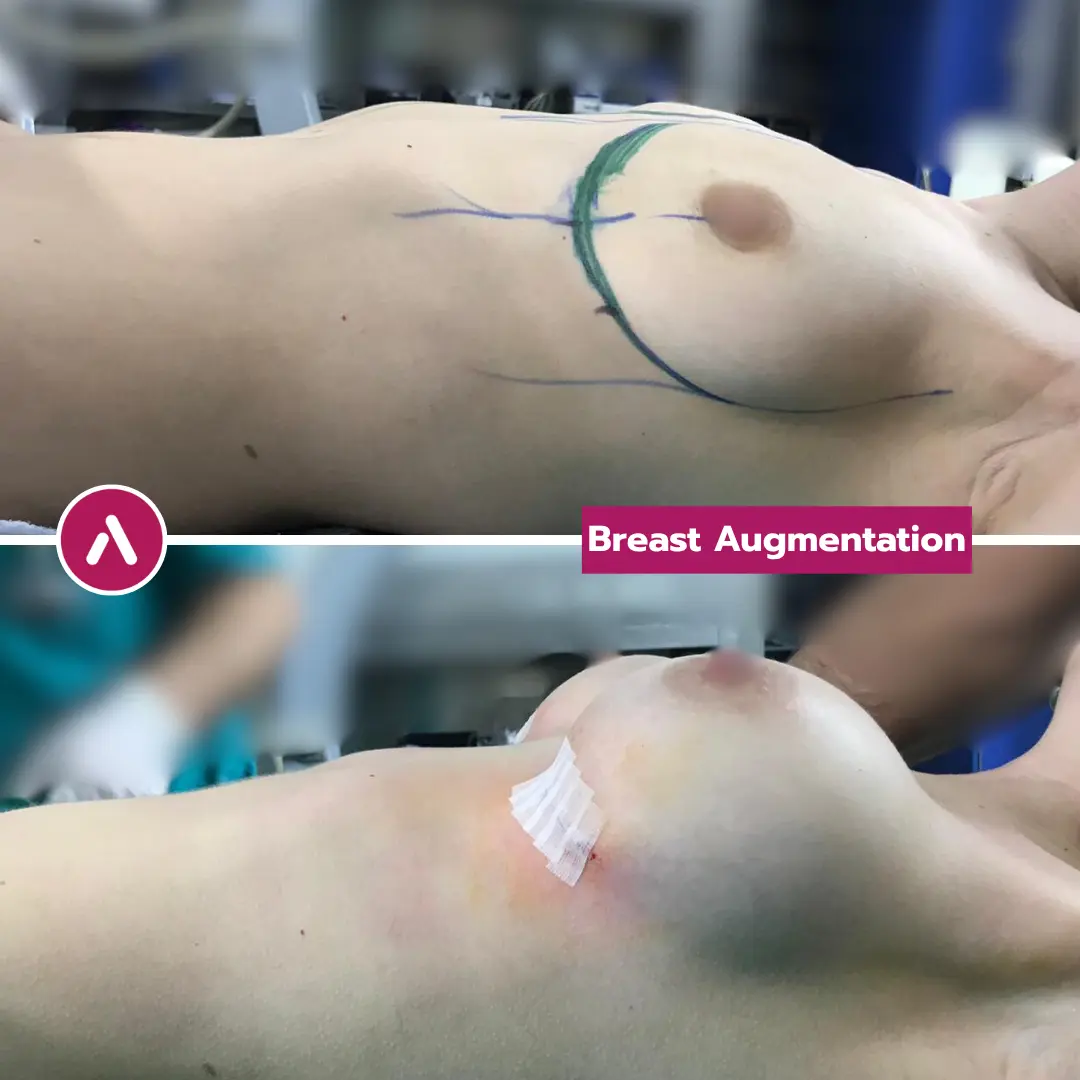
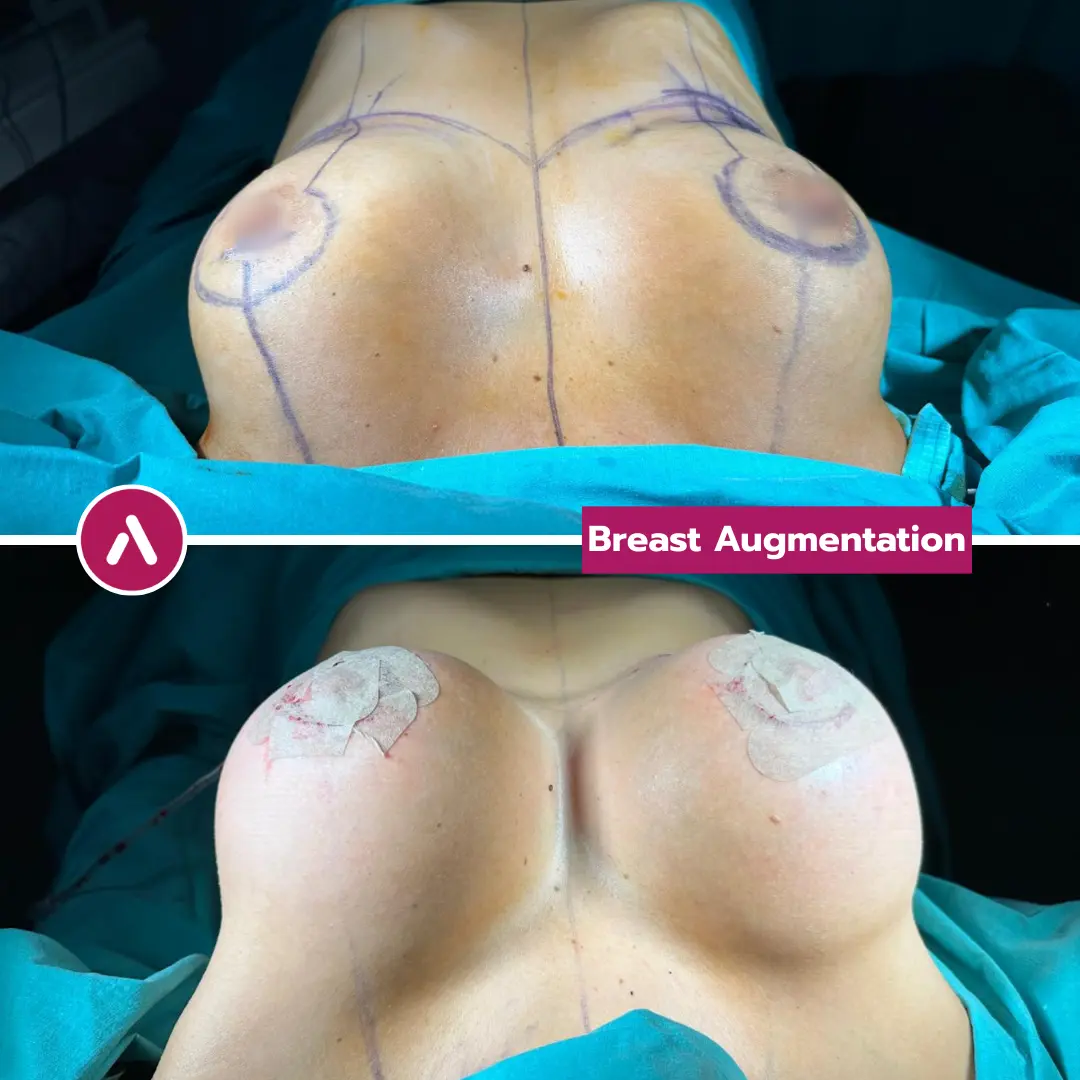
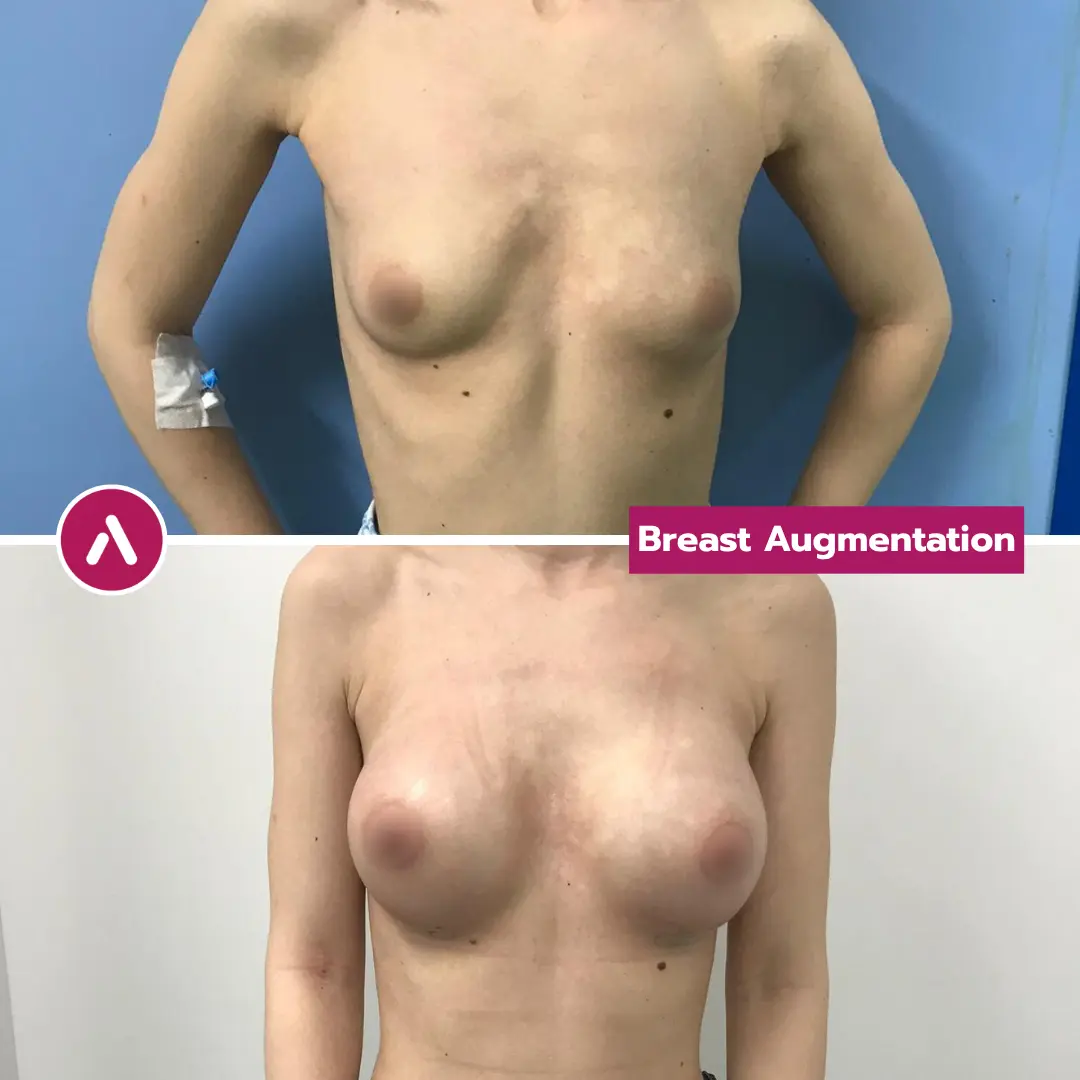
That distinction matters. A good breast lift should not look tight, artificial or “operated-on”. It should create a stable, natural-looking breast shape that ages as gracefully as possible. At AKM, the goal of breast uplift mastopexy in Turkey is not to chase a frozen result, but to plan a lift that suits your tissue, weight, skin quality and long-term life plans.
For UK patients comparing local private surgery with treatment abroad, the question should not be “How do I get the highest lift possible?” A better question is: “How do I time and plan this operation so the result still looks natural years from now?”
Table of Contents
How Long Does a Breast Lift Last?
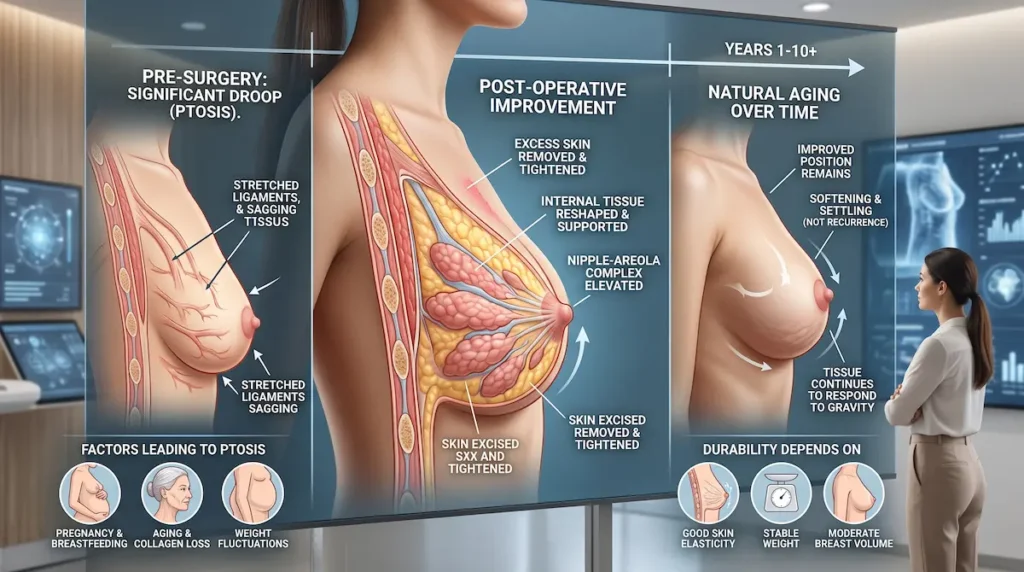
A breast lift usually lasts for many years, but no surgeon can promise that the breast will stay in the same position forever. The operation removes excess skin, reshapes the breast tissue and lifts the nipple-areola complex, but the lifted breast continues to respond to gravity, hormones, skin elasticity and body-weight changes.
The honest answer: years, not forever
Many patients keep a meaningful improvement for a decade or longer, especially when they have good skin quality, a stable weight and moderate breast volume. Some patients notice softening or a small degree of settling earlier. Others hold their shape for longer than expected. The difference is not luck alone. It is anatomy.
Think of a breast lift as resetting the breast to a better position, not freezing it in place. The breast sits higher after surgery because the skin envelope is tightened and the internal breast shape is reorganised. Over time, that envelope is still exposed to stretch. That is why “lasting” means the result remains improved compared with where you started, even though natural changes continue.
This is also why a responsible surgeon avoids promising a fixed number of years. A patient with smaller, lighter breasts and firm skin may maintain upper-pole shape differently from someone with heavier breasts, thinner skin or major weight fluctuations. Same operation. Different tissue behaviour.
Why it is long-lasting but not permanent
A breast lift corrects breast ptosis, which means drooping or a lower nipple position. It does this by removing loose skin and reshaping the tissue. It does not recreate the original fibrous support system of the breast exactly as it was in youth. BAAPS explains that breast drooping is linked to stretched skin and fibrous ligaments after ageing, pregnancy, breastfeeding and weight loss. That is the biological reason results can change again later.
There is also a difference between early settling and true recurrence. In the first few months, breasts may look slightly high or tight. As swelling settles and tissues relax, the shape becomes softer. That early drop is expected. It is not the same as the breast “falling” back to its old position.
True recurrent ptosis happens when the breast gradually descends again over years. This can be mild, moderate or significant. A peer-reviewed systematic review on how long breast lift results last notes that long-term stability depends heavily on technique and the way breast tissue is supported, but patient factors still matter.
What “lasting” really means after a breast uplift
Patients often expect a simple answer: five years, ten years, fifteen years. Real life is less tidy. A better way to judge longevity is to ask three questions.
- Is the nipple still in a better position than before surgery?
- Does the breast still have a more supported shape in a bra and out of one?
- Has the lower breast stretched again enough to bother you?
If the answer to the first two questions is yes, the lift is still doing its job, even if the breast has softened with time. A natural breast should not look fixed. Some movement, softness and settling are part of a realistic result.
This is especially important for patients who want a visible change, and for patients who want the anatomy to make sense before deciding. The best result is not the most dramatic lift on day one. It is the lift that still looks proportionate, comfortable and believable years later.
Surgeon-led perspective: The longest-lasting breast uplift is usually planned around stable weight, completed family plans where possible, careful tissue handling and realistic internal support. The aim is not to fight ageing completely; it is to create a breast shape that ages better from a stronger starting point.
Am I a Suitable Candidate for a Breast Uplift (Mastopexy)?
Answer a few brief questions about your concerns, health, and goals to discover which treatment options may suit you best.
What Affects How Long It Lasts?
Breast lift longevity is not determined by surgery alone. The operation sets the structure, but your skin, tissue quality, breast weight and lifestyle shape the years that follow. This is why two patients can have the same mastopexy pattern and very different long-term outcomes.
Skin quality and tissue support
Skin quality is one of the biggest predictors of how long a breast lift holds. Firm, elastic skin tends to grip the new shape better. Thin, sun-damaged or heavily stretched skin may relax sooner. Stretch marks can also suggest that the skin has already lost some of its recoil.
This does not mean patients with thinner skin cannot benefit from surgery. It means the plan must be more realistic. Your surgeon may discuss incision pattern, tissue rearrangement, nipple position and whether internal support is needed to reduce the risk of early bottoming-out or recurrent droop.
Breast tissue itself also matters. Some breasts are dense and glandular. Others are softer, fattier or deflated after weight loss or pregnancy. Softer tissue can be harder to hold in a high position long term, especially if the breast is large or the skin envelope has been stretched for years.
Gravity, breast size and breast weight
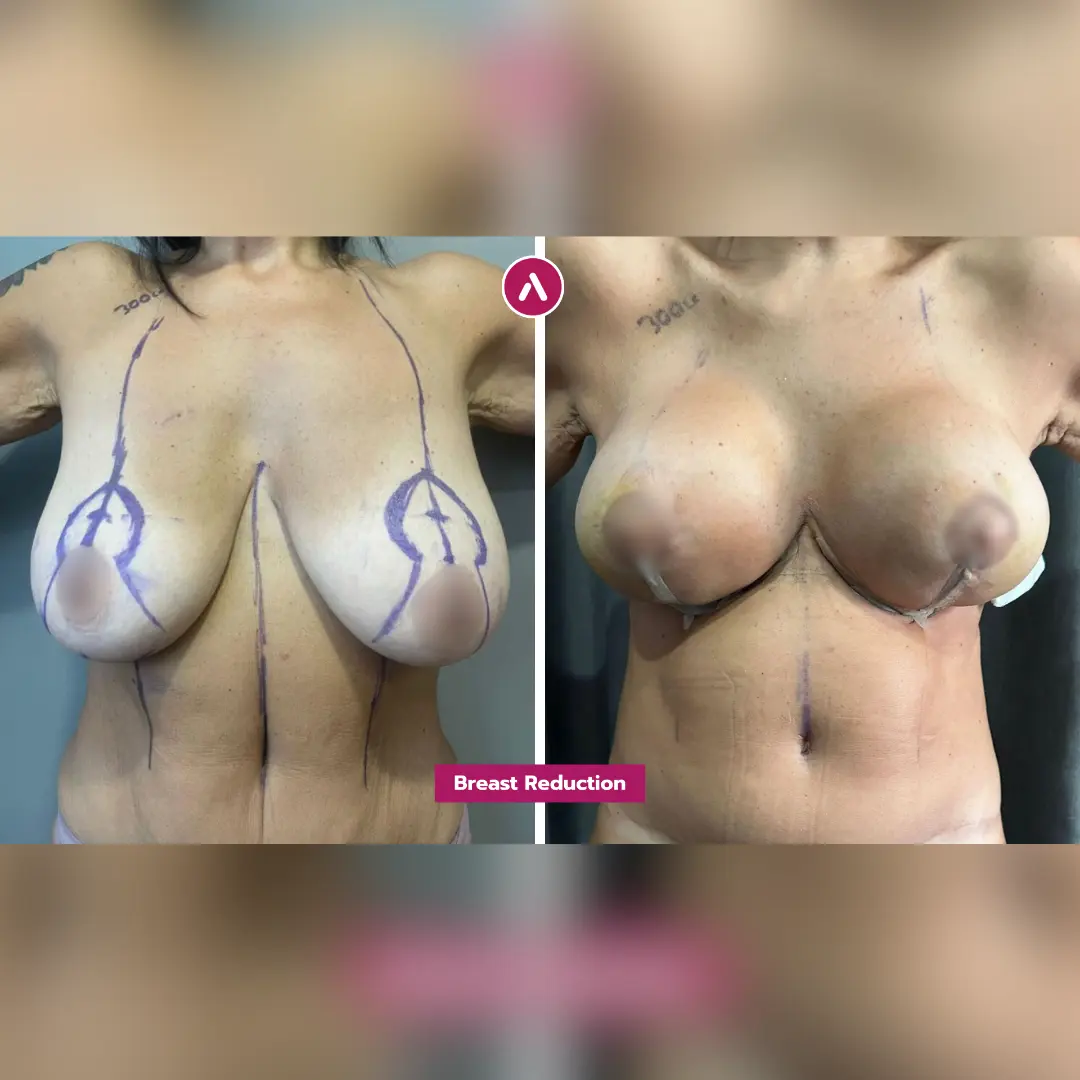
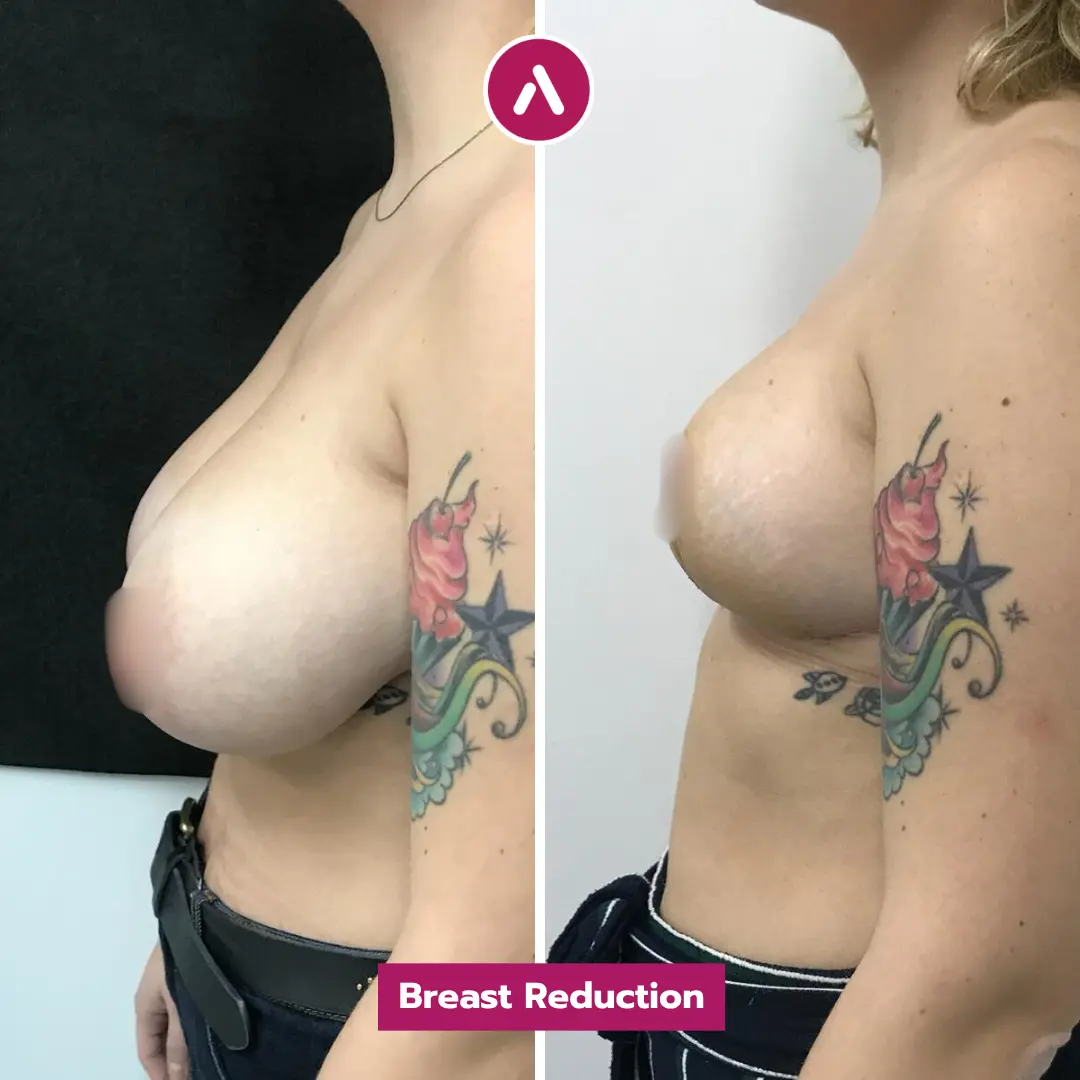
Gravity is constant. Heavier breasts place more downward force on the skin and internal support structures. This is why BAAPS notes that breast uplift results may not last as long with heavy breasts. A lift can raise and reshape the breast, but if the breast remains heavy, the tissues continue to carry that load every day.
This is also where expectation-setting is essential. A patient with large, heavy breasts may want a lift only, but may also need to understand whether some reduction would improve comfort and longevity. That decision belongs in consultation; this article is focused on longevity, not a full procedure comparison.
For patients with unusual or constricted breast shape, underlying anatomy can also affect long-term stability. If breast shape has always been narrow, tubular or uneven, it is worth discussing how that underlying shape may affect the result before assuming a standard uplift will behave the same way on every body.
Natural ageing over time
Ageing affects collagen, skin thickness, breast volume and the position of the nipple-areola complex. Even without pregnancy or weight change, the breast can slowly soften and descend over time. That does not mean the surgery has failed. It means the lifted breast is ageing naturally.
There is a practical way to think about it. A breast lift moves the clock back; it does not stop the clock. If your breasts would have continued to drop without surgery, a well-planned lift may keep them in a better position for many years, even as normal ageing continues.
Non-surgical options can sometimes give a mild temporary tightening effect, but they do not remove excess skin or reposition the nipple.
Pregnancy and Weight Changes
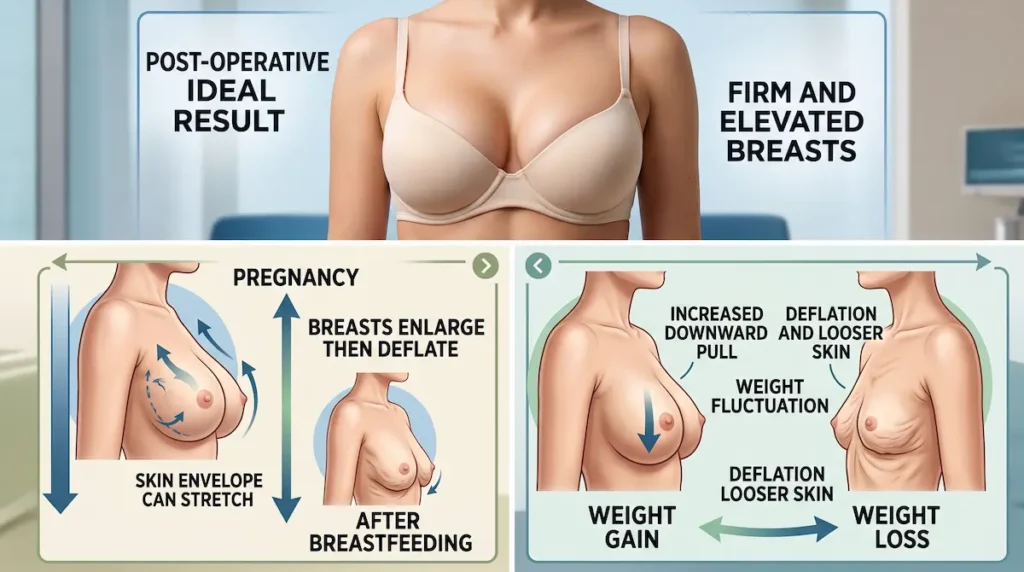
Pregnancy, breastfeeding and weight fluctuation are among the most common reasons a breast lift result changes earlier than expected. This does not mean a breast uplift is fragile. It means the breast is hormonally responsive tissue, and any major change in breast volume can stretch the skin envelope again.
Why pregnancy can stretch the result
During pregnancy, the breasts often enlarge as glandular tissue changes and the body prepares for breastfeeding. After pregnancy or breastfeeding, that volume may reduce again. The skin does not always shrink back to the same degree. This is one reason some women notice new drooping after having children, even if their uplift was well performed.
For that reason, many surgeons advise waiting until you have completed your family, especially if pregnancy is likely within the next year or two. This is not a strict rule for every patient. It is a timing discussion. If your symptoms or emotional concerns are significant, surgery before children may still be considered, but you should understand the trade-off.
UK patients sometimes ask whether pregnancy will “ruin” a breast lift. That word is too strong. Pregnancy may reduce the longevity of the result, but it does not automatically erase every improvement. The amount of change depends on how much your breasts enlarge, whether you breastfeed, how your skin responds and whether your weight remains stable afterwards.
How weight gain or weight loss affects breast position
Breasts contain glandular tissue, fat and connective support. If you gain weight, the breasts may become heavier, placing more pull on the skin. If you lose a significant amount of weight, the breasts may deflate, leaving looser skin and less internal fullness. Both directions can affect the lift.
Small weight changes are usually manageable. Large changes are different. A patient who has a breast uplift and then loses a substantial amount of weight may see the breast sit lower or look flatter than intended. A patient who gains weight may see the lower pole stretch again.
This is why stable weight matters. It is not about reaching a perfect number. It is about having a weight you can realistically maintain. If you are still actively losing weight, it may be better to wait until your body has settled before planning surgery.
Timing surgery around family plans and stable weight
The best timing is personal, but there are sensible principles. A breast lift tends to be more predictable when your weight has been stable for several months and when you do not expect major breast-size changes soon. If you are planning pregnancy, breastfeeding or major weight loss, raise this early in your consultation.
A good consultation should not pressure you into an operation date. It should help you decide whether now is the right time. The NHS advises patients considering cosmetic surgery to ask how long results are expected to last and what aftercare will be available. That is especially relevant if you are travelling abroad for surgery.
At AKM, UK patients are guided through timing, travel planning and long-term follow-up before deciding. The surgery itself is performed in Istanbul, with virtual follow-up after return home. For breast procedures, planning is handled by a board-certified plastic surgery team rather than by a sales-led coordinator.
| Longevity factor | How it can affect your breast lift | What you can do |
|---|---|---|
| Pregnancy | Can enlarge and then deflate the breasts, stretching the skin again | Consider waiting until family plans are complete where possible |
| Breastfeeding | May contribute to volume changes after pregnancy | Discuss timing, nipple position and future plans in consultation |
| Weight gain | Can make the breasts heavier and increase downward pull | Maintain a realistic, stable weight after surgery |
| Weight loss | Can reduce breast fullness and create new looseness | Complete major weight loss before planning a lift |
| Skin quality | Less elastic skin may stretch again sooner | Use supportive bras, protect skin from sun damage and avoid smoking |
| Breast size and weight | Heavier breasts place more strain on the lifted shape | Ask whether lift-only, reduction or another plan best suits your anatomy |
Experience a Seamless Breast Uplift (Mastopexy) Journey
From VIP airport transfers to 5-star hotel accommodation, we manage every detail. Enjoy a premier medical travel experience in Istanbul.
Can You Make It Last Longer?
You cannot stop ageing, but you can protect your breast lift result. Longevity comes from three places: good surgical planning, stable body changes and realistic aftercare. None of these requires perfection. They require consistency.
Stable weight and supportive bras
A stable weight is one of the simplest ways to preserve a breast uplift. Repeated cycles of weight gain and loss stretch and deflate the breast envelope. Over time, that can weaken the support created during surgery.
Supportive bras also matter, especially for patients with medium or larger breasts. A bra will not “hold” the surgical result in place permanently, but it can reduce day-to-day strain on the skin and breast tissue. This is most important during exercise, when breast movement is greater.
After surgery, your surgeon will usually recommend a post-operative support bra for the early healing period. Later, the goal is not to wear medical compression forever. It is to choose bras that support your new shape comfortably, without digging into fresh scars or pulling the breasts downward.
Technique and internal support
Surgical technique affects how long the lift holds. A skin-only approach relies mainly on tightened skin, which can stretch again. Modern mastopexy planning often focuses on reshaping and supporting the breast tissue itself, not just removing loose skin.
Some techniques use internal sutures or tissue rearrangement to improve lower-pole support. The exact method depends on the patient’s breast shape, degree of ptosis, tissue quality and whether implants are involved. This is not something to choose from a menu. It is an anatomical decision.
Research on why breasts can sag again over time highlights the role of tissue support and recurrent ptosis. In plain English, if the internal support system weakens again, the breast can descend again. That is why planning the lift around tissue strength matters.
For patients who want upper-pole fullness but do not want implants, the planning discussion is different. Our guide to lipofilling the breast without implants explains the fat-transfer option; this article stays focused on longevity.
Realistic maintenance without overpromising
There is no cream, exercise plan or non-surgical device that can make a surgical breast lift last forever. Chest exercises can improve the pectoral muscles underneath the breast, but they cannot tighten stretched breast skin or lift the nipple. Skin treatments may improve texture, not breast position.
What helps most is practical: avoid smoking, maintain a stable weight, wear supportive bras and attend follow-up reviews. Sun protection can also help scar quality where scars are exposed, although most breast lift scars are usually covered by clothing or swimwear.
This is where responsible expectation-setting matters. A clinic should not sell maintenance as a guarantee. A better promise is process-based: careful planning, safe technique, clear aftercare and long-term review points. Results still vary because patients’ bodies vary.
AKM’s philosophy is natural-first. In breast surgery, that means planning a lift that improves shape without creating an over-tightened look that fights the body. The aim is a result that feels proportionate now and still makes sense as the body changes.
Will You Need a Second Lift?
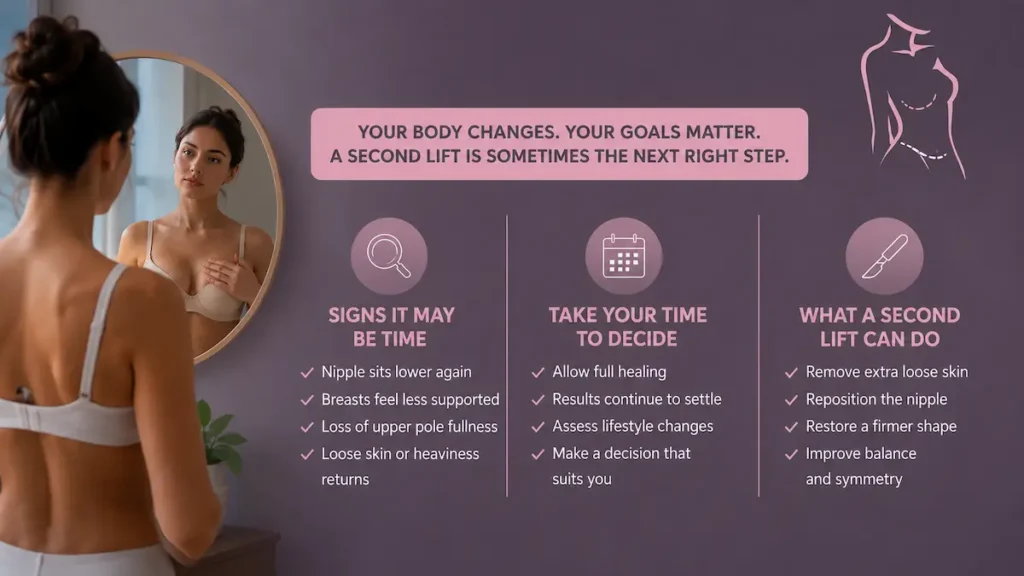
Some patients eventually choose a second breast lift, but not everyone needs one. A repeat lift is usually considered when recurrent drooping becomes visible enough to bother the patient, or when life changes such as pregnancy, weight loss or ageing have altered the breast shape again. This decision should be based on anatomy and timing, not panic over normal settling.
Signs of recurrent ptosis
Recurrent ptosis means the breast has dropped again after surgery. It may show as the nipple sitting lower than desired, the lower breast fold looking heavier, or the breast appearing flatter in the upper pole. Mild softening is normal. A clear return of drooping is different.
One useful sign is the nipple position relative to the breast crease. If the nipple remains above or close to the crease, the lift may still be holding reasonably well. If the nipple drops below the crease again, recurrent ptosis may be more significant. This is only a guide; a surgeon needs to assess it properly.
Breast asymmetry can also become more noticeable over time. Natural ageing rarely affects both breasts in exactly the same way. If one side has always been larger, softer or lower, it may settle differently after surgery. If this is a concern, mention it at consultation so the surgeon can assess each side separately.
Revision versus waiting
A second lift should not be rushed. In the first year, the breasts are still settling, scars are maturing and swelling is resolving. Judging the final result too early can lead to unnecessary worry. Most surgeons prefer to wait until healing is complete before considering revision unless there is a genuine complication.
Years later, the decision is more personal. Some patients are happy with a softer, natural breast shape and do not want further surgery. Others feel the breast has dropped enough that their original concern has returned. Neither response is wrong.
A responsible consultation will look at the cause of the change. Has the skin stretched? Has breast volume changed? Has weight shifted? Is the nipple low, or is the breast simply softer than it was at first? These questions determine whether a revision lift, a different breast procedure or no surgery is the right answer.
What a repeat lift may involve
A repeat lift may remove additional stretched skin, refine the nipple position and reshape the lower breast again. It may also need to work with existing scars. The pattern depends on your previous surgery, current breast position, tissue quality and future goals.
This is also the point where cost questions often arise. Because pricing depends on the technique, revision needs and whether other procedures are combined, this article will not open a price table. You can review breast lift costs compared with the UK separately.
For UK patients, the key is not only the operation itself. It is the follow-up plan. Before travelling, ask how you will be reviewed before you fly home, who you contact after returning to the UK, what photos are needed for virtual follow-up and what happens if you have concerns months later.
AKM’s all-inclusive patient journey includes virtual consultation, treatment planning, surgery in Istanbul, hotel-based recovery support and longer-term virtual follow-up at 1, 3, 6 and 12 months. The article is not a substitute for consultation, but it should help you ask better questions.
Ask AKM how to time your breast lift so results last as long as possible, especially if pregnancy, weight change, asymmetry or revision risk is part of your decision.
Frequently Asked Questions: How Long Does a Breast Lift Last?
These answers address the most common UK patient questions about breast lift longevity. They are designed to give clear expectations before consultation, not to replace a personalised surgical assessment.
How long does a breast lift last?
Do breast lifts last forever?
Will pregnancy ruin my breast lift?
Can a breast lift be redone?
Does weight loss affect a breast lift?
How can I make breast lift results last longer?
Have Specific Questions About Breast Uplift (Mastopexy)?
Speak directly with our dedicated patient coordinators regarding Breast Uplift (Mastopexy). Receive instant guidance and personalised support.
Medical Disclaimer: This article is for general information only and is not medical advice, diagnosis or a personalised treatment plan. Breast lift results vary between patients. Always consult a qualified surgeon who can assess your anatomy, health history, tissue quality, goals and suitability for surgery.
Related Treatments

Awake Breast Lift in Turkey
Awake breast lift (mastopexy) under local anaesthesia with optional twilight sedation. Technique-led planning for ptosis grades, recovery week-by-week, and safety. Premium UK-to-Istanbul pathway with HBOT and LLLT aftercare support.
Awake Breast Augmentation in Turkey
Awake breast augmentation under local anaesthesia with conscious (twilight) sedation. Suitability, recovery, UK-to-Istanbul care and clear GBP pricing.

Awake Mummy Makeover in Turkey
UK-focused guide to an awake mummy makeover using tumescent local anaesthesia with optional conscious sedation. Explore tummy tuck, liposuction and breast options, recovery timelines and costs in GBP.

Awake Tummy Tuck in Turkey
UK guide to Awake Tummy Tuck under twilight sedation at AKM Clinic, Istanbul—techniques, combinations, recovery timeline, risks, aftercare and GBP planning.
Ready to Begin Your Own Transformation Journey?
Join the 2,000+ patients who have trusted Dr Akif Mehmetoğlu and the AKM Clinic team. Your journey to a more confident, naturally restored you begins with a simple, no-obligation conversation. Contact us today from the UK for your free virtual consultation.
#1: Get Your Free Personalised Quote
Start with a free, no-obligation online consultation. Share your photos, and our surgical team will provide a fully personalised treatment plan and a transparent, all-inclusive price package. There are no hidden fees.
#2: Secure Your Date & VIP Booking
Once you are ready, our dedicated patient coordinators will help you secure your procedure date. We will handle all your bookings, including your 5-star hotel accommodation and private VIP airport transfers.
#3: Arrive in Istanbul & Meet Your Surgeon
Arrive at Istanbul Airport (IST) and be greeted by your private driver. Settle into your hotel and prepare for your in-person consultation, where you will meet your specialist surgeon to finalise the details for your "natural, subtle, and restored" new look.